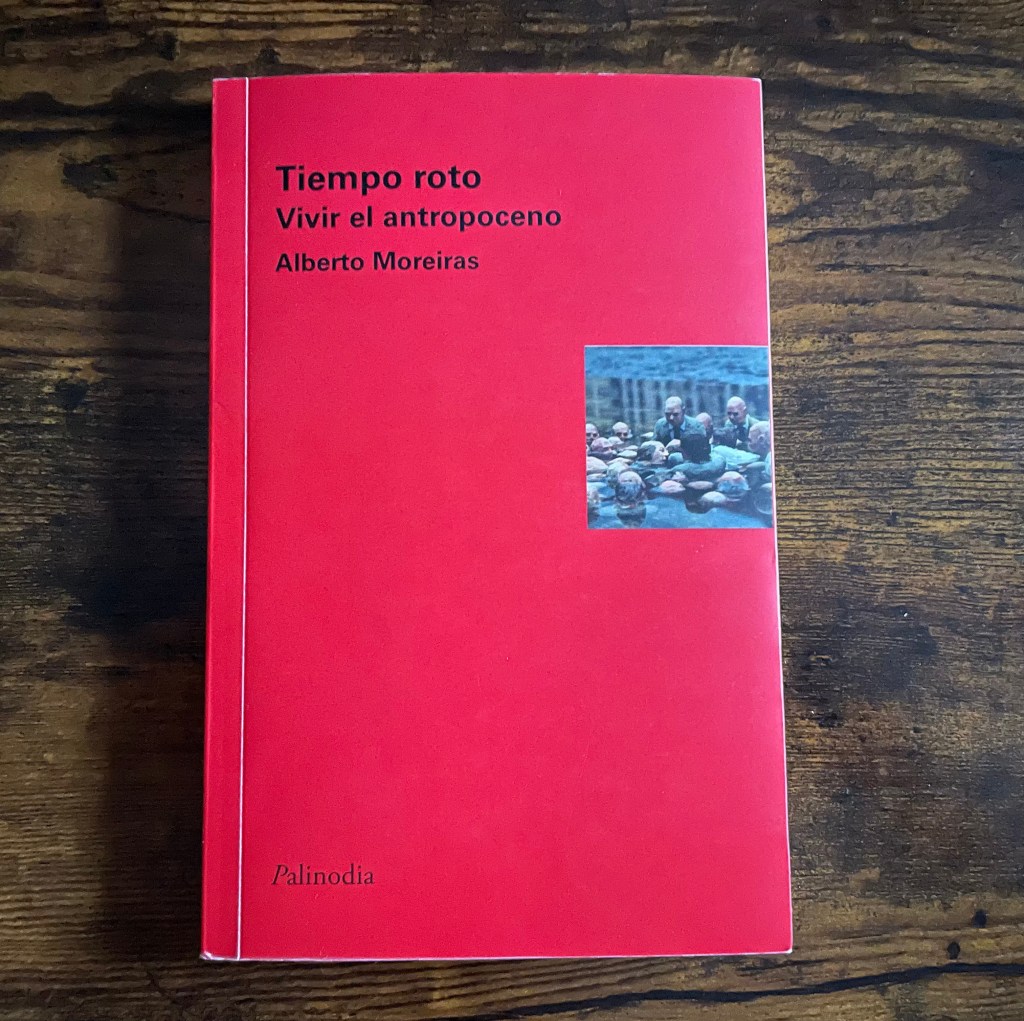
The task of the other beginning. On Alberto Moreiras’ Tiempo roto: vivir el antropoceno (2024). by Gerardo Muñoz

The sudden and uninvited intrusion of Gaia in our world is something rather strange, and yet consistent with the closure of the metaphysical tradition. The call of the outside takes place at the threshold of our reflexive capacities, habits, and mental propositions in our relation with the world, which demands everything to be thought from scratch. The historical imbalance in groundlessness now requires a new task for thinking – the imperative that runs through Alberto Moreiras’ most recent book Tiempo roto: vivir el antropoceno (Palinodia, 2024). The theoretical constellation deployed over the course of a decade now comes to the forefront with extreme urgency – I am referring to marranismo, posthegemony, aprincipial anarchy, and of course, infrapolitics. Tiempo roto (2024) is not a systematic culmination of Moreiras’ philosophical (or antiphilosophical) project of thought, but it is definitely a mature elaboration insofar as the field of problematization enters a hitherto unexplored thematics of late heideggerianism. All things considered, the emerge of the anthropocene as an explicit planetary endgame and the new beginning necessarily move pass the conditions of both political and scientific praxis, which today can only effectively adequate itself into positionality (the so-called Gestell) and objectivity of a world that slowly seems coming to its end. 

It might be worth remembering that the notion of “other beginning” (“otro comienzo”) in the wake of civilizational decline was already proposed in the book Sosiego siniestro (2020), but it was far from being thoroughly explained [1]. Following Heidegger’s philosophical scene, representational thought in the tradition of adequatio of the Thomist gnoseology coincides with technological administration of every living entity (Moreiras 14). But Heidegger’s suggestion in the Parmenides that calculative representation fails as grasping the essence of the polis might also have its own limitations, insofar Gaia appeals to an excess beyond or below the politics. As Jacques Camatte also understood it, the civilizational invariant of revolutionary breakthrough departing from the historical subject of the working class can seldomly do the work except as an article of faith in the myth of the autonomy of the proletariat within real subsumption. This means that we are in the terrain of infrapolitics or the chora, which point to ontic regions of thought towards a new beginning at the end of principial metaphysics. But the other beginning can only emerge within conditions of transforming existence against the closure of political technicity. 

I do not desire to reconstruct here all the refined analytical movements that lay out the transformation of existence in Tiempo roto (2025), but there is a maxim from Pindar’s Third Pythian Ode that stands out as an emblem for the appropriation of the non-humanity of the world. Moreiras cites Pindar’s “me, phila psycha, bion athanato speude, tan d’emprakton, antlie makanan”, which can roughly be translated as “do not seek, dear soul, immortal life, but do try to carry out the fullest the use of the possible” (Moreiras 61). Moreiras correctly notes that the ultimate difficulty lies in the “emprakton makanan”, or the use of the possible, which metaphysical Humanism and effective general equivalent can only exacerbate towards the planetary production and extractive valorization. The corruption of the use of the possible is the realization of hybris, and in this sense all representational humanism is always already a form of self-deification and induced hallucination, even when it tries to claim to engage in the opposite in relation to nature (Moreiras 65). Moreiras suggests that the pindaric maxim discloses a second relation of the “use of possibles” that does constitute a lacuna  in the metaphysical tradition, and that is understanding a praxis tied to sophrosyne or phronesis that abides to the prudent inclination of the non-human (“es una actividad sometida a la vergüenza de lo in-humano”) (Moreiras 65). Giorgio Agamben’s defense an ontology of possibility against the hegemony of metaphysical realization and representation also comes to mind, although Moreiras might not feel at ease at explicitly calling for a positive ontology nourished in the waters of a transfigured metaphysics of the tradition of scholastic Averroism [2]. Although both Moreiras and Agamben come at their closest proximity in terms of the notion of the chora – and more directly the space of the chora against the primacy of the polis – which serves the ontic condition for the non-spatial surfacing of the abode or region that is necessarily infrapolitical, because it’s never determined by distributionist political isonomia or meson (Moreiras 73). 

There are important nuances here to say the least: whereas for Agamben the notion of chora appeals to the gods of place (theos aisthetos), and thus a dejointed form of divinization decoupled from the legitimacy of every politico-theological archein; for Moreiras, the chora is a praxis of thought towards desecularization that lacks theology, and thus capable of exceeding the onto-theological reduction (Moreiras 74). But Moreiras says about the tendency towards nihilism of “possibility” in the historical dispensation of positionality (Gestell) could also be said about ‘de-secularization’, as the ultimate consequence of the decay of political legitimation in Ernst Bockenforde’s famous formulation. This might not be the space nor the moment to reach a verdict between Moreiras and Agamben’s position regarding the very complicated problem of the Platonic site of the sensible, since what is presented to the reader as a ‘phenomenology of excess’ or the inapparent (something merely alluded in the Zahringer seminar), might be the condition of an atopic mediation that prepares – or that has always prepared since the times of Orphic myths – the tonality of a coming philosophy under the sign of transformative thought (Moreiras 110) [3]. 

The dispensation of the Gestell open up and also step back (a folded movement that does not have a declension into a synthesis) into the genesis of the beginning (Moreiras 115). And the anthropocentric epochal dispensation, says Moreiras, is no longer the site of the polis, but “the planet as a the historical site of humanity, although we are still unaware of it (“aunque sigamos desconociéndolo”) (Moreiras 116). This uncanny phenomenology of the primary, traversed by the discharge of the entstehung, is the infrapolitical site par excellence, because it is in the atopic region where destiny is both affirmed and displaced. This is why, as Moreiras recalls Heidegger saying, the dialogue with Parmenides never exhausts itself, and yet it prepares a destiny (Moreiras 134). I take this to mean that there is an experience of the transfiguration of language for the emergence of an “ethics” (ethos), but this might be beyond Moreiras preliminary conditions for an existential breakthrough; that is, something possible further along the path.

Tiempo roto (2024) closes with a couple of undeveloped pages that take Massimo Cacciari’s old essay “Confrontation with Heidegger” (1977), in which the Italian philosopher makes a plea for a direct confrontation with Heidegger and Nietzsche’s teachings on nihilism and the closure of metaphysics if there would still be any hope for the composition of the working class during the stage of anthropomorphized dimension of capital defined by Jacques Camatte also during those years. But much has changed since the hot Italian summer of 1977 and the formulaic conjunction of  “left Heideggerianism” might not do the work anymore, as if the totality of materialist political economy could be amended by a radicalization of the historical question and the ontological difference. Political economy plus metaphysical critique is still relying on a conception of the political as a technique, which today has transformed into what some have called the “new regime of ecological accumulation” as mere stabilization of green ecological spheres of life [4]. 

But there is  a second register to Cacciari’s programmatic thesis that remains open. And these might be Moreiras’ most important words in the concluding part of the book: “Espero haber mostrado que Hiedegger señala la posibilidad de dejar atrás la explotación y el consumo en la era del Antropoceno a través de una comprensión alotrópica de nuestra relación con el mundo. Por lo tanto, vivir en el Antropoceno debe basarse en el abandono o desplazamiento de la metafísica como modo dominante de aprehensión del mundo en la actualidad” (Moreiras 151-152). Marx’s materialist dialectic through the critique of political economy – even as a destitution of political economy through its own vectorization – might be insufficient to face the unprogrammed presence posed by planetary anthropocene. 

Perhaps we can still repeat Dionys Mascolo’s words that the coming communism will owe more to Hölderlin than than Marx, not because of an idealist dispute over concepts, but rather because of what Cacciari called in his essay, also citing the German poet, the historical “affinity of conditions” [5]. And in the age of the Anthropocene and positionality, those conditions are kept in the pattern of economic decline or stagnation in which the law of rate of profit encounters its own limit, folded unto the ongoing destruction of the life forms in the world. The allotropic praxis endorsed by Moreiras finds traction in Hölderlin’s poetic dwelling in language at the heart of decline so that something other might emerge within and beyond life, from Gaia to Ctonia. This is the most difficult task to depart from, but it is also the path that saves from the current inhabitable passage of the Earth. 

Notes 

1. Alberto Moreiras, Sosiego siniestro (Guillermo Escolar, 2020), 24.

2. Giorgio Agamben. L’irrealizzabile: Per una politica dell’ontologia (Einaudi, 2022), 112-146. Kindle Edition.

3. For more on orphism and the limits of the site of the Greek polis, see Gianni Carchia’s Orfismo e tragedia (Quodlibet, 2019), epilogue by Julien Coupat. 

4. Gerardo Muñoz & Zeit der Ökologie. “On the New Regime of Accumulation”, Endnotes 2024: https://endnotes.org.uk/posts/on-the-new-ecological-regime-of-accumulation 

5. Massimo Cacciari. “Confronto con Heidegger”, in Pensiero negativo e razionalizzazione (Marsilio, 1977).

The world has been posthegemonic. by Gerardo Muñoz

In a recent text published at Verso Blog, entitled “The Coming Post-Hegemonic World”, Michael Hardt and Sandro Mezzadra make a case for a “turn to a post-hegemonic model” that will challenge the consensus of global in the coming era. In many ways, this era is already here with its diverse and multifaceted (in terms of intensities, forces, and leverages) of protracted and bizarre nationalisms, which as Jamie Merchant has teased out brilliantly, amount to desperate attempts to offer a belated response to the decline of growth as one more stage for containing rampant processes of accumulation via state capacities. For Hardt & Mezzadra, this “posthegemonic world to come” is characterized by a global spatial reconfiguration of capital – accommodating the logistics of regional spaces of influences and exchange across the planet – and on the other, an increasingly “domestic sphere of authoritarian rule” promoted by new accelerated initiatives at generating social homogeneity in the wake of rushing fragmentation hand in hand with a war regime that has utterly scrapped ideals about “strategic autonomy” in order to trumpet an arm race (nuclear weapons included), as it is currently unfolding in Europe. 

One can claim that this posthegemonic world is one that firmly assumes the consequences of two interdependent vectors that imploded within the project of political modernity: the end of  economic growth (thus validating the law of the fall of profit outlined in Capital V.III), and the liquidation of the principle of legitimacy that for two centuries accommodated the legislative sources of the state authority in democratic constituent power. For Hardt & Mezzadra posthegemony means global fragmentation, authoritarianism, and spatial remaking; however, one should also say that it means, the opening towards stagnation, the collapse of political unity of the state, and most recently the total discredit of the foolish leftist hypothesis that promoted a “rainbow social equivalent coalitions” to push for compensatory, and in every instance insufficient and moribound, populist resurgences elevated through the combustion of ethereal but effective rhetoric (in fact, my argument in a new short book, La fisura posthegemónica, is that the push for political hegemony of the last decades only cosigned forms of consensual totalization at the expense of the production of subalternization and social death).  

Even taken as a descriptive and normative condition of the current state of Western politics, the posthegemonic situation lays bare the reciprocal impasse of the claim of its opposition: in other words, one should also put to rest social mobilization that characterized the politics of High Modernity, since ultimately movements (and total mobilization as an apparatus of social energy transfer) presupposes that “every social structure, that it can receive what form required the needs of the political adventure…total mobilization signifies nothing other that the effort to reduce the social substance to a kind of plastic”, as Gérard Granel once defined it. Hence when Hardt & Mezzadra claim that the “effective rebellion must be rooted in social movements envisioning a life beyond the rule of capital”, they are inadvertently refusing to come to terms with the factical posthegemonic reality that they are describing, which is no longer driven by expansive economic growth, but rather by stagnation, and inoperativity at planetary scale that is maintained through the a global veneer of production into regimes of competitive accumulation (of territory, contractual debt, fiscal regulation, executive taxation or tariffs, and increasing arbitrary monetary regulations in the global system) for marginal profitability, as Paul Mattick argues in his recent The Return of Inflation (2023). 

This means that there is no outlook towards ‘social mobilization’ that does not serve the subjective productivity of real subsumption, since its ultimate goal is to anaxate social energy into the force of (un)productive labor. This form of dilatant mobilization can only serve the master of illusionary hegemony, and thus promote functional and unwarranted servitude everywhere. Indeed, only a reprobate can be immune to the moralist or the realist conditions of hegemony. If push comes to shove, the posthegemonic factical world of stagnation and political fragmentation already here proves that the ongoing irruption of non-movements are irreducible to the modern movement’s energy; and that life never fully coincides with political claim to rule and legitimacy, even less so in the becoming-world of Production. 

Ultimately, this posthegemonic fissure outlives the crumbling hegemonic world of principial High Modernism and no ‘international movement’ can piece it back together again. We are all posthegemonic now, but only if one takes up this predicament seriously and candidly.

War and stagnation. by Gerardo Muñoz

The global stock market crash this past Monday over fear of a forthcoming US recession has rendered materially visible the long economic stagnation across the large market economies. Those that feel content with the “not yet” moment of a strong AI financial bubble see it as an interphase of ongoing transformations on the domain of artificial intelligence. The interphase hypothesis, however, prefers to ignore that the expansion of AI will only plunge even deeper the condition of stagnation and the end of human labor. 

In this scenario, it has been interesting to see one segment of the stock market that has stood the test of the global crash; mainly, the defense giant Lockheed Martin, whose stocks S&P stood firmly at 55% and its profit has seen about 21% growth compared to a year ago and expecting revenues as high as 71 billions at the closing of this year. In fact, according to Frank St John, chief operating officer at Lookhead Martin, “the company will not slow its production rate. St John said it would “probably take three or four quarters to work our way through the backlog of jets that need to be delivered”. The active war zones in Eastern Europe have only intensified the production growth of the military economy. 

From a historical perspective there is nothing new here, and it is “business as usual”. In fact, the great German war economic theorist of the Weimar Republic, Adolf Caspary, who also authored the book Wirtschaftsstrategie Und Kriegsführung (1932), entitled as piece in the Esquire, March of 1944, entitled “War is a Business, as Usual”, where he claimed that historically “though the expenditure of war have become larger, the risk is smaller, for manpower, industrial resources and wealth decide the war – if they are mobilized”. Of course, Caspary’s historical conditions were one of ‘total mobilization’, as famously theorized by Jünger; whereas ours is one of demobilization, stagnation, and polycrises. The partial mobilization of military industries is, at best, a symptom of the epochal demobilization and paralysis. 

There is also something like an inversion of the causal relationship between wealth and hostilities: if for Caspary in the 1930s it was the effective management of wealth what could lead a nation to win a war, in our times it is the production of multiple wars and catastrophes what need to be organized in order to maintain the still too illusory, and thus compensatory, state of productive economic growth. This is also why military giants like Lockheed Martin or RTX Corporation are federal state sponsored conglomerates that nourish the otherwise decomposition of modern state form. What is unusual in the “business as usual” of war management and the economy in our days is that neither wars are won, nor is a stable productive economy ever achieved.

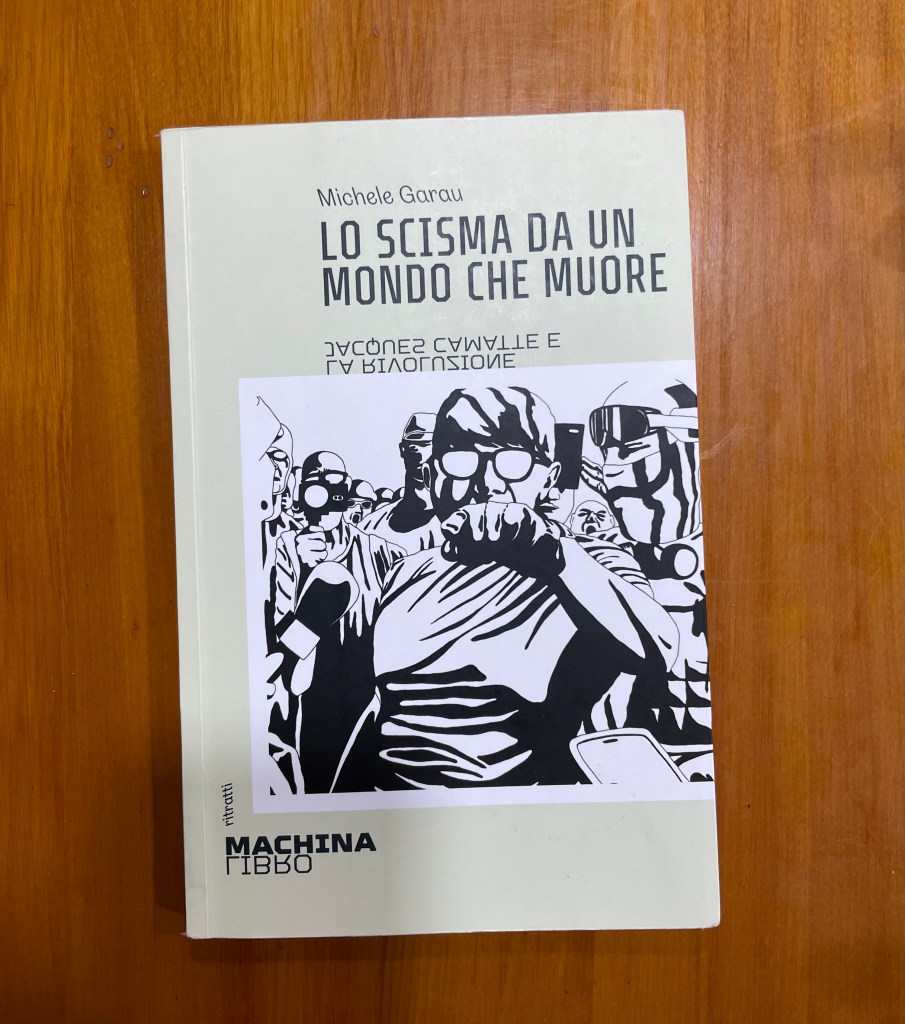
The absorption of the sky of politics. On Michele Garau’s Lo scisma da un mondo che muore: Jacques Camatte e la rivoluzione (2024). by Gerardo Muñoz

We must welcome that Michele Garau has written the first monograph on Jacques Camatte’s thought in any language, although the book, Lo scisma da un mondo che muore: Jacques Camatte e la rivoluzione (DeriveApprodi, 2024) it is also more ambitious than a mere philological reconstruction of the thinker of Invariance. Of course, not that there is anything particularly wrong with philological or archival work; rather, it is also that Lo scisma da un mondo che muore (2024) tries to think with Camatte (and also beyond some of his potential impasses) the historical bifurcation of a watershed moment in the history of humankind through the realization of the “capitalist revolution” as an autonomous colonization of every form of exteriority (Garau 7). If Camatte’s work has been only selectively considered in our ongoing discussions – while completely ignored at large by the so-called contemporary theory, which I guess it is an uplifting symptom – is precisely because he poses a challenge for a possible breakthrough in times of stagnation, while firmly announcing a much needed farewell to the modern revolution. But who would want to jump on that wagon when precisely voluntarism, prosthetic revolutionary cosmetic, and fictive communitarianism are all necessary platitudes to hold on to the illusion of ground right above the abyss? It is a rhetorical question, of course, but also one that Camatte move passed it in the in the decades of sixties and seventies observant to the material transformation of the working class, and the overall lesson of Amadeo Bordiga’s communism of the human species, which has also been rendered opaque and fossil-like by the victorious force of cultural hegemony and the whole grammatical structure of Gramsci’s thought in postwar political thought (and some will say well into our very present in the most recent cycle of failed left-populism). We said ‘farewell’ and this act, for Camatte after Bordiga’s teaching, means that the revolution has already taken place and must be perceived in the perspective of the crisis of negativity and the inception of the real absorption of capitalist development (Garau 14). 

Hence, new challenges lay ahead, which implies the abandonment of the historical and temporal productivity of revolutionary time – and Garau does an excellent mapping of bourgeois revolutionary thinking from Abbe Sieyès to Saint Just to later formulations of the Leninist paradigm of the dictatorship of the proletariat – which in the grand scene of modernity oriented the economy between form and function, but also between thought and action. If the epoch is said to be ‘anarchic’ is mainly because all these mediations and exclusive autonomous spheres have collapsed unto each other, and to favor one over the other is to work within the fiction of ideological reproduction at best. After Bordiga – Garau claims glossing Camatte, although there are nuances that I cannot consider in the space of this short commentary – the temporalization of the ius revolutionis can only bear in mind the crisis of presence (De Martino) as a suspension of exteriority that liberates right unto real subsumption. This means, following the recently polished phrase of Bordiga from his article “Tempo di abiuratori di scismi” (1965), that all revolutions are born and deployed as the affirmation of the schism. “Schism” or “scisma” — and one is reminded or taken back to a theological terrain, and not just as mitigated by the old ecclesiastical memories of the “Great Schism”, but because “schism” is also the “stazion” that fractures the visible-invisible legacy of form of the Church’s Trinitarian doctrine, and which is still the esoteric boiling point of the myth of political theology. This is a detour around Garau-Camatte-Bordiga’s intuition, since none of this is explicitly thematized in the book, nor should it be. It suffices that it opens to this question, given that Camatte’s own grammar of exhaustion – “extinction”, “inversion”, “autopoiesis”, “critique of organization”, “wandering” (erranza) – distill the echoes of an apocalyptic movement proper to the modern anthropological crisis, to put in terms of Ernesto de Martino.

Be as it may, the longue durée of civilizational development of Western revolutions (Edward Gibbon would claim at least since the reconstitution of the Christian Empire) there has been a process of adequation to invariant processes of capitalist accumulation that its substrate (whether permanent, uneven, natural law justified) becomes isomorphic to the structural needs of capitalist autonomization. In a cogent reading of Sieyes with Saint-Just in the framework of the French Revolution, Garau demonstrates how the genesis of modern politics and its categorial scaffolding (localization, constituent power, social unity, subject of rights, and representation) presuppose a thoroughly new vision to make the human community a clean slate for surface legibility (Garau 42). If the civil concept of the ancient polis was measurement and exchange; the crafting of high-modern state politics that took off in the eighteenth century was much thicker and spatially robust dynamics so that the ‘laws of commerce’ and population disciplining could come to fruition with its necessary infrastructural support. The schism was always a perturbation of the “sphere of politics” (and also of politics as a translucent sphere that can be observed, stabilized, and managed), and thus a great scandal.

Hence, the critique of political economy in the history of marxism was never able to untangle this mutual correspondence. For Garau at this point one can locate the difference between Camatte’s thought and Italian operaismo; given that Italian workerism at mid-century was never able to overcome the dialectic between the valence of value form and the theory of the production of capital. Whereas for Mario Tronti the struggle was still to be inscribed in to confrontation between the proletariat qua labor power; for Camatte the “invarianza” is not an permanent stage within the history of class struggle or Marxism, but of the human community and its resistance against the real subsumption of the material community (Garau 48). Decoupling the history of the working class as constitutive of productionism from the human community, allows Camatte, in the wake of Bordiga’s communism, to register the subsumption of capital as it collapses into dialectical negativity. Hence, communism is neither produced nor organized as operaismo always thought (Garau 26-27). And citing a passage from “Against domestication”, Garau argues that for Camatte the history of the proletariat struggle after 1945 is only the struggle to maintain the myth of the proletariat as the subject of a historical breakthrough (Garau 73). This is a staggering affirmation, and one that most definitely produces a theoretical schism. But the schism is also against the fictionalization of a subject of history, which has also been integrated into the emptying of social reality as we have come to know it in the final triumph of the fictive unto itself (Garau 93). 

There is the triumph of the fictive and expansive force of capital despotism, and then there is the struggle for the originary community (Gemeinwesen), which as Gianni Carchia argued in his “Glosa sull’umanismo” (1977) was still enmeshed in the contradiction between humanism and anti-humanism obstructing the vascular movement of non-identical fragments imploding the social. Is this getting at an impasse of Camatte’s own effort of thought to find an exit route? As an intelligent book, Lo scisma da un mondo che muore (2024), refuses to give an essay in the last three pages of the essay, although this difficulty is an object of attention. For instance, Garau writes in one of the clearest elaborations to tackle the problem directly: “La comunità deve allora essere riscoperta in una memoria della specie che finisce per radicarsi, questo è il rischio, esclusivamente in un bagaglio biologico. Nell’esaurimento delle strutture sociali preesistenti, dei linguaggi e degli schemi culturali, delle intelaiature rappresentative e cognitive, nella colonizzazione delle capacità psichiche, affettive, simboliche, è davvero possibile individuare un resto intoccabile dall’antropomorfosi del capitale che non debba essere, invece, creato dal nulla? C’è una «parte irriducibile», come scriveva Bataille, rispetto alle unità di misura del dispotismo economico? Non è semplice rispondere” (Garau 124).

In light of this rumination, Garau also attends to the cycle of contemporary revolts, which might stand as an instance of linguistic and existential struggle against domestication and the crisis of presence (Cesarano), and that might be capable of “absorbing the sky of politics into the most simple and elements components” (Garau 124-125). This is a great image, and one that has pictorial density and durability for thought even if it lacks specific elaboration. To absorb the open sky is to confront the exteriority of the world only as transfigured and brought back as a gathering of experience. The great German critic Kurt Badt comes to mind when writing about Constable: “the sky’s the organ of sentiment”. The embarrassing loss of the world today is fundamentally the destruction of the right attunement to our relation to the opening registered by what gleams above our heads. And perhaps this is a way to measure the capacity for non-movements rather than thinking that movements can disclose the sky. To this end, what could it mean to absorb the sky of politics – which is also a way to refuse the politics of sky, that is, the total planetary grand designs of geopolitical Tianxia? The irreductible may not be reduced to a substance, nor an ontological science nor a vitalist return to an originary community (if only mediated by the restriction of the archaic myth); but precisely that positionality of contact between what is exterior to life itself. To dislodge thought from all political plotting of objectivation and its plastic ligament of social adaptation. A life beyond itself that endures, and perhaps will outlive this dying world.

On American despair. by Gerardo Muñoz

The rhetoric of “decadence” now prevalent in United States has reached such heights that, regardless of political orientation, it is clear that it has become a pretext for a desired take off and accession from the objective  stagnation and paralysis. Paradoxically, the assumption that there is “decadence” is revered as a moment of forthcoming light and rejuvenation; and, thus, as a “crisis” that can be identified and managed through the end. As it is well-known, for some critics of decadence the Golden age of American life was the landing on the moon and the population boom of the 1950s; technology and family. The elements are self-serving: to accelerate the reproduction of the human species, and to lead technological gigantism against new geopolitical competitors (AI, chip wars, Green economy, etc).

In the early twentieth century Americanism was a benefactor of private Fordism (everyone could enjoy his or her car, that is, their increasing isolation), but in principle things have not changed much a century later in terms of the outlook and the techno-administrative power. But the one thing that has changed is that the age of increasing productivity and formal production is no longer the objective coordinates of social relations; rather, depopulation and stagnation are the new variables that public powers that must be governed through its effective processes. Ultimately, this also implies that the waning of the high-modern state is no longer effective, and so the established discussion about “race to the bottom” fails to understand that there is no bottom. Hence, the only race is toward planetary destruction.   

And what is curious to note is that even those that have identified the epochal crisis of Liberalism can only exacerbate and contribute to the acceleration of the ongoing destruction with cultural and rhetorical veneers notwithstanding. The ‘postliberal’ commitment to the fantasy of a “new policy of re-industrialization” cunningly allows the autonomy of state-sovereign capacity as the main orientation within the growing desert of administrative functions. In fact, this is a fort da moment in which policy makers can be in favor of empowering the nexus between executive power and the federal bureaucracy; while, at the same time, the mouthpieces of these policies can promise a dismantling of the administrative state in a post-Chevron era. This schizophrenic position is not a symptom of mere anachronistic derailments of a political movements, it is also an expression of the desperate attempts of American failed (and to a large extent non-existent) political elites to find a formal mediation between state, administrative coordination, and constituent power, precisely because this nexus is broken and in shackles. 

And truth be told, no piecemeal or nudge-driven re-industrial protectionism is “enough” to cure the social angst and despair of contemporary American subjectivity at all levels of human experience. It has been two honest economists, Anne Case & Angus Deaton in the book Deaths of Despair and the Future of Capitalism (2021), who taken noted that what they call “deaths of despair” is the central social affection of contemporary America, which fuels the slow but steady self-annihilation of the life that no longer truly lives (and paralyzes the economic framework as well). And, in turn, what outlives the hegemony of social domination is the regulation of pain and despair as the last dispensation of this unliving.

The necessary oblivion of the social production of the deaths of despair is what remains necessary so that a pseudo-theological framework of imperial “decadence” can retain its competitive narratives in the abyss. The end of real forces of autonomous production have led the way into the production of pain, which as Gianni Carchia clearly saw in his reading of Michelstaedter (Retorica del sublime, 1990), is a form of active ethical communication between souls. For all the alleged talk about spiritualism, theology, and instrumentalized Christianity in times of “decadence”, the high point of Americanism remains a techno-administrative apparatus that can only produce and conceal the prolongation of social pain. Precisely, “the parabola of the impossible so that any notion of the ‘good’ fails to be affirmed in this world”. 

Civilization and revolution. by Gerardo Muñoz

There is something insufficient and risible in the attempt to isolate notions like “revolution” or “emancipation” from the total collapse of the grammar of politics. This insufficiency speaks to a rhetorical inflation which already at the turn of the twentieth century Carlo Michaelsteader identified with the attempt at securing the social bond at all costs. The rhetoric of “saving” (the revolution, emancipation, liberation: saving the subject) at bottom, only shows the simulacra of a redemptive movement of value at the heart of social exchange. And we also know that modern political revolutions were experiments in general socialization. Whether it is Saint-Just appealing to the laws of nature against the positive social contract in the wake of the French Revolution; or Lenin and the Bolsheviks more than a century later in their efforts to stage a utopia of production and classless society, the revolutionary horizon was ultimately about the production of the social bond and little else.

The dialectization between subject and the totality of the modes of production was realized in its reverse: the passage to a new temporal domination unto all sensual activities of life. This was expected given the premise: at the center of the genesis of political organization of the West is not the state, but rather the rhetorical structures of civility. That the last theoretical project of politics hinges on the so-called “rhetorical foundations” of society now comes full circle: the development of civilization in the open.


Of course, revolutionary and emancipatory imagination, except in rare occasions, has always been oblivious to the problem of civilization. And this is why Fordism and high Stalinism were perceived as civilizational projects that mirrored and competed against each other. In this sense, the civilizational rise never escaped the duality between politics and nihilism that is proper to the anxiety over order in the genesis of modern European public powers. This is also why early in revolutionary moments of triumph the excess of barbarism was never left behind, but rather it emerged as its siamese twin of the humanist enterprise. As Merleau-Ponty hinted in his old book Humanism and Terror (1947): “Even though our political life creates a civilization we can never renounce, does it not also cointan a fundamental disease?” [1]. This was Ponty in 1947, where the debris of the war was still in full display in major European cities. To some extent one could imagine not wanting to renounce civilization of such barbarism in the face of atomic disaster. But is this our predicament today? Obviously not, since, precisely the collapse of politics (and its main institutional forms such as positive law and political parties) also amounts to an ongoing crisis that is civilizational in nature.

It is not surprising that what emerges in front of us is a different typology than the one that Merleau-Ponty witnessed in 1947: it is no longer the piling of rubbish, but the rise of metropolitan paradises that organize the infrastructural regime of a contactless world. A decade later, written in the 1950s, Amadeo Bordiga will redefine the stakes of civilization: “…the vigorous coarseness of the barbarian peoples was less dire than the decadence of the masses in the capitalist epoch, the epoch that our enemies name as civilization – a word used well here, and in its proper sense, because it means the urban way of life, the way of life proper to the great amalgamated monsters of the bourgeois metropolises” [2]. Bordiga’s lucidity was capable of grasping that Fordism as the triumph of the utopia of capital now meant that civilization (now reduced as the allocation of exchange and distribution) became the central figure of nihilism. Perhaps Bordiga was too imprudent to call for the shadow of the civilized – that is, the barbarian – but his problem, I take it, is still ours to reflect upon.

.

.

Notes 

1. Maurice Merleau-Ponty. Humanism and Terror (Beacon Press, 1969), xxxviii.

2. Amadeo Bordiga, “Specie umana e crosta terrestre”, in Drammi gialli e sinistre della moderna decadenza sociale (Iskra, 1978), 95. My translation. 

Homo Lupus Felix: Against Civilization. Notes for a presentation in the Eckhardt S. Program, Lehigh University. by Gerardo Muñoz

There is no question that Alice Rohrwacher’s Lazzaro felice (2018) is a marvelous cinematic work insofar as it measures up against the epoch by radically questioning the principles that have upheld what we know as civilization. This slight adjustment is critical given that ideology, political economy, or subject oriented frameworks of analysis have become insufficient to deal with the crisis of civilization. As a matter of fact, they have become functional (mere deployments of technique, to put it in Willy Thayer’s vocabulary) to the infrastructure, and its specific philosophy of History that promotes the maintenance of Order after the liquidation of its legitimacy. I would like to clarify that I am understanding civilization in a twofold register: as a genetic process of human anthropology based on the matrix of “appropriation, distribution, and production” of the world (a techno-political grid popularized by Carl Schmitt); but also as the total realization of an economic or political theology, which we can directly link to the function of “credit” (and the process of abstract dialectic between credit and debt, as a ground of a new “faith”) that is deployed as the medium of the total sum of social relations that commands beings in the world. Civilization is the general matrix of a process of optimal rationalization of the events that take place in the world, making us potential reactionary agents of the time of its phenomenality.

Aside from all the Christian and religious imaginary, Lazzaro felice is a theological film, but only insofar as it takes the irruption of the mythical remnant very seriously. There is something to be said here – and I think the film stresses this in several parts of the story – between religion and theology, dogma and the spiritual (anima), and the sacred and the commandment solicited by faith (pistis). In other words, Lazzaro felice enacts a destruction of a political theology by insisting on the civilizatory decline towards reproduction of as mere life of survival; a life that is delegated to the abstract faith of credit. In this sense, it is no mistake that Lazzaro’s homicide takes place in a bank and executed by the community of believers (capital, in the end, has already been incarnated; it is the Subject). The laboratory where this takes place is the metropolis, which as I have argued elsewhere is the site of devastation and optimization life in our epoch, which unifies world and life putting distance into crisis, in a suspense of the experiential [1]. The consumption of the new political theology of unreserved equivalence between humans and objects is what Rohrwacher interrupts through the fable of the beatitude of Lazzaro as a life to come in the threshold of the highest phase of the metropolitan stagnation. I will limit my commentary here to three nodes that allow the Lazzaro felice to expand this critique of civilization and the principle of the “civil society”, a notion that we will return to.

First, there is the fable, a capsule of an ancient gnostic wisdom. The fable is what can radically alter evil by tipping its objective realism into a real of the imagination against the grammar of order. Avoiding the order of narration based to account for the history of progress and developmentalism from the rural to the civilization of the metropolis, Rohrwacher’s strategy resorts to the ancient craft of the fable. This is fundamental for a number of reasons. First of all, because the fable allows to withdrawal from pure counter-narrative of historical development and its justifications that allow for the interruption of the time of development, while offering a possibility of an otherwise transformation of the world. This is the gnostic texture of the fable that Hans Blumenberg identified in this form, since obscuring of the distinction between humans and animals relaxes the burden of proof of the absolutism of reality as predicated in the matter of facts [2]. It through fables that something escapes, because there is always an image that escapes the narration of the events of this world. But the fable also offered something else: the beginning of myth as the site of legitimation for foundations of social relations. This is why, as T.J. Clark has reminded recently, Hegel associated the fable with the origin of master and slave dialectic, as a new form of domination of world once the world’s enchantment and mystery was dissolved: “In the slave, prose begins” [3].

The end of a paractical poetics? Perhaps. This means that the price to be paid to enter into the prose of “civilization” is to assimilate the unfathomable and invisible contours of the world into the polemos of storytelling; to be a subject of a story, and as a result, of historical transition. This is what civilization mobilizes through the fable as its posited legitimacy. It is in the fable where the abyss that separates us from the world becomes animated, ordered, and narrated in order for the apparatus of production to commence. It seems to me that Alice Rohrwacher goes to arcanum of civilization when she treats the fable of the wolf, which has functioned to legitimize the passage from the state of nature to the modern concept of the civil in Hobbes’s theory of the state. We should remember the brief fable in Lazzaro felice:

“Let me tell you the story of the wolf. A very old wolf had become decrepit, he could hunt wild animals anymore. So, he was excluded from the pack…and the old wolf went to houses, to steal animals, checks and sheep. He was hungry. The villagers tried to kill him in every way possible, but they didn’t succeed…as if he were invisible.”

It is a remarkable fable that inverts the political fiction of the wolf in Hobbes; mainly: a man is an arrant wolf to another man (homo homini lupus), which justifies the exodus from the state of nature as the “miserable condition of civil war” between men. The stakes are clear: by repressing civil war (stasis), civil society emerges as a divided but unified body under a sovereign principle of authority [2]. The wolf is first established as creature of fear and depredation in order to allow for the principle of civilization to emergence as uncontested and necessary. The fable of the wolf is the protofigure that guards the history of perimeters of civilization as a way to pacify and repress the latency of civil war. Rohrwacher, against the Hobbes political fable, gives us a fable of the wolf that not only is uncapable of waging life as war, but that it enacts full refusal and desertion to be hunted; that is, to be invisible, which ultimately entails a life not outside of a politics of hunting and the secondary pacification by which the end of hunting mutates to the enclosure of domestication [4]. 

If the wolf stands for the invisible it is because it occupies the excess of total legibility of a new civil order, that is, of a world administered by technique of order. The wolf is a prefiguration of the invisible that is improper to every life (and thus to all biopolitical domestication proper to civilization) in the passage from the organic community of the living to the civilizatory topos of the metropolis. The wolf condenses the instructive character in every life; that is, what cannot be reduced to the fiction or the depredatory total war of the civilization nor the fiction of the community lacking an open relation to the world.  This fable, then, is not just what unveils the fictional grounds of the legitimacy of civilization (its “black magic” under the light of rationality and control) but also what reprepares another community. A community in which what we have in common is not an attribute, a substance, or an identity, but an irreducible ethical relation in which civil war cannot equate total hostility and what establishes an absolute difference between life and the “principle of the civil” that formalized the aspiration of isonomic equality:

“The immemorial bad reputation of the wolf (wolf bashing) informs us about one of the oldest tricks of civilization. This consists of bearing the weight of predation on what is heterogeneous to it. To be able to say that man is a wolf of man, the wolf must first have been disguised as a “predator.” We do not mean that the wolf is gardener of daisy flowers, we mean that he behaves neither as a tyrant nor as a bloodthirsty animal, and even less as an individualist (the famous “lone wolf”). In fact, the wolf may have taught communism to humans. The cub that opens its eyes among humans recognizes them as part of its clan. Two lessons: 1) friendship ignores categories; 2) the common is the place where we open our eyes to the world. What the human, for his part, has “taught” to the wolf – like an angry father yelling at his son “I’ll teach you!” – is the servility of the good puppy and the good cop”. [5]. 

               The end of the film comes full circle with the only condition of finding a way out, producing a break in the infrastructure of the domestication, opening a path within and against the metropolis. It is almost as if the film, like in life, was a preparation for the moment of exodus and retreat. In fact, the wolf deserts the metropolis passing through and beyond the highway in plain rush hour. According to Alice Rohrwacher, the wolf leaving the city and not being seen was a reinforcement of the invisible ethical dimension that is proper to every life (an ethos, which in the old Pindaric sense that refers not only our character, but also, and more fundamentally to our abode and habits that are world-forming), and that is devastated by the anthropological crisis of the species in the wake of the process of civilization [6]. However, the wolf exit from the metropolis is not an abandonment of the world in the manner of a monastic communitarian retreat; but rather the pursuit of liberating an encounter with the events of the world foreclosed by topological circulation of credit that amounts to borrowed life without destiny. 

Now to the question that signals an instance of construens in what follows the desertion: what about happiness? It is here, it seems to me, where the beatitude of Lazzaro could be thought as an ethical form of life – as preparation to learn to how live a life against the abstract processes of domestication – that exceeds the two hegemonic paradigms of happiness offered by Western civilization: on the one hand, happiness understood as an equilibrium operative to virtue (aretē); or, on the other, the community of salvation as a compensatory effect for the structural gap of the fallen subject, original sin (felix culpa). One could clearly see that politics at the level of civilization could now be defined as the instrument that manages the production of happiness as a temporal exception in life, but never a defining form of our character.

The wolf that is Lazzaro’s form of life – at a posthistorical threshold that dissolves the anthropological divide man and animal – offers us a third possibility: happiness understood as the refusal to partake in the promises of civilization in order to attune oneself to an errancy of life that allows itself to be hunted by an experiential imbuing of the world. Happy Lazzaro? Yes, but never a Sisyphus who is incapable of experiencing the vanishing horizon between earth and sky in infinite divisibility of the world. The wolf unleashed traverses a geography against domestication, revoking the phantasy of home (the oikos). I will let the last words be made by some fellow-travelers contemporary American thinkers: “Civilisation, or more precisely civil society, with all its transformative hostility was mobilized in the service of extinction, of disappearance. Fuck a home in this world, if you think you have one.” [7].

=

Notes

1. Gerardo Muñoz. “Dix thèses sur Lazzaro felice” en tant que forme de vie”, Lundi Matin, May 2019: https://lundi.am/Dix-theses-sur-Lazzaro-felice-en-tant-que-forme-de-vie

2. Hans Blumenberg. “Of Nonunderstanding: Glosses on Three Fables” (1984), in History, Metaphors, Fables (Cornell University Press, 2020), 562-566.

3. T. J. Clark. “Masters and Fools”, LRB, vol.43, No.18, September 2021. 

4. Thomas Hobbes. Man and Citizen (De Homine and De Cive) (Hackett, 1991), 11.

5. “Éléments de descivilisation” (part 2), Lundi Matin, april 2019:  https://lundi.am/Elements-de-decivilisation-Partie-2

6. Jerónimo Aterhortúa Arteaga. “Creer en las imágenes: entrevista a Alice Rohrwacher.”, Correspondencias, May 2021: http://correspondenciascine.com/2021/03/creer-en-las-imagenes-entrevista-a-alice-rohrwacher/

7. Stefano Harney & Fred Moten. The Undercommons: Fugitive Planning & Black Study (Minor Compositions, 2013), 132.

Three ideas for a discussion on «Éléments de décivilisation» by Gerardo Muñoz.

[These are some preliminary notes for an ongoing discussion on Lundi Matin’sÉléments de décivilisation’’, a text that condenses a series of problems dealing with, although by no means, limited to infrapolitical reflection, the event, world, and the question of civilization in the wake of the ruin of hegemonic principles. This particular essay, more than content, raises the question of the status of the style of thought; and, in broad terms, I tend to link the notion of style to the constitution of an ethos. But let me offer three theses to open the discussion in very broad terms. What follows is the reconstruction of three brief points in a recent group meeting about this text.] 

i. The priority of the event. For me at least it is very important to consider that Éléments de décivilisation’’ moves away from at least two important precedents of a common intellectual orbit: messianism and the political theory of modern sovereignty. Of course, this is important for many reasons, but most it speaks to what I would call a strong opposition between thought and philosophy (favoring the first over the second). These two registers open important distinctions, such as, for instance, a displacement between historical temporality (messianism) to a notion of the taking place (the event or encounter) as exteriority. Whereas we were told that the “event is the enemy within Empire” (Gloss in Thesis 60 of Introduction à la guerre civile) , now we have a more through sketch about the way in which the form-of-life is not a category reducible to vitalism or the problem of the subject, but rather about the play between form and event. Here I think that Carlo Diano’s Forma ed evento (1952) is crucial as a backdrop that is not just philosophically (Aristotelian formalization against Stoic predication), but rather a sound position of thinking in relation to what has been passed down as “civilization”. 

ii. Civilization as a principle. Now, the question of civilization raises to a problem of thought insofar as is neither an ontological problem nor an operative idea in the history of intellectual concepts. Civilization becomes the apparatus by which the total regimen of production in any given epoch is structured to establish an order. And here order is both authority and police. To put it in juridical terms: the first secures legitimacy while the second posits the flexible energy of legality and execution. This is the same problem in the relation to the world. In other words, civilization means enclosing, domesticating, and producing. By the same token, civilization is the operative domain by which nomōs, history and the subject come together in virtue of their separation. Is not this the very issue in the Greek polis in the wake of the discovery of measurement, isonomy, and the distribution of the goods in which hegemony replaces the basileus (Vernant)? It is one of the merits of the text not having understood this problem at the level of an “archeology of Western political thought” (Agamben), but rather as an evolving transhistorical process that binds the axis of domination and power to the axis of anthropology and domestication. Civilization, then, would name the total apparatus of hegemony under which politics falls as a problem of metaphysical structure (I have tried this problem in recent positions here). Whether there is an assumed anthropological anarchy at the level of substance, capable of “inversion” (Camatte), is something that must be explored in further detail. 

iii. Happiness cuts absolute immanence. My last point. I would like to insist on something that Rodrigo Karmy mentioned recently: “Happiness is the unthought of the Weestern tradition”. I agree with Karmy not on the basis that there has not been any reflection of “happiness” in the tradition, but rather that this reflection has either been a) subordinated to politics or economics (Jeffersonian “happiness” conditioned by commerce); or, as a moral virtue of self-regulation and privation. But it seems to me that “Elements” wants to offer something else in a very novel way. It is here where the question of violence must be inscribed. A curious displacement since violence has been thought in relation to beauty, but not happiness. The violence at the level of forms puts us in proximity with the event at the end of life itself. In this sense, the Pacôme Thiellement footnote is important:

“l y a deux lumières: il y a la lumière d’avant la nuit et il y a la lumière d’après. Il y a celle qui était là au début, l’aube radieuse du jour d’avant, et puis il y a celle qui a lutté contre les ténèbres, la lumière qui naît de cette lutte : l’aube scintillante du jour d’après. Il n’y a pas seulement deux lumières, il y a aussi deux joies : il y a la joie d’avant la peine et il y a celle d’après. La joie originelle, la joie innocente, primitive, cette joie est sublime, mais c’est juste un cadeau de la vie, du ciel, du soleil… La joie qui vient après la peine, c’est le cadeau que tu te fais à toi-même : c’est la façon dont tu transformes ta peine en joie, l’innocence que tu réussis à faire renaître des jours d’amertume et des nuits de bile noire. C’est le moment où tu commences à vivre, mais vivre vraiment, parce que tu commences à renaître de toutes tes morts successives. C’est le moment où tu t’approches de la divinité ou du monde”. This position  – which I think it is prevalent throughout the text – allows the opening of a series of articulations:

a) it is no longer happiness an effect on the subject, which has only grown in the Spectacle or consumption; that is happiness as an exception to life.

b) it is not that happiness is a theological state of ‘blessed life’, which would presuppose the transmutation of sin and thus overcoming of the non-subject. This position depends on conditions of mythic-history and theology.

c) It is rather that happiness is the way in which the singular gathers his possibilities in use without enclosing the other possibles. To live a life among the fragmentation of the use of our disposed potentialities is a way to violently cut the seduction of absolute immanence in which style is diluted. Play could name the variations of use. But there is a second order risk in what constitutes “play”: a transfiguration of politic as civil war. The problem becomes how to think of ‘play’ (i. messianic abandonment, ii. political intensification – insurrection, or the separation between rhythm and voice, a poesis). I am interested in pushing for the third figure of play; a third figure in which the event and happiness impose a new division of souls, moving away from the separation from life. 

Production as a total religion of man: Notes on Gramsci’s Prison Writings (VII). by Gerardo Muñoz

In an important moment of Notebook 7, Antonio Gramsci writes that production in the age of industrialization amounts to a “new religion of the common man”. This thesis conditions many aspects of Gramsci’s thought and fully exposes his thinking as determined by the epoch of industrialization. If so, this means that his thinking is fundamentally insufficient for our historical present as defined by stagnation and the end of growth. First of all, the condition of industrialization allows for the famous “war of position”, which is exerted as a moralization of politics (hegemony). It is important to note that the concept of hegemony is introduced only “after” the historical reduction to industrial productivity is rendered as the unity of all historical time. In an explicit Hegelian fashion, Gramsci argues that: “The process of historical development is a unity in time, which is why the present contains the whole of the past and what is “essential” of the past realizes itself in the present, without any “unknowable” residue that would constitute its real “essence”. Whatever is lost….it pertained to chronicle not History, a superficial episode and, in the final analysis, negligible” (175). This is at the core of Gramsci’s thinking, not at the margins.

So, the Hegelian absolute movement of the philosophy of history as coterminous with the flattening of the “rational is the real” is the metaphysical ground in which Gramsci not only operates but the venue through which he offers us a “new religion of the common man”. A few sections later (§. 35), Gramsci confesses that “hegemony was also a great “metaphysical event”. Of course, one could suppose that Gramsci was delivering a new God within the gigantomachy of the age of production. The irony is, of course, that this strict “political theology” is only justified by the industrial regime that it seeks to overturn. Therefore, the question that the so-called contemporary Gramscians (or anyone taking up Gramsci today, say from the 1970s to the present) should respond is: how can the analytical conditions of Gramsci’s thought illuminate post-Fordism in the wake of the exhaustion of growth? 

If according to Jason E. Smith’s important new book Smart Machines and Service Work (2020) since the 1980s we are witnessing an ever-expanding service sector (in the US and the UK drifting well above the 80% of the GDP) as a compensatory for growth stagnation in the age of technological innovation, how could the Gramscian “new religion” on industry mobilize a horizon of emancipation, or even minimal transformation from said regime of exploitation? On the contrary, it seems (as I tried to argue recently here) that if we take Gramsci’s insight about the material conditions of “production” in any given epoch, the work of hegemony today can only open to a demand for exploitation as subjected to servant domination in the stagnant regime. In other words, if we accept Gramsci’s own analytical conditions (industrial production), this necessarily entails that we must move beyond hegemonic domination. To think otherwise – say, believing that a “temporal form of dictatorship” or “populist takeover”, now in ruins – amounts to a solution oblivious to the historical conditions, which can only blindly accept the “command” of a hegemonic principle. It is not a surprise that only the new nationalist right in the United States today can be properly labeled “Gramscian”, since they want to recoil political form to industrialization, organic community flourishing, and national “delinking” from globalization decomposition of the regime of total equivalence. But this is only a “storytelling” (a bad one, indeed) in times of stagnation.

More broadly, this speaks to the divergence between Gramsci’s faith in industrialization and Protestantism, as he defends it in section 47 of the Notebook. While glossing Max Weber’s Protestant Ethic, Gramsci notes that only the “spirt of the Reform” can produce reciprocal positions vis-à-vis grace and “good works”; whereas in Catholicism, activity and human action is not bounded by labor form, but by corporativism. On the surface this links Gramsci’s thesis with that of Max Weber’s; however, given the conditions explained above, it also shows that Gramsci’s thinking is really at odds with a commitment to thinking reform within the concrete conditions of a historical epoch. In other words, the political categories of Gramscianism (war of position, hegemony, production) are undeniably more on the side of reaction rather than in the production of new reforms. Of course, his position is not even a Catholic reaction; since, as Carl Schmitt observed in Roman Catholicism and Political Form (1923), at least the Church offered formal institutionality as a response to the total electrification of the world, whether in the hands of the Soviets or the American financial elite. But, as we know, the theory of hegemony is also oblivious to the problem of institution and the concrete order.