The gardening of the soul. by Gerardo Muñoz

There is an untimely moment in Saint Teresa de Jesús’ Oraciones where she speaks metaphorically about her soul as a form of a flourishing garden. It is a description that also advises of a potential risk of the devastation of the garden; as if more than a locus amoenus, what is at stake is a sort of ethical activity that must be retained and nourished in prolonged periods of unexpected danger. We read in the Oraciones: “Y considerar el ser mi alma un huerto, y al Señor que se paseaba en él. Suplicábale aumentase el olor de las florecitas de virtudes, que comenzaban, á lo que parecía, á querer salir, y que fuese para su gloria, y las sustentase, pues yo no quería nada para mí, y cortase las que quisiese, que ya sabía habían de salir mejores. Digo cortar, porque vienen tiempos en el alma que no hay memoria de este huerto; todo parece está seco, y que no ha de haber agua para sustentar, ni parece hubo jamás en el alma cosa de virtud” [1]. The topic of the garden and gardening, as we know, was central to the culture of medieval monasteries, as anyone knows who has seen these places all over the Mediterranean world, and that today many of them have been turned into high-end hotels for global tourism. 

The monastic garden was both a site but also a nonsite, a sort of chorā that, as the Saint Pacomio (286-346) would write, it was the place where one could be closest to God, and where existence could experiment its true grace and happiness [2]. And what are the company of the gods of place if not the very nameless fleeting instance of our free relation with the world? This is the index of the ethical nourishment that has been entirely lost.

There is little doubt that Teresa was also conscious of the theology of gardening that her predecessors wrote, such as Walafrido Strabo’s Hortulus (840), which was undoubtedly the most important treatise on horticulture of the monastic tradition during the middle ages laying down the principles for a flourishing seasonal harvest. Like the abbess Hildegard von Bingen centuries before her, for Teresa a comprehensive understanding of “sickness” was not just a question of biological maladies of life, but more fundamentally an existential problem that must be cultivated like a gardener keeps a parcel of land flourishing like a transfigured memory of Arcadia. A space of shade and a surrounding for breathing. 

Santa Teresa extends the metaphor when she tells us that there are dark times where the garden is drying up; and, in fact, the soul itself could entirely forget that there was a garden. It is all too simple to say that this dried soulless wasteland is a mirror image of our epoch, where it becomes obvious that in the name of “ecological” administered apocalyptic time, we are entirely uprooted from any possibility of nourishing our garden. In fact, what just a few years ago seemed like exceptional and arbitrary measures of confinement, social distancing and artificialization of the human community, it is now clear that it amounts to not just the absorption of the world as such (this was already the project of formal capital), but rather the destruction of the ethical dimension of the non-world that binds us, at a distance with what remains outside of it.

Even Carmille Pisarro’s “Two Young Peasant Women” (1891), at the shadow of nascent industrialization, now seems to us as dumbstruck by a deep sense of acedia (disconnected and mute) foreshadowing the forthcoming vanishing of their life-world. After all, the aim of the machinist is to make the world soulless, said Landauer in Skepsis und mystik (1903). We have lost all space but we must conquer the chorā, which allows us to cultivate, once again, the soul against all expectancy of programmed obsolescence. Teresa’s huerto del alma persuades us in the stray direction that some, in reality, have never left. 

.

.

Notes 

1. Santa Teresa de Jesús. Obras de Santa Teresa de Jesús, Tomo I (Libreria Religiosa, 1887), 12.

2. Peter Seewald & Regula Freuler. Los jardines de los monjes (Editorial Elba, 2019), 99.

The face of pain. by Gerardo Muñoz

One is always struck by the pictorial intensity of Massacio’s “Expulsion from the Garden of Eden” fresco (1425) at Santa Maria del Carmine Chapel. It has something to do with the unbounded expressivity swirled by an acoustic of lamentation that springs from both faces at once. The nakedness in movement only comes second. If it is right to call it ‘modern’ is precisely because of its polarity  between movement and paralysis, light and shadow, the formation of the lines delineating the bodies and the free-style strokes that carry Massacio’s picture to a strict and unsurpassed balance. It is a picture of the gathering of  lamentation and pain, which confirms Ernesto de Martino’s intuition that in the ritual of mourning weeping and crying is also accompanied by an act of self-defacement, such as covering the face or bring the face as close as possible to the lower body position. Adam’s pain is reinforced by the hand that covers and pulls the face downwards, almost making it disappear. In a way, his walkout of Paradise is already the stroll of a nobody. 

There is perhaps an intimate relationship between defacement and pain. In his short gloss on this work, Robert Longhi notes that the source of strength of Massacio’s work is given by the intensity of light that bathes the bodies of Adam and Eve in its purest naked form [1]. This total exposition is the cause of sin that, as a great historian of religion has brought to our attention, presupposes the entire carnalization of both body and soul after being thrown into the soteriological world of the living [2]. From now on, human life vested in pain means paying the price of the destruction of the soul for the protected  and preventive set up in the world. 

The sinful life – a life that will have to be chosen but punished justly – entails the consummation of pain as the central tonality of post-felix culpa existence. In other words, it is not that life is shameful because it has been dispossessed (or because it recognizes itself possessed); it is dispossessed because it can no longer look at the world outside the blinding light of programmed obsolescence towards death without transcendence. And the liquidation of transcendence means that human beings become faceless entities in a world that will forever become unfathomable. 

In our days – a present marked by absolute secularization of ancient religious somatic religiosity and magical traces – the phenomenon of defacement and the faceless far from disappearing is all over the world around us. The ritualistic mask which provided transcendence to the living presence of the divine gods has now become a symbol of social shame self-imposed by arbitrary and ever-increasing moral mandates. In a sense, we have not yet left the path initiated in Massacio’s Adam and Eve fresco, and who knows if we’ll ever exit it in the ongoing destruction of the human species. We do know, however, that any meaningful change of the current state of things can only take place starting at the divine surface of the face, as Carlo Levi so eloquently understood it in the postwar years: 

“Only a genuine revolution succeeds in changing the way people look, their facial expressions, the light in their eyes, the charm of their smiles. Christianity appeared with new faces, or taught a new way of looking at them. If we go through the streets and compare the faces we see with our memory of them, we won’t recognize persons any more. It is something that anticipates reality, as if prophetically, the universal change that for almost two centuries now has been shaping new faces throughout the whole world”. [3]


Notes 
1. Roberto Longhi. Breve pero auténtica historia de la pintura italiana (Machado Libros, 2023), 114.
2. Paula Fredriksen. Sin: The Early History of an Idea (Princeton University Press, 2012), 116.
3. Carlo Levi. La doppia notte dei tigli (Einaudi, 1959), 109.

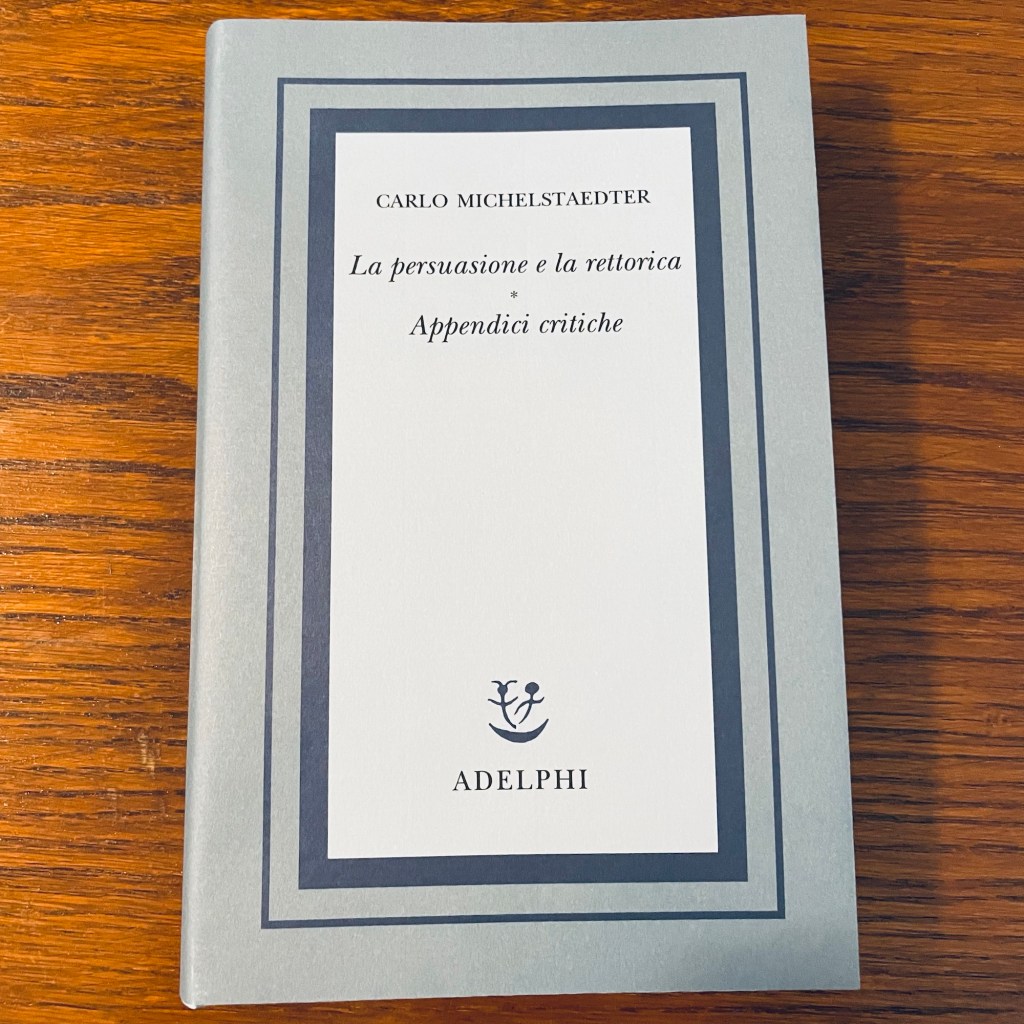
Carlo Michelstaedter: Pain and the Social. A seminar with Revista Disenso. by Gerardo Muñoz

In the following months some of us will offer an eight week seminar exclusively dedicated to a close and analytical reading of the enigmatic work La persuasione e la rettorica (1910) by Italian thinker Carlo Michelsteadter (1887-1910). Ever since his death – as can be easily gasped by Giovanni Papini’s obituary in 1917 – there has been an aura of mystery around the infamous philosophical suicide of Michelsteadter that only parallels that of Socrates’ hemlock or Otto Weiniger’s self-inflected gunshot. Of course, we will be less interested in the biographical motives, and if push comes to shove attention to this detail will be elaborated in light of the nexus of his thought to the event of his death.  

La persuasione e la rettorica (1910) offers a unique theoretical elaboration about the civilizational decline of the “living” into the rhetorical deferment of life as realized in the organization of social alienation. And for Michaelsteadter there is no other purpose of rhetorical form than the absolute submission to the general abstraction that defaces the event of pain. It is no accident that he was also interested in the thematics of health and ancient techniques of pain-relief (the techné alupias, for instance), even if underdeveloped in his thinking given his sudden premature death. So, it is for us, his posthumous readers, to take these sets of issues and move them forward in our present any way we can. This is part of the task that motivates putting together this seminar after a series of conversations with friends and interlocutors.

La persuasione e la rettorica (1910) deploys the classical metaphysical tradition through the ancient poles of “rhetoric” and “persuasion”, where the second (the ancient Peithò) seeks to return the voice and expression to the problem of pain as an ineffable type of speech (Logos) that refuses the elevation of force that harbors the circulation of violence and the administration of social death. The ancient notion of the Peithò withdraws echoes of the mythical inception and the sacred, as also reminded by Aristophanes: “Persuasion’s only shrine is eloquent speech (Logos)…And I Persuasion (Peitho), the most lovely word” (The Frogs, 1391-1395). Where and how do we attune ourselves to the peitho today – the imperative of the eros of the word in the wake of the regime of social production of pain? 

In the aftermath of the collapse of the cycle of civilizational secularization, it is only obvious that all these questions stratified in the tradition once again become attractive and pertinent. In this light, we think that Michelstaedter’s thought still offers us a series of  significant hypotheses to think through the crisis of social man and the domination of the civil that colors our current predicament, where the question of “pain” is still an understudied problem. Throughout this course we will address notions such as rhetoric and persuasion, life and communication, nihilism and values, the logic of capital and the social bond, or the notion of world and pain. Our aspiration when approaching Carlo Michelsteadter’s work is to develop reflective conditions to address the thorny issue of an ethics of pain that so thickly enmeshed in our historical moment.

.

.

‡: Information about the registration to the seminar will be made available at Revista Disenso in upcoming days. The seminar will run every other week for a period of eight sessions (roughly from the beginning of September to early December, 2024).

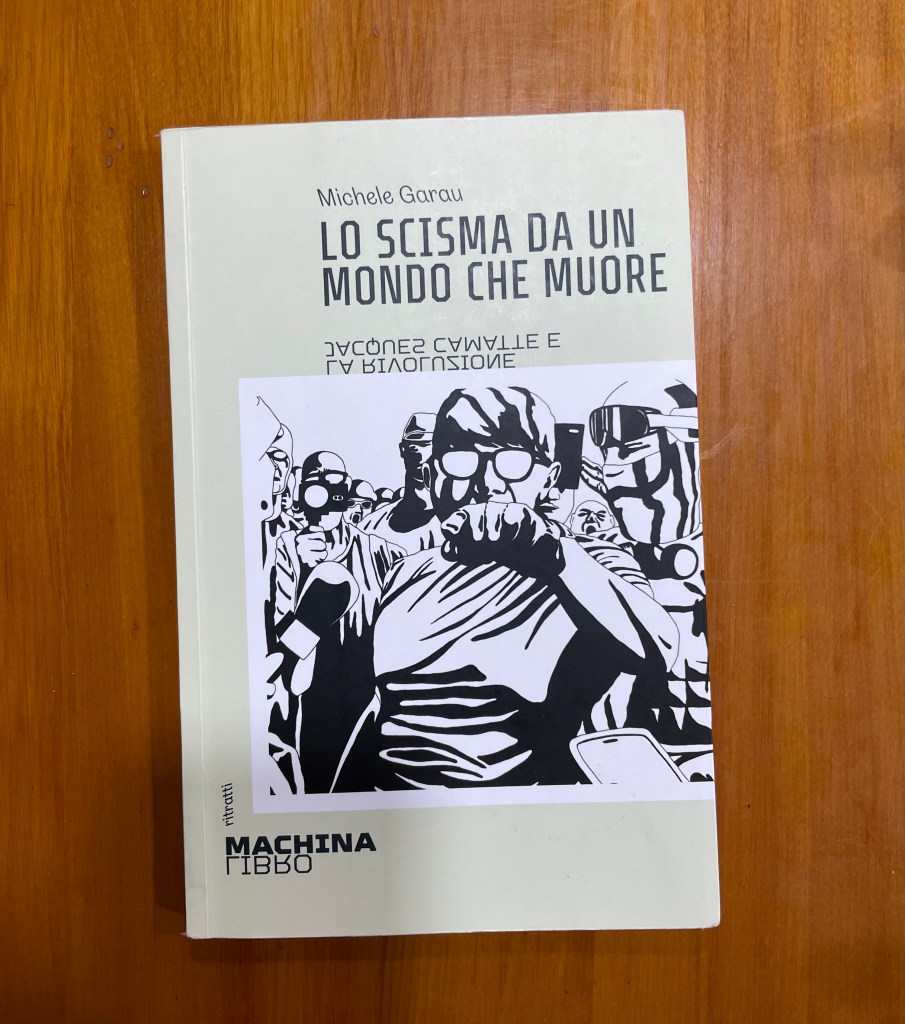
The absorption of the sky of politics. On Michele Garau’s Lo scisma da un mondo che muore: Jacques Camatte e la rivoluzione (2024). by Gerardo Muñoz

We must welcome that Michele Garau has written the first monograph on Jacques Camatte’s thought in any language, although the book, Lo scisma da un mondo che muore: Jacques Camatte e la rivoluzione (DeriveApprodi, 2024) it is also more ambitious than a mere philological reconstruction of the thinker of Invariance. Of course, not that there is anything particularly wrong with philological or archival work; rather, it is also that Lo scisma da un mondo che muore (2024) tries to think with Camatte (and also beyond some of his potential impasses) the historical bifurcation of a watershed moment in the history of humankind through the realization of the “capitalist revolution” as an autonomous colonization of every form of exteriority (Garau 7). If Camatte’s work has been only selectively considered in our ongoing discussions – while completely ignored at large by the so-called contemporary theory, which I guess it is an uplifting symptom – is precisely because he poses a challenge for a possible breakthrough in times of stagnation, while firmly announcing a much needed farewell to the modern revolution. But who would want to jump on that wagon when precisely voluntarism, prosthetic revolutionary cosmetic, and fictive communitarianism are all necessary platitudes to hold on to the illusion of ground right above the abyss? It is a rhetorical question, of course, but also one that Camatte move passed it in the in the decades of sixties and seventies observant to the material transformation of the working class, and the overall lesson of Amadeo Bordiga’s communism of the human species, which has also been rendered opaque and fossil-like by the victorious force of cultural hegemony and the whole grammatical structure of Gramsci’s thought in postwar political thought (and some will say well into our very present in the most recent cycle of failed left-populism). We said ‘farewell’ and this act, for Camatte after Bordiga’s teaching, means that the revolution has already taken place and must be perceived in the perspective of the crisis of negativity and the inception of the real absorption of capitalist development (Garau 14). 

Hence, new challenges lay ahead, which implies the abandonment of the historical and temporal productivity of revolutionary time – and Garau does an excellent mapping of bourgeois revolutionary thinking from Abbe Sieyès to Saint Just to later formulations of the Leninist paradigm of the dictatorship of the proletariat – which in the grand scene of modernity oriented the economy between form and function, but also between thought and action. If the epoch is said to be ‘anarchic’ is mainly because all these mediations and exclusive autonomous spheres have collapsed unto each other, and to favor one over the other is to work within the fiction of ideological reproduction at best. After Bordiga – Garau claims glossing Camatte, although there are nuances that I cannot consider in the space of this short commentary – the temporalization of the ius revolutionis can only bear in mind the crisis of presence (De Martino) as a suspension of exteriority that liberates right unto real subsumption. This means, following the recently polished phrase of Bordiga from his article “Tempo di abiuratori di scismi” (1965), that all revolutions are born and deployed as the affirmation of the schism. “Schism” or “scisma” — and one is reminded or taken back to a theological terrain, and not just as mitigated by the old ecclesiastical memories of the “Great Schism”, but because “schism” is also the “stazion” that fractures the visible-invisible legacy of form of the Church’s Trinitarian doctrine, and which is still the esoteric boiling point of the myth of political theology. This is a detour around Garau-Camatte-Bordiga’s intuition, since none of this is explicitly thematized in the book, nor should it be. It suffices that it opens to this question, given that Camatte’s own grammar of exhaustion – “extinction”, “inversion”, “autopoiesis”, “critique of organization”, “wandering” (erranza) – distill the echoes of an apocalyptic movement proper to the modern anthropological crisis, to put in terms of Ernesto de Martino.

Be as it may, the longue durée of civilizational development of Western revolutions (Edward Gibbon would claim at least since the reconstitution of the Christian Empire) there has been a process of adequation to invariant processes of capitalist accumulation that its substrate (whether permanent, uneven, natural law justified) becomes isomorphic to the structural needs of capitalist autonomization. In a cogent reading of Sieyes with Saint-Just in the framework of the French Revolution, Garau demonstrates how the genesis of modern politics and its categorial scaffolding (localization, constituent power, social unity, subject of rights, and representation) presuppose a thoroughly new vision to make the human community a clean slate for surface legibility (Garau 42). If the civil concept of the ancient polis was measurement and exchange; the crafting of high-modern state politics that took off in the eighteenth century was much thicker and spatially robust dynamics so that the ‘laws of commerce’ and population disciplining could come to fruition with its necessary infrastructural support. The schism was always a perturbation of the “sphere of politics” (and also of politics as a translucent sphere that can be observed, stabilized, and managed), and thus a great scandal.

Hence, the critique of political economy in the history of marxism was never able to untangle this mutual correspondence. For Garau at this point one can locate the difference between Camatte’s thought and Italian operaismo; given that Italian workerism at mid-century was never able to overcome the dialectic between the valence of value form and the theory of the production of capital. Whereas for Mario Tronti the struggle was still to be inscribed in to confrontation between the proletariat qua labor power; for Camatte the “invarianza” is not an permanent stage within the history of class struggle or Marxism, but of the human community and its resistance against the real subsumption of the material community (Garau 48). Decoupling the history of the working class as constitutive of productionism from the human community, allows Camatte, in the wake of Bordiga’s communism, to register the subsumption of capital as it collapses into dialectical negativity. Hence, communism is neither produced nor organized as operaismo always thought (Garau 26-27). And citing a passage from “Against domestication”, Garau argues that for Camatte the history of the proletariat struggle after 1945 is only the struggle to maintain the myth of the proletariat as the subject of a historical breakthrough (Garau 73). This is a staggering affirmation, and one that most definitely produces a theoretical schism. But the schism is also against the fictionalization of a subject of history, which has also been integrated into the emptying of social reality as we have come to know it in the final triumph of the fictive unto itself (Garau 93). 

There is the triumph of the fictive and expansive force of capital despotism, and then there is the struggle for the originary community (Gemeinwesen), which as Gianni Carchia argued in his “Glosa sull’umanismo” (1977) was still enmeshed in the contradiction between humanism and anti-humanism obstructing the vascular movement of non-identical fragments imploding the social. Is this getting at an impasse of Camatte’s own effort of thought to find an exit route? As an intelligent book, Lo scisma da un mondo che muore (2024), refuses to give an essay in the last three pages of the essay, although this difficulty is an object of attention. For instance, Garau writes in one of the clearest elaborations to tackle the problem directly: “La comunità deve allora essere riscoperta in una memoria della specie che finisce per radicarsi, questo è il rischio, esclusivamente in un bagaglio biologico. Nell’esaurimento delle strutture sociali preesistenti, dei linguaggi e degli schemi culturali, delle intelaiature rappresentative e cognitive, nella colonizzazione delle capacità psichiche, affettive, simboliche, è davvero possibile individuare un resto intoccabile dall’antropomorfosi del capitale che non debba essere, invece, creato dal nulla? C’è una «parte irriducibile», come scriveva Bataille, rispetto alle unità di misura del dispotismo economico? Non è semplice rispondere” (Garau 124).

In light of this rumination, Garau also attends to the cycle of contemporary revolts, which might stand as an instance of linguistic and existential struggle against domestication and the crisis of presence (Cesarano), and that might be capable of “absorbing the sky of politics into the most simple and elements components” (Garau 124-125). This is a great image, and one that has pictorial density and durability for thought even if it lacks specific elaboration. To absorb the open sky is to confront the exteriority of the world only as transfigured and brought back as a gathering of experience. The great German critic Kurt Badt comes to mind when writing about Constable: “the sky’s the organ of sentiment”. The embarrassing loss of the world today is fundamentally the destruction of the right attunement to our relation to the opening registered by what gleams above our heads. And perhaps this is a way to measure the capacity for non-movements rather than thinking that movements can disclose the sky. To this end, what could it mean to absorb the sky of politics – which is also a way to refuse the politics of sky, that is, the total planetary grand designs of geopolitical Tianxia? The irreductible may not be reduced to a substance, nor an ontological science nor a vitalist return to an originary community (if only mediated by the restriction of the archaic myth); but precisely that positionality of contact between what is exterior to life itself. To dislodge thought from all political plotting of objectivation and its plastic ligament of social adaptation. A life beyond itself that endures, and perhaps will outlive this dying world.

Holding on to painting. by Gerardo Muñoz

Paying a visit to a painter’s studio is a rare experience, but definitely gratifying. Or at least, it has been for a long time even before I could put it to words. At her studio, I confirm that Laura Carralero’s commitment to painting as a practical activity has an unfathomable dimension, and I was pleasantly surprised that she shared the same sentiment that our current epoch is not one in which painting has a minimal breathing space. And whenever painting emerges in the official market circuits of art, it seems that it is always already parasitical to some verbose rhetorical apparatus or heteronomic planning that distortions the painterly sentiment. But was not painting the task of speaking the engagement regarding  “mute things”, as Poussin would have it? There is little doubt that rhetorical inflation that thrives in mechanisms to legitimate art continuously devalorizes the mysterious proximity of painting with things in the world. We should reflect – or we should continue to reflect – about what it means to be in a point in the history of humankind where the obsolescence of painting and the disappearance of the dexterous achievement of the hand has thoroughly been realized (Focillon’s praise of the hand remains as actual as when it was first written: “The artist that cuts wood, twerks metal or rock keeps alive a very ancient human past that without which we would immediately cease to exist. Is not admirable to see in the mechanical age this stubborn human survivor of the ages of the hand?”) [1].

The task is immense and abnormal, and it defies (because it exceeds it) the theoretical concept and the absolutism of the philosopher. The engagement of the painters – a secret community that still exists here and there, in different geographies of the world – is precisely a keeping of the divine vortex of the human in the abyss without higher pretensions. And there is something stubbornly strange about painting against the mounting force of destruction. Although perhaps ‘resistance’ here means nothing but to hold on to the originary instance of appropriation of experience in the wake of the epochal mutation of anthropogenic composure; as if the end of the species is also pulsating its commencement.

Holding to painting is not just a substitute to the act of refusal (something that I have recently mapped out); rather, it refuses the very negation of the anthropological erosion in its soulful interaction with what it remains outside of language. To hold on to painting means to engage in the imperturbable: what discourse cannot mold and relocate; what previously is poor in language so that a new language, and thus a new world, could emerge anew among the rubble. In his forthcoming book Those Passions, T.J. Clark states, quite forcefully, that no political transformation or epochal breakthrough can emerge without a preliminary transformation in language; and, I am tempted to say, that practice of painting is the topoi in which eye, world, and hand come together in the very act of separation of said renewal.

The terror of painting – only aggravated in the last decades or so, although a process that took off the postwar years and continued into schools of art where militant pedagogues can only shout “don’t bother to paint!” – is the general stimulus of the reified world; a world in which the paradigm of “objethood” now stands as the compensatory empty experience for poignant idolization of nothingness and “mere stuff”. Sure, there is no return to painting in its grandiose historical sequences – Renaissance, French modern painting, the European Baroque, Van Eyck’s optical discoveries – which ultimately means that painting’s instantiation with the tradition is also bare and unexplored; or, absolutely uncharted whenever there the event of true painting. While I glance at Carralero’s diminutive wooden oil paintings I have this in mind at least. There is a return to the divinity of the icon, but it is not a restitution of its theological investiture and its purported liturgy; the pictorial exercise takes into account the structural void in which painting finds itself resisting, for better or worse, representational excess.

And this speaks, I take it, to the muteness of painting as such, which is also Carralero’s silence about the import of medieval icons into the present. In a way, the painterly operation (I realize that this expression is awful) is executed in a paradoxical redemption, since space always calls forth presentism, a here and now. One is reminded of Stevens’ verses in “Ordinary Evening in New Haven”: “To say good-bye to the past and to live and to be / in the present state of things as, say, to paint / In the present state of painting and not the state of thirty years ago”. The emphasis of the verse declines towards that injunction “as say, to paint”, which fixes a current state of being in the world where we are in it but outside of it. Is not this, precisely, another description of the “Just”? I am eager to work through painting’s stubborn position to this description, which means to hold on to the imperturbable. 

The imperturbable seems to me like a fitting term to grasp what Carralero is doing in her pictures, although with no pretensions to exhaust her pictorial adventure. The solemnity of the icon and its inverted gnosis yields something palpable as well as unattainable. What is being held is the vortex of painting’s mystery going back to Lascaux and ancient burial paintings. Carralero rationalizes her interest in medieval and Eastern European religious painting as a retreat from the unbreathable decay of contemporary pictorial practice as a general tendency. Here the renewal of painting is only possible through the sensible dimension of an integrative imagination. Hence, to live in the present, in the hour Stevens’ simile, is also to dwell in the flashes of painting’s general economy of sensible forms. A new history of freedom can take this as its point of departure; that is, to posit no longer the social functionalization of norms and rules for relations, but to expand the sensible space of the innumerable symbols of existence. 

In the well-known essay “The Pathology of Freedom”, Günther Anders says something significant about painting’s imperturbable nature: “Painting that fixes the aspect of a man or a thing in a picture seems as it were to repeat the act by which each thing is already condemned to itself” [2]. This “being-precisely-this” could be taken as the closure of contingency in relation to all possible forms; although it is also painting in which the contingency of the non-visible in the visible what arranges the possibility of what is precisely absolute contingent as absolute in each picture. This is why in great pictures we tend to feel that the consummation of form reveals as a necessary tradition that, by virtue of being thus, it assume the thisness of the particular rendition. This commitment that weighs heavy in each of Carralero’s paintings is a testamentary to the imperturbable even if we are already entering (or already in it) the eclipsing world of the mystery of the senses, a world that can no longer see the redeeming and unassuming vision that painting can offer.

Notes 
1. Henri Focillon. Elogio de la mano (UNAM, 2010), 131-132.

2. Günther Anders. “The Pathology of Freedom: An Essay on Non-Identification”, Deleuze Studies, Vol.3. 2009, 283.

Acies animi pictura. On Victoria Cirlot’s Taüll (2023). by Gerardo Muñoz

Victoria Cirlot’s vibrant short book, Taüll: liturgia y visión en los ábsides románicos catalanes (Mudito&Co, 2023) focuses on the well-known apse fresco panels of the Romanesque Saint Climent Church (Lleida) dating back to the twelfth century now housed in the Museo Nacional de Arte de Catalunya (MNAC), whose central figure is a Maesteis domini elevated to representation of the highest celestial cosmos. In another sense, Taüll should also be read (and perhaps the obligatory accent here is necessary) as a synthesis of Cirlot’s own work on the theological infusion of visuality and what it means to “see” and “being seeing” in a world that strives for legibility. Cirlot has no ‘presentist’ anxieties about the Romanesque period – its iconographic and overtly enigmatic depiction – but it is not difficult to think of the Christian temple as an aesthetic laboratory, or artist studio, in which the liturgical dimension functioned not much so much as a private space for the faithful, but rather as a site of encounters and vital experience (Cirlot 11). 

The liturgical performance depended on visual arrangement that opened visions of the inner sense, which Cirlot quoting Saint Augustine calls acies anime — transcendence through a sensible awakening that encompassed all the senses. Following Pavel Floresnky in his study about the Church as the synthesis of the arts, Cirlot attempts to portray the impossible experience at Tüll as the site of the life of the spirit; that is, where the spirit is transformed and released (Cirlot 12). Before there is acclamation and synthesis, there is an unfathomable experience facilitated by the liturgical imagery which is a passage or a preparation of sorts. 

It is almost impossible for us today – situated at the threshold of the autonomization of the arts and the division of its practices – to grasp the antecedent image (imago) through figures of what will only later be seen. Cirlot quotes Saint Paul to anchor this difficult chiasmatic movement of veiling-unveiling: “Now we see through a mirror, an enigma, but later we will see face to face (Cor.1.13) (Cirlot 22). Is the pictorial unveiling, or rather veiling, the juxtaposition of the image in space what will ultimately solve the enigma of unmediated appearance? And could appearance be released without its dependence on the mystery that prescribes the image making and destruction well into the totalization of modern pseudos at the art of depiction? There are conscious echos of Carchia’s thinking (in my reading of Cirlot, that is), which I think help to grant a bit more breathing space, as it were, to Cirlot’s unelaborated suggestion that “Pero la pintura es el fruto, no de una percepción sensible, sino del ojo visualiza eso que tiene que ser despertado en la interacción de los sentidos físicos” (Cirlot 23). 

To paint, or the painterly activity, is the gathering of an inner vision, where there is no more separation between the autonomous senses (visions, touch, flavor). Cirlot notes how the detailing of the querubin angel having small eyes painting on their hands would confirm this thesis. The movement of the hands registers a vision that touches the proximity of the specular Glory of transcendence. Following Henry Corbin, Cirlot can remind us that the angel for the mystical tradition is an entity whose “being is only vision” (Cirlot 28). In turn, the all-seeing angel is not a bird’s view (I guess today we will also say a drone commanded from a computing application) that has total vision over the terrestrial grid; it is more a vision that is able to see each thing — given that his divine vision he can see God in everything, and things in themselves because the painterly eye can only look outwards through the inner eye of the heart (Cirlot 38). In fact, the heart’s eye is a retreat from the world of countable and visual things, as transcendence becomes the mere contact of the senses with the divine. 

Part of the difficulty of grasping what is taking place at the Saint Climent of Taüll apse resides in a gesture that is the inversion of pictorial verisimilitude, if one is to take up Michael Fried’s thesis in Absorption and Theatricality (1980) as a reduction of disenchanted pictorial representation. In other words, the pictorial manifestation at Tüll is neither theatrical nor figural absorption for the spectators, but it was rather an experience with the liturgical mystery that strived in the liberation of the soul at the uncharted height of God itself (Cirlot 40).  And perhaps of being a mode, among many, with the presence of God in things, and things and names as already expressing the unavowable nature of the divine. Cirlot’s thesis gains traction and depth  at this point, since the central task of pictorial creation at Tüll is to find the means of granting visible to what must remain invisible (the Holy Trinity and the Eucharist mysterium) that breaks away from the implementation of imitatio naturae (Cirlot 44). This also speaks as to why Cirlot, with prudential reasons, never speaks of an aesthetic sublime that this pictorial commitment with the theos and experience clearly appears to reject. In the sublime construction, sense has been subordinated to the negative position, by which the return of representation will reveal itself in its erasure. 

The seemingly absorptive theatricality does not stand up to the highest music of the aspirations at Tüll. Once again Florensky appears as a central interpretive key for Cirlot: the iconomic and atmospheric opening of Romanesque art frees contemplation to a degree in which vision and the outside of life entangle to such a degree that no autonomization of the ‘aesthetic experience’ can formalize the sensorial gathering of the invisible upwards where “el alma no podía descansar”, or where the soul knows no rest. One can also recall Kurt Badt when writing about Constable meteorological landscape: such opening in the picture is the true organ of sentiment. But “that world is long gone” – the world of visual liturgical at Taüll – concludes Cirlot, and something similar could be said of the practice of painting. The minimal lesson at Taüll is as simple as it is difficult: any access to the world today requires to divest from the hand of technē so that the hand of pictura can take hold of the fleeting mystery of a life experienced. Such is the enduring vital vision at Taüll.

The Empire’s garden. by Gerardo Muñoz

The European Union elections this spring restate what otherwise is already felt almost everywhere; mainly, that the destiny of politics has ceased to mean anything historically, and that political representation stands as a compensatory preamble and veneer to planetary conflagration, in which Europe has become a minoritarian and bystander actor. This also means that the histrionic reaction to this reality can only bring out its counters more sharply: both pro-nationalist sovereignty political platforms, and abstract administrative pro-union coalitions are junior partners of the current geopolitical planetary regime, and they merely differ in mild policy nuances, social spending allocations, and rhetorical probing that can also be as flexible as needed  (such is the case of Italy’s Giorgia Miloni who one morning can be in a Vox Party Congress in Madrid, and later in the afternoon receive orders from Ursula von der Leyen and the White House). 

The passage of destiny politics to the gigantism of geopolitics entails not just the erasure of the modern boundaries of enmity recognition, but also the introduction of an administrative plasticity that responds to ad hoc organizational and infrastructural planning, as symptomatic of the collapse of the subject of history into the dominance of the objective. The final stage of the “disenchantment of the world” that characterizes bureaucratic legibility finally appears as the reign of objectivity and the objective. And the concrescence of objecthood as the last avatar of the colonization of forms of life allows us to see how the compensatory constructions of ‘community’ – both the “European Union” and the multiple sovereign communities as reactions to it – repeatedly oscillate between communities of fictive identitarian belonging, and formal political communities devoid of constituent authority. Regardless of their contrasting designs and contrasts, both defenders of national sovereignty and the supra-national EU share the same allure of communitarian integralism: a community for the living, that is, for those integrated into the social apparatus of a well lighted and funded administered world. Respectively, we can see that the debate that took place in the late 1980s about negative community in Europe among philosophers (Jean Luc-Nancy, Maurice Blanchot, Giorgio Agamben) has not lost any of its poignant relevance, as the compensatory communitarian options multiply and spread without ever retreating from the summoned shadow of politica arcana. In a certain sense, the confabulation of communities of belonging and communities of faith are dispensable painkillers to the effective disintegration of the immanence of the social bond. This explains why “people” can only assent to them.

Both community form and political empire are united by a legislative political principle that today remains chattered in the final stage of intrahistorical collapse. There is no communitarian option today that does not end up living negatively on the hinterlands of the nexus of Empire; an exception to the nomic organization of the globe incapable of taking into account the inmates of community form. What is at stake is access to the world; an excess beyond communitarian identification and the administration of the waning politics of Empire.

One can, I think, read Josep Borrell’s words in a speech given at the European Diplomatic Academy in 2020 in this direction, where he calls Europe a well cultivated garden [1]. Obviously if we read it in a political key, Borrell’s address maintains the perennial framework of civilization and barbarism, and in his head the role of the ‘gardener’ is only a metaphoric deployment to exalt the morality of the squalid and humiliated European diplomats on the global stage. However, we know that there is much more to the earthly garden, which retreats already at the moment it is enunciated, since it is a mythic-poetic trope that colors the sensibility of concordia rather than elevating itself as a sociological category of political orientation. 

As Italian historian Flavio Cuniberto notes in his beautiful book Viaggio in Italia (2020), for a poet like Dante the meridional Mediterranean region was the garden of empire (“che’l giardin de lo imperio sia diserto”) which attunes itself to the measureless relation between earth, landscape, and life. Is not this what is preparatory – that is, what must be posited in sensibility and in imagination through style – before any reduction of life into community and political mediation? Have not we felt this dissolving transport before a landscape in the outskirts of Tuscany or Orvieto? And is not this what political ecology (Green New Deals) are after in their effort to foreclose the world? The garden unworks empirical objecthood through its very refusal to be integral to devastation, usurpation and destruction of loci. This is why for Henry Miller the only “ideal community” would have the garden as its evanescent topoi, a “god filled place” even for those that have no gods: 

“Even if it lasts for only a few moments, the privilege of looking at the world as a spectacle of unending life and not a repository of persons, creatures and objects to be impressed in our service, is something never to be forgotten. The ideal community, in a sense, would be loose fluid aggregation of an individual whole elected to be alone and detached to be at one with themselves and all that lives and breathes. It would be a God-filled community, even if none of its members believe in (a) God. It would be a paradise, even though the word had long disappeared from our vocabulary” [2]. 

Looking at the world as a spectacle – of course, this brings to mind Petrarch’s specular heights at Mount Ventoux, in which the possibility of seeing, for once, has the upper hand against the mastering the worldly phenomena at our “service” and proportionality. There is no utopia without this attempt to grasp the spectacle in its taking place, infinitely exceeding the rationality that vests reality into amorphous abstraction. Perhaps the garden is a figure of this necessity of irreducible outlook, which in Marvell’s language touches the ungraspable as it is inwardly felt: “Annihilating all that’s made / To a green thought in a green shade” [3]. The promise of a new life takes resource in the abode of that green shade.

Notes

1. Josep Borrell. “Les jardiniers européens doivent aller “dans la jungle”, Le Grand Continent, October 2022: https://legrandcontinent.eu/fr/2022/10/16/les-jardiniers-europeens-doivent-aller-dans-la-jungle/ 

2. Henry Miller. Big Sur and the oranges of Hieronomys Bosch (New Directions, 1957), 34. 

3. Andrew Marvell. “The Garden”, Selected Poems (Routledge, 2002), 60.

The irreducible in language: a note on Robert Antelme’s L’espèce humaine (1947). by Gerardo Muñoz

At the outset of L’espéce humaine (1947), Robert Antelme discloses the difficulty between language and experience that lays at the heart of the book, and which is never thoroughly assumed at the level of form in the novel. L’espèce humaine (1947) is ultimately not an account about the impossibility of describing what took place in the camps; from the banal physical violence to the desperate hunger, from the microaggressions to the slightest movements and carnage of bodies in space; from the joyful smiles in the most miserable of scenario where the ultimate goal was for the human life to slowly rot; the sequence of actions engage in no struggle to bring to a crisis the level of representation. And Antelme goes into painstaking efforts to give us a full picture of what took place, only to never talk about it again in writing or in personal conversations as Marguerite Duras tells us [1]. So, what to make of Antelme’s initial affirmation in the “Forword” where he states that: “…during the first days after our return, I think we were all prey to a genuine delirium. We wanted at last to speak, to be heard. We were told that by itself our physical appearance was eloquent enough; but we had only just returned, with us brought back our memory of our experience, an experience that was still very much alive and we felt a frantic desire to describe it as such as it had been…[..]. No sooner would we begin to tell our story than we would be checking over it. And then, even to us, what we had to tell would start to seem unimaginable” [2]. The unimaginable for Antelme is a sort of threshold of language; a limit for the unrestricted, that is, for what could allow for an experiment of language after the catastrophe, or in the wake of the civilizational catastrophe that is consummated in the camp. 

This delirium and anxiety over language – to tell it now and how it happened and to tell “the world”, only to immediately acknowledge the impossible task of doing so – does not take place at the order of the narrative; it is first and foremost something that we get a glimpse of at the end of the book as the liberating soldiers enter the rubbled towns only to encounter the incontinence of the survivors “talk and talk, and pretty soon he isn’t listening anymore” [3]. At that moment, the face to face between human beings will follow “to a kind of infinite, untransmittable knowledge”, Antelme tells us [4]. But what type of untransmittable and nocturnal knowledge is Antelme referring to here? It is not about some ethical exigency of the defacement of experience through linguistic construction; it is rather the torrential and densely weight of description and events, that numbs and deposes language in the very mediation of its effective sayability. The experience of human suffering and domination is untransmittable not because there is a deficit in language or the effacement of representation; but, on the contrary, precisely because there an excess of language that flattens irreducible suffering to an anaphoric socialization of speech that tacitly accepts inhumanity at face value. And that socialized distribution of speech underserves suffering, in virtue of equalizing an expansive chatter that neutralizes in survival the inherent pain of the irreducible human species within the imposible ordeal of total annihilation. 

Antelme’s L’espéce humaine  is stubbornly nominalistic in its thick descriptions of things and events, and it wants to avoid metaphoric transports. He prefers to call things as he sees it and get to the thicket of things in the most nauseating of repetitions. In a way, the hellish atmosphere of the concentration camp resides in the slow moving degradation of human life deprived of the world. However, there is one moment where Antelme resorts to calling a situation ‘hell’; that is, precisely, to an account of the transparent use of language, the raw incontinence and commanding force towards exteriority, as if there is no longer a caesura or separation between being and language once enunciation has been homogenized as commanding force. This is a language without a secret or unsaid, moving against the outside of consciousness in the same depretatory form as the same administrative machinery that has lifeless bodies as its target. In this way, language being turned into the force of speech will not only foreclose itself to the world, but it will signal the very intangibility by virtue of the flattening of verbal communication as an immediate and furious call to an annihilation of appearance. Antelme writes in this admirable moment – one of those instances where description of the state of things is incepted by the negation of the very conditions that allow for the narrative order: 

“Degradation, and flabbiness of language. Mouths whence nothing any longer ever came that was ordered, or strong enough to last. A weakly woven cloth fraying to bits. Stencens succeeded one another, contradicted one another, expressed a kind of belched up wrtnessness; a bile of words. They were all jumbled together: the son of a bitch who’d done it, the wife left on her own, food, drink, the old lady’s tear, the fuck in the ass, and so on; the same mouth could say it all, one thing after the other. It came forth all by itself; it would be empty. It only stopped at night. Hell must be like that, a place where everything that’s said, everythat’s expressed, comes forth equalized with everything else, homogenized, like a drunkard’s puke” [5]. 

The incontinence of language at the limit of what can be said is a secondary hell; that is, the last contortion that the inhumanity of the human can offer outwards in order to outlive in a moment of minimal pleasure, since the absolute pain of a glacial existence has been deprived of any real contact with the world and things. It is a linguistic hell – the looping language of the camp, will only mirror also the linguistic codification that around the same years will be elevated to the paradigm of cybernetics and the regime of information theory – will now appear as a unified block of application, enforcement and extraction. Hence, we should take Antelme at his word: language has become “flabby”, and it is a “puke”. It is circulation without sense, as in the looping mechanics of the furnaces charted by the Nazi engineers that appears in the recent sequence of the film Zone of interest (2023). It is not that sayability loses it claim to the autonomy of its form before an event; it is also that by virtue of its own degradation against the erasure of events, it can only be unified, packed, homogenized and rendered into equivalence in the wake of the absolute triumph of the historical project of alienation and external objectivity.  

The passage of the old hymnal texture of language as solace and lamentation could only entail the conservation of communication, which for Theodor Adorno writing during the same years as Antelme (1946-1947) will deduce as the “techniques of insolence enabling each individual to spread around him the glacial atmosphere whose shelter he can thrive” [6]. That the experience of the camp for Antelme ultimately meant that the “executioner can kill a man but cannot change him into something else”, must be placed in tension with the epochal transformation of a hellish experience of language at the service of the nihilistic service of equivalence that unveils its purest semblance at the camp [7]. The unitary reduction between the “socialized Man” and the “deportee” enters into a proper focus that Antelme was able to grasp with uttermost honesty: “…that there is no inherent difference between the “normal” system of man’s exploitation and that of the camps. That the camps are simply a shepherd image of the more or less hidden hell in which most people still live” [8]. At the risk of an overtly mannerist claim, it seems to me that the kernel of Antelme’s intellectual effort is to withdraw from the condition of hell that is condensed in the block of ice fixated in the ruinous material of language [9]. Memory, experience, friendship, truth, writing, the soul – these are all tools to chip against the brute reification of the glacial subjection at the price of ultimate solitude. Is there anything else worth a shot? In the last pages of L’espéce humaine, Antelme returns to the question of “freedom”, only to claim that “to be free” implies to “say no to everything” – and could we also refuse the language as it declines into flabbiness, equivalence, and its putrid decline, as overflowing mountain of trash that covers up the ongoing pain of the human species? [10].  

Sure thing, the hölderlinean enduring and difficult task of the “free use of one’s own” appears here with some urgency as the requirement of traversing the attunement to pain. Antelme seems to have wanted to offer a negative theology to “forever starting anew”, in which the irreducible of human sayability is posited as the condition of the “only transcendence between beings” [11]. “To speak, in a word, is to seek the source of meaning in the prefix that the words exile, exodus, existence, exteriority, and estrangement are committed to unfolding in various modes of experience;  a prefix that for us designates distance and separation” [12]. Aren’t distance and separation two conditional criteria for grounding the irreducible? The habitation of the speaking being can harbor the contours of the unfathomable expression on the reverse of social tribulations, which is always the primal nomos of equivalence. Allowing the expansion of the irreducible as a the site of an ordinary accumulation of freedom preserves a sensible region for what takes place (“whatever happens”and is not this taking place the opening of the non-site of the chorá?) in a language attuned to the relentless event that has forever touched us. This is already the site of the unimaginable beyond and away from the language of survival that permeates everything in both times of peace and of war. 

Notes 

1. Marguerite Duras. El dolor (Alianza editorial, 2019 ), 71.

2. Robert Antelme. The Human Race (The Malboro Press, 1998), 3.

3. Ibid., 289.

4.Ibid., 290.

5.  Ibid., 135. 

6.  Theodor Adorno. Minima Moralia: Reflections from the damaged life (Verso, 2020), 33

7. Robert Antelme. The Human Race (The Malboro Press, 1998), 220.

8. Robert Antelme. “Poor Man – Proletarian – Deportee”, in On Robert Antelme’s The Human Race Essays and Commentary (The Marlboro Press, 2003), 22. Dionys Mascolo makes more or less the same claim in Autour d’un effort de mémoire: sur une lettre de Robert Antelme (1987) when speaking about the stratification of species in the camps and the division of classes in society: “l’intuition aveuglante de tous les survivants est celle d’avoir fait quant à eux, sous une forme extrême, cette expérience: que l’organisation de la société en classes telle que nous la vivons est déjà une image de la division de cette société en espèces, comme dans les camps”, 87.

9. Robert Antelme. “Revenge?”, in On Robert Antelme’s The Human Race Essays and Commentary (The Marlboro Press, 2003), 15.

10.  Robert Antelme. The Human Race (The Malboro Press, 1998), 291..

11. Robert Antelme. “The Smiling Angel: Rheims Cathedral”, in On Robert Antelme’s The Human Race Essays and Commentary (The Marlboro Press, 2003), 10. 

12. Maurice Blanchot. “The Indestructible”, in The Infinite Conversation (University of Minnesota Press, 1992). 

A certain life. A note on Marguerite Duras’ La vie tranquille (1944). by Gerardo Muñoz


Let us imagine a person that in a short period of time finds himself haunted by successive deaths, abandonments, missed encounters, displacements, and lost possibilities – the list could go on. All of this amounts to a loss of world. This is obviously the narration of anyone’s life, and every moment of it would seem to imply an internal necessity of its unfolding as felt in the weight of its coming together in remembrance. Obviously factical life will continue on – and it always goes on – but the ultimate question will reside in the relationship between existence and the narrative order of that past. All of Duras’ narrative world is almost entirely a direct wrestling with the possibility of going against this specific weight of narrativization, because to narrate means to forget oneself from the experience of being in the world here and now. The demand of recollection imposes rhetorical limitations to the unfathomable present. Remembrance is the courtyard of historical and religious necessity where self-transformation takes a secondary role in a massive and alienated narrative of causes and reasons.

Duras’ first novel La vie tranquille (1944) reacts strongly against the burden of memory in the name of forgetting: “Once you lose the ability to forget you are deprived for a certain life” [1]. But what could a “certain life” amount to? Obviously, this forgetting here does not mean a neutralization of conflict in life (as in the status of a civil war in a political community); rather, it entails a sort of rebirth, in which the density of life refuses the crushing force of fictitious acceptance dispensed by the order of the past. That loosely defined “certain life” does not qualify nor situates “life” to the survival of “this life”; on the contrary, it seeks to open life to its open and self-evolving possibilities. In other words, there is “only one life” because there are only irruptions of the tragic possibilities that will always elicit a vita nova. The “certain life” that is always lacking allows the infinite possibilities of rebirth in the face of the eruption of the tragedy. And tragedy requires affirmation and exposition to the world in a strong sense. This could very well be the ultimate tone and color of the adventure for Duras.

Dionys Mascolo once wrote that Marguerite Duras’ literary and cinematic work is a transfigurative elaboration of the the tragic, and for this very reason the active undoing of the civilizational narrative at least since the humans of the neolithic that had resulted in the production of justifications and reasons to live “our life” [2]. And in a way the irruption of the tragic is the confirmation that civilization does not have the last word of absolute moral order. But life  – and this is the “mystery” coloring a good part of Duras’ imagination – is always about keep afloat the possibility of the certain life without the threats of self-absorption and destruction in the wake of nihilism and abstract political equality between beings in the world. A “certain life” (our certain life without qualifications other than being attuned to the object of our passions) is always elsewhere, and for this very same reason as a transfigured revelation outside of what appears as the enclosed necessities of ‘this life’. “A certain life” is a higher indented form of the theos unto life, whose transcendence is not regulated by an article of faith or the anthropological deficiency of sin (this is at bottom the difference between Christ and Saint Paul). In other words, the tranquil life that many readers have generally understood as wilful irony wrapping Duras’ narrative bears the truth to that life – the only one worth affirming as destiny – must always be outside itself. As the character of La vie tranquille (1944) confesses in one of the peak moments of the monologue in the second part of the novel:

“I’ve existed for twenty-five years. I was very little, then I grew and reached my size, the size I am now and that I’ll be forever. I could have died in one of the thousand ways people die, and yet I managed to cover twenty-five years of life, I am still alive, not yet dead. I breathe. From my nostrils emanates real breath, wet and warm. Without trying, I managed to die of nothing. It advances stubbornly, what seems halted, in this moment: my life. …My life: a fruit I must have eaten without tasting it, without realizing it, distractedly. I am not responsible for this age or for this image…” [3]. 

The bite into the fruit in this monologue differs from the metaphoric self-confession that ascertains the theological irreversibility of  original sin and felix culpa; it signals the passage of the narrative of life into denarrativization. Here a “certain life” might open against the fluvial current of the order of necessity that will make the subject into a bundle of legible and memorable infortunios. The passage to the tranquil or serene life, however, is not just grounded in the description of a trembling account of onself. In Duras, it has a proper name: thought. In fact, as we will find in the last part of the novel: “You must advance with the last of your powers;…with the power of thought” [4]. And following Mascolo to the letter, one could say that this ‘power’ is misplaced – it is not a power of the subject to force a will to do or act – it is rather a passion of thought (“la passion de la pensée”) that elevates itself against necessity and actualization through a “refusal” of any given historical order. 

This is to say, the breakthrough to the ‘certain life’ or the ‘serene life does not presuppose a counterpolitical strategy, as much as the movement of thought enacted in refusal as condition for any democratic requirement that no one can ultimately possess, as Duras a decade later will go on to write in the third issue of Le 14 Juillet [5]. The serene life is only possible as an infinite movement of denarrativization. The inhabitation of the world in La vie tranquille (1944) was already preparatory for the gesture of ‘refusal’ where a certain life follows a retreat from the hypsipolis apolis (superpolitical apolitical) into the existential xenikos of a contemplative life that is irreducible to both the principles of humanity and the normative regulations of social interaction. The serene life is only achieved when the separation of thought and life enters into the  incommunicable sense of persuasion (the ancient peitho) capable of decompressing the vector of force that has only produced a generic humanity of political depredation, acceptance, and excruciating tonality of boredom. Duras’ writing – at its best moments – is an intense search of this kind; a search does not end in neither politics nor literature, but on what remains outside of them.

Notes 

1. Marguerite Duras. The Easy Life (Bloomsbury Publishing, 2022), 90.

2. Dionys Mascolo. “Naissance de la tragédie”, in A la recherche d’un communisme de pensée (fourbis, 1993), 397.

3. Marguerite Duras. The Easy Life (Bloomsbury Publishing, 2022), 96-97.

4. Ibid., 114.

5. Marguerite Duras. “Responses à l’enquête auprès d’intelectuels français”, Le 14 Juillet, N.3., 1959, 5-6.

Tradition according to Wallace Stevens. by Gerardo Muñoz

The fact that there is a continuous and secret communication between painting and tradition is something that has been registered in the genesis of myth well into aesthetic autonomy of modernity and the artificious equivalence of difference that regulates the temporal caducity of the new [1]. In a specific sense, the crisis of tradition in the contingency of the modern has the activity of painting as a privileged site because it holds the outside together in a perpetual unveiling; as if the human species were permanently exiting the shadows of the cave every time a hand strokes an animated brush over a surface. Painting clears the site of the inaccessible so that true life can emerge without the crutches of incorporated scripts of social organization. But what could it mean to think of ‘tradition’ in a painterly manner? In a poem of 1945, unequivocally entitled “Tradition”, Wallace Stevens seems to offer a response and an outlook for our consideration. 

In a conversationalist style, Stevens thinks that tradition is an uncontrolled question insofar as it can only be assessed through poetic form. Of course, for Stevens the character of tradition could not be grasped neither in a compilation of well delineated forms nor detailed through “a set of laws…to identify it is not tradition” [2]. As it was for Hölderlin’s practice relation to Greek antiquity, tradition is something that is always missed or unfulfilled from its uttermost strangeness. It is, as he asks in the fifth stanza “an unfamiliar sum, a legend scrawled in a script we cannot read?” [3]. The illegible transcription of what is passed as tradition holds to the incommensurability between what remains unfamiliar and what is already familiar and perceptible. We must resist the attempt at disambiguation, since any relation to tradition must be anachronistic as Nicoletta Di Vita has suggested [4]. Thus, for Stevens “tradition is always near”, at hand. And the hand calls forth the mystery of painting. It keeps a world at the threshold of the verbal. The placement of nearness, however, will be on the side of formlessness that characterizes the genesis of one’s existence. In other words, the true task of approaching tradition is neither at the level of the construction of forms nor about the analogical pairing of historical evolution; it is the painterly relationship between life and the experience in the world that precedes and outlives the time of life. This is what Stevens will denote a “ascending the Humane”; meaning a life qualified by fulfilling the adventure of a destiny that is capable of addressing the outside. In the most emphatic verses of “Tradition”, Stevens shows his absolute nearness to what he has in mind: 

“Ascending the humane. This is the form 

Tradition wears, the clear, the single form,

The solid shape, Aenas seen, perhaps,

By Nicolas Poussin, yet nevertheless 

A tall figure upright in a giant’s air.” [5]. 

The use of “form” in the first verse is most definitely mischievous, but it is also the playful ambiguity that Stevens wants to bring to our attention. One way to read it is to circle back to the sense in which the painterly becomes the utile passage between life and world. After all, tradition “wears” the dress of nature, although this is only facilitated by the sensible activity of painting. Exactly a decade later in the essay “The Whole Man” (1955), and speaking directly to the rise of cybernetics and technico-political technicians that had consolidated their mastery over the events of the world, Stevens will suggest that “Modern art often seems to be an attempt to bridge the gap between facts and miracle…to succeed in doing this, if it can be done at all, seems to be exclusively the task of the specialist, that is to say, of the painter” [6]. Why the painter and not the poet? At a very general level, the two figures are interchangeable; however, if one takes the painterly mediation, it becomes possible to claim that painting has a more subtle expressive footing in showing the nearness of tradition.

Painting is the non-language that  gathers the formless tune of tradition: “The vigor of art perpetuates itself through generations of form. But if the vigor of art is itself formless, and since it is merely a principle it must be, its form comes from those in whom the principle is active, so that generations of form come from generations of men. The all-round man is certain to scrutinize form as he scrutinizes men, that is to say, in relation to all past forms” [7]. Thus, for Stevens the possible tradition is that which creates a space in which a new life can take place in the world attentive to the transmission of forms. Of course, not any world, but to “live in the world but outside of existing conceptions of it” [8]. This is why Steevns will differentiate between two modalities of the task of poetry: the poetry of rhetoric and the poetry of experience; favoring the second because of how it folds our existence within the given order of space and time. 

Is not painting, precisely, a frozen instant in the spatial and temporal coherence that reveals, in turn, a hidden harmony that never fully coincides with nature nor stands in opposition to it? [9]. This is why “tradition wears” but it is also the transitory body of Aenas, which Stvevens inserts in the poem as a matter of ut pictura poesis in relation to Nicolas Poussin’s “Venus presenting arms to Aenas” (1639), which is ultimately the story of the persuasion unto one’s destiny. As it is well known, Poussin captures in a sequence Aenas being directed to his destiny invested in the arms of war. But where is destiny embodied for Stevens? Is it in the gesticulating figure of Aenas or in floating Venus that occupies the central sky of the landscape? It is almost as if Stevens acquired, as Walter Friedlander said of late Poussin, a “sublime vagueness” in visibility of the inner workings of imagination drifted from the physical imbalance of the activity of imitation [10]. 

After all, for Stevens Poussin stood precisely as the source of partition and the miniscule, confirming the primacy of “imagination” against the rhetorical compression that renders legible the modern abstraction [11]. Following André Gide who had had written on Poussin’s work, Stevens repeats without any elaboration that Poussin is to be taken “little by little” (peu à peu), so that only then its pictorial absorption can unfold against what at first sight appears as a theatrical and self-enclosed translucid stage. This is the distant ‘traditionalism’ that Stevens wanted to reject if the work of art was to endure, and still have the vigor to generate a tranquil and peaceful state of mind solicited by the late Poussin. Painting could only be expressed as a ‘mode’ — which for Poussin stood for moderation and restraint, but more importantly as the condition of a certain sensible order “by which the thing keeps itself in existence” both firmly and invisibly, that is, beyond enunciation [12]. Otherwise, as Gerald Cohen once claimed, tradition becomes the thing that you can only hold on to when it has relaxed its hold on you ceasing to color the genesis of life [13]. And while tradition cannot be fully absorbed by rules or forms of pictorial depiction, it does retain the “good that we have loved”, dispensing a noeud vital in which the divine (theos) disengages us from the compression of objective reality and into the nearness of the eternal. This is the integrity of painting that allows Stevens to proclaim the ascendance of the supreme human “good”: tradition is kept alive by the soul of an erotic deification. After all, “God and imagination are one” Stevens will suggest in the fragments of Adagia [14]. Against the edifice of sedimentation and rupture, repetition and originality, possession and abstraction; tradition will name the disembodied genesis of appearing between things in a “reflected seeming-so”. 

Notes 

1. Gianni Carchia. “Per un’estetica dellainvecchiato”, in Dario Lanzardo, Dame e cavalieri nel Balon di Torino (Mondadori, 1984).

2. Wallace Stevens. “Tradition”, in Collected Poetry and Prose (Library of America, 1997), 595-596

3. Ibid., 595.

4. Nicoletta Di Vita. Il nome e la voce (Neri Pozza, 2022), 28.

5. Ibid., 596.

6. Wallace Stevens. “The Whole Man: Perspectives, Horizons”, in Collected Poetry and Prose (Library of America, 1997), 874.

7. Ibid., 875. 

8. Wallace Stevens. “From Adagia”, in Collected Poetry and Prose (Library of America, 1997), 904. 

9. Monica Ferrando. “L’ultimo quadro di Poussin”, in L’oro e le ombre (Quodlibet, 2015), 82.

10. Walter Friedlander. Nicolas Poussin: A New Approach (Harry Abrams, 1964), 82.

11. Wallace Stevens. “Tradition”, in Collected Poetry and Prose (Library of America, 1997), 737.

12. Cited in Étienne Gilson’s Painting and Reality (Cluny Media, 2020), 173. 

13. G. A. Cohen. “Rescuing Conservatism: A Defense of Existing Value”, in Finding oneself in the other (Princeton U Press, 2013), 155.

14. Wallace Stevens. “From Adagia”, in Collected Poetry and Prose (Library of America, 1997), 914.