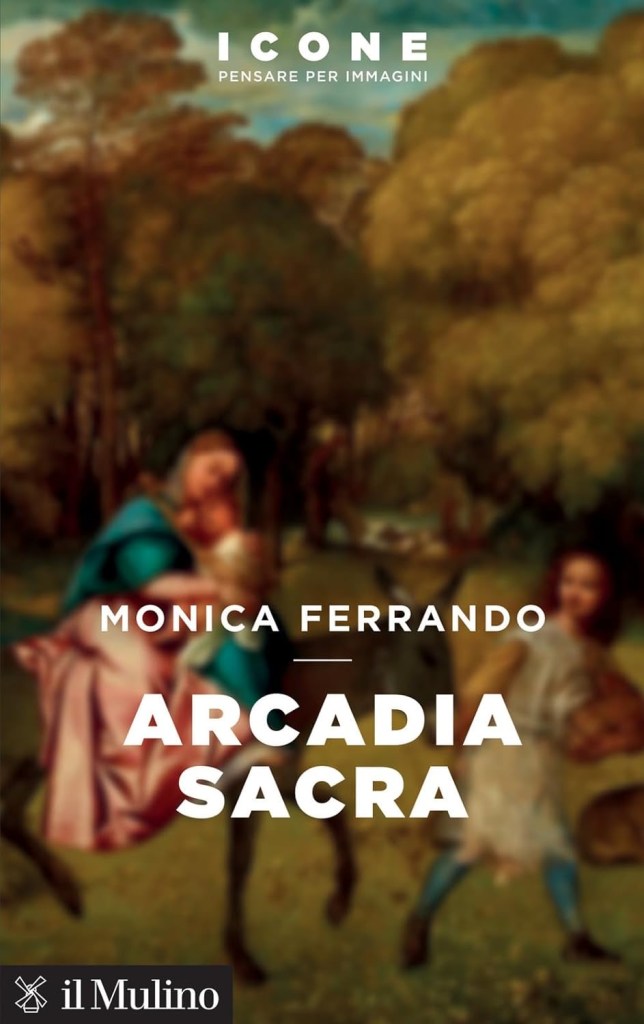
Living among the gods. On Monica Ferrando’s Arcadia Sacra (2024). by Gerardo Muñoz

For anyone familiar with the delicate thought of Monica Ferrando, the short book just published, Arcadia Sacra (Il Molino, 2024), makes it impossible not to read it in light of her the two previous works, the ambitious Il regno errante (Neri Pozza, 2018) that reconstructs the political paradigm of the nomos of Arcadia, and L’elezione e la sua ombra: Il cantico tradito (2022), which brought to light the corrupted meaning of a theopoetic understanding of “election” and its appropriation by an effective economic theology apparatus that governs over the destiny of the modern edifice. Arcadia Sacra continues Ferrando’s highly original reconstruction of the unforgettable myth of Arcadia within the obscure setting of secular  modernization in which painting itself has come into crisis to the point of utter obsolescence. We might be the first epoch in the history of humanity (or even prehistoric, since painting goes back to the non-original origin of the caves, as Ferrando has argued) in which painting itself is lacking and almost non-existent [1]. And although Ferrando does not allude to the present directly, it goes without saying that by choosing as her focal point Titian’s early picture “The Flight into Egypt” (1508), the vision deployed in the essay can only speak to us as urgently, where the thematics confronted by the Renaissance of Venetian painting returns to our present in a fractured flash: imperial conflagration, unlimited deployment of force, usurpation of territory and  multiplication of legal checkpoints, and the accelerated disconnection between architecture and nature, color the ongoing devastation of the vantage point of the landscape now eclipsed by the radiant artificial confinements of the contemporary metropolitan designs.  

Already during his postwar years in the United States, Theodor Adorno observed how the unbounded sadness of the American landscape has nothing to do with an inhuman romantic sublime; it was rather that the landscape feels as if it bears no traces of the human hand [2]. If Americanism configures the long lasting night of planetary nihilism; this is so, not only due to capitalist subsumption and production of human life, but fundamentally because of the inherent obliviousness of the  landscape that forecloses dwelling in the world. But the myth of Arcadia, as Ferrando will insists, is no utopia nor crafted rhetoric (the bucolic genre as an aesthetic compensation to the normative grid of the social bond); it is also the question about the earthly ground of existence, and the necessary attunement with the things that have been domesticated into order of the metaphysics of idolatry and objectivity (Ferrando 28). In this sense, Arcadia does not name another world to come; it is a world that has been registered many times, reappearing whenever the hand reaches out in proximity as if caressing the landscape’s skin.

The mytho-poetical deployment of Arcadia returns amidst a world in conflagration, and for Ferrando this has fundamental political implications insofar as it shows a way out from the grammar at the service of force and political dominion of commanders and soldiers – which is always already exercised as legitimate to coerce and to become a tool for the regulation of abstract mediations – into the voice of poets, painters, and shepherds (Ferrando 51). Arcadia reveals that the human species is a ductile animal that can sense by the ability to touch and use. This is why Arcadia stands as a third space outside the political dichotomy of empire and republicanism, between the struggle of usurpation and conquest, and the techno-political administration of common goods of social distribution and institutional delegation. The abstract humanism of the Renaissance, as Heidegger once claimed alluding to Machiavelli’s political thought, is also the commencement of a specific political technology rooted in certainty and justification that can only conceive representation as the ground for the production of an “effective truth” [3]. The virtuous homini militari of the Italian city states anticipate the neutralization of force as legitimate rule that will prepare the stage of modern political realism based on fear and normative rule of law. The final efficacy of force is to transform the sense of the world into a mere object, as Weil clearly understood it in her essay on Homer’s Iliad. One of the key insights of Ferrando’s Arcadia Sacra (2024) is that it shows that, parallel to the revolution in political technologies taking place in Renaissance Humanism, the image of Arcadia was being rediscovered in treatises and paintings in order to remain faithful to a different attunement of the nomoi, in which the philosophy of history of sacrifice, endless civil wars, and destruction of the Earth do not constitute true destiny (Ferrando 14). In an exoteric way – and it is so, because the craft of the painter is, precisely, depiction and figuration of the nakedness of what appears before our vision-  painters like Titian, Veronese, and Bellini, became witnesses to the acquiescence of the nomos mousikos, which far from soliciting the conceptual density of a theory of Justice; it registered the preeminent condition of poetizing nature of  living in the vanishing world. Indeed, it was in the musical nomos where the soul could establish the communication between exteriority and interiority within the gleaming order of things. 

If Heidegger in The Origin of the Work of Art suggests that the erection of work occupies the open space of this clearing; Ferrando will thematize how Boccaccio’s understanding of the Earth as radiantly divine was drawing upon the tradition of Arcadia will emerge as the pictorial space of the artists to disclose the vibrant sense of a necessary freedom (Ferrando 43). This means that living among the gods is not reducible to panentheism, if understood as oppositional to monotheism; rather, it was the opening to the event that gathered forms of life,  creations,  affections, and territories. In other words, there will always be gods whenever the world is not enclosed into the homogenous surface of a unified planetarity. And is not painting the quasi-originary activity of human anthropogenesis (the event of being in the world as such) the  sensible evidence that negates any conceptual and political translation directed towards action and justification? After all, painting is, among other things, the business of depicting mute things, as Nicolas Poussin famously claimed. 

But muteness must be qualified and expanded, since Arcadia is no asylum or final refuge of man. Titian’s “The Flight into Egypt” depicts a rite of passage, but also opens to a set of rhythmic connected activities that lead to the landscape. Thus, as Monica Ferrando reminds us, building from her previous Il regno errante, Arcadia is also the material experimentation of acoustic energy; music, or the the nomos mousikos, no longer guided by the command of political service, directed by attunement of the lyre and the syrinx, will speak the unwritten language of the human soul. Painting and music convergence at the nonsite of permanent formlessness. And it is rhythmic music allowing improvisation and experimentation that reimagines a different conception of the polis; a transfiguration of political life, in which the principle of civility in all of its complexity (citizenship, objective transference and negation, civilizational fortitude) will no longer articulate the principal axis of the human commonwealth. Neither a source of higher natural law nor a mere expansion of positive norms, the nomos of Arcadia for Ferrando entails: “inalterabile a unire intimamente musica e legge, entrambe  ágrapha, non scritte, se non nel cuore. L’interdipendenza tra modi della musica e nomoi della città, che sarebbe vano interpretare secondo un rapporto causale, trova nella stessa parola nomos un compendio inesauribile, ribadito nella Politeia: «Non si introducono mai cambiamenti nei modi della musica senza che se ne introducano nei più importanti nomoi della polis” (Ferrando 54). The separation of law from music – as Ferrando will say for poetry and philosophy in later pages – will ultimately lead to the moral struggle towards the rise of the fictitious (and whoever can impose it through their effective hegemony) against the emergence of the “love of thought” (l’amore del pensiero) (Ferrando 57). In this sense, the moralization of justice and its conversion into a specific historical grammar (lex scripta in the juridical apparatus) will ground the order of the polis in which the human will be absolutely sacred so that the sacred nearness between existence and the world – the atopia where the promise of happiness can take place – will vanish forever. As Carlo Levi saw clearly during the postwar years, the rise of the political administration of fear will coincide with the decline of painting as the source of being in liberty within the senses [4]. And, in our days, the historical termination of secularization can only be felt like an unending glacial interregnum (it is no surprise that Disney’s epochal blockbuster is precisely a defense of alienation of a cold being in a Frozen castle) in which the prehistoric reminiscence of the garden can only appear as an afterthought or mere representation, always out of reach, and viciously grazed by wild beasts before our own eyes.  

But seeing is already an exercise in prefiguration of a world that returns where painting stands as the medium for a mediation between the formlessness and the soul. This is why, above all, pictorial space is a privileged surface from which to flee our condition of unworldly inmates of our times. In a certain way, painting does not just bring to bear truth against the regime of calamitous fictions; it is also bears witness, as Ferrando states towards a high moment of Arcadia Sacra (2024), to the rediscovery of a new mental space that revives the attunement to a state of the world no longer reduced to the depredatory practices of civilizational extraction and consented servitude (Ferrando 77). The tradition of painting is not just a collection of forms and artistic conventions, but the ongoing concert that facilitates our movement (and being moved) towards happiness.

This is the promise of the itinerant Mary’s passive and inclined face in Titian’s early masterpiece. It does not come to surprise that for Ferrando, the mother dwells among the gods of peace, in contrast to the figures of the commander or the inquisitorial or priestly judge that monitor an endless narrative of intra-species civil war (Ferrando 63). It should not go without saying that at the same time that some contemporary scholars in the face of a historical crisis of legitimation attempt to revive the aura of the homini militari, the precepts of the ragion di stato and the technical virtues of the charismatic Prince; it has been the work of Monica Ferrando, in fully in display in Arcadia Sacra (2024), that invites us to turn to the counters of eros of painting that, almost stubbornly, transmit to us the infinite possibilities of life among the green blades of grass in Pan’s spiritual land (Ferrando 82) [5]. The sacredness of Arcadia resides in this unbounded exteriority that thanks to the mystery of the mother, is always commencing; and, having achieved happiness, it wants to know nothing about bring the world to conclusion. Beneath the arcana imperii (Rome) and the bylaws of the polis (Athens), the landscape of Arcadia remains a harmonious passage of our cohabitation.   

Notes 

1. Monica Ferrando. “Editoriale”, De pictura 3, 2020: https://www.quodlibet.it/rivista/9788822011643 

2. Theodor W. Adorno. Minima Moralia: Reflections on a Damaged Life (Verso, 2005), 73.

3. Martin Heidegger. Acerca de Ernst Jünger (El Hilo de Ariadna, 2013), 113.

4. Carlo Levi. “Paura della pittura” (1942).

5. I am thinking here of the works of several American  historians of political thought and  legal scholars in recent years that have mobilized efforts to restore a “neoclassical”, Renaissance centered political tradition, as a response to the crisis of modern liberalism. The most prominent list includes, although it is not limited to James Hankins’ Virtue Politics: Soulcraft and Statecraft in Renaissance Italy (Harvard U Press, 2020), Harvey Mansfield’s Machiavelli’s Effectual Truth (Cambridge U Press, 2023), and Adrian Vermuele’s endorsement of Renaissance imperial categories such as Ragion di stato, Lex Regia and the tradition of the Mirror of Princes, see his “Sacramental Liberalism and Region di Stato” (2019) and “The Many and the Few: On the American Lex Regia” (2023). The pastiche of this neoclassical investment made possible by rhetorical and hermeneutical deployments of instrumentalized myth, it is something that I have taken note of in “¿Revival de la tradición legal clásica?” (2022). Drawing a parallel to this classical absorption in American political thought, one could say that this is a reiteration of what Monica Ferrando herself has analyzed in her chapter on German Romantic Neoclassicism and the Winckelmann aesthetic project in her L’elezione e la sua ombra. Il cantico tradito (Neri Pozza, 2022), except now that it lacks aesthetic meditations (there is no Dichter als Führer), thus culminating in the direct exercise of applied executive force. 

Tum Otheos: on a detail in a Van Eyck’s painting. by Gerardo Muñoz

Jan Van Eyck’s 1432 Portrait of a Man has the Greek inscription, and rendered in transliteration, that reads “Tum Otheos” (ΤΥΜ ωΘΕΟς) that has baffled art historians and specialists on the painter for a very long time. It is well known that Van Eyck, the pioneer of oil painting, was fond of leaving all forms of writing in his pictures in Greek, Hebrew, and trilingual idioms that through the centuries have become incomprehensible jottings [1]. At a time when Van Eyck was painting in Northern Europe, the magical efficacy over names and naming was a dominant cultural and religious belief, and the expanded arts of the ‘names of god’ were used to heal and relieve pain, and protect against potential enemies and keep demons at bay [2]. Following Hermann Usener, one could see how the original act of the naming of the gods was no longer tied to ‘momentary divinities’ (Augenblicksgötter), but rather they were functionalized to specific anthropological needs for survival. Nonetheless, it is quite ashtonishing to witness how the painting at year zero that Van Eyck embodies – the very birth of oil painting and the “coming to life” of the figure in depiction – coincided with a divinization itself of the expanded field of the arts [2].  

In Erwin Panofksy’s early interpretation the inscription “Tum Otheos” should be read in light of the musical revolution that had taken place between 1420-1440 in the Netherlands, where the ars nova meant a thorough musical renovation towards a new expressive energy and “exquisite sensibility” nourished by the myth of Timotheos, who was taken as the ancient model of sublime harmony of the new arts and style of bringing life into depiction [3]. Overtly dependent on the transmission of the ancient figure of sound, for Panofsky the inscription “Tum Otheos” pays homage to the lyre Timotheus of Miletus as creator of the “new music”. But, could the same be transplanted into painting? Could painting at “year zero” be taken as precisely this new tonality of the arts? 

A second possible rendition of “Tum Otheos” is one what has been merely registered, although not elaborated, by art historian Alfred Acres, for whom “tum otheos” is not indexing the ancient musician but more importantly, it is registering an event or what is taking place [4]. Thus, for Acres “Tum Otheos” should be read as “and then God”; as if the relationship between painter, depiction, and spectator was the very taking place of a minor and invisible god of creation that painting facilitates. It is not difficult to recall here what Luca Giordano said of Velazquez’s painting: “this is the Theology of Painting” [5]. Although directed at Las Meninas, one could perceive that in the early stages of the secularization of the forms of the modern, the nexus between theology and painting becomes a clandestine partnership that resists its full integration into the autonomization of forms of representation. In other words, there is always a theos reminder in the act of depiction that is irreducible to the general economy of forms, as if the dissonance of the soul endured underneath at the nearness granted by the concrete realization of a picture. “And then God”, as proposed by Acres, should not be taken merely as the eruption of the divine in the symbolic structuration of the world, but rather as the very act of naming that allows divinization to continue in spite of the closure announced by the flight of the gods. 

Just one year after Van Eyck’s Portrait of a Man (1432) where the inscription “Tum Theos” appears, in Italy Alberti will write in his De Pictura that the gesture of painting “possess a truly divine power in that not only does it make the absent present (as they say of friendship), but it also represents the dead to the living many centuries later, so that they are recognized by spectators with please and deep admiration for the artist” [6]. And if Postel is right that Van Eyck’s Arnolfini masterpiece is one in which the picture reconvenes the dead bride and the rich merchant into pictorial space, then one could deduce that for the Flemish artist the divinity of painting is defined as the only passage left to the moderns to negate the world of the living and inhabit the invisible world of the dead against the coming of the monothematic world-image and its material crust of Gaia [7]. “Tum Otheos” – and then God – is literally registering the transfigured and expressive dimension of painting; that is, the taking place of depiction and its secret fidelity to what appears only to banish and become forever unfathomable. 

Notes 

1. Susan Frances Jones. “Jan van Eyck’s Greek, Hebrew and Trilingual Inscriptions”, in Van Eyck Studies, September 2012, 294.

2. Noa Turel. Living Pictures: Jan van Eyck and Painting’s First Century (Yale University Press, 2020).

3. Erwin Panofsky. “Who Is Jan van Eyck’s “Tymotheos”?, Journal of the Warburg Studies, 1949, 88-89. 

4. Alfred Acres. Jan van Eyck within His Art (Reaktion Books, 2023), 177.

5. Daniel Arasse. Take a Closer Look (Princeton U Press, 2013), 134.

6. Leon Battista Alberti. On Painting (Penguin Classics, 1991), 60.

7. Jean-Philippe Postel. El affaire Arnolfini: Investigación sobre un cuadro de Van Eyck (Acantilado, 2023).

Towards a new life. On Rodrigo Karmy’s Stasiología (2023). by Gerardo Muñoz

What comes after state form? The grounds for a self-evolving civil war at the heart of the social is what opens up in the wake of the collapse of the categories and grammar of modern politics. Stasiology becomes the fundamental unit to grasp the decoupling of the liberal state from its fixed guarantees and duties. Already during the crisis of legitimation of the seventies, we were told that the modern secular liberal state can no longer guarantee the conditions that made it possible, in the famous hypothesis developed by Böckenförde. The stasiological paradigm thoroughly governs the once implied mediations, social forms, and positive juridical norms of state-society internal mechanics without reminders and procedures. This is why all calls for political realism today are futile and insufficient; the only real existing realism is the one that must be confronted with increasing categorial inversions that ultimately channel the passage from a sufficiently ordered polity (the equilibrium of commerce and virtues) to the conflagration of the civil war as the production of social fabric.

All of this is implicit and glossed in Rodrigo Karmy’s excellent essay Stasiología: guerra civil, formas de vida, capitalismo (Voces Opuestas, 2023) in which the empty performance in the stage of fictitious contemporary sovereignty exchanged for the effective precautionary inversions that have become operative at a planetary scale: republicanism has given in to empire; the horizon of “liberty” nows entails dispossession and domination; authoritative and legitimate rule now means interpretative and exceptional discretionary execution; and, civil society (the modern civilizational unity for social cohesion) has become an axiomatic nexus to manage the tractions and turbulence of total economy (equivalence). The current state of things could not be more grim – and everything that passes through the sign of “order” (orderability, ordinary, ordo) elevates in the name of an self-sufficient abstraction that government paranoia to guide every deviation. The Leviathan stage has zoomed in into the pastoral exercise of uncontested dominion. Those that have claimed that the polis – precisely, as the sphere of social exchange and masquerade, in other words, of practical nihilism – is defunct are perhaps right in stating that its autonomy was destined to become the sheltered territory for pirates, delinquents, and the mafia. What is civil society today if not the confluence or the commuting space of the concert of all existing indirect powers?

For Karmy, abstraction and inversal do not mean just arbitrariness and formlessness lacking description. There is some rationality to what is arbitrary and anarchic in how the public powers are conjoined, distributed, and organized under several logistical units of optimal endurance: a) an axiomatic method that is immanent, flexible, and technologically sophisticated in its aversion to civil war; b) there is a process of exposition and vigilance that, conflating oikos and polis, makes hostis and inimicus indistinguishable, and by extension, coextensive to a global police (just as predicted by Carl Schmitt in the prologue to the Italian edition of The Concept of the political) that can manage and intervene in world-events as without residue. Expressively, Karmy reminds us, the police apparatus becomes the composition of cybernetic deployment based on the capillary consortium of information, reproduction, and differentiations. c) And finally, there is a nomic coupling between politics and geopolitics as the univocal destiny of a planetary humanity as a nihilistic mastery over nature, passions, and geographical localities. But if a century ago Benjamin suggested in One-Way Street (1928) that the power of the proletariat amounted to the measure of its convalescence, it seems that this is a materialist ideal that also has sunk deep into the anomia of the seas. Neither a “collective and sensible” proletariat nor a mobilized pacifist can enact the much expected epochal katechon; the immanent subject of Empire is already invested in the paradigm of force and counter-force, reinforcing what Karmy sees as the global practical and rhetorical geopolitics as an ongoing polemos: “Toda guerra es, ante todo, una guerra contra el pensamiento, Por eso abunda el análisis geopolítico” (Karmy 79). The manifest destiny of geopolitical grounding (knowledge, measurement, exposition) can only admit voluntary servitude towards the conflagration and the distributions of dominance and “influence” that has only intensified from the Iraq invasion of the early millennium to the Covid-19 pandemic techno-administrative measures.

But geopolitical dominance can no longer be said to integrate – there are too many cracks and holes in what it is still called, by inertia (Karmy calls it the ‘Newtonian hypothesis’) , the autonomy of the social. Similarly, its universality is a fallen one; but not because it has accepted the Augustuinian saeculum against the Pelagian heresy, but rather because its unitary mold consists in an internal stasis fractured within: a schism of every community from itself, a separation between things and forms in the originary sense of the Greek polis. Could another nomoi be recovered here? This is the last question posed by Karmy’s Stasiología (2023) through the poetic scene of Guadalupe Santa Cruz, whose turn to the garden is an involuntary act that gathers whatever is left of an ethical life from the ongoing devastation enacted by the barbarism of civilization. The garden is the threshold to a world according to Karmy reading Santa Cruz: “…al borde del mundo, el jardín es la figura que remite al cultivo de estilo, cuidado de la potencia de la imaginación, en último término, lo que designa un gesto” (Karmy 102-103). It is no coincidence that gesture and gestar is a polysemic term that allows to comprehend the figural and self-evolving of a transformation of life; “freedom” is not to deploy internal force towards the appropriation of advantageous outcomes and interest, but of the possibility of delineating the appearance of “a life” holding the unmeasurable world in proximity [1]. It is at this point where forms color how we become who we are.

What must be saved is not “life itself”, but rather the theōs between world and existence that opens “new possibilities” that is anti-scientific precisely because it is not incorporated by the pressure of objective absorption. The theōs is the invisible deviation from the worldly necessity of how things should be and what our lives should aspire to become; and only in this sense we are all martyrs as witnesses to this nearness. Extracting a further consequence from Karmy’s Stasiología (2023) one could claim that every desertion from geopolitical destiny – its unspeakable misery, its blatant bad faith, its farcical prepotence that forces a parodic eschatology – presupposes a return to a new life, which has always began at the surface of our face, as if anticipating reality prophetically: “Only a genuine revolution succeeds in changing the way people look, their facial expressions, the light in their eyes, the charm of their smiles. Christianity appeared with new faces, or taught a new way of looking at them. It is something that anticipates reality, as if prophetically, the universal change that for almost two centuries now has been shaping new faces throughout the whole world.” [2]. If the acclamations for a “New Man” concerned the humanist aspiration of the productive modernity; the vita nova concerns, first and foremost, the conservation of the partition of the soul, the only true entity of alienability where life conquers death. The practice of stasilogy sets out an exercise of this elegant depiction: allowing invisibility to prefigure and breach a new life from the trenches of a never ending struggle.

Notes

1. Monica Ferrando. “Gestare la figura. Note sulla pittura e il suo gesto”, Giardino di studi filosofici, Quodlibet, 2018.

2. Carlo Levi. The Two-Fold night: A narrative of travel in Germany (Cresset Press, 1962), 109.

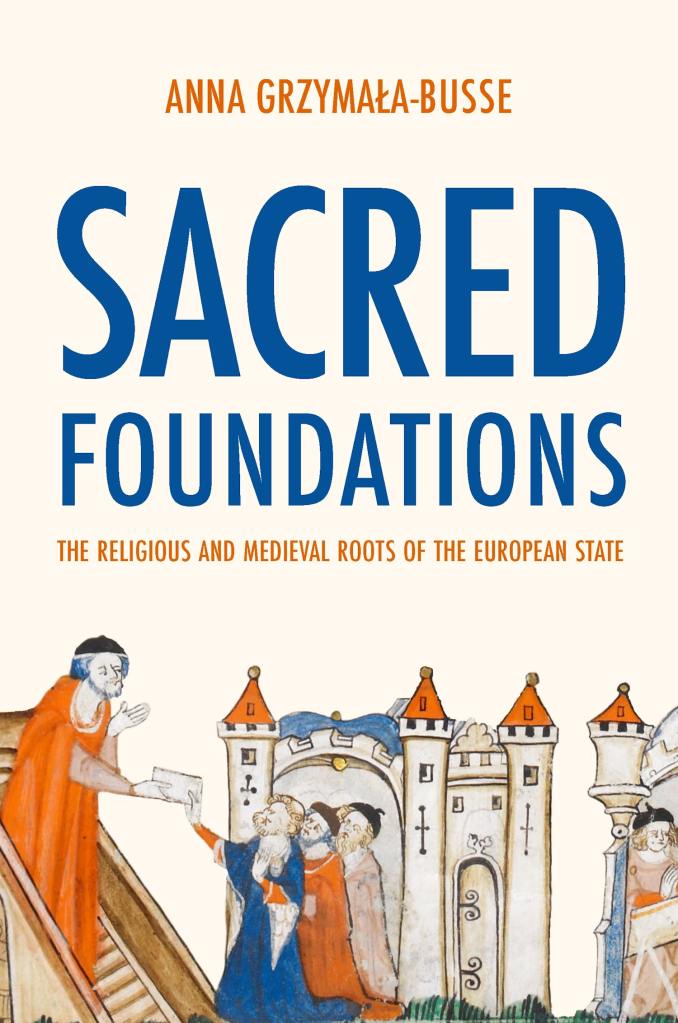
Two side notes on Anna Grzymala-Busse’s Sacred Foundations: The Religious and Medieval Roots of the European State (2023). by Gerardo Muñoz

Anna Grzymala-Busse’s recent study Sacred Foundations: The Religious and Medieval Roots of the Modern State (Princeton U Press, 2023) makes a compelling historical and data analysis grounded case for the emergence of the modern state through the process of the Church’s autonomization in its ongoing disputes with the European monarchs across the centuries. This process of the secularization of ecclesiastical forms (conciliarism, legal administration, the uniformity of procedures, rules for governing institutions, the emergence of educational training and mechanisms for political representation and fiscal control, etc), however, is silent about two defining features of the modern secular state. And I do not think it is an exaggeration to say that these two elements bring forth the way in which political authority was established after the victory of modern European Enlightenment. Busse’s book, if anything, has the felicity of putting in perspective, even if only in negative, the two pieces of the puzzle: a) coercion as guarantee by a legal process (not just the monopoly of force); b) and the inter-institutional coordination that we tend to associate with a ‘principle of an internal rule of recognition’ between different spheres of bureaucratic rationality. Busse admits for (a) that “….the authority of the people over the whole Church was not statelike. It depends on moral authority and influence, not on coercive control. Both kings and popes cajoled, convinced, and threatened rather than demanded or extracted force” (Busse, 78). But ruling on morality and influence are two weak presuppositions to guarantee systemic, homogeneous and uniform process required by institutional authority.

In other words, the Church was able to construct forms of civil mediations, although it lacked the power of efficacy; that is, a coherent set of reasons for action that would define a strong concept of sovereign authority as service (to put it in Raz’s well-known formulation). The classical apothegm by which ‘kings rule rule but do not govern’ (Rex regnat sed non gubernat) now is protracted by the exercise of an efficacious rule, which means laying out a combination of forms and a well-ordered power over coercive forms. In fact, this is one feature that will define the legitimacy of the Enlightenment according to historian Franco Venturi; the discovery of punishment understood within the scheme of a trade off between the “necessity of the right to punish when man was not able to re-establish communism” [1]. Hence, the genesis of modern legitimation is not exclusively “a given” vis-a-vis the structure of separation of powers and the ultimate source of the plenitudo potestatis; rather, it requires a second-step rule, as it were, to convalidate the specificity of institutional authority with ample concrete efficacy of police powers in charge of compliance and punishment. The reach and exercise of public police powers and the systematic ordering of penal codes through a criminal procedure and its guarantees (reasonable doubt, fair trial and due process, no crime published without a previous enacted law, nullum crimen sine lege) is what renders effective and “energic” the principle of authority.

Now, broadly speaking, when it comes to (b) Busse admits that (and this is in spite of its institutional schemes) laying down justice “…the church relied on secular enforcement, for example when it came to religious orthodoxy. […] The carrying out of sentences against heretics and apostates lay in secular hands – those found guilty were handed over the temporal authorities so as to not sully the clergy. Legal coevolution and influence, the struggles between popes and monarchs, and the diffusion of both canon law and personnel into the juridical systems were critical to the rise of constitutionalism and the rule of law in Europe” (Busse, 132-133). This asymmetry between two systems of legal jurisdiction confirm the inexistence of a strong internal rule of recognition that for H.L.A. Hart defines any robust modern legal system of public law. The internal rule of recognition, one must remember, is not a set of principles or norms for social action, but rather the internal mediation between a legislative authority and its internal obedience within a concrete application thereof. The internal rule of recognition binds a central authority with its specific formal enforcement in institutional union of primary rules and secondary rules to avoid the pathology of uncertainty. This is thoroughly absent from the free-floating institutional forms of the medieval church whose principal construction of primary rules was divorced from the objective and rational procedures of its internal coherence (the rule of recognition) that would ground, in time and place, the otherwise abstract primary norm and the pressure of contested social conflict.

But going straight to the crux of the matter, it follows that medieval templates as superbly redrawn in Busse’s studies lack the two fundamental determinations that ground the modern concept of law: law as the necessarily monopoly over coercion (the Austin thesis), and the concept of law as the construction of an internal rule of recognition to unite primary and secondary rules (the Hart thesis). But insofar as all major modern political concepts and mediations are secularized forms of religious and medieval forms – something we can say that Busse’s scholarship also confirms – we can then say that modern legitimacy will consist in the congruence of these two determinations to organize the mediations between civil society and state. Already in his early The value of the state and the significance of the individual (1914), Carl Schmitt will note of this formal transplant: “…the Catholic doctrine of the Pope as the infallible interpreter of the natural moral law and of the content of revelation, who receives the competence to declare state statutes that stand in contradiction with the moral law or ius divino-naturale to be non-obligatory in conscience. The exercise of his potestas indirecta which is regarded as an act of jurisdiction, and which is held, by many canonists, to be determinative of a statute’s validity in state law – contains real vis coactiva, even where the expression potestas directiva is employed in place of potestas indirecta (Suárez, de fide cath, 3.22.1)” [2].

For Schmitt, then, the process of rationalization between ecclesiastical form and the modern legal norms of the state is very much straightforward. This is what constitutes the very texture of secular modernity. But as we know, for Schmitt the secularization of forms was not enough – it must be said that he himself did not negate in his theory of adjudication of his constitutional thought – which is why the construction parameters of his ‘political theology’ proposes supplemental safeguards to isolate law and power, extending the power of secularization into the decision of the potentia dei asoluta (at times this was contained in the theological figure of the Katechon) [3]. But as Carlo Galli has noted, Schmitt’s political theology is far from a “political christology” or a substantive theological politics grounded in natural law; rather it is a resolute affirmation to defend any concrete order from the potential fallouts of the secularized cornerstones of rational neutralization (potentia directiva and potestas coactivva) of state authority [4]. Neither mechanic state forms nor a higher source of morality (natural law) would define the modern law; rather the autonomy of the political in the existential situation could provide the sufficient energy to avoid the self-defeating circularity of ius revolutionis (this is what most of the times is obliterated from the so called question of “decisionism”)[5]. If Busse is correct in making the case that all modern institutions have sacred medieval foundations; Schmitt’s concurrence in the wake of modern secularization will be to define the energy of the political as the defining element that must stand as the threshold of formal transplantations to have a chance within nihilism and against nihilism. It is both things. In other words, formlessness is the constitutive dimension of political forms; an element that defines, in my view at least, the strongest practical element of what it is to inherit a Christian political foundation. The process of secularization is thus infinite and groundless, ultimately without a moral foundation and universal design. Among its many achievements, a book like Sacred Foundations: The Religious and Medieval Roots of the Modern State (Princeton U Press, 2023) has the ability to refine what political theology is, what it meant, and what to make of its endurance and possible iterations in our present.

Notas 

1. Franco Venturi. Utopia and Reform in the Enlightenment (Cambridge University Press, 1971), 116.

2. Carl Schmitt. The value of the state and the significance of the individual, in Carl Schmitt’s Early Legal-Theoretical Writings (Cambridge University Press, 2022), eds. Zeitlin & Vinx, 215.

3. See my “Schmitt y Hart: los puntos fijos del concepto de derecho”, 2022: https://infrapoliticalreflections.org/2022/11/07/schmitt-y-hart-los-puntos-fijos-del-concepto-de-derecho-por-gerardo-munoz/ 

4. Carlo Galli. Genealogía de la política : Carl Schmitt y la crisis del pensamiento político moderno (Unipe, 2019), 301. 

5. Jorge Dotti. “Sobre el decisionismo”, en Lo cóncavo y lo convexo (Guillermo Escolar Editor, 2022), 391.

After plasticity: on Heretical Aesthetics: Pasolini on painting (2023). by Gerardo Muñoz

Pasolini never ceased reflecting upon the painterly nature of the image outside of both literalness and abstraction. In Pasolini we are accustomed to be exposed to a set of antinomies: image and depiction, tradition and the primordial, figuration and the tactile, the world and its fragments. The publication of his miscellaneous writings on painting (and painters of the Italy of the 1950s-1960s) Heretical Aesthetics: Pasolini on painting (Verso, 2023), edited by Ara Merjian and Alessandro Giammei, provides depth and substance to document Pasolini’s insistence to the pictorial activity as an index of unmediated expressivity against the domestication of the accelerated capitalist form that soon enough will generate devastating consequences for idiomaticity and the pregramatical expression of a living culture. It is not too far-fetched to claim that painting remained for him a necessary condition of the cinematic; a specific craft that fundamentally rejected the impulse to naturalness and its mimetic performance. Pasolini remains attached to painting as a form of embodiment, a corporeal resource, and an energetic surface of positioning of light.

After all, as the editors of the book remind us at the outset, Pasolini was after the “plasticity of the image” (37). And plasticity pushes the dexterity of human creativity, but it is something else as well: it is a line of expansion into the prehistoric when it comes to the frontier of appearance. And perhaps Pasolini would have agreed with Gianni Carchia’s indictment in Il mito in pittura (1987) that the attempt of realizing appearance – even at the cost of failing at it – is the fundamental metaphysical node in which the entire history of Western painting stands. A good painting elevates itself to supreme theology, as Luca Giordano said of Velázquez. The problem of appearance in Pasolini’s scene of writing on painting is registered through partial indications: the tone of detailism, the violent and free moving impressionism, the struggle for stylistic contamination, or in the “fragmentary chromatic and interrupted aesthetic” (114). Pasolini’s eye is always accessible to the transient and expressive in a picture.

But the Italian filmmaker struggles with description of paintings, as if possessed by a permanent impatience that harbors his recurrent shortcomings. And he was not unaware: “I am not fluent in the terminology of painting, so forgive me if I sound less specific” (134). It is a declaration that does not only appear once in this collection. One could speculate that this dilemma is resolved by Pasolini in three ways: first, he can choose the painters from a personal criteria that would justify his awareness of painting as a prehistoric cultural activity. Secondly, Pasolini repeatedly alludes to the teaching of the great Italian art historian Roberto Longhi – who was responsible for the first formal analysis of Piero de la Francesca’s pictorial oeuvre – as companion and a maestro that during the Fascist interwar period gifted his students (and Pasolini among them) a different reality through commentaries on the seminal works of Italian Renaissance painting (155). Longhi’s anti-iconographical approach to the pictorial tradition allowed Pasolini a sense touch – not less real than the physical hand that caresses another body or hard surface – and the inexorable mystery-like quality of plasticity. Thirdly, Pasolini avoids coming near a possible ontological description of what, in fact, painting as such stands for him. Does it have an autonomous specificity, or an internal grammar, or perhaps an intricate dependence on other artistic activities (poetry, cinema, social criticism, politics)? Pasolini wanted to understand painting as a force of absorption even if ultimately blinding to the spectator. Nonetheless, Pasolini’s commentaries is rigid at the abyss between what painting is (or should be) and the painters or pictures that he explores in these pages.

This abyssal between word and depiction vouches for Pasolini’s unresolved tension with the nature of painting; a picture is always already dependent or attached to a peripheral phenomena that moves beyond the modern vista’s fulfillment towards totality. In fact, there are a few moments where painting is qualified, as in the text on Carlo Levi: “We are in the presence of something mysterious, ineffable. To speak about that something I can only fumble in the dark, since O a, without a proper terminology…but this ‘something’ is a mystery to me” (176). Or, when in the fragment “Dialectal painting” he suggests that “ [the dialectal tone] is not for the objective content of its figure sand landscapes, but also for the tone he uses to represent it (a tonalism drawn, we could say, from a crepuscular post-impressionism)” (81). Both fragments – so distant from each other in time; one from the fifties and the one on Levi from the seventies – provide an approximate orientation of Pasoloni’s fixation of painting in its specific muteness. This is not because it lacks language, but rather because it only speaks in its own dialect. A painted picture is always about resolving a situated uncanny appearance.

And for Pasolini only the partial profile of a picture – its superficial depth and strength of figuration, but also its lack of sentimentality and abandonment of lyricism that he would come to associate with the bourgeoisie worldview – was capable of dialectical valance, thus upending its misstep into the vulgarity of the “equality predestined and predetermined…the representation of such a world excludes the very possibility of dialectics” (186). This was his indictment of Warhol’s homogenous silkscreen prints and the general phenomenon of Pop Art and the neovvanguardias as coordinated efforts to surpass all that was past and present collapsing into “the voice of the homo technologicus…replacing history with a surreptitious and sacral prediction of history” (147). Bernard Berenson would have agreed to this: the inception of ‘knowing’ over seeing will only secure further mimetic and mystified (through mechanized and applied models in advance) points of departure for a subject of consciousness directed towards history. This is why for Pasolini the avant-garde can only “make the definition of that moment zero [of absolute beginning] profoundly insincere” (149). Painting and tradition walk along the abyss of nihilism. Only negatively can we say that for Pasolini painting is, then, an earthly activity; it is about being in the world in spite of the state of the world; attached to seeing even if the blurred limits perturb the open horizon.

The allure of a lagging postmodern and mechanized painting – but isn’t’ the eclipse of painting for the epoch as such? – for Pasolini exchanges, rather too quickly, lyricism (dependent on the romantic subject that attains it) for nuanced poetic sayability. After all, one of the most straightforward assumptions entertained by Pasolini is that “a painter is a poet who is never forced by circumstances to write in prose…” (106). A remark that comes very close to Poussin’s assertion that painting is an endeavor about the mute nature of things. The muteness of painting has granted artists the possibility to evoke the picture from poetry, as if word and image by entering into proximity can finally participate, side by side, into the mystery of appearance withdrawing from the “adumbrations of our present image-world”, as T.J. Clark recognizes it. There is something to be said in this respect about Pasolini’s long poem “Picasso” (1953) where the medium of poetry touches Picasso’s canvas only to flee from its empty abstraction, disclosing the cunning negation of the world. Or to use a trope common to Clark’s art criticism: Picasso’s fall of Icarus lacks any possible awakening in the present.


Pasolini’s last verse of the poem expresses what for him painting should avoid: “Sunday air…and his error is here [Picasso’s], in this absence. / The exit to / eternity lines not in this desired and premature love. Salvation is to be sought by staying in hell, with a marmoreal will to understand it. A society fated to lose its way is always bound to lose it: a person, never” (75-76). For him painting and Paradise are not meant to cohabitation – which bears witness to Pasolini’s long lasting commitment to the fallen modern world ascertained by the promethean durable struggle. Painting is poetically affirmed by retaining to what does not come to pass: the convulsions of this world. But a question remains: should not the distance implicated in seeing be sufficient in a fading world? Traversing this distance is the inherent divine task of painting; or, as Pasolini simply called it: “exquisite, mysterious – a new religion of things”.

Jesus as gardener in the landscape. by Gerardo Muñoz

A reproduction of Titian’s early work “Noli Me Tangere” (~1514) cannot do justice to its majestical prudence if contemplated directly on the walls of the National Gallery. To use the terms “majestical prudence” might be a bit of a misnomer, but at least it allows to be slide into what entails the central enigma of the picture: its underemphasized contours of the biblical encounter from John 20:15, in which the resurrected Christ appears to Mary Magdalene as a gardener. A lot has been made about the Giorginesque influence on the picture, but it seems to me that the underemphasized composition speaks to the real triumph of Titian’s masterpiece. This is a triumph achieved not so much through the imports of allegory and pagan motifs, but rather as a complex web of distances untangled in the picture: the distance between Christ’s gaze with Magdalene’s upward look, but also the solitary tree inclined leftward, which compensates for the downwards light jerk movement of Christ as he takes distance to escape touching.

I have said nothing of the deep and overpainted deep blue sea in the background; or the receding landscape in the distance with a flock of sheep, high grasesses, barns, and a modest castle to the upper right side of the picture. A little man walks his dog, and we guess he is moving towards the sheep. Or perhaps not. The underemphasized and inconspicuous composition of the picture is precisely in the formulation of distances; invisible distances that allows the gathering of proximity. Only in this minimalist case can the painting be described as giorgenesque. Herbert Cook in his monograph on Giorgione captures this balance by what he calls invisible threads: “Peculiar, however, to an artist of genius is the subtlety of composition, which is held together by invisible threads, for nowhere else, perhaps, has Giorgione shown a greater mastery of line.” [1]. This is also a fair treatment of what holds up the elements in Titian’s picture.

Now, the invisible threads in “Noli me Tangere” do not merely substantiate the networks of lines; rather they also bring the picture to a point of a distant presence. This is what we are able to perceive when confronted with the painting in the walls of the National Gallery. There is another more straightforward way of stating the same: there is something “earthy” to Titian’s rendering of John 20:15, and by “earthy” we attempt to point to point at the distribution of distances between earth, sky, and landscape. This also implies how bodies move in it. It does not take much to document it: one could start by attending to Magdalene’s merciful arm raising to Christ’s cloaked body, followed by his holding of the hoe, which immediately swayes us to the tree. Magdalene’s left hand on an ointment vase reinstates the dowards movement to the ground. The earthly character is the tension elaborated by these distances – a very modern sensation that we will not get in the later pictures of resurrection in the glorious skies of redemption, as noted by Erwin Panoksky [2]. The earthly deposes the relieves of both glory and incarnation. Titian wants to give us the picture of a resurrection in a world that passes by as it retains its tranquility, which painting can only provide us through a non-emphatic incorporation of its distancing.

This could very well account for the assumption that “Noli Me Tangere” becomes a decisive “stepping stone in the evolution of modern culture…from the Byzantine theology to Pantheism and spiritual freedom” [3]. The fact that Renaissance painting was absorbent to the pagan myths is something that has been studied by the major art historians of the twentieth century, so one could also take Richter’s thesis somewhere else. Pantheism is not about the symbolic restitution of specific iconography or motifs, but it is rather the exposition of a particular experience: Jesus as gardener services the disclosure of an unmediated world granted by the perception of distances. The mistaken perception of Jesus as gardener can only be understood, even if momentarily, as undoing the work of Adam, only to be resumed and “served” (ābad) by the Savior [4]. But this might be reading too much “meaning” into the picture, which is deliberately underemphasized in its avoidance to allegorical weight.

To any modern attentive observer, it becomes impossible not to bring into the picture the early modern dispute between gardeners and architects. This opposition does not justify Titian’s “Noli Me Tangere’”, but it does serve (at least it serves me) to insist on the open relation between gardening and the disclosing of an unmediated world, which stands as a theological idiom of the picture. It is most definitely a picture of a resurrected life that is only apprehended by the possibility of immersing itself in the rhythms of the invisible that pertain the world. So, we do not have to wait for the late mysterious and dark Titian to find a full coincidence between painting and thought. “Noli me Tangere ” seems to tell us that there is thought whenever there is earthy grounding in the bifurcation between bodies and things in space.

And so, we can return to the thin blue sea on the left side of the painting, which magically brings all the earthly elements to the forefront. It is the ultimate distance, as well as the unbreachable region where all elements converge (pay attention to the vegetation and the clouds literally becoming blue) sharply on the horizon. It is also the most emphatic instance of the picture; the lacunae that guarantees the masterful structure of invisible threads that ultimately pins its intimate proximity to natural dissolution.

.

.

Notes 

1. Herbert Cook. Giorgione (George Bells & Sons, 1900), 41.

2. Erwin Panofsky. Problems in Titian: Mostly Iconographic (NYU Press, 1969), 40-41.

3. George M. Richter. “The problem of the Noli Me Tangere”, The Burlington Magazine for Connoisseurs, V.65, July 1934, 10.

4. Nicolas Wyatt. “When Adam Delved: The Meaning of Genesis III 2″, Vetus Testamentum, Vol.38, 1988, 121.

A new science of experience. by Gerardo Muñoz

This is merely a footnote to an exchange in light of the short talk “Immanence and Institution” that I delivered yesterday in Mexico City under the generous auspices of Professors Benjamin Mayer Foulkes and Andrés Gordillo (the recording should be available soon in the audio archive). In the rich discussion that followed the hypothesis regarding the triumph of the dominance of the civil concept today, Andrés Gordillo noted that a practice of “discernment” was required to confront the ongoing condition of planetary catastrophe that has only intensified in the wake of AI automation processes that orient the optimizing and unifying the totality of world-events. Alluding to his historiographical research on early modern epoch, Gordilo alluded to the mysticism of the seventeenth century’s “science of experience” (following Michel De Certau’s The Mystic Fable but not only this work) as an existential practice to retreat from the dominium of confession, but also to refuse the Protestant unification driven by the ends of predestination and grace. And unlike the early Christian mystics of the void and releasement, the proponents of a science of experience favored a discernment with God that was vested in every creation of possibilities and modalities exterior to life.

The mystical defense of a science of experiences, then, refuses the concretion of the social subject: being a subject of sin through the postlapsarian condition, but also reflecting the Protestant subject of election that will give birth to the secularization of consciousness and will. The science of experience is the exposure of the soul to the possible transformation with the exteriority as prefigured in transcendental exteriority. A transfiguration of the foundational unity of theological revelation. I find it fascinating that these mystics of the seventeenth century (some of them marranos or facing the problem of conversion) were already aware that an epoch of total dominium and absolute collapse against life requires a transformative nexus with the temporality of experience. 

When Erich Unger in 1921 contemplates the rise of a catastrophic politics in his Politics and Metaphysics, he retorts to a politics of exodus that, precisely, affirms the experiential dimension of existence and communication through what he would call the elevation of the imaginative capacities. In the face of a subsumption of politics into catastrophe, for Unger the immediate task was to elaborate the praxis of experience from the psychic imbalance of the corrosive effects of the subject. In other words, the science of experience names an interior exodus against every instance of rhetorical and mimetical fabrication that seeks to hold the plan discernment of life into a regime of administration and accumulation of plain historical time.


I agree with Gordillo that perhaps the diverse experiments of the “science of experience” could very well be understood as experiments in transitional thought against historiographical closures. The notion of experiment could be extrapolated from Saidiya Hartman’s usage, in a minimalist sense: ways of living on the other side of the rhetorical assignment of the fictitious life of the subject. But perhaps the very term “science of experience” today is a misnomer, in the same way that the proto-concept of “experiential politics” deployed by Michalis Lianos during the cycle of the Yellow Vests runs into an aporetic threshold to name the crisis of the soul’s attunement in the face of the conflagration of the world. Precisely the errancy of experience (and its non-sacrificial relation to pain) is what cannot be subsumed – and for this reason the invisible fleeting gradation – neither to a science nor to a politics.

Sundays outside history: some observations on Eliseo Diego’s La Calzada de Jesús del Monte (1949). by Gerardo Muñoz

The origin of Eliseo Diego’s mythical poetic collection En la Calzada de Jesús del Monte (1949) is so well known and recorded that it has been completely forgotten even by its most copious commentators. In his short memoralist essay “Un día ceremonial”, written decades after the publication of the poem, José Lezama Lima wrote the following: “En uno de sus ceremoniales litúrgicos, en un día de nuestro santo, nos reunimos en la iglesia de Bauta. En esa ocasión Eliseo Diego leyó su “Primer discurso” de En la Calzada de Jesús del Monte. Era un precioso y sorprendente regalo, suficientemente para llenar la tarde con aquella palabra que nace para uno de los más opulentamente sobrios destinos poéticos que hemos tenido…Cuando se publicó En la calzada de Jesús del Monte, el júbilo que me produjo fue esencialmente poético. En unos versos de circunstancia amistosa he intentado decir la alegría que me produce ese libro que traía esclarecimientos para nuestro paisaje y su acercamiento” [1]. At the center in this confession is not only the centrality of a poetic liturgical practice that vested the friendship of the origenistas poets, but more fundamentally the efficacy of the poetic word that Lezama describes as a “júbilo poético” or poetic happiness. It is a strange remark (like almost everything written by Lezama), since En la calzada de Jesús del Monte has been largely read as the litany of a domestic space (a “gran casa de todos”) consumed by dread experienced at the turn of the mid-century failed and stagnated republic.

The intuition raised by Lezama, although not elaborated, still haunts us: in what sense is En la calzada de Jesus del Monte about poetic happiness and what could stand for? We can go astray if we claim that happiness is a particular substantive and representational content of the poetic word. Indeed, there is really no event of happiness in En la calzada de Jesus del Monte except for the taking place of the poetic word fully estranged and foreign from its own place of annunciation. This seems to confirm Diego’s poetic vortex who writes in the dedicación of the book: “A poem is nothing more than a few words told one afternoon to a group of friends” [2]. However, this only deepens the mystery, since whoever tries to find concrete friends in En la calzada de Jesús del Monte (1949) will find none. Solitude abounds and expands throughout spaces. Lezama attempted to elevate the secret of friendship from thought to the liturgical enactment in search for transcendent meaning. Indeed, the emphasis on the mystery of liturgy is emphatic and compressed in Lezama’s programmatic memory about the almost ecclesiastical origins of the poem. I would like to suggest another path for the mysterious and inapparent force of the poem, which is no longer situated at the liturgical aesthetic experience, but rather in the mystery of a felicitous life at the threshold of history. If anything is disclosed throughout the pages of En la calzada de Jesús del Monte this is, precisely, that things appear to dwell in their place, even if no one is around and no community could stand for its reverence. Indeed, the poetic event dwells in an existential solitude before a changing world now fallen into pure disenchantment.

The happiness that falls from the poem, then, is not merely about the execution of the word or the unity of form, but it consists of something previous, altogether different: a mysterious shadow of the enchanted myth. In En la calzada de Jesús del Monte (1949) we are exposed to a poetic language that gathers in a desecularized dimension that suspends what Gianni Carchia identified as the postmythical form of mystery that seems to anticipate the semblance of historical order [3]. But Diego’s En la calzada de Jesús del Monte transfigures mystery to the point of disclosing the limit where life and redemption from the material world take place; namely, in the Sunday of life. But, unlike for Carchia, this poetic transfiguration takes place within the grammar of Christian theology and not the Greek classical past. Here Diego’s poetic mysterium differs fundamentally from the liturgical mystery, which presupposes a “fundamental sacrifice” that allows the temporal sequence of the end of time as the motor for universal religious redemption [4]. By contrast, Diego’s idea of a poetic mystery (which is also the mystery of the poem, which he never ceased to reflect upon through his life) is spatially dispersed, redeeming eternal life from the visibility of worldly phenomena. As Diego writes in an essay defining his conception of the theological mystery: “Primero les haré una confesión…no veo por la sala ningún hábito de Santo Domingo. Uno no debe jugar con los Misterios Mayores, y ninguno es mayor que el Misterio de los Tres que son Uno. Pero, ¿acaso no hizo Él a las ballenas y a los colibríes? ¿Acaso él no sonríe con la infinitud de sus peces y sus insectos? No creo que me tome a mal esta broma que hago como un niño pequeño que pretende jugar con su padre” [5].

By separating the “mayor mystery” of the Trinity from the minor mysteries of imaginative creations of the world (fables, poetry, child’s play), Diego was able to displace the grandiose stage of the liturgical mystery emphasizing the role that humor plays in the affective realization of the kingdom. In other words, it is most definitely the case that the mystery and the poetic musicality compose the parabolic nature of a transfigured kingdom that accompanies the inner existence of each and every human being [6]. Furthermore, this is why the Calzada is a defined in “Primer Discurso” as a pantheistic kingdom: “mi reino, en esta isla pequeña rodeada de Dios por todas partes / en ti ciego mis descanso” [7]. The happiness of the poetic effect in En la calzada de Jesús del Monte is the consummation of an eternal life that, by withdrawing itself from the representation of historical time, can outlive both dread and death. However, in its call for “eternity”, it is language itself that becomes a mode within a series of uncountable events: “sigo pensando, aquí, mi amigo, sucediéndome. / Luego de la primera muerte, señores, las imágenes … .Porque soy reciente, de ayer mismo” [8]. The “sigo sucediéndome”, a modal attempt at transforming life through event diffuses life and death like “Abel y Cain reunidos en Adán, como la muerte” [9]. The transfiguration of liturgical mystery does not evoke a christological arcana, but the overcoming of the civilizational myth of fratricide only to find “unity” in the eternal paradise evoked through Adam. As Diego will also write in an essay about the work of British novelist Jean Rhys: “…el sentido de orar para convertirse en símbolo del misterio de vivir: nuestro jardín era grande y hermoso como aquel jardín de la Biblia – el árbol de la vida crecía allí, nos dice, en medio del terror de una violencia que no entiende” [10]. The reemergence of the myth of an enchanted Edenic garden through the poem?

The fact that Diego chose to write En la calzada de Jesús del Monte as a series of poems and not a novel speaks to his resistance to metaphorize the Garden of Eden outside of the world, overly compensated through a figural postmythical semblance that could have only been taken as a form of parody. On the contrary, En la calzada de Jesús del Monte evokes the original paradise as a recurring and parabolic Sunday of life. A life of nothingness: “si la nada / es también el dormir, pesadamente / la caída sin voz entre la sombra… el Paraíso / realizado en la tierra, como un nombre!” [11]. What cuts through between the forms of the world is the poetic parabola that put us in nearness to the limit of the mystery and the unspeakable. This is what poet Fina García Marruz beautifully captured in one of the most outstanding essays on En la calzada de Jesus del Monte where the weight of the question is meshed with the eros of the poem’s parabola: “Todo arte es, o debería ser, arte de amor, qué es arte de re respeto, la estrategia de una amorosa retirada. Donde el yo se manifiesta en exceso, invade los otros límites, incendia el mundo, pero el verdadero sol del centro, como en Heráclito, no rebasa sus medidas” [12].

García Marruz will even allude to a “magical distance” to elucidate Diego’s poetic measureless opening to proximity: “para el dulce tamaño de la vida que miden estas distancias” [13]. The distances modulate situated existence against the reduction of ordered historical time: “El sitio donde gustamos las costumbres / aquí no pasa nada, no es más que la vida” [14]. As an authentic habitante Diego’s parabola solves the problem of the eclipse of historical time (the ruins of the first morning of historical development) through a descension to spatial detachment where the rest of Sunday is achieved amidst the dust of the world (“como el polvo del mundo”). And from the vantage point of every concrete experience and every limit, life emerges from the dead before a ruinous world marked by the failed Republic. This was a Republic that could not be named (“Yo no sé decirlo: la República”) in a paradoxical display of expository nominalism. As Diego writes in “El sitio en el que tan bien se está”: “en la penumbra como deshabitado sueño” [15]. At the height of 1949, En la calzada de Jesús del Monte was the most rigorous attempt to retreat from this penumbra of historical political life and its daydreaming.

This is the open secret of the actual city street, La Calzada de Jesús del Monte (Havana), during the first decades of the twentieth century, which according to historian Emilio Roig de Lauschering was the only route of communication between the hinterland and the new urban community: “La Calzada de Jesús del Monte que después se llamó después Calzada de Jesús del Monte por haber construido una ermita en la pequeña eminencia donde se encuentra la iglesia parroquial de Jesús del Monte…[…] Pero la Calzada de Jesús del Monte fue desde remotos tiempos hasta no hace mucho la vía principal de entrada y salida entre la población y el campo” [16]. In the late 1940s, la Calzada de Jesús del Monte was already a ‘deshabitado sueño’ as symbolized by dust, debris, oblivion, and death announced by the abstract time of modernization. En la calzada de Jesús del Monte, however, does not cross the path nor seeks a communication between the limits, but rather it opts to dwells on it.

This might be, indeed, Diego’s most important and subtle difference with Lezama’s defense of a liturgical surplus (even ex ecclesia cult of friendship, Freundschaftsdichtung, as a surrogate for national salvation) as if he had found a refuge in the mysterious parish of the Calzada Jesus del Monte or Bauta [17]. Diego’s transfiguration of history placed him at Sabbath in possession of “poderosas versiones de su vida” (“strong modes of his own life”) [18]. But the Sabbath is not a mere memory of a defeated religious community, but as Hermann Cohen argued, a spatial and institutional habit of a people coinciding with the cycles of a bright moonlight [19]. This is why imagination in En la calzada de Jesus del Monte is not enough, and the poet laments: “de tanto imaginarla mi corazón iba callando”. The eternal life of Sundays finds a retreat in the sabbatical experience against the historical time of normality and its revolutionary cycles that demystifies the thingly destruction in which civilization had declined at the end of times. Diego’s La Calzada de Jesús del Monte enshrined the only access to the transfiguration of the mystery: a sabbatical rest disambiguated from the monotone idleness posed by postmythical romanticism [20]. It was in the threshold of parabolic dwelling where En la Calzada de Jesús del Monte remained faithful neither to religious idolatry nor to a free-standing mysterium, but only to the feast of a sabbatical life “como un asno, en perpetuo domingo” (like a donkey, in a perpetual sunday) [21]. The donkey is the transfiguration that must carry this weight. And withdrawing from Juan Vives’ known fable about the peasant who sacrificed a donkey when realizing that he was drinking the moon reflected on a bucket of water, En la calzada de Jesus del Monte stubbornly trumpets not the entry to a “poetic enlightenment”, but the dwelling into the eternal Sunday where poetry is not a resource of radiant sacrifice of beauty, but the prophecy for both silence and sound [22].

.

.

Notes 

1. José Lezama Lima. “Un día ceremonial”, in Imagen y Posibilidad (Editorial Letras Cubanas, 1992), 48-50.

2. Eliseo Diego.  En la Calzada de Jesús del Monte (Editorial Pre-Textos, 2020), 103.

3. Gianni Carchia. Dall’Apparenza al Mistero, in Immagine e verità: Studi sulla tradizione classica, Edizioni di Storia e Letteratura, Roma, 2003.

4. Odo Casel. Misterio del culto en el cristianismo (Cuadernos Phase, 2006), 82.

5. Eliseo Diego. “Viaje al centro de la tierra”, in Flechas en vuelo: ensayos selectos (Editorial Verbum, 2014), 162.

6. Giorgio Agamben. “Parabola e Regno”, in Il fuoco e il racconto (nottetempo, 2014), 25-37.

7. Eliseo Diego, En la Calzada de Jesús del Monte (Editorial Pre-Textos, 2020). 

8. Ibid., 115.

9.  Ibid., 117.

10. Eliseo Diego. “Una Iglesia no muy británica: Jean Rhys y su ancho mar”, in Flechas en vuelo: ensayos selectos (Editorial Verbum, 2014), 124.

11.  E. Diego, 119.

12. Fina García Marruz. “Ese breve domingo de la forma”, in Hablar de la poesía (Editorial Letras Cubanas, 1986), 398.

13. E. Diego, 131.

14. Ibid., 177.

15. Ibid., 184. 

16. Emilio Roig de Leuchsenring. La Habana: Apuntes Históricos (Editora del Consejo Nacional de Cultura, 1963), 111.

17. Wolfdietrich Rasch. Freundschaftskult und Freundschaftsdichtung im Deutschen Schrifttum des 18. Jahrhunderts (Halle-Saale, 1936).

18. Ibid., 157.

19. Hermann Cohen. “The Sabbath in its Cultural-Historical Significance”, The Reform Advocate, February 10, 1917, 5-6.

20. José Lezama Lima claims in “Pascal y la poesía”: “En la tradición de Pitágoras, que creía que sólo el símbolo daba el signo y que la escritura, tesis incomprehensible para el contemporáneo romanticismo antisignario, nace de un misterio, no de la horticultura de la pereza”, in Algunos tratados en La Habana (Anagrama, 1971), 166.

21. E. Diego, 147.

22. The fable is told by Hans Blumenberg: “The Spanish humanist Juan Luis Vives recorded the fable of a peasant who killed a donkey because it swallowed the moon while drinking from a bucket, and because the world could sooner do without a donkey than without heaven’s lamp”, in “Glosses on Three Fables” (1984), History, Metaphors, Fables: A Hans Blumenberg Reader (Cornell University Press, 2020), 604.

The regime of adaptation. by Gerardo Muñoz


The collapse of the categorial and formal mediations proper to the foundations of modern politics open up a regime of adaptation as optimized administration. In a concrete sense the well-known Böckenförde formula comes to a closure as it is realized: the liberal secularized state draws its life from preconditions it can no longer guarantee. The fulfillment of secularization entails, paradoxically, a re-theologization of the separation between the species and the experience of the world already leaving behind the temporality of the saeculum. It is no coincidence that three excellent new books recently published and discussed – Conspiracionist Manifiesto (2022), The Politics of Immortality (2022) by Marten Björk, and Adapt! A New Political Imperative (2022) by Barbara Stiegler – share a common thread: the emergence of the regulatory system of adaptation in the wake of the end of political liberalism.

In other words, the marginalization of the logic of representation, the erasure of institutional mediations, and the depolitization of life (which also entails that everything becomes measurable to the value of the political) entails the intensification of a process of abstraction that is deployed on the surround of the human species itself, increasingly optimized given the contingent transformations and irruptions. The Conspiracionist Manifiesto goes as far as to claim that the current articulation of domination should be understood as a full restitution of the nineteenth century project of positivism as the integration of science and life. Comte and his followers, in fact, thought of positivism as a world religion concerning the reproduction of life whose aim was the general crafting of society as an plastic integral organism.

The acceleration of adaptation presupposes the triumph of immanence that was already exerting its force as an indirect power in the nineteenth century drift by romantic subjectivism and expansion of conditions for action in civil society. In the regime of adaptation, the realization of action, devoid of institutional justified reasons, becomes allocated in the processes of production fitted to the incessant demand for adaptation. It is obvious that the acceleration of immanence – first expressed in the subject’s will to power and now folded into the willing slave of adaptation – has intensified in the last years or so, coinciding with the pandemic event and the generic systematization of health understood as a set of coping techniques of behavior.

Already in the 1990s, in an unpublished lecture in Hannover, Ivan Illich described adaptation as an systematization of health: “Adaptation to the misanthropic genetic, climatic, chemical and cultural consequences of growth is now described as health. Neither the Galenic-Hippocratic representations of a humoral balance, nor the Enlightenment utopia of a right to “health and happiness”, nor any Vedic or Chinese concepts of well-being have anything to do with survival in a technical system” [1].

Insofar as it is concerned with the captive reproduction of life, the regime of adaptation puts to rest any believe in positive biopolitics or the community as exception to the social. Yes, this includes even the “community of friends” that Carlo Michelsteader, in his Il dialogo della salute thought as too much of a rhetorical illusion predicated on the exclusion of suffering and death: “In the friendly communities that emerge in light of common vanity, every one lives thanks to the death of those outside the community” [2]. In short, the regime of adaptation solicits nothing else than the task of coming to terms with the principle of the civil (truly the condition of state’s authority), which in even as far as in Roman law made possible the extraneous movement of the subjectum iuris as total equivalence. The predicament of the regime of adaptation – and its irreversible apparatus of administrative law – obliges us to imagine something other than civility (the principle from the Roman Empire to the modern to put it in Cooper Francis’ terms) but without sidestepping into the barbarism of ergonomic processes that are now at the center of what is understood as life. Barbarism and civility’s straight line now bends towards adaptation.

.

.

Notes 

1. Ivan Illich. “Health as one’s own responsibility. No, thank you!”, Speech given in Hannover, Germany, September, 1990.

2. Carlo Michelstaedter. Il dialogo della salute e altri dialoghi (Adelphi, 1988).

On dispensationalism. Monica Ferrando’s L’elezione e la sua ombra: Il cantico tradito (2022). by Gerardo Muñoz

Monica Ferrando’s short but dense book L’elezione e la sua ombra: Il cantico tradito (Neri Pozza, 2022) refines our understanding of the secularization debate in the wake of the epochal crisis of modernity and planetary domination. For Ferrando this current domination is rooted in a specific retheologization that must be grasped at face value, no abstractions allowed. The force of theological domination, which has become a proper religious imperialism, expresses itself as a true corruptio optimi pessima, which Ferrando locates in a very precise intersection: the passage from the suppression of dilectio to an instrumental manifestation of electio that will culminate in the unleashed power to dominate not only the relation with the world, but the very existence of the species. If the Ancient covenant of early Judaism was a prophetic covenant with God, the force of predestination will suppress the mysterious relationship of blessed life to render a “selective process” of theological election [1]. It is only with the rise Protestantism, and Luther’s specific hermeneutical efforts to neutralize the messianic message of Paul’s Letters to Romans that election becomes the paradigm of a new government of the soul in this world, which will ultimately find its material legitimacy with the advent of the reproductive logic of capital. Implicitly building on the thesis of economic theology, for Ferrando the advent of the machine of election materializes in the theological reform that translates the universal salvation of the prophecy into a never before seen economy of the dispensing grace through wealth retribution for human labor [2].

The reformation based on dispensation (oikonomia) differed fundamentally from the Church’s idea of change rooted in the ius reformandi. As Gerhart Ladner shows, if the “idea of reform” up until modernity presupposed periods of spiritual reform through monastic experience in relation to wordly profane time, the apparatus of dispensation of election was oriented at securing an integral government rationality combining law, economy and subjective production without reminder [3]. In this light, the operation of the dispensation paradigm is twofold: on the one hand, it promotes an anti-Judaic operation of reducing Jews to a people of this world that will ultimately will be identified with political Zionism; and, on the other, it dismisses the coming of Christ as worthless, and in the best case as merely postponed [4]. For a reformed theologian like Karl Barth – at odds with the economic evangelism that ultimately triumphed in the United States and that now it extends across the global – there was only a ‘great dispensation’ putting end to the abstraction of value and the homogeneity of the time of production [5]. But more importantly for Ferrando, the triumph of the dispensatory paradigm entails a new fundamentalism of judgement based on “election” (in the broadest sense of value equity and competition) will appear as the only immanent force capable of considering every other religion and confession exterior to itself as “merely pagan and idolatrous” [6]. It would amount to the triumph of the self-made ‘gentleman’ over the outward message of Paul.

The dominance of dispensation meant a full convergence between salvation and profane economic life that will bring exteriority into a crisis in the deepest sense. This is why for the reformist mentality, its own modern image initiates the epoch of irreversibility; that is, the pure historical progress guided by the will of election and the work of grace as an exception to universal salvation. If the modern reform has been at times understood as the new regime of social pluralism and system of indirect separations (between Church and State, civil society and religion, the public and the private, etc) for Ferrando it is on the side of the theological presupposition where its most terrifying arcanum must be found: a dispensational theology whose main unity is the recurrent intrusion, training, modification, and discipline of the forum internum, that is, the administration of the consciousness of man. Whereas the felix culpa allowed for the mystery of repentance and universal salvation; the political meditation of election through accumulation and economic benefits will legitimize the new discourse on toleration, “liberty”, and even democracy as the distribution of surplus value. In this sense, Liberalism (with Locke and other thinkers of the English and Scottish Enlightenments) was born, as later understood by Carl Schmitt, with the structural weakness of “individual freedom” and maximized autonomy that will require the expanding checks of police and governmental penalties to cope with the production of effects. Of course, every deviation or movement that could put a halt to the fiction of election will find itself on the side of illegality, or turned into a remnant of a surreptitious past that must be overcome at all costs. This implied, as Ferrando reminds us, nothing less than a novel modification of the anthropogenesis of the human species.

It is one of Ferrando’s most daring and surprising tasks to show how the machine of election does not merely occupy the economic-political sphere, but that it will eventually also imply an aesthetic imperative in Northern European culture; specifically with the rise of German romantic response to the crisis of the Enlightenment and the question of “classicism” of the classical Greece. If according to Gianni Carchia the aesthetic dimension of modernity should be read as a compensatory answer to the futility of the romantic revolution in subjectivity; Ferrando’s complementation to the thesis brilliantly shows how this attempt was meant to fail at its original ground due to the mimetic appropriation and metaphorization of the Greek historical past in the aesthetics program of Winckleman and German Idealism (with the exception of Hölderlin’s fugitive position) [7]. The mimetic “hellenization” of German romanticism and its posterior afterlives (one thinks of the Stefan George Circle, and Max Kommerell’s Der Dichter als Führer) gave birth to a notion of “culture” that hinged upon the separation of the aesthetic and the religious spheres that had to sacrifice the appearance of beauty in order to attest for the dialectics of objective and subjective forms of the “Spirit”, and thus leading to the triumph of the grotesque and the aesthetic imperative of uniformity and museification. For Ferrando the German spirit of genialismus had as a mission the overcoming Latin, Mediterranean and Mesopotamian forms of life where the distinction between beauty and life never understood itself as a “culture” or objective project of enlightened intellectuals and artists on the mission to transform the contingency of poesis into the realization of the Idea [8].

Displacing this aesthetic dimension to the present, for Ferrando the intrinsic disconnect between appearance and substance of art’s truth emerges today in the predominant social morality of today’s global bourgeoisie: hypocrisy. It is in hypocrisy where today one can see the inflationary hegemony of discourse over the true organization of life that is proper to the dominant metropolitan class of the West, and its maddening obsession with identity politics or “race” oriented discourse as a moral inquisitorial abstraction (it is in this process that the notion of election appears in the least expected of places: sky color, language use, demands for inclusivity, and hyperconscious towards an invented past). The work of hypocrisy, in fact, appears as a secularized form of the dispensation paradigm that aims to normalize and domesticate every form of life that challenges its specular regime. This is why according to Ferrando – and I do not think she is incorrect in saying so – the possibility of art (especially that of “painting”), as the undisclosed of truth will disappear from human experience, as it has no place in the moral functionalism of ‘contemporary art’ nor in the discursive struggle over global communication and opinion battles (the so-called ‘cultural wars’) [9]. The aesthetic museification of the world liquidates the possibility of art’s truth. Paradoxically, in this new scenario everyone must declare himself “an artist” of their own emptiness: the nowhere men that stroll in the works of Robert Walser or Franz Kafka – who never declared themselves to be anything – in our present are flipped on their heads becoming informers of the regime of a universal politics of recognition and moral judgement [10]. These ‘bloomesque figures’ confirms in the last epochal dispensation of the Reformist revolution that the premises of subjective freedom, economic gain, and autonomy of value have culminated in a new aesthetic imperialism that is anthropological and rooted in the triumphant religion of immanence and the sacralization of ultimate values. The endgame has been dispensed in the creation of a “new man” through the sacrifice of every exteriority in man, that is, of the invisibility outside the fiction of his personality.

The paradigm that Ferrando is describing vis-a-vis the operative force of “election” is also one of profound irony, since the mechanism of predestination and election, by betraying prophetic dilectio (love), the “free election” of the moderns entails that everything can be elected at the expense of losing dilectio: the only path towards the mystery of life. This is what the epoch of irreversibility and the arrogance of historical progress has foreclosed and it is incapable of considering. But for Ferrando life remains an ethics, which she links to Eros, whose appeal to the law of the heart is neither religious nor political, but rather an instance to the disclosure of truth. As she beautifully writes towards the end of L’ elezione e la sua ombra (2022): “Occorre osservare che qui si tocca una sorta di grado zero teologico, che scivola nel mero «biologico» solo a patto di esautorare la sapienza della madre o, detto altrimenti, la sapienza come madre, custode di una legge non scritta, di un nomos del cuore, che non necessita di alcun mandato esterno per esercitare la conoscenza che gli è propria. Si apre insomma quello spazio, costantemente e variamente negato, ma imperturbabile, di cui solo la madre, in virtú di una sapienza propria della natura umana, può custodire la legge.” [11].

The foreclosure of the acoustic relation to prophecy documents the recurrent political interest in the subordination of music to the moral captivity of the reproduction of humanity [12]. On its reverse, the law of eros, prior to the moral domain of natural law and the authoritative domain of positive law, is the protection of the indestructible region of the human soul where no political, moral, or economic dispensation can exert its force. This is confirmed today by the monstrous techno-scientific interventions and dysphoric alterations in the life of children as the last utopia in the long dispensation of the anthropomorphism of capital legitimized by rhetorical force of an unending sermo homilis [13]. In this sense, what Ferrando accomplishes in this wonderful essay is to remind us that the event of theology remains outside the dominion of priests and bureaucrats and situated in the prophetic dimension of Eros (love) that guards the inclination towards beauty and the disposition to attune oneself to the prophecy of the world’s fulfillment [14]. Hence, it is not in the community or in an integralist Christian traditional family order where the sacred dimension of humanity can be retrieved; rather, for Ferrando it is in the non-knowledge reserved by the eros of the mother who never decides nor choses before law, whose nonverbal “tacit authenticity” (“tacita autenticità del legame materno”) unconceals a true experiential depth away from the the delirious cacophony of our world.

.

.

Notes 

1. Monica Ferrando’s L’ elezione e la sua ombra: Il cantico tradito (Neri Pozza, 2022), 8-9.

2. Ibid., 22.

3. Gerhart B. Ladner. The Idea of Reform: Its Impact on Christian Thought and Action in the Age of the Fathers (Harvard University Press, 1959).

4. Monica Ferrando. L’ elezione e la sua ombra: Il cantico tradito (2022), 24.

5. Karl Barth. “The Great Dispensation”, Interpretation, V.14, July 1960, 311.

6. Monica Ferrando L’ elezione e la sua ombra: Il cantico tradito (2022), 30.

7. Gianni Carchia. “Modernità anti-romantica”, in Il mito trasfigurato (Ernani Stamptore, 1984).

8. Monica Ferrando. L’ elezione e la sua ombra: Il cantico tradito (2022), 60.

9. Ibid., 91-92.

10. Ibid., 94.

11. Ibid., 106.

12. On the controversy of music as a tool to tame human’s passions, see John Finnis’ “Truth and Complexity: Notes on Music and Liberalism”, American Journal of Jurisprudence, Vol. 62, 2017, 119-124.

13. Gianni Carchia. “Eros y Logos: Peitho arcaica y retórica antigua”, in Retórica de lo sublime (Tecnos, 1990), 29.

14. Gianni Carchia. “Dialettica dell’immagine: note sull’estetica biblica e cristiana”, in Legittimazione dell’arte (Guida Editores, 1982), 21.