This is merely a footnote to an exchange in light of the short talk “Immanence and Institution” that I delivered yesterday in Mexico City under the generous auspices of Professors Benjamin Mayer Foulkes and Andrés Gordillo (the recording should be available soon in the audio archive). In the rich discussion that followed the hypothesis regarding the triumph of the dominance of the civil concept today, Andrés Gordillo noted that a practice of “discernment” was required to confront the ongoing condition of planetary catastrophe that has only intensified in the wake of AI automation processes that orient the optimizing and unifying the totality of world-events. Alluding to his historiographical research on early modern epoch, Gordilo alluded to the mysticism of the seventeenth century’s “science of experience” (following Michel De Certau’s The Mystic Fable but not only this work) as an existential practice to retreat from the dominium of confession, but also to refuse the Protestant unification driven by the ends of predestination and grace. And unlike the early Christian mystics of the void and releasement, the proponents of a science of experience favored a discernment with God that was vested in every creation of possibilities and modalities exterior to life.
The mystical defense of a science of experiences, then, refuses the concretion of the social subject: being a subject of sin through the postlapsarian condition, but also reflecting the Protestant subject of election that will give birth to the secularization of consciousness and will. The science of experience is the exposure of the soul to the possible transformation with the exteriority as prefigured in transcendental exteriority. A transfiguration of the foundational unity of theological revelation. I find it fascinating that these mystics of the seventeenth century (some of them marranos or facing the problem of conversion) were already aware that an epoch of total dominium and absolute collapse against life requires a transformative nexus with the temporality of experience.
When Erich Unger in 1921 contemplates the rise of a catastrophic politics in his Politics and Metaphysics, he retorts to a politics of exodus that, precisely, affirms the experiential dimension of existence and communication through what he would call the elevation of the imaginative capacities. In the face of a subsumption of politics into catastrophe, for Unger the immediate task was to elaborate the praxis of experience from the psychic imbalance of the corrosive effects of the subject. In other words, the science of experience names an interior exodus against every instance of rhetorical and mimetical fabrication that seeks to hold the plan discernment of life into a regime of administration and accumulation of plain historical time.
I agree with Gordillo that perhaps the diverse experiments of the “science of experience” could very well be understood as experiments in transitional thought against historiographical closures. The notion of experiment could be extrapolated from Saidiya Hartman’s usage, in a minimalist sense: ways of living on the other side of the rhetorical assignment of the fictitious life of the subject. But perhaps the very term “science of experience” today is a misnomer, in the same way that the proto-concept of “experiential politics” deployed by Michalis Lianos during the cycle of the Yellow Vests runs into an aporetic threshold to name the crisis of the soul’s attunement in the face of the conflagration of the world. Precisely the errancy of experience (and its non-sacrificial relation to pain) is what cannot be subsumed – and for this reason the invisible fleeting gradation – neither to a science nor to a politics.
At his rubric at Quodlibet, Giorgio Agamben has recently reflected on the famous Goethe-Napoleon exchange on the destiny of human beings as entirely political. This theme is central to any observer of contemporary geopolitics, which as Carl Schmitt noted towards the end of The Concept of the Political (1932) was realized through the indirect powers of economy and war. During the interwar years Schmitt wanted to preserve the autonomy of the political at all costs, although he will soon conclude in his postwar writings that it was no longer possible given the full extent of a global police management (as he notes in the Italian prologue “Premessa alla edizione” to the 1963 Mulino edition).
What does it mean that politics has become the only destiny of Western Man? One could only imagine Goethe’s surprise at Napoleon given that he was the poet that most passionately reflected on the demonic opening towards destiny. Now, the fact that politics is destiny is a way to emphasize the dislocation of character from destiny as the search for one’s own freedom.
It is no surprise that it was another poet, William Butler Yeats who, in the dark hour of 1939, confronted this issue in his poem “Politics” published in his very last book. The poem in question is a sort of farewell to the eclipse of life of the soul constituting the releasement of destiny. It is also interesting that Yeats does not cite the Napoleon-Goethe scene recorded by Eckermann, and rather uses an epigraph from Thomas Mann to reiterate this preposition. The poem should be considered in its totality:
“Politics” (1939)
‘In our time the destiny of man presents its meanings in political terms.’ – Thomas Mann
How can I, that girl standing there,
My attention fix
On Roman or on Russian
Or on Spanish politics,
Yet here’s a traveled man that knows
What he talks about,
And there’s a politician
That has both read and thought,
And maybe what they say is true
Of war and war’s alarms,
But O that I were young again
And held her in my arms.
No destinial politics, however, can totalize the experience of language and thought. This is the crux of Yeats’ poem, it seems to me. In the opening of an epoch of catastrophic politics (as Unger would register it), it was a poet that resisted the metaphysical valence of political destiny working through the imaginal remembrance through the appearance of a “girl standing there”. The last poetic apostrophe of a caducous time could only be redeemed erotically; forever disentangling the fictive conflation of life and politics.
The dispute concerning the legitimacy of modernity also implies the question of the reformation, which transferred the power away from the hands of priests into a new priesthood of everyman’s consciousness. This was the Lutheran self-affirmation of economic theology (it has been laid out by Monica Ferrando’s recent work). The new priesthood implied a consolidation of the power over interpretation, since the biblical sources were now opened to battle over meaning itself. The interests over the Hebrew sources were not new, as a contemporary scholar has shown, but it was of central interest to the hermeneutics of sola scriptura over the scrutiny of the canons [1]. If this is the case, how come Thomas Hobbes account of the religious sources point to a different dimension of revelation? As we know, Hobbes was not alien to the ancient Hebrew sources, but his treatment and conclusions were entirely misplaced. Here I want to briefly account for this divergence.
In reality, it was Carl Schmitt who best confronted this problem in a late essay form 1964, published in “Der Staat, “Die Vollendete Reformation” by asserting that Hobbes’ place in the constellation of the modern political theology of the reform was rooted in the invention of the autonomy of the political. Schmitt works his way through Hobbes’ second bibliography in a subtle way, reminding us that the theorem “Jesus is the Christ” meant the artificial creation of a political technique over the battle over “meaning and truth” that fueled the European wars of religion. Hobbes, contrary to the theologians, became the founder of a counter-power: the confrontation between Leviathan and Behemoth. Indeed, for Hobbes the “reformed theologian” stands as the Behemoth, but it has yet to come to terms with the question posed by Leviathan as who will decide. This is for Schmitt the kerygmatic theme of the New Testament, which will only be decided at the end of times, but meanwhile the decision through authority is the only way in which the problem of “civil war could be neutralized. As a commentator of his time, Schmitt was directing a direct arrow to Rudolf Sohm’s idea of reform, which ultimately coincided with an economic theology bypassing the fact that the era of concrete political theology had its ultimate principle in authority of the sovereign’s decision [2].
Although never registered directly, the lesson of Hobbes for Schmitt resided in circumventing the rationality of the scientist and the technocrat, going as far as to mention Simone Weil’s critique of the codependency of the total state with the essence of technology [3]. The question of decision was Hobbes’ metaphysical solution to an “intra-evangelical war”, which introduced the immanentization of indirect powers unto the flatten space of civil society. In other words, for Schmitt, the true father of the “spirit and letter” of the Reformation was neither Luther nor Calvinism, but Hobbes’ Leviathan insofar as it was able to offer a third option against the secularization of a universal priesthood of the autonomous economic theology. But this is only the beginning of the problems, since we know that Hobbes’ political philosophy was dependent on “civil society” preparing the conditions for the liquidation of anti-normative decisionism. Schmitt himself was aware of this towards the end of his monograph on Hobbes as a farewell to state form. Hence, the epoch of political theology was brought to an end not through reformation, but through the ever-expansion of the operative sphere of the concept of the civil. The triumphant economic theology that has only intensified well into our days adequates to the fullest extent to the infrastructure of Hobbes’s project.
If this is the case, the differentiation that Schmitt establishes in Political Theology II between ius reformandi and ius revolutionis collapses, given that the solicitation of the autonomy of the social requires an ever-expanding outsourcing of administrative apparatus that will turn legality into the bin of administrative application (Verwaltungsrechts einzufügen unwissenschaftlich) [4]. And in the face of administration political theology loses its grip, and economic theology silently takes hold. The subsequent internal triumph of the verwaltungsrechts einzufügen will bring to an end the epoch of political theology. The ideal of the Reform took this challenge and brought it to the very anthropological core of humanity.
.
.
Notes
1. Eric Nelson. The Hebrew Republic (Harvard University Press, 2010), 8.
2. Carl Schmitt. “Die vollendete Reformation: Bemerkungen und Hinweise zu neuen Leviathan-Interpretationen”, Der Staat, Vol.4, 1965, 51-69.
In the short epilogue “Historical Background to the year of grace A.D. 499” to his novel Porius (1951), John Cowper Powys lays out a remarkable prophetic evaluation of a world fallen into a permanent catastrophic condition. Powys’ return to the sixth century in his novel departed from the fascinating fact that during the mid-fifth century there appears to be “an absolute blank” page about the history and culture of its people. And the only historical record proves that the central element was the Arthur’s commanding political dominion over the English territories. In these blank pages of history there are no tormented voices or traces of everyday existence, but the most absolute compacted pressure of barbarism and grandiose “crafty personal diplomacy” oriented by political rule. For Powys, this is the movement of abstract historical force that raises up the mirror of civilization and barbarism in the West.
However , this mirror is completely alien to any notion of happiness, imagination, and sensibility between the surviving human species. A world war had just concluded and atomic menace was the strange tune of daily life. But, in contrast to the triumphalist and historical narrative of postwar diplomatic theaters, Cowper Powys directs his vision (like Hölderlin and Pound before him with Greece and the Latin Mediterranean poets) to a prehistoric strata where language and sensation still had a chance against the civilizational collapse of the West. Againstboth civilization and barbarism, Powys prepares himself to drift away from something major, perhaps more even more catastrophic, which he never names directly in the Porious prologue, although he can unravel its essence in the last paragraph:
“As we contemplate the historic background to the autumn of the last year of the fifth century, it is impossible not to think of the background of human life from which we watch the first half of the twentieth century dissolve into the second half. As the old gods were departing then, so the old gods are departing now. And as the future was dark with the terrifying possibilities of human disaster then, so, today, are we confronted by the possibility of catastrophic world events compared with which those that Arthur and his Counsellor and his Horsemen contented against seem, as the Hebrew poet said, a “very little thing” [1]”.
It is thanks to the genius of Cowper Powys that the coming of catastrophe is understood not as another phase in world-history, but rather, as the opening of endless catastrophic world-events. Even before Martin Heidegger would define the essence of cybernetics as the consummation of the calculation of world events, Powys had already suspected that a stealth rationality towards calculation of events was the catastrophe that crossed the very line of the polarity of barbarism and civilization. The catastrophe of world-event consummation was hinged upon the total convergence of machine and humanity that would liquidate the free relation of the living in the world. As Powys had written in The Meaning of Culture (1930) decades prior: “Money and machines between them dominate the civilized world. Between them, the power of money and the power of the machine have distracted the minds of our western nations from those eternal aspects of life and nature, the contemplation of which engenders all noble and subtle thoughts” [2].
The ascent of atomic existence and the absolute dependency on administrative infrastructure to contain the world, will validate Powys’ astute observation about the ongoing catastrophe at a moment when its development was barely beginning to gain traction. And against futile political fictions, Powys was aware that in a civilization of collapse, political chatter becomes the only legible foul discourse: “Among other aspects of our destiny in this modern regime, the rumor of politics makes itself only too audible” [3]. The seriousness of this rumor has only deepened almost a century after.
.
.
Notes
1. John Cowper Powys. “Historical Background to the year of grace A.D. 499”, Porius (1952), xi.
2. John Cowper Powys. The Meaning of Culture (Jonathan Cape, 1932), 150.
There is a painting from the early sixteenth century at the galleries of the University of Bologna that depicts the gruesome death of Saint Cassian of Imola at the hands of his own students. The story goes that Cassian was a fleeing Christian in the Roman Empire who found a teaching position in the town of Imola, until he was discovered and exposed. In the saints’ hagiographies, it is emphasized his passion concerning reading and writing for his students. This would confirm the high price of Cassian’s punishment: torture and death at the hands of young students (some allegedly even brought their sharpened styli). The Bologna painting is, in fact, a miniature of about five by seven inches, and it depicts eight young students striking at a naked and tied up Cassian. The anonymous painter has chosen carefully to have all of the figures turn away from the spectator, except for a student in the far right corner of the painting who seems to be holding a sort of bowl in the air. He seems disengaged from the frenzied mob. And yet, there are no wounds or bruises in Cassian’s body, which could be an allegorical statement by the painter about the martyrdom condition, or, more literally, the plain fact that the cruel feast has just begun. Cassian’s face is monotone, and one of disbelief, but not yet of someone consumed by the ecstasy of bodily suffering. He is definitely humiliated amidst such violent and naked act. This is highlighted by the stage-like setting of the assault, which does not seem to be taking place somewhere outside, but rather in a strange room whose only way out is a dark and ominous black counter to the left side of the painting.
This black square immediately recalls martyrdom. And yes, in modernity this means David’s Death of Marat (1793) floating figure who stands as the secularized martyr at the year zero of modern representation. In the early modern bolognese painting we are far from there, but the resources at the painter’s disposal (myth, depth, and figure) speak to a postreligiousity at the threshold of a new historical time. Strangely, the figure of Saint Cassian as represented here by the anonymous bolognese painter throws a shadow to our present, given that the teacher or professor has been sacrificed, not so much the literal violence of his students, but by the an even greater disposition towards a shameless nakedness driven by value and a complicit abandonment of its mission. In the United States at least, the long dispensation of the “closing of the American mind” – driven by competition, ranking, placement, mentorship, cultural wars, and identity politics – entails the uttermost collapse of the teacher into the administrator and facilitator of a rather unknown enterprise.
Even in 1983 Carl Schmitt could identify the martyrdom of Saint Cassian as an emblem of the professor betrayed by his former students: “I have also been stabbed by my students”, he will confess to Lanchester [1]. So, just four decades ago the teacher could still stand as an object of fidelity and betrayal. It would be hard to make the case for this hypothesis today, since the pain of the teacher is no longer of betrayal, but of indifference insofar as he can be disposed of. In this sense, only something that possesses a certain aura can be said to be betrayed; while something that can be discarded altogether is something that has seen better days and no longer has value. And if universities and schools today have become larger centers of monotony and alienation of the most basic activities (such as discussion, reading and writing), this is because both students and professors have been, for the most part, replaced by “mentors” and consumers” under the holy contract of hypocrisy, the true and last ethics of the enlightened metropolitan class.
Anyone that has ever had the good fortune to encounter a good teacher or professor will know that his example springs not from what he knows or professes to know, but rather from what he can transpire unto others: to search of a form of one’s own path. The ethos of a teacher has little do with specialization or success, and everything to the incarnation of a gestalt that is not accidental or transient, but perpetually springing from its myth, as Carchia suggested for the work of art [2]. And myth is the sensorial mediation that resists to be instrumentalized into the endless amassing of value by the powerful administrative subjects. This amounts to saying that the teacher finds self-legitimization in its capacity to inspire the shared sense of wonder of the inaccessible.
Or, at least, this has been the teacher at its most groundbreaking moments. The eradication of teaching – which like mostly every other area foreclosed by the crisis of the human experience was unveiled during the years of the pandemic – and its complete abdication to models of “leadership” and “training” (under the fictitious rubric of the syllabus as an economic contract) is the bleakest of the futures that Cassiano could have taken. A nihilist future that, it goes without saying, will be void of martyrs and myths.
.
.
Notes
1. Carl Schmitt. “Un jurista frente a sí mismo: entrevista de Fulco Lanchester a Carl Schmitt”, CSS, 1, 2017, 220.
2. Gianni Carchia. Il mito in pittura: la tradizione come critica (Celuc Libri, 1987), 155.
The origin of Eliseo Diego’s mythical poetic collection En la Calzada de Jesús del Monte (1949) is so well known and recorded that it has been completely forgotten even by its most copious commentators. In his short memoralist essay “Un día ceremonial”, written decades after the publication of the poem, José Lezama Lima wrote the following: “En uno de sus ceremoniales litúrgicos, en un día de nuestro santo, nos reunimos en la iglesia de Bauta. En esa ocasión Eliseo Diego leyó su “Primer discurso” de En la Calzada de Jesús del Monte. Era un precioso y sorprendente regalo, suficientemente para llenar la tarde con aquella palabra que nace para uno de los más opulentamente sobrios destinos poéticos que hemos tenido…Cuando se publicó En la calzada de Jesús del Monte, el júbilo que me produjo fue esencialmente poético. En unos versos de circunstancia amistosa he intentado decir la alegría que me produce ese libro que traía esclarecimientos para nuestro paisaje y su acercamiento” [1]. At the center in this confession is not only the centrality of a poetic liturgical practice that vested the friendship of the origenistas poets, but more fundamentally the efficacy of the poetic word that Lezama describes as a “júbilo poético” or poetic happiness. It is a strange remark (like almost everything written by Lezama), since En la calzada de Jesús del Monte has been largely read as the litany of a domestic space (a “gran casa de todos”) consumed by dread experienced at the turn of the mid-century failed and stagnated republic.
The intuition raised by Lezama, although not elaborated, still haunts us: in what sense is En la calzada de Jesus del Monte about poetic happiness and what could stand for? We can go astray if we claim that happiness is a particular substantive and representational content of the poetic word. Indeed, there is really no event of happiness in En la calzada de Jesus del Monte except for the taking place of the poetic word fully estranged and foreign from its own place of annunciation. This seems to confirm Diego’s poetic vortex who writes in the dedicación of the book: “A poem is nothing more than a few words told one afternoon to a group of friends” [2]. However, this only deepens the mystery, since whoever tries to find concrete friends in En la calzada de Jesús del Monte (1949) will find none. Solitude abounds and expands throughout spaces. Lezama attempted to elevate the secret of friendship from thought to the liturgical enactment in search for transcendent meaning. Indeed, the emphasis on the mystery of liturgy is emphatic and compressed in Lezama’s programmatic memory about the almost ecclesiastical origins of the poem. I would like to suggest another path for the mysterious and inapparent force of the poem, which is no longer situated at the liturgical aesthetic experience, but rather in the mystery of a felicitous life at the threshold of history. If anything is disclosed throughout the pages of En la calzada de Jesús del Monte this is, precisely, that things appear to dwell in their place, even if no one is around and no community could stand for its reverence. Indeed, the poetic event dwells in an existential solitude before a changing world now fallen into pure disenchantment.
The happiness that falls from the poem, then, is not merely about the execution of the word or the unity of form, but it consists of something previous, altogether different: a mysterious shadow of the enchanted myth. In En la calzada de Jesús del Monte (1949) we are exposed to a poetic language that gathers in a desecularized dimension that suspends what Gianni Carchia identified as the postmythical form of mystery that seems to anticipate the semblance of historical order [3]. But Diego’s En la calzada de Jesús del Monte transfigures mystery to the point of disclosing the limit where life and redemption from the material world take place; namely, in the Sunday of life. But, unlike for Carchia, this poetic transfiguration takes place within the grammar of Christian theology and not the Greek classical past. Here Diego’s poetic mysterium differs fundamentally from the liturgical mystery, which presupposes a “fundamental sacrifice” that allows the temporal sequence of the end of time as the motor for universal religious redemption [4]. By contrast, Diego’s idea of a poetic mystery (which is also the mystery of the poem, which he never ceased to reflect upon through his life) is spatially dispersed, redeeming eternal life from the visibility of worldly phenomena. As Diego writes in an essay defining his conception of the theological mystery: “Primero les haré una confesión…no veo por la sala ningún hábito de Santo Domingo. Uno no debe jugar con los Misterios Mayores, y ninguno es mayor que el Misterio de los Tres que son Uno. Pero, ¿acaso no hizo Él a las ballenas y a los colibríes? ¿Acaso él no sonríe con la infinitud de sus peces y sus insectos? No creo que me tome a mal esta broma que hago como un niño pequeño que pretende jugar con su padre” [5].
By separating the “mayor mystery” of the Trinity from the minor mysteries of imaginative creations of the world (fables, poetry, child’s play), Diego was able to displace the grandiose stage of the liturgical mystery emphasizing the role that humor plays in the affective realization of the kingdom. In other words, it is most definitely the case that the mystery and the poetic musicality compose the parabolic nature of a transfigured kingdom that accompanies the inner existence of each and every human being [6]. Furthermore, this is why the Calzada is a defined in “Primer Discurso” as a pantheistic kingdom: “mi reino, en esta isla pequeña rodeada de Dios por todas partes / en ti ciego mis descanso” [7]. The happiness of the poetic effect in En la calzada de Jesús del Monte is the consummation of an eternal life that, by withdrawing itself from the representation of historical time, can outlive both dread and death. However, in its call for “eternity”, it is language itself that becomes a mode within a series of uncountable events: “sigo pensando, aquí, mi amigo, sucediéndome. / Luego de la primera muerte, señores, las imágenes … .Porque soy reciente, de ayer mismo” [8]. The “sigo sucediéndome”, a modal attempt at transforming life through event diffuses life and death like “Abel y Cain reunidos en Adán, como la muerte” [9]. The transfiguration of liturgical mystery does not evoke a christological arcana, but the overcoming of the civilizational myth of fratricide only to find “unity” in the eternal paradise evoked through Adam. As Diego will also write in an essay about the work of British novelist Jean Rhys: “…el sentido de orar para convertirse en símbolo del misterio de vivir: nuestro jardín era grande y hermoso como aquel jardín de la Biblia – el árbol de la vida crecía allí, nos dice, en medio del terror de una violencia que no entiende” [10]. The reemergence of the myth of an enchanted Edenic garden through the poem?
The fact that Diego chose to write En la calzada de Jesús del Monte as a series of poems and not a novel speaks to his resistance to metaphorize the Garden of Eden outside of the world, overly compensated through a figural postmythical semblance that could have only been taken as a form of parody. On the contrary, En la calzada de Jesús del Monte evokes the original paradise as a recurring and parabolic Sunday of life. A life of nothingness: “si la nada / es también el dormir, pesadamente / la caída sin voz entre la sombra… el Paraíso / realizado en la tierra, como un nombre!” [11]. What cuts through between the forms of the world is the poetic parabola that put us in nearness to the limit of the mystery and the unspeakable. This is what poet Fina García Marruz beautifully captured in one of the most outstanding essays on En la calzada de Jesus del Monte where the weight of the question is meshed with the eros of the poem’s parabola: “Todo arte es, o debería ser, arte de amor, qué es arte de re respeto, la estrategia de una amorosa retirada. Donde el yo se manifiesta en exceso, invade los otros límites, incendia el mundo, pero el verdadero sol del centro, como en Heráclito, no rebasa sus medidas” [12].
García Marruz will even allude to a “magical distance” to elucidate Diego’s poetic measureless opening to proximity: “para el dulce tamaño de la vida que miden estas distancias” [13]. The distances modulate situated existence against the reduction of ordered historical time: “El sitio donde gustamos las costumbres / aquí no pasa nada, no es más que la vida” [14]. As an authentic habitante Diego’s parabola solves the problem of the eclipse of historical time (the ruins of the first morning of historical development) through a descension to spatial detachment where the rest of Sunday is achieved amidst the dust of the world (“como el polvo del mundo”). And from the vantage point of every concrete experience and every limit, life emerges from the dead before a ruinous world marked by the failed Republic. This was a Republic that could not be named (“Yo no sé decirlo: la República”) in a paradoxical display of expository nominalism. As Diego writes in “El sitio en el que tan bien se está”: “en la penumbra como deshabitado sueño” [15]. At the height of 1949, En la calzada de Jesús del Monte was the most rigorous attempt to retreat from this penumbra of historical political life and its daydreaming.
This is the open secret of the actual city street, La Calzada de Jesús del Monte (Havana), during the first decades of the twentieth century, which according to historian Emilio Roig de Lauschering was the only route of communication between the hinterland and the new urban community: “La Calzada de Jesús del Monte que después se llamó después Calzada de Jesús del Monte por haber construido una ermita en la pequeña eminencia donde se encuentra la iglesia parroquial de Jesús del Monte…[…] Pero la Calzada de Jesús del Monte fue desde remotos tiempos hasta no hace mucho la vía principal de entrada y salida entre la población y el campo” [16]. In the late 1940s, la Calzada de Jesús del Monte was already a ‘deshabitado sueño’ as symbolized by dust, debris, oblivion, and death announced by the abstract time of modernization. En la calzada de Jesús del Monte, however, does not cross the path nor seeks a communication between the limits, but rather it opts to dwells on it.
This might be, indeed, Diego’s most important and subtle difference with Lezama’s defense of a liturgical surplus (even ex ecclesia cult of friendship, Freundschaftsdichtung, as a surrogate for national salvation) as if he had found a refuge in the mysterious parish of the Calzada Jesus del Monte or Bauta [17]. Diego’s transfiguration of history placed him at Sabbath in possession of “poderosas versiones de su vida” (“strong modes of his own life”) [18]. But the Sabbath is not a mere memory of a defeated religious community, but as Hermann Cohen argued, a spatial and institutional habit of a people coinciding with the cycles of a bright moonlight [19]. This is why imagination in En la calzada de Jesus del Monte is not enough, and the poet laments: “de tanto imaginarla mi corazón iba callando”. The eternal life of Sundays finds a retreat in the sabbatical experience against the historical time of normality and its revolutionary cycles that demystifies the thingly destruction in which civilization had declined at the end of times. Diego’s La Calzada de Jesús del Monte enshrined the only access to the transfiguration of the mystery: a sabbatical rest disambiguated from the monotone idleness posed by postmythical romanticism [20]. It was in the threshold of parabolic dwelling where En la Calzada de Jesús del Monte remained faithful neither to religious idolatry nor to a free-standing mysterium, but only to the feast of a sabbatical life “como un asno, en perpetuo domingo” (like a donkey, in a perpetual sunday) [21]. The donkey is the transfiguration that must carry this weight. And withdrawing from Juan Vives’ known fable about the peasant who sacrificed a donkey when realizing that he was drinking the moon reflected on a bucket of water, En la calzada de Jesus del Monte stubbornly trumpets not the entry to a “poetic enlightenment”, but the dwelling into the eternal Sunday where poetry is not a resource of radiant sacrifice of beauty, but the prophecy for both silence and sound [22].
.
.
Notes
1. José Lezama Lima. “Un día ceremonial”, in Imagen y Posibilidad (Editorial Letras Cubanas, 1992), 48-50.
2. Eliseo Diego. En la Calzada de Jesús del Monte (Editorial Pre-Textos, 2020), 103.
3. Gianni Carchia. Dall’Apparenza al Mistero, in Immagine e verità: Studi sulla tradizione classica, Edizioni di Storia e Letteratura, Roma, 2003.
4. Odo Casel. Misterio del culto en el cristianismo (Cuadernos Phase, 2006), 82.
5. Eliseo Diego. “Viaje al centro de la tierra”, in Flechas en vuelo: ensayos selectos (Editorial Verbum, 2014), 162.
6. Giorgio Agamben. “Parabola e Regno”, in Il fuoco e il racconto (nottetempo, 2014), 25-37.
7. Eliseo Diego, En la Calzada de Jesús del Monte (Editorial Pre-Textos, 2020).
8. Ibid., 115.
9. Ibid., 117.
10. Eliseo Diego. “Una Iglesia no muy británica: Jean Rhys y su ancho mar”, in Flechas en vuelo: ensayos selectos (Editorial Verbum, 2014), 124.
11. E. Diego, 119.
12. Fina García Marruz. “Ese breve domingo de la forma”, in Hablar de la poesía (Editorial Letras Cubanas, 1986), 398.
13. E. Diego, 131.
14. Ibid., 177.
15. Ibid., 184.
16. Emilio Roig de Leuchsenring. La Habana: Apuntes Históricos (Editora del Consejo Nacional de Cultura, 1963), 111.
17. Wolfdietrich Rasch. Freundschaftskult und Freundschaftsdichtung im Deutschen Schrifttum des 18. Jahrhunderts (Halle-Saale, 1936).
18. Ibid., 157.
19. Hermann Cohen. “The Sabbath in its Cultural-Historical Significance”, The Reform Advocate, February 10, 1917, 5-6.
20. José Lezama Lima claims in “Pascal y la poesía”: “En la tradición de Pitágoras, que creía que sólo el símbolo daba el signo y que la escritura, tesis incomprehensible para el contemporáneo romanticismo antisignario, nace de un misterio, no de la horticultura de la pereza”, in Algunos tratados en La Habana (Anagrama, 1971), 166.
21. E. Diego, 147.
22. The fable is told by Hans Blumenberg: “The Spanish humanist Juan Luis Vives recorded the fable of a peasant who killed a donkey because it swallowed the moon while drinking from a bucket, and because the world could sooner do without a donkey than without heaven’s lamp”, in “Glosses on Three Fables” (1984), History, Metaphors, Fables: A Hans Blumenberg Reader (Cornell University Press, 2020), 604.
There is something insufficient and risible in the attempt to isolate notions like “revolution” or “emancipation” from the total collapse of the grammar of politics. This insufficiency speaks to a rhetorical inflation which already at the turn of the twentieth century Carlo Michaelsteader identified with the attempt at securing the social bond at all costs. The rhetoric of “saving” (the revolution, emancipation, liberation: saving the subject) at bottom, only shows the simulacra of a redemptive movement of value at the heart of social exchange. And we also know that modern political revolutions were experiments in general socialization. Whether it is Saint-Just appealing to the laws of nature against the positive social contract in the wake of the French Revolution; or Lenin and the Bolsheviks more than a century later in their efforts to stage a utopia of production and classless society, the revolutionary horizon was ultimately about the production of the social bond and little else.
The dialectization between subject and the totality of the modes of production was realized in its reverse: the passage to a new temporal domination unto all sensual activities of life. This was expected given the premise: at the center of the genesis of political organization of the West is not the state, but rather the rhetorical structures of civility. That the last theoretical project of politics hinges on the so-called “rhetorical foundations” of society now comes full circle: the development of civilization in the open.
Of course, revolutionary and emancipatory imagination, except in rare occasions, has always been oblivious to the problem of civilization. And this is why Fordism and high Stalinism were perceived as civilizational projects that mirrored and competed against each other. In this sense, the civilizational rise never escaped the duality between politics and nihilism that is proper to the anxiety over order in the genesis of modern European public powers. This is also why early in revolutionary moments of triumph the excess of barbarism was never left behind, but rather it emerged as its siamese twin of the humanist enterprise. As Merleau-Ponty hinted in his old book Humanism and Terror (1947): “Even though our political life creates a civilization we can never renounce, does it not also cointan a fundamental disease?” [1]. This was Ponty in 1947, where the debris of the war was still in full display in major European cities. To some extent one could imagine not wanting to renounce civilization of such barbarism in the face of atomic disaster. But is this our predicament today? Obviously not, since, precisely the collapse of politics (and its main institutional forms such as positive law and political parties) also amounts to an ongoing crisis that is civilizational in nature.
It is not surprising that what emerges in front of us is a different typology than the one that Merleau-Ponty witnessed in 1947: it is no longer the piling of rubbish, but the rise of metropolitan paradises that organize the infrastructural regime of a contactless world. A decade later, written in the 1950s, Amadeo Bordiga will redefine the stakes of civilization: “…the vigorous coarseness of the barbarian peoples was less dire than the decadence of the masses in the capitalist epoch, the epoch that our enemies name as civilization – a word used well here, and in its proper sense, because it means the urban way of life, the way of life proper to the great amalgamated monsters of the bourgeois metropolises” [2]. Bordiga’s lucidity was capable of grasping that Fordismas the triumph of the utopia of capital now meant that civilization (now reduced as the allocation of exchange and distribution) became the central figure of nihilism. Perhaps Bordiga was too imprudent to call for the shadow of the civilized – that is, the barbarian – but his problem, I take it, is still ours to reflect upon.
.
.
Notes
1. Maurice Merleau-Ponty. Humanism and Terror (Beacon Press, 1969), xxxviii.
2. Amadeo Bordiga, “Specie umana e crosta terrestre”, in Drammi gialli e sinistre della moderna decadenza sociale (Iskra, 1978), 95. My translation.
Some will surely remember the figure of the painter Tirtorelli in Kafka’s The Trial who executes portraits of monotone and serious judges and magistrates on demand. The aura of these portraits is of absolute austereness and seriousness, as if Kafka wanted to capture the lackluster liturgy of the empire of judges and their repetitive exercise of legal adjudication. This seriousness, however, must be contrasted to the comic dimension of bureaucracy, that is known to anyone who might have glimpsed at the administrative processes that control even the tiniest details of daily life (the literary and cultural objects are too many to even reference them). The comic and the serious are also visual tones in the exhibition of modern public powers. If the empire of judges is gray and inexpressive, the bureaucratic agencies have been rendered as playful even if they repeatedly yield tragic effects on anyone entrapped in the legal construction of the “case”.
I recall this, because if today we are in the rise of an administrative state, this fundamentally entails a collapse of the bureaucratic comedy and the judge’s seriousness. The joining of the two spheres implies not only a transformation of the legal culture in the Anglo-Saxon tradition, but also a confusion regarding both the comic and serious that now form an integral techno-political unit. As humor eclipses, comedy becomes controlled, assessed, and weighted against what must be free-standing seriousness each and every time. This integralist institutional imagination, at first sight, could be taken as a return of theology of sorts; but, according to Hans Urs Von Balthasar, it is quite the contrary: the integralist suture is so alien to Catholic theology and the mystery that it only deserves to be taken as a distance from the divine. As Von Balthasar writes in Il Complesso antiromano (1974):
“For humor is a mysterious but unmistakable charism inseparable from Catholic faith, and neither the “progressives” nor the “integralists” seem to possess it—the latter even less than the former. Both of these tend to be faultfinders, malicious satirists, grumblers, carping critics, full of bitter scorn, know-it-alls who think they have the monopoly of infallible judgment; they are self-legitimizing prophets—in short, fanatics.” [1]
And Von Balthsar reminds us that fanatic is a word that comes from fanum – “holy place” – which alludes to the site that the guardian must guard to keep the divinity at bay. In the same way today, the fanatic is the nexus that organizes the administrative process that covers all spheres of human activity and purpose. If this is the case, then one could say that our current society is “fanatical” not because of the new religious factions or outnumbering of social cults, but rather because new legal administrators exert their control in the guise of priests that speak the rhetoric of a social intelligible common good. This is, indeed, the ultimate comic aspiration of a very seriousness legal process (it impacts literally every living species) in which the precondition to safeguards the “good” must be exerted as to keep everyone away from the irreducibility of what is good, beautiful, and just.
The seriousness of the administrative agents is transformed into a perpetual laughter that secures a social bond where no transgression and sensation is possible. Against this backdrop, we see how Gianni Carchia was correct when suggesting that the passage from comedy to enjoyment (divertimento) renders impossible the laughter of redemption in a life that ceases to be eventful [2]. In this way, comedy mutates into a mere socialization of laughter. And the impossibility of entering in contact with the comic initiates the commencement of the social parody.
.
.
Notes
1. Hars Von Balthasar. Il Complesso antiromano. Come integrare il papato nella chiesa universale (Queriniana, 1974), 304.
2. Gianni Carchia. “Lo cómico absoluto y lo sublime invertido”, en Retórica de lo sublime (Tecnos, 1990), 153.
The testimony of Michi Panero in Jaime Chaverri’s El desencanto (1976) still resonates today as a salient witness of the eclipse of the human race and its possibility of experience. I offer here a very straightforward translation of the last sequence of the documentary: “From my own experience, I fear that we will not achieve descendancy…we are the end of the species (fin de raza), an end that is far from being Wagnerian, a species that has been eroding with time. And we simply cannot go on…”. Although Michi uses the expression “fin de raza”, it is obvious that he is not referring to “race”, but rather evoking the human species or the ‘human race’ as a whole (in the same way that, for instance, Robert Antelme’s memoirs of the camp was rendered as The Human Race, originally in French L’Espèce humaine). If our epoch is frivolously obsessed with race and identity tribulations, it is simply because it has opted to suppress that the exhaustion of Man in the moment of the death of God has been set as a concrete end of the human species itself.
This is not necessarily due to a series of immanent threatening events that could put the species at extinction on earth – from ecological catastrophes to nuclear war and global epidemics, to other forms of unimaginable outbreaks – but more fundamentally because everywhere the end of the human is signaling that the human species merely occupy a bulky and flat space and time. In this sense, Michi’s existential witness is not about the decadence of the family structure (of an aristocratic Spanish family during the Franco Regime, which the film denounces as the epochal crisis of the family was becoming a reality in the West), but as Teresa Vilarós reminds us in her classic study, that from now on life will only be perceived as fossilized life, and thus devoid of any existence [1]. And I will add a complementary element to Vilarós’ analysis: there is no resurrection in the fossil residue, but only debris and decomposition of the most elemental kind.
Hence, the last of the human species will linger on for a while, but this is a separate question from what this transformation entails for the originary community of the species. The end of the species, insofar as it belongs to the trained to the regime of adaptation, will only relate through a process of abstraction of absolute expropriation. This is why increasingly today, in the wake of the ruins of politics, the social bond emerges as a brute force of inhuman mediation. In a way, socialization can only socialize the last reserve of the human species: its inhumanity.
If the end of the human species is rarely rationalized, it is due to the fact that within the regime of adaptation, the passage from the sense of belonging to the ‘human species’ into the community of inhumanity is intertwined and at times completely blurred. In fact, this is the same numbing of experience that Robert Antelme captured in The Human Race (1947): “For in fact everything happens in that world as though there were a number of human species, or, rather, as though belonging to a single human species wasn’t certain, as though you could join the species or leave it, could be halfway in it or belong to it fully, or never belong to it, try though you might for generations, divisions into races and classes being the canon of the species and sustaining the axiom we’re always prepared to use, the ultimate line of defense: ‘They aren’t people like us” [2]. The proliferation of the fictitious community today registers the absolute obsolescence of the human species rendered legible in the furious processes of adaptation and reproduction. Michi’s complaint – “somos un fin de raza” – should be inserted in its proper indictment. Un desencantamiento ante el mundo: the revealing of the inhumanity of the human species unleashed in the most natural ways imaginable against the world.
.
.
Notes
1. Teresa M. Vilarós. El mono del desencanto (Siglo XXI, 2018), 56.
2. Robert Antelme. The Human Race (Marlboro Press, 1998), 5.
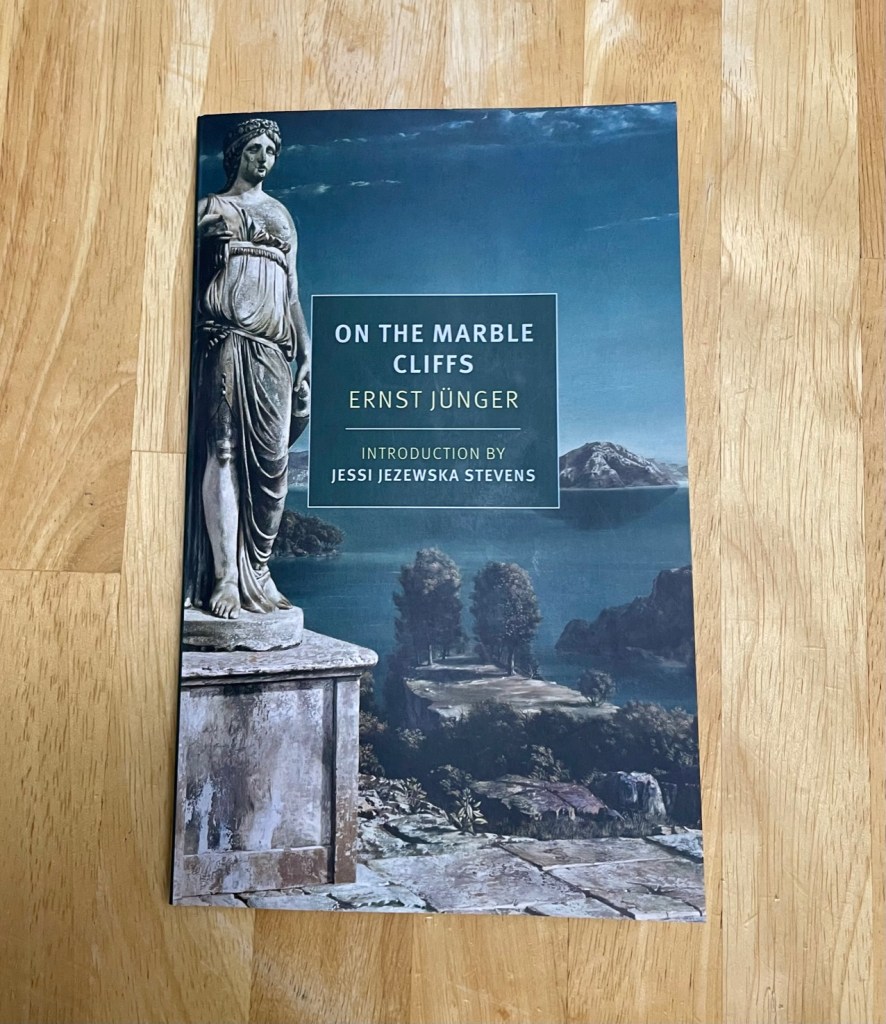
On the Marble Cliffs (1939), which appeared for the first time in Nazi Germany in 1939 (the new NYRB has just been published) offered a narrative of a thorough civilizational collapse of the West. I will side with many of the commentators that have reminded the readers that this novel doesn’t simply amount to an allegory of the rise of National Socialism or the reemergence of indirect powers of civil war in the European interwar years. By underlining “just”, I also mean to say that it is also very much about its epoch. Jünger was an insider of the German elite, and one of the most astute interpreters of his time as his theses on the dominion of the worker and the force of total mobilization were fully realized. It happens that On the Marble Cliffs introduces the civilizational collapse not through the allegorical reduction of the narrative procedure, but rather through a weaving, never truly resolved (much to Jünger’s own intentions), of temporalities that do not land in historical form. Circumventing the meanderings of a dreamlike stage and that of a thick and sensorial description, the novel diachronous movement resembles the stage of a vigil that retrospectively looks from page one at the advent of the disaster: “Only then do we recognize how fortunate we humans are to live from day to day in our small communities, under peaceful roofs, engaged in please conversation, and with the effective greetings morning and night. Alas, we always recognize too late that these simple things offered us a cornucopia of riches” (Jünger, 3). Granted, the vigil is an incomplete assessment of how (not so much as to why, which speaks to Jünger’s separation between his critico-politico essays and his narrative universe) the luminous community of brothers at Grand Marina entered the stage of destruction. During their peaceful time at Grand Marina, the brothers dedicate themselves to studying plants: a contemplative activity through an herbarium that becomes an exercise in clearing the mind and “draining time”. Botany has always stood as a minor activity to escape the realization of death, even if inevitable the cycle of temporal caducity.
But the ruinous time begins with the dominion of the Head Forester, an old governor of Mauretania region whose territorial ambitions are rooted in the domination of world affairs, and the willful defense of its doctrine Semper Vitrix (Jünger, 23). For those familiar with the worldview of Jünger, it is not surprising to find that domination does not begging at the original act of taking, but rather in the scheme of disposition that prepares the liquidation of the originary depth of the world’s opacity. Hence, imperii vitrix is always cartographical, and thus concerned with the the procedure of legible reduction: “For them [Mauretaninas] the world was reduced to a map like those thare engraved for amateour using little compasses and polished insutrmentions that are pleasing to hold. And so it seemed odd to come upon figures like the Head Forester in these clear, perfectly abstract realms freed of any shadows” (Jünger, 23). To dominate the world, one must first dominate over the ideals and images that unify a world. This is why Jünger, just a few years earlier in The Worker, had ended his treatise pointing at the passage from the classical social contract theories of social cohesion to the efficiency of planning of production in order to weaken any possible resistance [1]. This is another reason why On the Marble Cliffs fails at any allegorical instantiation, since allegory hinges upon the unfulfilled stage of historical consciousness, whereas Jünger levels his narrative with the metaphysical disposition that is accomplished in modernity. One could call this the triumph of nihilism and anarchy; the never-ending triumph of ‘barbarism and religion’ of the West since at least the Roman Empire to put in the terms of historian J.G.A. Pocock. This is the “line” of modernity, but it is also the line that is breached at the collapse of modernity staged Onthe Marble Cliffs.
Anarchy and nihilism – for Jünger these are for two routes for prompting a relation with the epochal collapse. More than clearcut positions to endorse, these are unbreachable counters of the limitless epoch. Jünger distinguishes them well through the character of Braquemart: “Suffice it to say that there is a profound difference between fully formed nihilism and unchecked anarchy. The outcome of the struggle will determine whether human settlements will become wasteland or virgin forest. With regards to Braquemart, he was marked by all the traits of full-fledged nihilism. His was a cold, rootless intelligence with a penchant for utopias…On seeing him, one inevitably thought of his master’s profound saying: “The desert grows – woe to him who carries the deserts within!” (Jünger, 76-77). The nihilist suffers from a rather coldness of intelligence, and what Jünger qualifies as the ill-fated adventure of the theorist, always unmatched with that of the pragmatist (Jünger, 78). Granted, everything depends on the internal capacities to react against the growing systematic devastation. On the other side, the anarchist cloaks his accomplice condition within the corruption of the law, where nothing is sacred. This is why the anarchist transforms the forest into an enclosed land for hunting and predatory practice where “cadavers left to rot in the fields spread pestilence, wiping out the herds. The downfall of order brings good to none” (Jünger, 62). On the Marble Cliffs is at times too emphatic with the reiteration of the order in opposition to terror: ‘Terror establishes its reign behind a mask of order” (Jünger, 38). And this speaks to National Socialism antipositivist attitudes to the rule of law, which Jünger seemed to have perceived clearly.
However, it is also true that Jünger’s insistence on order is not just about conservation in the abyss, but rather about how the civilizational collapse is expressed in the puncturing of indirect powers that will ultimately unify the anarchy of domination. To insist on nihilism means to de-hegemonize the indirect powers and factional domination against the visceral hatred of the gratitude of language and the mystery of beauty that burns the inside of demonic spirits (Jünger 39). The luminosity of Jünger’s style and symbolic nakedness speaks, in turn, to an attempt at a mythologization of beauty that emerges in a language devoid of parody. In this sense, Jünger displaces Gianni Carchia’s important thesis about the narrativization of the parody of mystery into the form in the bourgeois novel. Jünger’s beauty is mysterious because it exceeds signification and conceptual closure of the novel conflict, as what language does (or seems to do) on the line of nihilism. For Jünger the revocation of anarchy implies taking a distance from the subsumption of prose into narrative order. Thus, Jünger’s order is a primary order, one of retaining the reserves of sacred and the unfathomable character in the face of barbarism and the destruction of the world.
“We take leave more easily when things are in order” (Jünger, 59). This is the primary order of a plain state of the world, which does not presuppose the obsession with organization and management; it is what allows for the flourishing of contemplative life and the possibility of retreating to the density of the forest. But we know that this is, precisely, what comes crashing down in the rise of anarchy and nihilism, both working in tandem in modernity. Attaching oneself to primary order amounts to “concrete dreaming” at best, as the narrator says early in the book. And it is at this point that On the Marble Cliffs solves this conundrum: the idea of order must not be reduced to a nomos of the world, but rather the possibility of an outside from thinking that there is a finite and finished work of the world. This is where Jünger’s genius shines with usual intensity. It is the moment, towards the end, when the narrator admits: “the beauty of this world now enveloped, I saw, in the purple mantle of destruction” (Jünger, 102). The conflagration of the world, however, only undoes a new capacity for seeing thatwhich had remained in the dense fog of consciousness and aesthetics. In other words, the total collapse brings forth the unperishable element between existence and the world. Jünger achieves the highest point of condensation in this elaboration:
“The harvest of many years of labor fell prey to the element and with the house, our work returned to dust. We cannot count on seeing our work completed here below, and happy is the man whose will is not too painfully invested in his efforts. No house is built, no plan created, in which ruin is not the cornerstone, and what lives imperishably in us does not reside in our works. We perceived this truth in the flame, and its glow was not devoid of joy” (Jünger, 108).
This is not joy or appetite for destruction, but more a joy about what remains unperishable in every destructive act that realizes itself just so that everything could be renewed more or less the same. At the narrative level the unperishable of every work is the mystery that cannot be fully captured either by the deployment of historical allegory or by the mimetic translation of the work of narrative. On the Marble Cliffs remains stubbornly an open novel, but in a very precise sense: it gestures to the divergence between life and the world is barely touched parabolically at a distance. This is why the character of On the Marble Cliffs reaches the end by stressing “the sight of it [an old oak grove] made us feel at home…”(Jünger, 113). Whereas sight is an index of landscape, of seeing beyond the abyss. This is a condition for living among the dead once again. Perhaps this is why Jünger felt the need to record in his French war diaries that Pablo Picasso had asked him if the novel was based on a real landscape [2].
Only a painter that had witness the crisis of modern space (beginning with the “Blue Room” of 1900) could directly engage with the trope of the ‘marble cliff’: it is here that the altar of a sacrificial history and political domination turns into the site of theoria. Now the faculty of seeing grows outside of itself, “to manifest freedom in the face of danger” (Jünger, 117). On the Marble Cliffs is an invitation to this interior unperishable landscape that removes us from idle fictions in the face of anguish if only we do not turn our back to it (in the name of science or technology or new idols). Given that the desert of nihilism can only grow, I wonder how many today could even stand on the cliff. I fear that the effort of raising the head and looking beyond is already too much to ask.
.
.
Notes
1. Ernst Jünger. The Worker: Dominion and Form (Northwestern University Press, 2017), 173-178.
2. Ernst Jünger. A German Office in Occupied Paris: The War Journal 1941-1945 (Columbia University Press, 2019), 78.


 Infrapolitical Reflections