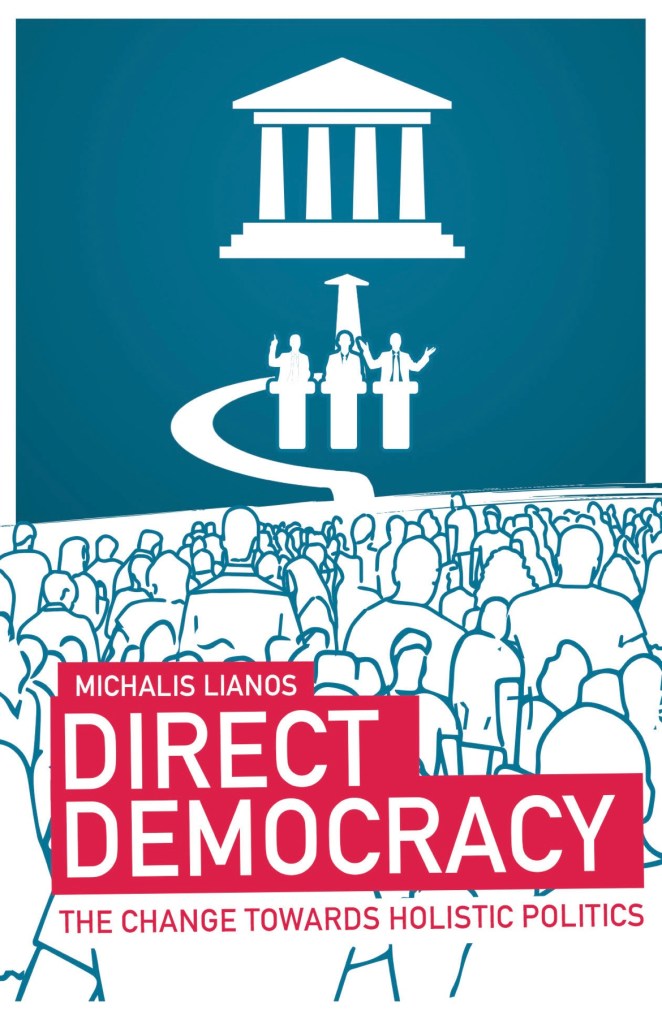
Can holistic politics do the heavy lifting? On Michalis Lianos’ Direct Democracy: The Change Towards Holistic Politics (2022). by Gerardo Muñoz

Michalis Lianos’ Direct Democracy: The Change Towards Holistic Politics (2022) defines itself as a social manifesto to confront the transformation of the nature of political power, public institutions, and the tradition of political representation inherited from the Enlightenment and the French Revolution. This is something that Michalis Lianos – one of the most interesting sociologists of social control of his generation – had already alluded to in his writing during the cycle of revolts of the Yellow Vests in France [1]. In more than one way, Direct Democracy: The Change Towards Holistic Politics (2022) is an expansion of this intuition; although, unlike most manifestos, the book does not take up the tone of denunciation and rupture, but rather of extreme prudence to construct and adequate itself to the complexity of our contemporary societies to a new regime of power distribution and individual empowerment. The total political alienation from public deliberation and participation is, according to Lianos, what stands in the way of people’s common interests. Institutions, political parties, the formalist separation of powers, and the legislative bodies (now in the hands of administrative agencies and corporate firms) have been radically disconnected from people’s lives to the point of becoming endogamic in its practices of decision making and public governance.

No one today can doubt the univocal distrust on all things political (a sentiment dating back to the Romantic age if we are to believe Carl Schmitt) which reminds us that the most interesting social insurrections in recent times have been against the democratic neutralization of the specific metropolitan and capital organization of administrative power. In the face of this schism, Lianos proposes a move towards direct democracy that can short circuit these institutional actors and partisan interests in order to revitalize people’s empowerment. The realization of direct democracy presupposes – and this Lianos’ propositional reinvention of the unity of politics – what he terms a new ‘Holistic Politics”, which he understands as a new civic attitude and a culture between citizens in a “holistic away, as a whole” (Lianos 2022, 2). The aim is to empower and lower public and private decision making at the scale of people’s life consistent with “social trust as the key for a happy collective life” (Lianos 2022, 3). The operative notion of Holistic Politics is, then, both a model of institutional design through the problem of scale; and, at the same time, a reassessment of the epistemological grounds of social action. In other words, for Lianos Holistic Politics should not be oriented towards putting the right answers in any social project, but rather to “ask society the right questions each time” (Lianos 2022, 9). We presume that what is “right” in the “right questions” point to an existential need of the whole, since given the plasticity of Holistic Politics, it cannot appeal directly to neither social facts (since these are always changing) nor a stable legislative agenda of higher representatives (there are inexistent for direct democracy). Regardless of these specificities, Holistic Politics does impose a need that the direct democracy will demand a greatest individual and community participation on fundamental issues raised by the social assembly list of objectives as raised by anyone in the community.

Lianos defines the problem of mitigating social issues within the framework of Holistic Politics in this way: “Holistic Politics recognizes that the most basic political process is the equal right of anyone to put forward issues for discussion and decision. So it is constantly vigilant to ensure, with specific measures that wherever exercises power is required to give answers as to the issues and priorities raised but never to ask the questions or influence how they are put. Issues are raised and ranked in order by the citizens themselves” (Lianos 2022, 15). Lianos is aware that every form of established institutional behavior ends up becoming a social habit (it has what some political scientists called, at least years back, “institutional stickiness”) , and this is why rules for immersion in social interaction must change on a regular basis (Lianos 2022, 17). It is true that rules are the infrastructure to limit social actions (this is, in fact, its unlimited possibilities); although, it begs to ask to what extent the regular change of social rules do not become in itself a habit within the very logic of exchange that defines structurally the social. To put it in different terms, it is insufficient to think, as Lianos does, that capitalism is a concentration of all entities into money form; rather, it is because there is an anterior civil form of exchange that the problem of value always emerges as an indirect force against the unit of the political (Lianos 2022, 21). If one changes the lens from strict capitalist exchange to the problem of value, then it becomes clear that what first appears as an alteration of rules in social facts could, potentially, constitute itself as an aleatory imposition of values, where the “happy life” of some could amount to the valorized “hellish life” of others. Holistic Politics in the same way that it does not say anything about values, it remains silent about the problem of institutions, even though institutions are far from being part of the stagnation of representative democracy that Lianos wants to surpass.

The central question for Holistic Politics is whether it can do the heavy lifting that it promises to accomplish. Can Holistic Politics really open up a way out of the current poverty of the species in the wake of social and civilizational collapse? Lianos seems to be aware of this question if only in passing, as he writes on the subdivision on “Foreigners”: “Holistic Politics is an approach for the entire human species at its present stage of development” (Lianos 2022, 41). This ‘present stage of development’ of the human species remains largely unqualified, and Lianos takes the route of geopolitics and the necessity to overcome the classical separation of powers. But to the extent that we are taking recourse to the human species, there is a fundamental topological and territorial dimension that we are sidestepping too quickly. At bottom the human species is a creature that steps on the Earth crust, and which today have been designated in relation (whether included or excluded) to the metropolitan regime of concentrated and amalgamated reserves for production and consumption [2]. We can say that this is the last expression of civil nihilism: the capability of putting to work; or rather, of the power to put into energy certain elements in any given structure of exchange. And we are barely raising the question here that lingers from Lianos’ assumption. It suffices to say that the spatial composition of the human species today is erased from Lianos’ Holistic Politics, which is raises enormous doubts as to whether a social assembly, the rotation of social rules, and the redesigning of democratic voting can really do the heavy lifting for what is required for this “moment” of the human species. If this is so, then Lianos’s Direct Democracy has not moved past the Atlantic republicanist tradition that placed voting and participation at heart of the democratic polity (this is the heart of the Federalist, as Sanford Levison argued a few years ago). Holistic Politics in this outlook is probably the last residue of modern politics now grafted into the regime of social organization. But we would like to be as precise as possible about this affirmation.

Towards the end of the manifesto Michalis Lianos argues that Holistic Politics brings the individual and society face to face (Lianos 2022, 114). But if this is endgame of Holistic Politics it is also where we found ourselves in the gridlock of social denomination as an extensive (and intensive) regime of adaptation; of forever changing norms, of arbitrary rule making and rule erecting, and governing through contingent situation through the balancing of cost and benefit rationality of social cohesion. In this sense, the conception of the “overall point of view of the social experience” can describe the social composition, but it cannot transcend, as alteration and changing based on needs and values is already folded within it (Lianos 2022, 90). I take it that something analogous could be said of the problem of equity and proportionality in relation to adjudication and the rule of law in the paradigm of Holistic Politics, since what has triumphed in advanced societies of the West is not the fossilized conception of the separation of powers and the empire of judges and courts, but rather the expansion of equity and balancing of principles based on a cost & benefit rationalization to adjust and transform always already mutating social facts (Lianos 2022, 105).

Insofar as it is committed to the primacy of principles of equity and balancing, Holistic Politics does not breach the current framework of value distribution for specific ends of social reproduction (Lianos might say that his ends are better and stronger since he has done away with political representation, but we are also aware that there is an autonomy of value that can be operative on the borders of the political, in fact, it no longer depends on the political unit). There is an interesting discussion by Lianos on the question of failure and social expectations in Holistic Politics – to take up failure beyond the economic penalties and social mortification of the current neoliberal regime – that open up new possibilities only insofar as we move then from and against the infrastructure of the civil exchange principle for social action. Perhaps the realism that Direct Democracy (2022) appeals to has also something to tell us here, since the current collapse of the social regime is one in which failure is abundant, regularly optimized, and rendered productive through forms that accrue greater and intensive force of valorization. But can the irruption of failure in Holistic Politics be taken as a hole within the scheme of valorization? Perhaps it is in this schism where the question of the present stage of the human-species and a politics of experience can be posited against the grain of total social subsumption. The task of a different democratic imagination should depart from this void.

.

.

Notes 

1. Michalis Lianos. “La política experiencial o los chalecos amarillos como pueblo”, traducción & introducción por Gerardo Muñoz, eldiario, Noviembre 2019: https://www.eldiario.es/interferencias/politica-experiencial-chalecos-amarillos-pueblo_132_1289123.html

2. Amadeo Bordiga. The Human Species and the Earth’s Crust (Pattern Books, 2020), 30-31. 

Police and Schools: two vectors of American civility. by Gerardo Muñoz

The conservative journalist David French has recently reported an interesting empirical fact about the social reality in the United States: according to a recent Gallup survey that measures public confidence in American public institutions, there are two institutions defended and discredited by both left and right: those on the conservative right expressed confidence in the police (about 70% or so), and those on the progressive left expressed confidence in schools and higher education (about the same percentage). This is an interesting fact only for the reason that it reveals with immense clarity – very much against French’s political idealism of overcoming the caesura – the two effective vectors of American civil society: police and schooling. In fact, aside from their divergent emphasis, progressives and conservatives agree fundamentally that policing and schooling are the indispensable elements in this moment of civil society. Let’s call it the “high modernist moment of the metropolis”.

This is why to any attentive observer of American reality, police and schooling are so intertwined and mingled with each other that it becomes impossible to separate them, and not just because there is police presence on university campuses or because the police articulates a discourse of “community” and educational instruction in their daily practice. Police and Schools are two vectors in the structure of civil society in the wake of the collapse of modern politics. In other words, what emerges after the end of politics in America is the intersection between police and school as two intersecting poles that sustain, nurture, and reproduce the axiomatic organization of civil society.

The zone of convergence of police and school is culture. Now culture should not be understood as symbolic distribution of mass consumption and public goods, but more specifically as a flexible regime of adaptation whose proper end is the optimization of the civil order. Hence, the fascination and continuous arousal of “cultural battles” in the public spheres is nothing but empty chatter of the same end: the acceleration of techniques and symbolic amalgamations in a social roundup of self-governance. When Sir Ernest Barker defined the necessity of civility as the precondition of the commonwealth, he took for granted that culture was meant to maximize singular character and conduct [1]. On the contrary, today the maximization of culture presupposes a paideia that revokes every character in the name of a flattening conduct that must be adaptive to the ends of abstract civil organization of values. If civility for Barker was condensed in the figure of the “gentleman”, in contemporary America, the figure is the nowhereman: an all-capable human-species that must adapt to the latest marching order and its temporal justifications. In this context, the police and school are elevated from social institutions to productive vectors of civil cohabitation.

It is still striking today to read what theologian Karl Barth wrote in 1928: “In paradise there were no schools and no police. Similarly, and in view of its intensity we must say specifically there was no gentleman unseen, and all the more penetrating “they” of costumes” [2]. And for Barth, it is only in the wake of Romanticism – in this way confirming Gianni Carchia’s important thesis about the consolidation of a subjective romantic modernity – that the police and the school was unleashed against every costume and against everything that stood in its way. Social abstraction is incapable of grasping this stealth transformation. And it cannot see it due to the fact that romantic civility offers, in return, a fundamental oblivion: eternal security within a hellish reality. All things considered, this is also why the United States remains the beacon of endless optimism – while being a deadly playground. The vectors of policing and schooling grammar of force expulses any possible ethical notion of paradisal life.

.

.

Notes. 

1. Ernest Barker. Traditions of Civility (Cambridge University Press, 1948), 137.

2. Karl Barth. Ethics (Wipf and Stock, 2013), 390.

The Gnostic residue. On Mårten Björk’s The Politics of Immortality in Rosenzweig, Barth, and Goldberg (2022). by Gerardo Muñoz.

Mårten Björk’s The Politics of Immortality in Rosenzweig, Barth, and Goldberg: Theology and Resistance Between 1914-1945 (Bloomsbury, 2022) is a major contribution to the ongoing discussion on theology, politics, and life in our present. Indeed, this book of unmatched originality will radically change the coordinates that have structured these debates in and beyond the academic disciplines involved. First conceived as a longer dissertation entitled Life outside life and defended at Gothenburg University in 2018 (which included an voluminous and illuminating chapter on the work of German theologian Erik Peterson, not included in the published monograph and scheduled for publication in the near future) studies three figures of the German interwar period that confronted the civilizational catastrophe of the twentieth century and the rise of the regime of mass production. Through different conceptual elaborations in Franz Rosenzweig, Karl Barth, and the Oskar Goldberg Group (it also includes thinkers such as Adolf Caspary and Erich Unger) a unified thesis emerges: these thinkers crafted a fundamental response to the collapse of the legitimacy of the modern epoch through a radical imagination of immortality and eternal life (Björk 2022, 3). From an angular perspective, Björk’s book measures to Hans Blumenberg’s groundbreaking defense of the legitimacy of modernity through “self-affirmation” of the human; a philosophical anthropology predicament that today has become fully integrated into the arts of planetary destruction, although its genesis is to be captured in the first decades of twentieth century through the dawn of a new catastrophic politics (the term is coined by Erich Unger in his Politics and Metaphysics). In Björk’s account, these thinkers took the stance against the stimmung of the epoch, its historical closure as well as the immanence of nature in order to take up a historical collapse that was civilizational in nature.

It would be a common place to remind the readers of this book that the figures of the research (with the exception of Rosenzweig who in some corners has been taken as the greatest Jewish philosopher since Maimonides) have been unwarranted buried in the monumental and political historiographies of the period and in the edifice of normative Continental philosophies of the twentieth century. However, Björk’s monograph is no simple restitution of dead old men, as this would be too accommodating to the field of the history of philosophy. Behind these figures there are multiple strategic displacements that connect the destruction of biopolitics to the reformulation of ethics of the dead, as well as the revision of Judaic theological sources to execute an effective retreat from the collapse of civilization of the last 5000 years of the human species. In this quadrant there is also a timely gesture on the complicated relationship between Judaism and Christianity; a relation that the book never really solves, although it runs throughout the book flagged for possible future explorations. Methodologically, it is the field of “theology” (not of science of religions a la Weber) that returns to the center as a way to explored an unthought dimension of immortality – that Björk properly renders as life outside life, against all biopolitical saturation and ecological catastrophe of the natural world. It goes without saying that there is an untimely tone that directly speaks to our present. Indeed, it is the radical theological and cosmological presuppositions (outside the formalism of religion and the apocalyptic historical saeculum of the Church) where something like a radical new existence of what it means to live can be rethought. This is Björk’s fundamental invitation.

In “Yearning for a system: Franz Rosenzweig and the great paganism of life’, Björk offers an all-encompassing outlook to the work of the Jewish scholar whose famous Star of Redemption was also accompanied by an interest in European geopolitics of the first decades of the century. In the midst of the First World War, Rosenzweig witnessed the rise of a new paganism of the state as the acceleration of the struggle for life in the West reproducing forever war (Björk 2022, 29). For Rosenzweig modernity was not an authentic or unfinished secularization, but rather the institutionalization of a pagan order of depredatory confrontation that foreclosed the world without outside: absolute immanence now meant the subjectivation of new false gods of modern civilization ordered towards survival and struggle (Björk 2022, 25). Against this backdrop, Björk reads Rosenzweig’s Star as an original theosophy of redemption of the world that exceeds the national political counters, while offering a new planetary and universal dimension of salvation beyond the state as articulated in Globus. Furthermore, Björk notes that Rosenzweig saw himself as a sort of Jewish fighter in the defense for a new planetary community with “religion as an instrument for change” (Björk 2022, 53). Even though the language had residues of imperial imagination proper to the time, it is the theological vector that distorts the political register of the ground battle for survival. Here Judaism appears as a subtraction from conventional historicity by retreating to a prehistoric past where the ‘unity of the world’ had no nomoi, states, or borders (Björk 2022, 54). It should be noted that something similar was advocated in his 1922 booklet Die Staatslose Bildung eines Judischen Volkes about the stateless wandering of the Hebrew people, by Erich Unger who thought could show a way out of the decadence of Western civilization through the revitalization of ancient Judaism. The Jew had never been a member of the polis or a slave of the state, since the Judaic Kingdoms were ruled, as Björk explains, “by an antipolitical priesthood” or a “metapolitical priesthood and not political kingdoms” (Björk 2022, 61). The sharp contrast to the modern Judaic subtext is of importance: whereas Eric Nelson shows in The Hebrew Republic (2010), how the ancient Jewish sources influenced the constitution of the modern state theories of Thomas Hobbes and John Milton; the work of Unger and Rosenzweig centuries later, in the wake of the Weimar era, seeked to radically alienate the command of Judaic prophecy from the regulatory political and geopolitical techniques of anthropological modernity. The gap between the two, for Rosenzweig, would be the hope for eternal life against the management of survival to which modern political grammar succumbed without return (Björk 2022, 66).

But theology offers the route to imagination and vocabulary of restitution, and infinite recapitulation. To grossly synthesize Björk’s thesis: life is best understood as an endless dialogue with the dead. The second chapter “Abundance and scarcity” glosses aspects of Reformed theologian Karl Barth’s thought against the materialism of scarcity of the world and the principle of abundance proper to eternal life. By tracing Barth’s critical dialogue with Feaubach’s sociology of religion of the species-being (which radically impacted the way Marx and Marxism came to understand theology), Björk’s theology puts paradisal life at the center of the mission of salvation; a heretical notion that exceeds the predestination theology of grace deployed in the organization of the modern kakedomonic public powers of modernity (Björk 2022, 88). In this sense it is insufficient to define the capitalist religion as merely a cult without dogma or atonement; it is also, perhaps more fundamentally, an axiomatic system that accentuates the two-dimensional positionality of death and life without residue. For Barth, Björk reminds us, theology is a way out from the cultish axiomatics of the countable and measurable of the visible world: “Theology….seeks to open the believer to the belief in the invisible side of the reality of the world. Theology must become an investigation of this invisible world to which further posits that the visible world is related” (Björk 2022, 103). And Barth’s lifelong interest in the theology of resurrection was precisely a way to insist on the invisible register that conflates nature, morality, and survival of the living within the objective normativity of the world.

Perhaps the most interesting aspect of Barth’s theology discussed by Björk comes by way of the opposition of ethics and morality – this is elaborated as a rejection of the predicament of natural law’s imago naturae and its dependency on rationality – where the second is discarded as merely finite life unto directive command of the natural good. On the contrary, an ethics suspended by the postlapsarian stage is guided by the principle of suum cuique (Björk 2022, 114). The suum cuique (‘to each its own’), although prima facie echoes the Thomist epikeia, it is also free standing for something more: it is a limit to the irreducibility of life in relation to God, which cannot be inscribed in a system of balancing of moral principles in the hands of a sacerdotal authority. Whereas the moral principle of equity (epikeia) organizes the government of this world through principles and moral reasons for action; the suum cuique is the limit set upon our finite life and the eternal in the scope of the saeculum. Björk connects the notion of the suum cuique to the Barthian figure of the “strange saint” who “with tears and laughter provides God and in this provocation is obedient to the election that forms death into life” (Björk 2022, 116). The suum cuique, accepting the postlapsarian condition rejects the instrumentalization of original sin in order to become a “vast eon of the cosmos itself…temporal and finite but also eternalized as that which once was” (Björk 2022, 117). In this way, the suum cuique prepares the paradisal affirmation of every unlived life, an anathema to the thomist substantiation of merely personal dignity and the exceptional mechanism of individual mediation with the economy of election and grace.

The theological exploration of modality of being – this is one of Björk’s implicit lessons in the book – never truly disappears in modernity, but rather reemerges in unexpected spheres. The politics of immortality does not pretend to exhaust this problem. But it is in the last chapter on the enigmatic figure of Oskar Goldberg where this theme is best explored as the true meaning of a life outside life at the center of the book’s conceptual development. Oskar Goldberg is one of the most enigmatic figures of the Weimar era; a magnetic personality that gathered diverse personalities from all corners of the intellectual milieu. He was looked with high suspicion by Thomas Mann, who portrayed him as a mystical undemocratic thinker in Doctor Faustus, but also dismissed by Walter Benjamin and Gershom Scholem (it only suffices to look at the correspondence collected in Scholem’s Walter Benjamin: The Story of a Friendship). A scholar with strong and sedimented knowledge in the Talmud and Ancient Judaism, Goldberg developed a highly sophisticated and speculative theology of the transcendental organism, to put it in Bruce Rosenstock’s terms, which provided an original formulation of a transcendent being based on the Torah in the wake of the new biological theories of the species (the work of Driesch, Uexküll, Spemann, among others) [1]. The biological and mystical vocabulary of Goldberg aroused immediate skepticism from the German intellectual class, but Björk convincingly shows that Golberg’s project was not an arabesque of a madman, but rather a very peculiar modal speculative system that seekd to confront the 5000 years of the civilization of fixation of the Western transition from the society of myth to the civilization of production and psychic energy imbalance (Björk 2022, 127). For Goldberg the passage from the prehistoric stage of myth to the inauguration of the religion of the state meant the sedimentation of a civilizational regimen oriented towards production, devastation, and positionality (Theophanidis recently expressed the proximity between Goldberg’s fixation and Heidegger’s Gestell, unexplored in Björk’s book). Björk is attentive to the fact that Goldberg was not just a proper name but also the constitution of a sort of ‘metapolitical university’ that gathered diverse figures, such as the economic historian and political thinker Adolf Caspary or the philosopher Erich Unger, both who developed their own critique of technological domination under the shadow of Goldberg. Thus, the critique of civilization is not to be taken as an abstract mysticism; for Björk, the concrete effects can be read in Caspary’s forgotten The Machine Utopia (1927), which criticized the utopia of machine civilization proper to both Soviet Bolshevism and Western capitalism – two social orders that shared the same the same historical horizon: reproduction and accumulation of surplus value (Björk 2022, 142).

In this framework, and against the historicist analytics of Marxism, for the Goldberg circle class antagonism and division of labor was not oriented towards emancipation, but rather towards the realization of a global total state. For the Goldberg circle to escape the civilization of the Behemoth of the industrial state required nothing short than a politics of errancy (defended by Unger in his Politics and Metaphysics of 1921) and the reversal to a modal relation with YHWH as an effective and potential dimension against the imbalance of an impoverished reality. Björk claims that for the Goldberg circle there were three possibilities of existence of coming to terms of the modern decline towards: civilizational fixation, myth, or Torah (Björk 2022, 154). And in different ways, they opted for the Torah, which implied not an identitarian reversal to a territorialized Volk but rather an infinite task of becoming immortal, given that our modes correspond to the nature of God and the world (Björk 2022, 166). The task was to depose the production of evil and suffering here and now as mobilized by the incarnation of historical progress. This infinite retreat from the materiality of the finite of the species was a way to open a new polytheism to the Ancient Hebrew metaphysics elaborated in Goldberg’s book, The Reality of the Hebrews (Die Wirklichkeit der Hebräer, 1925). In other words, to exit from the fixation of the 5000 years civilization required a passage to immortality as a way to “make us unadapted to the normal laws of evolution” and to the objective world (Björk 2022, 178).

Truth be told, immortality never disappears from modern political imagination and governmentality. Some of us still remember that one of the famous mottos of the Cuban Communist Party was: “Los hombres mueren, el Partido es Inmortal” (“Men die, but the Party is immortal”), which ultimately served to guarantee the idolatry of the state’s sacrificial principle through a continuous “lucha” (struggle) of everyday life under real-existing administrative communism. Likewise, in recent years Boris Groys has argued at length that immortality lives off in the topology of contemporary art, where archivization, spatial flexibility, and museification of the historical Vanguard stand in for the desire to become immortal [3]. This is, indeed, what Björk calls, following Blumenberg, the moralization of immortality whose political translation resulted in truly barbaric consequences that we are still suffering (Björk 2022, 186). Against all moralization and political instrumentalization of immortality, The Politics of Immortality in Rosenzweig, Barth, and Goldberg (2022) rises the theological mirror so that yet another anthropogenesis event through the “the Gnostic residue by insisting that the problem of evil could only be solved by God” (Björk 2022, 190). In other words, the problem of immortality restores the gnostic residue to its proper place beyond exceptionalism and anthropological humanism, since finitude (death) externalizes what is living, while “life” now becomes the meaning as its own otherness to the modes of God. Departing from the fourfold structure of the history of the modern error in Nietzsche’s typology, we could add a fifth: the error of conceiving the gnosis as worldly aspiration to domesticate exteriority as a forever postponed apocatastasis.

It is in the sense that Björk’s important book complements the unfinished elaboration on the gnosis undertaken by Giannia Carchia towards the end of his life: the exodus from the fiction of the subject and the person implies nothing short than the “resurrection of the human community capable of renewing the arc of history that appears so dramatically broken” [3]. Perhaps Carchia was a bit of an optimist here: the historical arch emanating from the potstlapsarian moment is now in ruins, but the gnostic residue remains once the darwinism of human-assertion has fallen flat into pieces across our planet (Björk 2022, 197). But Mårten Björk majestically teaches us that to keep insisting on life (on absolute life, on dignified life, or the monstrous “good enough life” recently proposed in a frank instance of academic nihilism) cannot but reproduce the civilization of calamities that has put the world in the road to extinction. In the current epochal implosion all these pieces are more apparent than in any other time in history. Yet, life is elsewhere, always escaping objectivity and immanence: “it is the invisibility of the wished, the desired and the dreamt. This is what human life entails. It is related to the wide world of what could have been or what should have been” (Björk 2022, 199). The modality of eternal life is also what value cannot apprehend, and for this reason what remains undialecticized, stubbornly disjointed from every unbearable fiction of the world. The Politics of Immortality (2022) is not only an exceptional book; it moves us to look to what always remains on the side of the invisible, to the unsaved in the exterior elan of every life, our lives.

.

.

Notes 

1. Bruce Rosenstock. Transfinite Life: Oskar Goldberg and the Vitalist Imagination (Indiana University Press, 2017).

2. See, Boris Groys, Política de la inmortalidad (Katz editores, 2008), and “The Immortal Bodies”, Res, Vol.53-54, 2008.

3. Gianni Carchia. “Elaborazione della fine: mito, gnosi, modernità”, in L’amore del pensiero (Quodlibet, 2000), 150.

On the community of friendship. by Gerardo Muñoz

There is no surprise that the growth of social fragmentation runs parallel to appeals to community and communitarian affirmations. For anyone today in the university (at least in the United States, but I am told that the trend is similar across parts of Europe and elsewhere) it is easy to see that all initiatives and justifications for actions (an art curatorial project, a library event, you name it) is almost always done in the name of the community. The communitarian affirmation emerges to help cure the otherwise too crude and unbearable wounds of the social bond and the community of the species (Gemeinwesen). A friend was on point recently in defining these communities of obligation, participation, and self-valorization as a minima societas; a mini society that helps to create the illusion that “Society”, somehow, is still here.

As we know, this is not far off from Edmund Burke’s famous theory of “little platoons” meant to orient humanity towards the virtues of public affections. The collapse of civil-society and state mediations realized the Burkean predicament to its integral idealization, which is why today radical Marxist, academic bureaucrats, postliberal nationalists, experts in mental health and psychiatric treatments, contemporary art curators and even special units of the police can all agree that community is the highest value that must protected and sustained. In this framework, there is no outside to the community, and every outside becomes integrated into the community as a value.

The community lodges the artificial allure to retract from catastrophe, but it does so by reproducing the catastrophic it seeks to avoid: that is, by negating the possibility of exteriority of every community sustained by the affective transmission of vanity and recognition. This is why to speak of community of friendship is a misnomer at best, which introduces a great amount of confusion between these two forms of contact. In a fabulous moment in his Il dialogo della salute, Carlo Michelstaedter goes as far as to write that: “In the communities of friendship that are born from a common vanity, every life off the death of those who are already outside the community. Everyone in its own solitude swallows with an empty stomach the sour implications of these lethal conversations. But these are the companies that please men”.

It is a remarkable passage that exposes the irredeemable position of a community of friendship, which ultimately subsumes the friend into the logistics of debt, obligation, and recognition and satisfaction. As in Mary McCarthy’s novel The Oasis (1949) about a group of disaffected antinuclear intellectuals who form a community in the mountains of New England, every community of friendship is destined to the worst catastrophe imaginable sacrificing both friendship and the world through the circulation of value.

Precisely, if friendship means anything, is that it is on the other side of valorization that permanently conflates language and directives of action. What happens in McCarthy’s The Oasis is precisely that language becomes a medium for directives and exchange, and friendship a hellish reality of ‘those who belong’ but now have nowhere to go.

The impossibility of separating community and friendship will only perpetuate the politics of catastrophe that has colored the entire course of Western political modernity. The Spanish political leader Pablo Iglesias recently captured the bad faith of our times: “Puede que la manifestación no tenga un impacto político inmediato pero del mismo que los católicos se encuentran en misa nosotros nos encontramos, nos abrazamos en las movilizaciones. Somos parte fundamental de una comunidad.”

For sure, a magnetic secularized religious liturgy lives on Iglesias’ candid heart. But we know that the partition of friendship is neither an offshoot nor a declension of a substantive community; it is what takes place on the other side of pathetic valorization.

Adespoton, the flight of freedom. An intervention on Pulcinella for the PAN Group Meeting. by Gerardo Muñoz


I want to thank Lucia Dell’Aia for putting together the PAN Group, which she describes as a natural garden composed of different voices already constituted and dispersed around the world. The group’s initial inspiration springs from Giorgio Agamben’s Pulcinella ovvero divertimento per li regazzi (Nottetempo, 2015), a beautiful and important book. Pulcinella is, prima facie, a book about a puppet (the famous Napolitan puppet that I remember first encountering years ago in an Italian pizzeria in New York Upper West Side without knowing much about him), but it is also something else. As it is already common to Agamben’s thought, these figures are depositary of arcanii of the western tradition, and Pulcinella is no exception. I want to suggest to all of you something obvious: Pulcinella stands for the arcana of blissful and happy life in the wake of a catastrophic civilization. It should be obvious that the thematics of happiness have always occupied a central place in the Italian philosopher’s work, and every book is a way to measure up to this latent sensibility proper to the mystery of anthropogenesis. In a way, then, Pulcinella rehearses an idea that has been present since the early books, although restated in new garments that have remained unsaid. In this short intervention I want to address these two dimensions, and perhaps contribute to the already rich discussion on Pulcinella in the intersection between philosophy, poetry, ethics and politics, which Lucia suggests it should be the way that we approach the field of forces of thought.

As early as in the gloss “Idea of Happiness” in Idea of Prose (1985), Agamben thematizes the problem of happiness inscribed in the relationship between character and destiny that will reappear in a central way in Pulcinella: “In every life there remains something unlived just a s in every word there remains something unexpressed…The comedy of character: at the point when death snatches from the hand of character what they tenacious hide, it but grasps a mask. At this point character disappears: in the face of the dead there is no longer any trace of what has never been lived…” [1]. Against the metaphysics of eudaimonia and the theological tribulation of happiness as a reflection of property (“in pursuit of happiness”, Thomas Jefferson will define civic life within the organization of the goods of the res publica); the idea of character is what traces the unlived in every life; and, more importantly, what neutralizes the tragic dimension of the narrative of destiny. Narration is the point of fixation and representation transcendence; it creates order and irreversibility, it hold us accountable. This is why character is a parabasis of destiny, thus its comic axis: “Character is the comic aspect of every destiny, and destiny is the tragic shadow of character. Pulcinella is beyond destiny and character, and tragedy and destiny” [2]. Pulcinella breaks aways from the prison of the metaphysics of destiny and character posited as “substance” for action. This is why, radicalizing the relation to death in the gloss on happiness, Agamben will introduce the theatrical figure of the parabasis to define the desertion from the conditions of fixation and historical time [3]. In other words, there is happiness when there is a possibility of parabasis in the face of catastrophe. And catastrophe is nothing but the integral adaptive operation between character and destiny that regulates legal fictions, political mediations, and ultimately the opposition between life and death. If Søren Kierkegaard understood Pulcinella as a figure of privation in opposition to the knight of faith; for Agamben, on the contrary, Pulcinella does not depend on fides or the persona, but rather on a comic intensification that allows “life itself” to move beyond the theological conditions dispensed by sin, guilty, or fear of death – all guarantees of the economy of salvation [4]. Pulcinella heresy is to move within and beyond the world, as Agamben writes in a remarkable orphic moment of the book:

“Che Pulcinella abbia una speciale relazione con la morte, è evidente dal suo costume spettrale: come l’homo sacer, egli appartiene agli dei interi, ma appartiene loro così esageratamente, da saltare tutt’intero al di là della morte. Ciò è provato dal fatto che ucciderlo è inutile, se lo fucilano o impiccano, immancabilmente risorge. E come è al di là o al di qua della morte, cosí è in qualche modo al di qua o al di là della vita, almeno nel senso in cui questa non può essere separata dalla morte. Decisivo è, in ogni caso, che una figura infera e mortuaria abbia a che fare essenzialmente col riso.” [5].

The comic dimension in Pulcinella’s expressive character, then, has little to do with an anthropological laughter automatism that would reveal the species proximity to animality (but also its outermost distance and alienation). More specifically, Pulcinella’s character is a lazzo or medial relation that exceeds life and death fixation. At the same time, Pulcinella (like Hölderlin, Pinocchio, to recall the other figures in Agamben’s most recent books) irradiates a new type of existence; in fact, an existence against all reductions of subjectivity and personalism, which could very well defined by the pícaro motto “vivir desviviéndose” [6]. If we grant this, we are in a better position to grasp that death is not finality to “a life”, but rather a limit of caducity of experience that those in possession of character can breach in order to affirm the releasement of happiness. In a fundamental way, life is always unto death, so it is through his character that one could accomplish resurrection and become eternal. It is obvious that Pulcinella’s character has important consequences for a novel characterization of freedom; a freedom beyond the attributes of the person (be the ‘harm principle’ or the ‘non-intervention’) and the modern legitimation through the rise of interests as a way to suppress the passions. One could say that the politico-civil conception of freedom always stood on the firm ground of the fiction of the person, which Pulcinella destitutes by emphasizing the unlived reminder: the soul. And it is the soul that renders – this is not explicit in Giorgio Agamben’s book, and could perhaps be a theme of discussion – a new principle of differentiation within the logic of immanence of nature. Towards the end of the book, Agamben appeals to Plato’s Myth of Er, which speaks to the penumbra or zone of indetermination between life and death, character and destiny; while preparing the ground for a different conception of freedom. A freedom defined through a very important term: “adéspoton” or virtue – which he designs as without masters and beyond adaptation, and it has been taken as one of the earliest affirmations of the notion of freedom as a separate intellect (a rendition elaborated by Plotinus’s Enneads VIII) – but this, I think, could be fully assessed in another ocassion. This is what Agamben writes:

“Nel racconto di Er il Panfilio alla fine della Repubblica, Platone ha rappresentato le anime che, giungendo dal cielo o dal mondo sotterraneo “in un luogo demonico” davanti al fuso che sta sulle ginocchia di Ananke, scelgono la vita in cui dovranno reincarnarsi. Un araldo le mette in fila e, dopo aver preso in mano le sorti e i paradigmi di vita, proclama che sta per cominciare per esse un nuovo ciclo di vita mortale: “Non sarà un demone a scegliere, ma voi sceglierete il vostro demone. Chi è stato sorteggiato per primo, scelga la forma di vita [bios] a cui sarà unito per necessità. La virtù invece è libera [adespoton, “senza padrone”, “inassegnabile”] e ciascuno ne avrà in misura maggiore o minore a seconda che la’- miola disprezzi. La colpa è di chi sceglie, dio è innocente” (617e).” [7]

The adéspoton is a strange and sui generis virtue, since it does not appeal to a moral conception of the good. Of course, this allows for something very subtle: retreating from the tribune of morality, the adéspoton belongs to the access of a life in happiness. I think this complicates the picture of Agamben’s insistence through his work on “beatitude” – and in large measure, Spinoza’s conatus essendi – since adéspoton is not a form of absolute immanence, but rather of a soul that is always inadequate in relation to the assigned preservation of its nature (perseverantia in suo esse). In other words, the adéspoton is the intensity that allows for a relation between interiority and exteriority through an acoustic attunement with the world. The adéspoton refuses the conditions of possibility for “freedom”; since it conceives freedom as emanating from the non-objective conditions of the contact with the outside.

At this point I will reach a preliminary conclusion in my intervention picking up on this last problem: the outside. Of course, to speak of the outside – the “transmigration of souls” as in Plato’s quintessential myth – already announces an imaginary of flight. And it is no coincidence that Pulcinella is a sort of half-bird creature: a chicken that cannot flight, but nonetheless experiences the outside thanks to its adéspoton. Agamben reminds us of the etymological proximity of Pulcinella with “pullecino” or chicken like creature like the Donald Duck [8]. It is also no coincidence that Agamben closes the book recalling how Giandomenico during his last years of life was fascinated with all kinds of birds that he painted in the Palazzo Caragiani in an effort to radically dissolve the human form [9]. I think that birdly nature of Pulcinella is to be taken seriously, given that in the mythical register of the Hebrew bible, the large bird, the Ziz, is the third mythic creature along with the Leviathan and the Behemoth, the creates of the sea and the land that have marked the world historical opposition of appropriation. And it is more strange that, in The Open, Agamben mentions the Ziz without thematizing its potentiality for the flight from the nomos of the earth that today expresses itself as a civilizational conflagration. The Ziz, very much like Pulcinella, prefers “not to” to participate in the geopolitical confrontation between land and sea undertaking a flight of its own from life towards freedom.

The arcana of Pulcinella resonates with the Ziz mythic figure, but it is not dependent on myth or allegorical substitution. The parabasis is the exposition of every life here and now. Although the figure of the bird disappeared from Agamben’s mature work, one should not dismiss his first publication, the poetic short-story “Decadenza” (1964), which he wrote while a law student at Sapienza, and which tells the story of a depressed community of birds with eggs that do not hatch and species that have lost the contact with the external world [10]. I think it’s fair to say that Agamben’s Pulcinella finds the ‘exit’ to the oblique and impoverished world of “Decadenza” through Pulcinella’s adéspoton: a new capability is imagined to flee from the catastrophe of the world, against nihilism and the global conflagration (think of the fetichistic avatar of political destruction), but rather to dwell in the non-event of happiness in the mystery of every life. If as Agamben writes, metaphysics is always the production of a dead-end – always arousing a feeling of “being-stuck”, always in need of “catching up” at the expense of suppressing our ethical freedom – one could very well see how Pulcinella’s flight of freedom is the path against metaphysics par excellence [11]. As Agamben writes at the closing of Pulcinella: “Il segreto di Pulcinella è che, nella commedia della vita, non vi è un segreto, ma solo, in ogni istante, una via d’uscita” [12]. One can imagine him being a truly unforgettable anti-Sisyphus.

.

.

Notes 

1. Giorgio Agamben. Idea della prosa (Quodlibet, 2002), 93.

2. Giorgio Agamben. Pulcinella ovvero divertimento per li regazzi (Nottetempo, 2015), 4

3. Ibild., 35

4. Søren Kierkegaard. Fear and Trembling (Penguin Classics, 1985), 79.

5. Giorgio Agamben. Pulcinella ovvero divertimento per li regazzi (Nottetempo, 2015), 65.

6. Gerardo Muñoz. “La existencia pícara. Sobre Pinocchio: Le avventure di un burattino (2021) de Giorgio Agamben“, Infrapolitical Reflections, 2022: https://infrapoliticalreflections.org/2022/01/03/la-existencia-picara-sobre-pinocchio-le-avventure-di-un-burattino-2021-de-giorgio-agamben-por-gerardo-munoz/ 

7. Giorgio Agamben. Pulcinella ovvero divertimento per li regazzi (Nottetempo, 2015), 105.

8. Ibid., 47.

9. Ibid., 122-123.

10. Giorgio Agamben. “Decadenza” (Futuro, 1964). I thank Philippe Theophanidis for bringing to my attention this early text. 

11. Giorgio Agamben. Filosofia prima filosofia ultima: Il sapere dell’Occidente fra metafisica e scienze (Einaudi editore, 2023), 103.

12. Giorgio Agamben. Pulcinella ovvero divertimento per li regazzi (Nottetempo, 2015), 130.

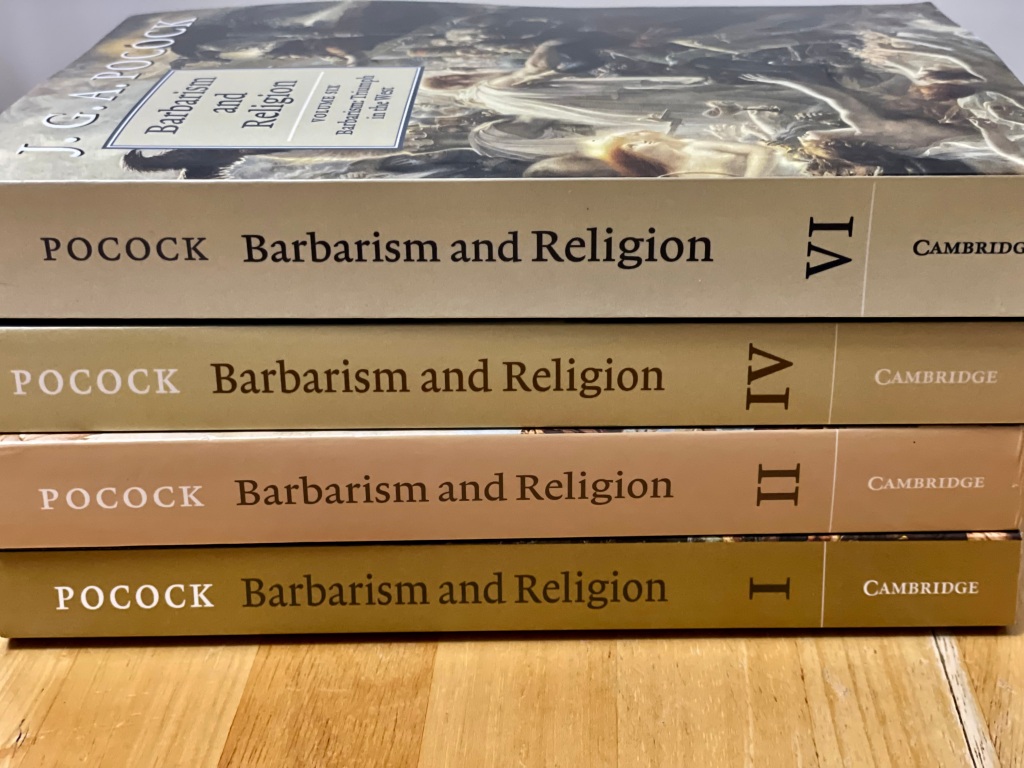
Barbarism and Religion: Rome and the civil concept. Introduction for a seminar. by Gerardo Muñoz

Thomas Hobbes famously wrote towards the end of Leviathan that “Papacy is no other than the Ghost of the deceased Roman Empire, sitting crowned upon the grave thereof” (Hobbes 1985). The long shadow casted by the Roman political tradition, however, is still peripheral to the current debates on secularization and political theology, and even in the most sophisticated analysis of the emergence of the fragmented public powers of the twelve century (Bisson 2015). In this seminar (one in a series of three) we will study the relation between Rome and the emergence of political modernity by attending to the multi-volume series Barbarism and Religion (1999-2015) authored by the Cambridge School historian J.G.A. Pocock, who has arguably undertaken the most serious attempt to provide an answer (however incomplete) regarding the passage between Rome and our modern political foundations.

Through a mannerist and highly idiosyncratic reconstruction of Edward Gibbon’s magnum opus, Pocock draws a large canvas of the Roman metapolitics, shedding light on the ongoing process of economic constitution and mutation. In this first seminar we will attend to the first two volumes of the series attending to the “civil” concept as an operative mediation of public order. Our wager is that the civil is at the crossroads in the ongoing crisis of authority and global civil war. Indeed, we tend to forget that the civil is operative in the notion of “civil war” used to describe the exhaustion of institutional and political forms.

Secondly, although we will consider the historiographical and conceptual constructions in Barbarism and Religion, the main focus of the seminar is to furnish an original understanding of the civil dimension from Rome to the modern legitimization of the political. In this sense we ask: to what extent does the concept of the civil discloses a specific genealogy from the decline of Rome and into the modern state? If so, how can one understand the polarity between barbarism and imperium (politics) as the two vectors of modern imagination about public order and the rule of law? And more ambitiously: can one mobilize (departing from Pocock’s historiographical project) the concept of the civil as a historical a priori – as the historical excess to every concept (Cooper 2022) – situated in the intersections of public law, modern commerce, and the rise of the state? What accounts for the event of the civil?

Getting ahead of ourselves, Pocock writes in the last volume of his series: “…so long powerful at the meeting point of imperium and barbaricum, who after defeat became the semi-autonomous subjects of the new kingdom. This is a moment in world history” (Pocock 2015). All things considered, this seminar looks to understand “this moment” in a present in which the civil has resurfaced as the principle of a total encompassing barbarism in the wake of the flaring up of Western civilization. If after concluding the six volume series we are capable of saying something to this end, we would have found ourselves lucky.

A noncatastrophic politics. Some notes on Erich Unger’s Politics and Metaphysics (1921). by Gerardo Muñoz

Erich Unger’s Politics and Metaphysics (1921), published just a year before Political Theology (1922), fully captures the spirit of the epoch: it is the moment when politics becomes catastrophic; a vehicle for war conflagration, an instrument for the acceleration of technology, and the spatial fragmentation of civil society and state. The overcoming of man through technology meant a new ‘reality principle’ in which the species were forced to adapt to an abstract process of catastrophic metabolic regulation. Unger’s essay, thoroughly ignored at the time of its publication, was a product of what in Political Theology (1922) was labeled as the force of indirect immanent powers. And from his side, Walter Benjamin, in his preparatory notes for his essay on violence, made the obscure remark that Unger’s Politics and Metaphysics (1921) ultimately favored the ‘overcoming of capitalism’ through errancy (at times translated as “migration”, which has been recently corrected by Fenves & Ng’s critical edition of the “Critique of Violence”) [1]. Indeed, in his short tract, Unger called for a “non-catastrophic politics”, which he understood as coming to terms with the problem of metaphysical structuration and positionality, and for politics to have a chance a principle of exodus was needed. This goes to show why Schmitt reacted against this spirit of the epoch, going as far as to say that his “concept of the political ” was the unified response to a sentiment of a whole generation, as well as the detector of enemies of the political demarcation [2]. In contrast, for Unger modern political autonomy had collapsed, and catastrophe now expressed itself as a civilizational problem of living forms, and so it demanded a confrontation with the problem of unity and separation of politics and metaphysics.

Politics is not metaphysics, but it had to be confronted with it if a non-catastrophic politics is to be imagined. This meant a new conception of the problem of “life”, which in Unger’s speculative philosophy received its historicity from immanence through the temporality of the tragic. The psychic separation between metaphysics and politics (a politics of the subject and subjection) meant fundamentally a catastrophic politics, which Unger read against the backdrop of the Oskar Goldberg’s Hebrew speculative reversal as a new re-constitution of the people (Volk) outside the fixation of the state. All of this is connected to his previous work on the stateless dimension of the Hebrew people in a short tract entitled Die staatslose Bildung eines jüdischen Volkes (1922). For Unger, the Hebrew prophetic rulers were not just a form of government, but rather also of healers, practitioners of a “techné alupias” of psychic intensification in the business of instituting an autoregulation between the metaphysical and the political.

The contrast with Carl Schmitt’s position is, once again, illuminating to say the least: whereas the figure central to Schmitt’s juridical thinking is that of the Pauline Katechon, the restrainer against the apocalyptic catastrophe; for Unger, no stranger to theological myth, appealed to a Parakletos of a universal People (Volk), coming to one as a single consciousness against unreality. The theological drama that informed the positions of both Schmitt and Unger, recasted the problem of separation the central concern of a particular thinking in a time of constituent power (and its infrastructure in the principle of civil society). But whereas Schmitt’s Katechon depends on an institutional mediation conditioned by revelation and authority; Unger’s non-catastrophic politics evokes a ‘people’ emptied of patrimony as reservoir of new energies for the unification of reality against psychic imbalance. Against the “relentless forms of domination”, Unger did not appeal to institutional mediation of the moderns, but instead to the interiority of the species that, in turn, required a “political principle of exodus”:

The principle of the exodus can end the civil war and represent the presupposition for the emergence of real political units, thus putting an end to those centrifugal tendencies which are lethal for any real synthesis. This principle of separation of communities operates an external delimitation of the Material to give rise to a possible real unity. It now considers establishing the basic regulatory principles of its internal structure.” [3]

The principle of exodus of politics meant, all things considered, the opening the metaphysical order of the possible against what was understood as domination of the species within the paradigm of civil war. It is telling that for Unger, like for Carl Schmitt, the true force to be confronted is that of the stasiological force, or nihilism, as the condition for the catastrophic politics in the perpetuity of separation during time of finality (Endgultigkeit) in historical transformation. For Unger this was no easy task, nor fully passive and open to gnostic reversal. On the contrary, it is connected to “a kind of intellectual orientation required of anything who might wish to understand this reflection” [4]. This is ultimately tied to Unger’s most enduring idea in Politics and Metaphysics (1922) – at least for some of us that look with suspicion anything that the contemporary has to offer today, or that has ever offered – which is the metapolitical universities, not mere supplementary communities against the politics of catastrophe, but rather practical forms of encounter, languages, and exercises in thought that return the dignity to the shipwrecked fragments in the field of immanence.

Unger knew very well that there was no absolute “exteriority”, and so the defense of a metapolitical university was offered not as a “new political unit” of intellectuals leading the masses, but something quite different: the encounter of a finality that is not knowledge but “the effective treatment of the concrete” elevating itself from mundane understanding of social knowledge [5]. This is no collective practice either, since the discriminatory point assumes the internal perspective of the instance of “intensification” [6]. And intensification is not executed from the coordinates immanence of the social but rather as a ‘possibility of an elevation (Steigerbarkeit) capable of returning to reality against a non-catastrophic politics. For Unger the notion of elevation – necessarily to destroy the compulsory mimesis and automatic recursiveness of subjection – is predicated as a path of innerness, “that is, in the inclusion of originally alien psychical factors within a single consciousness” [7]. The metapolitical universities were, hypothetically, hubs for the concrete practice of elevation vacant of any universal pretensions of unreality. Here Unger, like Schmitt, does not propose an exodus from politics, but rather an elevation to a coming politics whose mediation is neither annihilation nor exchange, but rather the imagination and concrete practice of organization. The question, of course, is whether the politics of exodus today has not also collapsed to the catastrophic (no longer an exception to it but immanent to the logic of equivalence), which means implies a relocation: the practice of the metapolitical university, mutatis mutandi, now presupposes an exodus from politics.

.

.

Notes 

1. Peter Fenves & Julia Ng (eds.). Walter Benjamin: Toward The Critique of Violence: A Critical Edition (Stanford University Press, 2022), 92.

2. Carl Schmitt. Glossarium: Anotaciones desde 1947 hasta 1958 (El Paseo, 2019), 240. 

3. Erich Unger. Politica e metafisica (Edizioni Cronopio, 2009), 87.

4. Ibid., 92.

5. Ibid., 23.

6. Ibid., 100.

7. Ibid., 24.

Three comments on Michele Spanò’s lecture on patrimony as a legal institution. by Gerardo Muñoz

One of the most illuminating talks at a recent workshop at Kingston University (hosted by the Centre for Modern in Modern European Thought) on institution, legal philosophy, and political thought, was Michele Spanò’s archaeology of the institution of patrimony entitled “Patrimony and the Legal Institution of Subjectivity”. Spanò’s work for some of us has been of extreme importance in thinking about roman law, the historical school of the German legal tradition, as well as the work of Yan Thomas whom he has edited and translated for Quodlibet. Although Spanò’s lecture was based primary on notes and part of a larger project on the ‘invention of subjective rights’, it made a few transitions that thematized the legal infrastructure of property that will be perhaps fundamental to understand, and radically transform, the problem of political economy and the logic of the capital coding that Katharina Pistor has recently explored in our post-sovereign present (I have discussed some aspects of imperial coding of capital here). But it is in the invention of “patrimony” in Roman law, where for Spanò a new epochal conception between things, persons, and reality (-res) was established as a relational matrix that he termined, following the Italian legal philosopher Riccardo Orestano, a conception of law without a subject [1]. This infrastructure of a relation without a central subject of authority – a problem too complex to analyze in this simple side note – revises and displaces the more modernist-style discussion on natural law and positive law, but also intra-conceptual determinations such as the subjects and the impersonal, between rights and obligations, which are part of the long dure Roman-modern matrix of the patrimonial foundation. For me there were at least three important elements that derive from Michele Spanò’s work, which I will leave here for some future elaboration in upcoming writing project on the problem of patrimonial and civil as roman categories of modern juristic-political thought and the American context.

1. The relationality or nexus of the conception of the patrimony (a. every person has a patrimony, b. all patrimony belongs to a person, c. there is a relation between obligation and patrimony) is an early form of exchange value; in fact, it is the equivalent structure that designs the total apparatus of social reproduction and the passage from the polis to the domus (housing / domestication). In this sense, Roman law of patrimony is not about substance or morality, but about the circulation, organization, and exchange of metaphoric value codified. This ensemble appears very similar to what will later be Ernesto Laclau’s theory of hegemony. If this is so, then hegemony is not about political “articulation”, but rather its “politics” is a mere veneer for a spectral patrimony. There is no patrimony without the work of hegemony, and the form of hegemony is a reduction of value that keeps it off from the autonomy of the political. In this light, it makes sense that even a Marxist political economist like former Vice-President of Bolivia, Álvaro García Linera, understood statecraft as the development of and from “patrimonialism”, which entailed necessarily the devastation of the ecological life world [2]. The patrimonial form will ultimately transform the exteriority of the natural world into an object at the service of value.

2. Spanò offered a typology of patrimony in two phases: a. For whom is the patrimony (the personalist type), and b. For what (the functionalist type). In a certain sense, we are now in a term phase of legal adjudication: c. what are the costs and benefits of the management of a patrimony? This entails the logistics of ‘creative destruction’ (Schumpeter) into the very interiority of the legal rationality based on balancing and equity functions. For the paradigm of the cost & benefit equity the problem is no longer posed as a question of function or proprietary, but rather of thorough administration and optimization: to what extent can the risk and security of a patrimony can render X costs in relation to Y benefits of Z of the social body? Here the abstraction of the regulation of patrimony coincides fully with the domination of the social space into the juridical logistics. The distinction between private and public law spheres of the European legal traditions (ius commune and Common Law) collapses. As we have suggested in recent investigations, this collapse today is expressed on the rise of administrative law as a restituted Lex Regia.

3. Finally, the collapse implies a chiasmatic movement in the history of the archaeology of Western domination: Roman law and modern positivist law, subject and object, production of rationality and extraction of resources for production of life, the limitations of Roman Law on property and Canon Law on statutes and morality. If medieval canon law of the Church was quenched in the wells of Roman Law, then the question regarding the modern state (its presuppositions, its conditions, crisis, and collapse) amounts to the problem of institution of patrimony as a regulatory of principle of rationality and network of the legislation between spheres (legality, economic, political, rational, instrumental, etc). If there is something to be today against and beyond “hegemony” (no longer an index of politics or culture), then the problem of the patrimonial framework must be understood as a juridical-economic paradigm in which “politics” is incapable of responding to. On the contrary, it could well be that the crisis of politics is an effect of this complex archaeology that, for some of us, Spanò’s work has already started to grasp in light of the return of ‘principles’ for social maintenance.

.

.

Notes 

1. Riccardo Orestano. “Diritti soggettivi e diritti senza soggetto”, Jus: Rivista di Scienze Giuridiche, 2, 1960.


2. Alvaro García Linera. Geopolítica de la Amazonía: Poder hacendal-Patrimonial y acumulación capitalista (Vicepresidencia del Estado de Bolivia, 2013).

The regime of adaptation. by Gerardo Muñoz


The collapse of the categorial and formal mediations proper to the foundations of modern politics open up a regime of adaptation as optimized administration. In a concrete sense the well-known Böckenförde formula comes to a closure as it is realized: the liberal secularized state draws its life from preconditions it can no longer guarantee. The fulfillment of secularization entails, paradoxically, a re-theologization of the separation between the species and the experience of the world already leaving behind the temporality of the saeculum. It is no coincidence that three excellent new books recently published and discussed – Conspiracionist Manifiesto (2022), The Politics of Immortality (2022) by Marten Björk, and Adapt! A New Political Imperative (2022) by Barbara Stiegler – share a common thread: the emergence of the regulatory system of adaptation in the wake of the end of political liberalism.

In other words, the marginalization of the logic of representation, the erasure of institutional mediations, and the depolitization of life (which also entails that everything becomes measurable to the value of the political) entails the intensification of a process of abstraction that is deployed on the surround of the human species itself, increasingly optimized given the contingent transformations and irruptions. The Conspiracionist Manifiesto goes as far as to claim that the current articulation of domination should be understood as a full restitution of the nineteenth century project of positivism as the integration of science and life. Comte and his followers, in fact, thought of positivism as a world religion concerning the reproduction of life whose aim was the general crafting of society as an plastic integral organism.

The acceleration of adaptation presupposes the triumph of immanence that was already exerting its force as an indirect power in the nineteenth century drift by romantic subjectivism and expansion of conditions for action in civil society. In the regime of adaptation, the realization of action, devoid of institutional justified reasons, becomes allocated in the processes of production fitted to the incessant demand for adaptation. It is obvious that the acceleration of immanence – first expressed in the subject’s will to power and now folded into the willing slave of adaptation – has intensified in the last years or so, coinciding with the pandemic event and the generic systematization of health understood as a set of coping techniques of behavior.

Already in the 1990s, in an unpublished lecture in Hannover, Ivan Illich described adaptation as an systematization of health: “Adaptation to the misanthropic genetic, climatic, chemical and cultural consequences of growth is now described as health. Neither the Galenic-Hippocratic representations of a humoral balance, nor the Enlightenment utopia of a right to “health and happiness”, nor any Vedic or Chinese concepts of well-being have anything to do with survival in a technical system” [1].

Insofar as it is concerned with the captive reproduction of life, the regime of adaptation puts to rest any believe in positive biopolitics or the community as exception to the social. Yes, this includes even the “community of friends” that Carlo Michelsteader, in his Il dialogo della salute thought as too much of a rhetorical illusion predicated on the exclusion of suffering and death: “In the friendly communities that emerge in light of common vanity, every one lives thanks to the death of those outside the community” [2]. In short, the regime of adaptation solicits nothing else than the task of coming to terms with the principle of the civil (truly the condition of state’s authority), which in even as far as in Roman law made possible the extraneous movement of the subjectum iuris as total equivalence. The predicament of the regime of adaptation – and its irreversible apparatus of administrative law – obliges us to imagine something other than civility (the principle from the Roman Empire to the modern to put it in Cooper Francis’ terms) but without sidestepping into the barbarism of ergonomic processes that are now at the center of what is understood as life. Barbarism and civility’s straight line now bends towards adaptation.

.

.

Notes 

1. Ivan Illich. “Health as one’s own responsibility. No, thank you!”, Speech given in Hannover, Germany, September, 1990.

2. Carlo Michelstaedter. Il dialogo della salute e altri dialoghi (Adelphi, 1988).

On dispensationalism. Monica Ferrando’s L’elezione e la sua ombra: Il cantico tradito (2022). by Gerardo Muñoz

Monica Ferrando’s short but dense book L’elezione e la sua ombra: Il cantico tradito (Neri Pozza, 2022) refines our understanding of the secularization debate in the wake of the epochal crisis of modernity and planetary domination. For Ferrando this current domination is rooted in a specific retheologization that must be grasped at face value, no abstractions allowed. The force of theological domination, which has become a proper religious imperialism, expresses itself as a true corruptio optimi pessima, which Ferrando locates in a very precise intersection: the passage from the suppression of dilectio to an instrumental manifestation of electio that will culminate in the unleashed power to dominate not only the relation with the world, but the very existence of the species. If the Ancient covenant of early Judaism was a prophetic covenant with God, the force of predestination will suppress the mysterious relationship of blessed life to render a “selective process” of theological election [1]. It is only with the rise Protestantism, and Luther’s specific hermeneutical efforts to neutralize the messianic message of Paul’s Letters to Romans that election becomes the paradigm of a new government of the soul in this world, which will ultimately find its material legitimacy with the advent of the reproductive logic of capital. Implicitly building on the thesis of economic theology, for Ferrando the advent of the machine of election materializes in the theological reform that translates the universal salvation of the prophecy into a never before seen economy of the dispensing grace through wealth retribution for human labor [2].

The reformation based on dispensation (oikonomia) differed fundamentally from the Church’s idea of change rooted in the ius reformandi. As Gerhart Ladner shows, if the “idea of reform” up until modernity presupposed periods of spiritual reform through monastic experience in relation to wordly profane time, the apparatus of dispensation of election was oriented at securing an integral government rationality combining law, economy and subjective production without reminder [3]. In this light, the operation of the dispensation paradigm is twofold: on the one hand, it promotes an anti-Judaic operation of reducing Jews to a people of this world that will ultimately will be identified with political Zionism; and, on the other, it dismisses the coming of Christ as worthless, and in the best case as merely postponed [4]. For a reformed theologian like Karl Barth – at odds with the economic evangelism that ultimately triumphed in the United States and that now it extends across the global – there was only a ‘great dispensation’ putting end to the abstraction of value and the homogeneity of the time of production [5]. But more importantly for Ferrando, the triumph of the dispensatory paradigm entails a new fundamentalism of judgement based on “election” (in the broadest sense of value equity and competition) will appear as the only immanent force capable of considering every other religion and confession exterior to itself as “merely pagan and idolatrous” [6]. It would amount to the triumph of the self-made ‘gentleman’ over the outward message of Paul.

The dominance of dispensation meant a full convergence between salvation and profane economic life that will bring exteriority into a crisis in the deepest sense. This is why for the reformist mentality, its own modern image initiates the epoch of irreversibility; that is, the pure historical progress guided by the will of election and the work of grace as an exception to universal salvation. If the modern reform has been at times understood as the new regime of social pluralism and system of indirect separations (between Church and State, civil society and religion, the public and the private, etc) for Ferrando it is on the side of the theological presupposition where its most terrifying arcanum must be found: a dispensational theology whose main unity is the recurrent intrusion, training, modification, and discipline of the forum internum, that is, the administration of the consciousness of man. Whereas the felix culpa allowed for the mystery of repentance and universal salvation; the political meditation of election through accumulation and economic benefits will legitimize the new discourse on toleration, “liberty”, and even democracy as the distribution of surplus value. In this sense, Liberalism (with Locke and other thinkers of the English and Scottish Enlightenments) was born, as later understood by Carl Schmitt, with the structural weakness of “individual freedom” and maximized autonomy that will require the expanding checks of police and governmental penalties to cope with the production of effects. Of course, every deviation or movement that could put a halt to the fiction of election will find itself on the side of illegality, or turned into a remnant of a surreptitious past that must be overcome at all costs. This implied, as Ferrando reminds us, nothing less than a novel modification of the anthropogenesis of the human species.

It is one of Ferrando’s most daring and surprising tasks to show how the machine of election does not merely occupy the economic-political sphere, but that it will eventually also imply an aesthetic imperative in Northern European culture; specifically with the rise of German romantic response to the crisis of the Enlightenment and the question of “classicism” of the classical Greece. If according to Gianni Carchia the aesthetic dimension of modernity should be read as a compensatory answer to the futility of the romantic revolution in subjectivity; Ferrando’s complementation to the thesis brilliantly shows how this attempt was meant to fail at its original ground due to the mimetic appropriation and metaphorization of the Greek historical past in the aesthetics program of Winckleman and German Idealism (with the exception of Hölderlin’s fugitive position) [7]. The mimetic “hellenization” of German romanticism and its posterior afterlives (one thinks of the Stefan George Circle, and Max Kommerell’s Der Dichter als Führer) gave birth to a notion of “culture” that hinged upon the separation of the aesthetic and the religious spheres that had to sacrifice the appearance of beauty in order to attest for the dialectics of objective and subjective forms of the “Spirit”, and thus leading to the triumph of the grotesque and the aesthetic imperative of uniformity and museification. For Ferrando the German spirit of genialismus had as a mission the overcoming Latin, Mediterranean and Mesopotamian forms of life where the distinction between beauty and life never understood itself as a “culture” or objective project of enlightened intellectuals and artists on the mission to transform the contingency of poesis into the realization of the Idea [8].

Displacing this aesthetic dimension to the present, for Ferrando the intrinsic disconnect between appearance and substance of art’s truth emerges today in the predominant social morality of today’s global bourgeoisie: hypocrisy. It is in hypocrisy where today one can see the inflationary hegemony of discourse over the true organization of life that is proper to the dominant metropolitan class of the West, and its maddening obsession with identity politics or “race” oriented discourse as a moral inquisitorial abstraction (it is in this process that the notion of election appears in the least expected of places: sky color, language use, demands for inclusivity, and hyperconscious towards an invented past). The work of hypocrisy, in fact, appears as a secularized form of the dispensation paradigm that aims to normalize and domesticate every form of life that challenges its specular regime. This is why according to Ferrando – and I do not think she is incorrect in saying so – the possibility of art (especially that of “painting”), as the undisclosed of truth will disappear from human experience, as it has no place in the moral functionalism of ‘contemporary art’ nor in the discursive struggle over global communication and opinion battles (the so-called ‘cultural wars’) [9]. The aesthetic museification of the world liquidates the possibility of art’s truth. Paradoxically, in this new scenario everyone must declare himself “an artist” of their own emptiness: the nowhere men that stroll in the works of Robert Walser or Franz Kafka – who never declared themselves to be anything – in our present are flipped on their heads becoming informers of the regime of a universal politics of recognition and moral judgement [10]. These ‘bloomesque figures’ confirms in the last epochal dispensation of the Reformist revolution that the premises of subjective freedom, economic gain, and autonomy of value have culminated in a new aesthetic imperialism that is anthropological and rooted in the triumphant religion of immanence and the sacralization of ultimate values. The endgame has been dispensed in the creation of a “new man” through the sacrifice of every exteriority in man, that is, of the invisibility outside the fiction of his personality.

The paradigm that Ferrando is describing vis-a-vis the operative force of “election” is also one of profound irony, since the mechanism of predestination and election, by betraying prophetic dilectio (love), the “free election” of the moderns entails that everything can be elected at the expense of losing dilectio: the only path towards the mystery of life. This is what the epoch of irreversibility and the arrogance of historical progress has foreclosed and it is incapable of considering. But for Ferrando life remains an ethics, which she links to Eros, whose appeal to the law of the heart is neither religious nor political, but rather an instance to the disclosure of truth. As she beautifully writes towards the end of L’ elezione e la sua ombra (2022): “Occorre osservare che qui si tocca una sorta di grado zero teologico, che scivola nel mero «biologico» solo a patto di esautorare la sapienza della madre o, detto altrimenti, la sapienza come madre, custode di una legge non scritta, di un nomos del cuore, che non necessita di alcun mandato esterno per esercitare la conoscenza che gli è propria. Si apre insomma quello spazio, costantemente e variamente negato, ma imperturbabile, di cui solo la madre, in virtú di una sapienza propria della natura umana, può custodire la legge.” [11].

The foreclosure of the acoustic relation to prophecy documents the recurrent political interest in the subordination of music to the moral captivity of the reproduction of humanity [12]. On its reverse, the law of eros, prior to the moral domain of natural law and the authoritative domain of positive law, is the protection of the indestructible region of the human soul where no political, moral, or economic dispensation can exert its force. This is confirmed today by the monstrous techno-scientific interventions and dysphoric alterations in the life of children as the last utopia in the long dispensation of the anthropomorphism of capital legitimized by rhetorical force of an unending sermo homilis [13]. In this sense, what Ferrando accomplishes in this wonderful essay is to remind us that the event of theology remains outside the dominion of priests and bureaucrats and situated in the prophetic dimension of Eros (love) that guards the inclination towards beauty and the disposition to attune oneself to the prophecy of the world’s fulfillment [14]. Hence, it is not in the community or in an integralist Christian traditional family order where the sacred dimension of humanity can be retrieved; rather, for Ferrando it is in the non-knowledge reserved by the eros of the mother who never decides nor choses before law, whose nonverbal “tacit authenticity” (“tacita autenticità del legame materno”) unconceals a true experiential depth away from the the delirious cacophony of our world.

.

.

Notes 

1. Monica Ferrando’s L’ elezione e la sua ombra: Il cantico tradito (Neri Pozza, 2022), 8-9.

2. Ibid., 22.

3. Gerhart B. Ladner. The Idea of Reform: Its Impact on Christian Thought and Action in the Age of the Fathers (Harvard University Press, 1959).

4. Monica Ferrando. L’ elezione e la sua ombra: Il cantico tradito (2022), 24.

5. Karl Barth. “The Great Dispensation”, Interpretation, V.14, July 1960, 311.

6. Monica Ferrando L’ elezione e la sua ombra: Il cantico tradito (2022), 30.

7. Gianni Carchia. “Modernità anti-romantica”, in Il mito trasfigurato (Ernani Stamptore, 1984).

8. Monica Ferrando. L’ elezione e la sua ombra: Il cantico tradito (2022), 60.

9. Ibid., 91-92.

10. Ibid., 94.

11. Ibid., 106.

12. On the controversy of music as a tool to tame human’s passions, see John Finnis’ “Truth and Complexity: Notes on Music and Liberalism”, American Journal of Jurisprudence, Vol. 62, 2017, 119-124.

13. Gianni Carchia. “Eros y Logos: Peitho arcaica y retórica antigua”, in Retórica de lo sublime (Tecnos, 1990), 29.

14. Gianni Carchia. “Dialettica dell’immagine: note sull’estetica biblica e cristiana”, in Legittimazione dell’arte (Guida Editores, 1982), 21.