American apocalypticism. On Pierpaolo Ascari’s Fine di mondo: dentro al rifugio antiatomico da giardino (2024). by Gerardo Muñoz

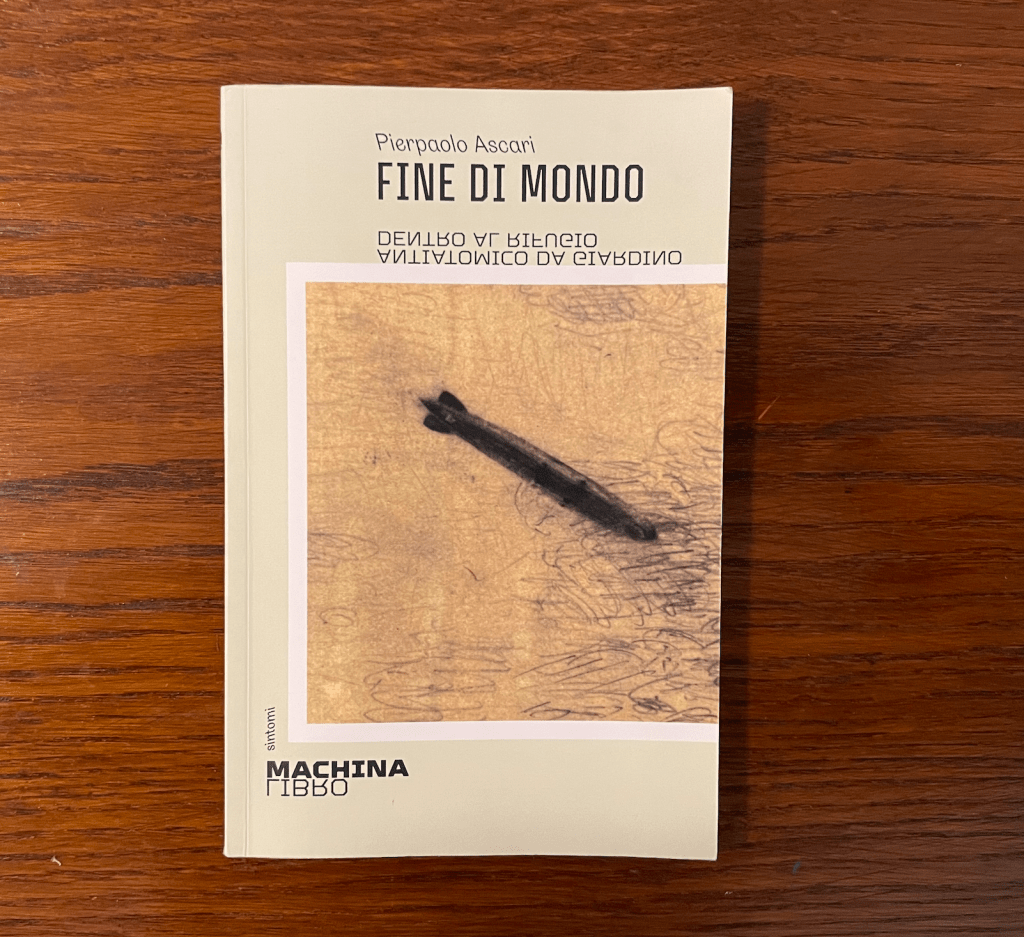
Pointing to a methodological clarification, Pierpaolo Ascari’s Fine di mondo: dentro al rifugio antiatomico da giardino (DeriveApprodi, 2024) opens with an untimely advice: the threat of atomic extermination of human life can only be told and appealed through the irony deployed in all areas of consumerist culture. Undoubtedly, this fits pretty well to the case on point, since American modernization is both the hotbed of Hollywood and the atomic bomb, two poles of the regime of a vicarious life consisted with Henry Adams’ well-known assertion that, in spite of everything, America civilizational passion has always been generalized optimism. And it is not surprising that Stanley Kubrick, when asked about the thesis of Dr. Strangelove (1964), also claimed that the only possible form to tell a story about the bomb of total extermination was through a black comedy (Ascari 11). This self-serving optimism is tested in Ascari’s Fine di mondo (2024) by looking at the construction of an apocalyptic underworld fantasy; that is, in the garden of anti-atomic sheltering that reveals the true arcana of modern Americanism as a subterfuge – but also a civil current in plain sight – parallel to the rise of mechanized labor under the conditions of the triumphant Fordism. Of course, now that our farewell to Fordism has been longed trumpeted, it does not take much to see that what remains is the infrastructure of schizophrenia and general terror in the social fabric that colors the specific tune of American apocalypticism. Ascari’s book is a superb elaboration of this tonality as historically rooted and articulated, but also open to its (pseudo)theological mutations undergoing in our present. 

On the surface, Ascari’s Fine di mondo (2024) is a short compendium of the civil responses and techniques towards atomic destruction and survival; but, more deeply, is also a history of Americanism as a historical project committed to a long process of civil domestication, enclosure, and endurance of survival. Of course, the nuances here are important to grasp the subtle hypothesis of Ascari’s working scene, since we also know that modernity at large (considering both its contingency and contradiction as features of its emergence) was also a process of an optimized gnosis through alienation and the enclosure of private property towards commerce stabilization and productive growth (the nomos). But for Ascari the specificity of the American nomoi through the lenses of atomic sheltering and refuge implies a microphysis; that is, a “way of life” validated through theological premises tailored in the organization of subjective deificatio (Ascari 23). This means that the apocalyptic apparatus driving American philosophy of history is not just one of realization towards the absolute objectivation of the world – even if such endeavor is necessary and preparatory – but rather that the sheltering and self-imposed domestication of human existence has become naturalized as a threshold of the conditions of finite human life. The paradigm of sheltering as the unit of survival is a form of self-regulation of grace that is consistent with the evangelical dispensationalism and technical election analyzed in Monica Ferrando’s recent important book.

The concrete examples abound in Ascari’s short but densely illustrated book: from the Civil Protection comic to the details of the emergence of “do it yourself” assemble manuals (discussed in the correspondence between Adorno and Sohn-Rethel); from the Hulk to Godzilla in a post-atomic bombed world; form the resilient speeches on atomic menace by JFK to a 1950s study conducted at Princeton University that reassured that “fathers” will get to know their children better in conditions of total sheltering even if it results in an “ethics of the jungle” (Ascari 34). Following Guy Oakes’ groundbreaking The Imaginary War: Civil Defense and American Cold War Culture (1994), what is distilled in Ascari’s pop culture puzzle is the panorama of the “Cold War” not as a war that did not take place between two imperial powers; but rather a total war that took place beneath the crust of the earth (and this is why the topoi of the refugee becomes so telling) and at the thicket of human existence waged as psychic management of the civil sphere. In fact, the “imaginary war” is nothing else than the stazion once social life that has yet to cease to exist in our days (Ascari 48-49). 

For Ascari this implied an interiorization of the ‘sublime’ in the reification of the social fabric, which cannot be divorced from the lobotomized subjectivity of the crisis of “social man” that Gianni Carchia identified as the steering project of post-enlightenment Romantic negativity. In the turbid vaults of the self-made man we encounter the liquidation of everything that is living and the projection of fictitious death that clings into “salvation” in spite of absolute destruction; because, after all, those that survive total destruction are only there to confirm the soteriological greatness of the American destiny (Ascari 78-79). The thorough “Ubu” dimension of American psychic political power definitely speaks to this well sedimented conviction of sacrificial subjectivity. Who does not remember the glorious chants for resilience and isolation of the American political elites during the peak of the COVID19 crisis management? If it came to no one’s surprise that a large majority of Americans accepted the pandemic arbitrary rules (monetized whenever needed, it goes without saying), it was because the American subjectivity has been adapted for quite too long to the ongoing separation of refugee and domestication. After reading Ascari, in fact, we think whether the emergency policies were not just another episode in the history of American sheltering now extended at a planetary scale.

There is another idiosyncrasy to American apocalypticism that must be accounted for. And this is introduced towards the end of Fine di mondo (2024), when Ascari quotes Ernesto De Martino about nuclear war; mainly, that when it comes to atomic annihilation there is no longer the symbolic mythic-ritualistic process of reintegration, but rather the mere technification of the hand that gathers scientific knowledge in convergence with the death drive” (Ascari 81). In other words, this technico-apocalypticism brings to absolute unity the originary response of the human species (the movement of the hand) with the organization of scientific rationality that, like Günther Anders saw, brings no re-symbolization of the principle of reality, but rather it can only reaffirm the layering of the principle of reality to govern over it (Ascari 85). In a way, if it as if the essence of American apocalypticism is instituted as if beyond time, since the endurance of a “time of the end” means that the triumphant death (and the dead fueling the demagoguery of its process) foreclosing the symbolization without an exit. Indeed, an apocalypse without redeeming kingdom. For Ascari the only anticipation – primordial mechanism of anthropological capacity – is that of “money”, and hence the dominance of the principle of general equivalence entails gaining the temporal illusion of some distance from the ongoing production of death. But it is evident to anyone today, as it was said not long ago, that the true dead are those petit bourgeoisie living in the American suburbs. And they keep coming as the embers of domestic happiness try to ferociously shut down the latency of a piercing pain. 

Yes, the nature of permanent apocalypticism confirms that the true and final object of techno-capitalist force has always been the possibility of multiple life worlds. And its erosion implies the endless possibility of ordering the life of the city, as Elon Musk just a couple of weeks ago told the former president of the Republican Party: “Hiroshima and Nagasaki were bombed and now they are full cities again. Yeah, it is not as scary as people think”. If the enterprise of civilization has largely been understood as springing from the crust of the earth upwards, one of the important lessons of Ascari’s Fine di mondo is that it trains us to look downwards and inwards as the cruxes of America’s persistent government over the garden of our souls. 

The face of pain. by Gerardo Muñoz

One is always struck by the pictorial intensity of Massacio’s “Expulsion from the Garden of Eden” fresco (1425) at Santa Maria del Carmine Chapel. It has something to do with the unbounded expressivity swirled by an acoustic of lamentation that springs from both faces at once. The nakedness in movement only comes second. If it is right to call it ‘modern’ is precisely because of its polarity  between movement and paralysis, light and shadow, the formation of the lines delineating the bodies and the free-style strokes that carry Massacio’s picture to a strict and unsurpassed balance. It is a picture of the gathering of  lamentation and pain, which confirms Ernesto de Martino’s intuition that in the ritual of mourning weeping and crying is also accompanied by an act of self-defacement, such as covering the face or bring the face as close as possible to the lower body position. Adam’s pain is reinforced by the hand that covers and pulls the face downwards, almost making it disappear. In a way, his walkout of Paradise is already the stroll of a nobody. 

There is perhaps an intimate relationship between defacement and pain. In his short gloss on this work, Robert Longhi notes that the source of strength of Massacio’s work is given by the intensity of light that bathes the bodies of Adam and Eve in its purest naked form [1]. This total exposition is the cause of sin that, as a great historian of religion has brought to our attention, presupposes the entire carnalization of both body and soul after being thrown into the soteriological world of the living [2]. From now on, human life vested in pain means paying the price of the destruction of the soul for the protected  and preventive set up in the world. 

The sinful life – a life that will have to be chosen but punished justly – entails the consummation of pain as the central tonality of post-felix culpa existence. In other words, it is not that life is shameful because it has been dispossessed (or because it recognizes itself possessed); it is dispossessed because it can no longer look at the world outside the blinding light of programmed obsolescence towards death without transcendence. And the liquidation of transcendence means that human beings become faceless entities in a world that will forever become unfathomable. 

In our days – a present marked by absolute secularization of ancient religious somatic religiosity and magical traces – the phenomenon of defacement and the faceless far from disappearing is all over the world around us. The ritualistic mask which provided transcendence to the living presence of the divine gods has now become a symbol of social shame self-imposed by arbitrary and ever-increasing moral mandates. In a sense, we have not yet left the path initiated in Massacio’s Adam and Eve fresco, and who knows if we’ll ever exit it in the ongoing destruction of the human species. We do know, however, that any meaningful change of the current state of things can only take place starting at the divine surface of the face, as Carlo Levi so eloquently understood it in the postwar years: 

“Only a genuine revolution succeeds in changing the way people look, their facial expressions, the light in their eyes, the charm of their smiles. Christianity appeared with new faces, or taught a new way of looking at them. If we go through the streets and compare the faces we see with our memory of them, we won’t recognize persons any more. It is something that anticipates reality, as if prophetically, the universal change that for almost two centuries now has been shaping new faces throughout the whole world”. [3]


Notes 
1. Roberto Longhi. Breve pero auténtica historia de la pintura italiana (Machado Libros, 2023), 114.
2. Paula Fredriksen. Sin: The Early History of an Idea (Princeton University Press, 2012), 116.
3. Carlo Levi. La doppia notte dei tigli (Einaudi, 1959), 109.

Carlo Michelstaedter: Pain and the Social. A seminar with Revista Disenso. by Gerardo Muñoz

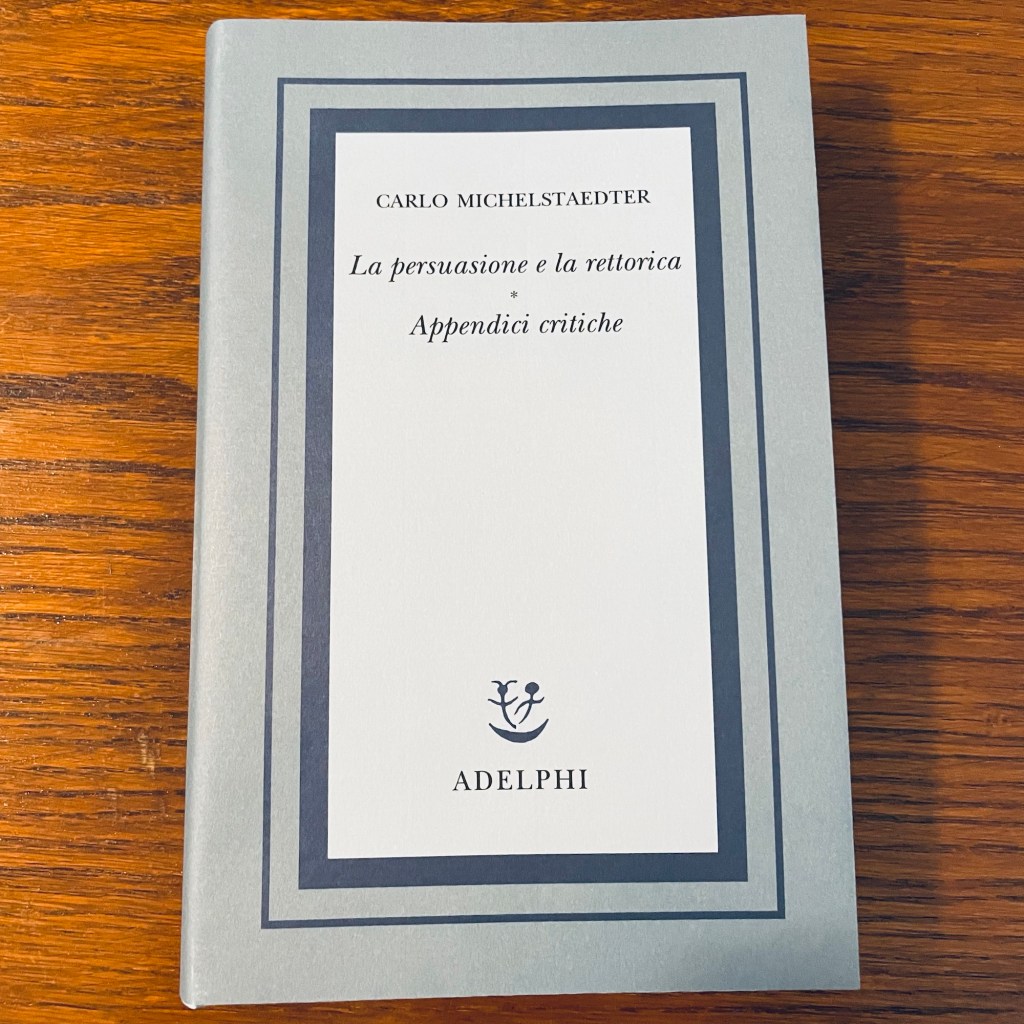
In the following months some of us will offer an eight week seminar exclusively dedicated to a close and analytical reading of the enigmatic work La persuasione e la rettorica (1910) by Italian thinker Carlo Michelsteadter (1887-1910). Ever since his death – as can be easily gasped by Giovanni Papini’s obituary in 1917 – there has been an aura of mystery around the infamous philosophical suicide of Michelsteadter that only parallels that of Socrates’ hemlock or Otto Weiniger’s self-inflected gunshot. Of course, we will be less interested in the biographical motives, and if push comes to shove attention to this detail will be elaborated in light of the nexus of his thought to the event of his death.  

La persuasione e la rettorica (1910) offers a unique theoretical elaboration about the civilizational decline of the “living” into the rhetorical deferment of life as realized in the organization of social alienation. And for Michaelsteadter there is no other purpose of rhetorical form than the absolute submission to the general abstraction that defaces the event of pain. It is no accident that he was also interested in the thematics of health and ancient techniques of pain-relief (the techné alupias, for instance), even if underdeveloped in his thinking given his sudden premature death. So, it is for us, his posthumous readers, to take these sets of issues and move them forward in our present any way we can. This is part of the task that motivates putting together this seminar after a series of conversations with friends and interlocutors.

La persuasione e la rettorica (1910) deploys the classical metaphysical tradition through the ancient poles of “rhetoric” and “persuasion”, where the second (the ancient Peithò) seeks to return the voice and expression to the problem of pain as an ineffable type of speech (Logos) that refuses the elevation of force that harbors the circulation of violence and the administration of social death. The ancient notion of the Peithò withdraws echoes of the mythical inception and the sacred, as also reminded by Aristophanes: “Persuasion’s only shrine is eloquent speech (Logos)…And I Persuasion (Peitho), the most lovely word” (The Frogs, 1391-1395). Where and how do we attune ourselves to the peitho today – the imperative of the eros of the word in the wake of the regime of social production of pain? 

In the aftermath of the collapse of the cycle of civilizational secularization, it is only obvious that all these questions stratified in the tradition once again become attractive and pertinent. In this light, we think that Michelstaedter’s thought still offers us a series of  significant hypotheses to think through the crisis of social man and the domination of the civil that colors our current predicament, where the question of “pain” is still an understudied problem. Throughout this course we will address notions such as rhetoric and persuasion, life and communication, nihilism and values, the logic of capital and the social bond, or the notion of world and pain. Our aspiration when approaching Carlo Michelsteadter’s work is to develop reflective conditions to address the thorny issue of an ethics of pain that so thickly enmeshed in our historical moment.

.

.

‡: Information about the registration to the seminar will be made available at Revista Disenso in upcoming days. The seminar will run every other week for a period of eight sessions (roughly from the beginning of September to early December, 2024).

The felicitous water carrier. By Gerardo Muñoz

There is something vessel-like in communication, and the need to keep it alive and to give it consistency and texture; to prolong it in both time and space. If it is true that ‘empty chatter’ is the erasure of the possibility of making in language, then communication is not just a practice of translation and legibility, but of passing of an experience, however impossible and tenuous that could be. This passing on through communication is embodied in the old figure of the portatori d’acqua or the aguador that famously appears in early modern Spain. The aguador is a figure of stagnation that sustains life, even if he is (or precisely due to this very fact) an iconic fact of social indigence.

One can easily recall Diego Velázquez’s “El aguador de Sevilla” (1618) with his ragged clothes and noble stance in the somber bodegón picture. V. S. Pritchett was up to something when he claimed that to ‘know a people’ is to know its poor. And that poverty is, first and foremost, a poverty in temper and restraint. What does it mean to communicate in the temper of poverty? This seems to me the question at the heart of Velázquez’s exemplary aguador. What is cherished in the aguador’s concrete labor (carrying and bringing water) is a transcendental relation that retains the need of life.

In a sense, there is no surprise as to why the aguador has disappeared in the due course of long and agonic historical development. If the essence of civilization is appropriation and growth, accumulation and production, then it is to see how the impoverished water carrier is meant to disappear. Already in the Lazarillo de Tormes (1554), Lázaro’s inverse transfigural condition into a social subject takes place by abandoning his short-lived condition of aguador, which is hyperbolic of the organization of the social stagnation. It is clear that Lázaro’s picaresque attitude of outsourcing the nascent commercial society of good and services – embedded in the production of criminality and banditry – is a way to overcome the original indigence of the aguador, whose sanctity must be amended through the mimetic process of autonomous secularization and the rise of the metropolis. 

Thus, the eclipse of the figure of the water carrier coincides historically with the fall of the contact of languages and experiences between human beings. This might be why in the civilizational peak of the metropolitan organization of the world, the poverty of experience refracted by the force of alienated objectivity becomes a problem for sewage engineers in the goal of the reproduction of life. Vargas Vilas’ provocative definition of the “social” as a machine of the production of excrement should be understood as an scatological image of what it means to live in a world without aguadores

And this why everytime that a water pitch is brought to a table an oblique and momentary happiness overtake us beyond the biological need of human thirst. To this end, Isabel Quintanilla’s Duralex water glass painting (1969) encapsulates something so divine and unfathomable; as if, in the suspension of words or stories, the resurrection of the water carrier is brought back to the sharp appearance of things.

The absorption of the sky of politics. On Michele Garau’s Lo scisma da un mondo che muore: Jacques Camatte e la rivoluzione (2024). by Gerardo Muñoz

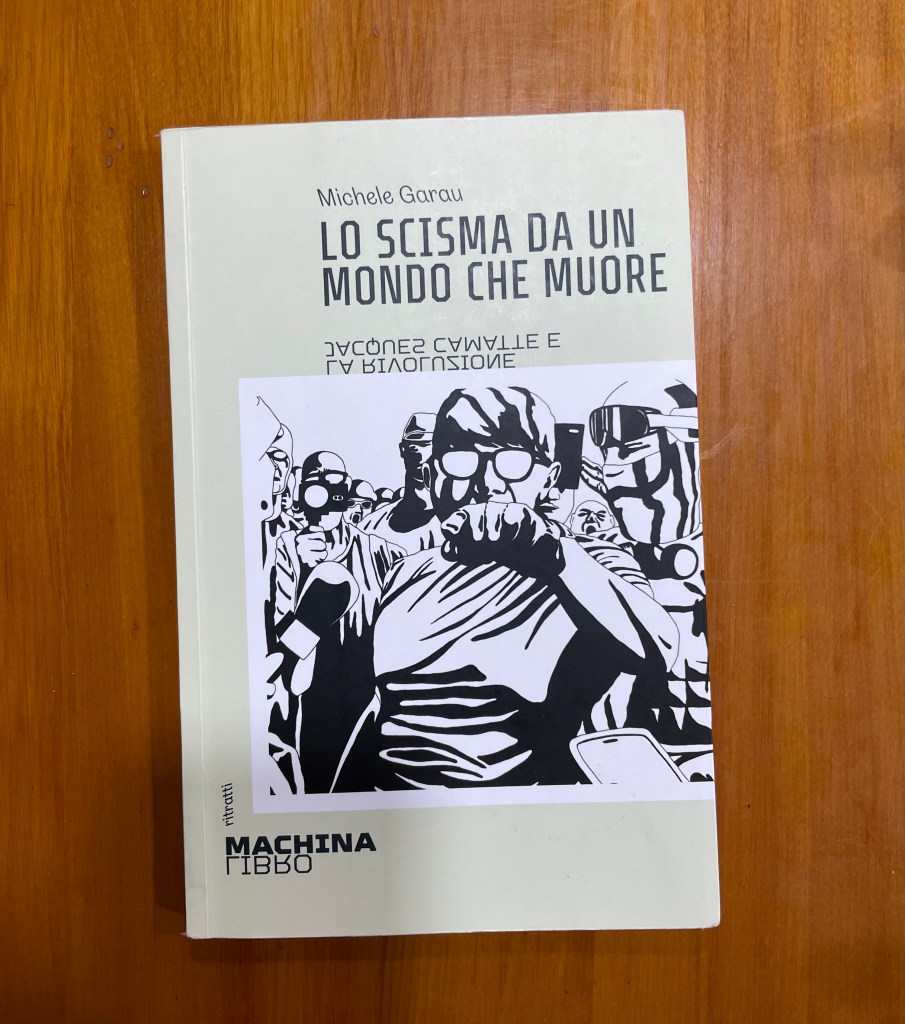
We must welcome that Michele Garau has written the first monograph on Jacques Camatte’s thought in any language, although the book, Lo scisma da un mondo che muore: Jacques Camatte e la rivoluzione (DeriveApprodi, 2024) it is also more ambitious than a mere philological reconstruction of the thinker of Invariance. Of course, not that there is anything particularly wrong with philological or archival work; rather, it is also that Lo scisma da un mondo che muore (2024) tries to think with Camatte (and also beyond some of his potential impasses) the historical bifurcation of a watershed moment in the history of humankind through the realization of the “capitalist revolution” as an autonomous colonization of every form of exteriority (Garau 7). If Camatte’s work has been only selectively considered in our ongoing discussions – while completely ignored at large by the so-called contemporary theory, which I guess it is an uplifting symptom – is precisely because he poses a challenge for a possible breakthrough in times of stagnation, while firmly announcing a much needed farewell to the modern revolution. But who would want to jump on that wagon when precisely voluntarism, prosthetic revolutionary cosmetic, and fictive communitarianism are all necessary platitudes to hold on to the illusion of ground right above the abyss? It is a rhetorical question, of course, but also one that Camatte move passed it in the in the decades of sixties and seventies observant to the material transformation of the working class, and the overall lesson of Amadeo Bordiga’s communism of the human species, which has also been rendered opaque and fossil-like by the victorious force of cultural hegemony and the whole grammatical structure of Gramsci’s thought in postwar political thought (and some will say well into our very present in the most recent cycle of failed left-populism). We said ‘farewell’ and this act, for Camatte after Bordiga’s teaching, means that the revolution has already taken place and must be perceived in the perspective of the crisis of negativity and the inception of the real absorption of capitalist development (Garau 14). 

Hence, new challenges lay ahead, which implies the abandonment of the historical and temporal productivity of revolutionary time – and Garau does an excellent mapping of bourgeois revolutionary thinking from Abbe Sieyès to Saint Just to later formulations of the Leninist paradigm of the dictatorship of the proletariat – which in the grand scene of modernity oriented the economy between form and function, but also between thought and action. If the epoch is said to be ‘anarchic’ is mainly because all these mediations and exclusive autonomous spheres have collapsed unto each other, and to favor one over the other is to work within the fiction of ideological reproduction at best. After Bordiga – Garau claims glossing Camatte, although there are nuances that I cannot consider in the space of this short commentary – the temporalization of the ius revolutionis can only bear in mind the crisis of presence (De Martino) as a suspension of exteriority that liberates right unto real subsumption. This means, following the recently polished phrase of Bordiga from his article “Tempo di abiuratori di scismi” (1965), that all revolutions are born and deployed as the affirmation of the schism. “Schism” or “scisma” — and one is reminded or taken back to a theological terrain, and not just as mitigated by the old ecclesiastical memories of the “Great Schism”, but because “schism” is also the “stazion” that fractures the visible-invisible legacy of form of the Church’s Trinitarian doctrine, and which is still the esoteric boiling point of the myth of political theology. This is a detour around Garau-Camatte-Bordiga’s intuition, since none of this is explicitly thematized in the book, nor should it be. It suffices that it opens to this question, given that Camatte’s own grammar of exhaustion – “extinction”, “inversion”, “autopoiesis”, “critique of organization”, “wandering” (erranza) – distill the echoes of an apocalyptic movement proper to the modern anthropological crisis, to put in terms of Ernesto de Martino.

Be as it may, the longue durée of civilizational development of Western revolutions (Edward Gibbon would claim at least since the reconstitution of the Christian Empire) there has been a process of adequation to invariant processes of capitalist accumulation that its substrate (whether permanent, uneven, natural law justified) becomes isomorphic to the structural needs of capitalist autonomization. In a cogent reading of Sieyes with Saint-Just in the framework of the French Revolution, Garau demonstrates how the genesis of modern politics and its categorial scaffolding (localization, constituent power, social unity, subject of rights, and representation) presuppose a thoroughly new vision to make the human community a clean slate for surface legibility (Garau 42). If the civil concept of the ancient polis was measurement and exchange; the crafting of high-modern state politics that took off in the eighteenth century was much thicker and spatially robust dynamics so that the ‘laws of commerce’ and population disciplining could come to fruition with its necessary infrastructural support. The schism was always a perturbation of the “sphere of politics” (and also of politics as a translucent sphere that can be observed, stabilized, and managed), and thus a great scandal.

Hence, the critique of political economy in the history of marxism was never able to untangle this mutual correspondence. For Garau at this point one can locate the difference between Camatte’s thought and Italian operaismo; given that Italian workerism at mid-century was never able to overcome the dialectic between the valence of value form and the theory of the production of capital. Whereas for Mario Tronti the struggle was still to be inscribed in to confrontation between the proletariat qua labor power; for Camatte the “invarianza” is not an permanent stage within the history of class struggle or Marxism, but of the human community and its resistance against the real subsumption of the material community (Garau 48). Decoupling the history of the working class as constitutive of productionism from the human community, allows Camatte, in the wake of Bordiga’s communism, to register the subsumption of capital as it collapses into dialectical negativity. Hence, communism is neither produced nor organized as operaismo always thought (Garau 26-27). And citing a passage from “Against domestication”, Garau argues that for Camatte the history of the proletariat struggle after 1945 is only the struggle to maintain the myth of the proletariat as the subject of a historical breakthrough (Garau 73). This is a staggering affirmation, and one that most definitely produces a theoretical schism. But the schism is also against the fictionalization of a subject of history, which has also been integrated into the emptying of social reality as we have come to know it in the final triumph of the fictive unto itself (Garau 93). 

There is the triumph of the fictive and expansive force of capital despotism, and then there is the struggle for the originary community (Gemeinwesen), which as Gianni Carchia argued in his “Glosa sull’umanismo” (1977) was still enmeshed in the contradiction between humanism and anti-humanism obstructing the vascular movement of non-identical fragments imploding the social. Is this getting at an impasse of Camatte’s own effort of thought to find an exit route? As an intelligent book, Lo scisma da un mondo che muore (2024), refuses to give an essay in the last three pages of the essay, although this difficulty is an object of attention. For instance, Garau writes in one of the clearest elaborations to tackle the problem directly: “La comunità deve allora essere riscoperta in una memoria della specie che finisce per radicarsi, questo è il rischio, esclusivamente in un bagaglio biologico. Nell’esaurimento delle strutture sociali preesistenti, dei linguaggi e degli schemi culturali, delle intelaiature rappresentative e cognitive, nella colonizzazione delle capacità psichiche, affettive, simboliche, è davvero possibile individuare un resto intoccabile dall’antropomorfosi del capitale che non debba essere, invece, creato dal nulla? C’è una «parte irriducibile», come scriveva Bataille, rispetto alle unità di misura del dispotismo economico? Non è semplice rispondere” (Garau 124).

In light of this rumination, Garau also attends to the cycle of contemporary revolts, which might stand as an instance of linguistic and existential struggle against domestication and the crisis of presence (Cesarano), and that might be capable of “absorbing the sky of politics into the most simple and elements components” (Garau 124-125). This is a great image, and one that has pictorial density and durability for thought even if it lacks specific elaboration. To absorb the open sky is to confront the exteriority of the world only as transfigured and brought back as a gathering of experience. The great German critic Kurt Badt comes to mind when writing about Constable: “the sky’s the organ of sentiment”. The embarrassing loss of the world today is fundamentally the destruction of the right attunement to our relation to the opening registered by what gleams above our heads. And perhaps this is a way to measure the capacity for non-movements rather than thinking that movements can disclose the sky. To this end, what could it mean to absorb the sky of politics – which is also a way to refuse the politics of sky, that is, the total planetary grand designs of geopolitical Tianxia? The irreductible may not be reduced to a substance, nor an ontological science nor a vitalist return to an originary community (if only mediated by the restriction of the archaic myth); but precisely that positionality of contact between what is exterior to life itself. To dislodge thought from all political plotting of objectivation and its plastic ligament of social adaptation. A life beyond itself that endures, and perhaps will outlive this dying world.

Two observations on the Non Kongress bulletins. by Gerardo Muñoz

I have read with genuine interest the five bulletins put out by the organizers of the Non-Kongress meeting, and it is only fair that I put some preliminary comments with no other purpose than to highlight a few points (I take it that other will have theirs, and I am looking forward to this discussion). To start somewhere, I will first say that I am fond of the open balance sheet format that puts on the table hot-button issues without exhausting all them. The starting point is broad and clear: our current predicament is one marked by the collapse of the ground of politics and the total absorption of politics into a social-moral designs. These days I also come from drafting a preliminary – an in a way a bit autobiographical – balance sheet of the last decade of (failed) debates in contemporary Spanish leftist politics (2014-2024), which allows for reflection of a contemporary sequence, draw a few conclusions, and move on. If we do this something has already change, and we have avoided the anxiety of feeling that everything must be said. The momentary arousal provided by rhetorical completion pays the price of immobility and confiscates the truly important thing: what will never be thoroughly said, or stated only indirectly, is the condition for any true communication of thought to have a chance even if it rarely happens. This aspiration is sincere and from its inception it already puts university discourse (and its experts in the intellectual division of labor) in trance. And this trance opens a region that allows for something to emerge in a new light sin sanata.

The five-installment bulletin seems to provide two general movements: an analytical sketch of current domination and several conditions for “refusal” or “exodus” under the generic designation of “destitution”. On the first level (the analytics of domination) the bulletin suggests that the configuration of power is organized as an imbrication between the scientific medical apparatus, the expansion of infrastructures and digitalization, and an administration of morality as stratification of values in social optimization that were effectively accelerated in the wake of the Covid19 policy directives. And it is also obvious that what also binds these three different strategies and domains is the administration of the hollow and the fictitious subject as the last subject of nihilism (nothingness as unconstrained force) for ecological catastrophe. Now it is utterly clear that – in aftermath of the gran designs of productive modernization and formal labor productivity – the true and ultimate objective of capital is the world; and, more concretely, the human species’ exposure to worldly phenomena. Hence, there is an implicit, not totally fleshed out, latency in the bulletins which one could situate under the turn towards territoriality, location, place, and fragmentation of the earth. Of course, there is ample risk here to assume that locality (communes, community, autonomous zone) is just an exception to planetary unification that labors negatively for the ongoing destruction; a sort of ‘partisan’ Benedictine community under the shadow of Empire. This is why it is important that Hugh Farrell reminds that any territorial program can no longer be unliteral and must be opened to the contamination of the experiences must incorporate play and openness to its outside [1].

This is touching the limit of the defunct strategy of occupation in which the spatial unity accomplishes the self-police work through the veiling of the good conscious subjective militancy, as I recently also saw in the Pro-Palestinian university encampments in the US [2]. More than a decade ago, Alberto Moreiras warned about the ontotheological determination of locationality as a fold of identity, and he called for a “dirty atopianism” against the allure of compensatory critical regionalisms, and which we can connect (with all the caveats necessary) to the form of countercommunity and the difficult problem of the non-site of the khorā that marks an unbreachable limit to the totalization of the ground of the polis and the political [3]. Life or existence at the end of the day is not “this body” or “this thought”; it is how this inclination connects to the surround of the world. And here is yet another problem, which is delicate as it is difficult to untangle: the need to for a reinvention of a concept after the destruction of its civilization diffuse uses in the Western tradition: “freedom”. We do not need Shelley to tell us, but it is always useful to recall it again: “…the state of probation in which we now reside is merely a preparatory stage in which….to fit us for a more exalted state of existence, is not the deprivation of liberty the deepest, the severest of injuries?” [4].

It is only now that we can understand that liberty of the subject – and the political subject of liberty – was a ragged garment when compared to the freedom of the surround — think paintings of Cézanne as a gesture of gathering to “declare the essence of the world to be existing together, a mutual self-supporting and carrying of things”, states an eminent art historian [5]. Political language, or the intensification of language through the lexicon of politics is too vulgar to do the work and the heavy lifting; we have to be capable, I think, to look elsewhere (say, painting) for claims of a transfigurative sense of what it means to grasp this notion of liberty that takes us to the very beginning. It is a difficult problem, no doubt, but against immediacy, the sensorial must be expanded beyond its commonplace allocation into the latent or full-fledged central conflict. Those images are also too poor of world; even if we know that the world “can have no temporal view of things…the world pass into nothing in the very multiplicity of its instancing” [6].

The fifth bulletin calls for an “ethical ground”, but immediately passes to claim a “politics of destitution”, which is overtly anchored in the recent cycle of “experiential revolts” as stable instances of this passing world that does not succumb to conclusion. I guess it all depends how much weight – or how deep down – one is willing to exert on this figure. Or how extensive the figure is — for someone like Rodrigo Karmy, the revolt is the turbulence of imagination itself. But the question remains as well: does not revolt, as prefiguration of a politics to come, or as a politics of destitution, run the risk of assuming a general central framework of entering into the world? If the precondition for the accumulation of freedom of the surround is given by the belligerent loss of fear of solitude, then this could mean, among other things, that the revolt does not stand as the exclusive theater of opposition or refusal [7]. The freeing of the instancing of the world means that there are multiple ways in which existence deals with the increasing pain at the end of social cohesion. The end of the Social bond entails the intensification of pain as the fundamental stimmung of our times.

.

.

Notes

1.Hugh Ferrell. “The Strategy of Composition”, Ill Will, January 2023: https://illwill.com/composition

2. Gerardo Muñoz. “Reporte desde Columbia: Gaza contra el encierro”, Revista Disenso 2024: https://revistadisenso.com/reporte-desde-columbia/

3. Alberto Moreiras. The Exhaustion of Difference (Duke U Press, 2001) 23.

4. Percy Shelley. “Poetical Essay on the Existing State of Things” (1811): https://poeticalessay.bodleian.ox.ac.uk

5. Kurt Badt. The Art of Cézanne (University of California Press, 1965).

6. Cormac McCarthy. The Crossing (1995), 154.

7. Moses Dobruska. “How it All Began: The Strasbourg Theses”, Ill Will 2023: https://illwill.com/how-it-all-began

The Empire’s garden. by Gerardo Muñoz

The European Union elections this spring restate what otherwise is already felt almost everywhere; mainly, that the destiny of politics has ceased to mean anything historically, and that political representation stands as a compensatory preamble and veneer to planetary conflagration, in which Europe has become a minoritarian and bystander actor. This also means that the histrionic reaction to this reality can only bring out its counters more sharply: both pro-nationalist sovereignty political platforms, and abstract administrative pro-union coalitions are junior partners of the current geopolitical planetary regime, and they merely differ in mild policy nuances, social spending allocations, and rhetorical probing that can also be as flexible as needed  (such is the case of Italy’s Giorgia Miloni who one morning can be in a Vox Party Congress in Madrid, and later in the afternoon receive orders from Ursula von der Leyen and the White House). 

The passage of destiny politics to the gigantism of geopolitics entails not just the erasure of the modern boundaries of enmity recognition, but also the introduction of an administrative plasticity that responds to ad hoc organizational and infrastructural planning, as symptomatic of the collapse of the subject of history into the dominance of the objective. The final stage of the “disenchantment of the world” that characterizes bureaucratic legibility finally appears as the reign of objectivity and the objective. And the concrescence of objecthood as the last avatar of the colonization of forms of life allows us to see how the compensatory constructions of ‘community’ – both the “European Union” and the multiple sovereign communities as reactions to it – repeatedly oscillate between communities of fictive identitarian belonging, and formal political communities devoid of constituent authority. Regardless of their contrasting designs and contrasts, both defenders of national sovereignty and the supra-national EU share the same allure of communitarian integralism: a community for the living, that is, for those integrated into the social apparatus of a well lighted and funded administered world. Respectively, we can see that the debate that took place in the late 1980s about negative community in Europe among philosophers (Jean Luc-Nancy, Maurice Blanchot, Giorgio Agamben) has not lost any of its poignant relevance, as the compensatory communitarian options multiply and spread without ever retreating from the summoned shadow of politica arcana. In a certain sense, the confabulation of communities of belonging and communities of faith are dispensable painkillers to the effective disintegration of the immanence of the social bond. This explains why “people” can only assent to them.

Both community form and political empire are united by a legislative political principle that today remains chattered in the final stage of intrahistorical collapse. There is no communitarian option today that does not end up living negatively on the hinterlands of the nexus of Empire; an exception to the nomic organization of the globe incapable of taking into account the inmates of community form. What is at stake is access to the world; an excess beyond communitarian identification and the administration of the waning politics of Empire.

One can, I think, read Josep Borrell’s words in a speech given at the European Diplomatic Academy in 2020 in this direction, where he calls Europe a well cultivated garden [1]. Obviously if we read it in a political key, Borrell’s address maintains the perennial framework of civilization and barbarism, and in his head the role of the ‘gardener’ is only a metaphoric deployment to exalt the morality of the squalid and humiliated European diplomats on the global stage. However, we know that there is much more to the earthly garden, which retreats already at the moment it is enunciated, since it is a mythic-poetic trope that colors the sensibility of concordia rather than elevating itself as a sociological category of political orientation. 

As Italian historian Flavio Cuniberto notes in his beautiful book Viaggio in Italia (2020), for a poet like Dante the meridional Mediterranean region was the garden of empire (“che’l giardin de lo imperio sia diserto”) which attunes itself to the measureless relation between earth, landscape, and life. Is not this what is preparatory – that is, what must be posited in sensibility and in imagination through style – before any reduction of life into community and political mediation? Have not we felt this dissolving transport before a landscape in the outskirts of Tuscany or Orvieto? And is not this what political ecology (Green New Deals) are after in their effort to foreclose the world? The garden unworks empirical objecthood through its very refusal to be integral to devastation, usurpation and destruction of loci. This is why for Henry Miller the only “ideal community” would have the garden as its evanescent topoi, a “god filled place” even for those that have no gods: 

“Even if it lasts for only a few moments, the privilege of looking at the world as a spectacle of unending life and not a repository of persons, creatures and objects to be impressed in our service, is something never to be forgotten. The ideal community, in a sense, would be loose fluid aggregation of an individual whole elected to be alone and detached to be at one with themselves and all that lives and breathes. It would be a God-filled community, even if none of its members believe in (a) God. It would be a paradise, even though the word had long disappeared from our vocabulary” [2]. 

Looking at the world as a spectacle – of course, this brings to mind Petrarch’s specular heights at Mount Ventoux, in which the possibility of seeing, for once, has the upper hand against the mastering the worldly phenomena at our “service” and proportionality. There is no utopia without this attempt to grasp the spectacle in its taking place, infinitely exceeding the rationality that vests reality into amorphous abstraction. Perhaps the garden is a figure of this necessity of irreducible outlook, which in Marvell’s language touches the ungraspable as it is inwardly felt: “Annihilating all that’s made / To a green thought in a green shade” [3]. The promise of a new life takes resource in the abode of that green shade.

Notes

1. Josep Borrell. “Les jardiniers européens doivent aller “dans la jungle”, Le Grand Continent, October 2022: https://legrandcontinent.eu/fr/2022/10/16/les-jardiniers-europeens-doivent-aller-dans-la-jungle/ 

2. Henry Miller. Big Sur and the oranges of Hieronomys Bosch (New Directions, 1957), 34. 

3. Andrew Marvell. “The Garden”, Selected Poems (Routledge, 2002), 60.

The soul of things. On Alice Rohrwacher’s Dopo il cinema: le domande di una regista (2023). by Gerardo Muñoz

In the the long conversation Dopo il cinema: le domande di una regista (Edizioni e/o, 2023) conducted by Goffredo Fofi, the contemporary Italian filmmaker Alice Rohrwacher offers a series of reflections about the possibilities of artistic creation in the abysmal time of integrated spectacle that has fully brought to bear the erosion of the human capacity for attention and outward experience. Can cinema and film do anything in the wake of such humiliating and crushing reality? At first glance the late modernist critique of the value-driven image seems insufficient and merely rhetorical as the valence of dialectics has been dissolved in the pressure of real subsumption.  In a certain sense,  Dopo il cinema: le domande di una regista (2023) is a reflection written after the ambivalent commitment of cinema to awaken the spectator from the slumber of the absorption in order regime of standardization where the utopia of self-design realizes the objective abstraction in the acceleration of optimized and contained expressiveness. At no moment does Rohrwacher affirm that we are, indeed, “after cinema”, but throughout the dialogue the tone is that of  immediacy in an epoch that seems to be saturated by looping, real-time, and the intensification of life-exposure spectacle. If film is reduced to telling stories, then it falls into vulgarity, while contributing to the gigantic sedative layout that veils the annihilation of social reproduction. In  the last decade, Alice Rohrwacher has done a series of important and highly original films (Le meraviglie, Lazzaro felice, or La chimera) that signal a way out from the numbness of sight, relocating the  moving image to the mythic dialogue with the invisible, the mysterious, and the old craft of the fable narrative. Rohrwacher’s cinema is only magical to the extent that it subtract itself from the historical overindulgence that the autonomous historical man had to endure in its separation from nature.  

Filmmaking is no privilege site of creation, but if Ruíz was right, there are plenty of chamanic energies circumventing the cinematic experience. This is a prehistoric residue that, in her own style, Rohrwacher wants to hold on to. In Dopo il cinema  (2023), she admits that  any attempt to organize a new “political” cinema is out of question, as it was always grounded in the idealism of ‘consciousness’, which is now realized in the self-narcissistic exposition of the free-floating subject of market equivalence. Political cinema could only be arrogant and superfluous pedagogy at the mercy of the furious chatter of “cultural wars”. Is there a higher poverty? And yet this is what appears as ‘necessary ideological critique’ in some circles. In this sense, cinema is not the leading instrument for the work of imagination and Rohrwacher insistence on ‘creation’ drives the point home. Citing Elsa Morante (and perhaps implicitly Cristina Campo) Rohwacher defends the creation as an ongoing effort of a common intelligence to grasp the invisible and allow the eruption of joy in the life of characters. Similar to Robert Bresson who wanted the characters of his films to have an outlook as if they were castaways from the time of the first Adam in the earthly paradise; for Rohrwacher the thicket of creativity for our times is rooted in a contemplative gaze through which the external elements of the world can hone the one and true destiny of the irreducibility of the human species [1]. Rohrwacher’s assertion that she wants creation to establish proximity with the outside – devoid of attachment to religion, political parties, or moral principles –  presupposes a sound critique of all forms of idolatry that have modeled aesthetic production at the service of abstract historical needs (Rohrwacher 33). 

As a creator Alice Rohrwacher’s own point departure is thoroughly subtractive. This means leaving behind the subject of consciousness (the internal and self-sufficient producer of images, which today appears with the empty label of content creator), while opening the cinematic possibilities to the luminosity of a collective imagination in which the contemplation touches, albeit for a moment, the thought of the world (‘pensieri del mundo’) (Rohwacher 36). Obviously, this is no longer an artifice of cinema in its industrial and technological capacities; rather, it is the impersonal general intellect that refuses the integral planning that forecloses the wayward route of imagination, discovery, happiness, and the uncharted land in which the characters and spectators are taken by the seduction of the possibility of events (Rohrwacher 39). Whenever film, like a fairy tale, touches the truth of a not-yet administered world (an inapprehensible excess that resembles prophecy), then visual pedagogy ceases to be a task of cinema; rather, the process of film is one of “ex-ducere, cioè portare fuori, educare” (Rohrwacher 52). And as Cristina Campo understood well, the fairy tale (analogous to cinema for Rohrwacher) has at the center of its making the “raw material of existence…this material is the mystery of character…which maintains its traits to the end, and only be transformed by repeating the same errors, suffering the same defeats. The nature of this mystery is sometimes suggested with enchanting ambiguity” [2]. It is this ambiguity what expresses the caesura between existence and world – their strange noncoincidence – that has colored the experiential texture of Rohrwacher’s poetical cinema. 

The central characters of Rohrwahcer’s films (Lazzaro felice, La chimera) are symbolic personifications of forms of life that are neither alive nor dead; neither mythic nor mundane; neither fictional nor historical determined (each of her films are also landscapes of specific territorial Italian communes); there are both things at once, and they maintain their musical tonality in their own symbolic protuberance, precisely because they cannot be divided and forced into the civilizational narrative at the expense of the exhaustion of the mystery of form (Rohrwacher 63). In fact, Rohrwacher, so attuned to Joseph Roth’s indictment of the Hollywood’s hollow gestalt announced in the The Antichrist (1933), reminds us that the word “devil” (diaballo) implies cut and division; whereas, the symbol, cultivates and renews the mysterious enchanted dimension of the world in which no reified image (any image that could be potentially any other) can hold the human species as hostage in the  cacophonous prison of senselessness. And is not this radical evil – an assumed and distributed morality of the active consumer, who always works “for his own interest” – the most basic unit of the transmission of the image-spectacle from which one has to flee from? The mythic or fairy-tale-like leveling in Rohrwacher is no metaphoric transport; it becomes the cinematic potential to see the world with a clear third eye. 

No easy task of course. Deposing the fictitious machine entails exerting a movement of exodus towards the outside, which Rohrwacher assuredly calls the invisible as that which restitutes the soul of things. The symbol is a passage against the seduction of the pleasure principle of self-enjoyment and parodic personal heroisms. And this is perhaps the most powerful and original testament of Rohrwacher aesthetic sensibility in Dopo il cinema (2023): “Ma nel memento in qui quella cose emanano – direi irradiano – un’anima, subito ne abbiamo più cura, e la cura come abbiamo detto è un atto eversivo. Un’azione poetica” (Rohrwacher 64). And poetry remains not only the dwelling place of human beings; but, fundamentally, the lacuna in a world that refuses to come to completion. Perhaps ‘cinema’ – or, rather, ‘cinema after cinema’ – in Rohrwacher’s view only emerges as a gnostic symbol that prepares the birth of a new earth, as if planting a seed for seasonal germination (Rohrwacher 64). In each character, image, symbol, and gesture, Rohrwacher’s filmmaking plunders into the position of redemption against the cruel reduction of the objective madhouse: restituting the soul in things dignifies the inheritance of terrestrial human species as if it is always coming into presence for the very first time. The eros of cinema becoming an enduring task — and is not ultimately what we feel in each of Rohrwacher’s films? The joyous spirit of the saltimbanca: in and outside the world’s reality, the symbol lives and outlives the fixation of this world.

Notes 

1. Robert Bresson. Bresson on Bresson: Interviews 1943-1983 (nyrb, 2013), 277.

2. Cristina Campo. “On Fairy Tales”, in The Unforgivable (nyrb, 2024), 33.

The irreducible in language: a note on Robert Antelme’s L’espèce humaine (1947). by Gerardo Muñoz

At the outset of L’espéce humaine (1947), Robert Antelme discloses the difficulty between language and experience that lays at the heart of the book, and which is never thoroughly assumed at the level of form in the novel. L’espèce humaine (1947) is ultimately not an account about the impossibility of describing what took place in the camps; from the banal physical violence to the desperate hunger, from the microaggressions to the slightest movements and carnage of bodies in space; from the joyful smiles in the most miserable of scenario where the ultimate goal was for the human life to slowly rot; the sequence of actions engage in no struggle to bring to a crisis the level of representation. And Antelme goes into painstaking efforts to give us a full picture of what took place, only to never talk about it again in writing or in personal conversations as Marguerite Duras tells us [1]. So, what to make of Antelme’s initial affirmation in the “Forword” where he states that: “…during the first days after our return, I think we were all prey to a genuine delirium. We wanted at last to speak, to be heard. We were told that by itself our physical appearance was eloquent enough; but we had only just returned, with us brought back our memory of our experience, an experience that was still very much alive and we felt a frantic desire to describe it as such as it had been…[..]. No sooner would we begin to tell our story than we would be checking over it. And then, even to us, what we had to tell would start to seem unimaginable” [2]. The unimaginable for Antelme is a sort of threshold of language; a limit for the unrestricted, that is, for what could allow for an experiment of language after the catastrophe, or in the wake of the civilizational catastrophe that is consummated in the camp. 

This delirium and anxiety over language – to tell it now and how it happened and to tell “the world”, only to immediately acknowledge the impossible task of doing so – does not take place at the order of the narrative; it is first and foremost something that we get a glimpse of at the end of the book as the liberating soldiers enter the rubbled towns only to encounter the incontinence of the survivors “talk and talk, and pretty soon he isn’t listening anymore” [3]. At that moment, the face to face between human beings will follow “to a kind of infinite, untransmittable knowledge”, Antelme tells us [4]. But what type of untransmittable and nocturnal knowledge is Antelme referring to here? It is not about some ethical exigency of the defacement of experience through linguistic construction; it is rather the torrential and densely weight of description and events, that numbs and deposes language in the very mediation of its effective sayability. The experience of human suffering and domination is untransmittable not because there is a deficit in language or the effacement of representation; but, on the contrary, precisely because there an excess of language that flattens irreducible suffering to an anaphoric socialization of speech that tacitly accepts inhumanity at face value. And that socialized distribution of speech underserves suffering, in virtue of equalizing an expansive chatter that neutralizes in survival the inherent pain of the irreducible human species within the imposible ordeal of total annihilation. 

Antelme’s L’espéce humaine  is stubbornly nominalistic in its thick descriptions of things and events, and it wants to avoid metaphoric transports. He prefers to call things as he sees it and get to the thicket of things in the most nauseating of repetitions. In a way, the hellish atmosphere of the concentration camp resides in the slow moving degradation of human life deprived of the world. However, there is one moment where Antelme resorts to calling a situation ‘hell’; that is, precisely, to an account of the transparent use of language, the raw incontinence and commanding force towards exteriority, as if there is no longer a caesura or separation between being and language once enunciation has been homogenized as commanding force. This is a language without a secret or unsaid, moving against the outside of consciousness in the same depretatory form as the same administrative machinery that has lifeless bodies as its target. In this way, language being turned into the force of speech will not only foreclose itself to the world, but it will signal the very intangibility by virtue of the flattening of verbal communication as an immediate and furious call to an annihilation of appearance. Antelme writes in this admirable moment – one of those instances where description of the state of things is incepted by the negation of the very conditions that allow for the narrative order: 

“Degradation, and flabbiness of language. Mouths whence nothing any longer ever came that was ordered, or strong enough to last. A weakly woven cloth fraying to bits. Stencens succeeded one another, contradicted one another, expressed a kind of belched up wrtnessness; a bile of words. They were all jumbled together: the son of a bitch who’d done it, the wife left on her own, food, drink, the old lady’s tear, the fuck in the ass, and so on; the same mouth could say it all, one thing after the other. It came forth all by itself; it would be empty. It only stopped at night. Hell must be like that, a place where everything that’s said, everythat’s expressed, comes forth equalized with everything else, homogenized, like a drunkard’s puke” [5]. 

The incontinence of language at the limit of what can be said is a secondary hell; that is, the last contortion that the inhumanity of the human can offer outwards in order to outlive in a moment of minimal pleasure, since the absolute pain of a glacial existence has been deprived of any real contact with the world and things. It is a linguistic hell – the looping language of the camp, will only mirror also the linguistic codification that around the same years will be elevated to the paradigm of cybernetics and the regime of information theory – will now appear as a unified block of application, enforcement and extraction. Hence, we should take Antelme at his word: language has become “flabby”, and it is a “puke”. It is circulation without sense, as in the looping mechanics of the furnaces charted by the Nazi engineers that appears in the recent sequence of the film Zone of interest (2023). It is not that sayability loses it claim to the autonomy of its form before an event; it is also that by virtue of its own degradation against the erasure of events, it can only be unified, packed, homogenized and rendered into equivalence in the wake of the absolute triumph of the historical project of alienation and external objectivity.  

The passage of the old hymnal texture of language as solace and lamentation could only entail the conservation of communication, which for Theodor Adorno writing during the same years as Antelme (1946-1947) will deduce as the “techniques of insolence enabling each individual to spread around him the glacial atmosphere whose shelter he can thrive” [6]. That the experience of the camp for Antelme ultimately meant that the “executioner can kill a man but cannot change him into something else”, must be placed in tension with the epochal transformation of a hellish experience of language at the service of the nihilistic service of equivalence that unveils its purest semblance at the camp [7]. The unitary reduction between the “socialized Man” and the “deportee” enters into a proper focus that Antelme was able to grasp with uttermost honesty: “…that there is no inherent difference between the “normal” system of man’s exploitation and that of the camps. That the camps are simply a shepherd image of the more or less hidden hell in which most people still live” [8]. At the risk of an overtly mannerist claim, it seems to me that the kernel of Antelme’s intellectual effort is to withdraw from the condition of hell that is condensed in the block of ice fixated in the ruinous material of language [9]. Memory, experience, friendship, truth, writing, the soul – these are all tools to chip against the brute reification of the glacial subjection at the price of ultimate solitude. Is there anything else worth a shot? In the last pages of L’espéce humaine, Antelme returns to the question of “freedom”, only to claim that “to be free” implies to “say no to everything” – and could we also refuse the language as it declines into flabbiness, equivalence, and its putrid decline, as overflowing mountain of trash that covers up the ongoing pain of the human species? [10].  

Sure thing, the hölderlinean enduring and difficult task of the “free use of one’s own” appears here with some urgency as the requirement of traversing the attunement to pain. Antelme seems to have wanted to offer a negative theology to “forever starting anew”, in which the irreducible of human sayability is posited as the condition of the “only transcendence between beings” [11]. “To speak, in a word, is to seek the source of meaning in the prefix that the words exile, exodus, existence, exteriority, and estrangement are committed to unfolding in various modes of experience;  a prefix that for us designates distance and separation” [12]. Aren’t distance and separation two conditional criteria for grounding the irreducible? The habitation of the speaking being can harbor the contours of the unfathomable expression on the reverse of social tribulations, which is always the primal nomos of equivalence. Allowing the expansion of the irreducible as a the site of an ordinary accumulation of freedom preserves a sensible region for what takes place (“whatever happens”and is not this taking place the opening of the non-site of the chorá?) in a language attuned to the relentless event that has forever touched us. This is already the site of the unimaginable beyond and away from the language of survival that permeates everything in both times of peace and of war. 

Notes 

1. Marguerite Duras. El dolor (Alianza editorial, 2019 ), 71.

2. Robert Antelme. The Human Race (The Malboro Press, 1998), 3.

3. Ibid., 289.

4.Ibid., 290.

5.  Ibid., 135. 

6.  Theodor Adorno. Minima Moralia: Reflections from the damaged life (Verso, 2020), 33

7. Robert Antelme. The Human Race (The Malboro Press, 1998), 220.

8. Robert Antelme. “Poor Man – Proletarian – Deportee”, in On Robert Antelme’s The Human Race Essays and Commentary (The Marlboro Press, 2003), 22. Dionys Mascolo makes more or less the same claim in Autour d’un effort de mémoire: sur une lettre de Robert Antelme (1987) when speaking about the stratification of species in the camps and the division of classes in society: “l’intuition aveuglante de tous les survivants est celle d’avoir fait quant à eux, sous une forme extrême, cette expérience: que l’organisation de la société en classes telle que nous la vivons est déjà une image de la division de cette société en espèces, comme dans les camps”, 87.

9. Robert Antelme. “Revenge?”, in On Robert Antelme’s The Human Race Essays and Commentary (The Marlboro Press, 2003), 15.

10.  Robert Antelme. The Human Race (The Malboro Press, 1998), 291..

11. Robert Antelme. “The Smiling Angel: Rheims Cathedral”, in On Robert Antelme’s The Human Race Essays and Commentary (The Marlboro Press, 2003), 10. 

12. Maurice Blanchot. “The Indestructible”, in The Infinite Conversation (University of Minnesota Press, 1992). 

Humanity’s way out: antinomies of Elio Vittorini’s Uomini e no (1945). by Gerardo Muñoz

In an early review of Elio Vittorini’s Uomini e no (1945), Renato Poggioli noted that one of the important merits of the novel was that in spite of the authort’s political commitment, the narrative was “neither partisan nor ideological. I dare to say it is not political; the author even apologizes for this at the end of the volume” [1]. Poggioli, of course, is referring to Vittorini’s Postscript where he states, favoring a thin notion of the autonomy of art, that the end of art is to “seek in art the trace progress of humanity is altogether different from fighting for it upon the political and social terrain” [2]. This is enough evidence to bring to bear Vittorini’s humanist project grounded in a faith in the “progress of the human species” that he wrestled with throughout his life, and that he never really abandoned according to Franco Fortini [3]. Of course, Vittorini’s ‘progressivism’ is not bounded to ironclad guidelines of political economy and the science of a materialist history, rather his position is the attempt to flee from it, to undertake a different path in which humanity and inhumanity could enter into an improper and inconspicuous relationship towards presence. 

Here we can part ways with Poggioli’s suggestion that Uomini e no (1945) is not “sufficiently political” because the characters do not dare to make political slogans or identify themselves with a concrete political party line (the Communist Party that Vittorini himself identified with in spite of having written a non-political novel) during the underground resistance during the years of fascist domination in Milan during the interwar years. If Uomini e no (1945) drifts aways from engaging in a formal political identification to mobilize the narrative persuasion it is because for Vittorini there is an original struggle for “life” that necessarily precedes subjection and political action: it is the struggle of human species to confront the difficulty of its own inhuman threshold, which becomes necessary to account for in any materialist conception. The whole tension of the novel hinges on the unnerving formal composition of the narrative with the asphyxiating dread and angst of the character that embodies the existential the practice of an incarnated struggle beyond survival. 

However, what is beyond survival? What comes after the desert of a world that soon enough – in the words of Theodor Adorno at the height of the mid century – will turn human life into “mere functions within a monstrous social machine in which “life does not longer lives”…in which what grows is the scope of socialization and its functions. What I want to say is that liberty has become a mere pretext to enhance the ways of domination” [4]. If politics is the religion of modernity (political theology suturing the void with authority), the accumulation of liberty can only be understood as the moment of expansion and reproduction of effective domination. In a way, the metropolitan scenario in Uomini e no (1945) foreshadows the evolving historical epoch of this ‘monstrous socialization’ as a civil war or stasis, in which the mere survival of political struggle is proportional to the dispensation of death of humanity as the last dialectical movement of humanity against itself; that is, towards the concrete extinction of the human. For Vittorini the swerving black sun of fascism and political militancy (in its idealized version invested in the paradigm of sacrificial structure of history) can only amount to the realization of epochal nihilism and the fertilization of the expansive desert in the novel at the expense of sacrificing the erotic mediation with the world, which entails the liquidation of the sensibility external to human: “Love, in those deserts, is at its most squalid; it is not that life is absent from but the life it has is not alive. You are thirsty and have a chance to drink; there is water. You are hungry, you have a chance to eat; there’s bread. There is a spring and alms around, just the one you are looking for. But it  is only a mirage, it is not the thing itself” [5]. The fundamental question posed by Vittorini is never truly resolved by Uomini e no (1945): crossing the desert to achieve something like an erotic distance with the thing itself as ultimately the confirmation of one’s irreductible destiny. No doubt, there are moments where this emerges in strange ways, at the limit of narration and as a linguistic declaration. This is scripted through the exchange with the old lady Selva on happiness: “We work in order that men be happy. Isn’t that what we are working for?…Men need to be happy. Would there be any point to our clandestine newspapers? To our conspiracies?” [6]. 

Is happiness a subterfuge to return to the world, or is happiness, authentic non-compensatory happiness, the stimmung of life as it retreats from the delegated representations of civil society? The suspended dialectical closure at the level of form in Uomini e no (1945) provides a preliminary resolution to the question of happiness amidst wreckage; a collapse that speaks to Vittorini’s impossibility to bring into synthesis political action and existential authenticity. The narrative texture of Uomini e no (1945) is a preparatory exploration – showing the false exists in the meantime – towards the possible liberation of man’s passions, even against the premises of a reconciled ‘Humanity’ capable of leaving behind the antinomies of humanism and antihumanism at the service of the ‘communist way’. And we know that for Vittorini the commitment to ‘Communism’ was inscribed not in the idea or the organizational tactics but in the notion of the “way” (una via), capable of opening possibilities to counter the coercive efficacy of the administrative social apparatuses that turn historical progress into a totalizing desert [7].  How to do so – is there any legible index to the “via comunista”? As a novel Uomini e no is preparatory towards this retreat from the confusion of the inhumanity of the human on the one hand, and the total humanization of the world to deface the possibility of happiness and experience with the world itself. 

In this sense, Fortini is right in describing the lyricism of the novel as attuned to a funeral oration or song (“canto funebre”), which is also a prolonged farewell to the ideals of Vittorini himself as a moral humanist; that is, as someone committed to the ideals and abstraction of redemptive self-sacrificial christology and the self-serving autonomous action of the pardon as man’s last hope to absorb the inhuman kernel into the vita nova of a redeemed universal Humanity. And in fact, these are two “endings”’ of Uomini e no (1945): the self-immolation and sacrifice of the protagonist N2 waiting to confront the Nazi official Cane Nero, and the final sequence of the worker that refuses to murder a German soldier because he looked “sad” even when standing on occupied soil, even when he occupies the role of the protectorate of the nomos of the earth [8]. These are the novel two preparatory distinct actions in the dense fog of the interregnum: the Christological path of sacrifice of N2  – the sacrifice to end all sacrifices, which according to René Girard’s defines the advent of the Christian sacrificial  practice- seeks a last action of resistance holding on to “humanity’s internal weakness”, which carries the elevation of secularized mythic discharge of subjective martyrdom [9]. On the other, the milanese worker offers redemption as a form of secret forgiveness (without a justification and without a why) to the occupier, and in this way integrate the inhuman into the human species as the solution to the repeated rumination over the movement of struggle and resistance: “Why, without being in any way forced to do so, had they entered this duel to the death, and why did they continue to wage it?” [10]. 

In his early reading of Uomini e no (1945) Franco Fortini offered a thesis that I am tempted to call the domestication of the wolf argument; an inversion of Hobbesian anthropology and the Christian felix culpa in which struggle’s optimism will ultimately transfigure the internal wolf unto the human’s heart [11]. But we know that the homo homini lupi depends on a thick notion of anthropology, of the human’s unfathomable deficiency in relation to ‘object reality’ so that any domestication of the wolf within humanity is also an anthropological quest; perhaps the last “route” of negating humanism through substantive acts (sacrificial sacrifice and forgiveness) in the attempt to reconcile the wolf with man. But this is the very enterprise of civilizational techniques of adaptation proper to the tooling of political anthropology – that is, the domestication of the savage wolf entails its conversion to the passive dog. Could there be a way out to the final verdict of dialectical form beyond struggle, and the reconciliation of humanity with its negation? Perhaps this is only registered as the unthought in Vittorini’s Uomini e no (1945); an experience that prepares a return to the world through the conatus essendi, or  the preservation of each thing’s being as their are. This is registered in only instances of the novel in the backdrop of a landscape; indeed, outside the subject of self-reflection, and beyond the premises of radical evil proper to moral platitudes. And the moment reads like this in chapter CXXX: “The long dusty road, the drowsiness, the hay, the stitches where the cicadas were: everything that was, and that, along with everyone who is lost, still wants to be. And the sky filled with kites? The sky that was filled with kites” [12]. The perseverance of the conatus essendi puts to rest what the delegated forms that politics and morality have to offer as temporal substitutes for dragging the historical promise of humanism within epochal nihilism. 

In this suspended imagery of an arid landscape, Vittorini descends to the preservation of things as they open to their manifestation of another sense of freedom – no longer tied to the paradigm of historical liberation nor to the assumption of synthetic anthropological determinations to sooth pain – comes upwards, always silently, through the order of description outside the human. And is not in this description what Gianni Carchia would call “the non-human…a gesture of farewell to the idealist movement; a farewell to the exaltation of the human up to the highpoint of its explosion. The refusal to substitute the dead god for a human that in the depredatory scope of totality crosses every limit, every transcendence, and infinity” [13]? This transposition of this  proximity with this “other-than-humanity” ( what Humanity can no longer hold on to) is the secret to Vittorini’s infrapolitical impasse in Uomini e no (1945) that holds the key to his insistence on a notion of “freedom” against the subject incapable of overcoming itself in the face of the abstraction (morality) or ideological  reassurance (militancy) [14]. One could assume that the worker’s last line in Uomini e no (1945) – which also coincides with Vittorini’s mimetic repetition in his “Postscript” – in the form of a promise (‘I’ll learn better’) registers the final attempt to grasp what remains on the exterior fog of humanity: a notion of freedom that, in seeking ‘a way out’, insists in the possibilities of establishing contact with the world. Thus, the program of historical liberation can only be achieved against historical and civilizational fixation; traversing the polarity of humanity and inhumanity, and thus deposing the sublimated sentiment of pain that social domination can administer as an unending process of degenerated and moribound humanity as mere continuation of the fictive life.

Notes 

1. Renato Poggioli. “Review of Uomini e no by Elio Vittorini”, Books Abroad, Vol.20, N.4, 1946, 393.

2. Elio Vittorini. Men and not men (The Malboro Press, 1985), 199.

3. Franco Fortini. “Ma esisteva Vittorini?”, L’Expresso, 4, 2 febbraio 1986, 86.

4. Theodor Adorno & Max Horkheimer. “El mundo administrado o la crisis del individuo”, Pensamiento al margen: revista digital de ideas políticas, N.19, 2023, 200.

5. Elio Vittorini. Men and not men (The Malboro Press, 1985), 34.

6. Ibid., 13. 

7. Elio Vittorini. “El comunismo como vía”, in Diario en público (Gadir Editorial, 2008), 279.

8.  Elio Vittorini. Men and not men (The Malboro Press, 1985), 50.

9. René Girard. Sacrifice (Michigan State University Press, 2011), 65. 

10. Ibid.,  196.

11. Franco Fortini. “Che cosa può l’uomo: Uomini e no” (1945), in Saggi italiani (1987), 253.

12. Elio Vittorini. Men and not men (The Malboro Press, 1985),190. 

13. Gianni Carchia. “Glosa sull’umanismo”, L’erba voglio, N.29-30, 1977, 9.

15. Elio Vittorini. “La libertad es difícil” (1956), en Diario en público (Gadir Editorial, 2008), 382.