In a letter dated from January of 1962 to his friend Carlos M. Luis, José Lezama Lima makes a case for the intimate relation between language and charity: “What lasts [la cantidad] is only possible through faith. Because what lasts with faith is charity. Omnis credit – believe all things. Charity is belief in anticipation. And what is poetry (the image), but this superabundance of charity that always presupposes creation? [1]. The question in the last sentence – a question that could have only come from a great poet – is not all naive, since it is also a slight displacement from the canonical source underlying the notion of charity. In fact, the expression caritas omnia credit comes from Saint Augustine’s Confessions (Book X, Section 3), where the Church Father treats the reception of his testimony to the rational knowledge of the “hearing of men” who will be attending to his words [2].
This means that for parole to be heard and enunciated in its original presence, there has to be a gathering in charity that makes not just ‘true’, but most importantly, a garment of faith in the occurrence of language. This means that for Lezama Lima, there was no distinction between “theological language” and “language as such”, or “poetic register”, since they are all participants in the mystery of charity, because only charity can welcome language as abode. Poetics as such is understood as facticity of parole. But for Lezama, the word depends on having grasped the motion of charity.
Lezama’s test for Carlos M. Luis was quite high: if you lose your faith, you would have given up on language as creation. This was not a new problem for the poet who already in his essay “La dignidad de la poesía”, mentions caritas omnia credit, as a process of destruction of representational (merely transactional and duty driven language) communication that arrives at the order of charity through language as intangible and inexistent by virtue of transcending what does not exists, thus manifesting itself as possible [3]. This is the moment in which the charity of language appears as both presence and promise, and what Lezama calls “el resurgimiento del verbo” (the reemergence of the word). Poetics is thus neither the subject matter of poets, nor the master dogma of theologians; rather it is the faith in language that once enunciated it can only move towards a greater opacity of the shadow of mystery. This is why a great Christian theologian says that charity(agape) is partial knowledge of the divine, otherwise there will be only a detestable army of mere academics, scribes, and administrative experts [4].
In other words, charity does not belong exclusively to the Saints, but it runs through All Souls and its dead. The long history of the Church has betrayed the parole of charity, going as far as transforming it into a social mechanism of distributed goods that has become known as the subsidiarity principle. But for Lezama Lima, in an esoteric pauline tone, charity had nothing to do with political absorption and pastoral power; it was fundamentally a problem of language as a relation of reciprocity between beings in order to subsist as species, to paraphrase a well versed French priest on the matter [5].
In our days we see that “believing in language” has become in the public the inverse: non-belief through credit; that is only after possessing it (I do not need to believe in you insofar your credit validates who you are). It has been noted that by a kind of philological accident in the history of secularization, the word charity in English came to be understood one handedly as almsgiving and subsidiarity over the original divine love, which is love supreme in language. A language that does not unify, but that creates ethical relations; in fact, this might be the only uninstructed means of allowing them to fruition.
.
.
Notes
1. José Lezama Lima. Cartas a Eloísa y otra correspondencia (Verbum, 2013), 324.
2. Saint Augustine. Confessions (Penguin Books, 1961), 208.
3. José Lezama Lima. “La dignidad de la poesía”, in Obras Completas, Tomo II (Aguilar Editor, 1977), 774.
4. Claude Tresmontant. Saint Paul and the mystery of Christ (Harper & Brothers, 1957), 157.
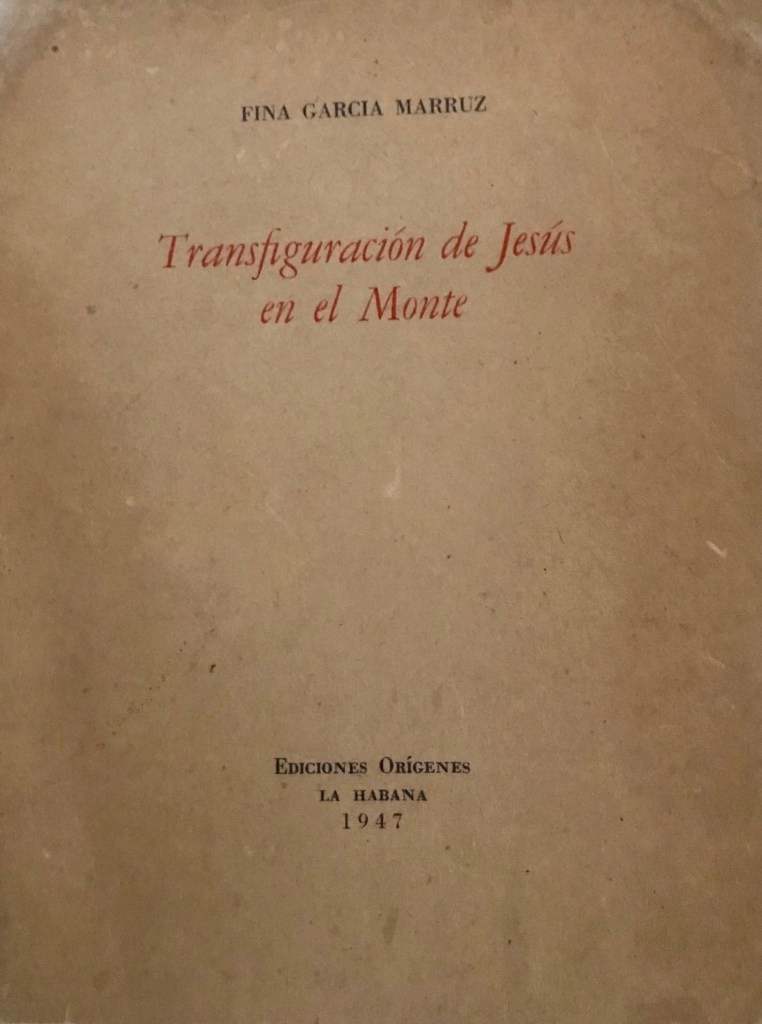
In 1947, the very young Cuban poet Fina García Marruz published the liturgical poem Transfiguración de Jesús en el Monte (Ediciones Orígenes, 1947), which stands in the modernist tradition series of attempts to probe the divine nature of language after the flight of gods and the triumph of the new secular jargons. If earlier in the century a well known Italian philosopher will predict that the international language of the future will be that of technical terms; the English Catholic poet David Jones, will reaffirm that we are “living in a world where the symbolic life (the life of the true cultures, of institutional religion and of all artists) is progressive eliminated – the technician is master. In a manner of speaking the priest and the artists are already in the catacombs, but separate catacombs – for the technician divides to rule” [1]. And if “liturgy” originally meant “public service” and the sphere of gestures, as suggested by Lubienska de Lenval, then Transfiguración has to be read, even into our days, as an attempt for language to measure to the transfiguration of revelation, in which the poem is a sacramental form that retracts language to possibilities of retaining communication.
In fact, Transfiguración de Jesús en el Monte, reinforcing the liturgical repetitions of an hymn and a sacred chant, enacts a flowing rhythm (“en tanto que”) that assesses the limits of the ineffable; a pure exteriority that is the negative or wound of language without ever being able to transcend it. In this sense, Marruz’s poem is only the poetic anabasis to the impossibility of a guided sacrament to organize interiority and visibility. Only the mystical can mediate between exteriority and the crisis of appearance. In an almost programmatic fashion, we read in the second part of the poem: “oh, difícilmente podríamos comprenderlo / Él se ha vuelto totalmente exterior como la luz; / Él ha rehusado la intimidad y se ha echado totalmente fuera de sí mismo” [2]. Transfiguration is the event that exiles oneself from the self (phygé), and in which language can generate contact with something other than its own conventions. This is why they [the witnesses and the martyrs] cannot provide an account about the transfigured revelation – just like anyone cannot truly provide a narrative, except by betraying the experience – except by their hearts as if being mysteriously called by a singular name (“ellos sienten que dentro de su corazón alguien / los ha llamado misteriosamente por su nombre”).
How can language disclose a sense of exteriority that is capable of moving past the autonomy of signification and self-referentiality of language? Can language befall into exteriority? Marruz provides an answer to this question, which can be taken as her contribution to the aporias of modern poetics: poetry can only attune to transfiguration as a cohabitual of a communicating being. In the year that the poem was published, Marruz also wrote in the winter issue of 1947 Orígenes a dense essay titled “Lo Exterior en la Poesía” (“The exterior in poetry) where she claims that “the heart of poem is always outside of it – it should not be that the poet can offer infinite variations of a secret self-possessed knowledge, but rather to rediscover the liturgy of the real; the extreme degree of visibility, which is also its great escape” [3]. What could the “liturgia de lo real” have meant for Marruz in 1947? Marruz does provide a clearcut theological definition of the exteriority as the “angelic”, which does corroborate the hymnological dimension of language, a transcendence between beings of the invisible. The liturgy of the real that defines the exteriority of the poetics of life does not entail a Romantic elevation by the Poet, but the effort to animate reality beyond an alienated monologue. This is why Marruz writes that “only a dialogue can realize an impossible communication, mystical, whenever it does take place in all of its purity” [4].
In 1947 Marruz went a step further than her fellow poets Gaztelu & Lezama Lima, who had defined transfiguration as a learning exercise of the potentia dei of the divine (“a todo transfigurarse sigue una suspension y el ejercicio del Monte era solo un aprendizaje”) [5]. Read side by side with Antelme’s Angel of Reims, one could very well say that for Marruz there is an event of transfiguration whenever transcendence delivers communication between beings, soul to soul; a relation that can one truly speak of the ungrounded and commencement. The liturgy clamored in language is not the memory of an original Adam severed from Nature, but the transfiguration of a linguistic relationship with the world. This might be the secret to Marruz last two verses: “como la infancia que acuña nuestro Rostro allí / donde no puede ser despertado”. If transfiguration also entails recapitulation, this means that this is not a process of forward becoming, but of retaining the atemporal detention that, like that of childhood, traces our silhouette as both figural and pure presence in the bushes of language.
.
.
Notes
1. David Jones. “Religion and the Muses” (1941), in Epoch and Artist (Faber&Faber, 1959), 134.
2. Fina García Marruz. Transfiguración de Jesús en el Monte (Orígenes, 1947), 6.
3. Fina García Marruz. “Lo Exterior en la Poesía”, 19.
3. Fina García Marruz. “Lo Exterior en la Poesía”, 22
4. Ángel Gaztelu & José Lezama Lima. Editorial: “Éxtasis de la Sustancia Destruida”, Nadie Parecía, Número IX, Nov, 1943, 1.
Surely friendship does not depend on obligations or frequency, but it does posit expectations on something like a movement of reciprocity. In fact, movement (κίνηση) and reciprocity are so intertwined that without it, there would not be any separation, only a compact bundle in unity without relations. But, what is at bottom reciprocity? If this notion merits anything thought at all, it must be removed from any conception of exchange in the manner of the quid pro quo and the the ius talionis, where at first sight reciprocity seems to reside as a form of levelling differentiated quantities. In social exchange there is levelling but surely there is no reciprocity except by the legal force enacted by the pressure of duties and obligations. Already in the nineteenth century, at outset of bourgeois society, Søren Kierkegaard with extreme lucidity denounced social levelling as a form of glittering vice: “The idolized positive principle of sociality in our time is the consuming, demoralizing principle, which in the thraldom of reflection transforms even virtues into vitia splendida. Levelling is not a single individual’s action but an activity of reflection in the hands of an abstract power” [1].
What is reciprocal in social exchange is no longer the incommensurable relation between beings, but the enactment of language saturated by its own completion, which is the aim of social organization. If there is no reciprocity in the age of kallopismata orphnes as the reduction of rhetorical language it is because there is no longer a missing word in the event of communication, given that, potentially, everything has been already communicated (it is obvious that today this process can only intensify with the planetary deployment of Artificial Intelligence). The only determination of reciprocity that should be of interest is the one that accounts for the lacunae in language that halts force of social levelling. To reciprocate does not mean to give each his due that defines the Western legal operation; it is rather the mutual codependency in the unforfeited event of language.
At this point, an etymological observation might be useful. In On the Latin Language, Varro records reciproca as a condition of elasticity; that is, a present quality that allows a thing to return to the position from which it has started. Reciprocare thus entails to move to and fro, and to demand [2]. But if we adapt this observation into the sphere of language, we immediately notice that in language there is no previous position nor set origin, which means that reciprocity can only be the undisclosed and disclosed movement of language. Breathing, articulating, speaking: the animus that escapes from the mouth as a mirror of the god of words. The erosion of reciprocity in modern society, thus, goes deeper than the first appearance in fact that human beings are witnesses to a crisis of communication; more importantly, humans have ceased to sense reciprocity because they believe that there is only god where language is mute, and there is language when gods are extinct. Such is the long vigil of computing language as an idol that is neither divine nor of the essence of the human voice. To reciprocate today means to re-divinize the world through words; and through our words greet incoming worlds.
.
Notes
1. Søren Kierkegaard. “The results of observing two ages”, in A Literary Review (Penguin, 2001), 76.
2. Varro. On the Latin Language, Vol.1 (Loeb Classical Library, 1938), 335.
The common Spanish verb “desvivirse” resists obvious translations. Could one translate “desvivirse” as “unliving”, “constructing by destroying”, or “fulfilled life”? It seems that none of them capture the full meaning of an expression that is anchored in practical use. It is important to note that when the term emerged in the intellectual discourse of Spanish twentieth century, its depth was intimately connected to its meaning (life, living, vocation) that it immediately took the life of a concept for cultural milieu and national character. In his lecture “Ideas para una filosofía de la historia de España”, Manuel García Morente suggested that “vivir desviviendose” was the singular form of life of Hispanic being that attained eternity while on the terrestrial world:
“Porque lo típico del hombre hispánico es, por decirlo así, su modo singular de vivir, que consiste en “vivir no viviendo”, o, dicho de otro modo, en “vivir desviviéndose”, en vivir la vida como si no fuera vida temporal, sino eternidad. El hombre hispánico no considera la vida eterna. O la salvación del alma como el remate, término y fin de la vida terrestre, sino como remate, término y fin de cada uno de los instantes y de los actos de la vida terrestre. La salvación eterna no es para él solamente un objeto de contemplación; ni tampoco solamente una norma de conducta, sino que es, ante todo y sobre todo, lo que da sentido y finalidad concreta a cada uno de los actos en que se descompone la vida terrestre” [1]”.
For García Morente, the specific meaning of “desvivirse” entails a tension between interiority and exteriority; and, by extension, between life and death, and in fact of death in life that leads to resurrection and a new life. He writes: “La vida del alma hispánica es un constante morir y resucitar para volver a morir; hasta que la última resurrección” [2]. “Desvivirse”, quite literally, happens at the level of the soul when life continuous through finitude and concrete death. This is why the notion of “desvivirse” has a clear theological underpenning that one can pair with the divine apocatastasis in intramundane life. “Desvivirse” is never about personal salvation and the economy of election, which is why Americo Castro would emphasize that this vocation does not align well with modern individualism, because the “vivir desvivido” experiences its own ruin like a joyous and exuberant Saturnalia” [3].
As in the indication by García Morente, for Castro “desvivirse” entails something like an external perspective in which life can ultimately only take place from its transcendence with a relation to what’s outside ofitself. This outside is neither determined by politics nor rhetoric [4]. To live “desviviéndose” entails an intensity that persists not just as an interior affirmation of self-preservation, but as an erotic relation with what is most desired and venerated (many Spanish thesaurus of the nineteenth century would define desvivirse as “to love or desire with eagerness”, “amar con ansia”). If extracted from the cultural and identitarian historical context, “desvivirse” appeals to the object of passion that overflows the senses of human life.
This overflow is embedded in the word itself. The great Spanish scholar of Benedictine monasticism, García Colombás, in his book El monje y el Misterio Pascual (1984), made a simple, and yet remarkable lexicographical observation about the word “desvivirse”. Colombás noted that while in most of monastic literature the prefix “-des” donates privation and deficiency, the function of this prefix in “desvivirse” suffered a complete inversion, since now it entails to love intensively and thoroughly, as in “se desvive por complacer a todo el mundo” [5]. As a theologian, it should not have passed Colombás that the term in question is a triad of three linguistic units: -des/vivir/-se. This means that it is not just that the prefix exerts the meaning of privation of “life”, but also makes room for the reflexive “se”. It is curious that in in Spanish grammar “vivirse” is often used in relation to location (i.e. “el va a vivirse al campo”), and never as a conventional reflexive action (i.e. “él quiere vivirse solo”, “el se vive solo” = this would be incorrect). Taking this cue, one could perhaps say that the inversion so keenly perceived by Colombás acts upon the living so that they can repeatedly making space for the unfolding of life, rendering possible the soul’s crossing the inside and outside in every form of life.
.
.
Notes
1. Manuel García Morente. “Ideas para una filosofía de la historia de España”, in Idea de la Hispanidad (Espasa-Calpe, 1947), 215.
2. Ibid., 216.
3. Américo Castro. España en su Historia: Cristianos, Moros, y Judíos (Editorial Losada, 1948), 45.
4. Ibid., 279.
5. García M. Colombás. El monje y el Misterio Pascual (Ediciones Monte Casino, 1984), 132.
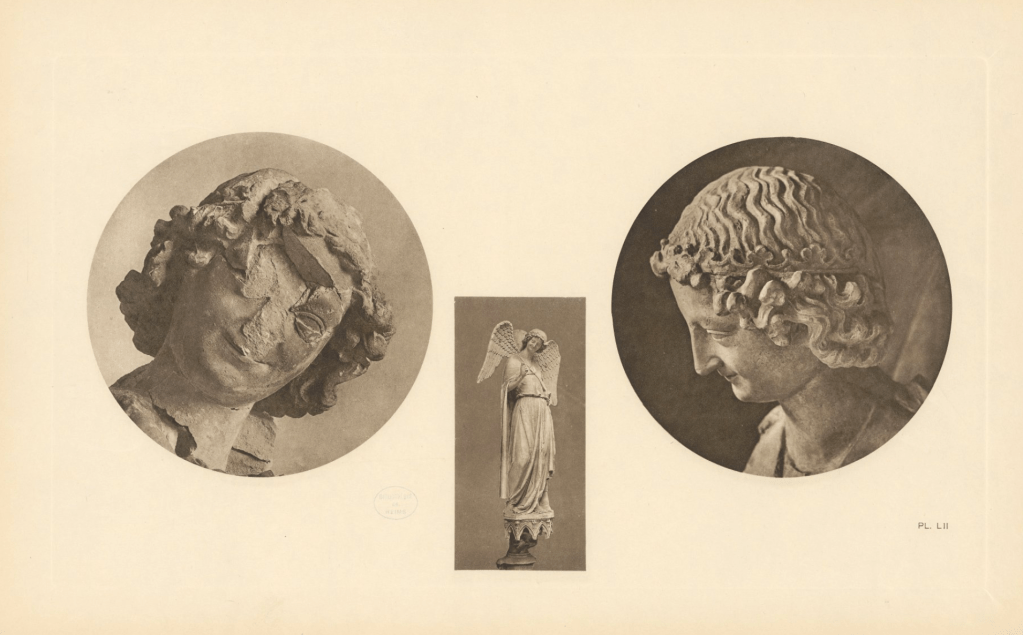
Among Robert Antelme’s posthumous writings the short text “L’ange au sourire” has a decisive place if we are to explain the transfigured theological experience of the French writer. To anyone familiar with French architecture history the title should sound familiar, since the ‘l’ange au sourire’ was already a common expression used by French scholars of architecture during the interwar years. Charles Sarazin, arguably the most important scholar of the architecture of Reims, penned a separata titled “Le Sourire de Reims” (1929), in which he celebrated the mysterious smile of the angel Gabriel that was severely damaged due to shell fire of the Cathedral during the fall of 1914 [1]. But a decade prior to the destruction, art historian Arthur Gardner, in a detailed essay on the sculptures of the facade of the Rheims Cathedral, also took note of this angel’s gaze writing that: “…the angel Gabriel of the Annunciation in which the French smile has almost become a grin, the beginning of the contorted expressions frequently found over the border in Germany.” [2]. The particular aspect of this unique angel’s face that Antelme undresses from the cloak of authority is also wonderfully documented in the photographic book by Pierre Antony-Thouret, who also showed pictorial interest in the way that angel Gabriel was chipped in a large area of the right frontal relief (image 1) [3].
Image 1. Reims au lendemain de la guerre (1928), plate 52.
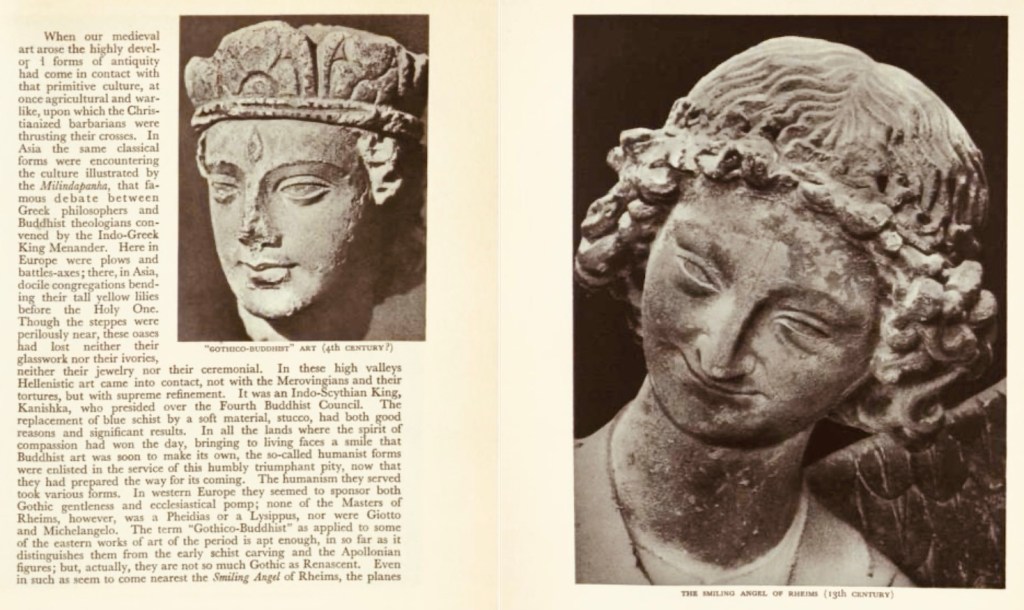
This curatorial context informs the historical background of Antelme’s reference to destruction and what he references as the crushed: “But not crushed by this building, or by that event, or by some power. It has always been crushed, crushed forever” [4]. For Antelme the tenuous, almost imperceptible, smile of the Angel of Rheims is what outlives absolute destruction because to be destroyed cannot be executed absolutely. It is the soul of existence that, because of its exteriority to history, is powerless “to have forever to be”. Even if this being has become petrified and immobile from its original plastic appearance auf vif of sacred art. This is what Malraux captured in his brief mention of the “L’ange au sourire” in The Voices of Silence (1951), where he also compares it to the Buddhist faces of Oriental sacred art (image 2): “The Smiling Angel of Rheims is a statue whose “stiffness” increased with every century; but at its birth it was a similar incarnate, a face that had suddenly come alive – like all faces sponsoring a discovery in the field of the lifelike” [5]. In order words, to see in the muteness of the face the nothingness that allows expressive relations to emerge in the open. This holds for Antelme’s description as well: “Radiant or hidden, inevitably it is there. Word, image, music: everything expresses it, and nothing. It lies at the heart of that realm where all relations are born. Forever starting anew. Possessing nothing, capable of nothing, it must be there, forever”.
Image 2. Angel of Rheims in The Voices of Silence (1964).
But what Antelme was able to capture through the smiling angel of the Rheims Cathedral was not a problem of iconology of art forms, but rather the very essence of the theological problem of angels as it relates to the poetics of life itself. The angel is not a promythical figure scaled to a specific historical moment, but an instantiation of the divine appeals to the withdrawal the possibilities and modes of the human being. This is why Antelme can state that “the only transcendence is the relation between beings”. Even in its muteness, the theologica depth of the angel is the poetic speech of divinity through a surge in language that has no end, but only celebration or hymnology.
This is why Erik Peterson writes towards the end of “The Book of Angels” about the intimate relation of angels in human existence: “A human being can draw near to the angels because the angel too – as its name already indicates – can draw near to humanity. […] The angels are more than poetic ornamentation left from the storehouse of popular fables, they belong to us. For us, they stand for a possibility of our being, a heightening and intensifying of our being – but for the possibility of a new faith…as a passion for mental clarity and an authentic existence” [6]. It is fair to say that, although the figure of the angel does not show again in Antelme’s work, all of his vision and witness accounts in the face of political horror must be placed in the endless vigil of a nocturnal life that is shared with the ethos of angels (utirur vigilis, angelorum vitam procul dubio meditatur).
.
.
Notes
1. Charles Sarazin. “Le Sourire de Reims” (s.l.n.d, 1929).
2. Arthur Gardner. “The sculptures of Rheims Cathedral”, The Burlington Magazine for Connoisseurs, V.26, 1914, 64.
3. Pierre Antony-Thouret. Reims au lendemain de la guerre: la cathédrale mutilée, la ville dévastée (Jean Budry, 1928).
4. Robert Antelme. Textes inédits sur l’Espèce humaine (Gallimard, 1996), 14.
5. Andre Malraux. The Voices of Silence (Secker & Warburg, 1964), 317.
6. Erik Peterson. “The Book of Angels”, in Theological Tractates (Stanford University Press, 2011), 139.
Almost at the end of the Cold War, arguably the most important natural law jurist of the West, John Finnis, published a very acrimonious and provocative essay in dialogue with the Christian theological morality and dogmatic tradition entitled “Nuclear Deterrence and the End of Christendom” (1988). In many respects, this essay speaks volumes to our present, but it also solicits new questions around limits that have been severely traspassed in the current atomic age headed towards extinction. It is worth noting that from the outset, Finnis reminds us how a fellow Catholic liberal theologian, Jacques Maritain in a lecture of 1955, claimed with surprising conviction that “America is today the area in the world in which…the notion of Christian-inspired civilization is more part of the national heritage than any other spot-on earth. If there is any hope for the sprouting of a new Christendom in the modern world, it is in America…” [1]. If this sounds completely analogous to the current program of “national conservatism” that today animates American political elites, defined by the ruthless attempt at the convergence of instrumental Christian vocation and political imperium, it is because these prophetic words have been thoroughly realized.
Finnis does not hesitate to put his thumb on the theological monstrosity maintained by Maritain at mid century – although he does not say it explicitly, it is a concrete restitution of imperial Eusebianism decades before denounced by Erik Peterson in his famous essay on political monotheism – that by accepting nuclear deterrence as a form of uncontested ‘minor evil’ in face of the Soviet menace Christians were endorsing heretic positions at odds with the teachings of the Second Vatican Council. As Finnis argues, the logical structure itself of nuclear deterrence, precisely due to its affirmative promise to exclude “target populations”, fails to differentiate between combatants and non-combatants in an endgame that promises the potential massacre of innocent human beings [2]. This means, first and foremost, that nuclear deterrence (as well as its new preventive forms that have become normalized among global hegemonic powers) terrorize human communities as a direct public act of forthcoming devastation [3].
Even though Finnis does not stop to reflect about the notion of “public act”, it is very clear that this action, insofar as it is a linguistic act, aims at the effective cancellation of the possibilities of language and communication. Nuclear deterrence and proliferation are instruments that speak publicly, and that by doing so, it contributes to the atrophy of human language. As a rebuttal to Maritain’s celebratory artificial gnosis, Finnis sees in the language of nuclear deterrence coincides with the language of ‘utopia’ as a new absolutization of morality. This means that Maritain’s philosophical error – which Finnis calls the “theologian’s position”, since it also implicates an official sector of the Church – is to abandon practical reason of allocated goods (including human life) in the name of a comprehensive aim of building a civilizational “Christendom” coupled in a national community [3]. But whoever fully identifies the spiritual-providential realm with the political-legislative order is already at the mercy of an utopian project embedded in the sacrificial structure promoted by nuclear deterrence.
Towards the end of his essay, Finnis laments (implicitly repeating Karl Barth’s well-known 1930s essay but in an opposite direction) that the relationship between Church and State from the point of view of the atomic age and nuclear deterrence has now been completely altered. From now on, the atomic age demands a Christian vocation based on conscience. Specifically, Finnis calls for a position of refusal and minoritarian observance against the general options of radical evil: “The choice to reverence human life by refusing to participate in public choices to destroy it, is thus a choice is material of the Kingdom and has real and truly lasting effects…even when worldly wisdoms understand it only as a choice of greater evil’ [4]. And citing Cardinal Ratzinger, Finnis endorses the position of Christians as “belonging to a minority” finding courage in nonconformity within the normative order of social space [5]. The Finnis-Ratzinger’s position was still oriented by a Catholic commitment to dogmatics and public reason and virtue, which depends on the luminosity of the subject of religion.
But the objection of conscience is a subjective reduction of modern secularization. In this sense, it might be pertinent to compare Finnis’ position to Ivan Illich’s own stance in the wake of nuclear testing in Germany in the 1980s, which he witnessed in “horrified silence…in order to make the horror visible” [6]. For Illich, who had come to see the triumph of civilizational mysterium iniquitatis in the institutional deformity of the conspiratio of the human species towards controlled subjectivity (conjutario) amounting to “intolerable realities”. The language of Christian prophecy is not the same as the language of silence, because only in the second we can become witnesses through the voice of pain and experience, because pain can uplift a contact with the world without redemption. As Illich made clear in his text “The Eloquence of Silence”, it is through the condition of silence that the word can become flesh and prepare a new life. It is very telling that in a later footnote to the essay in the 2011 edition, Finnis appears doubtful about the religious ground stating that: “Over twenty years later, the unsatisfactory state of Catholic teaching on the matter remains just as it was in 1988” [7]. What changed? At the end of the eighteenth century Novalis had noted that for any orientation of public reason in the West to materialize there needs to be a substrate of the divine mystery, but this is precisely the substrate that desecularization has effectively untied and obliterated from the public. A public where general annihilation percolates without restraints.
.
.
Notes
1. John Finnis. “Nuclear Deterrence and the End of Christendom” (1988), in Religion and Public Reasons, Collected Essays: Volume V (Oxford University Press, 2011),
2. Ibid., 280.
3. Ibid., 286-287.
4. Ibid., 288.
5. Ibid., 289.
6. David Cayley. Ivan Illich: An Intellectual Journal (The Penn State University Press, 2021), 80.
7. John Finnis. “Nuclear Deterrence and the End of Christendom” (1988), 290.
It is too often that we hear a common critique raised against the theoretical skepticism of the primacy of politics in the form of an alleged prefigured “mysticism”, as if the destructive operation against sufficient political reason would entail an ineffable silence. It is a striking claim because there is some truth to it. But we must also question its assumption: can the proponents of political primacy ascertain a ground that can escape the mystical position that it seeks to avoid? The task of intellectual history is infinite and rewarding, but that does not mean this enterprise can positively mobilize a breakthrough within the epochal collapse of modern politics. If this is true, then it would follow that everyone is, more or less, a defaced mystic, insofar mysticism is the condition that runs against the limits of language and the current of the negative. In the same way an American judge famously said that ‘we are all [legal] originalists now’, one could very well say that ‘we are all mystics now’. It all depends where we put the emphasis and the tone.
If we are to reject the totality of political administration and intraworldly legitimacy, this does not necessarily mean that we can immediately sketch what a coming politics would look like. According to Karl Barth in his Ethics, the position of mysticism always denotes a weak “us” that emerges from disobedience with respect to the world; concretely, against the system of planning and delegated orders (schools and the police). So mysticism is an archirealist position because it traverses the world, but only to depose the transcendental closure of its authority. In this way, the skepticism against the mystical position, perhaps unconsciously, is also an indirect skepticism against anti-social stance that is deficient from the vantage point of advantageous political realism. But the insistence of political realism is only anti-mystical on the surface, because it depends on an article of faith on the social reproduction and the overall general political economy between subjects and objects, value and the administration of life.
The mystic cannot be confused with a guru, a magnetic theologian, nor a priest in robes. On the contrary, the mystic is a sibling to the pícaro, a figure of the Spanish Golden Age, that made his life unarrating the social protocols of the emergent social space, revealing and subverting the “autoridades postizas” (fictional authorities) of his epoch, according to the beautiful formulation of Santa Teresa de Ávila. Whoever has read any of the Spanish picarescas will immediately recall that the pícaro does not endorse static or monastic life of interiority, he upholds a temporality of life that coincides with the events of a world that becomes unfixed and betrayed. And the pícaro lives and outlives himself in this gestaltic confrontation. This vital mysticism in how he uses the world is more practical than any political justification for consensual common action.
It is worth noting that Carlo Michelstaedter in a gloss on courage and the persuaded life, divided the world – and his world was that of the Austro-Hungarian interregnum, a transitional epoch of decline filled with specters and monstrosities, very much like ours – between mystics and the dishonest or tricksters, but only the first could be named “heroes” because only them knew the secret of their unique persuasion unto death, renouncing to petty morality, self-interest, and social orders [1]. The mystic inhabits not just the silence that arrests the truth for which he cannot speak; more fundamentally, he also exerts, in every act, the task of freedom as embedded in thought and contemplation of the soul, that according to Michelsteadter is a personal struggle that bends to the real gnosis, “because to know oneself is ultimately to know the universe and to name it…only there is life” [2].
.
.
Notes
1. Carlo Michelstaedter. La melodía del joven divino (Sexto Piso, 2009), 43.
Emilio Prados Such’s postwar book Dormido en la yerba (1953), long out of print since its publication, is the most clear and straightforward literary document of a poetic voice that stands as one of the foremost attempts at thinking the nexus of existence to the divine in the tradition of the twilight of the gods. Dormido en la yerba (1953), albeit its direct Lucretian overtone, does not enact a metaphoric appeal of a return to the physis of nature; rather for Prados, to dwell, imagine, and inhabit language is only possible in coexistence with the caducity of the natural world including life itself. In the poem that names the book, “Dormido en la yerba”, Prados writes that “La vida se te va / y tu te duermes sobre la hierba”, at first sight claim on appearance that seems to endorse the tempus fugit motif of the Spanish Renaissance verse. However, the temporal course in the poem is immediately redirected to a mysterious proximity that befalls existence in nature’s shadows, plunging the voice into the depth of the abyss that colors the caducity in a place. At this point, we note that Prado’s poetics is traversed by a mystical register that transfigures the temporal continuum with that of making of space that is eternal because it has neither end nor beginning.
It is in this sense that Emilio Prados’ theological drift in his poetry is neither about making transcendence palpable through the animation of the world; nor does it imply the absolute immanence of the divine presence towards a new reenchantment of the world. The status of the liberated theos in Prados, like in the mythic understanding of the platonic “gods of place” (theos aisthetos), is an event that can only take place once existence is attuned to the minuscule surrounding of the world. This means that there is never a “God” as a matter of a divine economy that orients a moral predicament; rather, as Maria Zambrano argued in an essay on his work, Prados’ instantiation with the divine is always expressed in the most diminutive melody of the common things as they are. A way of multum in parvo such as the “diminuta yerba”. Hence, God is not the agent of creation of individuation, rather God is an “idea” that expresses in each thing that we are affected to, such as every blade of grass, the spacing of the clouds, the invisible direction of the wind, a human face.
The event of the divine, thus, is not a matter of mental or international faculty between objectivity and consciousness, existence and the natural world; the irruption of the divine names the genesis of appearance and disappearance. And this means that the divine (Dios) is ultimately an affection of the soul, that animation that provides birth and death as relations that move world. It is for this very reason that Zambrano could claim that the opaque sun irradiating Prado’s work is disclosed by the “dios que está naciendo”, or the god that is birthing [1]. Of course, the birth of God is far from being a transcendental revelation that weaves the history of salvation; in the manner of Meister Eckhart we can say that the god is nothing else but the affection that makes his birth take place in the soul like a harvest; that is, leafy, bright, and green [2]. God is the possibility of sensation in the world that is ineffable because it is always on the path of natality. For Prados, the eternal dimension of the birth of gods is only temporary because it presupposes spacing; it presupposes being thrown somewhere, like in the lucretian trope of lying happily above the grass. Above the grass and infinitely outside the world, dwelling and world are irreductible whenever they come into its uttermost nearness. To dwell – which is the central meaning of laying on the grass – on the crust of the Earth is to liberate God, and the liberation of God is what allows us entry into the world.
As Prados wrote in a remarkable letter to his friend Zambrano in March of 1960: “Un cielo sin reposo” que es Dios: Dios no quiso morada y nosotros, como tú dices: edifica que te edifica… Y Dios, sin reposo. No buscamos reposo para Dios y nunca lo tendremos… En la guerra, me acuerdo, unos campesinos prendieron fuego a una iglesita en lo alto de un monte. Cuando bajaban, lo hacían como iluminados y decían: “¡Hemos libertado a Dios!” ¿No es hermoso eso?” [3]. To liberate God from dogmatic commands is also the liberation of world as detachment. There is dwelling for us, but never for the unresting divine presence of god.
It is well known that Aristophanes’ late comic work on wealth, Plutus (388), provides us with what is perhaps the most dramatic and conceptual elaboration of the mythic personification of poverty (Penia) of late antiquity. What is remarkable is that in her self-presentation to the character Chremylus, Penia draws on a political parallelism that colors the ongoing crisis of governance of the ancient polis. If the Greek comedy is dependent on the function of the pólos (which is the vortex of movement that makes possible grasping the specificity of the being that is said), always prior to the arrangement of the polis, then it would follow that Aristophanes’ commentary on the centrality of Penia is neither mockery nor irony within the structure of the play, but rather an element fundamental to the historical presentation of the consciousness of historical public life. The emergence of Penia in Plutus is recorded in the lines 550-554 (a paraphrase might be adequate here): “Thrasybulus and Dionysius are one and the same according to you. No, my life is not like that and will never be. The beggar, whom you have depicted to us, never possesses anything. The poor man lives threfitly and attentively to his work; he has not got too much, but does not lack what he really needs” [1]. Poverty is an intimate relationship with needs; perhaps an unsaid relation, but one that must be accounted for nonetheless.
At her entrance into the play, we are told that Penia’s complexion is both mad (makaron) and tragic (tragōdikon); she could very well be an Erinyes companion from the underworld of the dead. Penia as a mythic figure is a fullfilled form of life. More importantly, what is crucial in the Plutus is that Penia defines herself in sharp contrast to the life of beggars or ptochos. This means that while the penetes is tied to a constitutive need as condition for a form of life; the ptochoi is a being that merely lives in a state of survival, and endures his absence of proper needs. Because Penia is contrasted to the destitute life embodied by ptochos, she can state in one moment primacy over wealth: “all your blessing….you have all that you need in abundance, thanks to me” [2]. Hence, as it has been noted, the irrevocable presence of Penia in the polis is the condition of possibility for Ploutus, god of wealth and abundance, shown in ancient representations as holding the flourishing cornucopia from the fertile harvest season.
What is important to note is that the close and fluid relationship between Ploutus and Penia; that is, between abundance and need, far from being opposition is relational and nourished by its pólos. In this way, the being of need, the penetes, is only able to flourish if he is capable of attaining a free relation with its desire of its vital making, and not from an external power that can determine the functions directed to abstract modeling of population survival. If Aristophanes’ Penia is defined against the ptochos is not because there is a difference of degrees in terms of dispossession, negative or quantitative, but rather it is because it is a disjointed relationship between poverty as a transfigured life, and a life that become destitute because it has ceased to be attentive to its own needs. In the incommensurable ground of the polis, it could be said that the ptochoi were unformed lives that merely persisted in time on the margin of the system of relation of the human community, and for this reason they dwelled in a permanent state of apolis, since their only viable horizon was the result of economic abstraction for secondary needs. In other words, the beggars of the apolis are ultimately effects of economic forces that they do not control, precisely because they no longer have any existential relation with the realm of necessity, that is, with poverty as understood under the shadow of Penia.
In this sense, the condition of beggar is an ultimate economic subjection that is already beyond the sufficient limitation of needs, and thus it has lost all contact with the world. It is has become deprived of the world without being truly dead. Here, one should not forget that as Plato registers the genetic relationship between Penia and Eros in an important moment of The Symposium: “Eros is the son of Poros and Penia, and partakes of the nature of both parents, the fertile vigor of the one, the wastrel neediness of the other. As he is a mean between mortal and immortal” [3]. But the erotic soul in the last resort is nothing but the desire for immortality; and, as a daimon, it mediates between passions and the beautiful, between the divine and the mortal, between need and wealth towards the depth of a harmous life [4]. As Sandrine Coin-Longeray has shown in her exemplary study, Penia (πενία) exceeds the effective qualification of the “good life” based on labour; rather it is a route of life that outlives itself in the erotic transfiguration of world towards the preservation of irreducible homeostasis of common life [5].
This is why Plato’s conception of the ‘happy city’ or the kallipolis was imagined as a deposition of the process of abstraction between “rich” and “poor” that ultimately has come to regulate the modern organization of social rationality proper to accumulation, production, and distribution to supply to rhe demand of ever expanding secondary needs in the general field of consumption. As Plato writes in Book III of The Laws in a section precisely dedicated to showing how to bring civil war to an end: “Because of all this, they were not intolerably poor, not driven by poverty to quarrel with each other; but presumably they did not grow rich either, in view of the prevailing lack of gold and silver. Now the community in which neither wealth nor poverty exists will generally produce the finest characters, because tendencies to violence and crime, and feelings of jealousy and envy, simply do not arise” [6]. The civilizational path undertaken by West since the rise of institutionalized isonomy could not be but exactly the opposite of the platonic deposition of the autonomy of alienated classes. Today it is all too apparent that every sphere of social reproduction stimulates a ferocious race to the bottom between a kleptocracy and a vast administered population of ptochoi that, precisely because they have no relation to Penia, is left pursuing compensatory reactions within the social mechanism of organized begging that they are forced to endure. Under the oblique light of Penia, it becomes clear that both redistributionist policies through state institutions, as well as the autonomous market initiatives of financial models tend to be two sides of the same defense of abstract abundance on the back of the human community of penetes.
The negative subsumption of material needs, and thus of poverty into quantifiable assets that characterize abundance and growth at a civilizational scale – with the collaboration of all modern political ideologies without exception always oriented towards production – has contributed to thwart the path of Penia that is necessary to live freely between passions and needs. This is why in his 1945 lecture “Die Armut” (“Poverty”), Martin Heidegger, departing from a well-known intuition from Hölderlin, claimed that ‘being-poor’ does not mean the absence of some property or substance, but a relation to needs; because only in poverty do we preserve a free relation unto what we need (not-wedigkeit) as necessary. And only this can be taken as the true and ultimate wealth: ‘we have become poor in order to be rich’, means that only through the preserving necessity of Penia will there be a liberating dislocation for human life beyond the indigence of mere exchange and the endless struggle over material goods and the private property. As the world becomes a more vast wasteland of beggars and disposable bodies at the service of technology, Heidegger, in Eckhartian tenor, was not wrong to claim that poverty and Penia will ultimately be the ethical destiny of the people of the West only if they become attune to the divine overtone of poverty as their destiny. Thus, the only possible abundance in a declining world can be realized through the enduring necessity and disquiet return of the essence of poverty – to come near the nothing, because there we find the dearth of the earth. Indeed, as Penia says in Plutus before leaving the stage: “One day you will speedily send for me back” [7].
3. Plato. The Symposium (Penguin Books, 1987), 203b, 82.
4. F. M. Cornford. “The Doctrine of Eros in Plato’s Symposium” (1937), in The Unwritten Philosophy and Other Essays (Cambridge University Press, 1950), 74.
5. Sandrine Coin-Longeray. Poésie de la richesse et de la pauvreté: Étude du vocabulaire de la richesse et de la pauvreté dans la poésie grecque antique, d’Homère à Aristophane: ἄφενος, ὄλβος, πλοῦτος, πενία, πτωχός (Publications de l’Université de Saint-Etienne, 2014), 153-56.
In the broadest sense of the term, questions about the law are predominantly about its justifications, and more specifically about where to locate the act of justifying. That one of the most important elaborations of exclusive positive authority was dependent on a theory of justification to transfer norms of authority (a theory labeled the “normal justification theory”) goes to show that the traditional opposition between positive law as pertaining to the sphere of rights and guarantees and natural law to that of justification comes short in the understanding of the internal development of judicial reasoning in the second half of the twentieth century that unsurprisingly coincides with the crisis of the secular liberal state [1]. The reliance on a “justification theory” will imply not only a new conception of legitimation, but also the outsourcing of the self-referential determination of “Nature” through which Roman Law constructed its principle of the rule of law and the validity of adjudication. As we know, Roman Law did not speak of “justification” but rather of necessity emanating from Nature, which could not oblige to performance or act through by what by nature is impossible or wrong [Ius plurimis modis dicitur: uno modo, cum id quod semper aequum et bonum est ius dicitur, ut est lus naturale]. The natural source of law, as famously defined by Ulpian in the Digest, is in this way permanently tilting between the good and the equitable (ius est ars boni et aequi). This is a matter of first principles of the law (ius), which did not solicit “argumentation” or second order reasoning to uphold its internal legal validity.
The passage from natural necessity in the “hands of the priest”, in Ulpian’s conception, to the modern autonomy of justification takes place when principles are no longer the exclusive framework parameters for operative claims, but the very activity that defines the elasticity of an actual norm and its argumentation within a concrete positive order. This is one way in which one should define the specificity of the American practical legal order (not just its legal philosophies, which tends to run counter to this, cloaked under the vestigates of positivism vis-à-vis the letter and spirit of the Constitution) through juridical administration, whose structural polarity of command and justification defines the administrative process. Early in the twentieth century, Guglielmo Ferrero noted that one of defining characteristics of the American political model rested on a magistrate judicial power that fundamentally differed from European Common Law or positivist tradition in its practice [2]. Contrasting the independence of a limited bureaucracy to the predominance of an all encompassing “juridical administration”, Ferrero noted (although lacking the legal vocabulary to articulate it positively) that the administrative nexus will infinitely expand over social practical reasoning due to the unrestricted force of justification. And the need for justification is what outsources the ancient principles of natural law (ius) to the executive authority that renders operative every sphere of social action and interaction even if they are not explicitly declared prima facie by those principles. The efficacy of justification is the linguistic deployment – a rhetorical craft through rational argumentation – that will generate specific verisimilitude to the otherwise arbitrary and uncontested enactment of its principles. Justification could be said to appear as the work of language that provides internal cohesion of an array of coordinated conditions for secondary social actions.
Since the inception of modern secularization, the nature of justification is the realization of the works without end, which inverts the notion of “justification” in the theological sphere that we owe to Paul. For the Apostle the idea of justification or dikaiōsis implies the making of righteousness through the soteriological narrative of Christianity that subsumes humanity’s fall (sin) for a redeeming liquidation of law. This means that man’s just act in faith generates “justification” (dikaiōsis) of life for all people (Roman 5:18). And as we read from Galatians 2:6: “Know that a person is not justified by the works of the law, but by faith in Jesus Christ. So we, too, have put our faith in Christ Jesus that we may be justified by faith”. The force of justification (dikaiōsis) trumps the production of the works of law that divides human beings in the immanence of this world between the saved and the condemned, the free and the imprisoned, the friend and the enemy. Whereas justification in the theological sense can only imply the ‘end of law’ for righteousness (Roman 10:4), in its late secularized rendition it implies exactly its distorted mirror image: to justify is transformed into the binding force over the void of authority that renders effective the hollow machinery of its own self-validation.
It is telling that in an essay that was first published in German in 1938 under the title “Justification and Justice” (“Rechtfertigung Und Recht”), the German theologian Karl Barth takes note on the transformation of the State becoming “demonic” not due to its utter demise, but as a profanation of the theological justification of “unwarrantable assumption of autonomy as by the loss of its legitimate, relative independence, as by a renunciation of its true substance, dignity, function, and purpose…a renunciation which out in Caesar worship, the myth of the state and the like” [3]. The emergence of the “demonic nature” of the State was internal of its own making , since it conflated faith and people at the same level of social immanence, while preparing the actual realization of an authoritarian world without escape. Following Heinrich Schlier’s work on the figure of the State in the New Testament, Barth will suggest that this political totalization secularized the limit posited by the suum cuique of justification into an instrument of endless domination that characterized the emerging political reality. In fact, in his essay “The State according to the New Testament”, Schlier will define the phase of the demonic State as one colored by the inception of the sphragis, that is, “the sign of the state party as it were the secularized seal of baptism which levels all differences between men and only distinguishes between friend and energies of the ruling system. Those who refuse the new metaphysical slave are deprived of their economic foundations. Even economic life is directed by the spirit of the beast” [4].
Only in such context does the true light of the force of justification comes in full display: the sphragis can only labour to justify the vicarious social existence of the mystery of iniquity infinitely redressing itself as legal argumentation and juridical principles, administrative determinations and executive commands. And Schlier could not let the question pass: “What will Christians do in this situation? They will no longer want to have any part in this caricare of a state, they will “go out…they will simply be outlawed and persecuted” [5]. More than ever today, we are in desperate need of elaborating the elementary aspects of a political theory of demonology that defines a certain point where there is no turning back. To outlive persecution and tear the bond of justification shatters the civilizational course that has sublimated the end of time as an instrument of daemonic absorption into endless legal statues.
.
.
Notes
1. Joseph Raz defines “normal justification thesis” of legal authority in this way: “I shall call it the normal justification thesis. It claims that the normal and primary way to establish that a person should be acknowledged to have authority over another person involves showing that the alleged subject is likely better to comply with reasons which apply to him (other than the alleged authoritative directives) if he accepts the directives of the alleged authority as authoritatively binding and tries to follow them, rather than by trying to follow the reasons which apply to him directly”, in “Authority and Justification”, Authority (NYU Press, 1990), 129.
2. Guglielmo Ferrero. “American characteristics” (1910), The Atlantic. 226.
3. Karl Barth. Community, State, and Church (Peter Smith, 1968), 118.
4. Heinrich Schlier. “The State according to the New Testament”, in The relevance of the New Testament (Herder and Herder, 1968), 236.



 Infrapolitical Reflections