The love of painting. by Gerardo Muñoz

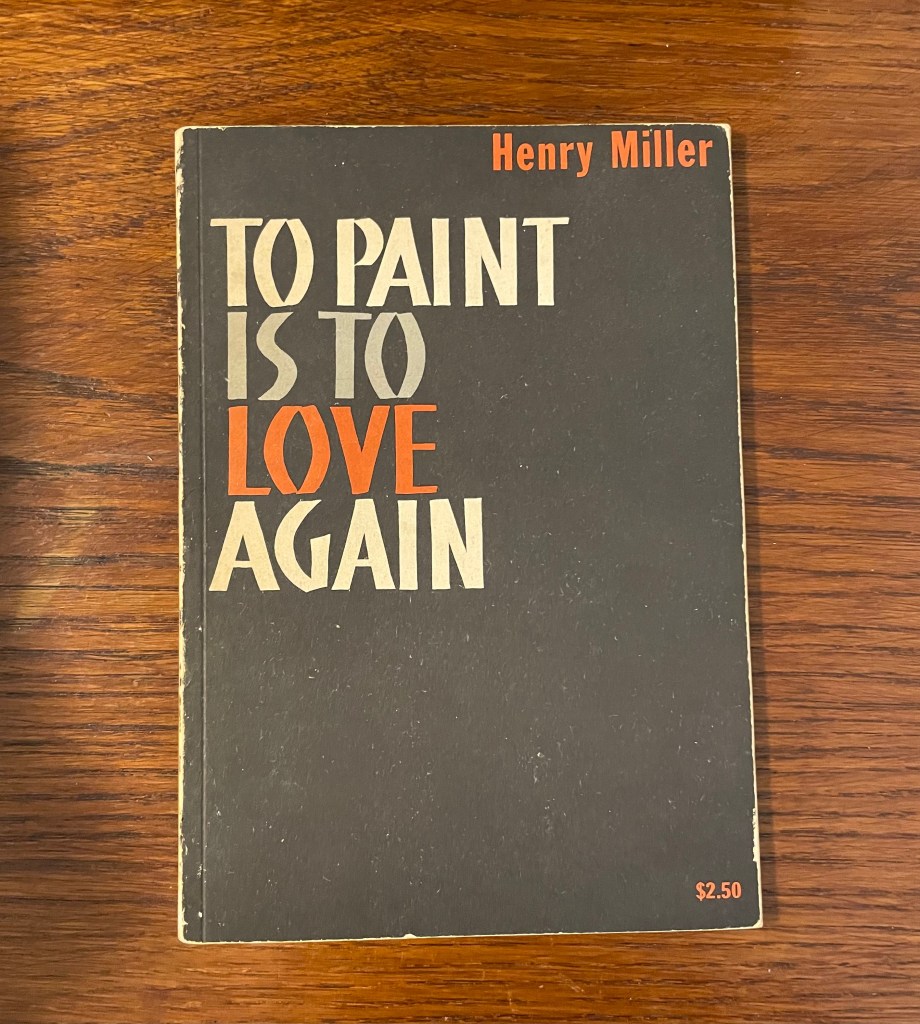
There might very well be an internal affinity between painting and love that at some point it becomes indistinguishable. A painterly picture can become love unquenched for that which remains persistently fixed and unrealizable. In one of the short essay books of his Big Sur period, Henry Miller asked this very question of painting. For him panting had a wondering origin that crosses the hand, undoing what we can easily enact. The erotic dimension of painting, thus, has nothing to do with the image or figure of the beloved, but rather with a specular limitation staged in the ability to allow the unseen to be incorporated in the visible scheme of the world. Only if we are able to see – and by the same token, only if there we are facing an event of painting – can something like use can be liberated from the constraints of mimetic compulsion. Miller writes in To Paint is to Love Again (1960): 

“To paint is to love again. It is only when we look with eyes of love that we see as the painter sees. His is a love, moreover, which is free of possessiveness. What the painter sees he is duty bound to share. Usually he makes us see and feel what ordinarily we ignore or are immune to a certain manner of approaching the world tells us, in effect, that nothing is vile or hideous, nothing is stale, flat or unpalatable unless it is our power of vision. To see is not merely to look. One must look-see .See into and around. Or, as John Marin, once put it – “art must show what goes on in the world” [1]. 

The place of painting for Miller is an imperturbable state that refuses to be fixated on objects, but in the invisible region (as in the figure of the chora) that allows for the thing in the world to be used. This is why Miller considered Japanese watercolor and prints an absolute primer of the pictorial: it taught him the appearance of worlds within the world, regionalizing the surroundings never logically stated unto itself, which in modernity it became the catastrophic horizon of autonomy towards its posterior liquidation. This is why Miller, very much like Carlo Levi, understood that the crisis of painting in the Western tradition ultimately signaled a general sense of social terror as a new phase of human desperation attenuated by the circulation of social fictions. 

At the height of the the closure of civilization, painting reemerged, if Kurt Badt’s axiom is correct, as the last metaphysical activity of human praxis. A metaphysical activity that holds on to the experience of belief in suspended appearance of originary anthropogenesis. For Miller, in painting as much as in love “one must be a true believer” [2]. And this assertion must be understood in the backdrop of Miller’s experiential retreat in the landscape of Big Sur: an experience away from the closure of American city life in research of a “feeling of aloness as spiritual achievement”, as a relation of oneself towards disclosure [3]. In this sense, the painter is a counter-social figure that, refusing to make stir in the world, turns to serenity, silence, and to the pressing contours of the unfathomable beyond any prefiguration. The believer in painting – who is a figure of belief in the desert, after the flight of the gods in the nocturnal vigil of history – is the thrust to the experience of things without barristers or shortcuts to what is revealed.

The age of automation in mid-century transformation of American industrial production serves as the historical backdrop of Miller’s indictment regarding the poverty and eventual disappearance of painting due to the autonomization of human praxis and the gigantic scale in spatial organization. Following Georges Duhamel’s prognosis in America: the menace (1931), he shared the intuition that the crisis of dexterity meant the impossibility of realizing painting, now situated beyond the grasp of human absorption [4]. A land without landscape that, as Adorno noted, bears no traces of the human hand. And this was seen already in the 1950s when the rise of abstract expressionism in North American announced not just the end of easel painting, but the funeral of the whole pictorial tradition. The barbarism of gigantic and unlimited Americanism would run counter to painting as a sensorial activity that embraced the vital limitations of its region. 

Miller’s insistence on painting was an eulogy to a life as experience – painting is indistinguishable from the hands and souls of the painters that he encountered and shared his life – and the value of poverty as absolute necessity for a life that regionalizes our contact with the world. It was through the love of painting that humanity could only restore its divine presence without rest.

Notes 

1. Henry Miller. To Paint is to Love Again (Cambria Books, 1960), 17. 

2. Ibid., 39

3. Henry Miller. Big Sur and the Oranges of Hieronymus Bosch (New Directions, 1957), 34.

4. Georges Duhamel. America: the menace (Houghton Mifflin, 1931), 85.

The ascent of the Shadow Docket. by Gerardo Muñoz

In recent years there has been a steady but increasing practice in the American legal system that has passed unnoticed outside the corridors of law professors and practitioners of litigation, including the federal state that has summoned to its practical use: the emergency relief, or ‘shadow docket’ that puts the burden on the Supreme Court to decide on concrete questions without a formal hearing, fact finding, or without proper argumentative opinions of visible authorship (the judge who pens the opinion tends to deface his authorship). Since the outbreak of the Covid-19 pandemic, the Supreme Court of the United States has increasingly expanded its so-called ‘shadow-docket’ in parallel with the merits docket to such an extent that, as some legal theorists have noted, the blurring of the borders between the first and the second have become so tenuous and intertwined that it would seem that the merits docket depends on the prior selection mustered in the shadow docket. As constitutional scholar Stephen Vladeck has registered in his The Shadow Docket (2023), a practice that historically was strictly tied to emergency relief for capital punishment executions, it has now become a normal vehicle to decide on the emergency contingencies, while at the same time exercise discretionary judgement regarding the merits, or actual dispute, of case pending future review that might never be considered at all [1]. 

It must be said that the selective practice of cases by the court through the notion of “certiorari” on merits cases was in itself a decision on the exclusivity of relief based on the criteria of major legal questions of interest to the court. But precisely the differentiation between certiorari and the shadow dockets grants sharp focus on their differences. On the one hand, the shadow docket fails to decide on “legal questions” – in fact, it avoids tailoring the boundaries between the other branches of government and itself, as some have noted – and, by the same token, its non-decision produces a precedent lacuna that further entrenches the ascension of the shadow docket, inviting an evermore practice of emergency relief to increase chances of ‘cert’. Contrary to expert opinion, this is a juridical situation that does not create the conditions for the normalization of the “state of exception”, since there is really no authoritative decision to stabilize a concrete order, which was the purpose of Carl Schmitt’s well known formulation about sovereign arcana in political theology. In a certain sense, we have already crossed this threshold. Rather, the shadow-docket as a juridical practice in the American legal order is an institutional symptom in which decision has been evacuated or rendered inoperative, so that emergent social needs enforce any specific arrangements and political vectors through an enacted order. 

Furthermore, the shadow-docket as a regularized legal practice at the highest court confirms the historical shift within American legal system from the empire of the courts to administrative departmentalized commands, which ultimately means that the formal tendency towards “delegation” should not be solely circumscribed in allocated powers of the different branches’ oversight and control, but rather is a product of a holistic tendency towards the emergence of a new form of social indeterminacy in which authority resides in the shadows. As Supreme Court Jackson writes in the “Per Curiam” dissent in Trump v. JGG  (April 7, 2025): “With more and more of our most significant rulings taking place in the shadows of our emergency docket, today’s Court leaves less and less of a trace. But make no mistake: we are just as wrong now has we have been in the past, with similar devastating consequences”. It is an astonishing statement from the Judge not only because of what it states, but also what it silences; mainly, that by leaving no trace at all of their argumentative reasons there is no precedent, and for that matter no process and thus no case. And what is a rule of law devoid of a case and precedent? The historical schism with respect to the tradition of Common Law that gives birth to its formal constrains should be utterly obvious. Ultimately, this evidences the uttermost decline of the legal positivist horizon of the modern law rooted in legitimate authority (authoritas, non veritas, facit legem), in which arbitrary decisionism, legal motorization, and appeals to external values align themselves in order to render absolute determinacy between social life and legal execution without any preclusion in the form of a social trial without end. In this sense, it would be foolish to assume that the crisis of authority with the dissolution of auctoritas in the social spheres compartmentalized in functions of the “political community”; on the contrary, in the shadow docket scenario, authority “becomes more and more abstract, more and more inhuman and inexorable; more and more demanding” [2]. The orientation of executive commands is met with proportional digression of adjudicated moral pondering, and each time the force of legalization is vigorously expanded.

The decline of the juridical decision, one would be tempted to say, paves the way for the infinite demands at the expense of the arbitrary values formation of social gigantism. In the opinion about college admissions and racial discrimination of the 2023 merits docket cycle (Students for Fair Admissions v. Harvard College), Justice Roberts wrote that “What cannot be done directly cannot be done indirectly. The constitution deals with substance, not shadows”. An ironic statement, indeed, given the preeminence of the shadow-docket in the adjudicative practice of the Supreme Court itself. While the administration of justice becomes a practice in the shadows, one cannot but be reminded of Plato’s protofigure of the Guardian of Constitution, the Nocturnal Council, as elaborated in the last pages of The Laws. And for Plato “if a state lacks such constituent [a Nocturnal Council], no one will be surprise to see it staggering from one irrational and senseless expedient to another in its affairs…that body must posses virtue in all of its completeness which amens that it will not take erratic aim at one target after another but keep its eye on single target and shoot all its arrow at that” [3]. On the tail opposite end of the platonic Nocturnal Council, the United States’ highest court’s gliding abdication seems to erratically aim at repeated targets that emerge blasting flickering lights from within the ever present shadow docket – indeed, a momentary luminosity, full of ‘technical terms’ and deferrals, that aim to showcase that the rule of law still endures in the House of Justice.

Notes

1. Stephen Vladeck. The Shadow Docket: How the Supreme Court uses stealth rulings to amass power and undermine the republic (Basic Books, 2023), 19.

2. Theodor W. Adorno. “On the Problem of the Family” (1955), Endnotes, 2022: https://endnotes.org.uk/posts/theodor-adorno-on-the-problem-of-the-family-1955 

3. Plato. The Laws (Penguin Books, 1975), 520.

Osculum pacis. by Gerardo Muñoz

It has taken Pope Francis’s public letter addressed to the Bishops of the United States to put in perspective how late American imperial politics in matters of immigration and probably other spheres of social life is not only at odds with the Christian vocation, but even waging war against the very dogma of Christian revelation. The reminder does not come completely out of context, since as we know, the marching band of intellectuals that for a long time have defended a “Christian postliberal” transformation – some of which not long ago offered theological justifications for the Church as the universal ark for migrants – given the current hegemonic configuration find themselves as mere scribes of whatever is enacted by unilateral executive command. The impossibility of enacting a transitional political theology evidences the emptying of politics into a technical mobilization of apocalyptical overtones, as clearly defended by Peter Thiel. The attempts to pilotage a planetary gnosis to his own image in the last stage of imperial stagnation, definitely supports Francis’ assertion politics today is built “on the basis of force, and not on the truth about equal dignity….begins badly and will end badly”.  But in a way, this “end” has already taken place through the revocation of the ethical tenor of the Christian mystery. 

It comes to no surprise, then, that if the erosion of an ethics is at stake, that Pope Francis would allude to the parable of the Good Samaritan and fraternity, something that he has explored previously in the encyclical “Fratelli Tutti” [1]. It is also important to note that Francis is not opposing the Good Samaritan to the ordo amoris; rather the operation is more subtle: for any community to be organized around ordo amoris, there needs to be a space for the infinite discovery that the Good Samaritan parable solicits of every Christian’s responsability. According to Francis: “The true ordo amoris that must be promoted is that which we discover by meditating constantly on the parable of the “Good Samaritan” (cf. Lk10:25-37), that is, by meditating on the love that builds a fraternity open to all, without exception”. In other words, and implicitly taking distance from the Calvinist dependency on community of salvation, the Pontifex is disclosing the memory of an ethical vocation that cannot end in social norms or national unity without exteriority. The communitarian ordo at times could also amount to oppressive familiarity, as it appears in Corrado Alvaro’s Revolt in Aspromonte: “Village life seemed to him a strange invention, a protective agreement between people who were afraid”. Thus, what the Samaritan teaches human beings is that there are no ethical standards for which we can respond, since every encounter opens up a ‘decision of existence’ before an absolute other beyond the sacramental duty of “I ought”. 

Who is this “other human being” that now becomes your brother? As we know, in Ivan Illich’s late work the ethical inflection of the Good Samaritan illuminates the true character of our poetic relationality and creative act: “You can recognize the other man who is out of bounds….and create the supreme form of relatedness which his not given by creation but created by you. Any attempt to explain this “ought” as corresponding to a norm takes away the mysterious greatness from this act” [2]. Indeed, Illich goes further in telling us that the suppression of the ethical decision of encountering the Samaritan can only leave us with a “liberal fantasy…where bombing our neighbor for his own good” [3]. Just like today the moral justifications of “ordo amoris” or the administrative allocation of a substantive “common good” can produce justifications for mass deportation of immigrants and dividing the social space between citizens and noncitizens (removing the foundation of ius soli) can become the strange patent of a monstrous theological manipulation. 

The ethical mystery exemplified by the parable of the Good Samaritan introduced into history a new conception of “brotherhood” that was not conditioned by national, political, or family affiliations, but by a common vocation expressed upon acting through mercy and charity. Belonging to the “human fraternity” allows me to decide who is my brother through the osculum pacis – a conspiratorial mouth-to-mouth kiss that creates proportionality and peace through the encounter that yields mutual creation. Before the Samaritan we give everything without waiting for anything in return, as required by any true ethical disposition. As the scholar of Ancient Christianity, Christine Mohrman once noted, the osculum pacis was a universal relationship of the human species through their voices coming together to assert external political peace as well as interior health of the soul [4]. If the predatory programs of mass deportations and intensification of hostilities between nations have come to forefront in our days, this is due to the fact that the overall end is not to piecemeal ordo amoris coordinated by state social policies, but rather a permanent assault against the association of the free souls constitutive of the osculum pacis. 

In light of the theological drama of Christianity, nationalism can only be taken as a symptom of brute force and inequity (radical evil). As Erik Peterson reminded in his essay “Das Problem des Nationalismus im alten Christentum” (1951), the cult and strife between nations and imagined communities, at least for the Chirstian vocation, do not have any traction, since the warring angels of nationalities have been overcome by the event of resurrection [4]. The ‘strange career’ of American political Catholicism is precisely that through a technocratic administration of social pain and spectacular delirium, it can only offer an noncorporeal ideal of ordo amoris “in the service of a single nation which seeks to establish its supremacy, by identify its own interest with that of humankind”, as Peterson observed  in the wake of European nationalism, but that it applies today to the letter with little variations [6].

In vain should we attempt to pin down the osculum pacis as professionalization of care or the hospitalization of pain that have become practices of a “corrupted core of a very clear and powerful ideal of democracy”. In the disjointed time that characterizes the end of political theology and its warring nomoi, the osculum pacis will be not be found in those that attempt to conjure a “Christian civilization”, but only in those that dwell in the state of adelphos, faithful to the scandal of peace and the endless conspiracy of speech. 

Notes 

1. Pope Francis. “Encyclical Letter Fratelli Tutti (On Fraternity and Social Friendship), 2020: “By his actions, the Good Samaritan showed that “the existence of each and every individual is deeply tied to that of others: life is not simply time that passes; life is a time for interactions”: https://www.vatican.va/content/francesco/en/encyclicals/documents/papa-francesco_20201003_enciclica-fratelli-tutti.html 

2. Ivan Illich. The Rivers North of the Future (Anansi, 2005), 207. 

3. Ibid., 208.

4. Christine Mohrmann. “Quelques traits caractéristiques du latin des chrétiens”, in Études sur le latin des chrétien (Edizione Di Storia E Letteratura, 1961) , 29-30.

5. Erik Peterson. “Das Problem des Nationalismus im alten Christentum”, Theologische Zeitschrift, 7, 1951, 81-91.

6. Erik Peterson. “Die Frage nach dem Menschen”, in Offenbarung des Johannes und Politisch-theologische Texte (Echter Verlag, 2004), 250.

Americanism and whaling. by Gerardo Muñoz

“What is the genealogical figure that best recalls this form of enmity in late American imperialism? The pirate.” This was written by Rodrigo Karmy, who sets up the ground for a timely inquiry. In fact, it is necessary to understand the accelerated processes that are currently underway as a civilizational choreography that only now finds an intense vortex of legibility. In what sense, then, can we speak of an order of pirates that have taken hostage the fleet of imperial politics and the empire of politics? At this point I would like to recall a brilliant and forgotten book by Charles Olson titled Call Me Ishmael (1947), which offers a perceptive interpretation of the essence and orientation of Americanism as an unbounded planetary civilization. Unlike many others interpretations – Max Weber on Calvinism and communitarian deification; Marxists on the Fordist mode of production and passive revolution; and even those that recast the economy of the spectacle and the psyche of mass culture – for Olson, who takes a necessary stepback, the civilization deployed by Americanism is essentially a production regime that first rose from the extraction of whale oil in the 19th century [1]. And as some economic historians have reminded us, before the first oil wells were found in Pennsylvania in the mid-nineteenth century, oil was embedded in the species of the sea, that is, in the fishing and cutting up of the mythic sea creature [2]. 

The veiled settlement of expansionism to which Daniel Immerwahr has drawn attention recently can only be understood if we start from the premise that the arcana imperii of Americanism is a maritime enterprise that takes the world itself hostage. This means that unlike the English trading companies of early liberal capitalist modernity, Americanism is no longer concerned with the neutralisation of a common space for the exchange of goods and values, but rather with something more terribly vast: the domination and total extraction of the sea and its species. Whoever rules the seas rules the earth; in other words, whoever is able to guide the threshold of the earth has been able to do so because he has already crossed every possible limit in the land surveying (agrimensura meant precisely the measurement of the land) art of territorial appropriation and separation.

The civilizational differential of such achievement should now be evident: this production regime does not have a territory or a specific mode of production as its objective, and this is precisely Olson’s thesis, but its sole purpose is to release an effective domination of the world. And only the world can be its most coveted object. Hence, it is worth remembering, that for Herman Melville – as he puts in the mouths of some of his characters – the enterprise of Americanism embodies in the secularized time of modernity something truly monstrous: nothing less than the consummation of the presence of evil; that is, the mystery of inequity (mysterium iniquitatis) in suspense and processed through the wager of the strongest whaler. How is humanity introduced and lodged in the courtyard of the mystery of inequity? Well, not only by fishing for each other, but by calling into question the very existence of the world. The religious imagination surrounding the fisherman as a prophetic symbol of salvation of the human species, as illustrated in a well-known plate from Herrad of Landsberg’s Hortus Deliciarum (1167), reappears in Americanism as an unbearable parody of all living things on earth. As one of the characters in the late novel Pierre (1852) says: “I hate this world.” And one could say that the inner belief in hatred is the fundamental stimmung of Americanism.

Thus, it is no longer just that we are hostages on the San Dominick, thrown into the groundless instance of the decision; it is something more sinister, lethal, and inconspicuous. The whaler is ultimately not the politician, he is the common man, a hollow-crowned qualunque, whose fate is shipwreck and whose tongue is commanding force. In the existential struggle between Ahab and the whale the only destiny is to caress the sea floor, as Olson says, will amount to something “all scattered in the bottom of the sea”. The post-mythic historicity of the flood reaches its definitive realization in Americanism as the genesis of a devastated world without an ark – propagated by the extinction of all species and all worlds and all presences, putting an end to the soft and untimely music of redemption.

A redemption that, not by chance, Melville only managed to find in the possible restitution of the original garden in the lands and landscape of Palestine: “Looks pearly as the blossoming / And youth and nature fond accord / wins Eden back…”, we read from the verses of Clarel (1876) [3]. Being able to preserve this acoustic garden besieged by the metaphysical force of the whalers may be the only ark left for us to land somewhere on Earth. 

Notes

1. Charles Olson. Call me Ishmael (Grove Press, Inc, 1947), 18-19.

2. David Moment. “The Business of Whaling in America in the 1850s”, The Business History Review, 1957, 281.

3. Herman Melville. Clarel: A Poem and Pilgrimage in the Holy Land (1991), 87.

The bruised souls. by Gerardo Muñoz

Whenever a professional politician today evokes the ‘soul’ one must be immediately suspicious, as it tends to be an automatic lullaby for “national unity” or a dormant metaphor in a flowing stream of empty chatter. What could the soul mean to anyone – say, those millions that have now for the second time voted fairly and squarely Donald J. Trump to the Executive branch of the national government – only capable of giving attention to a series of onomatopoeic pop-words that are now ingrained in the linguistic acoustics of the American lexicon (“Bitcoin”, “Tiktok”, “Woke”, “Prime”, and the list could go on). The ongoing catastrophe is first and foremost within the texture of language, which is ultimately why it is also an ethical decomposition in which all other spheres of practical action (first and foremost, politics) amount to business as usual with its corresponding rhetorical bravura.

Suggesting continuity might perhaps be an understatement: it is now a business that does not need any sumptuous or veiled mediation; refracted upon its own absorption of its hyperproduction of fiction, the defeat of the communitarian salvation of Calvinism can only be expressed as a self-serving an ongoing destruction and self-annihilation. True, it could be claimed that ‘Americanism’  has always been this; the only difference is that today, already well into the century, it moves in a vector that directly rejects the world while making a full fledged program of its own making. Only a Society that has become fully moribund can celebrate its own death and decomposition; while the emancipated and well scripted villains of the act now have no shame but to reveal how the ultimate object of their conspiracy was the obliteration of the Earth.

“It is the time of the assassins”, TJ Clark writes echoing Henry Miller’s unjustly forgotten book on Rimbaud and the legitimation of the social bond, in which the homo homini lupi discloses itself from any all possible contact in the metropolis solely dependent on ad hoc hyperproduction of justifications required to fully commit to the illusion of legitimate action. Only that now the time of the assassins is perhaps an uncanny dark night of those without souls, as in the deranged characters of a McCarthy’ novel: they are willing to kill and be killed; they are beyond any contact with language, and “what do you say to a man that by his own admission has no soul? I’ve thought about it a great deal” [1]. And indeed, there is nothing to say and nothing to face: in the soulless dark night there are only hunters and those that are hunted; there is integration or pulverization; there is killing and there is humiliation before an ever increasing legal nexus coordinating the acquiescence of force. But perhaps this is the real arcana of the American soul that is only shimmering through in all of its glory.

Someone like D.H. Lawreence definitely thought so when writing about the novels of Finimore Cooper: “[The white american] lives by death, by killing the wild things of the air and earth…All the other stuff, the love, the democracy, the flooring into lust is a sort of by-play. The essential American soul is hard, isolate, stoic, and a killer. It has never yet melted” [2]. But in our days it has begun to melt, to fragment, and decompose in a heavy storm of pain and despair. And it continues to stand in the long winter of American civilization (the castle of Frozen is the allegory of the epoch) that now finds itself at the epochal threshold of the end of growth, only left with rampant nationalist impulses of self-affirmation that can only deepen the nihilist tonality of anguish and self-destruction, and the emergence of the bizarre as Jamie Merchant notes in his recent Endgame (2024). 

In his Reflections on America (1958), Jacques Maritain maintained that the spiritual patrimony of Americanism is that of being “bruised souls”, a community that came into being by double exclusion (hunted by their religion and rejected within a national polity), which in turn allowed to be compassionate to human suffering, and thus the hidden meaning of the wound was to be seeing in the “role played by immigration and poverty suffered in the Old World” [3]. Hence, for Maritain the condition for the healing soul of America resides in its opening to ongoing suffering of migrants, the dispossessed, and those in exodus from the psychic pressure of a social metabolism gone sour in every subject of civilizational decay as Erich Unger had proposed in his Politics and Metaphysics (1921).

 It comes to no one’s surprise, thus, that the decomposition of the American soul departs from the overt opposition to migration, as a figure of the grazing over the Earth, that must be vanquished and condemned by a planetary gnosticism undergoing in front our eyes. The Chrisitian modern state enters in this way into a concrete and visible process of artificial desecularization showing that “the Christian relation to the State…is in mad hostility to all of them, having in the end, to the destruction of them all. […]. And it is, simply, suicide. Suicide individual and en masse” [4].

The stakes are extremely clear: it is for the bruised and the brute (some have called it the barbarians, proprietors of strange tongues, keepers of the clandestine lacunae of language) to retreat from the fictive proliferation of appearances, the artificialization of reason that can promise success as the ultimate pinnacle of self-destruction. Inclined beneath the shadow of archaic Penia, the bruised and incurable souls might not find redemption in the American wasteland, but they will land somewhere between language and world. Not a program but a moving conviction.

Notes 

1. Cormac McCarthy. No Country For Old Man (Vintage, 2005), 8.

2. D.H.Lawrence. “Fenimore Cooper’s Leatherstocking Novels”, in Studies in Classic American Literature (Thomas Seltzer, 1923), 92. 

3. Jacques Maritain. Reflections on America (Scribners, 1958), 84-85. 

4. D.H. Lawrence. Apocalypse (Penguin Books, 1995), 148.

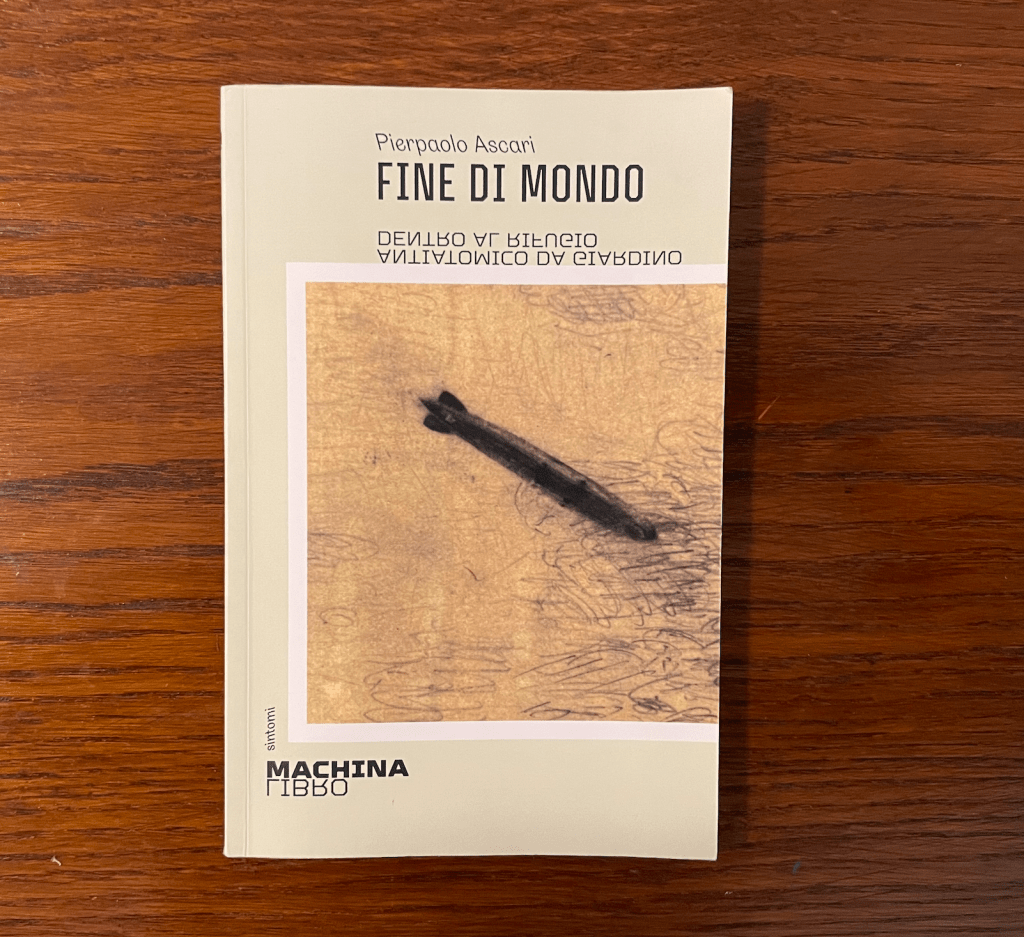
American apocalypticism. On Pierpaolo Ascari’s Fine di mondo: dentro al rifugio antiatomico da giardino (2024). by Gerardo Muñoz

Pointing to a methodological clarification, Pierpaolo Ascari’s Fine di mondo: dentro al rifugio antiatomico da giardino (DeriveApprodi, 2024) opens with an untimely advice: the threat of atomic extermination of human life can only be told and appealed through the irony deployed in all areas of consumerist culture. Undoubtedly, this fits pretty well to the case on point, since American modernization is both the hotbed of Hollywood and the atomic bomb, two poles of the regime of a vicarious life consisted with Henry Adams’ well-known assertion that, in spite of everything, America civilizational passion has always been generalized optimism. And it is not surprising that Stanley Kubrick, when asked about the thesis of Dr. Strangelove (1964), also claimed that the only possible form to tell a story about the bomb of total extermination was through a black comedy (Ascari 11). This self-serving optimism is tested in Ascari’s Fine di mondo (2024) by looking at the construction of an apocalyptic underworld fantasy; that is, in the garden of anti-atomic sheltering that reveals the true arcana of modern Americanism as a subterfuge – but also a civil current in plain sight – parallel to the rise of mechanized labor under the conditions of the triumphant Fordism. Of course, now that our farewell to Fordism has been longed trumpeted, it does not take much to see that what remains is the infrastructure of schizophrenia and general terror in the social fabric that colors the specific tune of American apocalypticism. Ascari’s book is a superb elaboration of this tonality as historically rooted and articulated, but also open to its (pseudo)theological mutations undergoing in our present. 

On the surface, Ascari’s Fine di mondo (2024) is a short compendium of the civil responses and techniques towards atomic destruction and survival; but, more deeply, is also a history of Americanism as a historical project committed to a long process of civil domestication, enclosure, and endurance of survival. Of course, the nuances here are important to grasp the subtle hypothesis of Ascari’s working scene, since we also know that modernity at large (considering both its contingency and contradiction as features of its emergence) was also a process of an optimized gnosis through alienation and the enclosure of private property towards commerce stabilization and productive growth (the nomos). But for Ascari the specificity of the American nomoi through the lenses of atomic sheltering and refuge implies a microphysis; that is, a “way of life” validated through theological premises tailored in the organization of subjective deificatio (Ascari 23). This means that the apocalyptic apparatus driving American philosophy of history is not just one of realization towards the absolute objectivation of the world – even if such endeavor is necessary and preparatory – but rather that the sheltering and self-imposed domestication of human existence has become naturalized as a threshold of the conditions of finite human life. The paradigm of sheltering as the unit of survival is a form of self-regulation of grace that is consistent with the evangelical dispensationalism and technical election analyzed in Monica Ferrando’s recent important book.

The concrete examples abound in Ascari’s short but densely illustrated book: from the Civil Protection comic to the details of the emergence of “do it yourself” assemble manuals (discussed in the correspondence between Adorno and Sohn-Rethel); from the Hulk to Godzilla in a post-atomic bombed world; form the resilient speeches on atomic menace by JFK to a 1950s study conducted at Princeton University that reassured that “fathers” will get to know their children better in conditions of total sheltering even if it results in an “ethics of the jungle” (Ascari 34). Following Guy Oakes’ groundbreaking The Imaginary War: Civil Defense and American Cold War Culture (1994), what is distilled in Ascari’s pop culture puzzle is the panorama of the “Cold War” not as a war that did not take place between two imperial powers; but rather a total war that took place beneath the crust of the earth (and this is why the topoi of the refugee becomes so telling) and at the thicket of human existence waged as psychic management of the civil sphere. In fact, the “imaginary war” is nothing else than the stazion once social life that has yet to cease to exist in our days (Ascari 48-49). 

For Ascari this implied an interiorization of the ‘sublime’ in the reification of the social fabric, which cannot be divorced from the lobotomized subjectivity of the crisis of “social man” that Gianni Carchia identified as the steering project of post-enlightenment Romantic negativity. In the turbid vaults of the self-made man we encounter the liquidation of everything that is living and the projection of fictitious death that clings into “salvation” in spite of absolute destruction; because, after all, those that survive total destruction are only there to confirm the soteriological greatness of the American destiny (Ascari 78-79). The thorough “Ubu” dimension of American psychic political power definitely speaks to this well sedimented conviction of sacrificial subjectivity. Who does not remember the glorious chants for resilience and isolation of the American political elites during the peak of the COVID19 crisis management? If it came to no one’s surprise that a large majority of Americans accepted the pandemic arbitrary rules (monetized whenever needed, it goes without saying), it was because the American subjectivity has been adapted for quite too long to the ongoing separation of refugee and domestication. After reading Ascari, in fact, we think whether the emergency policies were not just another episode in the history of American sheltering now extended at a planetary scale.

There is another idiosyncrasy to American apocalypticism that must be accounted for. And this is introduced towards the end of Fine di mondo (2024), when Ascari quotes Ernesto De Martino about nuclear war; mainly, that when it comes to atomic annihilation there is no longer the symbolic mythic-ritualistic process of reintegration, but rather the mere technification of the hand that gathers scientific knowledge in convergence with the death drive” (Ascari 81). In other words, this technico-apocalypticism brings to absolute unity the originary response of the human species (the movement of the hand) with the organization of scientific rationality that, like Günther Anders saw, brings no re-symbolization of the principle of reality, but rather it can only reaffirm the layering of the principle of reality to govern over it (Ascari 85). In a way, if it as if the essence of American apocalypticism is instituted as if beyond time, since the endurance of a “time of the end” means that the triumphant death (and the dead fueling the demagoguery of its process) foreclosing the symbolization without an exit. Indeed, an apocalypse without redeeming kingdom. For Ascari the only anticipation – primordial mechanism of anthropological capacity – is that of “money”, and hence the dominance of the principle of general equivalence entails gaining the temporal illusion of some distance from the ongoing production of death. But it is evident to anyone today, as it was said not long ago, that the true dead are those petit bourgeoisie living in the American suburbs. And they keep coming as the embers of domestic happiness try to ferociously shut down the latency of a piercing pain. 

Yes, the nature of permanent apocalypticism confirms that the true and final object of techno-capitalist force has always been the possibility of multiple life worlds. And its erosion implies the endless possibility of ordering the life of the city, as Elon Musk just a couple of weeks ago told the former president of the Republican Party: “Hiroshima and Nagasaki were bombed and now they are full cities again. Yeah, it is not as scary as people think”. If the enterprise of civilization has largely been understood as springing from the crust of the earth upwards, one of the important lessons of Ascari’s Fine di mondo is that it trains us to look downwards and inwards as the cruxes of America’s persistent government over the garden of our souls. 

On American despair. by Gerardo Muñoz

The rhetoric of “decadence” now prevalent in United States has reached such heights that, regardless of political orientation, it is clear that it has become a pretext for a desired take off and accession from the objective  stagnation and paralysis. Paradoxically, the assumption that there is “decadence” is revered as a moment of forthcoming light and rejuvenation; and, thus, as a “crisis” that can be identified and managed through the end. As it is well-known, for some critics of decadence the Golden age of American life was the landing on the moon and the population boom of the 1950s; technology and family. The elements are self-serving: to accelerate the reproduction of the human species, and to lead technological gigantism against new geopolitical competitors (AI, chip wars, Green economy, etc).

In the early twentieth century Americanism was a benefactor of private Fordism (everyone could enjoy his or her car, that is, their increasing isolation), but in principle things have not changed much a century later in terms of the outlook and the techno-administrative power. But the one thing that has changed is that the age of increasing productivity and formal production is no longer the objective coordinates of social relations; rather, depopulation and stagnation are the new variables that public powers that must be governed through its effective processes. Ultimately, this also implies that the waning of the high-modern state is no longer effective, and so the established discussion about “race to the bottom” fails to understand that there is no bottom. Hence, the only race is toward planetary destruction.   

And what is curious to note is that even those that have identified the epochal crisis of Liberalism can only exacerbate and contribute to the acceleration of the ongoing destruction with cultural and rhetorical veneers notwithstanding. The ‘postliberal’ commitment to the fantasy of a “new policy of re-industrialization” cunningly allows the autonomy of state-sovereign capacity as the main orientation within the growing desert of administrative functions. In fact, this is a fort da moment in which policy makers can be in favor of empowering the nexus between executive power and the federal bureaucracy; while, at the same time, the mouthpieces of these policies can promise a dismantling of the administrative state in a post-Chevron era. This schizophrenic position is not a symptom of mere anachronistic derailments of a political movements, it is also an expression of the desperate attempts of American failed (and to a large extent non-existent) political elites to find a formal mediation between state, administrative coordination, and constituent power, precisely because this nexus is broken and in shackles. 

And truth be told, no piecemeal or nudge-driven re-industrial protectionism is “enough” to cure the social angst and despair of contemporary American subjectivity at all levels of human experience. It has been two honest economists, Anne Case & Angus Deaton in the book Deaths of Despair and the Future of Capitalism (2021), who taken noted that what they call “deaths of despair” is the central social affection of contemporary America, which fuels the slow but steady self-annihilation of the life that no longer truly lives (and paralyzes the economic framework as well). And, in turn, what outlives the hegemony of social domination is the regulation of pain and despair as the last dispensation of this unliving.

The necessary oblivion of the social production of the deaths of despair is what remains necessary so that a pseudo-theological framework of imperial “decadence” can retain its competitive narratives in the abyss. The end of real forces of autonomous production have led the way into the production of pain, which as Gianni Carchia clearly saw in his reading of Michelstaedter (Retorica del sublime, 1990), is a form of active ethical communication between souls. For all the alleged talk about spiritualism, theology, and instrumentalized Christianity in times of “decadence”, the high point of Americanism remains a techno-administrative apparatus that can only produce and conceal the prolongation of social pain. Precisely, “the parabola of the impossible so that any notion of the ‘good’ fails to be affirmed in this world”. 

Virgil in contemporary America. by Gerardo Muñoz

The well-established American Liberal historian of ideas, Mark Lilla, writes in his recent essay “The Once and the Now” an outlandish thesis: “the ideologies of modern fascism are all heirs to the Aeneid.” Any reasonable reaction should start not by disputing the content of such superficial assertion, but rather by raising the central question: what has taken place in America so that this level of intellectual putrefaction and conscious oblivion towards the past could take place, thus becoming permissible and reasonable? From where does the intellectual confidence emerge so that such a lethal rhetorical force can be deployed? At a high paced rate, the United States has become a beacon for an ongoing fascination over “fascism and anti-fascism” to the point of adapting an absolute form of parody in the “serious” forms of culture, academic production, and current event discussions.

Perhaps it is not that difficult to find an answer; and, one can say that once a culture repeatedly defines itself by the parameters of its parodic enactment is precisely a culture that has effectively ceased to exist. Carl Schmitt was up to something when he writes in Glossarium (an entry from 1953) that fascism after the war amounted to the ultimate victory of Stalinism over every other geopolitical actor in the Western world. The Cold War was also a battle for mimetic containment and pacification: the uttermost consummation to the highest case of metonymic endurance. The diffused “cultural war” in America in every symbolic dimensions of life (the media, the university, the political jargon, the legal profession, the community interaction, etc) shows that the victory has now reached definitive and unprecedented heights. It is true that fascism has always triggered a sort of libidinal drive – something that Susan Sontag knew well – in the societal attachment to symbolic production. In this sense there is little new here. But the novelty shows itself if one understands that the rhetoric of fascism has now become autonomous and sine qua non to cultural solvency into nihilism.

If Lilla’s remark caught my attention it is because it fully captures this transformation at the highest levels of the American elite. This transformation is nothing but the essence of Americanism as a fictive rhetorical parody of everything belonging to “Western culture”. This is why, regardless of ideological commitments (or precisely because of them), Americanism is in the business of an active forgetting of the West; while, at the same time, presuming credentials to be its most courageous defender. But it should be clear that Americanism’s defense of the West ultimately means the compulsive expansion of public opinion through a trivialization of the alienability of the past in its own ever-changing image.

In 1935, a short book appeared in Europe penned by Catholic intellectual Theodor Haecker that was entitled Virgil, Father of the West. This essay reminded its readers that culture in Virgil’s Aeneid and Georgics is best understood as the possibility of dwelling in the land through the cultivation of the Eros itself. In fact, Haecker will go on to write that the paradigm of Virgil’s Georgica should remain well into the end of the epoch as a solid commitment to the iustissima tellus against the “mysticism of the machine and the glorification of technology”. Almost a century after, Haecker’s hope in the possibility of cultivating homecoming has literally vanished. To any attentive observer it is clear that American intellectual elites have abdicated their commitment to iustissima tellus, while the marching orders of Americanism, driven by the artificial hells of the Metaverse and planetary conflagration, have already animated the flock through the gate leaving behind nothing but resilient and uninterrupted destruction.