In his 1982 novel Aladdin’s Problem (1982), Ernst Jünger defined planetary domination through the actualization of the trope of Aladdin’s lamp. Whenever a symbol of this sort is used, we know that it always carries weight of ambivalence more than that of synthesis. The mythic lamp is a trope for magic and enduring power; of countering visibility and invisibility, but it is also made from a material that has been extracted from the Earth. In other words, raw materials are manipulated as a reservoir of energy that dispense the world of forms. In the most succinct moment of the novel, Jünger writes: “Aladdin’s lamp was made of pewter or copper, perhaps merely clay. The lamp guaranteed domination as far as the frontiers of the traveled world – from China to Mauritania. Aladdin preferred the life of a minor despot. Our lamp is made of uranium. It establishes the same problem: power streaming towards us titanically” [1]. Aladdin’s lamp is no longer a tool deployed by governments and armies, it is rather the autonomous commanding force that opens to human domination and technological catastrophe that generates calculable objectivity in the world.
In his conversations with Julien Hervier, Jünger stated that the “problem of Aladdin” is not a political problem, but rather one that involves the administration of energy and intelligence that is already beyond our hands, because it has been set loose by ongoing compulsion necessary to meet the indexes of production and transference of technology [2]. Of course, energy defined the broad design of modernity as the necessary condition to amplify historical forms and mediations (and deform, since it was always dialectic) of worldly events and relations. One should only be reminded that in the beginning of the 1920s three major texts by European thinkers – I am thinking of Pavel Florensky, Carl Schmitt, and Aby Warburg – saw the necessity to allude to the settled hegemony of electricity as the defining feature of the dominion of the world.
As Warburg understood it prophetically in his lecture on the serpent ritual of the Hopi Indians: “But myths and symbols, in attempting to establish spiritual bonds between man and the outside world, create space of devotion and scope for reason which are destroyed by the instantaneous electrical contact – unless a disciplined humanity reintroduce the impediment of conscience” [3]. And it goes without saying that this “instantaneous electrical contact” has become so thoroughly engrained in human existence, that it is now clear that life on Earth, as advanced by the latest phase of Artificial Intelligence (AI), is no longer point to the destruction of space but of the total disruption of electricity and energy that exceeds any sensible contact. Electricity as the paradigm of artificial mediation can only liberate the spiritualization of ongoing decline.
It is no historical accident that empires and nations have always been driven by the accumulation of energy, although at its historical exhaustion, there is no longer a veneer of development and production between energy and empire, but only a unified empire of energy in a lamp that quenches and overruns itself towards extinction. This means that what defines the darkness of our times is neither disorientation nor political violence (although there is much of that too), but the blinding darkness of a translucent expropriation of the world of the living and the dead. It is through this assumption that Jünger makes the last business of the epoch of Aladdin – extractive energy as domination of objects and objecthood between worlds – as a large necropolis called Terrestra, financed by a banker named Jersson, where there is no longer any need for the liturgy or cults proper to myths, but naked exchange between gold and the material corpse that suppresses, via technological titanism, any possible relations to the irreducible. It remains to be thought whether the moment when the lamp goes off in the drained excess of its energy will also lead to the end of this world.
.
.
Notes
1. Ernst Jünger. Aladdin’s Problem (Marsilio Publishers, 1992), 118.
2. Julien Hervier. Conversaciones con Ernst Jünger (Fondo de Cultura Económica, 1990), 100.
3. Aby Warburg. “A Lecture on Serpent Ritual”, Journal of Warburg Institute, V.2, April 1939, 292.
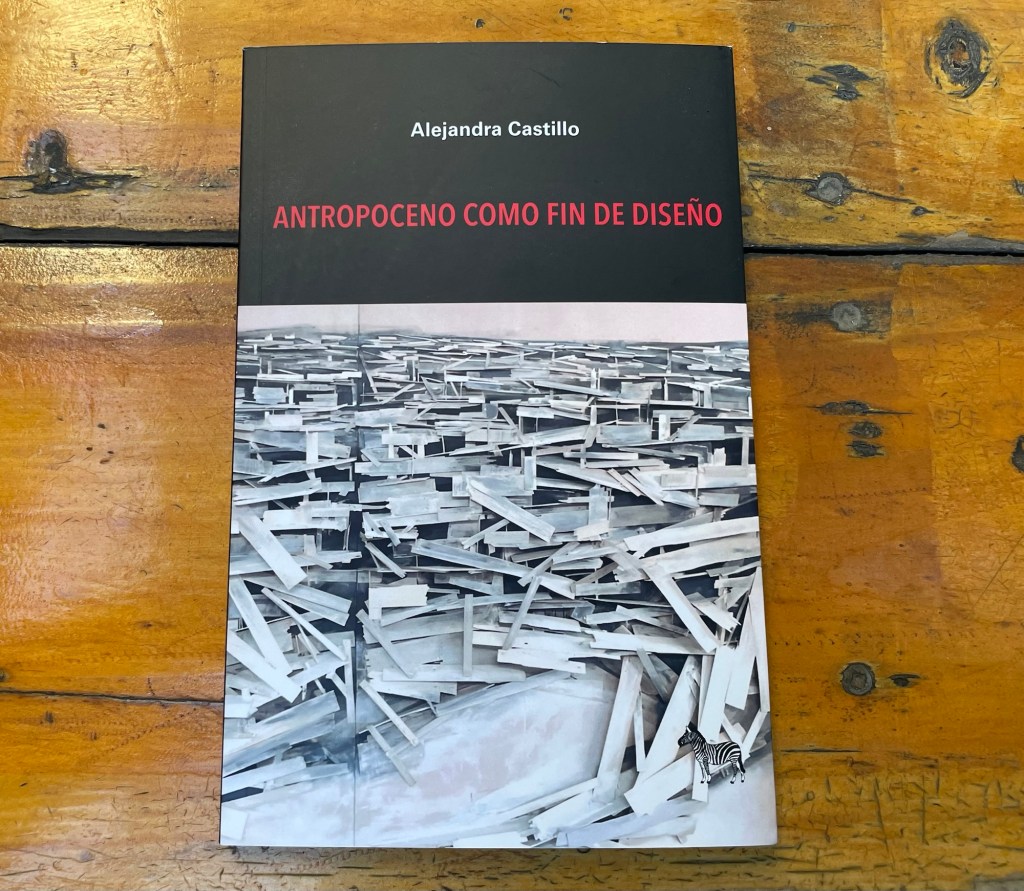
Only in rare occasions the operation of thinking finds angular or lateral points of escape. This is the gesture that characterizes Alejandra Castillo’s theoretical writing, and is particularly bright in her most recent book Antropoceno como fin de diseño (La Cebra, 2025). The zigzagging entry is an intuition that is also a guiding thread: the force of real subsumption of capitalist domination depends on the operation of design. Of course, in design one hears not only blueprint and form, but also designation, and thus the specular regime of visibility, orderability, quantification. It is the world of physiocratic forestry. In fact, Castillo’s succinct definition of the metapolitical condition of design is offered to the reader at the entrance: “Design is the figure that thinks always in advance (por adelantado) (Castillo 12). Design calculates and locates. It is through the operation of design that legibility becomes adequated to political representation so that the state can manage and attenuate the deployment of its forms and the circulations of relations of totality (Castillo 13). The design is what is common to the worker, the engineer, and the lawyer. This is why design for Castillo design is an efficacious nexus that connects the separation of objectivity and the life worlds. Understood in this sense, “design” is analogous to the enframing of the world that intensifies in the age of technology and rhetoric. But in the watershed of the end of modernity, the hegemony of design collapses, while it becomes a temporal “self-design” submerged in all spheres of expressive enactments.
The end of the second vector of the zigzag outlined in the essay is found precisely at this conjuncture: the anthropocene brings the humanist projections and design to a final wreckage. This is means that capitalist form is not formless because it has managed to subsume the time of life as exception to labour; time is a wreckage because design no longer coincides with the world of forms, as it has temporalized experience into total transparency without reminder. For Castillo this means that in the anthropocene there is no longer “struggle for visibility”, as everything has been rendered exposed and hollow; de-substantialized in the very fabric of subjectivity (in the early millennium some called this new hyperbolic figure the Bloom). Implicitly in Castillo’s writing is the assumption that the mediation between politics and design has been severed, and the new securitarian imperium can only immunize itself against the very site that in modern times granted its legitimacy (civil society, constituent power) (Castillo 37).
The end of design means the absolutization of design, a new carceral imperative for adaptation that makes any claim to subjectivity an endorsement of the prison of the ego. To live in a post-designed unworldly condition means not only to come face to face with the homogenous space of cultural exchange into image; it is also a new imperative that requires that “you must submit, without knowing to what; subject to what is the case anyway, and which, as a reflex to its power and commonsense, everyone believes anyway” [1]. The end of design paves the way for new plastic forms of domination towards an integral planetary unity.
Bordiga claimed throughout his work that the democratic design was perhaps the best fittingsystem for the versatility of capitalist accumulation and relentless expansion. This is why in all the political cases that Castillo introduces in a text in a manner of a shadow play do not pretend to offer a new theory of ideology, but rather show how democratic design is a one-piece suit that fits all without any needs for “ideal types” to fix normativity and institutional arrangements. Indeed, there is no longer anything like an “extreme political right” – and this is just a tweak from Castillo’s vocabulary, who does insist on the term throughout the essay – but rightward figures of the political that desperately cling to any form to distract from the abyss of social legitimation. Ultimately, the ruling over this void will be – in many ways already is – the continuation of war in the social fabric; and stasis will require new stealth development of technologies of containment that Palantir’s Alex Karp has called the new “lethal form”. This means that democratic design is not only expressively a system of sentencing to death; it is in virtue of the exchange of social forms, an inverted negation of human finitude. The point of despair would incite some to look again in the cabinet of forms; a knee-jerk reaction to the irruption of the Anthropocene against the total sum of possible designs.
Of course, this is also what Alejandra Castillo’s Antropoceno como fin de diseño (2025) avoids at all costs. Towards the last pages of the book, Castillo calls for a transformative turn that departs from the body; a corporeal insurrection that, in refusing the rectilinear and heteronormative political corpus of the modern epoch (no coincidence that Hobbes was both the founder of the autonomy of civil as well as of the physics of the body of matter in space), is capable of responding to the call of the anthropocene in all of its profuse conflictivity. Castillo proposes the necessity to gravitate towards a “maximum distance” against the general design of orderability of public domination (Castillo 77). But this can only be understood as an incommensurable distance that dissolves the ontotheological separation of subject and object of the state of confinement.
The political constitution of a corpus appears as the promise of an exit from the temporalization of the post-auratic literalism that, according to Michel Fried, dominated the structure of the object-oriented work of art, as compensatory to the corrosion of political forms and presentist autonomy [2]. Castillo does not seek to revive a last gasp of auratic objectification, which amounts to the sleepwalking condition of the image world of mere survival. In soliciting a maximum distance to what is closest (in fact, a body), Castillo invites us, as both promise and commitment, to think at the end of nondependency – not the “independence” that carries the traces of the fictitious individuality- from the crutches of design to finally conquer another liberty beyond terror and prevention; a life imbricated in the nonbeing of place (ecology) with others.
.
.
Notes
1. Thedor W. Adorno. “The Cultural Industry: A Resumé”, in Without Model (Seagull Books, 2023), 58.
2. Michael Fried. “Art and Objecthood”, in Art and Objecthood: Essays and Reviews (University of Chicago Press, 1998), 172.
A good place to start on Tetsuro Watsuji’s Climate (1935) is by considering how the very notion of the Japanese fudo as it appears defined in the first pages of the text, as a “structural element of human existence”. Augustin Berque has proposed a slightly different translation: the “structural moment” that speaks semantically to the prefix *-med, that also recalls mediality, metaxy, and also the French ‘milieu’. In any case, “fudo” discloses an expressive instance of existence, but it is not overtly determined cultural or historical teleologies; rather fudo like Heidegger’s fourfold (das Geviert), brings into gathering wind and earth in which existence can only appear to exist in between as exteriority. Watsuji writes: “The structure of “ex-sistence” is, thus, something rather than to exist in the reality of the cold; it is rather to exist within other persons. To designate this reality we prefer the technical relation of intentional reality, used by phenomenologists, the Japanese expression term aidagara (interpersonal)” (†27).
Unless we know the language, we can only take Watsuji at his word when it comes to the Japanese, but all things considered it is at least obvious to say that fudo is not strictly a descriptive objective reality, but a relation of Being. Watsuji calls it a few pages later a “movement of negativity”: “…this is a ‘movement of negativity’. This is how the spatial-temporal structure of human existence comes to being like that of the climate and that of historicity” (33). The notion of existential transcendence that Watsuji wants to hold on to dwells between reality and existence, generating kimochi, or tonality / stimmung (38). The first question here is what to make of Watsuji’s typology of regional climate setting if these are not to be taken geographically or culturally as expressing locational structures for specific kimochi?
There are three types of climate regions for Watsuji: monsoon, desert, and meadow. One could imagine that these three ideal types as environmental arrangements in the disclosure of kimochi. Each region has its surroundings. For instance, the monsoon is defined by its humidity (47). For Watsuji each of the climatic regions will fundamentally generate different forms of social organization, and it is from this perspective that he interprets the civilizational rise of the West beginning in Ancient Greece. The emergence of the polis is understood as a direct relation with harvesting and later to a social bond determined by production and struggle (war). In the most clear elaboration of his interpretation of the polis, Watsuji writes: “With a slave system as through-point as this, the small number of people who comprised the polis were freed from the labours of the herdsman-farmer. […]. With the building of the polis one may begin to use the word ‘Greece’. If this be correct, Greece began with the conversion of the farmer-herdsman gained freedom from the restraints of nature” (82, 113). This restraint of nature is not just productive in the practical sense (attachment to agricultural life), but it is also of the order of the sensible: this is why Watsuji claims that the Greek classical culture possessed a commitment to a visuality of clearing that is ingrained in their architecture and temples in the open (115). And being in the cleared visual spaces demands the question of technique: “The life of the polis has at its center the artificial-technique in order to dominate the Mediterranean. The emergence of this form of life was the powerful instance that determined the destiny of the “West” (116). In this line, modern science is nothing but a consequential reduction of technique for the Greeks (117).
There is definitely some ambiguity here, since later on and following Komei, Watsuji claims that the emergence of machines in the West was only possible as a retreat from cold weather in the North, and thus a product of interiority (130). Could this mean that the all-clearing established in classical Greece – with its vantage point and all too visible sculptures without oblique point of view – contributed to the later historical production of reserved interiority? Watsuji seems to contrast the clearing in classical Greece with the opaque and gloomy clime of the Germanic lands. In fact, Watsuji says later that only in the shrouds of Germany could pure music be created, where light is not so keenly embodied (141, 111). Returning to the question of existential tonality, or the kimochi, I wonder if Watsuji’s subtle yet recurrent positioning of Western destiny has to do with an originary ethical deficit that is maintained from the depths of fudo as within and outside the clearing of nature. There might be a clue about this in “America’s National Character” (1943): “The true hidden reserves are in ethical strength and not in the power of quantity” [‡]. Is living proportionally in the fudo the ability to master this ethical orientation?
Session 2 (continued)
Having laid out his climate interpretation of the West, I think it is fairly easy to grasp the orientation in Watsuji’s monsoon specificity as a sharp contrast to the condition of its “structural moments”. In particular, the political contrast is implicitly established – and I say implicit because Watsuji never confronts it as the guiding principle of differentiation, although it bends that way. It caught my attention that, following the scholar Kateke Fumio, Watsuji will note at the outset that Chinese (Asian) subjectivity refuses any positing of the legitimacy of the state, and especially the fiscal state (we know from Schumpeter that the modern European state is the fiscal state), and they can only flee from such submission, although they are submissive in other ways, to force (shoguns, for instance) (157). The monsoon structure, hence, has primacy over the political sphere projecting a sort of permanent stagnation for historical development. The notion of akirame or “no bearing, nothing we can do”, a sense of overwhelming resignation, becomes the social tonality of the monsoon surrounding, which ultimately (Watsuji does not say it like this, but perhaps we can push the text in this direct) entails enduring stagnation. This perhaps highlights, quite convincingly, of a certain caducity in Watsuji’s monsoon type in our present epoch.
In the order of the political register, one could read Watsuji’s emphasis on the Japanese home in this direction; that is, the monsoon resignation leads to permanent homecoming. The monsoon region is the region where the oikos triumphed over the polis (180-181). If in the Greek world, legibility and the transparency of the grasping logos made the domestic space an exception to the social life, for Watsuji the Japanese dwelling space is not just a space of familiar gathering, it is also a cosmology and an ecology: “The Japanese consciousness took shape in the totality of the home” (184). (As a side note, I cannot but read this in light of Xi Jinping’s notion of the ‘ecological civilization’ as the master key for the planetary relevance of the CCP). Elevated to the rank of cosmology, the monsoon retreat into the home, does not become an all too easy path towards natural domestication?
In the Japanese home there is no separation – there are no locks and keys – says Watsuji, which introduces as a paradigm for a different form of sociality that differs from Western individuality around appropriation, assignation, and separability (201). This is true to some extent if we think about a spatial figure of Western civilization and enclosure, such as the castle. This is fundamentally different from the tokonama. For Watsuji, the structural moments of ambiance and surrounding generates specific mentis types, and thus concrete organizations of said space. I derive from Watsuji’s second part of the book that Western civilization revolved around the movement of total legibility and clearing (Greeks) that unfolded to separation and thus control over nature, resulting in a machine utopia as Adolf Caspary rightly called it. What about the monsoon specificity? There is retreat and resignation over the surrounding, which allows another mediation or in-betweenness with the natural world and exteriority, although this will entail stagnation in world historical terms.
The contrast between the West and China was already well established during the Enlightenment in the writings of Montesquieu, Voltaire, and other luminaires according to Federico Chabod. In fact, Chabod claims that the civilizational divide between the West and China is crucial to understanding both [‡ ‡ ‡ ]. Asking why an ancient civilization like the Chinese had made such little progress in two centuries (XVII-XVIII), Montesquieu for instance claims that an explanation is to be found in the sacred respect of this civilizational mentis for the transmission of its tradition. It is easily inferred from Watsuji that the monsoon ambient allows for a civilization of “Wisdom” in the deep sense that it “thanks” all the elements of the tradition that it receives. This is also a form of “resignation” proper to mezuru, a form of wonder and surprise that adds nothing new. When Kojeve referred to the end of history in the form of American animality and Japanese snobbism, I think he was crediting this inner Wisdom in the wake of stagnation and released resignation. Of course, we also wonder what Watsuji will say about the “ecological civilization” driven by China’s modernizing planetary project that, if we are to believe Adam Tooze, possesses the master key for world transformation in the notion of “development”. If true, this can only entail the triumph of Western machination through the labor of its others.
.
.
Notes
† All pages are referring to the Spanish edition, Tetsuro Watsuji, Antropología del paisaje: climas, culturas, y religiones (Ediciones Sígueme, 2016). All English translations rendered are mine.
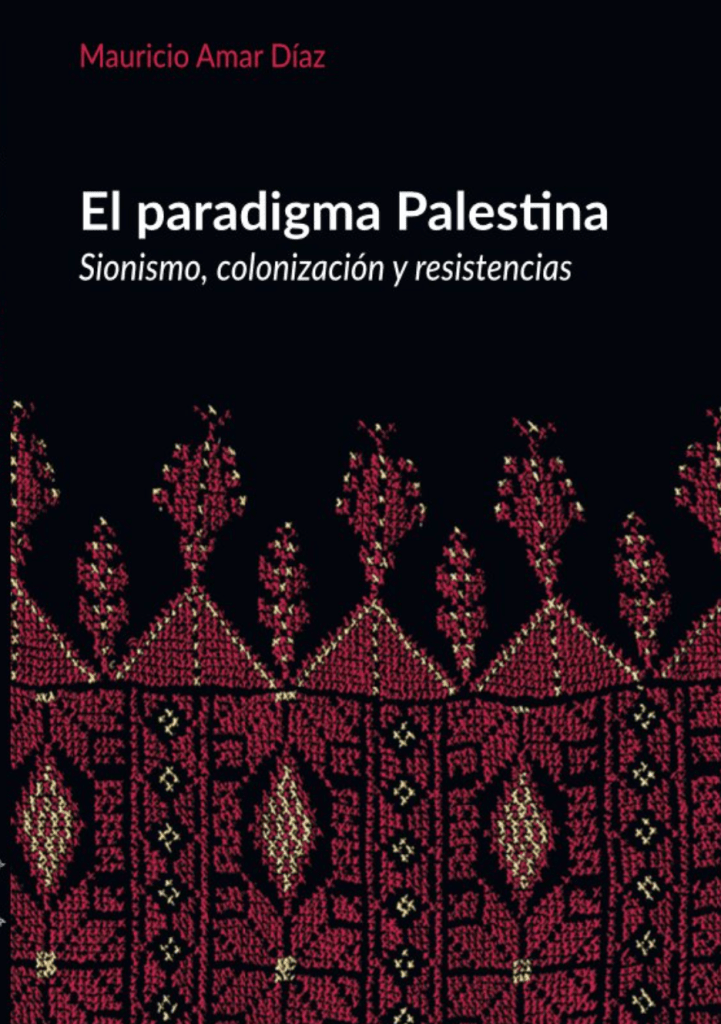
What does it take to destroy a world? It would seem that the question itself is too metaphoric and impertinent; perhaps also hyperbolic and presumptuous against the flight of the infinite embodied in worldling. But this is the question that we should direct ourselves to according to Mauricio Amar’s short and highly accessible book El Paradigma Palestina: Sionismo, Colonización, Resistencias (DobleaEditores, 2024), which is written in the wake of the ongoing war of annihilation in Gaza in order lay bare the paradigmatic abyss of social death in which humanity finds itself at the peak of its civilizational dominance. Amar does not use the term “paradigm” lightly, and nor is he interested, as recasted recently by none other than Steven Bannon citing Thomas Kuhn’s work about scientific revolutions, in posting a central conflict towards transformation; rather, one must situate this strategic conceptual deployment in light of the Chilean philosopher’s own work on imagination and use, which provides an irreducible and sensible texture to every emergence of a paradigm [1]. This means that if Palestine is, indeed, the paradigm of our epoch is precisely because it has no-space in the world – it is what can be infinitely be destroyed, as Maurce Blanchot famously said commenting Antelme’s work – and what illuminates the core and extension of the “integrated” planetary humanity oriented towards the administrative governmentality of contemporary Western democracies, and its corollary geopolitics of the total artificial spaces, as Bruno Maçaes has recently called it. Reading Amar one senses that under the name “Palestine” he is registering a limit to the Humanist force, where an existential claim reveals the maelstrom of an epoch that has resorted to a grotesque parody of the ancient homeric standards of domination and submission. It is the outlook that Simone Weil described as the paradigm of transforming the world into nonliving things.
If understood as a paradigm, Palestine reminds us that the homeric energy towards the aristocracy of equality through force and death among the human race never truly ceased, but only changed forms and cloaks throughout the ages. The post-mythic West seemed to have constructed itself through the repeated revolutions that accommodate justifications for usurpation and containment, self-deification and legibility of the territory at the service of a fictive ethnos. The belated nationalism of modern Zionism has had the paradoxical quality of being both a project of territorial usurpation after its illegalization in International Law (The Kellogg-Briand Pact of 1928); while, at the same time, a politico-theological configuration that, as Monica Ferrando has shown in L’elezione e la sua ombra: Il cantico tradito (2022), clings upon the manipulation of the theological election of “a People” in order to deploy the coterminous binding between community and territory justified through divine narration. The interdependence of the spiritual goal of Zion is only possible through the construction of a settler state, at the same time that the occupying state’s only legitimacy based on ‘one God, one People’ relies on the restitution of an instrumentalized form of the theological election. This is why for Amar the Zionist state building project is a the paradigm of a specific type of colonial governance whose end is not just to capture errant people into social subjects, but more fundamentally a translatio imperii that folds the Earth into a territorial nomoi of distinct multilevel functions: checkpoints, walls, vigilante control of movements, constructions and erasure of surfaces, administration of critical infrastructures, development of extractive resources, and finally the hunting down of humans that necessarily blurs the line between civil population and battlefield combatants. When Amar reminds us of Israel’s predominance in planetary security and warfare technology, one can immediately recall Emile Benveniste’s suggestion that “measurement” (med*-) and the proportional addition to produce objectivity, entails an efficacy of permanent dominance and governability whose main enterprise is the management of populations through the regime of accumulation. As Andreas Malm reminds us of the current cartography of Palestine: “The genocide is unfolding at a time when the state of Israel is more deeply integrated in the primitive accumulation of fossil capital than ever…This is the political economy of normalization: a sacralization of busines as usual that destroys first Palestine and then the earth” [2]. The ongoing devastation of Gaza is a window into the project as a whole: the necessary destruction of the worlds and the total artificiality of the life-worlds, always at the service of maintaining the needs of anthropological symbolizations.
For Amar this points to an epochal scenario of a people without world; and, following the lead of Sari Hanafi, he will claim that the paradigmatic mirroring of Palestine is also an spatial-cide, in which the living are deprived of a sense of inhabiting and roaming that brings to bear that the nakba is not something that has taken place in history once and for all, it is a catastrophic event that has not ceased from repeat itself, and whose ultimate intention is to suture the world and existence, the soul and the spirituality of the open atmosphere that is needed to sustain life. Reading Amar between the lines – who towards the end of the book finds distant interlocutors in Darwish’s poetry, the philosophy of Gilles Deleuze, as well as in the glosses of Walter Benjamin on history and the prose of Edward Said – one learns that the true arcana of Palestinian resistance is also a secret promise for our apocalyptic times: to hold on to the world, so that we can all passionately land on the Earth and freely breath in its surroundings. The nexus of the Palestinian question and the intrusion of Gaia, although underdeveloped in Amar’s analysis, obliquely runs through a text that is also very much about the central question of ethics that never abandons thought: how to name what escapes without taking the world as such into an object to be possessed, destroyed, and remade anew as a hostile secular imago dei. The vindictive hyper-consciousness of the contemporary unmediated arcana imperii now reveals, as Amar says towards the end of he book, a mirror through which we can observe our own increasing domestication, in which the metropolis is just the luminescent and self-protected hub, but whole ultimate darkening shadow is the Gaza’s pile of rubbles resembling an open air necropolis (Amar 108-109). Through different arrangements of organized destruction, both the metropolis and the necropolis converge in their preeminent ‘struggle against space’ and its form of life for the sake of familiar pieties of enslaved survival of unworldly anomie (Amar 116).
Does this mean that we are all “Palestinians”? Mauricio Amar’s El Paradigma Palestina (2024) rejects the all too well expected craft of solidarity and subjective identifications that can only work on the payroll of the gravediggers of the current civilizational project. On the contrary, if Palestine is our paradigm, and it remains so, it is because it can only refuse measurement and recognition in order to dwell in the only possible exteriority as embodied to Darwish’s poetry that Amar quotes towards to the end book: “Do not trust the poem / absent child / it is the throbbing of the abyss” (Amar 140). From the abyss we nourish the soul as the return to land on Earth prepares itself in order to no longer conquer a territory, an ancient tradition, or a “People” (ethnos), but to dwell on the nearness of a place that is an excess to every location or community of belonging (this is the false exit of the kibbutzim). We do not have political grammar to articulate what this integral freedom could mean, except that it is an exotic relation in Victor Segalen’s sense: a creation of a world alien from the compatible and petty one that currently drains us into its ongoing desperate destruction and passive enslavement [3]. Finally, like all authentic paradigms, it is worth noting that Paradigma Palestina (2024) teaches and preaches nothing; it only invites us into the swirling sensation that crosses over the imagination and the singing voice, from the world of the last remaining lives to the isles of the dead martyrs, and back.
.
.
Notes
1. Mauricio Amar. Ética de la imaginación: averroísmo, uso y orden de las cosas (Malamadre, 2018).
2. Andreas Malm. The Destruction of Palestine is the destruction of the Earth (Verso, 2025), 53.
3. Victor Segalen. Essay on Exoticism (Duke University Press, 2002), 24.
What comes after state form? The grounds for a self-evolving civil war at the heart of the social is what opens up in the wake of the collapse of the categories and grammar of modern politics. Stasiology becomes the fundamental unit to grasp the decoupling of the liberal state from its fixed guarantees and duties. Already during the crisis of legitimation of the seventies, we were told that the modern secular liberal state can no longer guarantee the conditions that made it possible, in the famous hypothesis developed by Böckenförde. The stasiological paradigm thoroughly governs the once implied mediations, social forms, and positive juridical norms of state-society internal mechanics without reminders and procedures. This is why all calls for political realism today are futile and insufficient; the only real existing realism is the one that must be confronted with increasing categorial inversions that ultimately channel the passage from a sufficiently ordered polity (the equilibrium of commerce and virtues) to the conflagration of the civil war as the production of social fabric.
All of this is implicit and glossed in Rodrigo Karmy’s excellent essay Stasiología: guerra civil, formas de vida, capitalismo (Voces Opuestas, 2023) in which the empty performance in the stage of fictitious contemporary sovereignty exchanged for the effective precautionary inversions that have become operative at a planetary scale: republicanism has given in to empire; the horizon of “liberty” nows entails dispossession and domination; authoritative and legitimate rule now means interpretative and exceptional discretionary execution; and, civil society (the modern civilizational unity for social cohesion) has become an axiomatic nexus to manage the tractions and turbulence of total economy (equivalence). The current state of things could not be more grim – and everything that passes through the sign of “order” (orderability, ordinary, ordo) elevates in the name of an self-sufficient abstraction that government paranoia to guide every deviation. The Leviathan stage has zoomed in into the pastoral exercise of uncontested dominion. Those that have claimed that the polis – precisely, as the sphere of social exchange and masquerade, in other words, of practical nihilism – is defunct are perhaps right in stating that its autonomy was destined to become the sheltered territory for pirates, delinquents, and the mafia. What is civil society today if not the confluence or the commuting space of the concert of all existing indirect powers?
For Karmy, abstraction and inversal do not mean just arbitrariness and formlessness lacking description. There is some rationality to what is arbitrary and anarchic in how the public powers are conjoined, distributed, and organized under several logistical units of optimal endurance: a) an axiomatic method that is immanent, flexible, and technologically sophisticated in its aversion to civil war; b) there is a process of exposition and vigilance that, conflating oikos and polis, makes hostis and inimicus indistinguishable, and by extension, coextensive to a global police (just as predicted by Carl Schmitt in the prologue to the Italian edition of The Concept of the political) that can manage and intervene in world-events as without residue. Expressively, Karmy reminds us, the police apparatus becomes the composition of cybernetic deployment based on the capillary consortium of information, reproduction, and differentiations. c) And finally, there is a nomic coupling between politics and geopolitics as the univocal destiny of a planetary humanity as a nihilistic mastery over nature, passions, and geographical localities. But if a century ago Benjamin suggested in One-Way Street (1928) that the power of the proletariat amounted to the measure of its convalescence, it seems that this is a materialist ideal that also has sunk deep into the anomia of the seas. Neither a “collective and sensible” proletariat nor a mobilized pacifist can enact the much expected epochal katechon; the immanent subject of Empire is already invested in the paradigm of force and counter-force, reinforcing what Karmy sees as the global practical and rhetorical geopolitics as an ongoing polemos: “Toda guerra es, ante todo, una guerra contra el pensamiento, Por eso abunda el análisis geopolítico” (Karmy 79). The manifest destiny of geopolitical grounding (knowledge, measurement, exposition) can only admit voluntary servitude towards the conflagration and the distributions of dominance and “influence” that has only intensified from the Iraq invasion of the early millennium to the Covid-19 pandemic techno-administrative measures.
But geopolitical dominance can no longer be said to integrate – there are too many cracks and holes in what it is still called, by inertia (Karmy calls it the ‘Newtonian hypothesis’) , the autonomy of the social. Similarly, its universality is a fallen one; but not because it has accepted the Augustuinian saeculum against the Pelagian heresy, but rather because its unitary mold consists in an internal stasis fractured within: a schism of every community from itself, a separation between things and forms in the originary sense of the Greek polis. Could another nomoi be recovered here? This is the last question posed by Karmy’s Stasiología (2023) through the poetic scene of Guadalupe Santa Cruz, whose turn to the garden is an involuntary act that gathers whatever is left of an ethical life from the ongoing devastation enacted by the barbarism of civilization. The garden is the threshold to a world according to Karmy reading Santa Cruz: “…al borde del mundo, el jardín es la figura que remite al cultivo de estilo, cuidado de la potencia de la imaginación, en último término, lo que designa un gesto” (Karmy 102-103). It is no coincidence that gesture and gestar is a polysemic term that allows to comprehend the figural and self-evolving of a transformation of life; “freedom” is not to deploy internal force towards the appropriation of advantageous outcomes and interest, but of the possibility of delineating the appearance of “a life” holding the unmeasurable world in proximity [1]. It is at this point where forms color how we become who we are.
What must be saved is not “life itself”, but rather the theōs between world and existence that opens “new possibilities” that is anti-scientific precisely because it is not incorporated by the pressure of objective absorption. The theōs is the invisible deviation from the worldly necessity of how things should be and what our lives should aspire to become; and only in this sense we are all martyrs as witnesses to this nearness. Extracting a further consequence from Karmy’s Stasiología (2023) one could claim that every desertion from geopolitical destiny – its unspeakable misery, its blatant bad faith, its farcical prepotence that forces a parodic eschatology – presupposes a return to a new life, which has always began at the surface of our face, as if anticipating reality prophetically: “Only a genuine revolution succeeds in changing the way people look, their facial expressions, the light in their eyes, the charm of their smiles. Christianity appeared with new faces, or taught a new way of looking at them. It is something that anticipates reality, as if prophetically, the universal change that for almost two centuries now has been shaping new faces throughout the whole world.” [2]. If the acclamations for a “New Man” concerned the humanist aspiration of the productive modernity; the vita nova concerns, first and foremost, the conservation of the partition of the soul, the only true entity of alienability where life conquers death. The practice of stasilogy sets out an exercise of this elegant depiction: allowing invisibility to prefigure and breach a new life from the trenches of a never ending struggle.
.
Notes
1. Monica Ferrando. “Gestare la figura. Note sulla pittura e il suo gesto”, Giardino di studi filosofici, Quodlibet, 2018.
2. Carlo Levi. The Two-Fold night: A narrative of travel in Germany (Cresset Press, 1962), 109.
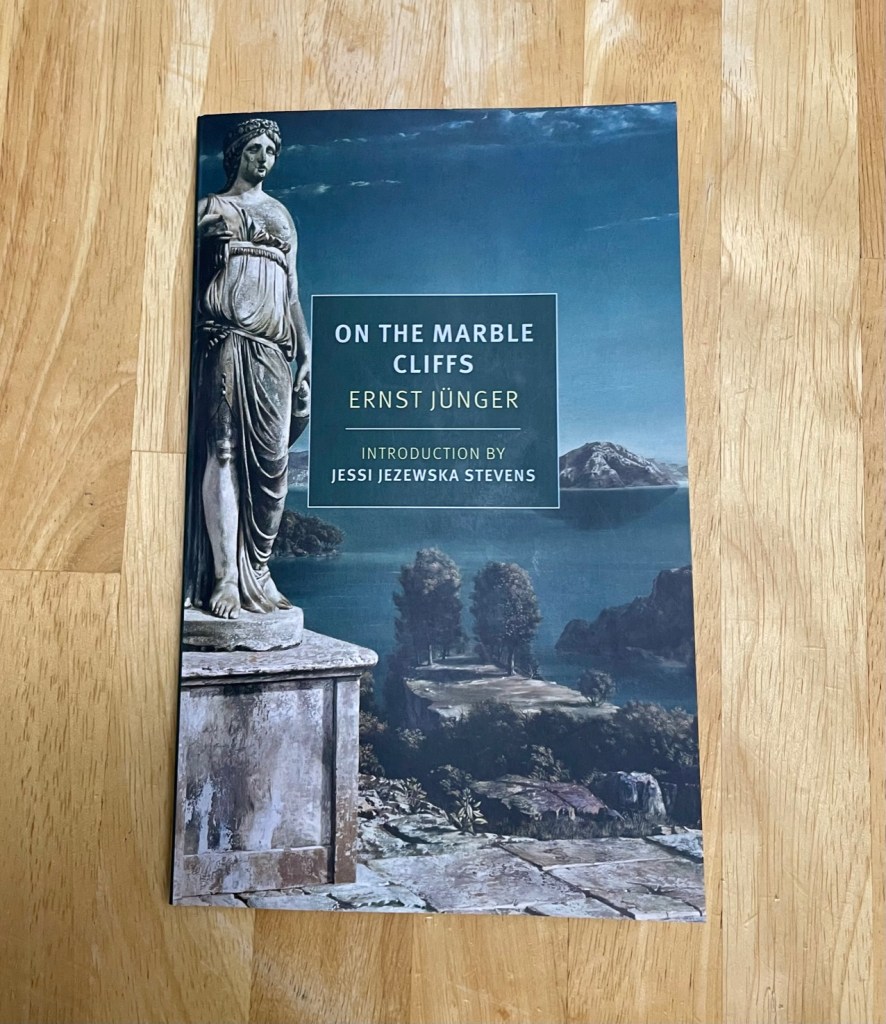
On the Marble Cliffs (1939), which appeared for the first time in Nazi Germany in 1939 (the new NYRB has just been published) offered a narrative of a thorough civilizational collapse of the West. I will side with many of the commentators that have reminded the readers that this novel doesn’t simply amount to an allegory of the rise of National Socialism or the reemergence of indirect powers of civil war in the European interwar years. By underlining “just”, I also mean to say that it is also very much about its epoch. Jünger was an insider of the German elite, and one of the most astute interpreters of his time as his theses on the dominion of the worker and the force of total mobilization were fully realized. It happens that On the Marble Cliffs introduces the civilizational collapse not through the allegorical reduction of the narrative procedure, but rather through a weaving, never truly resolved (much to Jünger’s own intentions), of temporalities that do not land in historical form. Circumventing the meanderings of a dreamlike stage and that of a thick and sensorial description, the novel diachronous movement resembles the stage of a vigil that retrospectively looks from page one at the advent of the disaster: “Only then do we recognize how fortunate we humans are to live from day to day in our small communities, under peaceful roofs, engaged in please conversation, and with the effective greetings morning and night. Alas, we always recognize too late that these simple things offered us a cornucopia of riches” (Jünger, 3). Granted, the vigil is an incomplete assessment of how (not so much as to why, which speaks to Jünger’s separation between his critico-politico essays and his narrative universe) the luminous community of brothers at Grand Marina entered the stage of destruction. During their peaceful time at Grand Marina, the brothers dedicate themselves to studying plants: a contemplative activity through an herbarium that becomes an exercise in clearing the mind and “draining time”. Botany has always stood as a minor activity to escape the realization of death, even if inevitable the cycle of temporal caducity.
But the ruinous time begins with the dominion of the Head Forester, an old governor of Mauretania region whose territorial ambitions are rooted in the domination of world affairs, and the willful defense of its doctrine Semper Vitrix (Jünger, 23). For those familiar with the worldview of Jünger, it is not surprising to find that domination does not begging at the original act of taking, but rather in the scheme of disposition that prepares the liquidation of the originary depth of the world’s opacity. Hence, imperii vitrix is always cartographical, and thus concerned with the the procedure of legible reduction: “For them [Mauretaninas] the world was reduced to a map like those thare engraved for amateour using little compasses and polished insutrmentions that are pleasing to hold. And so it seemed odd to come upon figures like the Head Forester in these clear, perfectly abstract realms freed of any shadows” (Jünger, 23). To dominate the world, one must first dominate over the ideals and images that unify a world. This is why Jünger, just a few years earlier in The Worker, had ended his treatise pointing at the passage from the classical social contract theories of social cohesion to the efficiency of planning of production in order to weaken any possible resistance [1]. This is another reason why On the Marble Cliffs fails at any allegorical instantiation, since allegory hinges upon the unfulfilled stage of historical consciousness, whereas Jünger levels his narrative with the metaphysical disposition that is accomplished in modernity. One could call this the triumph of nihilism and anarchy; the never-ending triumph of ‘barbarism and religion’ of the West since at least the Roman Empire to put in the terms of historian J.G.A. Pocock. This is the “line” of modernity, but it is also the line that is breached at the collapse of modernity staged Onthe Marble Cliffs.
Anarchy and nihilism – for Jünger these are for two routes for prompting a relation with the epochal collapse. More than clearcut positions to endorse, these are unbreachable counters of the limitless epoch. Jünger distinguishes them well through the character of Braquemart: “Suffice it to say that there is a profound difference between fully formed nihilism and unchecked anarchy. The outcome of the struggle will determine whether human settlements will become wasteland or virgin forest. With regards to Braquemart, he was marked by all the traits of full-fledged nihilism. His was a cold, rootless intelligence with a penchant for utopias…On seeing him, one inevitably thought of his master’s profound saying: “The desert grows – woe to him who carries the deserts within!” (Jünger, 76-77). The nihilist suffers from a rather coldness of intelligence, and what Jünger qualifies as the ill-fated adventure of the theorist, always unmatched with that of the pragmatist (Jünger, 78). Granted, everything depends on the internal capacities to react against the growing systematic devastation. On the other side, the anarchist cloaks his accomplice condition within the corruption of the law, where nothing is sacred. This is why the anarchist transforms the forest into an enclosed land for hunting and predatory practice where “cadavers left to rot in the fields spread pestilence, wiping out the herds. The downfall of order brings good to none” (Jünger, 62). On the Marble Cliffs is at times too emphatic with the reiteration of the order in opposition to terror: ‘Terror establishes its reign behind a mask of order” (Jünger, 38). And this speaks to National Socialism antipositivist attitudes to the rule of law, which Jünger seemed to have perceived clearly.
However, it is also true that Jünger’s insistence on order is not just about conservation in the abyss, but rather about how the civilizational collapse is expressed in the puncturing of indirect powers that will ultimately unify the anarchy of domination. To insist on nihilism means to de-hegemonize the indirect powers and factional domination against the visceral hatred of the gratitude of language and the mystery of beauty that burns the inside of demonic spirits (Jünger 39). The luminosity of Jünger’s style and symbolic nakedness speaks, in turn, to an attempt at a mythologization of beauty that emerges in a language devoid of parody. In this sense, Jünger displaces Gianni Carchia’s important thesis about the narrativization of the parody of mystery into the form in the bourgeois novel. Jünger’s beauty is mysterious because it exceeds signification and conceptual closure of the novel conflict, as what language does (or seems to do) on the line of nihilism. For Jünger the revocation of anarchy implies taking a distance from the subsumption of prose into narrative order. Thus, Jünger’s order is a primary order, one of retaining the reserves of sacred and the unfathomable character in the face of barbarism and the destruction of the world.
“We take leave more easily when things are in order” (Jünger, 59). This is the primary order of a plain state of the world, which does not presuppose the obsession with organization and management; it is what allows for the flourishing of contemplative life and the possibility of retreating to the density of the forest. But we know that this is, precisely, what comes crashing down in the rise of anarchy and nihilism, both working in tandem in modernity. Attaching oneself to primary order amounts to “concrete dreaming” at best, as the narrator says early in the book. And it is at this point that On the Marble Cliffs solves this conundrum: the idea of order must not be reduced to a nomos of the world, but rather the possibility of an outside from thinking that there is a finite and finished work of the world. This is where Jünger’s genius shines with usual intensity. It is the moment, towards the end, when the narrator admits: “the beauty of this world now enveloped, I saw, in the purple mantle of destruction” (Jünger, 102). The conflagration of the world, however, only undoes a new capacity for seeing thatwhich had remained in the dense fog of consciousness and aesthetics. In other words, the total collapse brings forth the unperishable element between existence and the world. Jünger achieves the highest point of condensation in this elaboration:
“The harvest of many years of labor fell prey to the element and with the house, our work returned to dust. We cannot count on seeing our work completed here below, and happy is the man whose will is not too painfully invested in his efforts. No house is built, no plan created, in which ruin is not the cornerstone, and what lives imperishably in us does not reside in our works. We perceived this truth in the flame, and its glow was not devoid of joy” (Jünger, 108).
This is not joy or appetite for destruction, but more a joy about what remains unperishable in every destructive act that realizes itself just so that everything could be renewed more or less the same. At the narrative level the unperishable of every work is the mystery that cannot be fully captured either by the deployment of historical allegory or by the mimetic translation of the work of narrative. On the Marble Cliffs remains stubbornly an open novel, but in a very precise sense: it gestures to the divergence between life and the world is barely touched parabolically at a distance. This is why the character of On the Marble Cliffs reaches the end by stressing “the sight of it [an old oak grove] made us feel at home…”(Jünger, 113). Whereas sight is an index of landscape, of seeing beyond the abyss. This is a condition for living among the dead once again. Perhaps this is why Jünger felt the need to record in his French war diaries that Pablo Picasso had asked him if the novel was based on a real landscape [2].
Only a painter that had witness the crisis of modern space (beginning with the “Blue Room” of 1900) could directly engage with the trope of the ‘marble cliff’: it is here that the altar of a sacrificial history and political domination turns into the site of theoria. Now the faculty of seeing grows outside of itself, “to manifest freedom in the face of danger” (Jünger, 117). On the Marble Cliffs is an invitation to this interior unperishable landscape that removes us from idle fictions in the face of anguish if only we do not turn our back to it (in the name of science or technology or new idols). Given that the desert of nihilism can only grow, I wonder how many today could even stand on the cliff. I fear that the effort of raising the head and looking beyond is already too much to ask.
.
.
Notes
1. Ernst Jünger. The Worker: Dominion and Form (Northwestern University Press, 2017), 173-178.
2. Ernst Jünger. A German Office in Occupied Paris: The War Journal 1941-1945 (Columbia University Press, 2019), 78.
A friend recently suggested that the refusal is at center of multiple critical positions against the moralization of politics. And I agree. In fact, I would go as far as saying that the strategy of refusal is something like a common denominator in positions critical of political mediation. Although the refusal could take many forms, I would also add that the refusal is directed against hegemony broadly understood (culturalist, political, logistical, etc.). Primarily, the refusal awakes from the dream of hegemony as contributing towards any real substantive transformation anchored in “political realism”. Realism today is mostly deployed as a freestanding argument aimed at political traction, although it merely contributes to stagnation and paralysis; it is a katechon to any concrete transformative movement of the actual moment.
It is telling that the notion of ‘refusal’ was first developed in the French political context by the likes of Maurice Blanchot and Dionys Mascolo in the journal Le 14 Julliet, a project obscured by the monumental historiographies of May 68. In his short text “Refusal”, Maurice Blanchot defines the notion as the gap in representation between an event and language: “accomplished by neither us nor in our name, but from a very poor beginning that belongs to those who cannot speak” [1]. The refusal denotes a limit to representation. Similarly, in “Refus Inconditional”, Dionys Mascolo understands refusal as the constitutive possibility of silence so that true communication can indeed take place [2]. For both Mascolo and Blanchot, the notion of refusal was the condition for the possibility of friendship preceding subjectivism. By way of refusal, the realization of a “community of the species” is guarded against the socialization of alienable classes. I think one could name four positions of refusal against the closure of hegemony as the organization of secondly separations (alienation). These might not be the only positions – and many a time there is a clear overlap of the problem at hand.
1. The refusal of culture. First, there is Mario Tronti’s “The Strategy of refusal” (Operaio e capitale), which grasps the refusal in classical Marxist terms by way of criticizing culture as resistance against capitalist form. In fact, for Tronti culture amounted to a mediation of social relation of capitalism uncapped expansion. And for Tronti, “oppositional culture does not escape this fact; rather, it merely states the body of the worker’s movement ideologies in the common clothing of bourgeoisie culture” [3]. Hence, for Tronti, refusal meant disengaging from “becoming of intellectuals” as disengaged from the practice of the class struggle. The critique of culture functioned as an inversion of mediation with no transformative leverage whatsoever. However, for Tronti ‘refusal’ was still understood as a political strategy, which necessarily needed to engage with the “subjected” force of class and organized in the party form. In other words, the refusal in Tronti’s early work was the rejection of cultural mediation by intensifying the antagonism of the autonomy of the political. There is not yet a rejection of politics, but rather the assumption that the refusal can lead the way in the destruction of capital production given the “pagan force” of the proletariat.
2. Refusal and fugitivity. Second, there is a clear and direct strategy of refusal in Afropessimism aimed at the totalization of the social bond organized around the destruction of black existence. Hence, for Afropessimism refusal takes the form of an archipolitics that seeks fugitivity from logistics of social death [4]. As Moten & Harney argue in All Incomplete (2021): “The Undercommons is the refusal of the interpersonal, and by extension the international, incomplete in the service of a shared incompletion, which acknowledges and upon which politics is built. To be undercommon is to live insists the inoperative condition of the individual and the nation as these upon brutal and unsustainable fantasies and all of the material effects they generate oscillate in the ever-foreshortening interval between liberalism and fascism. These inoperative forms still try to operate through us” [5]. Against all forms of bondage subsidized by hegemonic sature, the afropessimist refusal opens up a fugitive life in errancy that points to a new central antagonism now framed between black life and the world. In Wayward Lives (2020), Saidiya Hartman puts it in this way: “To strike, to riot, to refuse. To love what is not loved. To be lost to the world. It is the practice of the social otherwise, the insurgent ground that enables new possibilities and new vocabularies; it is the lived experience of enclosure and segregation, assembling and huddling together. It is the directionless search for a free territory; it is a practice of making and relation that enfolds within the policed boundaries of the dark ghetto; it is the mutual aid offered in the open-air prison. It is a queer resource of black survival. It is a beautiful experiment in how-to-live” [6]. The refusal of the total circulation of social relations allocates Black existence at the threshold of politics. This negative community refuses any hegemonic social rearticulation.
3. Refusal of logistics. Thirdly, in the work of the Invisible Committee the refusal entails destituting the social bond, although the emphasis is placed in infrastructure as the concrete and operative terrain of domination. For the collective the refusal becomes twofold: on the one hand, blocking the logistics of circulation and production of subjection; and on the other, separating the form of life from the regime of subjective domestication. At bottom, the refusal in the Committee’s takes aim against the mystification of the social as a site for autonomous gain from political struggle. For both Tiqqun and the Invisible Committee one needs to refuse the artificiality of the subject (Bloom) in the name of the form of life and reject politics of class antagonism favoring the civil war as a generic science of desertion (what remains after the collapse of the authority of modern politics).
4. Posthegemonic refusal. Finally, posthegemony refuses the codependency of politics and domination, and favors their non-correspondence; it refuses politics as hegemony, and hegemony as newcomer after the closure of metaphysics. In this sense, posthegemony favors the exit from the total structure of socialization ordered through the equivalence of demands. One could say that posthegemony affirms the “realistic option of non-cooperation” with hegemony. But the space of non-cooperation allows the exit from subjective limit of the political. The posthegemonic separation, therefore, is the refusal of cooperation on the basis of refusal of conditions of obligation (what Eric Nelson labels being “stuck on the boat”), whether predicated on a distributive conception of social justice, or as the maximization of indirect interests proper to liberalism [7]. In this sense, the posthegemonic refusal abandons the temptation of establishing a new civilizatory principle with politics as its auxiliary and optimizing tool of order [8].
.
.
Notes
1. Maurice Blanchot. “Refusal”, in Political Writings (1953-1993) (Fordham U Press, 2010). 7.
2. Dionys Mascolo. “Refus inconditionel”, en La révolution par l’amitié (La Fabrique éditions, 2022). 27-30.
3. Mario Tronti. “The Strategy of Refusal”, in Workers and Capital (Verso, 2021).




 Infrapolitical Reflections