In a letter written in 1969 to her friend Mary McCarthy, Hannah Arendt provides a striking description of the solitary condition of thought in language: “The silent dialogue of thought goes on between me and myself, but not between two selves. In thought, you are self-less – without age, without psychological attributes, not all as you say “really are” [1]. Thinking, she goes on to claim, puts into crisis all identity and nonsense, so that the inward searching can fold “outwardly” into the world. Arendt immediately notes that the passage from interiority to the outwardness does not express a fixed purpose; it is rather a motion through which “words become part of the world”. Thought can be said to express the coming into relation between language and world.
Further exploring the depth of the language that characterizes the “inner life” of thought, the philosopher immediately emphasizes its acoustic or tonal qualities, that is, “an inevitable noise of our apparatus, which Broch called Seeleenlärm, soul-noise. It is what makes us tick”. To be in thought, or in a way to thinking, means allowing the soul noise to buzz from beneath the skin. The Seeleenlärm does not coincide with language as concept or signification; it is rather the tear that allows for the emergence of language as imagination and thinking.
This operation is nothing more than the relation of language to its own impossibility or muteness in the region of the Seeleenlärm, and what artificial models of language cannot replicate. And although Arendt compares the soul noise to other functional organs of biological existence, it is only obvious that the harmony of the soul lacks a physical compartment, and can only be expressed in the possibilities that language bestows to thinking. The notion of Seeleenlärm, if we are to call it that, appears not in philosophical context, but in a literary one; that is, in Hermann Broch’s “Zerline’s Tale”, in which the soul voice is understood as the lacuna of sensation, having nothing special in terms of intellectual faculty or knowledge collectiom, it is the sensation that fill people’s empty and boring lives” [2]. Seeleenlärm determines thought, but it is not thinking as such; it is more like the suspension of temporalization and judgement in every living being. This is why it is not even coterminous with the passions, let alone love. Perhaps the Seeleenlärm can be said to occupy a third component (tertium comparationis) through which the human being structures the mystery of his spirit [3]. Is this third component that dissolves the self for the place for ethics? In Broch’s modernist aspirations, attuning to the noise of the soul meant the aesthetic reduction of a symbol to mediate “understanding from one person to another”.
But it should be obvious that the transition of Seeleenlärm to metaphoric understanding flattens the voidinto a conglomerate of selves that come into being by setting aside thought through the communication or artistic repression. In the reverse, one could imagine then that there is only thought when the suspension of any conglomerate or community ceases to communicate by resting on proximity to the hole of the soul voice in expression. The communication between souls – beyond the transport of the symbol, beyond separation ordered by discourse – can only be understood as the incommensurable in language. This is the instance where thinking takes flight because the invisible seeleenlärm transpires from its depths.
.
.
Notes
1. Hannah Arendt. Between Friends The Correspondence of Hannah Arendt and Mary McCarthy (Harcourt, 1995), 242-243.
2. Hermann Broch. “Zerline’s Tale”, in Selected Short Writings (Bloomsbury, 2006), 103.
3. Hermann Broch. “Some comments on the philosophy and technique of translating”, in Geist and Zeitgeist: The Spirit in an Unspiritual Age (Counterpoint, 2002), 122.
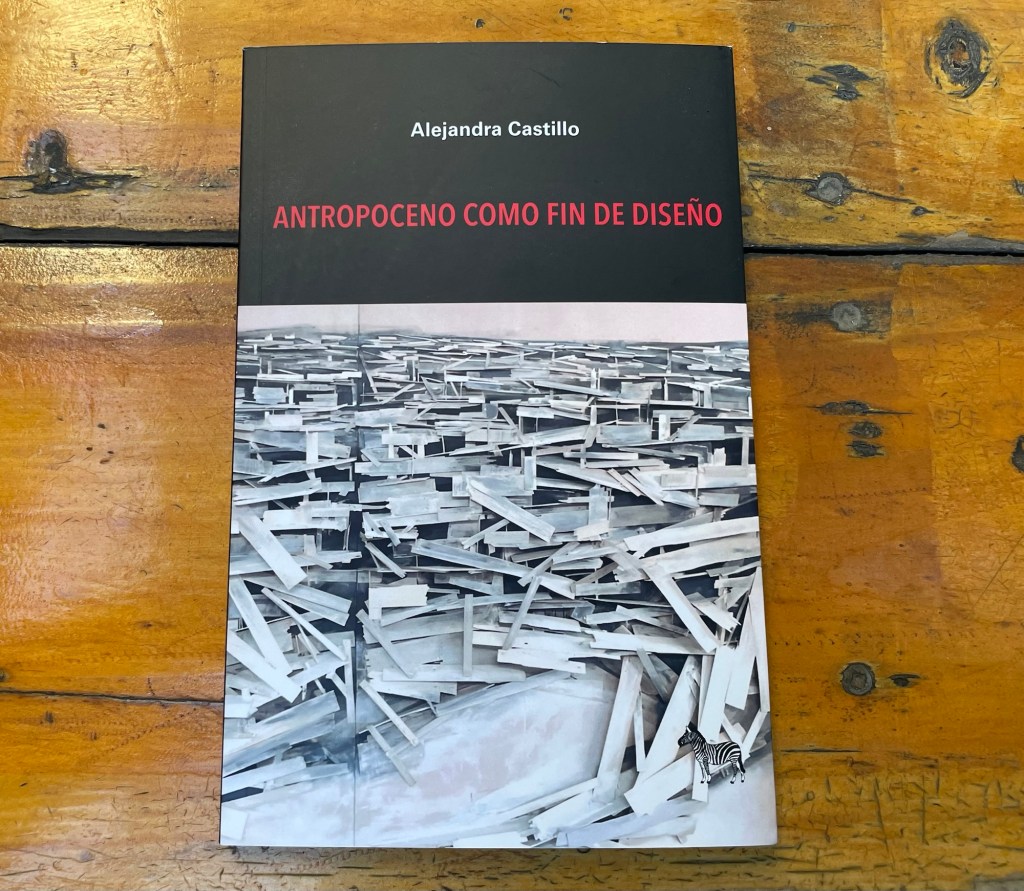
Only in rare occasions the operation of thinking finds angular or lateral points of escape. This is the gesture that characterizes Alejandra Castillo’s theoretical writing, and is particularly bright in her most recent book Antropoceno como fin de diseño (La Cebra, 2025). The zigzagging entry is an intuition that is also a guiding thread: the force of real subsumption of capitalist domination depends on the operation of design. Of course, in design one hears not only blueprint and form, but also designation, and thus the specular regime of visibility, orderability, quantification. It is the world of physiocratic forestry. In fact, Castillo’s succinct definition of the metapolitical condition of design is offered to the reader at the entrance: “Design is the figure that thinks always in advance (por adelantado) (Castillo 12). Design calculates and locates. It is through the operation of design that legibility becomes adequated to political representation so that the state can manage and attenuate the deployment of its forms and the circulations of relations of totality (Castillo 13). The design is what is common to the worker, the engineer, and the lawyer. This is why design for Castillo design is an efficacious nexus that connects the separation of objectivity and the life worlds. Understood in this sense, “design” is analogous to the enframing of the world that intensifies in the age of technology and rhetoric. But in the watershed of the end of modernity, the hegemony of design collapses, while it becomes a temporal “self-design” submerged in all spheres of expressive enactments.
The end of the second vector of the zigzag outlined in the essay is found precisely at this conjuncture: the anthropocene brings the humanist projections and design to a final wreckage. This is means that capitalist form is not formless because it has managed to subsume the time of life as exception to labour; time is a wreckage because design no longer coincides with the world of forms, as it has temporalized experience into total transparency without reminder. For Castillo this means that in the anthropocene there is no longer “struggle for visibility”, as everything has been rendered exposed and hollow; de-substantialized in the very fabric of subjectivity (in the early millennium some called this new hyperbolic figure the Bloom). Implicitly in Castillo’s writing is the assumption that the mediation between politics and design has been severed, and the new securitarian imperium can only immunize itself against the very site that in modern times granted its legitimacy (civil society, constituent power) (Castillo 37).
The end of design means the absolutization of design, a new carceral imperative for adaptation that makes any claim to subjectivity an endorsement of the prison of the ego. To live in a post-designed unworldly condition means not only to come face to face with the homogenous space of cultural exchange into image; it is also a new imperative that requires that “you must submit, without knowing to what; subject to what is the case anyway, and which, as a reflex to its power and commonsense, everyone believes anyway” [1]. The end of design paves the way for new plastic forms of domination towards an integral planetary unity.
Bordiga claimed throughout his work that the democratic design was perhaps the best fittingsystem for the versatility of capitalist accumulation and relentless expansion. This is why in all the political cases that Castillo introduces in a text in a manner of a shadow play do not pretend to offer a new theory of ideology, but rather show how democratic design is a one-piece suit that fits all without any needs for “ideal types” to fix normativity and institutional arrangements. Indeed, there is no longer anything like an “extreme political right” – and this is just a tweak from Castillo’s vocabulary, who does insist on the term throughout the essay – but rightward figures of the political that desperately cling to any form to distract from the abyss of social legitimation. Ultimately, the ruling over this void will be – in many ways already is – the continuation of war in the social fabric; and stasis will require new stealth development of technologies of containment that Palantir’s Alex Karp has called the new “lethal form”. This means that democratic design is not only expressively a system of sentencing to death; it is in virtue of the exchange of social forms, an inverted negation of human finitude. The point of despair would incite some to look again in the cabinet of forms; a knee-jerk reaction to the irruption of the Anthropocene against the total sum of possible designs.
Of course, this is also what Alejandra Castillo’s Antropoceno como fin de diseño (2025) avoids at all costs. Towards the last pages of the book, Castillo calls for a transformative turn that departs from the body; a corporeal insurrection that, in refusing the rectilinear and heteronormative political corpus of the modern epoch (no coincidence that Hobbes was both the founder of the autonomy of civil as well as of the physics of the body of matter in space), is capable of responding to the call of the anthropocene in all of its profuse conflictivity. Castillo proposes the necessity to gravitate towards a “maximum distance” against the general design of orderability of public domination (Castillo 77). But this can only be understood as an incommensurable distance that dissolves the ontotheological separation of subject and object of the state of confinement.
The political constitution of a corpus appears as the promise of an exit from the temporalization of the post-auratic literalism that, according to Michel Fried, dominated the structure of the object-oriented work of art, as compensatory to the corrosion of political forms and presentist autonomy [2]. Castillo does not seek to revive a last gasp of auratic objectification, which amounts to the sleepwalking condition of the image world of mere survival. In soliciting a maximum distance to what is closest (in fact, a body), Castillo invites us, as both promise and commitment, to think at the end of nondependency – not the “independence” that carries the traces of the fictitious individuality- from the crutches of design to finally conquer another liberty beyond terror and prevention; a life imbricated in the nonbeing of place (ecology) with others.
.
.
Notes
1. Thedor W. Adorno. “The Cultural Industry: A Resumé”, in Without Model (Seagull Books, 2023), 58.
2. Michael Fried. “Art and Objecthood”, in Art and Objecthood: Essays and Reviews (University of Chicago Press, 1998), 172.
In the late summer of last year, the painter Baruj Salinas (1935-2024) passed away at age 89. I was saddened to learn about his death many months after, and only because I had meant to write to him about a future encounter. For over fifteen years, I had contact with this extraordinary painter, and looking back into the past, my first visit to his studio in sunny South Florida when I was only a college student has become quite vivid and unforgettable. It was a rather small and unpretentious atelier filled with some cans and areca palms, and canvases everywhere. I remember that during my first visit he showed me an illustrated commemorative Torah on the five hundredth mark of the expulsion of the Jewish from Spain, of which only a few handmade copies were made (one of them was gifted to late Pope Francis). He was a painter that carried with him, very much like Edmond Jabès, a sort of clandestine culture of the sacred Book.
In fact, the last letter that he wrote to me in April of 2022, Baruj candidly recalled his early collaboration with the Spanish poet José Ángel Valente in Tres lecciones de tinibles (La Gaya Ciencia, 1981), for which he illustrated the pages with splattered Hebrew letters in magenta. I open one of the pages to “Guimel”: “El movimiento: exilio: regreso: vertigo: el solo movimiento es la quietud” writes the poet as if describing the pictorial gesture of Baruj. A life in double exile, Baruj’s painting oscillates between movement and repose, discharge and emptiness, figuration and the uttermost disintegration of the line.
If Baruj was arrested by the clandestine culture of the Book it was also due to his interest in the possibilities of language. This is a challenge whenever we confront a picture by Baruj: how can we assert in language what the picture is enacting without falling into the allure of ornamentation or the prescription of images in Jewish art? When I wrote about his work back in 2011 this ecstatic tension seemed attractive, but now I can only see it too emphatically invested. The truth is that language betrays what the movement of his painting resists time and again. And there is no such a thing as “Jewish Art”; in fact, whenever the topic came up (during those years I had taken a course on this tradition), the painter remained unaltered and quiet, keeping silence regarding its meaning, but insisting on the expressivity of his pictures.
Baruj’s abstraction befriends the persistence of everything living and thinking. The foam-like shapes levitate towards concrete forms of withdrawal and clearing of the pictorial space. This is why his friend María Zambrano, who wrote about his work, had suggested that in Baruj’s paintings emancipate “un pensar que se hace, como se hace aqui vida en su modalidad propia que es la pintura”. In Baruj, painting is an event that coincides with an image of thought, while the image of thought, stubbornly withdrawn from mimetic representation, materializes a proximity that only painting gives the world.
It is almost as if painting allows thought to breathe – and, in breathing, becoming extension, and thus a corpus in the world. This could perhaps explain why Baruj’s recurrent pictorial obsession was the landscape seen from high above, encircled by the aura of a clouded space. As Kurt Badt observed regarding the pictures of Constable, in painting the sky is the organ of sentiment; transcending the earthy attachment of our heavy footed existence. Before language, the light of painting circumvents the invisible space where all forms will fall into place accordingly. The hand of Baruj Salinas teaches us to orient ourselves in the divinity of appearance that is only eternal because it manages to be invisible between us.
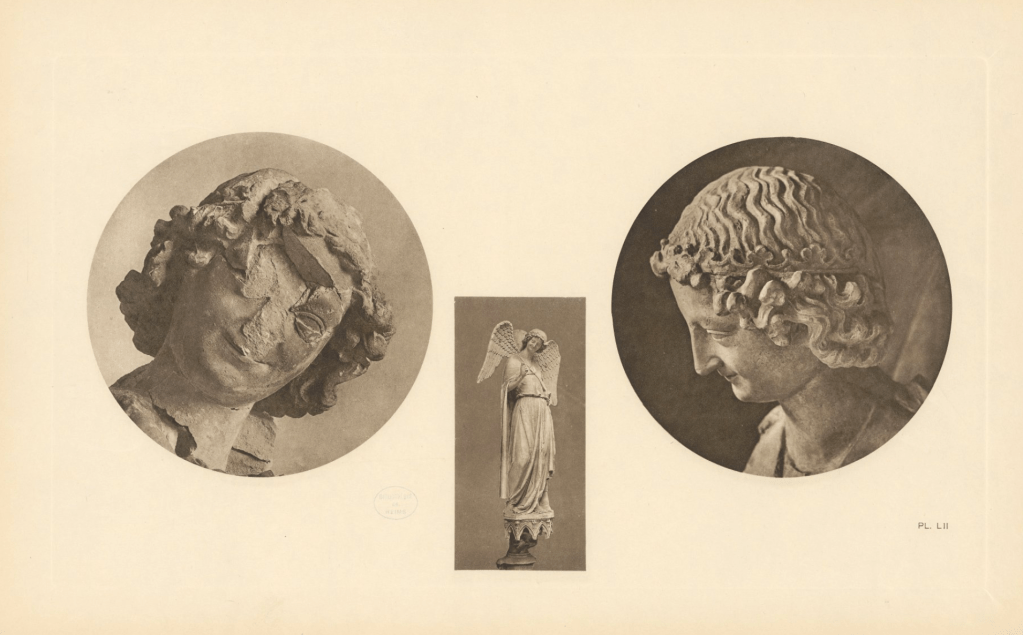
Among Robert Antelme’s posthumous writings the short text “L’ange au sourire” has a decisive place if we are to explain the transfigured theological experience of the French writer. To anyone familiar with French architecture history the title should sound familiar, since the ‘l’ange au sourire’ was already a common expression used by French scholars of architecture during the interwar years. Charles Sarazin, arguably the most important scholar of the architecture of Reims, penned a separata titled “Le Sourire de Reims” (1929), in which he celebrated the mysterious smile of the angel Gabriel that was severely damaged due to shell fire of the Cathedral during the fall of 1914 [1]. But a decade prior to the destruction, art historian Arthur Gardner, in a detailed essay on the sculptures of the facade of the Rheims Cathedral, also took note of this angel’s gaze writing that: “…the angel Gabriel of the Annunciation in which the French smile has almost become a grin, the beginning of the contorted expressions frequently found over the border in Germany.” [2]. The particular aspect of this unique angel’s face that Antelme undresses from the cloak of authority is also wonderfully documented in the photographic book by Pierre Antony-Thouret, who also showed pictorial interest in the way that angel Gabriel was chipped in a large area of the right frontal relief (image 1) [3].
Image 1. Reims au lendemain de la guerre (1928), plate 52.
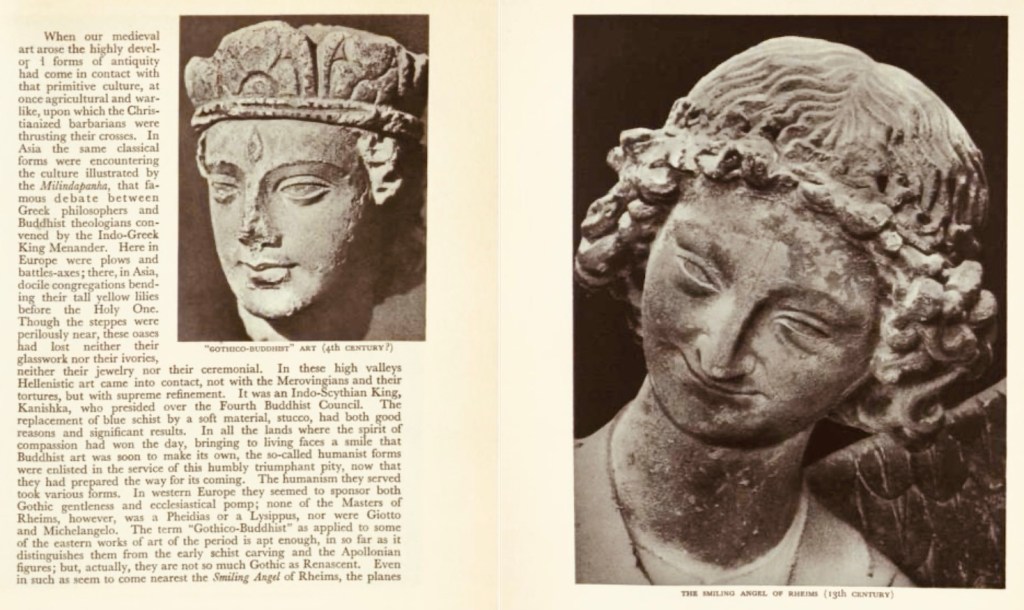
This curatorial context informs the historical background of Antelme’s reference to destruction and what he references as the crushed: “But not crushed by this building, or by that event, or by some power. It has always been crushed, crushed forever” [4]. For Antelme the tenuous, almost imperceptible, smile of the Angel of Rheims is what outlives absolute destruction because to be destroyed cannot be executed absolutely. It is the soul of existence that, because of its exteriority to history, is powerless “to have forever to be”. Even if this being has become petrified and immobile from its original plastic appearance auf vif of sacred art. This is what Malraux captured in his brief mention of the “L’ange au sourire” in The Voices of Silence (1951), where he also compares it to the Buddhist faces of Oriental sacred art (image 2): “The Smiling Angel of Rheims is a statue whose “stiffness” increased with every century; but at its birth it was a similar incarnate, a face that had suddenly come alive – like all faces sponsoring a discovery in the field of the lifelike” [5]. In order words, to see in the muteness of the face the nothingness that allows expressive relations to emerge in the open. This holds for Antelme’s description as well: “Radiant or hidden, inevitably it is there. Word, image, music: everything expresses it, and nothing. It lies at the heart of that realm where all relations are born. Forever starting anew. Possessing nothing, capable of nothing, it must be there, forever”.
Image 2. Angel of Rheims in The Voices of Silence (1964).
But what Antelme was able to capture through the smiling angel of the Rheims Cathedral was not a problem of iconology of art forms, but rather the very essence of the theological problem of angels as it relates to the poetics of life itself. The angel is not a promythical figure scaled to a specific historical moment, but an instantiation of the divine appeals to the withdrawal the possibilities and modes of the human being. This is why Antelme can state that “the only transcendence is the relation between beings”. Even in its muteness, the theologica depth of the angel is the poetic speech of divinity through a surge in language that has no end, but only celebration or hymnology.
This is why Erik Peterson writes towards the end of “The Book of Angels” about the intimate relation of angels in human existence: “A human being can draw near to the angels because the angel too – as its name already indicates – can draw near to humanity. […] The angels are more than poetic ornamentation left from the storehouse of popular fables, they belong to us. For us, they stand for a possibility of our being, a heightening and intensifying of our being – but for the possibility of a new faith…as a passion for mental clarity and an authentic existence” [6]. It is fair to say that, although the figure of the angel does not show again in Antelme’s work, all of his vision and witness accounts in the face of political horror must be placed in the endless vigil of a nocturnal life that is shared with the ethos of angels (utirur vigilis, angelorum vitam procul dubio meditatur).
.
.
Notes
1. Charles Sarazin. “Le Sourire de Reims” (s.l.n.d, 1929).
2. Arthur Gardner. “The sculptures of Rheims Cathedral”, The Burlington Magazine for Connoisseurs, V.26, 1914, 64.
3. Pierre Antony-Thouret. Reims au lendemain de la guerre: la cathédrale mutilée, la ville dévastée (Jean Budry, 1928).
4. Robert Antelme. Textes inédits sur l’Espèce humaine (Gallimard, 1996), 14.
5. Andre Malraux. The Voices of Silence (Secker & Warburg, 1964), 317.
6. Erik Peterson. “The Book of Angels”, in Theological Tractates (Stanford University Press, 2011), 139.
Endless war and infinite strife is always preceded by the erosion and the putrid decomposition of language. Such is the thesis of Adan Kovacsics’ idiosyncratic and historically situated Guerra y lenguaje (Acantilado, 2025), which sets a specific date for the moment of such linguistic rot into consciousness in European modernity: Hugo von Hofmannsthal’s “Lord Chandos Letter” of 1902 in which civilizational decline signaled the total detachment of expression, making language flourish in the form of opinions resembling rotten mushrooms. For Hofmannsthal this event was neither accidental nor a temporary malady, but a tonality of existence that soon enough broadened like a “spreading rust” (Kovacsics 11). Just a few years later in his posthumous Persuasion and Rhetoric, Michelstaedter will describe this rusting of language as the triumph of “darkening ornaments” (kallopismata orphnes) of the epoch, liberating the destiny of language as a mere transactional exchange between “technical terms” mastered by everyone regardless of their idioms (it surprises the reader that the thinker of Gorizia is absent from Kovacsics’ Austro-Hungarian constellation on the crisis of language).
The decline of an empire shimmering with languages and dialects across its territory began to suffer the malady of miscommunication that resulted in making language uninhabitable, throbbing in its empty chatter. Thus, the attempt to initiate an exodus from language began to appear everywhere according to Kovacsics: Fritz Mauthner drafts an encyclopedic treatise on the venereal misapprehension of language, Gustav Landauver battles in the trenches of linguistic scepticism and the mystical tradition in the name of revolution, while others like Hugo Ball attempts to flee from language altogether through the liberation of sounds and words, from the Dada avant-garde to his later Byzantine Christian asceticism. For his part, Karl Kraus in The last days of Mankind prefers to expose the surface of language as it becomes a regime regulated by opinion for bureaucratic administration over facts of reality. The nihilism that colors politics at the turn of the century is accompanied by the instrumentalization of language as the primordial technical apparatus that allows the flows of information through the acceleration of the autonomization of the linguistic mediation; as consequence, language began to arouse constant disbelief and doubt over the very essence of the sayable (Kovacsics 31). This throws light on contemporary debates about “misinformation” that, precisely because they are caught up on the epistemological determination proper to the linguistic crisis, it comes short to putting into perspective the range and depth of language over the problem of appearance now deprived of the expressive mediation between the speaking animal and phenomena, reducing experience to rhetorical commonalities or inter-social allocation of commands.
Kovacsics’s Guerra y Lenguaje (2025) brings to bear – without totally exhausting the crushing weight of its archive and set of problems for thought – the immense significance of the first decade of the twentieth century at outset of the waning of the Austrian-Hungarian Empire, which has always been understood historically as the condition for the last configuration of European nationalism and its war-economies, but rarely in light of its functionalization of language. If read against the backdrop of Simone Weil’s “Are we heading for the proletarian revolution?” (1933) intervention about the “functional” dimension of the state form in the first decades of the twentieth century, Kovacsic’s essay ultimately helps us to define the concrete nature of functionality as the index of mobilization of ‘worlding’ through the commanding force of language. To deliver this point home, Kovacsics tells how language itself severed enunciation from action:
“La transformación que se produjo y que la ha alejado, como si un tablón se hubiese desprendido del muelle y se hubiera adentrado en el mar, no se debe a que otras gentes se impusieron en su día en Grecia, sino a un cambio radical en el uso concreto de la palabra. Es en la Gran Guerra cuando esa corriente inicial de la utilización del lenguaje como herramienta se consolida de manera definitiva. Es entonces cuando la palabra pasa a ser plenamente funcional y su papel se reduce a aportar argumentos para la acción o incluso a “parirla” mediante el tópico. Hemos visto hasta qué punto el silencio de Karl Kraus al comienzo de la contienda se debía a la percepción de este vínculo entre palabra y acción, al que no quería ni podía sumarse de ningún modo” (Kovacsics 76-77).
Language does not disappear as much as it transforms itself into two vectors of social enforcement towards communication: functionality and rhetorical enthymemes. In this way, language is able to colonize reality and stabilize for the concrete order, or what Walter Benjamin called during those years the “bourgeois conception of language” hindering on causality and objectivity accelerating the collapse of its vocation to naming the exteriority of the world (Kovacsics 81). The totalization of this new rhetorical social structure becomes the main stage for the production of justification and competing regimes of fiction. But this implies no general theory or systematization of a linguistic science, but rather how language coincides with life in the form of an ethics. This is at the heart of the different attempts to retract language in the eclipse of empire and the new interstate fragmentation – which also entails grammatical and functional unifigies of national language – as a problem that concerns the limits of ethics. Ethics here cannot coincide with the general condition of ‘knowability’ that makes morality possible; rather, the problem of ethics can only reveal in turn the senseless of wanting to go beyond the facts of the world and allows us to dwell in one without completion. The withdrawal from the language of propaganda and objectivity demanded an ethics of the sayable beyond the commodification and intentionality of words promoted by “war” and “ware” (commodity) that the West had continued to endure; a total communication of ends that decades later evolved into cybernetics as the warping of world into informational encoded relation.
Kovacsics reminds us that there is a story here of extreme violence and creative destruction, only comparable to nuclear fusion and the flaying of a human being, only that this time, unlike the myth of Marsyas, without ever reaching transcendence of redemption through the proximity of language to myth (Kovacsics 129). Underneath there is the body of language, stripped of its capacity for truth and reduced to functions of survival and needs oriented towards the homogeneity of the future. Towards the end of Guerra y lenguaje (2025), and glossing Hobbes’ notion of political authority that legitimated the modern interstate system to neutralize truth contents and the stasis over words, one cannot help but think that the date 1902 as a. arcana was an effective culmination rather than genesis of the modern, which means that the foul scent of the twentieth century was destined for decomposition since it had already stripped bared one of the most beautiful lacunae of the human species: being in language and the event of appearance became integrated into the worldly utopia of the machine.
As captured in Marcel Duchamp’s “The Bride Stripped Bare”, the obsolescence of language over time evolved into a candid instrument of social functions of proportional exchange, coordinated fortuitous relations, and increasing moral indictment that purported parodies of contested realities. Thus, the sickness is always unto language – a basic assumption that reveals the need for infrapolitical analysis before there is any political practice and categorial reinvention. The overexposure of language as an avatar of metaphoric communication for ends and needs of humankind brought itself bare and all encompassing in its appropriative force, but only at the expense of darkening and losing the world forever.
Jan Van Eyck’s 1432 Portrait of a Man has the Greek inscription, and rendered in transliteration, that reads “Tum Otheos” (ΤΥΜ ωΘΕΟς) that has baffled art historians and specialists on the painter for a very long time. It is well known that Van Eyck, the pioneer of oil painting, was fond of leaving all forms of writing in his pictures in Greek, Hebrew, and trilingual idioms that through the centuries have become incomprehensible jottings [1]. At a time when Van Eyck was painting in Northern Europe, the magical efficacy over names and naming was a dominant cultural and religious belief, and the expanded arts of the ‘names of god’ were used to heal and relieve pain, and protect against potential enemies and keep demons at bay [2]. Following Hermann Usener, one could see how the original act of the naming of the gods was no longer tied to ‘momentary divinities’ (Augenblicksgötter), but rather they were functionalized to specific anthropological needs for survival. Nonetheless, it is quite ashtonishing to witness how the painting at year zero that Van Eyck embodies – the very birth of oil painting and the “coming to life” of the figure in depiction – coincided with a divinization itself of the expanded field of the arts [2].
In Erwin Panofksy’s early interpretation the inscription “Tum Otheos” should be read in light of the musical revolution that had taken place between 1420-1440 in the Netherlands, where the ars nova meant a thorough musical renovation towards a new expressive energy and “exquisite sensibility” nourished by the myth of Timotheos, who was taken as the ancient model of sublime harmony of the new arts and style of bringing life into depiction [3]. Overtly dependent on the transmission of the ancient figure of sound, for Panofsky the inscription “Tum Otheos” pays homage to the lyre Timotheus of Miletus as creator of the “new music”. But, could the same be transplanted into painting? Could painting at “year zero” be taken as precisely this new tonality of the arts?
A second possible rendition of “Tum Otheos” is one what has been merely registered, although not elaborated, by art historian Alfred Acres, for whom “tum otheos” is not indexing the ancient musician but more importantly, it is registering an event or what is taking place [4]. Thus, for Acres “Tum Otheos” should be read as “and then God”; as if the relationship between painter, depiction, and spectator was the very taking place of a minor and invisible god of creation that painting facilitates. It is not difficult to recall here what Luca Giordano said of Velazquez’s painting: “this is the Theology of Painting” [5]. Although directed at Las Meninas, one could perceive that in the early stages of the secularization of the forms of the modern, the nexus between theology and painting becomes a clandestine partnership that resists its full integration into the autonomization of forms of representation. In other words, there is always a theos reminder in the act of depiction that is irreducible to the general economy of forms, as if the dissonance of the soul endured underneath at the nearness granted by the concrete realization of a picture. “And then God”, as proposed by Acres, should not be taken merely as the eruption of the divine in the symbolic structuration of the world, but rather as the very act of naming that allows divinization to continue in spite of the closure announced by the flight of the gods.
Just one year after Van Eyck’s Portrait of a Man (1432) where the inscription “Tum Theos” appears, in Italy Alberti will write in his De Pictura that the gesture of painting “possess a truly divine power in that not only does it make the absent present (as they say of friendship), but it also represents the dead to the living many centuries later, so that they are recognized by spectators with please and deep admiration for the artist” [6]. And if Postel is right that Van Eyck’s Arnolfini masterpiece is one in which the picture reconvenes the dead bride and the rich merchant into pictorial space, then one could deduce that for the Flemish artist the divinity of painting is defined as the only passage left to the moderns to negate the world of the living and inhabit the invisible world of the dead against the coming of the monothematic world-image and its material crust of Gaia [7]. “Tum Otheos” – and then God – is literally registering the transfigured and expressive dimension of painting; that is, the taking place of depiction and its secret fidelity to what appears only to banish and become forever unfathomable.
.
.
Notes
1. Susan Frances Jones. “Jan van Eyck’s Greek, Hebrew and Trilingual Inscriptions”, in Van Eyck Studies, September 2012, 294.
2. Noa Turel. Living Pictures: Jan van Eyck and Painting’s First Century (Yale University Press, 2020).
3. Erwin Panofsky. “Who Is Jan van Eyck’s “Tymotheos”?, Journal of the Warburg Studies, 1949, 88-89.
4. Alfred Acres. Jan van Eyck within His Art (Reaktion Books, 2023), 177.
5. Daniel Arasse. Take a Closer Look (Princeton U Press, 2013), 134.
6. Leon Battista Alberti. On Painting (Penguin Classics, 1991), 60.
7. Jean-Philippe Postel. El affaire Arnolfini: Investigación sobre un cuadro de Van Eyck (Acantilado, 2023).
Giorgio Agamben’s most recent La voce umana (Quodlibet, 2023) sets the scene with an elemental question: what is to call on something, and what is it to be called upon? The exploration around the notion of the voice (a sort of chorâ that falls between the different antinomies of human language, as we will soon learn) is far from new in Agamben’s work, who from the the early period of Il linguaggio e la morte (1982) directly confronted the negative foundation of phonê in relation to the closure of metaphysics. In a certain way, the perimeter of La voce umana (2023) is now deliberately limited to how the ‘mystery of the language’ is to be found in the unending event of the voice as the arcanum of anthropogenesis itself. At this stage of his investigations, the problem of the voice for Agamben designates a double movement of inflection and recapitulation: the voice proves the internal division of political life in the West; at the same time, it is also the most intense experience that a form of life can bestow the disclosure of the world. The attentive reader might recall the last pages of L’aperto: l’uomo e l’animale (2002) where the impasse of the anthropological machine was assigned by caesuras between human and animal, the semiotic and the semantic, the word and the name, redemption and the end of time, writing (gramma) and sound. But it is now with the voice that a clear way out becomes apparent. In the analytics of the voice klesis no longe stands as a political-theological category of the West; but, on the contrary, a call of language unto itself, the vocative that resists linguistic denomination and the free-standing outside the case and even language itself (“fuori lingua”) as suggested by Gustave Guillaume.
The vocative dimension of language is shown as pure means of the human experience: the apostrophe that calls something – as in Moby Dick’s majestic beginning “Call me Ishmael” – is already the call through the act of naming, and naming falling into the voice becomes the originary place of language in the denomination of speech (21). Irreductible to the antinomy of langue and parole, the semantic and the semiotic, the vocative texture of the voice emerges as the third figure that neither linguistics, philosophy of language, phonology, analytical linguistics, and biological cybernetics are capable of truly grasping. And this is so – Agamben does not says it in this brutish way – because there cannot be any theory of the voice and the vocative denomination; there can only be a poetics of the voice in which the transformative and self-generative experience with reality is staged: “Ma è possibile pensare il linguaggio prescindendo dal suo rifermenta lla realtà? La voce – il vocabolo – non designa soltanto un significant, chiama piuttosto un ente reale…non si limite a elencare segni in un lessico, ma annuncai ed encunia realtà” (36).
In my respects – and this is not the place to bring into focus Emile Benveniste’s last seminar on language and writing – Agamben’s treatment of the voice is nourished by pushing beyond the limits of the great twentieth century linguist who, for the most part, remained silent on the place of the voice. Not that there is a need for another substantive treatment of the vocative; in fact, one of the great achievements of La voce umana (2023) is precisely the archeological reconstruction of the Aristotelean “what is in the voice” (ta en té phonē) formula in which the classical metaphysical inception of language comes closest to the voice only to render it “articulate” and thus subordinated to the legibility of gramma or the written sign (42-44). And whatever one thinks of what constitutes the “primacy” of metaphysics in West (phone or gramma), what is important is the fact that domestication of language has been auxiliary by the “fundamental discipline of the West” (grammar) that sets off the immediate point of dialectical force between speech and the alphabetical inscription in the voice (45-46). Civilization is nothing more than the historical process of taming one’s voice.
At this point, it becomes clear that Agamben remains faithful to his old friend, the Spanish poet José Bergamín, whose bewildering essay from 1933 “La decadencia del analfabetismo” (“The decline of illiteracy”), argued precisely that the upwards movement of civilization of grammar and writing undermined the living voice and imagination of concrete and localized people (“pueblos minorías”) livelihood [1]. Indeed, it does not take much to see how the grammaticalization of human experience was a fundamental infrastructure for the consolidation of civil society grounded in the articulation of internal recognition of rules, normative directives, and binding statutory enforcement. The triumph of the order of grammar will only intensify the movement towards the total integration of every form of life into the fictive rhetorical space on behalf of what has already been stated without having to persuade, to put in Carlo Michaelstaedter’s terms that I do not think contradict the terms that Agamben extracts from his exegesis of the voice.
The political problems emerging from the confrontation with the voice are multiple. One can recall how in modernity, when “words have been liberated from their sacred denomination” (something pondered by Joseph De Maistre in his The Generative Principle of Political Constitutions as political revolution sets through universal recognition), the closure of the rhetoric embedded in “social life” captures the event of the voice into a stable communicative dimension of language (“suoni della lengua”), which for Agamben resembles the etymology of the word phònos: murder, that is, the self-conscious assassination of the voice at the altar of free-floating rhetoric and the order of discourse (50-51). By the same token, in our epoch every living being has the malleable equalizer and “amplifier” (a word used, indeed, by the Supreme Court of the United States when deciding the case that granted equity between finance campaign and ‘public use of language’) of words, but it is only rare to see anyone truly possessing a voice. If every entity in the world has been previously assigned and grammatically ordered, what is absent is precisely the chōra as the “invisible and formeless place” (‘invisibile e senza forma”) in which the intelligible pure state of the language in the voice. In this strict sense, whoever possesses a voice is one who dissolves the axiomatic arrangement of discourse only to transform the world as inhabited. This is why the voice remains not a threshold to semantic register or the written technology, but rather an unknown song (“canto ignoto”), as it was called by Benedictine monk Guido d’Arezzo. And this song, the voice, can be followed and deciphered but never truly mastered as absolute transparent knowledge (45).
And if music is an index of prophecy, as Gianni Carchia once suggested, then this means that the voice, like the mythic harmony of the spheres, is what exceeds the proper human as indivisible and non-exchangeable realized only here and now. The political consequences are immense, Agamben is right. This means that we need to restate the medial and geographical distances of the chorā over the orderly cultural exchange of the polis. As it has been noted, the rise of the city state is waged against the orphic poetic myth; in the same way that the Roman imperium was possible by the erasure of the Etruscan musical underworld. Agamben reminds us that the birth of biopolitics coincides with the historical invention of the science of language leading to the impoverishment of the intangible and expressive communication between souls. This is Agamben’s rendition that the task of philosophy – not historical benchmarks or epistemological categorizations – resides in the attunement to the highest hymn of expressive form as it has been studied by Nicoletta De Vita’s erudite monograph Il nome e la voce (2022). There is no philosophical or theological closure as long as the song remains.
We can say that wherever there is a chorā of the voice something like this minor transcendence of the original human being that retracts from the soteriological false exits that have devastated the anthropogenic event. And it occurs to me that we could thematize three areas of what this closure means for us today: first, the technification of politics in epoch has been reduced, precisely, to a discursive theory of articulation (of social demands) to craft the fictive totalization of hegemony; second, the collapse of the political representation within contemporary democracies has turned into the optimal organization of containing willful self-expression in light of the contingency of values of the dominant aesthetic regime; and finally, the very understanding of legal culture and constitutionalism in the West has shuffled different modalities of the written authorial intention to generate the internal rules of institutional and statutory norms only to expand police powers and codification of conducts. At the expense of the unknown song, all sorts of prosthetic contraptions have been erected to douse the prehistoric voice that nevertheless keeps overflowing and reemerging like the unnerving cracking squick of Kafka’s Josephine. It is this watershed mystery of the anthropogenesis with its philo-poetological density that calls on humanity by the highest superlative imaginable: its voice.
i. What is your name? Every time that I have watched John Cassavetes’ Shadows (1959) I end up facing the same question: what is taking place in this film? Perhaps it is the incorrect question insofar as Shadows (1959) is, first and foremost, a film about the event; about “what takes place”. Unlike Hollywood’s telic form over conflict, the whole premise of Cassavetes’ method of improvisation is a way to liberate the event in the moving image. This is what I would like to call here a photogenic event. The whole structure of Shadows is, to this effect, the bringing-fourth of appearing without narration or naming. Hence, what takes place is the way in which characters or figures emerge from light, retracting from the plunge unto theatricality. The photogenetic effect in Cassavetes is a way out of the logic of naming: remember “what is your name?”, as Bennie asks very early in the film (the café sequence). Indeed, the naming is always what emerges after the event, once boredom has kicked him and the separation from light and shadow, human and animal, theater and theatrically have taken place. The taking place in Shadows is a return to an abysmal site predating naming, faces, or intentions: it is absolute proximity.
ii. The vocation of the quotidian. The photogenetic image works through the texture of life: this is why in Shadows nothing truly happens in virtue that everything takes place. The difference between happening and taking place is an irreducible distinction; mainly, what happens is not provoked a mediation between subjects and objects, but rather at a moment when both subject and object coincide only to immediately suspend each other. What takes place is life’s destiny, which ultimately entails that we are figures of exposure before we are subjects of narrative and causality. As in a diary or a midnight party, what takes place is the clandestine life once it enters in relation with other bodies, languages, and gestures. In this sense, Shadows remains faithful to one and only one principle: how to transfigure the boredom of factical life into a vocation of a clandestine life. It is not too clear that Cassavetes arrives at a successful answer to this problem; almost as if, indeed, to remain clandestine is to insist on the “invisible” image that is always missing from every life. The promiscuity between shadows and light transpires the possibility of the living all the other invisible and nonexistent lives that are scarified within that which we call “life”.
iii. Under the glorious sky. If the task of vocation opens to the invisible in life, then this means that there is always a dimension that is exterior the anthropological determination. In the solitude of the nocturnal splendor of the late modern metropolis – as in the instance in which Lelia is outside of a Manhattan theater lost in thought or contemplating the shimmering lights above – the existence of the human shines along with the embers of the sky. This most definitely an inherence of paganism in the sense of the medium in life as a mode of appearance without judgement. As one can still contemplate it from the frescos at Villa Fernesina, the pagan gazing towards the sky is not a flight towards abstraction or transcendence, but rather a releasement of life’s destiny as affirmed in the terrestrial presence [1]. Paradoxically, at the moment of the total subsumption of life into the Spectacle, the medium frees the possibility of the deconstitution of life into the modes and resources of appearing. From the photogenic perspective, this entails full saturation on the horizon; from the pagan perspective, the onwards unfolding of existence becomes a fragment in the exploration of the common sky.
iv. Inharmonious tonality. Now, fragmentation opens a heterochronic disassociation between images and events. Indeed, all of Shadows unfolding bears witness to the way in which the tonality of life is always at odds with the attunement of the rhythms of the world. It is in this threshold where interiority of the self and exteriority of music point to the peak of prophecy. For one thing, because music is the medium through the residual mystery of the “inexpressive” becomes the process of traversing the ecstatic formlessness of the event [2]. This disharmony dislocates the homogenization vis-à-vis the sky of cinematography. Bresson says something very beautiful about this disharmony: the image of cinematography must be such that it puts in relation the voice and the steps of a person in a way that the protagonist themselves have not foreseen [3]. This nocturnal knowledge between image and sound, rhythm and tonality of life, becomes the triumph of the photogenic medium in which life dissolves in a kinetic outburst without recourse.
v. The invisible and intoxication. At a very superficial dimension, Shadows is about alcohol consumption; hence about what happens to a life under the stage of intoxication. The only knowledge is that of the oblique pedagogy in which the way of the flesh becomes a pathway for language, friendship, and violence among other bodies. There is no transgression as an intoxicated subject, since intoxication is already the violence against the substance of the subject. In other words – and this was suggested to me by the contemporary artist and designer Claudia Patricia – the logistics of errancy is being able to do otherwise from a site in which no other possibility could have emerged. This absolute necessity moves against reality and the future planning of the metropolis. And here I must return to the beginning: what takes place is what allows a relation with the invisible. Already in 1959, Cassavetes understood that intoxication redeems an ethical life against an epochal phase in which total anthropological exposure would become the concrete utopia of the socialization of capital.
.
.
Notes
1. Fritz Saxl. La fede astrologica di Agostino Chigi. Interpretazione dei dipinti di Baldassarre Peruzzi nella Sala di Galatea della Farnesina (Bardi Edizioni, 2017).
2. Gianni Carchia. “Dialettica dell’immagine: note sull’estetica biblica e cristiana”, in La legittimazione dell’arte: studi sull’intelligibile estetico (1982).
3. Bresson on Bresson: Interviews, 1943-1983 (NYRB, 2016).
Jason Smith’s Smart Machines and Service Work (Reaktion Books, 2020) provides us with a renewed cartography of the labor transformations in the wake of automation and the cybernetic revolution, which has ultimately created a “vast service sector” (9). Although at first sight Smith’s book seems to be preoccupied with questions of technology innovation in the post-fordist epoch, the central vortex of the book sheds light on the notion of “servant economy” that has become the fast-evolving segment of today’s job-market. Smith notes that the expansion of the servant economy propelled by automation “poses special obstacles to organization and action in a fragmented workforce. The rise of the “servant economy”, increasingly forces workers into smaller, spatially dispersed workplaces, where they carry out labor-intensified production processes…. deemed low-skill occupations and therefore poorly paid” (14). The new region of the service economy is an effect of the exceptionality of capital form self-abdication where unemployment becomes an existential problem for the social fabric.
The nuanced analysis undertaken by Smith shows how the fragmented spatialization of labor has become the byproduct of the automation in which control, optimization, and feedback ensemble a new regime of total calculation. Already in 1956, Friedrich Pollock warned of a potential “totalitarian government” that could lead to mass unemployment. Pollock’s Cold War predicament was not off target: the fear of totalitarian unemployment (Habermas would call it crisis of legitimation) was answered with a total (service) economy that compensated for the paradox of stagnation of profit growth. The encompassing force of real subsumption through compartmentalization of services rendered effective James Boggs’ “nowhere to go” in the final dispensation of historical capitalism.
The phase of stagnation announces the “productivity paradox”. Smith writes glossing Mason: “If ours is an age defined by monopolies, cheap credit, rent-seeking and asset bubbles, it is not due to the concerted efforts of elites keen to forestall or smother in the cradle a new, sustained period of productivity gains….despite claims to the contrary, the weather of stagnation and drift that has settle over the advanced capitalist economies since the 1970s, and special since the turn of the century is attributable in no small part technological inertia” (41). The boom of “diversionary gadgets” are on the side of unproductiveness; and, as Ure argues, “do nothing towards the supply of the physical necessities of society” (43). But perhaps diversion usage accounts for the mobilization of the medium of the new phase of automated capitalism. In other words, precisely because traditional form of political legitimacy has crumbled, zero value technology becomes the compensatory psychic equilibrium within the process of abstraction of profit. The subjective dimension of the “medium” in the new phase of automation operates to drive dynamism in the “historic low” of labor productivity growth and the disjointed structural relation between economic growth and rise in wages (64, 69).
One of the conclusions that one can derive from Smith’s rich political economy empirical analysis is that the expansion of the service economy is fundamentally an anti-institutional phenomenon, both at the level of social forms (unions, movements, legal grounds for disputes) as well as in terms of mediations of exchange (intellectual labor, shadow-work, spatial relations to urban centers, etc.). In this sense, the absolutization of the regional “service economy” is the reallocation of reduced labor. In the same way that all ‘originary accumulation’ is an ‘onging accumulation’; the “crisis” of the economy is always already the recurrent stagnation of growth. But Smith notes with precision: “services therefore appear to obscure more than it clarifies” (80). This new process of rationalization mobilizes the valorization of the outside, that is, of every non-market sphere. This process draws a specific ordo rationality: “The true “advances” such as they are, have been in the domination of the labor process by employers: their ability to coerce more labor out of a given hour by means of refinement in supervision, oversight, and workplace discipline” (112).
Mirroring the optimal logistics of cybernetic and automation processes, one could claim that the expansion of the service economy initiates a regime of governmentality that allows for the attenuation and cost-benefit management of flows. Now I think one can clearly see that “service” is not just an avatar to formal processes of value, but also, as Ivan Illich showed, a secularized theological concept of the Christian notion of hospitality. According to Illich, hospitality was transformed into a use of power and money to provide services and needs [1]. For the ex-Catholic priest, this meant nothing less than the corruption of human freedom, which became tied to the logistics of equivalence. This is why, more than an economic theory, neoliberalism needs to defend an ever-expanding freedom of the subject. In the context of deep social atomization, the service economy self-legitimizes itself as absolute freedom in the social (141).
At the end of the book, Smith notes that in the wake of automation the relation between political struggles and the new economic composition begin to diverge. There is on one side the model of the teachers and that of the expendables (146-147). In a sense, the “nowhere land” registered by Boggs in the 60s has only intensified, as modern politics forms no longer seem up to the task in the face of total extraction and exclusion. If we think of arguably the most successful leftist political strategy in the last decade or so (the strongest cases have been in Latin America and Spain), the left populism rooted in the theory of hegemony; it becomes clear that after the empirical analysis of Smart Machines, any set of ‘equivalential demands’ is already a demand for exploitation within the regime of the service economy. During this months of pandemic the right has been calling for the immediate reintegration into the economy, bring to bear the internal production at the heart of the project of hegemony. Rather than thinking about a new multitude or unified subject of class, the expendables that Smith situates at the outskirts of the metropolis (the ‘hinterland’), constitute perhaps a new experiential texture of life that is no longer moved by representation but rather expression; it is no longer defined by class, but consumption; it is not interested in negation, but rather in “discovery” (148). Indeed, the new marginalized surplus population does not constitute a new “subject”, but an energy that seeks an exodus from the ruins of the political given the collapse of the whole framework of leftist hegemony [2]. It seem reasonable to think that it is precisely in the threshold of Boggs’ call for a “discovery” (a movement of anabasis), devoid of place and time, where the unfathomable stagnation of our epoch is defied.
.
.
Notes
1. Ivan Illich. The Rivers North of the Future (Anansis, 2005).






 Infrapolitical Reflections