I am sure that others will draw their point of inflection, but for me the stakes of a recent Berlin meeting (already commented here) was laid out during the very first session when one of the “non-participants” – let’s call it like this to embrace the spirit of the meeting – spoke audaciously about the current predicament: there has been a thorough loss, nothing but defeat that is both irreversible and consummated at the level of subjectivity. Some of us remembered that T.J. Clark more than a decade ago in the pages of New Left Reviewtook a similar position and was grilled for it. This tends to happen to any gesture that dares to push thought forward. In any case, the non-participant went further and called for a “new beginning”, a start from scratch, alluding to the underrated Revolution and counterrevolutionary in Germany (1851) by F. Engels, in which in fact this language is very much present. Engels wrote in the first article (the book is a collection of pieces published anonymously in the wake of the 1848 revolutions): “If, then, we have been beaten, we have nothing else to do but to begin again from the beginning. And, fortunately, the probably very short interval of rest which is allowed us between the close of the first and the beginning of the second act of the movement, gives us time for a very necessary piece of work: the study of the causes that necessitated both the late outbreak and its defeat; causes that are not to be sought for in the accidental efforts, talents, faults, errors, or treacheries of some of the leaders, but in the general social state and conditions of existence of each of the convulsed nations” [1].
Of course, “social or national conditions” are not “trapped in amber”, and I think that today one cannot take the national, local, or even regional contexts as sufficient to explain failure. The failure is civilizational, and raising the question of the “beginning” (or new beginnings) has a heideggerian overtone that is not facetious, but it is consistent with any exploration in the quadrant of critical-metaphysical commitments for thought (infrapolitical reflection has thematized it) [2]. This elaboration could be very well idiosyncratic, but I think it provides “grip” to the problem by not making concessions to well known junior partners of abstract politicization and ideological backlogging that like the Tortoise in the parable still fantasize with a breakthrough via yet another “textualist interpretation”; one more sophisticated mapping of political ecology or a collective hegemonic political theory department; or even a policy redistribution of a new Green Deal towards a new accumulation regime [3]. Perhaps they themselves do not believe any of the lies – for my part I think that they do not – and they endorse it for the sake of “bad faith”. But just in case, I think that raising the threshold at the highest point (ontotheology, civilization, the constitution of the polis) is a litmus test of separation against the new secular priests. These negative conditions already open a door to go through.
But there are also positive conditions for this “new beginning”: reopening the ethical intensity in retreat of political subjection; rejection of public chatter and freeing fugitive marranos; elaborating strong descriptions of the metamorphoses of domination; and avoiding the “revolt” as a compensatory category for of ius revolutionis in the epoch of real subsumption [4]. At the end of the day, it should not be forgotten that an-archy also means the turbulence of phenomena, in which every fragment moves in the direction of experience poking through the objectification of the world. This is “inapparent”, but it is for this very reason what is fundamental and invariant.
The ‘new beginning’ in the wake of collapse can only conquer life to traverse the hunger of meaning that propels the fictional machine of ongoing nihilism, as Giorgio Cesarano warned. There is no historical or moral beginning; there is only the beginning in which existence is able to expand the originary accumulation of a sensible ethos. And it is at the very end, or almost at the end of everything, that true beginning commences. Whoever does not start from the beginning is either understudying the epoch, or mastering the evermore painful social roles. It is only in the direction towards beginning that can avoid the crushing weight of the post-neolithic condition (Métraux) that calls for a divestment of what reality can contrive for us.
.
.
Notes
1. Fredrich Engels. Revolution and counter-revolution in Germany (FLP, 1977), 3.
It could easily be argued that one of the central immaterial characters of Robert Antelme’s L’espèce humaine (1947)is the constant state of hunger. It is the more telling that Antelme – and it is also surprising that most of his relevant critics have been unattentive to this problem – does not reflect explicitly about the nature of hunger in his account, as if already hunger as “facticity” of the destruction of human experience in the camp was enough to show how the crisis of effective symbolization with the world means, ultimately, the struggle for the maintenance of the nutritional condition for survival [1]. It is a particular state of nutritional privation that colors not just every community or social relation in L’espèce humaine, but also every thought, passive meandering, and even moral clarity of the deportee life in the camp. The pathetic struggles over pieces of bread or scoops of putrid soup while deposing the human race from the world brings them back, at the level of consciousness, to the raw origins of its anthropological self-affirmation. And this means that every bite of food and every bit of protein digested by the human being is only the antecedent of the future need to meet the elemental nutritional gain for survival. The ‘consciousness towards hunger’ colored in the camp becomes the mirror image of the incessant eating disorder of hypermodern social adaptation as two forms of predatory struggle over the exchange goods of the world.
Excessive eating and nutritional deficiency are, in this sense, two pothistorical temporal circuit of human beings as a species of hunger and gluttony. About a decade ago a book entitled Hunger: the oldest problem (2014), written by Martín Caparrós, stood out as a proof of a materialist conception at a planetary scale, which for the novelist could easily be solved by drafting the legibility of material inequality and charting the regional disproportionate asymmetries between the “good eaters” (and good feeders), and those in permanent hunger, malnutrition, localized famine, and potential starvation. For Caparros, given the height of our “civilizational progress”, hunger revealed the “original plague of humanity….which now can be solved through a political decision” [2]. The substance of the “political decision” for hunger of the human race was as empty as the very nauseating fatigue of real starvation, although as a rhetorical ploy it does contribute, even against its own presuppositions, to the civilizational paradigm that structures the poles of gluttony and hunger that sustains the domestication of the human species in conformity – under the terror imposed by the glacial tonality of nihilism – with a ‘good enough life’, as an American cultural scholar univocally upheld it [3]. A deconstructed Michelin rated restaurant is as much of the ‘good enough life’ as the oversized pots of soup delivered by World Central Kitchen in any of the ongoing war zones.
A ‘good enough life’, always marching towards the absolute postponement of an absolute hunger in any part of the planet, whose most recent avatar (not the final by any means) is the well wrapped brown bag of “food app delivery” that is silently placed in front of your house door. The food delivery package, very much like the breadcrumbs of the concentration camp described in L’espèce humaine, enter full circle even if the arrangement of symbolic reality says otherwise. It does not matter that there are human hand struggles for dregs in the camp while in civil society there is a seemingly untouched brown bag; what makes them equivalent is how the autonomization of hunger and gluttony have been deprived of everything except its own functionalization. In other words, the absolutization of gluttony and hunger as abstract nexus of social reproduction entails the complete devastation of commensality, and all features of experiential sharing that in the ancient tradition is gathered in the banquet or in wine festivities [4].
This absolute autonomization turns its back to the world, which has now been transformed as a mere reserve and container. This is why the analogies with the wild cornucopia of the elastic worlds of Gargantua or Pantagruel, or even the mythical land of Cockaigne fall short, and can only contribute to fetichize the problem of the “true hunger” of the human species beyond nutritional and biological arrangement. The dialectical movement at work in the alleged returned to the primal anthropological condition comes at a price: the sensible and meaningful relation, which is no longer to be invented but rather to be renounced in the elaborate thickening of a social space organized through depredation and adaptation. In his Manuale di sopravvivenza, Giorigo Cesarano noted that the problem of hunger exceeded the political and biological determinations, since hunger was first and foremost the problem of the completion of nihilism – the only hunger was that of the wandering of the human species reveals the hunger of meaning as a the true double negation:
“At the end of prehistoric times, the most ancient problem signals the return of the negative instinct: hunger. But this time is about the hunger of meaning that exceeds, while bringing it to synthesis, the anxiety of survival as merely an animal and its false resolution as a life that transcendentals the idealist forms of the human “ideal”. …both the negative instinct and the rational separation, having conquered some coherence in its praxis, from a possible totality seeks to insert being in a real university in order to be known truly as such” [5].
In this dense moment of his book, Cesarano seems to be arriving at an important inflection point: that is, the primal instinct of hunger, precisely as fealt and maximized in the new existential poverty of the human experience, is already compensatory to the concrete realization of an absolute hunger of meaning that emerges in both the privative stage of hunger, and in the consummation of any imaginable and desirable meal. Hence, the return to the facticity of the prehistoric stage of instinct negativity is ultimately the final exclusive dish: the nothingness of nihilism to retain the illusion of, in the words of Antelme’s poem “The soup”, going to far (or as far as it needs to be that the “world doesn’t end” [6]. The anthropophagic energies are the last tools of self-burial of the bicameral man in the wake of intramundane extinction [7].
But the dialectical vengeance in the epoch of real subsumption is hereby expressed in its uttermost kernel: the material world can only take the image of a predatory park of hunters and preys, of eating and being eaten. In the privation of death, the fictitious life of being is already a form of expropriating death as ongoing struggle for survival and self-conquest of life’s own organic illness, as it appears in Anatole France’s fragment: “No, I would rather think that organic life is an illness peculiar to our unlovely planet. It would be intolerable to believe that throughout the infinite universe there was nothing but eating and being eaten” [8]. The poverty of a restricted vitalist self-reflection can only described the organization of the world as a civilization that resembles a Pac-Man maze of the circulation of the equivalent. It is not difficult agree with Adorno that this is a perfect image of the integral society without any residue – as it continues to be in any point of the planet – is the last possible well administered utopia.
.
.
Notes
1. See the essays in the volume On Robert Antelme’s The Human Race: Essays and Commentaries (The Malboro Press, 2003), 55-203.
2. Martín Caparrós. Hunger: The Oldest Problem (Melville House, 2020).
3. Avram Alpert. The Good-Enough Life (Princeton University Press, 2022).
4. Albert Hirschman. “Melding the public and private spheres: taking commensality seriously”, in Crossing Boundaries: Selected Essays (Zone Books, 1998), 11-28.
5. Giorgio Cesarano. Manuale di sopravvivenza (Bollati Boringhieri, 2000), 70.
6. Robert Antelme. “The Soup”, in On Robert Antelme’s The Human Race: Essays and Commentaries (The Malboro Press, 2003), 36.
7. Julian Jayne. The Origin of Consciousness in the Breakdown of the Bicameral Mind (Msriner Book, 2000).
8. Theodor Adorno. Minima Moralia: Reflections from Damaged Life (Verso, 2020), 83-84.
At the outset of L’espéce humaine (1947), Robert Antelme discloses the difficulty between language and experience that lays at the heart of the book, and which is never thoroughly assumed at the level of form in the novel. L’espèce humaine (1947) is ultimately not an account about the impossibility of describing what took place in the camps; from the banal physical violence to the desperate hunger, from the microaggressions to the slightest movements and carnage of bodies in space; from the joyful smiles in the most miserable of scenario where the ultimate goal was for the human life to slowly rot; the sequence of actions engage in no struggle to bring to a crisis the level of representation. And Antelme goes into painstaking efforts to give us a full picture of what took place, only to never talk about it again in writing or in personal conversations as Marguerite Duras tells us [1]. So, what to make of Antelme’s initial affirmation in the “Forword” where he states that: “…during the first days after our return, I think we were all prey to a genuine delirium. We wanted at last to speak, to be heard. We were told that by itself our physical appearance was eloquent enough; but we had only just returned, with us brought back our memory of our experience, an experience that was still very much alive and we felt a frantic desire to describe it as such as it had been…[..]. No sooner would we begin to tell our story than we would be checking over it. And then, even to us, what we had to tell would start to seem unimaginable” [2]. The unimaginable for Antelme is a sort of threshold of language; a limit for the unrestricted, that is, for what could allow for an experiment of language after the catastrophe, or in the wake of the civilizational catastrophe that is consummated in the camp.
This delirium and anxiety over language – to tell it now and how it happened and to tell “the world”, only to immediately acknowledge the impossible task of doing so – does not take place at the order of the narrative; it is first and foremost something that we get a glimpse of at the end of the book as the liberating soldiers enter the rubbled towns only to encounter the incontinence of the survivors “talk and talk, and pretty soon he isn’t listening anymore” [3]. At that moment, the face to face between human beings will follow “to a kind of infinite, untransmittable knowledge”, Antelme tells us [4]. But what type of untransmittable and nocturnal knowledge is Antelme referring to here? It is not about some ethical exigency of the defacement of experience through linguistic construction; it is rather the torrential and densely weight of description and events, that numbs and deposes language in the very mediation of its effective sayability. The experience of human suffering and domination is untransmittable not because there is a deficit in language or the effacement of representation; but, on the contrary, precisely because there an excess of language that flattens irreducible suffering to an anaphoric socialization of speech that tacitly accepts inhumanity at face value. And that socialized distribution of speech underserves suffering, in virtue of equalizing an expansive chatter that neutralizes in survival the inherent pain of the irreducible human species within the imposible ordeal of total annihilation.
Antelme’s L’espéce humaine is stubbornly nominalistic in its thick descriptions of things and events, and it wants to avoid metaphoric transports. He prefers to call things as he sees it and get to the thicket of things in the most nauseating of repetitions. In a way, the hellish atmosphere of the concentration camp resides in the slow moving degradation of human life deprived of the world. However, there is one moment where Antelme resorts to calling a situation ‘hell’; that is, precisely, to an account of the transparent use of language, the raw incontinence and commanding force towards exteriority, as if there is no longer a caesura or separation between being and language once enunciation has been homogenized as commanding force. This is a language without a secret or unsaid, moving against the outside of consciousness in the same depretatory form as the same administrative machinery that has lifeless bodies as its target. In this way, language being turned into the force of speech will not only foreclose itself to the world, but it will signal the very intangibility by virtue of the flattening of verbal communication as an immediate and furious call to an annihilation of appearance. Antelme writes in this admirable moment – one of those instances where description of the state of things is incepted by the negation of the very conditions that allow for the narrative order:
“Degradation, and flabbiness of language. Mouths whence nothing any longer ever came that was ordered, or strong enough to last. A weakly woven cloth fraying to bits. Stencens succeeded one another, contradicted one another, expressed a kind of belched up wrtnessness; a bile of words. They were all jumbled together: the son of a bitch who’d done it, the wife left on her own, food, drink, the old lady’s tear, the fuck in the ass, and so on; the same mouth could say it all, one thing after the other. It came forth all by itself; it would be empty. It only stopped at night. Hell must be like that, a place where everything that’s said, everythat’s expressed, comes forth equalized with everything else, homogenized, like a drunkard’s puke” [5].
The incontinence of language at the limit of what can be said is a secondary hell; that is, the last contortion that the inhumanity of the human can offer outwards in order to outlive in a moment of minimal pleasure, since the absolute pain of a glacial existence has been deprived of any real contact with the world and things. It is a linguistic hell – the looping language of the camp, will only mirror also the linguistic codification that around the same years will be elevated to the paradigm of cybernetics and the regime of information theory – will now appear as a unified block of application, enforcement and extraction. Hence, we should take Antelme at his word: language has become “flabby”, and it is a “puke”. It is circulation without sense, as in the looping mechanics of the furnaces charted by the Nazi engineers that appears in the recent sequence of the film Zone of interest (2023). It is not that sayability loses it claim to the autonomy of its form before an event; it is also that by virtue of its own degradation against the erasure of events, it can only be unified, packed, homogenized and rendered into equivalence in the wake of the absolute triumph of the historical project of alienation and external objectivity.
The passage of the old hymnal texture of language as solace and lamentation could only entail the conservation of communication, which for Theodor Adorno writing during the same years as Antelme (1946-1947) will deduce as the “techniques of insolence enabling each individual to spread around him the glacial atmosphere whose shelter he can thrive” [6]. That the experience of the camp for Antelme ultimately meant that the “executioner can kill a man but cannot change him into something else”, must be placed in tension with the epochal transformation of a hellish experience of language at the service of the nihilistic service of equivalence that unveils its purest semblance at the camp [7]. The unitary reduction between the “socialized Man” and the “deportee” enters into a proper focus that Antelme was able to grasp with uttermost honesty: “…that there is no inherent difference between the “normal” system of man’s exploitation and that of the camps. That the camps are simply a shepherd image of the more or less hidden hell in which most people still live” [8]. At the risk of an overtly mannerist claim, it seems to me that the kernel of Antelme’s intellectual effort is to withdraw from the condition of hell that is condensed in the block of ice fixated in the ruinous material of language [9]. Memory, experience, friendship, truth, writing, the soul – these are all tools to chip against the brute reification of the glacial subjection at the price of ultimate solitude. Is there anything else worth a shot? In the last pages of L’espéce humaine, Antelme returns to the question of “freedom”, only to claim that “to be free” implies to “say no to everything” – and could we also refuse the language as it declines into flabbiness, equivalence, and its putrid decline, as overflowing mountain of trash that covers up the ongoing pain of the human species? [10].
Sure thing, the hölderlinean enduring and difficult task of the “free use of one’s own” appears here with some urgency as the requirement of traversing the attunement to pain. Antelme seems to have wanted to offer a negative theology to “forever starting anew”, in which the irreducible of human sayability is posited as the condition of the “only transcendence between beings” [11]. “To speak, in a word, is to seek the source of meaning in the prefix that the words exile, exodus, existence, exteriority, and estrangement are committed to unfolding in various modes of experience; a prefix that for us designates distance and separation” [12]. Aren’t distance and separation two conditional criteria for grounding the irreducible? The habitation of the speaking being can harbor the contours of the unfathomable expression on the reverse of social tribulations, which is always the primal nomos of equivalence. Allowing the expansion of the irreducible as a the site of an ordinary accumulation of freedom preserves a sensible region for what takes place (“whatever happens” — and is not this taking place the opening of the non-site of the chorá?) in a language attuned to the relentless event that has forever touched us. This is already the site of the unimaginable beyond and away from the language of survival that permeates everything in both times of peace and of war.
.
.
.
Notes
1. Marguerite Duras. El dolor (Alianza editorial, 2019 ), 71.
2. Robert Antelme. The Human Race (The Malboro Press, 1998), 3.
3. Ibid., 289.
4.Ibid., 290.
5. Ibid., 135.
6. Theodor Adorno. Minima Moralia: Reflections from the damaged life (Verso, 2020), 33
7. Robert Antelme. The Human Race (The Malboro Press, 1998), 220.
8. Robert Antelme. “Poor Man – Proletarian – Deportee”, in On Robert Antelme’s The Human Race Essays and Commentary (The Marlboro Press, 2003), 22. Dionys Mascolo makes more or less the same claim in Autour d’un effort de mémoire: sur une lettre de Robert Antelme (1987) when speaking about the stratification of species in the camps and the division of classes in society: “l’intuition aveuglante de tous les survivants est celle d’avoir fait quant à eux, sous une forme extrême, cette expérience: que l’organisation de la société en classes telle que nous la vivons est déjà une image de la division de cette société en espèces, comme dans les camps”, 87.
9. Robert Antelme. “Revenge?”, in On Robert Antelme’s The Human Race Essays and Commentary (The Marlboro Press, 2003), 15.
10. Robert Antelme. The Human Race (The Malboro Press, 1998), 291..
11. Robert Antelme. “The Smiling Angel: Rheims Cathedral”, in On Robert Antelme’s The Human Race Essays and Commentary (The Marlboro Press, 2003), 10.
12. Maurice Blanchot. “The Indestructible”, in The Infinite Conversation (University of Minnesota Press, 1992).
In an early review of Elio Vittorini’s Uomini e no (1945), Renato Poggioli noted that one of the important merits of the novel was that in spite of the authort’s political commitment, the narrative was “neither partisan nor ideological. I dare to say it is not political; the author even apologizes for this at the end of the volume” [1]. Poggioli, of course, is referring to Vittorini’s Postscript where he states, favoring a thin notion of the autonomy of art, that the end of art is to “seek in art the trace progress of humanity is altogether different from fighting for it upon the political and social terrain” [2]. This is enough evidence to bring to bear Vittorini’s humanist project grounded in a faith in the “progress of the human species” that he wrestled with throughout his life, and that he never really abandoned according to Franco Fortini [3]. Of course, Vittorini’s ‘progressivism’ is not bounded to ironclad guidelines of political economy and the science of a materialist history, rather his position is the attempt to flee from it, to undertake a different path in which humanity and inhumanity could enter into an improper and inconspicuous relationship towards presence.
Here we can part ways with Poggioli’s suggestion that Uomini e no (1945) is not “sufficiently political” because the characters do not dare to make political slogans or identify themselves with a concrete political party line (the Communist Party that Vittorini himself identified with in spite of having written a non-political novel) during the underground resistance during the years of fascist domination in Milan during the interwar years. If Uomini e no (1945) drifts aways from engaging in a formal political identification to mobilize the narrative persuasion it is because for Vittorini there is an original struggle for “life” that necessarily precedes subjection and political action: it is the struggle of human species to confront the difficulty of its own inhuman threshold, which becomes necessary to account for in any materialist conception. The whole tension of the novel hinges on the unnerving formal composition of the narrative with the asphyxiating dread and angst of the character that embodies the existential the practice of an incarnated struggle beyond survival.
However, what is beyond survival? What comes after the desert of a world that soon enough – in the words of Theodor Adorno at the height of the mid century – will turn human life into “mere functions within a monstrous social machine in which “life does not longer lives”…in which what grows is the scope of socialization and its functions. What I want to say is that liberty has become a mere pretext to enhance the ways of domination” [4]. If politics is the religion of modernity (political theology suturing the void with authority), the accumulation of liberty can only be understood as the moment of expansion and reproduction of effective domination. In a way, the metropolitan scenario in Uomini e no (1945) foreshadows the evolving historical epoch of this ‘monstrous socialization’ as a civil war or stasis, in which the mere survival of political struggle is proportional to the dispensation of death of humanity as the last dialectical movement of humanity against itself; that is, towards the concrete extinction of the human. For Vittorini the swerving black sun of fascism and political militancy (in its idealized version invested in the paradigm of sacrificial structure of history) can only amount to the realization of epochal nihilism and the fertilization of the expansive desert in the novel at the expense of sacrificing the erotic mediation with the world, which entails the liquidation of the sensibility external to human: “Love, in those deserts, is at its most squalid; it is not that life is absent from but the life it has is not alive. You are thirsty and have a chance to drink; there is water. You are hungry, you have a chance to eat; there’s bread. There is a spring and alms around, just the one you are looking for. But it is only a mirage, it is not the thing itself” [5]. The fundamental question posed by Vittorini is never truly resolved by Uomini e no (1945): crossing the desert to achieve something like an erotic distance with the thing itself as ultimately the confirmation of one’s irreductible destiny. No doubt, there are moments where this emerges in strange ways, at the limit of narration and as a linguistic declaration. This is scripted through the exchange with the old lady Selva on happiness: “We work in order that men be happy. Isn’t that what we are working for?…Men need to be happy. Would there be any point to our clandestine newspapers? To our conspiracies?” [6].
Is happiness a subterfuge to return to the world, or is happiness, authentic non-compensatory happiness, the stimmung of life as it retreats from the delegated representations of civil society? The suspended dialectical closure at the level of form in Uomini e no (1945) provides a preliminary resolution to the question of happiness amidst wreckage; a collapse that speaks to Vittorini’s impossibility to bring into synthesis political action and existential authenticity. The narrative texture of Uomini e no (1945) is a preparatory exploration – showing the false exists in the meantime – towards the possible liberation of man’s passions, even against the premises of a reconciled ‘Humanity’ capable of leaving behind the antinomies of humanism and antihumanism at the service of the ‘communist way’. And we know that for Vittorini the commitment to ‘Communism’ was inscribed not in the idea or the organizational tactics but in the notion of the “way” (una via), capable of opening possibilities to counter the coercive efficacy of the administrative social apparatuses that turn historical progress into a totalizing desert [7]. How to do so – is there any legible index to the “via comunista”? As a novel Uomini e no is preparatory towards this retreat from the confusion of the inhumanity of the human on the one hand, and the total humanization of the world to deface the possibility of happiness and experience with the world itself.
In this sense, Fortini is right in describing the lyricism of the novel as attuned to a funeral oration or song (“canto funebre”), which is also a prolonged farewell to the ideals of Vittorini himself as a moral humanist; that is, as someone committed to the ideals and abstraction of redemptive self-sacrificial christology and the self-serving autonomous action of the pardon as man’s last hope to absorb the inhuman kernel into the vita nova of a redeemed universal Humanity. And in fact, these are two “endings”’ of Uomini e no (1945): the self-immolation and sacrifice of the protagonist N2 waiting to confront the Nazi official Cane Nero, and the final sequence of the worker that refuses to murder a German soldier because he looked “sad” even when standing on occupied soil, even when he occupies the role of the protectorate of the nomos of the earth [8]. These are the novel two preparatory distinct actions in the dense fog of the interregnum: the Christological path of sacrifice of N2 – the sacrifice to end all sacrifices, which according to René Girard’s defines the advent of the Christian sacrificial practice- seeks a last action of resistance holding on to “humanity’s internal weakness”, which carries the elevation of secularized mythic discharge of subjective martyrdom [9]. On the other, the milanese worker offers redemption as a form of secret forgiveness (without a justification and without a why) to the occupier, and in this way integrate the inhuman into the human species as the solution to the repeated rumination over the movement of struggle and resistance: “Why, without being in any way forced to do so, had they entered this duel to the death, and why did they continue to wage it?” [10].
In his early reading of Uomini e no (1945) Franco Fortini offered a thesis that I am tempted to call the domestication of the wolf argument; an inversion of Hobbesian anthropology and the Christian felix culpa in which struggle’s optimism will ultimately transfigure the internal wolf unto the human’s heart [11]. But we know that the homo homini lupi depends on a thick notion of anthropology, of the human’s unfathomable deficiency in relation to ‘object reality’ so that any domestication of the wolf within humanity is also an anthropological quest; perhaps the last “route” of negating humanism through substantive acts (sacrificial sacrifice and forgiveness) in the attempt to reconcile the wolf with man. But this is the very enterprise of civilizational techniques of adaptation proper to the tooling of political anthropology – that is, the domestication of the savage wolf entails its conversion to the passive dog. Could there be a way out to the final verdict of dialectical form beyond struggle, and the reconciliation of humanity with its negation? Perhaps this is only registered as the unthought in Vittorini’s Uomini e no (1945); an experience that prepares a return to the world through the conatus essendi, or the preservation of each thing’s being as their are. This is registered in only instances of the novel in the backdrop of a landscape; indeed, outside the subject of self-reflection, and beyond the premises of radical evil proper to moral platitudes. And the moment reads like this in chapter CXXX: “The long dusty road, the drowsiness, the hay, the stitches where the cicadas were: everything that was, and that, along with everyone who is lost, still wants to be. And the sky filled with kites? The sky that was filled with kites” [12]. The perseverance of the conatus essendi puts to rest what the delegated forms that politics and morality have to offer as temporal substitutes for dragging the historical promise of humanism within epochal nihilism.
In this suspended imagery of an arid landscape, Vittorini descends to the preservation of things as they open to their manifestation of another sense of freedom – no longer tied to the paradigm of historical liberation nor to the assumption of synthetic anthropological determinations to sooth pain – comes upwards, always silently, through the order of description outside the human. And is not in this description what Gianni Carchia would call “the non-human…a gesture of farewell to the idealist movement; a farewell to the exaltation of the human up to the highpoint of its explosion. The refusal to substitute the dead god for a human that in the depredatory scope of totality crosses every limit, every transcendence, and infinity” [13]? This transposition of this proximity with this “other-than-humanity” ( what Humanity can no longer hold on to) is the secret to Vittorini’s infrapolitical impasse in Uomini e no (1945) that holds the key to his insistence on a notion of “freedom” against the subject incapable of overcoming itself in the face of the abstraction (morality) or ideological reassurance (militancy) [14]. One could assume that the worker’s last line in Uomini e no (1945) – which also coincides with Vittorini’s mimetic repetition in his “Postscript” – in the form of a promise (‘I’ll learn better’) registers the final attempt to grasp what remains on the exterior fog of humanity: a notion of freedom that, in seeking ‘a way out’, insists in the possibilities of establishing contact with the world. Thus, the program of historical liberation can only be achieved against historical and civilizational fixation; traversing the polarity of humanity and inhumanity, and thus deposing the sublimated sentiment of pain that social domination can administer as an unending process of degenerated and moribound humanity as mere continuation of the fictive life.
.
.
Notes
1. Renato Poggioli. “Review of Uomini e no by Elio Vittorini”, Books Abroad, Vol.20, N.4, 1946, 393.
2. Elio Vittorini. Men and not men (The Malboro Press, 1985), 199.
4. Theodor Adorno & Max Horkheimer. “El mundo administrado o la crisis del individuo”, Pensamiento al margen: revista digital de ideas políticas, N.19, 2023, 200.
5. Elio Vittorini. Men and not men (The Malboro Press, 1985), 34.
6. Ibid., 13.
7. Elio Vittorini. “El comunismo como vía”, in Diario en público (Gadir Editorial, 2008), 279.
8. Elio Vittorini. Men and not men (The Malboro Press, 1985), 50.
9. René Girard. Sacrifice (Michigan State University Press, 2011), 65.
10. Ibid., 196.
11. Franco Fortini. “Che cosa può l’uomo: Uomini e no” (1945), in Saggi italiani (1987), 253.
12. Elio Vittorini. Men and not men (The Malboro Press, 1985),190.
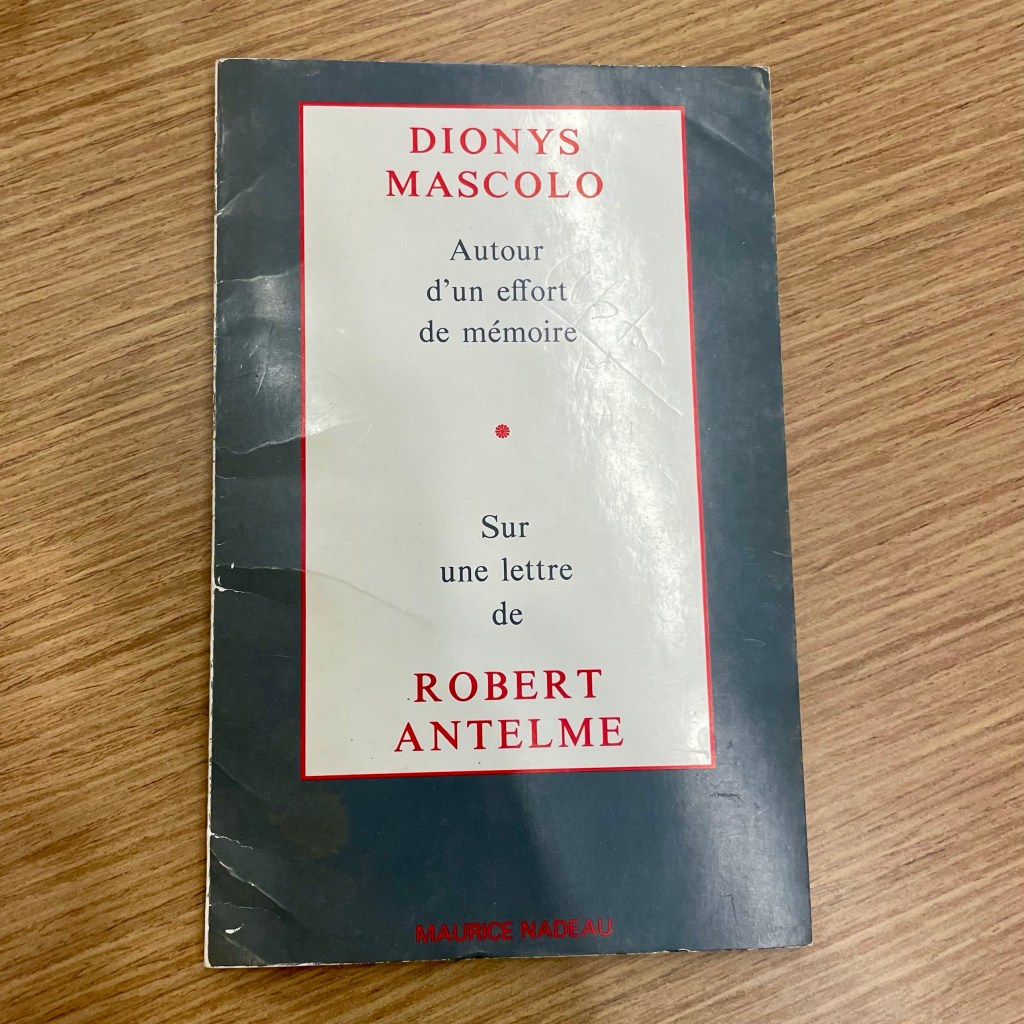
Rereading Dionys Mascolo’s Autour d’un effort de mémoire: sur une lettre de Robert Antelme (1987) in preparation for an upcoming course with Philippe Theophanidis, one gets the sense of beginning backwards or at the very end, since this late essay is a recapitulation of what the Rue Saint-Benoît Group embodied and stood for. And it is so obvious that for Mascolo what is at stake in Antelme’s letter is not a particular practice of confession (and the coupling of secrecy and extraction), but rather an integral register of an experience that belongs to “friendship in thought without reserve” [1]. And that it would not have been possible without friends, as simple as that. Of course, the condition of possibility of this shared thought in friendship has less to do with general principles, norms, or creative acts, and more with what Mascolo does not hesitate to qualify as “a sensibility that was common to us”.
What is this sensibility, and is it possible to describe it? This is a question that I do not think that is attempted to be resolved in Mascolo’s commentary nor in Antelme’s letter so consumed by its internal lacunae and effacement (I am definitely not capable of saying a word about it at the moment, and this might be one of the questions in the ongoing dialogue in the seminar). Mascolo does offer a little more when he states that this sensibility, however broad and partial, was always elevated against all totalitarianisms that were hegemonizing the political positions of the epoch. Obviously, it names the political totalitarianism (Fascist and state planned communism alike), but also the “the soul of the project” (‘est l’âme du projet et sa forme aboutie’) that must retract from it [2]. The last pages of Mascolo’s reflection is a shallow-deep, an insinuation, into the possibility of saying something in relation to this difficult proximity.
Hence, against total subsumption of life into political planning (whether on the right or left, whether ecclesiastical or in the name of the secularized forms of militant communist parties), Mascolo’s insistence on the ‘soul of the project’ is sustained by the “missing word” give that dispenses human necessities as infinite. He writes: “Et par mille et mille détours, il me (nous) fallait toujours en revenir au même point : Je suis ce qui me manque est la sentence que je porte (nous portons) inscrite à l’intérieur du front. La moindre des choses alors est de proposer que, sauf mensonge, elle vaut pour tout homme”. [3]. But what could it mean that “what I am” is always constituted by the missing word? It is definitely not a substantive attribute to a person (and thus what I can acquire), but a word that in its ideal absence and lack of epistemological validity stands as a form of seeking (zēteîn) that Nicoletta Di Vita has recently linked to the form of the ancient hymn [4]. The missing word is the passive and pure voice that calls out the rhetorical fiction of political totalitarianism. In other words, the missing word does not enact a present state of things, articulating the denomination in language with distinct objects of the world; it only has transformative weight when revealing what remains under the capes of morality.
This is why the experience of the camp constitutes a central threshold: on the one hand, it is an extreme and sharpened image of social alienation between classes; and, on the other, it is the experience that by depriving the human of its humanity it brings to an effective end the polarity between rich and poor that structured the economy of salvation and damnation of Western civilization. This is what Antelme describes in his essay “Poor Man – Proletarian – Deportee”, which according to Mascolo brings the rich to a psychotic night of desperation towards destruction and death of the specie. Hölderlin’s definition that “we have become poor in order to become rich” as a clement predicament in the face of the modern is here-forth suspended in the spiritual crisis generated by the social engineering whose most extreme case is the model of the camp.
And yet the missing word remains irreducible even after the corrupted stage of innocence and the impossibility of redemption. Mascolo, reader of Nietzsche, does not believe in the theos. This is why for him the missing word, far from being an apostrophe that offers consolation in the wake of the catastrophe, it remains concretely attached to the experience of the friend that no longer finds solace in abstract peace, but in the profound musicality of what remains inconsolable: “cette heureuse absence de paix qui est sa musique profonde, et que donne en partage l’être aimé, l’inconsolable qui console” [5]. This transfigured word – the unending capacity for hymn in the human, its nomoi mousikos – is both an excess to memory and appearance, and perhaps, more importantly, an excess to the experience of living and the dead. And is not this “seeking” passage of the missing word what the Rue Saint-Benoît Group was obsessively after?
__
Notes
1. Dionys Mascolo. Autour d’un effort de mémoire: sur une lettre de Robert Antelme (Maurice Nadeau, 1987), 82.
2. Ibid., 83.
3. Dionys Mascolo. Autour d’un effort…,82.
4. Nicoletta Di Vita, Il nome e la voce. Per una filosofia dell’inno (Neri Pozza, 2022), 27.
The central contribution of American republican political thought is arguably the way it found a solution to the problem of factions, a legendary difficulty that not only has not disappeared but rather intensified in our present. For the enlightened republicans of the eighteenth century, well versed in the classical tradition and the histories of Florentine medieval strife, factionalism was the cardinal difficulty of social order; how to best deal with conflicting loyalties and the perpetuation of violence for virtuous and at times times even springing from “idleness and courage of the youth”, as told by Carol Lansing’s scholarship [1]. The existence of differences and cleavages in the society ultimately meant the brewing of an ephemeral coalitions and private masters, which, in turn, often resulted in the thorough expulsion of the enemies from the polis. These unregulated clashes of authorities and private actors was called by the fourteenth century jurist Bartolus of Saxoferrato a seventh form of government mixture: a “monstrous government”. The problem of faction will emerge for the moderns as the condition that prompts the articulation of a governmental rationality capable of constructing the homogeneity of social living. In other words, the modern classical homogeneity of the civil society is the creation of the domestication of factions as social grouping units to be obtained and arranged as an indirect power from within to transform ‘barbarism’ to civilization. David Hume’s political writings – and in particular his “Idea of a Perfect Commonwealth” (1752), which was highly influential to the Federalists, understood that the threat is of “factions” required a new framework: politics had to be reduced to a science [2]. What could politics as science entail? We are not yet in the administrative rationality and professional political vocation of Max Weber’s sociology. The scientific reduction meant a paradigmatic transformation of classical politics properly understood (virtuous, moral, and just) into an economic determination in which interests took the center stage over the combustion of the passions. The new science of politics implied a retooling of the problem of factions by decompressing the clustered interests of unaccounted and disloyal factional expansion under governmental action. For Hume the passage from passions to interests entailed a descaling of factionalism on one hand, while an expansion of a robust form of government over a large territory on the other.
However, if for Hume factions are still an impolitical unit of association that must be minimized, it is James Madison in “Federalist 10” who achieves the complete “scientific” aspiration of political construction over factions as inseparable from the Social ahead of the industrial modern economic division of labor. In fact, as Douglass Adair reminds us, this particular essay of the Federalist Papers only became important towards the end of the nineteenth century in the wake of industrialization and economic power groups; that is, at a moment when indirect economic powers began to exert their influence into the institutional and regulatory composition of the state [3]. One could say that it is only at the outset of the triumph of economic “Americanism” that the Madisonian framework on factions is situated in its proper tripartite structure: factions are conditioned by positive liberty and make up the totality of the economic interests that make up civil society. Indeed, for Madison factions as expressions of the nature of man, and their existence detail degrees of activities in civil society [4]. In a way there is no civil society without factions, and there are only factions because there is civic Liberty.
Madison even constructs a naturalist analogy: what unrestrained Liberty is to faction, air is to a propagating fire. The activity and energy of factionalism is exclusively understood as one of economic interests which, insofar as it is conditioned by positive, differentiated, and unregulated liberty that expresses the unequal distribution of property that characterizes the essence of the social. The new science of government in this framework becomes clear: the end of government is neither properly about political enmity in relation to the state nor about suppressing and limiting factions, but rather about the optimization of the effects of factions. Madison writes in the groundbreaking moment of “Federalist 10”: “The interference to which we are brought is that the causes of faction cannot be removed from that relief is only to be sought in the means of controlling its effects” [5]. The optimized logistics of factionalism displaces the modern hobbesian picture of the sovereign state to a minimalist and compensatory nature to attenuate public order against “local and particular state legislatures” [6]. The optimization of factions now appears as the dominant aspect of a fundamental cybernetics that seeks to isolate, fragment, and juxtapose the conflagration of factions without losing the barring of state energetic durability. The faction difficulty lays bare the arcanum at the center of the res publica politics: the administration and reproduction of civil conflict.
The consolidation of the cybernetic solution to the faction difficulty emerges as an upgraded version of state auctoritas whose aim is to establish a balance between public opinion as distrust over “dispute”: “communication is always checked by distrust in proportion to the number whose concurrence is necessary” [7]. If communication becomes a strict science of regulating the means of expression (itself a medium), political authority is superseded over a constant war over words and force of exchange. This means that rather than putting an end to the stasiological tension through a political mediation of the state, the problem of faction reveals that stasis becomes an instrument to manage effects, produce legislative, and translate interests in the struggle of social differences. It goes without saying that perhaps the modernist differentiation between state and civil society in light of the problem of faction loses its predominance, as an entirely new framework emerges: a monstrous socialization that takes the form of a productive stasiology given that if “men were angels no government would be necessary” [8]. The irony is that the auxiliary precautions of factions is a secularized form (or at least one could trace it to) of the ministry of the angels. This reality demands a new ethic of the passions against both the vigorous indirect struggle of factionalism (and its modern rendition in the party form) and the axiological arrangement of interests that made the foundation of the social community possible.
.
.
Notes
1. Carol Lansing. “Violence and Faction”, in The Florentine Magnates: Lineage and Faction in a Medieval Commune (Princeton U Press, 2014), 181.
2. David Hume. “Idea of a Perfect Commonwealth”, in Political Writings (Hackett Publishing, 1994), 240-252.
3. Douglass Adair. “The Tenth Federalist Revisited”, The William and Mary Quarterly, Vol. 8, No. 1, 1951, 48-67.
4. Alexander Hamilton, James Madison, & John Jay. “Federalist 10”, in The Federalist Papers (Mentor, 1961). 79.
5. Ibid., 80.
6. Ibid., 83.
7. Ibid., 83.
8. “Federalist 51”, in The Federalist Papers (Mentor, 1961), 322.
Nowhere in his published work does John Rawls treats the concept of civil war explicitly or by that matter in relation of his concept of political liberalism, although it is central to genesis. In a Spring semester of 1969 lecture at Harvard University, which remains for the most part unknown and only alluded by specialists of his (although never subject to substantive treatment), “Moral Problems: Nations and War”, Rawls takes up the problem on its merits [1]. This is a lecture that took place in the wake of the Vietnam war, the post-1968 context, and during the years of the definite settling of “global civil war” intensifying in every corner of the world. There is little that Rawls when treating the problem of war within the tradition of liberalism, was also aware of the factical nature of war of his present; that is, the transformation of war as a legitimate declaration between nations (at that point outlawed by the international Kellogg-Briand Pact) to a predominately a war within nations, that is, a permanent civil war. In this lecture – which one does not need to summarize given its broad historical strokes and technical determinations – Rawls crafts an typology wars in international law, as construed by the ius gentium, a theme that will later be the subject of his late book in international relations principles Laws of the People (1993). What is surprising is that in this typology, Rawls defines civil war as a thorough conflict aiming at “social justice” to transform the state. A civil war, then, is no longer what precedes the foundation of ‘legitimate authority’ proper to sovereignty, but it is rather the means by which something like “justice” becomes the mediation of the “Social”.
From this it follows, that for Rawls civil wars either neither wars of aggression or wars of sessions, two forms that would be exclusionary to his definition grounded on ‘Justice’. Hence, the “justification” of civil war could only be a just war insofar as its aim grounded in social justice as the effective realization of the well-being of all the inhabitants of the polity. For Rawls this was the ‘active’ continuation of the ideal of the French Revolution of 1789. Indeed, one could claim that for Rawls civil war is the continuation of revolution after the principle of universal recognition was achieved through rights. The ideal of Justice, then, was never the well-ordered natural law theory of revolutionary change (endorsed by many Jacobins, such as Saint-Just), but rather an intra-level recognition of social rules within the plural system of value differences. Coinciding with the development of positive law as grounded in social facts and guided by a ‘rule of recognition’ (in H.L.A Hart’s well-known elaboration), Rawls’ theory of civil war was the mechanism for a social fact-based conception of justice that was predicated in the optimization of risks, regulations, and re-distrubution of post-recognition equity of the activist state. Indeed, social justice insofar it was no longer merely sovereign authority, took the function of social facts through the administration of a permanent social civil war.
Neither an event nor an exception, civil war for Rawls is a free-standing metapolitical paradigm of the new “transformative” conception of the Social ordered purposely around the principle of Justice. Paradoxically, the conditions of promoting “social justice” (whose echoes we still hear today from the political class as well as from the jargon of academic political ideology) is not limited to the “veil of ignorance” or the “originary position” for social action, but rather in the actualization of a latent stasiological paradigm. This esoteric unity is neither an exception nor a deviation from Rawls’ mature political thinking around social justice; but as all true political paradigms, an invariant mode of his thinking. This is why he points in the 1969 lecture the Spanish civil war as paradigm of stasis as social justice, and in his essay “My religion”, the American Civil War led by the exceptional executive authority of Abraham Lincoln as necessary to the “original sin” of human slavery [2]. And as Eric Nelson has convincingly argued, the anti-pelagian conception of sin in Rawls’ thought amounts to a secularized theodicy of social force: a regulatory physics in the aftermath of the crisis of the sovereign state. Although ignored by Nelson, the full picture of Rawlsian conception of the “Social” is not complete if one does not take into account the stasiological paradigm that legitimizes the aims of social justice. And if the internal conflict is latent within the Trinitarian ontology (as Political Theology II suggests) there is little doubt that the transformative model of Liberalism rather than moving the conditions of politics forward, ends up descending to the terrain of Christian political theology that it never abandoned.
But is it even ‘transformative’ within the conditions of the Christian model that it allegedly secularized? Is the primacy on social justice on civil war truly a political theology, or rather the consequential triumph of theology over the institutionality to restrain the ballistic aspiration of social hegemony? Both questions collapse if tested on the grounds offered by Carl Schmitt regarding both political theology and the critique of moral neutralization of values as direct application of the principle of Justice, which would turn social relations into pure subjection, a form of Homo homini Radbruch (Rabruch referring to the Radbruch formula of an unjust of law as non-law, thus requiring principles) [3]. What is “just” to a hegemonic stance indicates a clear crisis of institutional deficiency in the face of what values determine the scope and content of the “Just”.
Similarly, the transformative conception of Rawlsian “activist liberalism” is closer to the realism of latent civil war than what the Christian idea required on a thing and minimalist basis; which, according to Ladner implied retreat form the social as well as from liturgical participation. On the contrary, rather than moral unity, reform entailed a separation, solus ad solum, in order to transform the habits and costumes without direct enforcement [4]. Contrary to the Christian monastic ius reformandi, Rawls’ renovation of political liberalism, vis-à-vis the civil war paradigm, accepted the hellish reality of the social by affirming “social justice” as the only real means for subjective social cohesion. And if the just war principle stood largely under the guidance of positive sovereign rules and commands; the deployment of justice of civil war will be based on the exertion of principles and higher content without end. The true efficacy of civil war alien to the concept of the political, made possible a regime of socialization on the mere basis of values stratification and moral abstraction.
.
.
Notes
1. John Rawls. “Moral Problems: Nations and War”, Spring 1969, Harvard University. Harvard U Library Archives.
2. John Rawls. “On my religion”, in A brief inquiry into the meaning of sin and faith (Harvard U Press, 2009), 263.
3. Carl Schmitt. “Un jurista frente a sí mismo: entrevista de Fulco Lanchester a Carl Schmitt”, Carl-Schmitt-Studien, 1. Jg. 2017, 212.
4. Gerhart B. Ladner. The Idea of Reform: Its Impact on Christian Thought and Action (Harper Torchbooks, 1969), 322.
Alberto Moreiras escribe en Infraphilosophy una magnífica nota que actualiza la conocida “estrategia del rechazo” de Mario Tronti mediante un uso metonímico, el único posible para un mundo en el cual ya la espera por la posibilidad de atravesar al proletariado como forma de capital humano ha sido realizado en su totalidad por la racionalidad del liberalismo autoritario. Seguimos domiciliados en la hipótesis subjetiva-social del capital ahora asumido como parcialización del valor en la propia esfera intelectual. Hoy necesitamos de un segundo rechazo de lo que ha sido, en efecto, ya realizado.
Una nueva literalización, como decía Tronti hacia 1966: “la burguesía vive eternamente en el ciclo del capital”. Y hoy, a varias décadas de Operaio e capitale, allí residen sus satélites en órbita, sus naves galácticas, sus ensueños de eterno Pan como ominosa luz de olvido de la tierra. De manera que la postura en la que hemos sido asignados se vuelve la primera tarea existencial que debemos rechazar. (La política ya ha sido evacuada al suelo antropológico: un capitalismo donativo tras el fin de la producción clásica).
Esto lo veía James Boggs hacia el final de The American Revolution: Pages from a Negro Worker’s Notebook (1963): “…from which there is only one way for the individual to escape to prove his or her loyalty to the police state by becoming an informer for it. […] Today in the 60’s, the struggle is much more difficult. What it requires is that people in every stratum of the population clash not only with the agents of the silent police state but with their own prejudices, their own outmoded ideas, their own fears which keep them from grappling with the new realities of our age” [1].
Dejar de ser un informante supone nada más y nada menos que abandonar la esfera de lo social para así preparar los ingredientes de una experiencia en el umbral de una retirada. Otra vez Boggs: “pero no hay a dónde ir”. Esta es la condición del negro desembreando en la larga historicidad de la reconstrucción republicana. La lucha de clase ha quedado huérfana; las aspiraciones asimiladas a los subrogados de la policy y las infraestructuras; las lenguas y los contactos a las logísticas comunicacionales; el movimiento a la intensificación (aparente) de la movilización tan evasiva del conflicto como de una posible exploración de los mundos. Esta es la realidad.
Lo sensible ha dado paso a los dispositivos refractarios de una cultura como falso principio de diferenciación. Y ahora cultura solo puede ser considerada como forma de cultivo de una nueva ciencia de los encuentros por fuera de la devastación de la virtualización, que haga posible lo irreductible que el realismo hoy sostiene como mero “power nexus”. Superar las ficciones fundamentales implica abrir un abismo. Ahí moramos como existente y de paso preparamos la posibilidad de otra cosa.
No hay balance posible en el presente sin afirmar que George Floyd es la verdad absoluta de la época. Y esta verdad consistente en el hecho de que semejante mazacote llamado Sociedad ha dejado de contenernos. Ahora somos desbordes, formas minorías, itinerantes en búsqueda de ritmos, y paseantes que en su movimiento producen la seña de lo nuevo. Algunos permanecen inquilinos del realismo porque se abonan a la fe de lo Social. Hay otros, los póstumos, que saben que su destino bajo estas condiciones objetivas solo remite a una forma de administración de la muerte. Ahora podemos ver que la guerra civil es lo impensado y lo no-estudiado de la hegemonía, y en tanto tal, el verdadero antagonismo que debe ser llevado a cabo hasta la muerte [2].
Tenemos buenas razones para rechazar el realismo: no dejar impensado, otra vez, a los muertos. Y contra la ceguera de los realistas, la desrealización de los videntes. Esto implica, en cualquier caso, una nueva astucia (metīs), ya que el mundo nos exige pensar para volver a encontrarnos. Píndaro: “La astucia (metīs) del más débil logra sorprender al más fuerte hasta llevarlo a su caída” [3]. La pulsión de la astucia de quienes buscan abre la pregunta por la cuestión de nuestras técnicas (τέχνας). Una nueva comprensión de la organización para hacerle frente al estancamiento. Efectivamente, mundo no es conclusión.
.
.
Notas
1. James Boggs. The American Revolution: Pages from a Negro Worker’s Notebook (Monthly Review Press, 2009), 93.
2. Frank Wilderson III. Afropessimism (Liveright, 2020), 251.
3. Pindar. Isthmian Odes (Loeb, Harvard University Press, 1997).



 Infrapolitical Reflections