The idea of a world state. by Gerardo Muñoz

As a theme for his 1949 Aquinas Lecture at Marquette University, an American scholar, Robert Hutchins, decided to titled his conference “St. Thomas and the World State”. It is obvious that Hutchins had fresh in his mind the fact that the long European Civil War of the twentieth century, which included two World Wars, was a direct consequence of warring nationalisms and militarized nations that in our times it is once again has lavishly returned with even higher lethal consequences. There is a major historical difference, however; and that is the fact that whereas the nationalisms of the twentieth century were distinct territorial struggles in the wake of crumbling empires, the emergence of the new nationalisms are concerted, nourished, and aligned to the global commanding American imperialism. The techno-political ideal of an influential figure on American elites such as Peter Thiel takes the form of warring nations and firms against the possibility of a global world state to secure peace, interdependence, and free movement of populations across borders and communities [1]. It is fair to say that contemporary technopolitical dominance is a combination of imperial and national forces through the perpetual administration of anomia or lawlessness. 

What is striking about Hutchins’ 1949 lecture is that although Aquinas’ philosophy of law has been traditionally understood as the most important source of natural law, in his proposal Thomas’ actuality is able to fulfill positive law against the instrumental morality of nationalist empires (the United States and the Soviet Union then) that “in the absence of positive law; they may be expected to break the peace” [2]. For anyone that knows the emergence of the European state as coterminous with the secular authority of legal positivism will find this emphasis contradictory at best. The very notion of positive law requires principles of sovereign authority and normative internal recognition of its command coordination in order to consolidate a stable political form over time. This is a contradiction that Hutchins was aware of throughout his lecture. Consider, as an example, when he claims that: “The origin and meaning of the saying that a state has the natural right to sovereignty therefore, is that one state may not forcibly impose its will upon another. It means that Catholicism should oppose the foundations of a world state by force” (36). 

Or, when glossing over the obvious tension between the right of national sovereignty and a potential international federal state in the views of popes and Catholic thinkers: “I think they know that the national state is no longer the perfect community and that positive law is required to make the world community an effective political organization. I believe that they are making two points that are of the utmost importance: first, they are saying that any world government must be a federal government; and second, they see that world must come into existence by consent and not by conquest” (34). However, any student of modern political thought knows that consent and coercion are two internal modalities of governance for legitimate rule. Hutchins’ notion of “consent”, along with positive law, remains not only unthematized, but dependent on a circular of definition of law; that is, the “common good”, which is not a political concept, but a theological and moral notion extracted from the philosophy of history of Christian salvation. 

Towards the end of the lecture, Hutchins goes beyond strict positive law as if searching for some substantive ground: “…the West should not only survive, but also revive and rescue a deeper conception of human civilization than the one recently current, which enters around a religion of progress by resourceful greed and technological mastery of non-human nature” (42). But Hutchins’ plea for the retrieval of a past memory of the West runs astray when it relocates Church and State into a dual predicament of a new world state for peace on the conditions of the same structure of political theology that are no longer operative, but that actually make up the very ground of the modern collapse into nihilism – nihilism that political form does not remain immune to, quite the contrary. In fact, it is the most salient symptom of civilizational collapse. In the same way that Ernst Jünger immediately after the war called for the subsidiary spiritual assistance of the churches in the face of technological power- “the true conquest of nihilism and attainment of peace will be possible only with the help of the churches” – Hutchins will also repeat that only the conjointment of Church and State “must now work together for world peace founded on university charity…and universal democracy” (44) [3]. And the same thesis has found a clear expression in Pope Francis’ Apostolic Letter Candor Lucis Aetenae (2021): “To restore order and salvation, faith and reason, Beatrice and Virgil…Church and Empire are called to operate in harmony” [4]. This speaks directly to what we have recently called the plasticity inherent in the historical adaptations of thomism in social life [5].

This plasticity amounts to the administration of desperate souls from the structures of the state and Churches, without ever transforming the mere survival of life on Earth. This leaves us with the notion of kingdom, which Hutchins introduces in opposition to the political community of city life (polis), but only to reabsorb it into the order of political theology. And it is at this threshold, that we can claim that the kingdom is not a political theological category, but an experiential allowance in which life, the dead and languages occur beyond and before political determinations. It is no surprise, then, that Ivan Illich called the kingdom primarily a mystical experience: “I will dare to formulate a hypothesis: the kingdom is what constitutes the authentic mystical experience, if the mystic knows what experience is really constituted by. The mystical experience of the believer is the conscious experience of the kingdom before the parousia. The mystical experience is the fruit of love, and, therefore, it is also accessible to every lover. The awareness about its meaning is the fruit of faith…” [6]. 

We tend to forget that both national units and the contemporary empires of world building and destruction have been first and foremost enemies of spoken living languages and idioms. On the one hand, the historical grammars to build the unity of people’s official language, and in our days the rise of Artificial Intelligence has clearly become the last stage through which power abandons languages to computational and rhetorical obsolescence. This opening towards awareness is not an article of faith through consent nor a moral predicament that can be adequate prima facie into a political register; it is fundamentally a linguistic experience that allows for the delicate cultivation of peaceful coexistence taking place not in a world, but between them: “To learn a language in a human and mature way way is to accept the responsibility for its silences and sounds. The gift a people gives us in their language is more a gift of the rhythm, the mode, and the subtleties of its system of silences than its system of sounds…The greater the distance between two worlds, the more this silence of interest is a sign of love” [7]. 

.

.

Notes 

1. “Apocalypse Now? Peter Thiel On Ancient Prophecies And Modern Tech,” in conversation with Peter Robinson, October 2024, Hoover Institute: https://youtu.be/wTNI_lCvWZQ?si=M8-qrBh-G7bYZPfw

2. Robert M. Hutchins. St. Thomas and The World State (Marquette University Press, 1948), 15. 

3. Ernst Jünger. The Peace (Henry Regnery Company, 1948), 69. 

4. Pope Francis. “Apostolic Letter Candor Lucis Aeternae (2021)”: https://www.vatican.va/content/francesco/en/apost_letters/documents/papa-francesco-lettera-ap_20210325_centenario-dante.html 

5. Gerardo Muñoz. “The social efficacy of thomism”, Infrapolitical Reflections, August 2025: https://infrapoliticalreflections.org/2025/08/31/the-social-efficacy-of-thomism-by-gerardo-munoz/

6. Ivan Illich. “Concertning Aesthetic and Religious Experience”, in The Powerless Church and other selected writings, 1955-1985 (University of Penn State Press, 2018), 86.

7. Ivan Illich. “Missionary Silence”, in The Church, Change, and Development (Urban Center Training Press, 1970), 121.
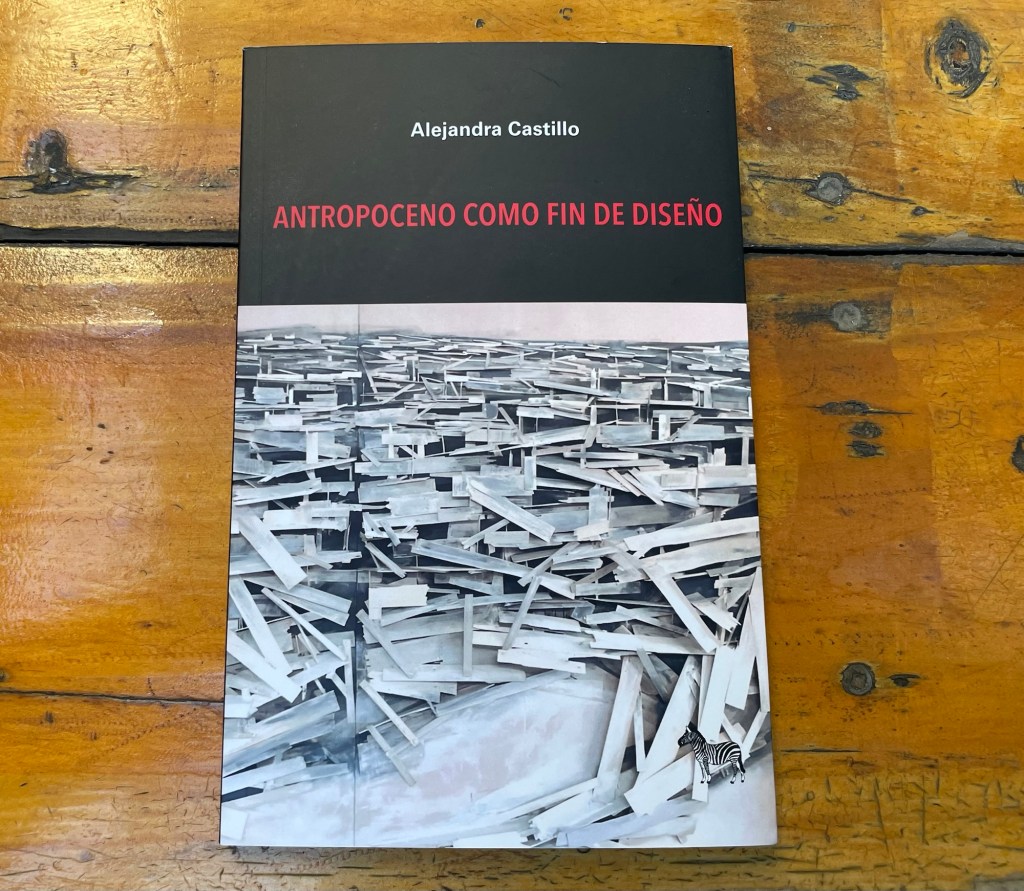
The wreckage of design. On Alejandra Castillo’s Antropoceno como fin de diseño (2025). by Gerardo Muñoz

Only in rare occasions the operation of thinking finds angular or lateral points of escape. This is the gesture that characterizes Alejandra Castillo’s theoretical writing, and is particularly bright in her most recent book Antropoceno como fin de diseño (La Cebra, 2025). The zigzagging entry is an intuition that is also a guiding thread: the force of real subsumption of capitalist domination depends on the operation of design. Of course, in design one hears not only blueprint and form, but also designation, and thus the specular regime of visibility, orderability, quantification. It is the world of physiocratic forestry. In fact, Castillo’s succinct definition of the metapolitical condition of design is offered to the reader at the entrance: “Design is the figure that thinks always in advance (por adelantado) (Castillo 12). Design calculates and locates. It is through the operation of design that legibility becomes adequated to political representation so that the state can manage and attenuate the deployment of its forms and the circulations of relations of totality (Castillo 13). The design is what is common to the worker, the engineer, and the lawyer. This is why design for Castillo design is an efficacious nexus that connects the separation of objectivity and the life worlds. Understood in this sense, “design” is analogous to the enframing of the world that intensifies in the age of technology and rhetoric. But in the watershed of the end of modernity, the hegemony of design collapses, while it becomes a temporal “self-design” submerged in all spheres of expressive enactments. 

The end of the second vector of the zigzag outlined in the essay is found precisely at this conjuncture: the anthropocene brings the humanist projections and design to a final wreckage. This is means that capitalist form is not formless because it has managed to subsume the time of life as exception to labour; time is a wreckage because design no longer coincides with the world of forms, as it has temporalized experience into total transparency without reminder. For Castillo this means that in the anthropocene there is no longer “struggle for visibility”, as everything has been rendered exposed and hollow; de-substantialized in the very fabric of subjectivity (in the early millennium some called this new hyperbolic figure the Bloom). Implicitly in Castillo’s writing is the assumption that the mediation between politics and design has been severed, and the new securitarian imperium can only immunize itself against the very site that in modern times granted its legitimacy (civil society, constituent power) (Castillo 37). 

The end of design means the absolutization of design, a new carceral imperative for adaptation that makes any claim to subjectivity an endorsement of the prison of the ego. To live in a post-designed unworldly condition means not only to come face to face with the homogenous space of cultural exchange into image; it is also a new imperative that requires that “you must submit, without knowing to what; subject to what is the case anyway, and which, as a reflex to its power and commonsense, everyone believes anyway” [1]. The end of design paves the way for new plastic forms of domination towards an integral planetary unity. 

Bordiga claimed throughout his work that the democratic design was perhaps the best fitting system for the versatility of capitalist accumulation and relentless expansion. This is why in all the political cases that Castillo introduces in a text in a manner of a shadow play do not pretend to offer a new theory of ideology, but rather show how democratic design is a one-piece suit that fits all without any needs for “ideal types” to fix normativity and institutional arrangements. Indeed, there is no longer anything like an “extreme political right” – and this is just a tweak from Castillo’s vocabulary, who does insist on the term throughout the essay – but rightward figures of the political that desperately cling to any form to distract from the abyss of social legitimation. Ultimately, the ruling over this void will be  – in many ways already is – the continuation of war in the social fabric; and stasis will require new stealth development of technologies of containment that Palantir’s Alex Karp has called the new “lethal form”. This means that democratic design is not only expressively a system of sentencing to death; it is in virtue of the exchange of social forms, an inverted negation of human finitude. The point of despair would incite some to look again in the cabinet of forms; a knee-jerk reaction to the irruption of the Anthropocene against the total sum of possible designs. 

Of course, this is also what Alejandra Castillo’s Antropoceno como fin de diseño (2025) avoids at all costs. Towards the last pages of the book, Castillo calls for a transformative turn that departs from the body; a corporeal insurrection that, in refusing the rectilinear and heteronormative political corpus of the modern epoch (no coincidence that Hobbes was both the founder of the autonomy of civil as well as of the physics of the body of matter in space), is capable of responding to the call of the anthropocene in all of its profuse conflictivity. Castillo proposes the necessity to gravitate towards a “maximum distance” against the general design of orderability of public domination (Castillo 77). But this can only be understood as an incommensurable distance that dissolves the ontotheological separation of subject and object of the state of confinement.

The political constitution of a corpus appears as the promise of an exit from the temporalization of the post-auratic literalism that, according to Michel Fried, dominated the structure of the object-oriented work of art, as compensatory to the corrosion of political forms and presentist autonomy [2]. Castillo does not seek to revive a last gasp of auratic objectification, which amounts to the sleepwalking condition of the image world of mere survival. In soliciting a maximum distance to what is closest (in fact, a body), Castillo invites us, as both promise and commitment, to think at the end of nondependency – not the “independence” that carries the traces of the fictitious individuality- from the crutches of design to finally conquer another liberty beyond terror and prevention; a life imbricated in the nonbeing of place (ecology) with others.

Notes 

1. Thedor W. Adorno. “The Cultural Industry: A Resumé”, in Without Model (Seagull Books, 2023), 58.

2. Michael Fried. “Art and Objecthood”, in Art and Objecthood: Essays and Reviews (University of Chicago Press, 1998), 172.

Pindar’s Fragment 180. by Gerardo Muñoz

Understanding what the ancient Greeks thought of sayability in language is no easy task, but in Pindar’s Fragment 180 we can confirm that the use of language must come to terms with the internal lacuna of silence. Pindar says as a way of recommendation: “Do not break out useless speech in front of everybody; there are times when the path of silence is most trustworthy, but lofty discourse holds the sting of domination” [1]. Although this fragment has been read as a form of “prudential speech”, it might be more interesting to read it as a form of the inception of the sublime in language, which Longinus, although not referring directly to the same fragment, inscribed it under the idea of being ‘tongueless’ or aglossīa, which like Ajax’s silence says significantly more in its restrain than from saying something directly. Language becomes useless – that is, it ceases to have any use with itself – if it becomes a tactic to diminish any given rhetorical order. It is no surprise that in our time the predominant use of language takes the form of a transaction through technical terms that has no use of its own. 

It has been shown that Pindar’s conception of language was not about representation, but rather about the voice or kompos that takes place whenever there is vibration or harmony in the collision or contact between two objects [2]. Of course, the truly originary collision in language is between the voice and the idea, where the cradle of language opens to its own poetic and ethical possibilities. Hence, if there is restraint and silence as constituent of language, it is because there is a rhythmic movement that accommodates without the intromission of an external force. Here, it is the well known definition of poetic creation that Pindar lays out in “Olympian 6”: “Upon my tongue I have the sensation of a clear-sounding whetstone, which I welcome as it comes over me with lovely streams of breath” [3]. What carries those streams of sounds?

The poet is not an independent creator with higher access to language; the poetic instance is only accessible to those who, in contact with inspiration, can sharpen their tongues to the use of one’s language. We are in language when we find ourselves in the direction of a “path of words” [4]. Thus, the contact of language is not with objects or entelechies of the visible world, it is first and foremost with the receiving movement of the voice as a “lovely streams of breath”. In this way, Pindar’s plea for silence is not to be understood as an active negation of “saying”, but of an internal lapse or suspension of language that allows the emergence of the truth of the voice. The absence of kompos turns language into an instrument that can only prepare and foment conflict and domination, seeking to overcome something that is ultimately captive of the common ground of an uninspired language. And this means that language without inspiration is not only a voice that has run astray from its rhythm, it is also a language that will only find war in its path. 

Notes 

1. Píndaro. “Fragmento 180”, in Obra completa (Cátedra, 2023), 410. 

2. Helga Kriegler. Untersuchungen zu den optischen und akustischen Daten der bacchylideischen Dichtung (Verlag Notring, 1969), 90.

3. Píndaro. “Olympian 6”, in Obra completa (Cátedra, 2023), 90. 

4. Píndaro. “Olympian 1”, in Obra completa (Cátedra, 2023), 90. 

The hypnotism of patriotism. by Gerardo Muñoz

We owe an untimely intuition about the enduring seduction of patriotism and nationalism to Leo Tolstoy’ essay “Patriotism and Government” (1900), in which he captured a paradoxical phenomenon: mainly, that at the same time that the integration of humanity and its historical consciousness reached its civilizational peak, patriotism instead of disappearing became increasingly more destructive and fierce. Looking at the outset of the First World War in Europe and its nascent total mobilization of industries, the Russian novelist claimed that, from that moment, government organization will depend on patriotism as a source to conduct total war within the human species. But what surprised Tolstoy – which has clear contemporary overtones in the impolitical movements that dominate Western societies – was the degree that this lethal patriotism infiltrated the very worldview and orientation of the Christian vocation. Tolstoy writes in the most most potent passage of the essay:

All the peoples of the so-called Christian world have been reduced by patriotism to such a state of brutality, that not only those who are obliged to kill or be killed desire slaughter and rejoice in murder, but all the people of Europe and America, living peaceably in their homes exposed to no danger, are, at each war – thanks to easy means of communication and to the press – in the position of the spectators in a Roman circus, and, like them, delight in the slaughter, and raise the bloodthirsty cry, ‘Pollice verso.’ [1]. 

This should suffice to note that for Tolstoy patriotism is neither a political ideology nor a formal principle of community; patriotism is rather a social liturgy born of the absolute sacrazalization of human life and whose hyperbolic figure will be that of the war-slave trained to endure “the act” (especially the slave that participates in the carnage through his words and attention). And just like in a theater play or in the Catholic liturgy where there are “acts” (and the service can only subsist through its enactment), the unleashed force of patriotism becomes a form of destruction as the essence of government organization.

This is why for Tolstoy the inception of total war recalibrates the grotesque spectacle through the “hypnotism of patriotism”, positing a fictional belonging of salvation – that is nontheological because it is unredeemable – through the destruction of another community of the human species. True, the end of politics always results in war; although Tolstoy introduces a nuance to this axiom: war is able to subsist thanks to the self-affirmation of patriotism as the triumph of a wordless inhumanity.

It is no coincidence that Tolstoy observed the rise of patriotic strife in tandem with modern science as conquest over Nature and the reality of human experience [2]. Thus, government patriotism and instrumental sciences are two interconnected regimes of the organization inhumanity that speak the rhetoric of growth and prosperity as stagnation deepens. In our days, this social cohesion, as Tolstoy warned with precision more than a century ago, has entered a new phase of domination that some called a “lethal form” integrating technology and war without any reminder [3]. 

Notes 

1. Leo Tolstoy. “Patriotism and Government” (1900), in Last Steps: The Late Writings (Penguin Books, 2009), 318. 

2. Leo Tolstoy. “Modern Science” (1898), Last Steps: The Late Writings (Penguin Books, 2009), 252. 

3. Alexander Karp. The Technological Republic (Crown Currency, 2025), 154.

Antelme’s smiling angel of Rheims. by Gerardo Muñoz

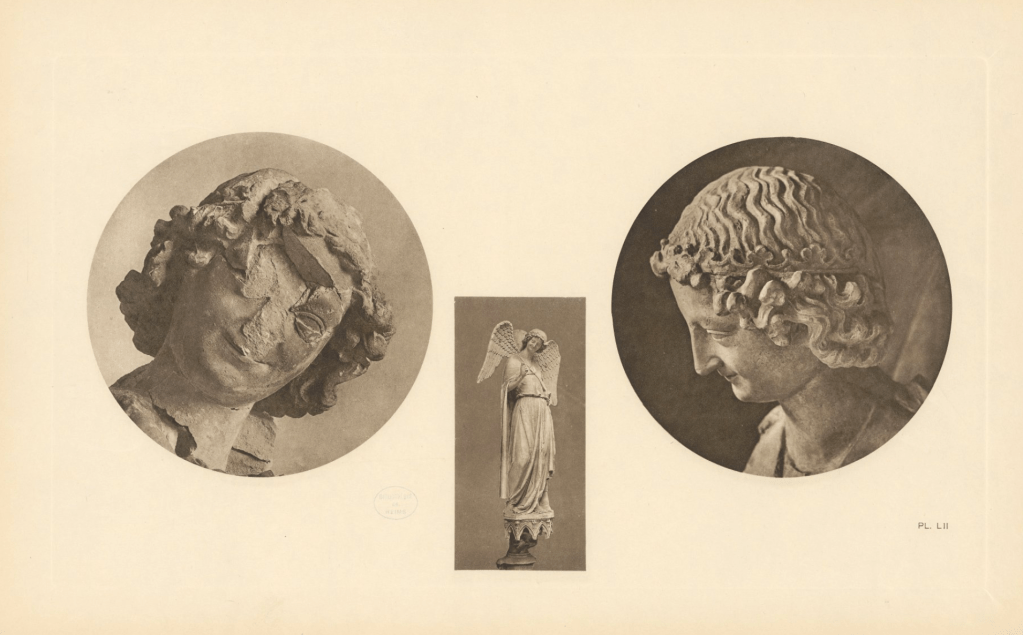
Among Robert Antelme’s posthumous writings the short text “L’ange au sourire” has a decisive place if we are to explain the transfigured theological experience of the French writer. To anyone familiar with French  architecture history the title should sound familiar, since the ‘l’ange au sourire’ was already a common expression used by French scholars of architecture during the interwar years. Charles Sarazin, arguably the most important scholar of the architecture of Reims, penned a separata titled “Le Sourire de Reims” (1929), in which he celebrated the mysterious smile of the angel Gabriel that was severely damaged due to shell fire of the Cathedral during the fall of 1914 [1]. But a decade prior to the destruction, art historian Arthur Gardner, in a detailed essay on the sculptures of the facade of the Rheims Cathedral, also took note of this angel’s gaze writing that: “…the angel Gabriel of the Annunciation in which the French smile has almost become a grin, the beginning of the contorted expressions frequently found over the border in Germany.” [2]. The particular aspect of this unique angel’s face that Antelme undresses from the cloak of authority is also wonderfully documented in the photographic book by Pierre Antony-Thouret, who also showed pictorial interest in the way that angel Gabriel was chipped in a large area of the right frontal relief (image 1) [3]. 

Image 1. Reims au lendemain de la guerre (1928), plate 52.

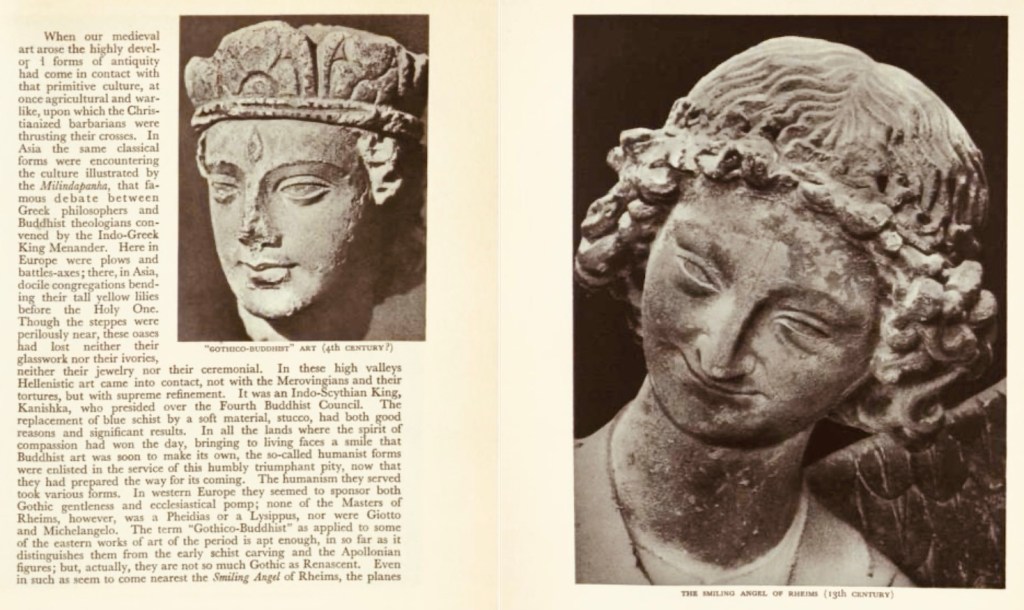
This curatorial context informs the historical background of Antelme’s reference to destruction and what he references as the crushed: “But not crushed by this building, or by that event, or by some power. It has always been crushed, crushed forever” [4]. For Antelme the tenuous, almost imperceptible, smile of the Angel of Rheims is what outlives absolute destruction because to be destroyed cannot be executed absolutely. It is the soul of existence that, because of its exteriority to history, is powerless “to have forever to be”.  Even if this being has become petrified and immobile from its original plastic appearance auf vif of sacred art. This is what Malraux captured in his brief mention of the  “L’ange au sourire” in The Voices of Silence (1951), where he also compares it to the Buddhist faces of Oriental sacred art (image 2): “The Smiling Angel of Rheims is a statue whose “stiffness” increased with every century; but at its birth it was a similar incarnate, a face that had suddenly come alive – like all faces sponsoring a discovery in the field of the lifelike” [5]. In order words, to see in the muteness of the face the nothingness that allows expressive relations to emerge in the open. This holds for Antelme’s description as well: “Radiant or hidden, inevitably it is there. Word, image, music: everything expresses it, and nothing. It lies at the heart of that realm where all relations are born. Forever starting anew. Possessing nothing, capable of nothing, it must be there, forever”. 

Image 2. Angel of Rheims in The Voices of Silence (1964).

But what Antelme was able to capture through the smiling angel of the Rheims Cathedral was not a problem of iconology of art forms, but rather the very essence of the theological problem of angels as it relates to the poetics of life itself. The angel is not a promythical figure scaled to a specific historical moment, but an instantiation of the divine appeals to the withdrawal the possibilities and modes of the human being. This is why Antelme can state that “the only transcendence is the relation between beings”. Even in its muteness, the theologica depth of the angel is the poetic speech of divinity through a surge in language that has no end, but only celebration or hymnology.

This is why Erik Peterson writes towards the end of  “The Book of Angels” about the intimate relation of angels in human existence: “A human being can draw near to the angels because the angel too – as its name already indicates – can draw near to humanity. […] The angels are more than poetic ornamentation left from the storehouse of popular fables, they belong to us. For us, they stand for a possibility of our being, a heightening and intensifying of our being – but for the possibility of a new faith…as a passion for mental clarity and an authentic existence” [6]. It is fair to say that, although the figure of the angel does not show again in Antelme’s work, all of his vision and witness accounts in the face of political horror must be placed in the endless vigil of a nocturnal life that is shared with the ethos of angels (utirur vigilis, angelorum vitam procul dubio meditatur). 

Notes 

1. Charles Sarazin. “Le Sourire de Reims” (s.l.n.d, 1929). 

2. Arthur Gardner. “The sculptures of Rheims Cathedral”, The Burlington Magazine for Connoisseurs, V.26, 1914, 64.

3. Pierre Antony-Thouret. Reims au lendemain de la guerre: la cathédrale mutilée, la ville dévastée (Jean Budry, 1928). 

4. Robert Antelme. Textes inédits sur l’Espèce humaine (Gallimard, 1996), 14.

5. Andre Malraux. The Voices of Silence (Secker & Warburg, 1964), 317. 

6. Erik Peterson. “The Book of Angels”, in Theological Tractates (Stanford University Press, 2011), 139.

The instrument stripped bare. On Adan Kovacsics’ Guerra y lenguaje (2025). by Gerardo Muñoz

Endless war and infinite strife is always preceded by the erosion and the putrid decomposition of language. Such is the thesis of Adan Kovacsics’ idiosyncratic and historically situated Guerra y lenguaje (Acantilado, 2025), which sets a specific date for the moment of such linguistic rot into consciousness in European modernity: Hugo von Hofmannsthal’s “Lord Chandos Letter” of 1902 in which civilizational decline signaled the total detachment of expression, making language flourish in the form of opinions resembling rotten mushrooms. For Hofmannsthal this event was neither accidental nor a temporary malady, but a tonality of existence that soon enough broadened like a “spreading rust” (Kovacsics 11). Just a few years later in his posthumous Persuasion and Rhetoric, Michelstaedter will describe this rusting of language as the triumph of “darkening ornaments” (kallopismata orphnes) of the epoch, liberating the destiny of language as a mere transactional exchange between “technical terms” mastered by everyone regardless of their idioms (it surprises the reader that the thinker of Gorizia is absent from Kovacsics’ Austro-Hungarian constellation on the crisis of language). 

The decline of an empire shimmering with languages and dialects across its territory began to suffer the malady of miscommunication that resulted in making language uninhabitable, throbbing in its empty chatter. Thus, the attempt to initiate an exodus from language began to appear everywhere according to Kovacsics: Fritz Mauthner drafts an encyclopedic treatise on the venereal misapprehension of language, Gustav Landauver battles in the trenches of linguistic scepticism and the mystical tradition in the name of revolution, while others like Hugo Ball attempts to flee from language altogether through the liberation of sounds and words, from the Dada avant-garde to his later Byzantine Christian asceticism. For his part, Karl Kraus in The last days of Mankind prefers to expose the surface of language as it becomes a regime regulated by opinion for bureaucratic administration over facts of reality. The nihilism that colors politics at the turn of the century is accompanied by the instrumentalization of language as the primordial technical apparatus that allows the flows of information through the acceleration of the autonomization of the linguistic mediation; as consequence, language began to arouse constant disbelief and doubt over the very essence of the sayable (Kovacsics 31). This throws light on contemporary debates about “misinformation” that, precisely because they are caught up on the epistemological determination proper to the linguistic crisis, it comes short to putting into perspective the range and depth of language over the problem of appearance now deprived of the expressive mediation between the speaking animal and phenomena, reducing experience to rhetorical commonalities or inter-social allocation of commands. 

Kovacsics’s Guerra y Lenguaje (2025) brings to bear – without totally exhausting the crushing weight of its archive and set of problems for thought – the immense significance of the first decade of the twentieth century at outset of the waning of the Austrian-Hungarian Empire, which has always been understood historically as the condition for the last configuration of European nationalism and its war-economies, but rarely in light of its functionalization of language. If read against the backdrop of Simone Weil’s “Are we heading for the proletarian revolution?” (1933) intervention about the “functional” dimension of the state form in the first decades of the twentieth century, Kovacsic’s essay ultimately helps us to define the concrete nature of functionality as the index of mobilization of ‘worlding’ through the commanding force of language. To deliver this point home, Kovacsics tells how language itself severed enunciation from action:

“La transformación que se produjo y que la ha alejado, como si un tablón se hubiese desprendido del muelle y se hubiera adentrado en el mar, no se debe a que otras gentes se impusieron en su día en Grecia, sino a un cambio radical en el uso concreto de la palabra. Es en la Gran Guerra cuando esa corriente inicial de la utilización del lenguaje como herramienta se consolida de manera definitiva. Es entonces cuando la palabra pasa a ser plenamente funcional y su papel se reduce a aportar argumentos para la acción o incluso a “parirla” mediante el tópico. Hemos visto hasta qué punto el silencio de Karl Kraus al comienzo de la contienda se debía a la percepción de este vínculo entre palabra y acción, al que no quería ni podía sumarse de ningún modo” (Kovacsics 76-77). 

Language does not disappear as much as it transforms itself into two vectors of social enforcement towards communication: functionality and rhetorical enthymemes. In this way, language is able to colonize reality and stabilize for the concrete order, or what Walter Benjamin called during those years the “bourgeois conception of language” hindering on causality and objectivity accelerating the collapse of its vocation to naming the exteriority of the world (Kovacsics 81). The totalization of this new rhetorical social structure becomes the main stage for the production of justification and competing regimes of fiction. But this implies no general theory or systematization of a linguistic science, but rather how language coincides with life in the form of an ethics. This is at the heart of the different attempts to retract language in the eclipse of empire and the new interstate fragmentation – which also entails grammatical and functional unifigies of national language – as a problem that concerns the limits of ethics. Ethics here cannot coincide with the general condition of ‘knowability’ that makes morality possible; rather, the problem of ethics can only reveal in turn the senseless of wanting to go beyond the facts of the world and allows us to dwell in one without completion.  The withdrawal from the language of propaganda and objectivity demanded an ethics of the sayable beyond the commodification and intentionality of words promoted by “war” and “ware” (commodity) that the West had continued to endure; a total communication of ends that decades later evolved into cybernetics as the warping of world into informational encoded relation.

Kovacsics reminds us that there is a story here of extreme violence and creative destruction, only comparable to nuclear fusion and the flaying of a human being, only that this time, unlike the myth of Marsyas, without ever reaching transcendence of redemption through the proximity of language to myth (Kovacsics 129). Underneath there is the body of language, stripped of its capacity for truth and reduced to functions of survival and needs oriented towards the homogeneity of the future. Towards the end of Guerra y lenguaje (2025), and glossing Hobbes’ notion of political authority that legitimated the modern interstate system to neutralize truth contents and the stasis over words, one cannot help but think that the date 1902 as a. arcana was an effective culmination rather than genesis of the modern, which means that the foul scent of the twentieth century was destined for decomposition since it had already stripped bared one of the most beautiful lacunae of the human species: being in language and the event of appearance became integrated into the worldly utopia of the machine.

As captured in Marcel Duchamp’s “The Bride Stripped Bare”, the obsolescence of language over time evolved into a candid instrument of social functions of proportional exchange, coordinated fortuitous relations, and increasing moral indictment that purported parodies of contested realities. Thus, the sickness is always unto language – a basic assumption that reveals the need for infrapolitical analysis before there is any political practice and categorial reinvention. The overexposure of language as an avatar of metaphoric communication for ends and needs of humankind brought itself bare and all encompassing in its appropriative force, but only at the expense of darkening and losing the world forever. 

Osculum pacis. by Gerardo Muñoz

It has taken Pope Francis’s public letter addressed to the Bishops of the United States to put in perspective how late American imperial politics in matters of immigration and probably other spheres of social life is not only at odds with the Christian vocation, but even waging war against the very dogma of Christian revelation. The reminder does not come completely out of context, since as we know, the marching band of intellectuals that for a long time have defended a “Christian postliberal” transformation – some of which not long ago offered theological justifications for the Church as the universal ark for migrants – given the current hegemonic configuration find themselves as mere scribes of whatever is enacted by unilateral executive command. The impossibility of enacting a transitional political theology evidences the emptying of politics into a technical mobilization of apocalyptical overtones, as clearly defended by Peter Thiel. The attempts to pilotage a planetary gnosis to his own image in the last stage of imperial stagnation, definitely supports Francis’ assertion politics today is built “on the basis of force, and not on the truth about equal dignity….begins badly and will end badly”.  But in a way, this “end” has already taken place through the revocation of the ethical tenor of the Christian mystery. 

It comes to no surprise, then, that if the erosion of an ethics is at stake, that Pope Francis would allude to the parable of the Good Samaritan and fraternity, something that he has explored previously in the encyclical “Fratelli Tutti” [1]. It is also important to note that Francis is not opposing the Good Samaritan to the ordo amoris; rather the operation is more subtle: for any community to be organized around ordo amoris, there needs to be a space for the infinite discovery that the Good Samaritan parable solicits of every Christian’s responsability. According to Francis: “The true ordo amoris that must be promoted is that which we discover by meditating constantly on the parable of the “Good Samaritan” (cf. Lk10:25-37), that is, by meditating on the love that builds a fraternity open to all, without exception”. In other words, and implicitly taking distance from the Calvinist dependency on community of salvation, the Pontifex is disclosing the memory of an ethical vocation that cannot end in social norms or national unity without exteriority. The communitarian ordo at times could also amount to oppressive familiarity, as it appears in Corrado Alvaro’s Revolt in Aspromonte: “Village life seemed to him a strange invention, a protective agreement between people who were afraid”. Thus, what the Samaritan teaches human beings is that there are no ethical standards for which we can respond, since every encounter opens up a ‘decision of existence’ before an absolute other beyond the sacramental duty of “I ought”. 

Who is this “other human being” that now becomes your brother? As we know, in Ivan Illich’s late work the ethical inflection of the Good Samaritan illuminates the true character of our poetic relationality and creative act: “You can recognize the other man who is out of bounds….and create the supreme form of relatedness which his not given by creation but created by you. Any attempt to explain this “ought” as corresponding to a norm takes away the mysterious greatness from this act” [2]. Indeed, Illich goes further in telling us that the suppression of the ethical decision of encountering the Samaritan can only leave us with a “liberal fantasy…where bombing our neighbor for his own good” [3]. Just like today the moral justifications of “ordo amoris” or the administrative allocation of a substantive “common good” can produce justifications for mass deportation of immigrants and dividing the social space between citizens and noncitizens (removing the foundation of ius soli) can become the strange patent of a monstrous theological manipulation. 

The ethical mystery exemplified by the parable of the Good Samaritan introduced into history a new conception of “brotherhood” that was not conditioned by national, political, or family affiliations, but by a common vocation expressed upon acting through mercy and charity. Belonging to the “human fraternity” allows me to decide who is my brother through the osculum pacis – a conspiratorial mouth-to-mouth kiss that creates proportionality and peace through the encounter that yields mutual creation. Before the Samaritan we give everything without waiting for anything in return, as required by any true ethical disposition. As the scholar of Ancient Christianity, Christine Mohrman once noted, the osculum pacis was a universal relationship of the human species through their voices coming together to assert external political peace as well as interior health of the soul [4]. If the predatory programs of mass deportations and intensification of hostilities between nations have come to forefront in our days, this is due to the fact that the overall end is not to piecemeal ordo amoris coordinated by state social policies, but rather a permanent assault against the association of the free souls constitutive of the osculum pacis. 

In light of the theological drama of Christianity, nationalism can only be taken as a symptom of brute force and inequity (radical evil). As Erik Peterson reminded in his essay “Das Problem des Nationalismus im alten Christentum” (1951), the cult and strife between nations and imagined communities, at least for the Chirstian vocation, do not have any traction, since the warring angels of nationalities have been overcome by the event of resurrection [4]. The ‘strange career’ of American political Catholicism is precisely that through a technocratic administration of social pain and spectacular delirium, it can only offer an noncorporeal ideal of ordo amoris “in the service of a single nation which seeks to establish its supremacy, by identify its own interest with that of humankind”, as Peterson observed  in the wake of European nationalism, but that it applies today to the letter with little variations [6].

In vain should we attempt to pin down the osculum pacis as professionalization of care or the hospitalization of pain that have become practices of a “corrupted core of a very clear and powerful ideal of democracy”. In the disjointed time that characterizes the end of political theology and its warring nomoi, the osculum pacis will be not be found in those that attempt to conjure a “Christian civilization”, but only in those that dwell in the state of adelphos, faithful to the scandal of peace and the endless conspiracy of speech. 

Notes 

1. Pope Francis. “Encyclical Letter Fratelli Tutti (On Fraternity and Social Friendship), 2020: “By his actions, the Good Samaritan showed that “the existence of each and every individual is deeply tied to that of others: life is not simply time that passes; life is a time for interactions”: https://www.vatican.va/content/francesco/en/encyclicals/documents/papa-francesco_20201003_enciclica-fratelli-tutti.html 

2. Ivan Illich. The Rivers North of the Future (Anansi, 2005), 207. 

3. Ibid., 208.

4. Christine Mohrmann. “Quelques traits caractéristiques du latin des chrétiens”, in Études sur le latin des chrétien (Edizione Di Storia E Letteratura, 1961) , 29-30.

5. Erik Peterson. “Das Problem des Nationalismus im alten Christentum”, Theologische Zeitschrift, 7, 1951, 81-91.

6. Erik Peterson. “Die Frage nach dem Menschen”, in Offenbarung des Johannes und Politisch-theologische Texte (Echter Verlag, 2004), 250.

War and stagnation. by Gerardo Muñoz

The global stock market crash this past Monday over fear of a forthcoming US recession has rendered materially visible the long economic stagnation across the large market economies. Those that feel content with the “not yet” moment of a strong AI financial bubble see it as an interphase of ongoing transformations on the domain of artificial intelligence. The interphase hypothesis, however, prefers to ignore that the expansion of AI will only plunge even deeper the condition of stagnation and the end of human labor. 

In this scenario, it has been interesting to see one segment of the stock market that has stood the test of the global crash; mainly, the defense giant Lockheed Martin, whose stocks S&P stood firmly at 55% and its profit has seen about 21% growth compared to a year ago and expecting revenues as high as 71 billions at the closing of this year. In fact, according to Frank St John, chief operating officer at Lookhead Martin, “the company will not slow its production rate. St John said it would “probably take three or four quarters to work our way through the backlog of jets that need to be delivered”. The active war zones in Eastern Europe have only intensified the production growth of the military economy. 

From a historical perspective there is nothing new here, and it is “business as usual”. In fact, the great German war economic theorist of the Weimar Republic, Adolf Caspary, who also authored the book Wirtschaftsstrategie Und Kriegsführung (1932), entitled as piece in the Esquire, March of 1944, entitled “War is a Business, as Usual”, where he claimed that historically “though the expenditure of war have become larger, the risk is smaller, for manpower, industrial resources and wealth decide the war – if they are mobilized”. Of course, Caspary’s historical conditions were one of ‘total mobilization’, as famously theorized by Jünger; whereas ours is one of demobilization, stagnation, and polycrises. The partial mobilization of military industries is, at best, a symptom of the epochal demobilization and paralysis. 

There is also something like an inversion of the causal relationship between wealth and hostilities: if for Caspary in the 1930s it was the effective management of wealth what could lead a nation to win a war, in our times it is the production of multiple wars and catastrophes what need to be organized in order to maintain the still too illusory, and thus compensatory, state of productive economic growth. This is also why military giants like Lockheed Martin or RTX Corporation are federal state sponsored conglomerates that nourish the otherwise decomposition of modern state form. What is unusual in the “business as usual” of war management and the economy in our days is that neither wars are won, nor is a stable productive economy ever achieved.

A few remarks about Giorgio Agamben’s theory of civil war. by Gerardo Muñoz

At the conference “The Undercommons & Destituent Power”, I was particularly interested in a suggestion made by Idris Robinson regarding the status of the theory of civil war in Giorgio Agamben’s work. I think Robinson’s position on this problem pushes thought forward, and it allows me say a little more about a possible transfiguration of politics, a sort of unsaid in many of the recent discussions. There are at least two levels that I would like to address: the first one is philological, and the second one is more speculative. The moment that I want to dwell upon specifically is when Robinson claimed that Giorgio Agamben at some point abandoned the question of “civil war”. Robinson is right. There is no mention about civil war, insurrectional politics, or even forms of direct political strategy in the endgame of L’uso dei corpi (Neri Pozza, 2014). Indeed, in this book it is as if the “concrete political” horizon is transformed by recasting a modal ontology, a theory of use, and an archeology of “form of life”. My hypothesis, however, is that the logistics of civil war never fully disappear, since it is explored through other regional quadrants of the tradition. In other words, one should understand civil war as fold within the signatura of potentiality. This is an important point of departure since, early in Homo Sacer, we thought that the vortex of the project was going to be the critique of sovereignty; but, on the contrary, it ended up being an archeology of the notion of potentiality. Thus, in a way, civil war is to war what potentiality (dunamis) is to actuality (energeia).

But the question of civil war never truly disappears. In a new gloss included in the Italian “integral edition” (Quodlibet, 2018) entitled “Nota sulla guerra, il gioco, e il nemico”, Agamben thematizes the concept of war in a way that sheds light to the problem of civil war. Agamben starts by pointing to the circularity of war and enmity in Schmitt’s theory of the political. For Schmitt – says Agamben – enmity “presupposes” [Voraussetzung] war, insofar as war is the condition for every enmity distinction [1]. Agamben continues to say that war and enmity converge in the same doctrine of the political: politics is always about war. However, the important metaphysical ingredient here is that war brings about a “serious” dimension to the political. So, state and politics, by means of seriousness (war), deters the influence of the “society of entertainment”, play, and the end of order. The legitimacy of war in Schmitt is weighted by a neo-Hobbesian maximization of “total war”. However, Agamben invites to take a step back. This is important, because at this point enters Johan Huizinga’s critique of Schmitt’s concept of the political, which reminds us war is constitutive of the ludic sphere that suspends all seriousness of politics rooted in enmity. So, it is war’s capacity to translate “political seriousness” what generates a politics of sacrifice proper to bare life. 

Unlike war, civil war would be a “zone of indetermination” (an event of human separation) that is more at home in play than in political action. Civil war is, each and every time, irreducible to war as the central conflict of human existence, since it stands for the free-playing interactions between forms of life as they come into inclination and divergence without ever being domesticated to a regulatory war. I take this also to be consistent with Agamben’s theory of comedy as an unthought site of Western metaphysics, which works against the tragic (constitutive to destiny), but also against war (constitutive of the political). This stasiological theory insofar as it expresses the movement of potentiality, it’s also an exodus from desire. This is why for Agamben the figure (gestalt) of the “coming politics” or a transfigured politics, is not the militant but a sort of puppet, as he writes in his book the character of Pulcinella. The comic texture of form of life leaves the epoch of tragic titanism behind. It is now expression or style what colors the outside to a politics of desire, which is always substantiated on a lack. Pulcinella does not desire anything, but only “seeks a way out”. The civil war, then, is the moment in which the comic destitutes the fiction of the subject into a form of life. This is why, as Julien Coupat has recently argued, that the role of the police is to watch and intervene at the moment when the game of civil war breaks out. The taskforce of the police become the exercise of the flattening of civil war into the grammar of war that regulates the very functioning of social order [2].

.

.

Notes

1. Giorgio Agamben. “Nota sulla guerra, il gioco e il nemico”, in Homo Sacer: Edizione Integrale (Quodlibet, 2018). 296-310.

2. Julien Coupat. “Engrenages, fiction policière”, in Police (La Fabrique, 2020). 

Ius imperii: on Roberto Esposito’s The Origin of the Political: Hannah Arendt or Simone Weil? By Gerardo Muñoz.

Vicenzo Binetti and Gareth Williams’ translation of Roberto Esposito’s The Origin of the Political: Hannah Arendt or Simone Weil? (Fordham U Press, 2017) fills an important gap in the Italian thinker’s philosophical trajectory, connecting the early works on the impolitical (Categorie dell’impolitico, Nove pensieri) to the latest elaborations on negative community and the impersonal (Terza persona, Due, Da Fuori). Origins is also an important meditation on the problem of thought, and Esposito admits that had he written this work today, he would have dwelled more on this question central to his own philosophical project up to Da Fouri and the turn to “Italian Thought” (pensiero vivente). Nevertheless, The Origin of the Political is a unique contribution that crowns a systematic effort in mapping the rare misencounter and esoteric exchange between two great Jewish thinkers of the twentieth century: Hannah Arendt and Simone Weil.

In a sequence of thirteen sections, Esposito dwells on the question of the origin of the political in light of western decline into nihilism, empire, and modern totalitarianism. He is not interested in writing a comparative essay, and this book could not be further from that end. Rather, Arendt and Weil are situated face to face in what Esposito calls a “reciprocal complication”, in which two bodies of work can illuminate, complement, and swerve from instances of the said and unsaid (Esposito 2). Albeit their dissimilar intellectual physiognomies and genealogical tracks, which Esposito puts to rest at times, the underlying question at stake is laid out clearly at the beginning. Mainly, the question about the arcanum or principle of the political:

“Does totalitarianism have a tradition, or is it born of destruction? How deep are its roots? Does it go back two decades, two centuries, or two millennia? And ultimately: is it internal or external to the sphere of politics and power? Is it born from lack or from excess? It is on this threshold that the two response, in quite clear-cut fashion diverge.” (Esposito 4).

Whereas for Arendt the causes and even the texture of the political is extraneous from the totalitarian experience that took place in the war theaters of the central Europe, Weil’s response solicits a frontal interrogation of the ruinous catering of the political, going back at least to the Roman Empire. But Esposito does not want to exploit differences between the Weil and Arendt too soon. In the first sections of Origins he brings them to common grounds. First, Esposito notes how important Homer’s Iliad was to both Arendt and Weil in terms of the question of “origins”. In fact, the Iliad does not only represent a ‘before of history’, a poem that cannot be reduced to the narrative of the event; it is also an artifact that allows for truth. Esposito writes: “It is precisely the defense of truth through the name of Homer that most intimately binds our authors” (Esposito 8). Whereas totalitarianism emerges once politics is only a legislative instrument for seeking ends, truth for the an-archic Homeric poem praises both accounts; that of the victor and the defeated. Thus, any an-archic (beyond or before origin or command) is always, necessarily, a history of the defeated, which remains a demand in the order of memory. This is what Arendt’s admires and defends in “Truth and Politics” regarding the Homerian telling of both Hector and Achilles. But it’s also what Weil in her pre-Christian intuitions accepts as the survival of the Greek beginning in the commencement of Christianity without mimesis. To recollect truth in history beyond arcana (origins and commanding force) is to take distance from the force of philosophy of history, and its salvific messianic reversals. This is far from the negation of history; it is the radicalization and the durability of the historical, which Esposito frames with a cue from Broch:

“How can something conceived in terms of a caesura lay the foundations for something enduring? How can one derive the fullness of Grund from the emptiness of Abgrund? How to stabilize and institute freedom when it is born literally from the “abyss of nothingness” This is the question that returns with increasing intensity in Arendt’s essay on revolution…However, revolution cannot be an inaugural caesura and constitutio libertatis simultaneously” (Esposito 17-18).

This explains, perhaps only implicitly (Esposito does not say so openly), Arendt’s convicted defense of the American Founders over the Jacobinism of the French Revolution, which has only been an achievement in history due to the enduring progressive force of living constitutionalism. Esposito does not take up the fact that, Weil also responded critically to the Jacobin rule in her influential “Note sur la suppression générale des partis politiques” (1940). Esposito does claim, however, that any historical an-archy, insofar as it remains incomplete and evolving, must not resolve itself in genesis or redemptive messianism of the “now-time” [1]. This clearing allows for a passage through the origin that brings to bear the proximity of war to politics, which for Arendt delimits the antinomy of polemos and polis, as well as the difference between power and violence elaborated in her book On Violence.

Esposito lays down three different levels of Arendt’s positing of the origin of the political: a first one predicated on the space of the polis for the action of the citizen (polis becoming a theater); a second one, in which the agon is manifested without death; and a third, a Romanization of the Greek physis into auctoritas. For Arendt, Rome becomes a sort of retroactive payment for what was lost and destroyed. It is an after Troy in order to experience “beginning as (re)commencement” (Esposito 31). Rome is the possibility of another polis after the incineration, a tropology for amnesty within the historical development of stasis or social strife. Once again, the hermeneutics of memory over forgetting is placed above a philosophy of history that absolutizes the valence of the political. But it is in this conjuncture where Weil’s thought announces itself as an interruptive force in Arendt’s ontological conversation of the polis.

Esposito immediately tells us that for Weil the “origin” of the political does not run astray due to accumulation of historical catastrophe. According to Weil, the Fall is already original in the sense of being grounded in the event of creation (Esposito 36). Here Weil’s neoplatonic Christianity carries the weight. Weil posits an understanding of contradiction in Christian Trinitarian thought, although unlike the Carl Schmitt of Roman Catholicism and Political Form (1923), she does not substantialize this split through the reciprocity of its division into decision in the name of legitimate order. Weil, as it is well known, affirms a moment of creation grounded in its own abnegation. This revolves in the concept of de-creation that Esposito defines as: “a presence that proposes itself in the modality of absence, as a yes to the other expressed by the negation of self in an act fully coincident with its own renunciation” (Esposito 39). Conceptually consistent with Eckhart’s kenosis and later in modernity with Schelling’s philosophy of revelation, decreation is the Weil’s stamp of unoriginary foundation.

At stake here is the question of impersonal life, which in different ways, Italian thinkers as diverse as Giorgio Agamben, Elettra Stimilli, Davide Tarizzo, or Roberto Esposito himself have articulated in multiple ways in a debate that has come to us under the label of biopolitics. To the extent that decreation is an an-archy of this neoplatonic theology, Weil remains a thinker of the non-subject or of the trace of the finite that is irreducible to any modality of the political [2]. At this point, Esposito exposes the problem of force. Without fully embarking on a phenomenology of the concept in Weil’s reading of the Iliad, Esposito notes that force has the character of a total encompassing sensation that strips life unto death, belonging to no one, and viciously bypassing all limits. Here Weil cuts away from Arendt’s agonistic impulse of the polis.

The maximum distance with Arendt also emerges at this point: whereas Arendt conceived the Iliad of glory and claritas, for Weil it is “a nocturnal canto of mortality, finitude, and human misery” (Esposito 52). The uncontained force, the true and central protagonist of Homer’s epic, unfolds a negative community that Esposito calls, after Jan Patočka, a community “of the front”. Although Weil’s utmost divergence from Arendt becomes effective in the question of Roman politicity, which for her amounts to a juridical idolatry and a theologico-political glorification, as well as a prelude for the modern totalitarian experiment. In a key moment of this treatment of Weil’s critique of Roman law, Esposito writes:

“But what is even more significant for Weil’s arguments, and this is in contrast to Arendt, is that Roman law – ius, whose intrinsic nexus with iubeo drags the entire semantic frame of iustitia far from the terrain of the Greek dikē – is annexed to the violent sphere of domination. While the latter alludes to the sovereign measure that subsides parts according to their just proportion, the Roman iustum always belongs to he ho stands higher in respect to others who for this very reason are judged to be inferior, or, in the literal sense of the expression, “looked down upon”. This is the principle of a “seeing” that in the roman action of war is always bound to “vanquishing”…” (Esposito 56).

For Weil, Rome was representative of imperium and ius that subordinated the transcendence of its uncontested rule above citizenship equality, such as it existed in the Greek polis through isonomia. Devoid of citizenship, the Roman ius imperii is necessarily a dependent on slavery. Esposito notes that Weil’s anti-roman sense is more consistent with Heidegger’s critique of the falsum of the Roman pax as well as with Elias Canneti’s understanding of roman perpetual war, than with the Romantic anti-roman verdict. In its decadence, Roman politics as based on fallare opens up Christian pastoral power in a long continuum that later reproduces the basis for supreme hegemony. At the same time, Rome never truly stands for war, since it negates by declining conflictivity to peace in the name of domination. That is why for Weil the greatest discovery of the Greeks was to abide by strife as the mother of all things, while realizing its destructive nature. This makes Weil, as Esposito is aware, a figure of ignition, and a “combative thinker”. There is a sense in which the imagination of warring also colors Weil’s reading of Love in Plato’s Symposium, which positively informs her deconstruction of Roman ius.

But is this enough to leave imperial legislative domination? Should one accept Love as contained in war, as a form of warring and as a sword? (Esposito 72). The question that emerges at the very end of the Origins is whether Love can be at the center of a elaboration of a third dimension of the political, traversing both Weil and Arendt’s thought, and establishing perhaps a new principle for politics. It is to this end that Esposito argues: “…justice – love and thought, the thought of love – requires that what appears to others be sacrificed to what is, even if it remains obscured, misunderstood, or despaired (and this is precisely what Weil’s hero also proposes)” (Esposito 77).

Esposito writes just a few pages before that perhaps only Antigone succeeded in facing this differend, but only at the highest possible cost of destruction. It is at this crossroads where we find the last attempt to reconnect Weil and Arendt. However, love (eros) stops short of being a legislative antinomy and premise for a politics of non-domination beyond sacrifice or the payment with one’s own life. One should recall that Arendt’s doctoral work on Saint Augustine and love sheds light on Weil’s pursuit of love in facticity of war [3]. And if love always retains a sacrificial and Christological trace, then it entails that at any moment the condition of eros could dispense towards the very falsum that it seeks to undue. Could there be a politics predicated on love as an origin, capable of obstructing imperial renewal?

This is the question that Esposito’s book elicits, but that it also leaves unanswered. While it is surprising that the question of ‘the friend’ goes without mention in The Origins of the Political – the last twist in the book is on the figure of the hero or the antihero – it begs to ask to what extent friendship, not love, becomes the “deviation of the political” into an post-hegemonic region irreducible to the negation of war? This region is not possible to subsume in the impersonal reversal of the lover, the enemy or the neighbor. Perhaps the “He” that Esposito analyzes in Kafka at the very end of the book cannot be properly placed as an amorous figure, since the friend always arrives, quite unexpectedly, at the game of life. We abide to this intimate encounter beyond ethical and the political maximization. Moreover, we care for him, even when we do not love him. It is the friend, in fact, a figure that finds itself in a hospitable region, in a city like Venice so admired by Weil, where “he can rest when he is exhausted” (Esposito 78). This is a region no longer ruled by imperial politics, nor by its exacerbated modern perpetuity.


Notes

  1. The target here is messianism as represented mainly by Walter Benjamin and other representatives of salvific philosophies. Esposito notes that Hannah Arendt was critical of Walter Benjamin’s messianism in her “Gnoseological Foreword” of Benjamin’s Origin of German Tragic Drama. For a devastating critique of messianism and philosophy of history as a dual machine of political theologies, see Jaime Rodriguez Matos’ Writing of the Formless: José Lezama Lima and the End of Time (Fordham U Press, 2016).
  2. For the non-subject, see Alberto Moreiras’ contribution to the debate of the political in his Línea de sombra: el no-sujeto de lo político (Palinodia, 2006).
  3. Giorgio Agamben makes the claim that love in Heidegger, as informed by Arendt’s early work on St. Augustine, stands for facticity. See his “The Passion of Facticity”, in Potentialities: Collected Essays in Philosophy (Stanford U Press, 1999). 185-205.