The name Beatriz Viterbo. by Gerardo Muñoz

The central question that “The Aleph” raises is as banal as difficult to answer: who is Beatriz Viterbo? For one, she is dead. Borges’ Leibnizian experiment with the infinite point of the universe is that even assuming that we account for all the possible predicates of this person we still cannot exhaust who lurks behind “Beatriz Viterbo”. In a way, Beatriz remains encrypted in a house soon to be demolished, remaining unattainable and mysterious in the passing of the world. As we know, there have been critics that have taken up the detective task to understand the significance of the name Beatriz Viterbo by probing the story’s dedication to Estela Canto, who later became the rightful owner of the original manuscript, and that connects to Dante’s Divine Comedy in terms of its cantiche structure as well as the figure of Beatrice [1]. However, as Giorgio Agamben once said regarding the Italian poet, it is utterly senseless to attempt to identify a subject behind Beatrice, since what is at stake in Dante’s poetics, perhaps of all poetics, is the experiment of language as an experience of love [2]. What the name Beatriz Viterbo enacts is no different. 

Indeed, in Borges’ Beatriz Viterbo this experience of love is one that fundamentally lacks images and predicates of this world; which means that love, if to be held as an intensity of the living, in the name harbors the region between life and death, between memory and forgetting. These distinctions are not oppositional, but rather an angular index that defines erotic intensity; and, as we know, the name is the supreme vehicle of the impropriety of oneself because it precedes it. As Borges writes in “The theologians” also included in The Aleph: “There are some that look for love in a woman in order to forget her; in order to cease thinking about her” [3]. The fundamental formlessness of love does not depend on neither images nor acts, but on the enduring vocative or song (canto) that shines forth in the open secret of the name. 

This is why the portrait of the deceased is insufficient for the narrator of the story. In a moment that is the clearest parallelism to the concatenation of “things seen” in the aleph, the name appears four times in repetition: “Beaitriz, Beatriz Elena Viterbo, Beatriz querida, Beatriz perdida para siempre…” [4]. If Osip Mandelstam once remarked that the “eye is an instrument of thought”, one could say that the the voice of the name is the instance where language and thought coincide without remainder; a convergence of Heaven and Earth, of the dead and the living in the grain of the voice. There are no static images of Viterbo because her mysterious life, the unlived life with the narrator, is precisely the missing image guarded by the name. In the basement, facing upwards to peek into the aleph, we are told that he, Borges, will be able to “establish a dialogue with all the images of Beatriz” (“podrás entablar un diálogo con todas la imágenes de Beatriz”). But what the aleph cannot yield is the missing image that is only the event of his irreducible linguistic contact proper to his memory. Once again Maldelstam: “The word, the name, is a psyche…does not signify an object, but freely chooses, as though for a dwelling place, some beloved body. And around the thing the word hovers freely, like a soul around a body that has been abandoned but not forgotten” [5]. But what is not forgotten is not that quality or that image of a person, but the enduring rustling of a name that recalls the oldest human experience: the mystery of the voice.

It might also be for this reason that Beatriz Viterbo recalls not just Dante’s divine and eternal Muse, but the world of the dead; the vetus in ‘Viterbo’, that is, the oldest or ‘most ancient’ life that dwells in the underworld, because its direct provenance is the archaic Etruscan civilization [6]. If Beatrice, as the trope of transcendence beyond the Earth has been a repeated object of literary interpretation, Viterbo as the vetus burial has rarely generated any interest (if the house of Viterbo is being demolished, this also means that in her proper name is the burial site at the end of remembrance). 

In the cadence of the name “Beatriz Viterbo” we can hear the transit between the living and the dead, the invisible and the present, the possible predications as well as the defaced; a work of oblivion in virtue of its own caducity. “Me trabajó otra vez el olvido”, writes Borges towards the end evoking the erosion of forgetting in the void of nonpresence: the working of eros pushes to the end, towards absolute oblivion through the very accruing of remembrance. Life is this immemorial that is encrypted, as if were, in a handful of names. 

Notes 

1. Emir Rodríguez Monegal. Jorge Luis Borges : A Literary Biography (Paragon House, 1988), 414.

2. Giorgio Agamben. “No amanece el cantor”, in En torno a la obra de José Ángel Valente (Alianza Editorial, 1996), 49.

3. Jorge Luis Borges. “Los teólogos”, in El Aleph (Alianza Editorial, 1999), 50.

4. Jorge Luis Borges. “El Aleph”, in El Aleph (Alianza Editorial, 1999), 189. 

5. Osip Mandelstam. “The Word and Culture” (1921), Arion: A Journal of Humanities and the Classics, Vol. 2, No. 4, 1975, 531.

6. Adolfo Zavaroni. Etymological Dictionary of Etruscan Words (2024), 310.

Verónica Jaffé’s translation of the “Andenken”. by Gerardo Muñoz

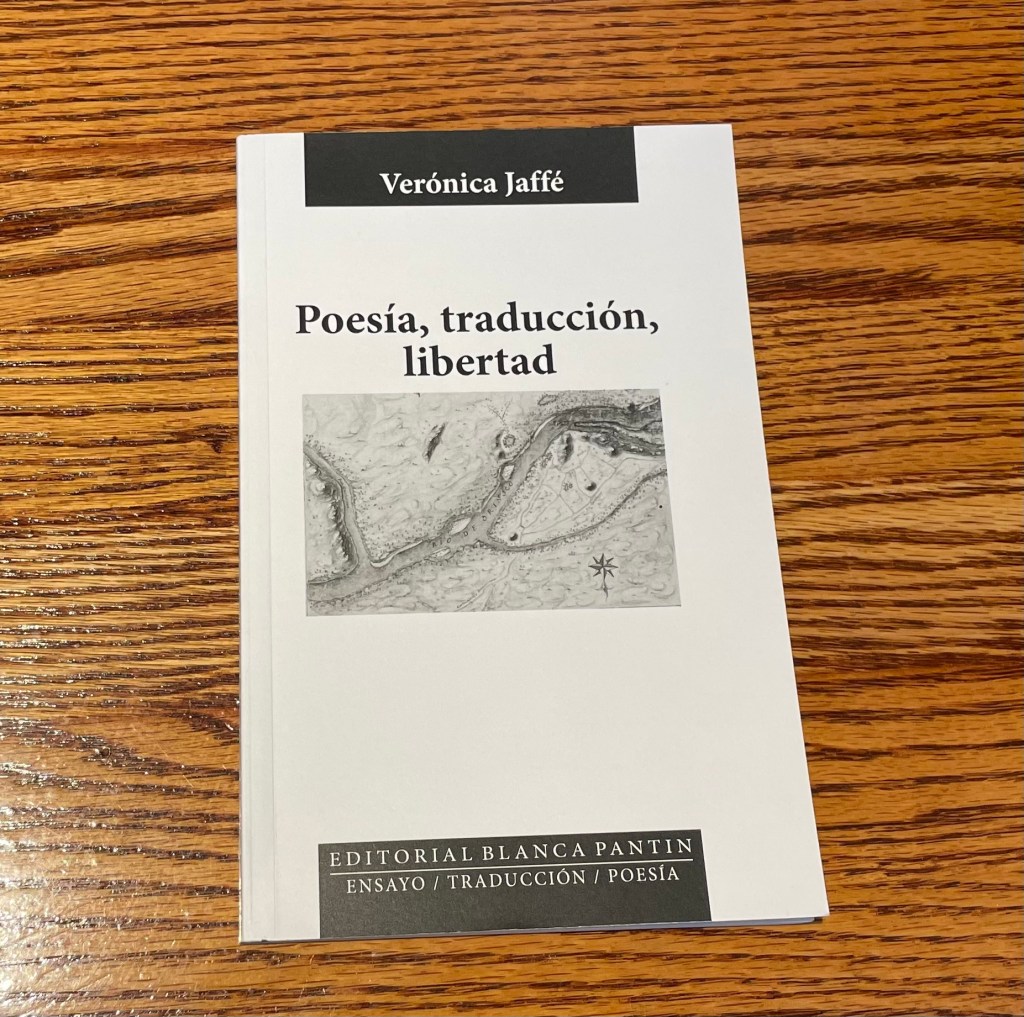
Verónica Jaffé’s most recent Poesía, traduccion, libertad (2024), which gathers some of the translations already contained in Fredrich Hölderlin: Cantos Hespéricos (La Laguna de Campona, 2016), features an introductory essay where she reflects on translating Hölderlin’s poetry from the German into her own creative visual renderings of Spanish. Reflecting on the difficult task, if not utterly impossible, of translating “Andenken” (in Spanish she opts for “Recuerdo” and not “Memoria”), Jaffé departs from an important observation that we must take into account here: the fact that this late hymn has been catalogued as a proemial composition. What does it mean that “Andenken” is to be read as a proem? As we know from the Ancient sources, the proem is an oratory prelude to the topic deployed in a text; in other words, it is the persuasive caesura of language before any argumentative exposition. Hence, the composition of the proem is something like the pure mirroring of language. This could explain why Hölderlin’s “Andenken” while prima facie about memory and thinking does not have a guiding thread to restrain it; it unfolds the enactment of its own recollection through the sayable.

If “Andenken” is a long proem – the space where the poem and proem absolutely coincide – then this means any translation must keep the poetic possibilities of oration in preamble, in path of preparation. Jaffé offers two distinct trans-creations of the famous poem’s last lines. The first reads thus: “Un mar que guarda los recuerdos / que da amores, que los toma / para que solo queden después / como tesoros / en quienes recuerden y en quienes escriban” [1]. In the second version, even more elaborate and idiosyncratic, Jaffé writes: “de pensar con todos / mis amores, es decir / pensar fijando / papel y lápiz / sobre tela / en memoria de todos mis muertos” [2]. It is noteworthy that the famous literal last lines of the “Andenken”, suspended in an enjambment, appeals to a canvas that is splattered with the memory of the dead. It seems of all the dead of the human race. What does it mean that the act of remembrance is the recollection of all the dead? Poetic imagination, if a testamentary document, appeals to the archaic where the living and the dead inhabit the world through image [3]. For Jaffé – but this also an intuition that Hölderlin shared in his pindaric translations – the beginning is not a previous stage, but in media res of the event of language. 

The recollection of language within proem attests to the exilic dimension of language; the site where no one truly ever belongs to: “…la lengua en mi país que no me pertenece”, writes Jaffé [4]. This means that the authentic remembrance of language is not a national language, but always ex patria lingua, or a language outside the telluric fabric of the national community. Because we are always walking strangers in our own language, the contact with the dead repeatedly reemerges in the memorial grain of the voice. 

As C.M. Bowra has noted, Pindar’s allusion to Memory takes place in the context of the Muses: “[the poet] invokes Memory because she embodies the accumulated wisdom of the past, and the Muses because they pass on this wisdom to him. What he asks from them is the ability to deal properly with what they give….men are blind if they do not pursue wisdom with the help of the Muses” [5]. If the “Andenken” should be read as a proem, this is because recollection is always fixed in the irreducible experience of our voice that recalls language from its beyond.

Notes 

1. Verónica Jaffé. Poesía, traducción, libertad (Editorial Blanca Pantin, 2024), 38.

2. Ibid., 40. 

3. Ibid., 40.

4. Ibid., 51.

5. C.M. Bowra, Pindar (Oxford, 1964), 33.

“An angel passed by”. by Gerardo Muñoz

In the Spanish language there is a wonderful idiom that has gone out of fashion in our times to express a sudden silence: “ha pasado un ángel”, or an angel passed by. The phrase is commonly used whenever a sudden silence imposes itself in the middle of a conversation, which leads to obvious discomfort and embarrassment among those engaged. It is almost as if the invisible angel reminds human beings that conversation rests as much in words as in silence; and that the shadow of silence sooner or later interrupts any communicative practice. According to historians and lexicographers, the inception of this idiom into Spanish remains a curious enigma, since although used in early modernity it does not have a Latinized version, and its origins can only be traced to classical Greek antiquity. In fact, Plutarch notes in his De garrulitate that whenever silence is introduced in a meeting it is said that Hermes has joined the company [1]. The angel thus stands for the nonpresence of language in language, just like an icon is the sublimation of presence in pictorial representation. 

We know that in Antiquity the angel as a minor divinity (angeloi) was a mediator between heaven and earth, only that in that moment that an ‘angel passed by’, it is not all clear on which side is there heaven and where earth [2]. In his beautiful book Angels & Saints (2020), Eliot Weinberger reminds us that for Saint Augustine the angels were first and foremost original gardeners of Paradise – given that they are free from felix culpa and sin – and that they are messengers between the living and the divine, as documented in the beggar Lazarous carried by angels to the bosom of Abraham [3]. Here it seems that the invisible inception of the angel relates fundamentally to the dead and conclusion, which also carries its aspiration in the lacunae of a conversation that reaches an impasse, and that for a moment effectively dies. 

The angel that accompanies the dead and the poor – and thus our structural poverty in language, being in the language that always lacks a grasping signifier – is also confirmed by lexicographer Alberto Buitrago, who in his entry on the idiom writes that the expression has its origins in the fact that in antiquity whenever a dead person was mentioned or brought up in conversation there was a silence held, because it was thought that his “spirit” (his angel) had become present in its nonpresence of language [4]. Although Buitrago does not provide any documentation for his assertion, it does bring to bear that whenever we are in communication, whether we like it or not, we are in the communion of angels that are expressing the soul of the dead through the litany of their names. 

This is why Antelme could suggest the similar enigmatic notion that being powerless and in poverty means to ‘have to forever be’ in a silence adjourned so that language can continue speaking. This is why perhaps the irruption of authentic silence has the effect of a certain petrification of the human expression, as masterfully captured in Velázquez’s Apollo in the Forge of Vulcan (1630). It is through silence that we encounter the divinity that for a moment places itself outside of language in order to contemplate it, letting the angel make his entrance. The language of computational machines is not only a language that has renounced its poetic and ethical instance; it is also a form of gated communication that has expelled itself from the angelic visitation of its own contemplation. 

Notes 

1. Plutarch. “Concerning Talkativeness” (De garrulitate), Moralia 6 (Loeb Classical Library, 1939 ) 502F.

2. Paula Fredriksen. Sin: The Early History of an Idea (Princeton University Press, 2012), 54.

3. Eliot Weinberger. Angels & Saints (New Directions, 2020), 30. 

4. Alberto Buitrago. Diccionario de dichos y frases hechas (Espasa, 2007), 333.

Holding on to painting. by Gerardo Muñoz

Paying a visit to a painter’s studio is a rare experience, but definitely gratifying. Or at least, it has been for a long time even before I could put it to words. At her studio, I confirm that Laura Carralero’s commitment to painting as a practical activity has an unfathomable dimension, and I was pleasantly surprised that she shared the same sentiment that our current epoch is not one in which painting has a minimal breathing space. And whenever painting emerges in the official market circuits of art, it seems that it is always already parasitical to some verbose rhetorical apparatus or heteronomic planning that distortions the painterly sentiment. But was not painting the task of speaking the engagement regarding  “mute things”, as Poussin would have it? There is little doubt that rhetorical inflation that thrives in mechanisms to legitimate art continuously devalorizes the mysterious proximity of painting with things in the world. We should reflect – or we should continue to reflect – about what it means to be in a point in the history of humankind where the obsolescence of painting and the disappearance of the dexterous achievement of the hand has thoroughly been realized (Focillon’s praise of the hand remains as actual as when it was first written: “The artist that cuts wood, twerks metal or rock keeps alive a very ancient human past that without which we would immediately cease to exist. Is not admirable to see in the mechanical age this stubborn human survivor of the ages of the hand?”) [1].

The task is immense and abnormal, and it defies (because it exceeds it) the theoretical concept and the absolutism of the philosopher. The engagement of the painters – a secret community that still exists here and there, in different geographies of the world – is precisely a keeping of the divine vortex of the human in the abyss without higher pretensions. And there is something stubbornly strange about painting against the mounting force of destruction. Although perhaps ‘resistance’ here means nothing but to hold on to the originary instance of appropriation of experience in the wake of the epochal mutation of anthropogenic composure; as if the end of the species is also pulsating its commencement.

Holding to painting is not just a substitute to the act of refusal (something that I have recently mapped out); rather, it refuses the very negation of the anthropological erosion in its soulful interaction with what it remains outside of language. To hold on to painting means to engage in the imperturbable: what discourse cannot mold and relocate; what previously is poor in language so that a new language, and thus a new world, could emerge anew among the rubble. In his forthcoming book Those Passions, T.J. Clark states, quite forcefully, that no political transformation or epochal breakthrough can emerge without a preliminary transformation in language; and, I am tempted to say, that practice of painting is the topoi in which eye, world, and hand come together in the very act of separation of said renewal.

The terror of painting – only aggravated in the last decades or so, although a process that took off the postwar years and continued into schools of art where militant pedagogues can only shout “don’t bother to paint!” – is the general stimulus of the reified world; a world in which the paradigm of “objethood” now stands as the compensatory empty experience for poignant idolization of nothingness and “mere stuff”. Sure, there is no return to painting in its grandiose historical sequences – Renaissance, French modern painting, the European Baroque, Van Eyck’s optical discoveries – which ultimately means that painting’s instantiation with the tradition is also bare and unexplored; or, absolutely uncharted whenever there the event of true painting. While I glance at Carralero’s diminutive wooden oil paintings I have this in mind at least. There is a return to the divinity of the icon, but it is not a restitution of its theological investiture and its purported liturgy; the pictorial exercise takes into account the structural void in which painting finds itself resisting, for better or worse, representational excess.

And this speaks, I take it, to the muteness of painting as such, which is also Carralero’s silence about the import of medieval icons into the present. In a way, the painterly operation (I realize that this expression is awful) is executed in a paradoxical redemption, since space always calls forth presentism, a here and now. One is reminded of Stevens’ verses in “Ordinary Evening in New Haven”: “To say good-bye to the past and to live and to be / in the present state of things as, say, to paint / In the present state of painting and not the state of thirty years ago”. The emphasis of the verse declines towards that injunction “as say, to paint”, which fixes a current state of being in the world where we are in it but outside of it. Is not this, precisely, another description of the “Just”? I am eager to work through painting’s stubborn position to this description, which means to hold on to the imperturbable. 

The imperturbable seems to me like a fitting term to grasp what Carralero is doing in her pictures, although with no pretensions to exhaust her pictorial adventure. The solemnity of the icon and its inverted gnosis yields something palpable as well as unattainable. What is being held is the vortex of painting’s mystery going back to Lascaux and ancient burial paintings. Carralero rationalizes her interest in medieval and Eastern European religious painting as a retreat from the unbreathable decay of contemporary pictorial practice as a general tendency. Here the renewal of painting is only possible through the sensible dimension of an integrative imagination. Hence, to live in the present, in the hour Stevens’ simile, is also to dwell in the flashes of painting’s general economy of sensible forms. A new history of freedom can take this as its point of departure; that is, to posit no longer the social functionalization of norms and rules for relations, but to expand the sensible space of the innumerable symbols of existence. 

In the well-known essay “The Pathology of Freedom”, Günther Anders says something significant about painting’s imperturbable nature: “Painting that fixes the aspect of a man or a thing in a picture seems as it were to repeat the act by which each thing is already condemned to itself” [2]. This “being-precisely-this” could be taken as the closure of contingency in relation to all possible forms; although it is also painting in which the contingency of the non-visible in the visible what arranges the possibility of what is precisely absolute contingent as absolute in each picture. This is why in great pictures we tend to feel that the consummation of form reveals as a necessary tradition that, by virtue of being thus, it assume the thisness of the particular rendition. This commitment that weighs heavy in each of Carralero’s paintings is a testamentary to the imperturbable even if we are already entering (or already in it) the eclipsing world of the mystery of the senses, a world that can no longer see the redeeming and unassuming vision that painting can offer.

Notes 
1. Henri Focillon. Elogio de la mano (UNAM, 2010), 131-132.

2. Günther Anders. “The Pathology of Freedom: An Essay on Non-Identification”, Deleuze Studies, Vol.3. 2009, 283.

The political elite and the dead. by Gerardo Muñoz


Over the weekend, the Catalan journalist Enric Juliana interviewed Ramón Tamames, former member of the Spanish Communist Party (PCE) who embodies the living memory of the 1978 transition to democracy. Nowadays he is the main protagonist of the motion of confidence against the government coalition raised by the nationalist right-wing party Vox. There is no surprise (at least for those of us that follow closely the idas y venidas of Spanish politics) that a former member of the Communist Party makes amends with with the neo-sovereignist right. Even the Medieval jurist Bártolo de Sassoferrato centuries ago diagnosed that an epoch void of political authority, leads to a ‘monstrous form’ of arbitrary governance. This is not the place to analyze the cartoonish Vox-Tamames’ alliance. Rather, what generated a chilling effect while reading Juliana’s exchange was the moment when he asked about what he would have said to the communist prisoners in the Burgos correctional facilities in the aftermath of the Spanish Civil War. And, to this Tamames responded: “Están todos muertos”. They are all dead. It is a monstrous phrase voiced by a hyperbolic figure of the Spanish political elite. The answer is bold and lacerant because the message is stated without formal investidures or pathos: the dead are dead, and we own them nothing, since they are nothing. They are less than nothing.

It is no minor feature that historical communist parties during the twentieth century, in spite of the public and rhetorical monumentalization of their ‘heroic pantheon’, had little patience with the dead. This is why a motto in some socialist countries was, indeed, “los hombres mueren pero el Partido es Inmortal” (men died, but the Party is Immortal). So, by organizing immortality and the relation to the dead around the Party, historical communism was able to solve two problems at some: it was able to justify sacrifice in the name of a transcendent cause; and, at the same time, it introduced the dead corpse in Party as a government that kept operating even well beyond people had ceased to believe in it. I mention this because as a historical communist, Ramón Tamames is still embedded in this metaphysical enframing, only that now it takes different garments through a full erase of the dead that a posteriori justifies a concrete political action. 

I have underlined a few times already the fact that Tamames is a trained political elite, because his alignment with Vox is rooted in his alleged elite credentials. This is an important feature. I remember a few years ago that Mario Tronti told me, in a Weberian spirit, that a new epochal transformation of Western politics required the elaboration of an elite in possession of vocation and conviction. But this is, paradoxically, what Tamames has always stood for, regardless of his political commitments. The problem is that today the restitution of political elitism is not only insufficient, but it is also visibly catastrophic and opportunist. It is opportunist because it can only self-affirm itself as a supreme value in the world of the living, which necessarily entails killing, once again, the dead. Under this light one should reconsider what Carl Schmitt enigmatically writes in his Glossarium: “elite is that category which no one dares to write a sociology about” [1]. It seems, however, that the contrary is true: sociology is the predominant form of political elite, since its final aim is the reproduction of material social relations at the expense of the dead. As administrators of the public life of the city, the political elite must hide the cemeteries and the world of the dead away from the arcana of its public powers (this is very visible in Washington DC or Madrid). This void demands a  relation with the dead as a fictitious memory based on public memory, monumentalization, infinite naming, and cultural commodification in exchange for foreclosing the relation with the dead. This also explains why the epoch of high-secularization is fascinated with the investment of public memory and practices of memorialization which maintain the equilibrium and endurance of the society of the living against the dead. 

And isn’t Tamames’ depreciation of the dead just an expression of the attitude present during the high peak of the epidemic across Western metropolises? The corpses amassed in registrator hums outside hospitals in New York was a monstrous spectacle that bore witness to the disconnect between the living and the dead in the triumphant epoch of absolute immanence. What is important here, it seems to me, is that one cannot but expect this from a “political elite”; that is, a denegritation and blockage from a contact with the dead that is neither in the home nor in the city, but in the khora or the extra muros. Whenever this has been achieved, the political consequence has been, precisely, punitive acceleration, social death or expulsion. 

In a beautiful text written during the height of the epidemic controls, Monica Ferrando reminded us that the socratic philosophical ethos was not rooted in the space of the city, but rather in relation to the underworld that grants “freedom every time” [2]. In times gone awry, nothing is more urgent than to do away with the gatekeepers that keep society a total space of inmates, while making the whirling presence of the dead a silent echochamber between cemeteries, as a friend likes to put it. In a certain way, we are already dead, and it is only the fiction of political elitism (or the permanence of those that appeal to the “political elite”) that taxes death – and our dead – to the sensible modes that we relate with the mysterious and the unfathomable.

.

.

Notes 

1. Carl Schmitt. Glossarium: Anotaciones desde 1947 hasta 1958 (El Paseo Editorial, 2021), 351.

2. Monica Ferrando. “Terra Giustissima: sulle tracce dei morti”, Laboratorio Archeologia Filosofica, February, 2021: https://www.archeologiafilosofica.it/terra-giustissima-sulle-tracce-dei-morti/