In his 1982 novel Aladdin’s Problem (1982), Ernst Jünger defined planetary domination through the actualization of the trope of Aladdin’s lamp. Whenever a symbol of this sort is used, we know that it always carries weight of ambivalence more than that of synthesis. The mythic lamp is a trope for magic and enduring power; of countering visibility and invisibility, but it is also made from a material that has been extracted from the Earth. In other words, raw materials are manipulated as a reservoir of energy that dispense the world of forms. In the most succinct moment of the novel, Jünger writes: “Aladdin’s lamp was made of pewter or copper, perhaps merely clay. The lamp guaranteed domination as far as the frontiers of the traveled world – from China to Mauritania. Aladdin preferred the life of a minor despot. Our lamp is made of uranium. It establishes the same problem: power streaming towards us titanically” [1]. Aladdin’s lamp is no longer a tool deployed by governments and armies, it is rather the autonomous commanding force that opens to human domination and technological catastrophe that generates calculable objectivity in the world.
In his conversations with Julien Hervier, Jünger stated that the “problem of Aladdin” is not a political problem, but rather one that involves the administration of energy and intelligence that is already beyond our hands, because it has been set loose by ongoing compulsion necessary to meet the indexes of production and transference of technology [2]. Of course, energy defined the broad design of modernity as the necessary condition to amplify historical forms and mediations (and deform, since it was always dialectic) of worldly events and relations. One should only be reminded that in the beginning of the 1920s three major texts by European thinkers – I am thinking of Pavel Florensky, Carl Schmitt, and Aby Warburg – saw the necessity to allude to the settled hegemony of electricity as the defining feature of the dominion of the world.
As Warburg understood it prophetically in his lecture on the serpent ritual of the Hopi Indians: “But myths and symbols, in attempting to establish spiritual bonds between man and the outside world, create space of devotion and scope for reason which are destroyed by the instantaneous electrical contact – unless a disciplined humanity reintroduce the impediment of conscience” [3]. And it goes without saying that this “instantaneous electrical contact” has become so thoroughly engrained in human existence, that it is now clear that life on Earth, as advanced by the latest phase of Artificial Intelligence (AI), is no longer point to the destruction of space but of the total disruption of electricity and energy that exceeds any sensible contact. Electricity as the paradigm of artificial mediation can only liberate the spiritualization of ongoing decline.
It is no historical accident that empires and nations have always been driven by the accumulation of energy, although at its historical exhaustion, there is no longer a veneer of development and production between energy and empire, but only a unified empire of energy in a lamp that quenches and overruns itself towards extinction. This means that what defines the darkness of our times is neither disorientation nor political violence (although there is much of that too), but the blinding darkness of a translucent expropriation of the world of the living and the dead. It is through this assumption that Jünger makes the last business of the epoch of Aladdin – extractive energy as domination of objects and objecthood between worlds – as a large necropolis called Terrestra, financed by a banker named Jersson, where there is no longer any need for the liturgy or cults proper to myths, but naked exchange between gold and the material corpse that suppresses, via technological titanism, any possible relations to the irreducible. It remains to be thought whether the moment when the lamp goes off in the drained excess of its energy will also lead to the end of this world.
.
.
Notes
1. Ernst Jünger. Aladdin’s Problem (Marsilio Publishers, 1992), 118.
2. Julien Hervier. Conversaciones con Ernst Jünger (Fondo de Cultura Económica, 1990), 100.
3. Aby Warburg. “A Lecture on Serpent Ritual”, Journal of Warburg Institute, V.2, April 1939, 292.
We owe an untimely intuition about the enduring seduction of patriotism and nationalism to Leo Tolstoy’ essay “Patriotism and Government” (1900), in which he captured a paradoxical phenomenon: mainly, that at the same time that the integration of humanity and its historical consciousness reached its civilizational peak, patriotism instead of disappearing became increasingly more destructive and fierce. Looking at the outset of the First World War in Europe and its nascent total mobilization of industries, the Russian novelist claimed that, from that moment, government organization will depend on patriotism as a source to conduct total war within the human species. But what surprised Tolstoy – which has clear contemporary overtones in the impolitical movements that dominate Western societies – was the degree that this lethal patriotism infiltrated the very worldview and orientation of the Christian vocation. Tolstoy writes in the most most potent passage of the essay:
“All the peoples of the so-called Christian world have been reduced by patriotism to such a state of brutality, that not only those who are obliged to kill or be killed desire slaughter and rejoice in murder, but all the people of Europe and America, living peaceably in their homes exposed to no danger, are, at each war – thanks to easy means of communication and to the press – in the position of the spectators in a Roman circus, and, like them, delight in the slaughter, and raise the bloodthirsty cry, ‘Pollice verso.’ [1].
This should suffice to note that for Tolstoy patriotism is neither a political ideology nor a formal principle of community; patriotism is rather a social liturgy born of the absolute sacrazalization of human life and whose hyperbolic figure will be that of the war-slave trained to endure “the act” (especially the slave that participates in the carnage through his words and attention). And just like in a theater play or in the Catholic liturgy where there are “acts” (and the service can only subsist through its enactment), the unleashed force of patriotism becomes a form of destruction as the essence of government organization.
This is why for Tolstoy the inception of total war recalibrates the grotesque spectacle through the “hypnotism of patriotism”, positing a fictional belonging of salvation – that is nontheological because it is unredeemable – through the destruction of another community of the human species. True, the end of politics always results in war; although Tolstoy introduces a nuance to this axiom: war is able to subsist thanks to the self-affirmation of patriotism as the triumph of a wordless inhumanity.
It is no coincidence that Tolstoy observed the rise of patriotic strife in tandem with modern science as conquest over Nature and the reality of human experience [2]. Thus, government patriotism and instrumental sciences are two interconnected regimes of the organization inhumanity that speak the rhetoric of growth and prosperity as stagnation deepens. In our days, this social cohesion, as Tolstoy warned with precision more than a century ago, has entered a new phase of domination that some called a “lethal form” integrating technology and war without any reminder [3].
.
.
Notes
1. Leo Tolstoy. “Patriotism and Government” (1900), in Last Steps: The Late Writings (Penguin Books, 2009), 318.
2. Leo Tolstoy. “Modern Science” (1898), Last Steps: The Late Writings (Penguin Books, 2009), 252.
3. Alexander Karp. The Technological Republic (Crown Currency, 2025), 154.
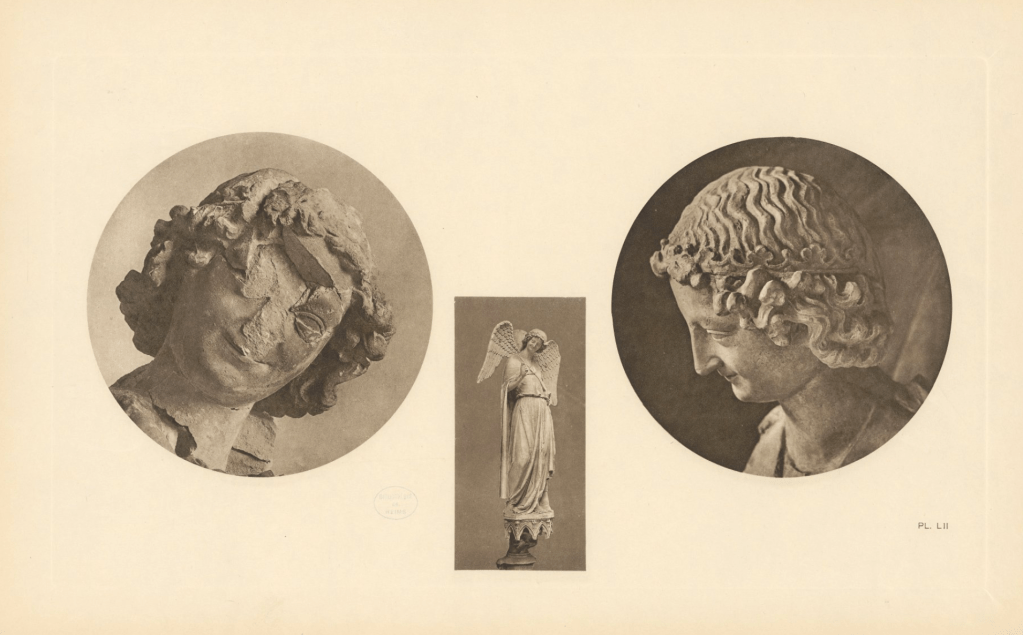
Among Robert Antelme’s posthumous writings the short text “L’ange au sourire” has a decisive place if we are to explain the transfigured theological experience of the French writer. To anyone familiar with French architecture history the title should sound familiar, since the ‘l’ange au sourire’ was already a common expression used by French scholars of architecture during the interwar years. Charles Sarazin, arguably the most important scholar of the architecture of Reims, penned a separata titled “Le Sourire de Reims” (1929), in which he celebrated the mysterious smile of the angel Gabriel that was severely damaged due to shell fire of the Cathedral during the fall of 1914 [1]. But a decade prior to the destruction, art historian Arthur Gardner, in a detailed essay on the sculptures of the facade of the Rheims Cathedral, also took note of this angel’s gaze writing that: “…the angel Gabriel of the Annunciation in which the French smile has almost become a grin, the beginning of the contorted expressions frequently found over the border in Germany.” [2]. The particular aspect of this unique angel’s face that Antelme undresses from the cloak of authority is also wonderfully documented in the photographic book by Pierre Antony-Thouret, who also showed pictorial interest in the way that angel Gabriel was chipped in a large area of the right frontal relief (image 1) [3].
Image 1. Reims au lendemain de la guerre (1928), plate 52.
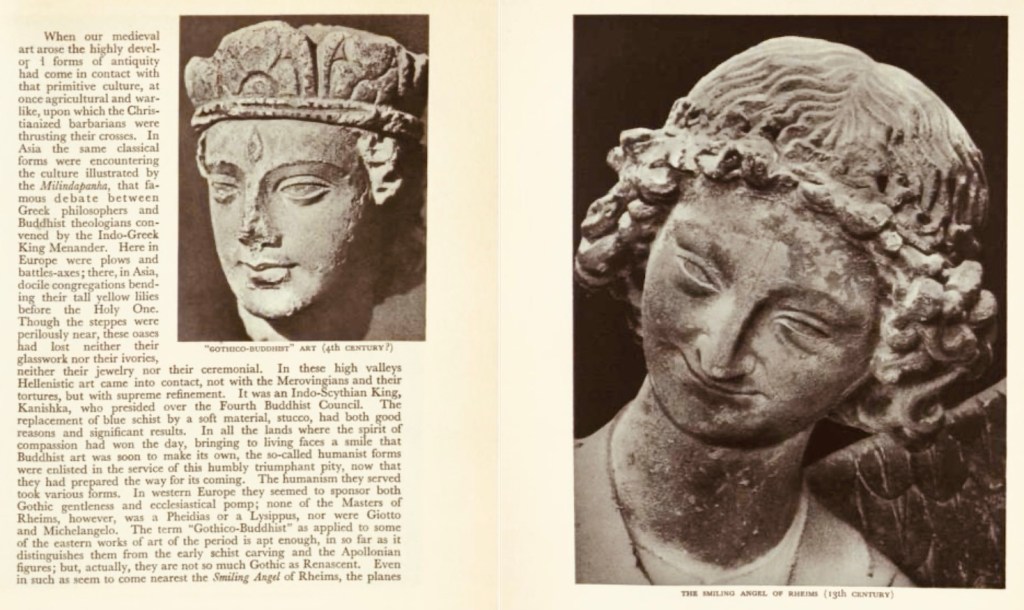
This curatorial context informs the historical background of Antelme’s reference to destruction and what he references as the crushed: “But not crushed by this building, or by that event, or by some power. It has always been crushed, crushed forever” [4]. For Antelme the tenuous, almost imperceptible, smile of the Angel of Rheims is what outlives absolute destruction because to be destroyed cannot be executed absolutely. It is the soul of existence that, because of its exteriority to history, is powerless “to have forever to be”. Even if this being has become petrified and immobile from its original plastic appearance auf vif of sacred art. This is what Malraux captured in his brief mention of the “L’ange au sourire” in The Voices of Silence (1951), where he also compares it to the Buddhist faces of Oriental sacred art (image 2): “The Smiling Angel of Rheims is a statue whose “stiffness” increased with every century; but at its birth it was a similar incarnate, a face that had suddenly come alive – like all faces sponsoring a discovery in the field of the lifelike” [5]. In order words, to see in the muteness of the face the nothingness that allows expressive relations to emerge in the open. This holds for Antelme’s description as well: “Radiant or hidden, inevitably it is there. Word, image, music: everything expresses it, and nothing. It lies at the heart of that realm where all relations are born. Forever starting anew. Possessing nothing, capable of nothing, it must be there, forever”.
Image 2. Angel of Rheims in The Voices of Silence (1964).
But what Antelme was able to capture through the smiling angel of the Rheims Cathedral was not a problem of iconology of art forms, but rather the very essence of the theological problem of angels as it relates to the poetics of life itself. The angel is not a promythical figure scaled to a specific historical moment, but an instantiation of the divine appeals to the withdrawal the possibilities and modes of the human being. This is why Antelme can state that “the only transcendence is the relation between beings”. Even in its muteness, the theologica depth of the angel is the poetic speech of divinity through a surge in language that has no end, but only celebration or hymnology.
This is why Erik Peterson writes towards the end of “The Book of Angels” about the intimate relation of angels in human existence: “A human being can draw near to the angels because the angel too – as its name already indicates – can draw near to humanity. […] The angels are more than poetic ornamentation left from the storehouse of popular fables, they belong to us. For us, they stand for a possibility of our being, a heightening and intensifying of our being – but for the possibility of a new faith…as a passion for mental clarity and an authentic existence” [6]. It is fair to say that, although the figure of the angel does not show again in Antelme’s work, all of his vision and witness accounts in the face of political horror must be placed in the endless vigil of a nocturnal life that is shared with the ethos of angels (utirur vigilis, angelorum vitam procul dubio meditatur).
.
.
Notes
1. Charles Sarazin. “Le Sourire de Reims” (s.l.n.d, 1929).
2. Arthur Gardner. “The sculptures of Rheims Cathedral”, The Burlington Magazine for Connoisseurs, V.26, 1914, 64.
3. Pierre Antony-Thouret. Reims au lendemain de la guerre: la cathédrale mutilée, la ville dévastée (Jean Budry, 1928).
4. Robert Antelme. Textes inédits sur l’Espèce humaine (Gallimard, 1996), 14.
5. Andre Malraux. The Voices of Silence (Secker & Warburg, 1964), 317.
6. Erik Peterson. “The Book of Angels”, in Theological Tractates (Stanford University Press, 2011), 139.
The essay “Por nada del mundo. Anarquismo y Catolicismo”, by Spanish poet and essayist José Bergamín, should be read as a wartime reflection on the historical impasse of the Spanish Civil War. First published in Emmanuel Mounier’s Catholic journal Esprit in the 1937 April issue, the essay in its final version featured in Bergamín’s Mexican exile collection Detrás de la cruz: terrorismo y persecusión religiosa en España (Lucero, 1941). While on the surface Bergamín is responding to the struggle between secular political anarchism and traditionalist Spanish Catholicism intertwined at the heart of the civil war, the essay is also highly idiosyncratic in laying out the poet’s theological vision that permeates his entire body of work, and which can already be found, in nuce, in the fragments and aphorisms of his first book El cohete y la estrella (Índice, 1923). “Reality is the spirit, imagination, and thought…there is religiosity when it claims space positively”, he would write in the first pages of that book.
The 1937 essay, along with his defense of illiteracy in “Decadadencia del analfabetismo” (1933), Bergamín argues for a living theology of the Spanish people (pueblo) that is neither imperial nor clerical, but rather always an excess to the imperial political theology that dominated the long historical narrative of Spanish modernity since the Reconquista. It was thanks to Bergamín’s genius that Catholicism appears connected to a habitual form of life of everyday people, their shared language, symbols, and experiences; and, ultimately the common imagination that grants them access to the world through the mystery of living and dying. In fact, as in “Decadencia” (1933), it is important to highlight the centrality of the term “pueblo”, which although translated as “people”, it coincides neither with the “People” of the unity of civil society nor the common historical identity of the Nation. For Bergamín, these determinations, in fact, were corrupted notions of pueblo. The pueblo is always the event that remains from the abstraction of political theology, and always pueblo minoría, a ‘minor people’ that dwells in the house of God within and beyond the mundane. This is why Bergamín would claim in the text that the pueblo is always ancilla mundi. In this light, Bergamín thought that political anarchism incapable of a revelation to the divine, and an imperial Church in charge of the administration of the “nothingness”, were two poles of the same vectorial force of modern nihilism. That was the color of his corruptio optimi pessima with clear echoes of Fridugisus’ De nihilo et tenebris.
In “Por nada del mundo. Anarquismo y Catolicismo”, Bergamín’s theological position emerges as a third way to exit this historical poverty of relating to the theos. As Giorgio Agamben observes in a 1973 entry of Quaderni (Quodlibet, I, 2024, 46-47), for Bergamín the divine entails a corporeal cohabitation of a demon and an angel that expresses appearance of life, and thus the sensible and poetic mediation with the world of forms. In this sense, Bergamín’s theology differs fundamentally from the rational and canonical traditions, fostering the sensorial path of dramatic and divine beauty. This goes to the kernel of the 1937 essay: the rise of the Totalizing State (historical Fascism), was a corrupting form of theos insofar as it aimed at regulating the “nothingness” against the possibility of appearance and truth. But the word of God and the angelic hymns linger in the time of wreckage and devastation in its impatient drift towards anger in the world, which is still very much our own. Ultimately, Bergamín was convinced that the pueblo’s mute voice, resurfacing from the depths of pain, could dodge the abysmal fall into the tribulations of radical evil always too congenial with the survival of ‘this world’.
.
.
* This gloss was written to accompany the English translation of Bergamín’s “Por nada del mundo” forthcoming at New Personalism, summer 2025.
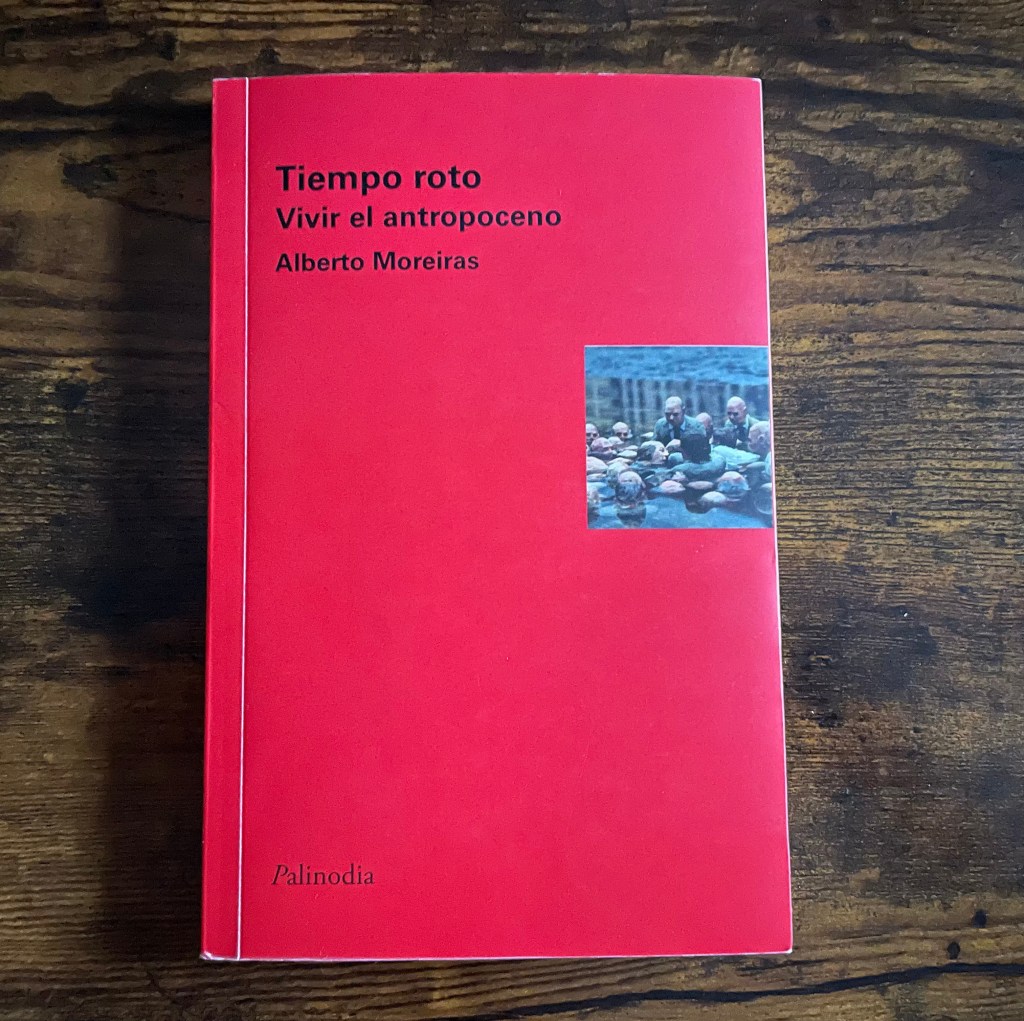
The sudden and uninvited intrusion of Gaia in our world is something rather strange, and yet consistent with the closure of the metaphysical tradition. The call of the outside takes place at the threshold of our reflexive capacities, habits, and mental propositions in our relation with the world, which demands everything to be thought from scratch. The historical imbalance in groundlessness now requires a new task for thinking – the imperative that runs through Alberto Moreiras’ most recent book Tiempo roto: vivir el antropoceno (Palinodia, 2024). The theoretical constellation deployed over the course of a decade now comes to the forefront with extreme urgency – I am referring to marranismo, posthegemony, aprincipial anarchy, and of course, infrapolitics. Tiempo roto (2024) is not a systematic culmination of Moreiras’ philosophical (or antiphilosophical) project of thought, but it is definitely a mature elaboration insofar as the field of problematization enters a hitherto unexplored thematics of late heideggerianism. All things considered, the emerge of the anthropocene as an explicit planetary endgame and the new beginning necessarily move pass the conditions of both political and scientific praxis, which today can only effectively adequate itself into positionality (the so-called Gestell) and objectivity of a world that slowly seems coming to its end.
It might be worth remembering that the notion of “other beginning” (“otro comienzo”) in the wake of civilizational decline was already proposed in the book Sosiego siniestro (2020), but it was far from being thoroughly explained [1]. Following Heidegger’s philosophical scene, representational thought in the tradition of adequatio of the Thomist gnoseology coincides with technological administration of every living entity (Moreiras 14). But Heidegger’s suggestion in the Parmenides that calculative representation fails as grasping the essence of the polis might also have its own limitations, insofar Gaia appeals to an excess beyond or below the politics. As Jacques Camatte also understood it, the civilizational invariant of revolutionary breakthrough departing from the historical subject of the working class can seldomly do the work except as an article of faith in the myth of the autonomy of the proletariat within real subsumption. This means that we are in the terrain of infrapolitics or the chora, which point to ontic regions of thought towards a new beginning at the end of principial metaphysics. But the other beginning can only emerge within conditions of transforming existence against the closure of political technicity.
I do not desire to reconstruct here all the refined analytical movements that lay out the transformation of existence in Tiempo roto (2025), but there is a maxim from Pindar’s Third Pythian Ode that stands out as an emblem for the appropriation of the non-humanity of the world. Moreiras cites Pindar’s “me, phila psycha, bion athanato speude, tan d’emprakton, antlie makanan”, which can roughly be translated as “do not seek, dear soul, immortal life, but do try to carry out the fullest the use of the possible” (Moreiras 61). Moreiras correctly notes that the ultimate difficulty lies in the “emprakton makanan”, or the use of the possible, which metaphysical Humanism and effective general equivalent can only exacerbate towards the planetary production and extractive valorization. The corruption of the use of the possible is the realization of hybris, and in this sense all representational humanism is always already a form of self-deification and induced hallucination, even when it tries to claim to engage in the opposite in relation to nature (Moreiras 65). Moreiras suggests that the pindaric maxim discloses a second relation of the “use of possibles” that does constitute a lacuna in the metaphysical tradition, and that is understanding a praxis tied to sophrosyne or phronesis that abides to the prudent inclination of the non-human (“es una actividad sometida a la vergüenza de lo in-humano”) (Moreiras 65). Giorgio Agamben’s defense an ontology of possibility against the hegemony of metaphysical realization and representation also comes to mind, although Moreiras might not feel at ease at explicitly calling for a positive ontology nourished in the waters of a transfigured metaphysics of the tradition of scholastic Averroism [2]. Although both Moreiras and Agamben come at their closest proximity in terms of the notion of the chora – and more directly the space of the chora against the primacy of the polis – which serves the ontic condition for the non-spatial surfacing of the abode or region that is necessarily infrapolitical, because it’s never determined by distributionist political isonomia or meson (Moreiras 73).
There are important nuances here to say the least: whereas for Agamben the notion of chora appeals to the gods of place (theos aisthetos), and thus a dejointed form of divinization decoupled from the legitimacy of every politico-theological archein; for Moreiras, the chora is a praxis of thought towards desecularization that lacks theology, and thus capable of exceeding the onto-theological reduction (Moreiras 74). But Moreiras says about the tendency towards nihilism of “possibility” in the historical dispensation of positionality (Gestell) could also be said about ‘de-secularization’, as the ultimate consequence of the decay of political legitimation in Ernst Bockenforde’s famous formulation. This might not be the space nor the moment to reach a verdict between Moreiras and Agamben’s position regarding the very complicated problem of the Platonic site of the sensible, since what is presented to the reader as a ‘phenomenology of excess’ or the inapparent (something merely alluded in the Zahringer seminar), might be the condition of an atopic mediation that prepares – or that has always prepared since the times of Orphic myths – the tonality of a coming philosophy under the sign of transformative thought (Moreiras 110) [3].
The dispensation of the Gestell open up and also step back (a folded movement that does not have a declension into a synthesis) into the genesis of the beginning (Moreiras 115). And the anthropocentric epochal dispensation, says Moreiras, is no longer the site of the polis, but “the planet as a the historical site of humanity, although we are still unaware of it (“aunque sigamos desconociéndolo”) (Moreiras 116). This uncanny phenomenology of the primary, traversed by the discharge of the entstehung, is the infrapolitical site par excellence, because it is in the atopic region where destiny is both affirmed and displaced. This is why, as Moreiras recalls Heidegger saying, the dialogue with Parmenides never exhausts itself, and yet it prepares a destiny (Moreiras 134). I take this to mean that there is an experience of the transfiguration of language for the emergence of an “ethics” (ethos), but this might be beyond Moreiras preliminary conditions for an existential breakthrough; that is, something possible further along the path.
Tiempo roto (2024) closes with a couple of undeveloped pages that take Massimo Cacciari’s old essay “Confrontation with Heidegger” (1977), in which the Italian philosopher makes a plea for a direct confrontation with Heidegger and Nietzsche’s teachings on nihilism and the closure of metaphysics if there would still be any hope for the composition of the working class during the stage of anthropomorphized dimension of capital defined by Jacques Camatte also during those years. But much has changed since the hot Italian summer of 1977 and the formulaic conjunction of “left Heideggerianism” might not do the work anymore, as if the totality of materialist political economy could be amended by a radicalization of the historical question and the ontological difference. Political economy plus metaphysical critique is still relying on a conception of the political as a technique, which today has transformed into what some have called the “new regime of ecological accumulation” as mere stabilization of green ecological spheres of life [4].
But there is a second register to Cacciari’s programmatic thesis that remains open. And these might be Moreiras’ most important words in the concluding part of the book: “Espero haber mostrado que Hiedegger señala la posibilidad de dejar atrás la explotación y el consumo en la era del Antropoceno a través de una comprensión alotrópica de nuestra relación con el mundo. Por lo tanto, vivir en el Antropoceno debe basarse en el abandono o desplazamiento de la metafísica como modo dominante de aprehensión del mundo en la actualidad” (Moreiras 151-152). Marx’s materialist dialectic through the critique of political economy – even as a destitution of political economy through its own vectorization – might be insufficient to face the unprogrammed presence posed by planetary anthropocene.
Perhaps we can still repeat Dionys Mascolo’s words that the coming communism will owe more to Hölderlin than than Marx, not because of an idealist dispute over concepts, but rather because of what Cacciari called in his essay, also citing the German poet, the historical “affinity of conditions” [5]. And in the age of the Anthropocene and positionality, those conditions are kept in the pattern of economic decline or stagnation in which the law of rate of profit encounters its own limit, folded unto the ongoing destruction of the life forms in the world. The allotropic praxis endorsed by Moreiras finds traction in Hölderlin’s poetic dwelling in language at the heart of decline so that something other might emerge within and beyond life, from Gaia to Ctonia. This is the most difficult task to depart from, but it is also the path that saves from the current inhabitable passage of the Earth.
.
.
Notes
1. Alberto Moreiras, Sosiego siniestro (Guillermo Escolar, 2020), 24.
2. Giorgio Agamben. L’irrealizzabile: Per una politica dell’ontologia (Einaudi, 2022), 112-146. Kindle Edition.
3. For more on orphism and the limits of the site of the Greek polis, see Gianni Carchia’s Orfismo e tragedia (Quodlibet, 2019), epilogue by Julien Coupat.
Whenever a professional politician today evokes the ‘soul’ one must be immediately suspicious, as it tends to be an automatic lullaby for “national unity” or a dormant metaphor in a flowing stream of empty chatter. What could the soul mean to anyone – say, those millions that have now for the second time voted fairly and squarely Donald J. Trump to the Executive branch of the national government – only capable of giving attention to a series of onomatopoeic pop-words that are now ingrained in the linguistic acoustics of the American lexicon (“Bitcoin”, “Tiktok”, “Woke”, “Prime”, and the list could go on). The ongoing catastrophe is first and foremost within the texture of language, which is ultimately why it is also an ethical decomposition in which all other spheres of practical action (first and foremost, politics) amount to business as usual with its corresponding rhetorical bravura.
Suggesting continuity might perhaps be an understatement: it is now a business that does not need any sumptuous or veiled mediation; refracted upon its own absorption of its hyperproduction of fiction, the defeat of the communitarian salvation of Calvinism can only be expressed as a self-serving an ongoing destruction and self-annihilation. True, it could be claimed that ‘Americanism’ has always been this; the only difference is that today, already well into the century, it moves in a vector that directly rejects the world while making a full fledged program of its own making. Only a Society that has become fully moribund can celebrate its own death and decomposition; while the emancipated and well scripted villains of the act now have no shame but to reveal how the ultimate object of their conspiracy was the obliteration of the Earth.
“It is the time of the assassins”, TJ Clark writes echoing Henry Miller’s unjustly forgotten book on Rimbaud and the legitimation of the social bond, in which the homo homini lupi discloses itself from any all possible contact in the metropolis solely dependent on ad hoc hyperproduction of justifications required to fully commit to the illusion of legitimate action. Only that now the time of the assassins is perhaps an uncanny dark night of those without souls, as in the deranged characters of a McCarthy’ novel: they are willing to kill and be killed; they are beyond any contact with language, and “what do you say to a man that by his own admission has no soul? I’ve thought about it a great deal” [1]. And indeed, there is nothing to say and nothing to face: in the soulless dark night there are only hunters and those that are hunted; there is integration or pulverization; there is killing and there is humiliation before an ever increasing legal nexus coordinating the acquiescence of force. But perhaps this is the real arcana of the American soul that is only shimmering through in all of its glory.
Someone like D.H. Lawreence definitely thought so when writing about the novels of Finimore Cooper: “[The white american] lives by death, by killing the wild things of the air and earth…All the other stuff, the love, the democracy, the flooring into lust is a sort of by-play. The essential American soul is hard, isolate, stoic, and a killer. It has never yet melted” [2]. But in our days it has begun to melt, to fragment, and decompose in a heavy storm of pain and despair. And it continues to stand in the long winter of American civilization (the castle of Frozen is the allegory of the epoch) that now finds itself at the epochal threshold of the end of growth, only left with rampant nationalist impulses of self-affirmation that can only deepen the nihilist tonality of anguish and self-destruction, and the emergence of the bizarre as Jamie Merchant notes in his recent Endgame (2024).
In his Reflections on America (1958), Jacques Maritain maintained that the spiritual patrimony of Americanism is that of being “bruised souls”, a community that came into being by double exclusion (hunted by their religion and rejected within a national polity), which in turn allowed to be compassionate to human suffering, and thus the hidden meaning of the wound was to be seeing in the “role played by immigration and poverty suffered in the Old World” [3]. Hence, for Maritain the condition for the healing soul of America resides in its opening to ongoing suffering of migrants, the dispossessed, and those in exodus from the psychic pressure of a social metabolism gone sour in every subject of civilizational decay as Erich Unger had proposed in his Politics and Metaphysics (1921).
It comes to no one’s surprise, thus, that the decomposition of the American soul departs from the overt opposition to migration, as a figure of the grazing over the Earth, that must be vanquished and condemned by a planetary gnosticism undergoing in front our eyes. The Chrisitian modern state enters in this way into a concrete and visible process of artificial desecularization showing that “the Christian relation to the State…is in mad hostility to all of them, having in the end, to the destruction of them all. […]. And it is, simply, suicide. Suicide individual and en masse” [4].
The stakes are extremely clear: it is for the bruised and the brute (some have called it the barbarians, proprietors of strange tongues, keepers of the clandestine lacunae of language) to retreat from the fictive proliferation of appearances, the artificialization of reason that can promise success as the ultimate pinnacle of self-destruction. Inclined beneath the shadow of archaic Penia, the bruised and incurable souls might not find redemption in the American wasteland, but they will land somewhere between language and world. Not a program but a moving conviction.
.
Notes
1. Cormac McCarthy. No Country For Old Man (Vintage, 2005), 8.
2. D.H.Lawrence. “Fenimore Cooper’s Leatherstocking Novels”, in Studies in Classic American Literature (Thomas Seltzer, 1923), 92.
3. Jacques Maritain. Reflections on America (Scribners, 1958), 84-85.
In his war diary Seven days on the roads of France June 1940 (2012), which recounts his itinerant vicissitudes in occupied France, the Russian theologian Vladimir Lossky makes an explicit case for the emergence of a third way beyond conservation and destruction, and its modern ideological avatars that led astray into the modern catastrophe; that is, the social revolution and conservative reaction cloaked under “traditionalism”. As it has been recently glossed, Lossky was not the only person from the East to be preoccupied with putting a halt to the eternal dialectical movement of destruction and conservation only fueling historical abstraction. Indeed, immediately in wake of the Russian Revolution, the poet Alexander Blok, in an epistolary exchange with Vladimir Mayakovsky, and anticipating the bewildering enthusiasm of the revolutionary energy, also demanded an effective exit from servitude so that “a third thing appears, equally dissimilar to construction and destruction” [1]. It matters little whether Lossky knew about Blok’s “third figure”, although it is at the same time impossible not to have it in mind when reading his own annotation in the June 16th entry of his diary, which does seem to offer a answer to Blok’s proposal:
“Nonetheless, revolutionaries are always in the wrong since, in their juvenile fervour for everything new, in their hopes for a better and a way of life built on justice they always base themselves on theories that are abstract and artificial, making a clean sweep of living tradition, which is after all, founded on the experience of centuries. Conservatives are always wrong, too…for in their desire to preservice ancient institutions that have withstood the test of time, they destroy the necessity of renewal and man’s yearning for a better way of life. Is there, then, a third way? Another destiny for society than of always being subject to the threat of revolutions which destroy life, or reactionary attitudes which mummify it? Or is this the inevitable fate of all terrestrial cities, the nature of their existence? In fact, only in the Church can we find both a Tradition that knows no revolution and at the same time, the impetus towards a new life that has no end. Which is why she is in possession of those infinite resources upon which may draw all who are called to govern the perishable cities of this world” [2].
It is no surprise that for both Blok and Lossky, the fundamental tension in the amphibology between conservation and rupture rests on the problem of “tradition”; given that, as Blok had also eloquently written in his letter to his fellow poet: “a breach with traditions is a tradition”. This is something that an artist like Kazimir Malevich understood well in his programmatic text about museums in the wake of the revolution (“On the Museum”, 1919): the turn into ashes of all the works of art altered their aura, but it left in place the topological frame and it still produced an image; in order words, the destructive artworks still demanded a museological space for storage, thus enacting new principles of the triumphant revolution. Understood in this sense, tradition is merely the retroactive accumulation of practices by the archē that orients its development retroactively from the point of view of the present with provisions towards the administration of the future. But, how did Lossky understand by the notion of “Tradition”? Rereading the fragment of his war diary entry, it would seem that this notion merely rests on the dogmatic transformations within the Church, and in this sense, a conceptual elucidation similar to the doctrinal exegesis not very different from John Henry Newman’s An essay on the development of Christian doctrine (1845). However, in his important essay “Tradition and Traditions”, Lossky attempts at defining the site and tension of the tradition, which he notes that in the language of theology it has been a term left vague and repeatedly undefined [3]. Lossky writes with sharp precision: “Tradition sometimes receives that of a teaching kept secret, not divulged, lest the mystery be profaned by the uninitiate” [4]. Thus, Tradition is the positive and textual scripture that registers the Word, but it is not exhausted in the positive scriptural authority.
At the heart of Lossky’s argumentation about the theological meaning of Tradition, is the fact that it exceeds both textual sources and narrative mastery and transmission. In fact, the theology garment of Tradition belongs to the mystery of revelation shared in conspiracy, rumors or whispers [5]. And although, in his essay Lossky reaffirms himself that Tradition is the invisible intertwined with the Church – what keeps the “critical spirit of the institution” for the incorporation of new dogmatic definitions – it is nonetheless important to note that for the theologian, Tradition as “opposed to the reality of the word, it would be necessary to say that Tradition is Silence” [6]. In this sense, Tradition is that which is created and transmitted but that no one has the right nor the authority to speak through its incommunicable name. Is Tradition transmitted at all? If it is not through the written word, how can there be any continuity? This is the ultimate lacuna of the theological underpinning of Tradition for Lossky: Tradition can only be properly understood as the crafting of a “unique mode of receiving truth”; in order words, it names the contact between revelation and the witness who receives its ‘fullness of knowledge’, which far from mastering the totality, it points to “the external limit…the narrow door which leads to the knowledge of Truth” [7]. As Monica Ferrando has recently glossed from Plato’s philosophical corpus, any robust conception of Tradition should be understood as that which maintains an absolute inseparability between wonder and salvation, as well as bridging invention and received grace (charîs) [8]. One step at a time, we invent traditions whenever we are thinking through the abyss that separates our language from the inheritance bestowed upon us. Tradition moves in every ethical position of thought overcoming the pseudo-authorization of alienated and metaphorical knowledge of the past.
But if the Church is no longer the institutional site for the keeping of the impossibility of the transmission and renewal of Tradition and revealed Truth – subsumed to the mysterium iniquitatis that works against the possibility of the rendition of the eternal life of a permanent vita nova – it entails that one can still hold on to Lossky’s assertion that the task is to be attentive to the ossified expressions and reified appearances of Truth against the “living Spirit of Truth”. Hence, to insist on the restitution of the Church in our current predicament, would place us on the side of instrumentalized and subject-oriented salvation that turns away from the active kingdom that is the only passage from the world of the living to that of the dead. The traditionalists or integralists are incompetent representatives of the Tradition in this sense: as Von Balthasar once argued, they lack the humor and contact with the invisible to apprehend the mystery that arrives without solicitation, as pure depotentialization [9]. In a godless world of the secularized gnosis of political force – that is, after the fleeing of the gods – perhaps theology could only be understood as the path of Tradition of uncountable wonders and the event of speech that produces an unworldly sensation within this world. Tradition brings the world beyond its shape and legibility. In this sense, we are always participants of Truth that the world cannot retain, and thus keepers of an enduring secret that will ineluctably outlive us.
It is only towards the end of his novella Un altro mare (1991) where Claudio Magris deploys a philosophical synthesis on the character and lesson of Carlo Michelsteadter. In the narrative, this occurs when historical time accelerates, and we cross from the crumbling of the Austrian-Hungarian Empire to the rise of Italian fascism and the confrontation between the German military occupation and the partisan forces and the postwar years. For Magris’ Gorizia characters this threshold leads the way into the historical epoché of a long civilizational decay and existential fatigue, where even the attempt to carve a ‘hide out’ (a community of salvation?) seems rather defeating. This is where Magris deploys his philosophical thesis – it must be quoted in full:
“This too is dumb pain, a weight that falls and crushes, the delirium of believing that life is redeemable, the illusion of the “I” which finds liberation from the world’s madness by sinking to the level of brute existence. Fortunately life is a short, painful negative adverb – “non-being” – and not something everlasting. The eternal scorches that “non, that tiny, ferocious sting. To keep to oneself and to turn to flame – that is true liberation from every single changeable thing. And nothing is more changeable than man.” [1].
A dumb pain that crushes humanity forever. And where Magris writes in lapidary tone that nothing is “more changeable than man”, one can also read – it is impossible not to hear it – what Blanchot says of Antelme’s camp testimony: that man is indestructible because he can be infinitely destroyed. But for Magris the enduring (it might not be the proper word) lesson of Michaelsteadter’s thought is that it accounts the refusal of a trascendental delegated life on the side of the redeemable and the messianic, always too functional to the same historical – rhetorical architecture of Western rationality. Could the perspective of persuasion be an alternative to the outlook of redemption (Adorno)? We can leave this question hanging for the moment. Perhaps one of the “fundamental lies”, to put it in Nietzschean overtone, is to believe the political legend of contractualism in which the compensation for “fear” of the state of nature is solely cured by the entry to the historical time of the civilizational principle can overcome the sense of pain.
The price to be paid for the Hobbesian logic is high: in other words, it is the dumbing of pain in life, which entails the course to optimize, suppress, and perhaps, in our contemporary vocabulary, to “medicalize” its symptoms (is not not health afterall the secularization of salvation). In English language, to speak of “dumbing” also entails “dumbing down” the quality of something or someone. Hence, the dumbing pain in which ‘life will go on without truly living’ in the reproduction of the Social will already presuppose a non-thinking life; a life that betrays and runs aways from the possibility of its ethical exposure. This is the befall towards historical time and the abstraction of positivism and value, by which precisely “every single thing” will become changeable and exchangeable for them to become legible.
For Magris, the strategy of persuasion is not a political or social technology, it is rather a refusal of living in the time of the changeable and the civilizational organizational capacities to “hide ourselves from the reality of our own emptiness”, in which the promotion of pain is rendered oblivious through the working out of a life that has already accepted the reification of death [2]. If we are to follow John Ruskin to the letter, this is the spirit of the triumph of bourgeoisie civilizing enterprise: “vulgarity is one of the forms of Death”, he writes [3]. The acceptance of vulgar life does not mean the end of life in exceptional historical or spectacular moments (as frequently as they have become); it is the suppression of persuaded life after the fall of prophets, higher values, and transcendental principles that accumulate in useless rubble.
Vulgarity, then, is the aesthetic vortex of what social pain can only organize through the reproduction of realized self-defacement. It could very well be that what Magris says with and about Michelstaedter in Un altro mare (1991) runs parallel to what he calls the “impolitical anarchism” of Joseph Roth’s world colored by the irreducible fragments of individual feelings, passions, and working through the loneliness of pain that oscillates in the ocean of language that struggles to retain a world [4]. This is the life of the soul that before the eclipse of the modern eon (including the real existing communism, as Magris takes into account): resist, in full force, the spillover of ethical vulgarity to persuade oneself that, even after redemption, there are other irreducible paths towards death.
.
.
Notes
1. Claudio Magris. A Different Sea (Harper Collins, 1993), 86.
2. Ibid., 56.
3. John Ruskin. “On Vulgarity”, in Modern Painters (1860), V.5, 348.
4. Claudio Magris. Lontano da dove: Joseph Roth e la tradizione ebraico-orientale (Einaudi editore, 1971), 225.
The global stock market crash this past Monday over fear of a forthcoming US recession has rendered materially visible the long economic stagnation across the large market economies. Those that feel content with the “not yet” moment of a strong AI financial bubble see it as an interphase of ongoing transformations on the domain of artificial intelligence. The interphase hypothesis, however, prefers to ignore that the expansion of AI will only plunge even deeper the condition of stagnation and the end of human labor.
In this scenario, it has been interesting to see one segment of the stock market that has stood the test of the global crash; mainly, the defense giant Lockheed Martin, whose stocks S&P stood firmly at 55% and its profit has seen about 21% growth compared to a year ago and expecting revenues as high as 71 billions at the closing of this year. In fact, according to Frank St John, chief operating officer at Lookhead Martin, “the company will not slow its production rate. St John said it would “probably take three or four quarters to work our way through the backlog of jets that need to be delivered”. The active war zones in Eastern Europe have only intensified the production growth of the military economy.
From a historical perspective there is nothing new here, and it is “business as usual”. In fact, the great German war economic theorist of the Weimar Republic, Adolf Caspary, who also authored the book Wirtschaftsstrategie Und Kriegsführung (1932), entitled as piece in the Esquire, March of 1944, entitled “War is a Business, as Usual”, where he claimed that historically “though the expenditure of war have become larger, the risk is smaller, for manpower, industrial resources and wealth decide the war – if they are mobilized”. Of course, Caspary’s historical conditions were one of ‘total mobilization’, as famously theorized by Jünger; whereas ours is one of demobilization, stagnation, and polycrises. The partial mobilization of military industries is, at best, a symptom of the epochal demobilization and paralysis.
There is also something like an inversion of the causal relationship between wealth and hostilities: if for Caspary in the 1930s it was the effective management of wealth what could lead a nation to win a war, in our times it is the production of multiple wars and catastrophes what need to be organized in order to maintain the still too illusory, and thus compensatory, state of productive economic growth. This is also why military giants like Lockheed Martin or RTX Corporation are federal state sponsored conglomerates that nourish the otherwise decomposition of modern state form. What is unusual in the “business as usual” of war management and the economy in our days is that neither wars are won, nor is a stable productive economy ever achieved.
“Symbolism and immortality”, was the title of a talk that a very young Boris Pasternak gave in 1913 to a group of students, although the paper was finalized around 1917. It has been known that the integral version was destroyed or misplaced, and only a synthesis was preserved in the author’s papers, which provides access to the thicket of the argument, which concerned ultimately the immortality of artistic creation and the transhistorical participation of the human species in the enduring process. Pasternak himself inscribes this lecture at the heights of his ars poetica: “My main purpose was to put forward the proposal that perhaps this maximally subjective and universally human corner or lot of the soul was art’s immemorial area of activity and its chief content. And, further, that although the artist is of course mortal like everybody else, the happiness of existence which he has felt is immortal and can be felt through his works by others centuries after him” [1]. Unlike the contentious positions about the creative genius and the orientation of the poet (dichter als Führer) that soon enough will inform the thick aura of European modernism in the age of dissonance, for Pasternak in the 1910s (the same decade as the early Lukacs and the youthful Michelstaedter), creation concerned a gathering of experience outside subjectivity; it was fundamentally the experience of the outside beyond the subject, which could only be cultivated by the poetic sensibility’s relation to that outside. It is not clear where there was a figural specificity to the notion of “poet” that Pasternak advances; but, what is essential, is that the poetic task was only possible through a spiritual formation and deployment of symbolization, that is, of the transfigurative use of language.
Pasternak does not distinguish between vulgar and crafted poetic language; rather he uses the term symbolism to account for the sensible immortal reservoir that is transmitted in the stratification of the genesis of the human race. It is not of minor importance that Pasternak is writing in the dawn of a concrete materialist revolution, in which possession is only registered, counted, and even “destroyed” as mere “stuff”, thus incapable of solving the crisis of the transmission of tradition and blind to the problem of sense. Indeed, perhaps the revolution can only deepen the epochal crisis of symbolization. Pastnark will write affirmatively: “Immortality takes possession of the contents of the soul…in pure form this is what symbolism teaches” [2]. In a conception that is strikingly similar to Warburg & Saxl’s conception of the symbol (and history now designed as a study of the coagulation of symbologies) as a surplus discharged of energy as the reservoir of human sensation and formulas of imagination (the pathos formulae); the attunement towards symbolization never amounts to an accumulation of meaning and narration, but rather it is what preserves the earliest and purest stages of human expression, as argued by Saxl [3].
This is why there is no immortality except in the beginning: the real process of the anthrogenesis is only accessible in those moments of passion and experience while “being observant and drawing from nature”, Pasternak will claim in his talk. The immortality to be retained, it seems now clear, is not that of a future and postponed soteriological communal “life”; it is rather a life that clings to the ordinary and intuitive symbolism that resists the monstrous numbing of fictitious life commanded by the blackmail of the reality principle required by orderability. In this light, perhaps Alfred Metraux is right in that going beyond the neolithic age marked a catastrophic wandering for human beings. (And is not the poetic instantiation a painful reminder of this?)
The stratification of symbolism was of a higher reality; a playful dance between the figure and the non-figural, between the visible and the invisible, between the countable and the non-countable. Pasternak situates this tendency under the sign of “theos“, a religious character in which the texture of the soul is able to find some breathing space as condition of possibility for the opening of symbolism. Modernity is many things at once, but for Pasternak what was being “withered away” at the altar of morality and politics, Church and State (his terms verbatim) was precisely the historical draught of the symbolic man: “The communion of mortals is immortal and that life is symbolic, because it is full of meaning” [4]. This means that there is no community of salvation that serves as the general economy transport between the two kingdoms; if there is a Kingdom it is only of the symbolization of the irreducibility of souls, that can only enjoy immortality in the renunciation of what the materialist and survivalist life is capable of offering in detriment of the experiential possibilities of creation and language when grasping the sense of deathlessness.
In the life of civil society you will live organized only unto death, without any experience of immortal death of any other, given that death has become mere transaction, a burdensome logistical ritual, a common spectacle. And this is why Pasternak, unlike the Cold War pawn that sometimes he was forced to embody, gradually became convinced that poetic existence could only take place outside the Social with no role or mission to subscribe to: “Do not reserve a poet’s position: it is a dangerous, if not empty” [5]. What was at stake was not a “new life” but a second birth (title of his own poetry collection, Vtoroe Roshdenie from 1934) to plunge into the depth of symbolization. The task is not to invent anything “new” (that modern fetishism), but to regain the life of the soul where the origin commences: “…and here art stops, And earth and fate breath in your face” [6]. It is a mysterious and impossible portrait of a face that reckons with the passing of the symbol and its absolute mystery. The very texture of expressivity that, against all odds, lingers on.
.
.
Notes
1. Boris Pasternak. An essay in Autobiography (Collins and Harvill Press, 1919), 69.
2. Boris Pasternak. “Symbolism and immortality”, in The Marsh of Gold: Pasternak’s Writing on Inspiration and Creation (2008), 40-41.
3. Fritz Saxl. “The expressive gestures of Fine Arts”, in Lectures V1-V2 (Warburg Institute, 1957).
4. Boris Pasternak. “Foreword”, in Selected Poems (Penguin Books, 1983), 14.
5. Boris Pasternak. “To a Friend”, in Selected Poems (Penguin Books, 1983), 100.
6. Boris Pasternak. “Second Birth”, in Selected Poems (Penguin Books, 1983), 109.





 Infrapolitical Reflections