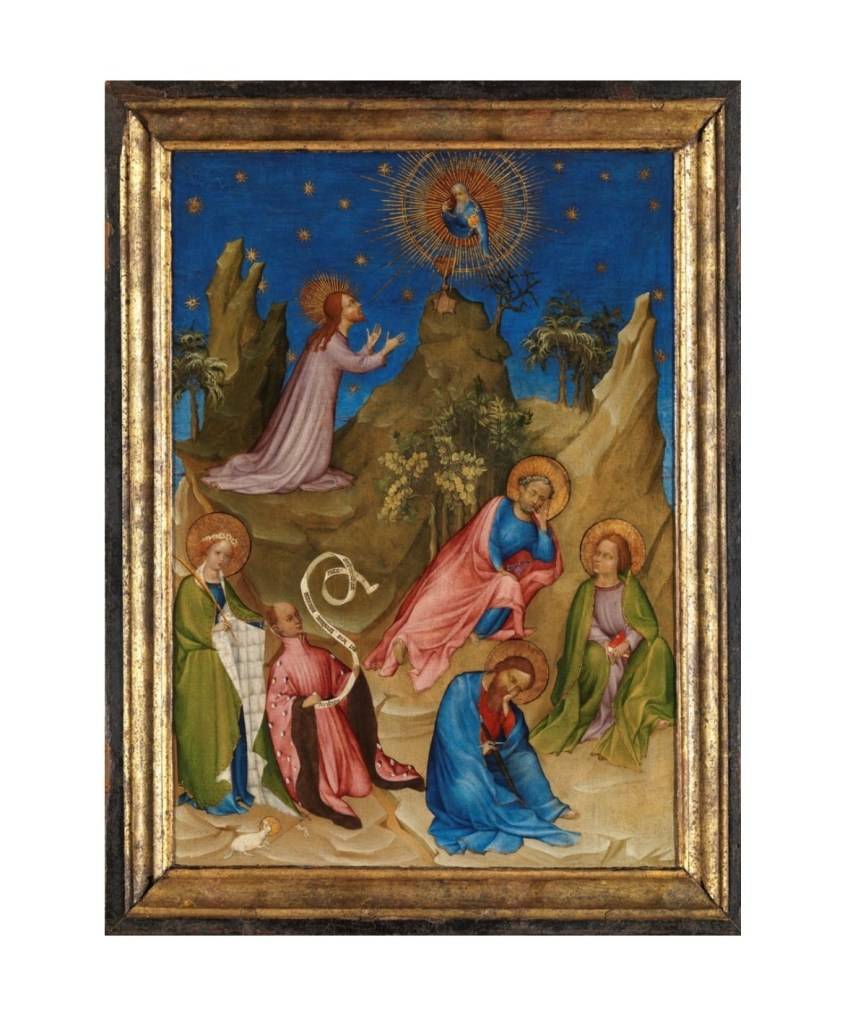
There is a panel in the Museo del Prado titled “Agony in the Garden”, attributed to the French painter Colart de Laon (1377) whose religious work barely survives (this panel is, in fact, one piece from an original triptych). The scene portrays the well known stay of Jesus in the Garden of Gethsamane on the Mount of Olives, where solitude and abandonment prepares the interval for the moment of transfiguration. If anything, Gethsamane is an experience of inwardness outside itself, which the painter has marvelously captured in the figure of Jesus raising his hands in supplication to the starry skies and god. Or so we think. The crisp blue tone of the sky immediately reminds the view of the vault of the Villa Farnesina that Fritz Saxl has interpreted as the transmission of a previous pagan astrological faith in the pictorial composition. The intense blue tone coupled with the emphatic stars arrest our imagination, but also that of the humane and worldly Christ.
What kind of experience is to look up into the firmament from man’s place on Earth and the cosmos? And what are we to make of the inability of the civilized human being to look into the blue depth not as a mirror of Nature, but of the non-totalizable and irreducible experience of solitude? It must be said that in a post-mythical world, the increasing loss of the opening of the sky goes hand in hand with the boundless loss of the Earth. And this is why we are tempted to read Colart de Laon’s picture as a gesture that renders legible the passage of the same movement: the Jesus that raises his hands outwards to the sky; and, simultaneously, the dozing Jesus that inhabits the contemplative state at the center bottom of the picture. To live in the world is defined neither by the experience of the time of arrival of the sky nor by the inward experience of the soul, but by the ability of transiting from one state to the other. And only there the worldly divine can be disclosed beyond the sclerosis of form.
This might also explain why Søren Kierkegaard following the German hymnist Gerhard Tersteegen could write in a gloss of his diaries that Jesus arises from the love feat into the path of Gethsemane: “It is always this way: Gethsemane lies closest to the highest bliss” [1]. The highest place is not the moment of absolute transcendence through faith; it is the secret that for Tersteegen expresses a kenotic hymn that empties life in the direction of poverty and death. In other words, the “highest bliss” is the experience of expropriation of every life; making life and death become indistinguishable in the vacillating night. A night beyond time and without god.
Perhaps not just the “religious experience”, but allexperience has as its central paradigm, the highest bliss in the face of death in which language can only account for it in its muteness and reverence. This is not an experience of vital teleology of humanity, but of a furtive relation. “Hacía sobre ella la experiencia”, as a Chilean writer once put it in the imperfect tense. But this can only mean to do an experience on the dissolution of oneself.
.
Notes
1. Søren Kierkegaard. Journals and Notebooks V.7 (Princeton University Press, 2014), 368.
In a fragment from 1919 entitled “World and Time”, written around the time of the elaboration of the essay on the question of violence, Walter Benjamin offers his most succinct definition of politics: “My definition of politics: the fulfillment of unelevated [ungesteigerten] humanness” [1]. The ontological reduction is compact, and the three terms in it are carefully chosen: fulfillment, unelevation, and humanness, which indicates a ‘preparation for a profane politics’ at the threshold of secularization and its negation in a new “spiritual ornamentation”, as he would claim in the notes of “Capitalism and Religion”. The stress on the refusal of “elevation” (gesteigerten), however, does bring to bear that Benjamin’s refusal of a political ontology constrained in subjective and objective representation, which is why in the same fragment he connects the abutting of politics to a “living-corporality” [Leiblichkeit] of the human species. To retract from the cycle of civilizational violence, politics had to be reformed from the groundlessness of the energy of the living.
Hence, for Benjamin there is a metapolitical condition or archipolitics that plays out in refusing “elevated humanity”, which for him was at the source of the romantic response to the impasse of the critical enlightenment, placing the subject of knowledge and its self-reflective faculty at the center of the developing self-rationalization of the spiritual transcendence of the world in this new critical religion: “…the ideal of humanity by rising up to…that very law which, joined to earlier laws, assures an approximation to the eternal ideal of humanity” [2]. Hence, neither trascendental representation nor spiritualized immanence of order could, but unelevation of the “human possibilities” (Menschhaftigkeit). But such possibilities could only be disclosed beyond the pretensions of spiritual elevations of a unified consciousness, as Erich Unger had proposed in his Politics and Metaphysics (1921) around the same time to enact a “politics of exodus” for a common psychosocial regeneration.
Benjamin’s proximity and distance from Unger’s position could perhaps inform why instead of writing a promised book that was going to be entitled True Politics (Die Wahre Politik) – allegedly containing two chapters “The destitution of power” and “Teleology without ultimate goal” – evolved into the landmark essay “Towards the critique of violence”, in which the frame of domination and the ontology of politics was recasted as a mediation about the folding of secularized annihilating violence, substance intrinsic to the philosophy of history and indestructible life of the soul (“annihilating only in a relative sense…never absolute with regard to the soul of the living”) [3]. Thus, one could say that accounting for the groundwork of “politics” meant accepting the constitutive verticality cosigned to modern philosophy of history, and its bipolar schematism between moral principles and sacrificial production. If Peter Fenves’ assumption is correct, Benjamin was not only inscribing a distance from Unger, but, more importantly, from Kant’s Toward Eternal Peace who defined his “true politics” as dependent on moral determination: “The true politics can therefore not take a step without having already paid homage to morality, and although politics by itself is a difficult art, its union with morality is no art all, for as soon as the two struggle against each other, morality into two cuts the knot that politics cannot dissolve – The right of human beings must be held sacred [heilig], however great a sacrifice this may yet the dominant power” [4].
The Kantian liquidation of politics to morality is hyperbolic to the modern epoch and its crisis – the crisis and enmity against the concept of the political, Carl Schmitt would claim in Political Theology (1922) – rendering modern politics and legitimacy hollow; something that Benjamin had understood well he saw to retract from the question of “politics” to that of a critico-metaphysical exploration waged on morality “as nothing other than the refraction of action in knowability, something from the region of knowledge…Morality is not ethos” [5]. Elevation could only have meant the production of a subject of knowledge and the specific (technical) arrangement of knowledges for subjection. On the contrary, the ethos was the necessary condition no longer for any “coming politics”, but rather for the disclosure of “the coming world” [die kommende Welt] itself. This means that working through the redemption of the world solicits a reversal from morality to ethics only to later transform the conditions of politics.
Let us return to the definition of politics as “unelevated [ungesteigerten] humanness”. What defines “unelevation”? From the ethical point of view it conjoins with the notion of “inclination” [Neigung] that Benjamin favors because of its unconditional valance that disarms the cycle of violence of the human community and its willful hostilities. The inclination rejects the paradigm of force because it an erotic mediation, that is, an affection of donation and love beyond exchange [6]. But inclination is only possible through language, as Benjamin had expressed in his “concept of politics” in a letter to Martin Buber from 1916: “I understand the concept of politics in its broadest sense…in this sense, therefore, language is only one means of more or less suggestively laying the groundwork for the motives that determine the person’s actions in his heart of hearts. Only the intensive aiming of words into the core of intrinsic silence is truly effective action” [7].
Thus, the suspended elevation of the subject and higher order meant that its persuasive purity allows the inception of the “divine” as a «teleology without a goal» validated by the suspension of judgement of appearance. The intensification of the unelevation opens life to an ethical demand of a “living corporality” that roams the world’s crust beyond depredation where the force of autonomy of social practices does not risks the world of life forms and the soul. Indeed, at this point Benjamin does join Unger’s cardinal thesis: “Overcoming capitalism through wandering”. Or as he wrote even earlier about Hölderlin’s poetics: “[In the world of Hölderlin], the living are always stretching of space, the plane spread out within which destiny extends itself…it already comprehends the fulfillment of destiny” [8]. A politics oriented pending dowards to “unelevation”, inhabits the ground level of co-existence and cultivation dismissing the ontological derivatives or principles (archein) of ‘politics’ in order to conquer every possible destiny in the lawless fulfillment of the world.
.
.
Notes
1. Walter Benjamin. “World and Time”, in Walter Benjamin: Toward the Critique of Violence: A Critical Edition (Stanford University Press, 2021), 74.
2. Walter Benjamin. “The Concept of Criticism in German Romanticism”, in Selected Writings, Volume 1, 1913-1926 (Harvard University Press, 1996), 138.
3. Walter Benjamin. “Toward the Critique of Violence”, in Walter Benjamin: Toward the Critique of Violence: A Critical Edition (Stanford University Press, 2021), 58.
4. Peter Fenves. “Introduction”, in Walter Benjamin: Toward the Critique of Violence: A Critical Edition (Stanford University Press, 2021), 18-19.
5. Walter Benjamin. “Ethics, Applied to History”, in Walter Benjamin: Toward the Critique of Violence: A Critical Edition (Stanford University Press, 2021), 74.
6. Walter Benjamin. “On Kantian Ethics”, in Walter Benjamin: Toward the Critique of Violence: A Critical Edition (Stanford University Press, 2021), 71.
7. Walter Benjamin. “Letter to Martin Buber” (1916), in The Correspondence of Walter Benjamin (University of Chicago Press, 1994), 79-80.
8. Walter Benjamin. “Two Poems by Fredrich Hölderlin”, in Selected Writings, Volume 1, 1913-1926 (Harvard University Press, 1996), 26.
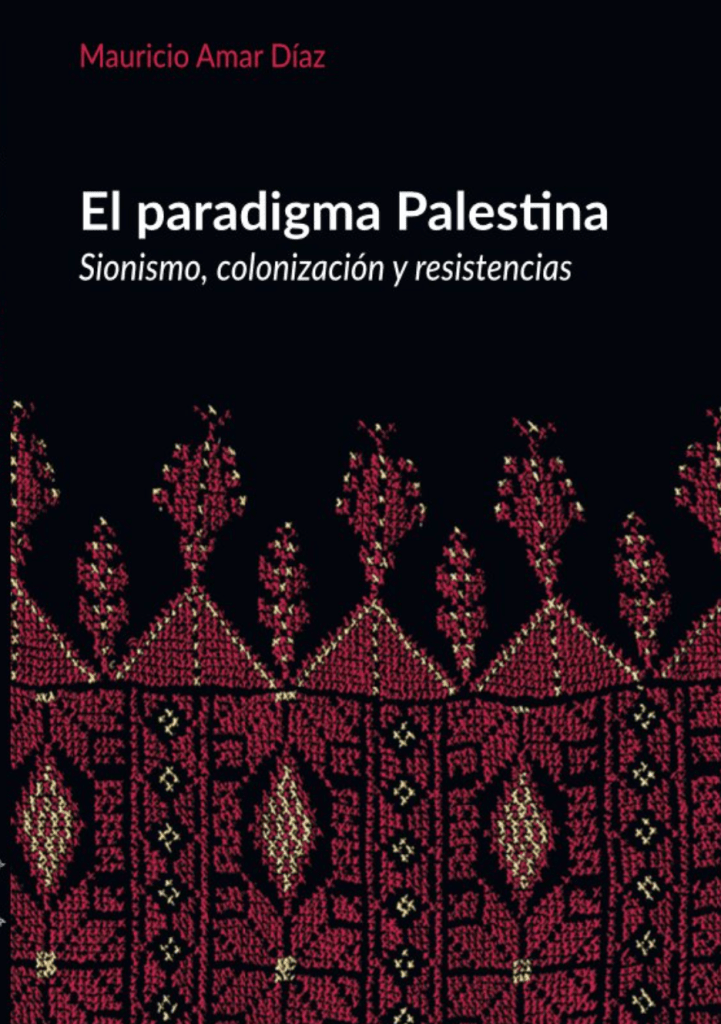
What does it take to destroy a world? It would seem that the question itself is too metaphoric and impertinent; perhaps also hyperbolic and presumptuous against the flight of the infinite embodied in worldling. But this is the question that we should direct ourselves to according to Mauricio Amar’s short and highly accessible book El Paradigma Palestina: Sionismo, Colonización, Resistencias (DobleaEditores, 2024), which is written in the wake of the ongoing war of annihilation in Gaza in order lay bare the paradigmatic abyss of social death in which humanity finds itself at the peak of its civilizational dominance. Amar does not use the term “paradigm” lightly, and nor is he interested, as recasted recently by none other than Steven Bannon citing Thomas Kuhn’s work about scientific revolutions, in posting a central conflict towards transformation; rather, one must situate this strategic conceptual deployment in light of the Chilean philosopher’s own work on imagination and use, which provides an irreducible and sensible texture to every emergence of a paradigm [1]. This means that if Palestine is, indeed, the paradigm of our epoch is precisely because it has no-space in the world – it is what can be infinitely be destroyed, as Maurce Blanchot famously said commenting Antelme’s work – and what illuminates the core and extension of the “integrated” planetary humanity oriented towards the administrative governmentality of contemporary Western democracies, and its corollary geopolitics of the total artificial spaces, as Bruno Maçaes has recently called it. Reading Amar one senses that under the name “Palestine” he is registering a limit to the Humanist force, where an existential claim reveals the maelstrom of an epoch that has resorted to a grotesque parody of the ancient homeric standards of domination and submission. It is the outlook that Simone Weil described as the paradigm of transforming the world into nonliving things.
If understood as a paradigm, Palestine reminds us that the homeric energy towards the aristocracy of equality through force and death among the human race never truly ceased, but only changed forms and cloaks throughout the ages. The post-mythic West seemed to have constructed itself through the repeated revolutions that accommodate justifications for usurpation and containment, self-deification and legibility of the territory at the service of a fictive ethnos. The belated nationalism of modern Zionism has had the paradoxical quality of being both a project of territorial usurpation after its illegalization in International Law (The Kellogg-Briand Pact of 1928); while, at the same time, a politico-theological configuration that, as Monica Ferrando has shown in L’elezione e la sua ombra: Il cantico tradito (2022), clings upon the manipulation of the theological election of “a People” in order to deploy the coterminous binding between community and territory justified through divine narration. The interdependence of the spiritual goal of Zion is only possible through the construction of a settler state, at the same time that the occupying state’s only legitimacy based on ‘one God, one People’ relies on the restitution of an instrumentalized form of the theological election. This is why for Amar the Zionist state building project is a the paradigm of a specific type of colonial governance whose end is not just to capture errant people into social subjects, but more fundamentally a translatio imperii that folds the Earth into a territorial nomoi of distinct multilevel functions: checkpoints, walls, vigilante control of movements, constructions and erasure of surfaces, administration of critical infrastructures, development of extractive resources, and finally the hunting down of humans that necessarily blurs the line between civil population and battlefield combatants. When Amar reminds us of Israel’s predominance in planetary security and warfare technology, one can immediately recall Emile Benveniste’s suggestion that “measurement” (med*-) and the proportional addition to produce objectivity, entails an efficacy of permanent dominance and governability whose main enterprise is the management of populations through the regime of accumulation. As Andreas Malm reminds us of the current cartography of Palestine: “The genocide is unfolding at a time when the state of Israel is more deeply integrated in the primitive accumulation of fossil capital than ever…This is the political economy of normalization: a sacralization of busines as usual that destroys first Palestine and then the earth” [2]. The ongoing devastation of Gaza is a window into the project as a whole: the necessary destruction of the worlds and the total artificiality of the life-worlds, always at the service of maintaining the needs of anthropological symbolizations.
For Amar this points to an epochal scenario of a people without world; and, following the lead of Sari Hanafi, he will claim that the paradigmatic mirroring of Palestine is also an spatial-cide, in which the living are deprived of a sense of inhabiting and roaming that brings to bear that the nakba is not something that has taken place in history once and for all, it is a catastrophic event that has not ceased from repeat itself, and whose ultimate intention is to suture the world and existence, the soul and the spirituality of the open atmosphere that is needed to sustain life. Reading Amar between the lines – who towards the end of the book finds distant interlocutors in Darwish’s poetry, the philosophy of Gilles Deleuze, as well as in the glosses of Walter Benjamin on history and the prose of Edward Said – one learns that the true arcana of Palestinian resistance is also a secret promise for our apocalyptic times: to hold on to the world, so that we can all passionately land on the Earth and freely breath in its surroundings. The nexus of the Palestinian question and the intrusion of Gaia, although underdeveloped in Amar’s analysis, obliquely runs through a text that is also very much about the central question of ethics that never abandons thought: how to name what escapes without taking the world as such into an object to be possessed, destroyed, and remade anew as a hostile secular imago dei. The vindictive hyper-consciousness of the contemporary unmediated arcana imperii now reveals, as Amar says towards the end of he book, a mirror through which we can observe our own increasing domestication, in which the metropolis is just the luminescent and self-protected hub, but whole ultimate darkening shadow is the Gaza’s pile of rubbles resembling an open air necropolis (Amar 108-109). Through different arrangements of organized destruction, both the metropolis and the necropolis converge in their preeminent ‘struggle against space’ and its form of life for the sake of familiar pieties of enslaved survival of unworldly anomie (Amar 116).
Does this mean that we are all “Palestinians”? Mauricio Amar’s El Paradigma Palestina (2024) rejects the all too well expected craft of solidarity and subjective identifications that can only work on the payroll of the gravediggers of the current civilizational project. On the contrary, if Palestine is our paradigm, and it remains so, it is because it can only refuse measurement and recognition in order to dwell in the only possible exteriority as embodied to Darwish’s poetry that Amar quotes towards to the end book: “Do not trust the poem / absent child / it is the throbbing of the abyss” (Amar 140). From the abyss we nourish the soul as the return to land on Earth prepares itself in order to no longer conquer a territory, an ancient tradition, or a “People” (ethnos), but to dwell on the nearness of a place that is an excess to every location or community of belonging (this is the false exit of the kibbutzim). We do not have political grammar to articulate what this integral freedom could mean, except that it is an exotic relation in Victor Segalen’s sense: a creation of a world alien from the compatible and petty one that currently drains us into its ongoing desperate destruction and passive enslavement [3]. Finally, like all authentic paradigms, it is worth noting that Paradigma Palestina (2024) teaches and preaches nothing; it only invites us into the swirling sensation that crosses over the imagination and the singing voice, from the world of the last remaining lives to the isles of the dead martyrs, and back.
.
.
Notes
1. Mauricio Amar. Ética de la imaginación: averroísmo, uso y orden de las cosas (Malamadre, 2018).
2. Andreas Malm. The Destruction of Palestine is the destruction of the Earth (Verso, 2025), 53.
3. Victor Segalen. Essay on Exoticism (Duke University Press, 2002), 24.
“What is the genealogical figure that best recalls this form of enmity in late American imperialism? The pirate.” This was written by Rodrigo Karmy, who sets up the ground for a timely inquiry. In fact, it is necessary to understand the accelerated processes that are currently underway as a civilizational choreography that only now finds an intense vortex of legibility. In what sense, then, can we speak of an order of pirates that have taken hostage the fleet of imperial politics and the empire of politics? At this point I would like to recall a brilliant and forgotten book by Charles Olson titled Call Me Ishmael (1947), which offers a perceptive interpretation of the essence and orientation of Americanism as an unbounded planetary civilization. Unlike many others interpretations – Max Weber on Calvinism and communitarian deification; Marxists on the Fordist mode of production and passive revolution; and even those that recast the economy of the spectacle and the psyche of mass culture – for Olson, who takes a necessary stepback, the civilization deployed by Americanism is essentially a production regime that first rose from the extraction of whale oil in the 19th century [1]. And as some economic historians have reminded us, before the first oil wells were found in Pennsylvania in the mid-nineteenth century, oil was embedded in the species of the sea, that is, in the fishing and cutting up of the mythic sea creature [2].
The veiled settlement of expansionism to which Daniel Immerwahr has drawn attention recently can only be understood if we start from the premise that the arcana imperii of Americanism is a maritime enterprise that takes the world itself hostage. This means that unlike the English trading companies of early liberal capitalist modernity, Americanism is no longer concerned with the neutralisation of a common space for the exchange of goods and values, but rather with something more terribly vast: the domination and total extraction of the sea and its species. Whoever rules the seas rules the earth; in other words, whoever is able to guide the threshold of the earth has been able to do so because he has already crossed every possible limit in the land surveying (agrimensura meant precisely the measurement of the land) art of territorial appropriation and separation.
The civilizational differential of such achievement should now be evident: this production regime does not have a territory or a specific mode of production as its objective, and this is precisely Olson’s thesis, but its sole purpose is to release an effective domination of the world. And only the world can be its most coveted object. Hence, it is worth remembering, that for Herman Melville – as he puts in the mouths of some of his characters – the enterprise of Americanism embodies in the secularized time of modernity something truly monstrous: nothing less than the consummation of the presence of evil; that is, the mystery of inequity (mysterium iniquitatis) in suspense and processed through the wager of the strongest whaler. How is humanity introduced and lodged in the courtyard of the mystery of inequity? Well, not only by fishing for each other, but by calling into question the very existence of the world. The religious imagination surrounding the fisherman as a prophetic symbol of salvation of the human species, as illustrated in a well-known plate from Herrad of Landsberg’s Hortus Deliciarum (1167), reappears in Americanism as an unbearable parody of all living things on earth. As one of the characters in the late novel Pierre (1852) says: “I hate this world.” And one could say that the inner belief in hatred is the fundamental stimmung of Americanism.
Thus, it is no longer just that we are hostages on the San Dominick, thrown into the groundless instance of the decision; it is something more sinister, lethal, and inconspicuous. The whaler is ultimately not the politician, he is the common man, a hollow-crowned qualunque, whose fate is shipwreck and whose tongue is commanding force. In the existential struggle between Ahab and the whale the only destiny is to caress the sea floor, as Olson says, will amount to something “all scattered in the bottom of the sea”. The post-mythic historicity of the flood reaches its definitive realization in Americanism as the genesis of a devastated world without an ark – propagated by the extinction of all species and all worlds and all presences, putting an end to the soft and untimely music of redemption.
A redemption that, not by chance, Melville only managed to find in the possible restitution of the original garden in the lands and landscape of Palestine: “Looks pearly as the blossoming / And youth and nature fond accord / wins Eden back…”, we read from the verses of Clarel (1876) [3]. Being able to preserve this acoustic garden besieged by the metaphysical force of the whalers may be the only ark left for us to land somewhere on Earth.
.
.
Notes
1. Charles Olson. Call me Ishmael (Grove Press, Inc, 1947), 18-19.
2. David Moment. “The Business of Whaling in America in the 1850s”, The Business History Review, 1957, 281.
3. Herman Melville. Clarel: A Poem and Pilgrimage in the Holy Land (1991), 87.
Whenever a professional politician today evokes the ‘soul’ one must be immediately suspicious, as it tends to be an automatic lullaby for “national unity” or a dormant metaphor in a flowing stream of empty chatter. What could the soul mean to anyone – say, those millions that have now for the second time voted fairly and squarely Donald J. Trump to the Executive branch of the national government – only capable of giving attention to a series of onomatopoeic pop-words that are now ingrained in the linguistic acoustics of the American lexicon (“Bitcoin”, “Tiktok”, “Woke”, “Prime”, and the list could go on). The ongoing catastrophe is first and foremost within the texture of language, which is ultimately why it is also an ethical decomposition in which all other spheres of practical action (first and foremost, politics) amount to business as usual with its corresponding rhetorical bravura.
Suggesting continuity might perhaps be an understatement: it is now a business that does not need any sumptuous or veiled mediation; refracted upon its own absorption of its hyperproduction of fiction, the defeat of the communitarian salvation of Calvinism can only be expressed as a self-serving an ongoing destruction and self-annihilation. True, it could be claimed that ‘Americanism’ has always been this; the only difference is that today, already well into the century, it moves in a vector that directly rejects the world while making a full fledged program of its own making. Only a Society that has become fully moribund can celebrate its own death and decomposition; while the emancipated and well scripted villains of the act now have no shame but to reveal how the ultimate object of their conspiracy was the obliteration of the Earth.
“It is the time of the assassins”, TJ Clark writes echoing Henry Miller’s unjustly forgotten book on Rimbaud and the legitimation of the social bond, in which the homo homini lupi discloses itself from any all possible contact in the metropolis solely dependent on ad hoc hyperproduction of justifications required to fully commit to the illusion of legitimate action. Only that now the time of the assassins is perhaps an uncanny dark night of those without souls, as in the deranged characters of a McCarthy’ novel: they are willing to kill and be killed; they are beyond any contact with language, and “what do you say to a man that by his own admission has no soul? I’ve thought about it a great deal” [1]. And indeed, there is nothing to say and nothing to face: in the soulless dark night there are only hunters and those that are hunted; there is integration or pulverization; there is killing and there is humiliation before an ever increasing legal nexus coordinating the acquiescence of force. But perhaps this is the real arcana of the American soul that is only shimmering through in all of its glory.
Someone like D.H. Lawreence definitely thought so when writing about the novels of Finimore Cooper: “[The white american] lives by death, by killing the wild things of the air and earth…All the other stuff, the love, the democracy, the flooring into lust is a sort of by-play. The essential American soul is hard, isolate, stoic, and a killer. It has never yet melted” [2]. But in our days it has begun to melt, to fragment, and decompose in a heavy storm of pain and despair. And it continues to stand in the long winter of American civilization (the castle of Frozen is the allegory of the epoch) that now finds itself at the epochal threshold of the end of growth, only left with rampant nationalist impulses of self-affirmation that can only deepen the nihilist tonality of anguish and self-destruction, and the emergence of the bizarre as Jamie Merchant notes in his recent Endgame (2024).
In his Reflections on America (1958), Jacques Maritain maintained that the spiritual patrimony of Americanism is that of being “bruised souls”, a community that came into being by double exclusion (hunted by their religion and rejected within a national polity), which in turn allowed to be compassionate to human suffering, and thus the hidden meaning of the wound was to be seeing in the “role played by immigration and poverty suffered in the Old World” [3]. Hence, for Maritain the condition for the healing soul of America resides in its opening to ongoing suffering of migrants, the dispossessed, and those in exodus from the psychic pressure of a social metabolism gone sour in every subject of civilizational decay as Erich Unger had proposed in his Politics and Metaphysics (1921).
It comes to no one’s surprise, thus, that the decomposition of the American soul departs from the overt opposition to migration, as a figure of the grazing over the Earth, that must be vanquished and condemned by a planetary gnosticism undergoing in front our eyes. The Chrisitian modern state enters in this way into a concrete and visible process of artificial desecularization showing that “the Christian relation to the State…is in mad hostility to all of them, having in the end, to the destruction of them all. […]. And it is, simply, suicide. Suicide individual and en masse” [4].
The stakes are extremely clear: it is for the bruised and the brute (some have called it the barbarians, proprietors of strange tongues, keepers of the clandestine lacunae of language) to retreat from the fictive proliferation of appearances, the artificialization of reason that can promise success as the ultimate pinnacle of self-destruction. Inclined beneath the shadow of archaic Penia, the bruised and incurable souls might not find redemption in the American wasteland, but they will land somewhere between language and world. Not a program but a moving conviction.
.
Notes
1. Cormac McCarthy. No Country For Old Man (Vintage, 2005), 8.
2. D.H.Lawrence. “Fenimore Cooper’s Leatherstocking Novels”, in Studies in Classic American Literature (Thomas Seltzer, 1923), 92.
3. Jacques Maritain. Reflections on America (Scribners, 1958), 84-85.
“Symbolism and immortality”, was the title of a talk that a very young Boris Pasternak gave in 1913 to a group of students, although the paper was finalized around 1917. It has been known that the integral version was destroyed or misplaced, and only a synthesis was preserved in the author’s papers, which provides access to the thicket of the argument, which concerned ultimately the immortality of artistic creation and the transhistorical participation of the human species in the enduring process. Pasternak himself inscribes this lecture at the heights of his ars poetica: “My main purpose was to put forward the proposal that perhaps this maximally subjective and universally human corner or lot of the soul was art’s immemorial area of activity and its chief content. And, further, that although the artist is of course mortal like everybody else, the happiness of existence which he has felt is immortal and can be felt through his works by others centuries after him” [1]. Unlike the contentious positions about the creative genius and the orientation of the poet (dichter als Führer) that soon enough will inform the thick aura of European modernism in the age of dissonance, for Pasternak in the 1910s (the same decade as the early Lukacs and the youthful Michelstaedter), creation concerned a gathering of experience outside subjectivity; it was fundamentally the experience of the outside beyond the subject, which could only be cultivated by the poetic sensibility’s relation to that outside. It is not clear where there was a figural specificity to the notion of “poet” that Pasternak advances; but, what is essential, is that the poetic task was only possible through a spiritual formation and deployment of symbolization, that is, of the transfigurative use of language.
Pasternak does not distinguish between vulgar and crafted poetic language; rather he uses the term symbolism to account for the sensible immortal reservoir that is transmitted in the stratification of the genesis of the human race. It is not of minor importance that Pasternak is writing in the dawn of a concrete materialist revolution, in which possession is only registered, counted, and even “destroyed” as mere “stuff”, thus incapable of solving the crisis of the transmission of tradition and blind to the problem of sense. Indeed, perhaps the revolution can only deepen the epochal crisis of symbolization. Pastnark will write affirmatively: “Immortality takes possession of the contents of the soul…in pure form this is what symbolism teaches” [2]. In a conception that is strikingly similar to Warburg & Saxl’s conception of the symbol (and history now designed as a study of the coagulation of symbologies) as a surplus discharged of energy as the reservoir of human sensation and formulas of imagination (the pathos formulae); the attunement towards symbolization never amounts to an accumulation of meaning and narration, but rather it is what preserves the earliest and purest stages of human expression, as argued by Saxl [3].
This is why there is no immortality except in the beginning: the real process of the anthrogenesis is only accessible in those moments of passion and experience while “being observant and drawing from nature”, Pasternak will claim in his talk. The immortality to be retained, it seems now clear, is not that of a future and postponed soteriological communal “life”; it is rather a life that clings to the ordinary and intuitive symbolism that resists the monstrous numbing of fictitious life commanded by the blackmail of the reality principle required by orderability. In this light, perhaps Alfred Metraux is right in that going beyond the neolithic age marked a catastrophic wandering for human beings. (And is not the poetic instantiation a painful reminder of this?)
The stratification of symbolism was of a higher reality; a playful dance between the figure and the non-figural, between the visible and the invisible, between the countable and the non-countable. Pasternak situates this tendency under the sign of “theos“, a religious character in which the texture of the soul is able to find some breathing space as condition of possibility for the opening of symbolism. Modernity is many things at once, but for Pasternak what was being “withered away” at the altar of morality and politics, Church and State (his terms verbatim) was precisely the historical draught of the symbolic man: “The communion of mortals is immortal and that life is symbolic, because it is full of meaning” [4]. This means that there is no community of salvation that serves as the general economy transport between the two kingdoms; if there is a Kingdom it is only of the symbolization of the irreducibility of souls, that can only enjoy immortality in the renunciation of what the materialist and survivalist life is capable of offering in detriment of the experiential possibilities of creation and language when grasping the sense of deathlessness.
In the life of civil society you will live organized only unto death, without any experience of immortal death of any other, given that death has become mere transaction, a burdensome logistical ritual, a common spectacle. And this is why Pasternak, unlike the Cold War pawn that sometimes he was forced to embody, gradually became convinced that poetic existence could only take place outside the Social with no role or mission to subscribe to: “Do not reserve a poet’s position: it is a dangerous, if not empty” [5]. What was at stake was not a “new life” but a second birth (title of his own poetry collection, Vtoroe Roshdenie from 1934) to plunge into the depth of symbolization. The task is not to invent anything “new” (that modern fetishism), but to regain the life of the soul where the origin commences: “…and here art stops, And earth and fate breath in your face” [6]. It is a mysterious and impossible portrait of a face that reckons with the passing of the symbol and its absolute mystery. The very texture of expressivity that, against all odds, lingers on.
.
.
Notes
1. Boris Pasternak. An essay in Autobiography (Collins and Harvill Press, 1919), 69.
2. Boris Pasternak. “Symbolism and immortality”, in The Marsh of Gold: Pasternak’s Writing on Inspiration and Creation (2008), 40-41.
3. Fritz Saxl. “The expressive gestures of Fine Arts”, in Lectures V1-V2 (Warburg Institute, 1957).
4. Boris Pasternak. “Foreword”, in Selected Poems (Penguin Books, 1983), 14.
5. Boris Pasternak. “To a Friend”, in Selected Poems (Penguin Books, 1983), 100.
6. Boris Pasternak. “Second Birth”, in Selected Poems (Penguin Books, 1983), 109.
Towards the end of his life, poet José Lezama Lima will mysteriously begin to sign the letters to his friends and family as “the Trocadero Etruscan”, a “member of the Etruscan religiosity”, and even the “man who lives in the Etruscan village” [1]. Why call himself an “Etruscan” in this particular moment of his life, and what could it possibly mean? The question about the meaning of the Etruscan authorial mask has been so thoroughly ignored by the literary critics that commentators at their best have noted that “being Etruscan” merely stands for his “cosmopolitanism” and “well-learned Europeanism”. Of course, this explains little to nothing. A sophisticated poet such as Lezama Lima, who ruminate over every single word he would write, could not have ignored that the Etruscans, unlike the civilized Romans and the Latin authorities, was a remnant to the very civilizational enterprise; a prehistoric people poor in written culture, achieved expressivity by the whole outlook of their form of life. And as in the case of Hölderlin’s adoption of different nom de plume (Scardanelli, Killalusimeno, Scaliger Rosa, etc), Lezama’s becoming Etruscan points to something so fundamental that if underscored we would fail to grasp the endgame of his vital poetic experience. The transfiguration of the name does not merely stand as a metaphor; rather it points to a distant figure that will finally dissolve him so that his immortal voice could continue to live on.
Indeed, the self-identification as an Etruscan for Lezama became a subterfuge to flee a political reality – his political reality, entirely structured by the revolutionary gigantic productivism and subjectivism – through a poetic refraction that would free an ethos from the overpowering of alienated autonomous space of the linguistic reproduction of social life. If at first glance it seems like a paradox that Lezama will adopt the Etruscan figure for his antisocial ethos – a civilization lacking written records or high literary achievements, a religious community known for its necropolis – this strangeness will ultimately prove that behind the Etruscan name there was no poetic exclusivity of the poet’s genius, but rather, as he claims in “A partir de la poesía”, the possibility for a divinization of reality to retreat from the historical epoch. In fact, Etruscan culture for Lezama was not a mere archeological ornament, but one of the “imaginary eras” of the West; that is, a stage of condensed and unnumbered imaginative possibilities resistant to griping subsumption and totalization of values. The Etruscan was the mythic remnant through the pantheistic divinization between language and the world. As Lezama writes glossing, in passing, Vico:
“Vico cree que las palabras sagradas, las sacerdotales, eran las que se transmitían entre los etruscos. Pero para nosotros el pueblo etrusco era esencialmente teocrático. Fue el más evidente caso de un pueblo surge en el misterio de las primeras inauguraciones del dios, el monarca, el sacerdote, y el pueblo unidos en forma indiferenciada … .les prestaba a cada una de sus experiencias o de sus gestos, la participación en un mundo sagrado. […] Pues en aquel pueblo, el nombre y la reminiscencia, animista de cada palabra, cobran un relieve de un solo perfil” [2].
The divinization of the Etruscans stubbornly insisted on the wonder of things. The human participation in divinity is no longer about founding a new theocracy or a “theocratic politics” in the hands of a ‘mystic accountant’ that would finally put the nation back in track (into the res publica), as Lezama would solicit out of desperation in the 1950s diaries [3]. On the contrary, for Etruscan people the fundamental tonality was the divine music of experience. Of course, we know that D.H. Lawrence captured this when claiming in his Etruscan Places (1932) that “the Etruscans are not a theory or a thesis. If they are anything, they are an experience. An experience that is always spoilt” [4]. And this experience (like every true experience) needs to be necessarily spoiled, which ultimately means that it cannot be mimetically rendered, arbitrarily modified, or subsumed into the order of idealization. But all of this is merely redundant, since the Etruscan inscription is what accounts for the limit to civilization, becoming the impossibility of the destruction of myth in the arrival of modern aesthetic autonomy. Thus, for Lezama the Etruscan way had something of a persistent cure against the ongoing civilizational disenchantment, even if it does not cease to appear in the modern attitude. In fact, Lezama writes that: “Rimbaud is the best reader of the Etruscan liver” (“hígrado etrusco”) to describe the dislocated position of the poet in the modern world of technology [5]. In the Etruscan cosmology, the liver was a symbolon of the vision of the cosmos registering the divisions of the spheres in the sky through the divine naming of the gods; it is the figure by which the poet guards the desecularizing remnant of the prehistoric inception of myth [6]. But this does not mean that Lezama will look at himself in the mirror of Rimbaud’s symbolist alchemy.
Rimbaud as an Etruscan is the poet who descends into hell because his lyricism can bear the pain in the disruption of language after the archaic peitho. Does the possibility mean a travel back in historical time? Not the least, as Lezama knew how to let go of storytelling and historical necessity. This is why Etruscans stand for an image or a sort of handwoven picture (the hand will make a comeback, as we will see) to gain vision. And this is one case on point: the Etruscan stands paradigmatically to the “sufficient enchantment” (“la cantidad hechizada”) , which discloses a higher knowledge of the soul (psychê) in the taking place of poetic errancy: “Sabemos que muchas veces el alma, al escaparse de su morada, tripulaba un caballo inquieto, afanoso de penetrar en las regiones solares” [7]. To wrestle against the historical reduction of autonomy of the modern age means to find this enchanted sufficiency necessarily for myth remnant to elevate itself against the aesthetic mediation that, in the words of Gianni Carchia, had become a consoling surrogate of the emptied historical time [8]. An entirely other conception of freedom is firmly implicated the Etruscan way: the gathering of the enchanted poetic dwelling to dissolve a reality that had become too thick in the business of brute force purporting to call ‘what’s out there’. The Etruscan reintroduces a divine nominalism of pure exteriority.
However, the Etruscan way does not commute with things of the world; rather, his soul unbinds the empirical limit of death to overcome death, and learn to live as if it were already dead. The trespassing of death through the poetic enchantment – which Lezama will also call an ‘potens etrusca’, or the Etruscan potentiality- will multiply the invisible possibilities against the rhetorical closure of reality legitimation. By accepting the thick of the dead as an illuminated presence, the Etruscans draw out the most important consequence: learning to live among the dead as the ultimate form of a dignified life. This is why D.H. Lawrence reminds us that the underworld of the Etruscans – their refusal of reality, the embrace of their dead, the augurium – was after all “a gay place…For the life on earth was so good, the life below could but be a continuation of it. This profound belief in life, acceptance of life, seems characteristic of the Etruscans. It is still vivid in the painted tombs. They are by no means downtrodden menials, let later Romans say what they will” [9].
If civilization is a construction that takes place at the crust of the Earth as some have claimed; the way of the Etruscan is a downward declination away from the architectural reduction of world sensing [10]. For Lezama the Etruscan dreams of a civilization submerged in the depths that only an acoustic totality that bear witness to its sensorial gradation: “Esas civilizaciones errantes por debajo del mar, sumergidas por el manteo de las arenas o por las extensivas exigencias…reaparecen, a veces, en los sueños de los campesinos” [11]. Hence, the fundamental dignity of poetry resides in the mythical homecoming that guards the possibility for what remains inexistent: “this is why the poet lives in the Etruscan world of the birth of fire” [12]. And although the Etruscan stands as one of the worlds in possession of an imaginary epoch (the other two for Lezama being the Catholic world and the feudal feudal Carolingian Empire), it is only in the Etruscan where the resurrection had taken the transubstantiation in the name itself; even if the price was its own liquidation as a historical people that refused to be incorporated into the doxa of postmythical order [13].
The fiery force of the mythic peitho outlives and predates the political epoch of the nomos of fixation organized as “One People, One State, One Language” [14]. As Lezama explains in “La dignidad de la poesía”: “…el odio en la polis contra el daimon socrático, hizo que la nueva doxa no logra sustituir a cabalidad el período mítico….Si por lo mitos, los dioses se irritable con la felicidad de los de los mortales, pero al menos, se interesaban por sus destinos; en la nueva doxa, la poesis se extinguía – el daimon individual reemplazando al destino individual liberado de la polis” [15]. The primacy of myth as orientation to happiness should make clear that for Lezama the poetics of naming follows the overflow of its permanent modalization [16]. The Etruscan way marks the path for the irrevocable retreat from the space of the polis where civilization will be erected on the grounds of deliating ethos and daimon, polis and poesis, and ultimately life and death as a rubric of a new science of separation. The fact that the civilization of social reproduction has been erected on the basis of the destruction of the chthonic underworld speaks to the systematic erasure from the dead as a vital extension of life [17]. The poetic natality of the Etruscans will only be cultivated, as Aby Warburg suggests, from the assumption of deep superstition in the face of the placement of political autonomy, which allows for the persistence of the image as inseparable from the needs and uses of the living [18]. And only persistence could prepare the final triumph over death.
[19]
Towards the later phase of his work, the poet seems to never want to abandon the Etruscan inframundo. Lezama returns to the Etruscan scene towards the end and unfinished novel, Oppiano Licario (1977), in which the central character Fronesis describes at length the mutation of reality following the footsteps at a distance of Ynaca Licario slowly merging into the Tarquinia necropolis painted wall, which is accompanied by a visual reproduction of the Etruscan tomb:
“El sacerdote, en el lateral izquierdo, hace gestos de ensalmo en torno a una espiga de triga. Un pájaro que se acerca queda detenido sin poder posarse en el ámbito hechizado de la hoja. En el lateral derecho, el sacerdote repite idéntico rito, pero ahora de la raíz colorida hace saltar la liebre que cavaba en las profundidades. El aire cubría como unas redes de secreta protección en torno de la mutabilidad de las hojas y de la inmovil jactancia de los troncos. Una indetenible pero resguardada evaporación alcanza aquella llanura con los muertos …La conversación subterránea era el símbolo del vencimiento de la muerte. [20]
The ongoing conversation (the shared word koina ta philōn) in a mysterious divine language had triumphed over death because it had overcome death and the sight of death. It is no longer the transposition of a historical sublime that must protect experience from the fixity of the human corpse, since the soul can escape the limit of form. In passing through and embracing death, the Etruscan validated their passions for mirrors and the palm, which according to Lezama is the true keep of the appearance of the uttermost revealing of the face in its own irreducible ethos. The possibility (potens etrusca) of defeating death while in life finds in the Etruscan appearance Lezama’s most intimate poetic arcana: the persistence of the anima renounces symbolic legibility as too innocuous and ornamental; where the flags of victories now resembled an accumulation of well settled defeats nurtured in the name of the muteness over “life”.
The Etruscan distance mysterium validated myth as the affirmation of the cosmos as based on the potentiality of contemplative imagination [21]. Lezama will call this distance the “eros de la lejanía” (Eros of distance) in the experience of the inframundo that will break through by affirming the possibilities of divine naming as a correlative causation in the world [22]. As Lezama tells his sister in a letter from 1966, he had already assumed to have crossed the bridge between the dead and the living: “Para mi ya ha sucedido todo lo que podía tocarme….Pues creo ya haber alcanzado en mi vida esa unidad entre los vivientes y los que esperan la voz de la resurrección que es la supresa contemplación” [23]. Or yet again: “El que está muerto en la muerte, vive, pero el que está muerto en la vida, es la única forma para mi conocida de la vida en su turbión, en su escala musical, en su fuego cortado” [24]. To scale up life to the higher music is the final trope of happiness as already dead. The Etruscan dirita vía of descension – “a weight going down” of stepping into the Earth, as Ruskin would have it – achieves the arrest of the divine contact between the voice and the dead [25]. It is for us to raise this mirror before our impoverished and fictive unswerving reality.
.
.
Notes
1. José Lezama Lima. Cartas a Eloísa y otra correspondencia (1939-1976) (Verbum, 1998), 230.
2. José Lezama Lima. “A partir de la poesía”, in Obras Completas, Tomo II (Aguilar, 1977), 831.
3. José Lezama Lima. Diario (Verbum, 2014), 87.
4. D. H. Lawrence. Etruscan Places (The Viking Press, 1957), 90.
5. José Lezama Lima. “La pintura y la poesía en Cuba”, in Obras Completas, Tomo II (Aguilar, 1977), 968
6. Gustav Herbig. “Etruscan Religion”, in Encyclopedia of Religion and Ethics, Volume V (Dravidians-Fichte, 1912), 533.
7. José Lezama Lima. “Introducción a los vasos órficos”, Obras Completas, Tomo II (Aguilar, 1977), 861.
8. Gianni Carchia. Orfismo e tragedia (Quodlibet, 2019), 81.
9. D.H. Lawrence. Etruscan Places (The Viking Press, 1957), 31.
10. Amadeo Bordiga. “Specie umana e crosta terrestre”, in Drammi gialli e sinistre della moderna decadenza sociale (Iskra, 1978).
11. José Lezama Lima. “Estatuas y sueños”, in Obras Completas, Tomo II (Aguilar, 1977), 449.
12. José Lezama Lima. “La dignidad de la poesía”, in Obras Completas, Tomo II (Aguilar, 1977), 774.
13. Ibid., 776.
14. Erich Unger. Die staatslose Bildung eines jüdischen Volkes (Verlag David, 1922).
15. José Lezama Lima. “La dignidad de la poesía”, in Obras Completas, Tomo II (Aguilar, 1977), 777.
18. Aby Warburg. The Renewal of Pagan Antiquity (Getty, 1999), 189.
19. Image included in Chapter VII of Oppiano Licario (Cátedra, 1989), 375.
20. José Lezama Lima. Oppiano Licario (Cátadra, 1989), 374.
21. Aby Warburg’s treatment of the symbolic mediation between myth and distance appears at the center of his essay on Pueblo Indians. See, Aby Warburg, El ritual de la serpiente (Sexto Piso, 2022), 66. And also, Franz Boll, Vita Contemplativa (Heidelberg, 1920), who connects contemplari to the augur’s spatiality of the templum.
22. José Lezama Lima. Cartas a Eloísa y otra correspondencia (1939-1976) (Verbum, 1998), 411.
23. Ibid., 109.
24. Ibid., 266.
25. John Ruskin. The Letters of John Ruskin (George Allen, 1909), 133.
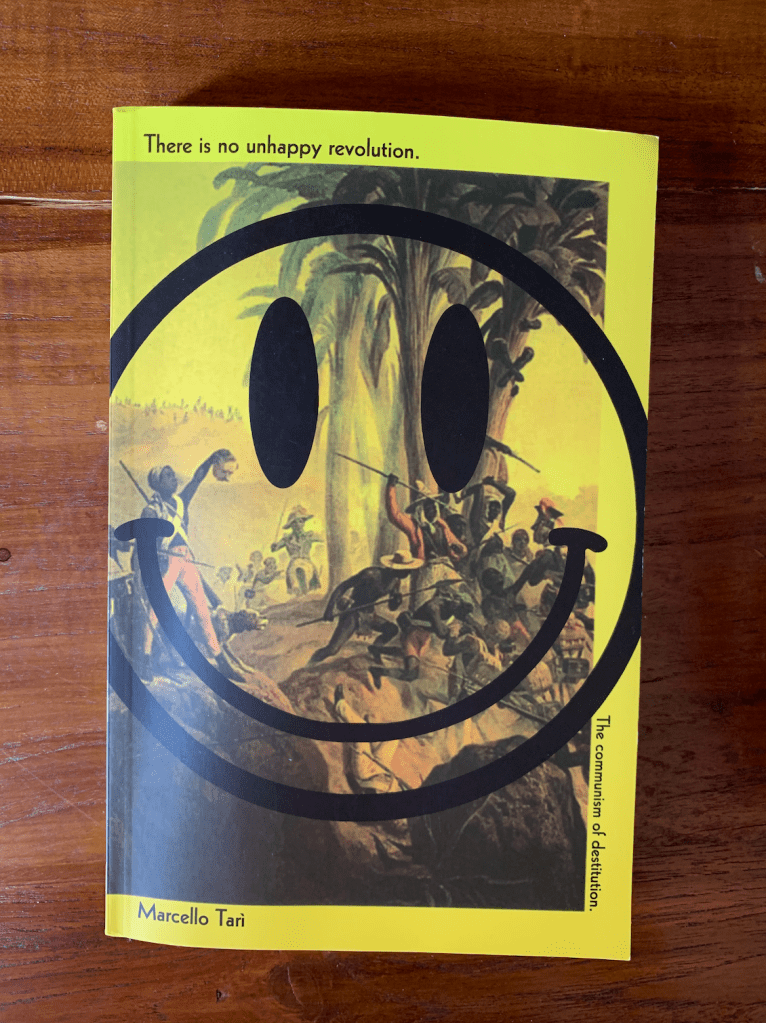
Marcello Tarì’s book There is no unhappy revolution: the communism of destitution (Common Notions, 2021), finally translated into English, is an important contribution in the ongoing discussions about politics and existence. It is also an exercise that pushes against the limits of contemporary political thought in the wake of the ruin of the grammars and vocabularies of the modern politics and the rise of the techno-biopolitics of governmentality. More importantly, the operation of Tarì’s book escapes the frame of “critique”, abandoning any false exits to regain the legacy of the Enlightenment and of “judgement” in hopes to reinstate the principles of thought and action in the genesis of the legitimation of the modern social contract. But the radicality of the horizon of destitution – which we have come to understand vis-à-vis the work of Giorgio Agamben, and the Invisible Committee – is first and foremost a thematization of the proximity between thinking and politics against the historical stagnation of a historical subsumed by the total technification of value (the principle of general equivalence). Since Tarì’s book is composed of a series of very heterogenous folds and intersections (literally a toolbox in the best sense of the term), in what follows I would like to sketch out a minor cartography to push the conditions forward that the book so elegantly proposes in three registers: the question of “revolutionary becoming” (the kernel of Tarì’s destituent gesture), the hermeneutics of contemporary domination, and the limits of political militancy.
Revolutionary becoming. Marcello Tarì correctly identifies the problem the epoch as fundamentally being about the problem of revolution. However, the notion of revolution must be understood outside the continuation of the modern horizon of the Leninist technique of the revolutionary vanguard nor party, the “revolution within the revolution”, and any appropriation of the “General Intellectual”. At the end of the day, these were all forms of scaling the desire as cathexis for the matrix of production. On the contrary, the problem of revolution is now understood in the true Copernican sense; mainly, how to inscribe an excentric apositionality within any field of totalization. When this is done, we no longer participate in History, but rather we are “freeing a line that will ultimately go down in History, but never coming from it”. Tarì argues that the field of confrontation today is no longer between different principles of organizing revolutionary strategies and even less about ideological critique; nor is communism an “Idea” (as it was thought just a decade ago in discussion that were philological rather than about thinking communism and life); the new epochal exigency is how to put “an end to the poverty of existence” (3). The potentiality of this transformation at the level of factical life, is what Tarì situates under the invariant of “communism”: “…not as an idea of the world, but the unraveling of a praxis within the world” (35). This communism requires a breakthrough in both temporal and spatial determinations, which prepares a dwelling in absolute relation with the outside (49). This revolutionary tonality is one closer to messianic interruption of historical time capable of destituting “actual state of things” governed the metaphysical apparatus of production and objetivation of the world, which depends on the production of the political subject. In an important moment of the book, Tarì writes: “…. only the revolutionary proletarian dimension can grasp the political as such, the true break from the current state of things. The real alternative to modern politics is thus not to be ground in what we usual can an “anti-politics”, which is merely a variation of the same there, but instead in a revolutionary becoming” (50).
The revolutionary becoming is a transformative intensity of singularization, which ceases to become a subject in virtue of becoming a “non-subject” of the political (67), which about a decade ago Alberto Moreiras announced to escape the dead end of the hegemony-subalternity controversy (one should note here that the fact that the Left today has fully subscribed the horizon of hegemony is something that I think it explains many of the deficits of the different experiments in a realization of a progressive political strategy). And this becoming revolutionary, in virtue of ceasing to be a subject (person, vanguard, multitude, worker) entails a new shift from action to use, and from technico-rationality to an opening of the sensible and singular means (metaxy). Again, Tarì’s continues as follows: “Becoming revolutionary…. means utilizing fantasy, freeing the imagination, and living all of this with the enthusiasm of a child” (75). The notion of “happiness” at stake in the book it is played out against the determination of the subject and the processes of incarnations (Karmy) that have haunted the modern revolutionary paradigm as always-already integrated into the metaphysics of the philosophy of history.
Metropolitan domination. Secondly, Tarì’s book locates the metastasis of domination at the level of a new spatial organization of the world in the apparatus of the metropolis. As we know the metropolis is not just an urban transformation of the Western form of the urbs and the polis, but rather the force of appropriation of the world into interconnectivity and surface in order to optimize, administer, and reproduce flows of the total fictionalization of life. The gesture towards the outside that crosses over Tarì’s book entails an exodus from the metropolitan structure that makes uninhabitable experience. This takes place by a process of domesticating its possibilities into the order of sameness (crisis of appearance) and translating our proximity with things into the regime of objects. What is stake in the metropolis – if we think of the most recent revolts in Santiago de Chile, Paris with the to the hinterlands of United States and Italy – if not precisely a response against the metropolitan machination “aiming at the destruction of every possibility of having any experience of the world and existence itself” (84). This why the intensity of any contemporary revolt today is proportional to the experiential texture of its composition and modes of evasion. Of course, Tarì correctly identifies the metropolis as an expanded field of cybernetic inter-connectivity, which, as I would argue is not merely the production of “bad substance” (to use Tiqqun’s Bloomian lexicon), but also a recursive dominion over the medium (metaxy) in which experience and the singular autopoiesis labors for the optimization and hylomorphic regimes that administer civil war. In this sense, destitution names an exodus from the metropolitan technical order and the sensible reproduction of the medium. It is in the outside the metropolis that the ongoing process of communization can free an infinite process of communization and forms of life.
Residual militancy and infrapolitics. But does not the exodus or the destitution of the metropolis – opening to singular experience, love, friendship, and the use of one’s disposable means and inclination – presuppose also a step back from a political determination, in other words, a fundamental separation from coterminous between existence and politics? At the end of the book, Tarì claims that “whenever anything reaches a certain level of intensity it becomes political” (117). But is the intensification of thinking or love or friendship always necessarily political? Tarì writes a few pages later that: “love is continually traversed by a line of extreme intensify, which makes it an exquisitely political affect” (126). But does not the politization of love depends on a certain commitment (a “faith”) to a residual militancy, even if it is a militancy posited as the principle of anarchy? But perhaps this is the difficulty at stake: since anarchy is only entails the “anarchy of phenomena” in reality, postulating a political principle as counter-exposition, however tenuous, might not be enough. For this reason, the crisis of appearance today needs a step back from the heliopoliticity of exposition. In an essay written a couple of years ago, Alberto Moreiras thematized this difficulty vis-à-vis Scürmann’s principle of anarchy, which I think is worth quoting: “The Schürmannian principle of anarchy could then be thought to be still the subjective reaction to the epochal dismantling of ontology (as metaphysics). But, if so, the principle of anarchy emerges, plainly, as principle, and principle of consciousness. Anarchy runs the risk of becoming yet another form of mastery, or rather: anarchy, as principle, is the last form of mastery. At the transitional time, posited as such by the hypothesis of metaphysical closure, metaphysics still runs the show as consolation and consolidation” [1].
If politics remains the central condition of existence, then it follows that it depends on a second-degree militancy that can govern over the dispersion of the events and this ultimately transfers the force of steering (kubernates) to mitigate the crisis of thought and action in the sea of “absolute immanence”. But immense is also a contemporary fundamental fantasy [2]. Against all “faith” in absolute immanence we need to cut through in its letting be (poein kata phusin) of the abyssal relation between existence and politics. This originary separation is an infrapolitical step back that solicits a distance an irreducible distance between life, events, and community form. The commune would be a secondary condition of political organization, but the existential breakthrough never coincides with community, except as a “common solitude”. Secondly, the infrapolitical irreducibility between politics and existence wants to reject any compensatory temporal politico-theological substitution, which also includes the messianic as a paradigm still constitutive of the age of Christian community of salvation and the efficacy of deificatio. The existential time of attunement of appropriation with the improper escapes the doble-pole paradigm of political theology, which has been at the arcana of both philosophy of history as well as the messianic inversion. A communism of thought needs to produce a leap outside the politico-theological machine which has fueled History as narrativization and waged against happiness [3]. Attuning oneself to the encounter or the event against the closure of the principle of reality might be a way out from the “hegemonic phantasm” of the political, which sacrifices our infinite possibilities to the logistics of a central conflict. If civil war is the side of the repressed in Western politics, then in the epoch of the ruin of authority it opens an opportunity to undue the measurement (meson) proper to the “Social”, which is now broken at the fault lines as Idris Robinson has put it [4]. It is only in this way that we can move outside and beyond the originary positionality of the polis whose “essence never coincides with politics” [5]. The saving of this irreducible and invisible distance prepares a new absolute proximity between use and the world.
2. Lundi Matin. “Éléments de decivilisation” (3): “It is also about the creed of the dominant religion: absolute immanence. Doing itself, designed to obey the modes of proceeding from production, is in advance conforming and consecrated. On this sense, no matter what you do, you bend the spine in front of the cult dominant. If all things count, none has a price, and everything is sacrificeable.”. https://lundi.am/Elements-de-decivilisation-Partie-3
3. This is why Hegel claims in his lectures on the Philosophy of History that: “History is not the soil in which happiness grows. The periods of happiness in it are the blank pages of history”. The revolutionary overflow of happiness is only possible as an exodus from the theological political structure of historical production. Here the question of style is emerges as our defining element.
We live in an epoch of odd reversals: that is, we live in an epoch of war, but there have not been as many pacifists as other times in history; we live in an epoch of “excellence”, but there has not been so much reproduction of the same; we live in an epoch of unbound expressionism and commotion, but only with the caveat that all the lines of sensation are contained within the prism of “my security”. Finally, we live in an epoch of “movements” (from the Tea Party to the Yellow Vests), however, everyone is more or less unmoved. The extensiveness of the movement of all things guards an originary “unmoved mover”.
In a 1953 essay “Il tempo della malafede”, Nicola Chiaromonte diagnosed our epoch not as one of disbelief, but rather as one of bad faith. According Chiaromonte: “Nihilism permeated not only intellectual groups but all of European society. This means that men began to feel that no believe was strong enough to withstand the pressure of faits accomplis. It is a very small step from this mood of doubt and distress to the grim conclusion that believes do not matter at all, and that in politics as in art, in art as in personal behavior, the only thing that counts is the will to act. With or without conviction he who acts is right. This is step point at which bad faith beings to set in and a preestablished ideology takes the place a freely formed conviction. The ersatz replaces the genuine.”
The destruction of the genuine or the conditions of the pursuit of our “truths” is what maximizes the regime of compensatory actions. And this is where we are today in the world. Back in the heyday of the Cold War, Chiaromonte had a solution to find an “exit route”. He writes at the end of his essay where he outlines the ingredients that we might consider: “A return to reality after mind and soul have been beclouded can only take place through disillusion and despair. Yet this suffering will remain sterile and the recovery of reason impossible unless a true conversion takes place. Conversion to what? First of all, to the immediacy of nature and experience, to contact with things one by one, and their primal disorder…”
The question for us (and for the species) is whether such a conversion can take place given the “unmoved” tone of the epoch. It seems obvious that this conversion can no longer happen at the level of language, ideas, rhetoric, justification, narratives, and even less political fides. The conversion is, each and every time, an opening of experience in which the things (not all Things, and most definitely not “every-thing”) attunes itself in a different way. Of course, most of the reactive and aggressive outbursts today are ways to block this process of “immediacy” in favor of the “security” of the unmoved position.
This is why the meeting of Wendy Rhoades and Rebecca Cantu in a recreational construction site is so moving (Billions, Season 4, episode 12). But it is moving not because it elicits some sort of aesthetic impulse on the viewers, but because of what Rebecca says to Wendy: “It is not a metaphor…it is going to feel absurd for a minute. I need you to fight that off and own the fact that you’re moving the earth”.
This is the sort of ecstatic movement that is needed today against the unmoved avowals of bad faith. Only this movement can open the “genuine”.
*Image: Wendy Rhoades and Rebecca Cantu at the construction site in upstate New York. Billions, Season 4, episode 12, 2019.




 Infrapolitical Reflections