In a letter written in 1969 to her friend Mary McCarthy, Hannah Arendt provides a striking description of the solitary condition of thought in language: “The silent dialogue of thought goes on between me and myself, but not between two selves. In thought, you are self-less – without age, without psychological attributes, not all as you say “really are” [1]. Thinking, she goes on to claim, puts into crisis all identity and nonsense, so that the inward searching can fold “outwardly” into the world. Arendt immediately notes that the passage from interiority to the outwardness does not express a fixed purpose; it is rather a motion through which “words become part of the world”. Thought can be said to express the coming into relation between language and world.
Further exploring the depth of the language that characterizes the “inner life” of thought, the philosopher immediately emphasizes its acoustic or tonal qualities, that is, “an inevitable noise of our apparatus, which Broch called Seeleenlärm, soul-noise. It is what makes us tick”. To be in thought, or in a way to thinking, means allowing the soul noise to buzz from beneath the skin. The Seeleenlärm does not coincide with language as concept or signification; it is rather the tear that allows for the emergence of language as imagination and thinking.
This operation is nothing more than the relation of language to its own impossibility or muteness in the region of the Seeleenlärm, and what artificial models of language cannot replicate. And although Arendt compares the soul noise to other functional organs of biological existence, it is only obvious that the harmony of the soul lacks a physical compartment, and can only be expressed in the possibilities that language bestows to thinking. The notion of Seeleenlärm, if we are to call it that, appears not in philosophical context, but in a literary one; that is, in Hermann Broch’s “Zerline’s Tale”, in which the soul voice is understood as the lacuna of sensation, having nothing special in terms of intellectual faculty or knowledge collectiom, it is the sensation that fill people’s empty and boring lives” [2]. Seeleenlärm determines thought, but it is not thinking as such; it is more like the suspension of temporalization and judgement in every living being. This is why it is not even coterminous with the passions, let alone love. Perhaps the Seeleenlärm can be said to occupy a third component (tertium comparationis) through which the human being structures the mystery of his spirit [3]. Is this third component that dissolves the self for the place for ethics? In Broch’s modernist aspirations, attuning to the noise of the soul meant the aesthetic reduction of a symbol to mediate “understanding from one person to another”.
But it should be obvious that the transition of Seeleenlärm to metaphoric understanding flattens the voidinto a conglomerate of selves that come into being by setting aside thought through the communication or artistic repression. In the reverse, one could imagine then that there is only thought when the suspension of any conglomerate or community ceases to communicate by resting on proximity to the hole of the soul voice in expression. The communication between souls – beyond the transport of the symbol, beyond separation ordered by discourse – can only be understood as the incommensurable in language. This is the instance where thinking takes flight because the invisible seeleenlärm transpires from its depths.
.
.
Notes
1. Hannah Arendt. Between Friends The Correspondence of Hannah Arendt and Mary McCarthy (Harcourt, 1995), 242-243.
2. Hermann Broch. “Zerline’s Tale”, in Selected Short Writings (Bloomsbury, 2006), 103.
3. Hermann Broch. “Some comments on the philosophy and technique of translating”, in Geist and Zeitgeist: The Spirit in an Unspiritual Age (Counterpoint, 2002), 122.
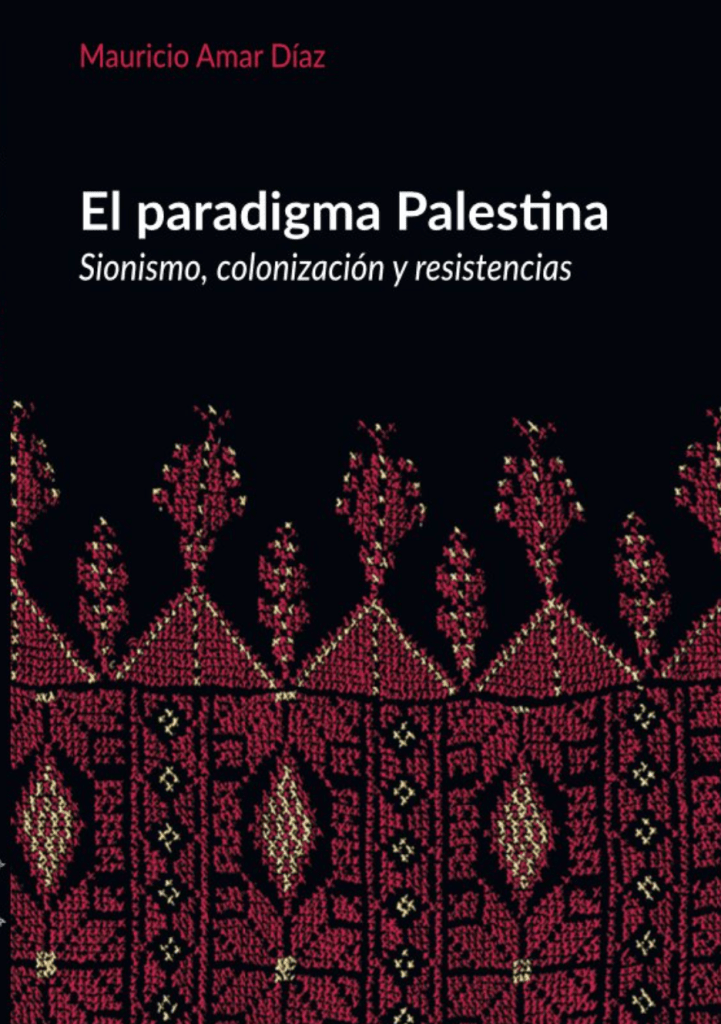
What does it take to destroy a world? It would seem that the question itself is too metaphoric and impertinent; perhaps also hyperbolic and presumptuous against the flight of the infinite embodied in worldling. But this is the question that we should direct ourselves to according to Mauricio Amar’s short and highly accessible book El Paradigma Palestina: Sionismo, Colonización, Resistencias (DobleaEditores, 2024), which is written in the wake of the ongoing war of annihilation in Gaza in order lay bare the paradigmatic abyss of social death in which humanity finds itself at the peak of its civilizational dominance. Amar does not use the term “paradigm” lightly, and nor is he interested, as recasted recently by none other than Steven Bannon citing Thomas Kuhn’s work about scientific revolutions, in posting a central conflict towards transformation; rather, one must situate this strategic conceptual deployment in light of the Chilean philosopher’s own work on imagination and use, which provides an irreducible and sensible texture to every emergence of a paradigm [1]. This means that if Palestine is, indeed, the paradigm of our epoch is precisely because it has no-space in the world – it is what can be infinitely be destroyed, as Maurce Blanchot famously said commenting Antelme’s work – and what illuminates the core and extension of the “integrated” planetary humanity oriented towards the administrative governmentality of contemporary Western democracies, and its corollary geopolitics of the total artificial spaces, as Bruno Maçaes has recently called it. Reading Amar one senses that under the name “Palestine” he is registering a limit to the Humanist force, where an existential claim reveals the maelstrom of an epoch that has resorted to a grotesque parody of the ancient homeric standards of domination and submission. It is the outlook that Simone Weil described as the paradigm of transforming the world into nonliving things.
If understood as a paradigm, Palestine reminds us that the homeric energy towards the aristocracy of equality through force and death among the human race never truly ceased, but only changed forms and cloaks throughout the ages. The post-mythic West seemed to have constructed itself through the repeated revolutions that accommodate justifications for usurpation and containment, self-deification and legibility of the territory at the service of a fictive ethnos. The belated nationalism of modern Zionism has had the paradoxical quality of being both a project of territorial usurpation after its illegalization in International Law (The Kellogg-Briand Pact of 1928); while, at the same time, a politico-theological configuration that, as Monica Ferrando has shown in L’elezione e la sua ombra: Il cantico tradito (2022), clings upon the manipulation of the theological election of “a People” in order to deploy the coterminous binding between community and territory justified through divine narration. The interdependence of the spiritual goal of Zion is only possible through the construction of a settler state, at the same time that the occupying state’s only legitimacy based on ‘one God, one People’ relies on the restitution of an instrumentalized form of the theological election. This is why for Amar the Zionist state building project is a the paradigm of a specific type of colonial governance whose end is not just to capture errant people into social subjects, but more fundamentally a translatio imperii that folds the Earth into a territorial nomoi of distinct multilevel functions: checkpoints, walls, vigilante control of movements, constructions and erasure of surfaces, administration of critical infrastructures, development of extractive resources, and finally the hunting down of humans that necessarily blurs the line between civil population and battlefield combatants. When Amar reminds us of Israel’s predominance in planetary security and warfare technology, one can immediately recall Emile Benveniste’s suggestion that “measurement” (med*-) and the proportional addition to produce objectivity, entails an efficacy of permanent dominance and governability whose main enterprise is the management of populations through the regime of accumulation. As Andreas Malm reminds us of the current cartography of Palestine: “The genocide is unfolding at a time when the state of Israel is more deeply integrated in the primitive accumulation of fossil capital than ever…This is the political economy of normalization: a sacralization of busines as usual that destroys first Palestine and then the earth” [2]. The ongoing devastation of Gaza is a window into the project as a whole: the necessary destruction of the worlds and the total artificiality of the life-worlds, always at the service of maintaining the needs of anthropological symbolizations.
For Amar this points to an epochal scenario of a people without world; and, following the lead of Sari Hanafi, he will claim that the paradigmatic mirroring of Palestine is also an spatial-cide, in which the living are deprived of a sense of inhabiting and roaming that brings to bear that the nakba is not something that has taken place in history once and for all, it is a catastrophic event that has not ceased from repeat itself, and whose ultimate intention is to suture the world and existence, the soul and the spirituality of the open atmosphere that is needed to sustain life. Reading Amar between the lines – who towards the end of the book finds distant interlocutors in Darwish’s poetry, the philosophy of Gilles Deleuze, as well as in the glosses of Walter Benjamin on history and the prose of Edward Said – one learns that the true arcana of Palestinian resistance is also a secret promise for our apocalyptic times: to hold on to the world, so that we can all passionately land on the Earth and freely breath in its surroundings. The nexus of the Palestinian question and the intrusion of Gaia, although underdeveloped in Amar’s analysis, obliquely runs through a text that is also very much about the central question of ethics that never abandons thought: how to name what escapes without taking the world as such into an object to be possessed, destroyed, and remade anew as a hostile secular imago dei. The vindictive hyper-consciousness of the contemporary unmediated arcana imperii now reveals, as Amar says towards the end of he book, a mirror through which we can observe our own increasing domestication, in which the metropolis is just the luminescent and self-protected hub, but whole ultimate darkening shadow is the Gaza’s pile of rubbles resembling an open air necropolis (Amar 108-109). Through different arrangements of organized destruction, both the metropolis and the necropolis converge in their preeminent ‘struggle against space’ and its form of life for the sake of familiar pieties of enslaved survival of unworldly anomie (Amar 116).
Does this mean that we are all “Palestinians”? Mauricio Amar’s El Paradigma Palestina (2024) rejects the all too well expected craft of solidarity and subjective identifications that can only work on the payroll of the gravediggers of the current civilizational project. On the contrary, if Palestine is our paradigm, and it remains so, it is because it can only refuse measurement and recognition in order to dwell in the only possible exteriority as embodied to Darwish’s poetry that Amar quotes towards to the end book: “Do not trust the poem / absent child / it is the throbbing of the abyss” (Amar 140). From the abyss we nourish the soul as the return to land on Earth prepares itself in order to no longer conquer a territory, an ancient tradition, or a “People” (ethnos), but to dwell on the nearness of a place that is an excess to every location or community of belonging (this is the false exit of the kibbutzim). We do not have political grammar to articulate what this integral freedom could mean, except that it is an exotic relation in Victor Segalen’s sense: a creation of a world alien from the compatible and petty one that currently drains us into its ongoing desperate destruction and passive enslavement [3]. Finally, like all authentic paradigms, it is worth noting that Paradigma Palestina (2024) teaches and preaches nothing; it only invites us into the swirling sensation that crosses over the imagination and the singing voice, from the world of the last remaining lives to the isles of the dead martyrs, and back.
.
.
Notes
1. Mauricio Amar. Ética de la imaginación: averroísmo, uso y orden de las cosas (Malamadre, 2018).
2. Andreas Malm. The Destruction of Palestine is the destruction of the Earth (Verso, 2025), 53.
3. Victor Segalen. Essay on Exoticism (Duke University Press, 2002), 24.
In Elio Vittorini’s short travel book Sardegna come un’infanzia (1957), entirely composed of painterly vignettes of his visit in the thirties, there is one of them that immediately jumps out at the reader, because it is the only moment where the radiance of the image and the possibilities of thought touch each other without any reservation. It is almost the moment in which the senses of what is felt and seen mysteriously touches a region that is not entirely political, even though it figures as the highest ‘political moment’ in Vittorini’s chronicle.
Vittorini is observing the ordinary lives of the common people in Sardinia when all the sudden he writes the following: “Now, and in spite of everything, those sitting down, almost drowsy and without much to do, are in life. The others in the struggle are not, especially if they fall into consciousness by the struggle and the movement, without understanding any other pleasure than that of the full warehouse. The secret is to struggle for existence, but without being colonized by the struggle’s idealism…in this way, there will be true life in the very roaming path. I have always understood activism for activism’s sake as the business of flies that, once they have taken off, they begin to scratch their head or sharpen their legs” [1]. It is almost as if written the parable of the fly is written for our times, where so many are blinded by the secularization of a Jesuit figure of the militant. The activity of fly, just like that of the political militant, falls into the pretense, thanks to the allure of his self-consciousness, that something moves in spite of its complete paralysis. The fly only moves in the metaphysical abstraction from ideal projection to material outcome and preconceived ends that it knows beforehand. Nothing moves and nothing ever can amount to a discovery or an event. The fly will recurrently miss the world because it has become obsessed by the illusion of its movement, convincing itself that flying over fresh dung is something entirely different.
The political subject is primarily the subject of the accumulated freedom, but it can rarely grasp ‘a way out’, as Peter Red claims in Kafka’s “A Report to an Academy”. Vittorini’s roaming and inert path is the sentiment of true life (“the serene truth of life”, he will say in a few pages later), which is always on the predicated on the possibility of experience against the crust of ideological falsification – even when this process is narrated from the point of view of the proletariat as the motor of the dialectic of history of its self-overcoming to completion. The ‘secret is to struggle for existence’, which entails how to grasp life as utterly outside that can only be shaped by a contact with the world. Perhaps by “sensing” the world without ever becoming its master; rather, what’s involved is a task of a cultivation that must remain singular by virtue of its own irreductibility.
And in a way, this was Vittorini’s own heterodox understanding of communism where there is according to him there was no “collective building of the soul, but rather the destitution of false differences so that once those regulated differences are abolished, new possibilities of absolute differences can flourish” [2]. This is why Vittorini could not find solace in the political militant or the engaged intellectual, except as figures already acting as smugglers of the planned obsolescence of a civilization overtly defended by those facilitating its own demise [3]. In the landscape of Sardinia – by the most passive of roles, he was merely a theōrós after all – Vittorini unravels the metapolitical blackmail of the epoch in order to conquer the most essential and inapparent: the time of existence in a minuscule world within worlds – and thus, always in a permanent state of infancy – that treasures something immense because it will be forever remain unknowable.
.
.
Notes
1. Elio Vittorini. Sardegna come un’infanzia (Mondadori, 1957), 64.
Alberto Moreiras escribe en Infraphilosophy una magnífica nota que actualiza la conocida “estrategia del rechazo” de Mario Tronti mediante un uso metonímico, el único posible para un mundo en el cual ya la espera por la posibilidad de atravesar al proletariado como forma de capital humano ha sido realizado en su totalidad por la racionalidad del liberalismo autoritario. Seguimos domiciliados en la hipótesis subjetiva-social del capital ahora asumido como parcialización del valor en la propia esfera intelectual. Hoy necesitamos de un segundo rechazo de lo que ha sido, en efecto, ya realizado.
Una nueva literalización, como decía Tronti hacia 1966: “la burguesía vive eternamente en el ciclo del capital”. Y hoy, a varias décadas de Operaio e capitale, allí residen sus satélites en órbita, sus naves galácticas, sus ensueños de eterno Pan como ominosa luz de olvido de la tierra. De manera que la postura en la que hemos sido asignados se vuelve la primera tarea existencial que debemos rechazar. (La política ya ha sido evacuada al suelo antropológico: un capitalismo donativo tras el fin de la producción clásica).
Esto lo veía James Boggs hacia el final de The American Revolution: Pages from a Negro Worker’s Notebook (1963): “…from which there is only one way for the individual to escape to prove his or her loyalty to the police state by becoming an informer for it. […] Today in the 60’s, the struggle is much more difficult. What it requires is that people in every stratum of the population clash not only with the agents of the silent police state but with their own prejudices, their own outmoded ideas, their own fears which keep them from grappling with the new realities of our age” [1].
Dejar de ser un informante supone nada más y nada menos que abandonar la esfera de lo social para así preparar los ingredientes de una experiencia en el umbral de una retirada. Otra vez Boggs: “pero no hay a dónde ir”. Esta es la condición del negro desembreando en la larga historicidad de la reconstrucción republicana. La lucha de clase ha quedado huérfana; las aspiraciones asimiladas a los subrogados de la policy y las infraestructuras; las lenguas y los contactos a las logísticas comunicacionales; el movimiento a la intensificación (aparente) de la movilización tan evasiva del conflicto como de una posible exploración de los mundos. Esta es la realidad.
Lo sensible ha dado paso a los dispositivos refractarios de una cultura como falso principio de diferenciación. Y ahora cultura solo puede ser considerada como forma de cultivo de una nueva ciencia de los encuentros por fuera de la devastación de la virtualización, que haga posible lo irreductible que el realismo hoy sostiene como mero “power nexus”. Superar las ficciones fundamentales implica abrir un abismo. Ahí moramos como existente y de paso preparamos la posibilidad de otra cosa.
No hay balance posible en el presente sin afirmar que George Floyd es la verdad absoluta de la época. Y esta verdad consistente en el hecho de que semejante mazacote llamado Sociedad ha dejado de contenernos. Ahora somos desbordes, formas minorías, itinerantes en búsqueda de ritmos, y paseantes que en su movimiento producen la seña de lo nuevo. Algunos permanecen inquilinos del realismo porque se abonan a la fe de lo Social. Hay otros, los póstumos, que saben que su destino bajo estas condiciones objetivas solo remite a una forma de administración de la muerte. Ahora podemos ver que la guerra civil es lo impensado y lo no-estudiado de la hegemonía, y en tanto tal, el verdadero antagonismo que debe ser llevado a cabo hasta la muerte [2].
Tenemos buenas razones para rechazar el realismo: no dejar impensado, otra vez, a los muertos. Y contra la ceguera de los realistas, la desrealización de los videntes. Esto implica, en cualquier caso, una nueva astucia (metīs), ya que el mundo nos exige pensar para volver a encontrarnos. Píndaro: “La astucia (metīs) del más débil logra sorprender al más fuerte hasta llevarlo a su caída” [3]. La pulsión de la astucia de quienes buscan abre la pregunta por la cuestión de nuestras técnicas (τέχνας). Una nueva comprensión de la organización para hacerle frente al estancamiento. Efectivamente, mundo no es conclusión.
.
.
Notas
1. James Boggs. The American Revolution: Pages from a Negro Worker’s Notebook (Monthly Review Press, 2009), 93.
2. Frank Wilderson III. Afropessimism (Liveright, 2020), 251.
3. Pindar. Isthmian Odes (Loeb, Harvard University Press, 1997).


 Infrapolitical Reflections