De Certeau’s untold night. by Gerardo Muñoz

The highest poetic moment in Michel De Certeau’s La culture au pluriel (1974) appears in the concluding pages where the historian resorts to a hunting image: “Culture is an untold night in which the revolutions of earlier times are dormant, invisible, folded into practices – but fireflies, and sometimes great nocturnal birds, cutting through it – as thrusts and creations that trace the promise of another day to come” [1]. This is De Certeau’s trope that stands for culture as opening of possibilities, the shoreline where administrators and technicians (his own terms) do not dare to cross and will probably never adventure. This is the site (the night, la noche oscura, which has a ringtone of the mystical tradition that the author knew perfectly well) where De Certeau wants to posit the possibilities of new struggles of cultural alterities [2]. A book in 1974 means many things, but for De Certeau it is an incursion into the collapse of his historical present, already showing full fledged signs of the crisis of legitimation, erosion of institutional trust, and the decomposition of social forms across Western symbolic realities. It is the nascent confirmation of the ascent of real subsumption, a term that does not appear in De Certeau’s book, although it informs it, even if negatively (the Italian Fiat wildstrikes makes a surprising cameo in the last paragraphs). Where to look, then?  

De Certeau’s answer read today does bring much naivete: cultural alterity. But this notion, which is reworked and contested in concrete fields of human activities (the university and schools, the new technological society and communication, social practices intertwined in popular and elite culture, power relations and post-statist configurations) do not appeal to the identitarian cosmopolitan horizon prima facie anchored in the diversity administration of a well integrated, albeit exploited planetary humanity. One senses that for De Certeau the nineteenth century “Social Question” has become the “cultural question” as the unit of the national sovereign state wanes and reacts. With the crisis of legitimation as backdrop, De Certeau sees the rise of a new subjectivity that he calls the new “militants without a cause”, a battalion of “exiles” that will only tacitly accept credible cultural imprints [3]. He wants to work with “culture” because at bottom De Certeau is both a historian and a realist. This new erosion of civil society-State relations entails a “new exile is in the works” [4]. And for De Certeau the exile, since biblical times, is seeking a new Earth where to “land”. 

In 1974, De Certeau’s invitation was to create the conditions for pluralist cultural landings that will foster, in the night of waiting, a new politics. But, could the same be said today even assuming concrete situations and the infuriating image of migration as a token for the workings of hegemonic politics? Does Gaia not alert us that we must “land” somewhere else on Earth? The anger and dissatisfaction that De Certeau cautiously predicated head on is already here in the form of what some of us have theorized as ongoing social stasis that is integrated in every social mediation. In the global metastasis of the 1970s De Certeau could claim that “behind anger there is the desire to create a polis and a politics; there is a desire to organize the conditions of life….” [5].

We are far removed from this desire, and even the most prominent cycle of revolts of the decade have refused in the solicitation of a new politics or a political horizon; and, even if, almost like weeds in cracks of piled urban ruins, we see again and again the last residues of the desire for hegemonic representation of the totality (the People, the Movement, the Class). In this light – now it is our own epoche – culture can only be compensatory, and still very much a symptom of the closure of exteriority. “Where there is no longer an imaginable outside we lose the possibility of an inside”, Moreiras wrote at the turn of the century against every form of culturalism [6]. Of course, De Certeau was well aware of it, which is why his proposal to cultural alterity retains zones of hermeneutical ambiguity many decades later [7]. For instance, he writes when commenting on neo-nationalist regional movements (Quebec, Catalonia, Occitania) that “cultural claims appear to be a reminder and a compensation” [8]. 

And recent events have proven De Certeau correct: what is Catalan nationalism – whether left or right, although ideological division is not a substantive difference – if not a compensatory rhetorical ruse to mobilize regional political elites to feed off the stagnant resources of a waning state form? The rhetoric of “political foundation” in the Catalan case created an “cultural alterity” that depended on the high illusion of hegemonic politics; a politics solely based on the “bad faith” of escalating and superposing values (“Spanish” v. “Catalan”) as the combustion of a fractured political social contract that ultimately deepens its fragmentation. De Certeau noted – cited with the long Augustunian tradition of political liberalism – that politics cannot bring happiness, but only create its conditions. However, today even this liberal ideal fails to account for its true source: our metapolitical collapse at the twilight of secularization means that the revival of the “social bond” is not to be found in the demand of new political principles, however narrowly or broadly defined. De Certeau in 1974 aspired at giving politics one more chance pulling it to the facticial heterogeneity of culture: “a politics that discovers in the diversity of the sky a generical….linked to the ambition of beginning over again, that is, of living” [9].

And indeed, we must begin all over again, but is really the only possibility? I believe that there are symptoms elsewhere in La culture au pluriel, and these concern language. In the second chapter, referring to the crisis of speech, De Certeau refers to the “denaturing act” of speech, as communication enters the regimen of commercial language and new computational masteries (what Jaime Semprún called neo-language) [10]. The crisis of language in the ascent of a new expressivity renders communication obsolete and obtuse; parasitic, or mushroom-like, as Hugo Von Hofmenthal had already noted in his Letter to Lord Chandos. Speech becomes a new form of blasphemy, something confirmed in recent years in the United States, which takes itself also as the homeland of “Free Speech” is increasingly under heavy surveillance by constitutionalism of codified parameters of “time, place, and manner”.

De Certeau shows himself highly consternated about blasphemous language, which is also conspiratorial language; the language that dwells on the reverse of social normativity and legal codification. But this perhaps the only language today can properly speak of pain without recurring to the transactions of violence; especially of the numbing violence of a neo-language that can communicate “everything” insofar as it ceases to communicate to no one. Could the “untold night”, that is also the night of the “unthought”, be the site of the preservation of another use of language, of nurturing language, descending into the hymnic sources of the sayable – thus, inverting the denaturing of historical severability – a language embedded in silence, in the protofigure of the mystic, assuming “the immediacy of nature and experience, to contact of things, one by one, in their primal disorder”? [11]. Ultimately, whatever the night will tell will only be possible through and in language. 

Notes 

1. Michel De Certeau. Culture in the Plural (University of Minnesota Press, 1997), 138.

2. Ibid., 11.

3. Ibid., 7.

4. Ibid., 8.

5. Ibid., 11.

6.  Alberto Moreiras. The Exhaustion of Difference: The Politics of Latin American Cultural Studies (Duke U Press, 2001), 21. 

7. Michel De Certeau. Culture in the Plural (University of Minnesota Press, 1997), 78.

8. Ibid., 70. 

9. Michel De Certeau. Culture in the Plural (University of Minnesota Press, 1997), 100.

10. Jaime Semprún. Defensa e ilustración de la neolengua (Ediciones El Salmón, 2018). 

11. Nicola Chiaromonte. “An Age of Bad Faith”, in The Paradox of History (University of Pennsylvania Press, 1985), 148. On the hymnic dimension of human speech, see the study undertaken by Nicoletta Di Vita, Il nome e la voce. Per una filosofia dell’inno (Neri Pozza, 2022).

Marruz’s Mount of Transfiguration. by Gerardo Muñoz

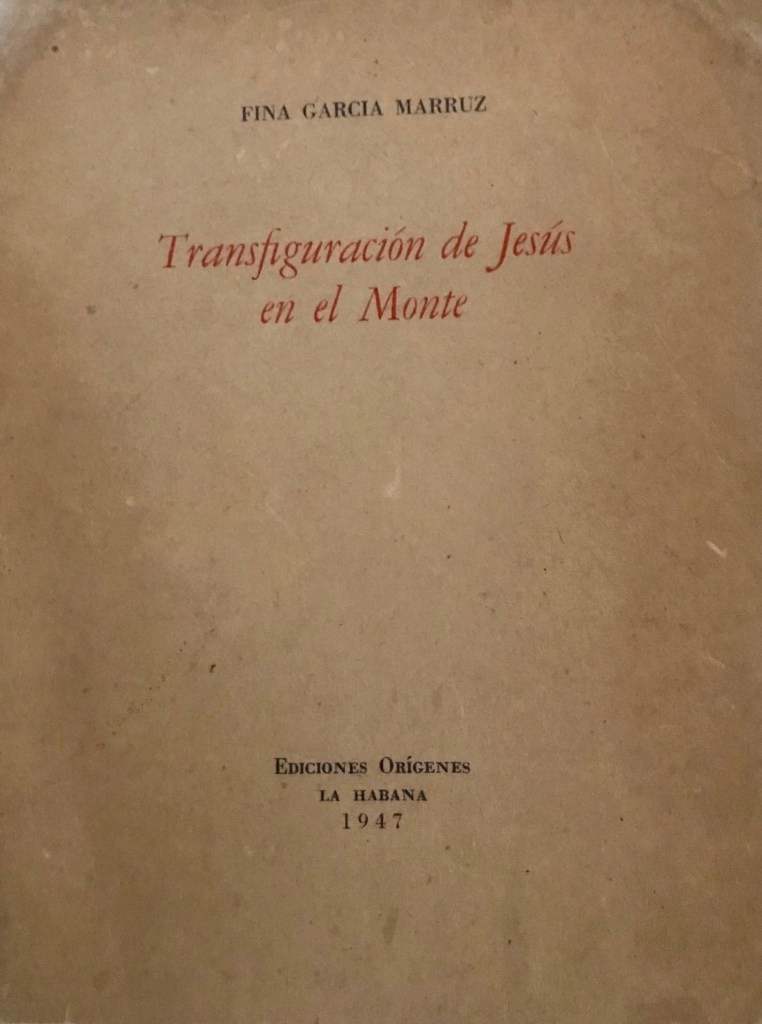
In 1947, the very young Cuban poet Fina García Marruz published the liturgical poem Transfiguración de Jesús en el Monte (Ediciones Orígenes, 1947), which stands in the modernist tradition series of attempts to probe the divine nature of language after the flight of gods and the triumph of the new secular jargons. If earlier in the century a well known Italian philosopher will predict that the international language of the future will be that of technical terms; the English Catholic poet David Jones, will reaffirm that we are “living in a world where the symbolic life (the life of the true cultures, of institutional religion and of all artists) is progressive eliminated – the technician is master. In a manner of speaking the priest and the artists are already in the catacombs, but separate catacombs – for the technician divides to rule” [1]. And if “liturgy” originally meant “public service” and the sphere of gestures, as suggested by Lubienska de Lenval, then Transfiguración has to be read, even into our days, as an attempt for language to measure to the transfiguration of revelation, in which the poem is a sacramental form that retracts language to possibilities of retaining communication.

In fact, Transfiguración de Jesús en el Monte, reinforcing the liturgical repetitions of an hymn and a sacred chant, enacts a flowing rhythm (“en tanto que”) that assesses the limits of the ineffable; a pure exteriority that is the negative or wound of language without ever being able to transcend it. In this sense, Marruz’s poem is only the poetic anabasis to the impossibility of a guided sacrament to organize interiority and visibility. Only the mystical can mediate between exteriority and the crisis of appearance. In an almost programmatic fashion, we read in the second part of the poem: “oh, difícilmente podríamos comprenderlo / Él se ha vuelto totalmente exterior como la luz; / Él ha rehusado la intimidad y se ha echado totalmente fuera de sí mismo” [2]. Transfiguration is the event that exiles oneself from the self (phygé), and in which language can generate contact with something other than its own conventions. This is why they [the witnesses and the martyrs] cannot provide an account about the transfigured revelation – just like anyone cannot truly provide a narrative, except by betraying the experience – except by their hearts as if being mysteriously called by a singular name (“ellos sienten que dentro de su corazón alguien / los ha llamado misteriosamente por su nombre”). 

How can language disclose a sense of exteriority that is capable of moving past the autonomy of signification and self-referentiality of language? Can language befall into exteriority? Marruz provides an answer to this question, which can be taken as her contribution to the aporias of modern poetics: poetry can only attune to transfiguration as a cohabitual of a communicating being. In the year that the poem was published, Marruz also wrote in the winter issue of 1947 Orígenes a dense essay titled “Lo Exterior en la Poesía” (“The exterior in poetry) where she claims that “the heart of poem is always outside of it – it should not be that the poet can offer infinite variations of a secret self-possessed knowledge, but rather to rediscover the liturgy of the real; the extreme degree of visibility, which is also its great escape” [3]. What could the “liturgia de lo real” have meant for Marruz in 1947? Marruz does provide a clearcut theological definition of the exteriority as the “angelic”, which does corroborate the hymnological dimension of language, a transcendence between beings of the invisible. The liturgy of the real that defines the exteriority of the poetics of life does not entail a Romantic elevation by the Poet, but the effort to animate reality beyond an alienated monologue. This is why Marruz writes that “only a dialogue can realize an impossible communication, mystical, whenever it does take place in all of its purity” [4].

In 1947 Marruz went a step further than her fellow poets Gaztelu & Lezama Lima, who had defined transfiguration as a learning exercise of the potentia dei of the divine (“a todo transfigurarse sigue una suspension y el ejercicio del Monte era solo un aprendizaje”) [5]. Read side by side with Antelme’s Angel of Reims, one could very well say that for Marruz there is an event of transfiguration whenever transcendence delivers communication between beings, soul to soul; a relation that can one truly speak of the ungrounded and commencement. The liturgy clamored in language is not the memory of an original Adam severed from Nature, but the transfiguration of a linguistic relationship with the world. This might be the secret to Marruz last two verses: “como la infancia que acuña nuestro Rostro allí / donde no puede ser despertado”. If transfiguration also entails recapitulation, this means that this is not a process of forward becoming, but of retaining the atemporal detention that, like that of childhood, traces our silhouette as both figural and pure presence in the bushes of language. 

Notes 

1. David Jones. “Religion and the Muses” (1941), in Epoch and Artist (Faber&Faber, 1959), 134.

2. Fina García Marruz. Transfiguración de Jesús en el Monte (Orígenes, 1947), 6.

3. Fina García Marruz. “Lo Exterior en la Poesía”, 19. 

3. Fina García Marruz. “Lo Exterior en la Poesía”, 22

4. Ángel Gaztelu & José Lezama Lima. Editorial: “Éxtasis de la Sustancia Destruida”, Nadie Parecía, Número IX, Nov, 1943, 1.

Seeing in the dark. On Michael Lobel’s Van Gogh and the End of Nature (2024). by Gerardo Muñoz

Michael Lobel’s new monograph on Van Gogh’s work, Van Gogh and the End of Nature (Yale University Press, 2024) undertakes a systematic effort, brilliantly argued and researched, at showing the redeeming visual capacities of the nineteenth century painter towards the natural world. If we call it redeeming it is because in more than one way, Van Gogh, in the last three decades of the modernizing century, was painting at the threshold of nature that soon enough was assaulted by the copious designs of modern industrialization, energy production, and the application of its effective scientific techniques over all spheres of life. It is the final culmination of the disenchantment of the world, and so also the moment of great temptations, such as standing up against it through the metaphorization of the imago naturae in one last desperate attempt at salvation through a reified ideal representation. Lobel’s art historical work shows us along the way that Van Gogh’s situation was far more complex, and that a French critic’s quip that he merely “captured nature with a soul” in his pictures requires specification and analytical comprehension within the context of the century of steam (Lobel 2). 

In other words, Van Gogh is not a painter of a return to the conscience of the “Beautiful Soul” that has interiorized the exhaustion of artistic imagination; implicitly throughout Lobel’s monograph is the well grounded intuition that Van Gogh was an artist of the depth of vision without necessarily translation their specular commitment to the efficacy of realism. Immersed in his age as every artist obviously is, Van Gogh’s vision is mediated and conditioned by the effects of modernization that will severely affect the act of looking and gazing. This is not exclusively reduced to the new subject of labour production of the industrial age, although certainly there in his mining drawings, but also ecological transformations such as pollution, gaslight, geographical sites, the new chemistry of color pigments, and the tonality of human expressivity (the hues of a human face) in its new surroundings. Although there is no ambition in offering (or modifying) a theory of modernity in Lobel’s account of Van Gogh, one is reminded in the historical documentation the total and integral dimension of modernity in terms of its spatial totality: the essence of modernity was a revolution in the immanence of forms and perceptions that transcended the mere mechanization of the atmospheric designs.

Thus, when Van Gogh gazed at a peasant field and saw the isolated and orderly harvest he was simultaneously preferring the composition of the color palette of a painter that is now conscious of the material elements of his process of production (Lobel 9). But the colors return to the field, and this already provides us with a symptom of Van Gogh’s pictorial signature – which again runs implicitly throughout the book without ever coming to the forefront – about retaining the outlook towards nature and the natural world, which for the painter it becomes the enduring task to be resolved in manifold ways. But there is one way in which Van Gogh tries to tackle this drift to the infinite vanishing of nature: the capacity to move visually through space. To this end, Lobel does well to remind us that Van Gogh, perhaps more than any other artist of his time, was able to travel places thanks to the new rail system efficiently connecting regions and cities that made his work possible (Lobel 28). But besides the autobiographical standpoint, what is noteworthy is how Van Gogh trained his vision to capture industrial air pollution, trainlines, malformations of the land the end of Parisian Montmartre, and of course, the starry skies of Arles transformed by the new coal driven modern gas lamps. In all of these figural vistas, Van Gogh is always situated somewhere above the territory looking outwards, and in this way, attentive to the transformation of the exterior world; insisting whether there is any exteriority out there in the world at all (it does seem he thought there were).

Van Gogh prefigures as a painter of the eclipse of the world because it is a world in which the very notion of horizon (and thus of landscape) enters into a terminal crisis. Lobel brings to our attention Avenue de la Gare with Plane (1888) that captures this problem: here is a picture where the line of the horizon in the foreground mutates into the main PLM train line from Arles to Marseille (Lobel 33). The rail line cuts through the horizon becoming the new transcendental vector of progress; the axis of movement that carries the world forward. And yet there is something visually “earthly” in Van Gogh’s pictorial works that drives our gaze downwards; it is a symptom of its grounded vision, but also, for Lobel, of his tense relation with the temporal mobilization of modernity, as if seeking rest and detention (Lobel 43). What are the sources of this tension? Does it mean that it is never resolved? These are questions that are poorly tackled in Lobel’s book, and that remain attached strictly to art historical documentation and archival sources. But these are nonetheless fundamental questions de ayer y hoy, as the Spanish saying goes.

One could linger in the question of visual grounding in Van Gogh’s work – a perspective (although not just an optical question) that permeates his work, even when there is no outside field as a visual referent, such as the well known The Night Café (1888), where the billiard table seems to slide down towards the spectator, making the true and ultimate actor of the painting the intense and palpable wooden floor (Lobel 90). But the same could apply to the perspective of the Roi Canal or the starry skies over the Rhône, the examples abound. Is there something about vision and grounding that offers a point of entry into Van Gogh’s proposal to look into the cage of modernity one last time in order to find some non-space solace of the resting gaze? Could one argue that this “tension” – between horizontal closure and downwards grounding – his personal response to what T.J. Clark called when analyzing Pissarro, the “ongoing vileness of our epoch of transition”? [1]. It is hard to tell because, unlike Pissarro, Lobel tells us nothing about Van Gogh’s political views. 

However, we do know that at a young age Van Gogh wanted to pursue theological studies that he soon gave up for visual arts (Lobel 74). Could it be that his insistence towards the ground is resolutely theological, as if he wanted to retain the god of place (theos aisthetos) as the ungraspable region for extraction and production, the new axiological order of the industrial age? Lobel’s does well to cite Victor Hugo at the beginning of the second chapter “Earth” about the outskirts quarries and sewages of Montmartre: “a variety of those misshapen fungi from the underside of civilization” (Lobel 68). It all seems that even when he was not attending to capture the limits of Montmartre, the fields of Arles, or the domestic spaces, Van Gogh’s provokes a downward descension into the ground that invites any participating space. Looking at the vanishing world one last time needs a ground from which to stand and retain a sensible distance; that very distance that the nascent bourgeois world will effectively dissolve giving up on the cohabitation between life and nature into generic and massive alienation. 

The question of the ground perspective is also corroborated by Van Gogh’s interest in strong and emphatic hues for his picture, learning from the previous generation of artists that “all the colors that Impressionism has made fashionable are unstable” (Lobel 149). In other words, the effect of color for the Impressionists, including Seurat and Pissarro, is too dialectical, which means that the tension evolving from the ground is immediately resolved between color and form, the orderly and the interdependence of the composition for stable appearance. This allows us to consider that one of Van Gogh’s key signatures – his almost bombastic and expressive use of colors – have something intimate, and perhaps also secret, to the spatial-temporal closure of modernity and its contingencies. I do accept Lobel’s suggestion that Van Gogh seized the opportunity of new industrial non-natural hues in order to mitigate the coming lackluster world oriented towards production, extraction, and human survival. For Van Gogh color becomes the barrister to gaze firmly upon the fleeting temporization of the highly visible and transparent world of disenchantment and total organization.

But to say color is also an artifice or short for the insistence on light, which is not the light of the new immanent world, but certainly a painterly light that transcends immanence by insisting on the irrevocable character of places, arrangements, inhabitation, and contingency of phenomena. This is painting at its best against the vile epoch of transition, that has extended itself as the transition of the end of the modern epoch into our present. The ruins of Van Gogh’s industrial materials allow Michael Lobel to come full circle about Van Gogh’s inscription in the modern age (Lobel 153). But we should not let go of the idea that while materials do decompose and rot, the painter’s ultimate material utensil is nothing but light, and this means “a thinking of light, an image that is aware of the relation that light has with things. This matter is equally concrete”, as Monica Ferrando has recently advised [2]. Is not the descending lux the sensorial condition for disclosing the gradual proximity between vision and ground? It is with this exterior lighting as pictorial praxis that Van Gogh stood as a madman and a witness to the endless night of our disappearing our world.

Notes 

1. T.J. Clark. “We Field-Women”, Farewell to an idea: Episodes from a History of Modernism (Yale University Press, 1999), 109. 

2. Monica Ferrando. “From History to Anarchy: The Painting of Louis Comtois in the Thought of Reiner Schürmann”, Philosophy Today, Vol.68, Fall 2024, 875.

Prados Such’s Dormido en la yerba (1953). by Gerardo Muñoz

Emilio Prados Such’s postwar book Dormido en la yerba (1953), long out of print since its publication, is the most clear and straightforward literary document of a poetic voice that stands as one of the foremost attempts at thinking the nexus of existence to the divine in the tradition of the twilight of the gods. Dormido en la yerba (1953), albeit its direct Lucretian overtone, does not enact a metaphoric appeal of a return to the physis of nature; rather for Prados, to dwell, imagine, and inhabit language is only possible in coexistence with the caducity of the natural world including life itself. In the poem that names the book, “Dormido en la yerba”, Prados writes that “La vida se te va / y tu te duermes sobre la hierba”, at first sight claim on appearance that seems to endorse the tempus fugit motif of the Spanish Renaissance verse. However, the temporal course in the poem is immediately redirected to a mysterious proximity that befalls existence in nature’s shadows, plunging the voice into the depth of the abyss that colors the caducity in a place. At this point, we note that Prado’s poetics is traversed by a mystical register that transfigures the temporal continuum with that of making of space that is eternal because it has neither end nor beginning. 

It is in this sense that Emilio Prados’ theological drift in his poetry is neither about making transcendence palpable through the animation of the world; nor does it imply the absolute immanence of the divine presence towards a new reenchantment of the world. The status of the liberated theos in Prados, like in the mythic understanding of the platonic “gods of place” (theos aisthetos), is an event that can only take place once existence is attuned to the minuscule surrounding of the world. This means that there is never a “God” as a matter of a divine economy that orients a moral predicament; rather, as Maria Zambrano argued in an essay on his work, Prados’ instantiation with the divine is always expressed in the most diminutive melody of the common things as they are. A way of multum in parvo such as the “diminuta yerba”. Hence, God is not the agent of creation of individuation, rather God is an “idea” that expresses in each thing that we are affected to, such as every blade of grass, the spacing of the clouds, the invisible direction of the wind, a human face.

The event of the divine, thus, is not a matter of mental or international faculty between objectivity and consciousness, existence and the natural world; the irruption of the divine names the genesis of appearance and disappearance. And this means that the divine (Dios) is ultimately an affection of the soul, that animation that provides birth and death as relations that move world. It is for this very reason that Zambrano could claim that the opaque sun irradiating Prado’s work is disclosed by the “dios que está naciendo”, or the god that is birthing [1]. Of course, the birth of God is far from being a transcendental revelation that weaves the history of salvation; in the manner of Meister Eckhart we can say that the god is nothing else but the affection that makes his birth take place in the soul like a harvest; that is, leafy, bright, and green [2]. God is the possibility of sensation in the world that is ineffable because it is always on the path of natality. For Prados, the eternal dimension of the birth of gods is only temporary because it presupposes spacing; it presupposes being thrown somewhere, like in the lucretian trope of lying happily above the grass. Above the grass and infinitely outside the world, dwelling and world are irreductible whenever they come into its uttermost nearness. To dwell – which is the central meaning of laying on the grass – on the crust of the Earth is to liberate God, and the liberation of God is what allows us entry into the world. 

As Prados wrote in a remarkable letter to his friend Zambrano in March of 1960: “Un cielo sin reposo” que es Dios: Dios no quiso morada y nosotros, como tú dices: edifica que te edifica… Y Dios, sin reposo. No buscamos reposo para Dios y nunca lo tendremos… En la guerra, me acuerdo, unos campesinos prendieron fuego a una iglesita en lo alto de un monte. Cuando bajaban, lo hacían como iluminados y decían: “¡Hemos libertado a Dios!” ¿No es hermoso eso?” [3]. To liberate God from dogmatic commands is also the liberation of world as detachment. There is dwelling for us, but never for the unresting divine presence of god. 

Notes 

1. Maria Zambrano. “Emilio Prados”, Cuadernos Americanos, Vol. 126, 1963, 165. 

2. Meister Eckhart. “Sermon 2”, in Selected Writings (Penguin Books, 1994), 116.

3. “Un cielo sin reposo. Emilio Prados y María Zambrano: correspondencia” (1998), El Colegio de Mexico: https://muse.jhu.edu/pub/320/oa_edited_volume/chapter/2584791 

Hölderlin on the serene life. by Gerardo Muñoz


In a letter from the beginning of 1799 addressed to his mother, Hölderlin makes a sort of confession that fully illuminates (in a multum in parvo fashion) what he understood as a quiet or serene life. Or at least, it allows to grasp how he comes to envision it and towards what end. At first sight, what is striking is its bare literalness, too strange for a poet, and too mundane if it were not for its intrinsic lyricism. It is a lyricism that comes forth effortlessly, which speaks to the quality of its furtive testimony. Literalness is also described in its engagement with the world – and, more fundamentally, the sufficient condition for sense to emerge. This is the fragment in question (from Helena Cortés’ translation of the correspondence):

“No quise rechazar de plano para tener por si acaso una vía de escape, y sobre todo puesto que se ofrece a buscarme una plaza que consiste en acompañar a la universidad a un jovencito. Conocer más mundo (conocer el pueblo alemán le es tan necesario, especialmente a todo el que quiera convertirse en un escritor alemán, como conocer el suelo al jardinero) es al fin y al cabo la única compensación que me puede ofrecer una situación tan fatigosa, y lo alejado del lugar, que de todos modos muy lejos no puede estar de alguna universidad, me parece más ventajoso que perjudicial durante un par de años en los que aun no puedo contar con gozar de una vida tranquila entre los míos”. [1]. 

There is little doubt that the world disclosed here is well within the bourgeois interiority: there is economic calculation and anticipation. At this time Hölderlin was being offered the position of a preceptor to a university student. But there is hardly only this. There is also the affirmation of fleeing from what this world has to offer – and this means quite a lot in the early quarters of the Enlightenment. Una vía de escape – for Hölderlin the way out is not merely from economic hardship, but also the possibility to retain a certain knowledge that he dares to qualify as “of the world”: “to know the world, which is the only compensation to a fatigued situation and the remoteness of place”. Loss of fixity to place demands access to the world.

This is not your expected aesthetic education of man. The subject of the Enlightenment – its commitment to historical abstraction and the possession of aesthetic form as mediation to totality – prevails at the epistemic register at the cost of rescinding the dislocation from nature. By contrast, the knowledge implicated in knowing thy world should be like that of the soil with the gardener (pay attention to how Hölderlin inverts subject and thing: it is the ground that becomes accustomed to the gardener, and not the other way around). But at the threshold of the eighteenth century, Hölderlin’s “vía de escape” was also compensatory to the fatigue of a nascent epoch of the subject. The compensation did not entail an excess of knowledge; it was rather knowledge a way to disengage with the presupositions grounding the historical epoch.

This seems to me the operation at work in Hölderlin’s epistolary confession. Carchia was right in positing Hölderlin’s poetological aspiration of spirit and nature was entirely pre-Olympian, which requires subtracting himself from the modern parody of cultic romanticism [2]. A way out appears in cleared space when serene life is finally realized between friends; that is, among those that I make as friends (“los míos”). Poetry and making are here at their closest proximity cutting through the thicket of experience. This is what it means to know thy world. At the center of Hölderlin’s ethics there is a sense of distance – the waiting for a serene life in which language will finally gather itself unto presence. Ultimately, this is the plain literalness that the 1799 letter offers us.

.

.

Notes

1. Friedrich Hölderlin. Correspondencia completa, traducción de Helena Cortés y Arturo Leyte (Libros Hiperión, 1990), 467.

2. Gianni Carchia. “Introduzione” to Walter Otto’s Il poeta e gli antichi dèi (Guida Editori, 1991), 8.

Civilization and revolution. by Gerardo Muñoz

There is something insufficient and risible in the attempt to isolate notions like “revolution” or “emancipation” from the total collapse of the grammar of politics. This insufficiency speaks to a rhetorical inflation which already at the turn of the twentieth century Carlo Michaelsteader identified with the attempt at securing the social bond at all costs. The rhetoric of “saving” (the revolution, emancipation, liberation: saving the subject) at bottom, only shows the simulacra of a redemptive movement of value at the heart of social exchange. And we also know that modern political revolutions were experiments in general socialization. Whether it is Saint-Just appealing to the laws of nature against the positive social contract in the wake of the French Revolution; or Lenin and the Bolsheviks more than a century later in their efforts to stage a utopia of production and classless society, the revolutionary horizon was ultimately about the production of the social bond and little else.

The dialectization between subject and the totality of the modes of production was realized in its reverse: the passage to a new temporal domination unto all sensual activities of life. This was expected given the premise: at the center of the genesis of political organization of the West is not the state, but rather the rhetorical structures of civility. That the last theoretical project of politics hinges on the so-called “rhetorical foundations” of society now comes full circle: the development of civilization in the open.


Of course, revolutionary and emancipatory imagination, except in rare occasions, has always been oblivious to the problem of civilization. And this is why Fordism and high Stalinism were perceived as civilizational projects that mirrored and competed against each other. In this sense, the civilizational rise never escaped the duality between politics and nihilism that is proper to the anxiety over order in the genesis of modern European public powers. This is also why early in revolutionary moments of triumph the excess of barbarism was never left behind, but rather it emerged as its siamese twin of the humanist enterprise. As Merleau-Ponty hinted in his old book Humanism and Terror (1947): “Even though our political life creates a civilization we can never renounce, does it not also cointan a fundamental disease?” [1]. This was Ponty in 1947, where the debris of the war was still in full display in major European cities. To some extent one could imagine not wanting to renounce civilization of such barbarism in the face of atomic disaster. But is this our predicament today? Obviously not, since, precisely the collapse of politics (and its main institutional forms such as positive law and political parties) also amounts to an ongoing crisis that is civilizational in nature.

It is not surprising that what emerges in front of us is a different typology than the one that Merleau-Ponty witnessed in 1947: it is no longer the piling of rubbish, but the rise of metropolitan paradises that organize the infrastructural regime of a contactless world. A decade later, written in the 1950s, Amadeo Bordiga will redefine the stakes of civilization: “…the vigorous coarseness of the barbarian peoples was less dire than the decadence of the masses in the capitalist epoch, the epoch that our enemies name as civilization – a word used well here, and in its proper sense, because it means the urban way of life, the way of life proper to the great amalgamated monsters of the bourgeois metropolises” [2]. Bordiga’s lucidity was capable of grasping that Fordism as the triumph of the utopia of capital now meant that civilization (now reduced as the allocation of exchange and distribution) became the central figure of nihilism. Perhaps Bordiga was too imprudent to call for the shadow of the civilized – that is, the barbarian – but his problem, I take it, is still ours to reflect upon.

.

.

Notes 

1. Maurice Merleau-Ponty. Humanism and Terror (Beacon Press, 1969), xxxviii.

2. Amadeo Bordiga, “Specie umana e crosta terrestre”, in Drammi gialli e sinistre della moderna decadenza sociale (Iskra, 1978), 95. My translation.