
Ius abutendi and late liberalism. by Gerardo Muñoz

In a recent lecture about the different strands of political liberalism in the American tradition – a lecture that in its own way was presented as a synthesis of his lifelong teaching now collected in the book titled The Rise and Fall of Rational Control (Harvard U Press, 2026) – the political theorist Harvey Mansfield made a claim that was left unquestioned by the audience, but that has some strong pungent resonances in our present: “You cannot conceive of a political [liberal] regime without some kind of abuse”. These words were not meant as a way to prevent the intrusion of this protuberance in a political order, but rather as a way to indicate that liberal politics is always, to some degree and arraignment, the administration of abuse. In Manfiesld’s own conception, the classical legal order of the American founding now chattered into “a thousand particles” (his words), dispersed in bureaucratic commands and executive arrangements, dispense a direct form of abuse. It is noteworthy that although Liberalism has always been thought in relation to fear (from the conception of auctoritas in Hobbes to the minimalist form of government of Skhlar), it is important to dwell on the initiate relation between liberal politics and abuse; or rather, about its kernel of truth in the notion of abuse. 

That liberalism’s ultimate objective can be understood as the regulation of abuse can easily be inferred, at least implicitly, in Mansfield’s own normative assumptions laid out towards the concluding pages of The Rise and Fall of Rational Control (Harvard U Press, 2026). Towards the end of the book, and commenting on Nietzsche’s declaration on nihilism and erosion of rational control for the efficacy of political order, Mansfield notes that when politics takes the form of an unconstrained form of subjectivity oriented towards survival, it must be supplemented by a new virtue of nobility and sacrifice: “Modern rational control, we have seen, does not work through  an effort of reason by its citizens; its government is indirect, using irrational moves to gain a rational result. It does not appeal to human pride, as would a liberalism attuned to the virtue of citizens in the exercise of their rights. That liberalism would return from an unnaturally constrained self, interested only in survival, to a reliance on the soul, which contains a concern for nobility and sacrifice as well as survival” [1]. In this framework of late liberalism, that in recent years in the American context has been called “post-liberalism”, can properly be understood as liberalism of abuse where force and executive power takes priority over legitimacy and social hegemony. The liberalism of abuse is not interested in the renewal of the social contract and the juridical capacity for rights and obligations; rather, it deploys a prerogative decision making over the souls of the living. Those that have recently claimed that the sphere of the soul is the new theater of operations have unlocked an important door of our epoch. 

To govern in this framework means to allow abuse to flourish in the social bond not just as a tributary of penal codification and retribution of punishment, but as a transference of hostilities through the grammar of values and willful possession. The old form of patrimonial form of legitimation, as some have recently emphasized it, does not just pertain to the transformation of political elites, it is also coextensive to the totality of civil society and its mediations [2]. And the normalization of patrimonial abuse casts the long shadow of the Roman Law’s notion of ius abutendi that transformed the concept of abuti into property destruction through the sovereignty of the subject of ownership. As the nineteenth legal scholar Ferdinando Piccinelli showed in his important study on this notion of Roman Law, the ius abutendi passed from being the the capacity of “using to the end” or the “consummation” of a thing as registered in Ulpian’s writings, into a plena in re potestas denoting the sovereign power of a subject over objects and things in the world [3]. This means that the notion of “abuse” in late political liberalism, at the threshold of the modern social contract and rational control, is structurally the way in which the destruction of our use of the world is legitimized and fostered. In this sense, the operativity of ius abuntendi is not exclusive to punitive practices, punishment and public police powers of the administrative state; more importantly, it should be understood as the ossification of subjects and objects that permanently enacts the unlimited destruction of the relations with exteriority, that is, with the world. When we use we are not decreeing modes of organized distribution, rather we are enabling the freedom of transit between things, the territories, and the proportional transmission of techniques. 

The deployment of abuse as technology of dominance is proportionally inverse to the obliteration of our capacity to use that defines the human experience. It is in this light that we can understand Hölderlin’s well known dictum in a letter to his friend Casimir Bohlendorff that “the free use of the proper is the most difficult thing”, as a refusal to disengage life from the political constrain of ius abutendi. It is only when use is thought, or brought into thought, beyond and outside political rational control that we can make room to inhabit the world beyond the perversions of abuse and judgment over the human species. In our historical conjuncture, we can say hyperbolically that all political thought is indirectly infused with ius abutendi, since it is incapable of seeing that the use of life never fully coincides with the circular polarity of domination and servitude; because there is a third figure beyond these two that allows use to unsettle the ground of force. If American political liberalism has entered a phase of self-infliciting abuse as the essence of political rule, destruction, and lethality of social forms, it is precisely because what it is desperately trying to conceal in the deep waters of Lethe is the pathway of a worldly use. After control, we are left with an expansive regime of socialized abuse even when it purports to speak on behalf of the preservation of the living community: “Because that is truly tragic among us, that we quietly leave the realm of the living inside some ordinary box, and not that, ravaged by flames, we pay for the fire we failed to control” [4].

Notes 

1. Harvey Mansfield. The Rise and Fall of Rational Control (Harvard University Press, 2026), 305.

2. Aziz Huq. “America Is Watching the Rise of a Dual State”, The Atlantic, March 2025: https://www.lrb.co.uk/the-paper/v48/n06/aziz-huq/wrong-sort-of-citizen 

3. Ferdinando Piccinelli. Studi e ricerche interno a lla definizione ‘Dominium est ius utendi et abutendi res sua, quatenus iurius ratio patitur’ (Firenze Presso L’Autore, 1886), 101-103.

4. Fredrich Hölderlin. Cartas filosóficas de Hölderlin (La Oficina, 2020), 191.
Andenken and Pythian 3. by Gerardo Muñoz

Many interpretations of Hölderlin’s “Andenken” (“Remembrance”) have taken for granted that the hymn’s last verse might have been a paraphrasis and creative translation of Pindar’s ode Pythian 3. In the philological scholarship of the poem, it was Günter Zuntz who took notice of the analogical semblance to shed light on “Andenken” final verse as something more than mere imitation: “Never, however – unlike Pindar who does so frequently – does Hölderlin begins a hymn with a praise of the Muse, which would be an imitation, but not an analogy…the “Andeken” conclusion, “Yet what remains, the poets found” – corresponds almost verbatim to Pindar’s Pythian 3 final verse…” [1]. If we reread Pindar’s Pythian 3 from Race translation (Loeb, 1997, 263), we encounter the following verse: “Excellence endures in glorious songs for a long time. But few can win them easily”. If on Hölderlin’s side we encounter the “remnant” of the sayable in language, in Pindar’s ode we are presented with the endurance of a “glorious song” of the festivity that is carried out in struggle and forward in time. 

Ignoring the common place interpretation that assumes that Hölderlin’s concluding verse is a distortion of the translation from the Greek, Zuntz goes to note that the pindaric remnant in Hölderlin’s hymn effectively “constitutes in essence an analogy – not an imitation; it rises from the affinity of spirit not from an act of self-effacement” [2]. This analogical relation with the past, and thus the memory of Antiquity speaks directly to the modality of the improper that is common to the hermeneutical debate on the poem. All things considered, and following Zuntz’s hermeneutics, we could say that the pindaric intrusion in the concluding verse is a way in which the poet is enacting the harmonious poetic creation as it finds external resonance in tradition. As Hölderlin notes in his difficult note “On the mode  of proceeding of the poetic spirit” (“Die Verfahrungsweise des poetischen Geistes”): “Put yourself through free choice in harmonious opposition with an outer sphere, just as you in yourself are in harmonious opposition, by nature, but unrecognizably, as long you remain in yourself” [3]. The solicitation of the irreducible distance from the creation is always the preparatory transitional space of poetic cohabitation that rejects a notion of life consolidated in modern representation. 

In this sense, the poetic spirit in Höderlin is a keeper of the analogia of the incurable separation between the language and gods; this means that remembrance is only possible because there is an abyss cured by the song. And here the maximum proximity between the German poet with Pindar comes to the forefront, as the distance that separates him from the inaccessible world of the Greek means that one cannot longer proceed from myth, but rather from the “remnant” of the festivity of the song that seeks the harmonious through expropriation with nonbeing. What “remains”, via analogia, is the flowing of the song as “capacity for the solitary school for the world” in postmythic historical time [4]. The poet does not “remember” what the substantive essence of the song as if the past is a reservoir of retrievable expenses; rather, what remains is the possibility of what must be said “amid the many things that remain to be borne in the long time and to be said in song” [5].  The song is a prelogical meandering that overflows reality because it is persistently remembered. 

And yet, this is a song without ideal form, because after the tragic age of the titans “we lack song that loosens the mind” as Hölderlin notes [6]. This poetic tension conquers and frees itself from the world at the risk of absolute loss. The analogia musicae retains the highest of the divine in suspended disbelief, which according to Hölderlin occurs “at a moment when man forgets both himself and the God, and in a sacred manner, turns himself around like a traitor” [7]. Here we are already at a distance from Pindar’s verbal testimony for Hieron and glorious fame, since what “remains” is the pure event of the song that transfigures presence so that “the memory of the heavenly ones does not die out” [8]. 

Notes 

1. Günther Zuntz. Über Hölderlins Pindar-Übersetzung (Thiele & Schwarz, 1928), 75.

2. Ibid., 76.

3. Friedrich Höderlin. “When the poet is once in command of the spirit…”, Essays and Letters (Penguin Books, 2009), 290.

4. Ibid., “Pindar Fragments”, 334. 

5. Martin Heidegger. Hölderlin’s Hymn “Remembrance” (Indiana University Press, 2018), 165. 

6. Friedrich Höderlin. “The Titans”, in Selected Poems and Fragments (Penguin Books, 1998), 283. 

7. Friedrich Höderlin. “Notes on the Oedipus”, in Essays and Letters (Penguin Books, 2009), 324.

8. Ibid., 324.

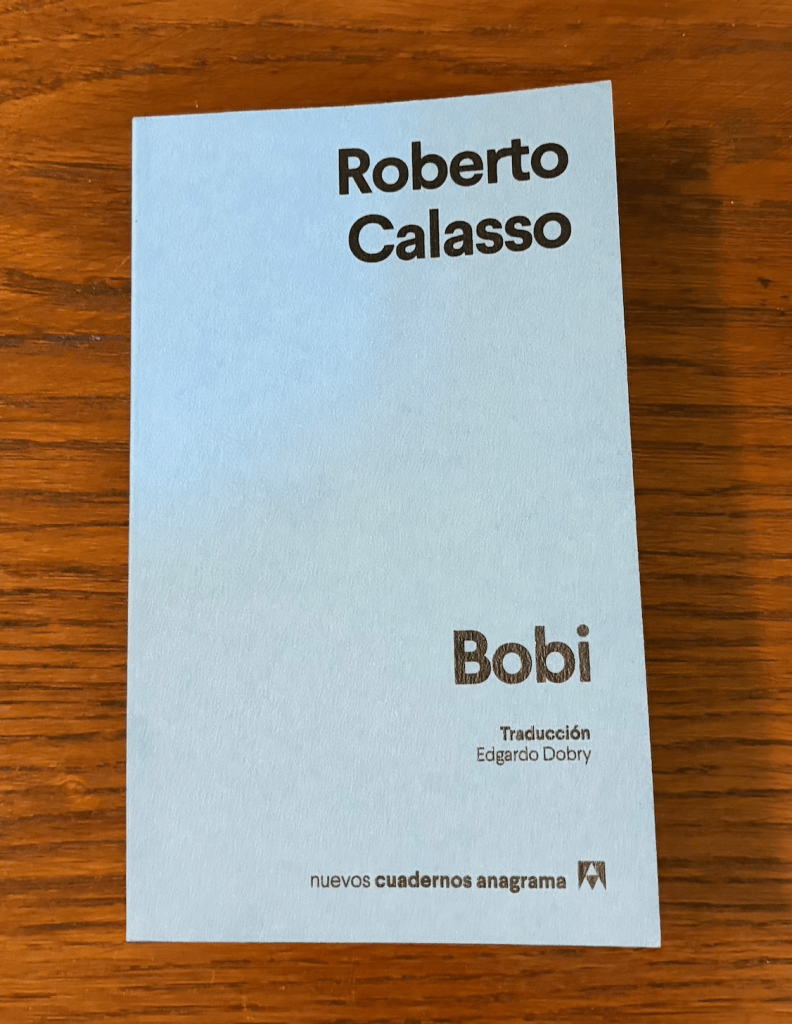
Bazlen’s acoustics. On Roberto Calasso’s Bobi (2026). by Gerardo Muñoz

Roberto Calasso’s short and epigrammatic posthumous book Bobi (Anagrama, 2026) on the opaque figure of Roberto Bazlen has just appeared in Spanish. It is a nebular autobiographical book that does not attempt to render legible the subterranean and oblique figure of Robert Bazlen, but rather to filter some of his obsessions and tonalities, many times through his own voice. Calasso is well qualified to write such book as a frequent stroller companion of the anonymous man of Trieste. There is no aura of the detective mystery about the person’s auratic psychic life, establishing a sharp contrast to Del Guiudice’s polyphonic narrative in Lo stadio di Wimbledon (1983). But in this short memoir book, I am particularly intrigued by a moment when Calasso inscribes Bazlen’s vortex of thought and life as an affinity for the acoustic. 

Calasso quotes Bazlen (we assume that from his own memory): “Bazlen used to say regularly: “This does not sound too good”, and immediately we knew what he meant. His capacity to recognize sound was thorough” [1]. Calasso tells us, moreover, that he cared little about cultural or intellectual polemics of his time. All that matter was sound, the grain of the voice. His meridian crossing was the song and rhythm of another. It is this proximity to the light of the voice what allowed Bazlen to conceive life and writing as a unified sensible reality; mutually interdependent, and always intertwined like the threads in a rigged tablecloth. To inhabit the world without judgement – of History, of morality, of punishment and guilt, of retribution – means to secure an aperture to an acoustics that will remain close to us, albeit incomplete, in the dissonance and impropriety of meaning.

To be able to attune oneself to the voice is a practice that retreats from the order of the world; that is, to descend into anonymity in order to inhabit a subterranean region, which speaks to Bazlen’s insistence on tugurios or spelonche, which Calasso does not hesitate to render as naked spaces, miniature deserts or caves to immunize oneself from the chatter of the world: minima chôra where something could take place or not. It is hard to define them but we know perfectly well what these are. Perhaps we can be more emphatic: to listen to the voice is already the encounter. And very much like Osip Mandelstam’s figure of the interlocutor, true poetics (and first and foremost that of life) “is ever moving toward that more or less distant, unknown addressee, whose existence the poet cannot doubt without also doubting himself. Only a reality can bring to life another reality” [2].

Bazlen’s notion of writing as the writing of life, experience as writing, very much like Mandelstam’s dialogic poetics, finds a tugurio so that language can emerge in absolute presence. And this is precisely what Bazlen understood in the becoming of life against the metabolic strain of survival, since the repression of the voice will result in the annihilation of what is most alive. Calasso recalls Bazlen’s affirmation: “In a world of death – there was an epoch where one was born alive and would later die. Today, on the contrary, one is born dead – and only a few are able, little by little, to be alive” [3]. 

For Bazlen there is no community of the living granted in immanence, because to live means to conquer the putrefaction of the culture of death, which is only permanent revolution and hostility. But one cannot conquer death from death; that is, by means of the beautiful soul’s literary prose of the world. It does not take Hegel to say that this is still unwarranted insubordination and permanent bondage. What is then to be alive? It is a resurrection that takes place as an existential decision, that is “at a point in life when a fundamental decision has to be made. I believe that was his passion, and his masterpiece” [4]. This is Del Giudice’s indictment, although surely not fully at odds with Calasso’s autobiographical sketch of Bazlen. In the melodic contact the possibility of a vita nuova is transfigured in not-knowing because the Western modernity is devoid of any notion of ethical destiny. Indeed, “et tout le reste est littérature”, as Verlaine famously wrote. For Calasso’s spectral portraiture in Bobbi (2026), the adventure is to remain alive well beyond completion and needs, as evidenced in our encounter with his languishing voice and memory.

Notes 

1. Roberto Calasso. Bobi (Anagrama, 2026), 83.

2. Osip Mandelstam. “El interlocutor”, en Gozo y misterio de la poesía (El Cobre Ediciones, 2005), 71.

3. Roberto Calasso.  Bobi (Anagrama, 2026), 55-56.

4. Daniele Del Giudice. A Fictional Inquiry (New Vessel Press, 2021), 123. 

Plastic spirit and depth. by Gerardo Muñoz

In an issue of The Listener in 1935, the renowned British art historian Kenneth Clark penned a short article titled “The Future of Painting” that can be read as an early eulogy to the tradition of the pictorial craft. As a provocation – this was still the high tide of Modernist art – the ‘future’ of painting for Clark was undeniably reaching a point of irreversible exhaustion, at least in the Western tradition. In a phenomenological reduction of two major strands of modern painting – what he called “pure painting” that included Impressionism and Post-Impressionism; and, on the other, “super-realism” as the artistic consciousness that bypassed  “spiritual salvation”, such as that of Surrealism and other visual experiments – Clark’s indictment deployed an indictment on what he sought as the end of the “plastic spirit”: “We must keep in mind the possibility that in the western world the plastic spirit is really exhausted and that art will be lost for many decades” [1]. 

For Clark, it was not that art ceased to exist as an autonomous practice of sensorial activity; it was rather that its imaginative and spiritual endeavors had a future only if mediated and “linked up” (sic) with the evolution of a “new social economic system” driven by the standards of productivity and mass spectatorship. Unlike Clement Greenberg’s reflexive plea of modernist painting as the triumph of the dialectical inversion of flatness over depth, for Clark the convergence of pictorial relation with social objectivity resulted, in the tradition of a post-Cezanne world, in draining the inherent sensible communication of painting and myth. This meant that modernist painting tout court was devoid of any mythical relation. In fact, one could very well claim that the outwardly material support (the flat canvas) of the picture became its most dramatic corroboration. Modernist painting was the triumph of social symbolization insofar as it served as a reminder of the objective space that could only be taken as unserious gratification of its own objectivity.

It does not take too many readings of Greenberg’s large claim on modernist painting to see that behind “flatness”, its very surface, lurks variations of the aura of subjectivity, expressed in “success of self-criticism”, “resistance to the sculptural”, and the drive towards systematic consistency viewed in the mirror of the “convergence of spirit with science; their concern does show the degree which Modernist art belongs to the same historical and cultural tendency as modern science” [2]. Or so writes Greenberg in his landmark text. If Greenberg goes out of his way to invite modern science into the field of aesthetics it is precisely because Modernist art has been able to spell out the potential for representation into an autonomous surface that has given up depth to the conscious effort of its material limitations as its primary concern (imagination, the divine, the liturgical theatrical aura are all secondary). It is perhaps against this backdrop that one can understand what Clark means by the exhaustion of the “plastic spirit” that underpins his prophetic understanding of the decline of painting. 

But what is, ultimately, the “plastic spirit”? It is not referring to sacred representation nor artistic inspiration of the artist, but rather the receptive affinity of the pictorial gesture with nature without ever being reducible to its material support (flatness). If painting exists, it is because its lovely being “is neither sensuous nor spirit, but rather the ungraspable, diffusing over the figure…this being is ungraspable yet perceptible to everyone is what the Greek language called [kharis] and we call grace” [3]. What the ‘plastic spirit’ discloses in its suspension of judgement through very disclosure of appearance is the imperturbable space, and by extension ungraspable, where figuration arrest an instance of eternity. In this sense, it always resists any assertion towards the future, because it dwells in the opening of a space “there” that fails to coincide with the material extension and limitation of the canvas.

This is what perhaps Walter Benjamin had in mind in an early fragment where he reflected on painting as an art of paradise or a state other-than-being grounded in visual contours: “Painting, too, generates space spiritually; its generation of form is likewise grounded originally in space, but it generates space in an­ other form. Not the dimension but the infinity of space is constructed in painting. This happens through the surface, in that, here, things develop not their dimensionality, their extension in space, but their being toward space. The depth yields infinite space. In this way, the form of concentration is given, but this now requires for its fulfillment, for the allaying of its tension, a presentation of the infinite in itself and no longer as dimensional and extended” [4]. Was not this the ungraspable caesura between depiction and nature already pointed out by Schelling?

Painting is depth, or at least it is about a certain way to accout for depth. And depth, fundus, before it takes the form of a flat spatial region in ‘thereness’, it is eminently the display of the figure that emerges from it. This “space otherwise” – that is not just a different spatial arrangement or geometrical calculation – is something of the infinite that makes both flatness and the diachronic arrow of time collapse in its unattainable rigor brought to bear in the affection through figures and colors. Every painting shows therenesss, but that is only possible through the depth of interiority that remains invisible. This can illuminate what Osip Mandelstam said of the plastic spirit when writing that “painting is also much more a matter of internal secretion than of apperception, that is, of external perceiving. To appreciate a picture you must go through a process making of restoring it” [5]. It is in this renewal that the imperturbable depth of painting fulfills before the abdication of the future. And from the “depths of nature” into the blossoming manifestation of appearance, painting recalls, beyond words, what in the sequence of time is understood, and yet often neglected, as the ungraspable. 

Notes 

1. Kenneth Clark. “The Future of Painting”, The Listener, October 2, 1935, 578.

2. Clement Greenberg. “Modernist Painting” (1960), in The Collected Essays and Criticism (University of Chicago Press, 1993), 91.

3. F.W.J. Schelling. “On the relationship of the plastic arts to Nature” (1807), Kabiri: The Official Journal of the North American Schelling Society, Vol. 3, 2021, 146.

4. Walter Benjamin. “The Rainbow, or the Art of Paradise”, in Early Writings 1910-1917 (Harvard University Press, 2011), 225.

5. Osip Mandelstam. Journey to Armenia & Conversation about Dante (Notting Hill Editions, 2011), 79.