There is a small marble Roman relief of Peitho (it is about 15” x 5” wide) of what used to be a larger decorative plate illustrating Helen being persuaded by Aphrodite to accept her husband’s voyage to Troy. The personification of Peitho in the form of a seating lady accompanying Aphrodite is not rare in classical representation, and if we are to follow Friedrich W. Hamdorf’s genealogy, it was actually the norm when it came to visual depiction of the deity [1]. What is striking in this Roman relief of Peitho is precisely the unassuming silence of the figure, who is merely gazing down and touching a dove or bird with her right hand and sunk in thought. Is not this mystical silence what bathes the mythical figure of Peitho, which according to Euripides has no other sanctuary than that of language?
The Peitho relief stands as a fragmentary of an ancient memory where the event of language implicated persuasion instead of commanding; a sensibility of saying instead of legitimate validation; granting space for the poetizing in the world instead of rationalizing, in the advent of the polis and the bios politikos, the transcendental condition of the political community [2]. Peitho will become rhetorical once it has taken the autonomos form of the transaction and the mutilated word by which nothing is ever said except a lethargy of the immanent movement of the logos. In the Roman relief Peitho does not communicate because she dwells in the poetic lacuna of language.
In fragment 81 of Aeschylus’ Niobe we read a mysterious outline of Peitho: “Death desires no gifts; one can gain nothing by making sacrifice…from him, alone among divinities, Persuasion stands aloof.” The ossification of language in hand with the general autonomization of rhetorical separation, in the words of Gianni Carchia, will mark the destitution of Peitho’s poetic magic allowing death to speak through the fierce instrument of demagoguery and and the production of justifiable certainties [3]. In a world without the irruption of the mythic-magical element personified by Peitho, there is only general declensions towards persuasion as a form of predication: to convince, to obey, to follow, and to concede belief as persuasion was transformed linguistically [4]. It is no surprise that the civilizational decline of the mythos of Peitho coincides with the rise of the rhetorical techné that guaranteed the autonomization of the world (private & public, appearance & truth); but, most fundamentally, the stabilization of the resource of rule-based lexicon as the dominion over exteriority.
Even the Sophist Gorgias in his Encomium of Helen defines Peitho as “Language is a power ruler who with a tiny and invisible body accomplishes deeds most devine” [5]. The process of deification of language (in the sense of the sources of archê) can topple the divine in order to mobilize all the energies no longer in the “uninterest encounter between souls” (Carchia’s words), but rather by grounding a necessity that, first and foremost, establishes its ontological solvency in the unending rhetorical polemics. As the sensible myth of Peitho withers into organized grammar and rules of predication, it is noteworthy to recall that in the monotheist tradition the organization of the invisible in becomes colored by “faith” in the law.
This could explain why Saint Paul seemed to have made a conscious attempt to oppose any remnant of the Hellenic persuasion (πειθώ) in favor of “demonstration of faith” (ἀποδείξις). As we read in Corinthians 2:4-5: “My words and proclamation were not based on the persuasion (πειθώ) of wisdom, but on demonstration (ἀποδείξις) of the Spirit and power… that your faith would not be based on human wisdom, but on the power of God. Indeed, “apodeixis” (ἀποδείξις), the word deployed by Paul, will guarantee persuasion only in revelation and the Christian philosophy of history; meaning that Peitho will remain, like the Roman relief from the First Century, a mute aesthetic artefact and a petty reminder of the expulsion of ethōs from language.
.
.
Notes
1. Friedrich W. Hamdorf. “Peitho”, in Griechische Kultpersonifikationen der vorhellenistischen Zeit (Zabern, 1964), 64-65.
2. Francis Kane. “Peitho and the Polis”, Philosophy and Rhetoric, Vol.19, N.2, 1986, 118.
3. Gianni Carchia. “Eros y Logos: Peitho arcaica y retórica antigua”, in Retórica de lo sublime (Técnos, 1994), 23-24.
4. María Dolores Jimenez López, “‘Persuadir’ en griego: el marco predicativo de peitho”, in Word Classes and Related Topics in Ancient Greek (Peeters Louvain-La-Neuve, 2006), 175-176.
5. Gorgias. Encomium of Helen (Bloomsbury, 2008), 44.
There is an untimely moment in Saint Teresa de Jesús’ Oraciones where she speaks metaphorically about her soul as a form of a flourishing garden. It is a description that also advises of a potential risk of the devastation of the garden; as if more than a locus amoenus, what is at stake is a sort of ethical activity that must be retained and nourished in prolonged periods of unexpected danger. We read in the Oraciones: “Y considerar el ser mi alma un huerto, y al Señor que se paseaba en él. Suplicábale aumentase el olor de las florecitas de virtudes, que comenzaban, á lo que parecía, á querer salir, y que fuese para su gloria, y las sustentase, pues yo no quería nada para mí, y cortase las que quisiese, que ya sabía habían de salir mejores. Digo cortar, porque vienen tiempos en el alma que no hay memoria de este huerto; todo parece está seco, y que no ha de haber agua para sustentar, ni parece hubo jamás en el alma cosa de virtud” [1]. The topic of the garden and gardening, as we know, was central to the culture of medieval monasteries, as anyone knows who has seen these places all over the Mediterranean world, and that today many of them have been turned into high-end hotels for global tourism.
The monastic garden was both a site but also a nonsite, a sort of chorā that, as the Saint Pacomio (286-346) would write, it was the place where one could be closest to God, and where existence could experiment its true grace and happiness [2]. And what are the company of the gods of place if not the very nameless fleeting instance of our free relation with the world? This is the index of the ethical nourishment that has been entirely lost.
There is little doubt that Teresa was also conscious of the theology of gardening that her predecessors wrote, such as Walafrido Strabo’s Hortulus (840), which was undoubtedly the most important treatise on horticulture of the monastic tradition during the middle ages laying down the principles for a flourishing seasonal harvest. Like the abbess Hildegard von Bingen centuries before her, for Teresa a comprehensive understanding of “sickness” was not just a question of biological maladies of life, but more fundamentally an existential problem that must be cultivated like a gardener keeps a parcel of land flourishing like a transfigured memory of Arcadia. A space of shade and a surrounding for breathing.
Santa Teresa extends the metaphor when she tells us that there are dark times where the garden is drying up; and, in fact, the soul itself could entirely forget that there was a garden. It is all too simple to say that this dried soulless wasteland is a mirror image of our epoch, where it becomes obvious that in the name of “ecological” administered apocalyptic time, we are entirely uprooted from any possibility of nourishing our garden. In fact, what just a few years ago seemed like exceptional and arbitrary measures of confinement, social distancing and artificialization of the human community, it is now clear that it amounts to not just the absorption of the world as such (this was already the project of formal capital), but rather the destruction of the ethical dimension of the non-world that binds us, at a distance with what remains outside of it.
Even Carmille Pisarro’s “Two Young Peasant Women” (1891), at the shadow of nascent industrialization, now seems to us as dumbstruck by a deep sense of acedia (disconnected and mute) foreshadowing the forthcoming vanishing of their life-world. After all, the aim of the machinist is to make the world soulless, said Landauer in Skepsis und mystik (1903). We have lost all space but we must conquer the chorā, which allows us to cultivate, once again, the soul against all expectancy of programmed obsolescence. Teresa’s huerto del alma persuades us in the stray direction that some, in reality, have never left.
.
.
Notes
1. Santa Teresa de Jesús. Obras de Santa Teresa de Jesús, Tomo I (Libreria Religiosa, 1887), 12.
2. Peter Seewald & Regula Freuler. Los jardines de los monjes (Editorial Elba, 2019), 99.
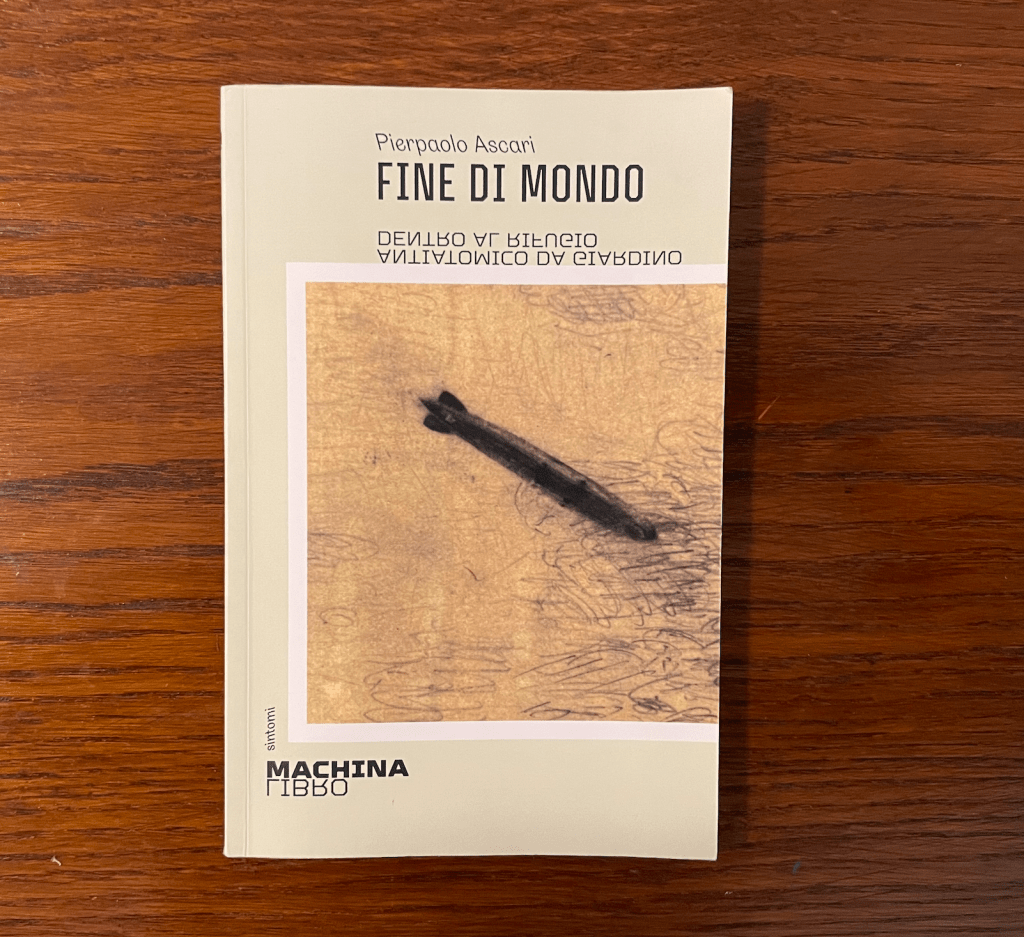
Pointing to a methodological clarification, Pierpaolo Ascari’s Fine di mondo: dentro al rifugio antiatomico da giardino (DeriveApprodi, 2024) opens with an untimely advice: the threat of atomic extermination of human life can only be told and appealed through the irony deployed in all areas of consumerist culture. Undoubtedly, this fits pretty well to the case on point, since American modernization is both the hotbed of Hollywood and the atomic bomb, two poles of the regime of a vicarious life consisted with Henry Adams’ well-known assertion that, in spite of everything, America civilizational passion has always been generalized optimism. And it is not surprising that Stanley Kubrick, when asked about the thesis of Dr. Strangelove (1964), also claimed that the only possible form to tell a story about the bomb of total extermination was through a black comedy (Ascari 11). This self-serving optimism is tested in Ascari’s Fine di mondo (2024) by looking at the construction of an apocalyptic underworld fantasy; that is, in the garden of anti-atomic sheltering that reveals the true arcana of modern Americanism as a subterfuge – but also a civil current in plain sight – parallel to the rise of mechanized labor under the conditions of the triumphant Fordism. Of course, now that our farewell to Fordism has been longed trumpeted, it does not take much to see that what remains is the infrastructure of schizophrenia and general terror in the social fabric that colors the specific tune of American apocalypticism. Ascari’s book is a superb elaboration of this tonality as historically rooted and articulated, but also open to its (pseudo)theological mutations undergoing in our present.
On the surface, Ascari’s Fine di mondo (2024) is a short compendium of the civil responses and techniques towards atomic destruction and survival; but, more deeply, is also a history of Americanism as a historical project committed to a long process of civil domestication, enclosure, and endurance of survival. Of course, the nuances here are important to grasp the subtle hypothesis of Ascari’s working scene, since we also know that modernity at large (considering both its contingency and contradiction as features of its emergence) was also a process of an optimized gnosis through alienation and the enclosure of private property towards commerce stabilization and productive growth (the nomos). But for Ascari the specificity of the American nomoi through the lenses of atomic sheltering and refuge implies a microphysis; that is, a “way of life” validated through theological premises tailored in the organization of subjective deificatio (Ascari 23). This means that the apocalyptic apparatus driving American philosophy of history is not just one of realization towards the absolute objectivation of the world – even if such endeavor is necessary and preparatory – but rather that the sheltering and self-imposed domestication of human existence has become naturalized as a threshold of the conditions of finite human life. The paradigm of sheltering as the unit of survival is a form of self-regulation of grace that is consistent with the evangelical dispensationalism and technical election analyzed in Monica Ferrando’s recent important book.
The concrete examples abound in Ascari’s short but densely illustrated book: from the Civil Protection comic to the details of the emergence of “do it yourself” assemble manuals (discussed in the correspondence between Adorno and Sohn-Rethel); from the Hulk to Godzilla in a post-atomic bombed world; form the resilient speeches on atomic menace by JFK to a 1950s study conducted at Princeton University that reassured that “fathers” will get to know their children better in conditions of total sheltering even if it results in an “ethics of the jungle” (Ascari 34). Following Guy Oakes’ groundbreaking The Imaginary War: Civil Defense and American Cold War Culture (1994), what is distilled in Ascari’s pop culture puzzle is the panorama of the “Cold War” not as a war that did not take place between two imperial powers; but rather a total war that took place beneath the crust of the earth (and this is why the topoi of the refugee becomes so telling) and at the thicket of human existence waged as psychic management of the civil sphere. In fact, the “imaginary war” is nothing else than the stazion once social life that has yet to cease to exist in our days (Ascari 48-49).
For Ascari this implied an interiorization of the ‘sublime’ in the reification of the social fabric, which cannot be divorced from the lobotomized subjectivity of the crisis of “social man” that Gianni Carchia identified as the steering project of post-enlightenment Romantic negativity. In the turbid vaults of the self-made man we encounter the liquidation of everything that is living and the projection of fictitious death that clings into “salvation” in spite of absolute destruction; because, after all, those that survive total destruction are only there to confirm the soteriological greatness of the American destiny (Ascari 78-79). The thorough “Ubu” dimension of American psychic political power definitely speaks to this well sedimented conviction of sacrificial subjectivity. Who does not remember the glorious chants for resilience and isolation of the American political elites during the peak of the COVID19 crisis management? If it came to no one’s surprise that a large majority of Americans accepted the pandemic arbitrary rules (monetized whenever needed, it goes without saying), it was because the American subjectivity has been adapted for quite too long to the ongoing separation of refugee and domestication. After reading Ascari, in fact, we think whether the emergency policies were not just another episode in the history of American sheltering now extended at a planetary scale.
There is another idiosyncrasy to American apocalypticism that must be accounted for. And this is introduced towards the end of Fine di mondo (2024), when Ascari quotes Ernesto De Martino about nuclear war; mainly, that when it comes to atomic annihilation there is no longer the symbolic mythic-ritualistic process of reintegration, but rather the mere technification of the hand that gathers scientific knowledge in convergence with the death drive” (Ascari 81). In other words, this technico-apocalypticism brings to absolute unity the originary response of the human species (the movement of the hand) with the organization of scientific rationality that, like Günther Anders saw, brings no re-symbolization of the principle of reality, but rather it can only reaffirm the layering of the principle of reality to govern over it (Ascari 85). In a way, if it as if the essence of American apocalypticism is instituted as if beyond time, since the endurance of a “time of the end” means that the triumphant death (and the dead fueling the demagoguery of its process) foreclosing the symbolization without an exit. Indeed, an apocalypse without redeeming kingdom. For Ascari the only anticipation – primordial mechanism of anthropological capacity – is that of “money”, and hence the dominance of the principle of general equivalence entails gaining the temporal illusion of some distance from the ongoing production of death. But it is evident to anyone today, as it was said not long ago, that the true dead are those petit bourgeoisie living in the American suburbs. And they keep coming as the embers of domestic happiness try to ferociously shut down the latency of a piercing pain.
Yes, the nature of permanent apocalypticism confirms that the true and final object of techno-capitalist force has always been the possibility of multiple life worlds. And its erosion implies the endless possibility of ordering the life of the city, as Elon Musk just a couple of weeks ago told the former president of the Republican Party: “Hiroshima and Nagasaki were bombed and now they are full cities again. Yeah, it is not as scary as people think”. If the enterprise of civilization has largely been understood as springing from the crust of the earth upwards, one of the important lessons of Ascari’s Fine di mondo is that it trains us to look downwards and inwards as the cruxes of America’s persistent government over the garden of our souls.
One is always struck by the pictorial intensity of Massacio’s “Expulsion from the Garden of Eden” fresco (1425) at Santa Maria del Carmine Chapel. It has something to do with the unbounded expressivity swirled by an acoustic of lamentation that springs from both faces at once. The nakedness in movement only comes second. If it is right to call it ‘modern’ is precisely because of its polarity between movement and paralysis, light and shadow, the formation of the lines delineating the bodies and the free-style strokes that carry Massacio’s picture to a strict and unsurpassed balance. It is a picture of the gathering of lamentation and pain, which confirms Ernesto de Martino’s intuition that in the ritual of mourning weeping and crying is also accompanied by an act of self-defacement, such as covering the face or bring the face as close as possible to the lower body position. Adam’s pain is reinforced by the hand that covers and pulls the face downwards, almost making it disappear. In a way, his walkout of Paradise is already the stroll of a nobody.
There is perhaps an intimate relationship between defacement and pain. In his short gloss on this work, Robert Longhi notes that the source of strength of Massacio’s work is given by the intensity of light that bathes the bodies of Adam and Eve in its purest naked form [1]. This total exposition is the cause of sin that, as a great historian of religion has brought to our attention, presupposes the entire carnalization of both body and soul after being thrown into the soteriological world of the living [2]. From now on, human life vested in pain means paying the price of the destruction of the soul for the protected and preventive set up in the world.
The sinful life – a life that will have to be chosen but punished justly – entails the consummation of pain as the central tonality of post-felix culpa existence. In other words, it is not that life is shameful because it has been dispossessed (or because it recognizes itself possessed); it is dispossessed because it can no longer look at the world outside the blinding light of programmed obsolescence towards death without transcendence. And the liquidation of transcendence means that human beings become faceless entities in a world that will forever become unfathomable.
In our days – a present marked by absolute secularization of ancient religious somatic religiosity and magical traces – the phenomenon of defacement and the faceless far from disappearing is all over the world around us. The ritualistic mask which provided transcendence to the living presence of the divine gods has now become a symbol of social shame self-imposed by arbitrary and ever-increasing moral mandates. In a sense, we have not yet left the path initiated in Massacio’s Adam and Eve fresco, and who knows if we’ll ever exit it in the ongoing destruction of the human species. We do know, however, that any meaningful change of the current state of things can only take place starting at the divine surface of the face, as Carlo Levi so eloquently understood it in the postwar years:
“Only a genuine revolution succeeds in changing the way people look, their facial expressions, the light in their eyes, the charm of their smiles. Christianity appeared with new faces, or taught a new way of looking at them. If we go through the streets and compare the faces we see with our memory of them, we won’t recognize persons any more. It is something that anticipates reality, as if prophetically, the universal change that for almost two centuries now has been shaping new faces throughout the whole world”. [3]
Notes 1. Roberto Longhi. Breve pero auténtica historia de la pintura italiana (Machado Libros, 2023), 114. 2. Paula Fredriksen. Sin: The Early History of an Idea (Princeton University Press, 2012), 116. 3. Carlo Levi. La doppia notte dei tigli (Einaudi, 1959), 109.
In the following months some of us will offer an eight week seminar exclusively dedicated to a close and analytical reading of the enigmatic work La persuasione e la rettorica (1910) by Italian thinker Carlo Michelsteadter (1887-1910). Ever since his death – as can be easily gasped by Giovanni Papini’s obituary in 1917 – there has been an aura of mystery around the infamous philosophical suicide of Michelsteadter that only parallels that of Socrates’ hemlock or Otto Weiniger’s self-inflected gunshot. Of course, we will be less interested in the biographical motives, and if push comes to shove attention to this detail will be elaborated in light of the nexus of his thought to the event of his death.
La persuasione e la rettorica (1910) offers a unique theoretical elaboration about the civilizational decline of the “living” into the rhetorical deferment of life as realized in the organization of social alienation. And for Michaelsteadter there is no other purpose of rhetorical form than the absolute submission to the general abstraction that defaces the event of pain. It is no accident that he was also interested in the thematics of health and ancient techniques of pain-relief (the techné alupias, for instance), even if underdeveloped in his thinking given his sudden premature death. So, it is for us, his posthumous readers, to take these sets of issues and move them forward in our present any way we can. This is part of the task that motivates putting together this seminar after a series of conversations with friends and interlocutors.
La persuasione e la rettorica (1910) deploys the classical metaphysical tradition through the ancient poles of “rhetoric” and “persuasion”, where the second (the ancient Peithò) seeks to return the voice and expression to the problem of pain as an ineffable type of speech (Logos) that refuses the elevation of force that harbors the circulation of violence and the administration of social death. The ancient notion of the Peithò withdraws echoes of the mythical inception and the sacred, as also reminded by Aristophanes: “Persuasion’s only shrine is eloquent speech (Logos)…And I Persuasion (Peitho), the most lovely word” (The Frogs, 1391-1395). Where and how do we attune ourselves to the peitho today – the imperative of the eros of the word in the wake of the regime of social production of pain?
In the aftermath of the collapse of the cycle of civilizational secularization, it is only obvious that all these questions stratified in the tradition once again become attractive and pertinent. In this light, we think that Michelstaedter’s thought still offers us a series of significant hypotheses to think through the crisis of social man and the domination of the civil that colors our current predicament, where the question of “pain” is still an understudied problem. Throughout this course we will address notions such as rhetoric and persuasion, life and communication, nihilism and values, the logic of capital and the social bond, or the notion of world and pain. Our aspiration when approaching Carlo Michelsteadter’s work is to develop reflective conditions to address the thorny issue of an ethics of pain that so thickly enmeshed in our historical moment.
.
.
‡: Information about the registration to the seminar will be made available at Revista Disenso in upcoming days. The seminar will run every other week for a period of eight sessions (roughly from the beginning of September to early December, 2024).
There is something vessel-like in communication, and the need to keep it alive and to give it consistency and texture; to prolong it in both time and space. If it is true that ‘empty chatter’ is the erasure of the possibility of making in language, then communication is not just a practice of translation and legibility, but of passing of an experience, however impossible and tenuous that could be. This passing on through communication is embodied in the old figure of the portatori d’acqua or the aguador that famously appears in early modern Spain. The aguador is a figure of stagnation that sustains life, even if he is (or precisely due to this very fact) an iconic fact of social indigence.
One can easily recall Diego Velázquez’s “El aguador de Sevilla” (1618) with his ragged clothes and noble stance in the somber bodegón picture. V. S. Pritchett was up to something when he claimed that to ‘know a people’ is to know its poor. And that poverty is, first and foremost, a poverty in temper and restraint. What does it mean to communicate in the temper of poverty? This seems to me the question at the heart of Velázquez’s exemplary aguador. What is cherished in the aguador’s concrete labor (carrying and bringing water) is a transcendental relation that retains the need of life.
In a sense, there is no surprise as to why the aguador has disappeared in the due course of long and agonic historical development. If the essence of civilization is appropriation and growth, accumulation and production, then it is to see how the impoverished water carrier is meant to disappear. Already in the Lazarillo de Tormes (1554), Lázaro’s inverse transfigural condition into a social subject takes place by abandoning his short-lived condition of aguador, which is hyperbolic of the organization of the social stagnation. It is clear that Lázaro’s picaresque attitude of outsourcing the nascent commercial society of good and services – embedded in the production of criminality and banditry – is a way to overcome the original indigence of the aguador, whose sanctity must be amended through the mimetic process of autonomous secularization and the rise of the metropolis.
Thus, the eclipse of the figure of the water carrier coincides historically with the fall of the contact of languages and experiences between human beings. This might be why in the civilizational peak of the metropolitan organization of the world, the poverty of experience refracted by the force of alienated objectivity becomes a problem for sewage engineers in the goal of the reproduction of life. Vargas Vilas’ provocative definition of the “social” as a machine of the production of excrement should be understood as an scatological image of what it means to live in a world without aguadores.
And this why everytime that a water pitch is brought to a table an oblique and momentary happiness overtake us beyond the biological need of human thirst. To this end, Isabel Quintanilla’s Duralex water glass painting (1969) encapsulates something so divine and unfathomable; as if, in the suspension of words or stories, the resurrection of the water carrier is brought back to the sharp appearance of things.
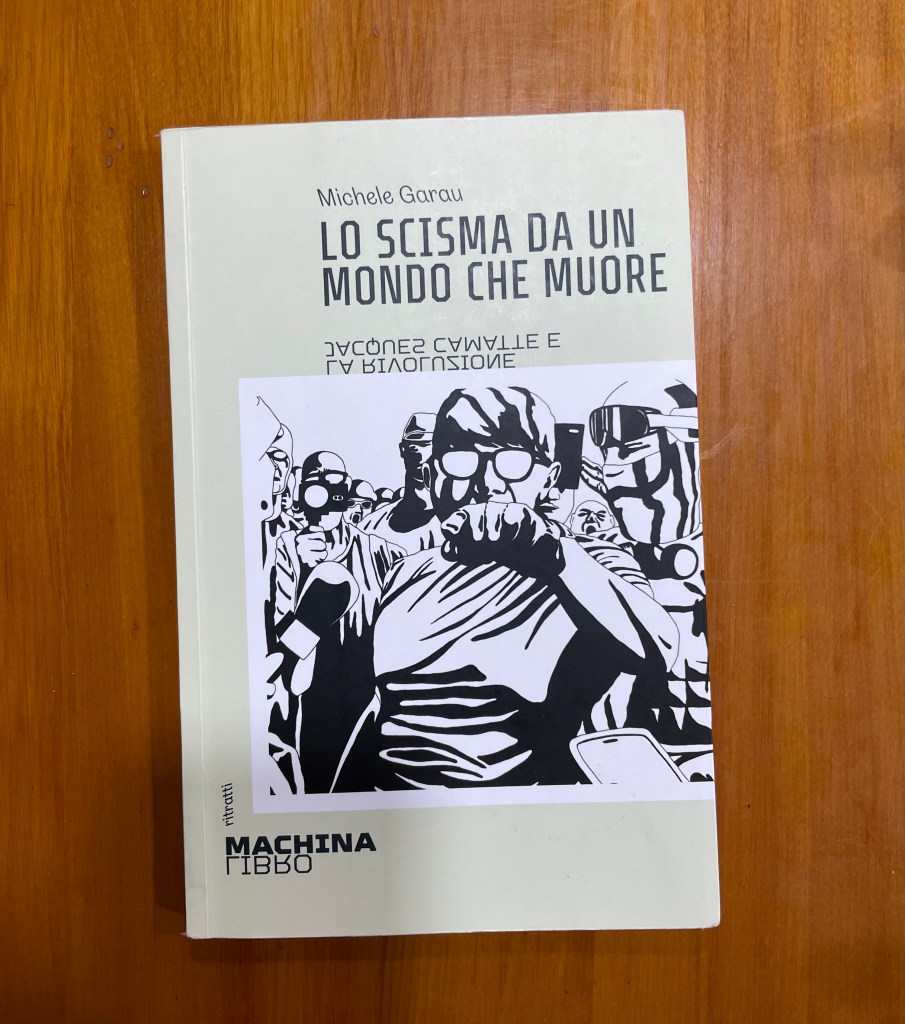
We must welcome that Michele Garau has written the first monograph on Jacques Camatte’s thought in any language, although the book, Lo scisma da un mondo che muore: Jacques Camatte e la rivoluzione (DeriveApprodi, 2024) it is also more ambitious than a mere philological reconstruction of the thinker of Invariance. Of course, not that there is anything particularly wrong with philological or archival work; rather, it is also that Lo scisma da un mondo che muore (2024) tries to think with Camatte (and also beyond some of his potential impasses) the historical bifurcation of a watershed moment in the history of humankind through the realization of the “capitalist revolution” as an autonomous colonization of every form of exteriority (Garau 7). If Camatte’s work has been only selectively considered in our ongoing discussions – while completely ignored at large by the so-called contemporary theory, which I guess it is an uplifting symptom – is precisely because he poses a challenge for a possible breakthrough in times of stagnation, while firmly announcing a much needed farewell to the modern revolution. But who would want to jump on that wagon when precisely voluntarism, prosthetic revolutionary cosmetic, and fictive communitarianism are all necessary platitudes to hold on to the illusion of ground right above the abyss? It is a rhetorical question, of course, but also one that Camatte move passed it in the in the decades of sixties and seventies observant to the material transformation of the working class, and the overall lesson of Amadeo Bordiga’s communism of the human species, which has also been rendered opaque and fossil-like by the victorious force of cultural hegemony and the whole grammatical structure of Gramsci’s thought in postwar political thought (and some will say well into our very present in the most recent cycle of failed left-populism). We said ‘farewell’ and this act, for Camatte after Bordiga’s teaching, means that the revolution has already taken place and must be perceived in the perspective of the crisis of negativity and the inception of the real absorption of capitalist development (Garau 14).
Hence, new challenges lay ahead, which implies the abandonment of the historical and temporal productivity of revolutionary time – and Garau does an excellent mapping of bourgeois revolutionary thinking from Abbe Sieyès to Saint Just to later formulations of the Leninist paradigm of the dictatorship of the proletariat – which in the grand scene of modernity oriented the economy between form and function, but also between thought and action. If the epoch is said to be ‘anarchic’ is mainly because all these mediations and exclusive autonomous spheres have collapsed unto each other, and to favor one over the other is to work within the fiction of ideological reproduction at best. After Bordiga – Garau claims glossing Camatte, although there are nuances that I cannot consider in the space of this short commentary – the temporalization of the ius revolutionis can only bear in mind the crisis of presence (De Martino) as a suspension of exteriority that liberates right unto real subsumption. This means, following the recently polished phrase of Bordiga from his article “Tempo di abiuratori di scismi” (1965), that all revolutions are born and deployed as the affirmation of the schism. “Schism” or “scisma” — and one is reminded or taken back to a theological terrain, and not just as mitigated by the old ecclesiastical memories of the “Great Schism”, but because “schism” is also the “stazion” that fractures the visible-invisible legacy of form of the Church’s Trinitarian doctrine, and which is still the esoteric boiling point of the myth of political theology. This is a detour around Garau-Camatte-Bordiga’s intuition, since none of this is explicitly thematized in the book, nor should it be. It suffices that it opens to this question, given that Camatte’s own grammar of exhaustion – “extinction”, “inversion”, “autopoiesis”, “critique of organization”, “wandering” (erranza) – distill the echoes of an apocalyptic movement proper to the modern anthropological crisis, to put in terms of Ernesto de Martino.
Be as it may, the longue durée of civilizational development of Western revolutions (Edward Gibbon would claim at least since the reconstitution of the Christian Empire) there has been a process of adequation to invariant processes of capitalist accumulation that its substrate (whether permanent, uneven, natural law justified) becomes isomorphic to the structural needs of capitalist autonomization. In a cogent reading of Sieyes with Saint-Just in the framework of the French Revolution, Garau demonstrates how the genesis of modern politics and its categorial scaffolding (localization, constituent power, social unity, subject of rights, and representation) presuppose a thoroughly new vision to make the human community a clean slate for surface legibility (Garau 42). If the civil concept of the ancient polis was measurement and exchange; the crafting of high-modern state politics that took off in the eighteenth century was much thicker and spatially robust dynamics so that the ‘laws of commerce’ and population disciplining could come to fruition with its necessary infrastructural support. The schism was always a perturbation of the “sphere of politics” (and also of politics as a translucent sphere that can be observed, stabilized, and managed), and thus a great scandal.
Hence, the critique of political economy in the history of marxism was never able to untangle this mutual correspondence. For Garau at this point one can locate the difference between Camatte’s thought and Italian operaismo; given that Italian workerism at mid-century was never able to overcome the dialectic between the valence of value form and the theory of the production of capital. Whereas for Mario Tronti the struggle was still to be inscribed in to confrontation between the proletariat qua labor power; for Camatte the “invarianza” is not an permanent stage within the history of class struggle or Marxism, but of the human community and its resistance against the real subsumption of the material community (Garau 48). Decoupling the history of the working class as constitutive of productionism from the human community, allows Camatte, in the wake of Bordiga’s communism, to register the subsumption of capital as it collapses into dialectical negativity. Hence, communism is neither produced nor organized as operaismo always thought (Garau 26-27). And citing a passage from “Against domestication”, Garau argues that for Camatte the history of the proletariat struggle after 1945 is only the struggle to maintain the myth of the proletariat as the subject of a historical breakthrough (Garau 73). This is a staggering affirmation, and one that most definitely produces a theoretical schism. But the schism is also against the fictionalization of a subject of history, which has also been integrated into the emptying of social reality as we have come to know it in the final triumph of the fictive unto itself (Garau 93).
There is the triumph of the fictive and expansive force of capital despotism, and then there is the struggle for the originary community (Gemeinwesen), which as Gianni Carchia argued in his “Glosa sull’umanismo” (1977) was still enmeshed in the contradiction between humanism and anti-humanism obstructing the vascular movement of non-identical fragments imploding the social. Is this getting at an impasse of Camatte’s own effort of thought to find an exit route? As an intelligent book, Lo scisma da un mondo che muore (2024), refuses to give an essay in the last three pages of the essay, although this difficulty is an object of attention. For instance, Garau writes in one of the clearest elaborations to tackle the problem directly: “La comunità deve allora essere riscoperta in una memoria della specie che finisce per radicarsi, questo è il rischio, esclusivamente in un bagaglio biologico. Nell’esaurimento delle strutture sociali preesistenti, dei linguaggi e degli schemi culturali, delle intelaiature rappresentative e cognitive, nella colonizzazione delle capacità psichiche, affettive, simboliche, è davvero possibile individuare un resto intoccabile dall’antropomorfosi del capitale che non debba essere, invece, creato dal nulla? C’è una «parte irriducibile», come scriveva Bataille, rispetto alle unità di misura del dispotismo economico? Non è semplice rispondere” (Garau 124).
In light of this rumination, Garau also attends to the cycle of contemporary revolts, which might stand as an instance of linguistic and existential struggle against domestication and the crisis of presence (Cesarano), and that might be capable of “absorbing the sky of politics into the most simple and elements components” (Garau 124-125). This is a great image, and one that has pictorial density and durability for thought even if it lacks specific elaboration. To absorb the open sky is to confront the exteriority of the world only as transfigured and brought back as a gathering of experience. The great German critic Kurt Badt comes to mind when writing about Constable: “the sky’s the organ of sentiment”. The embarrassing loss of the world today is fundamentally the destruction of the right attunement to our relation to the opening registered by what gleams above our heads. And perhaps this is a way to measure the capacity for non-movements rather than thinking that movements can disclose the sky. To this end, what could it mean to absorb the sky of politics – which is also a way to refuse the politics of sky, that is, the total planetary grand designs of geopolitical Tianxia? The irreductible may not be reduced to a substance, nor an ontological science nor a vitalist return to an originary community (if only mediated by the restriction of the archaic myth); but precisely that positionality of contact between what is exterior to life itself. To dislodge thought from all political plotting of objectivation and its plastic ligament of social adaptation. A life beyond itself that endures, and perhaps will outlive this dying world.
I have read with genuine interest the five bulletins put out by the organizers of the Non-Kongress meeting, and it is only fair that I put some preliminary comments with no other purpose than to highlight a few points (I take it that other will have theirs, and I am looking forward to this discussion). To start somewhere, I will first say that I am fond of the open balance sheet format that puts on the table hot-button issues without exhausting all them. The starting point is broad and clear: our current predicament is one marked by the collapse of the ground of politics and the total absorption of politics into a social-moral designs. These days I also come from drafting a preliminary – an in a way a bit autobiographical – balance sheet of the last decade of (failed) debates in contemporary Spanish leftist politics (2014-2024), which allows for reflection of a contemporary sequence, draw a few conclusions, and move on. If we do this something has already change, and we have avoided the anxiety of feeling that everything must be said. The momentary arousal provided by rhetorical completion pays the price of immobility and confiscates the truly important thing: what will never be thoroughly said, or stated only indirectly, is the condition for any true communication of thought to have a chance even if it rarely happens. This aspiration is sincere and from its inception it already puts university discourse (and its experts in the intellectual division of labor) in trance. And this trance opens a region that allows for something to emerge in a new light sin sanata.
The five-installment bulletin seems to provide two general movements: an analytical sketch of current domination and several conditions for “refusal” or “exodus” under the generic designation of “destitution”. On the first level (the analytics of domination) the bulletin suggests that the configuration of power is organized as an imbrication between the scientific medical apparatus, the expansion of infrastructures and digitalization, and an administration of morality as stratification of values in social optimization that were effectively accelerated in the wake of the Covid19 policy directives. And it is also obvious that what also binds these three different strategies and domains is the administration of the hollow and the fictitious subject as the last subject of nihilism (nothingness as unconstrained force) for ecological catastrophe. Now it is utterly clear that – in aftermath of the gran designs of productive modernization and formal labor productivity – the true and ultimate objective of capital is the world; and, more concretely, the human species’ exposure to worldly phenomena. Hence, there is an implicit, not totally fleshed out, latency in the bulletins which one could situate under the turn towards territoriality, location, place, and fragmentation of the earth. Of course, there is ample risk here to assume that locality (communes, community, autonomous zone) is just an exception to planetary unification that labors negatively for the ongoing destruction; a sort of ‘partisan’ Benedictine community under the shadow of Empire. This is why it is important that Hugh Farrell reminds that any territorial program can no longer be unliteral and must be opened to the contamination of the experiences must incorporate play and openness to its outside [1].
This is touching the limit of the defunct strategy of occupation in which the spatial unity accomplishes the self-police work through the veiling of the good conscious subjective militancy, as I recently also saw in the Pro-Palestinian university encampments in the US [2]. More than a decade ago, Alberto Moreiras warned about the ontotheological determination of locationality as a fold of identity, and he called for a “dirty atopianism” against the allure of compensatory critical regionalisms, and which we can connect (with all the caveats necessary) to the form of countercommunity and the difficult problem of the non-site of the khorā that marks an unbreachable limit to the totalization of the ground of the polis and the political [3]. Life or existence at the end of the day is not “this body” or “this thought”; it is how this inclination connects to the surround of the world. And here is yet another problem, which is delicate as it is difficult to untangle: the need to for a reinvention of a concept after the destruction of its civilization diffuse uses in the Western tradition: “freedom”. We do not need Shelley to tell us, but it is always useful to recall it again: “…the state of probation in which we now reside is merely a preparatory stage in which….to fit us for a more exalted state of existence, is not the deprivation of liberty the deepest, the severest of injuries?” [4].
It is only now that we can understand that liberty of the subject – and the political subject of liberty – was a ragged garment when compared to the freedom of the surround — think paintings of Cézanne as a gesture of gathering to “declare the essence of the world to be existing together, a mutual self-supporting and carrying of things”, states an eminent art historian [5]. Political language, or the intensification of language through the lexicon of politics is too vulgar to do the work and the heavy lifting; we have to be capable, I think, to look elsewhere (say, painting) for claims of a transfigurative sense of what it means to grasp this notion of liberty that takes us to the very beginning. It is a difficult problem, no doubt, but against immediacy, the sensorial must be expanded beyond its commonplace allocation into the latent or full-fledged central conflict. Those images are also too poor of world; even if we know that the world “can have no temporal view of things…the world pass into nothing in the very multiplicity of its instancing” [6].
The fifth bulletin calls for an “ethical ground”, but immediately passes to claim a “politics of destitution”, which is overtly anchored in the recent cycle of “experiential revolts” as stable instances of this passing world that does not succumb to conclusion. I guess it all depends how much weight – or how deep down – one is willing to exert on this figure. Or how extensive the figure is — for someone like Rodrigo Karmy, the revolt is the turbulence of imagination itself. But the question remains as well: does not revolt, as prefiguration of a politics to come, or as a politics of destitution, run the risk of assuming a general central framework of entering into the world? If the precondition for the accumulation of freedom of the surround is given by the belligerent loss of fear of solitude, then this could mean, among other things, that the revolt does not stand as the exclusive theater of opposition or refusal [7]. The freeing of the instancing of the world means that there are multiple ways in which existence deals with the increasing pain at the end of social cohesion. The end of the Social bond entails the intensification of pain as the fundamental stimmung of our times.
The European Union elections this spring restate what otherwise is already felt almost everywhere; mainly, that the destiny of politics has ceased to mean anything historically, and that political representation stands as a compensatory preamble and veneer to planetary conflagration, in which Europe has become a minoritarian and bystander actor. This also means that the histrionic reaction to this reality can only bring out its counters more sharply: both pro-nationalist sovereignty political platforms, and abstract administrative pro-union coalitions are junior partners of the current geopolitical planetary regime, and they merely differ in mild policy nuances, social spending allocations, and rhetorical probing that can also be as flexible as needed (such is the case of Italy’s Giorgia Miloni who one morning can be in a Vox Party Congress in Madrid, and later in the afternoon receive orders from Ursula von der Leyen and the White House).
The passage of destiny politics to the gigantism of geopolitics entails not just the erasure of the modern boundaries of enmity recognition, but also the introduction of an administrative plasticity that responds to ad hoc organizational and infrastructural planning, as symptomatic of the collapse of the subject of history into the dominance of the objective. The final stage of the “disenchantment of the world” that characterizes bureaucratic legibility finally appears as the reign of objectivity and the objective. And the concrescence of objecthood as the last avatar of the colonization of forms of life allows us to see how the compensatory constructions of ‘community’ – both the “European Union” and the multiple sovereign communities as reactions to it – repeatedly oscillate between communities of fictive identitarian belonging, and formal political communities devoid of constituent authority. Regardless of their contrasting designs and contrasts, both defenders of national sovereignty and the supra-national EU share the same allure of communitarian integralism: a community for the living, that is, for those integrated into the social apparatus of a well lighted and funded administered world. Respectively, we can see that the debate that took place in the late 1980s about negative community in Europe among philosophers (Jean Luc-Nancy, Maurice Blanchot, Giorgio Agamben) has not lost any of its poignant relevance, as the compensatory communitarian options multiply and spread without ever retreating from the summoned shadow of politica arcana. In a certain sense, the confabulation of communities of belonging and communities of faith are dispensable painkillers to the effective disintegration of the immanence of the social bond. This explains why “people” can only assent to them.
Both community form and political empire are united by a legislative political principle that today remains chattered in the final stage of intrahistorical collapse. There is no communitarian option today that does not end up living negatively on the hinterlands of the nexus of Empire; an exception to the nomic organization of the globe incapable of taking into account the inmates of community form. What is at stake is access to the world; an excess beyond communitarian identification and the administration of the waning politics of Empire.
One can, I think, read Josep Borrell’s words in a speech given at the European Diplomatic Academy in 2020 in this direction, where he calls Europe a well cultivated garden [1]. Obviously if we read it in a political key, Borrell’s address maintains the perennial framework of civilization and barbarism, and in his head the role of the ‘gardener’ is only a metaphoric deployment to exalt the morality of the squalid and humiliated European diplomats on the global stage. However, we know that there is much more to the earthly garden, which retreats already at the moment it is enunciated, since it is a mythic-poetic trope that colors the sensibility of concordia rather than elevating itself as a sociological category of political orientation.
As Italian historian Flavio Cuniberto notes in his beautiful book Viaggio in Italia (2020), for a poet like Dante the meridional Mediterranean region was the garden of empire (“che’l giardin de lo imperio sia diserto”) which attunes itself to the measureless relation between earth, landscape, and life. Is not this what is preparatory – that is, what must be posited in sensibility and in imagination through style – before any reduction of life into community and political mediation? Have not we felt this dissolving transport before a landscape in the outskirts of Tuscany or Orvieto? And is not this what political ecology (Green New Deals) are after in their effort to foreclose the world? The garden unworks empirical objecthood through its very refusal to be integral to devastation, usurpation and destruction of loci. This is why for Henry Miller the only “ideal community” would have the garden as its evanescent topoi, a “god filled place” even for those that have no gods:
“Even if it lasts for only a few moments, the privilege of looking at the world as a spectacle of unending life and not a repository of persons, creatures and objects to be impressed in our service, is something never to be forgotten. The ideal community, in a sense, would be loose fluid aggregation of an individual whole elected to be alone and detached to be at one with themselves and all that lives and breathes. It would be a God-filled community, even if none of its members believe in (a) God. It would be a paradise, even though the word had long disappeared from our vocabulary” [2].
Looking at the world as a spectacle – of course, this brings to mind Petrarch’s specular heights at Mount Ventoux, in which the possibility of seeing, for once, has the upper hand against the mastering the worldly phenomena at our “service” and proportionality. There is no utopia without this attempt to grasp the spectacle in its taking place, infinitely exceeding the rationality that vests reality into amorphous abstraction. Perhaps the garden is a figure of this necessity of irreducible outlook, which in Marvell’s language touches the ungraspable as it is inwardly felt: “Annihilating all that’s made / To a green thought in a green shade” [3]. The promise of a new life takes resource in the abode of that green shade.
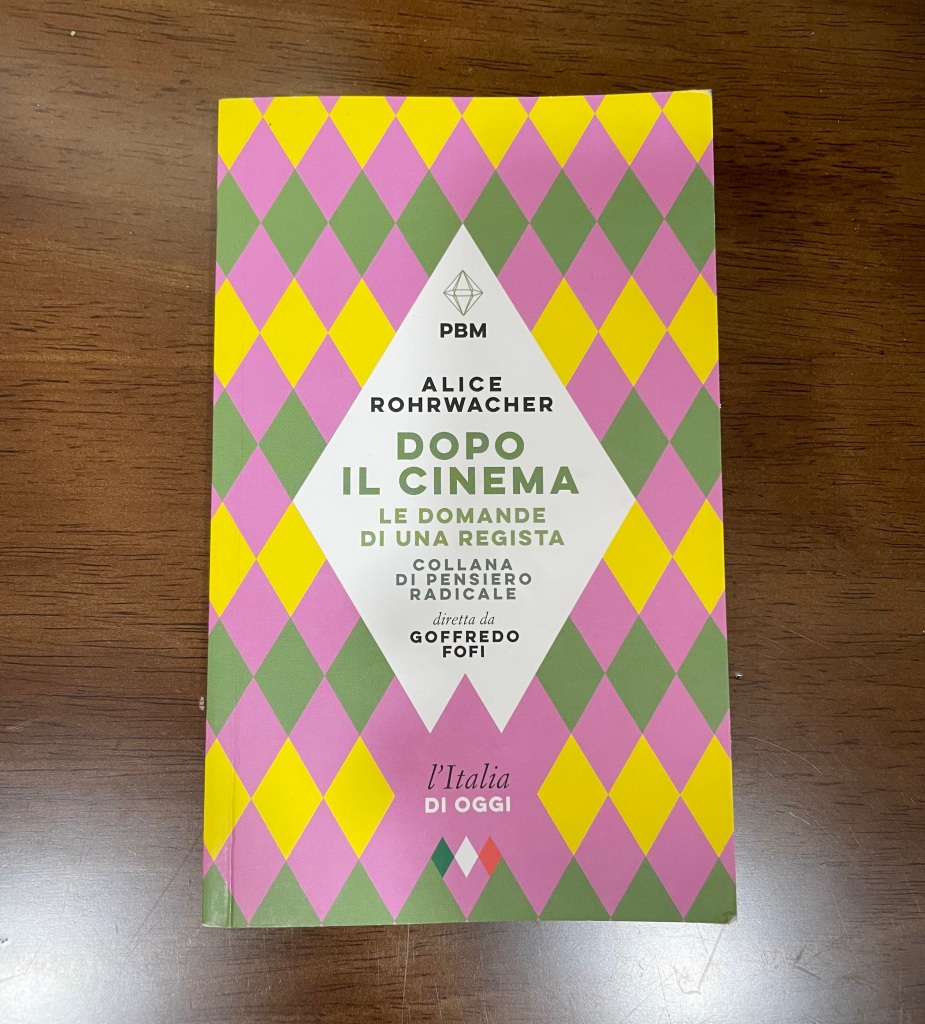
In the the long conversation Dopo il cinema: le domande di una regista (Edizioni e/o, 2023) conducted by Goffredo Fofi, the contemporary Italian filmmaker Alice Rohrwacher offers a series of reflections about the possibilities of artistic creation in the abysmal time of integrated spectacle that has fully brought to bear the erosion of the human capacity for attention and outward experience. Can cinema and film do anything in the wake of such humiliating and crushing reality? At first glance the late modernist critique of the value-driven image seems insufficient and merely rhetorical as the valence of dialectics has been dissolved in the pressure of real subsumption. In a certain sense, Dopo il cinema: le domande di una regista (2023) is a reflection written after the ambivalent commitment of cinema to awaken the spectator from the slumber of the absorption in order regime of standardization where the utopia of self-design realizes the objective abstraction in the acceleration of optimized and contained expressiveness. At no moment does Rohrwacher affirm that we are, indeed, “after cinema”, but throughout the dialogue the tone is that of immediacy in an epoch that seems to be saturated by looping, real-time, and the intensification of life-exposure spectacle. If film is reduced to telling stories, then it falls into vulgarity, while contributing to the gigantic sedative layout that veils the annihilation of social reproduction. In the last decade, Alice Rohrwacher has done a series of important and highly original films (Le meraviglie, Lazzaro felice, or La chimera) that signal a way out from the numbness of sight, relocating the moving image to the mythic dialogue with the invisible, the mysterious, and the old craft of the fable narrative. Rohrwacher’s cinema is only magical to the extent that it subtract itself from the historical overindulgence that the autonomous historical man had to endure in its separation from nature.
Filmmaking is no privilege site of creation, but if Ruíz was right, there are plenty of chamanic energies circumventing the cinematic experience. This is a prehistoric residue that, in her own style, Rohrwacher wants to hold on to. In Dopo il cinema (2023), she admits that any attempt to organize a new “political” cinema is out of question, as it was always grounded in the idealism of ‘consciousness’, which is now realized in the self-narcissistic exposition of the free-floating subject of market equivalence. Political cinema could only be arrogant and superfluous pedagogy at the mercy of the furious chatter of “cultural wars”. Is there a higher poverty? And yet this is what appears as ‘necessary ideological critique’ in some circles. In this sense, cinema is not the leading instrument for the work of imagination and Rohrwacher insistence on ‘creation’ drives the point home. Citing Elsa Morante (and perhaps implicitly Cristina Campo) Rohwacher defends the creation as an ongoing effort of a common intelligence to grasp the invisible and allow the eruption of joy in the life of characters. Similar to Robert Bresson who wanted the characters of his films to have an outlook as if they were castaways from the time of the first Adam in the earthly paradise; for Rohrwacher the thicket of creativity for our times is rooted in a contemplative gaze through which the external elements of the world can hone the one and true destiny of the irreducibility of the human species [1]. Rohrwacher’s assertion that she wants creation to establish proximity with the outside – devoid of attachment to religion, political parties, or moral principles – presupposes a sound critique of all forms of idolatry that have modeled aesthetic production at the service of abstract historical needs (Rohrwacher 33).
As a creator Alice Rohrwacher’s own point departure is thoroughly subtractive. This means leaving behind the subject of consciousness (the internal and self-sufficient producer of images, which today appears with the empty label of content creator), while opening the cinematic possibilities to the luminosity of a collective imagination in which the contemplation touches, albeit for a moment, the thought of the world (‘pensieri del mundo’) (Rohwacher 36). Obviously, this is no longer an artifice of cinema in its industrial and technological capacities; rather, it is the impersonal general intellect that refuses the integral planning that forecloses the wayward route of imagination, discovery, happiness, and the uncharted land in which the characters and spectators are taken by the seduction of the possibility of events (Rohrwacher 39). Whenever film, like a fairy tale, touches the truth of a not-yet administered world (an inapprehensible excess that resembles prophecy), then visual pedagogy ceases to be a task of cinema; rather, the process of film is one of “ex-ducere, cioè portare fuori, educare” (Rohrwacher 52). And as Cristina Campo understood well, the fairy tale (analogous to cinema for Rohrwacher) has at the center of its making the “raw material of existence…this material is the mystery of character…which maintains its traits to the end, and only be transformed by repeating the same errors, suffering the same defeats. The nature of this mystery is sometimes suggested with enchanting ambiguity” [2]. It is this ambiguity what expresses the caesura between existence and world – their strange noncoincidence – that has colored the experiential texture of Rohrwacher’s poetical cinema.
The central characters of Rohrwahcer’s films (Lazzaro felice, La chimera) are symbolic personifications of forms of life that are neither alive nor dead; neither mythic nor mundane; neither fictional nor historical determined (each of her films are also landscapes of specific territorial Italian communes); there are both things at once, and they maintain their musical tonality in their own symbolic protuberance, precisely because they cannot be divided and forced into the civilizational narrative at the expense of the exhaustion of the mystery of form (Rohrwacher 63). In fact, Rohrwacher, so attuned to Joseph Roth’s indictment of the Hollywood’s hollow gestalt announced in the The Antichrist (1933), reminds us that the word “devil” (diaballo) implies cut and division; whereas, the symbol, cultivates and renews the mysterious enchanted dimension of the world in which no reified image (any image that could be potentially any other) can hold the human species as hostage in the cacophonous prison of senselessness. And is not this radical evil – an assumed and distributed morality of the active consumer, who always works “for his own interest” – the most basic unit of the transmission of the image-spectacle from which one has to flee from? The mythic or fairy-tale-like leveling in Rohrwacher is no metaphoric transport; it becomes the cinematic potential to see the world with a clear third eye.
No easy task of course. Deposing the fictitious machine entails exerting a movement of exodus towards the outside, which Rohrwacher assuredly calls the invisible as that which restitutes the soul of things. The symbol is a passage against the seduction of the pleasure principle of self-enjoyment and parodic personal heroisms. And this is perhaps the most powerful and original testament of Rohrwacher aesthetic sensibility in Dopo il cinema (2023): “Ma nel memento in qui quella cose emanano – direi irradiano – un’anima, subito ne abbiamo più cura, e la cura come abbiamo detto è un atto eversivo. Un’azione poetica” (Rohrwacher 64). And poetry remains not only the dwelling place of human beings; but, fundamentally, the lacuna in a world that refuses to come to completion. Perhaps ‘cinema’ – or, rather, ‘cinema after cinema’ – in Rohrwacher’s view only emerges as a gnostic symbol that prepares the birth of a new earth, as if planting a seed for seasonal germination (Rohrwacher 64). In each character, image, symbol, and gesture, Rohrwacher’s filmmaking plunders into the position of redemption against the cruel reduction of the objective madhouse: restituting the soul in things dignifies the inheritance of terrestrial human species as if it is always coming into presence for the very first time. The eros of cinema becoming an enduring task — and is not ultimately what we feel in each of Rohrwacher’s films? The joyous spirit of the saltimbanca: in and outside the world’s reality, the symbol lives and outlives the fixation of this world.
.
.
Notes
1. Robert Bresson. Bresson on Bresson: Interviews 1943-1983 (nyrb, 2013), 277.
2. Cristina Campo. “On Fairy Tales”, in The Unforgivable (nyrb, 2024), 33.



 Infrapolitical Reflections