At his rubric at Quodlibet, Giorgio Agamben has recently reflected on the famous Goethe-Napoleon exchange on the destiny of human beings as entirely political. This theme is central to any observer of contemporary geopolitics, which as Carl Schmitt noted towards the end of The Concept of the Political (1932) was realized through the indirect powers of economy and war. During the interwar years Schmitt wanted to preserve the autonomy of the political at all costs, although he will soon conclude in his postwar writings that it was no longer possible given the full extent of a global police management (as he notes in the Italian prologue “Premessa alla edizione” to the 1963 Mulino edition).
What does it mean that politics has become the only destiny of Western Man? One could only imagine Goethe’s surprise at Napoleon given that he was the poet that most passionately reflected on the demonic opening towards destiny. Now, the fact that politics is destiny is a way to emphasize the dislocation of character from destiny as the search for one’s own freedom.
It is no surprise that it was another poet, William Butler Yeats who, in the dark hour of 1939, confronted this issue in his poem “Politics” published in his very last book. The poem in question is a sort of farewell to the eclipse of life of the soul constituting the releasement of destiny. It is also interesting that Yeats does not cite the Napoleon-Goethe scene recorded by Eckermann, and rather uses an epigraph from Thomas Mann to reiterate this preposition. The poem should be considered in its totality:
“Politics” (1939)
‘In our time the destiny of man presents its meanings in political terms.’ – Thomas Mann
How can I, that girl standing there,
My attention fix
On Roman or on Russian
Or on Spanish politics,
Yet here’s a traveled man that knows
What he talks about,
And there’s a politician
That has both read and thought,
And maybe what they say is true
Of war and war’s alarms,
But O that I were young again
And held her in my arms.
No destinial politics, however, can totalize the experience of language and thought. This is the crux of Yeats’ poem, it seems to me. In the opening of an epoch of catastrophic politics (as Unger would register it), it was a poet that resisted the metaphysical valence of political destiny working through the imaginal remembrance through the appearance of a “girl standing there”. The last poetic apostrophe of a caducous time could only be redeemed erotically; forever disentangling the fictive conflation of life and politics.
In the short epilogue “Historical Background to the year of grace A.D. 499” to his novel Porius (1951), John Cowper Powys lays out a remarkable prophetic evaluation of a world fallen into a permanent catastrophic condition. Powys’ return to the sixth century in his novel departed from the fascinating fact that during the mid-fifth century there appears to be “an absolute blank” page about the history and culture of its people. And the only historical record proves that the central element was the Arthur’s commanding political dominion over the English territories. In these blank pages of history there are no tormented voices or traces of everyday existence, but the most absolute compacted pressure of barbarism and grandiose “crafty personal diplomacy” oriented by political rule. For Powys, this is the movement of abstract historical force that raises up the mirror of civilization and barbarism in the West.
However , this mirror is completely alien to any notion of happiness, imagination, and sensibility between the surviving human species. A world war had just concluded and atomic menace was the strange tune of daily life. But, in contrast to the triumphalist and historical narrative of postwar diplomatic theaters, Cowper Powys directs his vision (like Hölderlin and Pound before him with Greece and the Latin Mediterranean poets) to a prehistoric strata where language and sensation still had a chance against the civilizational collapse of the West. Againstboth civilization and barbarism, Powys prepares himself to drift away from something major, perhaps more even more catastrophic, which he never names directly in the Porious prologue, although he can unravel its essence in the last paragraph:
“As we contemplate the historic background to the autumn of the last year of the fifth century, it is impossible not to think of the background of human life from which we watch the first half of the twentieth century dissolve into the second half. As the old gods were departing then, so the old gods are departing now. And as the future was dark with the terrifying possibilities of human disaster then, so, today, are we confronted by the possibility of catastrophic world events compared with which those that Arthur and his Counsellor and his Horsemen contented against seem, as the Hebrew poet said, a “very little thing” [1]”.
It is thanks to the genius of Cowper Powys that the coming of catastrophe is understood not as another phase in world-history, but rather, as the opening of endless catastrophic world-events. Even before Martin Heidegger would define the essence of cybernetics as the consummation of the calculation of world events, Powys had already suspected that a stealth rationality towards calculation of events was the catastrophe that crossed the very line of the polarity of barbarism and civilization. The catastrophe of world-event consummation was hinged upon the total convergence of machine and humanity that would liquidate the free relation of the living in the world. As Powys had written in The Meaning of Culture (1930) decades prior: “Money and machines between them dominate the civilized world. Between them, the power of money and the power of the machine have distracted the minds of our western nations from those eternal aspects of life and nature, the contemplation of which engenders all noble and subtle thoughts” [2].
The ascent of atomic existence and the absolute dependency on administrative infrastructure to contain the world, will validate Powys’ astute observation about the ongoing catastrophe at a moment when its development was barely beginning to gain traction. And against futile political fictions, Powys was aware that in a civilization of collapse, political chatter becomes the only legible foul discourse: “Among other aspects of our destiny in this modern regime, the rumor of politics makes itself only too audible” [3]. The seriousness of this rumor has only deepened almost a century after.
.
.
Notes
1. John Cowper Powys. “Historical Background to the year of grace A.D. 499”, Porius (1952), xi.
2. John Cowper Powys. The Meaning of Culture (Jonathan Cape, 1932), 150.
There is a painting from the early sixteenth century at the galleries of the University of Bologna that depicts the gruesome death of Saint Cassian of Imola at the hands of his own students. The story goes that Cassian was a fleeing Christian in the Roman Empire who found a teaching position in the town of Imola, until he was discovered and exposed. In the saints’ hagiographies, it is emphasized his passion concerning reading and writing for his students. This would confirm the high price of Cassian’s punishment: torture and death at the hands of young students (some allegedly even brought their sharpened styli). The Bologna painting is, in fact, a miniature of about five by seven inches, and it depicts eight young students striking at a naked and tied up Cassian. The anonymous painter has chosen carefully to have all of the figures turn away from the spectator, except for a student in the far right corner of the painting who seems to be holding a sort of bowl in the air. He seems disengaged from the frenzied mob. And yet, there are no wounds or bruises in Cassian’s body, which could be an allegorical statement by the painter about the martyrdom condition, or, more literally, the plain fact that the cruel feast has just begun. Cassian’s face is monotone, and one of disbelief, but not yet of someone consumed by the ecstasy of bodily suffering. He is definitely humiliated amidst such violent and naked act. This is highlighted by the stage-like setting of the assault, which does not seem to be taking place somewhere outside, but rather in a strange room whose only way out is a dark and ominous black counter to the left side of the painting.
This black square immediately recalls martyrdom. And yes, in modernity this means David’s Death of Marat (1793) floating figure who stands as the secularized martyr at the year zero of modern representation. In the early modern bolognese painting we are far from there, but the resources at the painter’s disposal (myth, depth, and figure) speak to a postreligiousity at the threshold of a new historical time. Strangely, the figure of Saint Cassian as represented here by the anonymous bolognese painter throws a shadow to our present, given that the teacher or professor has been sacrificed, not so much the literal violence of his students, but by the an even greater disposition towards a shameless nakedness driven by value and a complicit abandonment of its mission. In the United States at least, the long dispensation of the “closing of the American mind” – driven by competition, ranking, placement, mentorship, cultural wars, and identity politics – entails the uttermost collapse of the teacher into the administrator and facilitator of a rather unknown enterprise.
Even in 1983 Carl Schmitt could identify the martyrdom of Saint Cassian as an emblem of the professor betrayed by his former students: “I have also been stabbed by my students”, he will confess to Lanchester [1]. So, just four decades ago the teacher could still stand as an object of fidelity and betrayal. It would be hard to make the case for this hypothesis today, since the pain of the teacher is no longer of betrayal, but of indifference insofar as he can be disposed of. In this sense, only something that possesses a certain aura can be said to be betrayed; while something that can be discarded altogether is something that has seen better days and no longer has value. And if universities and schools today have become larger centers of monotony and alienation of the most basic activities (such as discussion, reading and writing), this is because both students and professors have been, for the most part, replaced by “mentors” and consumers” under the holy contract of hypocrisy, the true and last ethics of the enlightened metropolitan class.
Anyone that has ever had the good fortune to encounter a good teacher or professor will know that his example springs not from what he knows or professes to know, but rather from what he can transpire unto others: to search of a form of one’s own path. The ethos of a teacher has little do with specialization or success, and everything to the incarnation of a gestalt that is not accidental or transient, but perpetually springing from its myth, as Carchia suggested for the work of art [2]. And myth is the sensorial mediation that resists to be instrumentalized into the endless amassing of value by the powerful administrative subjects. This amounts to saying that the teacher finds self-legitimization in its capacity to inspire the shared sense of wonder of the inaccessible.
Or, at least, this has been the teacher at its most groundbreaking moments. The eradication of teaching – which like mostly every other area foreclosed by the crisis of the human experience was unveiled during the years of the pandemic – and its complete abdication to models of “leadership” and “training” (under the fictitious rubric of the syllabus as an economic contract) is the bleakest of the futures that Cassiano could have taken. A nihilist future that, it goes without saying, will be void of martyrs and myths.
.
.
Notes
1. Carl Schmitt. “Un jurista frente a sí mismo: entrevista de Fulco Lanchester a Carl Schmitt”, CSS, 1, 2017, 220.
2. Gianni Carchia. Il mito in pittura: la tradizione come critica (Celuc Libri, 1987), 155.
There is something insufficient and risible in the attempt to isolate notions like “revolution” or “emancipation” from the total collapse of the grammar of politics. This insufficiency speaks to a rhetorical inflation which already at the turn of the twentieth century Carlo Michaelsteader identified with the attempt at securing the social bond at all costs. The rhetoric of “saving” (the revolution, emancipation, liberation: saving the subject) at bottom, only shows the simulacra of a redemptive movement of value at the heart of social exchange. And we also know that modern political revolutions were experiments in general socialization. Whether it is Saint-Just appealing to the laws of nature against the positive social contract in the wake of the French Revolution; or Lenin and the Bolsheviks more than a century later in their efforts to stage a utopia of production and classless society, the revolutionary horizon was ultimately about the production of the social bond and little else.
The dialectization between subject and the totality of the modes of production was realized in its reverse: the passage to a new temporal domination unto all sensual activities of life. This was expected given the premise: at the center of the genesis of political organization of the West is not the state, but rather the rhetorical structures of civility. That the last theoretical project of politics hinges on the so-called “rhetorical foundations” of society now comes full circle: the development of civilization in the open.
Of course, revolutionary and emancipatory imagination, except in rare occasions, has always been oblivious to the problem of civilization. And this is why Fordism and high Stalinism were perceived as civilizational projects that mirrored and competed against each other. In this sense, the civilizational rise never escaped the duality between politics and nihilism that is proper to the anxiety over order in the genesis of modern European public powers. This is also why early in revolutionary moments of triumph the excess of barbarism was never left behind, but rather it emerged as its siamese twin of the humanist enterprise. As Merleau-Ponty hinted in his old book Humanism and Terror (1947): “Even though our political life creates a civilization we can never renounce, does it not also cointan a fundamental disease?” [1]. This was Ponty in 1947, where the debris of the war was still in full display in major European cities. To some extent one could imagine not wanting to renounce civilization of such barbarism in the face of atomic disaster. But is this our predicament today? Obviously not, since, precisely the collapse of politics (and its main institutional forms such as positive law and political parties) also amounts to an ongoing crisis that is civilizational in nature.
It is not surprising that what emerges in front of us is a different typology than the one that Merleau-Ponty witnessed in 1947: it is no longer the piling of rubbish, but the rise of metropolitan paradises that organize the infrastructural regime of a contactless world. A decade later, written in the 1950s, Amadeo Bordiga will redefine the stakes of civilization: “…the vigorous coarseness of the barbarian peoples was less dire than the decadence of the masses in the capitalist epoch, the epoch that our enemies name as civilization – a word used well here, and in its proper sense, because it means the urban way of life, the way of life proper to the great amalgamated monsters of the bourgeois metropolises” [2]. Bordiga’s lucidity was capable of grasping that Fordismas the triumph of the utopia of capital now meant that civilization (now reduced as the allocation of exchange and distribution) became the central figure of nihilism. Perhaps Bordiga was too imprudent to call for the shadow of the civilized – that is, the barbarian – but his problem, I take it, is still ours to reflect upon.
.
.
Notes
1. Maurice Merleau-Ponty. Humanism and Terror (Beacon Press, 1969), xxxviii.
2. Amadeo Bordiga, “Specie umana e crosta terrestre”, in Drammi gialli e sinistre della moderna decadenza sociale (Iskra, 1978), 95. My translation.
The testimony of Michi Panero in Jaime Chaverri’s El desencanto (1976) still resonates today as a salient witness of the eclipse of the human race and its possibility of experience. I offer here a very straightforward translation of the last sequence of the documentary: “From my own experience, I fear that we will not achieve descendancy…we are the end of the species (fin de raza), an end that is far from being Wagnerian, a species that has been eroding with time. And we simply cannot go on…”. Although Michi uses the expression “fin de raza”, it is obvious that he is not referring to “race”, but rather evoking the human species or the ‘human race’ as a whole (in the same way that, for instance, Robert Antelme’s memoirs of the camp was rendered as The Human Race, originally in French L’Espèce humaine). If our epoch is frivolously obsessed with race and identity tribulations, it is simply because it has opted to suppress that the exhaustion of Man in the moment of the death of God has been set as a concrete end of the human species itself.
This is not necessarily due to a series of immanent threatening events that could put the species at extinction on earth – from ecological catastrophes to nuclear war and global epidemics, to other forms of unimaginable outbreaks – but more fundamentally because everywhere the end of the human is signaling that the human species merely occupy a bulky and flat space and time. In this sense, Michi’s existential witness is not about the decadence of the family structure (of an aristocratic Spanish family during the Franco Regime, which the film denounces as the epochal crisis of the family was becoming a reality in the West), but as Teresa Vilarós reminds us in her classic study, that from now on life will only be perceived as fossilized life, and thus devoid of any existence [1]. And I will add a complementary element to Vilarós’ analysis: there is no resurrection in the fossil residue, but only debris and decomposition of the most elemental kind.
Hence, the last of the human species will linger on for a while, but this is a separate question from what this transformation entails for the originary community of the species. The end of the species, insofar as it belongs to the trained to the regime of adaptation, will only relate through a process of abstraction of absolute expropriation. This is why increasingly today, in the wake of the ruins of politics, the social bond emerges as a brute force of inhuman mediation. In a way, socialization can only socialize the last reserve of the human species: its inhumanity.
If the end of the human species is rarely rationalized, it is due to the fact that within the regime of adaptation, the passage from the sense of belonging to the ‘human species’ into the community of inhumanity is intertwined and at times completely blurred. In fact, this is the same numbing of experience that Robert Antelme captured in The Human Race (1947): “For in fact everything happens in that world as though there were a number of human species, or, rather, as though belonging to a single human species wasn’t certain, as though you could join the species or leave it, could be halfway in it or belong to it fully, or never belong to it, try though you might for generations, divisions into races and classes being the canon of the species and sustaining the axiom we’re always prepared to use, the ultimate line of defense: ‘They aren’t people like us” [2]. The proliferation of the fictitious community today registers the absolute obsolescence of the human species rendered legible in the furious processes of adaptation and reproduction. Michi’s complaint – “somos un fin de raza” – should be inserted in its proper indictment. Un desencantamiento ante el mundo: the revealing of the inhumanity of the human species unleashed in the most natural ways imaginable against the world.
.
.
Notes
1. Teresa M. Vilarós. El mono del desencanto (Siglo XXI, 2018), 56.
2. Robert Antelme. The Human Race (Marlboro Press, 1998), 5.
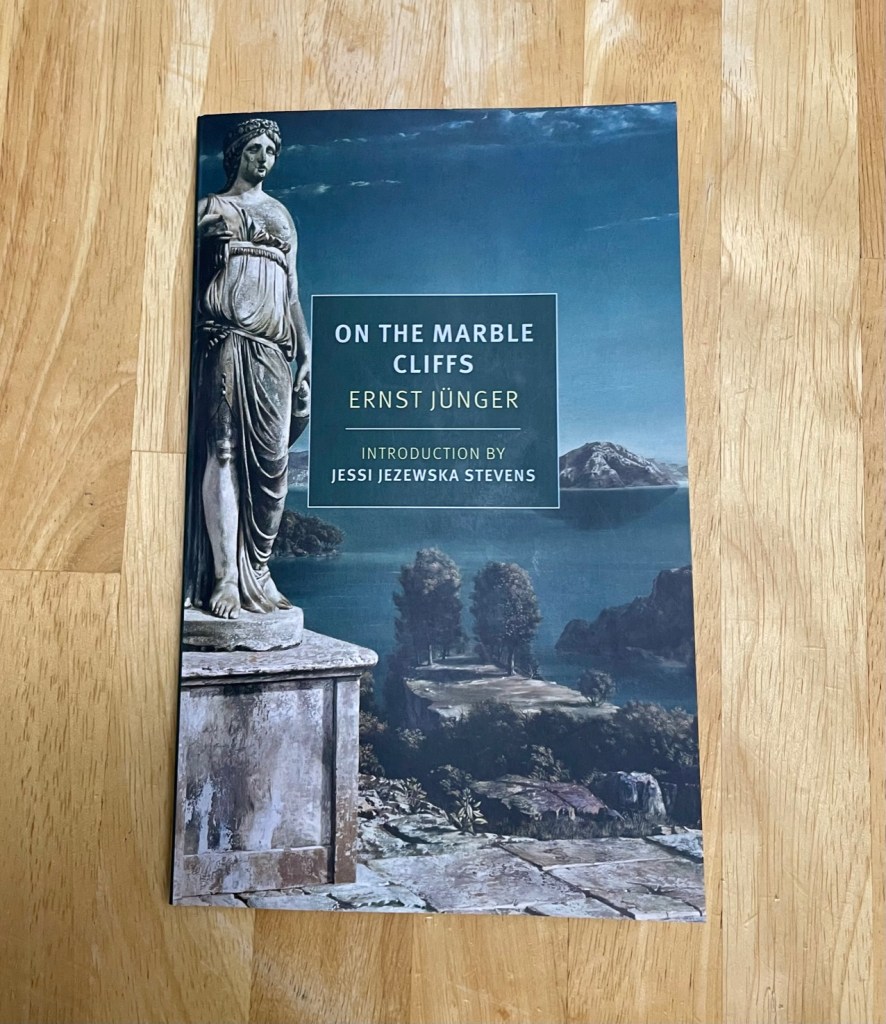
On the Marble Cliffs (1939), which appeared for the first time in Nazi Germany in 1939 (the new NYRB has just been published) offered a narrative of a thorough civilizational collapse of the West. I will side with many of the commentators that have reminded the readers that this novel doesn’t simply amount to an allegory of the rise of National Socialism or the reemergence of indirect powers of civil war in the European interwar years. By underlining “just”, I also mean to say that it is also very much about its epoch. Jünger was an insider of the German elite, and one of the most astute interpreters of his time as his theses on the dominion of the worker and the force of total mobilization were fully realized. It happens that On the Marble Cliffs introduces the civilizational collapse not through the allegorical reduction of the narrative procedure, but rather through a weaving, never truly resolved (much to Jünger’s own intentions), of temporalities that do not land in historical form. Circumventing the meanderings of a dreamlike stage and that of a thick and sensorial description, the novel diachronous movement resembles the stage of a vigil that retrospectively looks from page one at the advent of the disaster: “Only then do we recognize how fortunate we humans are to live from day to day in our small communities, under peaceful roofs, engaged in please conversation, and with the effective greetings morning and night. Alas, we always recognize too late that these simple things offered us a cornucopia of riches” (Jünger, 3). Granted, the vigil is an incomplete assessment of how (not so much as to why, which speaks to Jünger’s separation between his critico-politico essays and his narrative universe) the luminous community of brothers at Grand Marina entered the stage of destruction. During their peaceful time at Grand Marina, the brothers dedicate themselves to studying plants: a contemplative activity through an herbarium that becomes an exercise in clearing the mind and “draining time”. Botany has always stood as a minor activity to escape the realization of death, even if inevitable the cycle of temporal caducity.
But the ruinous time begins with the dominion of the Head Forester, an old governor of Mauretania region whose territorial ambitions are rooted in the domination of world affairs, and the willful defense of its doctrine Semper Vitrix (Jünger, 23). For those familiar with the worldview of Jünger, it is not surprising to find that domination does not begging at the original act of taking, but rather in the scheme of disposition that prepares the liquidation of the originary depth of the world’s opacity. Hence, imperii vitrix is always cartographical, and thus concerned with the the procedure of legible reduction: “For them [Mauretaninas] the world was reduced to a map like those thare engraved for amateour using little compasses and polished insutrmentions that are pleasing to hold. And so it seemed odd to come upon figures like the Head Forester in these clear, perfectly abstract realms freed of any shadows” (Jünger, 23). To dominate the world, one must first dominate over the ideals and images that unify a world. This is why Jünger, just a few years earlier in The Worker, had ended his treatise pointing at the passage from the classical social contract theories of social cohesion to the efficiency of planning of production in order to weaken any possible resistance [1]. This is another reason why On the Marble Cliffs fails at any allegorical instantiation, since allegory hinges upon the unfulfilled stage of historical consciousness, whereas Jünger levels his narrative with the metaphysical disposition that is accomplished in modernity. One could call this the triumph of nihilism and anarchy; the never-ending triumph of ‘barbarism and religion’ of the West since at least the Roman Empire to put in the terms of historian J.G.A. Pocock. This is the “line” of modernity, but it is also the line that is breached at the collapse of modernity staged Onthe Marble Cliffs.
Anarchy and nihilism – for Jünger these are for two routes for prompting a relation with the epochal collapse. More than clearcut positions to endorse, these are unbreachable counters of the limitless epoch. Jünger distinguishes them well through the character of Braquemart: “Suffice it to say that there is a profound difference between fully formed nihilism and unchecked anarchy. The outcome of the struggle will determine whether human settlements will become wasteland or virgin forest. With regards to Braquemart, he was marked by all the traits of full-fledged nihilism. His was a cold, rootless intelligence with a penchant for utopias…On seeing him, one inevitably thought of his master’s profound saying: “The desert grows – woe to him who carries the deserts within!” (Jünger, 76-77). The nihilist suffers from a rather coldness of intelligence, and what Jünger qualifies as the ill-fated adventure of the theorist, always unmatched with that of the pragmatist (Jünger, 78). Granted, everything depends on the internal capacities to react against the growing systematic devastation. On the other side, the anarchist cloaks his accomplice condition within the corruption of the law, where nothing is sacred. This is why the anarchist transforms the forest into an enclosed land for hunting and predatory practice where “cadavers left to rot in the fields spread pestilence, wiping out the herds. The downfall of order brings good to none” (Jünger, 62). On the Marble Cliffs is at times too emphatic with the reiteration of the order in opposition to terror: ‘Terror establishes its reign behind a mask of order” (Jünger, 38). And this speaks to National Socialism antipositivist attitudes to the rule of law, which Jünger seemed to have perceived clearly.
However, it is also true that Jünger’s insistence on order is not just about conservation in the abyss, but rather about how the civilizational collapse is expressed in the puncturing of indirect powers that will ultimately unify the anarchy of domination. To insist on nihilism means to de-hegemonize the indirect powers and factional domination against the visceral hatred of the gratitude of language and the mystery of beauty that burns the inside of demonic spirits (Jünger 39). The luminosity of Jünger’s style and symbolic nakedness speaks, in turn, to an attempt at a mythologization of beauty that emerges in a language devoid of parody. In this sense, Jünger displaces Gianni Carchia’s important thesis about the narrativization of the parody of mystery into the form in the bourgeois novel. Jünger’s beauty is mysterious because it exceeds signification and conceptual closure of the novel conflict, as what language does (or seems to do) on the line of nihilism. For Jünger the revocation of anarchy implies taking a distance from the subsumption of prose into narrative order. Thus, Jünger’s order is a primary order, one of retaining the reserves of sacred and the unfathomable character in the face of barbarism and the destruction of the world.
“We take leave more easily when things are in order” (Jünger, 59). This is the primary order of a plain state of the world, which does not presuppose the obsession with organization and management; it is what allows for the flourishing of contemplative life and the possibility of retreating to the density of the forest. But we know that this is, precisely, what comes crashing down in the rise of anarchy and nihilism, both working in tandem in modernity. Attaching oneself to primary order amounts to “concrete dreaming” at best, as the narrator says early in the book. And it is at this point that On the Marble Cliffs solves this conundrum: the idea of order must not be reduced to a nomos of the world, but rather the possibility of an outside from thinking that there is a finite and finished work of the world. This is where Jünger’s genius shines with usual intensity. It is the moment, towards the end, when the narrator admits: “the beauty of this world now enveloped, I saw, in the purple mantle of destruction” (Jünger, 102). The conflagration of the world, however, only undoes a new capacity for seeing thatwhich had remained in the dense fog of consciousness and aesthetics. In other words, the total collapse brings forth the unperishable element between existence and the world. Jünger achieves the highest point of condensation in this elaboration:
“The harvest of many years of labor fell prey to the element and with the house, our work returned to dust. We cannot count on seeing our work completed here below, and happy is the man whose will is not too painfully invested in his efforts. No house is built, no plan created, in which ruin is not the cornerstone, and what lives imperishably in us does not reside in our works. We perceived this truth in the flame, and its glow was not devoid of joy” (Jünger, 108).
This is not joy or appetite for destruction, but more a joy about what remains unperishable in every destructive act that realizes itself just so that everything could be renewed more or less the same. At the narrative level the unperishable of every work is the mystery that cannot be fully captured either by the deployment of historical allegory or by the mimetic translation of the work of narrative. On the Marble Cliffs remains stubbornly an open novel, but in a very precise sense: it gestures to the divergence between life and the world is barely touched parabolically at a distance. This is why the character of On the Marble Cliffs reaches the end by stressing “the sight of it [an old oak grove] made us feel at home…”(Jünger, 113). Whereas sight is an index of landscape, of seeing beyond the abyss. This is a condition for living among the dead once again. Perhaps this is why Jünger felt the need to record in his French war diaries that Pablo Picasso had asked him if the novel was based on a real landscape [2].
Only a painter that had witness the crisis of modern space (beginning with the “Blue Room” of 1900) could directly engage with the trope of the ‘marble cliff’: it is here that the altar of a sacrificial history and political domination turns into the site of theoria. Now the faculty of seeing grows outside of itself, “to manifest freedom in the face of danger” (Jünger, 117). On the Marble Cliffs is an invitation to this interior unperishable landscape that removes us from idle fictions in the face of anguish if only we do not turn our back to it (in the name of science or technology or new idols). Given that the desert of nihilism can only grow, I wonder how many today could even stand on the cliff. I fear that the effort of raising the head and looking beyond is already too much to ask.
.
.
Notes
1. Ernst Jünger. The Worker: Dominion and Form (Northwestern University Press, 2017), 173-178.
2. Ernst Jünger. A German Office in Occupied Paris: The War Journal 1941-1945 (Columbia University Press, 2019), 78.
Erich Unger’s Politics and Metaphysics (1921), published just a year before Political Theology (1922), fully captures the spirit of the epoch: it is the moment when politics becomes catastrophic; a vehicle for war conflagration, an instrument for the acceleration of technology, and the spatial fragmentation of civil society and state. The overcoming of man through technology meant a new ‘reality principle’ in which the species were forced to adapt to an abstract process of catastrophic metabolic regulation. Unger’s essay, thoroughly ignored at the time of its publication, was a product of what in Political Theology (1922) was labeled as the force of indirect immanent powers. And from his side, Walter Benjamin, in his preparatory notes for his essay on violence, made the obscure remark that Unger’s Politics and Metaphysics (1921) ultimately favored the ‘overcoming of capitalism’ through errancy (at times translated as “migration”, which has been recently corrected by Fenves & Ng’s critical edition of the “Critique of Violence”) [1]. Indeed, in his short tract, Unger called for a “non-catastrophic politics”, which he understood as coming to terms with the problem of metaphysical structuration and positionality, and for politics to have a chance a principle of exodus was needed. This goes to show why Schmitt reacted against this spirit of the epoch, going as far as to say that his “concept of the political ” was the unified response to a sentiment of a whole generation, as well as the detector of enemies of the political demarcation [2]. In contrast, for Unger modern political autonomy had collapsed, and catastrophe now expressed itself as a civilizational problem of living forms, and so it demanded a confrontation with the problem of unity and separation of politics and metaphysics.
Politics is not metaphysics, but it had to be confronted with it if a non-catastrophic politics is to be imagined. This meant a new conception of the problem of “life”, which in Unger’s speculative philosophy received its historicity from immanence through the temporality of the tragic. The psychic separation between metaphysics and politics (a politics of the subject and subjection) meant fundamentally a catastrophic politics, which Unger read against the backdrop of the Oskar Goldberg’s Hebrew speculative reversal as a new re-constitution of the people (Volk) outside the fixation of the state. All of this is connected to his previous work on the stateless dimension of the Hebrew people in a short tract entitled Die staatslose Bildung eines jüdischen Volkes (1922). For Unger, the Hebrew prophetic rulers were not just a form of government, but rather also of healers, practitioners of a “techné alupias” of psychic intensification in the business of instituting an autoregulation between the metaphysical and the political.
The contrast with Carl Schmitt’s position is, once again, illuminating to say the least: whereas the figure central to Schmitt’s juridical thinking is that of the Pauline Katechon, the restrainer against the apocalyptic catastrophe; for Unger, no stranger to theological myth, appealed to a Parakletos of a universal People (Volk), coming to one as a single consciousness against unreality. The theological drama that informed the positions of both Schmitt and Unger, recasted the problem of separation the central concern of a particular thinking in a time of constituent power (and its infrastructure in the principle of civil society). But whereas Schmitt’s Katechon depends on an institutional mediation conditioned by revelation and authority; Unger’s non-catastrophic politics evokes a ‘people’ emptied of patrimony as reservoir of new energies for the unification of reality against psychic imbalance. Against the “relentless forms of domination”, Unger did not appeal to institutional mediation of the moderns, but instead to the interiority of the species that, in turn, required a “political principle of exodus”:
“The principle of the exodus can end the civil war and represent the presupposition for the emergence of real political units, thus putting an end to those centrifugal tendencies which are lethal for any real synthesis. This principle of separation of communities operates an external delimitation of the Material to give rise to a possible real unity. It now considers establishing the basic regulatory principles of its internal structure.” [3]
The principle of exodus of politics meant, all things considered, the opening the metaphysical order of the possible against what was understood as domination of the species within the paradigm of civil war. It is telling that for Unger, like for Carl Schmitt, the true force to be confronted is that of the stasiological force, or nihilism, as the condition for the catastrophic politics in the perpetuity of separation during time of finality (Endgultigkeit) in historical transformation. For Unger this was no easy task, nor fully passive and open to gnostic reversal. On the contrary, it is connected to “a kind of intellectual orientation required of anything who might wish to understand this reflection” [4]. This is ultimately tied to Unger’s most enduring idea in Politics and Metaphysics (1922) – at least for some of us that look with suspicion anything that the contemporary has to offer today, or that has ever offered – which is the metapolitical universities, not mere supplementary communities against the politics of catastrophe, but rather practical forms of encounter, languages, and exercises in thought that return the dignity to the shipwrecked fragments in the field of immanence.
Unger knew very well that there was no absolute “exteriority”, and so the defense of a metapolitical university was offered not as a “new political unit” of intellectuals leading the masses, but something quite different: the encounter of a finality that is not knowledge but “the effective treatment of the concrete” elevating itself from mundane understanding of social knowledge [5]. This is no collective practice either, since the discriminatory point assumes the internal perspective of the instance of “intensification” [6]. And intensification is not executed from the coordinates immanence of the social but rather as a ‘possibility of an elevation (Steigerbarkeit) capable of returning to reality against a non-catastrophic politics. For Unger the notion of elevation – necessarily to destroy the compulsory mimesis and automatic recursiveness of subjection – is predicated as a path of innerness, “that is, in the inclusion of originally alien psychical factors within a single consciousness” [7]. The metapolitical universities were, hypothetically, hubs for the concrete practice of elevation vacant of any universal pretensions of unreality. Here Unger, like Schmitt, does not propose an exodus from politics, but rather an elevation to a coming politics whose mediation is neither annihilation nor exchange, but rather the imagination and concrete practice of organization. The question, of course, is whether the politics of exodus today has not also collapsed to the catastrophic (no longer an exception to it but immanent to the logic of equivalence), which means implies a relocation: the practice of the metapolitical university, mutatis mutandi, now presupposes an exodus from politics.
.
.
Notes
1. Peter Fenves & Julia Ng (eds.). Walter Benjamin: Toward The Critique of Violence: A Critical Edition (Stanford University Press, 2022), 92.
2. Carl Schmitt. Glossarium: Anotaciones desde 1947 hasta 1958 (El Paseo, 2019), 240.
3. Erich Unger. Politica e metafisica (Edizioni Cronopio, 2009), 87.
Lo hemos escuchado (y lo seguimos escuchando en todas partes): “más allá de la crítica”, más allá de la deuda”, “más allá de la política”, “más allá del texto”, “más allá la soberanía”, “más allá del sujeto masculino”, más allá…Claro, las enumeraciones pueden ser infinitas. El “más allá” constituye un artificio retórico empleado en el drama de capa y espada de la “crítica”. Es algo así como un operador que permite – como todos los estribillos y fillers – llenar retóricamente un vacío para poder continuar sin dar cuenta de los problemas. El “más allá” no es promesa de un “nuevo mundo”, sino una promesa calculada, aunque es difícil saber de qué va. ¿Qué hay en ese “más allá”, y qué nos podríamos encontrar? Difícil saberlo, pues el enunciado una vez articulado genera consenso y tranquilidad entre los “críticos”. Quien pronuncia “más allá” se vuelve automáticamente irrefutable. Aunque tampoco sabemos cómo se llega a ese “allá”. Pocos enunciados seducen tanto, lo cual viene a confirmar la actualidad del antiguo encantamiento de la lengua a pesar de la secularización más absoluta.
Si en algún momento los humanos solían emplear “en nombre de…” – una forma impersonal que pareciera estar en plena desaparición – hoy, el aparato de la crítica habla desde el “más allá”, un augurio que no necesita transar con el juramento. Por lo tanto, el “más allá” no es un lugar al que se quiere llegar; es una fuga hacia lo mismo en el momento en que se verbaliza. Pero decir “más allá” solo puede registrar una instancia apofántica que vierte sobre si misma la comprensión del mundo objetivado y técnico. Y si hemos de seguir a Carl Schmitt en su temprano “Crítica de la época” (1912), entonces la crítica en lugar de proporcionar un “más allá”, nos muestra el reverso de la época: es el índice de cierta valorización mediante la oposición de valores vigentes aquí y ahora. Allí donde la crítica aparece negar un valor fundamental de la época, se eleva un valor opuesto. Es el fecundo mar de las abstracciones que hoy lleva de ribete “guerra cultural” (hegemonía).
No nos sorprende que el “más allá” aparezca como una muletilla octogonal al discurso académico crítico, pues es allí donde el avance de la moral es proporcional a la crisis institucional en la cual nos ha tocado vivir. Tampoco en el “más allá “ hay promesa de un “reino”, sino la más pura inmanencia: contra toda diferenciación y toda posibilidad de separación, el “más allá” es el serrucho lingüístico de la indiferenciación que termina de talar el bosque donde alguna vez moró el pensamiento, la política y los recortes éticos que algunos durante siglos llamaron alma (‘cómo es que soy lo que soy’). Quien pronuncia el “más allá” ya ha aceptado habitar en el gnosticismo, pues su única divisa es la fuerza de los valores, y de todo aquello que supone un valor aquí y ahora.
Alguna vez el “más allá” fue también un “más acá”: el origen “revolucionario” de la crítica tuvo en Saint-Just un representante del derecho natural contra todo contractualismo social, previo a las leyes de los hombres y a la autoridad positiva. Por lo que el derecho natural siempre se encontraba “más acá” – en la naturaleza, en lo inmutable de la epikeia de la especie a cielo abierto – con respecto a toda norma, al estado moderno, o al ejercicio del legislador. Hoy, en cambio, el “más allá” confirma un farewell a la aspiración revolucionaria naturalista, desplegando todos los fueros inmanentes como primero y último principio para los cuales cada hombre se vuelve un sacerdote deuna única doctrina: “más allá”. La revolución ha sido consumada.
¿Por qué volver Averroes en nuestro tiempo? Se pudieran enumerar muchas razones, alguna de ellas de justificación de corte universitaria o histórica. Averroes porque quiero aprender del mundo árabe medieval sin teleologías historicistas. Averroes porque es un nombre intermitente en los textos que leemos y discutimos. Averroes porque convoca, pero también hay bastante más. Decir Averroes sigue siendo nombrar uno de los márgenes de la tradición filosófica occidental, aunque también es cierto que marginados hay y siempre habrán muchos; y, sin embargo, nos seguimos ocupando de Averroes y no de los otros que en realidad no interesan. Sin embargo, es probable que no seamos nosotros los interesamos en Averroes, sino el viejo comentador quien permanece como una sombra insondable que acecha a todo pensamiento y reflexión atenta. Por eso es por lo que tienen razón los editores del excelente volumen colectivo Averroes intempestivo (Doblea editores, 2022) al decir que el averroísmo es un espectro que recorre la imaginación a pesar de carecer de una arquitectónica sistemática de conceptos morales, políticos, u ontológicos. Aunque es gracias a esta misma razón que el averroísmo sobrevivió a lo largo de siglos, tras su exilio de la universidad medieval, en el extrañamiento lingüístico de la poesía, como señalan Agamben & Brenet en Intelletto d’amore (Quodlibet, 2020).
En efecto, no podemos hacer una historia de la sensación y de la experiencia de la lengua desde el concepto, sino que tenemos que contar con el espectro averroísta para esta génesis. El averroísmo es la verdadera marca de la philia en la filosofía, lo cual implica un paso atrás de la objetivación del mundo, la sistematización metafísica y sus tribulaciones, o el ordenamiento teológico de lo político aunque sin abstraerse de la configuración de la realitas. En tanto que potencia de lo impensado, la figura de Averroes sigue inspirando la incesante aventura de todo pensamiento sereno y medido (no hay que olvidar que, en su relato sobre Averroes, Jorge Luis Borges pone en escena justamente la búsqueda sobre la pérdida absoluta de la modernidad: la comedia) que autoafirma la separación originaria con el mundo bajo la fuerza del medio de la imaginación y de los sentidos.
De ahí que uno de los aciertos inmediatos de Averroes intempestivo (2022) – que recoge una serie de estudios que en muchos casos exceden los límites académicos propios de la una práctica del objeto de estudio en cuestión – es hacer patente un Averroes que en su excentricidad filosófica es tan moderno como cualquier referente de la modernidad occidental. Desde luego, Averroes, como luego Hölderlin, son portadores de un gesto de pensamiento en el cual se tematiza lo más “ajeno” (o lo extraño, diría Brenet en su lectura) en proximidad con lo que es “propio”. ¿Qué más arduo que el uso de la potencia al vernos asediados por la propia contemplación de la teoría? El sentido de lo “ajeno” en la relectura de Averroes en torno al corpus griego (los corpi filosóficos de Platón y Aristóteles) – así como luego lo llevaría a cabo Hölderlin con la tragedia de Empédocles o en los himnos pindáricos – es la exposición de la potencia a ser lo que somos en el medio de las cosas y de nuestras pasiones. El estudio o el pensamiento se vuelven exigencias éticas: estilos de estar en el mundo. En otras palabras, en Averroes lo ajeno cobra un sentido de expresión que solo puede ser registro de lo acontecido, y no de lo temporalmente inscrito en un mundo entregado a la eficacia administrativa de personas y objetos en la economía pastoral de las almas de los vivientes. Como lo demuestra con contundencia argumentativa Rodrigo Karmy en su ensayo “El monstruo Averroes”, la gnoseología Averroes supuso una dificultad mayor para la confección de la antropología tomista al desligar la voluntad subjetiva de los presupuestos necesarios del derecho natural [1]. El averroismo es otro nombre para el verdadero antipersonalismo sin recaer en la negatividad de lo sacro.
Al final , la monstruosidad de Averroes, como sugiere Karmy, consintió en una operación deflacionaria de la substancia calificada del hombre, por lo tanto abandonado las categorías hidráulicas de la culpa, la responsabilidad, de los actos, y toda la dimensión sacrificable de la persona propia de la filosofía de la historia cuyo coste ha sido el al nihilismo y su voluntad de poder. Averroes es un pensador que, previendo el nihilismo del valor como apropiación del mundo, hizo posible una antropología erótica y poética para expresar otra forma de estar verdaderamente en libertad. De ahí que Averroes tampoco encarne un gnosticismo ni una religión secularizada en nombre de la inmanencia absoluta (algo que solo puede devenir en el momento de la traducción de la irreductibilidad de las cosas a la iconocidad objetual, como hemos argumentado en otro lugar), sino que es un pensador de la individuación desde los acontecimientos que afectan a cada una de las formas de vida [2].
Si en la lectura de Averroes, la potencia es una forma sensible fundamentalmente atélica – en separación con su actualización de las obras – esto supone que el verdadero sentido de cada vida es la afirmación de nuestras pasiones para la que no hay objeto ni orientación ni orden (en la doble acepción de la palabra), tal y como el derecho natural intentó formalizar la mediación entre moral y principios para el actuar. Estas son las condiciones teológicas que dan lugar al sobrevenido de la voluntad que se somete a la comunión de salvación para garantizar su sentido de libertad. Aquí también otro de los aciertos que recorre los ensayos de este estupendo libro colectivo; a saber, ofrecernos un Averroes que no es ajeno a la política, sin que esto implica abonar las condiciones sustancialitas de aquella eficacia teológica sobre la contigencia (esencialmente temporalista). En este sentido, Averroes aparece como una tercera figura en la partición entre una legitimidad propia de un positivismo excluyente, y la de un derecho natural cuyo “ideal” de justicia y bien común depende de la dimensión impolítica de la antropología de la especie. Y esta tercera postura se define como la prioridad del acontecimiento mediante la cual se vuelve posible dar forma a nuestras pasiones. En el momento en el que las pasiones se vuelven pulsiones idólatras – como en nuestro actual mundo de pasarelas, influencers, y guardianes de la pobreza del valor – la erótica del intelecto ya ha degenerado en un sadismo que, en virtud de la posesión sobre la mera corporalidad, lleva a la caducidad inerte. Es aquí donde podemos situar el punto en el que el uso se transforma en abuso (ius abutendi). Pero si la norma se ecargará de regular el abuso y el derecho natural a tipificar un cúmulo de bienes del ‘buen uso’; la lección exotérica de Averroes reside en la posibilidad de asumir un uso que, en su separabilidad con el mundo, hace viable la libertad en las pasiones. O lo que es lo mismo: en los medios con los que dispone cada singular exponiendose eróticamente al mundo.
La abnegada actualidad de Averroes reside en el hecho de que es un pensador excéntrico no porque suministre una antropología del juicio reflexivo; sino más bien porque transforma nuestro sentido del ser a una potencia en desobra con efectos irreversibles para nuestra concepción de la libertad. Por eso, lo importante no es que Averroes apueste por un sentido de la irreversibilidad en el plano de la historia o de la negativa a ser dominado (ideal republicano); sino más bien se trata de un sentido de la irreversibilidad en el registro de las pasiones, del afectar, y de nuestros contactos con lo ajeno. Todo esto nutre la dimensión modal del ser humano a partir de la separabilidad de sus acontecimientos. Ya siglos más tarde el escritor Carlo Levi diría en Miedo a la libertad desde un averroísmo intuitivo: lo esencial no es ser libre de las pasiones, sino poder estar en libertad en las pasiones [3]. No debemos hacer nada con el averroismo, pues el averroismo solo es teoría en tanto que pensamiento que ya nos atraviesa. Así, el averroísmo no es una analítica de los conceptos ni una ontología de la acción o del derecho, sino un estilo en separación del mundo que en su opacidad huye de la domesticación de lo social como imperio psíquico de los valores.
En este sentido, la imputación de Ramón Llull de los averroístas como grupos clandestinos al interior de lo sociedad, debe entenderse como la vivencia desvivida, siempre renuente de las determinatio de la obra, de la obligación, y de la servidumbre de una voluntad ilimitada a las particiones substantivas de lo común [4]. En su clandestinidad comunicacional, el averroísmo es otro nombre para la intuición que siempre ha excedido las normas de la ciudad y sus trámites civiles. Averroismo: lo que conseguido la felicidad en los acontecimientos de lo que sentimos, pensamos y hablamos. Por lo tanto, la impronta del averroísmo es la indefinición absoluta de la vida feliz. Una felicidad que se recoge en la separabilidad del dominio de los sacerdotes y de sus comuniones subsidiadas en la eterna fe de la salvación.
.
.
Notas
1. Rodrigo Karmy & Benjamín Figueroa & Miguel Carmona, Editores. Averroes intempestivo: ensayos sobre intelecto, imaginación y potencia (Doblea editores, 2022), 198.
2. Sobre la relación entre uso y objetivación en la filosofía de Emanuele Coccia, ver mi ensayo “En el reino de las apariencias: sobre la cosmología”, Ontología de las superficies: ensayos averroístas sobre Emanuele Coccia (Universidad Iberoamericana AC, 2021).
3. Carlo Levi. Paura della libertà (Neri Pozza, 2018).
4. Francesco Márquez Villanueva. “El caso del averroísmo popular español”, en Cinco siglos de Celestina: aportaciones interpretativas (Universidad de València Servicio de Publicaciones, 1997), 128.
In a recent entry in his Quodlibet roster entitled “Sul diritto di resistenza“, Giorgio Agamben takes up once more time the question of civil war, but this time tested against the “right to resistance” (diritto di resistenza) as included in many Western constitutions. What is interesting in this note is that the for the first time – as far as I know, although it complements superbly an old intervention a propos of the publication of Tiqqun, along with Fulvia Carnevale and Eric Hazan – Agamben lays out quite explicitly how the “planetary civil war” tips the enumerated constitutional right of resistance on its head, making it indistinguishable from the management of civil war and the blurring of the category of formal enemy and that of the terrorist.
Indeed, the very notion of “planetary civil war” in an unified society without a strong discriminatory principle of enmity turns politics, as Carl Schmitt noted in his prologue to the 1971 Italian edition of The Concept of the Political, into something like a world police [1]. And the historical present has given Schmitt his due. Following Schmitt’s sound diagnosis, Agamben says nothing different, although this is the thesis that marks the limit of Schmitt’s modern categorical delimitations as well. In other words, if the unity of friend-enemy collapses, and now there is only the stratified value of association based on moral justifications, how can one speak of the “political” in this scenario (it is no longer about war, as we commented in a previous occasion). Is there even one?
And, if the political collapses so do the total sum of actions oriented as political resistance, and even resistance to the collapse of the political. For Schmitt it is very clear that it is even the internal exhaustion of the juridical order (ius publicum europeum) insofar as positivism is concerned, leading the way to the rise of what he called a world legal revolution consistent with what Karl Loewenstein already in the 1930s had termed “militant democracy” (1937). Once the modern state loses its monopoly on the legitimacy of authority, then anyone can establish an authoritative force; while, in turn, every enmity becomes a potential absolute enmity (even more so in legality, as we clearly see in the American context). In this sense, it is a misnomer to call a state “the state” if its function becomes a full equipped instrument of the optimization of civil war that rests on a sort of dual structure: on the one hand there is civil war at the limit of the collapse of legitimacy, but also the total domination that incorporates stasis as a functioning vector of its regulatory order.
In this sense, the advent of civil war after the collapse of the state is not a return to the confessional civil wars of early modern Europe, but rather the total unification of state and society without residue. So, if “right to resistance” presupposes not just the formal limitation of enmity but also the separation of society and state, it only makes sense that this category becomes defunct once the social emerges as proper site of the total administration: “the reunification gave us a new tyrant: the social” [2]. This entails that proper civil resistance is already subsumed in the process of civil war in the threshold of the political. In the context of civil war, resistances can mean both administration of the stasis, and the embedded position of a sacrificial subject, which has been costly (and it remains so) for the any calls for contestation, striking, or insubordination. Resistance here could only amount as a shadow apocalypticism. And sacrifice insofar as it is the fuel of any philosophy of history, merely relocates the energy of hostilities as measured by the factors of optimization.
It is only implicitly that Agamben concludes by suggesting that any “true resistance” must be imagined as a form of life in retreat from the social and its sacrificial idiolatry, from which one must draw its consequences or effects. This is the grounds of an ethical life, but also the way of reimagining another possibility of freedom, which in the brilliant definition of Carlo Levi, it means to live in freedom within our passions instead of being free of passions (precisely, because no principle can determine the true object of our passions, this demands a total reworking of modern notions of liberal and republican determinations of liberty) [3]. The time of the civil war, then, is best understood as a time of the affirmation of the conatus essendi, which rediscovers freedom through the sense of the event insofar as we are capable of attuning to the separability from any principle of socialization.
.
Notes
1. Carl Schmitt. “Premessa all’edizione italiana”, Le categorie del politico (ll Mulino 1972), 34.
2. Tiqqun. Introduction to Civil War (Semiotext, 2010), 61.
2. Carlo Levi. Paura della libertà (Neri Pozza, 2018), 45.





 Infrapolitical Reflections