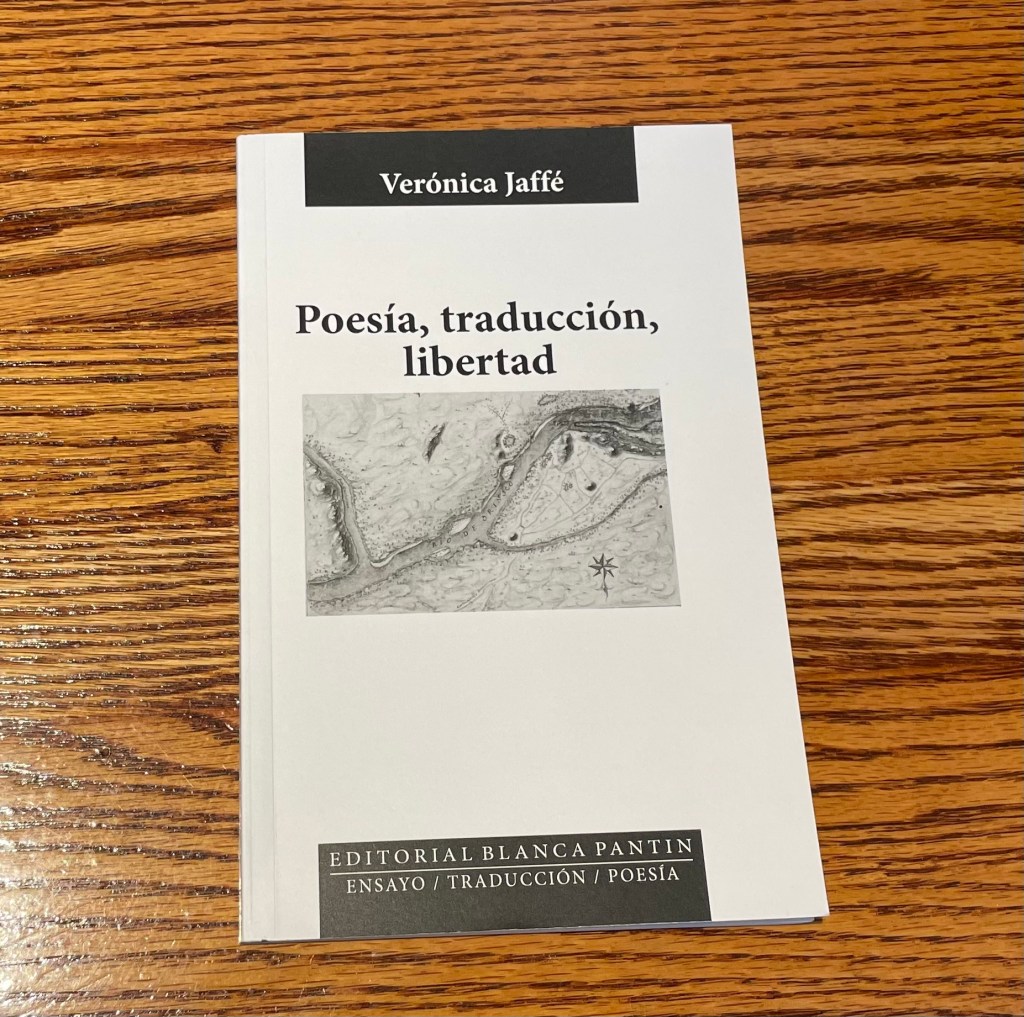
Verónica Jaffé’s most recent Poesía, traduccion, libertad (2024), which gathers some of the translations already contained in Fredrich Hölderlin: Cantos Hespéricos (La Laguna de Campona, 2016), features an introductory essay where she reflects on translating Hölderlin’s poetry from the German into her own creative visual renderings of Spanish. Reflecting on the difficult task, if not utterly impossible, of translating “Andenken” (in Spanish she opts for “Recuerdo” and not “Memoria”), Jaffé departs from an important observation that we must take into account here: the fact that this late hymn has been catalogued as a proemial composition. What does it mean that “Andenken” is to be read as a proem? As we know from the Ancient sources, the proem is an oratory prelude to the topic deployed in a text; in other words, it is the persuasive caesura of language before any argumentative exposition. Hence, the composition of the proem is something like the pure mirroring of language. This could explain why Hölderlin’s “Andenken” while prima facie about memory and thinking does not have a guiding thread to restrain it; it unfolds the enactment of its own recollection through the sayable.
If “Andenken” is a long proem – the space where the poem and proem absolutely coincide – then this means any translation must keep the poetic possibilities of oration in preamble, in path of preparation. Jaffé offers two distinct trans-creations of the famous poem’s last lines. The first reads thus: “Un mar que guarda los recuerdos / que da amores, que los toma / para que solo queden después / como tesoros / en quienes recuerden y en quienes escriban” [1]. In the second version, even more elaborate and idiosyncratic, Jaffé writes: “de pensar con todos / mis amores, es decir / pensar fijando / papel y lápiz / sobre tela / en memoria de todos mis muertos” [2]. It is noteworthy that the famous literal last lines of the “Andenken”, suspended in an enjambment, appeals to a canvas that is splattered with the memory of the dead. It seems of all the dead of the human race. What does it mean that the act of remembrance is the recollection of all the dead? Poetic imagination, if a testamentary document, appeals to the archaic where the living and the dead inhabit the world through image [3]. For Jaffé – but this also an intuition that Hölderlin shared in his pindaric translations – the beginning is not a previous stage, but in media res of the event of language.
The recollection of language within proem attests to the exilic dimension of language; the site where no one truly ever belongs to: “…la lengua en mi país que no me pertenece”, writes Jaffé [4]. This means that the authentic remembrance of language is not a national language, but always ex patria lingua, or a language outside the telluric fabric of the national community. Because we are always walking strangers in our own language, the contact with the dead repeatedly reemerges in the memorial grain of the voice.
As C.M. Bowra has noted, Pindar’s allusion to Memory takes place in the context of the Muses: “[the poet] invokes Memory because she embodies the accumulated wisdom of the past, and the Muses because they pass on this wisdom to him. What he asks from them is the ability to deal properly with what they give….men are blind if they do not pursue wisdom with the help of the Muses” [5]. If the “Andenken” should be read as a proem, this is because recollection is always fixed in the irreducible experience of our voice that recalls language from its beyond.
In the Spanish language there is a wonderful idiom that has gone out of fashion in our times to express a sudden silence: “ha pasado un ángel”, or an angel passed by. The phrase is commonly used whenever a sudden silence imposes itself in the middle of a conversation, which leads to obvious discomfort and embarrassment among those engaged. It is almost as if the invisible angel reminds human beings that conversation rests as much in words as in silence; and that the shadow of silence sooner or later interrupts any communicative practice. According to historians and lexicographers, the inception of this idiom into Spanish remains a curious enigma, since although used in early modernity it does not have a Latinized version, and its origins can only be traced to classical Greek antiquity. In fact, Plutarch notes in his De garrulitate that whenever silence is introduced in a meeting it is said that Hermes has joined the company [1]. The angel thus stands for the nonpresence of language in language, just like an icon is the sublimation of presence in pictorial representation.
We know that in Antiquity the angel as a minor divinity (angeloi) was a mediator between heaven and earth, only that in that moment that an ‘angel passed by’, it is not all clear on which side is there heaven and where earth [2]. In his beautiful book Angels & Saints (2020), Eliot Weinberger reminds us that for Saint Augustine the angels were first and foremost original gardeners of Paradise – given that they are free from felix culpa and sin – and that they are messengers between the living and the divine, as documented in the beggar Lazarous carried by angels to the bosom of Abraham [3]. Here it seems that the invisible inception of the angel relates fundamentally to the dead and conclusion, which also carries its aspiration in the lacunae of a conversation that reaches an impasse, and that for a moment effectively dies.
The angel that accompanies the dead and the poor – and thus our structural poverty in language, being in the language that always lacks a grasping signifier – is also confirmed by lexicographer Alberto Buitrago, who in his entry on the idiom writes that the expression has its origins in the fact that in antiquity whenever a dead person was mentioned or brought up in conversation there was a silence held, because it was thought that his “spirit” (his angel) had become present in its nonpresence of language [4]. Although Buitrago does not provide any documentation for his assertion, it does bring to bear that whenever we are in communication, whether we like it or not, we are in the communion of angels that are expressing the soul of the dead through the litany of their names.
This is why Antelme could suggest the similar enigmatic notion that being powerless and in poverty means to ‘have to forever be’ in a silence adjourned so that language can continue speaking. This is why perhaps the irruption of authentic silence has the effect of a certain petrification of the human expression, as masterfully captured in Velázquez’s Apollo in the Forge of Vulcan (1630). It is through silence that we encounter the divinity that for a moment places itself outside of language in order to contemplate it, letting the angel make his entrance. The language of computational machines is not only a language that has renounced its poetic and ethical instance; it is also a form of gated communication that has expelled itself from the angelic visitation of its own contemplation.
In a letter dated from January of 1962 to his friend Carlos M. Luis, José Lezama Lima makes a case for the intimate relation between language and charity: “What lasts [la cantidad] is only possible through faith. Because what lasts with faith is charity. Omnis credit – believe all things. Charity is belief in anticipation. And what is poetry (the image), but this superabundance of charity that always presupposes creation? [1]. The question in the last sentence – a question that could have only come from a great poet – is not all naive, since it is also a slight displacement from the canonical source underlying the notion of charity. In fact, the expression caritas omnia credit comes from Saint Augustine’s Confessions (Book X, Section 3), where the Church Father treats the reception of his testimony to the rational knowledge of the “hearing of men” who will be attending to his words [2].
This means that for parole to be heard and enunciated in its original presence, there has to be a gathering in charity that makes not just ‘true’, but most importantly, a garment of faith in the occurrence of language. This means that for Lezama Lima, there was no distinction between “theological language” and “language as such”, or “poetic register”, since they are all participants in the mystery of charity, because only charity can welcome language as abode. Poetics as such is understood as facticity of parole. But for Lezama, the word depends on having grasped the motion of charity.
Lezama’s test for Carlos M. Luis was quite high: if you lose your faith, you would have given up on language as creation. This was not a new problem for the poet who already in his essay “La dignidad de la poesía”, mentions caritas omnia credit, as a process of destruction of representational (merely transactional and duty driven language) communication that arrives at the order of charity through language as intangible and inexistent by virtue of transcending what does not exists, thus manifesting itself as possible [3]. This is the moment in which the charity of language appears as both presence and promise, and what Lezama calls “el resurgimiento del verbo” (the reemergence of the word). Poetics is thus neither the subject matter of poets, nor the master dogma of theologians; rather it is the faith in language that once enunciated it can only move towards a greater opacity of the shadow of mystery. This is why a great Christian theologian says that charity(agape) is partial knowledge of the divine, otherwise there will be only a detestable army of mere academics, scribes, and administrative experts [4].
In other words, charity does not belong exclusively to the Saints, but it runs through All Souls and its dead. The long history of the Church has betrayed the parole of charity, going as far as transforming it into a social mechanism of distributed goods that has become known as the subsidiarity principle. But for Lezama Lima, in an esoteric pauline tone, charity had nothing to do with political absorption and pastoral power; it was fundamentally a problem of language as a relation of reciprocity between beings in order to subsist as species, to paraphrase a well versed French priest on the matter [5].
In our days we see that “believing in language” has become in the public the inverse: non-belief through credit; that is only after possessing it (I do not need to believe in you insofar your credit validates who you are). It has been noted that by a kind of philological accident in the history of secularization, the word charity in English came to be understood one handedly as almsgiving and subsidiarity over the original divine love, which is love supreme in language. A language that does not unify, but that creates ethical relations; in fact, this might be the only uninstructed means of allowing them to fruition.
.
.
Notes
1. José Lezama Lima. Cartas a Eloísa y otra correspondencia (Verbum, 2013), 324.
2. Saint Augustine. Confessions (Penguin Books, 1961), 208.
3. José Lezama Lima. “La dignidad de la poesía”, in Obras Completas, Tomo II (Aguilar Editor, 1977), 774.
4. Claude Tresmontant. Saint Paul and the mystery of Christ (Harper & Brothers, 1957), 157.
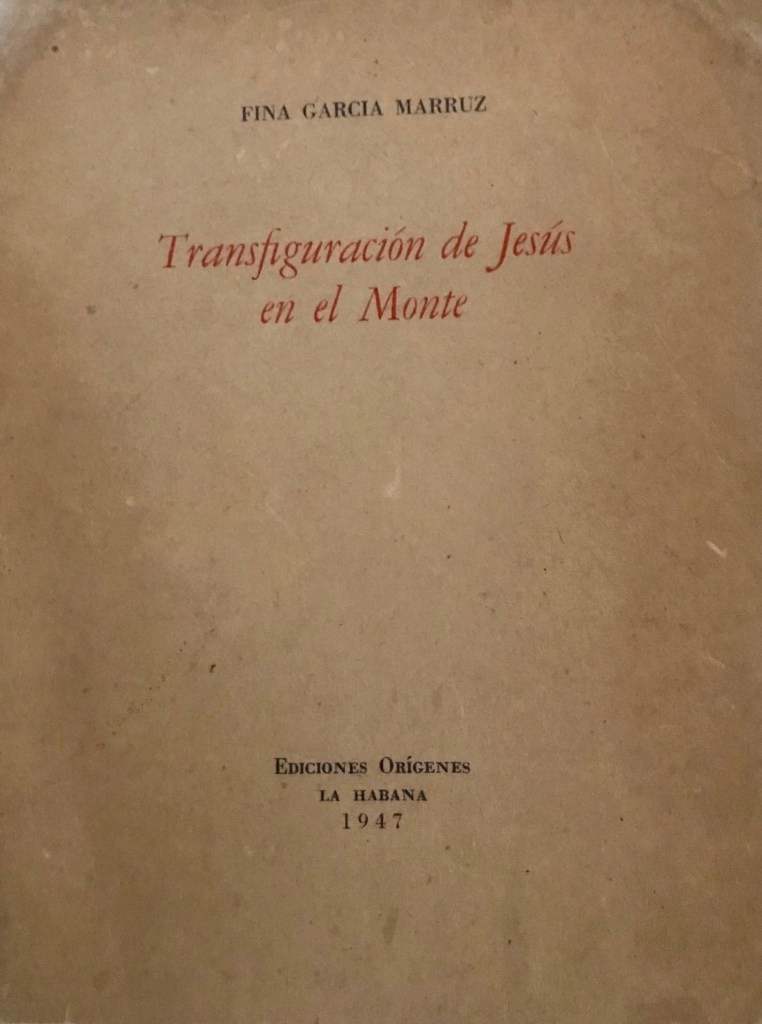
In 1947, the very young Cuban poet Fina García Marruz published the liturgical poem Transfiguración de Jesús en el Monte (Ediciones Orígenes, 1947), which stands in the modernist tradition series of attempts to probe the divine nature of language after the flight of gods and the triumph of the new secular jargons. If earlier in the century a well known Italian philosopher will predict that the international language of the future will be that of technical terms; the English Catholic poet David Jones, will reaffirm that we are “living in a world where the symbolic life (the life of the true cultures, of institutional religion and of all artists) is progressive eliminated – the technician is master. In a manner of speaking the priest and the artists are already in the catacombs, but separate catacombs – for the technician divides to rule” [1]. And if “liturgy” originally meant “public service” and the sphere of gestures, as suggested by Lubienska de Lenval, then Transfiguración has to be read, even into our days, as an attempt for language to measure to the transfiguration of revelation, in which the poem is a sacramental form that retracts language to possibilities of retaining communication.
In fact, Transfiguración de Jesús en el Monte, reinforcing the liturgical repetitions of an hymn and a sacred chant, enacts a flowing rhythm (“en tanto que”) that assesses the limits of the ineffable; a pure exteriority that is the negative or wound of language without ever being able to transcend it. In this sense, Marruz’s poem is only the poetic anabasis to the impossibility of a guided sacrament to organize interiority and visibility. Only the mystical can mediate between exteriority and the crisis of appearance. In an almost programmatic fashion, we read in the second part of the poem: “oh, difícilmente podríamos comprenderlo / Él se ha vuelto totalmente exterior como la luz; / Él ha rehusado la intimidad y se ha echado totalmente fuera de sí mismo” [2]. Transfiguration is the event that exiles oneself from the self (phygé), and in which language can generate contact with something other than its own conventions. This is why they [the witnesses and the martyrs] cannot provide an account about the transfigured revelation – just like anyone cannot truly provide a narrative, except by betraying the experience – except by their hearts as if being mysteriously called by a singular name (“ellos sienten que dentro de su corazón alguien / los ha llamado misteriosamente por su nombre”).
How can language disclose a sense of exteriority that is capable of moving past the autonomy of signification and self-referentiality of language? Can language befall into exteriority? Marruz provides an answer to this question, which can be taken as her contribution to the aporias of modern poetics: poetry can only attune to transfiguration as a cohabitual of a communicating being. In the year that the poem was published, Marruz also wrote in the winter issue of 1947 Orígenes a dense essay titled “Lo Exterior en la Poesía” (“The exterior in poetry) where she claims that “the heart of poem is always outside of it – it should not be that the poet can offer infinite variations of a secret self-possessed knowledge, but rather to rediscover the liturgy of the real; the extreme degree of visibility, which is also its great escape” [3]. What could the “liturgia de lo real” have meant for Marruz in 1947? Marruz does provide a clearcut theological definition of the exteriority as the “angelic”, which does corroborate the hymnological dimension of language, a transcendence between beings of the invisible. The liturgy of the real that defines the exteriority of the poetics of life does not entail a Romantic elevation by the Poet, but the effort to animate reality beyond an alienated monologue. This is why Marruz writes that “only a dialogue can realize an impossible communication, mystical, whenever it does take place in all of its purity” [4].
In 1947 Marruz went a step further than her fellow poets Gaztelu & Lezama Lima, who had defined transfiguration as a learning exercise of the potentia dei of the divine (“a todo transfigurarse sigue una suspension y el ejercicio del Monte era solo un aprendizaje”) [5]. Read side by side with Antelme’s Angel of Reims, one could very well say that for Marruz there is an event of transfiguration whenever transcendence delivers communication between beings, soul to soul; a relation that can one truly speak of the ungrounded and commencement. The liturgy clamored in language is not the memory of an original Adam severed from Nature, but the transfiguration of a linguistic relationship with the world. This might be the secret to Marruz last two verses: “como la infancia que acuña nuestro Rostro allí / donde no puede ser despertado”. If transfiguration also entails recapitulation, this means that this is not a process of forward becoming, but of retaining the atemporal detention that, like that of childhood, traces our silhouette as both figural and pure presence in the bushes of language.
.
.
Notes
1. David Jones. “Religion and the Muses” (1941), in Epoch and Artist (Faber&Faber, 1959), 134.
2. Fina García Marruz. Transfiguración de Jesús en el Monte (Orígenes, 1947), 6.
3. Fina García Marruz. “Lo Exterior en la Poesía”, 19.
3. Fina García Marruz. “Lo Exterior en la Poesía”, 22
4. Ángel Gaztelu & José Lezama Lima. Editorial: “Éxtasis de la Sustancia Destruida”, Nadie Parecía, Número IX, Nov, 1943, 1.
Surely friendship does not depend on obligations or frequency, but it does posit expectations on something like a movement of reciprocity. In fact, movement (κίνηση) and reciprocity are so intertwined that without it, there would not be any separation, only a compact bundle in unity without relations. But, what is at bottom reciprocity? If this notion merits anything thought at all, it must be removed from any conception of exchange in the manner of the quid pro quo and the the ius talionis, where at first sight reciprocity seems to reside as a form of levelling differentiated quantities. In social exchange there is levelling but surely there is no reciprocity except by the legal force enacted by the pressure of duties and obligations. Already in the nineteenth century, at outset of bourgeois society, Søren Kierkegaard with extreme lucidity denounced social levelling as a form of glittering vice: “The idolized positive principle of sociality in our time is the consuming, demoralizing principle, which in the thraldom of reflection transforms even virtues into vitia splendida. Levelling is not a single individual’s action but an activity of reflection in the hands of an abstract power” [1].
What is reciprocal in social exchange is no longer the incommensurable relation between beings, but the enactment of language saturated by its own completion, which is the aim of social organization. If there is no reciprocity in the age of kallopismata orphnes as the reduction of rhetorical language it is because there is no longer a missing word in the event of communication, given that, potentially, everything has been already communicated (it is obvious that today this process can only intensify with the planetary deployment of Artificial Intelligence). The only determination of reciprocity that should be of interest is the one that accounts for the lacunae in language that halts force of social levelling. To reciprocate does not mean to give each his due that defines the Western legal operation; it is rather the mutual codependency in the unforfeited event of language.
At this point, an etymological observation might be useful. In On the Latin Language, Varro records reciproca as a condition of elasticity; that is, a present quality that allows a thing to return to the position from which it has started. Reciprocare thus entails to move to and fro, and to demand [2]. But if we adapt this observation into the sphere of language, we immediately notice that in language there is no previous position nor set origin, which means that reciprocity can only be the undisclosed and disclosed movement of language. Breathing, articulating, speaking: the animus that escapes from the mouth as a mirror of the god of words. The erosion of reciprocity in modern society, thus, goes deeper than the first appearance in fact that human beings are witnesses to a crisis of communication; more importantly, humans have ceased to sense reciprocity because they believe that there is only god where language is mute, and there is language when gods are extinct. Such is the long vigil of computing language as an idol that is neither divine nor of the essence of the human voice. To reciprocate today means to re-divinize the world through words; and through our words greet incoming worlds.
.
Notes
1. Søren Kierkegaard. “The results of observing two ages”, in A Literary Review (Penguin, 2001), 76.
2. Varro. On the Latin Language, Vol.1 (Loeb Classical Library, 1938), 335.
In the late summer of last year, the painter Baruj Salinas (1935-2024) passed away at age 89. I was saddened to learn about his death many months after, and only because I had meant to write to him about a future encounter. For over fifteen years, I had contact with this extraordinary painter, and looking back into the past, my first visit to his studio in sunny South Florida when I was only a college student has become quite vivid and unforgettable. It was a rather small and unpretentious atelier filled with some cans and areca palms, and canvases everywhere. I remember that during my first visit he showed me an illustrated commemorative Torah on the five hundredth mark of the expulsion of the Jewish from Spain, of which only a few handmade copies were made (one of them was gifted to late Pope Francis). He was a painter that carried with him, very much like Edmond Jabès, a sort of clandestine culture of the sacred Book.
In fact, the last letter that he wrote to me in April of 2022, Baruj candidly recalled his early collaboration with the Spanish poet José Ángel Valente in Tres lecciones de tinibles (La Gaya Ciencia, 1981), for which he illustrated the pages with splattered Hebrew letters in magenta. I open one of the pages to “Guimel”: “El movimiento: exilio: regreso: vertigo: el solo movimiento es la quietud” writes the poet as if describing the pictorial gesture of Baruj. A life in double exile, Baruj’s painting oscillates between movement and repose, discharge and emptiness, figuration and the uttermost disintegration of the line.
If Baruj was arrested by the clandestine culture of the Book it was also due to his interest in the possibilities of language. This is a challenge whenever we confront a picture by Baruj: how can we assert in language what the picture is enacting without falling into the allure of ornamentation or the prescription of images in Jewish art? When I wrote about his work back in 2011 this ecstatic tension seemed attractive, but now I can only see it too emphatically invested. The truth is that language betrays what the movement of his painting resists time and again. And there is no such a thing as “Jewish Art”; in fact, whenever the topic came up (during those years I had taken a course on this tradition), the painter remained unaltered and quiet, keeping silence regarding its meaning, but insisting on the expressivity of his pictures.
Baruj’s abstraction befriends the persistence of everything living and thinking. The foam-like shapes levitate towards concrete forms of withdrawal and clearing of the pictorial space. This is why his friend María Zambrano, who wrote about his work, had suggested that in Baruj’s paintings emancipate “un pensar que se hace, como se hace aqui vida en su modalidad propia que es la pintura”. In Baruj, painting is an event that coincides with an image of thought, while the image of thought, stubbornly withdrawn from mimetic representation, materializes a proximity that only painting gives the world.
It is almost as if painting allows thought to breathe – and, in breathing, becoming extension, and thus a corpus in the world. This could perhaps explain why Baruj’s recurrent pictorial obsession was the landscape seen from high above, encircled by the aura of a clouded space. As Kurt Badt observed regarding the pictures of Constable, in painting the sky is the organ of sentiment; transcending the earthy attachment of our heavy footed existence. Before language, the light of painting circumvents the invisible space where all forms will fall into place accordingly. The hand of Baruj Salinas teaches us to orient ourselves in the divinity of appearance that is only eternal because it manages to be invisible between us.
A good place to start on Tetsuro Watsuji’s Climate (1935) is by considering how the very notion of the Japanese fudo as it appears defined in the first pages of the text, as a “structural element of human existence”. Augustin Berque has proposed a slightly different translation: the “structural moment” that speaks semantically to the prefix *-med, that also recalls mediality, metaxy, and also the French ‘milieu’. In any case, “fudo” discloses an expressive instance of existence, but it is not overtly determined cultural or historical teleologies; rather fudo like Heidegger’s fourfold (das Geviert), brings into gathering wind and earth in which existence can only appear to exist in between as exteriority. Watsuji writes: “The structure of “ex-sistence” is, thus, something rather than to exist in the reality of the cold; it is rather to exist within other persons. To designate this reality we prefer the technical relation of intentional reality, used by phenomenologists, the Japanese expression term aidagara (interpersonal)” (†27).
Unless we know the language, we can only take Watsuji at his word when it comes to the Japanese, but all things considered it is at least obvious to say that fudo is not strictly a descriptive objective reality, but a relation of Being. Watsuji calls it a few pages later a “movement of negativity”: “…this is a ‘movement of negativity’. This is how the spatial-temporal structure of human existence comes to being like that of the climate and that of historicity” (33). The notion of existential transcendence that Watsuji wants to hold on to dwells between reality and existence, generating kimochi, or tonality / stimmung (38). The first question here is what to make of Watsuji’s typology of regional climate setting if these are not to be taken geographically or culturally as expressing locational structures for specific kimochi?
There are three types of climate regions for Watsuji: monsoon, desert, and meadow. One could imagine that these three ideal types as environmental arrangements in the disclosure of kimochi. Each region has its surroundings. For instance, the monsoon is defined by its humidity (47). For Watsuji each of the climatic regions will fundamentally generate different forms of social organization, and it is from this perspective that he interprets the civilizational rise of the West beginning in Ancient Greece. The emergence of the polis is understood as a direct relation with harvesting and later to a social bond determined by production and struggle (war). In the most clear elaboration of his interpretation of the polis, Watsuji writes: “With a slave system as through-point as this, the small number of people who comprised the polis were freed from the labours of the herdsman-farmer. […]. With the building of the polis one may begin to use the word ‘Greece’. If this be correct, Greece began with the conversion of the farmer-herdsman gained freedom from the restraints of nature” (82, 113). This restraint of nature is not just productive in the practical sense (attachment to agricultural life), but it is also of the order of the sensible: this is why Watsuji claims that the Greek classical culture possessed a commitment to a visuality of clearing that is ingrained in their architecture and temples in the open (115). And being in the cleared visual spaces demands the question of technique: “The life of the polis has at its center the artificial-technique in order to dominate the Mediterranean. The emergence of this form of life was the powerful instance that determined the destiny of the “West” (116). In this line, modern science is nothing but a consequential reduction of technique for the Greeks (117).
There is definitely some ambiguity here, since later on and following Komei, Watsuji claims that the emergence of machines in the West was only possible as a retreat from cold weather in the North, and thus a product of interiority (130). Could this mean that the all-clearing established in classical Greece – with its vantage point and all too visible sculptures without oblique point of view – contributed to the later historical production of reserved interiority? Watsuji seems to contrast the clearing in classical Greece with the opaque and gloomy clime of the Germanic lands. In fact, Watsuji says later that only in the shrouds of Germany could pure music be created, where light is not so keenly embodied (141, 111). Returning to the question of existential tonality, or the kimochi, I wonder if Watsuji’s subtle yet recurrent positioning of Western destiny has to do with an originary ethical deficit that is maintained from the depths of fudo as within and outside the clearing of nature. There might be a clue about this in “America’s National Character” (1943): “The true hidden reserves are in ethical strength and not in the power of quantity” [‡]. Is living proportionally in the fudo the ability to master this ethical orientation?
Session 2 (continued)
Having laid out his climate interpretation of the West, I think it is fairly easy to grasp the orientation in Watsuji’s monsoon specificity as a sharp contrast to the condition of its “structural moments”. In particular, the political contrast is implicitly established – and I say implicit because Watsuji never confronts it as the guiding principle of differentiation, although it bends that way. It caught my attention that, following the scholar Kateke Fumio, Watsuji will note at the outset that Chinese (Asian) subjectivity refuses any positing of the legitimacy of the state, and especially the fiscal state (we know from Schumpeter that the modern European state is the fiscal state), and they can only flee from such submission, although they are submissive in other ways, to force (shoguns, for instance) (157). The monsoon structure, hence, has primacy over the political sphere projecting a sort of permanent stagnation for historical development. The notion of akirame or “no bearing, nothing we can do”, a sense of overwhelming resignation, becomes the social tonality of the monsoon surrounding, which ultimately (Watsuji does not say it like this, but perhaps we can push the text in this direct) entails enduring stagnation. This perhaps highlights, quite convincingly, of a certain caducity in Watsuji’s monsoon type in our present epoch.
In the order of the political register, one could read Watsuji’s emphasis on the Japanese home in this direction; that is, the monsoon resignation leads to permanent homecoming. The monsoon region is the region where the oikos triumphed over the polis (180-181). If in the Greek world, legibility and the transparency of the grasping logos made the domestic space an exception to the social life, for Watsuji the Japanese dwelling space is not just a space of familiar gathering, it is also a cosmology and an ecology: “The Japanese consciousness took shape in the totality of the home” (184). (As a side note, I cannot but read this in light of Xi Jinping’s notion of the ‘ecological civilization’ as the master key for the planetary relevance of the CCP). Elevated to the rank of cosmology, the monsoon retreat into the home, does not become an all too easy path towards natural domestication?
In the Japanese home there is no separation – there are no locks and keys – says Watsuji, which introduces as a paradigm for a different form of sociality that differs from Western individuality around appropriation, assignation, and separability (201). This is true to some extent if we think about a spatial figure of Western civilization and enclosure, such as the castle. This is fundamentally different from the tokonama. For Watsuji, the structural moments of ambiance and surrounding generates specific mentis types, and thus concrete organizations of said space. I derive from Watsuji’s second part of the book that Western civilization revolved around the movement of total legibility and clearing (Greeks) that unfolded to separation and thus control over nature, resulting in a machine utopia as Adolf Caspary rightly called it. What about the monsoon specificity? There is retreat and resignation over the surrounding, which allows another mediation or in-betweenness with the natural world and exteriority, although this will entail stagnation in world historical terms.
The contrast between the West and China was already well established during the Enlightenment in the writings of Montesquieu, Voltaire, and other luminaires according to Federico Chabod. In fact, Chabod claims that the civilizational divide between the West and China is crucial to understanding both [‡ ‡ ‡ ]. Asking why an ancient civilization like the Chinese had made such little progress in two centuries (XVII-XVIII), Montesquieu for instance claims that an explanation is to be found in the sacred respect of this civilizational mentis for the transmission of its tradition. It is easily inferred from Watsuji that the monsoon ambient allows for a civilization of “Wisdom” in the deep sense that it “thanks” all the elements of the tradition that it receives. This is also a form of “resignation” proper to mezuru, a form of wonder and surprise that adds nothing new. When Kojeve referred to the end of history in the form of American animality and Japanese snobbism, I think he was crediting this inner Wisdom in the wake of stagnation and released resignation. Of course, we also wonder what Watsuji will say about the “ecological civilization” driven by China’s modernizing planetary project that, if we are to believe Adam Tooze, possesses the master key for world transformation in the notion of “development”. If true, this can only entail the triumph of Western machination through the labor of its others.
.
.
Notes
† All pages are referring to the Spanish edition, Tetsuro Watsuji, Antropología del paisaje: climas, culturas, y religiones (Ediciones Sígueme, 2016). All English translations rendered are mine.
The essay “Por nada del mundo. Anarquismo y Catolicismo”, by Spanish poet and essayist José Bergamín, should be read as a wartime reflection on the historical impasse of the Spanish Civil War. First published in Emmanuel Mounier’s Catholic journal Esprit in the 1937 April issue, the essay in its final version featured in Bergamín’s Mexican exile collection Detrás de la cruz: terrorismo y persecusión religiosa en España (Lucero, 1941). While on the surface Bergamín is responding to the struggle between secular political anarchism and traditionalist Spanish Catholicism intertwined at the heart of the civil war, the essay is also highly idiosyncratic in laying out the poet’s theological vision that permeates his entire body of work, and which can already be found, in nuce, in the fragments and aphorisms of his first book El cohete y la estrella (Índice, 1923). “Reality is the spirit, imagination, and thought…there is religiosity when it claims space positively”, he would write in the first pages of that book.
The 1937 essay, along with his defense of illiteracy in “Decadadencia del analfabetismo” (1933), Bergamín argues for a living theology of the Spanish people (pueblo) that is neither imperial nor clerical, but rather always an excess to the imperial political theology that dominated the long historical narrative of Spanish modernity since the Reconquista. It was thanks to Bergamín’s genius that Catholicism appears connected to a habitual form of life of everyday people, their shared language, symbols, and experiences; and, ultimately the common imagination that grants them access to the world through the mystery of living and dying. In fact, as in “Decadencia” (1933), it is important to highlight the centrality of the term “pueblo”, which although translated as “people”, it coincides neither with the “People” of the unity of civil society nor the common historical identity of the Nation. For Bergamín, these determinations, in fact, were corrupted notions of pueblo. The pueblo is always the event that remains from the abstraction of political theology, and always pueblo minoría, a ‘minor people’ that dwells in the house of God within and beyond the mundane. This is why Bergamín would claim in the text that the pueblo is always ancilla mundi. In this light, Bergamín thought that political anarchism incapable of a revelation to the divine, and an imperial Church in charge of the administration of the “nothingness”, were two poles of the same vectorial force of modern nihilism. That was the color of his corruptio optimi pessima with clear echoes of Fridugisus’ De nihilo et tenebris.
In “Por nada del mundo. Anarquismo y Catolicismo”, Bergamín’s theological position emerges as a third way to exit this historical poverty of relating to the theos. As Giorgio Agamben observes in a 1973 entry of Quaderni (Quodlibet, I, 2024, 46-47), for Bergamín the divine entails a corporeal cohabitation of a demon and an angel that expresses appearance of life, and thus the sensible and poetic mediation with the world of forms. In this sense, Bergamín’s theology differs fundamentally from the rational and canonical traditions, fostering the sensorial path of dramatic and divine beauty. This goes to the kernel of the 1937 essay: the rise of the Totalizing State (historical Fascism), was a corrupting form of theos insofar as it aimed at regulating the “nothingness” against the possibility of appearance and truth. But the word of God and the angelic hymns linger in the time of wreckage and devastation in its impatient drift towards anger in the world, which is still very much our own. Ultimately, Bergamín was convinced that the pueblo’s mute voice, resurfacing from the depths of pain, could dodge the abysmal fall into the tribulations of radical evil always too congenial with the survival of ‘this world’.
.
.
* This gloss was written to accompany the English translation of Bergamín’s “Por nada del mundo” forthcoming at New Personalism, summer 2025.
Emilio Prados Such’s postwar book Dormido en la yerba (1953), long out of print since its publication, is the most clear and straightforward literary document of a poetic voice that stands as one of the foremost attempts at thinking the nexus of existence to the divine in the tradition of the twilight of the gods. Dormido en la yerba (1953), albeit its direct Lucretian overtone, does not enact a metaphoric appeal of a return to the physis of nature; rather for Prados, to dwell, imagine, and inhabit language is only possible in coexistence with the caducity of the natural world including life itself. In the poem that names the book, “Dormido en la yerba”, Prados writes that “La vida se te va / y tu te duermes sobre la hierba”, at first sight claim on appearance that seems to endorse the tempus fugit motif of the Spanish Renaissance verse. However, the temporal course in the poem is immediately redirected to a mysterious proximity that befalls existence in nature’s shadows, plunging the voice into the depth of the abyss that colors the caducity in a place. At this point, we note that Prado’s poetics is traversed by a mystical register that transfigures the temporal continuum with that of making of space that is eternal because it has neither end nor beginning.
It is in this sense that Emilio Prados’ theological drift in his poetry is neither about making transcendence palpable through the animation of the world; nor does it imply the absolute immanence of the divine presence towards a new reenchantment of the world. The status of the liberated theos in Prados, like in the mythic understanding of the platonic “gods of place” (theos aisthetos), is an event that can only take place once existence is attuned to the minuscule surrounding of the world. This means that there is never a “God” as a matter of a divine economy that orients a moral predicament; rather, as Maria Zambrano argued in an essay on his work, Prados’ instantiation with the divine is always expressed in the most diminutive melody of the common things as they are. A way of multum in parvo such as the “diminuta yerba”. Hence, God is not the agent of creation of individuation, rather God is an “idea” that expresses in each thing that we are affected to, such as every blade of grass, the spacing of the clouds, the invisible direction of the wind, a human face.
The event of the divine, thus, is not a matter of mental or international faculty between objectivity and consciousness, existence and the natural world; the irruption of the divine names the genesis of appearance and disappearance. And this means that the divine (Dios) is ultimately an affection of the soul, that animation that provides birth and death as relations that move world. It is for this very reason that Zambrano could claim that the opaque sun irradiating Prado’s work is disclosed by the “dios que está naciendo”, or the god that is birthing [1]. Of course, the birth of God is far from being a transcendental revelation that weaves the history of salvation; in the manner of Meister Eckhart we can say that the god is nothing else but the affection that makes his birth take place in the soul like a harvest; that is, leafy, bright, and green [2]. God is the possibility of sensation in the world that is ineffable because it is always on the path of natality. For Prados, the eternal dimension of the birth of gods is only temporary because it presupposes spacing; it presupposes being thrown somewhere, like in the lucretian trope of lying happily above the grass. Above the grass and infinitely outside the world, dwelling and world are irreductible whenever they come into its uttermost nearness. To dwell – which is the central meaning of laying on the grass – on the crust of the Earth is to liberate God, and the liberation of God is what allows us entry into the world.
As Prados wrote in a remarkable letter to his friend Zambrano in March of 1960: “Un cielo sin reposo” que es Dios: Dios no quiso morada y nosotros, como tú dices: edifica que te edifica… Y Dios, sin reposo. No buscamos reposo para Dios y nunca lo tendremos… En la guerra, me acuerdo, unos campesinos prendieron fuego a una iglesita en lo alto de un monte. Cuando bajaban, lo hacían como iluminados y decían: “¡Hemos libertado a Dios!” ¿No es hermoso eso?” [3]. To liberate God from dogmatic commands is also the liberation of world as detachment. There is dwelling for us, but never for the unresting divine presence of god.
The techno-administrative organization of the world that is showing off its force these days is only possible thanks to a previous devastation of the opacity of language, which ultimately connects human beings and the world. It is also the mysterious vortex of the breaking point of humanity into being, of which today there is only remembrance and scholastic teaching but seldomly authentic expression. When politicians, engineers, and social functionaries stubbornly distract us with open attempts to decimate secondary languages, prohibiting the annunciation of words through the legal enforcement of “place and manner” norms, and elevate abhorrent structures of linguistic commands and information as units of social interaction, it is obvious that the collapse has already happened. It also means that in terms of “Social” planning humanity has ceased to exist under the shadow of speech, to use an expression from Helene Lubienska. Hence, it is all the more absurd to confront this transformation with a strategy of multiplication of rhetorical codified languages that merely deepen the schism between the expressivity of language and their worlds. It suffices to say that any recognition of a para-official language of social interaction plays into the fictitious polarity of homogeneous globality and reified nationalism – the constitution of print nationalism being the historical destruction of minor and dispersed languages of remote places and villages for the sake of the organization of a productive fictitious historical subject.
We must ponder what it means that the current imperial world order is one that does not offer a language, let alone the flourishing of minor or ‘vulgar’ languages as in the Latin Middle Ages, but rather an exit from language, which is the cybernetic project of codifying flows of information and looping inputs in which asymptotically humanity surrenders their languages. In past imperial adventures, language was either a tool to subordinate the world of the colonized, or it was a lingua franca of elites (administrators and the clergy) that allowed for the real existing languages in the territories integrated precisely by their exclusion or subalternity to the civilizing regime guided by literacy. The sharp contrast with today it is striking, since it is all too clear that the project of cybernetics, and its most recent avatar “Artificial Intelligence” (AI), is fundamentally an Empire that does not even require to rule and neutralize the “civil war over words” that Thomas Hobbes repudiated in the European confessional state, since its ultimate goal is not political statecraft, but the regulation of unworldly bodies of social reproduction.
This is why some contemporary engineers have said that AI requires “a reconfiguration of the social contract”, with the caveat that it would necessarily be a “social contract beyond language and thus without politics”. The last social dispensation at the hands of engineers is the human soul, as it has been said. For this conception of language, it matters to only understand it as a semiotic reduction of the expressive human being to naked animality as the general form of the posthistorical being in the present. It is noteworthy that a great North American writer, Cormac McCarthy, while working on this problem of language at the Santa Fe Institute scientific research program (a central hub of American developments for artificial science and the unification of the sciences), reached the conclusion that language must be understood in relation to a virus: “a virus nicely machined. Offer it up, Turn it sligh, Push it in, Click. Nice Fit. But the scrap heap will be found to contain any number of viruses that did not fit…The facts of the world do not for the most part come in narrative form. We have to do that” [1]. The “unruly nature” of language, precisely because it does not fit into the biological pattern of virological model, must be mastered into an accompanying narrative of the social world, taking the copula and grammar as the final functionalization of the fictitious community. The artificiality of language is a civilizational decay that takes place not as heteronomic cooptation by technological advancement, but within its own internal abdication of its voice and mystery.
It is precisely this internal threat that the American sinologist Ernest Fenollosa sought to expose in the most polemical moment of his posthumous tract The Chinese Written Character as a Medium for Poetry (Stanley Nott, 1936) – an essay that was restituted, let us not forget, by Ezra Pound precisely to confront the pauperization of ‘Basic English’ as the standard of linguistic use – in which he writes the following observation about the extreme filing of words: “Languages today are thin and cold because we think less and less into them. We are forced, for the sake of quickness and sharpness, to file down each word to its narrowest edge of meaning. Nature would seem to have become less like a paradise and more and more like a factory. We are content to accept the vulgar misuse of the moment. A late stage of decay is arrested and embalmed in the dictionary” [2]. Fenollosa could not have foreseen that the posthistorical epoch – an epoch of the most furious abandonment of thinking – there was nothing else to file in terms of the expressivity and poetic soil of speech. The course of American artificial humanity is not a human with a pocket-dictionary; it is something way more grotesque: an animal that can repeat and chatter sounds and symbols severed of its proximity with any linguistic inherence and the sensorial worlds. And it goes without saying that the engineering plan against the poetic soil of speech, as North American poet understood well, means that this war is waged against the last reserve; that is, the ethos understood as ‘the cave of everyone’s inner being’.