De Certeau’s untold night. by Gerardo Muñoz

The highest poetic moment in Michel De Certeau’s La culture au pluriel (1974) appears in the concluding pages where the historian resorts to a hunting image: “Culture is an untold night in which the revolutions of earlier times are dormant, invisible, folded into practices – but fireflies, and sometimes great nocturnal birds, cutting through it – as thrusts and creations that trace the promise of another day to come” [1]. This is De Certeau’s trope that stands for culture as opening of possibilities, the shoreline where administrators and technicians (his own terms) do not dare to cross and will probably never adventure. This is the site (the night, la noche oscura, which has a ringtone of the mystical tradition that the author knew perfectly well) where De Certeau wants to posit the possibilities of new struggles of cultural alterities [2]. A book in 1974 means many things, but for De Certeau it is an incursion into the collapse of his historical present, already showing full fledged signs of the crisis of legitimation, erosion of institutional trust, and the decomposition of social forms across Western symbolic realities. It is the nascent confirmation of the ascent of real subsumption, a term that does not appear in De Certeau’s book, although it informs it, even if negatively (the Italian Fiat wildstrikes makes a surprising cameo in the last paragraphs). Where to look, then?  

De Certeau’s answer read today does bring much naivete: cultural alterity. But this notion, which is reworked and contested in concrete fields of human activities (the university and schools, the new technological society and communication, social practices intertwined in popular and elite culture, power relations and post-statist configurations) do not appeal to the identitarian cosmopolitan horizon prima facie anchored in the diversity administration of a well integrated, albeit exploited planetary humanity. One senses that for De Certeau the nineteenth century “Social Question” has become the “cultural question” as the unit of the national sovereign state wanes and reacts. With the crisis of legitimation as backdrop, De Certeau sees the rise of a new subjectivity that he calls the new “militants without a cause”, a battalion of “exiles” that will only tacitly accept credible cultural imprints [3]. He wants to work with “culture” because at bottom De Certeau is both a historian and a realist. This new erosion of civil society-State relations entails a “new exile is in the works” [4]. And for De Certeau the exile, since biblical times, is seeking a new Earth where to “land”. 

In 1974, De Certeau’s invitation was to create the conditions for pluralist cultural landings that will foster, in the night of waiting, a new politics. But, could the same be said today even assuming concrete situations and the infuriating image of migration as a token for the workings of hegemonic politics? Does Gaia not alert us that we must “land” somewhere else on Earth? The anger and dissatisfaction that De Certeau cautiously predicated head on is already here in the form of what some of us have theorized as ongoing social stasis that is integrated in every social mediation. In the global metastasis of the 1970s De Certeau could claim that “behind anger there is the desire to create a polis and a politics; there is a desire to organize the conditions of life….” [5].

We are far removed from this desire, and even the most prominent cycle of revolts of the decade have refused in the solicitation of a new politics or a political horizon; and, even if, almost like weeds in cracks of piled urban ruins, we see again and again the last residues of the desire for hegemonic representation of the totality (the People, the Movement, the Class). In this light – now it is our own epoche – culture can only be compensatory, and still very much a symptom of the closure of exteriority. “Where there is no longer an imaginable outside we lose the possibility of an inside”, Moreiras wrote at the turn of the century against every form of culturalism [6]. Of course, De Certeau was well aware of it, which is why his proposal to cultural alterity retains zones of hermeneutical ambiguity many decades later [7]. For instance, he writes when commenting on neo-nationalist regional movements (Quebec, Catalonia, Occitania) that “cultural claims appear to be a reminder and a compensation” [8]. 

And recent events have proven De Certeau correct: what is Catalan nationalism – whether left or right, although ideological division is not a substantive difference – if not a compensatory rhetorical ruse to mobilize regional political elites to feed off the stagnant resources of a waning state form? The rhetoric of “political foundation” in the Catalan case created an “cultural alterity” that depended on the high illusion of hegemonic politics; a politics solely based on the “bad faith” of escalating and superposing values (“Spanish” v. “Catalan”) as the combustion of a fractured political social contract that ultimately deepens its fragmentation. De Certeau noted – cited with the long Augustunian tradition of political liberalism – that politics cannot bring happiness, but only create its conditions. However, today even this liberal ideal fails to account for its true source: our metapolitical collapse at the twilight of secularization means that the revival of the “social bond” is not to be found in the demand of new political principles, however narrowly or broadly defined. De Certeau in 1974 aspired at giving politics one more chance pulling it to the facticial heterogeneity of culture: “a politics that discovers in the diversity of the sky a generical….linked to the ambition of beginning over again, that is, of living” [9].

And indeed, we must begin all over again, but is really the only possibility? I believe that there are symptoms elsewhere in La culture au pluriel, and these concern language. In the second chapter, referring to the crisis of speech, De Certeau refers to the “denaturing act” of speech, as communication enters the regimen of commercial language and new computational masteries (what Jaime Semprún called neo-language) [10]. The crisis of language in the ascent of a new expressivity renders communication obsolete and obtuse; parasitic, or mushroom-like, as Hugo Von Hofmenthal had already noted in his Letter to Lord Chandos. Speech becomes a new form of blasphemy, something confirmed in recent years in the United States, which takes itself also as the homeland of “Free Speech” is increasingly under heavy surveillance by constitutionalism of codified parameters of “time, place, and manner”.

De Certeau shows himself highly consternated about blasphemous language, which is also conspiratorial language; the language that dwells on the reverse of social normativity and legal codification. But this perhaps the only language today can properly speak of pain without recurring to the transactions of violence; especially of the numbing violence of a neo-language that can communicate “everything” insofar as it ceases to communicate to no one. Could the “untold night”, that is also the night of the “unthought”, be the site of the preservation of another use of language, of nurturing language, descending into the hymnic sources of the sayable – thus, inverting the denaturing of historical severability – a language embedded in silence, in the protofigure of the mystic, assuming “the immediacy of nature and experience, to contact of things, one by one, in their primal disorder”? [11]. Ultimately, whatever the night will tell will only be possible through and in language. 

Notes 

1. Michel De Certeau. Culture in the Plural (University of Minnesota Press, 1997), 138.

2. Ibid., 11.

3. Ibid., 7.

4. Ibid., 8.

5. Ibid., 11.

6.  Alberto Moreiras. The Exhaustion of Difference: The Politics of Latin American Cultural Studies (Duke U Press, 2001), 21. 

7. Michel De Certeau. Culture in the Plural (University of Minnesota Press, 1997), 78.

8. Ibid., 70. 

9. Michel De Certeau. Culture in the Plural (University of Minnesota Press, 1997), 100.

10. Jaime Semprún. Defensa e ilustración de la neolengua (Ediciones El Salmón, 2018). 

11. Nicola Chiaromonte. “An Age of Bad Faith”, in The Paradox of History (University of Pennsylvania Press, 1985), 148. On the hymnic dimension of human speech, see the study undertaken by Nicoletta Di Vita, Il nome e la voce. Per una filosofia dell’inno (Neri Pozza, 2022).

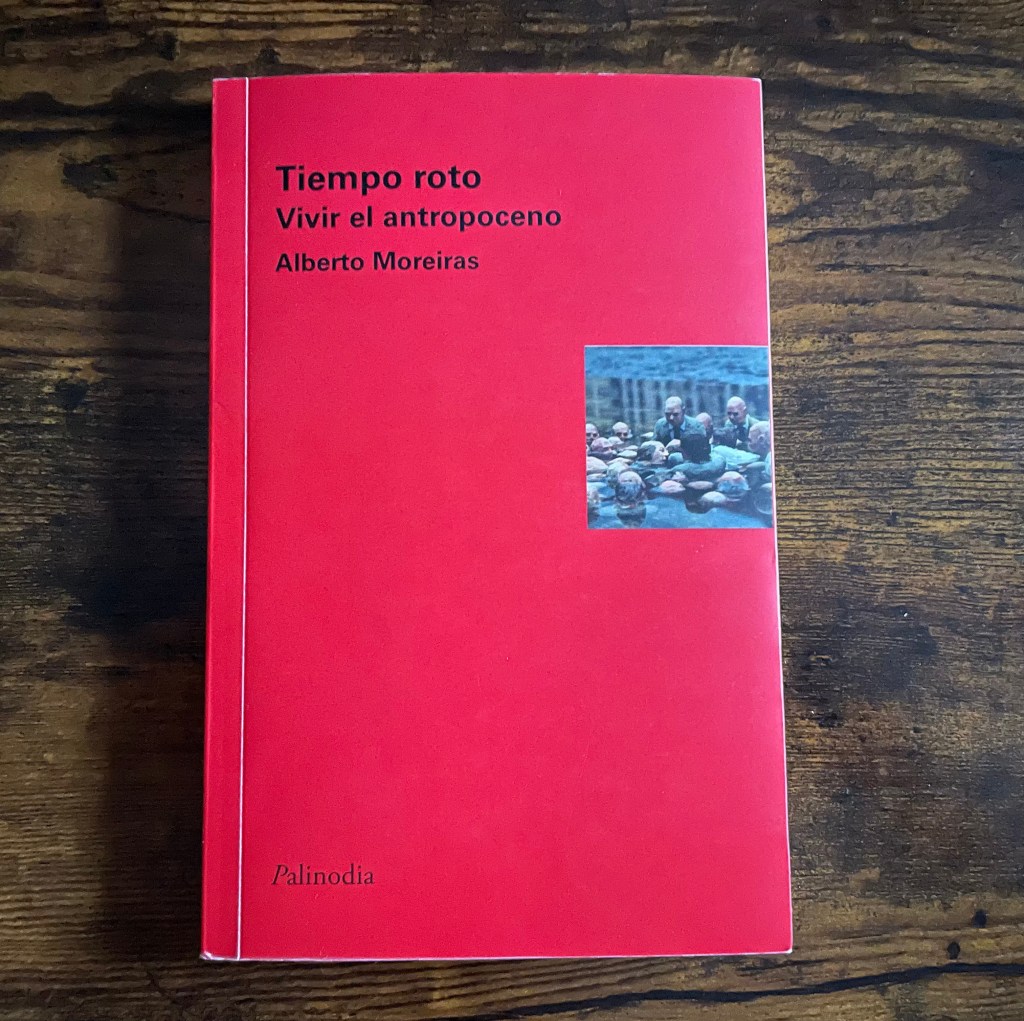
The task of the other beginning. On Alberto Moreiras’ Tiempo roto: vivir el antropoceno (2024). by Gerardo Muñoz

The sudden and uninvited intrusion of Gaia in our world is something rather strange, and yet consistent with the closure of the metaphysical tradition. The call of the outside takes place at the threshold of our reflexive capacities, habits, and mental propositions in our relation with the world, which demands everything to be thought from scratch. The historical imbalance in groundlessness now requires a new task for thinking – the imperative that runs through Alberto Moreiras’ most recent book Tiempo roto: vivir el antropoceno (Palinodia, 2024). The theoretical constellation deployed over the course of a decade now comes to the forefront with extreme urgency – I am referring to marranismo, posthegemony, aprincipial anarchy, and of course, infrapolitics. Tiempo roto (2024) is not a systematic culmination of Moreiras’ philosophical (or antiphilosophical) project of thought, but it is definitely a mature elaboration insofar as the field of problematization enters a hitherto unexplored thematics of late heideggerianism. All things considered, the emerge of the anthropocene as an explicit planetary endgame and the new beginning necessarily move pass the conditions of both political and scientific praxis, which today can only effectively adequate itself into positionality (the so-called Gestell) and objectivity of a world that slowly seems coming to its end. 

It might be worth remembering that the notion of “other beginning” (“otro comienzo”) in the wake of civilizational decline was already proposed in the book Sosiego siniestro (2020), but it was far from being thoroughly explained [1]. Following Heidegger’s philosophical scene, representational thought in the tradition of adequatio of the Thomist gnoseology coincides with technological administration of every living entity (Moreiras 14). But Heidegger’s suggestion in the Parmenides that calculative representation fails as grasping the essence of the polis might also have its own limitations, insofar Gaia appeals to an excess beyond or below the politics. As Jacques Camatte also understood it, the civilizational invariant of revolutionary breakthrough departing from the historical subject of the working class can seldomly do the work except as an article of faith in the myth of the autonomy of the proletariat within real subsumption. This means that we are in the terrain of infrapolitics or the chora, which point to ontic regions of thought towards a new beginning at the end of principial metaphysics. But the other beginning can only emerge within conditions of transforming existence against the closure of political technicity. 

I do not desire to reconstruct here all the refined analytical movements that lay out the transformation of existence in Tiempo roto (2025), but there is a maxim from Pindar’s Third Pythian Ode that stands out as an emblem for the appropriation of the non-humanity of the world. Moreiras cites Pindar’s “me, phila psycha, bion athanato speude, tan d’emprakton, antlie makanan”, which can roughly be translated as “do not seek, dear soul, immortal life, but do try to carry out the fullest the use of the possible” (Moreiras 61). Moreiras correctly notes that the ultimate difficulty lies in the “emprakton makanan”, or the use of the possible, which metaphysical Humanism and effective general equivalent can only exacerbate towards the planetary production and extractive valorization. The corruption of the use of the possible is the realization of hybris, and in this sense all representational humanism is always already a form of self-deification and induced hallucination, even when it tries to claim to engage in the opposite in relation to nature (Moreiras 65). Moreiras suggests that the pindaric maxim discloses a second relation of the “use of possibles” that does constitute a lacuna  in the metaphysical tradition, and that is understanding a praxis tied to sophrosyne or phronesis that abides to the prudent inclination of the non-human (“es una actividad sometida a la vergüenza de lo in-humano”) (Moreiras 65). Giorgio Agamben’s defense an ontology of possibility against the hegemony of metaphysical realization and representation also comes to mind, although Moreiras might not feel at ease at explicitly calling for a positive ontology nourished in the waters of a transfigured metaphysics of the tradition of scholastic Averroism [2]. Although both Moreiras and Agamben come at their closest proximity in terms of the notion of the chora – and more directly the space of the chora against the primacy of the polis – which serves the ontic condition for the non-spatial surfacing of the abode or region that is necessarily infrapolitical, because it’s never determined by distributionist political isonomia or meson (Moreiras 73). 

There are important nuances here to say the least: whereas for Agamben the notion of chora appeals to the gods of place (theos aisthetos), and thus a dejointed form of divinization decoupled from the legitimacy of every politico-theological archein; for Moreiras, the chora is a praxis of thought towards desecularization that lacks theology, and thus capable of exceeding the onto-theological reduction (Moreiras 74). But Moreiras says about the tendency towards nihilism of “possibility” in the historical dispensation of positionality (Gestell) could also be said about ‘de-secularization’, as the ultimate consequence of the decay of political legitimation in Ernst Bockenforde’s famous formulation. This might not be the space nor the moment to reach a verdict between Moreiras and Agamben’s position regarding the very complicated problem of the Platonic site of the sensible, since what is presented to the reader as a ‘phenomenology of excess’ or the inapparent (something merely alluded in the Zahringer seminar), might be the condition of an atopic mediation that prepares – or that has always prepared since the times of Orphic myths – the tonality of a coming philosophy under the sign of transformative thought (Moreiras 110) [3]. 

The dispensation of the Gestell open up and also step back (a folded movement that does not have a declension into a synthesis) into the genesis of the beginning (Moreiras 115). And the anthropocentric epochal dispensation, says Moreiras, is no longer the site of the polis, but “the planet as a the historical site of humanity, although we are still unaware of it (“aunque sigamos desconociéndolo”) (Moreiras 116). This uncanny phenomenology of the primary, traversed by the discharge of the entstehung, is the infrapolitical site par excellence, because it is in the atopic region where destiny is both affirmed and displaced. This is why, as Moreiras recalls Heidegger saying, the dialogue with Parmenides never exhausts itself, and yet it prepares a destiny (Moreiras 134). I take this to mean that there is an experience of the transfiguration of language for the emergence of an “ethics” (ethos), but this might be beyond Moreiras preliminary conditions for an existential breakthrough; that is, something possible further along the path.

Tiempo roto (2024) closes with a couple of undeveloped pages that take Massimo Cacciari’s old essay “Confrontation with Heidegger” (1977), in which the Italian philosopher makes a plea for a direct confrontation with Heidegger and Nietzsche’s teachings on nihilism and the closure of metaphysics if there would still be any hope for the composition of the working class during the stage of anthropomorphized dimension of capital defined by Jacques Camatte also during those years. But much has changed since the hot Italian summer of 1977 and the formulaic conjunction of  “left Heideggerianism” might not do the work anymore, as if the totality of materialist political economy could be amended by a radicalization of the historical question and the ontological difference. Political economy plus metaphysical critique is still relying on a conception of the political as a technique, which today has transformed into what some have called the “new regime of ecological accumulation” as mere stabilization of green ecological spheres of life [4]. 

But there is  a second register to Cacciari’s programmatic thesis that remains open. And these might be Moreiras’ most important words in the concluding part of the book: “Espero haber mostrado que Hiedegger señala la posibilidad de dejar atrás la explotación y el consumo en la era del Antropoceno a través de una comprensión alotrópica de nuestra relación con el mundo. Por lo tanto, vivir en el Antropoceno debe basarse en el abandono o desplazamiento de la metafísica como modo dominante de aprehensión del mundo en la actualidad” (Moreiras 151-152). Marx’s materialist dialectic through the critique of political economy – even as a destitution of political economy through its own vectorization – might be insufficient to face the unprogrammed presence posed by planetary anthropocene. 

Perhaps we can still repeat Dionys Mascolo’s words that the coming communism will owe more to Hölderlin than than Marx, not because of an idealist dispute over concepts, but rather because of what Cacciari called in his essay, also citing the German poet, the historical “affinity of conditions” [5]. And in the age of the Anthropocene and positionality, those conditions are kept in the pattern of economic decline or stagnation in which the law of rate of profit encounters its own limit, folded unto the ongoing destruction of the life forms in the world. The allotropic praxis endorsed by Moreiras finds traction in Hölderlin’s poetic dwelling in language at the heart of decline so that something other might emerge within and beyond life, from Gaia to Ctonia. This is the most difficult task to depart from, but it is also the path that saves from the current inhabitable passage of the Earth. 

Notes 

1. Alberto Moreiras, Sosiego siniestro (Guillermo Escolar, 2020), 24.

2. Giorgio Agamben. L’irrealizzabile: Per una politica dell’ontologia (Einaudi, 2022), 112-146. Kindle Edition.

3. For more on orphism and the limits of the site of the Greek polis, see Gianni Carchia’s Orfismo e tragedia (Quodlibet, 2019), epilogue by Julien Coupat. 

4. Gerardo Muñoz & Zeit der Ökologie. “On the New Regime of Accumulation”, Endnotes 2024: https://endnotes.org.uk/posts/on-the-new-ecological-regime-of-accumulation 

5. Massimo Cacciari. “Confronto con Heidegger”, in Pensiero negativo e razionalizzazione (Marsilio, 1977).

Unelevated politics. by Gerardo Muñoz

In a fragment from 1919 entitled “World and Time”, written around the time of the elaboration of the essay on the question of violence, Walter Benjamin offers his most succinct definition of politics: “My definition of politics: the fulfillment of unelevated [ungesteigerten] humanness” [1]. The ontological reduction is compact, and the three terms in it are carefully chosen: fulfillment, unelevation, and humanness, which indicates a ‘preparation for a profane politics’ at the threshold of secularization and its negation in a new “spiritual ornamentation”, as he would claim in the notes of “Capitalism and Religion”. The stress on the refusal of “elevation” (gesteigerten), however, does bring to bear that Benjamin’s refusal of a political ontology constrained in subjective and objective representation, which is why in the same fragment he connects the abutting of politics to a “living-corporality” [Leiblichkeit] of the human species. To retract from the cycle of civilizational violence, politics had to be reformed from the groundlessness of the energy of the living.

Hence, for Benjamin there is a metapolitical condition or archipolitics that plays out in refusing “elevated humanity”, which for him was at the source of the romantic response to the impasse of the critical enlightenment, placing the subject of knowledge and its self-reflective faculty at the center of the developing self-rationalization of the spiritual transcendence of the world in this new critical religion: “…the ideal of humanity by rising up to…that very law which, joined to earlier laws, assures an approximation to the eternal ideal of humanity” [2]. Hence, neither trascendental representation nor spiritualized immanence of order could, but unelevation of the “human possibilities” (Menschhaftigkeit). But such possibilities could only be disclosed beyond the pretensions of spiritual elevations of a unified consciousness, as Erich Unger had proposed in his Politics and Metaphysics (1921) around the same time to enact a “politics of exodus” for a common psychosocial regeneration. 

Benjamin’s proximity and distance from Unger’s position could perhaps inform why instead of writing a promised book that was going to be entitled True Politics (Die Wahre Politik) – allegedly containing two chapters “The destitution of power” and “Teleology without ultimate goal” – evolved into the landmark essay “Towards the critique of violence”, in which the frame of domination and the ontology of politics was recasted as a mediation about the folding of secularized annihilating violence, substance intrinsic to the philosophy of history and indestructible life of the soul (“annihilating only in a relative sense…never absolute with regard to the soul of the living”) [3]. Thus, one could say that accounting for the groundwork of “politics” meant accepting the constitutive verticality cosigned to modern philosophy of history, and its bipolar schematism between moral principles and sacrificial production. If Peter Fenves’ assumption is correct, Benjamin was not only inscribing a distance from Unger, but, more importantly, from Kant’s Toward Eternal Peace who defined his “true politics” as dependent on moral determination: “The true politics can therefore not take a step without having already paid homage to morality, and although politics by itself is a difficult art, its union with morality is no art all, for as soon as the two struggle against each other, morality into two cuts the knot that politics cannot dissolve – The right of human beings must be held sacred [heilig], however great a sacrifice this may yet the dominant power” [4].

The Kantian liquidation of politics to morality is hyperbolic to the modern epoch and its crisis – the crisis and enmity against the concept of the political, Carl Schmitt would claim in Political Theology (1922) – rendering modern politics and legitimacy hollow; something that Benjamin had understood well he saw to retract from the question of “politics” to that of a critico-metaphysical exploration waged on morality “as nothing other than the refraction of action in knowability, something from the region of knowledge…Morality is not ethos” [5]. Elevation could only have meant the production of a subject of knowledge and the specific (technical) arrangement of knowledges for subjection. On the contrary, the ethos was the necessary condition no longer for any “coming politics”, but rather for the disclosure of “the coming world” [die kommende Welt] itself. This means that working through the redemption of the world solicits a reversal from morality to ethics only to later transform the conditions of politics.

Let us return to the definition of politics as “unelevated [ungesteigerten] humanness”. What defines “unelevation”? From the ethical point of view it conjoins with the notion of “inclination” [Neigung] that Benjamin favors because of its unconditional valance that disarms the cycle of violence of the human community and its willful hostilities. The inclination rejects the paradigm of force because it an erotic mediation, that is, an affection of donation and love beyond exchange [6]. But inclination is only possible through language, as Benjamin had expressed in his “concept of politics” in a letter to Martin Buber from 1916: “I understand the concept of politics in its broadest sense…in this sense, therefore, language is only one means of more or less suggestively laying the groundwork for the motives that determine the person’s actions in his heart of hearts. Only the intensive aiming of words into the core of intrinsic silence is truly effective action” [7].  

Thus, the suspended elevation of the subject and higher order meant that its persuasive purity allows the inception of the “divine” as a «teleology without a goal» validated by the suspension of judgement of appearance. The intensification of the unelevation opens life to an ethical demand of a “living corporality” that roams the world’s crust beyond depredation where the force of autonomy of social practices does not risks the world of life forms and the soul. Indeed, at this point Benjamin does join Unger’s cardinal thesis: “Overcoming capitalism through wandering”. Or as he wrote even earlier about Hölderlin’s poetics: “[In the world of Hölderlin], the living are always stretching of space, the plane spread out within which destiny extends itself…it already comprehends the fulfillment of destiny” [8]. A politics oriented pending dowards to “unelevation”, inhabits the ground level of co-existence and cultivation dismissing the ontological derivatives or principles (archein) of ‘politics’ in order to conquer every possible destiny in the lawless fulfillment of the world.

Notes 

1. Walter Benjamin. “World and Time”, in Walter Benjamin: Toward the Critique of Violence: A Critical Edition (Stanford University Press, 2021), 74. 

2. Walter Benjamin. “The Concept of Criticism in German Romanticism”, in  Selected Writings, Volume 1, 1913-1926 (Harvard University Press, 1996), 138. 

3. Walter Benjamin. “Toward the Critique of Violence”, in Walter Benjamin: Toward the Critique of Violence: A Critical Edition (Stanford University Press, 2021), 58. 

4. Peter Fenves. “Introduction”, in Walter Benjamin: Toward the Critique of Violence: A Critical Edition (Stanford University Press, 2021), 18-19. 

5. Walter Benjamin. “Ethics, Applied to History”, in Walter Benjamin: Toward the Critique of Violence: A Critical Edition (Stanford University Press, 2021), 74. 

6. Walter Benjamin. “On Kantian Ethics”, in Walter Benjamin: Toward the Critique of Violence: A Critical Edition (Stanford University Press, 2021), 71. 

7. Walter Benjamin. “Letter to Martin Buber” (1916), in The Correspondence of Walter Benjamin (University of Chicago Press, 1994),  79-80.

8. Walter Benjamin. “Two Poems by Fredrich Hölderlin”, in Selected Writings, Volume 1, 1913-1926 (Harvard University Press, 1996), 26. 

The last stage of embalmed decay. by Gerardo Muñoz

The techno-administrative organization of the world that is showing off its force these days is only possible thanks to a previous devastation of the opacity of language, which ultimately connects human beings and the world. It is also the mysterious vortex of the breaking point of humanity into being, of which today there is only remembrance and scholastic teaching but seldomly authentic expression. When politicians, engineers, and social functionaries stubbornly distract us with open attempts to decimate secondary languages, prohibiting the annunciation of words through the legal enforcement of “place and manner” norms, and elevate abhorrent structures of linguistic commands and information as units of social interaction, it is obvious that the collapse has already happened. It also means that in terms of “Social” planning humanity has ceased to exist under the shadow of speech, to use an expression from Helene Lubienska. Hence, it is all the more absurd to confront this transformation with a strategy of multiplication of rhetorical codified languages that merely deepen the schism between the expressivity of language and their worlds. It suffices to say that any recognition of a para-official language of social interaction plays into the fictitious polarity of homogeneous globality and reified nationalism –  the constitution of print nationalism being the historical destruction of minor and dispersed languages of remote places and villages for the sake of the organization of a productive fictitious historical subject.

We must ponder what it means that the current imperial world order is one that does not offer a language, let alone the flourishing of minor or ‘vulgar’ languages as in the Latin Middle Ages, but rather an exit from language, which is the cybernetic project of codifying flows of information and looping inputs in which asymptotically humanity surrenders their languages. In past imperial adventures, language was either a tool to subordinate the world of the colonized, or it was a lingua franca of elites (administrators and the clergy) that allowed for the real existing languages in the territories integrated precisely by their exclusion or subalternity to the civilizing regime guided by literacy. The sharp contrast with today it is striking, since it is all too clear that the project of cybernetics, and its most recent avatar “Artificial Intelligence” (AI), is fundamentally an Empire that does not even require to rule and neutralize the “civil war over words” that Thomas Hobbes repudiated in the European confessional state, since its ultimate goal is not political statecraft, but the regulation of unworldly bodies of social reproduction. 

This is why some contemporary engineers have said that AI requires “a reconfiguration of the social contract”, with the caveat that it would necessarily be a “social contract beyond language and thus without politics”. The last social dispensation at the hands of engineers is the human soul, as it has been said. For this conception of language, it matters to only understand it as a semiotic reduction of the expressive human being to naked animality as the general form of the posthistorical being in the present. It is noteworthy that a great North American writer, Cormac McCarthy, while working on this problem of language at the Santa Fe Institute scientific research program (a central hub of American developments for artificial science and the unification of the sciences), reached the conclusion that language must be understood in relation to a virus: “a virus nicely machined. Offer it up, Turn it sligh, Push it in, Click. Nice Fit. But the scrap heap will be found to contain any number of viruses that did not fit…The facts of the world do not for the most part come in narrative form. We have to do that” [1]. The “unruly nature” of language, precisely because it does not fit into the biological pattern of virological model, must be mastered into an accompanying narrative of the social world, taking the copula and grammar as the final functionalization of the fictitious community. The artificiality of language is a civilizational decay that takes place not as heteronomic cooptation by technological advancement, but within its own internal abdication of its voice and mystery. 

It is precisely this internal threat that the American sinologist Ernest Fenollosa sought to expose in the most polemical moment of his posthumous tract The Chinese Written Character as a Medium for Poetry (Stanley Nott, 1936) – an essay that was restituted, let us not forget, by Ezra Pound precisely to confront the pauperization of ‘Basic English’ as the standard of linguistic use – in which he writes the following observation about the extreme filing of words: “Languages today are thin and cold because we think less and less into them. We are forced, for the sake of quickness and sharpness, to file down each word to its narrowest edge of meaning. Nature would seem to have become less like a paradise and more and more like a factory. We are content to accept the vulgar misuse of the moment. A late stage of decay is arrested and embalmed in the dictionary” [2]. Fenollosa could not have foreseen that the posthistorical epoch – an epoch of the most furious abandonment of thinking – there was nothing else to file in terms of the expressivity and poetic soil of speech. The course of American artificial humanity is not a human with a pocket-dictionary; it is something way more grotesque: an animal that can repeat and chatter sounds and symbols severed of its proximity with any linguistic inherence and the sensorial worlds. And it goes without saying that the engineering plan against the poetic soil of speech, as North American poet understood well, means that this war is waged against the last reserve; that is, the ethos understood as ‘the cave of everyone’s inner being’. 

Notes 

1. Cormac McCarthy. “The Kekulé Problem”, Nautilus, April 2017: https://nautil.us/the-kekul-problem-236574/

2. Ernest Fenollosa. The Chinese Written Character, edited by Ezra Pound (Stanley Nott, 1936), 28.

The bruised souls. by Gerardo Muñoz

Whenever a professional politician today evokes the ‘soul’ one must be immediately suspicious, as it tends to be an automatic lullaby for “national unity” or a dormant metaphor in a flowing stream of empty chatter. What could the soul mean to anyone – say, those millions that have now for the second time voted fairly and squarely Donald J. Trump to the Executive branch of the national government – only capable of giving attention to a series of onomatopoeic pop-words that are now ingrained in the linguistic acoustics of the American lexicon (“Bitcoin”, “Tiktok”, “Woke”, “Prime”, and the list could go on). The ongoing catastrophe is first and foremost within the texture of language, which is ultimately why it is also an ethical decomposition in which all other spheres of practical action (first and foremost, politics) amount to business as usual with its corresponding rhetorical bravura.

Suggesting continuity might perhaps be an understatement: it is now a business that does not need any sumptuous or veiled mediation; refracted upon its own absorption of its hyperproduction of fiction, the defeat of the communitarian salvation of Calvinism can only be expressed as a self-serving an ongoing destruction and self-annihilation. True, it could be claimed that ‘Americanism’  has always been this; the only difference is that today, already well into the century, it moves in a vector that directly rejects the world while making a full fledged program of its own making. Only a Society that has become fully moribund can celebrate its own death and decomposition; while the emancipated and well scripted villains of the act now have no shame but to reveal how the ultimate object of their conspiracy was the obliteration of the Earth.

“It is the time of the assassins”, TJ Clark writes echoing Henry Miller’s unjustly forgotten book on Rimbaud and the legitimation of the social bond, in which the homo homini lupi discloses itself from any all possible contact in the metropolis solely dependent on ad hoc hyperproduction of justifications required to fully commit to the illusion of legitimate action. Only that now the time of the assassins is perhaps an uncanny dark night of those without souls, as in the deranged characters of a McCarthy’ novel: they are willing to kill and be killed; they are beyond any contact with language, and “what do you say to a man that by his own admission has no soul? I’ve thought about it a great deal” [1]. And indeed, there is nothing to say and nothing to face: in the soulless dark night there are only hunters and those that are hunted; there is integration or pulverization; there is killing and there is humiliation before an ever increasing legal nexus coordinating the acquiescence of force. But perhaps this is the real arcana of the American soul that is only shimmering through in all of its glory.

Someone like D.H. Lawreence definitely thought so when writing about the novels of Finimore Cooper: “[The white american] lives by death, by killing the wild things of the air and earth…All the other stuff, the love, the democracy, the flooring into lust is a sort of by-play. The essential American soul is hard, isolate, stoic, and a killer. It has never yet melted” [2]. But in our days it has begun to melt, to fragment, and decompose in a heavy storm of pain and despair. And it continues to stand in the long winter of American civilization (the castle of Frozen is the allegory of the epoch) that now finds itself at the epochal threshold of the end of growth, only left with rampant nationalist impulses of self-affirmation that can only deepen the nihilist tonality of anguish and self-destruction, and the emergence of the bizarre as Jamie Merchant notes in his recent Endgame (2024). 

In his Reflections on America (1958), Jacques Maritain maintained that the spiritual patrimony of Americanism is that of being “bruised souls”, a community that came into being by double exclusion (hunted by their religion and rejected within a national polity), which in turn allowed to be compassionate to human suffering, and thus the hidden meaning of the wound was to be seeing in the “role played by immigration and poverty suffered in the Old World” [3]. Hence, for Maritain the condition for the healing soul of America resides in its opening to ongoing suffering of migrants, the dispossessed, and those in exodus from the psychic pressure of a social metabolism gone sour in every subject of civilizational decay as Erich Unger had proposed in his Politics and Metaphysics (1921).

 It comes to no one’s surprise, thus, that the decomposition of the American soul departs from the overt opposition to migration, as a figure of the grazing over the Earth, that must be vanquished and condemned by a planetary gnosticism undergoing in front our eyes. The Chrisitian modern state enters in this way into a concrete and visible process of artificial desecularization showing that “the Christian relation to the State…is in mad hostility to all of them, having in the end, to the destruction of them all. […]. And it is, simply, suicide. Suicide individual and en masse” [4].

The stakes are extremely clear: it is for the bruised and the brute (some have called it the barbarians, proprietors of strange tongues, keepers of the clandestine lacunae of language) to retreat from the fictive proliferation of appearances, the artificialization of reason that can promise success as the ultimate pinnacle of self-destruction. Inclined beneath the shadow of archaic Penia, the bruised and incurable souls might not find redemption in the American wasteland, but they will land somewhere between language and world. Not a program but a moving conviction.

Notes 

1. Cormac McCarthy. No Country For Old Man (Vintage, 2005), 8.

2. D.H.Lawrence. “Fenimore Cooper’s Leatherstocking Novels”, in Studies in Classic American Literature (Thomas Seltzer, 1923), 92. 

3. Jacques Maritain. Reflections on America (Scribners, 1958), 84-85. 

4. D.H. Lawrence. Apocalypse (Penguin Books, 1995), 148.

Morin’s autocritique and the human species. by Gerardo Muñoz

Edgar Morin’s memoir of the interwar years, Autocritique (1970), is a coherent elaboration of the early disaffection with the official culture of the Communist Party years, and the nihilist production of justifications to outlive the suppression of life into the abstraction of dogmatic principles. There are some harsh pages in Autocritique that color the general party-line position against the emerging critique of Stalinism. Let us just take this example: “The nonnegotiable and intransigent position against any anti-stalinsim would compensate for a life without principles with the enactment of a set of principles without life” [1]. It does not require much self-reflection to see that this formulation – the production of abstract reasoning in the name of boundless defense of principles – seeks to legitimize the dialectical ruse that indexes the general sense that “life does not live”, if one were to paraphrase Fernand Kürnberger. The self-assumed nihilism and bad faith denounced in the pages of Autocritique was not just that sacrifice was the abstract historical assumption of liberation, but rather that the reality of sacrifice was unbearable for many; specially for those who found themselves in a situation to suffer it [2]. And part of the memoiralist reconstruction by Morin is to leave all this behind, and in the effort to do so, also embrace a political option beyond the collapse of the historical utopia. 

Of course, there is some ambiguity here, and to put it in this way it is already a form of understatement. About halfway through the book, Morin recalls that Elio Vittorini had told them [Antelme and Mascolo, his two good buddies during the postwar years] that communist culture had a saturation of politicization within itself; and, already in 1949, this saturation of politics had calcified  into a “policing control within politics” [3]. In other words, the postwar Cold War context was the consummation of the static politics of the previous decade, only that now it was co-extensive with planetary gigantism as two formations of civilizational states (Americanism and the Soviet Union). Could there have been an option for a different political elaboration, to put in Morin’s own terms; that is, a communism without the iron law (and lawlessness) of objective-driven efficacy and efficiency? (This second was Morin’s term) [4]. Morin does not have a positive answer to this question at least in 1970. However, we can reconstruct a possible answer by taking into account at least two divergent symptoms. First, is Morin’s critical target: political stalinism as hyperbolic of the communist aspiration and necessary culmination, which had cut through the thicket of the gordian knot of historical dialetics movement for emancipation.

Let’s take this moment: “Stalinism was monstrous, I myself perceived in 1949. But this monstrosity had tainted the most admirable form conceived by man: communism. Now evil and good would intertwine in an intimate way….and the attempt to eliminate the cancer’s cause was not, at the sametime, also a form to suppress the fountain of life” [5]. If anything this is a symptom that for Morin, it seems to me, that communism cuts through political ideology, and cannot be contained otherwise. At the same time, the leveling of the critique at this height entails that Morin’s own leveled critique is still prey to ideological determinations blanketed as political rationality. In fact this is something that Autocritique never abandons; and, perhaps its retention indexes its impasse, which is also the impasse of the political subjectivity. 

The second symptom is that Morin never dares to mention Robert Antelme’s The Human Species as a touchtone memoir of the experience of the camp, and the camp as hyperbolic of the destruction of politicity. Of course, the strongest distillation of Antelme’s book is not waged at the level of political ideology, but rather about rather at the level of the human species as the final destination of infinite destruction (because he can be infinitely destroyed in virtue of its indestructible irreducibility) that brings back the indivisible origin of the human species. Of course, this rings true with Amadeo Borgida’s thesis that ideological determination puts emphasis on the individual (in positive or negative sense), whereas communism attends to the human species as the ground level of the species [6]. 

Needless to say, what is realized in both Stalinism and Nazism, albeit their different designs and orientations, is the confused struggle of the separation within what is unfathomable kernel of the human species (this is after all the naturalist project of Hitler’s Black Earth). And what Antelme discovers – although the verb discovering here is providing a scientific optic that is not too appropriate – is that the human species is at the ground of needs, but insofar as the need of the human species transcends itself to its biological reduction. Perhaps this is where the thorny question of “ethics” should be situated; a question that, in return, will also put in perspective our distance with the generation of Rue Saint Benoit and the humanist-nonhumanist polemic regarding the miraculous transcendence of human beings in the world. Was not this Antelme’s definition in the “The Smiling Angel”: “The only transcendence is the relation between beings”? Morin’s concluding remarks in Autocritique decisively go to the heart of this question, which is worth citing in full: 

“Ethics is an existential feeling, like the feeling of freedom, answered by every science, by every look at the past as well as by every forecast of the future, but which is the lifeblood of the lived present. And this sap of what has been lived, a paradoxical thing, is the presence in our inner core of the ought-to-be, of the ideal, of the negation, that is, of the virtual and the imaginary. And everything that eliminates the ought, the denial, the ideal, the imaginary and the virtual, concerns what is dead and fossilized. The only thing we can do is become aware of this contradiction. Perhaps a new conception of the world, where the relationship between what is called real and what is called virtual will have taken on a new meaning, will allow us to progress further.” [7]. 

At the end of Autocritique Morin seems ready to accept the magical and mystified dimension of reification, a necessary philosophical and practical technical anthropology invest a new ordered relationship with the world. But this is also symptomatic of Morin’s subjectivism and humanism that stops him at the nearness of the question of the human species. He never arrives there, or he stops too short. This is the distance that keeps illumination at hand; that is, that stubbornly insists on holding to modernity’s capacity for reinvention and, upholds the dialectics between critique and autonomous freedom. But, this is precisely what is no longer what could suffice the opening of “a new conception of the world today”, even if the gordian knot is precisely at the conjuncture of ethics, language, and existence. No subject without critique, and no critique without the emergence of a new subject. As such, self-critique becomes an unconvincing condition to advance towards a beaten and well known path.

Notes 

1. Edgar Morin. Autocrítica (Editorial Kairós, 1976), 117

2. Ibid., 45. 

3. Ibid., 163. 

4.Ibid., 72. 

5. Ibid., 162. 

6. Amadeo Bordiga. “Specie umana e crosta terrestre” (1952), in Drammi gialli e sinistri della moderna decadenza sociale (Iskra, 1978), 94.

7. Edgar Morin. Autocrítica (Editorial Kairós, 1976), 266-267.

Two observations on the Non Kongress bulletins. by Gerardo Muñoz

I have read with genuine interest the five bulletins put out by the organizers of the Non-Kongress meeting, and it is only fair that I put some preliminary comments with no other purpose than to highlight a few points (I take it that other will have theirs, and I am looking forward to this discussion). To start somewhere, I will first say that I am fond of the open balance sheet format that puts on the table hot-button issues without exhausting all them. The starting point is broad and clear: our current predicament is one marked by the collapse of the ground of politics and the total absorption of politics into a social-moral designs. These days I also come from drafting a preliminary – an in a way a bit autobiographical – balance sheet of the last decade of (failed) debates in contemporary Spanish leftist politics (2014-2024), which allows for reflection of a contemporary sequence, draw a few conclusions, and move on. If we do this something has already change, and we have avoided the anxiety of feeling that everything must be said. The momentary arousal provided by rhetorical completion pays the price of immobility and confiscates the truly important thing: what will never be thoroughly said, or stated only indirectly, is the condition for any true communication of thought to have a chance even if it rarely happens. This aspiration is sincere and from its inception it already puts university discourse (and its experts in the intellectual division of labor) in trance. And this trance opens a region that allows for something to emerge in a new light sin sanata.

The five-installment bulletin seems to provide two general movements: an analytical sketch of current domination and several conditions for “refusal” or “exodus” under the generic designation of “destitution”. On the first level (the analytics of domination) the bulletin suggests that the configuration of power is organized as an imbrication between the scientific medical apparatus, the expansion of infrastructures and digitalization, and an administration of morality as stratification of values in social optimization that were effectively accelerated in the wake of the Covid19 policy directives. And it is also obvious that what also binds these three different strategies and domains is the administration of the hollow and the fictitious subject as the last subject of nihilism (nothingness as unconstrained force) for ecological catastrophe. Now it is utterly clear that – in aftermath of the gran designs of productive modernization and formal labor productivity – the true and ultimate objective of capital is the world; and, more concretely, the human species’ exposure to worldly phenomena. Hence, there is an implicit, not totally fleshed out, latency in the bulletins which one could situate under the turn towards territoriality, location, place, and fragmentation of the earth. Of course, there is ample risk here to assume that locality (communes, community, autonomous zone) is just an exception to planetary unification that labors negatively for the ongoing destruction; a sort of ‘partisan’ Benedictine community under the shadow of Empire. This is why it is important that Hugh Farrell reminds that any territorial program can no longer be unliteral and must be opened to the contamination of the experiences must incorporate play and openness to its outside [1].

This is touching the limit of the defunct strategy of occupation in which the spatial unity accomplishes the self-police work through the veiling of the good conscious subjective militancy, as I recently also saw in the Pro-Palestinian university encampments in the US [2]. More than a decade ago, Alberto Moreiras warned about the ontotheological determination of locationality as a fold of identity, and he called for a “dirty atopianism” against the allure of compensatory critical regionalisms, and which we can connect (with all the caveats necessary) to the form of countercommunity and the difficult problem of the non-site of the khorā that marks an unbreachable limit to the totalization of the ground of the polis and the political [3]. Life or existence at the end of the day is not “this body” or “this thought”; it is how this inclination connects to the surround of the world. And here is yet another problem, which is delicate as it is difficult to untangle: the need to for a reinvention of a concept after the destruction of its civilization diffuse uses in the Western tradition: “freedom”. We do not need Shelley to tell us, but it is always useful to recall it again: “…the state of probation in which we now reside is merely a preparatory stage in which….to fit us for a more exalted state of existence, is not the deprivation of liberty the deepest, the severest of injuries?” [4].

It is only now that we can understand that liberty of the subject – and the political subject of liberty – was a ragged garment when compared to the freedom of the surround — think paintings of Cézanne as a gesture of gathering to “declare the essence of the world to be existing together, a mutual self-supporting and carrying of things”, states an eminent art historian [5]. Political language, or the intensification of language through the lexicon of politics is too vulgar to do the work and the heavy lifting; we have to be capable, I think, to look elsewhere (say, painting) for claims of a transfigurative sense of what it means to grasp this notion of liberty that takes us to the very beginning. It is a difficult problem, no doubt, but against immediacy, the sensorial must be expanded beyond its commonplace allocation into the latent or full-fledged central conflict. Those images are also too poor of world; even if we know that the world “can have no temporal view of things…the world pass into nothing in the very multiplicity of its instancing” [6].

The fifth bulletin calls for an “ethical ground”, but immediately passes to claim a “politics of destitution”, which is overtly anchored in the recent cycle of “experiential revolts” as stable instances of this passing world that does not succumb to conclusion. I guess it all depends how much weight – or how deep down – one is willing to exert on this figure. Or how extensive the figure is — for someone like Rodrigo Karmy, the revolt is the turbulence of imagination itself. But the question remains as well: does not revolt, as prefiguration of a politics to come, or as a politics of destitution, run the risk of assuming a general central framework of entering into the world? If the precondition for the accumulation of freedom of the surround is given by the belligerent loss of fear of solitude, then this could mean, among other things, that the revolt does not stand as the exclusive theater of opposition or refusal [7]. The freeing of the instancing of the world means that there are multiple ways in which existence deals with the increasing pain at the end of social cohesion. The end of the Social bond entails the intensification of pain as the fundamental stimmung of our times.

.

.

Notes

1.Hugh Ferrell. “The Strategy of Composition”, Ill Will, January 2023: https://illwill.com/composition

2. Gerardo Muñoz. “Reporte desde Columbia: Gaza contra el encierro”, Revista Disenso 2024: https://revistadisenso.com/reporte-desde-columbia/

3. Alberto Moreiras. The Exhaustion of Difference (Duke U Press, 2001) 23.

4. Percy Shelley. “Poetical Essay on the Existing State of Things” (1811): https://poeticalessay.bodleian.ox.ac.uk

5. Kurt Badt. The Art of Cézanne (University of California Press, 1965).

6. Cormac McCarthy. The Crossing (1995), 154.

7. Moses Dobruska. “How it All Began: The Strasbourg Theses”, Ill Will 2023: https://illwill.com/how-it-all-began

Treasure of the earth: on Elizabeth Sewell’s The Orphic voice: Poetry and Natural History (2022). by Gerardo Muñoz

Written at a time when the sciences of biological life were becoming fully integrated to technological and procedural social experimentation, Elizabeth Sewell’s 1960 The Orphic voice (nyrb, 2022) dared to pose the question of poetic myth as the mirror of scientific transformation of the modern world. Given that myth reopens the question of poetry and the natural world, for Sewell the modern exposure entails a profound misunderstanding: it is not that myth has eclipsed from the developments of scientific regime, but rather that science is incapable of absorbing it through its formal explorations in a system of subdivisions, classifications, and applicabilities. But for Sewell, it is myth itself that conditions scientific activity, providing ground for the discovery of situations and play in the world of forms. In other words, it is the persistence of myth in biological imagination the real forgotten path in the crisis of the transmission of tradition in a world aligned by the movement of scientific objectivity. For Sewell’s understanding of myth, there is no positive dialectical movement between myth and calculative rationality; rather, myth is what stands for the irreducibility of life in the cosmos. It is the very mystery of the anthropogenesis of creation as pure metamorphosis of forms. Why Orpheus, then? For Sewell, the orphic figure becomes “myth as a living thought and the very type of thought in action, and for all those other self-reflecting forms; for the human organism as an indivisible whole trying to understand itself….for biology reflection on the whole span of life in which thinking man appears as the last enigmatic development” (41). Orphism is the natural prehistory of becoming. This implies nothing less than reminding modern science of its “mistaken mythology”; as it is poetry – not mathematics or a scientific theory of language – the proper site for the adventure of life.

The strange career of orphism in the modern age is one of struggle, according to Sewell. A “struggle” that accounts for change, process, organism, and life” in an epoch that thinks of itself as definite and irreversible; completing the demythologization of the old gods and the ultimate achievement of secularization. Unlike for Oskar Goldberg for whom the civilizational regime of fixation of humanity is a matter of thousands of years (at least since Cain); for Sewell it has only bern a couple of centuries that has led to an esoteric experimentation with natural history in the wake of his postmythical substitution. At bottom, her task is to bring together, once and for all, the voice of Orpheus and “natural history and poetry, had not parted company and it only remains to try to bring them, after their long and wintry estrangement, back to one another” (48). This is the central task of the modern poet, Sewell seems to tell us: to wrestle the potentiality of myth to craft the a “model of thought” that transfigures the logical framework of rational thought into a “flexible and plastic” (beweglich und bildsam) play between form and formlessness that becomes inalienable from the metamorphosis of nature. This does not mean that all modern poets are orphic; and, I am not sure that Sewell will go as far as to accept that all orphism comes in the form of poetry (this will be of scarce persuasion). What the Orphic voices are saying “is that the poet and his world is part of natural history…it is postlogic” (153). The postlogic stands a tenuous and loose term to avoid the supreme autonomy of reason of scientific modernity. Rather than a tool to understand the causation of natural processes, or a set of artificial strategies for representation, the postlogical poetics is the music of a world as being transformed through experience and immersion. It is no doubt strange that Sewell calls postlogical method to account for the permanent overflowing of the orphic voice; although it becomes clear that she wants to think of it as a utensil inseparable from the form that it makes. In other words, the “method” stands for the possibilities of use through the attunement with worldly phenomena. Postlogical method wants to give substance to how well we construct and tailor the potent infinity of form. As Sewell writes: “The method, the lute strung with the poet sings, consists in the use of the self, and mind, heart ,as well as intelligence, as an instrument of wider interpretation, with language assisting in the process” (168).

The free use of one’s own is surely the hardest task for the poet, as we already know from Hölderlin who grasped the crisis at the outset of Romantic modernity. The capacities of the orphic poet wants to wrestle the force of expression from the stage of history into the methodology of forms. This is what Sewell reads positively in Goethe’s Urworte and Urpflanze as the “methodology of transformations…the key to all the signs in nature” (274). It is noteworthy that Sewell does feel the need to revise Hölderlin’s poetological attempt at the insufficiency of the tragic poet embedded in the play of Empedocles mediation between the material craft of art and the aorgic excess of nature. And it is too bad that she does not (alas, Hölderlin remains the missing key for many of these problems). But it might be that for Sewell the orphic voice is not a transfigurative element, but rather the acoustic composition of the play between creation and decreation. In this sense, the bios orphikos is, not merely of this world, but also the immemorial journey to the infraworld sidestepping tragic overflowing. It is very late in her book that Sewell defines this pathways that transcends all form and contours of scientific vitality:

“The origins of all our bodily and mental powers are in an exact sense with the dead, in heredity and tradition; thus the dead are not wholly dead here within the living body. The heart and the center of the kingdom of the dead to which Orpheus goes in search of Eurydice is also the penetralia of the individual human life which pulsates and thinks…Anthropology suggest that the labyrinth of primitive man, the maze emblem and the real mazes of the caves, were capable also of being the body, and the site of a journey between the two worlds of living and dead. The orphic search here goes past Orpheus back into immemorial antiquity.” (326-327). 

Immemorial antiquity – these are the wonderful markers of everything that Sewell’s book does not accomplish or flesh out in its voluminous 400 plus plages. But, it is only at this point that we are capable of understanding that what Sewell calls “biological thinking” has nothing to do with the basic mental capacities that dispenses the anthropological density of the modern reserve to self-assertion (in Blumenberg’s unsurpassed definition), and everything with a tradition of the immemorial that is creation’s most intense point of bifurcation between the living and the dead. The passage to this region becomes testament to the validity of one’s experience. This is also why the orphic voice cuts through the the subdivision of the polis and the modern autonomy of art; as it takes life through the fleeting instance of the freedom of forms in its non dependency with historical necessity and domestication, as Gianni Carchia lucidly reminded us [1].

The orphic immemorial will not appeal to a morality of nature based on its fictive aura of normative order, but rather, it will supply the potentiality of the taking place of language. Hence, it is no surprise that the taking place of the voice (its postlogical status) lifts the human outside of itself, at the same time that it retains its most absolute nearness to the symbolic strata of myth. Commenting on Wordsworth, Sewell writes: “…the first provisional conclusion on method in the poem: that each language is a treasure of the earth but that poetry is the more valuable (as if our word, postlogic, might here receive additional justification)” (358-359). The voice has never been an organ or a specific faculty that belongs properly to the human; it is the passage between humanity and its constitutive exteriority in the world. Like the harmony of the spheres, the voice registers tone in the wake of the impossibility of communicating in the murky waters of physis.

If at the turn of the century Aby Warburg had shown how modern technical civilization had ended up soaking the mythical force of the serpent from the stormy sky of the Pueblo Indians (and thus the luminous space of contemplation of man in the cosmos); Sewell’s extremely idiosyncratic essay shows, between lines and amidst rhetorical inflation, that the echoes of the mythic imagination are still an integral part of the sliding amore fati, whose “aim is the discovery of the world” (405) [2]. The lesson in our epoch becomes easily adapted: the ethical standard does not prove itself by appealing to norms and substitute fictive authorities, but rather in terms of how well one is able to attend to the incoming vibrations of forms. One can even go as far as contradict Sewell post factum and say that this is no longer a request to be made on science, which has fully ascended to the place of prima philosophia as prima politica. So, it is perhaps love (that figures so poorly in Sewell’s book in relation to the centrality of cerebral intelligence, barely making an appearance in the very last page) the symbol of the highest riches transfiguring myth into a voice that outlives the specter of humanity and the futility of the machine. If orphism means anything, it is that the voice implies withdrawing from the cacophony of a world that has imprisoned the living in the blistering entertainment of their own wrongdoing. “Flebile lingua murmurat exanimis”, signs Ovid — right, but who is still able to listen?

.

.

Notes 

1. Gianni Carchia. Orfismo e tragedia: Il mito trasfigurato (Quodlibet, 2019), 

2. Aby Warburg. “A lecture on Serpent Ritual”, Journal of the Warburg Institute, April 1939, 292. 

On clemency. by Gerardo Muñoz

The last mail that I received from my friend, the philosopher Emilio Ichikawa (1962-2021) before passing away stated the following: “Eres clemente, creo que esa palabra ya ni se usa”. Being clement (or ser clemente) has fallen in disuse, both in English and Spanish. One can only guess the reason as to why being clement or clemency has disappeared from a world governed primarily by force. It is notable that for Seneca in his treatise De Clementia (55 A.D) thought of the scope of this notion as precisely the preservation of the human political bond (vinculum) in moments of social disintegration. Speaking directly to the Roman rulers, Seneca argued that state power is never enough; there was also a standing requisite of clementia needed when dealing with weakest members of the social bond (membris languentibus) [1]. In modern legal discussions, clemency has not only disappeared as a practice, but been fully incorporated into the administrative function of the “pardon powers”; which, as we have seen in the last years in the United States, it has become a mere political token in favor of the powerful and not the weakest members in society.

On the contrary, it seems that the decline of politics and the full emergence of social administration presupposes a necessary forgetting of the principle of clemency. Perhaps a current Supreme Court case will suffice to bring this to light: a 94 years old lady, Geraldine Tyler evaded interest rates and property taxes for some years and ended up being expropriated from her home, which was immediately sold by the State of Minnesota for forty thousand dollars in order to charge her the fifteen thousand dollar fine, while keeping the equity surplus of the sale. The fact that the SCOTUS judges were not fully convinced of Minnesota state action and its lawyer (Neal Katyal), matters little to one fact that no one seems to have noticed: mainly, that the legal process has become main vehicle for injuries. In this framework, clemency has no place in in the statuary structure of public order.

Indeed, the main trait of the Americanization of ‘force’ is not just limited to physical or electoral stasis; rather, it is the motorization of legality without restraints. For every action that circumvents from public administration there is no possibility of clemency, but only subjection to legal rationalization through abstract principles of “equity” (passive exceptionalism mandated by costs and benefits models). And so, the clementia juris (the sweetness of law) as once imagined by Quintilian has been expelled from law, leaving behind only an obsessive legality that preserves an increasingly inclement schism of social life.

Perhaps “clemencia” as used by Ichikawa had nothing to do with politics; and, in a way, Seneca’s term in his treatise was already inflated by rhetorical functionalism at the service of the axiomatic order of socialization. There is a more originary sense of clemency – as the prefix *klei indicates – which is the clinamen that names the encounter (the Peitho) between the disinterested souls that freely subtract themselves from rhetorical force [2]. I would like to imagine that this is what Ichikawa had in mind when, instead of defining a concept, he appealed to an ethical disposition: being clemente.

.

.

Notes 

1. Seneca. De clementia (Oxford U Press, 2009), 74.

2. Gianni Carchia. “Eros e logos: Retorica antica e peitho arcaica”, in Retorica del sublime (Laterza, 1990).

A new science of experience. by Gerardo Muñoz

This is merely a footnote to an exchange in light of the short talk “Immanence and Institution” that I delivered yesterday in Mexico City under the generous auspices of Professors Benjamin Mayer Foulkes and Andrés Gordillo (the recording should be available soon in the audio archive). In the rich discussion that followed the hypothesis regarding the triumph of the dominance of the civil concept today, Andrés Gordillo noted that a practice of “discernment” was required to confront the ongoing condition of planetary catastrophe that has only intensified in the wake of AI automation processes that orient the optimizing and unifying the totality of world-events. Alluding to his historiographical research on early modern epoch, Gordilo alluded to the mysticism of the seventeenth century’s “science of experience” (following Michel De Certau’s The Mystic Fable but not only this work) as an existential practice to retreat from the dominium of confession, but also to refuse the Protestant unification driven by the ends of predestination and grace. And unlike the early Christian mystics of the void and releasement, the proponents of a science of experience favored a discernment with God that was vested in every creation of possibilities and modalities exterior to life.

The mystical defense of a science of experiences, then, refuses the concretion of the social subject: being a subject of sin through the postlapsarian condition, but also reflecting the Protestant subject of election that will give birth to the secularization of consciousness and will. The science of experience is the exposure of the soul to the possible transformation with the exteriority as prefigured in transcendental exteriority. A transfiguration of the foundational unity of theological revelation. I find it fascinating that these mystics of the seventeenth century (some of them marranos or facing the problem of conversion) were already aware that an epoch of total dominium and absolute collapse against life requires a transformative nexus with the temporality of experience. 

When Erich Unger in 1921 contemplates the rise of a catastrophic politics in his Politics and Metaphysics, he retorts to a politics of exodus that, precisely, affirms the experiential dimension of existence and communication through what he would call the elevation of the imaginative capacities. In the face of a subsumption of politics into catastrophe, for Unger the immediate task was to elaborate the praxis of experience from the psychic imbalance of the corrosive effects of the subject. In other words, the science of experience names an interior exodus against every instance of rhetorical and mimetical fabrication that seeks to hold the plan discernment of life into a regime of administration and accumulation of plain historical time.


I agree with Gordillo that perhaps the diverse experiments of the “science of experience” could very well be understood as experiments in transitional thought against historiographical closures. The notion of experiment could be extrapolated from Saidiya Hartman’s usage, in a minimalist sense: ways of living on the other side of the rhetorical assignment of the fictitious life of the subject. But perhaps the very term “science of experience” today is a misnomer, in the same way that the proto-concept of “experiential politics” deployed by Michalis Lianos during the cycle of the Yellow Vests runs into an aporetic threshold to name the crisis of the soul’s attunement in the face of the conflagration of the world. Precisely the errancy of experience (and its non-sacrificial relation to pain) is what cannot be subsumed – and for this reason the invisible fleeting gradation – neither to a science nor to a politics.