Worldly animism. Prologue to Josep Rafanell i Orra’s Spanish Edition of Petit traité de cosmoanarchisme (2025). by Gerardo Muñoz

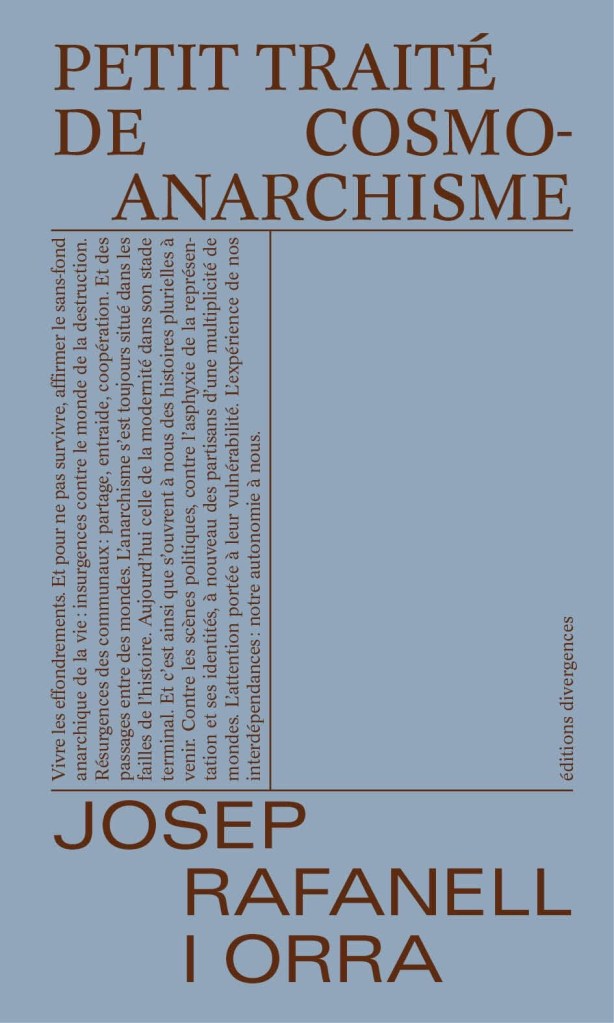
Anyone somewhat familiar with the writing of Josep Rafanell i Orra knows that we are in the company of a wanderer and itinerant in an infinite pursuit of what the experiences of worlds might offer [1]. A mad endeavor for a groundless epoch oriented towards planetary reduction and confinement, so obsessed with infrastructure and security, most recently through the reiteration of the politico-theological program of national sovereignty, one more desperate reaction to unrestrained planetary decline. We can say with Hölderlin that we are vagabonds in a destitute time, a poet who figures prominently at the entrance of Josep’s Traité. In our posthistorical epoch we are confronted with the thicket over the dominion of life, which means that the question of exteriority becomes pressing as existence enacts a path beyond the endless rubble of representation bestowed upon the human species in every point of the globe.

The book that the Spanish reader now holds in his hands thanks to Luciole Ediciones will immediately let in a dimming light of a singular style or maniera that dislocates the modernist assumptions of political thought into what one could what I am willing to name an analytics of sensible hybridizations between languages and thought. This analytic of the sensible refuses immediately Social normativity as well as the melancholic hangovers of the modern revolutionary tradition (always caught up between constituent and constituted power, representation and humanism, growth and production). This is why Josep will redefine communism as the nonprogramatic event that irrupts through hybridization of surrounds and regions capable of overcoming the ontotheological adequation of subject and object that has led an entire civilization astray (33). The project of the critique of metaphysics finds in Josep’s Traité a powerful schematic cartography that raises questions precisely in those spaces where the rationality of the science of political economy has never dared to enter. 

If the critical projects of High Modernity were fundamentally temporal (including that of Messianism and its overemphasized trance towards absolute immanentization), Josep’s writing also has the virtue of displacing the focus to the spatial formation and the thinking of the creation of spaces understood as dwelling, once populated by the gods of the events and which modern ontotheology obliterated through integrated objectivation and technological positionality. We know that the greatest nearness of the last god eventuates only when the event is elevated into refusal, especially when it manages to become too near [2]. As a shorthand, this drift towards objectification in the liquidation of modern politics is domination of the Social totality; ultimately, it is through the plasticity of the social bond that the reproduction of biopolitical life is temporalized, legally ordered, and rhetorically subsumused into an apparatus of predatory accumulation. It is the Social (not the State, or this or that concept of the modern grammar of political thought, or even fascism) that we must refuse. The collapse of the modern secular state and its moral guarantees, is the beginning of an autonomized social bond that now coincides with the total administration of world forms. The hegemony of the Social reduction is what allows Josep to claim that the opposition is no longer between Society and the State; but rather between community as a process and praxis against the static formation of the Social. Thinking today drifts from social domination to communities of encounters, heteronomic relations, communication, and interdependence in a web that characterizes the exotic movement of the imaginative possibilities of exteriority for manifold worlds. 

The notion of community in Josep’s thinking is neither about ecstatic groups or “little platoons” of identitarian belonging (as once famously defined by Edmund Burke); nor referring to filiation and propriety reductions that can subsist quite nicely under the heatwaves of the ongoing conflagrations of Empire. For Josep communities insofar as they are exposed to their excess (ubermass) are processes of external contact between souls as rites of passages. The community is formless, and in this sense it ceases to be a problem of Chistological stereology in order to become one in the order of ethics and language (50). In this sense, very much like the late Mario Tronti looking at the collapse of the modern revolutionary experiment; for Josep the ruinous fragmentation of the worlds has a silver lining: that all human, and non-human, souls are dwelling on the outside world calling for worldiness, and thus potentially sharing a sense of intimacy that re-enchants the appearance and knowability of the world through the invisible attunement to the outside (un nuovo modo di essere fuori e contro) [3]. 

Beyond the subject and the narcissism of the Ego, the light of a “spark of the soul”, in the words of Meister Eckhart’s memorable sermon, a new animism returns not because there is a transcendental revelation to be asserted, but because the encounter between souls brings forth the concatenation of worlds that are entangled with other worlds (68). If Jünger described the epoch of planetary machination as “soul murder” (seleenmord) it was because there was no longer any contact with the unfathomable opacity between the soul and any possible worlds [4]. Josep with an elegant mannerist style enhances this intuition: “We are no longer exiles on Earth, as the romantic moment freighted by the loss of world. We ended up forcing the Earth into exile after so many deadly abstractions (108). The modern age has not ceased accumulating abstractions against the human species until becoming a whirlwind of soul murdering that has extended into the current ecocide of the worlds.

It does not come as a surprise that throughout Petit traité de cosmoanarchisme (2023) Josep appears more than skeptical about political critique (and to say skeptical might be an understanding). There is a clear imperative that is mobilized in the book and that it should not be taken for granted: political critique should evolve into the negation and abandonment of politics, which also includes the always anachronistic anarchist politics. We know that ever since the Greek polis the autonomy of politics partition and distribution was waged against the incommensurable topos of the chora, the ungovernable and infrapolitical hinterland of the new substantive community of rights and obligations posited by the logistics of representation [5]. As we know, this is what forced Heraclitus to resolutely remain playing knucklebones in the temple of Artemis: “What are you gaping at, you scoundrels? Or is it not better to do this than to work with you on behalf of the polis?” [6]. The knucklebones of the ancient anecdote of the presocratic philosopher is symbolic to what Josep demands of existence: the liberation of environments and surrounds for multiplicities of experiences. The experience of gaming always starts in the middle, expressing the ineffable ethics of how I become what I am already on my way of becoming (142). The maximization of politics into the very thicket of life (this is biopolitical administration) have increasingly defaced the experiential practice of existence that now extends over the course of the historical dispensation of civilization. This is the vortex of the struggle against the realist validations in the interregnum. 

Against and beyond the force of abstraction and the prison of individuality, Josep situates the stakes: “It is there, where the fierce struggle we can lead today: to find the intimacy of our soul in the welcome of other souls to hear their silences and their voices. To participate in the animation of the world is to perceive the outside. And gently find the inside of the outside” (145). And between the process of the community and the soul there is no longer struggle or enmity, but only solvent philia; the influx of creation that, insofar was enmeshed in solitude, allows pain to speak in the time of transition, in the skirmishes between worlds. Ultimately, the experience of the itinerant is not that of learning to live in places; rather, it is the one that intensively yearns the presence of encounters. This remains the only ethopoetic imperative [7]. As Carlo Diano observed in an erudite study on the notion of the chora, the attunement of the soul with the world is not a conceptual entelechy; it runs materially through the sensorium of this body as it traverses the world towards its renewal [8]. To grasp this chiasmic region that dispenses the harmony of the soul as it flees the prison gates of an objective world, is the enduring letter and spirit that Petit traité grants to the ongoing task of thought. 

Notes

1. Gerardo Muñoz. “Escuchar las llamadas del mundo: diálogo con Josep Rafanell i Orra”, Disenso: Revista de Pensamiento Político, N.3, July 2020, 134-158. 

2. Martin Heidegger. Contributions to Philosophy (Indiana University Press, 2012), 329.

3. Mario Tronti writes in “Disperate speranze” (2019): “È necessario trovare un nuovo modo di essere fuori e contro. Io posso farlo nel solo modo in cui so farlo: tirando l’arco al punto che permette di cogliere il bersaglio più raggiungibile. Realistica visione.”. CRS, October 2019: https://centroriformastato.it/disperate-speranze/ 

4. Ernst Jünger. The Forest Passage (Telos Press, 2003), 93.

5. Julien Coupat. “Dialogo con i morti”, in Gianni Carchia’s Orfismo e tragedia (Quodlibet, 2019). 

6. Martin Heidegger. Heraclitus: The Inception of Occidental Thinking and Logic (Bloomsbury, 2018).

7. Josep Rafanell i Orra. Fragmenter le monde (Divergences, 2020), 70.

8. Carlo Diano. “Il problema della materia in Platone: la chora del Timeo”, Giornale Critico della Filosofia Italiana, V.1, 1970, 335.
Dialogue with Jacques Camatte (1935-2025)

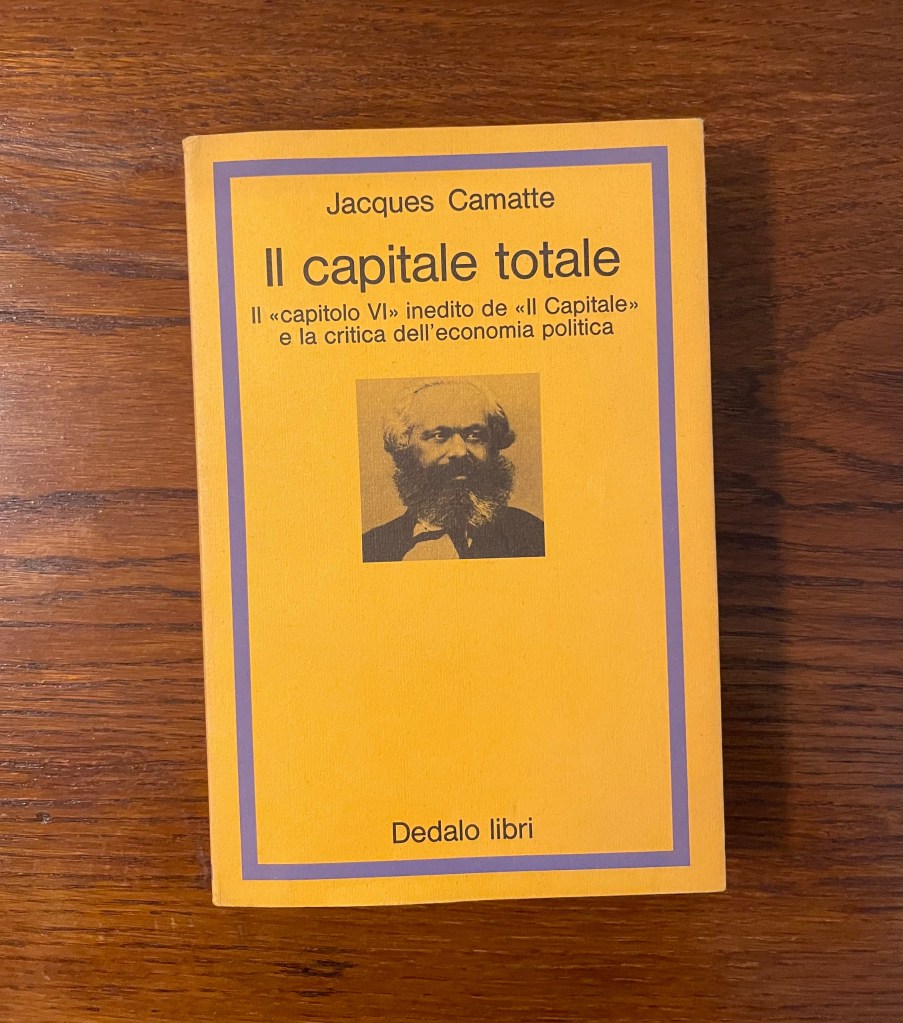
The passing of Jacques Camatte (1935-2025) a week ago from the writing of this text recalls a life that ostentatiously lingered in thought, and a thought that was entirely enmeshed and intertwined in the irreducibility of life. For some of us that had the good fortune to interact – however briefly and momentary, although every contact is always destinial and inescapable – Camatte transpired generosity and authenticity, and his voice evoked an almost Adanic happiness that has become rare among human beings. A common friend these days has recalled that somewhere in Camatte’s writing there is an endorsement of a capacious phrase from Chernyshevsky that could very well serve to remember his enduring ethical pursuit: ‘we have finally understood that the Earth is a place of life rather than judgement’. The opening the Earth as a dwelling place for life forms means that it is insufficient to conceive of domination as an organization of modes of production, since capital is first and foremost a spatial-temporal arrangement towards the future of the human species, and thus of a certain conquest of the world sensuous life. 

This was the outstanding triumph of real sumption: the modulated and ongoing alienation of the human community (Gemeinwesen) into a community of capital that has arrested time of life to the point of adjusting it to homogenized agony of historical time. Against the dynamic of revolution and counter-revolution that theologically exported the polarity of the eschaton and the ho katechon, already in the inception of 1970s Invariance Camatte called for an exteriority of any philosophy of history in order to rework of “a new relationship between human beings and nature”, and “breaking the lock that inhabits the creation of a new form of life”. The two citations in dialogue with each other come from “Against domestication” (1973) and the introduction to Urtext: frammento del testo originario di Critica dell’economia politica” (the 1977 Italian edition curated by Gianni Carchia), although these are variations from the depth of the emergence of the invariance of truth as a vantage point of the world. At the center is a form of life that renews the world that transitions beyond all forms of metaphysical logistics of appropriation, mere standing reserve, and the general arrangement for the mobilization of production. Any point of departure against domestication measures itself against the totality of this fluctuating dominion.

As it has been said of other great thinkers, Camatte’s ultimate passion was rooted in thinking one idea to the end and not of endorsing a system of concepts. For him it was the schism, that is, how to undo the historical process of domestication of a fictive community against the absorption of the increasing autonomization of fictive capital. The schism against the capitalist general equivalent also demands advancing a secondary schism against all humanism and its originary separation from nature. In schism, there is something of Gaunilo of Marmoutiers’ “thought of the word alone” that is receptive to the movement of the soul tries to account for the perceived voice. This precisely what Camatte carried as the lesson from Bordiga’s idiosyncratic original communist program: a movement against the historical benchmark of the development and political economy of growth, which will entail the exhaustion of the revolutionary horizon driven by an ideological political technification that tends to deepen the power towards the positionality of epochal nihilism expressed in the revitalization of strife and the ‘errancy of humanity’ (contrary to Martin Heidegger’s notion of errancy as a play between unconcealment and truth, for Camatte errancy is another name for the civilizational narrative that exemplifies the withering of the  human community into organized and protracted social reproduction and historical abstraction). Hence, as for Bordiga, Camatte conceived the ontology of communism as a world view (not as a political program oriented by concrete historical subject or distributive economic reproduction; not a soteriological dogma nor a transhistorical material idea); that is, broadly speaking, thinking the relationship between the human beings and the earth. A question more pressing than ever given the current planetary conflagration, which exposes the civilizational course that has lead to an inhospitable world where the survival of the human being has become the byproduct of an effective hostis of the community of capital integrated to the global surplus value accumulation.

In Camatte’s unrealized thought – but perhaps all forms of thinking are so – the bordigist gesture persists in locating the schism at the threshold of the force of real subsumption of the anthropomorphization of capital, where the notion of revolution itself is transfigured since, unlike Delacroix’s paradigmatic romantic painting, ‘liberty’ no longer guides the spirit of the “living”. Its redeeming voice also carries downwards unto the depth of the souls of the dead. Amadeo Bordiga himself in “Dialogato coi morti “(1956) writes that “The Revolution…it is always, in the course of an immense historical arc that will close as it opened and where it promised, where it has an appointment with many of the living, but certainly with the unborn, as with the dead: they knew that it never fails, never deceives”. True life can also take place with the nearness of that which seems remote (as Gustav Landauer once claimed: “For me, the dead also live”).

If both the collapse of the future and the increasing adaptation of social life has entered a gnostic dialectic of endless self-legitimation, it is paramount to capture not just the insurrectionary, but the resurrection flight in Camatte’s gesture that opens possibilities lodged in the dead as an emblem for the return to the world “full of joy and exuberant life”, as he wrote in an apostrophe in “Scatologie et résurrection” (1975): “I will draw from mother earth the vital and infinite power and I will resurface full of wisdom, joy and an exuberant life which will allow me to reach this human community…I will have left your world and been resurrected!” Does holding on to the unity of the Gemeinwesen require a theological undercurrent? Is not the passion for schism, and by the same token the stazion, the energy within the very dispensation withheld between mystery and revelation that has prompted the congenital forms of formal mediations and institutions for the political community? These are the questions that we are exposed to in the enduring task if we are to take seriously a continuous ‘dialogue with Camatte’, which carries the voices of the dead. Ultimately, any authentic conversation that dwells in thought does not have to invent anything new; we are depositories of an endless communication that is handed over, interrupted, and transmitted to anyone willing to hear and capable of being traversed by the shared word. 

In his last year of thinking, Camatte insisted on the notion of “inversion” in the wake of the civilizational phase of extinction, which would require deposing all forms of hostilities and bringing to an end the partisan positions invested in orienting technology and morality (nature) in their seditious defense of the real dominium over the passing of the world. For the current depressing (and depressed) times, writes Camattes in “Instauration du risque d’extinction” (2020), what could very well be a prelude to a return to the repressed allowing a return to the past to initiate an inversion that would allow liquidation of lall exhibition abandoning enmity. This is why, as he told me in an exchange that we undertook five years ago, “inversion cannot be a strategy, as it is totally outside of politics, which is the dynamic of organizing people, of controlling them”. A breakthrough, then, only as a mystical downwards leap into the past? Absolutely – but only insofar as the mystic is the ethical witness to his own openness to the word, and whose exodus from the social machination prepares a return to the world beyond the flattening and dominant language molded by rhetorical dishonesty or passive narcissism of the subjectivity.

This is why according to Carlo Michelstaedter to have courage in the world means to decide between two irreducible figures: the dishonest trickster, or the mystic in the desert. There are no third terms in between. And whereas the dishonest subject knows how to play the hand to his best outcome in each given moment; the mystic knows that his decisive moment is always commencing because the genesis of the human species has yet to take place. This beginning is always at the brink of an untimely auratic experience. And aura names the incommensurable distance from the rational containment of the world — unlike Teilhard de Chardin’s internal introspection in the noosphere that will bring the fullfilment of a spiritualized humanity upon Earth (realized in part by the unification of the sciences by cybernetics); in other words, an exodus from the temporal nominalism that inhabits another life attuned to its genesis: “devenu-devenant ce monde et sur cette vie autre au moment où s’effectue sa création”, he writes in “La séparation nécessaire et l’immense refus” (1979).

The visitation of Jacques Camatte in the world bears witness to that invisible freedom of the human species ready to jump and traverse the catastrophic trumpeting into the living and the dead, making possible the refractions of thinking as original texture of existence. From now on, the exodus from the immanence of this world will embrace a disempowered but perpetual dialogue with Camatte’s demure schism of the living. Indeed, we are always on the path to an earthly beginning. 

Gibbon on the university and erudition. by Gerardo Muñoz

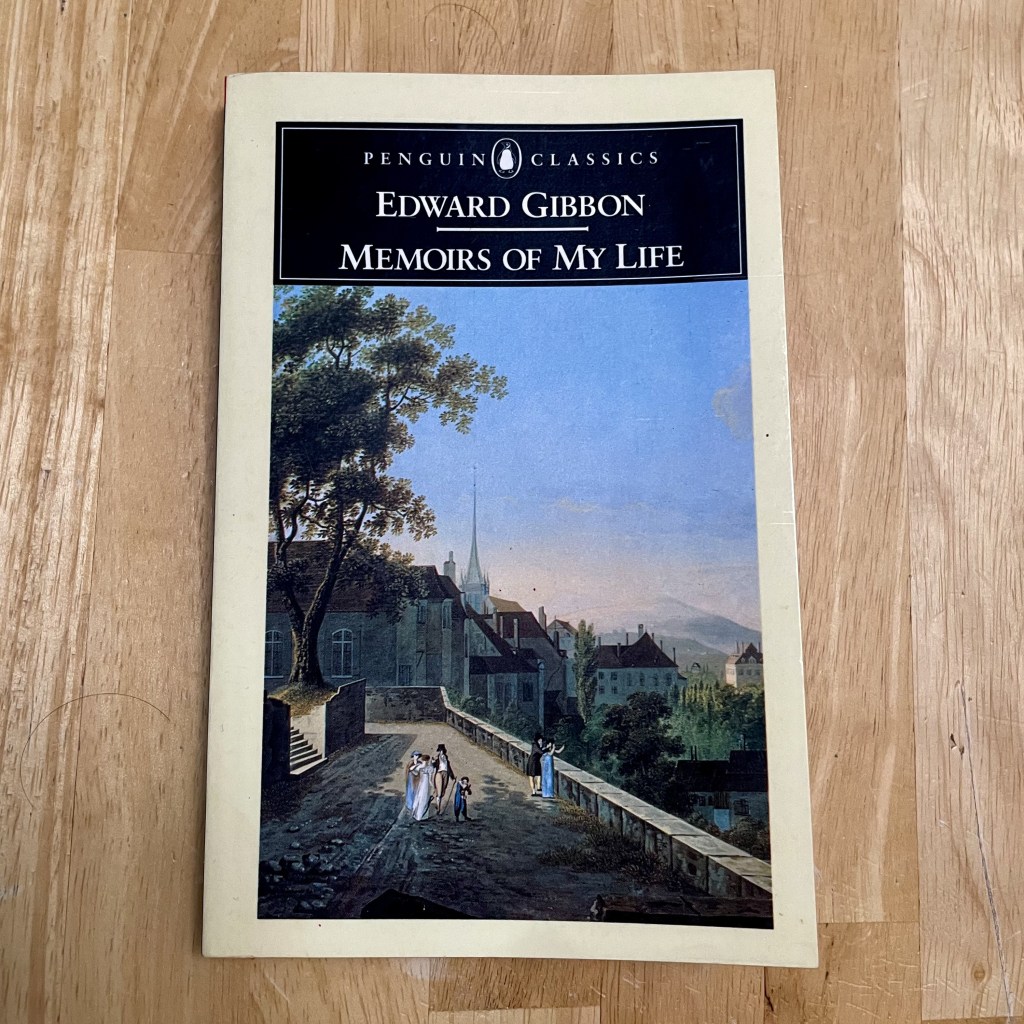
In his posthumous Memoirs from my life (1827), Edward Gibbon writes something quite striking about the modern English university in order to defend his alignment with the érudits. Now, to be an erudite was never something to be achieved at a university or academic discipline, it was something quite different in both style and form. Gibbon was quite crude when he writes:

“The schools of Oxford and Cambridge were founded in a dark age of false and barbarous science; and they are still tainted with the vice of their origin. Their primitive discipline was adapted to the education of priests and monks; and the government still remains in the hand of the clergy, an order of men whose manners are remote from the present world, and whose eyes are dazzled by the light of philosophy. The legal incorporation of these societies by the charters of popes and kings had given them a monopoly of public instruction; and the spirit of monopolists is narrow, lazy and oppressive. Their work is more costly and less productive than that of independent artists; and their new improvements so eagerly grasped by the competition of freedom are admitted with slow and sullen reluctance in those proud corporations, above the fear of a rival and below the confession of an error” [1]. 

It is worth noting that Gibbon’s defense of erudition – the same erudition that will make him undertake the genetic project of The Decline and Fall of the Roman Empire – is at least indirectly opposed to the reorganization of the university as infused by the ecclesiastical culture of priests and canon lawyers, which dominated the institution through the dogmas and platitudes legitimized by the currency of stable philosophical categories or doctrines. The university was always already an institution designed by the moral outsourcing of the intramural clerical rivalry among different levels of the administration and academic chairs. In a way, the future administrative clerk will be an impoverished version of the clerical denomination (homo homini clericus now realized through leading ‘cultural benchmarks’).

It is only at this point that Gibbon’s skeptical and ironic stance against “philosophes” – the secularized figure of the ecclesiastical priest – becomes quite clear, since the rational philosopher occupies the role of the judge in the internal institutional validity, conceptual arraignment, and liturgical enactment of the self-sufficient subject of knowledge. Gibbon reacted against this specific “Enlightenment” that harbored a universitas drenched in the undercurrents of barbarism against the ‘freedom to understand’. Or more precisely: freedom to land the sublime height of personal style. 

Under the sign of erudition, Gibbon understood tradition as a stylistic transmission that did not differ much from Hölderlin’s archeological suggestion in regards to antiquity; mainly, that formation only takes place when “we give ourselves our own direction determined by impure directions”; only this way truth-seeking can commence without prejudice and obscurantism [2]. In this light, the object of happiness must abandon the hubris of priestly academic knowledge in order to pursue the “love of study, a passion which derives fresh vigor from enjoyment, supplying research each day, each hour, with a perpetual source of independent and rational pleasure” [3]. It almost goes without saying that the fact that the contemporary university must justify every project, initiative, and prospect on behalf of current soteriological needs and values speaks to its organized alliance with barbarism against any possible form of personal erudition. But erudition, as something bestowed upon ourselves, will always persuade and humble men against the unreserved rhetorical force of the present.

Notes 

1. Edward Gibbon. Memoirs of my life (Penguin Books, 1990), 77.

2. Friedrich Hölderlin. “The standpoint from which we should consider Antiquity”, in Essays and Letters (Penguin Books, 2009),  442.

3. Edward Gibbon. Memoirs of my life (Penguin Books, 1990), 98.

Under a single statement: on Christopher Neve’s Immortal Thoughts: Late Style (2023). by Gerardo Muñoz

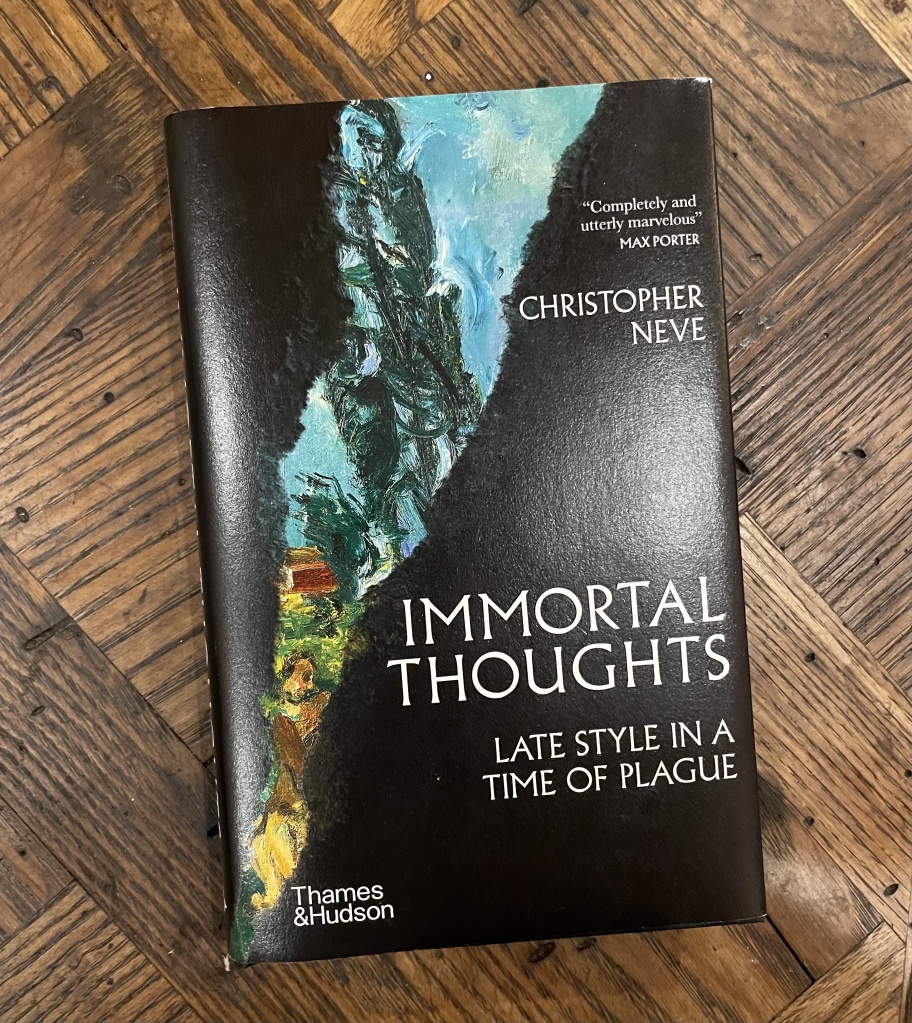
In his Immortal Thoughts: Late Style in a Time of Plague (Thames & Hudson, 2023), Christopher Neve ponders whether there is something like an “experience” of late style in painting. He immediately sets up himself to the task in the last works of great modern masters, from Cézanne to Soutine. The notion of “late style” can only be raised at the definitive end of the artist’s path. The old age style is an aspotilla no longer dependent on approval and excellence; it favors inner capacity and dexterity of seeing. This is why late style is, probably, always self-transformative: it poses the notion of work under erasure as it comes near the zenith of retraction. For Adorno late style registers the failure of synthesis as well as the force of dissociation in the permanence of the catastrophic. Neve will perhaps agree this much: painting is not about fixing temporality (the density of the history, the vulgarity of the contemporary, the monumentality of the past); rather what remains is the fugitive scene of depiction. If the question of “late style” is immensely difficult to raise, that is because it resists conceptualization: it merely seeks to denote achievement and the ruinous; appearance and retreat; unlearning schematics and producing “from life” itself, to put it with Poussin’s pictorial vocabulary. Late style is not about the moment of judgement and recapitulation – it is what depiction can achieve in the twilight of creative powers. As Goethe once defined old age: “Old age is gradual retreat from appearance”. But this retreat animates the space that had remained secluded in the order of temporal abstraction.

There is no theory (and there will never be) of late style of pictorial representation. It is a question that merits the weight of description – which Neve combines, quite successfully, with that of emblematic instances of the artists’ form of life. In other words, late style does not require conceptual renditions; it demands the elaboration of strong descriptions that can grasp the resonance of a fundamental ethos. Neve glosses Delacroix’s ethical imperative: ‘only in old age does a painter finally know what sort of artist he should have been all along’. In late style there is coming to conclusion because there is a path for homecoming. This ethical dimension of the artist is neither regulated by form nor by epistemological conditions. Late style implies a stripping away of things; it bares a specific nudity: it can reveal interiority (the invariant) without argumentative absorption. If anything else, it is the non-knowledge of the gesturing hand. Neve points calls this “statement” when offering a treatment of Rembrandt’s old age: “…technique and the process of getting older, and that this was somehow done all in one, summed up and expressed undeniable and in confidence of one blow and as a single statement. And I wished that all painting could be like this” (46). We suppose Neve’s desire as hyperbolic, since painting under a single statement also implies the moment when the picture approaches the abyss between the hand and the order of reality.

Painting gravitates towards a single statement when it surpasses life by taking death seriously. There is much truth in reminding that the work of art aspires to its bare lyrical moment of decline and unworking of itself – this was also Cézanne’s moment of “not being able to realize!”- in order to flee from the objective fixation of the “thisness of nature”. Painting assembles a transfigurative force against the temporal succession of the pro-duction of a specific work on a surface. As expressed by the old Pisarro from the window of his studio quoted by Neve: “A little more work before dying” (54). True, nothing else but painting mattered to Pisarro, as Neve reminds us. Now, does this mean that he is holding on to the unchanged and muted essence of things as a “metaphysical solace” in the face of the whirling of a world in chaos? Perhaps there is something to this suspicion that must be reckoned with – painting comes close to theological presuppositions insofar as creation unsettles a disenchanted world and its fictitious mimesis. Alas, this is a question not fully posed by Neve, but it is also one of the ways in which his book could travel without much effort. The question of immortality of a picture has a point of departure here. But is immortality conceivable as a form of solace and fallen piety? One should refuse to ask this question in the form of generality. The works Titian, Goya, Cézanne, the dreary and posthumous glory of Velázquez or the suffering Soutine during the Nazi occupation are all efforts to pose the problem of late style painting as the ethical attunement of each artist.

In the most elevated and charged moment of Neve’s efforts to grapple with the notion of style he recurs to Soutine (and it requires us to turn to the picture “Children playing at Champigny” from 1942): “What you are seeing, when Soutine paints the Auxerre trees, is what I think happens in the work of most of the artists I haven written about here. This storm of temperament is true painting, an inexplicable combination of seeing, feeling, memory, response, imagination, and profound oddness. And so he turns away in exhaustion” (122). Late style registers the collapse of a possible fulfillment with the world by indexing a detour to the point where realization seeks to “return to simplicity and order”. Truth indicates the literal thereness on the surface devoid of illusions. So, solace does not have the last word; this is not how a painting subsists under a single statement. And that accounts for the ultimate risk: the ethical presupposition of painting exposes the artist to the “terrible freedom” as the distance between the passions (temperament) and the gesture within profound disorder and arbitrariness of nature.


Someone like Carlo Levi will find himself at home: true freedom cannot begin by the suppression of the passions in the name of interests; rather, the burden of freedom is the caesura of passions that displaces the otherwise inexorable fear of civilizational progress. Painting as the event of truth dethrones fear as the primary attunement in reality. Through our emperament one finds the exit from alienation, gathering the moment of depiction into order. There is a gentleness of freedom in the mutual self-supporting carrying of things, as Kurt Badt saw in Cézanne’s old style. And this might be the tragic element of painting and its fundamental antinomy.

For Neve this means nothing shorter than “the world reduced to a series of prodigious impulses, the revelation of the inner intact, the change taken to see the universe in a new light at the risk of failing utterly” (130). Late style is what reveals inner intact to the fruition of exteriority – this is the compass of visibility. A failed world followed by decline – two terms where mythic transfiguration moves painting to the eccentric luminosity of altering the jarring relation with the world. Old style enacts a catastrophe that refuses the insolvency of pulsation that binds character to the harmony of form. One might add that it could very well be that painting is, as revealed in the abyssal caesura of a late style, a stated mystery: a passionate life that profoundly perturbs the world, a transcendence that falls into an irrevocable eternity.

Clandestine life in the open. by Gerardo Muñoz

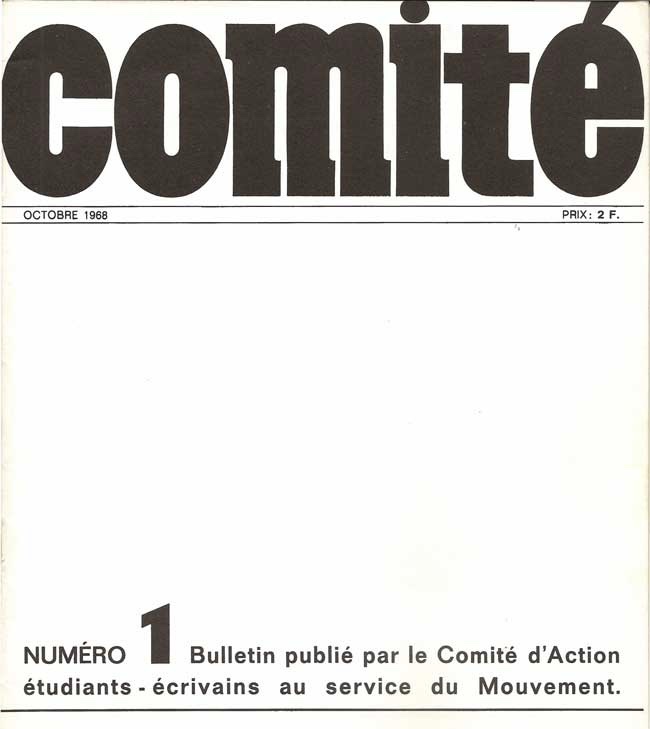
In the very last article that Maurice Blanchot wrote for the collective publication Comité in the wake of May 68, he draws a scenario that is still very much with us in the present. The “realism” is almost outstanding when Blanchot writes the following: “…from now on I will hold onto an exigency: to become fully conscious that we at the end of history, so that most of our inherited notions, beginning with the from the revolutionary tradition, must be reexamined and, as such, refuted. Let us put everything into question, including your own certainties and verbal hopes. The revolution is behind us: it is already an object of consumption, and occasionally, of enjoyment.” [1]. There was no question that the crisis of the very foundation of modern political thought has collapsed, including, as it couldn’t be otherwise, the generative principle of revolution. Blanchot did not even attempt to convince himself that the revolution could be brought back in an astronomical sense to revitalize a naturalism previous to Rousseau’s social contract.

So, for Blanchot the revolution was over, and yet, whatever it was that followed had no name. What was left, then? In order to avoid paralysis, Blanchot toyed during those months at the Comité (September-December 1968) with two possible maneuvers. The first position resided in what he called the “movement of possible speech” in order to establish an ardent and rigorous relation between the sequence of the French May and the Czech May, Soviet domination and Gaullian State. Blanchot called for (in the spirit of Bataille) a “transgressive speech”: “the impetus of outrageous, ways speaking beyond, spilling over, and thus threatening everything that contains and has limits” [2]. But we know that transgression is still within the logistics of the administration of order and temporal containment of the regulated exception. This was, in fact, the very rupture of the revolutionary break that was in crisis.

But Blanchot was up to something along with his friend Dionys Mascolo in thinking through language and communication as a path towards the outside. Hence the second option, which is really a third option (after the sleepwalking of ideological revolutionary ‘racketing’ of voluntarism); mainly, what he calls, although does not get to tease it out, the “clandestine resistance in the open”. Blanchot only tells us what he is thinking about through a recent example: some members of the Czech resistance when law was suspended had to confront the raw enemy military power, but they also experienced a freedom “through words and through writing than ever before”, tells us Blanchot. But this still does not explain much, given that if there is a naked military power threatening us, how could something like a clandestine form of life take place in the open? And at what risk?

I think one way to read this incorrectly or insufficiently would be to think of Blanchot’s suggestions as a sort of martyrdom or self-immolation. But it is no less true that Blanchot wanted to avoid a sort of Batallian “inner experience” or monastic xeniteia. Thus, he “refused” the fiction of self-clandestine life as sponsored by the Situationists; while, at the same time, also rejecting subjective revolutionary militancy. A third way emerges: the clandestine life into presence by way of friendship. A new “estilo de vida”, which I think could be read in the way that cryptojews and averroists lived in early Modern Spain: “a modo de sociedades secretas o semi-clandestinas, deben haber concebido la filosofía como un estilo de vida para sus iniciados…” [3]. Unlike the bogus image of the secret society as an alienated community of knuckleheads, I think what emerges in the clandestine open region is a form of shared friendship that does not retreat from the world, but rather that is capable of living in it. This was most definitely the transformative practice that during these years, Dionys Mascolo, dared to call the communism of thought that for him belonged to Hölderlin rather than to Marx. If open conspiracy is an act of the sharing and participating in language without meaning or command dependence, then this is already a poetic practice. After all, for Hölderlin the poets reveal an originary loss from nature. It is no surprise that Hölderlin favors a world opening even after the destruction of the leader-figure of the poet (Empedocles).

So, there is only clandestine life in the open when the sharing of language among friends take place (an event). This use of language is always harboring on the threshold of the last word to come. In short, the clandestine form of life has nothing oblique with respect to the world – it is not necessarily the space of an infinite night of contemplation, and it is also indifferent about fugitivity – it demands a return to appearance by way of experience. This might explain what Gilles Deleuze tells Dionys Mascolo at the end of their correspondence about friendship and thought: “it is a question of what we call and experience as philosophy” [4]. This form of experiential thought against the dissatisfaction of political domestication points a way out. For Blanchot this was a “fragmentary, lengthy, and instantaneous” path; a conspiratio unlocked by philia.

.

.

Notes

1. Maurice Blanchot. “On the Movement”, in Political Writings 1953-1993 (Fordham University Press, 2010), 106.

2. Maurice Blanchot. “Clandestine resistance in the open”, in Political Writings 1953-1993 (Fordham University Press, 2010), 106.

3. Francisco Márquez Villanueva. “El caso del averroísmo popular español”, in Cinco Siglos de La Celestina: aportaciones interpretativas (1997), 121-134.

4. Gilles Deleuze. “Correspondence with Dionys Mascolo”, in Two Regimes of Madness (Semiotexte, 2007), 332-338.

The politics of schism: theses on Dionys Mascolo’s La révolution par l’amitié (2022). by Gerardo Muñoz

1. Remembrance without restitution. The publication of Dionys Mascolo’s essays in La révolution par l’amitié (La fabrique, 2022) opens a path to a singular thinking that refused to conform to a master thinking, and even less what has come to us as political theory, or radical critique. Theory and critique have shown their resilient adaptiveness to university discourse. Thinking, on the contrary, moves annexes a relation with the missing word. This caesura negates the closure of both politics and community, it shows its insufficiency. In a letter to Maurice Blanchot regarding his ceased friend Robert Antelme, Mascolo comes to terms with this specific question: the remembrance of what loss in the actual word is – the voice of his friend Robert Antelme – what cannot be posited as a restitution of representation, but rather as effective effort to transcend mutism and silence that would have sunk writing into a pathos not short of a “miserabilist” stance [1]. The exigency of language is absolute. In an analogous way, we can say that the writing in La revolution par l’amité (La fabrique, 2022) is not a matter of restituting the history of Marxism, the intellectual debates of French theory, or even the burial site of a thinker that rejected repeatedly the metaphysical function of the public intellectual (a sort of captain at the steering wheel of public opinion, a cybernetician); but rather the remembrance that thinking is the irreductible site of common to the species. Remembrance has no “archive” and it does not produce anything; on the contrary, it invites a path to thinking in order to bring the absolutism of reality to an end.

2. The irreducibility of the species. For Mascolo – as for Nicola Chiaromonte – the stimmung of the modern age is not a lack of faith, but a bad faith subscribed by the subject of knowledge, a guardian of the nexus of legitimacy. In his practice of writing, Mascolo explored something like a countermovement to the rationality of the intellectual posture, in which communication ceases to be a common means in order to become a production of ends and instrumentality. Hence, what Mascolo called the “part irreductible” – and its “doubt in any system of organized ideas in sight” – is the only intuition of the unity of the species in communication. And if the intellectual is an organic unity of hegemony that replaces the function of the priest in the Church bureaucracy and its paideia (recall Antonio Gramsci’s “organic intellectual”), for Mascolo irreducibility in the sharing of thought in communication is “not political” as he states in Autour d’un effort de mémoire – Sur une lettre de Robert Antelme (1987). This step back from the production of modern politics thoroughly imagines another figure of communism. It is at this point where the whole Cold War polemics between humanism and anti-humanism is destituted internally: the species finds a way out of political domestication.

3. Communism of thought. We can understand why for Mascolo “the word communism really belongs more to Hölderlin than to Marx, as it designates all the possibilities of thought; that which escapes in thinking, and only that can constitute its work (oeuvre)” [2]. In other words, communism for Mascolo is not a matter of doctrine or an Idea, nor about philosophy of history and its inversion; it is not about a political subject or a unity of organization of political force; communism is a use of thought in language in proximity with what escapes in every communication. The inoperative communism, hence, is only possible in friendship, as a continuous experimentation of taste that cannot coincide with a community form. As Mascolo writes in his essay on Antelme: “We did not live in community. This is a deceptive word…we existed in a sentiment of mutual gift of freedom” (53). Any reinvention of a politics to come after the collapse of authority must commence with this rejection of a compensatory communitarian closure. Today only a conspiratio between friends can animate a new field of intensification for renewal.

4. Refusal and friendship. Even in his earliest stages of writing such as “Refus incoditionnel” (1959), the condition for friendship for Mascolo is to refuse the current state of things; to retreat from the demand of reality in order to survive in the imagination of the shared word. In this sense, the thematic of friendship does not make subjects of duty towards a social bond, but rather a secret in the word designated by separation. Friendship floats high above symbolic representation, as it moves to an inclination that is singulare tantum. If modern politics thought itself as a repression and administration of the hostis; for Mascolo the practice of friendship is the sacred space that is never inherited, but, precisely the dwelling of those who “seek” after in the wake of the homelessness of man and nature. This is analogous to Hölderlin’s allowance of thought which moves in passion while accounting for the abyss of our relationship with the world (aorgic) of originary detachment.

5. Revolution as style. In a brief text on the Cuban revolution of 1959, originally written for the collective exhibition Salón de Mayo in Havana, Mascolo says a new revolution in the island could potentially offer a the opportunity of a new style [3]. Of course, as soon as Fidel Castro supported the Soviet invasion of Czechoslovakia in 1968, it was clear that such promised crumbled, and that the Revolution will fall well within the paradigm of the metaphysics of historical project and the subject (“a new man”). But what is style? Once again, this speaks directly to Mascolo’s passion for the irreductible outside of the subject, and for this reason never alienated from the schism of the species. The notion of style relates fundamentally to our exposition to the outside, to the event of expropriation, which defines our fidelity to the invariant dimension of our character. A new style, therefore, is not something to be produced, an effect of the subject, but rather the unit of an ethical practice in our encounter with the outside. If the apparatus of the revolution was instituted as a the production of a civilization; the fidelity to a style names the modes of life that cannot be oriented towards a specific work. A new aberrant freedom emerges.

6. Saint-Just’s ethos. Mascolo never ceased to reflect on the ethical determination of politics, against politics, and for a transfigurative notion of a politics for the here and now. And he dwelled on this problem in his writings on the ethical figure of Saint-Just during the French Revolution (“Saint Just” and “Si la lecture de Saint-Just est possible”). Unlike the monumental historiographies – both left and right, revolutionary and conservative, historicist or revisionist – that situated the revolutionary under the sign of Terror and Revolution, of will power and the emergency of Jacobinism; for Mascolo Saint-Just stands a figure that keeps an important secret. And this is it: “the inhumanity of Saint Just is that unlike many men, he does not possess many lives but only one” (130). This is a concrete definition of a ethos that is irreducible to the “monstrous arts of government” in an epoch where the political had become the secularization of fate. In the same way that Hölderlin turned his gaze towards the impossible and concealed distance of the moderns in relation to truth of the Greeks, for Mascolo’s Saint-Just the legitimacy of the modern universalization (in the State, the Subject, the Social) does not have the last word. The ethos of life keeps the remembrance of an abyss of the monstrosity of historical universality and the social equality.

7. Borrowed existence. Dionys Mascolo lived at the dusk of the modern arch of the revolution, whether understood as eschatology or a conservation of the natural order of the species, as Saint-Just proposed against the Rousseaunian social contract and the Hobbesian mechanical Leviathan in exchange for authority. We have already crossed this threshold, and we are in the desert of the political, retreating on its shadow fallen into administration of fictive hegemonies. Hence, the question of an ethos of existence becomes even more pressing from Mascolo’s thematic of friendship in order to refuse what he calls in “Sur ma propre bêtise et celle de quelues autres”, a “borrowed existence in a comedy that feels as if we are being watch by God alone” (219). Indeed, as some have diagnosed with precision, the religion of our time is absolute immanence, the full disposition of the tooling of our means [4]. A cybernetic dreamworld, whose pathetic figure is the “influencer” (a few strata beneath the luminosity of the intellectual). This can only fix us into the stupidity of intelligence of the species: specialized intelligence, in other words, prisoners in the sea of nihilism. The intelligence of the species, on the contrary, is the cunning (methis) of the fox: a way out in spite of the swelling tides. But against the nihilism of a borrowed life of immanence (beatitude of the impersonal, and iconicity of things), Mascolo’s thought insists stubbornly in friendship as the initiation in an uncharted path to reenter the world once again.

.

.

Notes 

1. Dionys Mascolo. Autour d’un effort de mémoire: Sur une lettre de Robert Antelme (Maurice Nadeau, 1987). 

2. Ibid., 50.

3. Dionys Mascolo. “Cuba premier territoire libre du socialisme”, in A la recherche d’un communisme de pensée (fourbis, 1993).

4. Lundi Matin. “Éléments de descivilisation. Partie 4”, Lundi Matin, 2019: https://lundi.am/Elements-de-decivilisation-Partie-4

An epoch unmoved (V). by Gerardo Muñoz

The intrusion of appearance in the world posits the question of the unlived in every life. This taking place that appears in the world descends temporal finitude; and, more fundamentally, it posits the caducity of its unlived possibilities. In a recent book on the history of citrus in Italy, the author says in passing that blood oranges, being from the lowlands near the Etna, mixes a variation of flavors that ultimately make this particular orange expire sooner than others of its kind. Heterogeneity is a marker of caducity. The shimmering crust of this orange reveals that something like the mystery of what has not happened yet (and perhaps never will) comes to us in the sensorium, in the open of the ambient, and in the time of decay: “It gave us pause for thought. How long does it take for a lemon to completely rot?” [1]. This sense of the unlived in life was thematized by Hölderlin in his late drama The Death of Empedocles, a figure intimate to the Etna volcanic topoi“In holy union each beloved clings to love, a love One thought was dead…To they are this! The ones we so long did without, the living; The goodly gods, declining with the star of life! Farewell!” [2]. We have yet to develop a theory of the encounter that opens the epoch. But the solicitation for an experience entails the seeking of an outside to reality, in which the unlived facilitates nearness to an escape route. As we know, Hölderlin thought of the fissure of unity as excess between outside and reality, in which the relation between object and subject, thinking and action, imagination and things come to a tragic diremption.  

In this light, the actualization of the unlived is the vortex against the immobility of the epoch in which life is rendered actual in its becoming. But this requires specification; or at least a certain amendment of the pure aorgic immanence. We know that centuries before Hölderlin, Angelus Silesius provided a point of entry: “The Sun gives movement unto all, and makes the stars dance in the sky: if I still stand immovable, no part in the great whole have I” [3]. The mystical kenosis is ground cero to attunement of life. However, Silesius also seems to be suggesting that even under the dress of nature, movement is the condition for any instantiation with the abode. If glimpsed from the interior of the site of the natural world, pure immanence appears as the interrupted image without partition; but if described from the exteriority of the unlived, then world and life now meet in a kinetic extraneous divergence. 

But what is the limit of an intensity? There are two ways of coming to terms with this problem: every process of intensification reaches its caducity whenever its violence is overcome by the seduction of possession in submitting to the absolutism of reality. On the other hand, every intensity is perturbed when it finds an obstruction in the formal orientation of the concept. Therefore, when the co-existence between the exogenic and ecstatic limits meet, the free playing of forms becomes flow (plynein).  In other words, we cease to become immobile to deviate from the obstruction of the suspended wreck of every encounter.

Untimely, this invites that we reconsider the status of happiness. As a contemporary philosopher that I admire has insinuated it: perhaps happiness is the unthought notion in our tradition. In a certain way, the unthought and the unlived depart from the caesura of their own evasion. There is perhaps no need to reconstruct how “happiness” has been subordinated to designs proper to politics or commerce; or, as in the more classical tradition, the moral virtue for self-regulation and privation. Everything changes if we locate happiness in the site of the unlived, insofar as now the violence that is constituted of the separation between form and event in the texture of life. The immediacy of happiness is not being able to conquer something like a state of “blessed life” but being able to release the unlived in every succession of deaths that traverse a life [4]. 

But the unlived exits not only to de-constitute the vital determination, but also, and more fundamentally, to escape the seduction of the negative that assumes that loss and tragicity are irreparable limits. Rather, because there is something like an unlived there is happiness in the way that we constantly move within the available set of unlimited possibilities. The unlived initiates a physics that cuts absolute immanence in virtue of the genesis of style, since it is only in style where the overcoming of the unlived shelters the soul in the face of caducity. Indeed, it is in this invisible texture where the color of our mobility approaches asymptotic twirl between divinity and the world.

.

.

Notes

1. Ciaran Carson. Still Life. Winston: Wake Forest University Press, 2020. 16.

2. Friedrich Hölderlin. The Death of Empedocles. Trad. Farrell Krell. Albany: SUNY, 2008. 93.

3. Angelus Silesius. El peregrino querúbico. Madrid: Ediciones Siruela, 2005. 

4. Pacôme Thiellement. “Le Bonheur est un twist”, 25 june 2017: www.pacomethiellement.com/corpus_texte.php?id=326 : “l y a deux lumières: il y a la lumière d’avant la nuit et il y a la lumière d’après. Il y a celle qui était là au début, l’aube radieuse du jour d’avant, et puis il y a celle qui a lutté contre les ténèbres, la lumière qui naît de cette lutte : l’aube scintillante du jour d’après. Il n’y a pas seulement deux lumières, il y a aussi deux joies : il y a la joie d’avant la peine et il y a celle d’après. La joie originelle, la joie innocente, primitive, cette joie est sublime, mais c’est juste un cadeau de la vie, du ciel, du soleil… La joie qui vient après la peine, c’est le cadeau que tu te fais à toi-même : c’est la façon dont tu transformes ta peine en joie, l’innocence que tu réussis à faire renaître des jours d’amertume et des nuits de bile noire. C’est le moment où tu commences à vivre, mais vivre vraiment, parce que tu commences à renaître de toutes tes morts successives. C’est le moment où tu t’approches de la divinité ou du monde”.

Three ideas for a discussion on «Éléments de décivilisation» by Gerardo Muñoz.

[These are some preliminary notes for an ongoing discussion on Lundi Matin’sÉléments de décivilisation’’, a text that condenses a series of problems dealing with, although by no means, limited to infrapolitical reflection, the event, world, and the question of civilization in the wake of the ruin of hegemonic principles. This particular essay, more than content, raises the question of the status of the style of thought; and, in broad terms, I tend to link the notion of style to the constitution of an ethos. But let me offer three theses to open the discussion in very broad terms. What follows is the reconstruction of three brief points in a recent group meeting about this text.] 

i. The priority of the event. For me at least it is very important to consider that Éléments de décivilisation’’ moves away from at least two important precedents of a common intellectual orbit: messianism and the political theory of modern sovereignty. Of course, this is important for many reasons, but most it speaks to what I would call a strong opposition between thought and philosophy (favoring the first over the second). These two registers open important distinctions, such as, for instance, a displacement between historical temporality (messianism) to a notion of the taking place (the event or encounter) as exteriority. Whereas we were told that the “event is the enemy within Empire” (Gloss in Thesis 60 of Introduction à la guerre civile) , now we have a more through sketch about the way in which the form-of-life is not a category reducible to vitalism or the problem of the subject, but rather about the play between form and event. Here I think that Carlo Diano’s Forma ed evento (1952) is crucial as a backdrop that is not just philosophically (Aristotelian formalization against Stoic predication), but rather a sound position of thinking in relation to what has been passed down as “civilization”. 

ii. Civilization as a principle. Now, the question of civilization raises to a problem of thought insofar as is neither an ontological problem nor an operative idea in the history of intellectual concepts. Civilization becomes the apparatus by which the total regimen of production in any given epoch is structured to establish an order. And here order is both authority and police. To put it in juridical terms: the first secures legitimacy while the second posits the flexible energy of legality and execution. This is the same problem in the relation to the world. In other words, civilization means enclosing, domesticating, and producing. By the same token, civilization is the operative domain by which nomōs, history and the subject come together in virtue of their separation. Is not this the very issue in the Greek polis in the wake of the discovery of measurement, isonomy, and the distribution of the goods in which hegemony replaces the basileus (Vernant)? It is one of the merits of the text not having understood this problem at the level of an “archeology of Western political thought” (Agamben), but rather as an evolving transhistorical process that binds the axis of domination and power to the axis of anthropology and domestication. Civilization, then, would name the total apparatus of hegemony under which politics falls as a problem of metaphysical structure (I have tried this problem in recent positions here). Whether there is an assumed anthropological anarchy at the level of substance, capable of “inversion” (Camatte), is something that must be explored in further detail. 

iii. Happiness cuts absolute immanence. My last point. I would like to insist on something that Rodrigo Karmy mentioned recently: “Happiness is the unthought of the Weestern tradition”. I agree with Karmy not on the basis that there has not been any reflection of “happiness” in the tradition, but rather that this reflection has either been a) subordinated to politics or economics (Jeffersonian “happiness” conditioned by commerce); or, as a moral virtue of self-regulation and privation. But it seems to me that “Elements” wants to offer something else in a very novel way. It is here where the question of violence must be inscribed. A curious displacement since violence has been thought in relation to beauty, but not happiness. The violence at the level of forms puts us in proximity with the event at the end of life itself. In this sense, the Pacôme Thiellement footnote is important:

“l y a deux lumières: il y a la lumière d’avant la nuit et il y a la lumière d’après. Il y a celle qui était là au début, l’aube radieuse du jour d’avant, et puis il y a celle qui a lutté contre les ténèbres, la lumière qui naît de cette lutte : l’aube scintillante du jour d’après. Il n’y a pas seulement deux lumières, il y a aussi deux joies : il y a la joie d’avant la peine et il y a celle d’après. La joie originelle, la joie innocente, primitive, cette joie est sublime, mais c’est juste un cadeau de la vie, du ciel, du soleil… La joie qui vient après la peine, c’est le cadeau que tu te fais à toi-même : c’est la façon dont tu transformes ta peine en joie, l’innocence que tu réussis à faire renaître des jours d’amertume et des nuits de bile noire. C’est le moment où tu commences à vivre, mais vivre vraiment, parce que tu commences à renaître de toutes tes morts successives. C’est le moment où tu t’approches de la divinité ou du monde”. This position  – which I think it is prevalent throughout the text – allows the opening of a series of articulations:

a) it is no longer happiness an effect on the subject, which has only grown in the Spectacle or consumption; that is happiness as an exception to life.

b) it is not that happiness is a theological state of ‘blessed life’, which would presuppose the transmutation of sin and thus overcoming of the non-subject. This position depends on conditions of mythic-history and theology.

c) It is rather that happiness is the way in which the singular gathers his possibilities in use without enclosing the other possibles. To live a life among the fragmentation of the use of our disposed potentialities is a way to violently cut the seduction of absolute immanence in which style is diluted. Play could name the variations of use. But there is a second order risk in what constitutes “play”: a transfiguration of politic as civil war. The problem becomes how to think of ‘play’ (i. messianic abandonment, ii. political intensification – insurrection, or the separation between rhythm and voice, a poesis). I am interested in pushing for the third figure of play; a third figure in which the event and happiness impose a new division of souls, moving away from the separation from life. 

An epoch unmoved (IV). by Gerardo Muñoz

When I cut through things it means that I encounter a relief in the world. Now, a relief is something that takes us by surprise, although it is not hidden, as it is always there in the open. It is pure exteriority. Picture the cross-bedding tabular-planar layers on a bedding plane of a mountain. Thus, a relief is not a void nor is something that one accomplishes. On the contrary, it appears, and it transforms the world into a fragmentation of things. I would not be able to visualize a relief without first having an encounter. Hence the relief is a world that is freed from cartography: in this sense, it is a sub-world or ultra-world in its appearance. The relief takes place at ground level, but it is not grounded; it an event of the surface, but its ultimate determination is the sky or the landscape. I think that here the maximum distance with the metropolis becomes clear.

What is a metropolis at the end of the day? A possible definition: it is a total surface without reliefs. The prohibition of reliefs (an old monothetic superstition) confirms the aura of the epoch without movement. When all we have are extended surfaces, then anyone could be at anyplace any given time. The encounter with an irreducible thing is fulfilled by the relation with any object. An object that is really not an object but an icon. The consequence of this transformation of experiencing the world is immense; it entails nothing more than the destruction of the time of life compensated with relations with the surface.

How does a relief come to being? How does it appear in the open? Thinking about this in the past couple of days, it occurred to me that a moment in Pindar’s “Isthmian 4” ode offered an image of relief; an imagen that I have not been able to escape from since I first read it a few years ago. Pindar says:

“during the struggle, but in cunning (mētis) he is a fox

whirling onto its back (anapitanmena) to check the eagle’s swoop.

One must do everything to weaken the enemy” (Nem. 4.45-48).

The fox becomes a relief on the surface, and in doing so, it produces an exit from enmity. Unlike the wolf, the fox does not run away from the territory; it finds the “escape route” within the apparent. The term anapitanmena means ‘stretching” across the surface. Its character as kerdō (“the wily one”) guarantees its cunning movement from within its body. Indeed, according to Detienne & Vernant in their Cunning intelligence in Greek Culture and Society (1978), the “escape” – which Pindar’s Greek used “olisthanein” – stages the image of the wrester’s oiled body coming unloose from the opponent’s grip. The fox’s “via du uscita” takes place as relief that unstraps the reduction of a surface. Similarly, in Oppian’s Treatise on hunting (211), the fox’s wily character (dōlos) dwells in the threshold between dead and alive, becoming even “more alive than the living” (Detienne & Vernant, 35). However, it is not just a wrestling metaphor of physical force, as Detienne and Vernant beautifully explain, the fox’s intelligence occurs thanks to the flexibility that dissolves the inside and the outside:

“Thanks to its energy and flexibility (hugrotēta) it is able to change its body (metaballein tò sōma) and turn it inside out (strephein) so that the interior becomes the exterior: the hook falls out. Aelian provides full confirmation on the subject of this maneuver: ‘it unfolds its internal organs and turns them inside out, divesting itself of its body as if it were a shirt…The fox, being the embodiment of cunning can only behave as befits the nature of an intelligence full of wiles. If it turns back on itself it is because it is, itself, as it were, mētis, the power of reversal” (Detienne & Vernant, 37).

Not in the body but in the shirt, that is, in the garment. The fox embodies the relief that externalizes the surface with the kinetic energy of the inappropriable. Whoever has encountered a fox knows this from experience. The fox blends with the landscape, but it does not become one with it. This minimal apparent distance is the creation of the relief. Only now, after some years in Pennsylvania, I am able to make sense of an encounter with a wild fox in the backyard. There was no confrontation or desperate seeking out, but a moment of detention that seemed to cut against everything else happening around it lending itself to the encounter. The fox always waits for you even before you are near the encounter. What is this lapsus-time within time? Here again, perhaps a poet can give us a hand. In a poem surprisingly called “Metropoli” (1958) by Vittorio Sereni, we encounter a modern fox, or rather a fox in a modern setting. It is a more familiar fox than Pindar’s wily creature, since we in no condition today to be able to understand the epic of Greek wrestling, or the practice of hunting, or the life of the polis. Sereni makes a more manageable sense of the figure possible. The important verses from the second stanza are:

« […] vecchia volpe

abbagliata di città, come muove al massacro:

la sua eleganza, qualità̀

prettamente animale tra le poche che l’uomo

può̀ prestare alle cose» (Sereni 2006, 190)

Like Pindar’s fox, this old fox is dazzled because it “moves” towards the apparent. This mode of violence – “a massacro”, for Sereni – is not necessarily depredatory. What follows is an explicit thematization of style: an elegance that has a quality that is scarce among humans. This elegance is not an abstract characterization of being a fox, but rather how the apparent, in the clothing, invests the animal in one life. But it seems to me that the enjambment for Sereni falls on the last verse: “può prestare alle cose”. “It lends to things” – in other words, it finds itself at home with the things he finds.

Again, like in Pindar, he becomes a relief among things, because now things are separated and not just “ordered”. The stylization of the fox in the modern voice of Sereni is the passage from the extreme physicality of the olisthanein to the “eleganza” granted by the dressing with the surface. There is no vanitas in this dressing-up; it is rather a contact of appearances that, in suspending the unlimited contours, it exposes the glitter of the relief. The relief turns out to be a garment.


*Imagen: The visit of a fox in the backyard, Bethlehem, Pennsylvania, 2018. From my personal archive.