In an entry of Dopo Nietzsche (1974), Giorgio Colli states that after the overcoming of all values and taboos, the contending moral strife finds its highest value in hypocrisy. Colli goes on to say that “hypocrisy is the last bastion where moral forces have found their refuge” [1]. One can clearly see that for Colli hypocrisy as the highest value is quite distinct from morality, since it is the “refuge” where the contending moralities invest themselves in rhetorical encroachment. That hypocrisy has become – as Colli saw with clarity in the 1970s – the last alcove of humanity, means, for one thing, that the human species have ceased to have any faith in the language that they use, and that for this very reason there is only an estimation of rhetoric, procedure and technical terms abstracted from the sensible world. If understood as such, it would come to no surprise that the majority of public institutions in advanced societies are embracing, and for the most part promoting, the incorporation of Artificial Languages and Intelligence to organize the interactions of their lives. Ultimately, the order here is clear: it is not that new technological advances will lead to a rise in untruthfulness; rather, these instrumental mutations are a consequence of the deep hypocrisy that runs through the social bond.
In fact, one can only assume that Colli was pointing at something more profound and obscure in his gloss when he referred to hypocrisy as the last refuge, and in this sense he was pointing beyond Nietzsche. After all, Nietzsche understood hypocrisy as mimesis and appearance that if incorporated over a long period of time ceases to be hypocrisy to become real [2]. A series of good acts and deeds in the spirit of friendship makes a person benevolent. In the same way that Miguel de Unamuno’s San Manuel Bueno Martir through his public faith and habits, was a symbol of Catholic faith for all the believers of his tightly knit community in spite of his interior doubts (this is the Knight of Faith). Now, Colli is pointing to a second degree hypocrisy that is no longer explicated by mimicry, but by its dependence to an ethereal value that governs and justifies any set of given actions. The actions are no longer in relation to faith or non-faith, but are properly acts of “bad faith”, since they make belief captive to the justification of the highest moral value. This will be consistent with Nicola Chiaromonte’s description that the end of secularization is not an epoch lacking faith, but one that dwells in “bad faith”.
And what is ultimately “bad faith”? It is the realm of hypocrisy that, due to its impossibility of communication, understands its mission waged on the petty negation of one value over another. It is a mutation of Goethe’s nemo contra deum nisi deus ipse into the sphere of prevailing forces. The civilizational stage of enlightened hypocrisy prepares the human being to renounce the use of language and unmediated appearance. This means that the triumph of the technoadministration of the world would not be possible without the alluring refuge of hypocrisy that conquers reality through the very means that renders inaccessible the real presence of the world. It is not that politics and politicians have become hypocritical; it is that politics can only subsist thanks to its refuge in hypocrisy. The hypocrite is the last figure that steers in unworldliness.
..
Notes
1. Giorgio Colli. Dopo Nietzsche (Adelphi Edizioni, 1974), 50.
2. Friedrich Nietzsche. Human, All Too Human (Cambridge U Press, 1996), 39-40.
The legend of modern political theology is well known, and it has received extensive research and documentation. Less so is the legend of the theology of the visible as it relates to the problem of liturgy. For some time now some of us have pondered on a curious historical coincidence: the fact that in 1922 Pavel Florenski and Carl Schmitt, two epigonal figures that confronted head on Western modernity with its theological substratum, wrote parallel texts with strong positions regarding the same problem. I am of course referring to “The liturgy as a synthesis of the arts” (1922), and Roman Catholicism and Political Form (1922). From the strictly philological point of view, even the genesis of these two programmatic texts have a parallel development that go back to 1918, as can be seen in Schmitt’s only theological text entitled “The visibility of the Church” and Florenski’s “The reverse perspective”.
Why would two distinct thinkers confront the theological-pictorial in this specific historical dispensation of Western secularization? And, why does liturgy in the early twentieth century become a central problem for thought well beyond the walls of the Church and its ministries? What are the relations and divergences between theologia and visibility in the wake of the rise of European nihilism? If we press on the year 1922, it begs to ask why the problem of the “synthesis of arts” – theology as nothing more than the visible and a mode of seeing, to put it in Florenski’s own words – becomes so medular in European thought; and, under what conditions this emerges, given that already since the time of Johannes Vermeer, as Gregor Weber and Daniel Arasse have studied, the theological was already a fundamental topological injunction of specular understanding. These are questions that we hope to elucidate by closely examining both texts side by side with the working hypothesis that the theos – not theology as a science of Church dogmatics, which has little interest in the wake of the death of the unitary God, heis theos – but rather as a topological or choratic expression of facticity, as well as mediation with the disclosure of the world.
Almost parallel to the developmental height of the autonomy of art, it seems that both Schmitt and Florenski sought to come to terms in their own ways with the lagging energy of a specific topos of the theological trace: liturgy. It is then our task while reading these texts to ask why did liturgy become the site of inscription necessary to render legible the mediation, and possible transfiguration, of the theological as a first order question for the West. If theologian Laurence Hemming in Worship as a Revelation: The Past Present and Future of Catholic Liturgy (2008) is correct in saying that our age sees everything in terms of manufacture and efficacy mimicking the notion of “sacred worship” in liturgy, it becomes necessary for us today to understand the theological assumptions, as well of the possibilities, of the theos and the mystery at the very granular level of desecularization.
We thus propose a minor pictorial-theological legend of 1922 between Florenski and Schmitt – that is also that of the proximity and separation between East and West, theology and the pictorial, the visible and the invisible, revelation and authority – that could shed light on some of these concerns that continue to nourish discussions that have yet to find its proper treatment and productive assessment.
*
*This short text is meant as a working hypothesis for a forthcoming reading / study on Florenski/Schmitt and the question of the pictorial and liturgy set to begin in November 2025.
One of the merits of Sandor Agócs’ The troubled origins of the Italian Catholic Labor Movement (1988) is located on the question of Thomism during the rise of a national industrialization and the new centrality of the worker. This is a question that informs the very genesis of modern political thought, so I want to zoom in to the specifics: in Agócs’ narrative, the reinvention of Thomism goes hand in hand with the ‘social question’; that is, not just as the substrate for state legitimacy, but also as a supplement in the very mediation between the state and social incorporation. After reading Agócs a question lingers: what to make of the success story of social Thomism in the long history of modernity, that includes episodes from the both the left and the right; from the Italian Catholic Social Movement to Corporate Francoism, from the Pinochet Constitution drafted by Jaime Guzman to the most recent articulations of an interpretative common good in the contemporary American postliberal constitutional and interpretative balancing? One easy way out of the explanation is to delegate the answer to the historical uses (and misuses, depending who is defending what) of Aquinas’ thought, but that hardly answers the question. A while ago, John Finnis made a claim that could point to an important destination:
“This grand metaphysical overview of reality, and of our knowledge (‘theoretical’ in the first two kinds of order, ‘practical’ in the second two) of it, has been as fundamental to the new classical natural law theory from its beginnings as it was to Aquinas. It enables us to identify as illegitimately reductionist almost all the streams of social-theoretical thought, including political and legal, that have emerged since early modernity. It helps in identifying the errors of those would-be followers of Aquinas who reject the new-classical natural law theory on the ground that it neglects or subordinates nature and metaphysics; the misunderstanding of Aquinas, and of the relation between practical and theoretical thought” [1].
For Finnis, although writing for legal theorists, Aquinas’ thought properly understood possesses a ‘metaphysical view of reality’, a sort of plasticity interlocking practical reason for action and morality that serves socio-theoretical ends. In other words, the thomistic plasticity for social legitimation can be connected to what Martin Heidegger held as ‘adequatio’ as a fixed point in the problem of Medieval representation of beings. And this means that thomism is always already a theory of legitimate ground for governing that reality. As Finnis suggests in different moments of his work, the lesson of Thomism is construed in its emphasis on the rule of law as the source for justice and fairness, and in this sense it was never alien to modern social contract. Karl Barth’s rhetorical question -“Why did Hegel not become for the Protestant world something similar to what Thomas Aquinas was for Roman Catholicism? – can now be understood in its most consequential light.
Now it makes sense that Agócs refers to early twentieth century Italian Catholic Neo-Thomism as a “counterrevolution”, although he does not denote that this would be a second instance of counterrevolution with social prospects that the post-French Revolution figures (De Maistre, Bonald, and Donoso) could not meet in their antimodern stance. And here the divide is sharpened: whereas the counterrevolution post-1789 had very limited and unstable sources in social facts, Neo-Thomism offered a theory of law that was consistent with modern class dynamics supported towards social cohesion and stabilization proper to the ideal of the community centered in urban centers. If one defining feature of political modernity is reversibility, it would then make sense that thomistic natural law could rise to the demands of any given historical time to offer a nexus informed by the onto-theological structure of adequatio and analogia entis, whose proper end is the stabilization of social pressure. The second order ideological uses of Thomism (left, right, revolutionary, moral conservative, traditionalist, pre-post Vatican councils) are contingent to its malleable adequation generated by its own claim to natural morality. Heidegger once pointed in this direction when he claimed that Aquinas’ philosophical horizon was fundamentally the inception of metaphysics over theology as faith (that is actio and efficiency unto subjection) [2]. If modernity is the realization of onto-theology, then it can only make sense that Thomism takes as many garments as necessary to prevent gazing towards the abyss, becoming a manifold phosphorescent theory of social morality.
.
.
Notes
1. John Finnis. “Aquinas and Natural Law Jurisprudence”, in Duke & George, Natural Law and Jurisprudence (Cambridge University Press, 2017), 32.
2. Jean Beaufret. Dialogue with Heidegger (Indiana University Press, 2006), 106.
In one of the glosses in Marginalia on theology, Erik Peterson provides a remarkable pictorial image of thought of death and resurrection through the activity of washing a bowl. Peterson writes: “When washing a dirty dish, our thoughts may turn to the dead, to the dead as a genus, as an inferior genus that perhaps unconsciously influences our actions, as angels and demons do in another way. This probably happens because the dead have something in common with dirty, unclean dishes. Imagine this cleanliness however you like: perhaps we can say that death as such is an act of purification. To think of death in this way, endowed among things – like a bowl – gleam just like the voice of god in the bush” [1]. It is a fragment where Peterson comes closest to the specific nature of painting: what is painting if not the transference of muteness to the gleaming of the visible that opens before our very eyes? And like the divine voice in the bush in Exodus, what does it take to grasp and see the divine between or behind a dirty bowl as it lays on our hands? If washing a dirty dish entails receiving the dead in our thought, the passive act of painting seems always to lay a claim about the mystery of presence outside language.
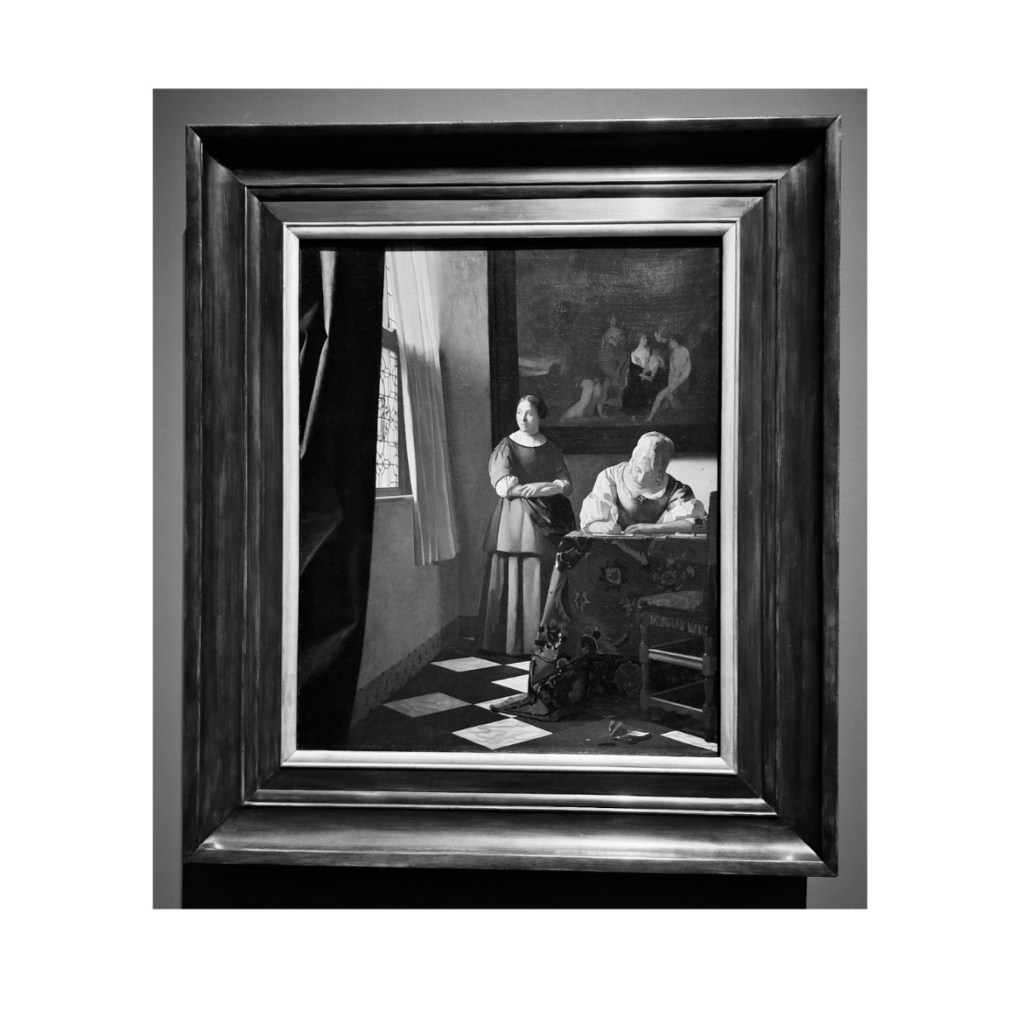
If I elevate Peterson’s remarks to a terrain that the one that he intended, is connected to two Vermeer’s pictures exhibited these days at the Frick Collection gathered around the theme of “letter writing”. In both pictures there is a lady seating at a table drafting a letter – one of them has already concluded it fully attentive to the visitor on her right side; the other a maid gazes at an open window – but what is always unnerving in Vermeer’s work is the sense of the ineffable and impenetrable in the disclosure of the picture (an exposure that that is usually aided by a side curtain that welcomes us in). What is this impenetrable divinity that lurks in Vermeer picture in pure presence? Although we do not have a name for it, it is like the god that dwells in the dirty bowls or in the nocturnal bushes of Peterson’s gloss.
The painting does not speak in revealing, it only bear witness of the absolute fall of language as it becomes imperturbable in the picture. Contesting the vulgar interpretations on Vermeer’s Catholic conversion in Delft, Daniel Arasse notes that the vortex of his pictorial theology is bounded to the threshold in which images become alive (in the tradition of au vif) outside itself: “Vermeer’s painting are constructed such a way as tho render this life equally present inaccessible, near and impenetrable. What is seen is not a crete of nature observed, but a mystery within the painting itself” [2]. In Vermeer’s pictures, presence and the invisible collapse not through the inception of a metaphor of nature, but rather through the painting’s light when it casts a shadow beyond any instance of closure.
This is why in Vermeer’s paintings surfaces mandate an order of theatrical presence, while simultaneously making room for a perturbance that is forever barred from the conceptual. Unlike Giorgione’s “Three Philosophers”, Vermeer’s pictures are not endowed by the mysterious force of an alienated nature that man can measure and master; rather, the mystery resides in the whispering of the invisible that cosigns the amoris causa of the appearance of painting. If for Peterson what gleams in the dirty bowl is the cleansing of resurrection; what befalls Vermeer’s pictures can only be understood as the faith in the painterly emergence of appearance dependent on the path opened by its light.
The question of god as appearance is always posited as a challenge to the meaning of reality as totality no longer as what emerges in the open, but as what which retracts lagging behind. And we know that only appearance is seductive enough to stand for faith well beyond the fact of being visible [3]. Hence, a way to supreme subtlety of painting (picturae summa subtilitas): no longer a matter of perspective and contour, but of the mysterious indiscernibility that mounts depth between vision and the divinity of presence.
.
.
Notes
1. Erik Peterson. “Fragmentos”, in Tratados Teológicos (Ediciones Cristiandad, 1966), 251-252.
2. Daniel Arasse. Vermeer: Faith in Painting (Princeton University Press, 1994), 75.
3. Consider Heidegger’s response to a question in the Zurich Seminar, 1951: “If I were yet to write a theology then the word ‘being’ would not be allowed to occur in it. Faith has no need of the thinking of being. If faith has recourse to it, it is already not faith. I believe that being can never be thought as the ground of God”. Séminare de Zurich (Paris, 1980), 60-61.
In a letter dated from January of 1962 to his friend Carlos M. Luis, José Lezama Lima makes a case for the intimate relation between language and charity: “What lasts [la cantidad] is only possible through faith. Because what lasts with faith is charity. Omnis credit – believe all things. Charity is belief in anticipation. And what is poetry (the image), but this superabundance of charity that always presupposes creation? [1]. The question in the last sentence – a question that could have only come from a great poet – is not all naive, since it is also a slight displacement from the canonical source underlying the notion of charity. In fact, the expression caritas omnia credit comes from Saint Augustine’s Confessions (Book X, Section 3), where the Church Father treats the reception of his testimony to the rational knowledge of the “hearing of men” who will be attending to his words [2].
This means that for parole to be heard and enunciated in its original presence, there has to be a gathering in charity that makes not just ‘true’, but most importantly, a garment of faith in the occurrence of language. This means that for Lezama Lima, there was no distinction between “theological language” and “language as such”, or “poetic register”, since they are all participants in the mystery of charity, because only charity can welcome language as abode. Poetics as such is understood as facticity of parole. But for Lezama, the word depends on having grasped the motion of charity.
Lezama’s test for Carlos M. Luis was quite high: if you lose your faith, you would have given up on language as creation. This was not a new problem for the poet who already in his essay “La dignidad de la poesía”, mentions caritas omnia credit, as a process of destruction of representational (merely transactional and duty driven language) communication that arrives at the order of charity through language as intangible and inexistent by virtue of transcending what does not exists, thus manifesting itself as possible [3]. This is the moment in which the charity of language appears as both presence and promise, and what Lezama calls “el resurgimiento del verbo” (the reemergence of the word). Poetics is thus neither the subject matter of poets, nor the master dogma of theologians; rather it is the faith in language that once enunciated it can only move towards a greater opacity of the shadow of mystery. This is why a great Christian theologian says that charity(agape) is partial knowledge of the divine, otherwise there will be only a detestable army of mere academics, scribes, and administrative experts [4].
In other words, charity does not belong exclusively to the Saints, but it runs through All Souls and its dead. The long history of the Church has betrayed the parole of charity, going as far as transforming it into a social mechanism of distributed goods that has become known as the subsidiarity principle. But for Lezama Lima, in an esoteric pauline tone, charity had nothing to do with political absorption and pastoral power; it was fundamentally a problem of language as a relation of reciprocity between beings in order to subsist as species, to paraphrase a well versed French priest on the matter [5].
In our days we see that “believing in language” has become in the public the inverse: non-belief through credit; that is only after possessing it (I do not need to believe in you insofar your credit validates who you are). It has been noted that by a kind of philological accident in the history of secularization, the word charity in English came to be understood one handedly as almsgiving and subsidiarity over the original divine love, which is love supreme in language. A language that does not unify, but that creates ethical relations; in fact, this might be the only uninstructed means of allowing them to fruition.
.
.
Notes
1. José Lezama Lima. Cartas a Eloísa y otra correspondencia (Verbum, 2013), 324.
2. Saint Augustine. Confessions (Penguin Books, 1961), 208.
3. José Lezama Lima. “La dignidad de la poesía”, in Obras Completas, Tomo II (Aguilar Editor, 1977), 774.
4. Claude Tresmontant. Saint Paul and the mystery of Christ (Harper & Brothers, 1957), 157.
Surely friendship does not depend on obligations or frequency, but it does posit expectations on something like a movement of reciprocity. In fact, movement (κίνηση) and reciprocity are so intertwined that without it, there would not be any separation, only a compact bundle in unity without relations. But, what is at bottom reciprocity? If this notion merits anything thought at all, it must be removed from any conception of exchange in the manner of the quid pro quo and the the ius talionis, where at first sight reciprocity seems to reside as a form of levelling differentiated quantities. In social exchange there is levelling but surely there is no reciprocity except by the legal force enacted by the pressure of duties and obligations. Already in the nineteenth century, at outset of bourgeois society, Søren Kierkegaard with extreme lucidity denounced social levelling as a form of glittering vice: “The idolized positive principle of sociality in our time is the consuming, demoralizing principle, which in the thraldom of reflection transforms even virtues into vitia splendida. Levelling is not a single individual’s action but an activity of reflection in the hands of an abstract power” [1].
What is reciprocal in social exchange is no longer the incommensurable relation between beings, but the enactment of language saturated by its own completion, which is the aim of social organization. If there is no reciprocity in the age of kallopismata orphnes as the reduction of rhetorical language it is because there is no longer a missing word in the event of communication, given that, potentially, everything has been already communicated (it is obvious that today this process can only intensify with the planetary deployment of Artificial Intelligence). The only determination of reciprocity that should be of interest is the one that accounts for the lacunae in language that halts force of social levelling. To reciprocate does not mean to give each his due that defines the Western legal operation; it is rather the mutual codependency in the unforfeited event of language.
At this point, an etymological observation might be useful. In On the Latin Language, Varro records reciproca as a condition of elasticity; that is, a present quality that allows a thing to return to the position from which it has started. Reciprocare thus entails to move to and fro, and to demand [2]. But if we adapt this observation into the sphere of language, we immediately notice that in language there is no previous position nor set origin, which means that reciprocity can only be the undisclosed and disclosed movement of language. Breathing, articulating, speaking: the animus that escapes from the mouth as a mirror of the god of words. The erosion of reciprocity in modern society, thus, goes deeper than the first appearance in fact that human beings are witnesses to a crisis of communication; more importantly, humans have ceased to sense reciprocity because they believe that there is only god where language is mute, and there is language when gods are extinct. Such is the long vigil of computing language as an idol that is neither divine nor of the essence of the human voice. To reciprocate today means to re-divinize the world through words; and through our words greet incoming worlds.
.
Notes
1. Søren Kierkegaard. “The results of observing two ages”, in A Literary Review (Penguin, 2001), 76.
2. Varro. On the Latin Language, Vol.1 (Loeb Classical Library, 1938), 335.
In the late summer of last year, the painter Baruj Salinas (1935-2024) passed away at age 89. I was saddened to learn about his death many months after, and only because I had meant to write to him about a future encounter. For over fifteen years, I had contact with this extraordinary painter, and looking back into the past, my first visit to his studio in sunny South Florida when I was only a college student has become quite vivid and unforgettable. It was a rather small and unpretentious atelier filled with some cans and areca palms, and canvases everywhere. I remember that during my first visit he showed me an illustrated commemorative Torah on the five hundredth mark of the expulsion of the Jewish from Spain, of which only a few handmade copies were made (one of them was gifted to late Pope Francis). He was a painter that carried with him, very much like Edmond Jabès, a sort of clandestine culture of the sacred Book.
In fact, the last letter that he wrote to me in April of 2022, Baruj candidly recalled his early collaboration with the Spanish poet José Ángel Valente in Tres lecciones de tinibles (La Gaya Ciencia, 1981), for which he illustrated the pages with splattered Hebrew letters in magenta. I open one of the pages to “Guimel”: “El movimiento: exilio: regreso: vertigo: el solo movimiento es la quietud” writes the poet as if describing the pictorial gesture of Baruj. A life in double exile, Baruj’s painting oscillates between movement and repose, discharge and emptiness, figuration and the uttermost disintegration of the line.
If Baruj was arrested by the clandestine culture of the Book it was also due to his interest in the possibilities of language. This is a challenge whenever we confront a picture by Baruj: how can we assert in language what the picture is enacting without falling into the allure of ornamentation or the prescription of images in Jewish art? When I wrote about his work back in 2011 this ecstatic tension seemed attractive, but now I can only see it too emphatically invested. The truth is that language betrays what the movement of his painting resists time and again. And there is no such a thing as “Jewish Art”; in fact, whenever the topic came up (during those years I had taken a course on this tradition), the painter remained unaltered and quiet, keeping silence regarding its meaning, but insisting on the expressivity of his pictures.
Baruj’s abstraction befriends the persistence of everything living and thinking. The foam-like shapes levitate towards concrete forms of withdrawal and clearing of the pictorial space. This is why his friend María Zambrano, who wrote about his work, had suggested that in Baruj’s paintings emancipate “un pensar que se hace, como se hace aqui vida en su modalidad propia que es la pintura”. In Baruj, painting is an event that coincides with an image of thought, while the image of thought, stubbornly withdrawn from mimetic representation, materializes a proximity that only painting gives the world.
It is almost as if painting allows thought to breathe – and, in breathing, becoming extension, and thus a corpus in the world. This could perhaps explain why Baruj’s recurrent pictorial obsession was the landscape seen from high above, encircled by the aura of a clouded space. As Kurt Badt observed regarding the pictures of Constable, in painting the sky is the organ of sentiment; transcending the earthy attachment of our heavy footed existence. Before language, the light of painting circumvents the invisible space where all forms will fall into place accordingly. The hand of Baruj Salinas teaches us to orient ourselves in the divinity of appearance that is only eternal because it manages to be invisible between us.
A good place to start on Tetsuro Watsuji’s Climate (1935) is by considering how the very notion of the Japanese fudo as it appears defined in the first pages of the text, as a “structural element of human existence”. Augustin Berque has proposed a slightly different translation: the “structural moment” that speaks semantically to the prefix *-med, that also recalls mediality, metaxy, and also the French ‘milieu’. In any case, “fudo” discloses an expressive instance of existence, but it is not overtly determined cultural or historical teleologies; rather fudo like Heidegger’s fourfold (das Geviert), brings into gathering wind and earth in which existence can only appear to exist in between as exteriority. Watsuji writes: “The structure of “ex-sistence” is, thus, something rather than to exist in the reality of the cold; it is rather to exist within other persons. To designate this reality we prefer the technical relation of intentional reality, used by phenomenologists, the Japanese expression term aidagara (interpersonal)” (†27).
Unless we know the language, we can only take Watsuji at his word when it comes to the Japanese, but all things considered it is at least obvious to say that fudo is not strictly a descriptive objective reality, but a relation of Being. Watsuji calls it a few pages later a “movement of negativity”: “…this is a ‘movement of negativity’. This is how the spatial-temporal structure of human existence comes to being like that of the climate and that of historicity” (33). The notion of existential transcendence that Watsuji wants to hold on to dwells between reality and existence, generating kimochi, or tonality / stimmung (38). The first question here is what to make of Watsuji’s typology of regional climate setting if these are not to be taken geographically or culturally as expressing locational structures for specific kimochi?
There are three types of climate regions for Watsuji: monsoon, desert, and meadow. One could imagine that these three ideal types as environmental arrangements in the disclosure of kimochi. Each region has its surroundings. For instance, the monsoon is defined by its humidity (47). For Watsuji each of the climatic regions will fundamentally generate different forms of social organization, and it is from this perspective that he interprets the civilizational rise of the West beginning in Ancient Greece. The emergence of the polis is understood as a direct relation with harvesting and later to a social bond determined by production and struggle (war). In the most clear elaboration of his interpretation of the polis, Watsuji writes: “With a slave system as through-point as this, the small number of people who comprised the polis were freed from the labours of the herdsman-farmer. […]. With the building of the polis one may begin to use the word ‘Greece’. If this be correct, Greece began with the conversion of the farmer-herdsman gained freedom from the restraints of nature” (82, 113). This restraint of nature is not just productive in the practical sense (attachment to agricultural life), but it is also of the order of the sensible: this is why Watsuji claims that the Greek classical culture possessed a commitment to a visuality of clearing that is ingrained in their architecture and temples in the open (115). And being in the cleared visual spaces demands the question of technique: “The life of the polis has at its center the artificial-technique in order to dominate the Mediterranean. The emergence of this form of life was the powerful instance that determined the destiny of the “West” (116). In this line, modern science is nothing but a consequential reduction of technique for the Greeks (117).
There is definitely some ambiguity here, since later on and following Komei, Watsuji claims that the emergence of machines in the West was only possible as a retreat from cold weather in the North, and thus a product of interiority (130). Could this mean that the all-clearing established in classical Greece – with its vantage point and all too visible sculptures without oblique point of view – contributed to the later historical production of reserved interiority? Watsuji seems to contrast the clearing in classical Greece with the opaque and gloomy clime of the Germanic lands. In fact, Watsuji says later that only in the shrouds of Germany could pure music be created, where light is not so keenly embodied (141, 111). Returning to the question of existential tonality, or the kimochi, I wonder if Watsuji’s subtle yet recurrent positioning of Western destiny has to do with an originary ethical deficit that is maintained from the depths of fudo as within and outside the clearing of nature. There might be a clue about this in “America’s National Character” (1943): “The true hidden reserves are in ethical strength and not in the power of quantity” [‡]. Is living proportionally in the fudo the ability to master this ethical orientation?
Session 2 (continued)
Having laid out his climate interpretation of the West, I think it is fairly easy to grasp the orientation in Watsuji’s monsoon specificity as a sharp contrast to the condition of its “structural moments”. In particular, the political contrast is implicitly established – and I say implicit because Watsuji never confronts it as the guiding principle of differentiation, although it bends that way. It caught my attention that, following the scholar Kateke Fumio, Watsuji will note at the outset that Chinese (Asian) subjectivity refuses any positing of the legitimacy of the state, and especially the fiscal state (we know from Schumpeter that the modern European state is the fiscal state), and they can only flee from such submission, although they are submissive in other ways, to force (shoguns, for instance) (157). The monsoon structure, hence, has primacy over the political sphere projecting a sort of permanent stagnation for historical development. The notion of akirame or “no bearing, nothing we can do”, a sense of overwhelming resignation, becomes the social tonality of the monsoon surrounding, which ultimately (Watsuji does not say it like this, but perhaps we can push the text in this direct) entails enduring stagnation. This perhaps highlights, quite convincingly, of a certain caducity in Watsuji’s monsoon type in our present epoch.
In the order of the political register, one could read Watsuji’s emphasis on the Japanese home in this direction; that is, the monsoon resignation leads to permanent homecoming. The monsoon region is the region where the oikos triumphed over the polis (180-181). If in the Greek world, legibility and the transparency of the grasping logos made the domestic space an exception to the social life, for Watsuji the Japanese dwelling space is not just a space of familiar gathering, it is also a cosmology and an ecology: “The Japanese consciousness took shape in the totality of the home” (184). (As a side note, I cannot but read this in light of Xi Jinping’s notion of the ‘ecological civilization’ as the master key for the planetary relevance of the CCP). Elevated to the rank of cosmology, the monsoon retreat into the home, does not become an all too easy path towards natural domestication?
In the Japanese home there is no separation – there are no locks and keys – says Watsuji, which introduces as a paradigm for a different form of sociality that differs from Western individuality around appropriation, assignation, and separability (201). This is true to some extent if we think about a spatial figure of Western civilization and enclosure, such as the castle. This is fundamentally different from the tokonama. For Watsuji, the structural moments of ambiance and surrounding generates specific mentis types, and thus concrete organizations of said space. I derive from Watsuji’s second part of the book that Western civilization revolved around the movement of total legibility and clearing (Greeks) that unfolded to separation and thus control over nature, resulting in a machine utopia as Adolf Caspary rightly called it. What about the monsoon specificity? There is retreat and resignation over the surrounding, which allows another mediation or in-betweenness with the natural world and exteriority, although this will entail stagnation in world historical terms.
The contrast between the West and China was already well established during the Enlightenment in the writings of Montesquieu, Voltaire, and other luminaires according to Federico Chabod. In fact, Chabod claims that the civilizational divide between the West and China is crucial to understanding both [‡ ‡ ‡ ]. Asking why an ancient civilization like the Chinese had made such little progress in two centuries (XVII-XVIII), Montesquieu for instance claims that an explanation is to be found in the sacred respect of this civilizational mentis for the transmission of its tradition. It is easily inferred from Watsuji that the monsoon ambient allows for a civilization of “Wisdom” in the deep sense that it “thanks” all the elements of the tradition that it receives. This is also a form of “resignation” proper to mezuru, a form of wonder and surprise that adds nothing new. When Kojeve referred to the end of history in the form of American animality and Japanese snobbism, I think he was crediting this inner Wisdom in the wake of stagnation and released resignation. Of course, we also wonder what Watsuji will say about the “ecological civilization” driven by China’s modernizing planetary project that, if we are to believe Adam Tooze, possesses the master key for world transformation in the notion of “development”. If true, this can only entail the triumph of Western machination through the labor of its others.
.
.
Notes
† All pages are referring to the Spanish edition, Tetsuro Watsuji, Antropología del paisaje: climas, culturas, y religiones (Ediciones Sígueme, 2016). All English translations rendered are mine.
If the modern age is characterized by the triumphant claim to legitimacy thanks to some major forgetting, then there is much to learn from Chaim Bialik’s 1917 enduring essay on Jewish Law, Halakhah e Aggadah: Sulla Legge ebraica (Quodlibet, 2025), which has just been republished in a very timely fashion in Italian. Bialik in 1917 means being in good company of many other names: Franz Kafka and Gustav Landauer, Walter Benjamin and Martin Buber, Ahad Ha’am and Carlo Michelstaedter, and many other names that surely have been eroded by the dust of historical time. This very erosion is at the center of Bialik’s essay that in the thunderstorm of the First Great War, the imperial consolidation of political Zionism, and the disintegration of the Austro-Hungarian Empire where many Jewish marranos dwelled, decides to take a step back from the modern acceleration and ask about the two poles of Ancient Judaic Law: the Haggadah and Halakhah. Immediately taking distance from the modern scheme of positive law and natural law, norms and principles, Bialik reminds us that Haggadah and Halakhah are two faces of the divine dispensation of Judaic law, in which temporal continuity and the statute, the heart and the shelter appear to communicate each and every time through the life of a people (5).
As someone writing in the waning of Halakhah due to modern secularism, Bialik’s essay is first and foremost invested in preserving the Halakhah as a living tradition, “an art of concrete life” that allows for the form of life of human beings in the world (7). It is from Bialik’s essay where Walter Benjamin in the 1934 Kafka essay would later incorporate the notion that Judaic law as void of content, open to the pure means of its own transmissibility. But perhaps in Benjamin’s materialist rendition Bialik’s central notion of the Hallakah is also blurred, since for the Jewish theologian what is central is the spiritual formation of the soul, a sort of subterranean facticity that is passed throughout the ages, just like that Chrisitan masons built major Medieval cathedrals across the centuries (11) (the metaphor is indeed his). The Halakhah insofar as it inspires the soul is an endless formation, although it is also “the imagination of becoming a living soul, with a body and a sense of beauty” (13). The Halakhah is a region of de-autonomized sublime that Bialik compares to a crossgenerational Shabbat in which a people are observant to a way of living in its own becoming (14). In other words, the Halakhah is not a moral principle for personal virtue as arete as in the ancient metaphysical ethics; it is the absorption of the life of the community into the “voice of the heart” that can regenerate forms of sensible wisdom (16). It is wisdom without a master or priest that teaches the law, since it is not a knowledge that must be interrupted through mental capacities. According to Bialik’s theory, once the Jewish people are thrown into a temporality of dilation, what appears to shine in a powerful light is the cultivation of a life against the abuse and corruption of historical obsolescence. As Bialik writes in one of the most striking passages of his essay:
“Che questi «vasi di vita» siano rimasti da parte per qualche tempo non significa che siano inutili. È una grande legge: ogni forma di vita durante la sua creazione, finché dura questo periodo, rappresenta a sua volta un contenuto nello spirito del suo creatore. Appena la sua creazione è compiuta, essa si separa, si confonde con le altre, e ormai priva di essenza propria decade a strumento: chiunque vi trova quel che vi mette ogni volta che la usa. Essa deve tutto all’uomo e allo spirito dell’uomo a cui tocca in sorte come un bene abbandonato. Se egli vi mette oro, troverà oro; se polvere, polvere. Se non sa cosa mettervi, può anche lasciare che questo strumento arrugginisca. Ma quell’uomo non deve dire: lo strumento è inservibile, da buttare; deve dire invece: io sono povero!” (19).
This means that for Bialik the theological conception of “creation” does not stand for a mythical origin unconcealed by some authority; rather, it is a “vase of life” that allows life to be attuned to the the spirit of the creator, and for the creator to be rendered unfinished because the texture of the form of life is always to be written. At bottom, this modal structure of theological interdependency is at the heart of Bialik’s underappreciated theory of the letter and spirit of law that still resonates in our days. It is not that there is unwritten tradition and then it becomes a written norm to adjudicate the force of law (as in the current American jurisprudential debates about the “History and Tradition” test); on the contrary, Bialik’s legal contribution, well beyond the confines of Ancient Judaic Law, is that there is an abyss in the soul in every enigmatic life because the legal force cannot yet (and cannot for a long time) adjudicate a resolute execution of judgment (23). Counterintuitively, we can thus say that to really “live in the Law” cannot be expressively taken to be to defend court orders and police powers, but rather to allow life to live concretely as enigmatic life that is deprived of temporary ad hoc fictions suited to social domination. That is to say, to live according to the law means coherently with the Hakkhalah entails to an awareness that the law remains fully unknown, in this way incapable of becoming a part of social and penal organization that in our days it has thoroughly transformed the legal systems of the West (37).
This is why Bialik also includes a strong warning towards the end of Halakkah e Aggadah: the rise of substantive qualifications of Judaic culture (Jewish art, education, work, nationalism, theology) bending towards identitarian abstractions amount to what he called “ethereal love” (38). This ethereal love not only dissolves into the solution of modern humanism, but betrays the enigmatic form of Jewish life in the time of dilated waiting. A time of dilation (Aufschub) that does not mean that there is nothing to do – consummated boredom and alienated experience – it is rather the opening to a whole field of possibilities and relations, of worlds and the attunement of the imagination in its exposure. This non-closure of the theological experience provided by the fine attunement of the heart cannot be properly called political; which is why Bialik understood the land of Palestine as a vitam nomoi and not one of nationalist settlement validated by the institutional authority of the modern state.
As Andrea Cavalletti records in his illuminating Postface Bialik telling Hannah Arendt: “La mia convinzione politica, se ve n’è una, è anarchica” (64). Like in Oskar Goldberg’s theology, what is at stake in Bialik is an anarchic Hebraism that allows the presence of God in the world to deter the emergence of poisonous deifications (the individual and the state). Far away instrumentally infused pseudo-messianic overtones of an “elected People” for historical assertion and depredation, Bialik understood that only in the free relation between Halakhah and Haggadah, could the gordian knot of life and law be considered if we are to avoid the slippage into the seductions of the ethereal forces.
The common Spanish verb “desvivirse” resists obvious translations. Could one translate “desvivirse” as “unliving”, “constructing by destroying”, or “fulfilled life”? It seems that none of them capture the full meaning of an expression that is anchored in practical use. It is important to note that when the term emerged in the intellectual discourse of Spanish twentieth century, its depth was intimately connected to its meaning (life, living, vocation) that it immediately took the life of a concept for cultural milieu and national character. In his lecture “Ideas para una filosofía de la historia de España”, Manuel García Morente suggested that “vivir desviviendose” was the singular form of life of Hispanic being that attained eternity while on the terrestrial world:
“Porque lo típico del hombre hispánico es, por decirlo así, su modo singular de vivir, que consiste en “vivir no viviendo”, o, dicho de otro modo, en “vivir desviviéndose”, en vivir la vida como si no fuera vida temporal, sino eternidad. El hombre hispánico no considera la vida eterna. O la salvación del alma como el remate, término y fin de la vida terrestre, sino como remate, término y fin de cada uno de los instantes y de los actos de la vida terrestre. La salvación eterna no es para él solamente un objeto de contemplación; ni tampoco solamente una norma de conducta, sino que es, ante todo y sobre todo, lo que da sentido y finalidad concreta a cada uno de los actos en que se descompone la vida terrestre” [1]”.
For García Morente, the specific meaning of “desvivirse” entails a tension between interiority and exteriority; and, by extension, between life and death, and in fact of death in life that leads to resurrection and a new life. He writes: “La vida del alma hispánica es un constante morir y resucitar para volver a morir; hasta que la última resurrección” [2]. “Desvivirse”, quite literally, happens at the level of the soul when life continuous through finitude and concrete death. This is why the notion of “desvivirse” has a clear theological underpenning that one can pair with the divine apocatastasis in intramundane life. “Desvivirse” is never about personal salvation and the economy of election, which is why Americo Castro would emphasize that this vocation does not align well with modern individualism, because the “vivir desvivido” experiences its own ruin like a joyous and exuberant Saturnalia” [3].
As in the indication by García Morente, for Castro “desvivirse” entails something like an external perspective in which life can ultimately only take place from its transcendence with a relation to what’s outside ofitself. This outside is neither determined by politics nor rhetoric [4]. To live “desviviéndose” entails an intensity that persists not just as an interior affirmation of self-preservation, but as an erotic relation with what is most desired and venerated (many Spanish thesaurus of the nineteenth century would define desvivirse as “to love or desire with eagerness”, “amar con ansia”). If extracted from the cultural and identitarian historical context, “desvivirse” appeals to the object of passion that overflows the senses of human life.
This overflow is embedded in the word itself. The great Spanish scholar of Benedictine monasticism, García Colombás, in his book El monje y el Misterio Pascual (1984), made a simple, and yet remarkable lexicographical observation about the word “desvivirse”. Colombás noted that while in most of monastic literature the prefix “-des” donates privation and deficiency, the function of this prefix in “desvivirse” suffered a complete inversion, since now it entails to love intensively and thoroughly, as in “se desvive por complacer a todo el mundo” [5]. As a theologian, it should not have passed Colombás that the term in question is a triad of three linguistic units: -des/vivir/-se. This means that it is not just that the prefix exerts the meaning of privation of “life”, but also makes room for the reflexive “se”. It is curious that in in Spanish grammar “vivirse” is often used in relation to location (i.e. “el va a vivirse al campo”), and never as a conventional reflexive action (i.e. “él quiere vivirse solo”, “el se vive solo” = this would be incorrect). Taking this cue, one could perhaps say that the inversion so keenly perceived by Colombás acts upon the living so that they can repeatedly making space for the unfolding of life, rendering possible the soul’s crossing the inside and outside in every form of life.
.
.
Notes
1. Manuel García Morente. “Ideas para una filosofía de la historia de España”, in Idea de la Hispanidad (Espasa-Calpe, 1947), 215.
2. Ibid., 216.
3. Américo Castro. España en su Historia: Cristianos, Moros, y Judíos (Editorial Losada, 1948), 45.
4. Ibid., 279.
5. García M. Colombás. El monje y el Misterio Pascual (Ediciones Monte Casino, 1984), 132.



 Infrapolitical Reflections