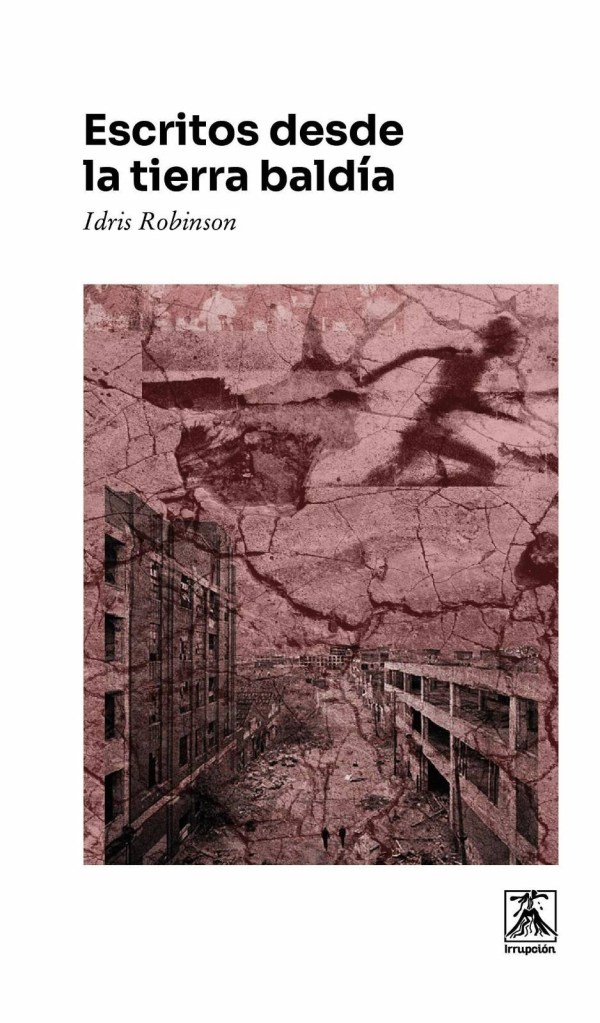
Intervención para la presentación de Escritos desde la tierra baldía (2025) de Idris Robinson, UMCE, Santiago de Chile. Por Gerardo Muñoz

Ya no me toca decir mucho más sobre Escritos desde la tierra baldía (Irrupción Ediciones, 2025) de Idris Robinson, que se adelanta a la publicación de finales del este año de la versión en inglés publicada por Semiotexte, bajo otro título, The revolt eclipses whatever the world has to offer. El título en inglés en realidad tiene una afinidad chilena implícita, pues remite a una expresión de una conversación que tuve con Idris en los meses tras la revuelta de George Floyd, y que fue publicada en la ahora inexistente Revista Disenso. Estamos hablando de la primavera del 2021, lo que quiere decir que ya casi cinco años nos separan de ese momento. Creo que ambos estamos muy agradecidos no solo por la acogida en el catálogo de Irrupciones Ediciones, sino también por una colaboración de pensamiento real, que hace que todo sea un poco más llevadero y fecundo. En este comentario simplemente quiero registrar tres planos que pudieran contribuir en torno a la escena de escritura de Idris para luego conversar. 

En primer lugar, creo que como podrá ver el lector que se asome a la páginas del libro, lo que llama la atención de inmediato es una pulsión en el lenguaje que pudiéramos caracterizar de inmediatez y caída. Pongo el énfasis en este nudo, porque no se ha reparado lo suficiente, me parece, en la relación entre el acontecimiento de la revuelta y el lugar de la lengua. Creo recordar que Willy Thayer lo tematizó con cierto énfasis en una discusión sobre la “constitución menor” en un número de Papel Máquina de 2021. Idris es un pensador de escritura escasa, contenida, tenue; y, sin embargo, en esos meses del llamado “American hot summer” del 2020 su voz desbordó a la letra con regularidad. Un desborde que no tiene nada que ver con el reportaje de los hechos – no es un John Reed con nuevos días que conmovieron al mundo desde Minneapolis – aunque también los incluya desde luego, sino con la posibilidad misma de “decir” al calor de una instancia temporal que trastoca y anima. Si hay momentos de “golpes a la lengua”, ¿no es el acontecimiento de la revuelta la instancia donde la lengua hace presencia pura?

Ya que hablamos de presencia, en Escritos hay un timbre zigzagueante que pasa por dar lugar a la presencia de la existencia afroamericana; dejarla actuar en el teatro de su entorno. ¿Qué significa esto? Yo recuerdo que hace algunos años, el tren regional de New Jersey, el NJTransit, tuvo muchos problemas técnicos, y entonces durante un final de mes se habilitó montarse en tren sin pagar. Y durante esos días, los que tomamos el tren vimos de repente algo sorprendente e inédito: tribus de jóvenes afroamericanos – algunos tan jóvenes como de la junior high  – en pura algarabía y con sus rostros de absoluta felicidad se montaban al tren de Trenton a Manhattan por vez primera. La “muerte social” contra la existencia afroamericana de la cual Floyd es sólo su expresión extrema, no es reducible al momento de un siniestro, sino que es contra todo el mundo de circulación de lo social. En ese momento en el que el precio se ponía en suspenso, se abolía la cruda violencia que subyace la atadura entre la tarifa y el salario. Cuento esto porque me parece que la escritura de Idris tiene una operatividad que busca descomprimir esa violencia social contra la presencia indexando una textura experiencial, desfigurada. Y esta es su diferencia con las otras dos tendencias del pensamiento negro en Estados Unidos: el activismo político democrático (BLM), y el afropesimismo, que es una metateoría disolvente, aunque ciertamente muy comprometida con zonas autográficas o experienciales de escritura. Me parece que leer a Idris con esto en mente nos ayuda a afinar sus diferencias ante esas otras dos opciones del pensamiento crítico contemporáneo. 

Y finalmente, la elección del título relativo a la tierra baldía obviamente remite al famoso long poem The Wasteland de T.S. Eliot, que Idris recoge en varios momentos de sus escritos, aunque sin remitir al poeta. La wasteland para Eliot, como sabemos, constituía el horizonte en marcha de la modernidad protestante y maquínica ante la que él reaccionaba desde su catolicismo reaccionario; en Idris, en cambio, la wasteland es lo que ya habitamos, el espacio tortuoso y siniestro de la interconectividad, de las infraestructuras metropolitanas, de la exposición social regulada. Por banal que parezca creo que es muy atractivo haber puesto el énfasis en la tierra baldía, porque parte del colapso epocal en curso tiene que ver con la conquista del espacio; ya no el espacio de los astros donde Musk y los otros personajes de Silicon Valley quieren instalar sus fundos, sino la tierra misma que pisamos, y que ahora sentimos como lugar inmundo carente de sentido de ‘región’. La tierra traducida a superficie para ingenieros o world builders, por decirlo con Bruno Maçaes.  

Pensar hoy supone pensar sobre y en el espacio, haciendo espacio para abrir el no-espacio que le devuelve su dignidad contra toda reducción de lo intercambiable. La modernidad fue la época de la temporalidad, de la filosofía de la historia y del mesianismo; hoy, de la mano de Idris, podemos abrir la pregunta por el pensamiento en región, que tiene prioridad con respecto a la organización y a la economía política. Escritos desde la tierra baldía nos da paso a esto y a más. Muchas gracias.

The camp is still with us. by Gerardo Muñoz

Immediately after the end of the Second World War, the historian Emilio Roig de Leuchsenring published a thin book in Havana with the title Weyler en Cuba: un precursor de la barbarie fascista (Páginas, 1947), which made a direct connection between twentieth century political movement fascism and the lurking shadow of the Spanish general Valeriano Weyler, who commanded the intense colonial pacification against pro-independence insurrection at the end of the nineteenth century in Cuba. It is to Roig’s credit how he managed, toward the end of the book, to capture the actuality of what he called “weylerism” of full-fledged totalitarian and imperial wars against populations that did not come to an end in spite of international law and the several peace agreements of the Second War victors. For Roig the structural positionality of politics even in the years 1945-1947 was still maximalist, all encompassing the total conditions of living of populations, and thus a direct instrument of capitalist rent through war making. What he termed “weylerism” or the new fascist barbarism was a new qualitative leap in terms of conducting war, which now realized itself in terms of population control and the veneer of “order”: “Todo lo que Weyler representó y practicó está vigente en la posguerra” [1]. 

The idea of “peace” (the United Nations was settled in the fall of 1945 with the active participation of Cuba, something that Roig would not have ignored) could only signal the continuation of an extreme form of extermination and the dispensation of cruelty. In fact, the Weyler model (weylerism), was very much an administrative form of pacification of population through encampment and survival. In his memoirs, Weyler himself justifies “reconcentraciones” of the population as a martial solution to answer insurrectional arson activity, in the form of an exclusionary space within the territory even if this meant mass starvation [2]. As Roig does not cease repeating in his postwar essay, the actuality of Weylerian command is not an image of the past, but something that is already an essential part of the world of today and surely of tomorrow. 

Today we are living Roig’s historical future, and we can say that his Weyler en Cuba: un precursor de la barbarie fascista (Páginas, 1947) has become as current as ever before. Just a few days ago we heard the Secretary of Homeland Security of the United States claim that Immigration Detenter Center in Florida’s Everglades could become a model for detention centers across the nation thanks to its spatial efficiency near airport runways that facilitate deportation flights and extraditions without due process. As observed by Stephen Bonsal as early as 1897, the Spanish reconcentraciones in the island of Cuba enacted by Weyler’s military command were all deployed near key military strategic sites of the colonial army [3]. 

It comes to no surprise that in the current public discussion about Immigration Detention camps in the United States, the discussion always pivots towards health and sanitary management of the centers, and not in the “dislocating localizations” of these evolving zones d’attentes that now are propping up near airports, shipping ports, and hinterlands of American metropolises [4]. If the camp, or reconcentraciones, is the sharp image of ongoing domestication of human beings, as a great twentieth century writer observed, it might very well be that the current metamorphosis of Weylerinism has become victorious because it has been rendered acceptable by an increasingly indolent and dormant Society.

Notes 

1. Emilio Roig de Leuchsenring. Weyler en Cuba: un precursor de la barbarie fascista (Páginas, 1947), 216.

2. Valeriano Weyler. Memorias de un general (Ediciones Destino, 2004), 257.

3. Stephen Bonsal. The real condition of Cuba today (Harper & Brothers Publishers, 1897), 112.

4. Giorgio Agamben. Homo sacer (Stanford University Press, 1995). 175.

The world has been posthegemonic. by Gerardo Muñoz

In a recent text published at Verso Blog, entitled “The Coming Post-Hegemonic World”, Michael Hardt and Sandro Mezzadra make a case for a “turn to a post-hegemonic model” that will challenge the consensus of global in the coming era. In many ways, this era is already here with its diverse and multifaceted (in terms of intensities, forces, and leverages) of protracted and bizarre nationalisms, which as Jamie Merchant has teased out brilliantly, amount to desperate attempts to offer a belated response to the decline of growth as one more stage for containing rampant processes of accumulation via state capacities. For Hardt & Mezzadra, this “posthegemonic world to come” is characterized by a global spatial reconfiguration of capital – accommodating the logistics of regional spaces of influences and exchange across the planet – and on the other, an increasingly “domestic sphere of authoritarian rule” promoted by new accelerated initiatives at generating social homogeneity in the wake of rushing fragmentation hand in hand with a war regime that has utterly scrapped ideals about “strategic autonomy” in order to trumpet an arm race (nuclear weapons included), as it is currently unfolding in Europe. 

One can claim that this posthegemonic world is one that firmly assumes the consequences of two interdependent vectors that imploded within the project of political modernity: the end of  economic growth (thus validating the law of the fall of profit outlined in Capital V.III), and the liquidation of the principle of legitimacy that for two centuries accommodated the legislative sources of the state authority in democratic constituent power. For Hardt & Mezzadra posthegemony means global fragmentation, authoritarianism, and spatial remaking; however, one should also say that it means, the opening towards stagnation, the collapse of political unity of the state, and most recently the total discredit of the foolish leftist hypothesis that promoted a “rainbow social equivalent coalitions” to push for compensatory, and in every instance insufficient and moribound, populist resurgences elevated through the combustion of ethereal but effective rhetoric (in fact, my argument in a new short book, La fisura posthegemónica, is that the push for political hegemony of the last decades only cosigned forms of consensual totalization at the expense of the production of subalternization and social death).  

Even taken as a descriptive and normative condition of the current state of Western politics, the posthegemonic situation lays bare the reciprocal impasse of the claim of its opposition: in other words, one should also put to rest social mobilization that characterized the politics of High Modernity, since ultimately movements (and total mobilization as an apparatus of social energy transfer) presupposes that “every social structure, that it can receive what form required the needs of the political adventure…total mobilization signifies nothing other that the effort to reduce the social substance to a kind of plastic”, as Gérard Granel once defined it. Hence when Hardt & Mezzadra claim that the “effective rebellion must be rooted in social movements envisioning a life beyond the rule of capital”, they are inadvertently refusing to come to terms with the factical posthegemonic reality that they are describing, which is no longer driven by expansive economic growth, but rather by stagnation, and inoperativity at planetary scale that is maintained through the a global veneer of production into regimes of competitive accumulation (of territory, contractual debt, fiscal regulation, executive taxation or tariffs, and increasing arbitrary monetary regulations in the global system) for marginal profitability, as Paul Mattick argues in his recent The Return of Inflation (2023). 

This means that there is no outlook towards ‘social mobilization’ that does not serve the subjective productivity of real subsumption, since its ultimate goal is to anaxate social energy into the force of (un)productive labor. This form of dilatant mobilization can only serve the master of illusionary hegemony, and thus promote functional and unwarranted servitude everywhere. Indeed, only a reprobate can be immune to the moralist or the realist conditions of hegemony. If push comes to shove, the posthegemonic factical world of stagnation and political fragmentation already here proves that the ongoing irruption of non-movements are irreducible to the modern movement’s energy; and that life never fully coincides with political claim to rule and legitimacy, even less so in the becoming-world of Production. 

Ultimately, this posthegemonic fissure outlives the crumbling hegemonic world of principial High Modernism and no ‘international movement’ can piece it back together again. We are all posthegemonic now, but only if one takes up this predicament seriously and candidly.

Emergency and the abdicating liberal executive. by Gerardo Muñoz


Over at the newspaper Perfil, the constitutional scholars Andrés Rosler and Guillermo Rosler have an excellent critical analysis of the omnibus emergency decree (“Decreto de Necesidad y Urgencia”) proposed by the newly minted Argentine President Javier Milei, which has the alberdinian ringtone in its title “Proyecto de Ley de Bases y Puntos de Partida para la Libertad de los Argentinos”. As members of his cabinet have described without vacillation, the aspiration of the legislative package has the high aspiration of enacting a true political revolution in the name of unmediated “civilization freedom” against the institutions and mediations of the state. Rosler & Jensen make a good case that Milei is far from being the ‘founding father’ of the instrumentalization of executive emergency; and in fact, at least since the the transition to democracy of the 1980s, Argentine executive power has increasingly become a normalized standard of broad executive decrees against the letter and spirit of Article 99 of the Argentinian Constitution. As a matter of habit and precedent, the exceptional character of the emergency decree over time has sort of become the supra-institutional norm of governance, thus blurring the state of emergency from the normal course of institutional mediations and consequential remedies. Paradoxically, Milei’s revolutionary force expresses more of a continuity with the collapse of the liberal modern state than a counter-revolutionary seeking a strong formal stabilization between the economic interests and state functions. 

As an addenda to Rosler & Jensen’s illuminating piece, I wanted to register the symptomatic and perhaps unique paradox of the revolutionary executive command; mainly, that at the same time that it discharges an ambitious and total encompassing legislative omnibus bill for the emergency, its purpose differs from the classical conception of political decision that seeks to harmonize a strong state and a sound economy, as Carl Schmitt famously argued in the 1930s. Indeed, Schmitt argues in “Strong State and Sound Economy” (1932) that authority emerges from success and achievement between the spheres. Now this success presupposes not only the effective deployment of state institutions (“the constitutional legalization of new institutions”), but also that the autonomy of the political system guarantees the separation between the unity of the state and the plurality of civil society [1]. This means that even if Milei’s libertarian ideal of a strong financial state is taken at face-value, the betrayal on the autonomy of the political reveals the feeble dimension of his executive force; a self-defeating overreach that, similar to the ways of the Trump presidency (2016-2020) in the United States, ends up revealing the executive weakness with respect to the conservation of the autonomy of the political [2].

In other words, by disdainfully acting through an unbounded economic ideal to disarm the state, the executive also abdicates his energetic capacity to reorganize the chaos from partisan, ideological, and economic interests in the long run. In his proposal to the business class to consolidate the authority of the state, Schmitt advised about the necessity of a robust and independent neutral bureaucracy for legislative deference and operative allocation of reasonable decision-making regulations. This allows us to differentiate another structural disparity between the Argentine and the North-American forms of executive power: whereas the first tends to maximize the power of its office through a vicarious political charisma that leads to its own abdication; the hamiltonian energetic executive (Federalist 70) has drifted towards a process of abdication or self-evolving expansion and containment within the principal tracks of a gigantic administrative apparatus. The picture in question is, of course, one of paradox: this means that the presidentialist model of the Latin Americanist design, at least broadly speaking, differs substantially from the energetic American model, precisely because every attempt to enact hegemonic force ultimately shrinks the overall reach of the administrative execution. Hence when Rosler & Jensen write about the executive that “…nuestra Constitución no adoptó un modelo de ejecutivo fuerte de impronta alberdiana, con amplias facultades, sino que se inspiró en el modelo norteamericano en donde este tipo de decretos no existe”, they only partially give capture the full picture. In other words, the contrast is not merely at the level of executive forms of potestas (executive order without Congress authorization and “Decreto de Necesidad y Urgencia”), but also, and more importantly, at the very capacities for abdication and abnegation of delegated power within the two institutional arrangements where the administrative institutional building from within plays a fundamental role in the functioning of formal liberal political designs. 

In fact, if we are to follow Rosler & Jensen’s astute intuition that Milei is nothing new under the sun, we could say that his executive habits, now cloaked under extreme commercial faith of the “invisible hand” of the market, follows to the letter the political tradition of the liberal criollo political class that the republican theorist Juan Bautita Alberdi criticized in the nineteenth century. As he wrote in his posthumous writings: “Argentine liberals are platonic lovers of a deity they have neither seen nor known. Being free for them does not consist in governing themselves, but in governing others. The position of the government: that’s all about freedom. The government’s monopoly: that’s all about liberalism…Liberalism, as we have to respect the discontent of other officials against us, is something that does not fit into the head of an Argentine liberal. The dissident is an enemy; the dissent of opinion is war, hostility, which authorizes repression and death” [3]. In this strong cautionary denunciation, Alberdi’s well-crafted portrait of Liberalism has at least two conjoined features that adds sharp historical relief: the deficiency of Liberalism was always the aspiration of unconstrained freedom (of interest) suppressing the autonomy of the political and dissent (the enemy), while increasing the frontiers of government over the space of civil society. In effect, the sovereign exception (broadly applies to Latin America) can be said to have been an exception to neutralize the very condition of exceptionality constitutive of sovereignty’s exclusionary political theology.

This will remind us, at least axiomatically, that Saint-Just’s maxim that a government ruled by hegemonic underpinning tends to produce only monsters and absolute enemies meets the truth of a historical pathology. In a wider panorama of Latin American political thought, the ideals of Liberalism have only fomented the administration of political stasis or civil war over the spiritual unity of constituent power in which the state and its institutions have been too fragile to overcome throughout its different renditions (the criollo oligarchic state, the national popular, the socialist welfare state, and the openly revolutionary socialist states) [4]. In contrast to the constitutional ‘royalism’ of the original North American republican organization of public powers and its abnegating executive office (a war of independence waged against the British Parliament), taking a look at contemporary presidential power allows us to derive the different compensatory strategies in confronting the collapse of the legitimacy of the modern legislative state [5]. The so-called “revolution of freedom” (with the consumer citizen at the center stage of the always unfinished and ongoing coercive consent required by the passive revolution) mandated by the executive against the institutional fabric is ultimately a renewed attempt at conserving the root and branch of the hegemonic logistics at the heart of the region’s post-independence apparent state and its rocky historical development.

Notes 

1. Carl Schmitt. “Strong State and Sound Economy: An Address to Business Leaders” (1932), appendix in Renato Cristi’s Carl Schmitt and Authoritarian Liberalism (University of Wales Press, 1998), 221.

2. I argued for this position in several publications a few years ago, see for example Gerardo Muñoz, “¿Se avecina un momento Weimar en los Estados Unidos?”, La voz de los que sobran (Chile), November 2020: https://lavozdelosquesobran.cl/opinion/se-avecina-un-momento-weimar-en-los-estados-unidos/07112020 

3. Juan Bautista Alberdi. Escritos Póstumos: Del Gobierno en Sudamérica (1896), Vol.IV, 188.

4. The continuity of stasis at the foundation in the region is something that can be derived from Rafael Rojas’ historiographical contribution Los derechos del alma: ensayos sobre la querella liberal-conservadora en Hispanoamérica 1830-1870 (Taurus, 2014)

5. Eric Nelson. The Royalist Revolution: Monarchy and the American Founding (Harvard University Press, 2014). 

The ascent of the administrator. by Gerardo Muñoz

Today the political surface only seems to obfuscate the analyses of the real forces that move at different pace underneath the crust. When recently Emmanuel Macron referred to the popular unrest protest as “la foule…pas de légitimité face au peuple qui s’exprime souverain a traversé ses élus”, he was not only speaking as the sovereign, but as something more specific; that is, as an administrator. If the old sovereign stood metonymically for the totality of the whole constituent body, Macron’s political rhetoric cleverly distinguishes between the “groups” or “masses” (this is also the same term that Sigmund Freud deployed in his contestation to Le Bon’s theory of the multitudes in 1921), and the institutional mediation of the “People”. What is interesting, in any case, is the cleavage between the two figures becoming well delimited: one being on the side of political legitimacy, the other on its inverse pole of apolitical illegitimacy. The logistics of administration (or what I have called in recent research the administrative nexus) serves to conjoint this specific separation. By the same token, we should not let pass the occasion to recall that if Macron is a hyperbolic political commander of the West, it is precisely because he stands as the executive force at the helm of the administrative legitimacy (as a political elite, he was shaped at the École nationale d’administration).

What do we mean by administrator in this specific historical conjuncture? It goes without saying that modern French public law has a long and important history of droit administratif, which in France is structured around a dual jurisdictional system enshrined by an extensive legal case law and its juridical principles. The French system of droit administratif, however, is not to be understood as an amalgamation a posteriori of classical separation of powers, but rather a concrete institutional design within public powers. This was an institutionalist design that profoundly impacted Schmitt’s thought on the concrete order in the first decades of the twentieth century. The bureaucratic institutionalization was an integral organizational mechanism of legislative congressional practice. The rise of the administrative state differs from droit administratif insofar as it represents liquidation, as well as a thorough transformation of the modern system from within. In this sense, the rise of the administrative state is an excedent to bureaucratic legitimation – and Schmitt was right to characterize as the ‘motorization of law’, a force that he saw unleashing already in the overall tendency of European public law of the 1930s, although only taken to its fulfillment in the United States (something that Schmitt did not foresee) [1]. And if we were to sketch out a minimal phenomenological reduction of administrative law today we could state that it consists of the overflow of executive power through the exercise of the principle of delegation and the extension of intra-agency policy-police enforcement. What early on administrative law professors termed the revolution of an ‘administrative process’ has now come to full extension by subsuming the tripartite structure of the separation of powers to the administrative oversight of the space of social reproduction.

That Macron can only frame his political analysis in terms of “la foule” entails that he is already occupying (at least tendentially; and I can not speak myself for the concrete institutional transformation of the executive office in the French political system) and envisioning role of executive branch as a presidential administration. In an academic legal article that will exert an enduring influence in American public law, “Presidential Administration” (Harvard Law Review, 2001), Judge Elena Kagan stated that the era of executive administration had arrived; which rather than the supremacy of an institutional branch over others, it aspired to defend the orderly equilibrium to the total functioning administration of the whole system [2]. It is important to note that today’s ascent of the administrative state across the Western Anglo-Saxon public law is not rooted in maximization of bureaucratic rationalization nor in the authority of the charismatic office of a Reichspräsident as in the Weimar Republic (I have previously shown its difference), but rather in the production of delegation and deference of political authority that flows from executive power, while remaining bounded within a logistics of balancing and equity (in fact, the notion of equity has become the administrative unity of enforcing a positive production of exceptionality, but this is a discussion for another occasion). In other words – and as paradoxically as this may sound – the Macronite experiment with executive action based on Article 49 of the French Constitution, bypassing Congress, is a thoroughly habitual and normalized practice in the American legal system, which have led some jurists to claim a last farewell to the legislative body of the State – the same branch that Woodrow Wilson would describe as the ‘body of the nation’ in his seminal Congressional Government (1885).

All things considered, whenever Macron’s technocratic politics are described there is an amnesia to the concrete fact that Americanism is not just economic planning or the drive towards indexes of productivity and financial credit standards; it is also a specific governmental stylization. And this stylization is the administrative government, whose stronghold on public law should not be taken for granted. This means at face value that the empire of judges and congressmen (the “elected representatives” upheld by the Macron internal doctrine) is ultimately marginalized in the new center stage government occupied by an elite cadre of administrators and regulators in charge of grand policydesigns in virtues of expertise, rationality, adjudication, and compartmentalized decision-making process – that Kagan recommended should orient “a coherent policy with distance from politics and public opinion” [3].

Contrary to Macron’s republicanist rhetoric, the true and concrete ethos of the administrator is no longer at the level of classical modern political representation (elections, legislative body, judicial restraintment), but rather on the production of statute rulemaking balancing (equity) that unifies the aggregation of private preferences and calculations to the specific determinations of broad and discretionary public interests. At the level of the analytics of ideal types, this transformation sediments the passage from the political elite to the executive administrator of new normative indirect powers. The ‘americanization’ of Macron’s policymaking universe is centered on the exclusion of political governance or judgement in favor of abstract administrative principles (the so-called ecological transition tied to metropolitan or specific territorial energy hubs, to cite one example) and optimal regulatory determinations. What emerges at the threshold of modern republican politics is, then, the rise of a fragmented ‘la foule’ and the activation of police-powers (legality) through the procedures of statute enactment oriented at the unruly state of contemporary civil society.

.

.

Notes 

1. Carl Schmitt. “The Plight of European Jurisprudence”, Telos, March, 1990, 35-70.

2. Elegan Kagan. “Presidential Administration”, Harvard Law Review, 114:2245, 2001, 2385.

3. Ibid., 2262.

A memory of Jean Franco (1924-2022). by Gerardo Muñoz

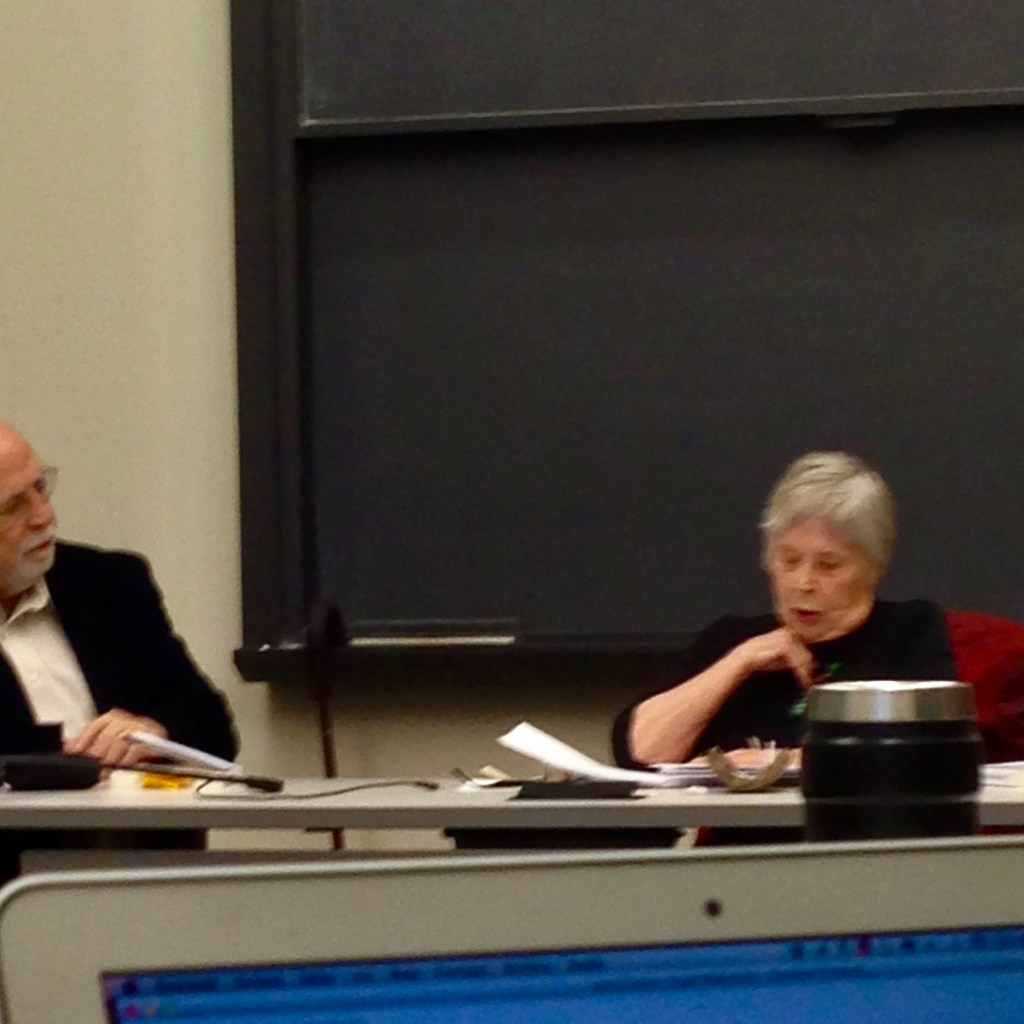
Jean Franco, pioneer of Latin American Cultural Studies and witness to its Cold War gigantomachy, passed away a couple of weeks in December at age 98. She remained lively and curious even at the very end of her scholarly life, and for some of us that saw her in action she embodied the memory of the century. The photograph above is of Jean’s visit to Arcadio Díaz Quiñones graduate seminar in the fall of 2015 where she discussed some of the main arguments of her last book Cruel Modernity (Duke U Press, 2014), a cartography showing the definite closure of the Latin American insomnia for political modernity in light of its most oblique mutations: narcoviolence, the emergence of a dualist state structure, and new global economic forces that putted an end to the vigil of the revolutionary enterprise. I write “definite” purposely, since Jean’s own The Decline and Fall of the Lettered City (Harvard U Press, 2002) already hinted at a certain exhaustion (to borrow the strategic term of Alberto Moreiras also writing during these years), most definitely a thorough disillusion, in the sense deployed by Claudio Magris, of cultural substitution for the belated state-making modernization. The function of “culture” (and its hegemonic state apparatus) was always insufficient, dragging behind, or simply put, unintentionally laboring for the cunning of a project forever postponed in the sweatshop of the newest ideologue, or for the hidden interests of the “local” marketplace of moral academicism. All of this has come crashing down rather quickly even if the demand for culturalist janitorial or housekeeping services are still in demand to sustain the illusion sans reve et sans merci.

What always impressed me about Franco’s scholarship was her intellectual honesty to record, even if through an adjacent detours and academic finesse, the destitution of all the main categories of the Latin American modern wardrobe: developmentalism, state-civil society relations, the intellectual, cultural hegemony, revolutionary violence, the “rights revolution”, and the intra-national spatiality (rural/metropolitan divide). From now on it is hard to say that there is a “task of the critic”, if we are to understand the critic in the Kantian aspiration of sponsoring modern values and perceptiveness to an enthusiastic disposition (definitely optimistic towards action) to transforming the present. As a witness to the twilight of the Latin American modern epoch, Franco univocally resisted the inflationary, value-driven, demand for politicity and ‘more politics’. This is why her attitude remained at the threshold of any given effective political panaceas or half-baked illusions.

Does her biographical experience say anything to this particular inclination? It is difficult to say, although as a witness of the century Jean had lived through the coup in Guatemala in 1954, visited the Cuban Revolution during its most “intense years” of the sugar cane milestone (La Zafra de los Diez Millones), and followed with attentiveness the rise and transformation of the Southern Cone dictatorships in the 1980s coupled with the irreversible social transformation of neoliberalism in the 1990s signaling the effective end to regional integration in the face of planetary unity. All of this to say that I find it hard – at least leaving aside the many nuances – to see in Jean’s scholarly witness an enthusiasm for the Latin American Pink Tide, the communal state, or abstract regional historicizing that could finally bring about the moral universe of the national-popular state (as if said moral realization would be anything worthwhile, which we some of us seriously doubt). If Jon Beasley-Murray once said that John Beverley was the “Latin American unconscious”, I guess it is fair to claim that Jean Franco was an authentic Latin americanist realist; that is, someone that was up to task to see in the face of the tragic, the cruel, and the heinous as the proper elements of the interregnum. Or to better qualify this: she was a worldly realist, leaving aside utopias and its abstractions. At the end end of the day, Leninists are also realists, or at least claim to be so. What places Jean’s earthly realism apart from the Leninist realism is the subtraction from the seduction of Idealization, which even in the name of the “idea” (“the idea of communism”, say) or “immanent higher causes” must bear and render effective the logic of sacrifice at whatever cost, even the real sense of freedom if demanded by the party, the leader, or the community. This is why at the closure of Latin American modernizing enterprise communitarian arrangements, posthistorical subjects / identities, or grand-spaces that mimic the constitution of Earth are foul dishes for a final banquet. It is always convenient to refuse them.


Going back to my conversations with Franco at Princeton, and some exchanges a few months later in a cafe near Columbia University, for her there was remaining only the anomic geography of Santa Teresa in Bolaño’s 2666, a novel that charts the current ongoing planetary civil war in the wake of the crisis of modern principles of political authority. I can recall one remark from Jean during these exchanges: “¿Y quién pudiera mirar hacia otra parte?” This is the general contour of her witnessing: how not to look somewhere else? In other words, how not to look here and now, into the abyss that is no longer regional or national, Latin American or cultural specific, but rather proper to our own civilization? A civilization is, after all, nothing but the organization of a civis, which has now abdicated to both the metropolitan dominium, as well as the campo santo of sacrificed life at the hand of techno-administrative operators (the new praetorian guard) of a well lighted and fully integrated Earth.

There is no alternative modernity, decolonial state, or hegemonic culture that will not serve to the compensatory and sadistic interests of the cruel policing of death and value, as the only masters in town. We are in Santa Teresa as a species of energy extraction. Can reflection be courageous enough to look through and against them? This is the lasting and eternal question that Franco left for those who are willing to see. It does not take much, although it amounts to everything: mirar / to gaze – in an opening where human form is lacking and categories are wretched – is the the most contemplative of all human actions. Whatever we make of it, this practice now becomes the daring task of the coming scholar.

Referéndum y separación constitucional. por Gerardo Muñoz

Durante las semanas de cara al referendo del Reino Unido sobre su membresía en la Unión Europea, el gran historiador y teórico político J.G.A Pocock escribió una mínima defensa de la expresión plebiscitaria en una miniserie que publicó en mayo el London Review of Books (dado que es corta, vale citarla en su forma integral):

“Profoundly​ anti-democratic and anti-constitutional, the EU obliges you to leave by the only act it recognizes: the referendum, which can be ignored as a snap decision you didn’t really mean. If you are to go ahead, it must be by your own constitutional machinery: crown, parliament and people; election, debate and statute. This will take time and deliberation, which is the way decisions of any magnitude should be taken. Avoid further referendums and act for yourselves as you know how to act and be.” [1]. 

Dejando a un lado el escepticismo del autor del Barbarism and Religion sobre la EU, lo interesante es la forma en que defiende el plebiscito, como una de las herramientas propias de la “máquina constitucional”, aunque siendo un último resorte. Una vía de escape y recomienzo. El plebiscito es ciertamente una forma “aclamatoria” de todo poder constituyente – así también lo cifró Carl Schmitt en su Volksentscheid und Volksbegehren (1927) – que se propone una última apelación (que es también la primera): el poder constituyente para transformar las condiciones de representación. El referéndum no un principio de primer orden, sino de segundo, puesto que es mediante la expresión de un mínimo directo que busca reordenar formas de primer orden (diseño institucional, composición judicial, garantías y derechos estipulados). En cierto sentido, el referéndum es una mediación directa en separación de toda sutura constitucionalista y promueve revisión de las condiciones hiperbólicas de todo sistema político concreto.

La segunda sugerencia de Pocock se deriva del referéndum es una recomendación: evitar repetirlo para no ser persuadidos de que el cambio de condiciones debe ser sometidas a la “voluntad general” cada vez que un proyecto legislativo entra en vigor. Esta estandarización del referéndum sería fútil, pues volvería a cerrar la puerta de atrás que en algun momento se necesitará ante una crisis de representación política. Son dos las reglas del referéndum: a) reconstrucción de las condiciones y principios internos de la constitución, b) pero siempre y cuando, el principio del referéndum sea externo a uno de los poderes institucionales. El referéndum tiene una dimensión que es, a su vez, ligada al concepto de lo político y a la vez que emana de toda unidad política. Y a diferencia de la votación, el referéndum no existe dentro de los límites de la representación, sino que cuestiona los principios que hace posible y efectivos toda representación.

Parafraseando un dictum de Alfred Loisy – “Cristo vino a declarar el reino, y, sin embargo, lo que vino fue la Iglesia” – pudiéramos decir que el caso chileno (que celebra su referéndum sobre la nueva nueva carta hoy, domingo 4 de septiembre), ya que el “momento de octubre” vino a destituir el orden institucional del país, y, sin embargo, mediante un referéndum ha producido un nuevo orden constitucional renovado. Sabemos que no hay revoluciones infinitas, y que, como solía decir el profesor Jorge Dotti, el problema realmente difícil es una revolución (o de una revuelta) no es abrirla, sino también cerrarla. Aunque si se lee a la luz de la condición de separabilidad del referéndum, también podemos decir que la vía de renovación tendrá mucho qué ver con la relación entre constitucionalidad y régimen de representación a partir de la votación del referéndum. La tarea dificil es siempre el ‘día después’.

Desde mi punto de vista, esto suponone avanzar de la instancia “aclamatoria” del referéndum hacia una separación de un posible nexo constitucional cuya eficacia excluyente imperó en todo el interregnum postdictatorial de la ‘democracia chilena’. En efecto, de asentarse la consolidación de una constitución “mágica” – que absolutice derechos, principios, y reglas de manera irrestricta, donde todo juez pueda “sacar conejos”, al decir de Lora – implica la expansión de los controles judiciales, que a prima facie convierten el referéndum en práctica frequente (al menos en potencia) [2]. El riesgo de un constitucionalismo confeccionado en la fuente de derechos y principios es que, contra sus propias intenciones, puede terminar por indexar la vida política a la imperialidad juristocrática.

En cambio, la separación de toda subsunción del constitucionalismo puede entenderse, tal y como lo ha sugerido Rodrigo Karmy recientemente, como una zona “umbral” [3]. El umbral es una figura topológica muy peculiar, puesto que no se encuentra ni dentro ni fuera, sino que permite una flexibilidad que despeja el concepto de lo político del imperio de los derechos. Esta separabilidad, por lo tanto, toma distancia de las grandes “causas valóricas” (y sí , también de la ilusa promesa de “justicia social”) que en mano de jueces es un arma de doble filo en sus controles discrecionales. La separación de todo constitucionalismo co-extensivo con la política y la esfera de valores – hoy en descrédito, gracias al activismo constitucionalista, el principialismo, y el iusmoralismo – fue defendido por el jurista decimonónico norteamericano James Bradley Thayer con un propósito: hacer que la esfera jurídica solo intervenga con su control judicial ahí donde no exista una “base razonable” en el estatuto o el caso [4]. El minimalismo judicial (ex ius) es la única posibilidad para darle espacio a lo político, sometiéndolo a una “examinación” demótica sin la tiranía de valores.

Todo lo demás es política, legislación, estatuto, debate, institución. La seperación del constitucionalismo supone no ceder a la ilusión de que la liquidación de un “constitucionalismo del miedo” ya por si misma genera inmunidad total a al constitucionalismo de principios. El caso chileno es atendible en la medida en que ya experimentó un constitucionalismo atávico en principios económicos subsidiarios. Ahora está por ver si en este segundo momento ‘constitucional’ se decanta por una acogida al activismo judicial del principialismo jurídico; o si, por el contrario, asume la constitución como “umbral” oxigenando a la inasible imaginación de octubre.

.

.

Notas

1. J.G.A. Pocock. “Where are we now? Responses to the Referendum”, London Review of Books, Vol.38, N.14, 2016: https://www.lrb.co.uk/the-paper/v38/n14/on-brexit/where-are-we-now

2. Pablo de Lora. “Constitucionalismo mágico”, The Objective, mayo de 2020: https://theobjective.com/elsubjetivo/opinion/2022-05-07/constitucionalismo-magico/

3. James Bradley Thayer. “The Origin and Scope of the American Doctrine of Constitutional Law”, Harvard Law Review, Vol.7, N.3, 1893. 129-156.

Derecho a la carta: sobre The Authority of the Court and the Peril of Politics (2021) de Stephen Breyer. por Gerardo Muñoz

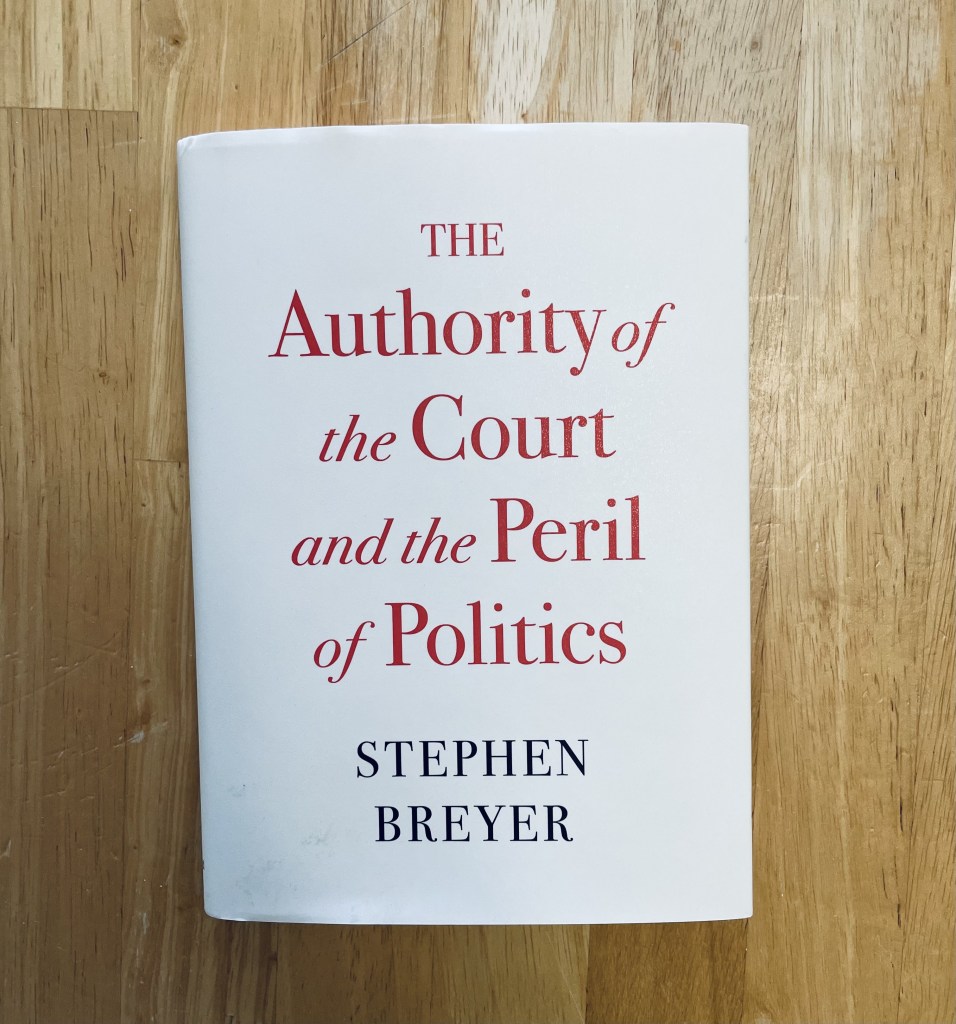
El breve opúsculo The Authority of the Court and the Peril of Politics (Harvard U Press, 2021) del juez de la Corte Suprema Stephen Breyer merece atención tan solo por el hecho de que se trata del último libro de un juez antes de su retiro de la institución más importante del país. Pero si acaso esto no fuese suficiente, también diríamos que el opúsculo de Breyer busca ser leído como un testimonio en tiempos de “peligro”, o bien de entrada a zonas peligrosas en la deslegitimación de la autoridad del derecho y del sistema judicial norteamericano. La latencia que recorre el libro de Breyer es el síntoma de nuestros tiempos: “todo es político”. Claro, si todo es político, entonces la Corte debe responder a la política de turno, cualquiera que esta sea. De esto se deriva que la supremacía de la política debe subordinar la función adjudicativa del derecho, incluso desobedecer su autoridad. Esto es un reto para la esfera del derecho simplemente porque como veía el jurista Alexander Bickel, la función estructural de la Corte Suprema tiene una función de limitación contra-mayoritaria, esto es, debe poner límites a la expresión legislativa y representativa de una mayoría que ha ganado elecciones. Pero una vez que se nos dice que todo es política la llamada “countermajoritaran difficulty” cesa de tener sentido, puesto que ahora el terreno de la jurisprudencia también deviene terreno político, al punto de que sus límites se van dilatando en conveniencia de las causas. Esta estructura propia de una legalidad tecnificada hace que la Corte pierda todo ápice de confianza en la opinión pública. Y también su reverso: que el juez comience a pensar demasiado en el “qué dirá” del público.

Breyer recuerda que durante la historia de los doscientos años de democracia norteamericana (y tras la consolidación de Madbury sobre la revisión judicial), las otras ramas del poder han obedecido la última palabra de la Corte Suprema. Tras las décadas esta obediencia tácita se ha comprobado en disputas como Bush vs. Gore, pero también con la integración racial en Arkansas, o las disputas de las tierras de los Cheroke durante la presidencia de Jackson. Aunque Breyer no mencione explícitamente la pugna por los resultados de la elección del 2020 y la desobediencia del ejecutivo ante la negativa de la Corte de tomar el caso, es ciertamente esto lo que merodea la crisis autoritativa que crece con intentos de “court-packing”, o bien expandir la nómina de jueces en la corte. Ante los ojos del jurista, la desobediencia de su principio de revisión judicial solo puede implicar la “motorización” del derecho por el lado de la política, puesto que su objetivo es brindar “derecho a la carta”, como dice Breyer. Y desde luego, si de menú se trata, es muy fácil que una decisión autoritativa se rechace de la misma forma que podemos rechazar un plato fuerte o un postre en nuestro restaurante favorito. Desde luego, la diferencia radica en que si en un restaurante podemos devolver un plato que no fue de nuestro agrado, cuando hacemos lo mismo en el derecho, entonces estamos favoreciendo la “ley del más fuerte”; o lo que es lo mismo, una moralización de la política que nos revierte de vuelta a un estado de guerra civil legal, pues ya no necesitamos al derecho.

Breyer insiste que la Corte o los jueces no son ajenos a la política ni al sistema político. En todo caso son guardianes de la constitución que poseen una “doctrina sobre la pregunta política” que establece límites entre legislación y adjudicación. Breyer recuerda que Felix Frankfurter recomendó tomar distancia del “political thicket” para evitar que una corte se transforme en un espacio de legislación litigante [1]. Desde luego, en muchos sentidos en Estados Unidos ya hemos cruzado este Rubicón, para no hablar de otros países que cuando un colectivo quiere facturar o frenar una ley ya ni se molestan en ir a “sus representantes” sino que apelan directamente al sistema judiciario. Esta es la consumación integral de lo que Carl Schmitt llamara revolución legal mundial solo que ahora se encuentra al interior de los sistemas democráticos de Occidente, y más específicamente, en la propia valorización de las filosofías judiciales contemporáneas.

Como juez de la Corte Suprema Norteamericana, Breyer puede decir con comodidad que una “filosofía judicial no debe ser entendida como un código político”, pero esto es demasiado vague, por lo que requiere especificación. Lo cierto es que gracias a que un estado administrativo regula y delega las determinaciones judiciales en los Estados Unidos, la descarga de los principios contra las normas no pesa tanto como en contextos en los que un estado administrativo es inexistente, y los principios lo pueden todo contra la organización de un sistema normativo. Ciertamente, donde esto pasa, la filosofía del derecho post-positivista es un arma de la supremacía del valor contra la autoridad del derecho. En el contexto norteamericano las contiendas entre originalistas y activistas judiciales encuentran un espacio de neutralización en el estado administrativo, cuya transformación del derecho público Stephen Breyer guarda silencio en el libro. Y este silencio probablemente se deba al hecho de que la hegemonía del aparato administrativo requiere de una nueva teorización de la autoridad que Breyer no está en condiciones de asumir; o que un juez que todavía asume el law’s empire de los juristas no está dispuesto a conceder. Pero este proceso interno en el tejido del funcionamiento efectivo del derecho público pudiera arrojar luz a la crisis de autoridad que preocupa a Breyer.

Por decirlo con otras palabras, tal vez la crisis de la autoridad judicial se conecta con la creciente de despolitización una vez que la praxis política deviene un proceso administrativo supremo. De ahí que Breyer se encuentre en una paradoja que trenza su libro y que deja irresuelta: por un lado, la Corte no está en divorcio con la política (solo que no es una primera instancia); pero por otro, para Breyer hay una desconexión de las tareas de la “vida pública” y de los asuntos políticos de buena parte de la sociedad. La despolitización de la sociedad se encuentra diametralmente opuesta a la aceleración de una politización extrema del espacio autoritativo del derecho. Pero esta polaridad es propia de una crisis de legitimidad en la que pueden acelerarse ambos movimientos: politización del derecho, y despolitización de la autonomía en las formas en que las comunidades deciden vivir su entorno. De ahí que, a mayor hegemonía de la administración, también mayor aceleración del activismo judicial y de sus filosofías interpretativas desde el valor. En este contexto, claro está, solo quedan ejércitos de jueces que siguen “órdenes de marcha” (la frase es del jurista de derecho canónico y iusnaturalismo, R.H. Helmholz) que abona la guerra civil en el umbral de la crisis de autoridad. Y en un contexto de valorización absoluta de principios, las ordenes o los deberes ya no se obedecen, sino que se imponen desde la ratio última de la coerción legalista.

En este sentido, el optimismo de Stephen Breyer es demasiado idealista si tomamos en serio el escenario actual. Cuando al final del libro pide recuperar la “confianza” (trust) del público ante la autoridad de la Corte, creo que pasa por alto que nociones como “confianza” o “fe” solo pueden ser revividas dentro de un sistema institucional concreto que favorezca sus razones como coordinación de un sistema de mediaciones. Pero allí donde el sistema institucional es cada vez más débil y su ratio pasa de ser autoriativa a convertirse en valorativa (económica), entonces las razones para obedecer y confiar a la autoridad no encuentran su chance. Y no encuentran su chance porque el “trust” recae ya no sobre la mediación de las razones adjucativas, sino más bien en las “causas” ad hoc que se tienden a defender valores. Esta contracción llega a su punto máximo cuando el mismo Breyer dice hacia el final que “el estado de derecho depende de la confianza, guiado por principios legales, y no por la política” [2]. Pero una legalidad basada en principios y valores termina armando al juez en un sacerdote, al decir de Ulpiano, que reintroduce la moralización de la política por la ventana. De ahí que el descredito por la confianza del estado de derecho sea proporcional al fideísmo de las causas patentizadas en principios. En este escenario, la transmisión de una fidelidad ante el peso justificatorio de la autoridad – construida como mediación institucional para la esfera de las razones, como sugiere Joseph Raz – se disuelve en un derecho a la carta en cuyo menú siempre están servidos nuevos principios.

.

.

Notas 

1. Stephen Breyer. The Authority of the Court and the Peril of Politics (Harvard U Press, 2021), 39.

2. Ibíd., 100. 

3. Joseph Raz. “Authority and Justification”, en Authority (NYU Press, 1990), 138. 

Four positions of refusal. by Gerardo Muñoz

A friend recently suggested that the refusal is at center of multiple critical positions against the moralization of politics. And I agree. In fact, I would go as far as saying that the strategy of refusal is something like a common denominator in positions critical of political mediation. Although the refusal could take many forms, I would also add that the refusal is directed against hegemony broadly understood (culturalist, political, logistical, etc.). Primarily, the refusal awakes from the dream of hegemony as contributing towards any real substantive transformation anchored in “political realism”. Realism today is mostly deployed as a freestanding argument aimed at political traction, although it merely contributes to stagnation and paralysis; it is a katechon to any concrete transformative movement of the actual moment.

It is telling that the notion of ‘refusal’ was first developed in the French political context by the likes of Maurice Blanchot and Dionys Mascolo in the journal Le 14 Julliet, a project obscured by the monumental historiographies of May 68. In his short text “Refusal”, Maurice Blanchot defines the notion as the gap in representation between an event and language: “accomplished by neither us nor in our name, but from a very poor beginning that belongs to those who cannot speak” [1]. The refusal denotes a limit to representation. Similarly, in “Refus Inconditional”, Dionys Mascolo understands refusal as the constitutive possibility of silence so that true communication can indeed take place [2]. For both Mascolo and Blanchot, the notion of refusal was the condition for the possibility of friendship preceding subjectivism. By way of refusal, the realization of a “community of the species” is guarded against the socialization of alienable classes. I think one could name four positions of refusal against the closure of hegemony as the organization of secondly separations (alienation). These might not be the only positions – and many a time there is a clear overlap of the problem at hand.

1. The refusal of culture. First, there is Mario Tronti’s “The Strategy of refusal” (Operaio e capitale), which grasps the refusal in classical Marxist terms by way of criticizing culture as resistance against capitalist form. In fact, for Tronti culture amounted to a mediation of social relation of capitalism uncapped expansion. And for Tronti, “oppositional culture does not escape this fact; rather, it merely states the body of the worker’s movement ideologies in the common clothing of bourgeoisie culture” [3]. Hence, for Tronti, refusal meant disengaging from “becoming of intellectuals” as disengaged from the practice of the class struggle. The critique of culture functioned as an inversion of mediation with no transformative leverage whatsoever. However, for Tronti ‘refusal’ was still understood as a political strategy, which necessarily needed to engage with the “subjected” force of class and organized in the party form. In other words, the refusal in Tronti’s early work was the rejection of cultural mediation by intensifying the antagonism of the autonomy of the political. There is not yet a rejection of politics, but rather the assumption that the refusal can lead the way in the destruction of capital production given the “pagan force” of the proletariat. 

2. Refusal and fugitivity. Second, there is a clear and direct strategy of refusal in Afropessimism aimed at the totalization of the social bond organized around the destruction of black existence. Hence, for Afropessimism refusal takes the form of an archipolitics that seeks fugitivity from logistics of social death [4]. As Moten & Harney argue in All Incomplete (2021): “The Undercommons is the refusal of the interpersonal, and by extension the international, incomplete in the service of a shared incompletion, which acknowledges and upon which politics is built. To be undercommon is to live insists the inoperative condition of the individual and the nation as these upon brutal and unsustainable fantasies and all of the material effects they generate oscillate in the ever-foreshortening interval between liberalism and fascism. These inoperative forms still try to operate through us” [5]. Against all forms of bondage subsidized by hegemonic sature, the afropessimist refusal opens up a fugitive life in errancy that points to a new central antagonism now framed between black life and the world. In Wayward Lives (2020), Saidiya Hartman puts it in this way: “To strike, to riot, to refuse. To love what is not loved. To be lost to the world. It is the practice of the social otherwise, the insurgent ground that enables new possibilities and new vocabularies; it is the lived experience of enclosure and segregation, assembling and huddling together. It is the directionless search for a free territory; it is a practice of making and relation that enfolds within the policed boundaries of the dark ghetto; it is the mutual aid offered in the open-air prison. It is a queer resource of black survival. It is a beautiful experiment in how-to-live” [6]. The refusal of the total circulation of social relations allocates Black existence at the threshold of politics. This negative community refuses any hegemonic social rearticulation.

3. Refusal of logistics. Thirdly, in the work of the Invisible Committee the refusal entails destituting the social bond, although the emphasis is placed in infrastructure as the concrete and operative terrain of domination. For the collective the refusal becomes twofold: on the one hand, blocking the logistics of circulation and production of subjection; and on the other, separating the form of life from the regime of subjective domestication. At bottom, the refusal in the Committee’s takes aim against the mystification of the social as a site for autonomous gain from political struggle. For both Tiqqun and the Invisible Committee one needs to refuse the artificiality of the subject (Bloom) in the name of the form of life and reject politics of class antagonism favoring the civil war as a generic science of desertion (what remains after the collapse of the authority of modern politics).

4. Posthegemonic refusal. Finally, posthegemony refuses the codependency of politics and domination, and favors their non-correspondence; it refuses politics as hegemony, and hegemony as newcomer after the closure of metaphysics.  In this sense, posthegemony favors the exit from the total structure of socialization ordered through the equivalence of demands. One could say that posthegemony affirms the “realistic option of non-cooperation” with hegemony. But the space of non-cooperation allows the exit from subjective limit of the political. The posthegemonic separation, therefore, is the refusal of cooperation on the basis of refusal of conditions of obligation (what Eric Nelson labels being “stuck on the boat”), whether predicated on a distributive conception of social justice, or as the maximization of indirect interests proper to liberalism [7]. In this sense, the posthegemonic refusal abandons the temptation of establishing a new civilizatory principle with politics as its auxiliary and optimizing tool of order [8]. 

.

.

Notes 

1. Maurice Blanchot. “Refusal”, in Political Writings (1953-1993) (Fordham U Press, 2010). 7.

2. Dionys Mascolo. “Refus inconditionel”, en La révolution par l’amitié (La Fabrique éditions, 2022). 27-30. 

3. Mario Tronti. “The Strategy of Refusal”, in Workers and Capital (Verso, 2021).

4. Alberto Moreiras. “An Invitation to Social Death: Afropessimism and Posthegemony, Archipolitics and Infrapolitics”, Tillfällighetsskrivandehttps://www.tillfallighet.org/tillfallighetsskrivande/an-invitation-to-social-death-afropessimism-and-posthegemony-archipolitics-and-infrapolitics

5. Fred Moten & Stefano Harney. All Incomplete (Minor Compositions, 2021). 29.

6. Saidiya Hartman. Wayward Lives, Beautiful Experiments (Norton, 2019). 227.

7. Eric Nelson. The Theology of Liberalism: Political Philosophy and the Justice of God (Harvard U Press, 2019). 163-164.

8. Gerardo Muñoz. “Posthegemonía, o por una retracción de los principios de la civilización”, Infrapolitical Reflections, 2020: https://infrapoliticalreflections.org/2020/08/03/posthegemonia-o-por-una-retraccion-de-los-principios-de-la-civilizacion-por-gerardo-munoz/

Domingo de Chile. Intervención en “La revuelta de octubre y el ascenso del neopinochetismo”. por Gerardo Muñoz

Asomarse a la coyuntura chilena es seguir comprobando que Chile no cesa de ser algo así como un laboratorio de las gramáticas políticas y sus crisis. Basta con pensar en la secuencia: ascenso de la “vía chilena al socialismo”, golpe de estado y modelo económico ilimitado (Pinochetismo 1), transición y operación legal de la constitución subsidiaria (Guzmán-Pinochetismo 2), revuelta contrametropolitana del 18 de octubre, e instancia instituyente doblemente marcada por la transformación de la derecha (ahora en clave nacional-popular y antropológica) y la escena escritural de la constituyente. El laboratorio chileno abre una pregunta que queda como tarea para la época: ¿Qué significa hoy instituir? ¿Cómo pensar una lógica instituyente, dentro o más allá de los diseños del constitucionalismo contemporáneo? O más bien, ¿es ya lo instituyente, en su deriva constitucional, una puerta abierta para la metástasis del propio neoliberalismo en sus sucesivas pérdidas de “pelleja de reptil” en el seno de lo social” (tomo esto verbatim de Willy Thayer) [1]. En cualquier caso, el laboratorio chileno agita la pregunta por la diferenciación entre institución y constitucionalismo, en un nudo aporético tal y como en su momento fue el experimento entre dictadura y libre mercado vis-a-vis la racionalidad de Chicago.

De manera que este último experimento del laboratorio chileno se mide por encontrar una respuesta a la pregunta acechante: ¿Cómo dejar atrás las múltiples metamorfosis del pinochetismo que desde los abiertamente herederos del dictador (Guzmán mediante) hasta quienes lo traducen a crédito para derivar un mal menor (de Mayol a Boric) representan el hilo de una continuidad? Así, en un sentido estricto, no habría “neo-pinochetismo” sino una transversal o cuasi-transcendental que se expresa como paradigma flexible de la forma Hacienda, como ha argumentado Iván Torres Apablaza [2]. Desde luego, si el pinochetismo es una cuasi-transcendental, la signatura post-octubrista se mide contra este único enemigo en todas sus apariciones capilares. ¿Es posible darle frente? ¿Y cómo? ¿Puede el constitucionalismo gestionar una reinvención democrática, si el vórtice mismo de la unidad de pueblo ha sido liquidada por la propia sutura entre valor y racionalidad económica en lo social? En este nudo solo podemos apostar por la invención, quizás, de un constitucionalismo menor, disyuntivo, capaz de mezclar los tiempos (destituyentes e instituyentes) en una deriva necesariamente posthegemónica; esto es, sin clausurar la instancia entre democracia y gobernabilidad para dejar abierto la irrupción conflictiva.

El gran equivoco de nuestro tiempo es pensar que la fuerza destituyente – el vórtice de la desrealización de la ratio criolla de la soberanía chilena con el momento octubrista – es un estado previo a la instancia de una forma constituyente [3]. Todo lo contrario: lo destituyente es otro nombre por el vacío irreductible en el seno de toda socialización. Intentar darle “prioridad” a esa permanencia de lo des-social por encima de las tribulaciones de la jerarquización de las formas es ya un ápice de avance (una insistencia en la potencia del medio, mas no de los fines). Aquí es donde justamente podemos trascender el impasse teórico conceptual del nuevo constitucionalismo político, común tanto en la derecha plessneriana como en el kelsianismo de izquierda (Herrera y Atria).

Ruptura, destitución, instituir: son las tres claves para el presente ante el dominio de las fuerzas en juego. Y hablar de fuerzas del mundo convoca a la pregunta sobre la “organización”. ¿Es posible repensar la organización más allá de sus formas leninistas, de proyección y finalidad; de intencionalidad y de construcción de un partido político antes de afirmar condiciones revolucionarias de existencia? Bordiga: dejemos de pensar tanto en la organización y así llegaremos a la revolución. Desde luego, Bordiga pensaba a contrapelo de la crisis de la “dictadura del proletariado”; hoy se nos muestra como la capacidad de afirmar una excentricidad por fuera de las condiciones objetivas de todo realismo político. Si el discurso político chileno ha intentado “neutralizar” el acontecimiento octubrista desde el dispositivo “ultraizquierdista” (de Brunner y Svensson a Warnken y Boric), en realidad este síntoma nos devuelve es la posibilidad de volver a pensar la instancia revolucionaria en retirada: el verdadero escandalo de atreverse a pensar una revolución existencial.

¿Cómo atravesar las llamaradas de las fuerzas sin quedar consumidos por ellas? Contaba el pensador reaccionario norteamericano Allan Bloom que cuando conoció a Alexandre Kojeve en París de los 50s le preguntó a quemarropa: Maestro, ¿Qué nos pudiera decir para entender las fuerzas de este mundo? A lo que el gran filósofo hegeliano le respondió: pues léase usted, antes que nada, The Man Who Was Thursday de G.K. Chesterton [4]. Y como sabemos, aquella novela trata de un cambio de roles entre anarquistas y policías en una carrera por quemar una ciudad hasta que al final los dos bandos entienden que trabajan para el lado opuesto. Solo hay fuerzas en este mundo sí, pero hacer uso de ellas (o contra ellas) supone estar en condiciones de desrealizar las condiciones en las que el poder nos ha situado. No es menor que el vacío que tanto anarquistas como policías encuentran al final de su contienda es el misterio del “Domingo”, un abismo para el cual no hay partición ni gramática general. Este domingo chileno se juega algo importante – ¡quién lo duda! – pero también es importante no perder de vista ese otro Domingo una vez que la fase electoral haya concluido.

Coda. No existe así una “nueva derecha” por fuera de las chismografías periodísticas de turno. La derecha es, en todo caso, un dispositivo que dispone de una multiplicidad de estrategias postnacionales (sin centro), y por lo tanto ya siempre geopolíticas. De esta manera, pudiéramos decir que hoy política y geopolítica coinciden es un mismo campo de fuerza. Así, deberíamos evitar alojarnos en un “nuevo internacionalismo” y afirmar una “opción renacentista” (en clave de Buckhardt y Nietzsche): éxodo del fragmento en búsqueda de amigos por fuera de la lucha imperial. Abandonar, entonces, todos los maquiavelismos programáticos para no ser consumido en la casona de Arimán, condición planetaria actual.

.

.

Notas 

1. Willy Thayer. “Una constitución menor”, en Papel Máquina 16, 2021, 91.

2. Iván Torres Apablaza. “Octubre y el estallido de la política”, Revista Disenso, noviembre de 2021: https://revistadisenso.com/estallido-de-la-politica/?fbclid=

3. Ver discusión “Momento constituyente, crisis social, pandemia” entre Rodrigo Karmy y Fernando Atria: https://bit.ly/32cGHxo

4. Una anécdota contada por Marco Filoni en conversación conmigo de próxima aparición, “Alexandre Kojève as a philosopher of politics: An interview with Marco Filoni”, Le Grand Continent, diciembre de 2021.

*  Encuentro organizado por Gonzalo Diaz-Letelier (UCR Riverside) y la Revista Disenso el 17 de diciembre de 2021, en el que participamos junto a Willy Thayer, Alejandra Castillo, Roxana Pey, Sergio Villalobos-Ruminott, y Rodrigo Karmy. Ya puede puede verse aquí: https://www.youtube.com/watch?v=aqgtKpfjJTk