The wreckage of design. On Alejandra Castillo’s Antropoceno como fin de diseño (2025). by Gerardo Muñoz

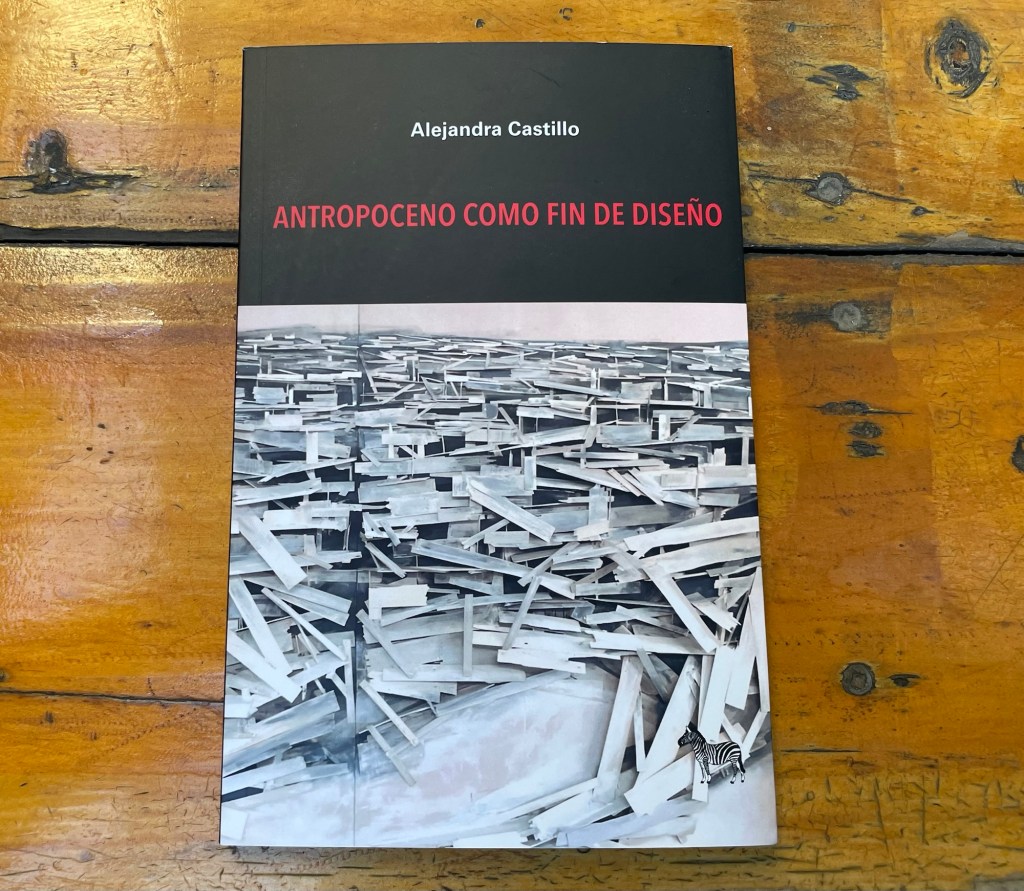
Only in rare occasions the operation of thinking finds angular or lateral points of escape. This is the gesture that characterizes Alejandra Castillo’s theoretical writing, and is particularly bright in her most recent book Antropoceno como fin de diseño (La Cebra, 2025). The zigzagging entry is an intuition that is also a guiding thread: the force of real subsumption of capitalist domination depends on the operation of design. Of course, in design one hears not only blueprint and form, but also designation, and thus the specular regime of visibility, orderability, quantification. It is the world of physiocratic forestry. In fact, Castillo’s succinct definition of the metapolitical condition of design is offered to the reader at the entrance: “Design is the figure that thinks always in advance (por adelantado) (Castillo 12). Design calculates and locates. It is through the operation of design that legibility becomes adequated to political representation so that the state can manage and attenuate the deployment of its forms and the circulations of relations of totality (Castillo 13). The design is what is common to the worker, the engineer, and the lawyer. This is why design for Castillo design is an efficacious nexus that connects the separation of objectivity and the life worlds. Understood in this sense, “design” is analogous to the enframing of the world that intensifies in the age of technology and rhetoric. But in the watershed of the end of modernity, the hegemony of design collapses, while it becomes a temporal “self-design” submerged in all spheres of expressive enactments. 

The end of the second vector of the zigzag outlined in the essay is found precisely at this conjuncture: the anthropocene brings the humanist projections and design to a final wreckage. This is means that capitalist form is not formless because it has managed to subsume the time of life as exception to labour; time is a wreckage because design no longer coincides with the world of forms, as it has temporalized experience into total transparency without reminder. For Castillo this means that in the anthropocene there is no longer “struggle for visibility”, as everything has been rendered exposed and hollow; de-substantialized in the very fabric of subjectivity (in the early millennium some called this new hyperbolic figure the Bloom). Implicitly in Castillo’s writing is the assumption that the mediation between politics and design has been severed, and the new securitarian imperium can only immunize itself against the very site that in modern times granted its legitimacy (civil society, constituent power) (Castillo 37). 

The end of design means the absolutization of design, a new carceral imperative for adaptation that makes any claim to subjectivity an endorsement of the prison of the ego. To live in a post-designed unworldly condition means not only to come face to face with the homogenous space of cultural exchange into image; it is also a new imperative that requires that “you must submit, without knowing to what; subject to what is the case anyway, and which, as a reflex to its power and commonsense, everyone believes anyway” [1]. The end of design paves the way for new plastic forms of domination towards an integral planetary unity. 

Bordiga claimed throughout his work that the democratic design was perhaps the best fitting system for the versatility of capitalist accumulation and relentless expansion. This is why in all the political cases that Castillo introduces in a text in a manner of a shadow play do not pretend to offer a new theory of ideology, but rather show how democratic design is a one-piece suit that fits all without any needs for “ideal types” to fix normativity and institutional arrangements. Indeed, there is no longer anything like an “extreme political right” – and this is just a tweak from Castillo’s vocabulary, who does insist on the term throughout the essay – but rightward figures of the political that desperately cling to any form to distract from the abyss of social legitimation. Ultimately, the ruling over this void will be  – in many ways already is – the continuation of war in the social fabric; and stasis will require new stealth development of technologies of containment that Palantir’s Alex Karp has called the new “lethal form”. This means that democratic design is not only expressively a system of sentencing to death; it is in virtue of the exchange of social forms, an inverted negation of human finitude. The point of despair would incite some to look again in the cabinet of forms; a knee-jerk reaction to the irruption of the Anthropocene against the total sum of possible designs. 

Of course, this is also what Alejandra Castillo’s Antropoceno como fin de diseño (2025) avoids at all costs. Towards the last pages of the book, Castillo calls for a transformative turn that departs from the body; a corporeal insurrection that, in refusing the rectilinear and heteronormative political corpus of the modern epoch (no coincidence that Hobbes was both the founder of the autonomy of civil as well as of the physics of the body of matter in space), is capable of responding to the call of the anthropocene in all of its profuse conflictivity. Castillo proposes the necessity to gravitate towards a “maximum distance” against the general design of orderability of public domination (Castillo 77). But this can only be understood as an incommensurable distance that dissolves the ontotheological separation of subject and object of the state of confinement.

The political constitution of a corpus appears as the promise of an exit from the temporalization of the post-auratic literalism that, according to Michel Fried, dominated the structure of the object-oriented work of art, as compensatory to the corrosion of political forms and presentist autonomy [2]. Castillo does not seek to revive a last gasp of auratic objectification, which amounts to the sleepwalking condition of the image world of mere survival. In soliciting a maximum distance to what is closest (in fact, a body), Castillo invites us, as both promise and commitment, to think at the end of nondependency – not the “independence” that carries the traces of the fictitious individuality- from the crutches of design to finally conquer another liberty beyond terror and prevention; a life imbricated in the nonbeing of place (ecology) with others.

Notes 

1. Thedor W. Adorno. “The Cultural Industry: A Resumé”, in Without Model (Seagull Books, 2023), 58.

2. Michael Fried. “Art and Objecthood”, in Art and Objecthood: Essays and Reviews (University of Chicago Press, 1998), 172.

Pindar’s Fragment 180. by Gerardo Muñoz

Understanding what the ancient Greeks thought of sayability in language is no easy task, but in Pindar’s Fragment 180 we can confirm that the use of language must come to terms with the internal lacuna of silence. Pindar says as a way of recommendation: “Do not break out useless speech in front of everybody; there are times when the path of silence is most trustworthy, but lofty discourse holds the sting of domination” [1]. Although this fragment has been read as a form of “prudential speech”, it might be more interesting to read it as a form of the inception of the sublime in language, which Longinus, although not referring directly to the same fragment, inscribed it under the idea of being ‘tongueless’ or aglossīa, which like Ajax’s silence says significantly more in its restrain than from saying something directly. Language becomes useless – that is, it ceases to have any use with itself – if it becomes a tactic to diminish any given rhetorical order. It is no surprise that in our time the predominant use of language takes the form of a transaction through technical terms that has no use of its own. 

It has been shown that Pindar’s conception of language was not about representation, but rather about the voice or kompos that takes place whenever there is vibration or harmony in the collision or contact between two objects [2]. Of course, the truly originary collision in language is between the voice and the idea, where the cradle of language opens to its own poetic and ethical possibilities. Hence, if there is restraint and silence as constituent of language, it is because there is a rhythmic movement that accommodates without the intromission of an external force. Here, it is the well known definition of poetic creation that Pindar lays out in “Olympian 6”: “Upon my tongue I have the sensation of a clear-sounding whetstone, which I welcome as it comes over me with lovely streams of breath” [3]. What carries those streams of sounds?

The poet is not an independent creator with higher access to language; the poetic instance is only accessible to those who, in contact with inspiration, can sharpen their tongues to the use of one’s language. We are in language when we find ourselves in the direction of a “path of words” [4]. Thus, the contact of language is not with objects or entelechies of the visible world, it is first and foremost with the receiving movement of the voice as a “lovely streams of breath”. In this way, Pindar’s plea for silence is not to be understood as an active negation of “saying”, but of an internal lapse or suspension of language that allows the emergence of the truth of the voice. The absence of kompos turns language into an instrument that can only prepare and foment conflict and domination, seeking to overcome something that is ultimately captive of the common ground of an uninspired language. And this means that language without inspiration is not only a voice that has run astray from its rhythm, it is also a language that will only find war in its path. 

Notes 

1. Píndaro. “Fragmento 180”, in Obra completa (Cátedra, 2023), 410. 

2. Helga Kriegler. Untersuchungen zu den optischen und akustischen Daten der bacchylideischen Dichtung (Verlag Notring, 1969), 90.

3. Píndaro. “Olympian 6”, in Obra completa (Cátedra, 2023), 90. 

4. Píndaro. “Olympian 1”, in Obra completa (Cátedra, 2023), 90. 

Hypocrisy as last refuge. by Gerardo Muñoz

In an entry of Dopo Nietzsche (1974), Giorgio Colli states that after the overcoming of all values and taboos, the contending moral strife finds its highest value in hypocrisy. Colli goes on to say that “hypocrisy is the last bastion where moral forces have found their refuge” [1]. One can clearly see that for Colli hypocrisy as the highest value is quite distinct from morality, since it is the “refuge” where the contending moralities invest themselves in rhetorical encroachment. That hypocrisy has become – as Colli saw with clarity in the 1970s – the last alcove of humanity, means, for one thing, that the human species have ceased to have any faith in the language that they use, and that for this very reason there is only an estimation of rhetoric, procedure and technical terms abstracted from the sensible world. If understood as such, it would come to no surprise that the majority of public institutions in advanced societies are embracing, and for the most part promoting, the incorporation of Artificial Languages and Intelligence to organize the interactions of their lives. Ultimately, the order here is clear: it is not that new technological advances will lead to a rise in untruthfulness; rather, these instrumental mutations are a consequence of the deep hypocrisy that runs through the social bond.

In fact, one can only assume that Colli was pointing at something more profound and obscure in his gloss when he referred to hypocrisy as the last refuge, and in this sense he was pointing beyond Nietzsche. After all, Nietzsche understood hypocrisy as mimesis and appearance that if incorporated over a long period of time ceases to be hypocrisy to become real [2]. A series of good acts and deeds in the spirit of friendship makes a person benevolent. In the same way that Miguel de Unamuno’s San Manuel Bueno Martir through his public faith and habits, was a symbol of Catholic faith for all the believers of his tightly knit community in spite of his interior doubts (this is the Knight of Faith). Now, Colli is pointing to a second degree hypocrisy that is no longer explicated by mimicry, but by its dependence to an ethereal value that governs and justifies any set of given actions. The actions are no longer in relation to faith or non-faith, but are properly acts of “bad faith”, since they make belief captive to the justification of the highest moral value. This will be consistent with Nicola Chiaromonte’s description that the end of secularization is not an epoch lacking faith, but one that dwells in “bad faith”. 

And what is ultimately “bad faith”? It is the realm of hypocrisy that, due to its impossibility of communication, understands its mission waged on the petty negation of one value over another. It is a mutation of Goethe’s nemo contra deum nisi deus ipse into the sphere of prevailing forces. The civilizational stage of enlightened hypocrisy prepares the human being to renounce the use of language and unmediated appearance. This means that the triumph of the technoadministration of the world would not be possible without the alluring refuge of hypocrisy that conquers reality through the very means that renders inaccessible the real presence of the world. It is not that politics and politicians have become hypocritical; it is that politics can only subsist thanks to its refuge in hypocrisy. The hypocrite is the last figure that steers in unworldliness.  

Notes 

1. Giorgio Colli. Dopo Nietzsche (Adelphi Edizioni, 1974), 50.

2. Friedrich Nietzsche. Human, All Too Human (Cambridge U Press, 1996), 39-40.

Commentary on Monica Ferrando & Michele Dantini’s dialogue on painting and theology. by Gerardo Muñoz

The fourth issue of the journal De Pictura (Quodlibet, 2024) has just been published, and among a dozen of illuminating articles there is a very substantive and rich conversation between Monica Ferrando and the art historian Michele Dantini on theology and painting that solicits required attention, and that I can only emphatically recommend. As the very title suggests, the conversation is about the unity (and posterior historical divorce?) between painting and theology in the Western tradition, but it is also about another problem that never goes out of fashion, if ever rarely attended by a handful of scholars: mainly,  the light of the genesis of modernity vis-à-vis the aesthetic mediation with Antiquity. (Is it fair to say that this is an undeveloped path in post-Nietzschean thought? For now this is a broad question that we can only bracket, and it is needless to say that Ferrando’s own work already amounts to an indispensable barrister to take up this very concern). Be it as it may, there are two problems that I want to flag from this conversation — these are idiosyncratic concerns, as perhaps all attempts to condense a vast area of study obviously are. 

First, there is an important moment in the exchange where the problem of “perfection” is discussed as a watershed schism between the politics of representation in the wake of post-Renaissance development of painting. A notion of “perfection” that derived from the theological sphere was unequivocally different from technical mastery; it was understood as a problem of distance and proximity of pathos inherited from the great tradition of Antiquity and its canons of beauty and virtue. How else to read Poussin’s one of a kind theory of the modes of the Ancient in his famous letter to Chantelou? Of course there is also Hölderlin’s gaze towards the Greeks and Pindaric poetry decades later in the dawn of the nineteenth century only to succumb into madness. The theology grounding distance is the condition of possibility of ‘aura’, but also what Ferrando, at the highest point in the conversation, superbly defines as: “…pura della differenze temendo di riconoscere e irriducibili” (137). The liquidation of perfection into mastery of the “work of art” (and perhaps work should be overly stressed, which is linked to all the metaphysical dispensations over creation) implied that “distance” would become standardized, homogeneous, autonomous to regulated form, and finally absorbed unto the objecthood of creator and spectator in the coupling the force of secularization. Whether it is the vicarious image of the Hollywood spectacle, or the factorization of the socialized art object in the Russian avant-garde, the movement towards absorption is one-directional and open to the validity of an external justification of truth. 

What I find interesting is that the emphasis on perfection allows us to say that painting clearly put into view the history of an error about representation and its negation. As it has been noted, in the outset of Protestantism – for instance in Noa Turell’s excellent Living Pictures: Jan van Eyck and Painting’s First Century (2020) – there took place a new struggle over representation of perfection oriented towards “bringing painting into life”. The Northern superiority hinges upon the effectual perfection of a new legibility of the world that suspends the distance between thought, hand and the idea of pictorial praxis. The valorization of justified truth in perfection is paid by the occlusion of the truth of unintentional appearance. And the consequences are catastrophic: Ferrando at one point claims that the painting is about retaining the invisible; an argument that she has also displayed in relation to Poussin’s landscapes in her L’oro e le ombre (2015). In other words, the development of the dialectical autonomization of the very unit of pictorial space is integrated only be rationalized as an obstacle to be wrestled with and eventually overcome (an endpoint being Jackson Pollock’s outpouring of the line into a vanishing mist over white space). Prometheus unbound. Indeed, über die linie.  The “farewell to modern painting” (so elegantly trumpeted by T.J.Clark at the turn of this century) remains right on track with the only caveat that it did not began in the “age of the machines”, but at the outset of the secularization polemic over the impasse of the responses to the crisis of transcendence and the eclipse of myth.

Now, the second point can be stated briefly: the extension of autonomization implied turning away from what the tradition has offered; especially a tradition that is “pre-historical”, according to Ferrando, since painting is previous to historical consciousness and not the other way around (painting is always without a grounding principle). In the words of Stevens, this tradition can be understood as the “love ascending the humane” that attests to the authenticity of what appears-there in the disclosure of the world. A definition of painting emerges here, although not pursued in the dialogue between Ferrando and Dantini. However, for Dantini this means that the whole history of art / pictorial representation needs to be rethought and reorganized and possibly returned to its proper theological sphere. Of course, it will depend on how we understand the vertical axis of theology converging with the horizontal axis of appearance.

A counterexample here comes to mind, a sort of historical false exit: the Baroque, as a post-Renaissance paradigm of response to the crisis of the erotic and pagan image of the Renaissance paid the price of its exuberance, elliptical contortion, expenditure, and ornamentation through a reified and excessive field of self-ordered theatricality. As shown by the exemplary study of the Jesuit discipline in light of the modern state, La política del cielo: clericalismo jesuita y estado moderno (1999) by Antonio Rivera, the ascesis of the counterreformation Company required the split between director and practitioner that already presupposed the modern autonomization of spheres of signification. The baroque supra-theology (imago naturans notwithstanding) was also a reified theology whose anxiety about annihilation and total absorption of the community of the faithful would further drain the invisible outlook of the theos. Or to use the image favored by Carlo Michelstaedter: “the lamp burns out by the insufficiency of oil, but it drowns by having too much oil”. It is no coincidence, then, that the polarity of absorption and theatrically, used to understand the revolution of French modern painting, can only bring to life anything and everything under the sun of pictorial representation except its own sense of distance between appearance and what always remains unfathomable in the world.

The gardening of the soul. by Gerardo Muñoz

There is an untimely moment in Saint Teresa de Jesús’ Oraciones where she speaks metaphorically about her soul as a form of a flourishing garden. It is a description that also advises of a potential risk of the devastation of the garden; as if more than a locus amoenus, what is at stake is a sort of ethical activity that must be retained and nourished in prolonged periods of unexpected danger. We read in the Oraciones: “Y considerar el ser mi alma un huerto, y al Señor que se paseaba en él. Suplicábale aumentase el olor de las florecitas de virtudes, que comenzaban, á lo que parecía, á querer salir, y que fuese para su gloria, y las sustentase, pues yo no quería nada para mí, y cortase las que quisiese, que ya sabía habían de salir mejores. Digo cortar, porque vienen tiempos en el alma que no hay memoria de este huerto; todo parece está seco, y que no ha de haber agua para sustentar, ni parece hubo jamás en el alma cosa de virtud” [1]. The topic of the garden and gardening, as we know, was central to the culture of medieval monasteries, as anyone knows who has seen these places all over the Mediterranean world, and that today many of them have been turned into high-end hotels for global tourism. 

The monastic garden was both a site but also a nonsite, a sort of chorā that, as the Saint Pacomio (286-346) would write, it was the place where one could be closest to God, and where existence could experiment its true grace and happiness [2]. And what are the company of the gods of place if not the very nameless fleeting instance of our free relation with the world? This is the index of the ethical nourishment that has been entirely lost.

There is little doubt that Teresa was also conscious of the theology of gardening that her predecessors wrote, such as Walafrido Strabo’s Hortulus (840), which was undoubtedly the most important treatise on horticulture of the monastic tradition during the middle ages laying down the principles for a flourishing seasonal harvest. Like the abbess Hildegard von Bingen centuries before her, for Teresa a comprehensive understanding of “sickness” was not just a question of biological maladies of life, but more fundamentally an existential problem that must be cultivated like a gardener keeps a parcel of land flourishing like a transfigured memory of Arcadia. A space of shade and a surrounding for breathing. 

Santa Teresa extends the metaphor when she tells us that there are dark times where the garden is drying up; and, in fact, the soul itself could entirely forget that there was a garden. It is all too simple to say that this dried soulless wasteland is a mirror image of our epoch, where it becomes obvious that in the name of “ecological” administered apocalyptic time, we are entirely uprooted from any possibility of nourishing our garden. In fact, what just a few years ago seemed like exceptional and arbitrary measures of confinement, social distancing and artificialization of the human community, it is now clear that it amounts to not just the absorption of the world as such (this was already the project of formal capital), but rather the destruction of the ethical dimension of the non-world that binds us, at a distance with what remains outside of it.

Even Carmille Pisarro’s “Two Young Peasant Women” (1891), at the shadow of nascent industrialization, now seems to us as dumbstruck by a deep sense of acedia (disconnected and mute) foreshadowing the forthcoming vanishing of their life-world. After all, the aim of the machinist is to make the world soulless, said Landauer in Skepsis und mystik (1903). We have lost all space but we must conquer the chorā, which allows us to cultivate, once again, the soul against all expectancy of programmed obsolescence. Teresa’s huerto del alma persuades us in the stray direction that some, in reality, have never left. 

.

.

Notes 

1. Santa Teresa de Jesús. Obras de Santa Teresa de Jesús, Tomo I (Libreria Religiosa, 1887), 12.

2. Peter Seewald & Regula Freuler. Los jardines de los monjes (Editorial Elba, 2019), 99.

Tradition according to Wallace Stevens. by Gerardo Muñoz

The fact that there is a continuous and secret communication between painting and tradition is something that has been registered in the genesis of myth well into aesthetic autonomy of modernity and the artificious equivalence of difference that regulates the temporal caducity of the new [1]. In a specific sense, the crisis of tradition in the contingency of the modern has the activity of painting as a privileged site because it holds the outside together in a perpetual unveiling; as if the human species were permanently exiting the shadows of the cave every time a hand strokes an animated brush over a surface. Painting clears the site of the inaccessible so that true life can emerge without the crutches of incorporated scripts of social organization. But what could it mean to think of ‘tradition’ in a painterly manner? In a poem of 1945, unequivocally entitled “Tradition”, Wallace Stevens seems to offer a response and an outlook for our consideration. 

In a conversationalist style, Stevens thinks that tradition is an uncontrolled question insofar as it can only be assessed through poetic form. Of course, for Stevens the character of tradition could not be grasped neither in a compilation of well delineated forms nor detailed through “a set of laws…to identify it is not tradition” [2]. As it was for Hölderlin’s practice relation to Greek antiquity, tradition is something that is always missed or unfulfilled from its uttermost strangeness. It is, as he asks in the fifth stanza “an unfamiliar sum, a legend scrawled in a script we cannot read?” [3]. The illegible transcription of what is passed as tradition holds to the incommensurability between what remains unfamiliar and what is already familiar and perceptible. We must resist the attempt at disambiguation, since any relation to tradition must be anachronistic as Nicoletta Di Vita has suggested [4]. Thus, for Stevens “tradition is always near”, at hand. And the hand calls forth the mystery of painting. It keeps a world at the threshold of the verbal. The placement of nearness, however, will be on the side of formlessness that characterizes the genesis of one’s existence. In other words, the true task of approaching tradition is neither at the level of the construction of forms nor about the analogical pairing of historical evolution; it is the painterly relationship between life and the experience in the world that precedes and outlives the time of life. This is what Stevens will denote a “ascending the Humane”; meaning a life qualified by fulfilling the adventure of a destiny that is capable of addressing the outside. In the most emphatic verses of “Tradition”, Stevens shows his absolute nearness to what he has in mind: 

“Ascending the humane. This is the form 

Tradition wears, the clear, the single form,

The solid shape, Aenas seen, perhaps,

By Nicolas Poussin, yet nevertheless 

A tall figure upright in a giant’s air.” [5]. 

The use of “form” in the first verse is most definitely mischievous, but it is also the playful ambiguity that Stevens wants to bring to our attention. One way to read it is to circle back to the sense in which the painterly becomes the utile passage between life and world. After all, tradition “wears” the dress of nature, although this is only facilitated by the sensible activity of painting. Exactly a decade later in the essay “The Whole Man” (1955), and speaking directly to the rise of cybernetics and technico-political technicians that had consolidated their mastery over the events of the world, Stevens will suggest that “Modern art often seems to be an attempt to bridge the gap between facts and miracle…to succeed in doing this, if it can be done at all, seems to be exclusively the task of the specialist, that is to say, of the painter” [6]. Why the painter and not the poet? At a very general level, the two figures are interchangeable; however, if one takes the painterly mediation, it becomes possible to claim that painting has a more subtle expressive footing in showing the nearness of tradition.

Painting is the non-language that  gathers the formless tune of tradition: “The vigor of art perpetuates itself through generations of form. But if the vigor of art is itself formless, and since it is merely a principle it must be, its form comes from those in whom the principle is active, so that generations of form come from generations of men. The all-round man is certain to scrutinize form as he scrutinizes men, that is to say, in relation to all past forms” [7]. Thus, for Stevens the possible tradition is that which creates a space in which a new life can take place in the world attentive to the transmission of forms. Of course, not any world, but to “live in the world but outside of existing conceptions of it” [8]. This is why Steevns will differentiate between two modalities of the task of poetry: the poetry of rhetoric and the poetry of experience; favoring the second because of how it folds our existence within the given order of space and time. 

Is not painting, precisely, a frozen instant in the spatial and temporal coherence that reveals, in turn, a hidden harmony that never fully coincides with nature nor stands in opposition to it? [9]. This is why “tradition wears” but it is also the transitory body of Aenas, which Stvevens inserts in the poem as a matter of ut pictura poesis in relation to Nicolas Poussin’s “Venus presenting arms to Aenas” (1639), which is ultimately the story of the persuasion unto one’s destiny. As it is well known, Poussin captures in a sequence Aenas being directed to his destiny invested in the arms of war. But where is destiny embodied for Stevens? Is it in the gesticulating figure of Aenas or in floating Venus that occupies the central sky of the landscape? It is almost as if Stevens acquired, as Walter Friedlander said of late Poussin, a “sublime vagueness” in visibility of the inner workings of imagination drifted from the physical imbalance of the activity of imitation [10]. 

After all, for Stevens Poussin stood precisely as the source of partition and the miniscule, confirming the primacy of “imagination” against the rhetorical compression that renders legible the modern abstraction [11]. Following André Gide who had had written on Poussin’s work, Stevens repeats without any elaboration that Poussin is to be taken “little by little” (peu à peu), so that only then its pictorial absorption can unfold against what at first sight appears as a theatrical and self-enclosed translucid stage. This is the distant ‘traditionalism’ that Stevens wanted to reject if the work of art was to endure, and still have the vigor to generate a tranquil and peaceful state of mind solicited by the late Poussin. Painting could only be expressed as a ‘mode’ — which for Poussin stood for moderation and restraint, but more importantly as the condition of a certain sensible order “by which the thing keeps itself in existence” both firmly and invisibly, that is, beyond enunciation [12]. Otherwise, as Gerald Cohen once claimed, tradition becomes the thing that you can only hold on to when it has relaxed its hold on you ceasing to color the genesis of life [13]. And while tradition cannot be fully absorbed by rules or forms of pictorial depiction, it does retain the “good that we have loved”, dispensing a noeud vital in which the divine (theos) disengages us from the compression of objective reality and into the nearness of the eternal. This is the integrity of painting that allows Stevens to proclaim the ascendance of the supreme human “good”: tradition is kept alive by the soul of an erotic deification. After all, “God and imagination are one” Stevens will suggest in the fragments of Adagia [14]. Against the edifice of sedimentation and rupture, repetition and originality, possession and abstraction; tradition will name the disembodied genesis of appearing between things in a “reflected seeming-so”. 

Notes 

1. Gianni Carchia. “Per un’estetica dellainvecchiato”, in Dario Lanzardo, Dame e cavalieri nel Balon di Torino (Mondadori, 1984).

2. Wallace Stevens. “Tradition”, in Collected Poetry and Prose (Library of America, 1997), 595-596

3. Ibid., 595.

4. Nicoletta Di Vita. Il nome e la voce (Neri Pozza, 2022), 28.

5. Ibid., 596.

6. Wallace Stevens. “The Whole Man: Perspectives, Horizons”, in Collected Poetry and Prose (Library of America, 1997), 874.

7. Ibid., 875. 

8. Wallace Stevens. “From Adagia”, in Collected Poetry and Prose (Library of America, 1997), 904. 

9. Monica Ferrando. “L’ultimo quadro di Poussin”, in L’oro e le ombre (Quodlibet, 2015), 82.

10. Walter Friedlander. Nicolas Poussin: A New Approach (Harry Abrams, 1964), 82.

11. Wallace Stevens. “Tradition”, in Collected Poetry and Prose (Library of America, 1997), 737.

12. Cited in Étienne Gilson’s Painting and Reality (Cluny Media, 2020), 173. 

13. G. A. Cohen. “Rescuing Conservatism: A Defense of Existing Value”, in Finding oneself in the other (Princeton U Press, 2013), 155.

14. Wallace Stevens. “From Adagia”, in Collected Poetry and Prose (Library of America, 1997), 914. 

Living among the gods. On Monica Ferrando’s Arcadia Sacra (2024). by Gerardo Muñoz

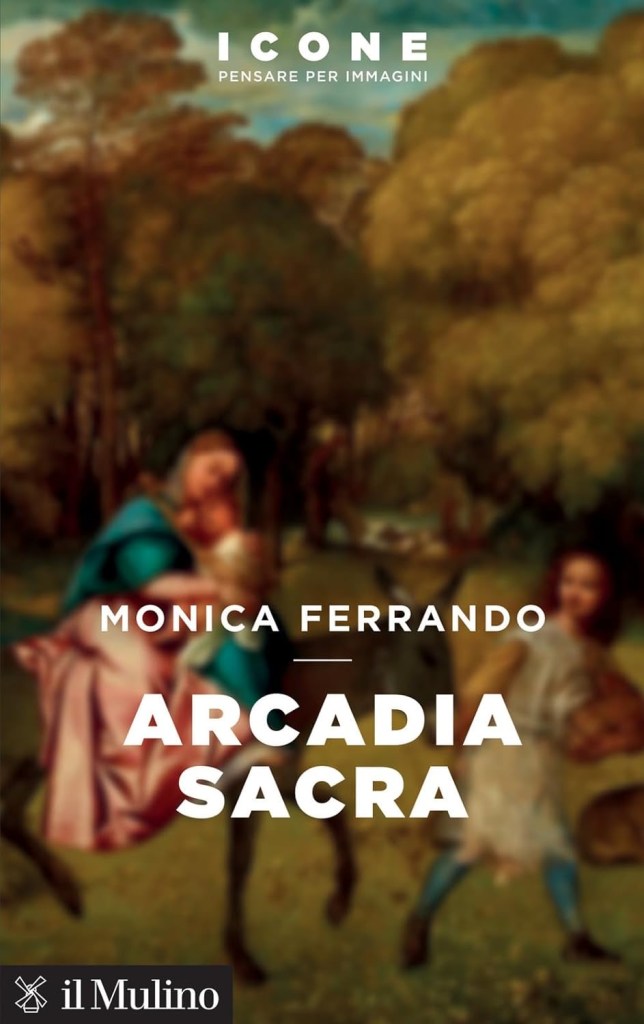
For anyone familiar with the delicate thought of Monica Ferrando, the short book just published, Arcadia Sacra (Il Molino, 2024), makes it impossible not to read it in light of her the two previous works, the ambitious Il regno errante (Neri Pozza, 2018) that reconstructs the political paradigm of the nomos of Arcadia, and L’elezione e la sua ombra: Il cantico tradito (2022), which brought to light the corrupted meaning of a theopoetic understanding of “election” and its appropriation by an effective economic theology apparatus that governs over the destiny of the modern edifice. Arcadia Sacra continues Ferrando’s highly original reconstruction of the unforgettable myth of Arcadia within the obscure setting of secular  modernization in which painting itself has come into crisis to the point of utter obsolescence. We might be the first epoch in the history of humanity (or even prehistoric, since painting goes back to the non-original origin of the caves, as Ferrando has argued) in which painting itself is lacking and almost non-existent [1]. And although Ferrando does not allude to the present directly, it goes without saying that by choosing as her focal point Titian’s early picture “The Flight into Egypt” (1508), the vision deployed in the essay can only speak to us as urgently, where the thematics confronted by the Renaissance of Venetian painting returns to our present in a fractured flash: imperial conflagration, unlimited deployment of force, usurpation of territory and  multiplication of legal checkpoints, and the accelerated disconnection between architecture and nature, color the ongoing devastation of the vantage point of the landscape now eclipsed by the radiant artificial confinements of the contemporary metropolitan designs.  

Already during his postwar years in the United States, Theodor Adorno observed how the unbounded sadness of the American landscape has nothing to do with an inhuman romantic sublime; it was rather that the landscape feels as if it bears no traces of the human hand [2]. If Americanism configures the long lasting night of planetary nihilism; this is so, not only due to capitalist subsumption and production of human life, but fundamentally because of the inherent obliviousness of the  landscape that forecloses dwelling in the world. But the myth of Arcadia, as Ferrando will insists, is no utopia nor crafted rhetoric (the bucolic genre as an aesthetic compensation to the normative grid of the social bond); it is also the question about the earthly ground of existence, and the necessary attunement with the things that have been domesticated into order of the metaphysics of idolatry and objectivity (Ferrando 28). In this sense, Arcadia does not name another world to come; it is a world that has been registered many times, reappearing whenever the hand reaches out in proximity as if caressing the landscape’s skin.

The mytho-poetical deployment of Arcadia returns amidst a world in conflagration, and for Ferrando this has fundamental political implications insofar as it shows a way out from the grammar at the service of force and political dominion of commanders and soldiers – which is always already exercised as legitimate to coerce and to become a tool for the regulation of abstract mediations – into the voice of poets, painters, and shepherds (Ferrando 51). Arcadia reveals that the human species is a ductile animal that can sense by the ability to touch and use. This is why Arcadia stands as a third space outside the political dichotomy of empire and republicanism, between the struggle of usurpation and conquest, and the techno-political administration of common goods of social distribution and institutional delegation. The abstract humanism of the Renaissance, as Heidegger once claimed alluding to Machiavelli’s political thought, is also the commencement of a specific political technology rooted in certainty and justification that can only conceive representation as the ground for the production of an “effective truth” [3]. The virtuous homini militari of the Italian city states anticipate the neutralization of force as legitimate rule that will prepare the stage of modern political realism based on fear and normative rule of law. The final efficacy of force is to transform the sense of the world into a mere object, as Weil clearly understood it in her essay on Homer’s Iliad. One of the key insights of Ferrando’s Arcadia Sacra (2024) is that it shows that, parallel to the revolution in political technologies taking place in Renaissance Humanism, the image of Arcadia was being rediscovered in treatises and paintings in order to remain faithful to a different attunement of the nomoi, in which the philosophy of history of sacrifice, endless civil wars, and destruction of the Earth do not constitute true destiny (Ferrando 14). In an exoteric way – and it is so, because the craft of the painter is, precisely, depiction and figuration of the nakedness of what appears before our vision-  painters like Titian, Veronese, and Bellini, became witnesses to the acquiescence of the nomos mousikos, which far from soliciting the conceptual density of a theory of Justice; it registered the preeminent condition of poetizing nature of  living in the vanishing world. Indeed, it was in the musical nomos where the soul could establish the communication between exteriority and interiority within the gleaming order of things. 

If Heidegger in The Origin of the Work of Art suggests that the erection of work occupies the open space of this clearing; Ferrando will thematize how Boccaccio’s understanding of the Earth as radiantly divine was drawing upon the tradition of Arcadia will emerge as the pictorial space of the artists to disclose the vibrant sense of a necessary freedom (Ferrando 43). This means that living among the gods is not reducible to panentheism, if understood as oppositional to monotheism; rather, it was the opening to the event that gathered forms of life,  creations,  affections, and territories. In other words, there will always be gods whenever the world is not enclosed into the homogenous surface of a unified planetarity. And is not painting the quasi-originary activity of human anthropogenesis (the event of being in the world as such) the  sensible evidence that negates any conceptual and political translation directed towards action and justification? After all, painting is, among other things, the business of depicting mute things, as Nicolas Poussin famously claimed. 

But muteness must be qualified and expanded, since Arcadia is no asylum or final refuge of man. Titian’s “The Flight into Egypt” depicts a rite of passage, but also opens to a set of rhythmic connected activities that lead to the landscape. Thus, as Monica Ferrando reminds us, building from her previous Il regno errante, Arcadia is also the material experimentation of acoustic energy; music, or the the nomos mousikos, no longer guided by the command of political service, directed by attunement of the lyre and the syrinx, will speak the unwritten language of the human soul. Painting and music convergence at the nonsite of permanent formlessness. And it is rhythmic music allowing improvisation and experimentation that reimagines a different conception of the polis; a transfiguration of political life, in which the principle of civility in all of its complexity (citizenship, objective transference and negation, civilizational fortitude) will no longer articulate the principal axis of the human commonwealth. Neither a source of higher natural law nor a mere expansion of positive norms, the nomos of Arcadia for Ferrando entails: “inalterabile a unire intimamente musica e legge, entrambe  ágrapha, non scritte, se non nel cuore. L’interdipendenza tra modi della musica e nomoi della città, che sarebbe vano interpretare secondo un rapporto causale, trova nella stessa parola nomos un compendio inesauribile, ribadito nella Politeia: «Non si introducono mai cambiamenti nei modi della musica senza che se ne introducano nei più importanti nomoi della polis” (Ferrando 54). The separation of law from music – as Ferrando will say for poetry and philosophy in later pages – will ultimately lead to the moral struggle towards the rise of the fictitious (and whoever can impose it through their effective hegemony) against the emergence of the “love of thought” (l’amore del pensiero) (Ferrando 57). In this sense, the moralization of justice and its conversion into a specific historical grammar (lex scripta in the juridical apparatus) will ground the order of the polis in which the human will be absolutely sacred so that the sacred nearness between existence and the world – the atopia where the promise of happiness can take place – will vanish forever. As Carlo Levi saw clearly during the postwar years, the rise of the political administration of fear will coincide with the decline of painting as the source of being in liberty within the senses [4]. And, in our days, the historical termination of secularization can only be felt like an unending glacial interregnum (it is no surprise that Disney’s epochal blockbuster is precisely a defense of alienation of a cold being in a Frozen castle) in which the prehistoric reminiscence of the garden can only appear as an afterthought or mere representation, always out of reach, and viciously grazed by wild beasts before our own eyes.  

But seeing is already an exercise in prefiguration of a world that returns where painting stands as the medium for a mediation between the formlessness and the soul. This is why, above all, pictorial space is a privileged surface from which to flee our condition of unworldly inmates of our times. In a certain way, painting does not just bring to bear truth against the regime of calamitous fictions; it is also bears witness, as Ferrando states towards a high moment of Arcadia Sacra (2024), to the rediscovery of a new mental space that revives the attunement to a state of the world no longer reduced to the depredatory practices of civilizational extraction and consented servitude (Ferrando 77). The tradition of painting is not just a collection of forms and artistic conventions, but the ongoing concert that facilitates our movement (and being moved) towards happiness.

This is the promise of the itinerant Mary’s passive and inclined face in Titian’s early masterpiece. It does not come to surprise that for Ferrando, the mother dwells among the gods of peace, in contrast to the figures of the commander or the inquisitorial or priestly judge that monitor an endless narrative of intra-species civil war (Ferrando 63). It should not go without saying that at the same time that some contemporary scholars in the face of a historical crisis of legitimation attempt to revive the aura of the homini militari, the precepts of the ragion di stato and the technical virtues of the charismatic Prince; it has been the work of Monica Ferrando, in fully in display in Arcadia Sacra (2024), that invites us to turn to the counters of eros of painting that, almost stubbornly, transmit to us the infinite possibilities of life among the green blades of grass in Pan’s spiritual land (Ferrando 82) [5]. The sacredness of Arcadia resides in this unbounded exteriority that thanks to the mystery of the mother, is always commencing; and, having achieved happiness, it wants to know nothing about bring the world to conclusion. Beneath the arcana imperii (Rome) and the bylaws of the polis (Athens), the landscape of Arcadia remains a harmonious passage of our cohabitation.   

Notes 

1. Monica Ferrando. “Editoriale”, De pictura 3, 2020: https://www.quodlibet.it/rivista/9788822011643 

2. Theodor W. Adorno. Minima Moralia: Reflections on a Damaged Life (Verso, 2005), 73.

3. Martin Heidegger. Acerca de Ernst Jünger (El Hilo de Ariadna, 2013), 113.

4. Carlo Levi. “Paura della pittura” (1942).

5. I am thinking here of the works of several American  historians of political thought and  legal scholars in recent years that have mobilized efforts to restore a “neoclassical”, Renaissance centered political tradition, as a response to the crisis of modern liberalism. The most prominent list includes, although it is not limited to James Hankins’ Virtue Politics: Soulcraft and Statecraft in Renaissance Italy (Harvard U Press, 2020), Harvey Mansfield’s Machiavelli’s Effectual Truth (Cambridge U Press, 2023), and Adrian Vermuele’s endorsement of Renaissance imperial categories such as Ragion di stato, Lex Regia and the tradition of the Mirror of Princes, see his “Sacramental Liberalism and Region di Stato” (2019) and “The Many and the Few: On the American Lex Regia” (2023). The pastiche of this neoclassical investment made possible by rhetorical and hermeneutical deployments of instrumentalized myth, it is something that I have taken note of in “¿Revival de la tradición legal clásica?” (2022). Drawing a parallel to this classical absorption in American political thought, one could say that this is a reiteration of what Monica Ferrando herself has analyzed in her chapter on German Romantic Neoclassicism and the Winckelmann aesthetic project in her L’elezione e la sua ombra. Il cantico tradito (Neri Pozza, 2022), except now that it lacks aesthetic meditations (there is no Dichter als Führer), thus culminating in the direct exercise of applied executive force. 

On Cézanne’s pink stripe tablecloth. by Gerardo Muñoz

The title of the painting is “Still Life with Apples” (1894) housed at the Getty. Like many of Cézanne’s pictures of the 1890s we have a sense of immediately entering into an space warped by distance and nearness that lavishly seals the scene. We feel that something has taken place; after all these are pictures of an event, but only concealed to us. We are given the sense of that experience, which is the fundamental thing to depict for Cézanne. Now, if Clark is correct, then it is true that Cézanne’s still life painting was meant to annihilate the objectivity of the world through a study and stubborn simplicity; although simplicity never amounts to synthesis. On the contrary, what preserves sensation over absorption remains at a distance: this is the narrowing act of simplicity as a fact of style [1]. The depiction of appearance is a problem for Cézanne precisely because painting now stood (late nineteenth century), as Kurt Badt well observed, as the last metaphysical activity in the face of Western nihilism [2]. There is nihilism, an unbridled chaos – and thus painting aspired to accomplish a different form of order, a transfiguration through sense. A higher order subtracted from representation. Thus, the outpouring of sense was everything to Cézanne; nothingless than the attunement of the relationship between depiction and nature. Thus, nearness and distance stands a problem in the picture itself: what is most apparent is what Cézanne seeks to qualify through depth and singular brittle rigidity.

As he would write to his friend Émile Bernard: “In order to make progress in realization, there is only nature, and an eye educated by contact with it….I mean that in an oregon, an apple, a ball, a head, there is a culminating point, and this point is always the closet to our eye, the edges of objects recede towards a centre placed at eye level. With only a little bit of temperament one can be a lot of painter. All you need is an artistic sensibility. And doubtless this sensibility horrifies the bourgeois” [2]. This is Cézanne’s permanent struggle (a non-subjective position, that is, anti-Romantic) struggle: the impossibility to “realize” and to complete a picture as the heart of the mysterious vortex of the execution of depiction. This clears the entrypoint to the problem of the “last metaphysical activity in the wake of nihilism” that Badt consigns to the activity of painting: pictorial art can reveal the unrealizable in every work; but it is no less true that all works fundamentally have an asymptotic inclination to the potential of realizing the idea. The achievement of that impossible nearness attest to the achievement of painting (or to its consummated failure).

The unrealizable in Cézanne’s painting, however, is not merely indexing the unfinished gesture of the brush in a scene or a series of selected objects; rather it is the condition of possibility for entering into the world through a medial common existence between things, however fragmentary within the whole. The unrealizable dimension is never a conscious attempt for a spatial unity to be fulfilled; it is alienable by a stylistic reduction at the moment in which it ceases to belong to the painter’s cognition. This is why Cézanne’s pictorial project – more so than Pisarro’s anarchic affinities and political flirtations in the late nineteenth century – has radical consequences for an opening of freedom that is grounded on the senses (and what it means to be ‘free in the senses and the passion’, in each temperament), allowing experience to decompress the formalistic representational conditions of bourgeois civility. Indeed, Cézanne’s work – and the world it depicts, the opening towards things as a whole but through separation, having in common precisely alienability – does not aspire to be legible in the social, which is the ideal space of exchange and metaphorization, recognition and reification as image. The social is the limitless spatiality in which anything can enter, as anything can stand for any other thing. Or, to put it more concisely: painting seeks to let things be things in their interchangeable nature (without the anxiety over fixing an image of Nature).

Paul Cézanne. “Ginger Pot with Pomegranate and Pears” (1893), Phillips Collection, Washington DC.

Cézanne inadvertently knows that whatever fate in the wake of nihilism awaits “painting” (soon to be utterly destroyed and displaced by the conceptual and object driven monstrosity of the modern vanguard), the effort to “realize” in painting meant holding to experience of depth as the only guarantee of an existential freedom. Surface and depth will remain on the side of the insistence of an appearance without predicates proper to theatricality. Kurt Badt poignantly captures this in Cézanne’s “old age style”: “There is no longer anything in our sensory experience of seeing which corresponds to what thus becoming visible; what is shown nis rather the visible picture of the concept of freedom. For the thing common to all these forms of the “style of old age” is two-faced: negatively it is a ligeration from isolation and resistance, possibly a liberation to the serious gentleness of freedom” [4]. And gentleness means letting things be: the serene elevation to irreducibility, upholding them only in the proclivity of its contact; never fully absorbed by surrounding and revealing its state of harmonious composition. The task of depiction in painting is the impossible task- but the task nonetheless thoroughly achievable through the hands of the painter – of coming as close as possible to what has actually been experienced. Having affirmed (not necessarily achieved) something like a fate-like divine temporality in painting is able to ground worldliness as transcendent only to let it fall immediately after. And what fate is to character, for Cézanne ‘that which is preserved unchanged’ is the supreme tonality of the pictorial task realized by the restraint of the artist [5].

But precisely to depict immobility, the forever permanent, the befallen weight of the conatus essendi (what preserves itself as such), painting has to mobilize a minimum motion for the confluence of objects, planes, and emergence of depth. The pink stripe tablecloths that appear in several of the 1890s still life paintings with fruits can be very well taken as a multum in parvo of the declension in every realization. In a sense, then, the pink strip is a signature, as if were, of the gathering of things and depth at the price of unrealizing the closure of integral depiction. It is precisely the pink stripe in which it becomes realizable in a single brushstroke that the place of the line appears otherwise, crowning the mystery of painting as the clearest manifestation of a different musical order. It is the mysteriously nature of painting, which barely introduces itself as a line substitute for a color (the color of the tablecloth as a thing) that, while remaining visible to the viewer, cannot but reveal the invisible; that is, the temperament of the artist attuned to the muteness of painting, to say with Poussin. And perhaps this is the highest moment of depiction in the search for the “integrity” of “wholeness” that, in turn, grants the instance of the unconcealment of truth. A lace plotting what has already been validated in the irrevocable thereness of the most inapparent existence: an eternal state in the world.

.

.

Notes 

1. Maurice Denis. “Cézanne II”, The Burlington Magazine for Connoisseurs, Feb, 1910, 279.

2. Kurt Badt. The Art of Cézanne (University of California Press, 1965), 181.

3. The Letters of Paul Cézanne (Getty Museum, 2013), 342. 

4. Kurt Badt. The Art of Cézanne (University of California Press, 1965), 313-314.

5. Ibid., 161.

Hölderlin on the serene life. by Gerardo Muñoz


In a letter from the beginning of 1799 addressed to his mother, Hölderlin makes a sort of confession that fully illuminates (in a multum in parvo fashion) what he understood as a quiet or serene life. Or at least, it allows to grasp how he comes to envision it and towards what end. At first sight, what is striking is its bare literalness, too strange for a poet, and too mundane if it were not for its intrinsic lyricism. It is a lyricism that comes forth effortlessly, which speaks to the quality of its furtive testimony. Literalness is also described in its engagement with the world – and, more fundamentally, the sufficient condition for sense to emerge. This is the fragment in question (from Helena Cortés’ translation of the correspondence):

“No quise rechazar de plano para tener por si acaso una vía de escape, y sobre todo puesto que se ofrece a buscarme una plaza que consiste en acompañar a la universidad a un jovencito. Conocer más mundo (conocer el pueblo alemán le es tan necesario, especialmente a todo el que quiera convertirse en un escritor alemán, como conocer el suelo al jardinero) es al fin y al cabo la única compensación que me puede ofrecer una situación tan fatigosa, y lo alejado del lugar, que de todos modos muy lejos no puede estar de alguna universidad, me parece más ventajoso que perjudicial durante un par de años en los que aun no puedo contar con gozar de una vida tranquila entre los míos”. [1]. 

There is little doubt that the world disclosed here is well within the bourgeois interiority: there is economic calculation and anticipation. At this time Hölderlin was being offered the position of a preceptor to a university student. But there is hardly only this. There is also the affirmation of fleeing from what this world has to offer – and this means quite a lot in the early quarters of the Enlightenment. Una vía de escape – for Hölderlin the way out is not merely from economic hardship, but also the possibility to retain a certain knowledge that he dares to qualify as “of the world”: “to know the world, which is the only compensation to a fatigued situation and the remoteness of place”. Loss of fixity to place demands access to the world.

This is not your expected aesthetic education of man. The subject of the Enlightenment – its commitment to historical abstraction and the possession of aesthetic form as mediation to totality – prevails at the epistemic register at the cost of rescinding the dislocation from nature. By contrast, the knowledge implicated in knowing thy world should be like that of the soil with the gardener (pay attention to how Hölderlin inverts subject and thing: it is the ground that becomes accustomed to the gardener, and not the other way around). But at the threshold of the eighteenth century, Hölderlin’s “vía de escape” was also compensatory to the fatigue of a nascent epoch of the subject. The compensation did not entail an excess of knowledge; it was rather knowledge a way to disengage with the presupositions grounding the historical epoch.

This seems to me the operation at work in Hölderlin’s epistolary confession. Carchia was right in positing Hölderlin’s poetological aspiration of spirit and nature was entirely pre-Olympian, which requires subtracting himself from the modern parody of cultic romanticism [2]. A way out appears in cleared space when serene life is finally realized between friends; that is, among those that I make as friends (“los míos”). Poetry and making are here at their closest proximity cutting through the thicket of experience. This is what it means to know thy world. At the center of Hölderlin’s ethics there is a sense of distance – the waiting for a serene life in which language will finally gather itself unto presence. Ultimately, this is the plain literalness that the 1799 letter offers us.

.

.

Notes

1. Friedrich Hölderlin. Correspondencia completa, traducción de Helena Cortés y Arturo Leyte (Libros Hiperión, 1990), 467.

2. Gianni Carchia. “Introduzione” to Walter Otto’s Il poeta e gli antichi dèi (Guida Editori, 1991), 8.

Jesus as gardener in the landscape. by Gerardo Muñoz

A reproduction of Titian’s early work “Noli Me Tangere” (~1514) cannot do justice to its majestical prudence if contemplated directly on the walls of the National Gallery. To use the terms “majestical prudence” might be a bit of a misnomer, but at least it allows to be slide into what entails the central enigma of the picture: its underemphasized contours of the biblical encounter from John 20:15, in which the resurrected Christ appears to Mary Magdalene as a gardener. A lot has been made about the Giorginesque influence on the picture, but it seems to me that the underemphasized composition speaks to the real triumph of Titian’s masterpiece. This is a triumph achieved not so much through the imports of allegory and pagan motifs, but rather as a complex web of distances untangled in the picture: the distance between Christ’s gaze with Magdalene’s upward look, but also the solitary tree inclined leftward, which compensates for the downwards light jerk movement of Christ as he takes distance to escape touching.

I have said nothing of the deep and overpainted deep blue sea in the background; or the receding landscape in the distance with a flock of sheep, high grasesses, barns, and a modest castle to the upper right side of the picture. A little man walks his dog, and we guess he is moving towards the sheep. Or perhaps not. The underemphasized and inconspicuous composition of the picture is precisely in the formulation of distances; invisible distances that allows the gathering of proximity. Only in this minimalist case can the painting be described as giorgenesque. Herbert Cook in his monograph on Giorgione captures this balance by what he calls invisible threads: “Peculiar, however, to an artist of genius is the subtlety of composition, which is held together by invisible threads, for nowhere else, perhaps, has Giorgione shown a greater mastery of line.” [1]. This is also a fair treatment of what holds up the elements in Titian’s picture.

Now, the invisible threads in “Noli me Tangere” do not merely substantiate the networks of lines; rather they also bring the picture to a point of a distant presence. This is what we are able to perceive when confronted with the painting in the walls of the National Gallery. There is another more straightforward way of stating the same: there is something “earthy” to Titian’s rendering of John 20:15, and by “earthy” we attempt to point to point at the distribution of distances between earth, sky, and landscape. This also implies how bodies move in it. It does not take much to document it: one could start by attending to Magdalene’s merciful arm raising to Christ’s cloaked body, followed by his holding of the hoe, which immediately swayes us to the tree. Magdalene’s left hand on an ointment vase reinstates the dowards movement to the ground. The earthly character is the tension elaborated by these distances – a very modern sensation that we will not get in the later pictures of resurrection in the glorious skies of redemption, as noted by Erwin Panoksky [2]. The earthly deposes the relieves of both glory and incarnation. Titian wants to give us the picture of a resurrection in a world that passes by as it retains its tranquility, which painting can only provide us through a non-emphatic incorporation of its distancing.

This could very well account for the assumption that “Noli Me Tangere” becomes a decisive “stepping stone in the evolution of modern culture…from the Byzantine theology to Pantheism and spiritual freedom” [3]. The fact that Renaissance painting was absorbent to the pagan myths is something that has been studied by the major art historians of the twentieth century, so one could also take Richter’s thesis somewhere else. Pantheism is not about the symbolic restitution of specific iconography or motifs, but it is rather the exposition of a particular experience: Jesus as gardener services the disclosure of an unmediated world granted by the perception of distances. The mistaken perception of Jesus as gardener can only be understood, even if momentarily, as undoing the work of Adam, only to be resumed and “served” (ābad) by the Savior [4]. But this might be reading too much “meaning” into the picture, which is deliberately underemphasized in its avoidance to allegorical weight.

To any modern attentive observer, it becomes impossible not to bring into the picture the early modern dispute between gardeners and architects. This opposition does not justify Titian’s “Noli Me Tangere’”, but it does serve (at least it serves me) to insist on the open relation between gardening and the disclosing of an unmediated world, which stands as a theological idiom of the picture. It is most definitely a picture of a resurrected life that is only apprehended by the possibility of immersing itself in the rhythms of the invisible that pertain the world. So, we do not have to wait for the late mysterious and dark Titian to find a full coincidence between painting and thought. “Noli me Tangere ” seems to tell us that there is thought whenever there is earthy grounding in the bifurcation between bodies and things in space.

And so, we can return to the thin blue sea on the left side of the painting, which magically brings all the earthly elements to the forefront. It is the ultimate distance, as well as the unbreachable region where all elements converge (pay attention to the vegetation and the clouds literally becoming blue) sharply on the horizon. It is also the most emphatic instance of the picture; the lacunae that guarantees the masterful structure of invisible threads that ultimately pins its intimate proximity to natural dissolution.

.

.

Notes 

1. Herbert Cook. Giorgione (George Bells & Sons, 1900), 41.

2. Erwin Panofsky. Problems in Titian: Mostly Iconographic (NYU Press, 1969), 40-41.

3. George M. Richter. “The problem of the Noli Me Tangere”, The Burlington Magazine for Connoisseurs, V.65, July 1934, 10.

4. Nicolas Wyatt. “When Adam Delved: The Meaning of Genesis III 2″, Vetus Testamentum, Vol.38, 1988, 121.