Casa Bayona’s pensive slave. by Gerardo Muñoz

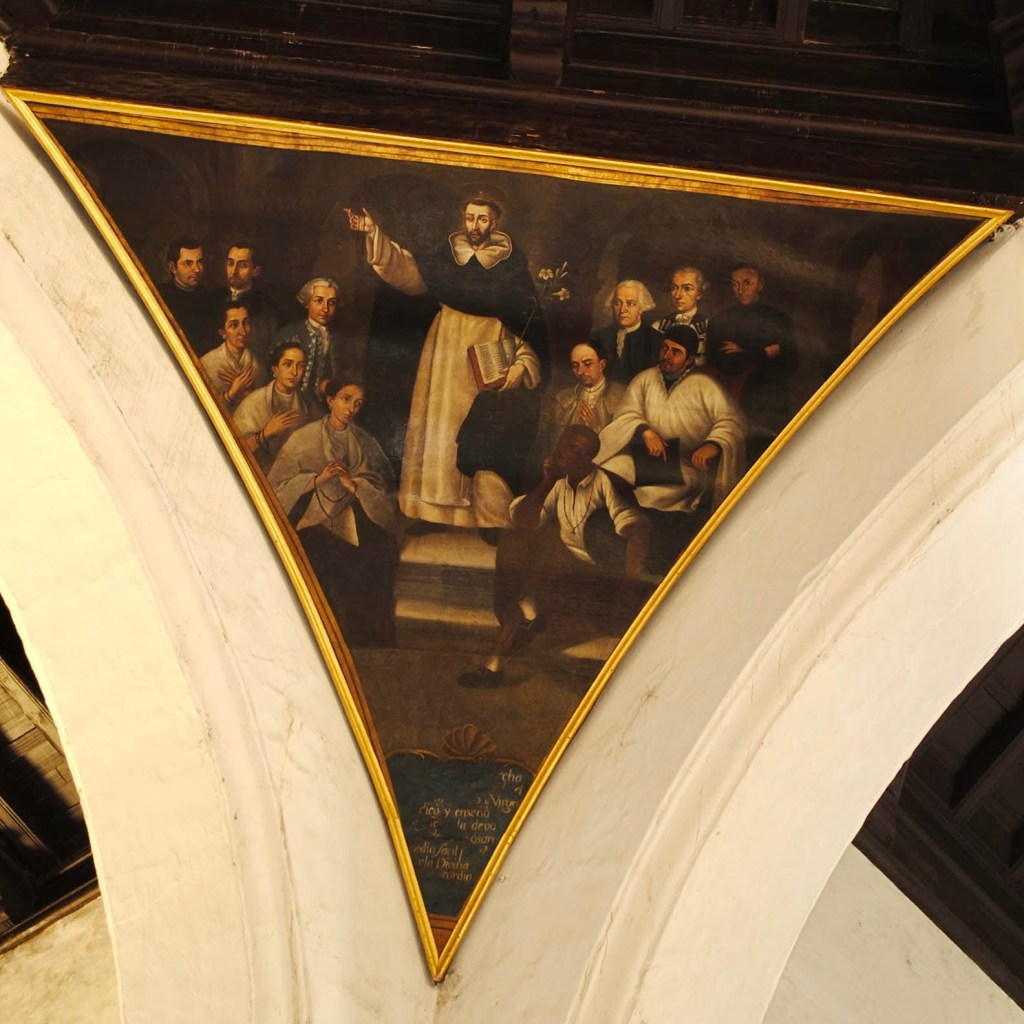
In the Church Santa María del Rosario of Havana there is a pendentive cycle completed in the 1770s painted by the baroque artist José Nicolás de Escalera – whom according to Guy Pérez Cisneros, was truly the first professional Cuban painter of the tradition – that includes a black slave in a pensive pose seating on a lower step, just below a Dominican priest who figures prominently in the middle of the picture holding a Bible and raising his right arm forward [1]. It has been noted that the figure of the black slave is also the first portrait of a slave in the New World, and its meaning has been highly disputed. The enigmatic slave or liberto portrait shows the man in a thinking pose, with a folded long white shirt, and what seems to be a wooden rosary hanging in plain sight. It is hard to make the details of his facial expressions, but it is obvious that his gaze is neither upwards nor directed at the viewer, but rather suspended, as if were, in a moment of attention and rest (and also listening?). The context here is fundamental, since Santa María del Rosario Church was commissioned by the Count of Bayona, a wealthy member of the sacarocracia (sugar plantation owner) after a previous church was burned to the ground by a slave revolt that took place in 1727 in an act of complete defiance to Christian indoctrination. 

The event that only has come down to us in just a handful of mentions and erasures of the colonial archive is featured prominently, as we know, in Manuel Moreno Fraginals’ El Ingenio when the historian documents the spiritual schism of the eighteenth century colonial plantations of the island. According to Fraginals’ historical account, the slave insurrection in the plantation took place in the wake of a theatrical enactment proposed by the Count of Casa Bayona in an act of repentance and humility aiming to mimic a well known moment of the Christian story: one day the Count washed the feet of twelve slaves, and when he finished he made them sat with him for dinner. Later that afternoon the slaves revolted and burnt down the whole sugar mill, including the chapel, to the ground. The episode ended with a plantation mayoral officer hunting down the runaway slaves, who was ordered to place the heads of the dead slaves high in spikes for the Count and everyone to see them [2]. It is an early staging of visibility and bodily dominion that the modern epoch will take to its final conclusion. 

The portrayal of human suffering was a symptom of the impossible hegemony of christianization of body and soul that the missionary Nicolás Duque de Estrada decades later will try to deploy in his pedagogical treatise Explicación de la doctirna cristiana acomoada a la capacidad de los negros bozales (1823), which argued that obedience of slaves could be achieved by implating “guilt” and work ethic in the affective interiority, in the forum internum of their souls. But even Estrada was of the fact that after sixteen hour workdays the Christian ascesis was imperceptible and little more than convoluted chatter to the ears of the slave. It is almost as if the slave, separated from the politico-theological inscription of salvation, was already outside the subjective domination of productive bondage and political freedom.

When Escalera was commissioned to do the cycle of frescos at Santa María del Rosario he was asked to combine a twofold narrative: the history of Christian salvation and the story of the Casa Bayona. At the center of the altar piece is the world as a common house or oikos, that carries history and its bodily sovereignty forward. One possible reading of the pensive slave shown in Santa María del Rosario’s pendentive is to assume that this figure is completely outside the eschatological vision embodying a sense of freedom that only painting could have documented in its unique and mute language. This raises the question about the relation between painting and freedom in which the figural emerges unmistakably fixed beyond historical narration. Although writing about Cézanne’s late work, Kurt Badt once suggested that there is no such a thing as the representation of freedom, but rather “painting generates a concept of freedom as two-faced: negatively, it is liberation from isolation and resistance, positively to the serious gentleness of freedom….expression in freedom to the scene from nature, which declares the world to be existing together, a mutual self-supporting and carrying of things” [3]. The pensive slave portrayed in the pendentive does not embody freedom understood as the spiritual accumulation of rights and duties known to the order of historical transformation; rather is an absolute pictorial appearance of freedom because it embodies, in its non-separation of life and thought, a static moment of a being that contemplates the liberty of his potency.

What is striking about the collective portrait where Escalera inserted the former slave is what we can call, following Bernard Berenson, a dimension of the ineloquent that appears just as “mute, with no urgent communication to make, and no thought of rousing us with look and gesture. If they express anything it is the character, essence rather than momentary feeling or purpose. They manifest potentiality rather than activity. It is enough that they exist in themselves” [4]. In the pensive gesture of his pose, the slave is the untouched existence and the revolt that rips the escathological narrative that ordains the interiors of Santa María del Rosario. Malraux once noted that the age of the divine disdained the realistic portrait of an ordinary person, because he was too distant and mundane from the stone conclave of the gaze of the gods. The slave’s inexpressive ‘naturalness’ refrains from partaking into a mood compensated by the semantic compulsion of the colonial painter, because his naturalness discloses the indestructible soul that has transfigured the realm of the divine. 

The unfathomable mystery of the pensive slave or liberto is the obscure and yet luminous portrait of a life in thought that is, at the same time, the thought of a life that is forever inexpressive, and as such the highest state of imperturbable freedom in the aftermath of worldly destruction. The ‘gentleness of freedom’ that Badt locates at the heart of painting is the imperative of the stream that carries, and yet restrains, thought and appearance into the figure of life. The freedom that anchors painting – because such freedom is never realized in painting except as vulgarity – becomes a tacit secret for which ultimately there is no image.  

Notes 

1.Guy Pérez Cisneros. Características de la evolución de la pintura en Cuba (Ministerio de Educación, 1959).

2. Manuel Moreno Fraginals. El Ingenio (Crítica, 2001), 99.

3. Kurt Badt. The Art of Cézanne (Faber & Faber, 1965), 314.

4. Bernard Berenson. Piero Della Francesca: The Ineloquent in Art (Chapman & Hall 1954), 7.

The name Beatriz Viterbo. by Gerardo Muñoz

The central question that “The Aleph” raises is as banal as difficult to answer: who is Beatriz Viterbo? For one, she is dead. Borges’ Leibnizian experiment with the infinite point of the universe is that even assuming that we account for all the possible predicates of this person we still cannot exhaust who lurks behind “Beatriz Viterbo”. In a way, Beatriz remains encrypted in a house soon to be demolished, remaining unattainable and mysterious in the passing of the world. As we know, there have been critics that have taken up the detective task to understand the significance of the name Beatriz Viterbo by probing the story’s dedication to Estela Canto, who later became the rightful owner of the original manuscript, and that connects to Dante’s Divine Comedy in terms of its cantiche structure as well as the figure of Beatrice [1]. However, as Giorgio Agamben once said regarding the Italian poet, it is utterly senseless to attempt to identify a subject behind Beatrice, since what is at stake in Dante’s poetics, perhaps of all poetics, is the experiment of language as an experience of love [2]. What the name Beatriz Viterbo enacts is no different. 

Indeed, in Borges’ Beatriz Viterbo this experience of love is one that fundamentally lacks images and predicates of this world; which means that love, if to be held as an intensity of the living, in the name harbors the region between life and death, between memory and forgetting. These distinctions are not oppositional, but rather an angular index that defines erotic intensity; and, as we know, the name is the supreme vehicle of the impropriety of oneself because it precedes it. As Borges writes in “The theologians” also included in The Aleph: “There are some that look for love in a woman in order to forget her; in order to cease thinking about her” [3]. The fundamental formlessness of love does not depend on neither images nor acts, but on the enduring vocative or song (canto) that shines forth in the open secret of the name. 

This is why the portrait of the deceased is insufficient for the narrator of the story. In a moment that is the clearest parallelism to the concatenation of “things seen” in the aleph, the name appears four times in repetition: “Beaitriz, Beatriz Elena Viterbo, Beatriz querida, Beatriz perdida para siempre…” [4]. If Osip Mandelstam once remarked that the “eye is an instrument of thought”, one could say that the the voice of the name is the instance where language and thought coincide without remainder; a convergence of Heaven and Earth, of the dead and the living in the grain of the voice. There are no static images of Viterbo because her mysterious life, the unlived life with the narrator, is precisely the missing image guarded by the name. In the basement, facing upwards to peek into the aleph, we are told that he, Borges, will be able to “establish a dialogue with all the images of Beatriz” (“podrás entablar un diálogo con todas la imágenes de Beatriz”). But what the aleph cannot yield is the missing image that is only the event of his irreducible linguistic contact proper to his memory. Once again Maldelstam: “The word, the name, is a psyche…does not signify an object, but freely chooses, as though for a dwelling place, some beloved body. And around the thing the word hovers freely, like a soul around a body that has been abandoned but not forgotten” [5]. But what is not forgotten is not that quality or that image of a person, but the enduring rustling of a name that recalls the oldest human experience: the mystery of the voice.

It might also be for this reason that Beatriz Viterbo recalls not just Dante’s divine and eternal Muse, but the world of the dead; the vetus in ‘Viterbo’, that is, the oldest or ‘most ancient’ life that dwells in the underworld, because its direct provenance is the archaic Etruscan civilization [6]. If Beatrice, as the trope of transcendence beyond the Earth has been a repeated object of literary interpretation, Viterbo as the vetus burial has rarely generated any interest (if the house of Viterbo is being demolished, this also means that in her proper name is the burial site at the end of remembrance). 

In the cadence of the name “Beatriz Viterbo” we can hear the transit between the living and the dead, the invisible and the present, the possible predications as well as the defaced; a work of oblivion in virtue of its own caducity. “Me trabajó otra vez el olvido”, writes Borges towards the end evoking the erosion of forgetting in the void of nonpresence: the working of eros pushes to the end, towards absolute oblivion through the very accruing of remembrance. Life is this immemorial that is encrypted, as if were, in a handful of names. 

Notes 

1. Emir Rodríguez Monegal. Jorge Luis Borges : A Literary Biography (Paragon House, 1988), 414.

2. Giorgio Agamben. “No amanece el cantor”, in En torno a la obra de José Ángel Valente (Alianza Editorial, 1996), 49.

3. Jorge Luis Borges. “Los teólogos”, in El Aleph (Alianza Editorial, 1999), 50.

4. Jorge Luis Borges. “El Aleph”, in El Aleph (Alianza Editorial, 1999), 189. 

5. Osip Mandelstam. “The Word and Culture” (1921), Arion: A Journal of Humanities and the Classics, Vol. 2, No. 4, 1975, 531.

6. Adolfo Zavaroni. Etymological Dictionary of Etruscan Words (2024), 310.

The love of painting. by Gerardo Muñoz

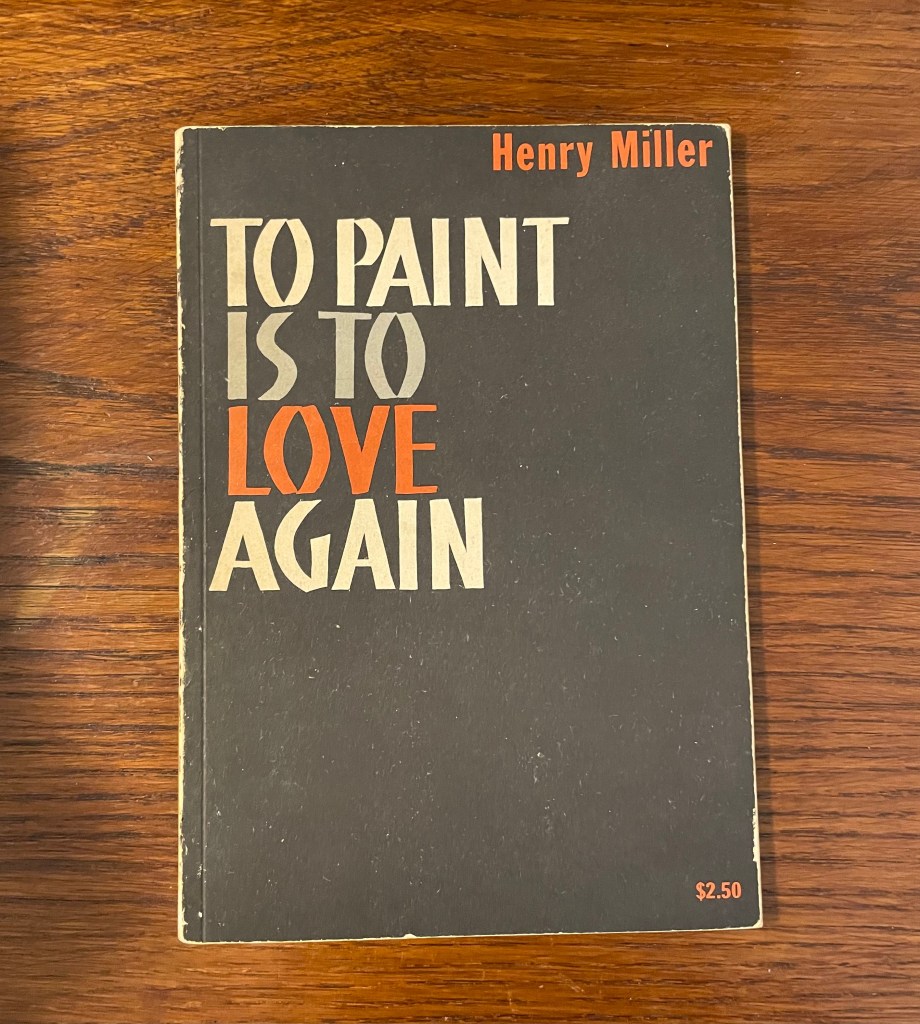
There might very well be an internal affinity between painting and love that at some point it becomes indistinguishable. A painterly picture can become love unquenched for that which remains persistently fixed and unrealizable. In one of the short essay books of his Big Sur period, Henry Miller asked this very question of painting. For him panting had a wondering origin that crosses the hand, undoing what we can easily enact. The erotic dimension of painting, thus, has nothing to do with the image or figure of the beloved, but rather with a specular limitation staged in the ability to allow the unseen to be incorporated in the visible scheme of the world. Only if we are able to see – and by the same token, only if there we are facing an event of painting – can something like use can be liberated from the constraints of mimetic compulsion. Miller writes in To Paint is to Love Again (1960): 

“To paint is to love again. It is only when we look with eyes of love that we see as the painter sees. His is a love, moreover, which is free of possessiveness. What the painter sees he is duty bound to share. Usually he makes us see and feel what ordinarily we ignore or are immune to a certain manner of approaching the world tells us, in effect, that nothing is vile or hideous, nothing is stale, flat or unpalatable unless it is our power of vision. To see is not merely to look. One must look-see .See into and around. Or, as John Marin, once put it – “art must show what goes on in the world” [1]. 

The place of painting for Miller is an imperturbable state that refuses to be fixated on objects, but in the invisible region (as in the figure of the chora) that allows for the thing in the world to be used. This is why Miller considered Japanese watercolor and prints an absolute primer of the pictorial: it taught him the appearance of worlds within the world, regionalizing the surroundings never logically stated unto itself, which in modernity it became the catastrophic horizon of autonomy towards its posterior liquidation. This is why Miller, very much like Carlo Levi, understood that the crisis of painting in the Western tradition ultimately signaled a general sense of social terror as a new phase of human desperation attenuated by the circulation of social fictions. 

At the height of the the closure of civilization, painting reemerged, if Kurt Badt’s axiom is correct, as the last metaphysical activity of human praxis. A metaphysical activity that holds on to the experience of belief in suspended appearance of originary anthropogenesis. For Miller, in painting as much as in love “one must be a true believer” [2]. And this assertion must be understood in the backdrop of Miller’s experiential retreat in the landscape of Big Sur: an experience away from the closure of American city life in research of a “feeling of aloness as spiritual achievement”, as a relation of oneself towards disclosure [3]. In this sense, the painter is a counter-social figure that, refusing to make stir in the world, turns to serenity, silence, and to the pressing contours of the unfathomable beyond any prefiguration. The believer in painting – who is a figure of belief in the desert, after the flight of the gods in the nocturnal vigil of history – is the thrust to the experience of things without barristers or shortcuts to what is revealed.

The age of automation in mid-century transformation of American industrial production serves as the historical backdrop of Miller’s indictment regarding the poverty and eventual disappearance of painting due to the autonomization of human praxis and the gigantic scale in spatial organization. Following Georges Duhamel’s prognosis in America: the menace (1931), he shared the intuition that the crisis of dexterity meant the impossibility of realizing painting, now situated beyond the grasp of human absorption [4]. A land without landscape that, as Adorno noted, bears no traces of the human hand. And this was seen already in the 1950s when the rise of abstract expressionism in North American announced not just the end of easel painting, but the funeral of the whole pictorial tradition. The barbarism of gigantic and unlimited Americanism would run counter to painting as a sensorial activity that embraced the vital limitations of its region. 

Miller’s insistence on painting was an eulogy to a life as experience – painting is indistinguishable from the hands and souls of the painters that he encountered and shared his life – and the value of poverty as absolute necessity for a life that regionalizes our contact with the world. It was through the love of painting that humanity could only restore its divine presence without rest.

Notes 

1. Henry Miller. To Paint is to Love Again (Cambria Books, 1960), 17. 

2. Ibid., 39

3. Henry Miller. Big Sur and the Oranges of Hieronymus Bosch (New Directions, 1957), 34.

4. Georges Duhamel. America: the menace (Houghton Mifflin, 1931), 85.

Gethsemane as experience. by Gerardo Muñoz

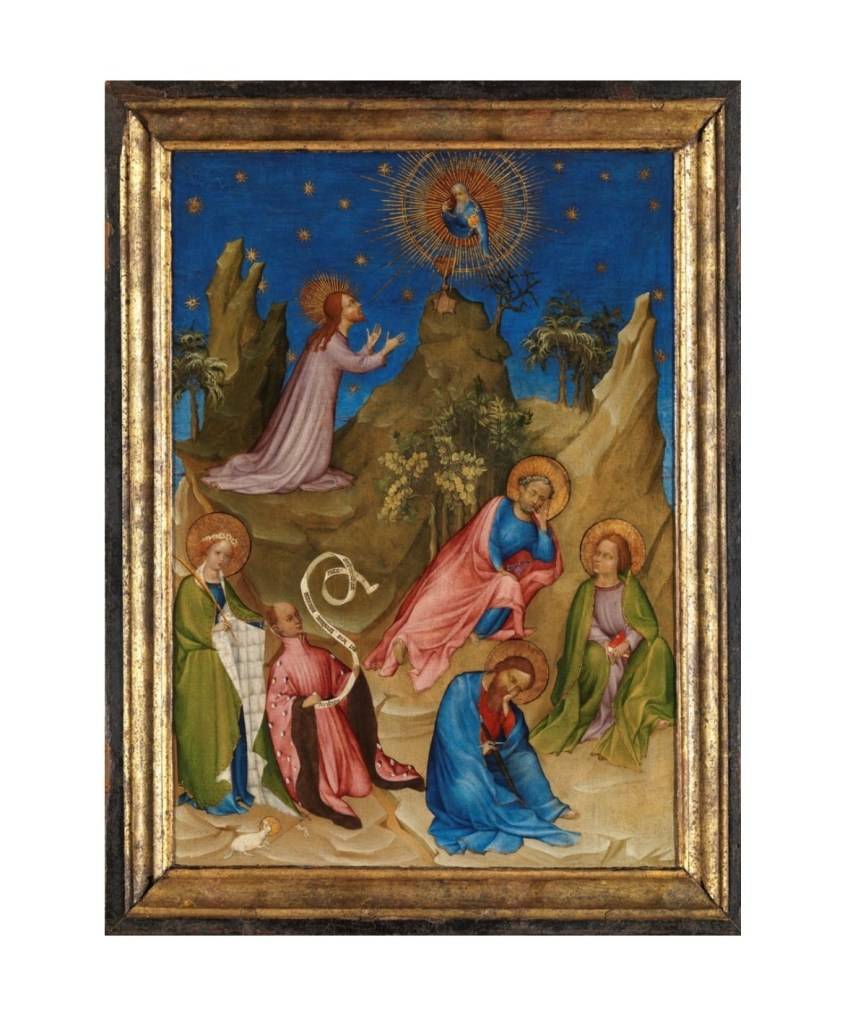
There is a panel in the Museo del Prado titled “Agony in the Garden”, attributed to the French painter Colart de Laon (1377) whose religious work barely survives (this panel is, in fact, one piece from an original triptych). The scene portrays the well known stay of Jesus in the Garden of Gethsamane on the Mount of Olives, where solitude and abandonment prepares the interval for the moment of transfiguration. If anything, Gethsamane is an experience of inwardness outside itself, which the painter has marvelously captured in the figure of Jesus raising his hands in supplication to the starry skies and god. Or so we think. The crisp blue tone of the sky immediately reminds the view of the vault of the Villa Farnesina that Fritz Saxl has interpreted as the transmission of a previous pagan astrological faith in the pictorial composition. The intense blue tone coupled with the emphatic stars arrest our imagination, but also that of the humane and worldly Christ.

What kind of experience is to look up into the firmament from man’s place on Earth and the cosmos? And what are we to make of the inability of the civilized human being to look into the blue depth not as a mirror of Nature, but of the non-totalizable and irreducible experience of solitude? It must be said that in a post-mythical world, the increasing loss of the opening of the sky goes hand in hand with the boundless loss of the Earth. And this is why we are tempted to read Colart de Laon’s picture as a gesture that renders legible the passage of the same movement: the Jesus that raises his hands outwards to the sky; and, simultaneously, the dozing Jesus that inhabits the contemplative state at the center bottom of the picture. To live in the world is defined neither by the experience of the time of arrival of the sky nor by the inward experience of the soul, but by the ability of transiting from one state to the other. And only there the worldly divine can be disclosed beyond the sclerosis of form.

This might also explain why Søren Kierkegaard following the German hymnist Gerhard Tersteegen could write in a gloss of his diaries that Jesus arises from the love feat into the path of Gethsemane: “It is always this way: Gethsemane lies closest to the highest bliss” [1]. The highest place is not the moment of absolute transcendence through faith; it is the secret that for Tersteegen expresses a kenotic hymn that empties life in the direction of poverty and death. In other words, the “highest bliss” is the experience of expropriation of every life; making life and death become indistinguishable in the vacillating night. A night beyond time and without god.  

Perhaps not just the “religious experience”, but all experience has as its central paradigm, the highest bliss in the face of death in which language can only account for it in its muteness and reverence. This is not an experience of vital teleology of humanity, but of a furtive relation. “Hacía sobre ella la experiencia”, as a Chilean writer once put it in the imperfect tense. But this can only mean to do an experience on the dissolution of oneself. 

Notes 

1. Søren Kierkegaard. Journals and Notebooks V.7 (Princeton University Press, 2014), 368.

Desvivirse. by Gerardo Muñoz

The common Spanish verb “desvivirse” resists obvious translations. Could one translate “desvivirse” as “unliving”, “constructing by destroying”, or “fulfilled life”? It seems that none of them capture the full meaning of an expression that is anchored in practical use. It is important to note that when the term emerged in the intellectual discourse of Spanish twentieth century, its depth was intimately connected to its meaning (life, living, vocation) that it immediately took the life of a concept for cultural milieu and national character. In his lecture “Ideas para una filosofía de la historia de España”, Manuel García Morente suggested that “vivir desviviendose” was the singular form of life of Hispanic being that attained eternity while on the terrestrial world: 

“Porque lo típico del hombre hispánico es, por decirlo así, su modo singular de vivir, que consiste en “vivir no viviendo”, o, dicho de otro modo, en “vivir desviviéndose”, en vivir la vida como si no fuera vida temporal, sino eternidad. El hombre hispánico no considera la vida eterna. O la salvación del alma como el remate, término y fin de la vida terrestre, sino como remate, término y fin de cada uno de los instantes y de los actos de la vida terrestre. La salvación eterna no es para él solamente un objeto de contemplación; ni tampoco solamente una norma de conducta, sino que es, ante todo y sobre todo, lo que da sentido y finalidad concreta a cada uno de los actos en que se descompone la vida terrestre” [1]”. 

For García Morente, the specific meaning of “desvivirse” entails a tension between interiority and exteriority; and, by extension, between life and death, and in fact of death in life that leads to resurrection and a new life. He writes: “La vida del alma hispánica es un constante morir y resucitar para volver a morir; hasta que la última resurrección” [2]. “Desvivirse”, quite literally, happens at the level of the soul when life continuous through finitude and concrete death. This is why the notion of “desvivirse” has a clear theological underpenning that one can pair with the divine apocatastasis in intramundane life. “Desvivirse” is never about personal salvation and the economy of election, which is why Americo Castro would emphasize that this vocation does not align well with modern individualism, because the “vivir desvivido” experiences its own ruin like a joyous and exuberant Saturnalia” [3]. 

As in the indication by García Morente, for Castro “desvivirse” entails something like an external perspective in which life can ultimately only take place from its transcendence with a relation to what’s outside of itself. This outside is neither determined by politics nor rhetoric [4]. To live “desviviéndose” entails an intensity that persists not just as an interior affirmation of self-preservation, but as an erotic relation with what is most desired and venerated (many Spanish thesaurus of the nineteenth century would define desvivirse as “to love or desire with eagerness”, “amar con ansia”). If extracted from the cultural and identitarian historical context, “desvivirse” appeals to the object of passion that overflows the senses of human life. 

This overflow is embedded in the word itself. The great Spanish scholar of Benedictine monasticism, García Colombás, in his book El monje y el Misterio Pascual (1984), made a simple, and yet remarkable lexicographical observation about the word “desvivirse”. Colombás noted that while in most of monastic literature the prefix “-des” donates privation and deficiency, the function of this prefix in “desvivirse” suffered a complete inversion, since now it entails to love intensively and thoroughly, as in “se desvive por complacer a todo el mundo” [5]. As a theologian, it should not have passed Colombás that the term in question is a triad of three linguistic units: -des/vivir/-se. This means that it is not just that the prefix exerts the meaning of privation of “life”, but also makes room for the reflexive “se”. It is curious that in in Spanish grammar “vivirse” is often used in relation to location (i.e. “el va a vivirse al campo”), and never as a conventional reflexive action (i.e. “él quiere vivirse solo”, “el se vive solo” = this would be incorrect). Taking this cue, one could perhaps say that the inversion so keenly perceived by Colombás acts upon the living so that they can repeatedly making space for the unfolding of life, rendering possible the soul’s crossing the inside and outside in every form of life. 

Notes 

1.  Manuel García Morente. “Ideas para una filosofía de la historia de España”, in Idea de la Hispanidad (Espasa-Calpe, 1947), 215. 

2. Ibid., 216.

3. Américo Castro. España en su Historia: Cristianos, Moros, y Judíos (Editorial Losada, 1948), 45.

4. Ibid., 279. 

5. García M. Colombás. El monje y el Misterio Pascual (Ediciones Monte Casino, 1984), 132.

Antelme’s smiling angel of Rheims. by Gerardo Muñoz

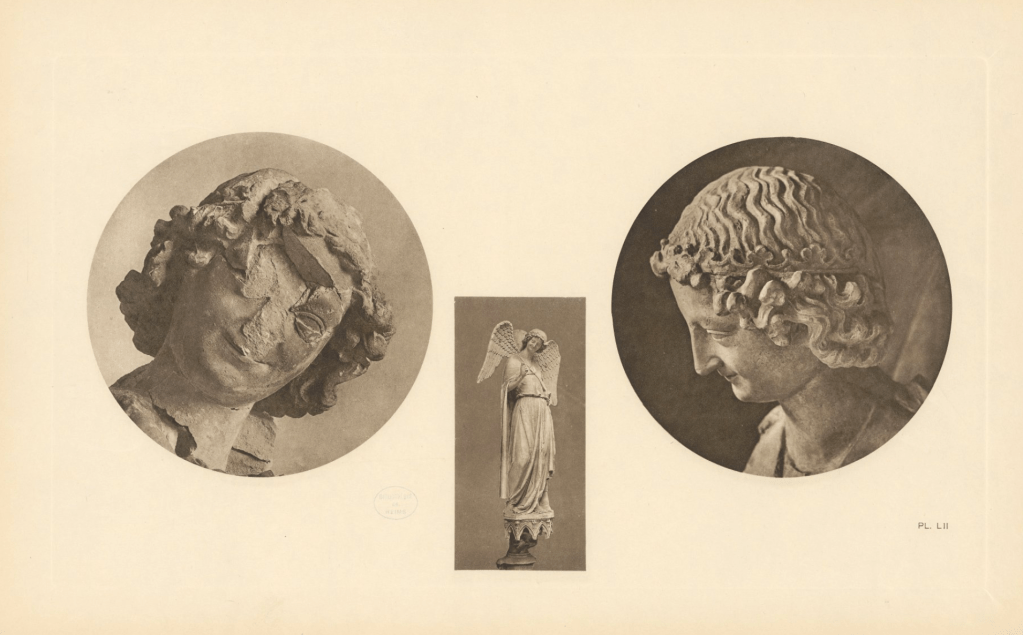
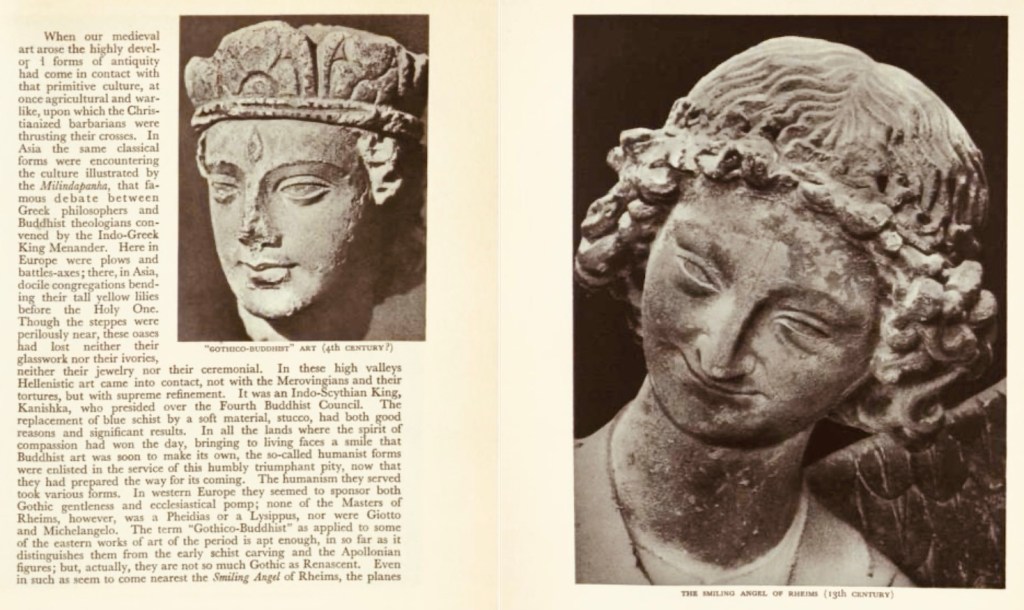
Among Robert Antelme’s posthumous writings the short text “L’ange au sourire” has a decisive place if we are to explain the transfigured theological experience of the French writer. To anyone familiar with French  architecture history the title should sound familiar, since the ‘l’ange au sourire’ was already a common expression used by French scholars of architecture during the interwar years. Charles Sarazin, arguably the most important scholar of the architecture of Reims, penned a separata titled “Le Sourire de Reims” (1929), in which he celebrated the mysterious smile of the angel Gabriel that was severely damaged due to shell fire of the Cathedral during the fall of 1914 [1]. But a decade prior to the destruction, art historian Arthur Gardner, in a detailed essay on the sculptures of the facade of the Rheims Cathedral, also took note of this angel’s gaze writing that: “…the angel Gabriel of the Annunciation in which the French smile has almost become a grin, the beginning of the contorted expressions frequently found over the border in Germany.” [2]. The particular aspect of this unique angel’s face that Antelme undresses from the cloak of authority is also wonderfully documented in the photographic book by Pierre Antony-Thouret, who also showed pictorial interest in the way that angel Gabriel was chipped in a large area of the right frontal relief (image 1) [3]. 

Image 1. Reims au lendemain de la guerre (1928), plate 52.

This curatorial context informs the historical background of Antelme’s reference to destruction and what he references as the crushed: “But not crushed by this building, or by that event, or by some power. It has always been crushed, crushed forever” [4]. For Antelme the tenuous, almost imperceptible, smile of the Angel of Rheims is what outlives absolute destruction because to be destroyed cannot be executed absolutely. It is the soul of existence that, because of its exteriority to history, is powerless “to have forever to be”.  Even if this being has become petrified and immobile from its original plastic appearance auf vif of sacred art. This is what Malraux captured in his brief mention of the  “L’ange au sourire” in The Voices of Silence (1951), where he also compares it to the Buddhist faces of Oriental sacred art (image 2): “The Smiling Angel of Rheims is a statue whose “stiffness” increased with every century; but at its birth it was a similar incarnate, a face that had suddenly come alive – like all faces sponsoring a discovery in the field of the lifelike” [5]. In order words, to see in the muteness of the face the nothingness that allows expressive relations to emerge in the open. This holds for Antelme’s description as well: “Radiant or hidden, inevitably it is there. Word, image, music: everything expresses it, and nothing. It lies at the heart of that realm where all relations are born. Forever starting anew. Possessing nothing, capable of nothing, it must be there, forever”. 

Image 2. Angel of Rheims in The Voices of Silence (1964).

But what Antelme was able to capture through the smiling angel of the Rheims Cathedral was not a problem of iconology of art forms, but rather the very essence of the theological problem of angels as it relates to the poetics of life itself. The angel is not a promythical figure scaled to a specific historical moment, but an instantiation of the divine appeals to the withdrawal the possibilities and modes of the human being. This is why Antelme can state that “the only transcendence is the relation between beings”. Even in its muteness, the theologica depth of the angel is the poetic speech of divinity through a surge in language that has no end, but only celebration or hymnology.

This is why Erik Peterson writes towards the end of  “The Book of Angels” about the intimate relation of angels in human existence: “A human being can draw near to the angels because the angel too – as its name already indicates – can draw near to humanity. […] The angels are more than poetic ornamentation left from the storehouse of popular fables, they belong to us. For us, they stand for a possibility of our being, a heightening and intensifying of our being – but for the possibility of a new faith…as a passion for mental clarity and an authentic existence” [6]. It is fair to say that, although the figure of the angel does not show again in Antelme’s work, all of his vision and witness accounts in the face of political horror must be placed in the endless vigil of a nocturnal life that is shared with the ethos of angels (utirur vigilis, angelorum vitam procul dubio meditatur). 

Notes 

1. Charles Sarazin. “Le Sourire de Reims” (s.l.n.d, 1929). 

2. Arthur Gardner. “The sculptures of Rheims Cathedral”, The Burlington Magazine for Connoisseurs, V.26, 1914, 64.

3. Pierre Antony-Thouret. Reims au lendemain de la guerre: la cathédrale mutilée, la ville dévastée (Jean Budry, 1928). 

4. Robert Antelme. Textes inédits sur l’Espèce humaine (Gallimard, 1996), 14.

5. Andre Malraux. The Voices of Silence (Secker & Warburg, 1964), 317. 

6. Erik Peterson. “The Book of Angels”, in Theological Tractates (Stanford University Press, 2011), 139.

Introduction to José Bergamín’s For Nothing in the World (1937). by Gerardo Muñoz

The essay “Por nada del mundo. Anarquismo y Catolicismo”, by Spanish poet and essayist José Bergamín, should be read as a wartime reflection on the historical impasse of the Spanish Civil War. First published in Emmanuel Mounier’s Catholic journal Esprit in the 1937 April issue, the essay in its final version featured in Bergamín’s Mexican exile collection Detrás de la cruz: terrorismo y persecusión religiosa en España (Lucero, 1941). While on the surface Bergamín is responding to the struggle between secular political anarchism and traditionalist Spanish Catholicism intertwined at the heart of the civil war, the essay is also highly idiosyncratic in laying out the poet’s theological vision that permeates his entire body of work, and which can already be found, in nuce, in the fragments and aphorisms of his first book El cohete y la estrella (Índice, 1923). “Reality is the spirit, imagination, and thought…there is religiosity when it claims space positively”, he would write in the first pages of that book. 

The 1937 essay, along with his defense of illiteracy in “Decadadencia del analfabetismo” (1933), Bergamín argues for a living theology of the Spanish people (pueblo) that is neither imperial nor clerical, but rather always an excess to the imperial political theology that dominated the long historical narrative of Spanish modernity since the Reconquista. It was thanks to Bergamín’s genius that Catholicism appears connected to a habitual form of life of everyday people, their shared language, symbols, and experiences; and, ultimately the common imagination that grants them access to the world through the mystery of living and dying. In fact, as in “Decadencia” (1933), it is important to highlight the centrality of the term “pueblo”, which although translated as “people”, it coincides neither with the “People” of the unity of civil society nor the common historical identity of the Nation. For Bergamín, these determinations, in fact, were corrupted notions of pueblo. The pueblo is always the event that remains from the abstraction of political theology, and always pueblo minoría, a ‘minor people’ that dwells in the house of God within and beyond the mundane. This is why Bergamín would claim in the text that the pueblo is always ancilla mundi. In this light, Bergamín thought that political anarchism incapable of a revelation to the divine, and an imperial Church in charge of the administration of the “nothingness”, were two poles of the same vectorial force of modern nihilism. That was the color of his corruptio optimi pessima with clear echoes of Fridugisus’ De nihilo et tenebris

In “Por nada del mundo. Anarquismo y Catolicismo”, Bergamín’s theological position emerges as a third way to exit this historical poverty of relating to the theos. As Giorgio Agamben observes in a 1973 entry of Quaderni (Quodlibet, I, 2024, 46-47), for Bergamín the divine entails a corporeal cohabitation of a demon and an angel that expresses appearance of life, and thus the sensible and poetic mediation with the world of forms. In this sense, Bergamín’s theology differs fundamentally from the rational and canonical traditions, fostering the sensorial path of dramatic and divine beauty. This goes to the kernel of the 1937 essay: the rise of the Totalizing State (historical Fascism), was a corrupting form of theos insofar as it aimed at regulating the “nothingness” against the possibility of appearance and truth. But the word of God and the angelic hymns linger in the time of wreckage and devastation in its impatient drift towards anger in the world, which is still very much our own. Ultimately, Bergamín was convinced that the pueblo’s mute voice, resurfacing from the depths of pain, could dodge the abysmal fall into the tribulations of radical evil always too congenial with the survival of ‘this world’.

* This gloss was written to accompany the English translation of Bergamín’s “Por nada del mundo” forthcoming at New Personalism, summer 2025. 

Prados Such’s Dormido en la yerba (1953). by Gerardo Muñoz

Emilio Prados Such’s postwar book Dormido en la yerba (1953), long out of print since its publication, is the most clear and straightforward literary document of a poetic voice that stands as one of the foremost attempts at thinking the nexus of existence to the divine in the tradition of the twilight of the gods. Dormido en la yerba (1953), albeit its direct Lucretian overtone, does not enact a metaphoric appeal of a return to the physis of nature; rather for Prados, to dwell, imagine, and inhabit language is only possible in coexistence with the caducity of the natural world including life itself. In the poem that names the book, “Dormido en la yerba”, Prados writes that “La vida se te va / y tu te duermes sobre la hierba”, at first sight claim on appearance that seems to endorse the tempus fugit motif of the Spanish Renaissance verse. However, the temporal course in the poem is immediately redirected to a mysterious proximity that befalls existence in nature’s shadows, plunging the voice into the depth of the abyss that colors the caducity in a place. At this point, we note that Prado’s poetics is traversed by a mystical register that transfigures the temporal continuum with that of making of space that is eternal because it has neither end nor beginning. 

It is in this sense that Emilio Prados’ theological drift in his poetry is neither about making transcendence palpable through the animation of the world; nor does it imply the absolute immanence of the divine presence towards a new reenchantment of the world. The status of the liberated theos in Prados, like in the mythic understanding of the platonic “gods of place” (theos aisthetos), is an event that can only take place once existence is attuned to the minuscule surrounding of the world. This means that there is never a “God” as a matter of a divine economy that orients a moral predicament; rather, as Maria Zambrano argued in an essay on his work, Prados’ instantiation with the divine is always expressed in the most diminutive melody of the common things as they are. A way of multum in parvo such as the “diminuta yerba”. Hence, God is not the agent of creation of individuation, rather God is an “idea” that expresses in each thing that we are affected to, such as every blade of grass, the spacing of the clouds, the invisible direction of the wind, a human face.

The event of the divine, thus, is not a matter of mental or international faculty between objectivity and consciousness, existence and the natural world; the irruption of the divine names the genesis of appearance and disappearance. And this means that the divine (Dios) is ultimately an affection of the soul, that animation that provides birth and death as relations that move world. It is for this very reason that Zambrano could claim that the opaque sun irradiating Prado’s work is disclosed by the “dios que está naciendo”, or the god that is birthing [1]. Of course, the birth of God is far from being a transcendental revelation that weaves the history of salvation; in the manner of Meister Eckhart we can say that the god is nothing else but the affection that makes his birth take place in the soul like a harvest; that is, leafy, bright, and green [2]. God is the possibility of sensation in the world that is ineffable because it is always on the path of natality. For Prados, the eternal dimension of the birth of gods is only temporary because it presupposes spacing; it presupposes being thrown somewhere, like in the lucretian trope of lying happily above the grass. Above the grass and infinitely outside the world, dwelling and world are irreductible whenever they come into its uttermost nearness. To dwell – which is the central meaning of laying on the grass – on the crust of the Earth is to liberate God, and the liberation of God is what allows us entry into the world. 

As Prados wrote in a remarkable letter to his friend Zambrano in March of 1960: “Un cielo sin reposo” que es Dios: Dios no quiso morada y nosotros, como tú dices: edifica que te edifica… Y Dios, sin reposo. No buscamos reposo para Dios y nunca lo tendremos… En la guerra, me acuerdo, unos campesinos prendieron fuego a una iglesita en lo alto de un monte. Cuando bajaban, lo hacían como iluminados y decían: “¡Hemos libertado a Dios!” ¿No es hermoso eso?” [3]. To liberate God from dogmatic commands is also the liberation of world as detachment. There is dwelling for us, but never for the unresting divine presence of god. 

Notes 

1. Maria Zambrano. “Emilio Prados”, Cuadernos Americanos, Vol. 126, 1963, 165. 

2. Meister Eckhart. “Sermon 2”, in Selected Writings (Penguin Books, 1994), 116.

3. “Un cielo sin reposo. Emilio Prados y María Zambrano: correspondencia” (1998), El Colegio de Mexico: https://muse.jhu.edu/pub/320/oa_edited_volume/chapter/2584791 

The necessity of Penia. by Gerardo Muñoz

It is well known that Aristophanes’ late comic work on wealth, Plutus (388), provides us with what is perhaps the most dramatic and conceptual elaboration of the mythic personification of poverty (Penia) of late antiquity. What is remarkable is that in her self-presentation to the character Chremylus, Penia draws on a political parallelism that colors the ongoing crisis of governance of the ancient polis. If the Greek comedy is dependent on the function of the pólos (which is the vortex of movement that makes possible grasping the specificity of the being that is said), always prior to the arrangement of the polis, then it would follow that Aristophanes’ commentary on the centrality of Penia is neither mockery nor irony within the structure of the play, but rather an element fundamental to the historical presentation of the consciousness of historical public life. The emergence of Penia in Plutus is recorded in the lines 550-554 (a paraphrase might be adequate here): “Thrasybulus and Dionysius are one and the same according to you. No, my life is not like that and will never be. The beggar, whom you have depicted to us, never possesses anything. The poor man lives threfitly and attentively to his work; he has not got too much, but does not lack what he really needs” [1]. Poverty is an intimate relationship with needs; perhaps an unsaid relation, but one that must be accounted for nonetheless.

At her entrance into the play, we are told that Penia’s complexion is both mad (makaron) and tragic (tragōdikon); she could very well be an Erinyes companion from the underworld of the dead. Penia as a mythic figure is a fullfilled form of life. More importantly, what is crucial in the Plutus is that Penia defines herself in sharp contrast to the life of beggars or ptochos. This means that while the penetes is tied to a constitutive need as condition for a form of life; the ptochoi is a being that merely lives in a state of survival, and endures his absence of proper needs. Because Penia is contrasted to the destitute life embodied by ptochos, she can state in one moment primacy over wealth: “all your blessing….you have all that you need in abundance, thanks to me” [2]. Hence, as it has been noted, the irrevocable presence of Penia in the polis is the condition of possibility for Ploutus, god of wealth and abundance, shown in ancient representations as holding the flourishing cornucopia from the fertile harvest season. 

What is important to note is that the close and fluid relationship between Ploutus and Penia; that is, between abundance and need, far from being opposition is relational and nourished by its pólos. In this way, the being of need, the penetes, is only able to flourish if he is capable of attaining a free relation with its desire of its vital making, and not from an external power that can determine the functions directed to abstract modeling of population survival. If Aristophanes’ Penia is defined against the ptochos is not because there is a difference of degrees in terms of dispossession, negative or quantitative, but rather it is because it is a disjointed relationship between poverty as a transfigured life, and a life that become destitute because it has ceased to be attentive to its own needs. In the incommensurable ground of the polis, it could be said that the ptochoi were unformed lives that merely persisted in time on the margin of the system of relation of the human community, and for this reason they dwelled in a permanent state of apolis, since their only viable horizon was the result of economic abstraction for secondary needs. In other words, the beggars of the apolis are ultimately effects of economic forces that they do not control, precisely because they no longer have any existential relation with the realm of necessity, that is, with poverty as understood under the shadow of Penia. 

In this sense, the condition of beggar is an ultimate economic subjection that is already beyond the sufficient limitation of needs, and thus it has lost all contact with the world. It is has become deprived of the world without being truly dead. Here, one should not forget that as Plato registers the genetic relationship between Penia and Eros in an important moment of The Symposium: “Eros is the son of Poros and Penia, and partakes of the nature of both parents, the fertile vigor of the one, the wastrel neediness of the other. As he is a mean between mortal and immortal” [3]. But the erotic soul in the last resort is nothing but the desire for immortality; and, as a daimon, it mediates between passions and the beautiful, between the divine and the mortal, between need and wealth towards the depth of a harmous life [4]. As Sandrine Coin-Longeray has shown in her exemplary study, Penia (πενία) exceeds the effective qualification of the “good life” based on labour; rather it is a route of life that outlives itself in the erotic transfiguration of world towards the preservation of irreducible homeostasis of common life [5]. 

This is why Plato’s conception of the ‘happy city’ or the kallipolis was imagined as a deposition of the process of abstraction between “rich” and “poor” that ultimately has come to regulate the modern organization of social rationality proper to accumulation, production, and distribution to supply to rhe demand of ever expanding secondary needs in the general field of consumption. As Plato writes in Book III of The Laws in a section precisely dedicated to showing how to bring civil war to an end: “Because of all this, they were not intolerably poor, not driven by poverty to quarrel with each other; but presumably they did not grow rich either, in view of the prevailing lack of gold and silver. Now the community in which neither wealth nor poverty exists will generally produce the finest characters, because tendencies to violence and crime, and feelings of jealousy and envy, simply do not arise” [6]. The civilizational path undertaken by West since the rise of institutionalized isonomy could not be but exactly the opposite of the platonic deposition of the autonomy of alienated classes. Today it is all too apparent that every sphere of social reproduction stimulates a ferocious race to the bottom between a kleptocracy and a vast administered population of ptochoi that, precisely because they have no relation to Penia, is left pursuing compensatory reactions within the social mechanism of organized begging that they are forced to endure. Under the oblique light of Penia, it becomes clear that both redistributionist policies through state institutions, as well as the autonomous market initiatives of financial models tend to be two sides of the same defense of abstract abundance on the back of the human community of penetes

The negative subsumption of material needs, and thus of poverty into quantifiable assets that characterize abundance and growth at a civilizational scale – with the collaboration of all modern political ideologies without exception always oriented towards production – has contributed to thwart the path of Penia that is necessary to live freely between passions and needs. This is why in his 1945 lecture “Die Armut” (“Poverty”), Martin Heidegger, departing from a well-known intuition from Hölderlin, claimed that ‘being-poor’ does not mean the absence of some property or substance, but a relation to needs; because only in poverty do we preserve a free relation unto what we need (not-wedigkeit) as necessary. And only this can be taken as the true and ultimate wealth: ‘we have become poor in order to be rich’, means that only through the preserving necessity of Penia will there be a liberating dislocation for human life beyond the indigence of mere exchange and the endless struggle over material goods and the private property. As the world becomes a more vast wasteland of beggars and disposable bodies at the service of technology, Heidegger, in Eckhartian tenor, was not wrong to claim that poverty and Penia will ultimately be the ethical destiny of the people of the West only if they become attune to the divine overtone of poverty as their destiny. Thus, the only possible abundance in a declining world can be realized through the enduring necessity and disquiet return of the essence of poverty – to come near the nothing, because there we find the dearth of the earth. Indeed, as Penia says in Plutus before leaving the stage: “One day you will speedily send for me back” [7]. 

Notes 

1. Aristophanes. Plutus (Loeb 1946), 550-555, 421. 

2. Ibid., 501-511, 409.

3. Plato. The Symposium (Penguin Books, 1987), 203b, 82. 

4. F. M. Cornford. “The Doctrine of Eros in Plato’s Symposium” (1937), in The Unwritten Philosophy and Other Essays (Cambridge University Press, 1950), 74. 

5. Sandrine Coin-Longeray. Poésie de la richesse et de la pauvreté: Étude du vocabulaire de la richesse et de la pauvreté dans la poésie grecque antique, d’Homère à Aristophane: ἄφενος, ὄλβος, πλοῦτος, πενία, πτωχός (Publications de l’Université de Saint-Etienne, 2014), 153-56.

6. Plato. The Laws (Penguin Books, 1975), 122. 

7. Aristophanes. Plutus (Loeb 1946), 630, 421.

Vladimir Lossky’s third way. by Gerardo Muñoz

In his war diary Seven days on the roads of France June 1940 (2012), which recounts his itinerant vicissitudes in occupied France, the Russian theologian Vladimir Lossky makes an explicit case for the emergence of a third way beyond conservation and destruction, and its modern ideological avatars that led astray into the modern catastrophe; that is, the social revolution and conservative reaction cloaked under “traditionalism”. As it has been recently glossed, Lossky was not the only person from the East to be preoccupied with putting a halt to the eternal dialectical movement of destruction and conservation only fueling historical abstraction. Indeed, immediately in wake of the Russian Revolution, the poet Alexander Blok, in an epistolary exchange with Vladimir Mayakovsky, and anticipating the bewildering enthusiasm of the revolutionary energy, also demanded an effective exit from servitude so that “a third thing appears, equally dissimilar to construction and destruction” [1]. It matters little whether Lossky knew about Blok’s “third figure”, although it is at the same time impossible not to have it in mind when reading his own annotation in the June 16th entry of his diary, which does seem to offer a answer to Blok’s proposal:

“Nonetheless, revolutionaries are always in the wrong since, in their juvenile fervour for everything new, in their hopes for a better and a way of life built on justice they always base themselves on theories that are abstract and artificial, making a clean sweep of living tradition, which is after all, founded on the experience of centuries. Conservatives are always wrong, too…for in their desire to preservice ancient institutions that have withstood the test of time, they destroy the necessity of renewal and man’s yearning for a better way of life. Is there, then, a third way? Another destiny for society than of always being subject to the threat of revolutions which destroy life, or reactionary attitudes which mummify it? Or is this the inevitable fate of all terrestrial cities, the nature of their existence? In fact, only in the Church can we find both a Tradition that knows no revolution and at the same time, the impetus towards a new life that has no end. Which is why she is in possession of those infinite resources upon which may draw all who are called to govern the perishable cities of this world” [2]. 

It is no surprise that for both Blok and Lossky, the fundamental tension in the amphibology between conservation and rupture rests on the problem of “tradition”; given that, as Blok had also eloquently written in his letter to his fellow poet: “a breach with traditions is a tradition”. This is something that an artist like Kazimir Malevich understood well in his programmatic text about museums in the wake of the revolution (“On the Museum”, 1919): the turn into ashes of all the works of art altered their aura, but it left in place the topological frame and it still produced an image; in order words, the destructive artworks still demanded a museological space for storage, thus enacting new principles of the triumphant revolution. Understood in this sense, tradition is merely the retroactive accumulation of practices by the archē that orients its development retroactively from the point of view of the present with provisions towards the administration of the future. But, how did Lossky understand by the notion of “Tradition”? Rereading the fragment of his war diary entry, it would seem that this notion merely rests on the dogmatic transformations within the Church, and in this sense, a conceptual elucidation similar to the doctrinal exegesis not very different from John Henry Newman’s An essay on the development of Christian doctrine (1845). However, in his important essay “Tradition and Traditions”, Lossky attempts at defining the site and tension of the tradition, which he notes that in the language of theology it has been a term left vague and repeatedly undefined [3]. Lossky writes with sharp precision: “Tradition sometimes receives that of a teaching kept secret, not divulged, lest the mystery be profaned by the uninitiate” [4]. Thus, Tradition is the positive and textual scripture that registers the Word, but it is not exhausted in the positive scriptural authority. 

At the heart of Lossky’s argumentation about the theological meaning of Tradition, is the fact that it exceeds both textual sources and narrative mastery and transmission. In fact, the theology garment of Tradition belongs to the mystery of revelation shared in conspiracy, rumors or whispers [5]. And although, in his essay Lossky reaffirms himself that Tradition is the invisible intertwined with the Church – what keeps the “critical spirit of the institution” for the incorporation of new dogmatic definitions – it is nonetheless important to note that for the theologian, Tradition as “opposed to the reality of the word, it would be necessary to say that Tradition is Silence” [6]. In this sense, Tradition is that which is created and transmitted but that no one has the right nor the authority to speak through its incommunicable name. Is Tradition transmitted at all? If it is not through the written word, how can there be any continuity? This is the ultimate lacuna of the theological underpinning of Tradition for Lossky: Tradition can only be properly understood as the crafting of a “unique mode of receiving truth”; in order words, it names the contact between revelation and the witness who receives its ‘fullness of knowledge’, which far from mastering the totality, it points to “the external limit…the narrow door which leads to the knowledge of Truth” [7]. As Monica Ferrando has recently glossed from Plato’s philosophical corpus, any robust conception of Tradition should be understood as that which maintains an absolute inseparability between wonder and salvation, as well as bridging invention and received grace (charîs) [8]. One step at a time, we invent traditions whenever we are thinking through the abyss that separates our language from the inheritance bestowed upon us. Tradition moves in every ethical position of thought overcoming the pseudo-authorization of alienated and metaphorical knowledge of the past.

But if  the Church is no longer the institutional site for the keeping of the impossibility of the transmission and renewal of Tradition and revealed Truth – subsumed to the mysterium iniquitatis that works against the possibility of the rendition of the eternal life of a permanent vita nova  – it entails that one can still hold on to Lossky’s assertion that the task is to be attentive to the ossified expressions and reified appearances of Truth against the “living Spirit of Truth”. Hence, to insist on the restitution of the Church in our current predicament, would place us on the side of instrumentalized and subject-oriented salvation that turns away from the active kingdom that is the only passage from the world of the living to that of the dead. The traditionalists or integralists are incompetent representatives of the Tradition in this sense: as Von Balthasar once argued, they lack the humor and contact with the invisible to apprehend the mystery that arrives without solicitation, as pure depotentialization [9]. In a godless world of the secularized gnosis of political force – that is, after the fleeing of the gods – perhaps theology could only be understood as the path of Tradition of uncountable wonders and the event of speech that produces an unworldly sensation within this world. Tradition brings the world beyond its shape and legibility. In this sense, we are always participants of Truth that the world cannot retain, and thus keepers of an enduring secret that will ineluctably outlive us. 

Notes 

1. Philippe Theophanidis. “Alexander Blok: ‘A breach with traditions is a tradition'”, October 13, 2024: https://aphelis.net/breach-with-traditions-alexander-blok/ 

2. Vladimir Lossky. Seven days on the roads of France June 1940 (St. Vladimir’s Seminary Press, 2012), 54.

3. Vladimir Lossky. “Tradition and Traditions”, in In the image and likeness of God (St. Vladimir’s Seminary Press, 1974), 141.

4. Ibid., 144-145.

5. Ibid., 146.

6. Ibid., 150.

7. Ibid., 162. 

8. Monica Ferrando. “La libera grazie della tradizione”, in Un anno con Platone (Neri Pozza, 2024), 424.

9. Hans Urs Von Balthasar. The Office of Peter And the Structure of the Church (Ignatius Press, 2013), 403.