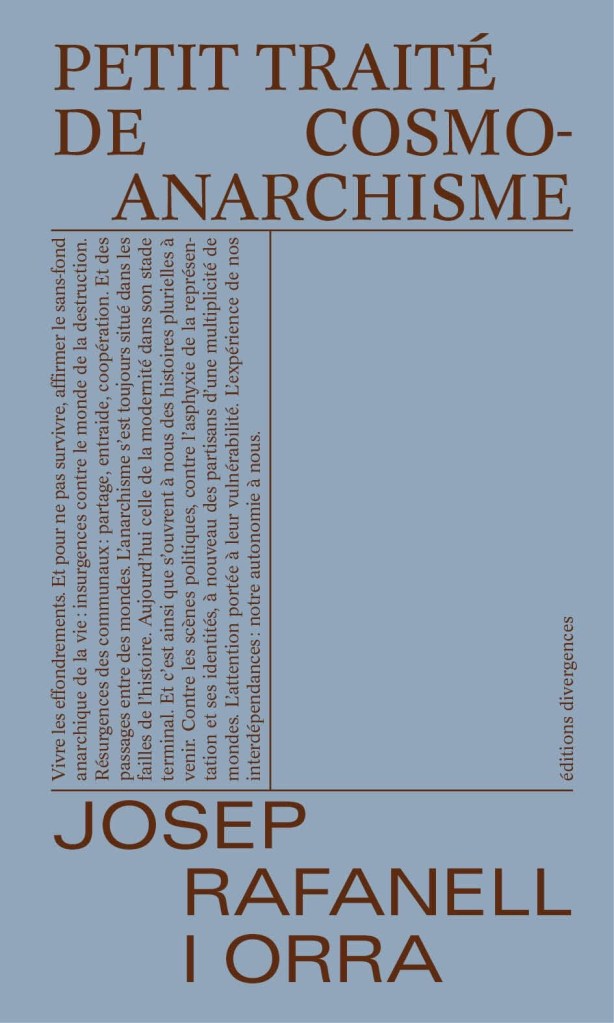
Worldly animism. Prologue to Josep Rafanell i Orra’s Spanish Edition of Petit traité de cosmoanarchisme (2025). by Gerardo Muñoz

Anyone somewhat familiar with the writing of Josep Rafanell i Orra knows that we are in the company of a wanderer and itinerant in an infinite pursuit of what the experiences of worlds might offer [1]. A mad endeavor for a groundless epoch oriented towards planetary reduction and confinement, so obsessed with infrastructure and security, most recently through the reiteration of the politico-theological program of national sovereignty, one more desperate reaction to unrestrained planetary decline. We can say with Hölderlin that we are vagabonds in a destitute time, a poet who figures prominently at the entrance of Josep’s Traité. In our posthistorical epoch we are confronted with the thicket over the dominion of life, which means that the question of exteriority becomes pressing as existence enacts a path beyond the endless rubble of representation bestowed upon the human species in every point of the globe.

The book that the Spanish reader now holds in his hands thanks to Luciole Ediciones will immediately let in a dimming light of a singular style or maniera that dislocates the modernist assumptions of political thought into what one could what I am willing to name an analytics of sensible hybridizations between languages and thought. This analytic of the sensible refuses immediately Social normativity as well as the melancholic hangovers of the modern revolutionary tradition (always caught up between constituent and constituted power, representation and humanism, growth and production). This is why Josep will redefine communism as the nonprogramatic event that irrupts through hybridization of surrounds and regions capable of overcoming the ontotheological adequation of subject and object that has led an entire civilization astray (33). The project of the critique of metaphysics finds in Josep’s Traité a powerful schematic cartography that raises questions precisely in those spaces where the rationality of the science of political economy has never dared to enter. 

If the critical projects of High Modernity were fundamentally temporal (including that of Messianism and its overemphasized trance towards absolute immanentization), Josep’s writing also has the virtue of displacing the focus to the spatial formation and the thinking of the creation of spaces understood as dwelling, once populated by the gods of the events and which modern ontotheology obliterated through integrated objectivation and technological positionality. We know that the greatest nearness of the last god eventuates only when the event is elevated into refusal, especially when it manages to become too near [2]. As a shorthand, this drift towards objectification in the liquidation of modern politics is domination of the Social totality; ultimately, it is through the plasticity of the social bond that the reproduction of biopolitical life is temporalized, legally ordered, and rhetorically subsumused into an apparatus of predatory accumulation. It is the Social (not the State, or this or that concept of the modern grammar of political thought, or even fascism) that we must refuse. The collapse of the modern secular state and its moral guarantees, is the beginning of an autonomized social bond that now coincides with the total administration of world forms. The hegemony of the Social reduction is what allows Josep to claim that the opposition is no longer between Society and the State; but rather between community as a process and praxis against the static formation of the Social. Thinking today drifts from social domination to communities of encounters, heteronomic relations, communication, and interdependence in a web that characterizes the exotic movement of the imaginative possibilities of exteriority for manifold worlds. 

The notion of community in Josep’s thinking is neither about ecstatic groups or “little platoons” of identitarian belonging (as once famously defined by Edmund Burke); nor referring to filiation and propriety reductions that can subsist quite nicely under the heatwaves of the ongoing conflagrations of Empire. For Josep communities insofar as they are exposed to their excess (ubermass) are processes of external contact between souls as rites of passages. The community is formless, and in this sense it ceases to be a problem of Chistological stereology in order to become one in the order of ethics and language (50). In this sense, very much like the late Mario Tronti looking at the collapse of the modern revolutionary experiment; for Josep the ruinous fragmentation of the worlds has a silver lining: that all human, and non-human, souls are dwelling on the outside world calling for worldiness, and thus potentially sharing a sense of intimacy that re-enchants the appearance and knowability of the world through the invisible attunement to the outside (un nuovo modo di essere fuori e contro) [3]. 

Beyond the subject and the narcissism of the Ego, the light of a “spark of the soul”, in the words of Meister Eckhart’s memorable sermon, a new animism returns not because there is a transcendental revelation to be asserted, but because the encounter between souls brings forth the concatenation of worlds that are entangled with other worlds (68). If Jünger described the epoch of planetary machination as “soul murder” (seleenmord) it was because there was no longer any contact with the unfathomable opacity between the soul and any possible worlds [4]. Josep with an elegant mannerist style enhances this intuition: “We are no longer exiles on Earth, as the romantic moment freighted by the loss of world. We ended up forcing the Earth into exile after so many deadly abstractions (108). The modern age has not ceased accumulating abstractions against the human species until becoming a whirlwind of soul murdering that has extended into the current ecocide of the worlds.

It does not come as a surprise that throughout Petit traité de cosmoanarchisme (2023) Josep appears more than skeptical about political critique (and to say skeptical might be an understanding). There is a clear imperative that is mobilized in the book and that it should not be taken for granted: political critique should evolve into the negation and abandonment of politics, which also includes the always anachronistic anarchist politics. We know that ever since the Greek polis the autonomy of politics partition and distribution was waged against the incommensurable topos of the chora, the ungovernable and infrapolitical hinterland of the new substantive community of rights and obligations posited by the logistics of representation [5]. As we know, this is what forced Heraclitus to resolutely remain playing knucklebones in the temple of Artemis: “What are you gaping at, you scoundrels? Or is it not better to do this than to work with you on behalf of the polis?” [6]. The knucklebones of the ancient anecdote of the presocratic philosopher is symbolic to what Josep demands of existence: the liberation of environments and surrounds for multiplicities of experiences. The experience of gaming always starts in the middle, expressing the ineffable ethics of how I become what I am already on my way of becoming (142). The maximization of politics into the very thicket of life (this is biopolitical administration) have increasingly defaced the experiential practice of existence that now extends over the course of the historical dispensation of civilization. This is the vortex of the struggle against the realist validations in the interregnum. 

Against and beyond the force of abstraction and the prison of individuality, Josep situates the stakes: “It is there, where the fierce struggle we can lead today: to find the intimacy of our soul in the welcome of other souls to hear their silences and their voices. To participate in the animation of the world is to perceive the outside. And gently find the inside of the outside” (145). And between the process of the community and the soul there is no longer struggle or enmity, but only solvent philia; the influx of creation that, insofar was enmeshed in solitude, allows pain to speak in the time of transition, in the skirmishes between worlds. Ultimately, the experience of the itinerant is not that of learning to live in places; rather, it is the one that intensively yearns the presence of encounters. This remains the only ethopoetic imperative [7]. As Carlo Diano observed in an erudite study on the notion of the chora, the attunement of the soul with the world is not a conceptual entelechy; it runs materially through the sensorium of this body as it traverses the world towards its renewal [8]. To grasp this chiasmic region that dispenses the harmony of the soul as it flees the prison gates of an objective world, is the enduring letter and spirit that Petit traité grants to the ongoing task of thought. 

Notes

1. Gerardo Muñoz. “Escuchar las llamadas del mundo: diálogo con Josep Rafanell i Orra”, Disenso: Revista de Pensamiento Político, N.3, July 2020, 134-158. 

2. Martin Heidegger. Contributions to Philosophy (Indiana University Press, 2012), 329.

3. Mario Tronti writes in “Disperate speranze” (2019): “È necessario trovare un nuovo modo di essere fuori e contro. Io posso farlo nel solo modo in cui so farlo: tirando l’arco al punto che permette di cogliere il bersaglio più raggiungibile. Realistica visione.”. CRS, October 2019: https://centroriformastato.it/disperate-speranze/ 

4. Ernst Jünger. The Forest Passage (Telos Press, 2003), 93.

5. Julien Coupat. “Dialogo con i morti”, in Gianni Carchia’s Orfismo e tragedia (Quodlibet, 2019). 

6. Martin Heidegger. Heraclitus: The Inception of Occidental Thinking and Logic (Bloomsbury, 2018).

7. Josep Rafanell i Orra. Fragmenter le monde (Divergences, 2020), 70.

8. Carlo Diano. “Il problema della materia in Platone: la chora del Timeo”, Giornale Critico della Filosofia Italiana, V.1, 1970, 335.

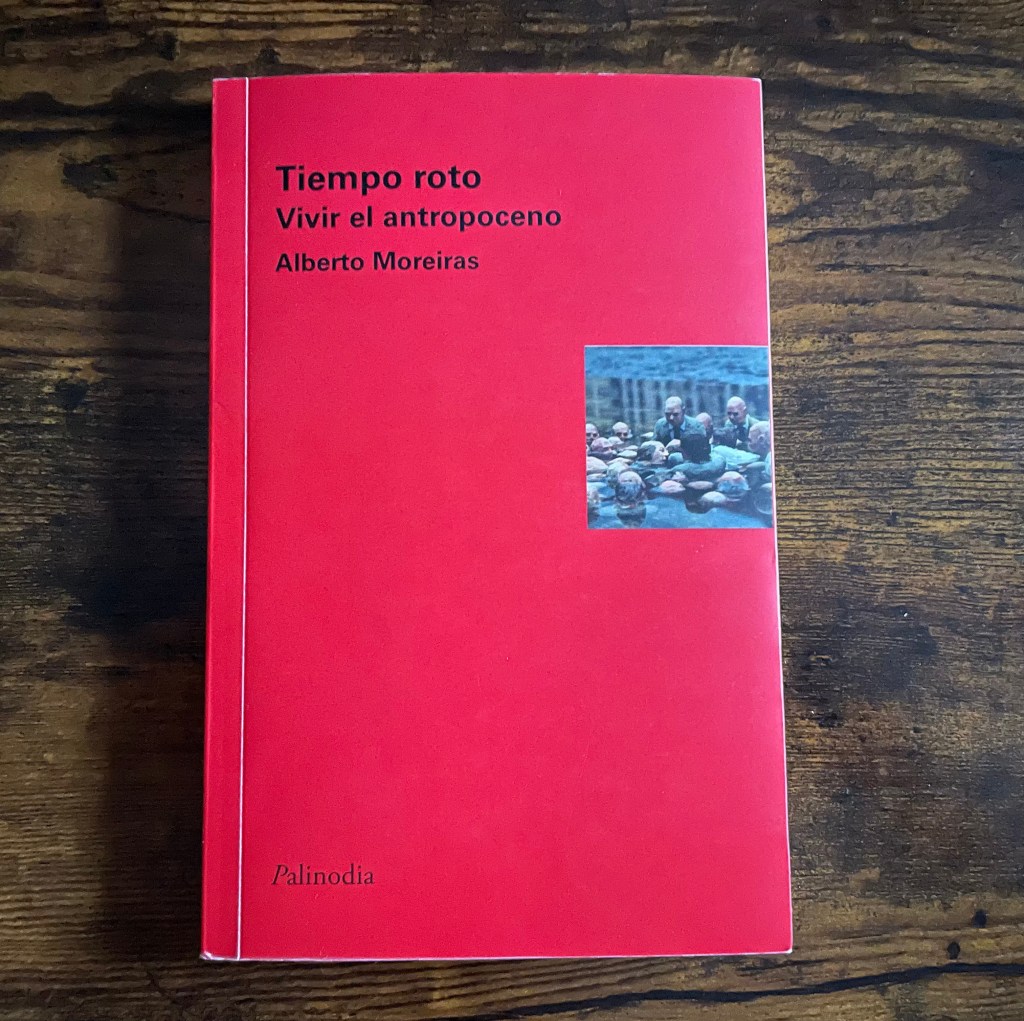
The task of the other beginning. On Alberto Moreiras’ Tiempo roto: vivir el antropoceno (2024). by Gerardo Muñoz

The sudden and uninvited intrusion of Gaia in our world is something rather strange, and yet consistent with the closure of the metaphysical tradition. The call of the outside takes place at the threshold of our reflexive capacities, habits, and mental propositions in our relation with the world, which demands everything to be thought from scratch. The historical imbalance in groundlessness now requires a new task for thinking – the imperative that runs through Alberto Moreiras’ most recent book Tiempo roto: vivir el antropoceno (Palinodia, 2024). The theoretical constellation deployed over the course of a decade now comes to the forefront with extreme urgency – I am referring to marranismo, posthegemony, aprincipial anarchy, and of course, infrapolitics. Tiempo roto (2024) is not a systematic culmination of Moreiras’ philosophical (or antiphilosophical) project of thought, but it is definitely a mature elaboration insofar as the field of problematization enters a hitherto unexplored thematics of late heideggerianism. All things considered, the emerge of the anthropocene as an explicit planetary endgame and the new beginning necessarily move pass the conditions of both political and scientific praxis, which today can only effectively adequate itself into positionality (the so-called Gestell) and objectivity of a world that slowly seems coming to its end. 

It might be worth remembering that the notion of “other beginning” (“otro comienzo”) in the wake of civilizational decline was already proposed in the book Sosiego siniestro (2020), but it was far from being thoroughly explained [1]. Following Heidegger’s philosophical scene, representational thought in the tradition of adequatio of the Thomist gnoseology coincides with technological administration of every living entity (Moreiras 14). But Heidegger’s suggestion in the Parmenides that calculative representation fails as grasping the essence of the polis might also have its own limitations, insofar Gaia appeals to an excess beyond or below the politics. As Jacques Camatte also understood it, the civilizational invariant of revolutionary breakthrough departing from the historical subject of the working class can seldomly do the work except as an article of faith in the myth of the autonomy of the proletariat within real subsumption. This means that we are in the terrain of infrapolitics or the chora, which point to ontic regions of thought towards a new beginning at the end of principial metaphysics. But the other beginning can only emerge within conditions of transforming existence against the closure of political technicity. 

I do not desire to reconstruct here all the refined analytical movements that lay out the transformation of existence in Tiempo roto (2025), but there is a maxim from Pindar’s Third Pythian Ode that stands out as an emblem for the appropriation of the non-humanity of the world. Moreiras cites Pindar’s “me, phila psycha, bion athanato speude, tan d’emprakton, antlie makanan”, which can roughly be translated as “do not seek, dear soul, immortal life, but do try to carry out the fullest the use of the possible” (Moreiras 61). Moreiras correctly notes that the ultimate difficulty lies in the “emprakton makanan”, or the use of the possible, which metaphysical Humanism and effective general equivalent can only exacerbate towards the planetary production and extractive valorization. The corruption of the use of the possible is the realization of hybris, and in this sense all representational humanism is always already a form of self-deification and induced hallucination, even when it tries to claim to engage in the opposite in relation to nature (Moreiras 65). Moreiras suggests that the pindaric maxim discloses a second relation of the “use of possibles” that does constitute a lacuna  in the metaphysical tradition, and that is understanding a praxis tied to sophrosyne or phronesis that abides to the prudent inclination of the non-human (“es una actividad sometida a la vergüenza de lo in-humano”) (Moreiras 65). Giorgio Agamben’s defense an ontology of possibility against the hegemony of metaphysical realization and representation also comes to mind, although Moreiras might not feel at ease at explicitly calling for a positive ontology nourished in the waters of a transfigured metaphysics of the tradition of scholastic Averroism [2]. Although both Moreiras and Agamben come at their closest proximity in terms of the notion of the chora – and more directly the space of the chora against the primacy of the polis – which serves the ontic condition for the non-spatial surfacing of the abode or region that is necessarily infrapolitical, because it’s never determined by distributionist political isonomia or meson (Moreiras 73). 

There are important nuances here to say the least: whereas for Agamben the notion of chora appeals to the gods of place (theos aisthetos), and thus a dejointed form of divinization decoupled from the legitimacy of every politico-theological archein; for Moreiras, the chora is a praxis of thought towards desecularization that lacks theology, and thus capable of exceeding the onto-theological reduction (Moreiras 74). But Moreiras says about the tendency towards nihilism of “possibility” in the historical dispensation of positionality (Gestell) could also be said about ‘de-secularization’, as the ultimate consequence of the decay of political legitimation in Ernst Bockenforde’s famous formulation. This might not be the space nor the moment to reach a verdict between Moreiras and Agamben’s position regarding the very complicated problem of the Platonic site of the sensible, since what is presented to the reader as a ‘phenomenology of excess’ or the inapparent (something merely alluded in the Zahringer seminar), might be the condition of an atopic mediation that prepares – or that has always prepared since the times of Orphic myths – the tonality of a coming philosophy under the sign of transformative thought (Moreiras 110) [3]. 

The dispensation of the Gestell open up and also step back (a folded movement that does not have a declension into a synthesis) into the genesis of the beginning (Moreiras 115). And the anthropocentric epochal dispensation, says Moreiras, is no longer the site of the polis, but “the planet as a the historical site of humanity, although we are still unaware of it (“aunque sigamos desconociéndolo”) (Moreiras 116). This uncanny phenomenology of the primary, traversed by the discharge of the entstehung, is the infrapolitical site par excellence, because it is in the atopic region where destiny is both affirmed and displaced. This is why, as Moreiras recalls Heidegger saying, the dialogue with Parmenides never exhausts itself, and yet it prepares a destiny (Moreiras 134). I take this to mean that there is an experience of the transfiguration of language for the emergence of an “ethics” (ethos), but this might be beyond Moreiras preliminary conditions for an existential breakthrough; that is, something possible further along the path.

Tiempo roto (2024) closes with a couple of undeveloped pages that take Massimo Cacciari’s old essay “Confrontation with Heidegger” (1977), in which the Italian philosopher makes a plea for a direct confrontation with Heidegger and Nietzsche’s teachings on nihilism and the closure of metaphysics if there would still be any hope for the composition of the working class during the stage of anthropomorphized dimension of capital defined by Jacques Camatte also during those years. But much has changed since the hot Italian summer of 1977 and the formulaic conjunction of  “left Heideggerianism” might not do the work anymore, as if the totality of materialist political economy could be amended by a radicalization of the historical question and the ontological difference. Political economy plus metaphysical critique is still relying on a conception of the political as a technique, which today has transformed into what some have called the “new regime of ecological accumulation” as mere stabilization of green ecological spheres of life [4]. 

But there is  a second register to Cacciari’s programmatic thesis that remains open. And these might be Moreiras’ most important words in the concluding part of the book: “Espero haber mostrado que Hiedegger señala la posibilidad de dejar atrás la explotación y el consumo en la era del Antropoceno a través de una comprensión alotrópica de nuestra relación con el mundo. Por lo tanto, vivir en el Antropoceno debe basarse en el abandono o desplazamiento de la metafísica como modo dominante de aprehensión del mundo en la actualidad” (Moreiras 151-152). Marx’s materialist dialectic through the critique of political economy – even as a destitution of political economy through its own vectorization – might be insufficient to face the unprogrammed presence posed by planetary anthropocene. 

Perhaps we can still repeat Dionys Mascolo’s words that the coming communism will owe more to Hölderlin than than Marx, not because of an idealist dispute over concepts, but rather because of what Cacciari called in his essay, also citing the German poet, the historical “affinity of conditions” [5]. And in the age of the Anthropocene and positionality, those conditions are kept in the pattern of economic decline or stagnation in which the law of rate of profit encounters its own limit, folded unto the ongoing destruction of the life forms in the world. The allotropic praxis endorsed by Moreiras finds traction in Hölderlin’s poetic dwelling in language at the heart of decline so that something other might emerge within and beyond life, from Gaia to Ctonia. This is the most difficult task to depart from, but it is also the path that saves from the current inhabitable passage of the Earth. 

Notes 

1. Alberto Moreiras, Sosiego siniestro (Guillermo Escolar, 2020), 24.

2. Giorgio Agamben. L’irrealizzabile: Per una politica dell’ontologia (Einaudi, 2022), 112-146. Kindle Edition.

3. For more on orphism and the limits of the site of the Greek polis, see Gianni Carchia’s Orfismo e tragedia (Quodlibet, 2019), epilogue by Julien Coupat. 

4. Gerardo Muñoz & Zeit der Ökologie. “On the New Regime of Accumulation”, Endnotes 2024: https://endnotes.org.uk/posts/on-the-new-ecological-regime-of-accumulation 

5. Massimo Cacciari. “Confronto con Heidegger”, in Pensiero negativo e razionalizzazione (Marsilio, 1977).

We are all mystics. by Gerardo Muñoz

It is too often that we hear a common critique raised against the theoretical skepticism of the primacy of politics in the form of an alleged prefigured “mysticism”, as if the destructive operation against sufficient political reason would entail an ineffable silence. It is a striking claim because there is some truth to it. But we must also question its assumption: can the proponents of political primacy ascertain a ground that can escape the mystical position that it seeks to avoid? The task of intellectual history is infinite and rewarding, but that does not mean this enterprise can positively mobilize a breakthrough within the epochal collapse of modern politics. If this is true, then it would follow that everyone is, more or less, a defaced mystic, insofar mysticism is the condition that runs against the limits of language and the current of the negative. In the same way an American judge famously said that ‘we are all [legal] originalists now’, one could very well say that ‘we are all mystics now’. It all depends where we put the emphasis and the tone. 

If we are to reject the totality of political administration and intraworldly legitimacy, this does not necessarily mean that we can immediately sketch what a coming politics would look like. According to Karl Barth in his Ethics, the position of mysticism always denotes a weak “us” that emerges from disobedience with respect to the world; concretely, against the system of planning and delegated orders (schools and the police). So mysticism is an archirealist position because it traverses the world, but only to depose the transcendental closure of its authority. In this way, the skepticism against the mystical position, perhaps unconsciously, is also an indirect skepticism against anti-social stance that is deficient from the vantage point of advantageous political realism. But the insistence of political realism is only anti-mystical on the surface, because it depends on an article of faith on the social reproduction and the overall general political economy between subjects and objects, value and the administration of life. 

The mystic cannot be confused with a guru, a magnetic theologian, nor a priest in robes. On the contrary, the mystic is a sibling to the pícaro, a figure of the Spanish Golden Age, that made his life unarrating the social protocols of the emergent social space, revealing and subverting the “autoridades postizas” (fictional authorities) of his epoch, according to the beautiful formulation of Santa Teresa de Ávila. Whoever has read any of the Spanish picarescas will immediately recall that the pícaro does not endorse static or monastic life of interiority, he upholds a temporality of life that coincides with the events of a world that becomes unfixed and betrayed. And the pícaro lives and outlives himself in this gestaltic confrontation. This vital mysticism in how he uses the world is more practical than any political justification for consensual common action.

It is worth noting that Carlo Michelstaedter in a gloss on courage and the persuaded life, divided the world – and his world was that of the Austro-Hungarian interregnum, a transitional epoch of decline filled with specters and monstrosities, very much like ours – between mystics and the dishonest or tricksters, but only the first could be named “heroes” because only them knew the secret of their unique persuasion unto death, renouncing to petty morality, self-interest, and social orders [1]. The mystic inhabits not just the silence that arrests the truth for which he cannot speak; more fundamentally, he also exerts, in every act, the task of freedom as embedded in thought and contemplation of the soul, that according to Michelsteadter is a personal struggle that bends to the real gnosis, “because to know oneself is ultimately to know the universe and to name it…only there is life” [2].

Notes 

1. Carlo Michelstaedter. La melodía del joven divino (Sexto Piso, 2009), 43. 

2. Ibid., 53.

Justification and the demonic State. by Gerardo Muñoz

In the broadest sense of the term, questions about the law are predominantly about its justifications, and more specifically about where to locate the act of justifying. That one of the most important elaborations of exclusive positive authority was dependent on a theory of justification to transfer norms of authority (a theory labeled the “normal justification theory”) goes to show that the traditional opposition between positive law as pertaining to the sphere of rights and guarantees and natural law to that of justification comes short in the understanding of the internal development of judicial reasoning in the second half of the twentieth century that unsurprisingly coincides with the crisis of the secular liberal state [1]. The reliance on a “justification theory” will imply not only a new conception of legitimation, but also the outsourcing of the self-referential determination of “Nature” through which Roman Law constructed its principle of the rule of law and the validity of adjudication. As we know, Roman Law did not speak of “justification” but rather of necessity emanating from Nature, which could not oblige to performance or act through by what by nature is impossible or wrong [Ius plurimis modis dicitur: uno modo, cum id quod semper aequum et bonum est ius dicitur, ut est lus naturale]. The natural source of law, as famously defined by Ulpian in the Digest, is in this way permanently tilting between the good and the equitable (ius est ars boni et aequi). This is a matter of first principles of the law (ius), which did not solicit “argumentation” or second order reasoning to uphold its internal legal validity. 

The passage from natural necessity in the “hands of the priest”, in Ulpian’s conception, to the modern autonomy of justification takes place when principles are no longer the exclusive framework parameters for operative claims, but the very activity that defines the elasticity of an actual norm and its argumentation within a concrete positive order. This is one way in which one should define the specificity of the American practical legal order (not just its legal philosophies, which tends to run counter to this, cloaked under the vestigates of positivism vis-à-vis the letter and spirit of the Constitution) through juridical administration, whose structural polarity of command and justification defines the administrative process. Early in the twentieth century, Guglielmo Ferrero noted that one of defining characteristics of the American political model rested on a magistrate judicial power that fundamentally differed from European Common Law or positivist tradition in its practice [2]. Contrasting the independence of a limited bureaucracy to the predominance of an all encompassing “juridical administration”, Ferrero noted (although lacking the legal vocabulary to articulate it positively) that the administrative nexus will infinitely expand over social practical reasoning due to the unrestricted force of justification. And the need for justification is what outsources the ancient principles of natural law (ius) to the executive authority that renders operative every sphere of social action and interaction even if they are not explicitly declared prima facie by those principles. The efficacy of justification is the linguistic deployment – a rhetorical craft through rational argumentation – that will generate specific verisimilitude to the otherwise arbitrary and uncontested enactment of its principles. Justification could be said to appear as the work of language that provides internal cohesion of an array of coordinated conditions for secondary social actions. 

Since the inception of modern secularization, the nature of justification is the realization of the works without end, which inverts the notion of “justification” in the theological sphere that we owe to Paul. For the Apostle the idea of justification or dikaiōsis implies the making of righteousness through the soteriological narrative of Christianity that subsumes humanity’s fall (sin) for a redeeming liquidation of law. This means that man’s just act in faith generates “justification” (dikaiōsis) of life for all people (Roman 5:18). And as we read from Galatians 2:6: “Know that a person is not justified by the works of the law, but by faith in Jesus Christ. So we, too, have put our faith in Christ Jesus that we may be justified by faith”. The force of justification (dikaiōsis) trumps the production of the works of law that divides human beings in the immanence of this world between the saved and the condemned, the free and the imprisoned, the friend and the enemy. Whereas justification in the theological sense can only imply the ‘end of law’ for righteousness (Roman 10:4), in its late secularized rendition it implies exactly its distorted mirror image: to justify is transformed into the binding force over the void of authority that renders effective the hollow machinery of its own self-validation. 

It is telling that in an essay that was first published in German in 1938 under the title “Justification and Justice” (“Rechtfertigung Und Recht”), the German theologian Karl Barth takes note on the transformation of the State becoming “demonic” not due to its utter demise, but as a profanation of the theological justification of “unwarrantable assumption of autonomy as by the loss of its legitimate, relative independence, as by a renunciation of its true substance, dignity, function, and purpose…a renunciation which out in Caesar worship, the myth of the state and the like” [3]. The emergence of the “demonic nature” of the State was internal of its own making , since it conflated faith and people at the same level of social immanence, while preparing the actual realization of an authoritarian world without escape. Following Heinrich Schlier’s work on the figure of the State in the New Testament, Barth will suggest that this political totalization secularized the limit posited by the suum cuique of justification into an instrument of endless domination that characterized the emerging political reality. In fact, in his essay “The State according to the New Testament”, Schlier will define the phase of the demonic State as one colored by the inception of the sphragis, that is, “the sign of the state party as it were the secularized seal of baptism which levels all differences between men and only distinguishes between friend and energies of the ruling system. Those who refuse the new metaphysical slave are deprived of their economic foundations. Even economic life is directed by the spirit of the beast” [4]. 

Only in such context does the true light of the force of justification comes in full display: the sphragis can only labour to justify the vicarious social existence of the mystery of iniquity infinitely redressing itself as legal argumentation and juridical principles, administrative determinations and executive commands. And Schlier could not let the question pass: “What will Christians do in this situation? They will no longer want to have any part in this caricare of a state, they will “go out…they will simply be outlawed and persecuted” [5]. More than ever today, we are in desperate need of elaborating the elementary aspects of a political theory of demonology that defines a certain point where there is no turning back. To outlive persecution and tear the bond of justification shatters the civilizational course that has sublimated the end of time as an instrument of daemonic absorption into endless legal statues.

Notes 

1. Joseph Raz defines “normal justification thesis” of legal authority in this way: “I shall call it the normal justification thesis. It claims that the normal and primary way to establish that a person should be acknowledged to have authority over another person involves showing that the alleged subject is likely better to comply with reasons which apply to him (other than the alleged authoritative directives) if he accepts the directives of the alleged authority as authoritatively binding and tries to follow them, rather than by trying to follow the reasons which apply to him directly”, in “Authority and Justification”, Authority (NYU Press, 1990), 129.

2. Guglielmo Ferrero. “American characteristics” (1910), The Atlantic. 226. 

3. Karl Barth. Community, State, and Church (Peter Smith, 1968), 118.

4. Heinrich Schlier. “The State  according to the New Testament”, in The relevance of the New Testament (Herder and Herder, 1968), 236.

5. Ibid., 237.

Unelevated politics. by Gerardo Muñoz

In a fragment from 1919 entitled “World and Time”, written around the time of the elaboration of the essay on the question of violence, Walter Benjamin offers his most succinct definition of politics: “My definition of politics: the fulfillment of unelevated [ungesteigerten] humanness” [1]. The ontological reduction is compact, and the three terms in it are carefully chosen: fulfillment, unelevation, and humanness, which indicates a ‘preparation for a profane politics’ at the threshold of secularization and its negation in a new “spiritual ornamentation”, as he would claim in the notes of “Capitalism and Religion”. The stress on the refusal of “elevation” (gesteigerten), however, does bring to bear that Benjamin’s refusal of a political ontology constrained in subjective and objective representation, which is why in the same fragment he connects the abutting of politics to a “living-corporality” [Leiblichkeit] of the human species. To retract from the cycle of civilizational violence, politics had to be reformed from the groundlessness of the energy of the living.

Hence, for Benjamin there is a metapolitical condition or archipolitics that plays out in refusing “elevated humanity”, which for him was at the source of the romantic response to the impasse of the critical enlightenment, placing the subject of knowledge and its self-reflective faculty at the center of the developing self-rationalization of the spiritual transcendence of the world in this new critical religion: “…the ideal of humanity by rising up to…that very law which, joined to earlier laws, assures an approximation to the eternal ideal of humanity” [2]. Hence, neither trascendental representation nor spiritualized immanence of order could, but unelevation of the “human possibilities” (Menschhaftigkeit). But such possibilities could only be disclosed beyond the pretensions of spiritual elevations of a unified consciousness, as Erich Unger had proposed in his Politics and Metaphysics (1921) around the same time to enact a “politics of exodus” for a common psychosocial regeneration. 

Benjamin’s proximity and distance from Unger’s position could perhaps inform why instead of writing a promised book that was going to be entitled True Politics (Die Wahre Politik) – allegedly containing two chapters “The destitution of power” and “Teleology without ultimate goal” – evolved into the landmark essay “Towards the critique of violence”, in which the frame of domination and the ontology of politics was recasted as a mediation about the folding of secularized annihilating violence, substance intrinsic to the philosophy of history and indestructible life of the soul (“annihilating only in a relative sense…never absolute with regard to the soul of the living”) [3]. Thus, one could say that accounting for the groundwork of “politics” meant accepting the constitutive verticality cosigned to modern philosophy of history, and its bipolar schematism between moral principles and sacrificial production. If Peter Fenves’ assumption is correct, Benjamin was not only inscribing a distance from Unger, but, more importantly, from Kant’s Toward Eternal Peace who defined his “true politics” as dependent on moral determination: “The true politics can therefore not take a step without having already paid homage to morality, and although politics by itself is a difficult art, its union with morality is no art all, for as soon as the two struggle against each other, morality into two cuts the knot that politics cannot dissolve – The right of human beings must be held sacred [heilig], however great a sacrifice this may yet the dominant power” [4].

The Kantian liquidation of politics to morality is hyperbolic to the modern epoch and its crisis – the crisis and enmity against the concept of the political, Carl Schmitt would claim in Political Theology (1922) – rendering modern politics and legitimacy hollow; something that Benjamin had understood well he saw to retract from the question of “politics” to that of a critico-metaphysical exploration waged on morality “as nothing other than the refraction of action in knowability, something from the region of knowledge…Morality is not ethos” [5]. Elevation could only have meant the production of a subject of knowledge and the specific (technical) arrangement of knowledges for subjection. On the contrary, the ethos was the necessary condition no longer for any “coming politics”, but rather for the disclosure of “the coming world” [die kommende Welt] itself. This means that working through the redemption of the world solicits a reversal from morality to ethics only to later transform the conditions of politics.

Let us return to the definition of politics as “unelevated [ungesteigerten] humanness”. What defines “unelevation”? From the ethical point of view it conjoins with the notion of “inclination” [Neigung] that Benjamin favors because of its unconditional valance that disarms the cycle of violence of the human community and its willful hostilities. The inclination rejects the paradigm of force because it an erotic mediation, that is, an affection of donation and love beyond exchange [6]. But inclination is only possible through language, as Benjamin had expressed in his “concept of politics” in a letter to Martin Buber from 1916: “I understand the concept of politics in its broadest sense…in this sense, therefore, language is only one means of more or less suggestively laying the groundwork for the motives that determine the person’s actions in his heart of hearts. Only the intensive aiming of words into the core of intrinsic silence is truly effective action” [7].  

Thus, the suspended elevation of the subject and higher order meant that its persuasive purity allows the inception of the “divine” as a «teleology without a goal» validated by the suspension of judgement of appearance. The intensification of the unelevation opens life to an ethical demand of a “living corporality” that roams the world’s crust beyond depredation where the force of autonomy of social practices does not risks the world of life forms and the soul. Indeed, at this point Benjamin does join Unger’s cardinal thesis: “Overcoming capitalism through wandering”. Or as he wrote even earlier about Hölderlin’s poetics: “[In the world of Hölderlin], the living are always stretching of space, the plane spread out within which destiny extends itself…it already comprehends the fulfillment of destiny” [8]. A politics oriented pending dowards to “unelevation”, inhabits the ground level of co-existence and cultivation dismissing the ontological derivatives or principles (archein) of ‘politics’ in order to conquer every possible destiny in the lawless fulfillment of the world.

Notes 

1. Walter Benjamin. “World and Time”, in Walter Benjamin: Toward the Critique of Violence: A Critical Edition (Stanford University Press, 2021), 74. 

2. Walter Benjamin. “The Concept of Criticism in German Romanticism”, in  Selected Writings, Volume 1, 1913-1926 (Harvard University Press, 1996), 138. 

3. Walter Benjamin. “Toward the Critique of Violence”, in Walter Benjamin: Toward the Critique of Violence: A Critical Edition (Stanford University Press, 2021), 58. 

4. Peter Fenves. “Introduction”, in Walter Benjamin: Toward the Critique of Violence: A Critical Edition (Stanford University Press, 2021), 18-19. 

5. Walter Benjamin. “Ethics, Applied to History”, in Walter Benjamin: Toward the Critique of Violence: A Critical Edition (Stanford University Press, 2021), 74. 

6. Walter Benjamin. “On Kantian Ethics”, in Walter Benjamin: Toward the Critique of Violence: A Critical Edition (Stanford University Press, 2021), 71. 

7. Walter Benjamin. “Letter to Martin Buber” (1916), in The Correspondence of Walter Benjamin (University of Chicago Press, 1994),  79-80.

8. Walter Benjamin. “Two Poems by Fredrich Hölderlin”, in Selected Writings, Volume 1, 1913-1926 (Harvard University Press, 1996), 26. 

The instrument stripped bare. On Adan Kovacsics’ Guerra y lenguaje (2025). by Gerardo Muñoz

Endless war and infinite strife is always preceded by the erosion and the putrid decomposition of language. Such is the thesis of Adan Kovacsics’ idiosyncratic and historically situated Guerra y lenguaje (Acantilado, 2025), which sets a specific date for the moment of such linguistic rot into consciousness in European modernity: Hugo von Hofmannsthal’s “Lord Chandos Letter” of 1902 in which civilizational decline signaled the total detachment of expression, making language flourish in the form of opinions resembling rotten mushrooms. For Hofmannsthal this event was neither accidental nor a temporary malady, but a tonality of existence that soon enough broadened like a “spreading rust” (Kovacsics 11). Just a few years later in his posthumous Persuasion and Rhetoric, Michelstaedter will describe this rusting of language as the triumph of “darkening ornaments” (kallopismata orphnes) of the epoch, liberating the destiny of language as a mere transactional exchange between “technical terms” mastered by everyone regardless of their idioms (it surprises the reader that the thinker of Gorizia is absent from Kovacsics’ Austro-Hungarian constellation on the crisis of language). 

The decline of an empire shimmering with languages and dialects across its territory began to suffer the malady of miscommunication that resulted in making language uninhabitable, throbbing in its empty chatter. Thus, the attempt to initiate an exodus from language began to appear everywhere according to Kovacsics: Fritz Mauthner drafts an encyclopedic treatise on the venereal misapprehension of language, Gustav Landauver battles in the trenches of linguistic scepticism and the mystical tradition in the name of revolution, while others like Hugo Ball attempts to flee from language altogether through the liberation of sounds and words, from the Dada avant-garde to his later Byzantine Christian asceticism. For his part, Karl Kraus in The last days of Mankind prefers to expose the surface of language as it becomes a regime regulated by opinion for bureaucratic administration over facts of reality. The nihilism that colors politics at the turn of the century is accompanied by the instrumentalization of language as the primordial technical apparatus that allows the flows of information through the acceleration of the autonomization of the linguistic mediation; as consequence, language began to arouse constant disbelief and doubt over the very essence of the sayable (Kovacsics 31). This throws light on contemporary debates about “misinformation” that, precisely because they are caught up on the epistemological determination proper to the linguistic crisis, it comes short to putting into perspective the range and depth of language over the problem of appearance now deprived of the expressive mediation between the speaking animal and phenomena, reducing experience to rhetorical commonalities or inter-social allocation of commands. 

Kovacsics’s Guerra y Lenguaje (2025) brings to bear – without totally exhausting the crushing weight of its archive and set of problems for thought – the immense significance of the first decade of the twentieth century at outset of the waning of the Austrian-Hungarian Empire, which has always been understood historically as the condition for the last configuration of European nationalism and its war-economies, but rarely in light of its functionalization of language. If read against the backdrop of Simone Weil’s “Are we heading for the proletarian revolution?” (1933) intervention about the “functional” dimension of the state form in the first decades of the twentieth century, Kovacsic’s essay ultimately helps us to define the concrete nature of functionality as the index of mobilization of ‘worlding’ through the commanding force of language. To deliver this point home, Kovacsics tells how language itself severed enunciation from action:

“La transformación que se produjo y que la ha alejado, como si un tablón se hubiese desprendido del muelle y se hubiera adentrado en el mar, no se debe a que otras gentes se impusieron en su día en Grecia, sino a un cambio radical en el uso concreto de la palabra. Es en la Gran Guerra cuando esa corriente inicial de la utilización del lenguaje como herramienta se consolida de manera definitiva. Es entonces cuando la palabra pasa a ser plenamente funcional y su papel se reduce a aportar argumentos para la acción o incluso a “parirla” mediante el tópico. Hemos visto hasta qué punto el silencio de Karl Kraus al comienzo de la contienda se debía a la percepción de este vínculo entre palabra y acción, al que no quería ni podía sumarse de ningún modo” (Kovacsics 76-77). 

Language does not disappear as much as it transforms itself into two vectors of social enforcement towards communication: functionality and rhetorical enthymemes. In this way, language is able to colonize reality and stabilize for the concrete order, or what Walter Benjamin called during those years the “bourgeois conception of language” hindering on causality and objectivity accelerating the collapse of its vocation to naming the exteriority of the world (Kovacsics 81). The totalization of this new rhetorical social structure becomes the main stage for the production of justification and competing regimes of fiction. But this implies no general theory or systematization of a linguistic science, but rather how language coincides with life in the form of an ethics. This is at the heart of the different attempts to retract language in the eclipse of empire and the new interstate fragmentation – which also entails grammatical and functional unifigies of national language – as a problem that concerns the limits of ethics. Ethics here cannot coincide with the general condition of ‘knowability’ that makes morality possible; rather, the problem of ethics can only reveal in turn the senseless of wanting to go beyond the facts of the world and allows us to dwell in one without completion.  The withdrawal from the language of propaganda and objectivity demanded an ethics of the sayable beyond the commodification and intentionality of words promoted by “war” and “ware” (commodity) that the West had continued to endure; a total communication of ends that decades later evolved into cybernetics as the warping of world into informational encoded relation.

Kovacsics reminds us that there is a story here of extreme violence and creative destruction, only comparable to nuclear fusion and the flaying of a human being, only that this time, unlike the myth of Marsyas, without ever reaching transcendence of redemption through the proximity of language to myth (Kovacsics 129). Underneath there is the body of language, stripped of its capacity for truth and reduced to functions of survival and needs oriented towards the homogeneity of the future. Towards the end of Guerra y lenguaje (2025), and glossing Hobbes’ notion of political authority that legitimated the modern interstate system to neutralize truth contents and the stasis over words, one cannot help but think that the date 1902 as a. arcana was an effective culmination rather than genesis of the modern, which means that the foul scent of the twentieth century was destined for decomposition since it had already stripped bared one of the most beautiful lacunae of the human species: being in language and the event of appearance became integrated into the worldly utopia of the machine.

As captured in Marcel Duchamp’s “The Bride Stripped Bare”, the obsolescence of language over time evolved into a candid instrument of social functions of proportional exchange, coordinated fortuitous relations, and increasing moral indictment that purported parodies of contested realities. Thus, the sickness is always unto language – a basic assumption that reveals the need for infrapolitical analysis before there is any political practice and categorial reinvention. The overexposure of language as an avatar of metaphoric communication for ends and needs of humankind brought itself bare and all encompassing in its appropriative force, but only at the expense of darkening and losing the world forever. 

Osculum pacis. by Gerardo Muñoz

It has taken Pope Francis’s public letter addressed to the Bishops of the United States to put in perspective how late American imperial politics in matters of immigration and probably other spheres of social life is not only at odds with the Christian vocation, but even waging war against the very dogma of Christian revelation. The reminder does not come completely out of context, since as we know, the marching band of intellectuals that for a long time have defended a “Christian postliberal” transformation – some of which not long ago offered theological justifications for the Church as the universal ark for migrants – given the current hegemonic configuration find themselves as mere scribes of whatever is enacted by unilateral executive command. The impossibility of enacting a transitional political theology evidences the emptying of politics into a technical mobilization of apocalyptical overtones, as clearly defended by Peter Thiel. The attempts to pilotage a planetary gnosis to his own image in the last stage of imperial stagnation, definitely supports Francis’ assertion politics today is built “on the basis of force, and not on the truth about equal dignity….begins badly and will end badly”.  But in a way, this “end” has already taken place through the revocation of the ethical tenor of the Christian mystery. 

It comes to no surprise, then, that if the erosion of an ethics is at stake, that Pope Francis would allude to the parable of the Good Samaritan and fraternity, something that he has explored previously in the encyclical “Fratelli Tutti” [1]. It is also important to note that Francis is not opposing the Good Samaritan to the ordo amoris; rather the operation is more subtle: for any community to be organized around ordo amoris, there needs to be a space for the infinite discovery that the Good Samaritan parable solicits of every Christian’s responsability. According to Francis: “The true ordo amoris that must be promoted is that which we discover by meditating constantly on the parable of the “Good Samaritan” (cf. Lk10:25-37), that is, by meditating on the love that builds a fraternity open to all, without exception”. In other words, and implicitly taking distance from the Calvinist dependency on community of salvation, the Pontifex is disclosing the memory of an ethical vocation that cannot end in social norms or national unity without exteriority. The communitarian ordo at times could also amount to oppressive familiarity, as it appears in Corrado Alvaro’s Revolt in Aspromonte: “Village life seemed to him a strange invention, a protective agreement between people who were afraid”. Thus, what the Samaritan teaches human beings is that there are no ethical standards for which we can respond, since every encounter opens up a ‘decision of existence’ before an absolute other beyond the sacramental duty of “I ought”. 

Who is this “other human being” that now becomes your brother? As we know, in Ivan Illich’s late work the ethical inflection of the Good Samaritan illuminates the true character of our poetic relationality and creative act: “You can recognize the other man who is out of bounds….and create the supreme form of relatedness which his not given by creation but created by you. Any attempt to explain this “ought” as corresponding to a norm takes away the mysterious greatness from this act” [2]. Indeed, Illich goes further in telling us that the suppression of the ethical decision of encountering the Samaritan can only leave us with a “liberal fantasy…where bombing our neighbor for his own good” [3]. Just like today the moral justifications of “ordo amoris” or the administrative allocation of a substantive “common good” can produce justifications for mass deportation of immigrants and dividing the social space between citizens and noncitizens (removing the foundation of ius soli) can become the strange patent of a monstrous theological manipulation. 

The ethical mystery exemplified by the parable of the Good Samaritan introduced into history a new conception of “brotherhood” that was not conditioned by national, political, or family affiliations, but by a common vocation expressed upon acting through mercy and charity. Belonging to the “human fraternity” allows me to decide who is my brother through the osculum pacis – a conspiratorial mouth-to-mouth kiss that creates proportionality and peace through the encounter that yields mutual creation. Before the Samaritan we give everything without waiting for anything in return, as required by any true ethical disposition. As the scholar of Ancient Christianity, Christine Mohrman once noted, the osculum pacis was a universal relationship of the human species through their voices coming together to assert external political peace as well as interior health of the soul [4]. If the predatory programs of mass deportations and intensification of hostilities between nations have come to forefront in our days, this is due to the fact that the overall end is not to piecemeal ordo amoris coordinated by state social policies, but rather a permanent assault against the association of the free souls constitutive of the osculum pacis. 

In light of the theological drama of Christianity, nationalism can only be taken as a symptom of brute force and inequity (radical evil). As Erik Peterson reminded in his essay “Das Problem des Nationalismus im alten Christentum” (1951), the cult and strife between nations and imagined communities, at least for the Chirstian vocation, do not have any traction, since the warring angels of nationalities have been overcome by the event of resurrection [4]. The ‘strange career’ of American political Catholicism is precisely that through a technocratic administration of social pain and spectacular delirium, it can only offer an noncorporeal ideal of ordo amoris “in the service of a single nation which seeks to establish its supremacy, by identify its own interest with that of humankind”, as Peterson observed  in the wake of European nationalism, but that it applies today to the letter with little variations [6].

In vain should we attempt to pin down the osculum pacis as professionalization of care or the hospitalization of pain that have become practices of a “corrupted core of a very clear and powerful ideal of democracy”. In the disjointed time that characterizes the end of political theology and its warring nomoi, the osculum pacis will be not be found in those that attempt to conjure a “Christian civilization”, but only in those that dwell in the state of adelphos, faithful to the scandal of peace and the endless conspiracy of speech. 

Notes 

1. Pope Francis. “Encyclical Letter Fratelli Tutti (On Fraternity and Social Friendship), 2020: “By his actions, the Good Samaritan showed that “the existence of each and every individual is deeply tied to that of others: life is not simply time that passes; life is a time for interactions”: https://www.vatican.va/content/francesco/en/encyclicals/documents/papa-francesco_20201003_enciclica-fratelli-tutti.html 

2. Ivan Illich. The Rivers North of the Future (Anansi, 2005), 207. 

3. Ibid., 208.

4. Christine Mohrmann. “Quelques traits caractéristiques du latin des chrétiens”, in Études sur le latin des chrétien (Edizione Di Storia E Letteratura, 1961) , 29-30.

5. Erik Peterson. “Das Problem des Nationalismus im alten Christentum”, Theologische Zeitschrift, 7, 1951, 81-91.

6. Erik Peterson. “Die Frage nach dem Menschen”, in Offenbarung des Johannes und Politisch-theologische Texte (Echter Verlag, 2004), 250.

The last stage of embalmed decay. by Gerardo Muñoz

The techno-administrative organization of the world that is showing off its force these days is only possible thanks to a previous devastation of the opacity of language, which ultimately connects human beings and the world. It is also the mysterious vortex of the breaking point of humanity into being, of which today there is only remembrance and scholastic teaching but seldomly authentic expression. When politicians, engineers, and social functionaries stubbornly distract us with open attempts to decimate secondary languages, prohibiting the annunciation of words through the legal enforcement of “place and manner” norms, and elevate abhorrent structures of linguistic commands and information as units of social interaction, it is obvious that the collapse has already happened. It also means that in terms of “Social” planning humanity has ceased to exist under the shadow of speech, to use an expression from Helene Lubienska. Hence, it is all the more absurd to confront this transformation with a strategy of multiplication of rhetorical codified languages that merely deepen the schism between the expressivity of language and their worlds. It suffices to say that any recognition of a para-official language of social interaction plays into the fictitious polarity of homogeneous globality and reified nationalism –  the constitution of print nationalism being the historical destruction of minor and dispersed languages of remote places and villages for the sake of the organization of a productive fictitious historical subject.

We must ponder what it means that the current imperial world order is one that does not offer a language, let alone the flourishing of minor or ‘vulgar’ languages as in the Latin Middle Ages, but rather an exit from language, which is the cybernetic project of codifying flows of information and looping inputs in which asymptotically humanity surrenders their languages. In past imperial adventures, language was either a tool to subordinate the world of the colonized, or it was a lingua franca of elites (administrators and the clergy) that allowed for the real existing languages in the territories integrated precisely by their exclusion or subalternity to the civilizing regime guided by literacy. The sharp contrast with today it is striking, since it is all too clear that the project of cybernetics, and its most recent avatar “Artificial Intelligence” (AI), is fundamentally an Empire that does not even require to rule and neutralize the “civil war over words” that Thomas Hobbes repudiated in the European confessional state, since its ultimate goal is not political statecraft, but the regulation of unworldly bodies of social reproduction. 

This is why some contemporary engineers have said that AI requires “a reconfiguration of the social contract”, with the caveat that it would necessarily be a “social contract beyond language and thus without politics”. The last social dispensation at the hands of engineers is the human soul, as it has been said. For this conception of language, it matters to only understand it as a semiotic reduction of the expressive human being to naked animality as the general form of the posthistorical being in the present. It is noteworthy that a great North American writer, Cormac McCarthy, while working on this problem of language at the Santa Fe Institute scientific research program (a central hub of American developments for artificial science and the unification of the sciences), reached the conclusion that language must be understood in relation to a virus: “a virus nicely machined. Offer it up, Turn it sligh, Push it in, Click. Nice Fit. But the scrap heap will be found to contain any number of viruses that did not fit…The facts of the world do not for the most part come in narrative form. We have to do that” [1]. The “unruly nature” of language, precisely because it does not fit into the biological pattern of virological model, must be mastered into an accompanying narrative of the social world, taking the copula and grammar as the final functionalization of the fictitious community. The artificiality of language is a civilizational decay that takes place not as heteronomic cooptation by technological advancement, but within its own internal abdication of its voice and mystery. 

It is precisely this internal threat that the American sinologist Ernest Fenollosa sought to expose in the most polemical moment of his posthumous tract The Chinese Written Character as a Medium for Poetry (Stanley Nott, 1936) – an essay that was restituted, let us not forget, by Ezra Pound precisely to confront the pauperization of ‘Basic English’ as the standard of linguistic use – in which he writes the following observation about the extreme filing of words: “Languages today are thin and cold because we think less and less into them. We are forced, for the sake of quickness and sharpness, to file down each word to its narrowest edge of meaning. Nature would seem to have become less like a paradise and more and more like a factory. We are content to accept the vulgar misuse of the moment. A late stage of decay is arrested and embalmed in the dictionary” [2]. Fenollosa could not have foreseen that the posthistorical epoch – an epoch of the most furious abandonment of thinking – there was nothing else to file in terms of the expressivity and poetic soil of speech. The course of American artificial humanity is not a human with a pocket-dictionary; it is something way more grotesque: an animal that can repeat and chatter sounds and symbols severed of its proximity with any linguistic inherence and the sensorial worlds. And it goes without saying that the engineering plan against the poetic soil of speech, as North American poet understood well, means that this war is waged against the last reserve; that is, the ethos understood as ‘the cave of everyone’s inner being’. 

Notes 

1. Cormac McCarthy. “The Kekulé Problem”, Nautilus, April 2017: https://nautil.us/the-kekul-problem-236574/

2. Ernest Fenollosa. The Chinese Written Character, edited by Ezra Pound (Stanley Nott, 1936), 28.

Kallopismata orphnes: the eclipse of language. by Gerardo Muñoz

In his most decisive confrontation with the scientific method and the legitimacy of science through objective knowledge, Carlo Michelstaedter introduces a rather loosely expression from Plato’s Gorgias to lever his position against the sufficiency of the scientific experiment: the “kallopismata” (καλλωπίσματα), which can be rendered as “embellishments” or “ornaments” that is constituted in figures such as matter, law, the final cause, or ruling principles (archein) that align the conditions for calculative and sufficient reasoning [1]. For Michelstaedter, the world of objectivation and scientific neutrality proceeds through figures of rhetorical ornamentation, kallopismata, which allows conquering the future; that is, what remains completely foreign and inaccessible to the domain of calculative reason waged upon a series of expressed goods. 

It could be said that kallopismata is the artifice that allows the absorption of those goods to the historicity of civilization as they undergo their own ‘corruptio optimi pessima’ a process of functional realization of their entelechy: the desert becomes a cloister, the banquet an academic, the artist’s studio a school of beaux artists…imitative technique assumes the name of art; any virtuosity assumes the name of virtue [2]. In a language similar to that of Heidegger’s, Michelstaedter speaks of the constitution of an “exceptional machine”, which positions the organization of the world through rhetorical deployment (and it was not by coincide that Heidegger referred to Aristotle’s Rhetoric as “the first systematic hermeneutic of everydayness with one another”), and hence the fundamental metalinguistics of any social economy. The exceptional machination not only deploys generic meaning from the irreducibility of things, but also organizes the mediations between the subjective plane and the objective reality. In this way, the rise of the hegemony of science in the hands of the ‘pioneers of civilization’ and a “community of the wicked”, as Michelstaedter calls the endeavor of modern scientists, can violate nature offering security and comfort to the totality of mankind. This will explain their civilizational endurance and the recursive positionality for historical self-amendment and renewed adaptation.

How can this community of the wicked achieve absolute consent and domination through their practice? The domination over nature is not exclusively an anthropological process extended outwardly; it posits a nexus between interiority and exteriority where the question of language itself is entirely redefined. This is why the most stealth invention of the practice of scientists for Michelstaedter is to “infiltrate life with certain words….on which meaning unknowingly prop themselves for their daily needs, without acknowledging them they pass them on as they were received” [3]. The ultimate experiment of the techno-scientific understanding of the world amounts to the elaboration of cybernetics (a term that Michelstaedter never uses but that obviously colors the effect of his general scheme of civilizational nihilism); that is, the unification between the phenomena of the world and the human’s sayable language. To this end, Michelstadter will emphasize this proximity: “Technical terms give men a certain uniformity of language. In  vain do the proponents of internally created international languages dream. The international language will be language of technical terms; of kallopismata orphnes, ‘ornaments of the darkness’ [4]. Whereas darkness denotes the harboring of language and its limit – and one can recall Fridugisus’ De nihilo et tenebris – its slow decay in darkness, kallopismata orphnes, outlives itself by the artificial luminosity that tears all mediation from the sensible world, now realized as fully alien to the appearance of truth and the truth of appearance. As Giorgio Agamben has noted, in what could be read as an esoteric gloss on the triumph of the kallopismata orphnes in our times, the technical question in the scientific paradigm is not merely a problem of the modes of techniques and instrumentalization, but more concretely a process that brings to an end the use of language as a sensible experience with the world [5]. And insofar as “sense” is only an idea of the sayable, it might as well be senselessness has been fully integrated into the infinite production of “informational differences” (“data run”), a final hypertrophied form of an unworldly logoi

It would not have passed Michelstaedter that the context in which the degraded notion of kallopismata (embellishment, ornament, decoration as adjectives do the work, but one should also register the kallos, a central tonality in Plato’s musical thought) happens in a rebuttal of Callicles to Socrates’ critique of force and personal interest as requirement for a conception of Justice. In 492c of the Gorgias Callicles will reply to Scorates stating the following: “No, in good truth, Socrates—which you claim to be seeking—the fact is this: luxury and licentiousness and liberty, if they have the support of force, are virtue and happiness, and the rest of these embellishments (kallōpismata)—the unnatural covenants of mankind—are all mere stuff and nonsense” [6]. In other words, for Callicles anything that does not have the force of principle or justification has already fallen to the level of “stuff” and “nonsense”, even though that nonsense is itself the use of language in its contact with the “thereness” of appearances. It is no coincidence that in his lecture of ethics, Wittgestein will press upon the nonsensical expressions of language in order to elude the escaping and impossible essence of language every time that it seeks to move beyond the world” [7]. In other words, if Callicles is the hyperbolic figure of the rhetorician-scientist, what is at stake in the inception of kallōpismata as veil of language is nothing else than the effective liquidation of its ethical dimension, which in turn transforms the use of language into a mere coding instrument at the altar of philopsychia, or, in the words of Callicles, of empty “unnatural covenants” (para physin synthēmata), depleting language to exclusive semantic and and metaphoric correspondence [8]. In other words, the ascendancy of the nonlanguage of the kallopismata will now entail abandoning the imperative mode in which language and life can enter a secret relation as defined by its use [9]. 

Can one even speak of human life after the ascension of the kallopismata orphnes as the civilizational matrix of the world? A life without the use of language, under the veil of kallōpismata, represents an unprecedented milestone and perhaps something beyond the rhetorical enthymemes. Perhaps one could elucidate this point in this way: according to Hans Blumenberg, the most important rhetorical form ever invented was that of the prayer because through its practice one is ultimately trying to persuade a God. In contrast, in the complete darkness prefigured by kallōpismata orphnes that dwells in a civilization eclipse – the rise and fall of modern secularization and political idolatry – the gods can no longer be posited as exteriority towards the taming of the gnosis for the anthropological need of self-affirmation [10]. Because the process of fictitious anthropomorphism has reached its own limit to the point of becoming itself an “exceptional machine” (macchina eccezionale), the mystery of the senselessness of language has lost the world not necessarily by becoming mute and silent, but by enslaving itself to the endless chatter and infinite consensus by the moral equilibrium of the social age that for Michelstaedter ultimately meant “the machinery of dispersing interests, where the paths of existence are no longer clearly traced, but become confused and disappear; hence it is up to every existence to create the luminous path among the universal chaos; as if were, an art of practical life” [11].  It is that existential path granted by the nonsense of language (soul to soul) that grants beauty in the event of appearance, that cuts through and overcomes the civilizational allure of linguistic kallopismasta whose radiant heliotropism can only result in the most spectacular of blindness. 

Notes

1. Carlo Michelstaedter. Persuasion and Rhetoric (Yale University Press, 2004), 98.

2. Ibid., 96.

3. Ibid., 98.

4. Ibid., 98.

5. Giorgio Agamben writes in “Sul dicibile e l’idea”, Che cos’è la filosofia? (Quodlibet, 2016): “Technics is not an “application of science”: it is the fundamental production of a science that no longer wants to save appearances, but obstinately tends to replace its hypothesis with reality, to “realize” them. The transformation of the experiments – which now takes place through machines there so complex that they do have anything to do with real conditions, but purport to force them – eloquently shows that the translation between languages is no longer at stake. As science that renounces saving appearances can only aim at their destruction; a philosophy that no longer calls itself into question through ideas, in language, loses its necessary connection with the sensible world”, 115. The attempt to escape appearance and experience to turn the world into a mimetic illusion administered by the aesthetic dominance of the pseudos was also elaborated by Gianni Carchia in his analysis of Plato’s aesthetics in L’estetica antica (Editori Laterza, 1999), 89-100.

6. Plato. Gorgias (Loeb, 1967), 413.

7. Ludwig Wittgstein. Lecture on Ethics (Wiley & Sons, 2014), 50-51.

8. Carlo Michelstaedter. Persuasion and Rhetoric (Yale University Press, 2004), 97.

9. Carlo Michelstaedter “Appendici I: Modi Della Significazione Sufficiente”, in La persuasione e la rettorica (Adelphi Edizioni, 1995), 142.

10. Hans Blumenberg. “Una aproximación antropológica a la actualidad de la retórica”, in La realida en que vivimos (Ediciones Paidós, 1999), 133. Philippe Theophanidis recently suggested in a discussion that we should read kallopismata orphnes in mind with the formulation  “God help me”—because I haven’t the courage to help myself” that Michelstaedter introduces in the chapter “Rhetoric”, 69. “Notes on The Constitution of Rhetoric”, unpublished, February 2025.

11. Carlo Michelstaedter. Epistolario (Adelphi Edizioni, 1983), 159.

The bruised souls. by Gerardo Muñoz

Whenever a professional politician today evokes the ‘soul’ one must be immediately suspicious, as it tends to be an automatic lullaby for “national unity” or a dormant metaphor in a flowing stream of empty chatter. What could the soul mean to anyone – say, those millions that have now for the second time voted fairly and squarely Donald J. Trump to the Executive branch of the national government – only capable of giving attention to a series of onomatopoeic pop-words that are now ingrained in the linguistic acoustics of the American lexicon (“Bitcoin”, “Tiktok”, “Woke”, “Prime”, and the list could go on). The ongoing catastrophe is first and foremost within the texture of language, which is ultimately why it is also an ethical decomposition in which all other spheres of practical action (first and foremost, politics) amount to business as usual with its corresponding rhetorical bravura.

Suggesting continuity might perhaps be an understatement: it is now a business that does not need any sumptuous or veiled mediation; refracted upon its own absorption of its hyperproduction of fiction, the defeat of the communitarian salvation of Calvinism can only be expressed as a self-serving an ongoing destruction and self-annihilation. True, it could be claimed that ‘Americanism’  has always been this; the only difference is that today, already well into the century, it moves in a vector that directly rejects the world while making a full fledged program of its own making. Only a Society that has become fully moribund can celebrate its own death and decomposition; while the emancipated and well scripted villains of the act now have no shame but to reveal how the ultimate object of their conspiracy was the obliteration of the Earth.

“It is the time of the assassins”, TJ Clark writes echoing Henry Miller’s unjustly forgotten book on Rimbaud and the legitimation of the social bond, in which the homo homini lupi discloses itself from any all possible contact in the metropolis solely dependent on ad hoc hyperproduction of justifications required to fully commit to the illusion of legitimate action. Only that now the time of the assassins is perhaps an uncanny dark night of those without souls, as in the deranged characters of a McCarthy’ novel: they are willing to kill and be killed; they are beyond any contact with language, and “what do you say to a man that by his own admission has no soul? I’ve thought about it a great deal” [1]. And indeed, there is nothing to say and nothing to face: in the soulless dark night there are only hunters and those that are hunted; there is integration or pulverization; there is killing and there is humiliation before an ever increasing legal nexus coordinating the acquiescence of force. But perhaps this is the real arcana of the American soul that is only shimmering through in all of its glory.

Someone like D.H. Lawreence definitely thought so when writing about the novels of Finimore Cooper: “[The white american] lives by death, by killing the wild things of the air and earth…All the other stuff, the love, the democracy, the flooring into lust is a sort of by-play. The essential American soul is hard, isolate, stoic, and a killer. It has never yet melted” [2]. But in our days it has begun to melt, to fragment, and decompose in a heavy storm of pain and despair. And it continues to stand in the long winter of American civilization (the castle of Frozen is the allegory of the epoch) that now finds itself at the epochal threshold of the end of growth, only left with rampant nationalist impulses of self-affirmation that can only deepen the nihilist tonality of anguish and self-destruction, and the emergence of the bizarre as Jamie Merchant notes in his recent Endgame (2024). 

In his Reflections on America (1958), Jacques Maritain maintained that the spiritual patrimony of Americanism is that of being “bruised souls”, a community that came into being by double exclusion (hunted by their religion and rejected within a national polity), which in turn allowed to be compassionate to human suffering, and thus the hidden meaning of the wound was to be seeing in the “role played by immigration and poverty suffered in the Old World” [3]. Hence, for Maritain the condition for the healing soul of America resides in its opening to ongoing suffering of migrants, the dispossessed, and those in exodus from the psychic pressure of a social metabolism gone sour in every subject of civilizational decay as Erich Unger had proposed in his Politics and Metaphysics (1921).

 It comes to no one’s surprise, thus, that the decomposition of the American soul departs from the overt opposition to migration, as a figure of the grazing over the Earth, that must be vanquished and condemned by a planetary gnosticism undergoing in front our eyes. The Chrisitian modern state enters in this way into a concrete and visible process of artificial desecularization showing that “the Christian relation to the State…is in mad hostility to all of them, having in the end, to the destruction of them all. […]. And it is, simply, suicide. Suicide individual and en masse” [4].

The stakes are extremely clear: it is for the bruised and the brute (some have called it the barbarians, proprietors of strange tongues, keepers of the clandestine lacunae of language) to retreat from the fictive proliferation of appearances, the artificialization of reason that can promise success as the ultimate pinnacle of self-destruction. Inclined beneath the shadow of archaic Penia, the bruised and incurable souls might not find redemption in the American wasteland, but they will land somewhere between language and world. Not a program but a moving conviction.

Notes 

1. Cormac McCarthy. No Country For Old Man (Vintage, 2005), 8.

2. D.H.Lawrence. “Fenimore Cooper’s Leatherstocking Novels”, in Studies in Classic American Literature (Thomas Seltzer, 1923), 92. 

3. Jacques Maritain. Reflections on America (Scribners, 1958), 84-85. 

4. D.H. Lawrence. Apocalypse (Penguin Books, 1995), 148.