There is a wonderful poem titled “Midston House”, where the now forgotten American poet David Schubert defines the poetic task as the possibility of freeing a path through conversation capable of transposing both experience and language. The verses, also quoted in John Ashbery’s lectures on “minor poetic traditions”,taking the form of the imperative read as follow: “What is needed is a technique of conversation / but not the limited vocabulary of our experience, the surface irritations which pile up, accumulate a city, – but the expression, metamorphosed, of what they are the metaphor of– and their conversion into light” [1]. This technique of conversation and the living words should not be understood as a mere transposition or vehicle for the grounding of meaning that makes exchange possible; rather it is first and foremost an ethical mode rooted in experience that can enact the clearing, between sense and silence in order for something to appear. What emerges from the cloud of the phenomena is not the blinding light of truth; what is true can only be taken as the effortless coming in what has been cleared. This is why for Schubert the task of poetic speech is concerned with coming into “light” not as an exclusive effect of language, but as the distance between language and sensation that sparks the soul momentarily, to use an eckhartian figure.
Conversation allows for the simplification between things through a detachment in a path where the possible supersedes that of the deficiencies and needs. This fleeting state of serenity is confirmed in further verses when Schubert endorses the possibility of the eternal place of concordia: “To a place where life is simple and decent, not too demanding …That man, whose handshake was happiness” [2]. This is not a sublimated state of bliss in a subject, but the crossing over, an event, which is usually at hand distance and yet ungraspable. In this way, it becomes pertinent to assume that what Shubert mysteriously solicits as a “technique of conversation” nourished in experience but always as excess to it, never comes to fulfill the autonomy of poetry and life, corrupted by the exclusionary modalities of rhetorical dispensation.
But the technique of conversation is the coming of the poetic at the end of its tradition; a poeticity completely aligned with Osip Mandelstam’s revocation of the value of “poetic work” in order to recover, as the only possibility of presence, the tension that the voice lends to the contemplation of thought. In his short poetological statement, Schubert seemed to have grasped this problem when writing that “this rather unimportant novelty [poetry] is sometimes a play of possibility and sometimes a genuinely new insight” [3]. The poetic task of conversation both proceeds and exceeds life, appearingas a formof nepsis, a workable vigilance of interiority, that run through every ethical intensity. And if the poetic conversation takes the form of light, it is because its verbal illumination is far from announcing a new world; it is merely the witness to the sensation in thought that has cleared a site for cohabitation.
If the task is to measure up to a techne conversationis of language it is because the poetic tradition guarded by the age of the poet is no longer viable, since it has run astray without any possibility of legitimate restitution. In her new biography of Paul Celan, Anna Arno comments that in the early years, in a poem titled “The Arrows of Artemis”, the poet considered the Arcadian topos with great skepticism in the wake of catastrophe and historical barbarism: “….not ponder that Artemis’ arrow still lurks in the forest and in the end will strike him?” [For Celan] mythical lands provided no shelter against the shockwaves of history. Celan was declaring a new path” [4]. What is the essence of this new path? Of course, it is the path of the meridian, which in its asymptotic drift towards conversation and alterity shatters the illusion of the self-sufficient and embellished order of discourse, whether as inflationary rhetoric or as absolute muteness atrophied by delegated systems of communication. The poetic word, on the contrary, is the moment when persuasion looks at the face of the homelessness for those “who speaks truly, who speaks the shade” [5]. It is in this capitulated assortment of clearing and shadows where one can locate what Schubert called the ‘fragment of life’.
.
.
Notes
1. David Schubert. Works and Days (Quarterly Review of Literature, 1984), 56.
2. Ibid., 57.
3. Ibid., “A Short Essay on Poetry”, 2.
4. Anna Arno. Paul Celan: A Life (Harvard University Press, 2026), 61.
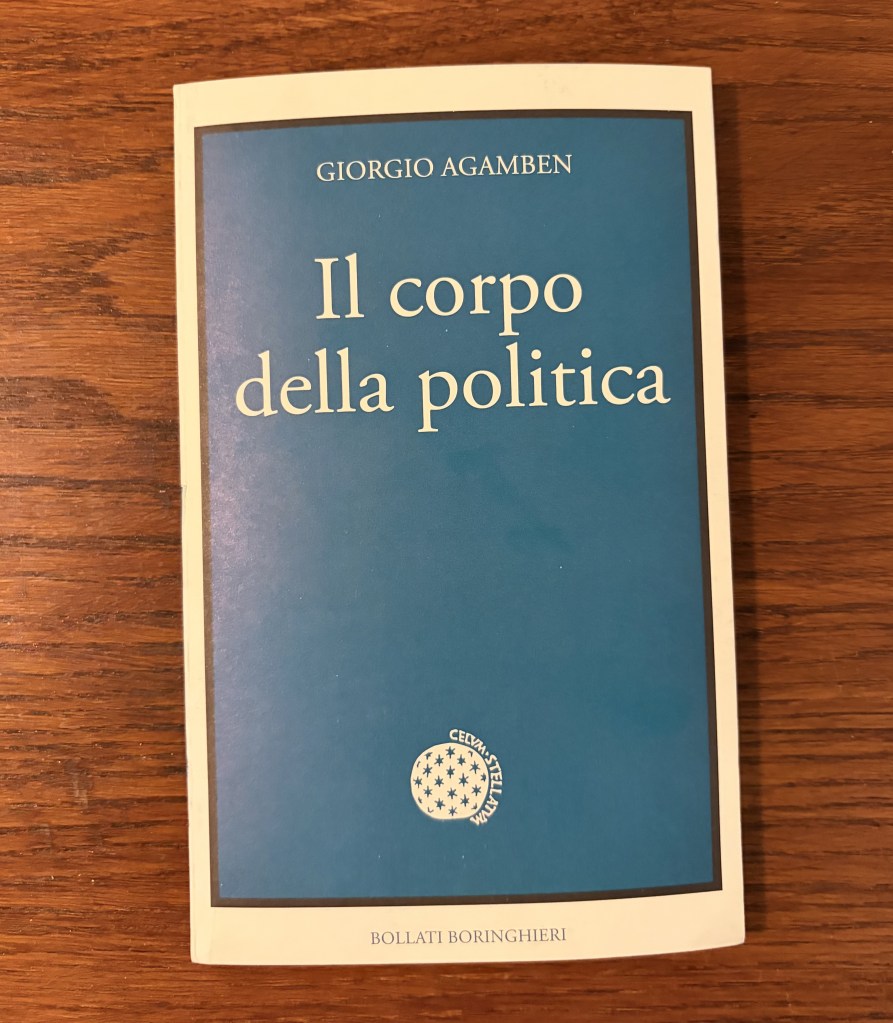
One of the decisive lessons of Giorgio Agamben’s archeological examination of Western politics is that the imperative to confront the closure of representation, sooner or later it must also come to terms with the notion of the body (corpo) as a central metapolitical condition in the genesis of modernity. If L’uso dei corpi (Neri Pozza, 2014) brought to its final stage the philosophical exploration of Western ontology of politics defined by efficacy and realization; in most recent opuscules, Agamben has shown how the fixation and regulation of the body is also embedded in the regions of language and sensation of human life as well. In this sense, it is impossible not to read Il corpo della politica (Bollati Boringhieri, 2026) along with Il corpo della lingua (Einaudi, 2024), as two parallel commentaries on the defining stature of political representation. If a new beginning is one of the decisive questions of our times, then one of the pending tasks is precisely to think the body (corpo) against the ontotheological assumptions of calculative reason.
Similar to Il corpo della lingua (2024), Il corpo della politica (2026) starts with the treatment of the Copernican revolution of bodies in Hobbes and Newton, which in the face of the cosmological infinity inscribed a notion of two bodies in order to allow for representation within spatial coordinates. In other words, Hobbes’ artificial sovereign represented by the mortal god Leviathan (state normative authority) will have an autonomous colorary in the autonomy of the subject that will become “political” as long as it becomes coterminous with the civic body of the “People”. Thus, to speak of “bodies” is not just to rationalize physicality in space – although it is also this from a technical viewpoint that state legibility will soon demand of the incipient civil society – but more importantly, it entails the administration of energy and movement (in Agamben’s well known lexicon, the domestication of potency to the realization of purposeful ends). For Agamben, Spinoza’s conatus, which appears in the Baroque period in critical dialogue with Hobbesian and Newtonian frameworks should be read precisely a way to think past the body as substance, following the steps of the tradition of ancient Stoicism in which beings are corporeal insofar as they are in tension with the world, allowing the tonos or acoustics to animate being in its movement towards preservation and exposure (Agamben 20-21).
If all beings are traversed by a tonos – a tension that crosses as its medium in virtue of its contact with the world – this means that they are no longer defined by a substance, but as intensity within a field of forces once thrown in the world. As Agamben writes in passing with explicit confrontation with Heidegger’s Being and Time: “…con la tesi perentoria ‘l’essenza dell’esserci giace (liegt) nell’esistenza’. L’esserci è stato “gettato” nel mondo, ma si direbbe che, una volta gettato, non cade in piedi, ma giace (liegen significa innanzitutto essere sdraiato). E questa concezione sub-stanziale dell’essere che il conatus mette radicalmente in questione” (Agamben 23). In an archeological gesture that is already signatura of his work, Agamben reminds us that Hobbes’ substantive and artificial division of the “two bodies” that anchors modern politics can be traced to the corpus mysticum and the theological debates concerning transubstantiation that will later be recasted in the intersecting works of both Ernst Kantorowicz and Carl Schmitt, in which the impolitical dimension of the multitude becomes political through the artifice of decision and representation of a unified and indivisible body (Agamben 25-26).
The catastrophe of modern politics takes place when the body, once reduced to a substance and computable object in space, ceases to be understood as an inteusum or intensity of an irreducible multitude that expressed a generic and universal human species, as it was for Dante: “La politico – il finis totius humanae civilitatis che Dante intende definirie nel suo trattato – è ancora una volta un campo di tensioni interne allo stesso genere umano e questa intensità ha la foram di una moltitudine” (Agamben 39). In other words, for Agamben following the implicit tonus present in Dante’s Monarchia, the political is neither action nor mediation, but what names the very site of the possible. Agamben calls the hypothesis of an “anarchic politics” (politica anarchica), which no longer defines itself in relation to a formal mediation of government and state, but rather as the intensity of the multitude through the generic being (Marx) or the universal humanity (Dante) that takes the form of sensible Empire devoid of principial politics mediated by constituent power (Agamben 47).
Where does the multitude dwell outside the constituted representation of a community of belonging or the social mediation of the state? Already in 1990s Agamben had written a gloss on the politics of exile collected in Mezzi senza fine (1996), and the last part of Il corpo della politica (2026) he returns to philosophical and theological notion of the exile vis-a-vis the historical experience of the Jewish tradition as an errant or stateless people, as Erich Unger called it in 1922, whose existence has been defined by exile or galut (Agamben 48). It is a bit of a misnomer to call the exilic experience a “politics”, since for Agamben the authentic tradition of exile does not entail the right or duty fixed to a community of belonging; rather, what outlives the law is the only path capable of deposing it (in the manner of Paul, that is, as katargeo). In this way, justice is now understood not as a procedure in a normative system, but as a written tradition that can only be studied and reflected upon and ultimately experienced as a state of passivity.
Hence, the exilic experience is the caesura between language and world, in which we touch the exteriority with a renewed intimacy that unfolds the uncommunicative solitude that keeps the mystery of our use of language. Following the neoplatonic formulation “phygé monou pros monon” – understood by Erik Peterson as an expressive mystical relation of a “fuga di un solo presso un solo” – there is intimacy and authentic belonging whenever there is sensible separation in being (Agamben 55). Following Plutarch and Plato, for Agamben the exilic dimension is the very home of philosophy and thought, which confirms, against Crito’s suggestions at the end of Socrates’ life, that there life outside of the polis and the conglomerate of the demos, because life is outside itself once it is assimilated in the virtuality of a divine that nourishes its own potency. In what stands as one of the most precise formulations of the pheugein (exile) condition as a figure of existence, Agamben writes of its precise ascesis:
“La celebre definizione ascetica della fuga dal mondo come assimilazione a Dio andrà resa, pertanto, restituendo tutta la sua forza alla metafora politica: “l’assimilazione a Dio virtualmente un esilio” (kata ton dynaton significa qui, secondo il sense più proprio del termine dynatos, “virtualmente, secondo la potenza). L’affermazione e tanto piu significativa in quanto, con queste parole, Platone rompe con l’insegnamento socratico del Critone, secondo cui la possibilità di phygé offerta al condannato non potrà che essere rifiutata, perché non vi è vita possibile fuora dalla polis” (Agamben 57).
This region that precedes and exceeds politics – in the language of Sophocles, the well known ypsipolis apolis – is akin to the tone that runs to the forgetting of any substantive ontology of politics that seeks to subsumes life into the confinement of external forces. It is in this paradoxical situation of assimilation in exile, and a permanent exile that assimilates itself in God as shared thought that politics can be transfigured as an apodemia that refuses the closure of life into principles of government and dominium, and away from the community form of propriety and rooted belonging. Agamben recalls that in the history of Christianity, it is the time of the parish (paroikias) what allows the soul to live in earth as foreigner and exile, in proximity of the medium of the kingdom, and that only later with Saint Augustine it was transformed into a territorial institution for the communio and communal salvation (Agamben 60-61). In the paroikias, Agamben returns to the kingdom not as a retheologization of the politics, but as a figural parable in which a poetic dwelling is enacted in the measureless passivity of a form of life, a project consistent with the formulation of the singular whatever being articulated in La comunita che viene (1990).
The assimilation in the exile of the divine, which recalls the forgetting of oneself and the god announced by Hölderlin in“Note on the Oedipus”, is refined in the last essay of the book entitled “Il corpo dell’Europa”, which reproduces a lecture delivered in Venice in May 2024 about idea of Europe. As a sort of concluding reflection or apostilla, we are now able to say that for Agamben the only possibility of dwelling in the vestiges of the European tradition and memory is to rescue, from the wreckage of its history, the sediments of a texture of the phygén: to be exiled is not just a vitalist affirmation of this life, but more importantly, it also implies disclosing the possibilities buried in the past with the dead, that is, in contact not only with Gaia, but also in the downward movement to the domus of the infraworld (a figure that receives a novel treatment Agamben’s recent book La lingua che resta). Agamben exemplifies this exile with the dead with three poetic moments of high european modernism: Ezra Pound’ Cantos, T.S. Eliot’s The Wasteland, and Eric Auerbach’s masterpiece Mimesis written from his exile in Turkey – and of course, we could also think here of Kafka’s parables and Joseph Roth’s narratives of Jewish errancy; as well as Alexandre Lerrnet Holenia’s phantasmatic crumbling of Empire in The Standard and Osip Mandelstam’s “The Fourth Prose”, where the end of the work leads to the human voice as the supreme poetic task in the face of nihilism and political totalitarianism.
It should be clear, however, that the problem is not found a temporary refuge or a last stand in the fortress of modern literature, but of coming to terms with the phygé as a fundamental problem of language that, in virtue of its unique and irreplaceable experience, delivers a world nested in the affection of remembrance. As Agamben asks towards the end of the lecture: “Is there a sensibility and a form of life that we can call European?” (Agamben 82). This question can only be answered when we dwell and assimilate into the exile of thought that harbors the residues, figures, and voices that speak to us from the dead in a tradition because it is no longer transmitted, we can only access it poetically. In the only moment that the word anima (soul) appears in the text, in the very last sentences, it becomes clear that it is only in the intensity of thought that life accounts for the inseparability of the body and the soul that historical abstraction has rendered oblivious and alien from the tonos of presence. We are not yet ready to declare a return to the appearance between being and world, and for that very reason even the presence of the divine, as Agamben says following Isaac Luria, is itself exiled from the creation of the world until the advent of the tiqqun in the night of restitution. The exilic dwelling of life outside itself is marked by this sort of secret unfaithfulness in the absence of the god. In the meantime, the task of an ethical life is to passively reside in an exile where the reality of the soul returns what is possible and breathable to the appearance of the real.
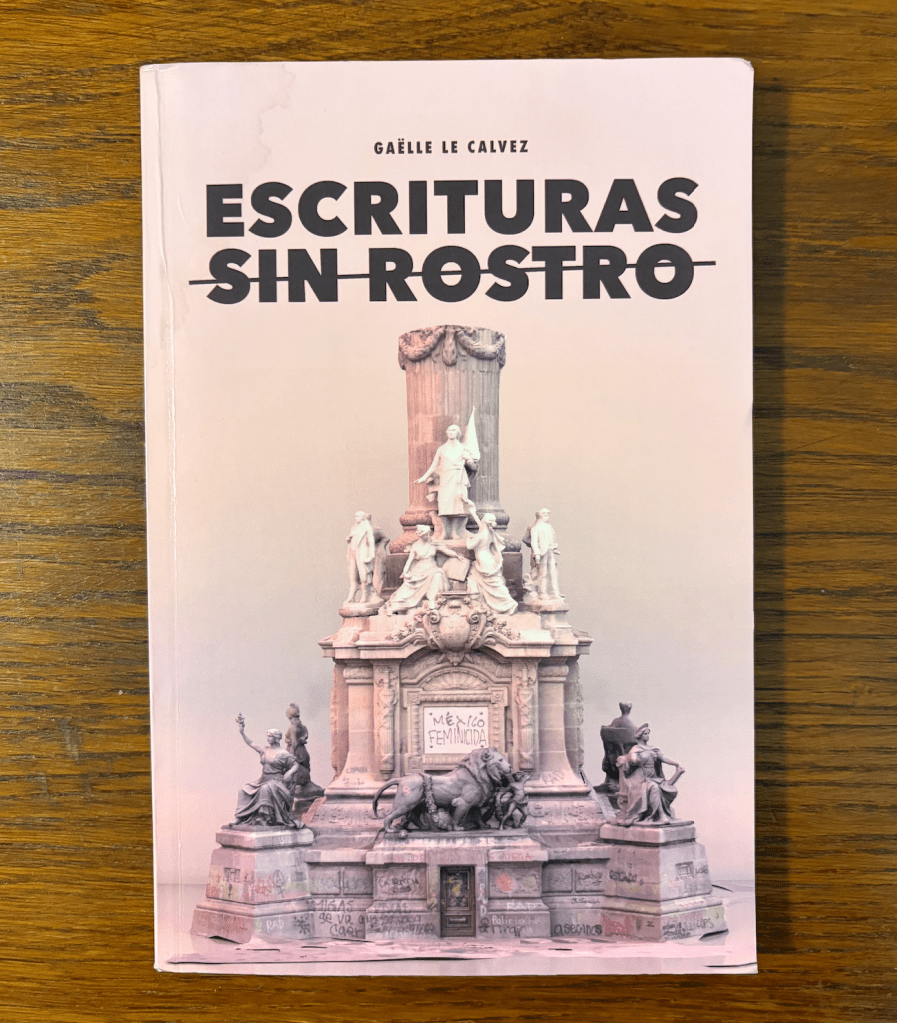
Every book has a history of its own, its subterranean itineraries, and oblique paths that are only disclosed when entering in contact with its future readers. There is no question that Gaëlle Le Calvez’s Escrituras sin rostro (University of North Carolina Press, 2025) has plenty of merits that we cannot begin to elucidate. For one, it is a monograph that should be of interest to students of Latin American studies, but also to any fellow travellers wanting to confront and think through the problem of writing at the wake of the epochal crisis of the state form and the exhaustion of the historical subject. Can thinking overcome the deficiencies proper to cultural studies and populist hegemony to understand the ongoing fragmentation visible everywhere? One can start by saying that Le Calvez’s books points to a positive direction from this impasse, avoiding the shortcomings of sociological epistemology and the auratic reflexes of subaltern subjects as the master oppositional category to State form in the becoming of modernist development and global neoliberalism. In Gaëlle Le Calvez’s Escrituras sin rostro (2025) the object of study is the irruption of EZLN or Zapatismo, and more specifically the scene of writing of the Zapatistas through the genealogy of their declarations, public letters, gestures, and signatures of all kinds that speak to the persistence of a writing of defacement; a scene of writing beyond the social function of the author, and on the margins of the legitimacy of the “lettered city” of the Latin American criollo uneven modernism. In the space of this commentary, I would like to list three levels of Le Calvez’s arguments that hope will further contribute not just to the themes proper to her study, but more fundamentally to a constellation of problems that exceed Latin America as a region of studies.
First, Gaëlle Le Calvez’s Escrituras sin rostro (2025) withdraws itself from understanding Zapatismo as a sociological political phenomenon of the late Mexican State, or a belated product of the shortcomings of the Mexican Revolution and its process of modernization. Unlike other studies of Zapatismo in Latin American studies Escriturassin rostro (2025) is not invested in the restitution of new political subject of resistance in the face of global war and the anarchy of political action; rather, what is presented is the redrawing of a genealogical scene of writing subsumed by its excess and dislocation, stubbornly out of place that evidences the negativity of the collapse of the autonomous spheres of actions that once defined the apparatuses of historical development and legibility. As Le Calvez convincingly points out, the defaced and non-authored writings of the Zapataistas are neither literature nor political manifestos, and they also refuse the autonomy of literature and its incorporation into the objective ornaments of the Avant Garde projects. The defacement of writing for the Zapatistas is neither Avant Garde nor kitsch, because it is no longer interested in weighting itself on the rhetorical scale of social compartmentalization. In my terms, which are not those of Le Calvez, one could say that “escritura” or writing in this study is the vortex of flight from rhetorical submission; that is, what cuts through the enthymemes to refuse ossification and reproduction of language. The freedom of writing is always measured by the possibilities that is able to generate against rhetorical abstractions.
Secondly, because there is no justification in social or political principles, Le Calvez argues that Zapatista writing and negative gesture is a refusal of hegemony, and thus properly posthegemonic. If “escritura sin rostro” makes no demands, seeks no identification, and avoids the prefiguration of rhetorical subsumption, it means that Zapatismo openly rejects the articulatory nature of hegemony as the last avatar of the administration of identity at the end of metaphysics. As Le Calvez claims succinctly, the dispersal of writing cannot adequate itself to Laclau’s theory of hegemony and its “rhetorical foundations” of the social (Le Calvez 67-68). In this sense, posthegemony is not merely what interrupts the closure of politics in the neutralization of a new social consensus, but what transfigures language into its autographic, experiential, and faceless excess that overflows every identity and every place of enunciation. In very subtle and elegant ways, Le Calvez’s hermeneutics of the Zapatalistas’ Declaraciones confirm that the solicitation of hegemony in both discourse and political practice is an inversion, almost an hallucination in political form of the money form and the general equivalent in the historical process of real subsumption of capitalist value. If Zapatistas are indeed a “realist” political formation it is not because they parody of modern guerrillas or enact a new communal organization; the realism at its best is grounded in the capacity to discern that hegemony in the wake of end of the modern liberal state only serves to deepen the ongoing process of the capitalist utopia.
Thirdly, and more surprisingly, is the fact that Gaëlle Le Calvez’s Escrituras sin rostro (2025) does not just reconstruct moments of the Zapatista inscription, it also considers its intensity to its very end. And to think something to the end means to reveal its limits, disclose its fissures, and open a site to move pass the object of reflection. This maximum point of reflection is when philological exploration outlives itself in the intensity of an uncharted path. Thus, the story that Le Calvez tells us about Zapatista writing concludes with a series of aporias and contradictions that announce a certain “decline” and eclipse of its poetic intensity. This is a moment where its poetic elevation begins to deflate; and, in its decline we are confronted with a persistent drift to “civil society”, “self-critique”, the appeal to plurality of “indigenous people” (what Gareth Williams once called “fictive ethnicity” as master representational fiction), or an internationalist appeal in order to generate a “counterbalance” to global neoliberalism (Le Calvez, 106-108). And we are putting aside the nomination of Marichuy for the 2018 Mexican presidential election. Does not this recomposition of social recognition, both global and national, seek to replenish the void in representation as it appears in the third Declaración that evoked “para nosotros nada”? (Le Calvez, 93). The waning of the poetic moment of Zapatista appears to project a flickering shadow of its dependency to political movements.
Does this mean then that the “rise and fall” of Zapatismo ends in a tenuous archē embedded in the ‘movement’? In his Latinamericanism after 9/11 (2011), John Beverley projected his unfiltered Leninism towards antiquity and Ancient Christianity when stating that the central political question for our times in the face of Empire, is to find ‘who are the real Christians today’ [1]. But ideological Leninism distorts the past, since as we know well, the central question for the Christians of the Early Church of the desert, such as Origen, was not who was going to mobilize the masses in the material world, but rather in what way to retreat and avoid worldly political power [2]. Zapatistas as the new and last Christians, then? It is a tempting question, but one that will only contribute to the Leninist reduction of historical political fictions. Our times is not one for Leninism and the Vanguard Party to carry a breakthrough. But perhaps Zapatistas are residually Christians in another country way; that is; in the internal dynamics of its own language. I would like to suggest that this language can be understood especially in the last phase of the Declaraciones, a late rhetorical style of the sermo humilis. As Erich Auerbach has shown, the sermo humilis was the rhetorical innovation of the early Christian community at a moment of the political decadence of the Roman Empire, at the entrance of the interregnum. The sermo humilis appeals to a low or popular style, seeking legibility and pathetic understanding of the difficult mysteries of faith. The humilis also designates the ground level of the land, the humus, which elevates through the persuasion for the humble and the humiliated common men of this world [3].
In other words, the sermo humilis could be said to be a sublime of the everyday life that is refractory to the mystery. It is obvious that if we now turn to the Zapatista late writing, something like the sermo humilis codifies a symptom that is no longer the mystery of revelation, but rather in its secularized form of the revolution. Does not the sermo humilis functions as a secularized artifice to guard and elevates hopes (all too human, alas) on behalf of the “revolution” to come? However, it is precisely political revolution, just like hegemony, what cannot longer account to the effective revolutionary force of the autonomization of capital. If according to Le Calvez the formation of the Zapatista is analogous to an “artificial movement” (masa artificial) like the Church, then one could say that the rhetorical construction of the sermo humilis functions as a linguistic prayer for the revolution whose only certitude is the apophatic metaphorization in the name of the “people”, the “homeland” (la patria), or the antagonistic and oppositional “we” (nosotros), or any other compact grouping. Of course, this is the terrifying question for the sermo humilis in its secularized form: to what extend the communitarian and autonomous ideal, through its appeal to the humiliated and subaltern class, does not transform itself into an apotropeic instrument devoid of true redemption? [4].
Is writing, and witnessing through writing the practice where the possibility of redeeming human experience is lodged? This is the fundamental question that Le Calvez’s book puts forth to us as readers, without entirely coming to an effective resolution. And yet, in the last part of Escrituras sin rostro (2025) seems to offer us another possibility through the writings of Cristina Rivera Garza, Alejandra Pizarnik, and Sergio Gónzalez Rodríguez in the face of a fragmented and disarticulated social body and the night of history in which social protection and protracted civil war become indistinguishable (Le Calvez 186). This writing is no longer tailored in the Christian shops of the sermo humilis, but in an open plain where the voice becomes “un anhelo de prosa”, or a longing for prose, crossed by the finitude of being and the collapse of mediating forms of totality (Le Calvez 174).
This longing for prose as it appears in Cristina Rivera Garza’s work – in the Spanish anhelo one can also hear the echo of breathing that is constitutive of life’s exteriority with the world, to conspire – is not the letter of the law as in Hegel’s spiritual prose of the world (“in the slave prose begins”, we read in Aesthetics), but the clearing of a voice that can register the world because it speaks from the witnessing of the ruins of representation, and the conviction that there is no political mystery high above, but only the irreductibility of writing in spite of it all. In the shipwreck of perpetual global war, writing’s redeemable elevation is the caritas that puts us in a permanent exodus from the order of representation (Le Calvez, 186). Writing, escritura becomes the passage of the chiasmatic and breathable imagination that, because it has cleared a via poetica, it can name what can also be properly inhabited.
.
.
Notes
1. John Beverley. Latinamericanism After 9/11 (Duke University Press, 2011), 26.
2. David Nirenberg. Anti-Judaism: The Western Tradition (Norton, 2014), 108.
3. Erich Auerbach. “Sermo humilis”, in Literary Language & Its Public in Late Latin Antiquity and in the Middle Ages (Princeton University Press, 1993), 39.
4. Gianni Carchia. “Eros y Logos: Peitho arcaica y retórica antigua”, in Retórica de lo sublime (Tecnos, 1990), 29.
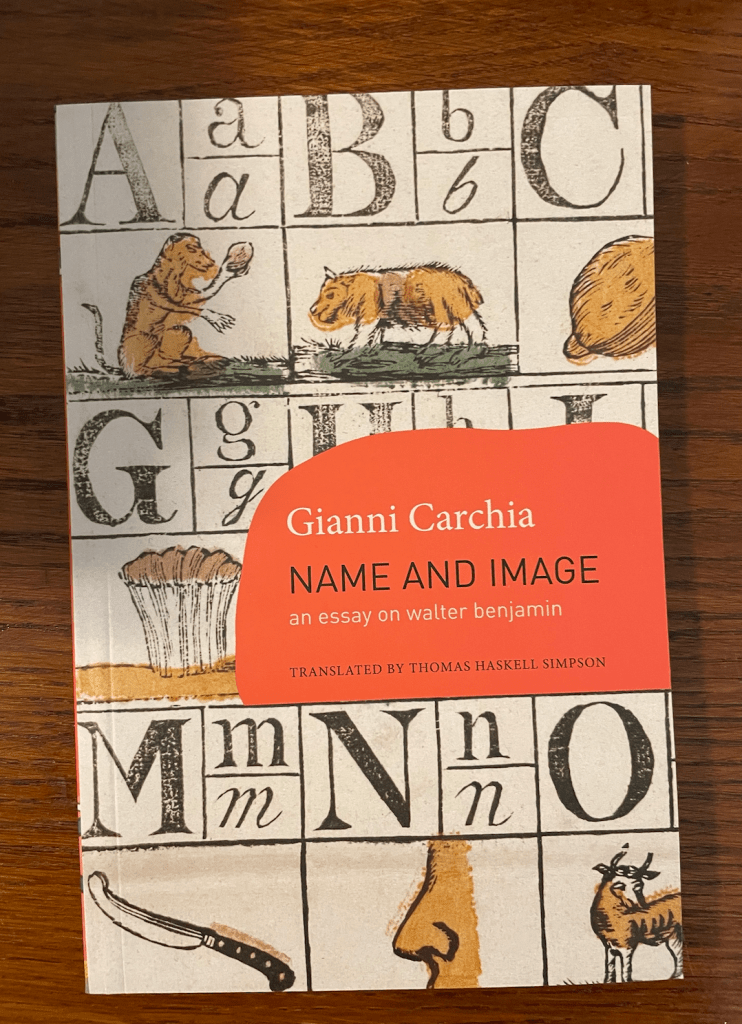
At long last readers in the English speaking world will be able to read Gianni Carchia’s work in translation thanks to the publication of Name and image: an essay on Walter Benjamin (Seagull Books, 2025), which was the Italian philosopher very last book published posthumously in 2008. This is not a work of late style as such, since these four essays on Walter Benjamin serve as an oblique and angular entry point to the thinking form of Carchia’s own philosophical concerns on sensibility, the survival of the myth through aesthetic mediation, and the post-kantian elaboration of the appearance as the condition for experiencing the world. This is a project without systematic architecture that dates back to his first books of the late seventies such as Orfismo e tragedia (1979) and Estetica ed erotica (1981), both published in the Milanese publisher Celuc Libri. It must be noted that although this is a marvelous introduction to Carchia’s philosophical idiosyncrasies and recurring themes, it is perhaps not the best introduction to Walter Benjamin, who in these four essays is read against the grain of dominant hermeneutical frameworks; that is, beyond Frankfurt Critical Theory and dialectics of the image, and on the other hand, the theologico-political concerned with messianic temporality as a transformative philosophy of history.
It does not mean that Carchia is oblivious to these constitutive elements in the corpus of the German thinker; but it does mean that the profile constructed is one that favors a critical project that has disinhibited affinity with the Platonist project of beauty as condition of the critical endeavor committed to truth. For Carchia it is at this vortex where one should locate the “brilliant degree of illumination” that awakens philosophy from its slumber, overturning the texture of thinking to an erotics of the lost detail and the enduring fragment. Citing the correspondences to Florens Rang and The Origin of the German Tragic Drama, we know that for Benjamin “without at least an intuitive grasp of the life of the detail in the structure all love of beauty is no more than empty daydreaming” (Carchia 33). The task of the critic is one capable of arresting the inexpressible, only because beauty lives in the world as a state of silence and expressed revelation (Carchia 38). And it must be said that platonism in Carchia never manages to crystallize into a doctrine of being, pivoting to persuasion as the route to an idea without form.
Carchia shows that for Benjamin the reinvention of the critical method cannot aspire to the totalization of origins and principles – or even that of the status of the visible (Schau), as he brought to bear in his comment to Max Kommerell’s Der Dichter als Führer in der deutschen Klassik (1928) – underpinning the emergence of the idea where the seeds of truth germinate to unfold the interstices of historical sedimentation (Carchia 62). Unapologetically, Carchia suggests that Benjamin’s critical method, if there is such a thing, must be read as a “philosophy of the infinitesimal aim to shatter the prejudice that attributes to totality predominance over phenomena…at the price of their insignificance” (Carchia 61-62). In turn, this means that “the smallest cell of visualized reality outweighs the rest of the world” (Carchia 63). The infinite cuts through the world as a remnant that must be redeemed precisely because of its incongruence in the face of the triumph of immanence and the distribution of forms. And this is yet another sign that Carchia’s Benjamin must read as a thinker of a platonism of the immanence that by folding forms it is able to escape modernity’s temporalization of the sensible reality and its lethargic material objectivity [1]. This hits a hight note about Benjamin’s philosophical thought as anointed in the ancient currents of Stocism, since as Pohlenz taught us, the material forms of this world are the hurdles that neutralize the inception of the divine in a reality governed by the necessity of kakia.
Hence the confrontation with language occupies the center of every critico-historical reflection, which means how to live the immemorial language that is neither an instrument nor the “medium of prophecy or domination” (Carchia 85). Carchia reminds us that for Benjamin Karl Kraus’ language is platonische sprachliebe, or platonic love of language, which means a voice that overcomes the separations of signification and symbol, object and subject, and the consolidation of exchange through the voice of gratitude and use: “thanking and dedication – for to thank is to put feelings under a name” (Carchia 85). The word as apophantic revelation places judgement under erasure, enacting not a return to Edenic pristine nature of divinization or virtuality that attests to the figure and repetition of appearances and the medium of the “spiritual verbalization that animates reality” (Carchia 92). The abdication of an original language survives as the mythic memory of a voice porously open to translation: “All higher language is a translation of lower one, until the ultimate clarity the word of God unfolds, which is the unity of this movement made up of language” (Carchia 92). If for Benjamin the problem of translation is coterminous with that of the mystery of language, it is because it reveals the fragments of a vessel that removes the ground of rhetoric through “variation and discontinuity” (Carchia 96).
In fact, reading Carchia one can infer that rhetoric is to language what the destiny is to human existence in its becoming. Thus, the destitution of language, its internal rhetorical and objective liquidation, appeals to the possibility of the event of happiness and bliss that is the only well illuminated path for redemption, that is, for the flourishing of the “nexus of truth and beauty” of the liberty of the soul. We are painfully aware that modernity is many contradictory elements at once, but Carchia tells us following Simmel, it is ultimately the historical project of Entseelung or loss of soul of the world, and thus “the faculty of memory as particular gift of the soul” (Carchia 121). The historical time of progress, its formal assumption and increasing autonomization, means a ritual situation that “seizes control in exteriority – as as continuum of temporal unfolding – of that entertainment, flashing, discontinuous awareness of the irrevocability of the past held firm by the image-memory” (Carchia 121). Hence, the exercise of thought and memory through the redemption of appearance is the necessary struggle against the usurpation of caducity, and thus the only promise of salvation through the dead, the defeated, and the forgotten. There are clear echoes of Hölderlin’s “Andenken” here that Carchia formulates as the necessity of memory in the repeated dispensation for the clearing of appearance. As he writes in one of the most formidable moments of the book when discussing the self-offering of the memory that guards the catacombs of the dead:
“…for Benjamin, aesthetic temporality, as temporality of the soul absorbed in the contemplation of the nexus of truth and beauty, is the very origin of temporality’s self-offering, of temporality tour court as the space of memory. The salvation of appearance and the dimension of memory are all one: here is rooted the connection between temporality and the aesthetic dimension. The appearance constitutive of the space of redemption, and the beauty whose sacrifice would sacrifice the space of truth itself, are nothing other than memory continuously rescuing them from the space of historical time. It is precisely this connection, between the sphere of appearance as the sphere of the irremediable caducity, and the counter-movement of memory in the involuntary image, that forms the nexus that some of the most subtle passages struggle to delineate as the world of the soul, or rather the world of the past” (Carchia 120).
Thinking the fragment becomes indistinguishable from retaining the sensible participation of the soul. It is this arresting breath (Hauch) of the soul that clears a path on which appearance is saved from the crushing weight of historical self-sufficiency. This confirms, if anything, that Benjamin’s sensibility for Carchia does not end in the confines of postromantic critique, nor in the utopia of totality and abstraction imposed by the metaphysics realized in money form over the living and the dead. As Carchia asserts: “utopia is the end of the constructive and generative ideal of knowledge” at the base of human anthropology and material conditions of social existence, but a whole “redirection underpinning what we have called thinking the informal” (Carchia 127, 135).
What does it mean to think the informal, and what accounts a thought of the informal where Carchia posits Benjamin’s most enduring and clandestine signature? Avoiding all false exists in neopaganism of worldly immanence, Carchia connects the formless dispensation of thought with a nirvana state of para-rūpa (a hypostasis of God that does not presuppose a form, but that it is transformational), the instance of imagination without an image and place that speaks of a chôra as the last refuge of the living. A refuge that, like the platonic cave, does not entail the accumulation or wealth of signification, but that retreats from the perils of insignificance and unhappy consciousness of nihilism. This is one way to understand what Benjamin writes in one of the glosses in “Short Shadows”: “…an image that has already crossed the threshold of the image and property, and knows only the power of the name, from which the lover lives, transforms, ages…and imageless, is refuge of all images”. An existence devoid of a central and authorized image can only prepare for the idea of justice that, because it is experienced it can retreat from the aleatory predication of the world. This enacts a descent into “an anarchy of being in this side of form”, as Carchia would beautifully call it towards the end of book; an inward saturation that is also a reservoir of sensibility because it is able to take a breath. And because it is breathing, it can assent to the external penumbra that restores the appearance of every thinking being in its very image and name.
.
.
Notes
1. On the platonic immanence and the soul, the central reference is Gianni Carchia’s essay “Platonismo dell’immanenza: Fenomenologia e storia in Hans Blumenberg”, Hans Blumenberg: Mito, Metafora, Modernità (il Mulino, 1999), 215-26.
Vermeer’s “Woman Holding a Balance” (1663) has been read as an allegory of the Final Judgement for very obvious reasons. The painting within the painting on the foreground embodies a traditional representation of the Last Judgement for the saved and the damned. But how are we to mediate between the painting in the painting and the activity that is taking place in the mute and contemplative woman that is holding a balance with her right hand? Advancing an interpretation that departs from the coins placed on the table, Herbert Rudlolph’s important thesis suggests that exchange and equilibrium is taken place at once; a movement that allows him to favor the narrative of vanitas that would have been immediately diaphanous to the spectators of his time, especially the growing Catholic community of Vermeer’s Netherlands [1].
The picture shines with religious piety and depth, and yet it is a work of interiority that Vermeer has notably chosen to deprive of an explicit iconographical assertion in its main figure. Could it just be a visual representation of Loyola’s Exciertia spiritualia (1548) that recommended to be “like the equivalent scales of a balance ready to follow the course which is more for the glory and profuse of God, our Lord, and the salvation of the soul”? [2]. What are the instances of balance in the picture that would justify such a singlehanded transposition into the picture? If painting is anything, it is precisely what carries an excess to narrative and iconology. And this is what we should be interested when looking attentively to the picture. The vortex of depiction is the event that falls outside the concept through which we are attempting to arrest the meaning of a picture in its manifolds historical subtleties.
If taken prima facie “Woman Holding a Balance” (1663) is representing a combination of the embodiment of justice and judgment, what remains an enigma is precisely the fact that the balances are empty, as is evacuating the act of weighting the unequal units of weight. In the graceful hands that hold up the weightless balance, Vermeer has given us something like an image of the suspension of judgement, and in this way, communicating esoterically with the Last Judgement that looms heavily on the foreground. Whereas the allegorical representation of the last judgement is reminiscent of Van Eyck’s “Last Judgement Diptych” (1430), the female figure appears to us in an experiential graceness restrained from any transcendence; as if only sub specie aeternitatis time had come to a halt at the very contemplative motion of her inexpressible being. Her presence recalls Kafka’s assertion about the temporal fixation of judgment: “It is only our conception of time that makes us call the Last Judgement by its name; it is a kind of martial law” [3].
The nullification or void in the balance inscribes this ex tempore suspension in the sequence of historical time of salvation that subordinates faith to history oblivious to the fact that life without judgment is also an instant of faith. As Felix Weltsch, a theologian that was very close to Kafka, thought in an important work: faith is a process that overcomes itself by creation; it is not a force of judgement and belief, but the the subsumption of existence into what which already is [4]. Or, in the words of Kafka, closely following the steps of Weltsch: “faith means emancipating oneself: being indestructible or better: being”. Faith has been transfigured as a transmission of what now is the emergence of appearance as the event of life. Fleeting and yet irrevocably unbending, what appears is both incommensurable and sensuous.
After this detour, if one goes back to Vermeer’s picture, what does one see? Definitely, not an instance of allegorical portrayal towards the transcendental expectation; rather, this is an image where theos has become a presence because it is enacting the faith of being in the withdrawal of God. This invisible, and yet sliding retreat is rendered visible by the emptying of a balance that is no longer posited as judgement of post-Edenic life towards salvation; it is the opening of space that upholds life because it no longer surrenders to the martial court enabled by time. When judgement unfolds into the indestructible and visible ‘lunatic strength of faith’, to use Kafka’s singular expression, then we are entering a living grace that is only attuned to the eternity of its appearance. And is not this another way to define the emergence of painting, after all?
Against what contemporary jurists’ formulations about pondering and weighting of rights as the ideal of the rule of law; the figure of thought that emerges in the picture is that justice is neither scalable nor measurable, but rather a motionless state of grace that can only be contemplated in the mystery of life. The emancipated life staged in Vermeer’s “Woman Holding a Balance” (1663) holds an inconspicuous eloquence that knows neither waiting nor judging, because its imperturbable state is beyond all consolation.
.
.
Notes
1. Herbert Rudolph. “Vanitas: Die Bedeutung mittelalterlicher und humanistischer Bildinhalte in der niederländischen Malerei des 17”, in Wilhelm Pinder (Seemann, 1938), 410.
2. Gregor Weber. Johannes Vermeer: Faith, Light, and Reflection (Rijksmuseum, 2022), 127.
3. Franz Kafka. The Aphorisms (Princeton University Press, 2022), 82.
4. Felix Weltsch. Freiheit und Gnade (Kurt Wolff, 1920), 10.
In a recent lecture about the different strands of political liberalism in the American tradition – a lecture that in its own way was presented as a synthesis of his lifelong teaching now collected in the book titled The Rise and Fall of Rational Control (Harvard U Press, 2026) – the political theorist Harvey Mansfield made a claim that was left unquestioned by the audience, but that has some strong pungent resonances in our present: “You cannot conceive of a political [liberal] regime without some kind of abuse”. These words were not meant as a way to prevent the intrusion of this protuberance in a political order, but rather as a way to indicate that liberal politics is always, to some degree and arraignment, the administration of abuse. In Manfiesld’s own conception, the classical legal order of the American founding now chattered into “a thousand particles” (his words), dispersed in bureaucratic commands and executive arrangements, dispense a direct form of abuse. It is noteworthy that although Liberalism has always been thought in relation to fear (from the conception of auctoritas in Hobbes to the minimalist form of government of Skhlar), it is important to dwell on the initiate relation between liberal politics and abuse; or rather, about its kernel of truth in the notion of abuse.
That liberalism’s ultimate objective can be understood as the regulation of abuse can easily be inferred, at least implicitly, in Mansfield’s own normative assumptions laid out towards the concluding pages of The Rise and Fall of Rational Control (Harvard U Press, 2026). Towards the end of the book, and commenting on Nietzsche’s declaration on nihilism and erosion of rational control for the efficacy of political order, Mansfield notes that when politics takes the form of an unconstrained form of subjectivity oriented towards survival, it must be supplemented by a new virtue of nobility and sacrifice: “Modern rational control, we have seen, does not work through an effort of reason by its citizens; its government is indirect, using irrational moves to gain a rational result. It does not appeal to human pride, as would a liberalism attuned to the virtue of citizens in the exercise of their rights. That liberalism would return from an unnaturally constrained self, interested only in survival, to a reliance on the soul, which contains a concern for nobility and sacrifice as well as survival” [1]. In this framework of late liberalism, that in recent years in the American context has been called “post-liberalism”, can properly be understood as liberalism of abuse where force and executive power takes priority over legitimacy and social hegemony. The liberalism of abuse is not interested in the renewal of the social contract and the juridical capacity for rights and obligations; rather, it deploys a prerogative decision making over the souls of the living. Those that have recently claimed that the sphere of the soul is the new theater of operations have unlocked an important door of our epoch.
To govern in this framework means to allow abuse to flourish in the social bond not just as a tributary of penal codification and retribution of punishment, but as a transference of hostilities through the grammar of values and willful possession. The old form of patrimonial form of legitimation, as some have recently emphasized it, does not just pertain to the transformation of political elites, it is also coextensive to the totality of civil society and its mediations [2]. And the normalization of patrimonial abuse casts the long shadow of the Roman Law’s notion of ius abutendi that transformed the concept of abuti into property destruction through the sovereignty of the subject of ownership. As the nineteenth legal scholar Ferdinando Piccinelli showed in his important study on this notion of Roman Law, the ius abutendi passed from being the the capacity of “using to the end” or the “consummation” of a thing as registered in Ulpian’s writings, into a plena in re potestas denoting the sovereign power of a subject over objects and things in the world [3]. This means that the notion of “abuse” in late political liberalism, at the threshold of the modern social contract and rational control, is structurally the way in which the destruction of our use of the world is legitimized and fostered. In this sense, the operativity of ius abuntendi is not exclusive to punitive practices, punishment and public police powers of the administrative state; more importantly, it should be understood as the ossification of subjects and objects that permanently enacts the unlimited destruction of the relations with exteriority, that is, with the world. When we use we are not decreeing modes of organized distribution, rather we are enabling the freedom of transit between things, the territories, and the proportional transmission of techniques.
The deployment of abuse as technology of dominance is proportionally inverse to the obliteration of our capacity to use that defines the human experience. It is in this light that we can understand Hölderlin’s well known dictum in a letter to his friend Casimir Bohlendorff that “the free use of the proper is the most difficult thing”, as a refusal to disengage life from the political constrain of ius abutendi. It is only when use is thought, or brought into thought, beyond and outside political rational control that we can make room to inhabit the world beyond the perversions of abuse and judgment over the human species. In our historical conjuncture, we can say hyperbolically that all political thought is indirectly infused with ius abutendi, since it is incapable of seeing that the use of life never fully coincides with the circular polarity of domination and servitude; because there is a third figure beyond these two that allows use to unsettle the ground of force. If American political liberalism has entered a phase of self-infliciting abuse as the essence of political rule, destruction, and lethality of social forms, it is precisely because what it is desperately trying to conceal in the deep waters of Lethe is the pathway of a worldly use. After control, we are left with an expansive regime of socialized abuse even when it purports to speak on behalf of the preservation of the living community: “Because that is truly tragic among us, that we quietly leave the realm of the living inside some ordinary box, and not that, ravaged by flames, we pay for the fire we failed to control” [4].
.
.
Notes
1. Harvey Mansfield. The Rise and Fall of Rational Control (Harvard University Press, 2026), 305.
3. Ferdinando Piccinelli. Studi e ricerche interno a lla definizione ‘Dominium est ius utendi et abutendi res sua, quatenus iurius ratio patitur’ (Firenze Presso L’Autore, 1886), 101-103.
4. Fredrich Hölderlin. Cartas filosóficas de Hölderlin (La Oficina, 2020), 191.
Many interpretations of Hölderlin’s “Andenken” (“Remembrance”) have taken for granted that the hymn’s last verse might have been a paraphrasis and creative translation of Pindar’s ode Pythian 3. In the philological scholarship of the poem, it was Günter Zuntz who took notice of the analogical semblance to shed light on “Andenken” final verse as something more than mere imitation: “Never, however – unlike Pindar who does so frequently – does Hölderlin begins a hymn with a praise of the Muse, which would be an imitation, but not an analogy…the “Andeken” conclusion, “Yet what remains, the poets found” – corresponds almost verbatim to Pindar’s Pythian 3 final verse…” [1]. If we reread Pindar’s Pythian 3 from Race translation (Loeb, 1997, 263), we encounter the following verse: “Excellence endures in glorious songs for a long time. But few can win them easily”. If on Hölderlin’s side we encounter the “remnant” of the sayable in language, in Pindar’s ode we are presented with the endurance of a “glorious song” of the festivity that is carried out in struggle and forward in time.
Ignoring the common place interpretation that assumes that Hölderlin’s concluding verse is a distortion of the translation from the Greek, Zuntz goes to note that the pindaric remnant in Hölderlin’s hymn effectively “constitutes in essence an analogy – not an imitation; it rises from the affinity of spirit not from an act of self-effacement” [2]. This analogical relation with the past, and thus the memory of Antiquity speaks directly to the modality of the improper that is common to the hermeneutical debate on the poem. All things considered, and following Zuntz’s hermeneutics, we could say that the pindaric intrusion in the concluding verse is a way in which the poet is enacting the harmonious poetic creation as it finds external resonance in tradition. As Hölderlin notes in his difficult note “On the mode of proceeding of the poetic spirit” (“Die Verfahrungsweise des poetischen Geistes”): “Put yourself through free choice in harmonious opposition with an outer sphere, just as you in yourself are in harmonious opposition, by nature, but unrecognizably, as long you remain in yourself” [3]. The solicitation of the irreducible distance from the creation is always the preparatory transitional space of poetic cohabitation that rejects a notion of life consolidated in modern representation.
In this sense, the poetic spirit in Höderlin is a keeper of the analogia of the incurable separation between the language and gods; this means that remembrance is only possible because there is an abyss cured by the song. And here the maximum proximity between the German poet with Pindar comes to the forefront, as the distance that separates him from the inaccessible world of the Greek means that one cannot longer proceed from myth, but rather from the “remnant” of the festivity of the song that seeks the harmonious through expropriation with nonbeing. What “remains”, via analogia, is the flowing of the song as “capacity for the solitary school for the world” in postmythic historical time [4]. The poet does not “remember” what the substantive essence of the song as if the past is a reservoir of retrievable expenses; rather, what remains is the possibility of what must be said “amid the many things that remain to be borne in the long time and to be said in song” [5]. The song is a prelogical meandering that overflows reality because it is persistently remembered.
And yet, this is a song without ideal form, because after the tragic age of the titans “we lack song that loosens the mind” as Hölderlin notes [6]. This poetic tension conquers and frees itself from the world at the risk of absolute loss. The analogia musicae retains the highest of the divine in suspended disbelief, which according to Hölderlin occurs “at a moment when man forgets both himself and the God, and in a sacred manner, turns himself around like a traitor” [7]. Here we are already at a distance from Pindar’s verbal testimony for Hieron and glorious fame, since what “remains” is the pure event of the song that transfigures presence so that “the memory of the heavenly ones does not die out” [8].
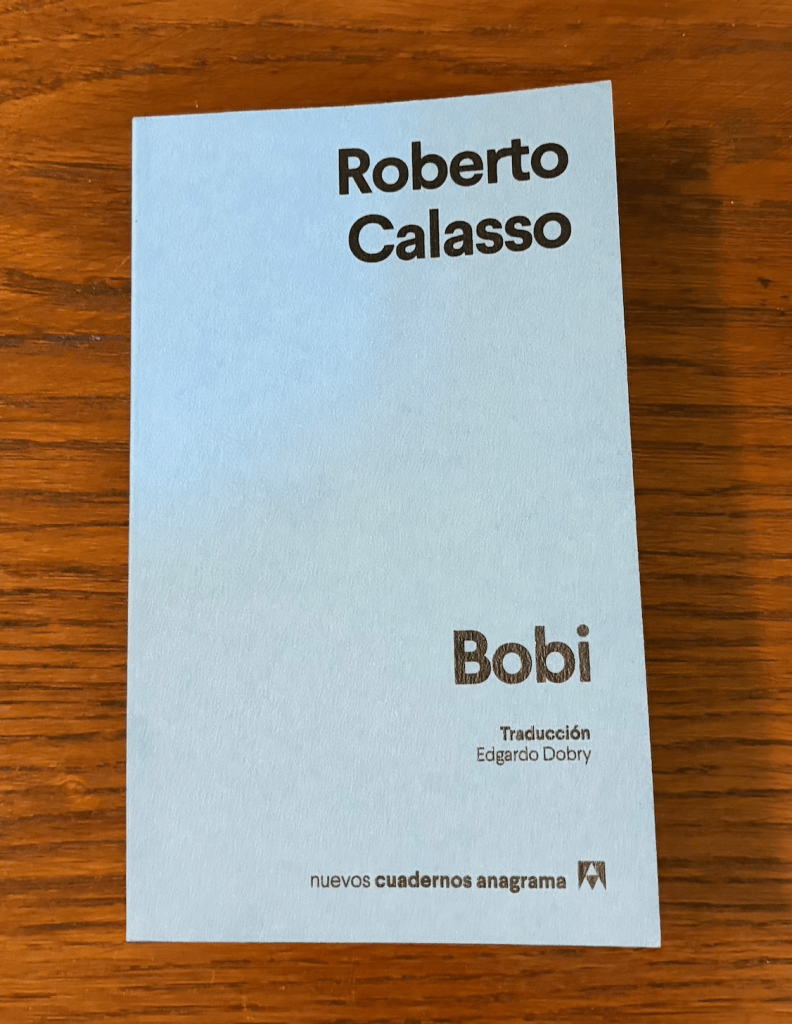
Roberto Calasso’s short and epigrammatic posthumous book Bobi (Anagrama, 2026) on the opaque figure of Roberto Bazlen has just appeared in Spanish. It is a nebular autobiographical book that does not attempt to render legible the subterranean and oblique figure of Robert Bazlen, but rather to filter some of his obsessions and tonalities, many times through his own voice. Calasso is well qualified to write such book as a frequent stroller companion of the anonymous man of Trieste. There is no aura of the detective mystery about the person’s auratic psychic life, establishing a sharp contrast to Del Guiudice’s polyphonic narrative in Lo stadio di Wimbledon (1983). But in this short memoir book, I am particularly intrigued by a moment when Calasso inscribes Bazlen’s vortex of thought and life as an affinity for the acoustic.
Calasso quotes Bazlen (we assume that from his own memory): “Bazlen used to say regularly: “This does not sound too good”, and immediately we knew what he meant. His capacity to recognize sound was thorough” [1]. Calasso tells us, moreover, that he cared little about cultural or intellectual polemics of his time. All that matter was sound, the grain of the voice. His meridian crossing was the song and rhythm of another. It is this proximity to the light of the voice what allowed Bazlen to conceive life and writing as a unified sensible reality; mutually interdependent, and always intertwined like the threads in a rigged tablecloth. To inhabit the world without judgement – of History, of morality, of punishment and guilt, of retribution – means to secure an aperture to an acoustics that will remain close to us, albeit incomplete, in the dissonance and impropriety of meaning.
To be able to attune oneself to the voice is a practice that retreats from the order of the world; that is, to descend into anonymity in order to inhabit a subterranean region, which speaks to Bazlen’s insistence on tugurios or spelonche, which Calasso does not hesitate to render as naked spaces, miniature deserts or caves to immunize oneself from the chatter of the world: minima chôra where something could take place or not. It is hard to define them but we know perfectly well what these are. Perhaps we can be more emphatic: to listen to the voice is already the encounter. And very much like Osip Mandelstam’s figure of the interlocutor, true poetics (and first and foremost that of life) “is ever moving toward that more or less distant, unknown addressee, whose existence the poet cannot doubt without also doubting himself. Only a reality can bring to life another reality” [2].
Bazlen’s notion of writing as the writing of life, experience as writing, very much like Mandelstam’s dialogic poetics, finds a tugurio so that language can emerge in absolute presence. And this is precisely what Bazlen understood in the becoming of life against the metabolic strain of survival, since the repression of the voice will result in the annihilation of what is most alive. Calasso recalls Bazlen’s affirmation: “In a world of death – there was an epoch where one was born alive and would later die. Today, on the contrary, one is born dead – and only a few are able, little by little, to be alive” [3].
For Bazlen there is no community of the living granted in immanence, because to live means to conquer the putrefaction of the culture of death, which is only permanent revolution and hostility. But one cannot conquer death from death; that is, by means of the beautiful soul’s literary prose of the world. It does not take Hegel to say that this is still unwarranted insubordination and permanent bondage. What is then to be alive? It is a resurrection that takes place as an existential decision, that is “at a point in life when a fundamental decision has to be made. I believe that was his passion, and his masterpiece” [4]. This is Del Giudice’s indictment, although surely not fully at odds with Calasso’s autobiographical sketch of Bazlen. In the melodic contact the possibility of a vita nuova is transfigured in not-knowing because the Western modernity is devoid of any notion of ethical destiny. Indeed, “et tout le reste est littérature”, as Verlaine famously wrote. For Calasso’s spectral portraiture in Bobbi (2026), the adventure is to remain alive well beyond completion and needs, as evidenced in our encounter with his languishing voice and memory.
.
.
Notes
1. Roberto Calasso. Bobi (Anagrama, 2026), 83.
2. Osip Mandelstam. “El interlocutor”, en Gozo y misterio de la poesía (El Cobre Ediciones, 2005), 71.
3. Roberto Calasso. Bobi (Anagrama, 2026), 55-56.
4. Daniele Del Giudice. A Fictional Inquiry (New Vessel Press, 2021), 123.
In an issue of The Listener in 1935, the renowned British art historian Kenneth Clark penned a short article titled “The Future of Painting” that can be read as an early eulogy to the tradition of the pictorial craft. As a provocation – this was still the high tide of Modernist art – the ‘future’ of painting for Clark was undeniably reaching a point of irreversible exhaustion, at least in the Western tradition. In a phenomenological reduction of two major strands of modern painting – what he called “pure painting” that included Impressionism and Post-Impressionism; and, on the other, “super-realism” as the artistic consciousness that bypassed “spiritual salvation”, such as that of Surrealism and other visual experiments – Clark’s indictment deployed an indictment on what he sought as the end of the “plastic spirit”: “We must keep in mind the possibility that in the western world the plastic spirit is really exhausted and that art will be lost for many decades” [1].
For Clark, it was not that art ceased to exist as an autonomous practice of sensorial activity; it was rather that its imaginative and spiritual endeavors had a future only if mediated and “linked up” (sic) with the evolution of a “new social economic system” driven by the standards of productivity and mass spectatorship. Unlike Clement Greenberg’s reflexive plea of modernist painting as the triumph of the dialectical inversion of flatness over depth, for Clark the convergence of pictorial relation with social objectivity resulted, in the tradition of a post-Cezanne world, in draining the inherent sensible communication of painting and myth. This meant that modernist painting tout court was devoid of any mythical relation. In fact, one could very well claim that the outwardly material support (the flat canvas) of the picture became its most dramatic corroboration. Modernist painting was the triumph of social symbolization insofar as it served as a reminder of the objective space that could only be taken as unserious gratification of its own objectivity.
It does not take too many readings of Greenberg’s large claim on modernist painting to see that behind “flatness”, its very surface, lurks variations of the aura of subjectivity, expressed in “success of self-criticism”, “resistance to the sculptural”, and the drive towards systematic consistency viewed in the mirror of the “convergence of spirit with science; their concern does show the degree which Modernist art belongs to the same historical and cultural tendency as modern science” [2]. Or so writes Greenberg in his landmark text. If Greenberg goes out of his way to invite modern science into the field of aesthetics it is precisely because Modernist art has been able to spell out the potential for representation into an autonomous surface that has given up depth to the conscious effort of its material limitations as its primary concern (imagination, the divine, the liturgical theatrical aura are all secondary). It is perhaps against this backdrop that one can understand what Clark means by the exhaustion of the “plastic spirit” that underpins his prophetic understanding of the decline of painting.
But what is, ultimately, the “plastic spirit”? It is not referring to sacred representation nor artistic inspiration of the artist, but rather the receptive affinity of the pictorial gesture with nature without ever being reducible to its material support (flatness). If painting exists, it is because its lovely being “is neither sensuous nor spirit, but rather the ungraspable, diffusing over the figure…this being is ungraspable yet perceptible to everyone is what the Greek language called [kharis] and we call grace” [3]. What the ‘plastic spirit’ discloses in its suspension of judgement through very disclosure of appearance is the imperturbable space, and by extension ungraspable, where figuration arrest an instance of eternity. In this sense, it always resists any assertion towards the future, because it dwells in the opening of a space “there” that fails to coincide with the material extension and limitation of the canvas.
This is what perhaps Walter Benjamin had in mind in an early fragment where he reflected on painting as an art of paradise or a state other-than-being grounded in visual contours: “Painting, too, generates space spiritually; its generation of form is likewise grounded originally in space, but it generates space in an other form. Not the dimension but the infinity of space is constructed in painting. This happens through the surface, in that, here, things develop not their dimensionality, their extension in space, but their being toward space. The depth yields infinite space. In this way, the form of concentration is given, but this now requires for its fulfillment, for the allaying of its tension, a presentation of the infinite in itself and no longer as dimensional and extended” [4]. Was not this the ungraspable caesura between depiction and nature already pointed out by Schelling?
Painting is depth, or at least it is about a certain way to accout for depth. And depth, fundus, before it takes the form of a flat spatial region in ‘thereness’, it is eminently the display of the figure that emerges from it. This “space otherwise” – that is not just a different spatial arrangement or geometrical calculation – is something of the infinite that makes both flatness and the diachronic arrow of time collapse in its unattainable rigor brought to bear in the affection through figures and colors. Every painting shows therenesss, but that is only possible through the depth of interiority that remains invisible. This can illuminate what Osip Mandelstam said of the plastic spirit when writing that “painting is also much more a matter of internal secretion than of apperception, that is, of external perceiving. To appreciate a picture you must go through a process making of restoring it” [5]. It is in this renewal that the imperturbable depth of painting fulfills before the abdication of the future. And from the “depths of nature” into the blossoming manifestation of appearance, painting recalls, beyond words, what in the sequence of time is understood, and yet often neglected, as the ungraspable.
.
.
Notes
1. Kenneth Clark. “The Future of Painting”, The Listener, October 2, 1935, 578.
2. Clement Greenberg. “Modernist Painting” (1960), in The Collected Essays and Criticism (University of Chicago Press, 1993), 91.
3. F.W.J. Schelling. “On the relationship of the plastic arts to Nature” (1807), Kabiri: The Official Journal of the North American Schelling Society, Vol. 3, 2021, 146.
4. Walter Benjamin. “The Rainbow, or the Art of Paradise”, in Early Writings 1910-1917 (Harvard University Press, 2011), 225.
5. Osip Mandelstam. Journey to Armenia & Conversation about Dante (Notting Hill Editions, 2011), 79.
We have attempted to read Florensky and Schmitt side by side, and certainly many fundamental questions have been raised converging profusely on the problem of Catholic form. At the same time, it is undoubtedly true that some questions have not been pursued at length, and they exceed the modest purpose of this short seminar. As a way of synthesis, I want to press against one question that seems to me to link both thinkers in the wake of secularization, and especially modern representation. Modernity is always too many things at once – it is purely the force of the contingent, but ultimately it is the temporalization of space through objectivity and its necessary legibility. It seems to me that the spatial question is a guiding thread, not the exclusive one, that connects Florensky and Schmitt’s interventions circa 1922. It is obviously the problem that the German jurist never ceased to reflect upon, if we recall how in the very end of his work he situated the very arcana of the law in relation to the visuality of the Homeric “kai nomon egnō”, a predicament for seeing space laying before the law; that is, subsumming the sense of worldly opening into the necessary predicate of a legitimate ground for order.
Schmitt’s purified, prima facie formalist conception of the Catholic form, is also fundamentally spatial, because the primordial essence of the duality of the ekklesia as an institution comes about through the dominion of life unifying the communities and burgs into an internal system of legitimation that builds a concrete order (in recent years the work of Anna Grzymala-Busse has convincingly tracked the morphologies from the medieval church the modern city state and the rule of law). As we know, for Schmitt Rome (Catholic form) is Raum, spatial arrangement, dilation of orders and institutions, representation and decision elevated beyond the fundamental norm. In this sense, the thesis on the ‘visibility of the Church’ hinges upon the opening of the world as always already oriented towards salvation through the structural deficiency of human beings (original sin) and communitarian order of representation and delegation. This is why Schmitt remains a modern political thinker – perhaps the most acutely aware of thinkers when it comes to the fragility of the political project based on the specular visibility of legitimation – because the fusion of the political and that of territory remains indivisible, in spite all of his self-conscious response to the force of immanence noted in Political Theology (1922). The liquidation of the limiting autonomy of the political against technical neutralization is only possible because “space” has been first subsumed into the visible nomos of the nomon egno.
It goes without saying that Pavel Florensky’s strategy is also extremely sensitive to visuality, but his position departs from the assumption that modernity is about the flattening of the unilateral and objective specular regime of visibility. One can recast what Alberti writes quite ostentatiously in De Pictura: “No one will deny that things which are not visible do not concern the painter, for he strives to represent only the things that are seen. Points joined together continuously in a row constitute a line” [1]. In Alberti’s visual inception of pictorial representation, space is already orienting the direction for the flattening of pictorial space that defines modern pictorial representation in the well established argument by Clement Greenberg [2]. Obviously, Florensky wants to break against the flatness of modern representation, which is the condition of possibility for the very nihilism of subject and object that becomes worldness because it has no longer any possible carving out the “thereness” of space. It seems to me that this is what Florensky is after when elaboration of the ‘reverse’ or ‘inverted’ perspective. The inversion here is not just an aesthetic problem of the autonomy of work of art in the new distribution of labor, and here is where liturgy marks a fundamental distinction in terms of the analytical paradigm that frames Florensky’s investigations. Around the same years, Romano Guardini in his The Spirit of the Liturgy (1918) defined the liturgical experience as anti-aesthetic phenomenon, because in its communion of souls, it gathers the visible as well as the invisible, whose exclusive beauty shines in the light of truth and not of delimited notion of “work”. For Florensky moving past linear perspective, and by extension objective representation, is the path that prepares “a new structure of thinking” as such [3]. In virtue of its own experiential depth, “a certain spiritual excitement, a joly that rouses one’s attention to reality itself. In other words, perspective too, if it is worth anything, should be a language, a witness to reality” [4].
The so-called inversion of perspective is a destructive operation at the level of sensibility against the traps of illusionism and abstraction, opening in the concrete and yet not-yet-here space where life and its alterity enter into contact. This is why Florensky claims that it is “the content of space that is transmitted, but not the organization” [5]. And in a more densely and rich moment of the “Reverse perspective” (1920) he writes the most clearly expressed elaboration of this new structure of thinking: “To sum up. It is possible to represent space on a surface, but only by destroying the form of the thing represented. Yet it is form, and only form, that visual art is concerned with. Consequently, the final verdict is proclaimed for painting, as for the visual arts in general, to the degree that it claims to provide a likeness of reality: naturalism is once and for all an impossibility” [6]. As it is obviously clear, Florensky is not thinking destruction in virtue of restating a metaphoric sacralization of nature; rather, for him the liturgical depth of the reverse perspective discloses an experience is only possible in the contact between the possibilities of the world and being. It is this region that he call the “abyss of own freedom”, and that the attempt to contain it through the hegemony of the matheme and calculation only amounts to “as tasks of insane presumptuousness” [7]
The turning of experience must inhabit this abyss of freedom retreating from an “unmoving monumental and ontological massiveness of the world, activity by the cognising spirit that lives and labours in these thresholds of ontology” [8]. Thus, accounting for that ontological reduction makes possible inhabiting realities in the world that never become validated through representation. As Florensky writes in a short piece published around these years: “Obviously our living remoteness from reality must again destroy realism in art as well. There are realities in the world; one comes to know them by coming into living contact with them through work in the worldwide sphere….art can unite us with realities are inaccessible to our sense – such are the formal prerequisites of any artistic reality, and a tendency that rejects even one of them thereby forfeits its right to be called realism” [9].
If the Christian liturgy remains the most “realistic” experiential arrangement for Florensky it is because the texture of space appears in its non-visibility as the “missing aspect of what what we might call the surrounding world…it is this surrounding world, place as such, which the liturgy addresses” [10]. It is this surrounding world, that is both beyond the world and yet within it, almost folded unto it, what I would claim that relates tendentially to the notion of the chora (χώρα), not as an interchangeable modulation of “place”, but as what allows externality as the requirement of experience to be indifferent to sense because it its presence is that of possibility. John Sallis in an essay on the notion of the chôra puts it in a way resonates with the abyss of freedom withdrawn by Florensky:
“One could say—though not without some risk of falling into the dream in which the chora (χώρα) is conflated with place—that the chora (χώρα) is the other of being, not just in the sense of being other than being (as every eidos except being would be other than being), but rather in a more abysmal sense, in a sense irreducible to a difference of sense. One could say, too, that the chora (χώρα) is the outside of being, that it is what enables externality as such and thus makes it possible for something outside being nonetheless to be” [11].
We should linger on those words: “a more abysmal sense, in a sense irreducible to a difference of sense”. But this abyss is not what refers to an ontological vacancy that becomes operative for the subject; it is the excess that allows being, and for that matter “ethical being”, to have composed duration in its region. I think it is possible to accept the minimalist thesis of the liturgy as the sanctification of “time-place that the world is” (this is the syntagm deployed by Hemming) beyond divine revelation, but only if one takes up the chôra as the space of spaces (ur-space) at the end of secularization, a transformative leap that transcends time to land somewhere in the depths of regionality. It is the region that makes the passage, as Florensky would say, fata voletem ducunt, nolentem trahunt, from interiority to exteriority without ever achieving consummation, perhaps as a folded relation. The stakes are enormous no doubt. In an entry in his recent Quaderni XIII (Quodlibet, 2025), Giorgio Agamben defines it in a particular way that traverses Heidegger, but also beyond him. This is a difficulty disclosed by the chôra, and it is the beginning of further challenging investigations waiting for us:
“It is the choice of this misleading conceptualization that leads Heidegger to privilege, like Hegel, time and action over space and contemplation. Not “Being and Space [chôra],” as in Plato, but “Being and Time,” as in Hegel. Even the “wonder that beings are” becomes a task and a “sacrifice”. Instead, the aim is to understand this wonder ethically as “use” (“to use it again in order to contemplate it”). Admittedly, in his later years, Heidegger attempts to rewrite Being and Time as “Being and Space”; yet here too, the conceptualization remains imprecise because it does not sufficiently question itself. (Although he merely acknowledges the inadequacy of language, he continues to propose terms that are necessarily deficient.)” [12].
.
.
NotesNotes
Notes
1. Leon Battista Alberti. On Painting (Penguin Books, 2004), 37.
2. Clement Greenberg. “Modernist Painting” (1960), in The Collected Essays and Criticism (University of Chicago Press, 1993), 90.
3. Pavel Florensky. “Reverse Perspective”, in Beyond Vision: Essays on the Perception of Art (Reaktion Books, 2002), 246.
4. Ibid., 254.
5. Ibid., 258.
6. Ibid., 258.
7. Ibid., 260.
8. Ibid., 269.
9. Pavel Florensky. “On Realism”, in Beyond Vision: Essays on the Perception of Art (Reaktion Books, 2002), 181
10. Laurence Paul Hemming. Worship as Revelation: The Past Present and the Future of Catholic Liturgy (Burns & Oates, 2008), 47-48.
11. John Sallis. “The Politics of the χώρα”, in Platonic Legacies (SUNY Press, 2004), 42.
12. Giorgio Agamben. Quaderni XIII 2020-2021 (Quodlibet, 2025), 248