Immediately after the end of the Second World War, the historian Emilio Roig de Leuchsenring published a thin book in Havana with the title Weyler en Cuba: un precursor de la barbarie fascista (Páginas, 1947), which made a direct connection between twentieth century political movement fascism and the lurking shadow of the Spanish general Valeriano Weyler, who commanded the intense colonial pacification against pro-independence insurrection at the end of the nineteenth century in Cuba. It is to Roig’s credit how he managed, toward the end of the book, to capture the actuality of what he called “weylerism” of full-fledged totalitarian and imperial wars against populations that did not come to an end in spite of international law and the several peace agreements of the Second War victors. For Roig the structural positionality of politics even in the years 1945-1947 was still maximalist, all encompassing the total conditions of living of populations, and thus a direct instrument of capitalist rent through war making. What he termed “weylerism” or the new fascist barbarism was a new qualitative leap in terms of conducting war, which now realized itself in terms of population control and the veneer of “order”: “Todo lo que Weyler representó y practicó está vigente en la posguerra” [1].
The idea of “peace” (the United Nations was settled in the fall of 1945 with the active participation of Cuba, something that Roig would not have ignored) could only signal the continuation of an extreme form of extermination and the dispensation of cruelty. In fact, the Weyler model (weylerism), was very much an administrative form of pacification of population through encampment and survival. In his memoirs, Weyler himself justifies “reconcentraciones” of the population as a martial solution to answer insurrectional arson activity, in the form of an exclusionary space within the territory even if this meant mass starvation [2]. As Roig does not cease repeating in his postwar essay, the actuality of Weylerian command is not an image of the past, but something that is already an essential part of the world of today and surely of tomorrow.
Today we are living Roig’s historical future, and we can say that his Weyler en Cuba: un precursor de la barbarie fascista (Páginas, 1947) has become as current as ever before. Just a few days ago we heard the Secretary of Homeland Security of the United States claim that Immigration Detenter Center in Florida’s Everglades could become a model for detention centers across the nation thanks to its spatial efficiency near airport runways that facilitate deportation flights and extraditions without due process. As observed by Stephen Bonsal as early as 1897, the Spanish reconcentraciones in the island of Cuba enacted by Weyler’s military command were all deployed near key military strategic sites of the colonial army [3].
It comes to no surprise that in the current public discussion about Immigration Detention camps in the United States, the discussion always pivots towards health and sanitary management of the centers, and not in the “dislocating localizations” of these evolving zones d’attentes that now are propping up near airports, shipping ports, and hinterlands of American metropolises [4]. If the camp, or reconcentraciones, is the sharp image of ongoing domestication of human beings, as a great twentieth century writer observed, it might very well be that the current metamorphosis of Weylerinism has become victorious because it has been rendered acceptable by an increasingly indolent and dormant Society.
.
.
Notes
1. Emilio Roig de Leuchsenring. Weyler en Cuba: un precursor de la barbarie fascista (Páginas, 1947), 216.
2. Valeriano Weyler. Memorias de un general (Ediciones Destino, 2004), 257.
3. Stephen Bonsal. The real condition of Cuba today (Harper & Brothers Publishers, 1897), 112.
4. Giorgio Agamben. Homo sacer (Stanford University Press, 1995). 175.
The essay “Por nada del mundo. Anarquismo y Catolicismo”, by Spanish poet and essayist José Bergamín, should be read as a wartime reflection on the historical impasse of the Spanish Civil War. First published in Emmanuel Mounier’s Catholic journal Esprit in the 1937 April issue, the essay in its final version featured in Bergamín’s Mexican exile collection Detrás de la cruz: terrorismo y persecusión religiosa en España (Lucero, 1941). While on the surface Bergamín is responding to the struggle between secular political anarchism and traditionalist Spanish Catholicism intertwined at the heart of the civil war, the essay is also highly idiosyncratic in laying out the poet’s theological vision that permeates his entire body of work, and which can already be found, in nuce, in the fragments and aphorisms of his first book El cohete y la estrella (Índice, 1923). “Reality is the spirit, imagination, and thought…there is religiosity when it claims space positively”, he would write in the first pages of that book.
The 1937 essay, along with his defense of illiteracy in “Decadadencia del analfabetismo” (1933), Bergamín argues for a living theology of the Spanish people (pueblo) that is neither imperial nor clerical, but rather always an excess to the imperial political theology that dominated the long historical narrative of Spanish modernity since the Reconquista. It was thanks to Bergamín’s genius that Catholicism appears connected to a habitual form of life of everyday people, their shared language, symbols, and experiences; and, ultimately the common imagination that grants them access to the world through the mystery of living and dying. In fact, as in “Decadencia” (1933), it is important to highlight the centrality of the term “pueblo”, which although translated as “people”, it coincides neither with the “People” of the unity of civil society nor the common historical identity of the Nation. For Bergamín, these determinations, in fact, were corrupted notions of pueblo. The pueblo is always the event that remains from the abstraction of political theology, and always pueblo minoría, a ‘minor people’ that dwells in the house of God within and beyond the mundane. This is why Bergamín would claim in the text that the pueblo is always ancilla mundi. In this light, Bergamín thought that political anarchism incapable of a revelation to the divine, and an imperial Church in charge of the administration of the “nothingness”, were two poles of the same vectorial force of modern nihilism. That was the color of his corruptio optimi pessima with clear echoes of Fridugisus’ De nihilo et tenebris.
In “Por nada del mundo. Anarquismo y Catolicismo”, Bergamín’s theological position emerges as a third way to exit this historical poverty of relating to the theos. As Giorgio Agamben observes in a 1973 entry of Quaderni (Quodlibet, I, 2024, 46-47), for Bergamín the divine entails a corporeal cohabitation of a demon and an angel that expresses appearance of life, and thus the sensible and poetic mediation with the world of forms. In this sense, Bergamín’s theology differs fundamentally from the rational and canonical traditions, fostering the sensorial path of dramatic and divine beauty. This goes to the kernel of the 1937 essay: the rise of the Totalizing State (historical Fascism), was a corrupting form of theos insofar as it aimed at regulating the “nothingness” against the possibility of appearance and truth. But the word of God and the angelic hymns linger in the time of wreckage and devastation in its impatient drift towards anger in the world, which is still very much our own. Ultimately, Bergamín was convinced that the pueblo’s mute voice, resurfacing from the depths of pain, could dodge the abysmal fall into the tribulations of radical evil always too congenial with the survival of ‘this world’.
.
.
* This gloss was written to accompany the English translation of Bergamín’s “Por nada del mundo” forthcoming at New Personalism, summer 2025.
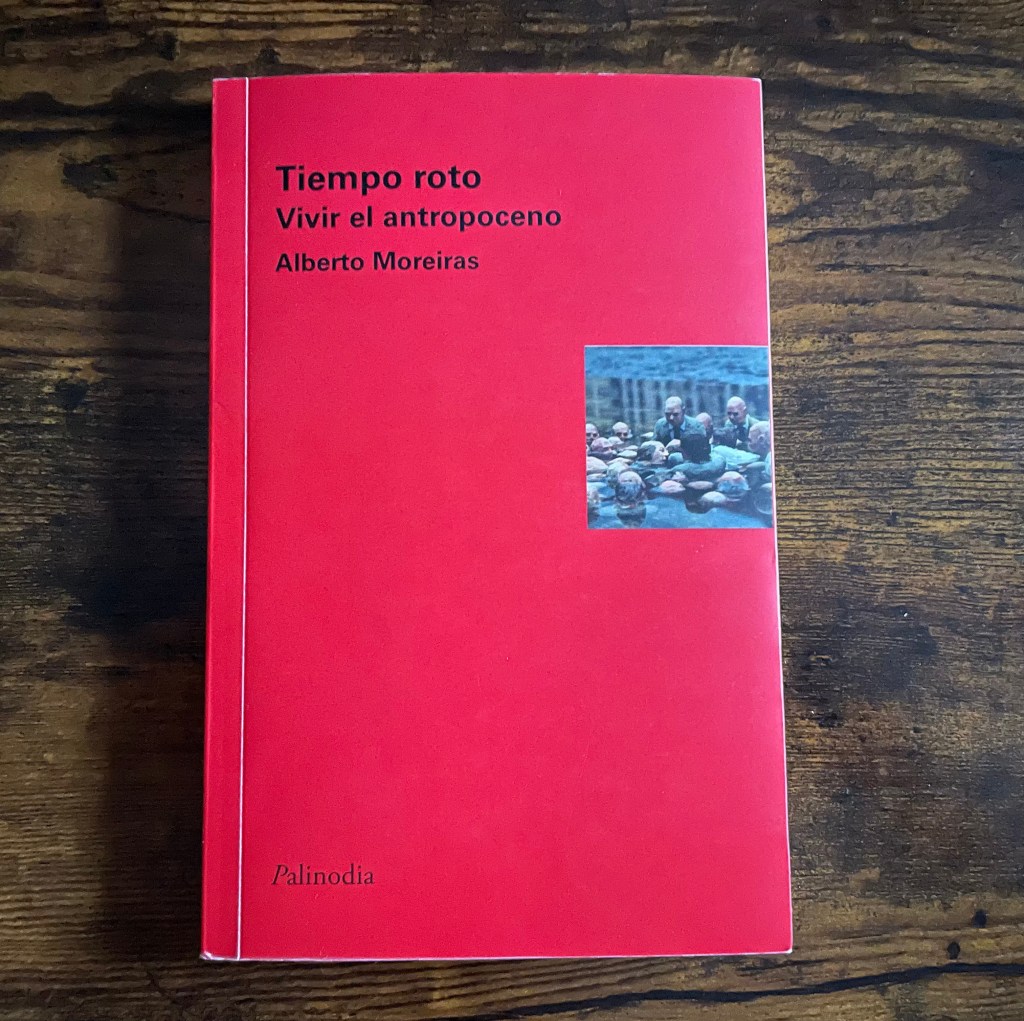
The sudden and uninvited intrusion of Gaia in our world is something rather strange, and yet consistent with the closure of the metaphysical tradition. The call of the outside takes place at the threshold of our reflexive capacities, habits, and mental propositions in our relation with the world, which demands everything to be thought from scratch. The historical imbalance in groundlessness now requires a new task for thinking – the imperative that runs through Alberto Moreiras’ most recent book Tiempo roto: vivir el antropoceno (Palinodia, 2024). The theoretical constellation deployed over the course of a decade now comes to the forefront with extreme urgency – I am referring to marranismo, posthegemony, aprincipial anarchy, and of course, infrapolitics. Tiempo roto (2024) is not a systematic culmination of Moreiras’ philosophical (or antiphilosophical) project of thought, but it is definitely a mature elaboration insofar as the field of problematization enters a hitherto unexplored thematics of late heideggerianism. All things considered, the emerge of the anthropocene as an explicit planetary endgame and the new beginning necessarily move pass the conditions of both political and scientific praxis, which today can only effectively adequate itself into positionality (the so-called Gestell) and objectivity of a world that slowly seems coming to its end.
It might be worth remembering that the notion of “other beginning” (“otro comienzo”) in the wake of civilizational decline was already proposed in the book Sosiego siniestro (2020), but it was far from being thoroughly explained [1]. Following Heidegger’s philosophical scene, representational thought in the tradition of adequatio of the Thomist gnoseology coincides with technological administration of every living entity (Moreiras 14). But Heidegger’s suggestion in the Parmenides that calculative representation fails as grasping the essence of the polis might also have its own limitations, insofar Gaia appeals to an excess beyond or below the politics. As Jacques Camatte also understood it, the civilizational invariant of revolutionary breakthrough departing from the historical subject of the working class can seldomly do the work except as an article of faith in the myth of the autonomy of the proletariat within real subsumption. This means that we are in the terrain of infrapolitics or the chora, which point to ontic regions of thought towards a new beginning at the end of principial metaphysics. But the other beginning can only emerge within conditions of transforming existence against the closure of political technicity.
I do not desire to reconstruct here all the refined analytical movements that lay out the transformation of existence in Tiempo roto (2025), but there is a maxim from Pindar’s Third Pythian Ode that stands out as an emblem for the appropriation of the non-humanity of the world. Moreiras cites Pindar’s “me, phila psycha, bion athanato speude, tan d’emprakton, antlie makanan”, which can roughly be translated as “do not seek, dear soul, immortal life, but do try to carry out the fullest the use of the possible” (Moreiras 61). Moreiras correctly notes that the ultimate difficulty lies in the “emprakton makanan”, or the use of the possible, which metaphysical Humanism and effective general equivalent can only exacerbate towards the planetary production and extractive valorization. The corruption of the use of the possible is the realization of hybris, and in this sense all representational humanism is always already a form of self-deification and induced hallucination, even when it tries to claim to engage in the opposite in relation to nature (Moreiras 65). Moreiras suggests that the pindaric maxim discloses a second relation of the “use of possibles” that does constitute a lacuna in the metaphysical tradition, and that is understanding a praxis tied to sophrosyne or phronesis that abides to the prudent inclination of the non-human (“es una actividad sometida a la vergüenza de lo in-humano”) (Moreiras 65). Giorgio Agamben’s defense an ontology of possibility against the hegemony of metaphysical realization and representation also comes to mind, although Moreiras might not feel at ease at explicitly calling for a positive ontology nourished in the waters of a transfigured metaphysics of the tradition of scholastic Averroism [2]. Although both Moreiras and Agamben come at their closest proximity in terms of the notion of the chora – and more directly the space of the chora against the primacy of the polis – which serves the ontic condition for the non-spatial surfacing of the abode or region that is necessarily infrapolitical, because it’s never determined by distributionist political isonomia or meson (Moreiras 73).
There are important nuances here to say the least: whereas for Agamben the notion of chora appeals to the gods of place (theos aisthetos), and thus a dejointed form of divinization decoupled from the legitimacy of every politico-theological archein; for Moreiras, the chora is a praxis of thought towards desecularization that lacks theology, and thus capable of exceeding the onto-theological reduction (Moreiras 74). But Moreiras says about the tendency towards nihilism of “possibility” in the historical dispensation of positionality (Gestell) could also be said about ‘de-secularization’, as the ultimate consequence of the decay of political legitimation in Ernst Bockenforde’s famous formulation. This might not be the space nor the moment to reach a verdict between Moreiras and Agamben’s position regarding the very complicated problem of the Platonic site of the sensible, since what is presented to the reader as a ‘phenomenology of excess’ or the inapparent (something merely alluded in the Zahringer seminar), might be the condition of an atopic mediation that prepares – or that has always prepared since the times of Orphic myths – the tonality of a coming philosophy under the sign of transformative thought (Moreiras 110) [3].
The dispensation of the Gestell open up and also step back (a folded movement that does not have a declension into a synthesis) into the genesis of the beginning (Moreiras 115). And the anthropocentric epochal dispensation, says Moreiras, is no longer the site of the polis, but “the planet as a the historical site of humanity, although we are still unaware of it (“aunque sigamos desconociéndolo”) (Moreiras 116). This uncanny phenomenology of the primary, traversed by the discharge of the entstehung, is the infrapolitical site par excellence, because it is in the atopic region where destiny is both affirmed and displaced. This is why, as Moreiras recalls Heidegger saying, the dialogue with Parmenides never exhausts itself, and yet it prepares a destiny (Moreiras 134). I take this to mean that there is an experience of the transfiguration of language for the emergence of an “ethics” (ethos), but this might be beyond Moreiras preliminary conditions for an existential breakthrough; that is, something possible further along the path.
Tiempo roto (2024) closes with a couple of undeveloped pages that take Massimo Cacciari’s old essay “Confrontation with Heidegger” (1977), in which the Italian philosopher makes a plea for a direct confrontation with Heidegger and Nietzsche’s teachings on nihilism and the closure of metaphysics if there would still be any hope for the composition of the working class during the stage of anthropomorphized dimension of capital defined by Jacques Camatte also during those years. But much has changed since the hot Italian summer of 1977 and the formulaic conjunction of “left Heideggerianism” might not do the work anymore, as if the totality of materialist political economy could be amended by a radicalization of the historical question and the ontological difference. Political economy plus metaphysical critique is still relying on a conception of the political as a technique, which today has transformed into what some have called the “new regime of ecological accumulation” as mere stabilization of green ecological spheres of life [4].
But there is a second register to Cacciari’s programmatic thesis that remains open. And these might be Moreiras’ most important words in the concluding part of the book: “Espero haber mostrado que Hiedegger señala la posibilidad de dejar atrás la explotación y el consumo en la era del Antropoceno a través de una comprensión alotrópica de nuestra relación con el mundo. Por lo tanto, vivir en el Antropoceno debe basarse en el abandono o desplazamiento de la metafísica como modo dominante de aprehensión del mundo en la actualidad” (Moreiras 151-152). Marx’s materialist dialectic through the critique of political economy – even as a destitution of political economy through its own vectorization – might be insufficient to face the unprogrammed presence posed by planetary anthropocene.
Perhaps we can still repeat Dionys Mascolo’s words that the coming communism will owe more to Hölderlin than than Marx, not because of an idealist dispute over concepts, but rather because of what Cacciari called in his essay, also citing the German poet, the historical “affinity of conditions” [5]. And in the age of the Anthropocene and positionality, those conditions are kept in the pattern of economic decline or stagnation in which the law of rate of profit encounters its own limit, folded unto the ongoing destruction of the life forms in the world. The allotropic praxis endorsed by Moreiras finds traction in Hölderlin’s poetic dwelling in language at the heart of decline so that something other might emerge within and beyond life, from Gaia to Ctonia. This is the most difficult task to depart from, but it is also the path that saves from the current inhabitable passage of the Earth.
.
.
Notes
1. Alberto Moreiras, Sosiego siniestro (Guillermo Escolar, 2020), 24.
2. Giorgio Agamben. L’irrealizzabile: Per una politica dell’ontologia (Einaudi, 2022), 112-146. Kindle Edition.
3. For more on orphism and the limits of the site of the Greek polis, see Gianni Carchia’s Orfismo e tragedia (Quodlibet, 2019), epilogue by Julien Coupat.
In his most decisive confrontation with the scientific method and the legitimacy of science through objective knowledge, Carlo Michelstaedter introduces a rather loosely expression from Plato’s Gorgias to lever his position against the sufficiency of the scientific experiment: the “kallopismata” (καλλωπίσματα), which can be rendered as “embellishments” or “ornaments” that is constituted in figures such as matter, law, the final cause, or ruling principles (archein) that align the conditions for calculative and sufficient reasoning [1]. For Michelstaedter, the world of objectivation and scientific neutrality proceeds through figures of rhetorical ornamentation, kallopismata, which allows conquering the future; that is, what remains completely foreign and inaccessible to the domain of calculative reason waged upon a series of expressed goods.
It could be said that kallopismata is the artifice that allows the absorption of those goods to the historicity of civilization as they undergo their own ‘corruptio optimi pessima’ a process of functional realization of their entelechy: the desert becomes a cloister, the banquet an academic, the artist’s studio a school of beaux artists…imitative technique assumes the name of art; any virtuosity assumes the name of virtue [2]. In a language similar to that of Heidegger’s, Michelstaedter speaks of the constitution of an “exceptional machine”, which positions the organization of the world through rhetorical deployment (and it was not by coincide that Heidegger referred to Aristotle’s Rhetoric as “the first systematic hermeneutic of everydayness with one another”), and hence the fundamental metalinguistics of any social economy. The exceptional machination not only deploys generic meaning from the irreducibility of things, but also organizes the mediations between the subjective plane and the objective reality. In this way, the rise of the hegemony of science in the hands of the ‘pioneers of civilization’ and a “community of the wicked”, as Michelstaedter calls the endeavor of modern scientists, can violate nature offering security and comfort to the totality of mankind. This will explain their civilizational endurance and the recursive positionality for historical self-amendment and renewed adaptation.
How can this community of the wicked achieve absolute consent and domination through their practice? The domination over nature is not exclusively an anthropological process extended outwardly; it posits a nexus between interiority and exteriority where the question of language itself is entirely redefined. This is why the most stealth invention of the practice of scientists for Michelstaedter is to “infiltrate life with certain words….on which meaning unknowingly prop themselves for their daily needs, without acknowledging them they pass them on as they were received” [3]. The ultimate experiment of the techno-scientific understanding of the world amounts to the elaboration of cybernetics (a term that Michelstaedter never uses but that obviously colors the effect of his general scheme of civilizational nihilism); that is, the unification between the phenomena of the world and the human’s sayable language. To this end, Michelstadter will emphasize this proximity: “Technical terms give men a certain uniformity of language. In vain do the proponents of internally created international languages dream. The international language will be language of technical terms; of kallopismata orphnes, ‘ornaments of the darkness’ [4]. Whereas darkness denotes the harboring of language and its limit – and one can recall Fridugisus’ De nihilo et tenebris – its slow decay in darkness, kallopismata orphnes, outlives itself by the artificial luminosity that tears all mediation from the sensible world, now realized as fully alien to the appearance of truth and the truth of appearance. As Giorgio Agamben has noted, in what could be read as an esoteric gloss on the triumph of the kallopismata orphnes in our times, the technical question in the scientific paradigm is not merely a problem of the modes of techniques and instrumentalization, but more concretely a process that brings to an end the use of language as a sensible experience with the world [5]. And insofar as “sense” is only an idea of the sayable, it might as well be senselessness has been fully integrated into the infinite production of “informational differences” (“data run”), a final hypertrophied form of an unworldly logoi.
It would not have passed Michelstaedter that the context in which the degraded notion of kallopismata (embellishment, ornament, decoration as adjectives do the work, but one should also register the kallos, a central tonality in Plato’s musical thought) happens in a rebuttal of Callicles to Socrates’ critique of force and personal interest as requirement for a conception of Justice. In 492c of the Gorgias Callicles will reply to Scorates stating the following: “No, in good truth, Socrates—which you claim to be seeking—the fact is this: luxury and licentiousness and liberty, if they have the support of force, are virtue and happiness, and the rest of these embellishments (kallōpismata)—the unnatural covenants of mankind—are all mere stuff and nonsense” [6]. In other words, for Callicles anything that does not have the force of principle or justification has already fallen to the level of “stuff” and “nonsense”, even though that nonsense is itself the use of language in its contact with the “thereness” of appearances. It is no coincidence that in his lecture of ethics, Wittgestein will press upon the nonsensical expressions of language in order to elude the escaping and impossible essence of language every time that it seeks to move beyond the world” [7]. In other words, if Callicles is the hyperbolic figure of the rhetorician-scientist, what is at stake in the inception of kallōpismata as veil of language is nothing else than the effective liquidation of its ethical dimension, which in turn transforms the use of language into a mere coding instrument at the altar of philopsychia, or, in the words of Callicles, of empty “unnatural covenants” (para physin synthēmata), depleting language to exclusive semantic and and metaphoric correspondence [8]. In other words, the ascendancy of the nonlanguage of the kallopismata will now entail abandoning the imperative mode in which language and life can enter a secret relation as defined by itsuse[9].
Can one even speak of human life after the ascension of the kallopismata orphnes as the civilizational matrix of the world? A life without the use of language, under the veil of kallōpismata, represents an unprecedented milestone and perhaps something beyond the rhetorical enthymemes. Perhaps one could elucidate this point in this way: according to Hans Blumenberg, the most important rhetorical form ever invented was that of the prayer because through its practice one is ultimately trying to persuade a God. In contrast, in the complete darkness prefigured by kallōpismata orphnes that dwells in a civilization eclipse – the rise and fall of modern secularization and political idolatry – the gods can no longer be posited as exteriority towards the taming of the gnosis for the anthropological need of self-affirmation [10]. Because the process of fictitious anthropomorphism has reached its own limit to the point of becoming itself an “exceptional machine” (macchina eccezionale), the mystery of the senselessness of language has lost the world not necessarily by becoming mute and silent, but by enslaving itself to the endless chatter and infinite consensus by the moral equilibrium of the social age that for Michelstaedter ultimately meant “the machinery of dispersing interests, where the paths of existence are no longer clearly traced, but become confused and disappear; hence it is up to every existence to create the luminous path among the universal chaos; as if were, an art of practical life” [11]. It is that existential path granted by the nonsense of language (soul to soul) that grants beauty in the event of appearance, that cuts through and overcomes the civilizational allure of linguistic kallopismasta whose radiant heliotropism can only result in the most spectacular of blindness.
.
.
Notes
1. Carlo Michelstaedter. Persuasion and Rhetoric (Yale University Press, 2004), 98.
2. Ibid., 96.
3. Ibid., 98.
4. Ibid., 98.
5. Giorgio Agamben writes in “Sul dicibile e l’idea”, Che cos’è la filosofia? (Quodlibet, 2016): “Technics is not an “application of science”: it is the fundamental production of a science that no longer wants to save appearances, but obstinately tends to replace its hypothesis with reality, to “realize” them. The transformation of the experiments – which now takes place through machines there so complex that they do have anything to do with real conditions, but purport to force them – eloquently shows that the translation between languages is no longer at stake. As science that renounces saving appearances can only aim at their destruction; a philosophy that no longer calls itself into question through ideas, in language, loses its necessary connection with the sensible world”, 115. The attempt to escape appearance and experience to turn the world into a mimetic illusion administered by the aesthetic dominance of the pseudos was also elaborated by Gianni Carchia in his analysis of Plato’s aesthetics in L’estetica antica (Editori Laterza, 1999), 89-100.
6. Plato. Gorgias (Loeb, 1967), 413.
7. Ludwig Wittgstein. Lecture on Ethics (Wiley & Sons, 2014), 50-51.
8. Carlo Michelstaedter. Persuasion and Rhetoric (Yale University Press, 2004), 97.
9. Carlo Michelstaedter “Appendici I: Modi Della Significazione Sufficiente”, in La persuasione e la rettorica (Adelphi Edizioni, 1995), 142.
10. Hans Blumenberg. “Una aproximación antropológica a la actualidad de la retórica”, in La realida en que vivimos (Ediciones Paidós, 1999), 133. Philippe Theophanidis recently suggested in a discussion that we should read kallopismata orphnes in mind with the formulation “God help me”—because I haven’t the courage to help myself” that Michelstaedter introduces in the chapter “Rhetoric”, 69. “Notes on The Constitution of Rhetoric”, unpublished, February 2025.
11. Carlo Michelstaedter. Epistolario (Adelphi Edizioni, 1983), 159.
A few years ago, in a book I edited on the thought of Giorgio Agamben, I tried to suggest that his work was both an archeology of politics in the wake of the closure of metaphysics and a reopening of the problem of existence. Now it seems to me that this formulation did not go deep enough, insofar as I remained silent aboutabout existence was inscribed into a problematic field of reflection. Agamben has continued writing many other books in recent years, and in reading them I have come to think that the question of existence is intimately tied to the problem of “ethics”, which continues to be underdeveloped in his philosophical writings, but then again probably all ethics is always underwritten, oblique, and fundamentally lacking an essence. As Agamben states in La comunità che viene (1990): “….the point of departure of any discourse on ethics is that there is no essence, no historical or spiritual vocation, no biopolitical destiny…This is the only reason why something like an ethics can exist, because it is clear that if humans were or had to be this or that substance…no ethical experience would be possible – there would be only tasks to be done” [1].
It is obvious that ethics is unequal to morality, and here Agamben implicitly (later it will become also explicit in his opuscule L’avventura) is taking a distance from the Goethean conflation of ethos into a substrate of nature in the Aristotelian tradition [2]. But in the 1990 essay, Agamben is still considering and grappling with “ethics” from a vantage point that I would call a high-level of generality that can only connect to the conceptual exploration of potentiality and potentiality with an unequal valence, still searching for its ground as it were. In more recent books, it has become evident that Agamben’s thinking on ethics achieves a new precision. It does not mean that it modifies or alters his conviction of the untamable and unprogrammatic potentiality of ethics against morality and nihilism, but it does put it in the specific light the terrain of language. I am thinking of this moment in Filosofia prima Filosofia ultima (2023), where he writes the following:
“What corresponds to is not a limit dimension of signification [“that which is said”], not even in the mystical form of a negation or a dark night, but an experience absolutely heterogeneous to that: not a logic but an ethics; not a logos but an ethics or a form of life. In other words, ethics is first and foremost the experience that reveals itself when we dwell in a fully nonintentional language. Far from being mute and ineffable, it is the speech we wrong when language frees itself from its suppositional pretension and address itself not as an object of a metalanguage but as the rhythm and scansion of a doing, a poesis” [3]
In no other book has a view on ethics come forth with the same force and eloquence. Although, clearly, the passage is drenched in negative conditions («not mystical, not a logic, not a logos»), the thinker also advances towards a par construens orientation that allows him to push for a different route from the relationship of ethics and language arrested in two important paradigms of Western thought: that of the mystical ineffable experience, and that of Wittgestein’s suggestion in his 1929 lecture that the ethical question runs into the “boundaries of language” in its attempt to go beyond the world [4].
The mystical experience of the “dark night” – and which Agamben seems to be recapitulating here after early essay on this very question in an edition of San Juan De la Cruz’s poetry translated in Italian – is also, in the words of Gustav Landauer’s Skepsis und Mystik (1903), the immaterial symbol of what cannot be discussed any further [5]. And in the early essay on De la Cruz’s mystic poetry, Agamben positioned himself against the elevation of dichtung as an autonomous sphere of the language’s modern wreckage into discourse and rhetoric. In both conceptions, Agamben seems to suggest, the negative lack in language seems to hold back the event of language that is nothing more than the “sayable”. And this sayable is the non-articulated, and thus in suspended judgement before the world (although not beyond it) in the opening of the voice securing its own appearance without remainder or negative threshold of substantial lack.
There is something to be said about this ex-position in Agamben’s types of the ethical life in recent books; mainly, Pulcinella, Pinocchio, Hölderlin, and the formless peasantry of the Rabelaisian world. Is not common to all them, precisely, an experience of the taking place of language that, far from being divorced from the world, is able to makes its own chorā within the world? As we read in Il corpo della lingua 2024): “… is because there is no world, but always and constantly leaping worlds within worlds that sink into each other in a star-crossed blazon, which is the same sensitivity of God as a living and thinking being” [6].
The refinement around the question of ethics also illuminates the moment in L’uso dei corpi (2014) where Agamben, following French linguist Michel Bréal, attempts to secure the modal status of the “ethos” as a creative non-relation (and non-naturalist) of being, which is not only a matter of “suspension of a work of end”, but more positively, a dwelling in non-intententional use of language [7]. And is not this, precisely, the language of Persuasion (Peitho) in which the human touches the divine, an eternal life of speech that relates, in an angular manner, to Karl Barth’s suum cuique’ solace between life and death, happiness and pain? It is an open and intriguing question. The pure taking place of every thing – as God is, in fact, in all things – is the positive ethics of the chorā in which nothing is presupposed, and yet its ek-tasis never perturbes what, in fact, takes place in language.
.
.
Notes
1. Giorgio Agamben. La comunità che viene (Einaudi, 1990).
2. Giorgio Agamben. L’avventura (nottetempo, 2015), 11-12.
3. Giorgio Agamben. Filosofia prima filosofia ultima (Einaudi, 2023), 74.
4. Ludwig Wittgestein. Lecture on Ethics (Wiley Blackwell, 2014), 119.
5. Giorgio Agamben. “La ‘notte oscura’ di San Juan de la Cruz”, in Poesie (Einaudi, 1974), v-xiii.
6. Giorgio Agamben. Il corpo della lingua (Einaudi, 2024), 59.
7. Giorgio Agamben. L’uso dei corpi (Neri Pozza, 2014), 314.
Giorgio Agamben’s most recent La voce umana (Quodlibet, 2023) sets the scene with an elemental question: what is to call on something, and what is it to be called upon? The exploration around the notion of the voice (a sort of chorâ that falls between the different antinomies of human language, as we will soon learn) is far from new in Agamben’s work, who from the the early period of Il linguaggio e la morte (1982) directly confronted the negative foundation of phonê in relation to the closure of metaphysics. In a certain way, the perimeter of La voce umana (2023) is now deliberately limited to how the ‘mystery of the language’ is to be found in the unending event of the voice as the arcanum of anthropogenesis itself. At this stage of his investigations, the problem of the voice for Agamben designates a double movement of inflection and recapitulation: the voice proves the internal division of political life in the West; at the same time, it is also the most intense experience that a form of life can bestow the disclosure of the world. The attentive reader might recall the last pages of L’aperto: l’uomo e l’animale (2002) where the impasse of the anthropological machine was assigned by caesuras between human and animal, the semiotic and the semantic, the word and the name, redemption and the end of time, writing (gramma) and sound. But it is now with the voice that a clear way out becomes apparent. In the analytics of the voice klesis no longe stands as a political-theological category of the West; but, on the contrary, a call of language unto itself, the vocative that resists linguistic denomination and the free-standing outside the case and even language itself (“fuori lingua”) as suggested by Gustave Guillaume.
The vocative dimension of language is shown as pure means of the human experience: the apostrophe that calls something – as in Moby Dick’s majestic beginning “Call me Ishmael” – is already the call through the act of naming, and naming falling into the voice becomes the originary place of language in the denomination of speech (21). Irreductible to the antinomy of langue and parole, the semantic and the semiotic, the vocative texture of the voice emerges as the third figure that neither linguistics, philosophy of language, phonology, analytical linguistics, and biological cybernetics are capable of truly grasping. And this is so – Agamben does not says it in this brutish way – because there cannot be any theory of the voice and the vocative denomination; there can only be a poetics of the voice in which the transformative and self-generative experience with reality is staged: “Ma è possibile pensare il linguaggio prescindendo dal suo rifermenta lla realtà? La voce – il vocabolo – non designa soltanto un significant, chiama piuttosto un ente reale…non si limite a elencare segni in un lessico, ma annuncai ed encunia realtà” (36).
In my respects – and this is not the place to bring into focus Emile Benveniste’s last seminar on language and writing – Agamben’s treatment of the voice is nourished by pushing beyond the limits of the great twentieth century linguist who, for the most part, remained silent on the place of the voice. Not that there is a need for another substantive treatment of the vocative; in fact, one of the great achievements of La voce umana (2023) is precisely the archeological reconstruction of the Aristotelean “what is in the voice” (ta en té phonē) formula in which the classical metaphysical inception of language comes closest to the voice only to render it “articulate” and thus subordinated to the legibility of gramma or the written sign (42-44). And whatever one thinks of what constitutes the “primacy” of metaphysics in West (phone or gramma), what is important is the fact that domestication of language has been auxiliary by the “fundamental discipline of the West” (grammar) that sets off the immediate point of dialectical force between speech and the alphabetical inscription in the voice (45-46). Civilization is nothing more than the historical process of taming one’s voice.
At this point, it becomes clear that Agamben remains faithful to his old friend, the Spanish poet José Bergamín, whose bewildering essay from 1933 “La decadencia del analfabetismo” (“The decline of illiteracy”), argued precisely that the upwards movement of civilization of grammar and writing undermined the living voice and imagination of concrete and localized people (“pueblos minorías”) livelihood [1]. Indeed, it does not take much to see how the grammaticalization of human experience was a fundamental infrastructure for the consolidation of civil society grounded in the articulation of internal recognition of rules, normative directives, and binding statutory enforcement. The triumph of the order of grammar will only intensify the movement towards the total integration of every form of life into the fictive rhetorical space on behalf of what has already been stated without having to persuade, to put in Carlo Michaelstaedter’s terms that I do not think contradict the terms that Agamben extracts from his exegesis of the voice.
The political problems emerging from the confrontation with the voice are multiple. One can recall how in modernity, when “words have been liberated from their sacred denomination” (something pondered by Joseph De Maistre in his The Generative Principle of Political Constitutions as political revolution sets through universal recognition), the closure of the rhetoric embedded in “social life” captures the event of the voice into a stable communicative dimension of language (“suoni della lengua”), which for Agamben resembles the etymology of the word phònos: murder, that is, the self-conscious assassination of the voice at the altar of free-floating rhetoric and the order of discourse (50-51). By the same token, in our epoch every living being has the malleable equalizer and “amplifier” (a word used, indeed, by the Supreme Court of the United States when deciding the case that granted equity between finance campaign and ‘public use of language’) of words, but it is only rare to see anyone truly possessing a voice. If every entity in the world has been previously assigned and grammatically ordered, what is absent is precisely the chōra as the “invisible and formeless place” (‘invisibile e senza forma”) in which the intelligible pure state of the language in the voice. In this strict sense, whoever possesses a voice is one who dissolves the axiomatic arrangement of discourse only to transform the world as inhabited. This is why the voice remains not a threshold to semantic register or the written technology, but rather an unknown song (“canto ignoto”), as it was called by Benedictine monk Guido d’Arezzo. And this song, the voice, can be followed and deciphered but never truly mastered as absolute transparent knowledge (45).
And if music is an index of prophecy, as Gianni Carchia once suggested, then this means that the voice, like the mythic harmony of the spheres, is what exceeds the proper human as indivisible and non-exchangeable realized only here and now. The political consequences are immense, Agamben is right. This means that we need to restate the medial and geographical distances of the chorā over the orderly cultural exchange of the polis. As it has been noted, the rise of the city state is waged against the orphic poetic myth; in the same way that the Roman imperium was possible by the erasure of the Etruscan musical underworld. Agamben reminds us that the birth of biopolitics coincides with the historical invention of the science of language leading to the impoverishment of the intangible and expressive communication between souls. This is Agamben’s rendition that the task of philosophy – not historical benchmarks or epistemological categorizations – resides in the attunement to the highest hymn of expressive form as it has been studied by Nicoletta De Vita’s erudite monograph Il nome e la voce (2022). There is no philosophical or theological closure as long as the song remains.
We can say that wherever there is a chorā of the voice something like this minor transcendence of the original human being that retracts from the soteriological false exits that have devastated the anthropogenic event. And it occurs to me that we could thematize three areas of what this closure means for us today: first, the technification of politics in epoch has been reduced, precisely, to a discursive theory of articulation (of social demands) to craft the fictive totalization of hegemony; second, the collapse of the political representation within contemporary democracies has turned into the optimal organization of containing willful self-expression in light of the contingency of values of the dominant aesthetic regime; and finally, the very understanding of legal culture and constitutionalism in the West has shuffled different modalities of the written authorial intention to generate the internal rules of institutional and statutory norms only to expand police powers and codification of conducts. At the expense of the unknown song, all sorts of prosthetic contraptions have been erected to douse the prehistoric voice that nevertheless keeps overflowing and reemerging like the unnerving cracking squick of Kafka’s Josephine. It is this watershed mystery of the anthropogenesis with its philo-poetological density that calls on humanity by the highest superlative imaginable: its voice.
At his rubric at Quodlibet, Giorgio Agamben has recently reflected on the famous Goethe-Napoleon exchange on the destiny of human beings as entirely political. This theme is central to any observer of contemporary geopolitics, which as Carl Schmitt noted towards the end of The Concept of the Political (1932) was realized through the indirect powers of economy and war. During the interwar years Schmitt wanted to preserve the autonomy of the political at all costs, although he will soon conclude in his postwar writings that it was no longer possible given the full extent of a global police management (as he notes in the Italian prologue “Premessa alla edizione” to the 1963 Mulino edition).
What does it mean that politics has become the only destiny of Western Man? One could only imagine Goethe’s surprise at Napoleon given that he was the poet that most passionately reflected on the demonic opening towards destiny. Now, the fact that politics is destiny is a way to emphasize the dislocation of character from destiny as the search for one’s own freedom.
It is no surprise that it was another poet, William Butler Yeats who, in the dark hour of 1939, confronted this issue in his poem “Politics” published in his very last book. The poem in question is a sort of farewell to the eclipse of life of the soul constituting the releasement of destiny. It is also interesting that Yeats does not cite the Napoleon-Goethe scene recorded by Eckermann, and rather uses an epigraph from Thomas Mann to reiterate this preposition. The poem should be considered in its totality:
“Politics” (1939)
‘In our time the destiny of man presents its meanings in political terms.’ – Thomas Mann
How can I, that girl standing there,
My attention fix
On Roman or on Russian
Or on Spanish politics,
Yet here’s a traveled man that knows
What he talks about,
And there’s a politician
That has both read and thought,
And maybe what they say is true
Of war and war’s alarms,
But O that I were young again
And held her in my arms.
No destinial politics, however, can totalize the experience of language and thought. This is the crux of Yeats’ poem, it seems to me. In the opening of an epoch of catastrophic politics (as Unger would register it), it was a poet that resisted the metaphysical valence of political destiny working through the imaginal remembrance through the appearance of a “girl standing there”. The last poetic apostrophe of a caducous time could only be redeemed erotically; forever disentangling the fictive conflation of life and politics.
I want to thank Lucia Dell’Aia for putting together the PAN Group, which she describes as a natural garden composed of different voices already constituted and dispersed around the world. The group’s initial inspiration springs from Giorgio Agamben’s Pulcinella ovvero divertimento per li regazzi (Nottetempo, 2015), a beautiful and important book. Pulcinella is, prima facie, a book about a puppet (the famous Napolitan puppet that I remember first encountering years ago in an Italian pizzeria in New York Upper West Side without knowing much about him), but it is also something else. As it is already common to Agamben’s thought, these figures are depositary of arcanii of the western tradition, and Pulcinella is no exception. I want to suggest to all of you something obvious: Pulcinella stands for the arcana of blissful and happy life in the wake of a catastrophic civilization. It should be obvious that the thematics of happiness have always occupied a central place in the Italian philosopher’s work, and every book is a way to measure up to this latent sensibility proper to the mystery of anthropogenesis. In a way, then, Pulcinella rehearses an idea that has been present since the early books, although restated in new garments that have remained unsaid. In this short intervention I want to address these two dimensions, and perhaps contribute to the already rich discussion on Pulcinella in the intersection between philosophy, poetry, ethics and politics, which Lucia suggests it should be the way that we approach the field of forces of thought.
As early as in the gloss “Idea of Happiness” in Idea of Prose (1985), Agamben thematizes the problem of happiness inscribed in the relationship between character and destiny that will reappear in a central way in Pulcinella: “In every life there remains something unlived just a s in every word there remains something unexpressed…The comedy of character: at the point when death snatches from the hand of character what they tenacious hide, it but grasps a mask. At this point character disappears: in the face of the dead there is no longer any trace of what has never been lived…” [1]. Against the metaphysics of eudaimonia and the theological tribulation of happiness as a reflection of property (“in pursuit of happiness”, Thomas Jefferson will define civic life within the organization of the goods of the res publica); the idea of character is what traces the unlived in every life; and, more importantly, what neutralizes the tragic dimension of the narrative of destiny. Narration is the point of fixation and representation transcendence; it creates order and irreversibility, it hold us accountable. This is why character is a parabasis of destiny, thus its comic axis: “Character is the comic aspect of every destiny, and destiny is the tragic shadow of character. Pulcinella is beyond destiny and character, and tragedy and destiny” [2]. Pulcinella breaks aways from the prison of the metaphysics of destiny and character posited as “substance” for action. This is why, radicalizing the relation to death in the gloss on happiness, Agamben will introduce the theatrical figure of the parabasis to define the desertion from the conditions of fixation and historical time [3]. In other words, there is happiness when there is a possibility of parabasis in the face of catastrophe. And catastrophe is nothing but the integral adaptive operation between character and destiny that regulates legal fictions, political mediations, and ultimately the opposition between life and death. If Søren Kierkegaard understood Pulcinella as a figure of privation in opposition to the knight of faith; for Agamben, on the contrary, Pulcinella does not depend on fides or the persona, but rather on a comic intensification that allows “life itself” to move beyond the theological conditions dispensed by sin, guilty, or fear of death – all guarantees of the economy of salvation [4]. Pulcinella heresy is to move within and beyond the world, as Agamben writes in a remarkable orphic moment of the book:
“Che Pulcinella abbia una speciale relazione con la morte, è evidente dal suo costume spettrale: come l’homo sacer, egli appartiene agli dei interi, ma appartiene loro così esageratamente, da saltare tutt’intero al di là della morte. Ciò è provato dal fatto che ucciderlo è inutile, se lo fucilano o impiccano, immancabilmente risorge. E come è al di là o al di qua della morte, cosí è in qualche modo al di qua o al di là della vita, almeno nel senso in cui questa non può essere separata dalla morte. Decisivo è, in ogni caso, che una figura infera e mortuaria abbia a che fare essenzialmente col riso.” [5].
The comic dimension in Pulcinella’s expressive character, then, has little to do with an anthropological laughter automatism that would reveal the species proximity to animality (but also its outermost distance and alienation). More specifically, Pulcinella’s character is a lazzo or medial relation that exceeds life and death fixation. At the same time, Pulcinella (like Hölderlin, Pinocchio, to recall the other figures in Agamben’s most recent books) irradiates a new type of existence; in fact, an existence against all reductions of subjectivity and personalism, which could very well defined by the pícaro motto “vivir desviviéndose” [6]. If we grant this, we are in a better position to grasp that death is not finality to “a life”, but rather a limit of caducity of experience that those in possession of character can breach in order to affirm the releasement of happiness. In a fundamental way, life is always unto death, so it is through his character that one could accomplish resurrection and become eternal. It is obvious that Pulcinella’s character has important consequences for a novel characterization of freedom; a freedom beyond the attributes of the person (be the ‘harm principle’ or the ‘non-intervention’) and the modern legitimation through the rise of interests as a way to suppress the passions. One could say that the politico-civil conception of freedom always stood on the firm ground of the fiction of the person, which Pulcinella destitutes by emphasizing the unlived reminder: the soul. And it is the soul that renders – this is not explicit in Giorgio Agamben’s book, and could perhaps be a theme of discussion – a new principle of differentiation within the logic of immanence of nature. Towards the end of the book, Agamben appeals to Plato’s Myth of Er, which speaks to the penumbra or zone of indetermination between life and death, character and destiny; while preparing the ground for a different conception of freedom. A freedom defined through a very important term: “adéspoton” or virtue – which he designs as without masters and beyond adaptation, and it has been taken as one of the earliest affirmations of the notion of freedom as a separate intellect (a rendition elaborated by Plotinus’s Enneads VIII) – but this, I think, could be fully assessed in another ocassion. This is what Agamben writes:
“Nel racconto di Er il Panfilio alla fine della Repubblica, Platone ha rappresentato le anime che, giungendo dal cielo o dal mondo sotterraneo “in un luogo demonico” davanti al fuso che sta sulle ginocchia di Ananke, scelgono la vita in cui dovranno reincarnarsi. Un araldo le mette in fila e, dopo aver preso in mano le sorti e i paradigmi di vita, proclama che sta per cominciare per esse un nuovo ciclo di vita mortale: “Non sarà un demone a scegliere, ma voi sceglierete il vostro demone. Chi è stato sorteggiato per primo, scelga la forma di vita [bios] a cui sarà unito per necessità. La virtù invece è libera [adespoton, “senza padrone”, “inassegnabile”] e ciascuno ne avrà in misura maggiore o minore a seconda che la’- miola disprezzi. La colpa è di chi sceglie, dio è innocente” (617e).” [7]
The adéspoton is a strange and sui generis virtue, since it does not appeal to a moral conception of the good. Of course, this allows for something very subtle: retreating from the tribune of morality, the adéspoton belongs to the access of a life in happiness. I think this complicates the picture of Agamben’s insistence through his work on “beatitude” – and in large measure, Spinoza’s conatus essendi – since adéspoton is not a form of absolute immanence, but rather of a soul that is always inadequate in relation to the assigned preservation of its nature (perseverantia in suo esse). In other words, the adéspoton is the intensity that allows for a relation between interiority and exteriority through an acoustic attunement with the world. The adéspoton refuses the conditions of possibility for “freedom”; since it conceives freedom as emanating from the non-objective conditions of the contact with the outside.
At this point I will reach a preliminary conclusion in my intervention picking up on this last problem: the outside. Of course, to speak of the outside – the “transmigration of souls” as in Plato’s quintessential myth – already announces an imaginary of flight. And it is no coincidence that Pulcinella is a sort of half-bird creature: a chicken that cannot flight, but nonetheless experiences the outside thanks to its adéspoton. Agamben reminds us of the etymological proximity of Pulcinella with “pullecino” or chicken like creature like the Donald Duck [8]. It is also no coincidence that Agamben closes the book recalling how Giandomenico during his last years of life was fascinated with all kinds of birds that he painted in the Palazzo Caragiani in an effort to radically dissolve the human form [9]. I think that birdly nature of Pulcinella is to be taken seriously, given that in the mythical register of the Hebrew bible, the large bird, the Ziz, is the third mythic creature along with the Leviathan and the Behemoth, the creates of the sea and the land that have marked the world historical opposition of appropriation. And it is more strange that, in The Open, Agamben mentions the Ziz without thematizing its potentiality for the flight from the nomos of the earth that today expresses itself as a civilizational conflagration. The Ziz, very much like Pulcinella, prefers “not to” to participate in the geopolitical confrontation between land and sea undertaking a flight of its own from life towards freedom.
The arcana of Pulcinella resonates with the Ziz mythic figure, but it is not dependent on myth or allegorical substitution. The parabasis is the exposition of every life here and now. Although the figure of the bird disappeared from Agamben’s mature work, one should not dismiss his first publication, the poetic short-story “Decadenza” (1964), which he wrote while a law student at Sapienza, and which tells the story of a depressed community of birds with eggs that do not hatch and species that have lost the contact with the external world [10]. I think it’s fair to say that Agamben’s Pulcinella finds the ‘exit’ to the oblique and impoverished world of “Decadenza” through Pulcinella’s adéspoton: a new capability is imagined to flee from the catastrophe of the world, against nihilism and the global conflagration (think of the fetichistic avatar of political destruction), but rather to dwell in the non-event of happiness in the mystery of every life. If as Agamben writes, metaphysics is always the production of a dead-end – always arousing a feeling of “being-stuck”, always in need of “catching up” at the expense of suppressing our ethical freedom – one could very well see how Pulcinella’s flight of freedom is the path against metaphysics par excellence [11]. As Agamben writes at the closing of Pulcinella: “Il segreto di Pulcinella è che, nella commedia della vita, non vi è un segreto, ma solo, in ogni istante, una via d’uscita” [12]. One can imagine him being a truly unforgettable anti-Sisyphus.
.
.
Notes
1. Giorgio Agamben. Idea della prosa (Quodlibet, 2002), 93.
2. Giorgio Agamben. Pulcinella ovvero divertimento per li regazzi (Nottetempo, 2015), 4
3. Ibild., 35
4. Søren Kierkegaard. Fear and Trembling (Penguin Classics, 1985), 79.
5. Giorgio Agamben. Pulcinella ovvero divertimento per li regazzi (Nottetempo, 2015), 65.
This is the final entry on the mini-series of interventions within the framework of the course that I am teaching at 17 instituto on contemporary Italian political thought. In this last fourth installment we had a very rich and productive conversation with Idris Robinson (University of New Mexico) on the philosophy of work of logic developed by the Italian thinker Enzo Melandri. Melandri’s work remains largely unknown, aside from the recent new editions of his major works at Quodlibet, and the recent monograph Le Forme Dell’Analogia: Studi Sulla Filosofia Di Enzo Melandri (2014) by Angelo Bonfanti. Idris’ doctoral dissertation (hopefully a book in the near future) will be a major contribution in a rising interest on Melandri’s work on logic, politics, and history, and its dialogues with the work of Wittgenstein, Foucault, and Agamben. As Idris Robinson recalled, the work of Melandri would have been entirely unknown if it weren’t for Agamben’s book on method, Signatura rerum, which uses Melandri’s work on analogy and paradigms as conditions for his own archeological method. This whole terrain remains to be explored, as Philippe Theophanidis suggested, given that it has been for the most part ignored in all the main works on the Agamben’s thought (including Villacañas’ otherwise excellent essay on method, history, and archaeology in the recent collective volume that I edited). But to the extent that Enzo Melandri’s work remains to be translated into English, Idris’ lecture serves as an important introduction to some of the key elements of his work, even if there is a lot to fill in and discuss from now on. All of the questions regarding Agamben’s method should emerge from this terrain, rather than the exhausted and ambiguous mantra of “critical theory”.
1. First, Idris Robinson suggested that Melandri’s central contribution departed from the distinction of two major path of Western logic: linear logic, which comes full circle in symbolic logic and formalization at the turn of the twentieth century (Russell, Frege, Wittgenstein); and analogical logic, which remains suppressed, but subterranean latency for problems of bivalence and the excluded middle against all preconditions of the identity-difference polarity. Like Agamben would later do with his rereading of energeia/dunamis opposition in Aristotle, Melandri was also a strong reader of Aristotle’s logic and the categories in order to advance a series of logical alternatives (not by any means the only ones, and not necessarily distributed equally): a) a different conception of the principle of identity (p / -p), b) gradations of contradictions (p / -p), c) inclusion of a middle or third as failure of bivalence, d) continuity and gradation, and e) the equivocity of meaning. All of these should not be taken at face value or even as complete abandonment of linear logic. Needless to say, these elements supply analogic logic an exit from linear reductions of formal logic and its presuppositions on the grounds of identity and negation to secure general ends and goods. By working within the paradigm of analogy, Melandri is said to account for indetermination and modality, which do not divide form and matter as opposites as in the linear model of the Aristotelian canons of medieval philosophy (Aquinas as its foremost representative) to the more analytical models of twentieth century logic.
2. The work of analogical logic allows Idris Robison to take up the question of form (he referred to it as morphology) as a problem of experience and specular observation of the world. Essentially this is the difference between Goethe and Newton in their explorations of colors, whereas the paradigmatic assumptions of Goethe aligned him with the logic of analogy by favoring deviations, gradation, and middle terms when thinking about the sensible problem of colors as an immanent series in nature (a method continued in Benjamin’s constellation images in his study of nineteenth century, but one could also think of Aby Warburg’s pathosformel as index of Western Art). Whereas Newton made an experiment and deduced the range of colors from a prism; Goethe was able to engage in observation (Idris alluded to his descriptions in his Italian diaries entries) in changing phenomena and organize it as such.
3. As a methodological question, what is important is how the paradigm becomes the unity for regulating (perhaps not the happiest of words) and constructing the indeterminate zone between thinking and the world, and in this way avoiding the abyss of pure relativism (or the arbitrary, I would also add). In this sense, the Goethe example stands for the problem of paradigm, but it does not necessarily entail – at least in my view – that his work is in itself free-standing for analogical transformation of life and thought. At the end of the day, Goethe is also famous for claiming that “All theory is gray, forever green is the tree of life”, which could explain why Giorgio Agamben in his most recent book on Holderlin’s final year juxtaposes the chronicle of Hölderlin modal and dwelling life (the parataxis is analogic poetics with respect to language) with the diplomatic and successful life of Goethe (the linear logic here could also be transposed with the ideal of destiny becoming ‘political’, as it is appears in his meeting with Napoleon). In any case, the logic of analogy and the reduction of paradigms becomes crucial to account for two distinct problems (at least this is my first reading, and I am in no way speaking on behalf of Idris Robinson’s thesis): to hold on to a stratification of history (open to configuration of mediums – images); and, on the other, a ground for logic, but only insofar as they are neither at the level of historical necessity and negation (philosophy of history), nor about linear logic that dispenses moral ends according to some “natural law”. From this premises, it should be interesting to explore Agamben’s archeology and ethics as a third path that diverges from both rationalization and the moral standing of understanding the just or the good.
4. Finally, I think two major problems emerge from a first preliminary confrontation with Melandri’s work, which we are only beginning to see how they “operate” in Agamben work, although at some point one should also confront the work on its own merits: on the one hand, the logic of analogy provides us with a truly historical method that is sensible to forms and stratification of the imagination that does not depend on conceptual history (in the manner of R. Koselleck), and even less on teleological historical progression. At the level of content, the analogical paradigm is consistent with trumping (suggested by Philippe Theophanidis) the hylomorphic conjunction of Western metaphysics, and thus contributing to a logical infrastructure for the form of life that abandons the primacy of ends and realization. What could this design entail for the transformation of our political categories? Does this necessarily imply that analogical legislating is always about political ontology! Does it require interpretation or a qualification of truth-validity? Or rather, does analogy favors the event instead of formal principles that have subsumed the grammar of politics and its negations (yes, also revolutionary politics, a problem also present in Della Sala’s paper)? Sure, extrapolating these questions to the field of politics is perhaps too hasty to fully repeal deontological concerns. Perhaps analogical analysis requires, precisely, a distance from the subsumption of political ontology at the center of thought. But to be able to answer these questions we need to further explore the work of Melandri. Idris Robinson’s lecture has provided us an excellent starting point§.
.
Notes
§ Idris Robinson’s intervention on Melandri and the discussion should be available in the next days at the 17/instituto YouTube channel.
These are further notes on the mini-series of interventions within the framework of the course that I am teaching at 17 instituto on contemporary Italian political thought. In this third installment we engaged with Francesco Guercio and Federico Della Sala around the notions of comedy and tragedy in Italian theory, and the development of political reflection in Italy from the sixties onwards. Della Sala facilitated an excellent paper entitled “Tragedy and Comedy in Italian Theory: Notes on the intersection between literature and politics” (for the moment unpublished), which was extremely suggestive, elegant, and comprehensive in terms of its critical take on the horizon of Italian theory. These notes are by no means representative of the richness of Della’s text: rather, it just wants to highlight a few checkpoints to further the discussion of the seminar. Francesco Guercio participated in the conversation as a commentator who provided important insights on several of the essay’s critical movements.
1. In his paper, Della Sala offers one of the strongest critiques of Italian theory that I have read in recent times (perhaps the strongest), and it does so by engaging its own premises on alterity and historical restitution, which he defines as working within the paradigm of political modernity. As it emerges in the projects of Massimo Cacciari, Roberto Esposito, Antonio Negri, but also in the commentaries of the so-called Italian difference paradigm by academics such as Dario Gentili, the common terrain is to sustain a paradigm of alternative modernization rooted in difference and conflict. In a way – and I understand I risk of simplifying Della Sala’s layered argument a bit – Italian theory amounts to offering a paradigm that remains within the metaphysics of power and governmental optimization, even when it speaks the language of contingency, errancy, or the outside. Here Della Sala’s critique of Italian theory differs quite substantially from the normativist accounts raised against Italian theory, such as that of P. P. Portinaro, whose discomfort is really against political excess and its allegedly revolutionary principles. For Della Sala, on the contrary, Italian theory is a betrayal of thinking the transformative politics at the threshold of the ruins of modern principles of authority and legitimacy. Indeed, Massimo Caccari’s return to renaissance humanism in his Mente Inquieta: saggio sull’Umanesimo (2019), or Esposito’s Pensiero istituente (2021) that ends up defending human rights and anthropology of rights, ironically self-serve Portinaro’s critique of the “radical excess” as if inadvertently admitting the irreversibility of political modernity. Of course, this doesn’t get out anywhere. In fact, it is regressive, instead of moving thinking forward.
2. Della Sala credits Italian theory – specially from the 1960s onwards, perhaps from the work of Mario Tronti and autonomia more generally – with bringing the question of politics to the center debate, showing the limitations of political economy in Marxist thought and the insufficiency of the negative. But, at the same time, it has done so by remaining within a paradigm of crisis in which the ideal of struggle defines the meditation between politics and life. And this can only exacerbate the administration of a catastrophic of politics. It is through the “krisis” of negative thought (Cacciari, Vattimo, and Esposito) that something like a literature of Italian theory becomes tragic, amounting to a sort of reverse nihilism. Della Sala does not it claim it explicitly – and I wonder if he would agree with my own personal translation – but this tragicity results to a compensatory wager to the sacrificial horizon of the philosophy of history opened by Hegelian dialectics or the imperial romanitas conception of politics. So the sense of the tragic in modernity can live comfortably within the paradigm of the sacrifice of modernity, and it does not get us very far.
3. As Francesco Guercio also suggested it, the abyssal ground of modernity becomes tragic when it places life in the site of death, which entails that existence can only be understood as something to be administered and protected. It goes without saying that this is the overall project of positive biopolitics and immunity in the horizon of democratic legitimacy, whose final utopia, according to Della Sala, is to live at least one day like a King. This rings true given the operative function of King and “archē” (principle) that are needed to legislate the creation between politics and life, history and the anthropological sense of reality. Under this paradigm there is no space – or it is always parasitic, always subjected to the enmity of the species– to the question of existence, which becomes a generic aggregate of civil community. But can one subtract oneself from the seduction of a demonic politics and its negative relation to the tragic politics in the face of nihilism? The strong thesis in Dalla Sala’s paper is that Italian theory has not been successful to the task and that we must begin from scratch putting aside, once and for all, the mythical paradigm of crisis.
4. It is here where comedy enters. And it enters obliquely, although in resonance with Giorgio Agamben’s most recent argument in his book on Hölderlin, where the comic is understood as a retreat from the conversion of the tragic into the sacrificial suture of modernity. And for Della Sala, but also for Agamben, comedy has little done with the anthropology of laughter or the psychic drive of the Freudian slip. Rather comedy becomes the possibility of imagining a life that refuses the promise of living like a future king. On the contrary, the motto of the comic can be the early Hispanic (it was mentioned by Francesco Guercio in the conversation) “vivir desviviéndose” of the pícaro existence that allows for the mystery of life without political subsumption. Della Sala concludes his paper with a provocative assertion: “after all there has never existed nor will exist a tragic or unhappy revolution”. But would a “happy life” be consternated about revolution, or should it forfeit revolution to the trash bin of the modern political concepts? Isn’t comedy the abdication of revolution, either as the return to the same (think of Saint-Just naturalism) or the overcoming of the temporal order of the day after tomorrow? Perhaps comedy as the texture of life is a thorough abandonment not only of the tragic, but also of the efficacy of revolution as a residual messianism. And it is against the closure of revolution (because revolution depends on a principle of authority the exact moment that it triumphs) where the ongoing stasiological present should be thought.





 Infrapolitical Reflections