The love of painting. by Gerardo Muñoz

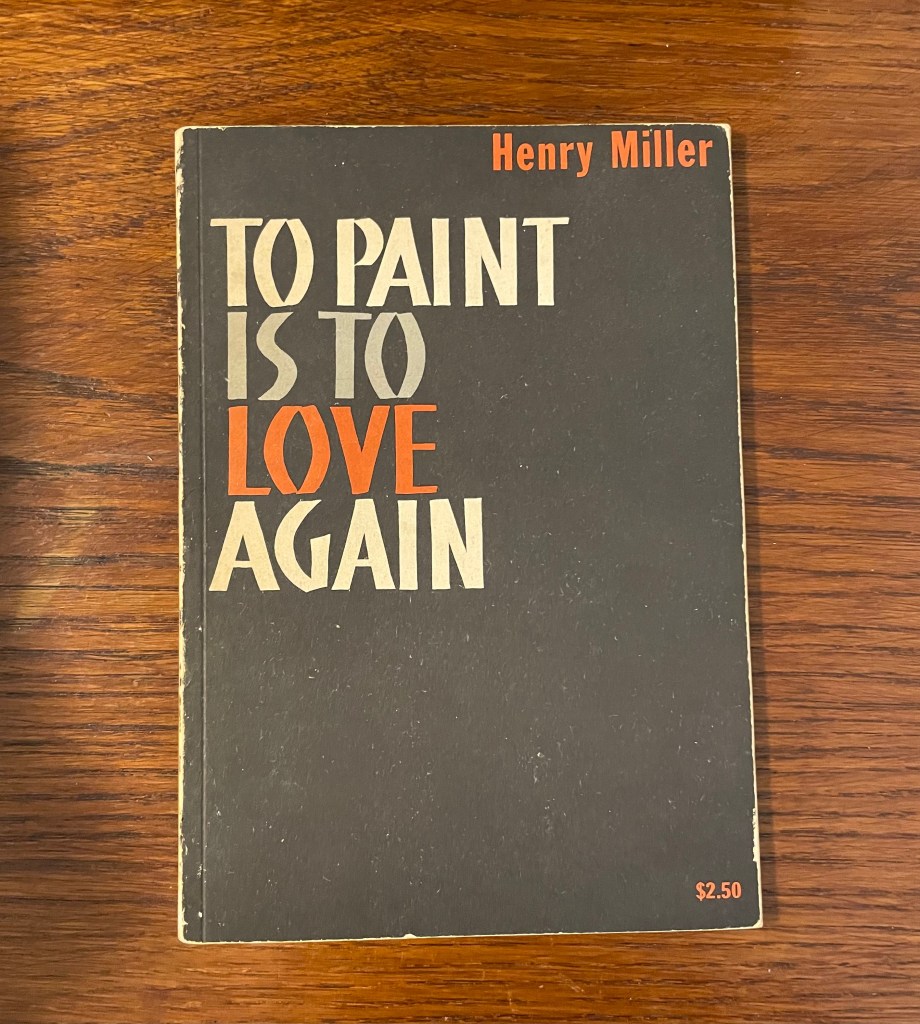
There might very well be an internal affinity between painting and love that at some point it becomes indistinguishable. A painterly picture can become love unquenched for that which remains persistently fixed and unrealizable. In one of the short essay books of his Big Sur period, Henry Miller asked this very question of painting. For him panting had a wondering origin that crosses the hand, undoing what we can easily enact. The erotic dimension of painting, thus, has nothing to do with the image or figure of the beloved, but rather with a specular limitation staged in the ability to allow the unseen to be incorporated in the visible scheme of the world. Only if we are able to see – and by the same token, only if there we are facing an event of painting – can something like use can be liberated from the constraints of mimetic compulsion. Miller writes in To Paint is to Love Again (1960): 

“To paint is to love again. It is only when we look with eyes of love that we see as the painter sees. His is a love, moreover, which is free of possessiveness. What the painter sees he is duty bound to share. Usually he makes us see and feel what ordinarily we ignore or are immune to a certain manner of approaching the world tells us, in effect, that nothing is vile or hideous, nothing is stale, flat or unpalatable unless it is our power of vision. To see is not merely to look. One must look-see .See into and around. Or, as John Marin, once put it – “art must show what goes on in the world” [1]. 

The place of painting for Miller is an imperturbable state that refuses to be fixated on objects, but in the invisible region (as in the figure of the chora) that allows for the thing in the world to be used. This is why Miller considered Japanese watercolor and prints an absolute primer of the pictorial: it taught him the appearance of worlds within the world, regionalizing the surroundings never logically stated unto itself, which in modernity it became the catastrophic horizon of autonomy towards its posterior liquidation. This is why Miller, very much like Carlo Levi, understood that the crisis of painting in the Western tradition ultimately signaled a general sense of social terror as a new phase of human desperation attenuated by the circulation of social fictions. 

At the height of the the closure of civilization, painting reemerged, if Kurt Badt’s axiom is correct, as the last metaphysical activity of human praxis. A metaphysical activity that holds on to the experience of belief in suspended appearance of originary anthropogenesis. For Miller, in painting as much as in love “one must be a true believer” [2]. And this assertion must be understood in the backdrop of Miller’s experiential retreat in the landscape of Big Sur: an experience away from the closure of American city life in research of a “feeling of aloness as spiritual achievement”, as a relation of oneself towards disclosure [3]. In this sense, the painter is a counter-social figure that, refusing to make stir in the world, turns to serenity, silence, and to the pressing contours of the unfathomable beyond any prefiguration. The believer in painting – who is a figure of belief in the desert, after the flight of the gods in the nocturnal vigil of history – is the thrust to the experience of things without barristers or shortcuts to what is revealed.

The age of automation in mid-century transformation of American industrial production serves as the historical backdrop of Miller’s indictment regarding the poverty and eventual disappearance of painting due to the autonomization of human praxis and the gigantic scale in spatial organization. Following Georges Duhamel’s prognosis in America: the menace (1931), he shared the intuition that the crisis of dexterity meant the impossibility of realizing painting, now situated beyond the grasp of human absorption [4]. A land without landscape that, as Adorno noted, bears no traces of the human hand. And this was seen already in the 1950s when the rise of abstract expressionism in North American announced not just the end of easel painting, but the funeral of the whole pictorial tradition. The barbarism of gigantic and unlimited Americanism would run counter to painting as a sensorial activity that embraced the vital limitations of its region. 

Miller’s insistence on painting was an eulogy to a life as experience – painting is indistinguishable from the hands and souls of the painters that he encountered and shared his life – and the value of poverty as absolute necessity for a life that regionalizes our contact with the world. It was through the love of painting that humanity could only restore its divine presence without rest.

Notes 

1. Henry Miller. To Paint is to Love Again (Cambria Books, 1960), 17. 

2. Ibid., 39

3. Henry Miller. Big Sur and the Oranges of Hieronymus Bosch (New Directions, 1957), 34.

4. Georges Duhamel. America: the menace (Houghton Mifflin, 1931), 85.

The social efficacy of Thomism. By Gerardo Muñoz

One of the merits of Sandor Agócs’ The troubled origins of the Italian Catholic Labor Movement (1988) is located on the question of Thomism during the rise of a national industrialization and the new centrality of the worker. This is a question that informs the very genesis of modern political thought, so I want to zoom in to the specifics: in Agócs’ narrative, the reinvention of Thomism goes hand in hand with the ‘social question’; that is, not just as the substrate for state legitimacy, but also as a supplement in the very mediation between the state and social incorporation. After reading Agócs a question lingers: what to make of the success story of social Thomism in the long history of modernity, that includes episodes from the both the left and the right; from the Italian Catholic Social Movement to Corporate Francoism, from the Pinochet Constitution drafted by Jaime Guzman to the most recent articulations of an interpretative common good in the contemporary American postliberal constitutional and interpretative balancing? One easy way out of the explanation is to delegate the answer to the historical uses (and misuses, depending who is defending what) of Aquinas’ thought, but that hardly answers the question. A while ago, John Finnis made a claim that could point to an important destination: 

“This grand metaphysical overview of reality, and of our knowledge (‘theoretical’ in the first two kinds of order, ‘practical’ in the second two) of it, has been as fundamental to the new classical natural law theory from its beginnings as it was to Aquinas. It enables us to identify as illegitimately reductionist almost all the streams of social-theoretical thought, including political and legal, that have emerged since early modernity. It helps in identifying the errors of those would-be followers of Aquinas who reject the new-classical natural law theory on the ground that it neglects or subordinates nature and metaphysics; the misunderstanding of Aquinas, and of the relation between practical and theoretical thought” [1]. 

For Finnis, although writing for legal theorists, Aquinas’ thought properly understood possesses a ‘metaphysical view of reality’, a sort of plasticity interlocking practical reason for action and morality that serves socio-theoretical ends. In other words, the thomistic plasticity for social legitimation can be connected to what Martin Heidegger held as ‘adequatio’ as a fixed point in the problem of Medieval representation of beings. And this means that thomism is always already a theory of legitimate ground for governing that reality. As Finnis suggests in different moments of his work, the lesson of Thomism is construed in its emphasis on the rule of law as the source for justice and fairness, and in this sense it was never alien to modern social contract. Karl Barth’s rhetorical question -“Why did Hegel not become for the Protestant world something similar to what Thomas Aquinas was for Roman Catholicism? – can now be understood in its most consequential light. 

Now it makes sense that Agócs refers to early twentieth century Italian Catholic Neo-Thomism as a “counterrevolution”, although he does not denote that this would be a second instance of counterrevolution with social prospects that the post-French Revolution figures (De Maistre, Bonald, and Donoso) could not meet in their antimodern stance. And here the divide is sharpened: whereas the counterrevolution post-1789 had very limited and unstable sources in social facts, Neo-Thomism offered a theory of law that was consistent with modern class dynamics supported towards social cohesion and stabilization proper to the ideal of the community centered in urban centers. If one defining feature of political modernity is reversibility, it would then make sense that thomistic natural law could rise to the demands of any given historical time to offer a nexus informed by the onto-theological structure of adequatio and analogia entis, whose proper end is the stabilization of social pressure. The second order ideological uses of Thomism (left, right, revolutionary, moral conservative, traditionalist, pre-post Vatican councils) are contingent to its malleable adequation generated by its own claim to natural morality. Heidegger once pointed in this direction when he claimed that Aquinas’ philosophical horizon was fundamentally the inception of metaphysics over theology as faith (that is actio and efficiency unto subjection) [2]. If modernity is the realization of onto-theology, then it can only make sense that Thomism takes as many garments as necessary to prevent gazing towards the abyss, becoming a manifold phosphorescent theory of social morality.

Notes 

1. John Finnis. “Aquinas and Natural Law Jurisprudence”, in Duke & George, Natural Law and Jurisprudence (Cambridge University Press, 2017), 32.

2. Jean Beaufret. Dialogue with Heidegger (Indiana University Press, 2006), 106.

On reciprocity. by Gerardo Muñoz

Surely friendship does not depend on obligations or frequency, but it does posit expectations on something like a movement of reciprocity. In fact, movement (κίνηση) and reciprocity are so intertwined that without it, there would not be any separation, only a compact bundle in unity without relations. But, what is at bottom reciprocity? If this notion merits anything thought at all, it must be removed from any conception of exchange in the manner of the quid pro quo and the the ius talionis, where at first sight reciprocity seems to reside as a form of levelling differentiated quantities. In social exchange there is levelling but surely there is no reciprocity except by the legal force enacted by the pressure of duties and obligations. Already in the nineteenth century, at outset of bourgeois society, Søren Kierkegaard with extreme lucidity denounced social levelling as a form of glittering vice: “The idolized positive principle of sociality in our time is the consuming, demoralizing principle, which in the thraldom of reflection transforms even virtues into vitia splendida. Levelling is not a single individual’s action but an activity of reflection in the hands of an abstract power” [1]. 

What is reciprocal in social exchange is no longer the incommensurable relation between beings, but the enactment of language saturated by its own completion, which is the aim of social organization. If there is no reciprocity in the age of kallopismata orphnes as the reduction of rhetorical language it is because there is no longer a missing word in the event of communication, given that, potentially, everything has been already communicated (it is obvious that today this process can only intensify with the planetary deployment of Artificial Intelligence). The only determination of reciprocity that should be of interest is the one that accounts for the lacunae in language that halts force of social levelling. To reciprocate does not mean to give each his due that defines the Western legal operation; it is rather the mutual codependency in the unforfeited event of language. 

At this point, an etymological observation might be useful. In On the Latin Language, Varro records reciproca as a condition of elasticity; that is, a present quality that allows a thing to return to the position from which it has started. Reciprocare thus entails to move to and fro, and to demand [2]. But if we adapt this observation into the sphere of language, we immediately notice that in language there is no previous position nor set origin, which means that reciprocity can only be the undisclosed and disclosed movement of language. Breathing, articulating, speaking: the animus that escapes from the mouth as a mirror of the god of words. The erosion of reciprocity in modern society, thus, goes deeper than the first appearance in fact that human beings are witnesses to a crisis of communication; more importantly, humans have ceased to sense reciprocity because they believe that there is only god where language is mute, and there is language when gods are extinct. Such is the long vigil of computing language as an idol that is neither divine nor of the essence of the human voice. To reciprocate today means to re-divinize the world through words; and through our words greet incoming worlds.

Notes 

1. Søren Kierkegaard. “The results of observing two ages”, in A Literary Review (Penguin, 2001), 76. 

2. Varro. On the Latin Language, Vol.1 (Loeb Classical Library, 1938), 335.

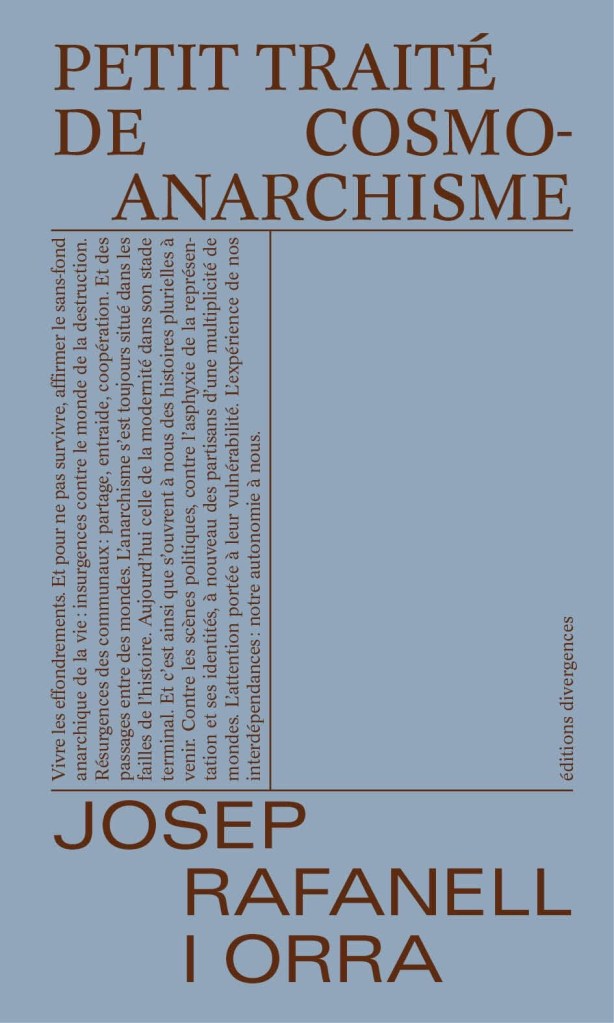
Worldly animism. Prologue to Josep Rafanell i Orra’s Spanish Edition of Petit traité de cosmoanarchisme (2025). by Gerardo Muñoz

Anyone somewhat familiar with the writing of Josep Rafanell i Orra knows that we are in the company of a wanderer and itinerant in an infinite pursuit of what the experiences of worlds might offer [1]. A mad endeavor for a groundless epoch oriented towards planetary reduction and confinement, so obsessed with infrastructure and security, most recently through the reiteration of the politico-theological program of national sovereignty, one more desperate reaction to unrestrained planetary decline. We can say with Hölderlin that we are vagabonds in a destitute time, a poet who figures prominently at the entrance of Josep’s Traité. In our posthistorical epoch we are confronted with the thicket over the dominion of life, which means that the question of exteriority becomes pressing as existence enacts a path beyond the endless rubble of representation bestowed upon the human species in every point of the globe.

The book that the Spanish reader now holds in his hands thanks to Luciole Ediciones will immediately let in a dimming light of a singular style or maniera that dislocates the modernist assumptions of political thought into what one could what I am willing to name an analytics of sensible hybridizations between languages and thought. This analytic of the sensible refuses immediately Social normativity as well as the melancholic hangovers of the modern revolutionary tradition (always caught up between constituent and constituted power, representation and humanism, growth and production). This is why Josep will redefine communism as the nonprogramatic event that irrupts through hybridization of surrounds and regions capable of overcoming the ontotheological adequation of subject and object that has led an entire civilization astray (33). The project of the critique of metaphysics finds in Josep’s Traité a powerful schematic cartography that raises questions precisely in those spaces where the rationality of the science of political economy has never dared to enter. 

If the critical projects of High Modernity were fundamentally temporal (including that of Messianism and its overemphasized trance towards absolute immanentization), Josep’s writing also has the virtue of displacing the focus to the spatial formation and the thinking of the creation of spaces understood as dwelling, once populated by the gods of the events and which modern ontotheology obliterated through integrated objectivation and technological positionality. We know that the greatest nearness of the last god eventuates only when the event is elevated into refusal, especially when it manages to become too near [2]. As a shorthand, this drift towards objectification in the liquidation of modern politics is domination of the Social totality; ultimately, it is through the plasticity of the social bond that the reproduction of biopolitical life is temporalized, legally ordered, and rhetorically subsumused into an apparatus of predatory accumulation. It is the Social (not the State, or this or that concept of the modern grammar of political thought, or even fascism) that we must refuse. The collapse of the modern secular state and its moral guarantees, is the beginning of an autonomized social bond that now coincides with the total administration of world forms. The hegemony of the Social reduction is what allows Josep to claim that the opposition is no longer between Society and the State; but rather between community as a process and praxis against the static formation of the Social. Thinking today drifts from social domination to communities of encounters, heteronomic relations, communication, and interdependence in a web that characterizes the exotic movement of the imaginative possibilities of exteriority for manifold worlds. 

The notion of community in Josep’s thinking is neither about ecstatic groups or “little platoons” of identitarian belonging (as once famously defined by Edmund Burke); nor referring to filiation and propriety reductions that can subsist quite nicely under the heatwaves of the ongoing conflagrations of Empire. For Josep communities insofar as they are exposed to their excess (ubermass) are processes of external contact between souls as rites of passages. The community is formless, and in this sense it ceases to be a problem of Chistological stereology in order to become one in the order of ethics and language (50). In this sense, very much like the late Mario Tronti looking at the collapse of the modern revolutionary experiment; for Josep the ruinous fragmentation of the worlds has a silver lining: that all human, and non-human, souls are dwelling on the outside world calling for worldiness, and thus potentially sharing a sense of intimacy that re-enchants the appearance and knowability of the world through the invisible attunement to the outside (un nuovo modo di essere fuori e contro) [3]. 

Beyond the subject and the narcissism of the Ego, the light of a “spark of the soul”, in the words of Meister Eckhart’s memorable sermon, a new animism returns not because there is a transcendental revelation to be asserted, but because the encounter between souls brings forth the concatenation of worlds that are entangled with other worlds (68). If Jünger described the epoch of planetary machination as “soul murder” (seleenmord) it was because there was no longer any contact with the unfathomable opacity between the soul and any possible worlds [4]. Josep with an elegant mannerist style enhances this intuition: “We are no longer exiles on Earth, as the romantic moment freighted by the loss of world. We ended up forcing the Earth into exile after so many deadly abstractions (108). The modern age has not ceased accumulating abstractions against the human species until becoming a whirlwind of soul murdering that has extended into the current ecocide of the worlds.

It does not come as a surprise that throughout Petit traité de cosmoanarchisme (2023) Josep appears more than skeptical about political critique (and to say skeptical might be an understanding). There is a clear imperative that is mobilized in the book and that it should not be taken for granted: political critique should evolve into the negation and abandonment of politics, which also includes the always anachronistic anarchist politics. We know that ever since the Greek polis the autonomy of politics partition and distribution was waged against the incommensurable topos of the chora, the ungovernable and infrapolitical hinterland of the new substantive community of rights and obligations posited by the logistics of representation [5]. As we know, this is what forced Heraclitus to resolutely remain playing knucklebones in the temple of Artemis: “What are you gaping at, you scoundrels? Or is it not better to do this than to work with you on behalf of the polis?” [6]. The knucklebones of the ancient anecdote of the presocratic philosopher is symbolic to what Josep demands of existence: the liberation of environments and surrounds for multiplicities of experiences. The experience of gaming always starts in the middle, expressing the ineffable ethics of how I become what I am already on my way of becoming (142). The maximization of politics into the very thicket of life (this is biopolitical administration) have increasingly defaced the experiential practice of existence that now extends over the course of the historical dispensation of civilization. This is the vortex of the struggle against the realist validations in the interregnum. 

Against and beyond the force of abstraction and the prison of individuality, Josep situates the stakes: “It is there, where the fierce struggle we can lead today: to find the intimacy of our soul in the welcome of other souls to hear their silences and their voices. To participate in the animation of the world is to perceive the outside. And gently find the inside of the outside” (145). And between the process of the community and the soul there is no longer struggle or enmity, but only solvent philia; the influx of creation that, insofar was enmeshed in solitude, allows pain to speak in the time of transition, in the skirmishes between worlds. Ultimately, the experience of the itinerant is not that of learning to live in places; rather, it is the one that intensively yearns the presence of encounters. This remains the only ethopoetic imperative [7]. As Carlo Diano observed in an erudite study on the notion of the chora, the attunement of the soul with the world is not a conceptual entelechy; it runs materially through the sensorium of this body as it traverses the world towards its renewal [8]. To grasp this chiasmic region that dispenses the harmony of the soul as it flees the prison gates of an objective world, is the enduring letter and spirit that Petit traité grants to the ongoing task of thought. 

Notes

1. Gerardo Muñoz. “Escuchar las llamadas del mundo: diálogo con Josep Rafanell i Orra”, Disenso: Revista de Pensamiento Político, N.3, July 2020, 134-158. 

2. Martin Heidegger. Contributions to Philosophy (Indiana University Press, 2012), 329.

3. Mario Tronti writes in “Disperate speranze” (2019): “È necessario trovare un nuovo modo di essere fuori e contro. Io posso farlo nel solo modo in cui so farlo: tirando l’arco al punto che permette di cogliere il bersaglio più raggiungibile. Realistica visione.”. CRS, October 2019: https://centroriformastato.it/disperate-speranze/ 

4. Ernst Jünger. The Forest Passage (Telos Press, 2003), 93.

5. Julien Coupat. “Dialogo con i morti”, in Gianni Carchia’s Orfismo e tragedia (Quodlibet, 2019). 

6. Martin Heidegger. Heraclitus: The Inception of Occidental Thinking and Logic (Bloomsbury, 2018).

7. Josep Rafanell i Orra. Fragmenter le monde (Divergences, 2020), 70.

8. Carlo Diano. “Il problema della materia in Platone: la chora del Timeo”, Giornale Critico della Filosofia Italiana, V.1, 1970, 335.

Justification and the demonic State. by Gerardo Muñoz

In the broadest sense of the term, questions about the law are predominantly about its justifications, and more specifically about where to locate the act of justifying. That one of the most important elaborations of exclusive positive authority was dependent on a theory of justification to transfer norms of authority (a theory labeled the “normal justification theory”) goes to show that the traditional opposition between positive law as pertaining to the sphere of rights and guarantees and natural law to that of justification comes short in the understanding of the internal development of judicial reasoning in the second half of the twentieth century that unsurprisingly coincides with the crisis of the secular liberal state [1]. The reliance on a “justification theory” will imply not only a new conception of legitimation, but also the outsourcing of the self-referential determination of “Nature” through which Roman Law constructed its principle of the rule of law and the validity of adjudication. As we know, Roman Law did not speak of “justification” but rather of necessity emanating from Nature, which could not oblige to performance or act through by what by nature is impossible or wrong [Ius plurimis modis dicitur: uno modo, cum id quod semper aequum et bonum est ius dicitur, ut est lus naturale]. The natural source of law, as famously defined by Ulpian in the Digest, is in this way permanently tilting between the good and the equitable (ius est ars boni et aequi). This is a matter of first principles of the law (ius), which did not solicit “argumentation” or second order reasoning to uphold its internal legal validity. 

The passage from natural necessity in the “hands of the priest”, in Ulpian’s conception, to the modern autonomy of justification takes place when principles are no longer the exclusive framework parameters for operative claims, but the very activity that defines the elasticity of an actual norm and its argumentation within a concrete positive order. This is one way in which one should define the specificity of the American practical legal order (not just its legal philosophies, which tends to run counter to this, cloaked under the vestigates of positivism vis-à-vis the letter and spirit of the Constitution) through juridical administration, whose structural polarity of command and justification defines the administrative process. Early in the twentieth century, Guglielmo Ferrero noted that one of defining characteristics of the American political model rested on a magistrate judicial power that fundamentally differed from European Common Law or positivist tradition in its practice [2]. Contrasting the independence of a limited bureaucracy to the predominance of an all encompassing “juridical administration”, Ferrero noted (although lacking the legal vocabulary to articulate it positively) that the administrative nexus will infinitely expand over social practical reasoning due to the unrestricted force of justification. And the need for justification is what outsources the ancient principles of natural law (ius) to the executive authority that renders operative every sphere of social action and interaction even if they are not explicitly declared prima facie by those principles. The efficacy of justification is the linguistic deployment – a rhetorical craft through rational argumentation – that will generate specific verisimilitude to the otherwise arbitrary and uncontested enactment of its principles. Justification could be said to appear as the work of language that provides internal cohesion of an array of coordinated conditions for secondary social actions. 

Since the inception of modern secularization, the nature of justification is the realization of the works without end, which inverts the notion of “justification” in the theological sphere that we owe to Paul. For the Apostle the idea of justification or dikaiōsis implies the making of righteousness through the soteriological narrative of Christianity that subsumes humanity’s fall (sin) for a redeeming liquidation of law. This means that man’s just act in faith generates “justification” (dikaiōsis) of life for all people (Roman 5:18). And as we read from Galatians 2:6: “Know that a person is not justified by the works of the law, but by faith in Jesus Christ. So we, too, have put our faith in Christ Jesus that we may be justified by faith”. The force of justification (dikaiōsis) trumps the production of the works of law that divides human beings in the immanence of this world between the saved and the condemned, the free and the imprisoned, the friend and the enemy. Whereas justification in the theological sense can only imply the ‘end of law’ for righteousness (Roman 10:4), in its late secularized rendition it implies exactly its distorted mirror image: to justify is transformed into the binding force over the void of authority that renders effective the hollow machinery of its own self-validation. 

It is telling that in an essay that was first published in German in 1938 under the title “Justification and Justice” (“Rechtfertigung Und Recht”), the German theologian Karl Barth takes note on the transformation of the State becoming “demonic” not due to its utter demise, but as a profanation of the theological justification of “unwarrantable assumption of autonomy as by the loss of its legitimate, relative independence, as by a renunciation of its true substance, dignity, function, and purpose…a renunciation which out in Caesar worship, the myth of the state and the like” [3]. The emergence of the “demonic nature” of the State was internal of its own making , since it conflated faith and people at the same level of social immanence, while preparing the actual realization of an authoritarian world without escape. Following Heinrich Schlier’s work on the figure of the State in the New Testament, Barth will suggest that this political totalization secularized the limit posited by the suum cuique of justification into an instrument of endless domination that characterized the emerging political reality. In fact, in his essay “The State according to the New Testament”, Schlier will define the phase of the demonic State as one colored by the inception of the sphragis, that is, “the sign of the state party as it were the secularized seal of baptism which levels all differences between men and only distinguishes between friend and energies of the ruling system. Those who refuse the new metaphysical slave are deprived of their economic foundations. Even economic life is directed by the spirit of the beast” [4]. 

Only in such context does the true light of the force of justification comes in full display: the sphragis can only labour to justify the vicarious social existence of the mystery of iniquity infinitely redressing itself as legal argumentation and juridical principles, administrative determinations and executive commands. And Schlier could not let the question pass: “What will Christians do in this situation? They will no longer want to have any part in this caricare of a state, they will “go out…they will simply be outlawed and persecuted” [5]. More than ever today, we are in desperate need of elaborating the elementary aspects of a political theory of demonology that defines a certain point where there is no turning back. To outlive persecution and tear the bond of justification shatters the civilizational course that has sublimated the end of time as an instrument of daemonic absorption into endless legal statues.

Notes 

1. Joseph Raz defines “normal justification thesis” of legal authority in this way: “I shall call it the normal justification thesis. It claims that the normal and primary way to establish that a person should be acknowledged to have authority over another person involves showing that the alleged subject is likely better to comply with reasons which apply to him (other than the alleged authoritative directives) if he accepts the directives of the alleged authority as authoritatively binding and tries to follow them, rather than by trying to follow the reasons which apply to him directly”, in “Authority and Justification”, Authority (NYU Press, 1990), 129.

2. Guglielmo Ferrero. “American characteristics” (1910), The Atlantic. 226. 

3. Karl Barth. Community, State, and Church (Peter Smith, 1968), 118.

4. Heinrich Schlier. “The State  according to the New Testament”, in The relevance of the New Testament (Herder and Herder, 1968), 236.

5. Ibid., 237.

The last stage of embalmed decay. by Gerardo Muñoz

The techno-administrative organization of the world that is showing off its force these days is only possible thanks to a previous devastation of the opacity of language, which ultimately connects human beings and the world. It is also the mysterious vortex of the breaking point of humanity into being, of which today there is only remembrance and scholastic teaching but seldomly authentic expression. When politicians, engineers, and social functionaries stubbornly distract us with open attempts to decimate secondary languages, prohibiting the annunciation of words through the legal enforcement of “place and manner” norms, and elevate abhorrent structures of linguistic commands and information as units of social interaction, it is obvious that the collapse has already happened. It also means that in terms of “Social” planning humanity has ceased to exist under the shadow of speech, to use an expression from Helene Lubienska. Hence, it is all the more absurd to confront this transformation with a strategy of multiplication of rhetorical codified languages that merely deepen the schism between the expressivity of language and their worlds. It suffices to say that any recognition of a para-official language of social interaction plays into the fictitious polarity of homogeneous globality and reified nationalism –  the constitution of print nationalism being the historical destruction of minor and dispersed languages of remote places and villages for the sake of the organization of a productive fictitious historical subject.

We must ponder what it means that the current imperial world order is one that does not offer a language, let alone the flourishing of minor or ‘vulgar’ languages as in the Latin Middle Ages, but rather an exit from language, which is the cybernetic project of codifying flows of information and looping inputs in which asymptotically humanity surrenders their languages. In past imperial adventures, language was either a tool to subordinate the world of the colonized, or it was a lingua franca of elites (administrators and the clergy) that allowed for the real existing languages in the territories integrated precisely by their exclusion or subalternity to the civilizing regime guided by literacy. The sharp contrast with today it is striking, since it is all too clear that the project of cybernetics, and its most recent avatar “Artificial Intelligence” (AI), is fundamentally an Empire that does not even require to rule and neutralize the “civil war over words” that Thomas Hobbes repudiated in the European confessional state, since its ultimate goal is not political statecraft, but the regulation of unworldly bodies of social reproduction. 

This is why some contemporary engineers have said that AI requires “a reconfiguration of the social contract”, with the caveat that it would necessarily be a “social contract beyond language and thus without politics”. The last social dispensation at the hands of engineers is the human soul, as it has been said. For this conception of language, it matters to only understand it as a semiotic reduction of the expressive human being to naked animality as the general form of the posthistorical being in the present. It is noteworthy that a great North American writer, Cormac McCarthy, while working on this problem of language at the Santa Fe Institute scientific research program (a central hub of American developments for artificial science and the unification of the sciences), reached the conclusion that language must be understood in relation to a virus: “a virus nicely machined. Offer it up, Turn it sligh, Push it in, Click. Nice Fit. But the scrap heap will be found to contain any number of viruses that did not fit…The facts of the world do not for the most part come in narrative form. We have to do that” [1]. The “unruly nature” of language, precisely because it does not fit into the biological pattern of virological model, must be mastered into an accompanying narrative of the social world, taking the copula and grammar as the final functionalization of the fictitious community. The artificiality of language is a civilizational decay that takes place not as heteronomic cooptation by technological advancement, but within its own internal abdication of its voice and mystery. 

It is precisely this internal threat that the American sinologist Ernest Fenollosa sought to expose in the most polemical moment of his posthumous tract The Chinese Written Character as a Medium for Poetry (Stanley Nott, 1936) – an essay that was restituted, let us not forget, by Ezra Pound precisely to confront the pauperization of ‘Basic English’ as the standard of linguistic use – in which he writes the following observation about the extreme filing of words: “Languages today are thin and cold because we think less and less into them. We are forced, for the sake of quickness and sharpness, to file down each word to its narrowest edge of meaning. Nature would seem to have become less like a paradise and more and more like a factory. We are content to accept the vulgar misuse of the moment. A late stage of decay is arrested and embalmed in the dictionary” [2]. Fenollosa could not have foreseen that the posthistorical epoch – an epoch of the most furious abandonment of thinking – there was nothing else to file in terms of the expressivity and poetic soil of speech. The course of American artificial humanity is not a human with a pocket-dictionary; it is something way more grotesque: an animal that can repeat and chatter sounds and symbols severed of its proximity with any linguistic inherence and the sensorial worlds. And it goes without saying that the engineering plan against the poetic soil of speech, as North American poet understood well, means that this war is waged against the last reserve; that is, the ethos understood as ‘the cave of everyone’s inner being’. 

Notes 

1. Cormac McCarthy. “The Kekulé Problem”, Nautilus, April 2017: https://nautil.us/the-kekul-problem-236574/

2. Ernest Fenollosa. The Chinese Written Character, edited by Ezra Pound (Stanley Nott, 1936), 28.

Techne alupias. by Gerardo Muñoz

In his Lives of Ten Orators, Plutarch dedicates an entry to the sophist and rhetorician Antiphon who, among other things, allegedly possessed a technique to deal with distress of the human soul (techne alupias) [1]. We know from historical sources that anxiety was already a common psychotic malady in the life of the polis, and it is most probable that Antiphon’s discourse treatment was reacting to this general phenomenon of his time. In the testimonia of Suda and Lucian there is agreement that Antiphon was a sort of language magician, a “speech-cook” (sic), who derived his powers from the interpretation of dreams, and in the words of the second, could unlock “the office of Sleep” [2]. Although his so-called pain-removing lectures have been lost, there is enough evidence that suggests that these rested on the archaic notion of “persuasion” (Peitho), whose main object was neither human psychology nor bodily somatic terrain, but rather psyche or the soul in the state of being. It is an art that has been lost – if something like “techne alupias” can be counted as a technique is plausible, given its irreducibility. In other words, what survives is only a lacuna of a philosophical ascesis that we should locate no so much as a conceptual problem, but as an ethical one. This is a task that today seems more needed than ever if we can agree that the fundamental tonality of social existence today is, precisely, the reproduction and endurance of pain, or what has been called the self-inflicted deaths of despair.

Much of the reflective work in this direction has been lacking, however in 1958 there was a publication entitled La curación por la palabra en la antigüedad clásica by the  Spanish physician and historian Pedro Lain Entralgo, which dedicated a whole section to Antiphon’s “techne alupias” as a fundamental strategy to treat an existential affliction. Recasting the opposition between nomos and physis as a general structure of Antiphon’s teaching, Entralgo seems to advance the hypothesis that the technique to alleviate affliction seeks to revoke the primacy of the normative conventions of the nomos towards the natural consension and causation of physis. In the most elaborate moment of his reconstruction of Antiphone’s techne alupias, Entralgo seems to project unto the opposition of nomos-physis, the rationalization of the sensible and the sensation of the corporeal through language: “Antifonte cree que para tal fin hay una «técnica» (tékhne alypías); más aún, práctica esa tékhné, informándose acerca de las causas de la aflicción y hablando al paciente en consecuencia. Actuando según las causas, la persuasión verbal logra eliminar la pena del alma: el pensamiento y la palabra del retórico sanador —su lógos— ordenan y racionalizan la vida anímica y corporal del afligido” [3]. 

But Entralgo stops short of elucidating what the language of persuasion entails in this specific elaboration. Is it just a form of compensatory mediation between nomos and physics, between soul and body dualism? The German classical philologist Julius Stenzel in an article dedicated to Antiphon in the 1920s had taken the contrary view; mainly, that the sophist’s treatment of pain does not aim at naturalizing the logos, nor at rationalizing nature (physis) for the event of affliction; it was rather an opening through language creating a new reality principle beyond all opposition, an undercurrent in which the taking place of language could only serve as the anemic nutrient [4]. Taking into account Stenzel’s intuition it becomes evident why Entralgo, as he concludes his gloss on Antiphon, seems to be skeptical of an existential techne alupias fully deprived of normative content, that is, situated outside the nomos that founded the polis so lavishly celebrated by Pindar. 

This was totally unconvincing to him, since it would seem to shake a bit the foundation of Western political civilization that needs to maintain the hylomorphism between soul and body, nomos and physis, happiness and deficiency towards a well balanced organic life. The prefix –*lup that derives from –luk should be understood as a lightening of human appearance converted into something ominous that must be contained and differentiated into a political program [5]. In this way, and if “techne alupias” is to be understood as the event of language, it is also the eruption of the involuntary form of language that “can prevent the autonomization of ethical action: pain is the “grace” that is communicated by acting. And it is, at the same time, the muteness that permits the realization of authentic communication: not that of abstract or arbitrary signs, but between souls. The obstinate, irreducible enigmaticity of pain is precisely what prevents Persuasion from falling back on the Christian morality of “sacrifice”, or of acting towards the direction of an end” [6].

This picture drawn by Gianni Carchia should reveal itself as fully contemporaneous, since today the two poles being offered (replicating the nomos and physis duality in updated versions) are on the one hand the moralization of a neo-Christian acceptance towards salvation; and, on the other, the secularized version of salvation in the form of the highly sophisticated techno-medical field. If both positions have as their central aim an offer to end pain, it is also true that they both renounce the ethical dimension of the sayable in language, which renders impossible a techne alupias to come to terms with our current abysmal sentiment. This means that no amount of prescribed pain-killers and medicalized strategies can come to terms with the soul’s angst. By choosing to erase pain from life of the soul, religious-medical integration univocally accepts the triumph of a living death.

Notes

1. Plutarch. “Lives of the Ten Orators”, in Plutarch’s Morals, V.5 (Little Brown and Company, 1874), 18-21.

2. Antiphon the Sophist. The Fragments (Cambridge University Press, 2002), ed. Gerard J. Pendrick, 96-97.

3. Pedro Lain Entralgo. La curación por la palabra en la antigüedad clásica (Revista de Occidente, 1958), 149.

4. Julius Stenzel. “Antiphon”(1924), in Paulys Realencyclopädie der classischen, Stuttgart, 33-43.

5. Hermann Usener. Götternamen (F. Cohen, 1896), 198-199.

6. Gianni Carchia. “Tragedia y persuasión: nota sobre Carlo Michelstaedter”, in Retórica de lo sublime (Técnos, 1990), 38.

Dumb pain: Magris’ reading of Michelstaedter. by Gerardo Muñoz

It is only towards the end of his novella Un altro mare (1991) where Claudio Magris deploys a philosophical synthesis on the character and lesson of Carlo Michelsteadter. In the narrative, this occurs when historical time accelerates, and we cross from the crumbling of the Austrian-Hungarian Empire to the rise of Italian fascism and the confrontation between the German military occupation and the partisan forces and the postwar years. For Magris’ Gorizia characters this threshold leads the way into the historical epoché of a long civilizational decay and existential fatigue, where even the attempt to carve a ‘hide out’ (a community of salvation?) seems rather defeating. This is where Magris deploys his philosophical thesis – it must be quoted in full: 

“This too is dumb pain, a weight that falls and crushes, the delirium of believing that life is redeemable, the illusion of the “I” which finds liberation from the world’s madness by sinking to the level of brute existence. Fortunately life is a short, painful negative adverb – “non-being” – and not something everlasting. The eternal scorches that “non, that tiny, ferocious sting. To keep to oneself and to turn to flame – that is true liberation from every single changeable thing. And nothing is more changeable than man.” [1]. 

A dumb pain that crushes humanity forever. And where Magris writes in lapidary tone that nothing is “more changeable than man”, one can also read – it is impossible not to hear it – what Blanchot says of Antelme’s camp testimony: that man is indestructible because he can be infinitely destroyed. But for Magris the enduring (it might not be the proper word) lesson of Michaelsteadter’s thought is that it accounts the refusal of a trascendental delegated life on the side of the redeemable and the messianic, always too functional to the same historical – rhetorical architecture of Western rationality. Could the perspective of persuasion be an alternative to the outlook of redemption (Adorno)? We can leave this question hanging for the moment. Perhaps one of the “fundamental lies”, to put it in Nietzschean overtone, is to believe the political legend of contractualism in which the compensation for “fear” of the state of nature is solely cured by the entry to the historical time of the civilizational principle can overcome the sense of pain. 

The price to be paid for the Hobbesian logic is high: in other words, it is the dumbing of pain in life, which entails the course to optimize, suppress, and perhaps, in our contemporary vocabulary, to “medicalize” its symptoms (is not not health afterall the secularization of salvation). In English language, to speak of “dumbing” also entails “dumbing down” the quality of something or someone. Hence, the dumbing pain in which ‘life will go on without truly living’ in the reproduction of the Social will already presuppose a non-thinking life; a life that betrays and runs aways from the possibility of its ethical exposure. This is the befall towards historical time and the abstraction of positivism and value, by which precisely “every single thing” will become changeable and exchangeable for them to become legible. 

For Magris, the strategy of persuasion is not a political or social technology, it is rather a refusal of living in the time of the changeable and the civilizational organizational capacities to “hide ourselves from the reality of our own emptiness”, in which the promotion of pain is rendered oblivious through the working out of a life that has already accepted the reification of death [2]. If we are to follow John Ruskin to the letter, this is the spirit of the triumph of bourgeoisie civilizing enterprise: “vulgarity is one of the forms of Death”, he writes [3]. The acceptance of vulgar life does not mean the end of life in exceptional historical or spectacular moments (as frequently as they have become); it is the suppression of persuaded life after the fall of prophets, higher values, and transcendental principles that accumulate in useless rubble.

Vulgarity, then, is the aesthetic vortex of what social pain can only organize through the reproduction of realized self-defacement. It could very well be that what Magris says with and about Michelstaedter in Un altro mare (1991) runs parallel to what he calls the “impolitical anarchism” of Joseph Roth’s world colored by the irreducible fragments of individual feelings, passions, and working through the loneliness of pain that oscillates in the ocean of language that struggles to retain a world [4]. This is the life of the soul that before the eclipse of the modern eon (including the real existing communism, as Magris takes into account): resist, in full force, the spillover of ethical vulgarity to persuade oneself that, even after redemption, there are other irreducible paths towards death. 

Notes 

1. Claudio Magris. A Different Sea (Harper Collins, 1993), 86.

2. Ibid., 56.

3. John Ruskin. “On Vulgarity”, in Modern Painters (1860), V.5, 348.

4. Claudio Magris. Lontano da dove: Joseph Roth e la tradizione ebraico-orientale (Einaudi editore, 1971), 225.

The felicitous water carrier. By Gerardo Muñoz

There is something vessel-like in communication, and the need to keep it alive and to give it consistency and texture; to prolong it in both time and space. If it is true that ‘empty chatter’ is the erasure of the possibility of making in language, then communication is not just a practice of translation and legibility, but of passing of an experience, however impossible and tenuous that could be. This passing on through communication is embodied in the old figure of the portatori d’acqua or the aguador that famously appears in early modern Spain. The aguador is a figure of stagnation that sustains life, even if he is (or precisely due to this very fact) an iconic fact of social indigence.

One can easily recall Diego Velázquez’s “El aguador de Sevilla” (1618) with his ragged clothes and noble stance in the somber bodegón picture. V. S. Pritchett was up to something when he claimed that to ‘know a people’ is to know its poor. And that poverty is, first and foremost, a poverty in temper and restraint. What does it mean to communicate in the temper of poverty? This seems to me the question at the heart of Velázquez’s exemplary aguador. What is cherished in the aguador’s concrete labor (carrying and bringing water) is a transcendental relation that retains the need of life.

In a sense, there is no surprise as to why the aguador has disappeared in the due course of long and agonic historical development. If the essence of civilization is appropriation and growth, accumulation and production, then it is to see how the impoverished water carrier is meant to disappear. Already in the Lazarillo de Tormes (1554), Lázaro’s inverse transfigural condition into a social subject takes place by abandoning his short-lived condition of aguador, which is hyperbolic of the organization of the social stagnation. It is clear that Lázaro’s picaresque attitude of outsourcing the nascent commercial society of good and services – embedded in the production of criminality and banditry – is a way to overcome the original indigence of the aguador, whose sanctity must be amended through the mimetic process of autonomous secularization and the rise of the metropolis. 

Thus, the eclipse of the figure of the water carrier coincides historically with the fall of the contact of languages and experiences between human beings. This might be why in the civilizational peak of the metropolitan organization of the world, the poverty of experience refracted by the force of alienated objectivity becomes a problem for sewage engineers in the goal of the reproduction of life. Vargas Vilas’ provocative definition of the “social” as a machine of the production of excrement should be understood as an scatological image of what it means to live in a world without aguadores

And this why everytime that a water pitch is brought to a table an oblique and momentary happiness overtake us beyond the biological need of human thirst. To this end, Isabel Quintanilla’s Duralex water glass painting (1969) encapsulates something so divine and unfathomable; as if, in the suspension of words or stories, the resurrection of the water carrier is brought back to the sharp appearance of things.

From the beginning (after a Berlin meeting). by Gerardo Muñoz

I am sure that others will draw their point of inflection, but for me the stakes of a recent Berlin meeting (already commented here) was laid out during the very first session when one of the “non-participants” – let’s call it like this to embrace the spirit of the meeting – spoke audaciously about the current predicament: there has been a thorough loss, nothing but defeat that is both irreversible and consummated at the level of subjectivity. Some of us remembered that T.J. Clark more than a decade ago in the pages of New Left Review took a similar position and was grilled for it. This tends to happen to any gesture that dares to push thought forward. In any case, the non-participant went further and called for a “new beginning”, a start from scratch, alluding to the underrated Revolution and counterrevolutionary in Germany (1851) by F. Engels, in which in fact this language is very much present. Engels wrote in the first article (the book is a collection of pieces published anonymously in the wake of the 1848 revolutions): “If, then, we have been beaten, we have nothing else to do but to begin again from the beginning. And, fortunately, the probably very short interval of rest which is allowed us between the close of the first and the beginning of the second act of the movement, gives us time for a very necessary piece of work: the study of the causes that necessitated both the late outbreak and its defeat; causes that are not to be sought for in the accidental efforts, talents, faults, errors, or treacheries of some of the leaders, but in the general social state and conditions of existence of each of the convulsed nations” [1]. 

Of course, “social or national conditions” are not “trapped in amber”, and I think that today one cannot take the national, local, or even regional contexts as sufficient to explain failure. The failure is civilizational, and raising the question of the “beginning” (or new beginnings) has a heideggerian overtone that is not facetious, but it is consistent with any exploration in the quadrant of critical-metaphysical commitments for thought (infrapolitical reflection has thematized it) [2]. This elaboration could be very well idiosyncratic, but I think it provides “grip” to the problem by not making concessions to well known junior partners of abstract politicization and ideological backlogging that like the Tortoise in the parable still fantasize with a breakthrough via yet another “textualist interpretation”; one more sophisticated mapping of political ecology or a collective hegemonic political theory department; or even a policy redistribution of a new Green Deal towards a new accumulation regime [3]. Perhaps they themselves do not believe any of the lies – for my part I think that they do not – and they endorse it for the sake of “bad faith”. But just in case, I think that raising the threshold at the highest point (ontotheology, civilization, the constitution of the polis) is a litmus test of separation against the new secular priests. These negative conditions already open a door to go through.

But there are also positive conditions for this “new beginning”: reopening the ethical intensity in retreat of political subjection; rejection of public chatter and freeing fugitive marranos; elaborating strong descriptions of the metamorphoses of domination; and avoiding the “revolt” as a compensatory category for of ius revolutionis in the epoch of real subsumption [4]. At the end of the day, it should not be forgotten that an-archy also means the turbulence of phenomena, in which every fragment moves in the direction of experience poking through the objectification of the world. This is “inapparent”, but it is for this very reason what is fundamental and invariant. 

The ‘new beginning’ in the wake of collapse can only conquer life to traverse the hunger of meaning that propels the fictional machine of ongoing nihilism, as Giorgio Cesarano warned. There is no historical or moral beginning; there is only the beginning in which existence is able to expand the originary accumulation of a sensible ethos. And it is at the very end, or almost at the end of everything, that true beginning commences. Whoever does not start from the beginning is either understudying the epoch, or mastering the evermore painful social roles. It is only in the direction towards beginning that can avoid the crushing weight of the post-neolithic condition (Métraux) that calls for a divestment of what reality can contrive for us. 

Notes 

1. Fredrich Engels. Revolution and counter-revolution in Germany (FLP, 1977), 3.

2. Alberto Moreiras, “La cuarta vía” (2022): “¿No se hace necesario hoy pensar, por lo tanto, otro comienzo del pensamiento, proponer otro comienzo que nos sustraiga al peligro del colapso mismo del mundo?  Quienes se oponen a ello, llamándolo arrogancia o presunción, llamando veneno a la propuesta misma, no son para mí ya distinguibles del avestruz que hunde la cabeza en la arena al verse atacada”. https://infraphilosophy.com/2022/02/18/la-cuarta-via-entre-parmenides-y-la-obligacion-reflexiva-conferencia-para-la-universidad-de-arizona-spanish-and-portuguese-department-borrador-3/

3. Zeit Der Ökologie. Das neue Akkumulationsregime (2024).

4. Conspiracist Manifesto (Semiotexte, 2023), 341.