The idea of a world state. by Gerardo Muñoz

As a theme for his 1949 Aquinas Lecture at Marquette University, an American scholar, Robert Hutchins, decided to titled his conference “St. Thomas and the World State”. It is obvious that Hutchins had fresh in his mind the fact that the long European Civil War of the twentieth century, which included two World Wars, was a direct consequence of warring nationalisms and militarized nations that in our times it is once again has lavishly returned with even higher lethal consequences. There is a major historical difference, however; and that is the fact that whereas the nationalisms of the twentieth century were distinct territorial struggles in the wake of crumbling empires, the emergence of the new nationalisms are concerted, nourished, and aligned to the global commanding American imperialism. The techno-political ideal of an influential figure on American elites such as Peter Thiel takes the form of warring nations and firms against the possibility of a global world state to secure peace, interdependence, and free movement of populations across borders and communities [1]. It is fair to say that contemporary technopolitical dominance is a combination of imperial and national forces through the perpetual administration of anomia or lawlessness. 

What is striking about Hutchins’ 1949 lecture is that although Aquinas’ philosophy of law has been traditionally understood as the most important source of natural law, in his proposal Thomas’ actuality is able to fulfill positive law against the instrumental morality of nationalist empires (the United States and the Soviet Union then) that “in the absence of positive law; they may be expected to break the peace” [2]. For anyone that knows the emergence of the European state as coterminous with the secular authority of legal positivism will find this emphasis contradictory at best. The very notion of positive law requires principles of sovereign authority and normative internal recognition of its command coordination in order to consolidate a stable political form over time. This is a contradiction that Hutchins was aware of throughout his lecture. Consider, as an example, when he claims that: “The origin and meaning of the saying that a state has the natural right to sovereignty therefore, is that one state may not forcibly impose its will upon another. It means that Catholicism should oppose the foundations of a world state by force” (36). 

Or, when glossing over the obvious tension between the right of national sovereignty and a potential international federal state in the views of popes and Catholic thinkers: “I think they know that the national state is no longer the perfect community and that positive law is required to make the world community an effective political organization. I believe that they are making two points that are of the utmost importance: first, they are saying that any world government must be a federal government; and second, they see that world must come into existence by consent and not by conquest” (34). However, any student of modern political thought knows that consent and coercion are two internal modalities of governance for legitimate rule. Hutchins’ notion of “consent”, along with positive law, remains not only unthematized, but dependent on a circular of definition of law; that is, the “common good”, which is not a political concept, but a theological and moral notion extracted from the philosophy of history of Christian salvation. 

Towards the end of the lecture, Hutchins goes beyond strict positive law as if searching for some substantive ground: “…the West should not only survive, but also revive and rescue a deeper conception of human civilization than the one recently current, which enters around a religion of progress by resourceful greed and technological mastery of non-human nature” (42). But Hutchins’ plea for the retrieval of a past memory of the West runs astray when it relocates Church and State into a dual predicament of a new world state for peace on the conditions of the same structure of political theology that are no longer operative, but that actually make up the very ground of the modern collapse into nihilism – nihilism that political form does not remain immune to, quite the contrary. In fact, it is the most salient symptom of civilizational collapse. In the same way that Ernst Jünger immediately after the war called for the subsidiary spiritual assistance of the churches in the face of technological power- “the true conquest of nihilism and attainment of peace will be possible only with the help of the churches” – Hutchins will also repeat that only the conjointment of Church and State “must now work together for world peace founded on university charity…and universal democracy” (44) [3]. And the same thesis has found a clear expression in Pope Francis’ Apostolic Letter Candor Lucis Aetenae (2021): “To restore order and salvation, faith and reason, Beatrice and Virgil…Church and Empire are called to operate in harmony” [4]. This speaks directly to what we have recently called the plasticity inherent in the historical adaptations of thomism in social life [5].

This plasticity amounts to the administration of desperate souls from the structures of the state and Churches, without ever transforming the mere survival of life on Earth. This leaves us with the notion of kingdom, which Hutchins introduces in opposition to the political community of city life (polis), but only to reabsorb it into the order of political theology. And it is at this threshold, that we can claim that the kingdom is not a political theological category, but an experiential allowance in which life, the dead and languages occur beyond and before political determinations. It is no surprise, then, that Ivan Illich called the kingdom primarily a mystical experience: “I will dare to formulate a hypothesis: the kingdom is what constitutes the authentic mystical experience, if the mystic knows what experience is really constituted by. The mystical experience of the believer is the conscious experience of the kingdom before the parousia. The mystical experience is the fruit of love, and, therefore, it is also accessible to every lover. The awareness about its meaning is the fruit of faith…” [6]. 

We tend to forget that both national units and the contemporary empires of world building and destruction have been first and foremost enemies of spoken living languages and idioms. On the one hand, the historical grammars to build the unity of people’s official language, and in our days the rise of Artificial Intelligence has clearly become the last stage through which power abandons languages to computational and rhetorical obsolescence. This opening towards awareness is not an article of faith through consent nor a moral predicament that can be adequate prima facie into a political register; it is fundamentally a linguistic experience that allows for the delicate cultivation of peaceful coexistence taking place not in a world, but between them: “To learn a language in a human and mature way way is to accept the responsibility for its silences and sounds. The gift a people gives us in their language is more a gift of the rhythm, the mode, and the subtleties of its system of silences than its system of sounds…The greater the distance between two worlds, the more this silence of interest is a sign of love” [7]. 

.

.

Notes 

1. “Apocalypse Now? Peter Thiel On Ancient Prophecies And Modern Tech,” in conversation with Peter Robinson, October 2024, Hoover Institute: https://youtu.be/wTNI_lCvWZQ?si=M8-qrBh-G7bYZPfw

2. Robert M. Hutchins. St. Thomas and The World State (Marquette University Press, 1948), 15. 

3. Ernst Jünger. The Peace (Henry Regnery Company, 1948), 69. 

4. Pope Francis. “Apostolic Letter Candor Lucis Aeternae (2021)”: https://www.vatican.va/content/francesco/en/apost_letters/documents/papa-francesco-lettera-ap_20210325_centenario-dante.html 

5. Gerardo Muñoz. “The social efficacy of thomism”, Infrapolitical Reflections, August 2025: https://infrapoliticalreflections.org/2025/08/31/the-social-efficacy-of-thomism-by-gerardo-munoz/

6. Ivan Illich. “Concertning Aesthetic and Religious Experience”, in The Powerless Church and other selected writings, 1955-1985 (University of Penn State Press, 2018), 86.

7. Ivan Illich. “Missionary Silence”, in The Church, Change, and Development (Urban Center Training Press, 1970), 121.

The love of painting. by Gerardo Muñoz

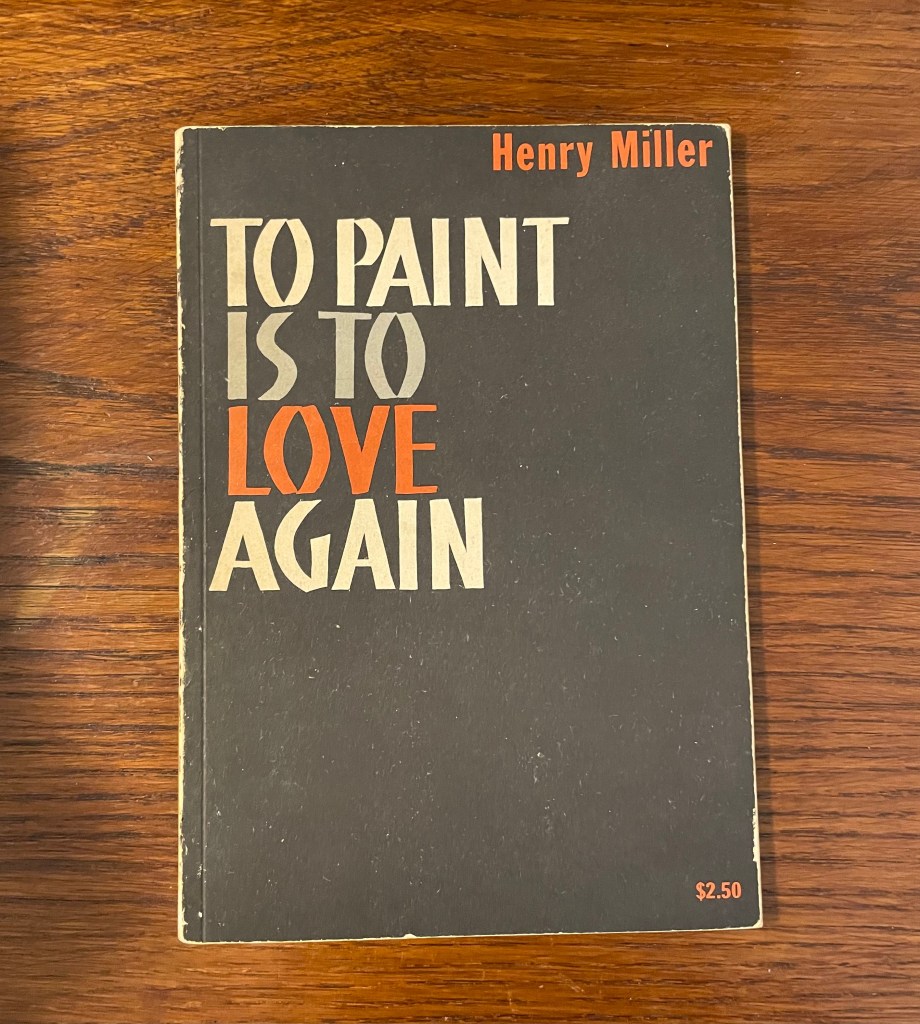
There might very well be an internal affinity between painting and love that at some point it becomes indistinguishable. A painterly picture can become love unquenched for that which remains persistently fixed and unrealizable. In one of the short essay books of his Big Sur period, Henry Miller asked this very question of painting. For him panting had a wondering origin that crosses the hand, undoing what we can easily enact. The erotic dimension of painting, thus, has nothing to do with the image or figure of the beloved, but rather with a specular limitation staged in the ability to allow the unseen to be incorporated in the visible scheme of the world. Only if we are able to see – and by the same token, only if there we are facing an event of painting – can something like use can be liberated from the constraints of mimetic compulsion. Miller writes in To Paint is to Love Again (1960): 

“To paint is to love again. It is only when we look with eyes of love that we see as the painter sees. His is a love, moreover, which is free of possessiveness. What the painter sees he is duty bound to share. Usually he makes us see and feel what ordinarily we ignore or are immune to a certain manner of approaching the world tells us, in effect, that nothing is vile or hideous, nothing is stale, flat or unpalatable unless it is our power of vision. To see is not merely to look. One must look-see .See into and around. Or, as John Marin, once put it – “art must show what goes on in the world” [1]. 

The place of painting for Miller is an imperturbable state that refuses to be fixated on objects, but in the invisible region (as in the figure of the chora) that allows for the thing in the world to be used. This is why Miller considered Japanese watercolor and prints an absolute primer of the pictorial: it taught him the appearance of worlds within the world, regionalizing the surroundings never logically stated unto itself, which in modernity it became the catastrophic horizon of autonomy towards its posterior liquidation. This is why Miller, very much like Carlo Levi, understood that the crisis of painting in the Western tradition ultimately signaled a general sense of social terror as a new phase of human desperation attenuated by the circulation of social fictions. 

At the height of the the closure of civilization, painting reemerged, if Kurt Badt’s axiom is correct, as the last metaphysical activity of human praxis. A metaphysical activity that holds on to the experience of belief in suspended appearance of originary anthropogenesis. For Miller, in painting as much as in love “one must be a true believer” [2]. And this assertion must be understood in the backdrop of Miller’s experiential retreat in the landscape of Big Sur: an experience away from the closure of American city life in research of a “feeling of aloness as spiritual achievement”, as a relation of oneself towards disclosure [3]. In this sense, the painter is a counter-social figure that, refusing to make stir in the world, turns to serenity, silence, and to the pressing contours of the unfathomable beyond any prefiguration. The believer in painting – who is a figure of belief in the desert, after the flight of the gods in the nocturnal vigil of history – is the thrust to the experience of things without barristers or shortcuts to what is revealed.

The age of automation in mid-century transformation of American industrial production serves as the historical backdrop of Miller’s indictment regarding the poverty and eventual disappearance of painting due to the autonomization of human praxis and the gigantic scale in spatial organization. Following Georges Duhamel’s prognosis in America: the menace (1931), he shared the intuition that the crisis of dexterity meant the impossibility of realizing painting, now situated beyond the grasp of human absorption [4]. A land without landscape that, as Adorno noted, bears no traces of the human hand. And this was seen already in the 1950s when the rise of abstract expressionism in North American announced not just the end of easel painting, but the funeral of the whole pictorial tradition. The barbarism of gigantic and unlimited Americanism would run counter to painting as a sensorial activity that embraced the vital limitations of its region. 

Miller’s insistence on painting was an eulogy to a life as experience – painting is indistinguishable from the hands and souls of the painters that he encountered and shared his life – and the value of poverty as absolute necessity for a life that regionalizes our contact with the world. It was through the love of painting that humanity could only restore its divine presence without rest.

Notes 

1. Henry Miller. To Paint is to Love Again (Cambria Books, 1960), 17. 

2. Ibid., 39

3. Henry Miller. Big Sur and the Oranges of Hieronymus Bosch (New Directions, 1957), 34.

4. Georges Duhamel. America: the menace (Houghton Mifflin, 1931), 85.

Zoning and the inalienable. By Gerardo Muñoz

The notion of “zoning” in American public law refers to the compartmentalization of land use (residential, governmental, industrial, among others), as well as the “zones” of the administrative framework that dispenses its delegated power. It is a common fact that the Fifth Amendment of the United States Constitution, which includes the “Taking Clause”, states that taking territory must always be equitable compensated. The Fourteenth Amendment included during Reconstruction implements a non-discriminatory standard into zoning as division of space for political representation, and what is usually referred as “redistricting” in any given state. This means that the operative semantic and legal field of “zoning” refers simultaneously to both land as property, and territory as a spatial index of political representation. Of course, modern revolutions, whether in 1776 or in 1789, were stealth transformations of space into these two tier units of alienated property and representation, as we know from the territorial census in the aftermath of the French Revolution.

Likewise, the framework of Americanism as a political civilization is that of landsurveying, which ultimately means not just to make coterminous sovereign authority to territorial limitations, but to make transactions between world forms (territory and its inhabitants). If “zoning” has become a fundamental point of contention in all spheres of American life – from housing to development, from political representation to governmental “taking”, from wildlife sites to the circulation of good and services of the metropolis – is because the essence of Calvinism was fundamentally a settler cosmos that reduced life to usurpation of territory. In this sense, Bruno Maçaes is right that in the age of planetary Americanism the predominant form of domination is world-building and world-destroying. The perpetual social war over “zoning” is precisely the movement of building and destroying life-worlds through the linguistic justification of the administrative legal apparatus. 

In his forgotten book Nomos and Physis: Origin and Meaning of One (1945) on the severability of the two notion of “order” in Ancient Greece, Felix Heinimann notes that the triumph of nomos over physis implied a separation from the world of “reality” and “deeds” from that of rhetorical language that came to dominate it (nomos). In the present, the separation between nomoi and physis is the void that is perpetually governed by the attenuation of zoning: the creation of artificial worlds, but, at the same time, the composition of artificial languages. But the paradox is the following: the world of nomoi ceases to have any contact with that of physis; and physis, the natural world, becomes an artificial life world only responsive to irreflexive and undetermined practices of social exchange. This means that zoning is the vector of force that constantly separates human beings from both the world and language, and ultimately stripped its “humanity” from the species-being. 

As the zoning process plunges extensively into all spheres of practical and intellectual relations of human beings, an increasingly grouping of unalienable life emerges in a polar night. Here solitude in language brings forth the warmth of the unalienable. Perhaps it is in this night, where a trivial amor mundi will be cultivated for other generations, as beautifully suggested by Tim Ingold. A vita nota that will only commence on the lines that are invisible and opaque to the shining surfaces of zoning.

The wreckage of design. On Alejandra Castillo’s Antropoceno como fin de diseño (2025). by Gerardo Muñoz

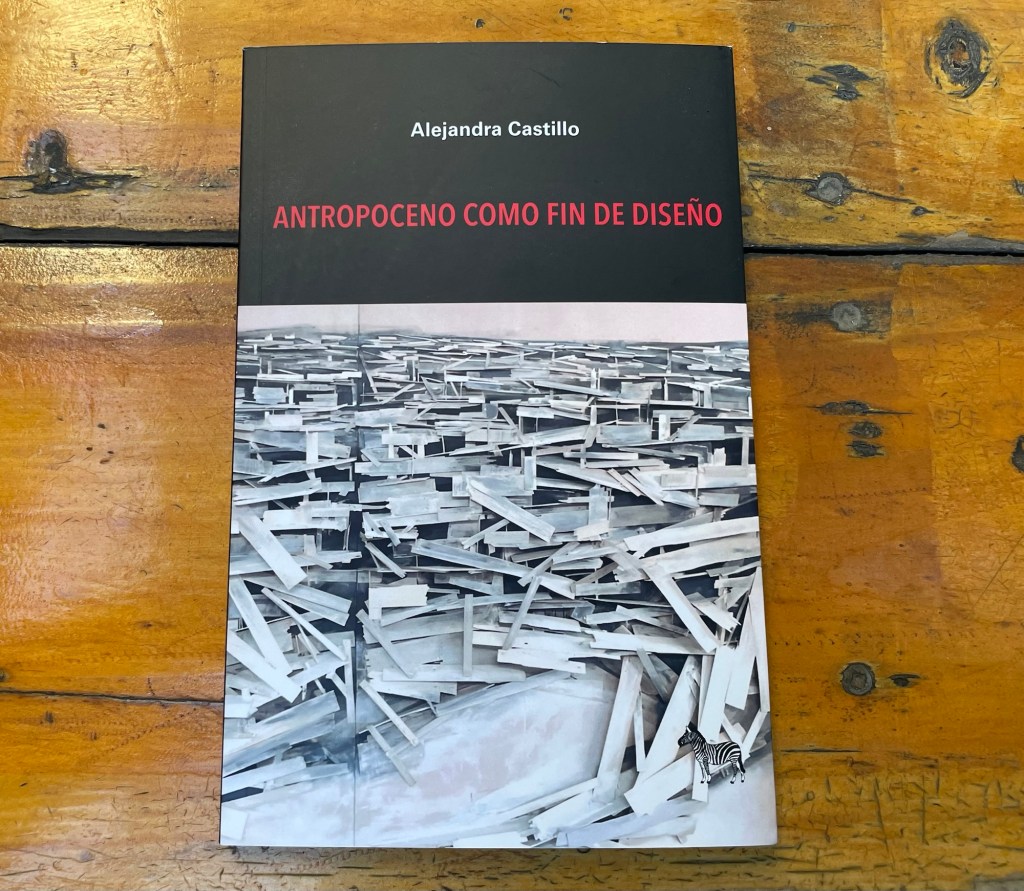
Only in rare occasions the operation of thinking finds angular or lateral points of escape. This is the gesture that characterizes Alejandra Castillo’s theoretical writing, and is particularly bright in her most recent book Antropoceno como fin de diseño (La Cebra, 2025). The zigzagging entry is an intuition that is also a guiding thread: the force of real subsumption of capitalist domination depends on the operation of design. Of course, in design one hears not only blueprint and form, but also designation, and thus the specular regime of visibility, orderability, quantification. It is the world of physiocratic forestry. In fact, Castillo’s succinct definition of the metapolitical condition of design is offered to the reader at the entrance: “Design is the figure that thinks always in advance (por adelantado) (Castillo 12). Design calculates and locates. It is through the operation of design that legibility becomes adequated to political representation so that the state can manage and attenuate the deployment of its forms and the circulations of relations of totality (Castillo 13). The design is what is common to the worker, the engineer, and the lawyer. This is why design for Castillo design is an efficacious nexus that connects the separation of objectivity and the life worlds. Understood in this sense, “design” is analogous to the enframing of the world that intensifies in the age of technology and rhetoric. But in the watershed of the end of modernity, the hegemony of design collapses, while it becomes a temporal “self-design” submerged in all spheres of expressive enactments. 

The end of the second vector of the zigzag outlined in the essay is found precisely at this conjuncture: the anthropocene brings the humanist projections and design to a final wreckage. This is means that capitalist form is not formless because it has managed to subsume the time of life as exception to labour; time is a wreckage because design no longer coincides with the world of forms, as it has temporalized experience into total transparency without reminder. For Castillo this means that in the anthropocene there is no longer “struggle for visibility”, as everything has been rendered exposed and hollow; de-substantialized in the very fabric of subjectivity (in the early millennium some called this new hyperbolic figure the Bloom). Implicitly in Castillo’s writing is the assumption that the mediation between politics and design has been severed, and the new securitarian imperium can only immunize itself against the very site that in modern times granted its legitimacy (civil society, constituent power) (Castillo 37). 

The end of design means the absolutization of design, a new carceral imperative for adaptation that makes any claim to subjectivity an endorsement of the prison of the ego. To live in a post-designed unworldly condition means not only to come face to face with the homogenous space of cultural exchange into image; it is also a new imperative that requires that “you must submit, without knowing to what; subject to what is the case anyway, and which, as a reflex to its power and commonsense, everyone believes anyway” [1]. The end of design paves the way for new plastic forms of domination towards an integral planetary unity. 

Bordiga claimed throughout his work that the democratic design was perhaps the best fitting system for the versatility of capitalist accumulation and relentless expansion. This is why in all the political cases that Castillo introduces in a text in a manner of a shadow play do not pretend to offer a new theory of ideology, but rather show how democratic design is a one-piece suit that fits all without any needs for “ideal types” to fix normativity and institutional arrangements. Indeed, there is no longer anything like an “extreme political right” – and this is just a tweak from Castillo’s vocabulary, who does insist on the term throughout the essay – but rightward figures of the political that desperately cling to any form to distract from the abyss of social legitimation. Ultimately, the ruling over this void will be  – in many ways already is – the continuation of war in the social fabric; and stasis will require new stealth development of technologies of containment that Palantir’s Alex Karp has called the new “lethal form”. This means that democratic design is not only expressively a system of sentencing to death; it is in virtue of the exchange of social forms, an inverted negation of human finitude. The point of despair would incite some to look again in the cabinet of forms; a knee-jerk reaction to the irruption of the Anthropocene against the total sum of possible designs. 

Of course, this is also what Alejandra Castillo’s Antropoceno como fin de diseño (2025) avoids at all costs. Towards the last pages of the book, Castillo calls for a transformative turn that departs from the body; a corporeal insurrection that, in refusing the rectilinear and heteronormative political corpus of the modern epoch (no coincidence that Hobbes was both the founder of the autonomy of civil as well as of the physics of the body of matter in space), is capable of responding to the call of the anthropocene in all of its profuse conflictivity. Castillo proposes the necessity to gravitate towards a “maximum distance” against the general design of orderability of public domination (Castillo 77). But this can only be understood as an incommensurable distance that dissolves the ontotheological separation of subject and object of the state of confinement.

The political constitution of a corpus appears as the promise of an exit from the temporalization of the post-auratic literalism that, according to Michel Fried, dominated the structure of the object-oriented work of art, as compensatory to the corrosion of political forms and presentist autonomy [2]. Castillo does not seek to revive a last gasp of auratic objectification, which amounts to the sleepwalking condition of the image world of mere survival. In soliciting a maximum distance to what is closest (in fact, a body), Castillo invites us, as both promise and commitment, to think at the end of nondependency – not the “independence” that carries the traces of the fictitious individuality- from the crutches of design to finally conquer another liberty beyond terror and prevention; a life imbricated in the nonbeing of place (ecology) with others.

Notes 

1. Thedor W. Adorno. “The Cultural Industry: A Resumé”, in Without Model (Seagull Books, 2023), 58.

2. Michael Fried. “Art and Objecthood”, in Art and Objecthood: Essays and Reviews (University of Chicago Press, 1998), 172.

Pindar’s Fragment 180. by Gerardo Muñoz

Understanding what the ancient Greeks thought of sayability in language is no easy task, but in Pindar’s Fragment 180 we can confirm that the use of language must come to terms with the internal lacuna of silence. Pindar says as a way of recommendation: “Do not break out useless speech in front of everybody; there are times when the path of silence is most trustworthy, but lofty discourse holds the sting of domination” [1]. Although this fragment has been read as a form of “prudential speech”, it might be more interesting to read it as a form of the inception of the sublime in language, which Longinus, although not referring directly to the same fragment, inscribed it under the idea of being ‘tongueless’ or aglossīa, which like Ajax’s silence says significantly more in its restrain than from saying something directly. Language becomes useless – that is, it ceases to have any use with itself – if it becomes a tactic to diminish any given rhetorical order. It is no surprise that in our time the predominant use of language takes the form of a transaction through technical terms that has no use of its own. 

It has been shown that Pindar’s conception of language was not about representation, but rather about the voice or kompos that takes place whenever there is vibration or harmony in the collision or contact between two objects [2]. Of course, the truly originary collision in language is between the voice and the idea, where the cradle of language opens to its own poetic and ethical possibilities. Hence, if there is restraint and silence as constituent of language, it is because there is a rhythmic movement that accommodates without the intromission of an external force. Here, it is the well known definition of poetic creation that Pindar lays out in “Olympian 6”: “Upon my tongue I have the sensation of a clear-sounding whetstone, which I welcome as it comes over me with lovely streams of breath” [3]. What carries those streams of sounds?

The poet is not an independent creator with higher access to language; the poetic instance is only accessible to those who, in contact with inspiration, can sharpen their tongues to the use of one’s language. We are in language when we find ourselves in the direction of a “path of words” [4]. Thus, the contact of language is not with objects or entelechies of the visible world, it is first and foremost with the receiving movement of the voice as a “lovely streams of breath”. In this way, Pindar’s plea for silence is not to be understood as an active negation of “saying”, but of an internal lapse or suspension of language that allows the emergence of the truth of the voice. The absence of kompos turns language into an instrument that can only prepare and foment conflict and domination, seeking to overcome something that is ultimately captive of the common ground of an uninspired language. And this means that language without inspiration is not only a voice that has run astray from its rhythm, it is also a language that will only find war in its path. 

Notes 

1. Píndaro. “Fragmento 180”, in Obra completa (Cátedra, 2023), 410. 

2. Helga Kriegler. Untersuchungen zu den optischen und akustischen Daten der bacchylideischen Dichtung (Verlag Notring, 1969), 90.

3. Píndaro. “Olympian 6”, in Obra completa (Cátedra, 2023), 90. 

4. Píndaro. “Olympian 1”, in Obra completa (Cátedra, 2023), 90. 

De Certeau’s untold night. by Gerardo Muñoz

The highest poetic moment in Michel De Certeau’s La culture au pluriel (1974) appears in the concluding pages where the historian resorts to a hunting image: “Culture is an untold night in which the revolutions of earlier times are dormant, invisible, folded into practices – but fireflies, and sometimes great nocturnal birds, cutting through it – as thrusts and creations that trace the promise of another day to come” [1]. This is De Certeau’s trope that stands for culture as opening of possibilities, the shoreline where administrators and technicians (his own terms) do not dare to cross and will probably never adventure. This is the site (the night, la noche oscura, which has a ringtone of the mystical tradition that the author knew perfectly well) where De Certeau wants to posit the possibilities of new struggles of cultural alterities [2]. A book in 1974 means many things, but for De Certeau it is an incursion into the collapse of his historical present, already showing full fledged signs of the crisis of legitimation, erosion of institutional trust, and the decomposition of social forms across Western symbolic realities. It is the nascent confirmation of the ascent of real subsumption, a term that does not appear in De Certeau’s book, although it informs it, even if negatively (the Italian Fiat wildstrikes makes a surprising cameo in the last paragraphs). Where to look, then?  

De Certeau’s answer read today does bring much naivete: cultural alterity. But this notion, which is reworked and contested in concrete fields of human activities (the university and schools, the new technological society and communication, social practices intertwined in popular and elite culture, power relations and post-statist configurations) do not appeal to the identitarian cosmopolitan horizon prima facie anchored in the diversity administration of a well integrated, albeit exploited planetary humanity. One senses that for De Certeau the nineteenth century “Social Question” has become the “cultural question” as the unit of the national sovereign state wanes and reacts. With the crisis of legitimation as backdrop, De Certeau sees the rise of a new subjectivity that he calls the new “militants without a cause”, a battalion of “exiles” that will only tacitly accept credible cultural imprints [3]. He wants to work with “culture” because at bottom De Certeau is both a historian and a realist. This new erosion of civil society-State relations entails a “new exile is in the works” [4]. And for De Certeau the exile, since biblical times, is seeking a new Earth where to “land”. 

In 1974, De Certeau’s invitation was to create the conditions for pluralist cultural landings that will foster, in the night of waiting, a new politics. But, could the same be said today even assuming concrete situations and the infuriating image of migration as a token for the workings of hegemonic politics? Does Gaia not alert us that we must “land” somewhere else on Earth? The anger and dissatisfaction that De Certeau cautiously predicated head on is already here in the form of what some of us have theorized as ongoing social stasis that is integrated in every social mediation. In the global metastasis of the 1970s De Certeau could claim that “behind anger there is the desire to create a polis and a politics; there is a desire to organize the conditions of life….” [5].

We are far removed from this desire, and even the most prominent cycle of revolts of the decade have refused in the solicitation of a new politics or a political horizon; and, even if, almost like weeds in cracks of piled urban ruins, we see again and again the last residues of the desire for hegemonic representation of the totality (the People, the Movement, the Class). In this light – now it is our own epoche – culture can only be compensatory, and still very much a symptom of the closure of exteriority. “Where there is no longer an imaginable outside we lose the possibility of an inside”, Moreiras wrote at the turn of the century against every form of culturalism [6]. Of course, De Certeau was well aware of it, which is why his proposal to cultural alterity retains zones of hermeneutical ambiguity many decades later [7]. For instance, he writes when commenting on neo-nationalist regional movements (Quebec, Catalonia, Occitania) that “cultural claims appear to be a reminder and a compensation” [8]. 

And recent events have proven De Certeau correct: what is Catalan nationalism – whether left or right, although ideological division is not a substantive difference – if not a compensatory rhetorical ruse to mobilize regional political elites to feed off the stagnant resources of a waning state form? The rhetoric of “political foundation” in the Catalan case created an “cultural alterity” that depended on the high illusion of hegemonic politics; a politics solely based on the “bad faith” of escalating and superposing values (“Spanish” v. “Catalan”) as the combustion of a fractured political social contract that ultimately deepens its fragmentation. De Certeau noted – cited with the long Augustunian tradition of political liberalism – that politics cannot bring happiness, but only create its conditions. However, today even this liberal ideal fails to account for its true source: our metapolitical collapse at the twilight of secularization means that the revival of the “social bond” is not to be found in the demand of new political principles, however narrowly or broadly defined. De Certeau in 1974 aspired at giving politics one more chance pulling it to the facticial heterogeneity of culture: “a politics that discovers in the diversity of the sky a generical….linked to the ambition of beginning over again, that is, of living” [9].

And indeed, we must begin all over again, but is really the only possibility? I believe that there are symptoms elsewhere in La culture au pluriel, and these concern language. In the second chapter, referring to the crisis of speech, De Certeau refers to the “denaturing act” of speech, as communication enters the regimen of commercial language and new computational masteries (what Jaime Semprún called neo-language) [10]. The crisis of language in the ascent of a new expressivity renders communication obsolete and obtuse; parasitic, or mushroom-like, as Hugo Von Hofmenthal had already noted in his Letter to Lord Chandos. Speech becomes a new form of blasphemy, something confirmed in recent years in the United States, which takes itself also as the homeland of “Free Speech” is increasingly under heavy surveillance by constitutionalism of codified parameters of “time, place, and manner”.

De Certeau shows himself highly consternated about blasphemous language, which is also conspiratorial language; the language that dwells on the reverse of social normativity and legal codification. But this perhaps the only language today can properly speak of pain without recurring to the transactions of violence; especially of the numbing violence of a neo-language that can communicate “everything” insofar as it ceases to communicate to no one. Could the “untold night”, that is also the night of the “unthought”, be the site of the preservation of another use of language, of nurturing language, descending into the hymnic sources of the sayable – thus, inverting the denaturing of historical severability – a language embedded in silence, in the protofigure of the mystic, assuming “the immediacy of nature and experience, to contact of things, one by one, in their primal disorder”? [11]. Ultimately, whatever the night will tell will only be possible through and in language. 

Notes 

1. Michel De Certeau. Culture in the Plural (University of Minnesota Press, 1997), 138.

2. Ibid., 11.

3. Ibid., 7.

4. Ibid., 8.

5. Ibid., 11.

6.  Alberto Moreiras. The Exhaustion of Difference: The Politics of Latin American Cultural Studies (Duke U Press, 2001), 21. 

7. Michel De Certeau. Culture in the Plural (University of Minnesota Press, 1997), 78.

8. Ibid., 70. 

9. Michel De Certeau. Culture in the Plural (University of Minnesota Press, 1997), 100.

10. Jaime Semprún. Defensa e ilustración de la neolengua (Ediciones El Salmón, 2018). 

11. Nicola Chiaromonte. “An Age of Bad Faith”, in The Paradox of History (University of Pennsylvania Press, 1985), 148. On the hymnic dimension of human speech, see the study undertaken by Nicoletta Di Vita, Il nome e la voce. Per una filosofia dell’inno (Neri Pozza, 2022).

The social efficacy of Thomism. By Gerardo Muñoz

One of the merits of Sandor Agócs’ The troubled origins of the Italian Catholic Labor Movement (1988) is located on the question of Thomism during the rise of a national industrialization and the new centrality of the worker. This is a question that informs the very genesis of modern political thought, so I want to zoom in to the specifics: in Agócs’ narrative, the reinvention of Thomism goes hand in hand with the ‘social question’; that is, not just as the substrate for state legitimacy, but also as a supplement in the very mediation between the state and social incorporation. After reading Agócs a question lingers: what to make of the success story of social Thomism in the long history of modernity, that includes episodes from the both the left and the right; from the Italian Catholic Social Movement to Corporate Francoism, from the Pinochet Constitution drafted by Jaime Guzman to the most recent articulations of an interpretative common good in the contemporary American postliberal constitutional and interpretative balancing? One easy way out of the explanation is to delegate the answer to the historical uses (and misuses, depending who is defending what) of Aquinas’ thought, but that hardly answers the question. A while ago, John Finnis made a claim that could point to an important destination: 

“This grand metaphysical overview of reality, and of our knowledge (‘theoretical’ in the first two kinds of order, ‘practical’ in the second two) of it, has been as fundamental to the new classical natural law theory from its beginnings as it was to Aquinas. It enables us to identify as illegitimately reductionist almost all the streams of social-theoretical thought, including political and legal, that have emerged since early modernity. It helps in identifying the errors of those would-be followers of Aquinas who reject the new-classical natural law theory on the ground that it neglects or subordinates nature and metaphysics; the misunderstanding of Aquinas, and of the relation between practical and theoretical thought” [1]. 

For Finnis, although writing for legal theorists, Aquinas’ thought properly understood possesses a ‘metaphysical view of reality’, a sort of plasticity interlocking practical reason for action and morality that serves socio-theoretical ends. In other words, the thomistic plasticity for social legitimation can be connected to what Martin Heidegger held as ‘adequatio’ as a fixed point in the problem of Medieval representation of beings. And this means that thomism is always already a theory of legitimate ground for governing that reality. As Finnis suggests in different moments of his work, the lesson of Thomism is construed in its emphasis on the rule of law as the source for justice and fairness, and in this sense it was never alien to modern social contract. Karl Barth’s rhetorical question -“Why did Hegel not become for the Protestant world something similar to what Thomas Aquinas was for Roman Catholicism? – can now be understood in its most consequential light. 

Now it makes sense that Agócs refers to early twentieth century Italian Catholic Neo-Thomism as a “counterrevolution”, although he does not denote that this would be a second instance of counterrevolution with social prospects that the post-French Revolution figures (De Maistre, Bonald, and Donoso) could not meet in their antimodern stance. And here the divide is sharpened: whereas the counterrevolution post-1789 had very limited and unstable sources in social facts, Neo-Thomism offered a theory of law that was consistent with modern class dynamics supported towards social cohesion and stabilization proper to the ideal of the community centered in urban centers. If one defining feature of political modernity is reversibility, it would then make sense that thomistic natural law could rise to the demands of any given historical time to offer a nexus informed by the onto-theological structure of adequatio and analogia entis, whose proper end is the stabilization of social pressure. The second order ideological uses of Thomism (left, right, revolutionary, moral conservative, traditionalist, pre-post Vatican councils) are contingent to its malleable adequation generated by its own claim to natural morality. Heidegger once pointed in this direction when he claimed that Aquinas’ philosophical horizon was fundamentally the inception of metaphysics over theology as faith (that is actio and efficiency unto subjection) [2]. If modernity is the realization of onto-theology, then it can only make sense that Thomism takes as many garments as necessary to prevent gazing towards the abyss, becoming a manifold phosphorescent theory of social morality.

Notes 

1. John Finnis. “Aquinas and Natural Law Jurisprudence”, in Duke & George, Natural Law and Jurisprudence (Cambridge University Press, 2017), 32.

2. Jean Beaufret. Dialogue with Heidegger (Indiana University Press, 2006), 106.

“An angel passed by”. by Gerardo Muñoz

In the Spanish language there is a wonderful idiom that has gone out of fashion in our times to express a sudden silence: “ha pasado un ángel”, or an angel passed by. The phrase is commonly used whenever a sudden silence imposes itself in the middle of a conversation, which leads to obvious discomfort and embarrassment among those engaged. It is almost as if the invisible angel reminds human beings that conversation rests as much in words as in silence; and that the shadow of silence sooner or later interrupts any communicative practice. According to historians and lexicographers, the inception of this idiom into Spanish remains a curious enigma, since although used in early modernity it does not have a Latinized version, and its origins can only be traced to classical Greek antiquity. In fact, Plutarch notes in his De garrulitate that whenever silence is introduced in a meeting it is said that Hermes has joined the company [1]. The angel thus stands for the nonpresence of language in language, just like an icon is the sublimation of presence in pictorial representation. 

We know that in Antiquity the angel as a minor divinity (angeloi) was a mediator between heaven and earth, only that in that moment that an ‘angel passed by’, it is not all clear on which side is there heaven and where earth [2]. In his beautiful book Angels & Saints (2020), Eliot Weinberger reminds us that for Saint Augustine the angels were first and foremost original gardeners of Paradise – given that they are free from felix culpa and sin – and that they are messengers between the living and the divine, as documented in the beggar Lazarous carried by angels to the bosom of Abraham [3]. Here it seems that the invisible inception of the angel relates fundamentally to the dead and conclusion, which also carries its aspiration in the lacunae of a conversation that reaches an impasse, and that for a moment effectively dies. 

The angel that accompanies the dead and the poor – and thus our structural poverty in language, being in the language that always lacks a grasping signifier – is also confirmed by lexicographer Alberto Buitrago, who in his entry on the idiom writes that the expression has its origins in the fact that in antiquity whenever a dead person was mentioned or brought up in conversation there was a silence held, because it was thought that his “spirit” (his angel) had become present in its nonpresence of language [4]. Although Buitrago does not provide any documentation for his assertion, it does bring to bear that whenever we are in communication, whether we like it or not, we are in the communion of angels that are expressing the soul of the dead through the litany of their names. 

This is why Antelme could suggest the similar enigmatic notion that being powerless and in poverty means to ‘have to forever be’ in a silence adjourned so that language can continue speaking. This is why perhaps the irruption of authentic silence has the effect of a certain petrification of the human expression, as masterfully captured in Velázquez’s Apollo in the Forge of Vulcan (1630). It is through silence that we encounter the divinity that for a moment places itself outside of language in order to contemplate it, letting the angel make his entrance. The language of computational machines is not only a language that has renounced its poetic and ethical instance; it is also a form of gated communication that has expelled itself from the angelic visitation of its own contemplation. 

Notes 

1. Plutarch. “Concerning Talkativeness” (De garrulitate), Moralia 6 (Loeb Classical Library, 1939 ) 502F.

2. Paula Fredriksen. Sin: The Early History of an Idea (Princeton University Press, 2012), 54.

3. Eliot Weinberger. Angels & Saints (New Directions, 2020), 30. 

4. Alberto Buitrago. Diccionario de dichos y frases hechas (Espasa, 2007), 333.

Antelme’s smiling angel of Rheims. by Gerardo Muñoz

Among Robert Antelme’s posthumous writings the short text “L’ange au sourire” has a decisive place if we are to explain the transfigured theological experience of the French writer. To anyone familiar with French  architecture history the title should sound familiar, since the ‘l’ange au sourire’ was already a common expression used by French scholars of architecture during the interwar years. Charles Sarazin, arguably the most important scholar of the architecture of Reims, penned a separata titled “Le Sourire de Reims” (1929), in which he celebrated the mysterious smile of the angel Gabriel that was severely damaged due to shell fire of the Cathedral during the fall of 1914 [1]. But a decade prior to the destruction, art historian Arthur Gardner, in a detailed essay on the sculptures of the facade of the Rheims Cathedral, also took note of this angel’s gaze writing that: “…the angel Gabriel of the Annunciation in which the French smile has almost become a grin, the beginning of the contorted expressions frequently found over the border in Germany.” [2]. The particular aspect of this unique angel’s face that Antelme undresses from the cloak of authority is also wonderfully documented in the photographic book by Pierre Antony-Thouret, who also showed pictorial interest in the way that angel Gabriel was chipped in a large area of the right frontal relief (image 1) [3]. 

Image 1. Reims au lendemain de la guerre (1928), plate 52.

This curatorial context informs the historical background of Antelme’s reference to destruction and what he references as the crushed: “But not crushed by this building, or by that event, or by some power. It has always been crushed, crushed forever” [4]. For Antelme the tenuous, almost imperceptible, smile of the Angel of Rheims is what outlives absolute destruction because to be destroyed cannot be executed absolutely. It is the soul of existence that, because of its exteriority to history, is powerless “to have forever to be”.  Even if this being has become petrified and immobile from its original plastic appearance auf vif of sacred art. This is what Malraux captured in his brief mention of the  “L’ange au sourire” in The Voices of Silence (1951), where he also compares it to the Buddhist faces of Oriental sacred art (image 2): “The Smiling Angel of Rheims is a statue whose “stiffness” increased with every century; but at its birth it was a similar incarnate, a face that had suddenly come alive – like all faces sponsoring a discovery in the field of the lifelike” [5]. In order words, to see in the muteness of the face the nothingness that allows expressive relations to emerge in the open. This holds for Antelme’s description as well: “Radiant or hidden, inevitably it is there. Word, image, music: everything expresses it, and nothing. It lies at the heart of that realm where all relations are born. Forever starting anew. Possessing nothing, capable of nothing, it must be there, forever”. 

Image 2. Angel of Rheims in The Voices of Silence (1964).

But what Antelme was able to capture through the smiling angel of the Rheims Cathedral was not a problem of iconology of art forms, but rather the very essence of the theological problem of angels as it relates to the poetics of life itself. The angel is not a promythical figure scaled to a specific historical moment, but an instantiation of the divine appeals to the withdrawal the possibilities and modes of the human being. This is why Antelme can state that “the only transcendence is the relation between beings”. Even in its muteness, the theologica depth of the angel is the poetic speech of divinity through a surge in language that has no end, but only celebration or hymnology.

This is why Erik Peterson writes towards the end of  “The Book of Angels” about the intimate relation of angels in human existence: “A human being can draw near to the angels because the angel too – as its name already indicates – can draw near to humanity. […] The angels are more than poetic ornamentation left from the storehouse of popular fables, they belong to us. For us, they stand for a possibility of our being, a heightening and intensifying of our being – but for the possibility of a new faith…as a passion for mental clarity and an authentic existence” [6]. It is fair to say that, although the figure of the angel does not show again in Antelme’s work, all of his vision and witness accounts in the face of political horror must be placed in the endless vigil of a nocturnal life that is shared with the ethos of angels (utirur vigilis, angelorum vitam procul dubio meditatur). 

Notes 

1. Charles Sarazin. “Le Sourire de Reims” (s.l.n.d, 1929). 

2. Arthur Gardner. “The sculptures of Rheims Cathedral”, The Burlington Magazine for Connoisseurs, V.26, 1914, 64.

3. Pierre Antony-Thouret. Reims au lendemain de la guerre: la cathédrale mutilée, la ville dévastée (Jean Budry, 1928). 

4. Robert Antelme. Textes inédits sur l’Espèce humaine (Gallimard, 1996), 14.

5. Andre Malraux. The Voices of Silence (Secker & Warburg, 1964), 317. 

6. Erik Peterson. “The Book of Angels”, in Theological Tractates (Stanford University Press, 2011), 139.

Nuclear deterrence and Christian silence. by Gerardo Muñoz

Almost at the end of the Cold War, arguably the most important natural law jurist of the West, John Finnis, published a very acrimonious and provocative essay in dialogue with the Christian theological morality and dogmatic tradition entitled “Nuclear Deterrence and the End of Christendom” (1988). In many respects, this essay speaks volumes to our present, but it also solicits new questions around limits that have been severely traspassed in the current atomic age headed towards extinction. It is worth noting that from the outset, Finnis reminds us how a fellow Catholic liberal theologian, Jacques Maritain in a lecture of 1955, claimed with surprising conviction that “America is today the area in the world in which…the notion of Christian-inspired civilization is more part of the national heritage than any other spot-on earth. If there is any hope for the sprouting of a new Christendom in the modern world, it is in America…” [1]. If this sounds completely analogous to the current program of “national conservatism” that today animates American political elites, defined by the ruthless attempt at the convergence of instrumental Christian vocation and political imperium, it is because these prophetic words have been thoroughly realized. 

Finnis does not hesitate to put his thumb on the theological monstrosity maintained by Maritain at mid century – although he does not say it explicitly, it is a concrete restitution of imperial Eusebianism decades before denounced by Erik Peterson in his famous essay on political monotheism – that by accepting nuclear deterrence as a form of uncontested ‘minor evil’ in face of the Soviet menace Christians were endorsing heretic positions at odds with the teachings of the Second Vatican Council. As Finnis argues, the logical structure itself of nuclear deterrence, precisely due to its affirmative promise to exclude “target populations”, fails to differentiate between combatants and non-combatants in an endgame that promises the potential massacre of innocent human beings [2]. This means, first and foremost, that nuclear deterrence (as well as its new preventive forms that have become normalized among global hegemonic powers) terrorize human communities as a direct public act of forthcoming devastation [3]. 

Even though Finnis does not stop to reflect about the notion of “public act”, it is very clear that this action, insofar as it is a linguistic act, aims at the effective cancellation of the possibilities of language and communication. Nuclear deterrence and proliferation are instruments that speak publicly, and that by doing so, it contributes to the atrophy of human language. As a rebuttal to Maritain’s celebratory artificial gnosis, Finnis sees in the language of nuclear deterrence coincides with the language of ‘utopia’ as a new absolutization of morality. This means that Maritain’s philosophical error – which Finnis calls the “theologian’s position”, since it also implicates an official sector of the Church – is to abandon practical reason of allocated goods (including human life) in the name of a comprehensive aim of building a civilizational “Christendom” coupled in a national community [3]. But whoever fully identifies the spiritual-providential realm with the political-legislative order is already at the mercy of an utopian project embedded in the sacrificial structure promoted by nuclear deterrence.

Towards the end of his essay, Finnis laments (implicitly repeating Karl Barth’s well-known 1930s essay but in an opposite direction) that the relationship between Church and State from the point of view of the atomic age and nuclear deterrence has now been completely altered. From now on, the atomic age demands a Christian vocation based on conscience. Specifically, Finnis calls for a position of refusal and minoritarian observance against the general options of radical evil: “The choice to reverence human life by refusing to participate in public choices to destroy it, is thus a choice is material of the Kingdom and has real and truly lasting effects…even when worldly wisdoms understand it only as a choice of greater evil’ [4]. And citing Cardinal Ratzinger, Finnis endorses the position of Christians as “belonging to a minority” finding courage in nonconformity within the normative order of social space [5]. The Finnis-Ratzinger’s position was still oriented by a Catholic commitment to dogmatics and public reason and virtue, which depends on the luminosity of the subject of religion. 

But the objection of conscience is a subjective reduction of modern secularization. In this sense, it might be pertinent to compare Finnis’ position to Ivan Illich’s own stance in the wake of nuclear testing in Germany in the 1980s, which he witnessed in “horrified silence…in order to make the horror visible” [6]. For Illich, who had come to see the triumph of civilizational mysterium iniquitatis in the institutional deformity of the conspiratio of the human species towards controlled subjectivity (conjutario) amounting to “intolerable realities”. The language of Christian prophecy is not the same as the language of silence, because only in the second we can become witnesses through the voice of pain and experience, because pain can uplift a contact with the world without redemption. As Illich made clear in his text “The Eloquence of Silence”, it is through the condition of silence that the word can become flesh and prepare a new life. It is very telling that in a later footnote to the essay in the 2011 edition, Finnis appears doubtful about the religious ground stating that: “Over twenty years later, the unsatisfactory state of Catholic teaching on the matter remains just as it was in 1988” [7]. What changed? At the end of the eighteenth century Novalis had noted that for any orientation of public reason in the West to materialize there needs to be a substrate of the divine mystery, but this is precisely the substrate that desecularization has effectively untied and obliterated from the public. A public where general annihilation percolates without restraints.

Notes 

1. John Finnis. “Nuclear Deterrence and the End of Christendom” (1988), in Religion and Public Reasons, Collected Essays: Volume V (Oxford University Press, 2011), 

2. Ibid., 280. 

3. Ibid., 286-287.

4. Ibid., 288.

5. Ibid., 289.

6. David Cayley. Ivan Illich: An Intellectual Journal (The Penn State University Press, 2021), 80. 

7. John Finnis. “Nuclear Deterrence and the End of Christendom” (1988), 290.