Carlo Michelstaedter: Pain and the Social. A seminar with Revista Disenso. by Gerardo Muñoz

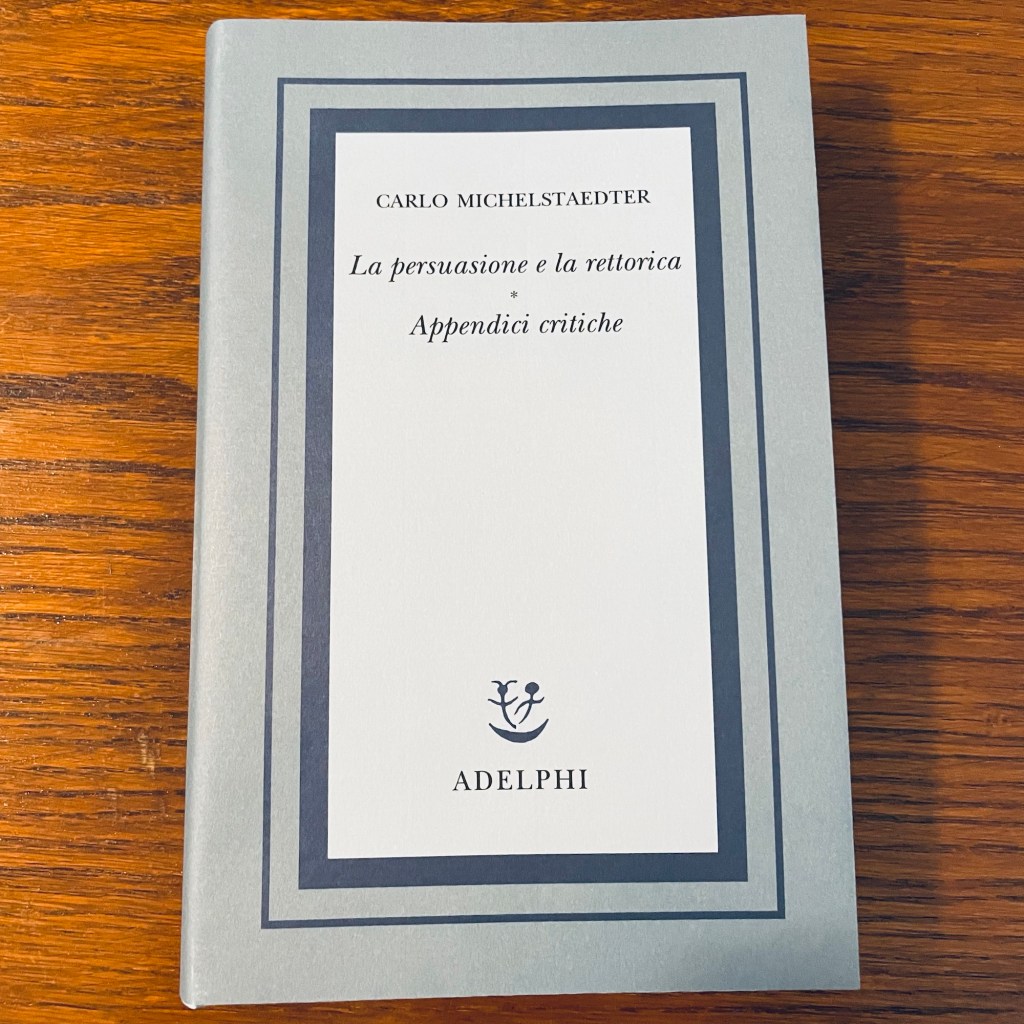
In the following months some of us will offer an eight week seminar exclusively dedicated to a close and analytical reading of the enigmatic work La persuasione e la rettorica (1910) by Italian thinker Carlo Michelsteadter (1887-1910). Ever since his death – as can be easily gasped by Giovanni Papini’s obituary in 1917 – there has been an aura of mystery around the infamous philosophical suicide of Michelsteadter that only parallels that of Socrates’ hemlock or Otto Weiniger’s self-inflected gunshot. Of course, we will be less interested in the biographical motives, and if push comes to shove attention to this detail will be elaborated in light of the nexus of his thought to the event of his death.  

La persuasione e la rettorica (1910) offers a unique theoretical elaboration about the civilizational decline of the “living” into the rhetorical deferment of life as realized in the organization of social alienation. And for Michaelsteadter there is no other purpose of rhetorical form than the absolute submission to the general abstraction that defaces the event of pain. It is no accident that he was also interested in the thematics of health and ancient techniques of pain-relief (the techné alupias, for instance), even if underdeveloped in his thinking given his sudden premature death. So, it is for us, his posthumous readers, to take these sets of issues and move them forward in our present any way we can. This is part of the task that motivates putting together this seminar after a series of conversations with friends and interlocutors.

La persuasione e la rettorica (1910) deploys the classical metaphysical tradition through the ancient poles of “rhetoric” and “persuasion”, where the second (the ancient Peithò) seeks to return the voice and expression to the problem of pain as an ineffable type of speech (Logos) that refuses the elevation of force that harbors the circulation of violence and the administration of social death. The ancient notion of the Peithò withdraws echoes of the mythical inception and the sacred, as also reminded by Aristophanes: “Persuasion’s only shrine is eloquent speech (Logos)…And I Persuasion (Peitho), the most lovely word” (The Frogs, 1391-1395). Where and how do we attune ourselves to the peitho today – the imperative of the eros of the word in the wake of the regime of social production of pain? 

In the aftermath of the collapse of the cycle of civilizational secularization, it is only obvious that all these questions stratified in the tradition once again become attractive and pertinent. In this light, we think that Michelstaedter’s thought still offers us a series of  significant hypotheses to think through the crisis of social man and the domination of the civil that colors our current predicament, where the question of “pain” is still an understudied problem. Throughout this course we will address notions such as rhetoric and persuasion, life and communication, nihilism and values, the logic of capital and the social bond, or the notion of world and pain. Our aspiration when approaching Carlo Michelsteadter’s work is to develop reflective conditions to address the thorny issue of an ethics of pain that so thickly enmeshed in our historical moment.

.

.

‡: Information about the registration to the seminar will be made available at Revista Disenso in upcoming days. The seminar will run every other week for a period of eight sessions (roughly from the beginning of September to early December, 2024).

Acies animi pictura. On Victoria Cirlot’s Taüll (2023). by Gerardo Muñoz

Victoria Cirlot’s vibrant short book, Taüll: liturgia y visión en los ábsides románicos catalanes (Mudito&Co, 2023) focuses on the well-known apse fresco panels of the Romanesque Saint Climent Church (Lleida) dating back to the twelfth century now housed in the Museo Nacional de Arte de Catalunya (MNAC), whose central figure is a Maesteis domini elevated to representation of the highest celestial cosmos. In another sense, Taüll should also be read (and perhaps the obligatory accent here is necessary) as a synthesis of Cirlot’s own work on the theological infusion of visuality and what it means to “see” and “being seeing” in a world that strives for legibility. Cirlot has no ‘presentist’ anxieties about the Romanesque period – its iconographic and overtly enigmatic depiction – but it is not difficult to think of the Christian temple as an aesthetic laboratory, or artist studio, in which the liturgical dimension functioned not much so much as a private space for the faithful, but rather as a site of encounters and vital experience (Cirlot 11). 

The liturgical performance depended on visual arrangement that opened visions of the inner sense, which Cirlot quoting Saint Augustine calls acies anime — transcendence through a sensible awakening that encompassed all the senses. Following Pavel Floresnky in his study about the Church as the synthesis of the arts, Cirlot attempts to portray the impossible experience at Tüll as the site of the life of the spirit; that is, where the spirit is transformed and released (Cirlot 12). Before there is acclamation and synthesis, there is an unfathomable experience facilitated by the liturgical imagery which is a passage or a preparation of sorts. 

It is almost impossible for us today – situated at the threshold of the autonomization of the arts and the division of its practices – to grasp the antecedent image (imago) through figures of what will only later be seen. Cirlot quotes Saint Paul to anchor this difficult chiasmatic movement of veiling-unveiling: “Now we see through a mirror, an enigma, but later we will see face to face (Cor.1.13) (Cirlot 22). Is the pictorial unveiling, or rather veiling, the juxtaposition of the image in space what will ultimately solve the enigma of unmediated appearance? And could appearance be released without its dependence on the mystery that prescribes the image making and destruction well into the totalization of modern pseudos at the art of depiction? There are conscious echos of Carchia’s thinking (in my reading of Cirlot, that is), which I think help to grant a bit more breathing space, as it were, to Cirlot’s unelaborated suggestion that “Pero la pintura es el fruto, no de una percepción sensible, sino del ojo visualiza eso que tiene que ser despertado en la interacción de los sentidos físicos” (Cirlot 23). 

To paint, or the painterly activity, is the gathering of an inner vision, where there is no more separation between the autonomous senses (visions, touch, flavor). Cirlot notes how the detailing of the querubin angel having small eyes painting on their hands would confirm this thesis. The movement of the hands registers a vision that touches the proximity of the specular Glory of transcendence. Following Henry Corbin, Cirlot can remind us that the angel for the mystical tradition is an entity whose “being is only vision” (Cirlot 28). In turn, the all-seeing angel is not a bird’s view (I guess today we will also say a drone commanded from a computing application) that has total vision over the terrestrial grid; it is more a vision that is able to see each thing — given that his divine vision he can see God in everything, and things in themselves because the painterly eye can only look outwards through the inner eye of the heart (Cirlot 38). In fact, the heart’s eye is a retreat from the world of countable and visual things, as transcendence becomes the mere contact of the senses with the divine. 

Part of the difficulty of grasping what is taking place at the Saint Climent of Taüll apse resides in a gesture that is the inversion of pictorial verisimilitude, if one is to take up Michael Fried’s thesis in Absorption and Theatricality (1980) as a reduction of disenchanted pictorial representation. In other words, the pictorial manifestation at Tüll is neither theatrical nor figural absorption for the spectators, but it was rather an experience with the liturgical mystery that strived in the liberation of the soul at the uncharted height of God itself (Cirlot 40).  And perhaps of being a mode, among many, with the presence of God in things, and things and names as already expressing the unavowable nature of the divine. Cirlot’s thesis gains traction and depth  at this point, since the central task of pictorial creation at Tüll is to find the means of granting visible to what must remain invisible (the Holy Trinity and the Eucharist mysterium) that breaks away from the implementation of imitatio naturae (Cirlot 44). This also speaks as to why Cirlot, with prudential reasons, never speaks of an aesthetic sublime that this pictorial commitment with the theos and experience clearly appears to reject. In the sublime construction, sense has been subordinated to the negative position, by which the return of representation will reveal itself in its erasure. 

The seemingly absorptive theatricality does not stand up to the highest music of the aspirations at Tüll. Once again Florensky appears as a central interpretive key for Cirlot: the iconomic and atmospheric opening of Romanesque art frees contemplation to a degree in which vision and the outside of life entangle to such a degree that no autonomization of the ‘aesthetic experience’ can formalize the sensorial gathering of the invisible upwards where “el alma no podía descansar”, or where the soul knows no rest. One can also recall Kurt Badt when writing about Constable meteorological landscape: such opening in the picture is the true organ of sentiment. But “that world is long gone” – the world of visual liturgical at Taüll – concludes Cirlot, and something similar could be said of the practice of painting. The minimal lesson at Taüll is as simple as it is difficult: any access to the world today requires to divest from the hand of technē so that the hand of pictura can take hold of the fleeting mystery of a life experienced. Such is the enduring vital vision at Taüll.

From the beginning (after a Berlin meeting). by Gerardo Muñoz

I am sure that others will draw their point of inflection, but for me the stakes of a recent Berlin meeting (already commented here) was laid out during the very first session when one of the “non-participants” – let’s call it like this to embrace the spirit of the meeting – spoke audaciously about the current predicament: there has been a thorough loss, nothing but defeat that is both irreversible and consummated at the level of subjectivity. Some of us remembered that T.J. Clark more than a decade ago in the pages of New Left Review took a similar position and was grilled for it. This tends to happen to any gesture that dares to push thought forward. In any case, the non-participant went further and called for a “new beginning”, a start from scratch, alluding to the underrated Revolution and counterrevolutionary in Germany (1851) by F. Engels, in which in fact this language is very much present. Engels wrote in the first article (the book is a collection of pieces published anonymously in the wake of the 1848 revolutions): “If, then, we have been beaten, we have nothing else to do but to begin again from the beginning. And, fortunately, the probably very short interval of rest which is allowed us between the close of the first and the beginning of the second act of the movement, gives us time for a very necessary piece of work: the study of the causes that necessitated both the late outbreak and its defeat; causes that are not to be sought for in the accidental efforts, talents, faults, errors, or treacheries of some of the leaders, but in the general social state and conditions of existence of each of the convulsed nations” [1]. 

Of course, “social or national conditions” are not “trapped in amber”, and I think that today one cannot take the national, local, or even regional contexts as sufficient to explain failure. The failure is civilizational, and raising the question of the “beginning” (or new beginnings) has a heideggerian overtone that is not facetious, but it is consistent with any exploration in the quadrant of critical-metaphysical commitments for thought (infrapolitical reflection has thematized it) [2]. This elaboration could be very well idiosyncratic, but I think it provides “grip” to the problem by not making concessions to well known junior partners of abstract politicization and ideological backlogging that like the Tortoise in the parable still fantasize with a breakthrough via yet another “textualist interpretation”; one more sophisticated mapping of political ecology or a collective hegemonic political theory department; or even a policy redistribution of a new Green Deal towards a new accumulation regime [3]. Perhaps they themselves do not believe any of the lies – for my part I think that they do not – and they endorse it for the sake of “bad faith”. But just in case, I think that raising the threshold at the highest point (ontotheology, civilization, the constitution of the polis) is a litmus test of separation against the new secular priests. These negative conditions already open a door to go through.

But there are also positive conditions for this “new beginning”: reopening the ethical intensity in retreat of political subjection; rejection of public chatter and freeing fugitive marranos; elaborating strong descriptions of the metamorphoses of domination; and avoiding the “revolt” as a compensatory category for of ius revolutionis in the epoch of real subsumption [4]. At the end of the day, it should not be forgotten that an-archy also means the turbulence of phenomena, in which every fragment moves in the direction of experience poking through the objectification of the world. This is “inapparent”, but it is for this very reason what is fundamental and invariant. 

The ‘new beginning’ in the wake of collapse can only conquer life to traverse the hunger of meaning that propels the fictional machine of ongoing nihilism, as Giorgio Cesarano warned. There is no historical or moral beginning; there is only the beginning in which existence is able to expand the originary accumulation of a sensible ethos. And it is at the very end, or almost at the end of everything, that true beginning commences. Whoever does not start from the beginning is either understudying the epoch, or mastering the evermore painful social roles. It is only in the direction towards beginning that can avoid the crushing weight of the post-neolithic condition (Métraux) that calls for a divestment of what reality can contrive for us. 

Notes 

1. Fredrich Engels. Revolution and counter-revolution in Germany (FLP, 1977), 3.

2. Alberto Moreiras, “La cuarta vía” (2022): “¿No se hace necesario hoy pensar, por lo tanto, otro comienzo del pensamiento, proponer otro comienzo que nos sustraiga al peligro del colapso mismo del mundo?  Quienes se oponen a ello, llamándolo arrogancia o presunción, llamando veneno a la propuesta misma, no son para mí ya distinguibles del avestruz que hunde la cabeza en la arena al verse atacada”. https://infraphilosophy.com/2022/02/18/la-cuarta-via-entre-parmenides-y-la-obligacion-reflexiva-conferencia-para-la-universidad-de-arizona-spanish-and-portuguese-department-borrador-3/

3. Zeit Der Ökologie. Das neue Akkumulationsregime (2024).

4. Conspiracist Manifesto (Semiotexte, 2023), 341.

Hunger and gluttony after civilization. by Gerardo Muñoz

It could easily be argued that one of the central immaterial characters of Robert Antelme’s L’espèce humaine (1947) is the constant state of hunger. It is the more telling that Antelme – and it is also surprising that most of his relevant critics have been unattentive to this problem – does not reflect explicitly about the nature of hunger in his account, as if already hunger as “facticity” of the destruction of human experience in the camp was enough to show how the crisis of effective symbolization with the world means, ultimately, the struggle for the maintenance of the nutritional condition for survival [1]. It is a particular state of nutritional privation that colors not just every community or social relation in L’espèce humaine, but also every thought, passive meandering, and even moral clarity of the deportee life in the camp. The pathetic struggles over pieces of bread or scoops of putrid soup while deposing the human race from the world brings them back, at the level of consciousness, to the raw origins of its anthropological self-affirmation. And this means that every bite of food and every bit of  protein digested by the human being is only the antecedent of the future need to meet the elemental nutritional gain for survival. The ‘consciousness towards hunger’ colored in the camp becomes the mirror image of the incessant eating disorder of hypermodern social adaptation as two forms of predatory struggle over the exchange goods of the world. 

Excessive eating and nutritional deficiency are, in this sense, two pothistorical temporal circuit of human beings as a species of hunger and gluttony. About a decade ago a book entitled Hunger: the oldest problem (2014), written by Martín Caparrós, stood out as a proof of a materialist conception at a planetary scale, which for the novelist could easily be solved by drafting the legibility of material inequality and charting the regional disproportionate asymmetries between the “good eaters” (and good feeders), and those in permanent hunger, malnutrition, localized famine, and potential starvation. For Caparros, given the height of our “civilizational progress”, hunger revealed the “original plague of humanity….which now can be solved through a political decision” [2]. The substance of the “political decision” for hunger of the human race was as empty as the very nauseating fatigue of real starvation, although as a rhetorical ploy it does contribute, even against its own presuppositions, to the civilizational paradigm that structures the poles of gluttony and hunger that sustains the domestication of the human species in conformity – under the terror imposed by the glacial tonality of nihilism – with a ‘good enough life’, as an American cultural scholar univocally upheld it [3]. A deconstructed Michelin rated restaurant is as much of the ‘good enough life’ as the oversized pots of soup delivered by World Central Kitchen in any of the ongoing war zones.

A ‘good enough life’, always marching towards the absolute postponement of an absolute hunger in any part of the planet, whose most recent avatar (not the final by any means) is the well wrapped brown bag of “food app delivery” that is silently placed in front of your house door. The food delivery package, very much like the breadcrumbs of the concentration camp described in  L’espèce humaine, enter full circle even if the arrangement of symbolic reality says otherwise. It does not matter that there are human hand struggles for dregs in the camp while in civil society there is a seemingly untouched brown bag; what makes them equivalent is how the autonomization of hunger and gluttony have been deprived of everything except its own functionalization. In other words, the absolutization of gluttony and hunger as abstract nexus of social reproduction entails the complete devastation of commensality, and all features of experiential sharing that in the ancient tradition is gathered in the banquet or in wine festivities [4].

This absolute autonomization turns its back to the world, which has now been transformed as a mere reserve and container. This is why the analogies with the wild cornucopia of the elastic worlds of Gargantua or Pantagruel, or even the mythical land of Cockaigne fall short, and can only contribute to fetichize the problem of the “true hunger” of the human species beyond nutritional and biological  arrangement. The dialectical movement at work in the alleged returned to the primal anthropological condition comes at a price: the sensible and meaningful relation, which is no longer to be invented but rather to be renounced in the elaborate thickening of a social space organized through depredation and adaptation. In his Manuale di sopravvivenza, Giorigo Cesarano noted that the problem of hunger exceeded the political and biological determinations, since hunger was first and foremost the problem of the completion of nihilism – the only hunger was that of the wandering of the human species reveals the hunger of meaning as a the true double negation: 

“At the end of prehistoric times, the most ancient problem signals the return of the negative instinct: hunger. But this time is about the hunger of meaning  that exceeds, while bringing it to synthesis, the anxiety of survival as merely an animal and its false resolution as a life that transcendentals the idealist forms of the human “ideal”. …both the negative instinct and the rational separation, having conquered some coherence in its praxis, from a possible totality seeks to insert being in a real university in order to be known truly as such” [5].

In this dense moment of his book, Cesarano seems to be arriving at an important inflection point: that is, the primal instinct of hunger, precisely as fealt and maximized in the new existential poverty of the human experience, is already compensatory to the concrete realization of an absolute hunger of meaning that emerges in both the privative stage of hunger, and in the consummation of any imaginable and desirable meal. Hence, the return to the facticity of the prehistoric stage of instinct negativity is ultimately the final exclusive dish: the nothingness of nihilism to retain the illusion of, in the words of Antelme’s poem “The soup”, going to far (or as far as it needs to be that the “world doesn’t end” [6]. The anthropophagic energies are the last tools of self-burial of the bicameral man in the wake of intramundane extinction [7].

But the dialectical vengeance in the epoch of real subsumption is hereby expressed in its uttermost kernel: the material world can only take the image of a predatory park of hunters and preys, of eating and being eaten. In the privation of death, the fictitious life of being is already a form of expropriating death as ongoing struggle for survival and self-conquest of life’s own organic illness, as it appears in Anatole France’s fragment: “No, I would rather think that organic life is an illness peculiar to our unlovely planet. It would be intolerable to believe that throughout the infinite universe there was nothing but eating and being eaten” [8]. The poverty of a restricted vitalist self-reflection can only described the organization of the world as a civilization that resembles a Pac-Man maze of the circulation of the equivalent. It is not difficult agree with Adorno that this is a perfect image of the integral society without any residue – as it continues to be in any point of the planet – is the last possible well administered utopia.


Notes 

1. See the essays in the volume On Robert Antelme’s The Human Race: Essays and Commentaries (The Malboro Press, 2003), 55-203.

2. Martín Caparrós. Hunger: The Oldest Problem (Melville House, 2020).

3. Avram Alpert. The Good-Enough Life (Princeton University Press, 2022).

4. Albert Hirschman. “Melding the public and private spheres: taking commensality seriously”, in Crossing Boundaries: Selected Essays (Zone Books, 1998), 11-28.

5. Giorgio Cesarano. Manuale di sopravvivenza (Bollati Boringhieri, 2000), 70.

6. Robert Antelme. “The Soup”, in On Robert Antelme’s The Human Race: Essays and Commentaries (The Malboro Press, 2003), 36.

7. Julian Jayne. The Origin of Consciousness in the Breakdown of the Bicameral Mind (Msriner Book, 2000).

8. Theodor Adorno. Minima Moralia: Reflections from Damaged Life (Verso, 2020), 83-84.

La vía abierta. Introducción a dossier sobre Uncanny Rest (2022) de Alberto Moreiras. por Gerardo Muñoz

El libro Uncanny Rest: For Antiphilosophy (2022), versión aumentada de Sosiego siniestro (2020), es el libro cuaderno de Alberto Moreiras que despliega una peculiar escena de escritura de los primeros meses del confinamiento en pandemia. Como todo libro verdadero (o escritura que entiende la verdad como una inexorable develación), las entradas del cuaderno se van haciendo al ritmo de su propia búsqueda. Tal cual como quería Miles Davis: “I’ll play it first and tell you what it is later”. Uncanny Rest tiene mucho de esto, y para quienes acompañamos de forma directa aquella constelación de apuntes, glosas, interrogaciones y susurros, no podemos dejar de leer todo tipo de partituras esotéricas. Se trata de un libro prolífico en registros e insinuaciones. En cualquier caso, Uncanny Rest (2022) es el libro más aventurero y dialogante de Alberto Moreiras, aunque esto tiene poco que ver con una capacidad afectiva para generar “consuelo” al interior de aquel tiempo enrarecido.

Cuando digo diálogo pienso concretamente en la palabra compartida, en la brecha entre palabra y pensamiento que para Alberto Moreiras – y ahora compruebo para mi sorpresa que ya en la primera entrada del libro versa sobre esto – es la sola vía abierta”.  ¿Tendremos el coraje necesario para emprender camino en ella? En efecto, nada le es ajeno a la escritura de Alberto para despejar ese encargo: un paseo con Teresa, un recuerdo juvenil que regresa en una fotografía; una conversación imposible o una pintura de Andrew Wyeth; la rememoración del mito de Tobías o el trazo de la figura sublime del piel roja acéfalo sobre el anómico desierto. Rastros de experiencia. Uncanny Rest es también el libro más feliz de Alberto Moreiras porque es el más especular; una tela donde comienzan a aparecer todo tipo de cosas – vivas y muertas, lejanas y próximas, posibles, existentes, e inaparentes – que actúan como un espejo de paciencia en el que escritura y pensamiento, allende de las inclinaciones personales, esbozan la búsqueda clemente en un tiempo espectral. 

La ‘sola vía abierta’ – a la que podemos ingresar desde la inaprensible soledad del pensamiento entre amigos – no se reduce al acontecimiento de los meses de la pandemia. De ahí que, a diferencia de tantos ensayos escritos durante aquel momento, no sería justo catalogar Uncanny Rest (2021) en el anaquel del global writing of COVID-19. Al contrario, Alberto aprovecha el tiempo de sosiego de la pandemia para tirar las tabas en el tablero de la época: lo central de nuestra vida es afirmar una vía de salida de la barbarie biopolítica y administrativa sobre la que Occidente pareciera haber colapsado irremediablemente.

Y si por todos lados – incluyendo desde la clase periodística a la “progresía filosófica” a los programas IA de Eric Schmidt o los nudges de Cass Sunstein – el ‘imperativo adaptativo’ no ha dejado de efectuarse como la nueva plasticidad regulativa de lo Social; la valentía de Uncanny Rest reside en haber percibido desde el ground zero las falsas salidas y los rat-holes que impiden ver lo esencial, lo duradero, o lo más alto que Alberto vincula al imperativo pindárico γένοι᾽ οἷος ἐσσὶ μαθών; esto es, ‘habiendo aprendido quién eres, debes convertirte en ese ser’. Creo que aún no hemos sabido cómo extraer todas las consecuencias de esa forma de vida que tiene algo de eternidad transfigurada, ciertamente de vida fuera de la vida contra toda vida delegada [2].

Los excelentes comentarios de Maddalena Cerrato, Mårten Björk, y Andrés Gordillo, más que reseñas protocolares y subsidiarias del libro, son ejercicios de escritura que facturan sobre la invitación a cabalgar sobre la única vía que resta: el pensamiento. Finalmente, el último texto en el carné es la versión escrita de la réplica que Alberto Moreiras ofreció a los participantes durante la presentación del libro durante la primavera de este año [3].

Notas 

* Esta introducción es parte del dossier que preparé sobre Uncanny Rest (2022) de Alberto Moreiras de próxima aparición en la revista chilena Escrituras americanas, primavera de 2024.

1. Barbara Stiegler. Adapt! On a New Political Imperative (2022). 

2. Mårten Björk. The Politics of Immortality in Rosenzweig, Barth, and Goldberg Theology and Resistance Between 1914-1945 (2021).

3. Conversaciones a la intemperie: Uncanny Rest (2022), de Alberto Moreiras, junto a Maddalena Cerrato, Andrés Gordillo, Mårten Björk, Gerardo Muñoz, y el autor, mayo de 2023: https://www.youtube.com/watch?v=I9Zs-FvdANE

Tum Otheos: on a detail in a Van Eyck’s painting. by Gerardo Muñoz

Jan Van Eyck’s 1432 Portrait of a Man has the Greek inscription, and rendered in transliteration, that reads “Tum Otheos” (ΤΥΜ ωΘΕΟς) that has baffled art historians and specialists on the painter for a very long time. It is well known that Van Eyck, the pioneer of oil painting, was fond of leaving all forms of writing in his pictures in Greek, Hebrew, and trilingual idioms that through the centuries have become incomprehensible jottings [1]. At a time when Van Eyck was painting in Northern Europe, the magical efficacy over names and naming was a dominant cultural and religious belief, and the expanded arts of the ‘names of god’ were used to heal and relieve pain, and protect against potential enemies and keep demons at bay [2]. Following Hermann Usener, one could see how the original act of the naming of the gods was no longer tied to ‘momentary divinities’ (Augenblicksgötter), but rather they were functionalized to specific anthropological needs for survival. Nonetheless, it is quite ashtonishing to witness how the painting at year zero that Van Eyck embodies – the very birth of oil painting and the “coming to life” of the figure in depiction – coincided with a divinization itself of the expanded field of the arts [2].  

In Erwin Panofksy’s early interpretation the inscription “Tum Otheos” should be read in light of the musical revolution that had taken place between 1420-1440 in the Netherlands, where the ars nova meant a thorough musical renovation towards a new expressive energy and “exquisite sensibility” nourished by the myth of Timotheos, who was taken as the ancient model of sublime harmony of the new arts and style of bringing life into depiction [3]. Overtly dependent on the transmission of the ancient figure of sound, for Panofsky the inscription “Tum Otheos” pays homage to the lyre Timotheus of Miletus as creator of the “new music”. But, could the same be transplanted into painting? Could painting at “year zero” be taken as precisely this new tonality of the arts? 

A second possible rendition of “Tum Otheos” is one what has been merely registered, although not elaborated, by art historian Alfred Acres, for whom “tum otheos” is not indexing the ancient musician but more importantly, it is registering an event or what is taking place [4]. Thus, for Acres “Tum Otheos” should be read as “and then God”; as if the relationship between painter, depiction, and spectator was the very taking place of a minor and invisible god of creation that painting facilitates. It is not difficult to recall here what Luca Giordano said of Velazquez’s painting: “this is the Theology of Painting” [5]. Although directed at Las Meninas, one could perceive that in the early stages of the secularization of the forms of the modern, the nexus between theology and painting becomes a clandestine partnership that resists its full integration into the autonomization of forms of representation. In other words, there is always a theos reminder in the act of depiction that is irreducible to the general economy of forms, as if the dissonance of the soul endured underneath at the nearness granted by the concrete realization of a picture. “And then God”, as proposed by Acres, should not be taken merely as the eruption of the divine in the symbolic structuration of the world, but rather as the very act of naming that allows divinization to continue in spite of the closure announced by the flight of the gods. 

Just one year after Van Eyck’s Portrait of a Man (1432) where the inscription “Tum Theos” appears, in Italy Alberti will write in his De Pictura that the gesture of painting “possess a truly divine power in that not only does it make the absent present (as they say of friendship), but it also represents the dead to the living many centuries later, so that they are recognized by spectators with please and deep admiration for the artist” [6]. And if Postel is right that Van Eyck’s Arnolfini masterpiece is one in which the picture reconvenes the dead bride and the rich merchant into pictorial space, then one could deduce that for the Flemish artist the divinity of painting is defined as the only passage left to the moderns to negate the world of the living and inhabit the invisible world of the dead against the coming of the monothematic world-image and its material crust of Gaia [7]. “Tum Otheos” – and then God – is literally registering the transfigured and expressive dimension of painting; that is, the taking place of depiction and its secret fidelity to what appears only to banish and become forever unfathomable. 

Notes 

1. Susan Frances Jones. “Jan van Eyck’s Greek, Hebrew and Trilingual Inscriptions”, in Van Eyck Studies, September 2012, 294.

2. Noa Turel. Living Pictures: Jan van Eyck and Painting’s First Century (Yale University Press, 2020).

3. Erwin Panofsky. “Who Is Jan van Eyck’s “Tymotheos”?, Journal of the Warburg Studies, 1949, 88-89. 

4. Alfred Acres. Jan van Eyck within His Art (Reaktion Books, 2023), 177.

5. Daniel Arasse. Take a Closer Look (Princeton U Press, 2013), 134.

6. Leon Battista Alberti. On Painting (Penguin Classics, 1991), 60.

7. Jean-Philippe Postel. El affaire Arnolfini: Investigación sobre un cuadro de Van Eyck (Acantilado, 2023).

The unknown song. On Giorgio Agamben’s La voce umana (2023). by Gerardo Muñoz

Giorgio Agamben’s most recent La voce umana (Quodlibet, 2023) sets the scene with an elemental question: what is to call on something, and what is it to be called upon? The exploration around the notion of the voice (a sort of chorâ that falls between the different antinomies of human language, as we will soon learn) is far from new in Agamben’s work, who from the the early period of Il linguaggio e la morte (1982) directly confronted the negative foundation of phonê in relation to the closure of metaphysics. In a certain way, the perimeter of La voce umana (2023) is now deliberately limited to how the ‘mystery of the language’ is to be found in the unending event of the voice as the arcanum of anthropogenesis itself. At this stage of his investigations, the problem of the voice for Agamben designates a double movement of inflection and recapitulation: the voice proves the internal division of political life in the West; at the same time, it is also the most intense experience that a form of life can bestow the disclosure of the world. The attentive reader might recall the last pages of L’aperto: l’uomo e l’animale (2002) where the impasse of the anthropological machine was assigned by caesuras between human and animal, the semiotic and the semantic, the word and the name, redemption and the end of time, writing (gramma) and sound. But it is now with the voice that a clear way out becomes apparent. In the analytics of the voice klesis no longe stands as a political-theological category of the West; but, on the contrary, a call of language unto itself, the vocative that resists linguistic denomination and the free-standing outside the case and even language itself (“fuori lingua”) as suggested by Gustave Guillaume.

The vocative dimension of language is shown as pure means of the human experience: the apostrophe that calls something – as in Moby Dick’s majestic beginning “Call me Ishmael” – is already the call through the act of naming, and naming falling into the voice becomes the originary place of language in the denomination of speech (21). Irreductible to the antinomy of langue and parole, the semantic and the semiotic, the vocative texture of the voice emerges as the third figure that neither linguistics, philosophy of language, phonology, analytical linguistics, and biological cybernetics are capable of truly grasping. And this is so – Agamben does not says it in this brutish way – because there cannot be any theory of the voice and the vocative denomination; there can only be a poetics of the voice in which the transformative and self-generative experience with reality is staged: “Ma è possibile pensare il linguaggio prescindendo dal suo rifermenta lla realtà? La voce – il vocabolo – non designa soltanto un significant, chiama piuttosto un ente reale…non si limite a elencare segni in un lessico, ma annuncai ed encunia realtà” (36).

In my respects – and this is not the place to bring into focus Emile Benveniste’s last seminar on language and writing – Agamben’s treatment of the voice is nourished by pushing beyond the limits of the great twentieth century linguist who, for the most part, remained silent on the place of the voice. Not that there is a need for another substantive treatment of the vocative; in fact, one of the great achievements of La voce umana (2023) is precisely the archeological reconstruction of the Aristotelean “what is in the voice” (ta en té phonē) formula in which the classical metaphysical inception of language comes closest to the voice only to render it “articulate” and thus subordinated to the legibility of gramma or the written sign (42-44). And whatever one thinks of what constitutes the “primacy” of metaphysics in West (phone or gramma), what is important is the fact that domestication of language has been auxiliary by the “fundamental discipline of the West” (grammar) that sets off the immediate point of dialectical force between speech and the alphabetical inscription in the voice (45-46). Civilization is nothing more than the historical process of taming one’s voice.

At this point, it becomes clear that Agamben remains faithful to his old friend, the Spanish poet José Bergamín, whose bewildering essay from 1933 “La decadencia del analfabetismo” (“The decline of illiteracy”), argued precisely that the upwards movement of civilization of grammar and writing undermined the living voice and imagination of concrete and localized people (“pueblos minorías”) livelihood [1]. Indeed, it does not take much to see how the grammaticalization of human experience was a fundamental infrastructure for the consolidation of civil society grounded in the articulation of internal recognition of rules, normative directives, and binding statutory enforcement. The triumph of the order of grammar will only intensify the movement towards the total integration of every form of life into the fictive rhetorical space on behalf of what has already been stated without having to persuade, to put in Carlo Michaelstaedter’s terms that I do not think contradict the terms that Agamben extracts from his exegesis of the voice.

The political problems emerging from the confrontation with the voice are multiple. One can recall how in modernity, when “words have been liberated from their sacred denomination” (something pondered by Joseph De Maistre in his The Generative Principle of Political Constitutions as political revolution sets through universal recognition), the closure of the rhetoric embedded in “social life” captures the event of the voice into a stable communicative dimension of language (“suoni della lengua”), which for Agamben resembles the etymology of the word phònos: murder, that is, the self-conscious assassination of the voice at the altar of free-floating rhetoric and the order of discourse (50-51). By the same token, in our epoch every living being has the malleable equalizer and “amplifier” (a word used, indeed, by the Supreme Court of the United States when deciding the case that granted equity between finance campaign and ‘public use of language’) of words, but it is only rare to see anyone truly possessing a voice. If every entity in the world has been previously assigned and grammatically ordered, what is absent is precisely the chōra as the “invisible and formeless place” (‘invisibile e senza forma”) in which the intelligible pure state of the language in the voice. In this strict sense, whoever possesses a voice is one who dissolves the axiomatic arrangement of discourse only to transform the world as inhabited. This is why the voice remains not a threshold to semantic register or the written technology, but rather an unknown song (“canto ignoto”), as it was called by Benedictine monk Guido d’Arezzo. And this song, the voice, can be followed and deciphered but never truly mastered as absolute transparent knowledge (45).

And if music is an index of prophecy, as Gianni Carchia once suggested, then this means that the voice, like the mythic harmony of the spheres, is what exceeds the proper human as indivisible and non-exchangeable realized only here and now. The political consequences are immense, Agamben is right. This means that we need to restate the medial and geographical distances of the chorā over the orderly cultural exchange of the polis. As it has been noted, the rise of the city state is waged against the orphic poetic myth; in the same way that the Roman imperium was possible by the erasure of the Etruscan musical underworld. Agamben reminds us that the birth of biopolitics coincides with the historical invention of the science of language leading to the impoverishment of the intangible and expressive communication between souls. This is Agamben’s rendition that the task of philosophy – not historical benchmarks or epistemological categorizations – resides in the attunement to the highest hymn of expressive form as it has been studied by Nicoletta De Vita’s erudite monograph Il nome e la voce (2022). There is no philosophical or theological closure as long as the song remains.

We can say that wherever there is a chorā of the voice something like this minor transcendence of the original human being that retracts from the soteriological false exits that have devastated the anthropogenic event. And it occurs to me that we could thematize three areas of what this closure means for us today: first, the technification of politics in epoch has been reduced, precisely, to a discursive theory of articulation (of social demands) to craft the fictive totalization of hegemony; second, the collapse of the political representation within contemporary democracies has turned into the optimal organization of containing willful self-expression in light of the contingency of values of the dominant aesthetic regime; and finally, the very understanding of legal culture and constitutionalism in the West has shuffled different modalities of the written authorial intention to generate the internal rules of institutional and statutory norms only to expand police powers and codification of conducts. At the expense of the unknown song, all sorts of prosthetic contraptions have been erected to douse the prehistoric voice that nevertheless keeps overflowing and reemerging like the unnerving cracking squick of Kafka’s Josephine. It is this watershed mystery of the anthropogenesis with its philo-poetological density that calls on humanity by the highest superlative imaginable: its voice.

Erich Unger’s The Stateless formation of the Jewish People today. by Gerardo Muñoz

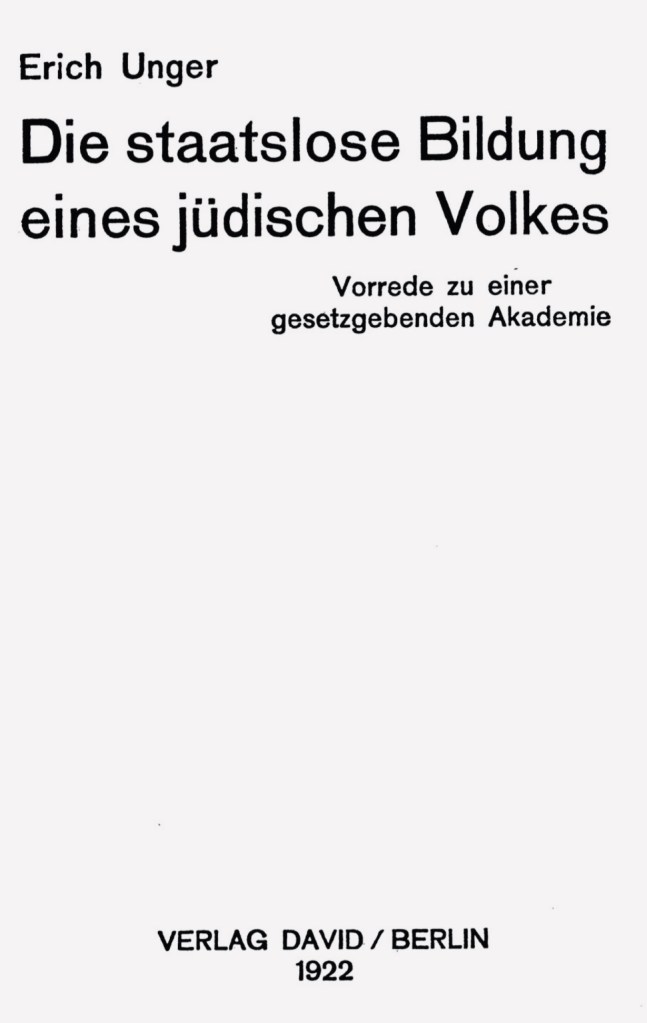
The same year that Carl Schmitt’s Political Theology (1922) appeared in the intellectual scene of the Weimar Republic defending the exceptional of the decision against immanentism, a short opuscule entitled Die staatenlose Bildung eines jüdischen Volkes (The stateless formation of the Jewish People, 1922) written by Jewish philosopher Erich Unger was published as an untimely response to the question of “Jewish identity” (Judentum) and its fate in the wake of civilizational collapse. The fact that this essay – as well as his 1921 book Politics and Metaphysics, which Walter Benjamin described as the most important political reflection of his time – has remained on the fringe of intellectual history, political theory, and the history of thought is something that anyone must seriously reflect upon. It should not come to a surprise that this text comes back today to attentive readers evidences how every creation, event of speech, or written word does not reside in the preventive invention of a specific audience; but, on the contrary, in the way that its words, images, and thought will generate the evanescence community of extemporal readers. The century that separates us in time from Unger’s essay bears witness to its ultimately proximity and prophetic calling. 

In 1922, for Unger, very much like for us today, thinking about politics meant finding a way out of a catastrophic politics [1]. If Politics and Metaphysics had suggested the necessity of an existential and energetic exodus for breakthrough against civilizational sedentary absorption and domestication, in The stateless formation of the Jewish People (1922) Unger argues critically against a state Zionist project that artificially, and through the anti-universalism paradigm of force (just as Weil would argue during her war writings about politics in the West) will attempt to “absolute Judaism, and all the manifestation of judaism that remain outside, hostile to the state trend” [2]. For Unger, Zionism as a political ideology and state program fails to come to terms with the concrete “outside the world historical power” that characterizes the universalism of the Hebrews as a theology marked by dispersal in the West; that is, outside the philosophy of history of sacrifice and soteriological incarnation of the Christian eon [3]. Hence, Zionism’s political form of the Jewish people was epochally insufficient – too empirical and thus trapped into the modern logic of racial and biological survival – to express the true conditions to enact as the “a priori” for the question of Judaism as a grounded redemptive universality. And insofar as Zionism presupposes something “outside of itself” (corporeal and spiritual Judaism), for Unger “the demand for an imperial state…must modify its demand, since it should express its underlying basis of the demand differently” [4]. The Hebrew ‘universality’ was metaphysical as much as “concrete”, based on modal ritual and myth, and for this reason at a distance from the discharge of formal logical statements [5].

What did the apriorist consideration of Judaism mean for Unger? The hypothesis in The stateless formation of the Jewish People (1922) was far from bring esoteric: Judaism is a exclusively a spiritual, immutable soul matter that hoevers the surface of the corporeal; and, more importantly, “it governs itself independently through the insubstantial for of a concrete existence” [6]. In other words, for Unger before the unity of the “People”, the articulation of the “movement”, and the erection of a positivist constitution based on Zionist nationalist principles, one should consider the sensible fabric of a people  – a dispersed, multiple, and metapolitical communities that have endured outside the geopolitical and sacrificial structuration of Christian history – that each and every time have insisted on the separation from the subsumption into a sphere of power and domination, into an ethnic-community validated by recognition and its claims to “consciousness” at the most empirical and material level. But this would amount to an effective liquidation – a surrogate for the acceleration of the dominant religion of historicity – of Judaism into yet another planetary religion, and an expression of power that integrates itself into the struggle for the nomoi of a contained and policed world. For Unger, “empirical Zionism” becomes the attempt to reduce Judaism to a “real self-executiving power” that will diminish the “supreme expression of existence” of Judaic spiritualism as “an inner experience that it is not historically given but that must precede it in order to make Judaism an endless and inevitable precondition of a truly world historical project” [7]. In this mold, Judaism will be dispensed into the theaters of the constitutive war of historical progress. 

As such, Judaism as theologically transcendent is not to be conflated into the corset of a political fictive ethnicity, but rather as an autonomous transmission that allows the communication from soul to soul that descends all the way from its metaphysical beginning. And at this beginning that has exerted itself against the whirlwind of historical fixation (the very structure of civilization after Cain according to his mentor, the Jewish theologian Oskar Goldberg) were metaphysical and errant fragments of encounters and communication, of psychological energy and dispersal of shared spiritual goals. If this is lacking, then no political form [for Judaism] will arise, but only a foolish copy of the already-existing, because the spirit cannot be skipped and left out without the rising danger” [8]. It is telling that for Unger this rising danger can emerge not only from indirect powers that exert pressure against the unity of authority – as Schmitt would have in his framework of his theory of sovereignty in Political Theology (1922) – but also, and more dramatically, from the suppression and alienation of the spiritual interiority by which a “people” never coinciding with itself can arrive at the “crystallization point” (sic) outside of the individual [9]. 

Circling back to the problem of “catastrophic politics” – that Schmitt wants to “contain” through decisionism, and that Unger wants to overbecome through an exodus from political thresholds – at the crux of Unger’s indictment of the arcana of Western politics is the “it has set everything in such a way so that the metaphysical or religious area, the internal direction, stands as a mere private thing”, sidestepping the fact that even reality and the constitution of the principle of reality depends on interiority for the possibility of an outside. And it is this outside what allows the a priori historicity that Oskar Goldberg had defended in his book The Reality of the Hebrews (1925). As the late Bruce Rosenstock lucidly argued, for Goldberg (who stands as the unnamed reference in Unger’s position about an experiential Judaism), the “a priori” takes place in an ur-time in which the physical world was closely connected to the transcendental presence of the gods, in which the people cease to be a cultural, ethnic, or identitarian unit in order to become a humanity capable of “overcoming the catastrophic history of wars sparked by competition over scarce resources” [10]. In endorsing the instrumentalized politico-theological reduction of state Zionism, Unger sees the abdication of the “Jews as the people who have driven the spirit the furthest…to cultivate the spirit deeper, more skillful, more subtle, to be the most deeply suitable through this tension” [11]. A true and vital reality was in the conspiracy between souls, wherever and whenever these meet as the ultimate manifestation of the fidelity to the unspeakable mediation between the true life and the divine. 

At the height of 1922, Unger did not suspend from a certain self-afflecting optimism, and towards the end of The stateless formation of the Jewish People (1922) he writes: “The Jews should not overlook their uniquely favorable situation; mainly, they have been materially unhistorical for two thousand years, and the only one that have not been beaten into a reality and into the shackles of the past or the empirical state that others have had to suffer” [12]. In Unger’s reading, Judaism and its errant communities (the ‘wandering Jew’ that Joseph Roth will narrate in these years, but that one must trace to the mythic texture from expulsion of Cain to the marrano) have shown the density to gather through spirit a resistance to the paradigm of force and the technicians in charge of dominating over materialism. As Unger states unequivocally: “the one who technically masters matter is ultimately defeated” [13].

This was Unger’s anti-promethean wager in 1922 skeptical of all political horizons oriented towards foreseeable catastrophes blinded to the underlying cyclical polarity of barbarism and civilization in the West.  The wayward asymptote of a non-catastrophic politics was not to be found in the abstraction of the political concept or the mechanical construction of a state form through assimilation and usurpation, but in what Unger termed, in the most intense poetic moment of his essay, the Hebrew “ increasing decipherability of its own origin”. And unlike Enlightenment historians such as Edward Gibbon who saw the state as the irreversible revolution in world history that brought the age of the nomads to an end; for Unger the twentieth century meant the fixation of the state degenerating in the worst of barbarisms. It was the existence of the unit that must generate the internal limit to the political, and not the political as the external threshold to what is inherited in the world. And yet, insofar the events of thought, language, and imagination take place, the origin (urgeschichte) will always escape what has been sedimented by rubble and wars that fuel planetary destruction and collapse. 

Notes 

1. Erich Unger. Die staatenlose Bildung eines jüdischen Volkes (Verlag David, 1922).

2. Ibid., 6.

3. Ibid., 10.

4. Ibid.,  15.

5. Erich Unger. “Universalism in Hebreism”, trans. Esther J. Ehrman, The Journal of Jewish Thought and Philosophy, Vol.4, 1995, 307.

6. Erich Unger. Die staatenlose Bildung eines jüdischen Volkes (Verlag David, 1922), 8.

7. Ibid., 19.

8. Ibid., 25.

9. Ibid., 24.

10. Ibid., 29.

11. Bruce Rosenstock. Transfinite Life: Oskar Goldberg and the Vitalist Imagination (Indiana University Press, 2017), 172.

12. Ibid., 31.

13. Ibid., 32.

Naturae species ratioque. On Guillermo García Ureña’s Las semillas y el vacío: pensar con Lucrecio (2023). by Gerardo Muñoz

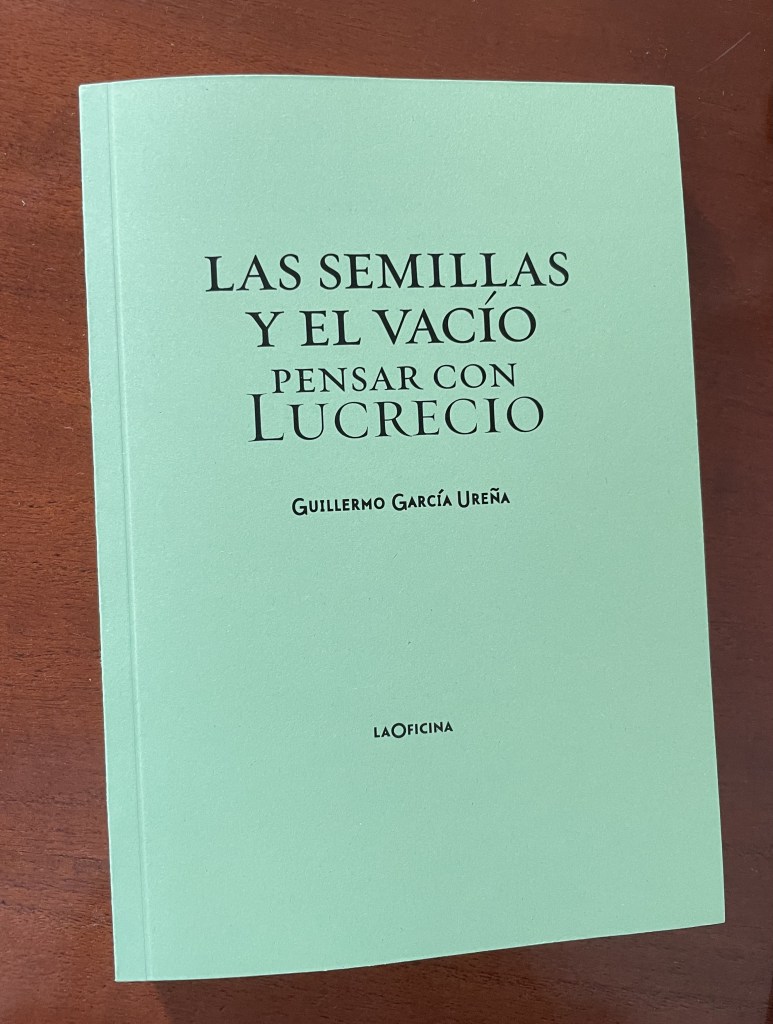
Lucretius’ poem De rerum natura is one of the most used and abused texts of the tradition, and like all classics it has had the most diverse receptions imaginable: the poem of modern science, a baroque expression of creationism for the English metaphysical poets, the precursor of historical materialism and atheism, and a tract of scientific positivism that laid the foundation for the regulation of nineteenth century social order. Once a text becomes an emblem, it usually means that it has lost its prehistoric imprint and place in the tradition. Against this backdrop, Guillermo García Ureña’s just published Las semillas y el vacío: pensar con Lucrecio (La Oficina, 2023) has the prudential gesture of disclosing the great Roman poem to its fundamental structure; attentively listening to its original complex articulation difficult to grasp with the categories of modern philosophical thought. In this sense, Ureña’s purpose is not to deploy another “philosophical account” of De rerum natura – endorsing and subscribing the influence of Epicurus and its later resonances in modern theories of physicalism and materialism of the continental schools – but rather to engage in its own ground exerting an original philological exploration of the text that opens up an array of different problems for thought. Whoever is looking for a “theory” of Lucretius will find none in this brilliant and well articulated essay. But the reader will find, nonetheless, a comprehensive hermeneutics of a text that stands as a threshold between the closure of Greek classical antiquity and the Roman reintegration of the tradition. Now, for Ureña De rerum natura proem discloses the originary understand of the epic, or épos, through which the stability of the things as they appear takes place; whether it is the Muses, the gods, being and language, the simulacra or the soul, the physical declination of creation (the atomic clinamen) and the final document of language invigorated in the corpus of the poem itself. De rerum natura is both a cosmology and a poetics with the ambition of elucidating the most obscure things of this world: Lucretius’ text defies a fixed representation through a choreography (a term that it is not used by Ureña, it must be said) that discloses the possibilities of worlds; the combination of worlds only to posit the question of how to live within them, which is another way of saying how to account for a form of life.

One of Ureña’s commitments is to hold on to Lucretius’ aesthetic and philosophical autonomy. This implies treating the influence of Epicureanism with great care; engaging with Epicurus insofar as the aesthetic autonomy and its loci of poetization reject the classical structure of the epic hero incarnated by the soteriological impulse of the great poet-philosopher (we know that this is the same problem that centuries later Hölderlin will identify through the tragic drama of Empedocles). Lucretius is writing after the twilight of the classical Greek genres. Furthermore, there is no community under an organized program of leadership and telos; on the contrary, there is only an existence that “one day will want to desert all of us” (41). True, the Epicurean notion of serenity (ataraxía) is retained and treasured; but only as the aspiration of every living being who seeks to transfigure the shadows of superstitiousness and fear that govern over the perceptive mediating forces in the world. In this sense, to dwell in the world does not consist in the limitless relationship with the simulacra; it is rather, the self-transformative exercise of freeing possibilities within the void in which forms of life can emerge. As Ureña reminds, the rainfall of the atom is as fast as that of thought itself. It is already an image of thought, as well as the figure of imagination. And the image of thought validates the history of cosmos as a patchwork of accumulations and deflections, creations and destructions, repetitions and disintegrations in a swerve of forms that infinitely recline on its ethical possibilities (139). It is altogether interesting that Ureña reminds us that, in fact, De rerum natura is not interested in staging the things in Nature; on the contrary, at the center there is the question of the ‘nature of things’ in the luminous expression of their irreducibility. This is what modern onto-theological closure brings to a process of domestication, whether through the composition of the civil structure (limitless exchange according to philosopher Felipe Martínez Marzoa, who figures prominently in Ureña’s book) or through the progressive historical structure commanded by the essence of technology that blurs the relations between forms and techniques.

If De rerum natura abandons universal history and historical narration, it is because its structure is profoundly kenotic: it can only be assigned as contingent historical transmission of the most immediate and sensorial (not necessarily “true” in the metaphysical sense) that allows the convergence of the history of forms of life and natural history (140). The operation of subtraction implies the transfiguration of freedom through the becoming of forms – their interests, constructions, and pacts (foedera naturae) as guarantee for a plastic relationship between things in a world that is always already a fragment in the void. The highly attractive Lucretian notion of foedera or “pact” (that expresses separation in coming together: a com-pact that de-compacts) is almost the inversion of the modern principle of irreversibility, if one were to take Hans Blumenberg’s  legitimation hypothesis at face value. And this is so because a foedus or pact is insufficiently strong to resist the impact of the clinamen, but indispensable for the emergence of a body that materializes its own fate towards dissolution.

The lack of unity of being allows for the existence of simulacra as that which does not have sufficient matter to compose itself as foedera; and so, it is a material semblance as an image without figure that makes it an ephemeral entelechy. In this choreography between the downwards of atoms and ephemeral intermittence of events the taking place of the world emerges a topoi of a combination of rhythms that intertwine the weight of bodies and the animation of souls. The possible combination and stylization of multiplicities in separation is the way in which a form of life emerges as the desertion from superstition and fear that hinges upon the irreversible stabilization of a principle of reality. Ureña does not go this far into the wager of Lucretius’s text – and he does not have to in his close reading of the text – but it is precisely this thick dimension of the ethical primacy that makes Lucretius’ dislocated comprehension of materiality a vibrant tune against the weight of alienation that we are still struggling to abandon.

The struggle against the alienated life – the alienation from the world, and the external manipulation of the simulacra that has become a gnostic planetary form of “TV Democracy’ (Schmitt) of the “society of the spectacle” (Debord), which implies the usurpation of our imaginal and erotic relationship with the world – well understood, does not mean to relocate the confrontation at the level of political order; it rather, rests on what we have understood by order and disorder for the reconstitution of a happy or contemplative life (naturae species ratioque). This serene life declines the offer to negotiate at the arena of sacrifice and legitimate domination, favoring the event of friendship. At this point Lucretius comes closest to Epicurus’s society of friends – studied by Carlo Diano in an important 1966 conference in relation to the organization of the passions and the transmission of love – that can guarantee a content life in the presence of “other joyous gazes” (glossing Diano’s terms) away from the persistence of war and the compensatory administration of pain. This is the ultimate treat of De rerum natura: the exemplary dimension of the serene life takes shape through the community of friends, the civilizational invariant of the human experience (prehistoric times, the classical epoch, and in our times) that abandons the paradigm of perpetual war that obfuscates omnia cordi.

It is not too ambitious to claim that only at this point we finally grasp the full extent of the Lucretian épos: not just an ephemeral and contingent declension of the primacy of atoms in the void; but, more importantly, it can disclose the irreducibility of an experience with friends. Ureña wisely closest his book with an image of the “buena vida en compañía” (the good life in companion) that insists that serenity is only possible (or desirable) in the open landscape, a nowhere-land of an eternal foedera (or a sinousia, as it appears in Plato’s Symposium) that even if temporarily too short-lived or inconsequential it paints an earthly paradise just above the grass: “poder tendernos unos juntos a otros en el césped suave, cabe un arroyuelo, a la sombra de un árbol copudo, y regalar el cuerpo sin grandes dispendios; sobre todo si el cielo sonríe y la estación del año esparce de flores el verdor de la hierba (II, 29-33)” (203). It is this inconspicuous and mute experience that strangely holds on to the passing of the world.

Lezama Lima and the Etruscan way. by Gerardo Muñoz

Towards the end of his life, poet José Lezama Lima will mysteriously begin to sign the letters to his friends and family as “the Trocadero Etruscan”, a “member of the Etruscan religiosity”, and even the “man who lives in the Etruscan village” [1]. Why call himself an “Etruscan” in this particular moment of his life, and what could it possibly mean? The question about the meaning of the Etruscan authorial mask has been so thoroughly ignored by the literary critics that commentators at their best have noted that “being Etruscan” merely stands for his “cosmopolitanism” and “well-learned Europeanism”. Of course, this explains little to nothing. A sophisticated poet such as Lezama Lima, who ruminate over every single word he would write, could not have ignored that the Etruscans, unlike the civilized Romans and the Latin authorities, was a remnant to the very civilizational enterprise; a prehistoric people poor in written culture, achieved expressivity by the whole outlook of their form of life. And as in the case of Hölderlin’s adoption of different nom de plume (Scardanelli, Killalusimeno, Scaliger Rosa, etc), Lezama’s becoming Etruscan points to something so fundamental that if underscored we would fail to grasp the endgame of his vital poetic experience. The transfiguration of the name does not merely stand as a metaphor; rather it points to a distant figure that will finally dissolve him so that his immortal voice could continue to live on.

Indeed, the self-identification as an Etruscan for Lezama became a subterfuge to flee a political reality – his political reality, entirely structured by the revolutionary gigantic productivism and subjectivism – through a poetic refraction that would free an ethos from the overpowering of alienated autonomous space of the linguistic reproduction of social life. If at first glance it seems like a paradox that Lezama will adopt the Etruscan figure for his antisocial ethos – a civilization lacking written records or high literary achievements, a religious community known for its necropolis – this strangeness will ultimately prove that behind the Etruscan name there was no poetic exclusivity of the poet’s genius, but rather, as he claims in “A partir de la poesía”, the possibility for a divinization of reality to retreat from the historical epoch. In fact, Etruscan culture for Lezama was not a mere archeological ornament, but one of the “imaginary eras” of the West; that is, a stage of condensed and unnumbered imaginative possibilities resistant to griping subsumption and totalization of values. The Etruscan was the mythic remnant through the pantheistic divinization between language and the world. As Lezama writes glossing, in passing, Vico:

“Vico cree que las palabras sagradas, las sacerdotales, eran las que se transmitían entre los etruscos. Pero para nosotros el pueblo etrusco era esencialmente teocrático. Fue el más evidente caso de un pueblo surge en el misterio de las primeras inauguraciones del dios, el monarca, el sacerdote, y el pueblo unidos en forma indiferenciada … .les prestaba a cada una de sus experiencias o de sus gestos, la participación en un mundo sagrado. […] Pues en aquel pueblo, el nombre y la reminiscencia, animista de cada palabra, cobran un relieve de un solo perfil” [2]. 

The divinization of the Etruscans stubbornly insisted on the wonder of things. The human participation in divinity is no longer about founding a new theocracy or a “theocratic politics” in the hands of a ‘mystic accountant’ that would finally put the nation back in track (into the res publica), as Lezama would solicit out of desperation in the 1950s diaries [3]. On the contrary, for Etruscan people the fundamental tonality was the divine music of experience. Of course, we know that D.H. Lawrence captured this when claiming in his Etruscan Places (1932) that “the Etruscans are not a theory or a thesis. If they are anything, they are an experience. An experience that is always spoilt” [4]. And this experience (like every true experience) needs to be necessarily spoiled, which ultimately means that it cannot be mimetically rendered, arbitrarily modified, or subsumed into the order of idealization. But all of this is merely redundant, since the Etruscan inscription is what accounts for the limit to civilization, becoming the impossibility of the destruction of myth in the arrival of modern aesthetic autonomy. Thus, for Lezama the Etruscan way had something of a persistent cure against the ongoing civilizational disenchantment, even if it does not cease to appear in the modern attitude. In fact, Lezama writes that: “Rimbaud is the best reader of the Etruscan liver” (“hígrado etrusco”) to describe the dislocated position of the poet in the modern world of technology [5]. In the Etruscan cosmology, the liver was a symbolon of the vision of the cosmos registering the divisions of the spheres in the sky through the divine naming of the gods; it is the figure by which the poet guards the desecularizing remnant of the prehistoric inception of myth [6]. But this does not mean that Lezama will look at himself in the mirror of Rimbaud’s symbolist alchemy.

Rimbaud as an Etruscan is the poet who descends into hell because his lyricism can bear the pain in the disruption of language after the archaic peitho. Does the possibility mean a travel back in historical time? Not the least, as Lezama knew how to let go of storytelling and historical necessity. This is why Etruscans stand for an image or a sort of handwoven picture (the hand will make a comeback, as we will see) to gain vision. And this is one case on point: the Etruscan stands paradigmatically to the “sufficient enchantment” (“la cantidad hechizada”) , which discloses a higher knowledge of the soul (psychê) in the taking place of poetic errancy: “Sabemos que muchas veces el alma, al escaparse de su morada, tripulaba un caballo inquieto, afanoso de penetrar en las regiones solares” [7]. To wrestle against the historical reduction of autonomy of the modern age means to find this enchanted sufficiency necessarily for myth remnant to elevate itself against the aesthetic mediation that, in the words of Gianni Carchia, had become a consoling surrogate of the emptied historical time [8]. An entirely other conception of freedom is firmly implicated the Etruscan way: the gathering of the enchanted poetic dwelling to dissolve a reality that had become too thick in the business of brute force purporting to call ‘what’s out there’. The Etruscan reintroduces a divine nominalism of pure exteriority.

However, the Etruscan way does not commute with things of the world; rather, his soul unbinds the empirical limit of death to overcome death, and learn to live as if it were already dead. The trespassing of death through the poetic enchantment – which Lezama will also call an ‘potens etrusca’, or the Etruscan potentiality- will multiply the invisible possibilities against the rhetorical closure of reality legitimation. By accepting the thick of the dead as an illuminated presence, the Etruscans draw out the most important consequence: learning to live among the dead as the ultimate form of a dignified life. This is why D.H. Lawrence reminds us that the underworld of the Etruscans – their refusal of reality, the embrace of their dead, the augurium – was after all “a gay place…For the life on earth was so good, the life below could but be a continuation of it. This profound belief in life, acceptance of life, seems characteristic of the Etruscans. It is still vivid in the painted tombs. They are by no means downtrodden menials, let later Romans say what they will” [9].

If civilization is a construction that takes place at the crust of the Earth as some have claimed; the way of the Etruscan is a downward declination away from the architectural reduction of world sensing [10]. For Lezama the Etruscan dreams of a civilization submerged in the depths that only an acoustic totality that bear witness to its sensorial gradation: “Esas civilizaciones errantes por debajo del mar, sumergidas por el manteo de las arenas o por las extensivas exigencias…reaparecen, a veces, en los sueños de los campesinos” [11]. Hence, the fundamental dignity of poetry resides in the mythical homecoming that guards the possibility for what remains inexistent: “this is why the poet lives in the Etruscan world of the birth of fire” [12]. And although the Etruscan stands as one of the worlds in possession of an imaginary epoch (the other two for Lezama being the Catholic world and the feudal feudal Carolingian Empire), it is only in the Etruscan where the resurrection had taken the transubstantiation in the name itself; even if the price was its own liquidation as a historical people that refused to be incorporated into the doxa of postmythical order [13].  

The fiery force of the mythic peitho outlives and predates the political epoch of the nomos of fixation organized as “One People, One State, One Language” [14]. As Lezama explains in “La dignidad de la poesía”: “…el odio en la polis contra el daimon socrático, hizo que la nueva doxa no logra sustituir a cabalidad el período mítico….Si por lo mitos, los dioses se irritable con la felicidad de los de los mortales, pero al menos, se interesaban por sus destinos; en la nueva doxa, la poesis se extinguía – el daimon individual reemplazando al destino individual liberado de la polis” [15]. The primacy of myth as orientation to happiness should make clear that for Lezama the poetics of naming follows the overflow of its permanent modalization [16]. The Etruscan way marks the path for the irrevocable retreat from the space of the polis where civilization will be erected on the grounds of deliating ethos and daimon, polis and poesis, and ultimately life and death as a rubric of a new science of separation. The fact that the civilization of social reproduction has been erected on the basis of the destruction of the chthonic underworld speaks to the systematic erasure from the dead as a vital extension of life [17]. The poetic natality of the Etruscans will only be cultivated, as Aby Warburg suggests, from the assumption of deep superstition in the face of the placement of political autonomy, which allows for the persistence of the image as inseparable from the needs and uses of the living [18]. And only persistence could prepare the final triumph over death.

19
[19]

Towards the later phase of his work, the poet seems to never want to abandon the Etruscan inframundo. Lezama returns to the Etruscan scene towards the end and unfinished novel, Oppiano Licario (1977), in which the central character Fronesis describes at length the mutation of reality following the footsteps at a distance of Ynaca Licario slowly merging into the Tarquinia necropolis painted wall, which is accompanied by a visual reproduction of the Etruscan tomb:

“El sacerdote, en el lateral izquierdo, hace gestos de ensalmo en torno a una espiga de triga. Un pájaro que se acerca queda detenido sin poder posarse en el ámbito hechizado de la hoja. En el lateral derecho, el sacerdote repite idéntico rito, pero ahora de la raíz colorida hace saltar la liebre que cavaba en las profundidades. El aire cubría como unas redes de secreta protección en torno de la mutabilidad de las hojas y de la inmovil jactancia de los troncos. Una indetenible pero resguardada evaporación alcanza aquella llanura con los muertos …La conversación subterránea era el símbolo del vencimiento de la muerte. [20]

The ongoing conversation (the shared word koina ta philōn) in a mysterious divine language had triumphed over death because it had overcome death and the sight of death. It is no longer the transposition of a historical sublime that must protect experience from the fixity of the human corpse, since the soul can escape the limit of form. In passing through and embracing death, the Etruscan validated their passions for mirrors and the palm, which according to Lezama is the true keep of the appearance of the uttermost revealing of the face in its own irreducible ethos. The possibility (potens etrusca) of defeating death while in life finds in the Etruscan appearance Lezama’s most intimate poetic arcana: the persistence of the anima renounces symbolic legibility as too innocuous and ornamental; where the flags of victories now resembled an accumulation of well settled defeats nurtured in the name of the muteness over “life”.

The Etruscan distance mysterium validated myth as the affirmation of the cosmos as based on the potentiality of contemplative imagination [21]. Lezama will call this distance the “eros de la lejanía” (Eros of distance) in the experience of the inframundo that will break through by affirming the possibilities of divine naming as a correlative causation in the world [22]. As Lezama tells his sister in a letter from 1966, he had already assumed to have crossed the bridge between the dead and the living: “Para mi ya ha sucedido todo lo que podía tocarme….Pues creo ya haber alcanzado en mi vida esa unidad entre los vivientes y los que esperan la voz de la resurrección que es la supresa contemplación” [23]. Or yet again: “El que está muerto en la muerte, vive, pero el que está muerto en la vida, es la única forma para mi conocida de la vida en su turbión, en su escala musical, en su fuego cortado” [24]. To scale up life to the higher music is the final trope of happiness as already dead. The Etruscan dirita vía of descension – “a weight going down” of stepping into the Earth, as Ruskin would have it – achieves the arrest of the divine contact between the voice and the dead [25]. It is for us to raise this mirror before our impoverished and fictive unswerving reality.

.

.  

Notes 

1. José Lezama Lima. Cartas a Eloísa y otra correspondencia (1939-1976) (Verbum, 1998), 230.

2.  José Lezama Lima. “A partir de la poesía”, in Obras Completas, Tomo II (Aguilar, 1977), 831.

3.  José Lezama Lima. Diario (Verbum, 2014), 87.

4. D. H. Lawrence. Etruscan Places (The Viking Press, 1957),  90.

5. José Lezama Lima. “La pintura y la poesía en Cuba”, in Obras Completas, Tomo II (Aguilar, 1977), 968 

6. Gustav Herbig. “Etruscan Religion”, in Encyclopedia of Religion and Ethics, Volume V (Dravidians-Fichte, 1912), 533.

7. José Lezama Lima. “Introducción a los vasos órficos”, Obras Completas, Tomo II (Aguilar, 1977), 861. 

8. Gianni Carchia. Orfismo e tragedia (Quodlibet, 2019), 81.

9. D.H. Lawrence. Etruscan Places (The Viking Press, 1957), 31.

10. Amadeo Bordiga. “Specie umana e crosta terrestre”, in Drammi gialli e sinistre della moderna decadenza sociale (Iskra, 1978). 

11. José Lezama Lima. “Estatuas y sueños”, in Obras Completas, Tomo II (Aguilar, 1977), 449.

12.  José Lezama Lima. “La dignidad de la poesía”, in Obras Completas, Tomo II (Aguilar, 1977), 774. 

13. Ibid., 776.

14. Erich Unger. Die staatslose Bildung eines jüdischen Volkes (Verlag David, 1922).

15.  José Lezama Lima. “La dignidad de la poesía”, in Obras Completas, Tomo II (Aguilar, 1977), 777.

16. Monica Ferrando. “Presentazione”, in Hermann Usener, Triade: saggio di numerologia mitologica (Guida Editori, 1993).

1176.  Giorgio Agamben. “Gaia e Ctonia”, Quodlibet, 2020 https://www.quodlibet.it/giorgio-agamben-gaia-e-ctonia 

18. Aby Warburg. The Renewal of Pagan Antiquity (Getty, 1999), 189.

19. Image included in Chapter VII of Oppiano Licario (Cátedra, 1989), 375. 

20. José Lezama Lima. Oppiano Licario (Cátadra, 1989), 374.

21. Aby Warburg’s treatment of the symbolic mediation between myth and distance appears at the center of his essay on Pueblo Indians. See, Aby Warburg, El ritual de la serpiente (Sexto Piso, 2022), 66.  And also, Franz Boll, Vita Contemplativa (Heidelberg, 1920), who connects contemplari to the augur’s spatiality of the templum.

22. José Lezama Lima. Cartas a Eloísa y otra correspondencia (1939-1976) (Verbum, 1998), 411.

23. Ibid., 109.

24. Ibid., 266. 

25. John Ruskin. The Letters of John Ruskin (George Allen, 1909), 133.