Lo que sigue a continuación es una síntesis escrita de mi réplica en la presentación de La fisura posthegemónica (Doblea Editores, 2025), en la que intervinieron Mauricio Amar, Ángel Octavio Álvarez, Miguel Ángel Hermosilla, y Lieta Vivaldi el 3 de octubre en Ñuñoa, Santiago de Chile. Esos comentarios aparecerán en el próximo número de la revista Escrituras Americanas.
Agradezco enormemente las intervenciones de mis amigos Ángel, Miguel Ángel, Lieta, Mauricio, porque en última instancia un libro no es nada sin la posibilidad de ser encarado y llevado fuera de sus límites. Mauricio Amar preguntaba por la apuesta general del libro, y quizás pueda decir algo sobre esto. Este libro se inspira en lo que me gustaría llamar la escritura del adiós o del farewell. Siempre me ha llamado la atención que, al comienzo de este siglo, dos pensadores que admiro profundamente escribieron por separado dos libros de farewell: me refiero a Farewell to an Idea (Yale U Press, 1999) de T.J. Clark, y The Exhaustion of Difference (Duke U Press, 2000) de Alberto Moreiras. Respectivamente, adiós al modernismo pictórico, y a la suma metareflexiva sobre América Latina. Al menos para mi La fisura es una forma de decirle adiós a cierta reflexión política contemporánea. Y decir adiós supone atravesar el problema; por eso mismo, el hilo del libro es un problema de hegemonía que ha dominado el horizonte reflexivo y práctico del pensamiento teórico.
Ya aludimos al colapso de las formas de mediación, y se nos suele olvidar que forma es política, y la política es sólo posible mediante una forma. Si queremos pensar contra la dominación, a espaldas del vector retórico de la hegemonía, debemos tomar muy en serio cómo la forma hoy solo cumple la tarea de la dominación sobre la existencia y la palabra. La insistencia compulsiva que las formas ofrecen desembocan en su cierre letal (en la jerga de Alex Karp) sobre cada uno de nosotros. Ángel Octavio veía que el problema se nos presentaba como salida a otra parte. ¿Pero, qué salida?
Toda salida remite a una trascendencia menor: podemos salir al cielo como interioridad espiritualizada; o bien, podemos salir a un espacio demónico nocturno, un hacer noche, como versa el título del nuevo libro de Constanza Michelson. No deja de ser un síntoma de época que algunos hoy insistan en el vector de la espiritualización como vuelta a la tierra, aunque ésta sea el desierto en free fall que produce el declive (stagnation). El último Tronti, con el que tuve la suerte de intercambiar, lo recogía: el único combate hoy pasa por la interioridad (xeniteia). Pero el problema aquí es que el mundo no coincide con la Tierra. Y lo que interesa, entonces, ese justamente esa no-coincidencia, esa fisura, con respecto al mundo del viviente que hoy aparece como búsqueda de región. Y la región está en su acontecer fuera del mundo más que en el fuero interno.
O podríamos decir que está en la apertura del paisaje. No hay salida a un lugar sometido a la viabilidad ecológica. O no puede terminar ahí. Al final de cuentas, como vio un pensador en su momento, la revolución industrial fue la segunda revolución, puesto que la primera había sido la relativa a la agricultura entendida como asentamiento en el terreno. En apertura entronizamos con el cielo; o, en la bellísima definición de Kurt Badt comentando la obra pictórica de Constable: “el cielo es el órgano de los sentimientos”. El cielo aquí no es el espejo mítico que habilita la autoafirmación que conduce al humanismo catastrófico; más bien, es el punto de fuga que no se dirime en las particiones del suelo. Es curioso que la dominación en curso ya está operando como el diseño geoespacial del cielo. Esto es lo que comparte la figura del palantir de la Inteligencia, así como la Tianxia, doctrina “Todo bajo el Cielo” del emergente imperio chino. En apertura mantenemos las intermediaciones entre cielo y suelo en el fin de nuestro tiempo.
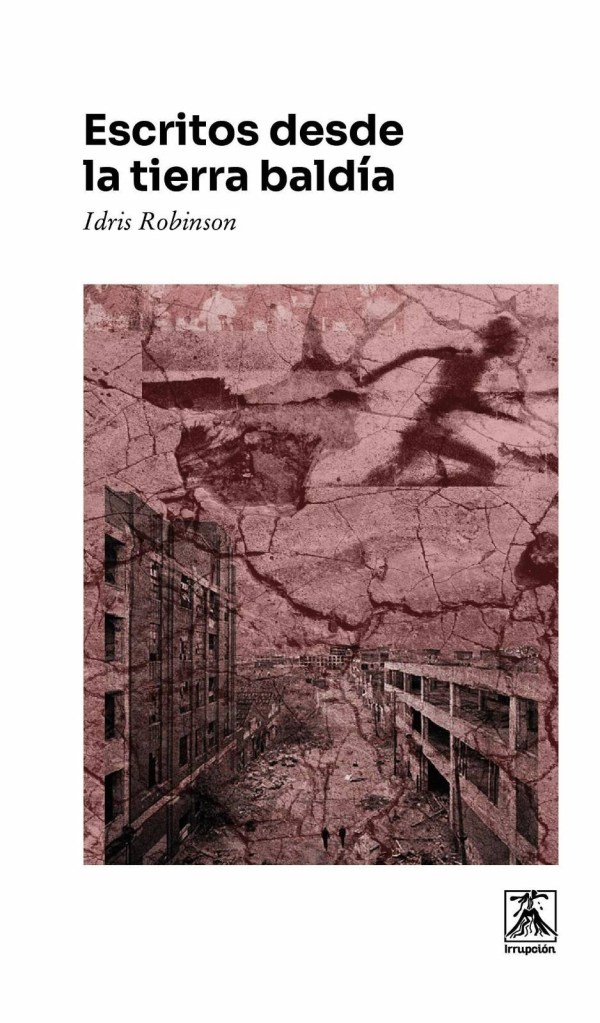
Ya no me toca decir mucho más sobre Escritos desde la tierra baldía (Irrupción Ediciones, 2025) de Idris Robinson, que se adelanta a la publicación de finales del este año de la versión en inglés publicada por Semiotexte, bajo otro título, The revolt eclipses whatever the world has to offer. El título en inglés en realidad tiene una afinidad chilena implícita, pues remite a una expresión de una conversación que tuve con Idris en los meses tras la revuelta de George Floyd, y que fue publicada en la ahora inexistente Revista Disenso. Estamos hablando de la primavera del 2021, lo que quiere decir que ya casi cinco años nos separan de ese momento. Creo que ambos estamos muy agradecidos no solo por la acogida en el catálogo de Irrupciones Ediciones, sino también por una colaboración de pensamiento real, que hace que todo sea un poco más llevadero y fecundo. En este comentario simplemente quiero registrar tres planos que pudieran contribuir en torno a la escena de escritura de Idris para luego conversar.
En primer lugar, creo que como podrá ver el lector que se asome a la páginas del libro, lo que llama la atención de inmediato es una pulsión en el lenguaje que pudiéramos caracterizar de inmediatez y caída. Pongo el énfasis en este nudo, porque no se ha reparado lo suficiente, me parece, en la relación entre el acontecimiento de la revuelta y el lugar de la lengua. Creo recordar que Willy Thayer lo tematizó con cierto énfasis en una discusión sobre la “constitución menor” en un número de Papel Máquina de 2021. Idris es un pensador de escritura escasa, contenida, tenue; y, sin embargo, en esos meses del llamado “American hot summer” del 2020 su voz desbordó a la letra con regularidad. Un desborde que no tiene nada que ver con el reportaje de los hechos – no es un John Reed con nuevos días que conmovieron al mundo desde Minneapolis – aunque también los incluya desde luego, sino con la posibilidad misma de “decir” al calor de una instancia temporal que trastoca y anima. Si hay momentos de “golpes a la lengua”, ¿no es el acontecimiento de la revuelta la instancia donde la lengua hace presencia pura?
Ya que hablamos de presencia, en Escritos hay un timbre zigzagueante que pasa por dar lugar a la presencia de la existencia afroamericana; dejarla actuar en el teatro de su entorno. ¿Qué significa esto? Yo recuerdo que hace algunos años, el tren regional de New Jersey, el NJTransit, tuvo muchos problemas técnicos, y entonces durante un final de mes se habilitó montarse en tren sin pagar. Y durante esos días, los que tomamos el tren vimos de repente algo sorprendente e inédito: tribus de jóvenes afroamericanos – algunos tan jóvenes como de la junior high – en pura algarabía y con sus rostros de absoluta felicidad se montaban al tren de Trenton a Manhattan por vez primera. La “muerte social” contra la existencia afroamericana de la cual Floyd es sólo su expresión extrema, no es reducible al momento de un siniestro, sino que es contra todo el mundo de circulación de lo social. En ese momento en el que el precio se ponía en suspenso, se abolía la cruda violencia que subyace la atadura entre la tarifa y el salario. Cuento esto porque me parece que la escritura de Idris tiene una operatividad que busca descomprimir esa violencia social contra la presencia indexando una textura experiencial, desfigurada. Y esta es su diferencia con las otras dos tendencias del pensamiento negro en Estados Unidos: el activismo político democrático (BLM), y el afropesimismo, que es una metateoría disolvente, aunque ciertamente muy comprometida con zonas autográficas o experienciales de escritura. Me parece que leer a Idris con esto en mente nos ayuda a afinar sus diferencias ante esas otras dos opciones del pensamiento crítico contemporáneo.
Y finalmente, la elección del título relativo a la tierra baldía obviamente remite al famoso long poem The Wasteland de T.S. Eliot, que Idris recoge en varios momentos de sus escritos, aunque sin remitir al poeta. La wasteland para Eliot, como sabemos, constituía el horizonte en marcha de la modernidad protestante y maquínica ante la que él reaccionaba desde su catolicismo reaccionario; en Idris, en cambio, la wasteland es lo que ya habitamos, el espacio tortuoso y siniestro de la interconectividad, de las infraestructuras metropolitanas, de la exposición social regulada. Por banal que parezca creo que es muy atractivo haber puesto el énfasis en la tierra baldía, porque parte del colapso epocal en curso tiene que ver con la conquista del espacio; ya no el espacio de los astros donde Musk y los otros personajes de Silicon Valley quieren instalar sus fundos, sino la tierra misma que pisamos, y que ahora sentimos como lugar inmundo carente de sentido de ‘región’. La tierra traducida a superficie para ingenieros o world builders, por decirlo con Bruno Maçaes.
Pensar hoy supone pensar sobre y en el espacio, haciendo espacio para abrir el no-espacio que le devuelve su dignidad contra toda reducción de lo intercambiable. La modernidad fue la época de la temporalidad, de la filosofía de la historia y del mesianismo; hoy, de la mano de Idris, podemos abrir la pregunta por el pensamiento en región, que tiene prioridad con respecto a la organización y a la economía política. Escritos desde la tierra baldía nos da paso a esto y a más. Muchas gracias.
We owe an untimely intuition about the enduring seduction of patriotism and nationalism to Leo Tolstoy’ essay “Patriotism and Government” (1900), in which he captured a paradoxical phenomenon: mainly, that at the same time that the integration of humanity and its historical consciousness reached its civilizational peak, patriotism instead of disappearing became increasingly more destructive and fierce. Looking at the outset of the First World War in Europe and its nascent total mobilization of industries, the Russian novelist claimed that, from that moment, government organization will depend on patriotism as a source to conduct total war within the human species. But what surprised Tolstoy – which has clear contemporary overtones in the impolitical movements that dominate Western societies – was the degree that this lethal patriotism infiltrated the very worldview and orientation of the Christian vocation. Tolstoy writes in the most most potent passage of the essay:
“All the peoples of the so-called Christian world have been reduced by patriotism to such a state of brutality, that not only those who are obliged to kill or be killed desire slaughter and rejoice in murder, but all the people of Europe and America, living peaceably in their homes exposed to no danger, are, at each war – thanks to easy means of communication and to the press – in the position of the spectators in a Roman circus, and, like them, delight in the slaughter, and raise the bloodthirsty cry, ‘Pollice verso.’ [1].
This should suffice to note that for Tolstoy patriotism is neither a political ideology nor a formal principle of community; patriotism is rather a social liturgy born of the absolute sacrazalization of human life and whose hyperbolic figure will be that of the war-slave trained to endure “the act” (especially the slave that participates in the carnage through his words and attention). And just like in a theater play or in the Catholic liturgy where there are “acts” (and the service can only subsist through its enactment), the unleashed force of patriotism becomes a form of destruction as the essence of government organization.
This is why for Tolstoy the inception of total war recalibrates the grotesque spectacle through the “hypnotism of patriotism”, positing a fictional belonging of salvation – that is nontheological because it is unredeemable – through the destruction of another community of the human species. True, the end of politics always results in war; although Tolstoy introduces a nuance to this axiom: war is able to subsist thanks to the self-affirmation of patriotism as the triumph of a wordless inhumanity.
It is no coincidence that Tolstoy observed the rise of patriotic strife in tandem with modern science as conquest over Nature and the reality of human experience [2]. Thus, government patriotism and instrumental sciences are two interconnected regimes of the organization inhumanity that speak the rhetoric of growth and prosperity as stagnation deepens. In our days, this social cohesion, as Tolstoy warned with precision more than a century ago, has entered a new phase of domination that some called a “lethal form” integrating technology and war without any reminder [3].
.
.
Notes
1. Leo Tolstoy. “Patriotism and Government” (1900), in Last Steps: The Late Writings (Penguin Books, 2009), 318.
2. Leo Tolstoy. “Modern Science” (1898), Last Steps: The Late Writings (Penguin Books, 2009), 252.
3. Alexander Karp. The Technological Republic (Crown Currency, 2025), 154.
Immediately after the end of the Second World War, the historian Emilio Roig de Leuchsenring published a thin book in Havana with the title Weyler en Cuba: un precursor de la barbarie fascista (Páginas, 1947), which made a direct connection between twentieth century political movement fascism and the lurking shadow of the Spanish general Valeriano Weyler, who commanded the intense colonial pacification against pro-independence insurrection at the end of the nineteenth century in Cuba. It is to Roig’s credit how he managed, toward the end of the book, to capture the actuality of what he called “weylerism” of full-fledged totalitarian and imperial wars against populations that did not come to an end in spite of international law and the several peace agreements of the Second War victors. For Roig the structural positionality of politics even in the years 1945-1947 was still maximalist, all encompassing the total conditions of living of populations, and thus a direct instrument of capitalist rent through war making. What he termed “weylerism” or the new fascist barbarism was a new qualitative leap in terms of conducting war, which now realized itself in terms of population control and the veneer of “order”: “Todo lo que Weyler representó y practicó está vigente en la posguerra” [1].
The idea of “peace” (the United Nations was settled in the fall of 1945 with the active participation of Cuba, something that Roig would not have ignored) could only signal the continuation of an extreme form of extermination and the dispensation of cruelty. In fact, the Weyler model (weylerism), was very much an administrative form of pacification of population through encampment and survival. In his memoirs, Weyler himself justifies “reconcentraciones” of the population as a martial solution to answer insurrectional arson activity, in the form of an exclusionary space within the territory even if this meant mass starvation [2]. As Roig does not cease repeating in his postwar essay, the actuality of Weylerian command is not an image of the past, but something that is already an essential part of the world of today and surely of tomorrow.
Today we are living Roig’s historical future, and we can say that his Weyler en Cuba: un precursor de la barbarie fascista (Páginas, 1947) has become as current as ever before. Just a few days ago we heard the Secretary of Homeland Security of the United States claim that Immigration Detenter Center in Florida’s Everglades could become a model for detention centers across the nation thanks to its spatial efficiency near airport runways that facilitate deportation flights and extraditions without due process. As observed by Stephen Bonsal as early as 1897, the Spanish reconcentraciones in the island of Cuba enacted by Weyler’s military command were all deployed near key military strategic sites of the colonial army [3].
It comes to no surprise that in the current public discussion about Immigration Detention camps in the United States, the discussion always pivots towards health and sanitary management of the centers, and not in the “dislocating localizations” of these evolving zones d’attentes that now are propping up near airports, shipping ports, and hinterlands of American metropolises [4]. If the camp, or reconcentraciones, is the sharp image of ongoing domestication of human beings, as a great twentieth century writer observed, it might very well be that the current metamorphosis of Weylerinism has become victorious because it has been rendered acceptable by an increasingly indolent and dormant Society.
.
.
Notes
1. Emilio Roig de Leuchsenring. Weyler en Cuba: un precursor de la barbarie fascista (Páginas, 1947), 216.
2. Valeriano Weyler. Memorias de un general (Ediciones Destino, 2004), 257.
3. Stephen Bonsal. The real condition of Cuba today (Harper & Brothers Publishers, 1897), 112.
4. Giorgio Agamben. Homo sacer (Stanford University Press, 1995). 175.
It is well known that Aristophanes’ late comic work on wealth, Plutus (388), provides us with what is perhaps the most dramatic and conceptual elaboration of the mythic personification of poverty (Penia) of late antiquity. What is remarkable is that in her self-presentation to the character Chremylus, Penia draws on a political parallelism that colors the ongoing crisis of governance of the ancient polis. If the Greek comedy is dependent on the function of the pólos (which is the vortex of movement that makes possible grasping the specificity of the being that is said), always prior to the arrangement of the polis, then it would follow that Aristophanes’ commentary on the centrality of Penia is neither mockery nor irony within the structure of the play, but rather an element fundamental to the historical presentation of the consciousness of historical public life. The emergence of Penia in Plutus is recorded in the lines 550-554 (a paraphrase might be adequate here): “Thrasybulus and Dionysius are one and the same according to you. No, my life is not like that and will never be. The beggar, whom you have depicted to us, never possesses anything. The poor man lives threfitly and attentively to his work; he has not got too much, but does not lack what he really needs” [1]. Poverty is an intimate relationship with needs; perhaps an unsaid relation, but one that must be accounted for nonetheless.
At her entrance into the play, we are told that Penia’s complexion is both mad (makaron) and tragic (tragōdikon); she could very well be an Erinyes companion from the underworld of the dead. Penia as a mythic figure is a fullfilled form of life. More importantly, what is crucial in the Plutus is that Penia defines herself in sharp contrast to the life of beggars or ptochos. This means that while the penetes is tied to a constitutive need as condition for a form of life; the ptochoi is a being that merely lives in a state of survival, and endures his absence of proper needs. Because Penia is contrasted to the destitute life embodied by ptochos, she can state in one moment primacy over wealth: “all your blessing….you have all that you need in abundance, thanks to me” [2]. Hence, as it has been noted, the irrevocable presence of Penia in the polis is the condition of possibility for Ploutus, god of wealth and abundance, shown in ancient representations as holding the flourishing cornucopia from the fertile harvest season.
What is important to note is that the close and fluid relationship between Ploutus and Penia; that is, between abundance and need, far from being opposition is relational and nourished by its pólos. In this way, the being of need, the penetes, is only able to flourish if he is capable of attaining a free relation with its desire of its vital making, and not from an external power that can determine the functions directed to abstract modeling of population survival. If Aristophanes’ Penia is defined against the ptochos is not because there is a difference of degrees in terms of dispossession, negative or quantitative, but rather it is because it is a disjointed relationship between poverty as a transfigured life, and a life that become destitute because it has ceased to be attentive to its own needs. In the incommensurable ground of the polis, it could be said that the ptochoi were unformed lives that merely persisted in time on the margin of the system of relation of the human community, and for this reason they dwelled in a permanent state of apolis, since their only viable horizon was the result of economic abstraction for secondary needs. In other words, the beggars of the apolis are ultimately effects of economic forces that they do not control, precisely because they no longer have any existential relation with the realm of necessity, that is, with poverty as understood under the shadow of Penia.
In this sense, the condition of beggar is an ultimate economic subjection that is already beyond the sufficient limitation of needs, and thus it has lost all contact with the world. It is has become deprived of the world without being truly dead. Here, one should not forget that as Plato registers the genetic relationship between Penia and Eros in an important moment of The Symposium: “Eros is the son of Poros and Penia, and partakes of the nature of both parents, the fertile vigor of the one, the wastrel neediness of the other. As he is a mean between mortal and immortal” [3]. But the erotic soul in the last resort is nothing but the desire for immortality; and, as a daimon, it mediates between passions and the beautiful, between the divine and the mortal, between need and wealth towards the depth of a harmous life [4]. As Sandrine Coin-Longeray has shown in her exemplary study, Penia (πενία) exceeds the effective qualification of the “good life” based on labour; rather it is a route of life that outlives itself in the erotic transfiguration of world towards the preservation of irreducible homeostasis of common life [5].
This is why Plato’s conception of the ‘happy city’ or the kallipolis was imagined as a deposition of the process of abstraction between “rich” and “poor” that ultimately has come to regulate the modern organization of social rationality proper to accumulation, production, and distribution to supply to rhe demand of ever expanding secondary needs in the general field of consumption. As Plato writes in Book III of The Laws in a section precisely dedicated to showing how to bring civil war to an end: “Because of all this, they were not intolerably poor, not driven by poverty to quarrel with each other; but presumably they did not grow rich either, in view of the prevailing lack of gold and silver. Now the community in which neither wealth nor poverty exists will generally produce the finest characters, because tendencies to violence and crime, and feelings of jealousy and envy, simply do not arise” [6]. The civilizational path undertaken by West since the rise of institutionalized isonomy could not be but exactly the opposite of the platonic deposition of the autonomy of alienated classes. Today it is all too apparent that every sphere of social reproduction stimulates a ferocious race to the bottom between a kleptocracy and a vast administered population of ptochoi that, precisely because they have no relation to Penia, is left pursuing compensatory reactions within the social mechanism of organized begging that they are forced to endure. Under the oblique light of Penia, it becomes clear that both redistributionist policies through state institutions, as well as the autonomous market initiatives of financial models tend to be two sides of the same defense of abstract abundance on the back of the human community of penetes.
The negative subsumption of material needs, and thus of poverty into quantifiable assets that characterize abundance and growth at a civilizational scale – with the collaboration of all modern political ideologies without exception always oriented towards production – has contributed to thwart the path of Penia that is necessary to live freely between passions and needs. This is why in his 1945 lecture “Die Armut” (“Poverty”), Martin Heidegger, departing from a well-known intuition from Hölderlin, claimed that ‘being-poor’ does not mean the absence of some property or substance, but a relation to needs; because only in poverty do we preserve a free relation unto what we need (not-wedigkeit) as necessary. And only this can be taken as the true and ultimate wealth: ‘we have become poor in order to be rich’, means that only through the preserving necessity of Penia will there be a liberating dislocation for human life beyond the indigence of mere exchange and the endless struggle over material goods and the private property. As the world becomes a more vast wasteland of beggars and disposable bodies at the service of technology, Heidegger, in Eckhartian tenor, was not wrong to claim that poverty and Penia will ultimately be the ethical destiny of the people of the West only if they become attune to the divine overtone of poverty as their destiny. Thus, the only possible abundance in a declining world can be realized through the enduring necessity and disquiet return of the essence of poverty – to come near the nothing, because there we find the dearth of the earth. Indeed, as Penia says in Plutus before leaving the stage: “One day you will speedily send for me back” [7].
3. Plato. The Symposium (Penguin Books, 1987), 203b, 82.
4. F. M. Cornford. “The Doctrine of Eros in Plato’s Symposium” (1937), in The Unwritten Philosophy and Other Essays (Cambridge University Press, 1950), 74.
5. Sandrine Coin-Longeray. Poésie de la richesse et de la pauvreté: Étude du vocabulaire de la richesse et de la pauvreté dans la poésie grecque antique, d’Homère à Aristophane: ἄφενος, ὄλβος, πλοῦτος, πενία, πτωχός (Publications de l’Université de Saint-Etienne, 2014), 153-56.
There is something to be said about the facticity of epochal decline, and the reiterated attempts to call for its overcoming. But both decline and renewal are so interconnected in the Western dispensation of community and institutional organization that any attempt to surpass only deepens and pushes onwards the pendular movement between rise and fall towards generic equilibrium and social stabilization. Oswald Spengler understood well that decline situates civilization at the center of Western internal historical development just as birth presupposes death; thus, civilization is merely the coagulation of vital energies to overcome the emergence of decline. The genesis of civilization into final decline should at least elicit a question to break this ongoing circularity: what does it mean to hold to decline without converting its minimal energy into the orientation of a new horizontal epoch? The end of growth (economic stagnation) realized in real subsumption and the autonomization of value also allows us to formulate the question in the following terms: what does it mean to seize the fall of the rate of profit affirming demobilization and the inoperative nature of life beyond its conversion into the movement of energetic production that characterized the epoch of production through the historical figure of the worker?
Ultimately, this is a question about how to represent (or how to avoid representation) an ethical orientation of life. At the turn of the twentieth century, it was noted that the ethical bourgeois form of life was conditioned by the sense of “community upon all men” around utility of life’s functions subsumed by work, and work as the sole purpose and meaning of life. The definite character of modern social life can be said to compensate for decline for giving up the incommensurability of life forms; that is, what Lukács also called the temporality of the “genius, in the sense that [the genius] can never be measured against anything, whether interior or exterior” [1]. Confronting this very question at the threshold of the crisis of the transmission of forms in Antiquity, Bernard Berenson in The Arch of Constantine: the Decline of Form (1954) offers a distinct position: the moment for seizing decline should be a deliberate prospect of gazing backwards; a facilis descensus that will disclose something entirely different deprived of the race towards “newness” promised by temporal futurity and its social spheres rhetorically organized. In a remarkable moment of his book, Berenson writes that: “Except in unique moments like the fifth century in Hellas or some three thousand years earlier in Egypt and Sumeria, conscious, deliberate, purposeful art is constantly looking backwards – renaissancing – if I may be allowed this uncouth but necessary verb-striving to recapture some phase of its choice in the art of the past, or at least to model itself or draw inspiration from it” [2].
In other words, there is only “renaissancing” if one is able to traverse the decline of the past in the fullest sense of its inheritance of its formal stratification. The perpetual infantilism of the modern ethical outlook is that it tries to claim its definite character in irreversibility in order to exit the downwards path of decline through abundance and vulgarity (and we know from Ruskin that vulgarity is one of the forms that death takes unto the living).
For Berenson there seems to be authentic renaissancing at the level of life forms – of that incommensurable generality of human concrete and practical creation – by holding on to epochal decline, and not through state cultural policies that have sedimented the disappearance of forms of art legitimized by a “critic that will discover a deep meaning, a strange beauty, a revelaning newness in what you have done” [3]. The vicious modern liquidation of the free interplaying creation of forms of life and their external model of appearances is paid with the ascension of the rhetorical utility that will alleviate, at least momentarily, the sentiment of the decline proper to the transmission of dissolution. Whatever redemption creation can offer in the muddled waters of decline, the modern autonomy of reified forms, pushing upwards towards “newness”, will separate the sensorial transformation of life to the homogenous representation of communitarian representative order that puts an end to mood and solitude.
What Berenson calls “renaissancing” of factical experience nourishes the unrealized instances of the tradition not towards the breakthrough of a historical epoch (something like a virtuous mythic age of “Renaissance”) that can be posited by way of general background principles nor through the enforcement of a common social morality; rather the incorporated memory of the past is transformed to its very end because in its liquidation “true life” beyond measure reemerges. Berenson will state quite enigmatically that “style cannot be manufactured by taking thought” independently [4]. This is what Hölderlin had in mind when in a moment of “The Fatherland in Decline” from his theory of the tragic and its passage of dissolution: “The new life, which was to dissolve and did in fact dissolve, is not actually the ideally old, the dissolution of which was necessary, exhibiting its peculiar character between being and nonbeing…thus dissolution, as necessary, when seen from the point of view of ideal remembrance” [5]. It is this remembrance of dissolution that reveals decline as a felicitous fall without judgment that brings the appearance of life outside the irreversibility of the modern historical progress that has accumulated the oblivion of possible worlds.
This is why Hölderlin will also claim in his “The Perspective from which we look at Antiquity” (1799) that the ‘general decline of all peoples’ is due to the inheritance of forms of “an almost boundless prior world, which we internalize either through learning or experience and exerts pressure on us” [6]. To take up decline in a serious way means that we proceed from the formlessness of life, and not from the mimetic drive that expresses, in the name of ‘originality and autonomy’, the civilizational alienation towards the most distant (Antiquity) and the most near (ethos). We can then say that in decline the most distant and the irreducible becoming allows the ascension of ethical life. In this way, we can authoritatively say that there is only hope and redemption in decline because new life flourishes in a time of prudens futuri temporis exitum (“Prudently the god covers the outcome of the future in dark night”) that will transcend itself by becoming into what ceases and ultimately is.
.
.
Notes
1. Georg Lukács. “The Bourgeois Way of Life and Art for Art’s Sake”, in Soul and Form (Columbia University Press, 2010), 76.
2. Bernard Berenson. The Arch of Constantine: the Decline of Form (1954), 36.
3. Ibid., 64.
4. Ibid., 22.
5. Friedrich Hölderlin. “The Fatherland in Decline”, in The Death of Empedocles (Suny Press, 2008), 154.
6. Friedrich Hölderlin. “The Perspective from which We Have to Look at Antiquity”, in Essays and Letters on Theory (Suny Press, 1988), 39-40.
In recent years there has been a steady but increasing practice in the American legal system that has passed unnoticed outside the corridors of law professors and practitioners of litigation, including the federal state that has summoned to its practical use: the emergency relief, or ‘shadow docket’ that puts the burden on the Supreme Court to decide on concrete questions without a formal hearing, fact finding, or without proper argumentative opinions of visible authorship (the judge who pens the opinion tends to deface his authorship). Since the outbreak of the Covid-19 pandemic, the Supreme Court of the United States has increasingly expanded its so-called ‘shadow-docket’ in parallel with the merits docket to such an extent that, as some legal theorists have noted, the blurring of the borders between the first and the second have become so tenuous and intertwined that it would seem that the merits docket depends on the prior selection mustered in the shadow docket. As constitutional scholar Stephen Vladeck has registered in his The Shadow Docket (2023), a practice that historically was strictly tied to emergency relief for capital punishment executions, it has now become a normal vehicle to decide on the emergency contingencies, while at the same time exercise discretionary judgement regarding the merits, or actual dispute, of case pending future review that might never be considered at all [1].
It must be said that the selective practice of cases by the court through the notion of “certiorari” on merits cases was in itself a decision on the exclusivity of relief based on the criteria of major legal questions of interest to the court. But precisely the differentiation between certiorari and the shadow dockets grants sharp focus on their differences. On the one hand, the shadow docket fails to decide on “legal questions” – in fact, it avoids tailoring the boundaries between the other branches of government and itself, as some have noted – and, by the same token, its non-decision produces a precedent lacuna that further entrenches the ascension of the shadow docket, inviting an evermore practice of emergency relief to increase chances of ‘cert’. Contrary to expert opinion, this is a juridical situation that does not create the conditions for the normalization of the “state of exception”, since there is really no authoritative decision to stabilize a concrete order, which was the purpose of Carl Schmitt’s well known formulation about sovereign arcana in political theology. In a certain sense, we have already crossed this threshold. Rather, the shadow-docket as a juridical practice in the American legal order is an institutional symptom in which decision has been evacuated or rendered inoperative, so that emergent social needs enforce any specific arrangements and political vectors through an enacted order.
Furthermore, the shadow-docket as a regularized legal practice at the highest court confirms the historical shift within American legal system from the empire of the courts to administrative departmentalized commands, which ultimately means that the formal tendency towards “delegation” should not be solely circumscribed in allocated powers of the different branches’ oversight and control, but rather is a product of a holistic tendency towards the emergence of a new form of social indeterminacy in which authority resides in the shadows. As Supreme Court Jackson writes in the “Per Curiam” dissent in Trump v. JGG (April 7, 2025): “With more and more of our most significant rulings taking place in the shadows of our emergency docket, today’s Court leaves less and less of a trace. But make no mistake: we are just as wrong now has we have been in the past, with similar devastating consequences”. It is an astonishing statement from the Judge not only because of what it states, but also what it silences; mainly, that by leaving no trace at all of their argumentative reasons there is no precedent, and for that matter no process and thus no case. And what is a rule of law devoid of a case and precedent? The historical schism with respect to the tradition of Common Law that gives birth to its formal constrains should be utterly obvious. Ultimately, this evidences the uttermost decline of the legal positivist horizon of the modern law rooted in legitimate authority (authoritas, non veritas, facit legem), in which arbitrary decisionism, legal motorization, and appeals to external values align themselves in order to render absolute determinacy between social life and legal execution without any preclusion in the form of a social trial without end. In this sense, it would be foolish to assume that the crisis of authority with the dissolution of auctoritas in the social spheres compartmentalized in functions of the “political community”; on the contrary, in the shadow docket scenario, authority “becomes more and more abstract, more and more inhuman and inexorable; more and more demanding” [2]. The orientation of executive commands is met with proportional digression of adjudicated moral pondering, and each time the force of legalization is vigorously expanded.
The decline of the juridical decision, one would be tempted to say, paves the way for the infinite demands at the expense of the arbitrary values formation of social gigantism. In the opinion about college admissions and racial discrimination of the 2023 merits docket cycle (Students for Fair Admissions v. Harvard College), Justice Roberts wrote that “What cannot be done directly cannot be done indirectly. The constitution deals with substance, not shadows”. An ironic statement, indeed, given the preeminence of the shadow-docket in the adjudicative practice of the Supreme Court itself. While the administration of justice becomes a practice in the shadows, one cannot but be reminded of Plato’s protofigure of the Guardian of Constitution, the Nocturnal Council, as elaborated in the last pages of TheLaws. And for Plato “if a state lacks such constituent [a Nocturnal Council], no one will be surprise to see it staggering from one irrational and senseless expedient to another in its affairs…that body must posses virtue in all of its completeness which amens that it will not take erratic aim at one target after another but keep its eye on single target and shoot all its arrow at that” [3]. On the tail opposite end of the platonic Nocturnal Council, the United States’ highest court’s gliding abdication seems to erratically aim at repeated targets that emerge blasting flickering lights from within the ever present shadow docket – indeed, a momentary luminosity, full of ‘technical terms’ and deferrals, that aim to showcase that the rule of law still endures in the House of Justice.
.
.
Notes
1. Stephen Vladeck. The Shadow Docket: How the Supreme Court uses stealth rulings to amass power and undermine the republic (Basic Books, 2023), 19.
In the broadest sense of the term, questions about the law are predominantly about its justifications, and more specifically about where to locate the act of justifying. That one of the most important elaborations of exclusive positive authority was dependent on a theory of justification to transfer norms of authority (a theory labeled the “normal justification theory”) goes to show that the traditional opposition between positive law as pertaining to the sphere of rights and guarantees and natural law to that of justification comes short in the understanding of the internal development of judicial reasoning in the second half of the twentieth century that unsurprisingly coincides with the crisis of the secular liberal state [1]. The reliance on a “justification theory” will imply not only a new conception of legitimation, but also the outsourcing of the self-referential determination of “Nature” through which Roman Law constructed its principle of the rule of law and the validity of adjudication. As we know, Roman Law did not speak of “justification” but rather of necessity emanating from Nature, which could not oblige to performance or act through by what by nature is impossible or wrong [Ius plurimis modis dicitur: uno modo, cum id quod semper aequum et bonum est ius dicitur, ut est lus naturale]. The natural source of law, as famously defined by Ulpian in the Digest, is in this way permanently tilting between the good and the equitable (ius est ars boni et aequi). This is a matter of first principles of the law (ius), which did not solicit “argumentation” or second order reasoning to uphold its internal legal validity.
The passage from natural necessity in the “hands of the priest”, in Ulpian’s conception, to the modern autonomy of justification takes place when principles are no longer the exclusive framework parameters for operative claims, but the very activity that defines the elasticity of an actual norm and its argumentation within a concrete positive order. This is one way in which one should define the specificity of the American practical legal order (not just its legal philosophies, which tends to run counter to this, cloaked under the vestigates of positivism vis-à-vis the letter and spirit of the Constitution) through juridical administration, whose structural polarity of command and justification defines the administrative process. Early in the twentieth century, Guglielmo Ferrero noted that one of defining characteristics of the American political model rested on a magistrate judicial power that fundamentally differed from European Common Law or positivist tradition in its practice [2]. Contrasting the independence of a limited bureaucracy to the predominance of an all encompassing “juridical administration”, Ferrero noted (although lacking the legal vocabulary to articulate it positively) that the administrative nexus will infinitely expand over social practical reasoning due to the unrestricted force of justification. And the need for justification is what outsources the ancient principles of natural law (ius) to the executive authority that renders operative every sphere of social action and interaction even if they are not explicitly declared prima facie by those principles. The efficacy of justification is the linguistic deployment – a rhetorical craft through rational argumentation – that will generate specific verisimilitude to the otherwise arbitrary and uncontested enactment of its principles. Justification could be said to appear as the work of language that provides internal cohesion of an array of coordinated conditions for secondary social actions.
Since the inception of modern secularization, the nature of justification is the realization of the works without end, which inverts the notion of “justification” in the theological sphere that we owe to Paul. For the Apostle the idea of justification or dikaiōsis implies the making of righteousness through the soteriological narrative of Christianity that subsumes humanity’s fall (sin) for a redeeming liquidation of law. This means that man’s just act in faith generates “justification” (dikaiōsis) of life for all people (Roman 5:18). And as we read from Galatians 2:6: “Know that a person is not justified by the works of the law, but by faith in Jesus Christ. So we, too, have put our faith in Christ Jesus that we may be justified by faith”. The force of justification (dikaiōsis) trumps the production of the works of law that divides human beings in the immanence of this world between the saved and the condemned, the free and the imprisoned, the friend and the enemy. Whereas justification in the theological sense can only imply the ‘end of law’ for righteousness (Roman 10:4), in its late secularized rendition it implies exactly its distorted mirror image: to justify is transformed into the binding force over the void of authority that renders effective the hollow machinery of its own self-validation.
It is telling that in an essay that was first published in German in 1938 under the title “Justification and Justice” (“Rechtfertigung Und Recht”), the German theologian Karl Barth takes note on the transformation of the State becoming “demonic” not due to its utter demise, but as a profanation of the theological justification of “unwarrantable assumption of autonomy as by the loss of its legitimate, relative independence, as by a renunciation of its true substance, dignity, function, and purpose…a renunciation which out in Caesar worship, the myth of the state and the like” [3]. The emergence of the “demonic nature” of the State was internal of its own making , since it conflated faith and people at the same level of social immanence, while preparing the actual realization of an authoritarian world without escape. Following Heinrich Schlier’s work on the figure of the State in the New Testament, Barth will suggest that this political totalization secularized the limit posited by the suum cuique of justification into an instrument of endless domination that characterized the emerging political reality. In fact, in his essay “The State according to the New Testament”, Schlier will define the phase of the demonic State as one colored by the inception of the sphragis, that is, “the sign of the state party as it were the secularized seal of baptism which levels all differences between men and only distinguishes between friend and energies of the ruling system. Those who refuse the new metaphysical slave are deprived of their economic foundations. Even economic life is directed by the spirit of the beast” [4].
Only in such context does the true light of the force of justification comes in full display: the sphragis can only labour to justify the vicarious social existence of the mystery of iniquity infinitely redressing itself as legal argumentation and juridical principles, administrative determinations and executive commands. And Schlier could not let the question pass: “What will Christians do in this situation? They will no longer want to have any part in this caricare of a state, they will “go out…they will simply be outlawed and persecuted” [5]. More than ever today, we are in desperate need of elaborating the elementary aspects of a political theory of demonology that defines a certain point where there is no turning back. To outlive persecution and tear the bond of justification shatters the civilizational course that has sublimated the end of time as an instrument of daemonic absorption into endless legal statues.
.
.
Notes
1. Joseph Raz defines “normal justification thesis” of legal authority in this way: “I shall call it the normal justification thesis. It claims that the normal and primary way to establish that a person should be acknowledged to have authority over another person involves showing that the alleged subject is likely better to comply with reasons which apply to him (other than the alleged authoritative directives) if he accepts the directives of the alleged authority as authoritatively binding and tries to follow them, rather than by trying to follow the reasons which apply to him directly”, in “Authority and Justification”, Authority (NYU Press, 1990), 129.
2. Guglielmo Ferrero. “American characteristics” (1910), The Atlantic. 226.
3. Karl Barth. Community, State, and Church (Peter Smith, 1968), 118.
4. Heinrich Schlier. “The State according to the New Testament”, in The relevance of the New Testament (Herder and Herder, 1968), 236.
In a fragment from 1919 entitled “World and Time”, written around the time of the elaboration of the essay on the question of violence, Walter Benjamin offers his most succinct definition of politics: “My definition of politics: the fulfillment of unelevated [ungesteigerten] humanness” [1]. The ontological reduction is compact, and the three terms in it are carefully chosen: fulfillment, unelevation, and humanness, which indicates a ‘preparation for a profane politics’ at the threshold of secularization and its negation in a new “spiritual ornamentation”, as he would claim in the notes of “Capitalism and Religion”. The stress on the refusal of “elevation” (gesteigerten), however, does bring to bear that Benjamin’s refusal of a political ontology constrained in subjective and objective representation, which is why in the same fragment he connects the abutting of politics to a “living-corporality” [Leiblichkeit] of the human species. To retract from the cycle of civilizational violence, politics had to be reformed from the groundlessness of the energy of the living.
Hence, for Benjamin there is a metapolitical condition or archipolitics that plays out in refusing “elevated humanity”, which for him was at the source of the romantic response to the impasse of the critical enlightenment, placing the subject of knowledge and its self-reflective faculty at the center of the developing self-rationalization of the spiritual transcendence of the world in this new critical religion: “…the ideal of humanity by rising up to…that very law which, joined to earlier laws, assures an approximation to the eternal ideal of humanity” [2]. Hence, neither trascendental representation nor spiritualized immanence of order could, but unelevation of the “human possibilities” (Menschhaftigkeit). But such possibilities could only be disclosed beyond the pretensions of spiritual elevations of a unified consciousness, as Erich Unger had proposed in his Politics and Metaphysics (1921) around the same time to enact a “politics of exodus” for a common psychosocial regeneration.
Benjamin’s proximity and distance from Unger’s position could perhaps inform why instead of writing a promised book that was going to be entitled True Politics (Die Wahre Politik) – allegedly containing two chapters “The destitution of power” and “Teleology without ultimate goal” – evolved into the landmark essay “Towards the critique of violence”, in which the frame of domination and the ontology of politics was recasted as a mediation about the folding of secularized annihilating violence, substance intrinsic to the philosophy of history and indestructible life of the soul (“annihilating only in a relative sense…never absolute with regard to the soul of the living”) [3]. Thus, one could say that accounting for the groundwork of “politics” meant accepting the constitutive verticality cosigned to modern philosophy of history, and its bipolar schematism between moral principles and sacrificial production. If Peter Fenves’ assumption is correct, Benjamin was not only inscribing a distance from Unger, but, more importantly, from Kant’s Toward Eternal Peace who defined his “true politics” as dependent on moral determination: “The true politics can therefore not take a step without having already paid homage to morality, and although politics by itself is a difficult art, its union with morality is no art all, for as soon as the two struggle against each other, morality into two cuts the knot that politics cannot dissolve – The right of human beings must be held sacred [heilig], however great a sacrifice this may yet the dominant power” [4].
The Kantian liquidation of politics to morality is hyperbolic to the modern epoch and its crisis – the crisis and enmity against the concept of the political, Carl Schmitt would claim in Political Theology (1922) – rendering modern politics and legitimacy hollow; something that Benjamin had understood well he saw to retract from the question of “politics” to that of a critico-metaphysical exploration waged on morality “as nothing other than the refraction of action in knowability, something from the region of knowledge…Morality is not ethos” [5]. Elevation could only have meant the production of a subject of knowledge and the specific (technical) arrangement of knowledges for subjection. On the contrary, the ethos was the necessary condition no longer for any “coming politics”, but rather for the disclosure of “the coming world” [die kommende Welt] itself. This means that working through the redemption of the world solicits a reversal from morality to ethics only to later transform the conditions of politics.
Let us return to the definition of politics as “unelevated [ungesteigerten] humanness”. What defines “unelevation”? From the ethical point of view it conjoins with the notion of “inclination” [Neigung] that Benjamin favors because of its unconditional valance that disarms the cycle of violence of the human community and its willful hostilities. The inclination rejects the paradigm of force because it an erotic mediation, that is, an affection of donation and love beyond exchange [6]. But inclination is only possible through language, as Benjamin had expressed in his “concept of politics” in a letter to Martin Buber from 1916: “I understand the concept of politics in its broadest sense…in this sense, therefore, language is only one means of more or less suggestively laying the groundwork for the motives that determine the person’s actions in his heart of hearts. Only the intensive aiming of words into the core of intrinsic silence is truly effective action” [7].
Thus, the suspended elevation of the subject and higher order meant that its persuasive purity allows the inception of the “divine” as a «teleology without a goal» validated by the suspension of judgement of appearance. The intensification of the unelevation opens life to an ethical demand of a “living corporality” that roams the world’s crust beyond depredation where the force of autonomy of social practices does not risks the world of life forms and the soul. Indeed, at this point Benjamin does join Unger’s cardinal thesis: “Overcoming capitalism through wandering”. Or as he wrote even earlier about Hölderlin’s poetics: “[In the world of Hölderlin], the living are always stretching of space, the plane spread out within which destiny extends itself…it already comprehends the fulfillment of destiny” [8]. A politics oriented pending dowards to “unelevation”, inhabits the ground level of co-existence and cultivation dismissing the ontological derivatives or principles (archein) of ‘politics’ in order to conquer every possible destiny in the lawless fulfillment of the world.
.
.
Notes
1. Walter Benjamin. “World and Time”, in Walter Benjamin: Toward the Critique of Violence: A Critical Edition (Stanford University Press, 2021), 74.
2. Walter Benjamin. “The Concept of Criticism in German Romanticism”, in Selected Writings, Volume 1, 1913-1926 (Harvard University Press, 1996), 138.
3. Walter Benjamin. “Toward the Critique of Violence”, in Walter Benjamin: Toward the Critique of Violence: A Critical Edition (Stanford University Press, 2021), 58.
4. Peter Fenves. “Introduction”, in Walter Benjamin: Toward the Critique of Violence: A Critical Edition (Stanford University Press, 2021), 18-19.
5. Walter Benjamin. “Ethics, Applied to History”, in Walter Benjamin: Toward the Critique of Violence: A Critical Edition (Stanford University Press, 2021), 74.
6. Walter Benjamin. “On Kantian Ethics”, in Walter Benjamin: Toward the Critique of Violence: A Critical Edition (Stanford University Press, 2021), 71.
7. Walter Benjamin. “Letter to Martin Buber” (1916), in The Correspondence of Walter Benjamin (University of Chicago Press, 1994), 79-80.
8. Walter Benjamin. “Two Poems by Fredrich Hölderlin”, in Selected Writings, Volume 1, 1913-1926 (Harvard University Press, 1996), 26.
What does it take to destroy a world? It would seem that the question itself is too metaphoric and impertinent; perhaps also hyperbolic and presumptuous against the flight of the infinite embodied in worldling. But this is the question that we should direct ourselves to according to Mauricio Amar’s short and highly accessible book El Paradigma Palestina: Sionismo, Colonización, Resistencias (DobleaEditores, 2024), which is written in the wake of the ongoing war of annihilation in Gaza in order lay bare the paradigmatic abyss of social death in which humanity finds itself at the peak of its civilizational dominance. Amar does not use the term “paradigm” lightly, and nor is he interested, as recasted recently by none other than Steven Bannon citing Thomas Kuhn’s work about scientific revolutions, in posting a central conflict towards transformation; rather, one must situate this strategic conceptual deployment in light of the Chilean philosopher’s own work on imagination and use, which provides an irreducible and sensible texture to every emergence of a paradigm [1]. This means that if Palestine is, indeed, the paradigm of our epoch is precisely because it has no-space in the world – it is what can be infinitely be destroyed, as Maurce Blanchot famously said commenting Antelme’s work – and what illuminates the core and extension of the “integrated” planetary humanity oriented towards the administrative governmentality of contemporary Western democracies, and its corollary geopolitics of the total artificial spaces, as Bruno Maçaes has recently called it. Reading Amar one senses that under the name “Palestine” he is registering a limit to the Humanist force, where an existential claim reveals the maelstrom of an epoch that has resorted to a grotesque parody of the ancient homeric standards of domination and submission. It is the outlook that Simone Weil described as the paradigm of transforming the world into nonliving things.
If understood as a paradigm, Palestine reminds us that the homeric energy towards the aristocracy of equality through force and death among the human race never truly ceased, but only changed forms and cloaks throughout the ages. The post-mythic West seemed to have constructed itself through the repeated revolutions that accommodate justifications for usurpation and containment, self-deification and legibility of the territory at the service of a fictive ethnos. The belated nationalism of modern Zionism has had the paradoxical quality of being both a project of territorial usurpation after its illegalization in International Law (The Kellogg-Briand Pact of 1928); while, at the same time, a politico-theological configuration that, as Monica Ferrando has shown in L’elezione e la sua ombra: Il cantico tradito (2022), clings upon the manipulation of the theological election of “a People” in order to deploy the coterminous binding between community and territory justified through divine narration. The interdependence of the spiritual goal of Zion is only possible through the construction of a settler state, at the same time that the occupying state’s only legitimacy based on ‘one God, one People’ relies on the restitution of an instrumentalized form of the theological election. This is why for Amar the Zionist state building project is a the paradigm of a specific type of colonial governance whose end is not just to capture errant people into social subjects, but more fundamentally a translatio imperii that folds the Earth into a territorial nomoi of distinct multilevel functions: checkpoints, walls, vigilante control of movements, constructions and erasure of surfaces, administration of critical infrastructures, development of extractive resources, and finally the hunting down of humans that necessarily blurs the line between civil population and battlefield combatants. When Amar reminds us of Israel’s predominance in planetary security and warfare technology, one can immediately recall Emile Benveniste’s suggestion that “measurement” (med*-) and the proportional addition to produce objectivity, entails an efficacy of permanent dominance and governability whose main enterprise is the management of populations through the regime of accumulation. As Andreas Malm reminds us of the current cartography of Palestine: “The genocide is unfolding at a time when the state of Israel is more deeply integrated in the primitive accumulation of fossil capital than ever…This is the political economy of normalization: a sacralization of busines as usual that destroys first Palestine and then the earth” [2]. The ongoing devastation of Gaza is a window into the project as a whole: the necessary destruction of the worlds and the total artificiality of the life-worlds, always at the service of maintaining the needs of anthropological symbolizations.
For Amar this points to an epochal scenario of a people without world; and, following the lead of Sari Hanafi, he will claim that the paradigmatic mirroring of Palestine is also an spatial-cide, in which the living are deprived of a sense of inhabiting and roaming that brings to bear that the nakba is not something that has taken place in history once and for all, it is a catastrophic event that has not ceased from repeat itself, and whose ultimate intention is to suture the world and existence, the soul and the spirituality of the open atmosphere that is needed to sustain life. Reading Amar between the lines – who towards the end of the book finds distant interlocutors in Darwish’s poetry, the philosophy of Gilles Deleuze, as well as in the glosses of Walter Benjamin on history and the prose of Edward Said – one learns that the true arcana of Palestinian resistance is also a secret promise for our apocalyptic times: to hold on to the world, so that we can all passionately land on the Earth and freely breath in its surroundings. The nexus of the Palestinian question and the intrusion of Gaia, although underdeveloped in Amar’s analysis, obliquely runs through a text that is also very much about the central question of ethics that never abandons thought: how to name what escapes without taking the world as such into an object to be possessed, destroyed, and remade anew as a hostile secular imago dei. The vindictive hyper-consciousness of the contemporary unmediated arcana imperii now reveals, as Amar says towards the end of he book, a mirror through which we can observe our own increasing domestication, in which the metropolis is just the luminescent and self-protected hub, but whole ultimate darkening shadow is the Gaza’s pile of rubbles resembling an open air necropolis (Amar 108-109). Through different arrangements of organized destruction, both the metropolis and the necropolis converge in their preeminent ‘struggle against space’ and its form of life for the sake of familiar pieties of enslaved survival of unworldly anomie (Amar 116).
Does this mean that we are all “Palestinians”? Mauricio Amar’s El Paradigma Palestina (2024) rejects the all too well expected craft of solidarity and subjective identifications that can only work on the payroll of the gravediggers of the current civilizational project. On the contrary, if Palestine is our paradigm, and it remains so, it is because it can only refuse measurement and recognition in order to dwell in the only possible exteriority as embodied to Darwish’s poetry that Amar quotes towards to the end book: “Do not trust the poem / absent child / it is the throbbing of the abyss” (Amar 140). From the abyss we nourish the soul as the return to land on Earth prepares itself in order to no longer conquer a territory, an ancient tradition, or a “People” (ethnos), but to dwell on the nearness of a place that is an excess to every location or community of belonging (this is the false exit of the kibbutzim). We do not have political grammar to articulate what this integral freedom could mean, except that it is an exotic relation in Victor Segalen’s sense: a creation of a world alien from the compatible and petty one that currently drains us into its ongoing desperate destruction and passive enslavement [3]. Finally, like all authentic paradigms, it is worth noting that Paradigma Palestina (2024) teaches and preaches nothing; it only invites us into the swirling sensation that crosses over the imagination and the singing voice, from the world of the last remaining lives to the isles of the dead martyrs, and back.
.
.
Notes
1. Mauricio Amar. Ética de la imaginación: averroísmo, uso y orden de las cosas (Malamadre, 2018).
2. Andreas Malm. The Destruction of Palestine is the destruction of the Earth (Verso, 2025), 53.
3. Victor Segalen. Essay on Exoticism (Duke University Press, 2002), 24.




 Infrapolitical Reflections