The Rue Saint-Benoît Group. Introduction for a 2024 seminar. by Gerardo Muñoz & Philippe Theophanidis.

The Rue Saint-Benoît Group, organized by Marguerite Duras, Robert Antelme, and Dionys Mascolo and other fellow-travelers of the interwar years can hardly be defined as a political movement, a literary school, nor an intellectual community with a direct orientation or aesthetic program. In fact, the Saint-Benoît Group (transnational in its composition) understood itself as a shared experience of thought that gravitated under the words of the German poet Friedrich Hölderlin: “The life of the mind among friends, thought is formed in the exchange of the written word and for those who seek”. It is also known that Hölderlin was the quintessential poet dwelling in the fracture between tradition and modernity, the flight of the gods and the eclipse of the poetic in the wake of a consummated technological Prometheism. To affirm Hölderlin’s words entails to confront the difficult questions of language and the voice as conditions for thought. How can we think of an intellectual experience in which friendship becomes inseparable from thought; and, at the same time, when thought becomes a condition for the endurance of friendship? And to what extent could this double register allow for a reinvention of the autonomy of politics in the wake of the crisis of Humanism? 

These are the enduring questions that the experiential setting of the Saint-Benoît Group bequeaths to us today. If the Saint-Benoît experience has remained opaque and invisible even within monumental historiographic narratives of twentieth-century ideas, it is because only seldom have these problems been rightly posed. Under the sign of a “friendship of thought” – a transfigurative plane that immediately resonates with the immaterial common intellect, the Heideggerian incursion on the task of thinking, and the revival of a sensible Platonism – the members of the Saint-Benoît Group witnessed the catastrophe of modern politics in real time; such as, although not limited to, the concentration camp, the postcolonial wars of liberation, communist totalitarianism, and the exhaustion of the fundamental categories of political Liberalism. Taking distance from the elaboration of a normative political theory, the Saint-Benoît Group favored the heterogeneity of stylistic endeavors and expressive acts in order to grapple with the crisis of experience. And it is to their specific scenes of writing that we must attend to in a systematic and careful way. 

In this eight-week course we will explore the diversity of the writings of the group, including figures such as Dionys Mascolo, Robert Antelme, Marguerite Duras, Maurice Blanchot, Elio Vittorini and other fellow-travelers to explore questions concerning the nexus between experience and creation (both of us have worked on some of these writers intermittently in the past couple of years). To the extent that we still live among the ruins of the legitimacy of modern politics, the contestatory style of Saint-Benoît Group still raises the question about the human species within our civilizational collapse.

What type of authority emerges from their writings, communication, and imagination of a fractured humanity? And how could the concept of ‘revolution’ be transformed from its moral and technical elaborations that hegemonized the twentieth century? We are aware that the Saint-Benoît Group has no “lesson” to be extracted and made “actual”; rather, we are interested in what we would call a “gesture of thinking” that prepares the condition for a life in freedom within and beyond the contours of the polis

*For those interested in registering for the eight week seminar beginning in February 2024, please consider signing up at 17/instituto de estudios críticos: https://17instituto.org, or by writing to extension@17edu.org.

Gibbon on the university and erudition. by Gerardo Muñoz

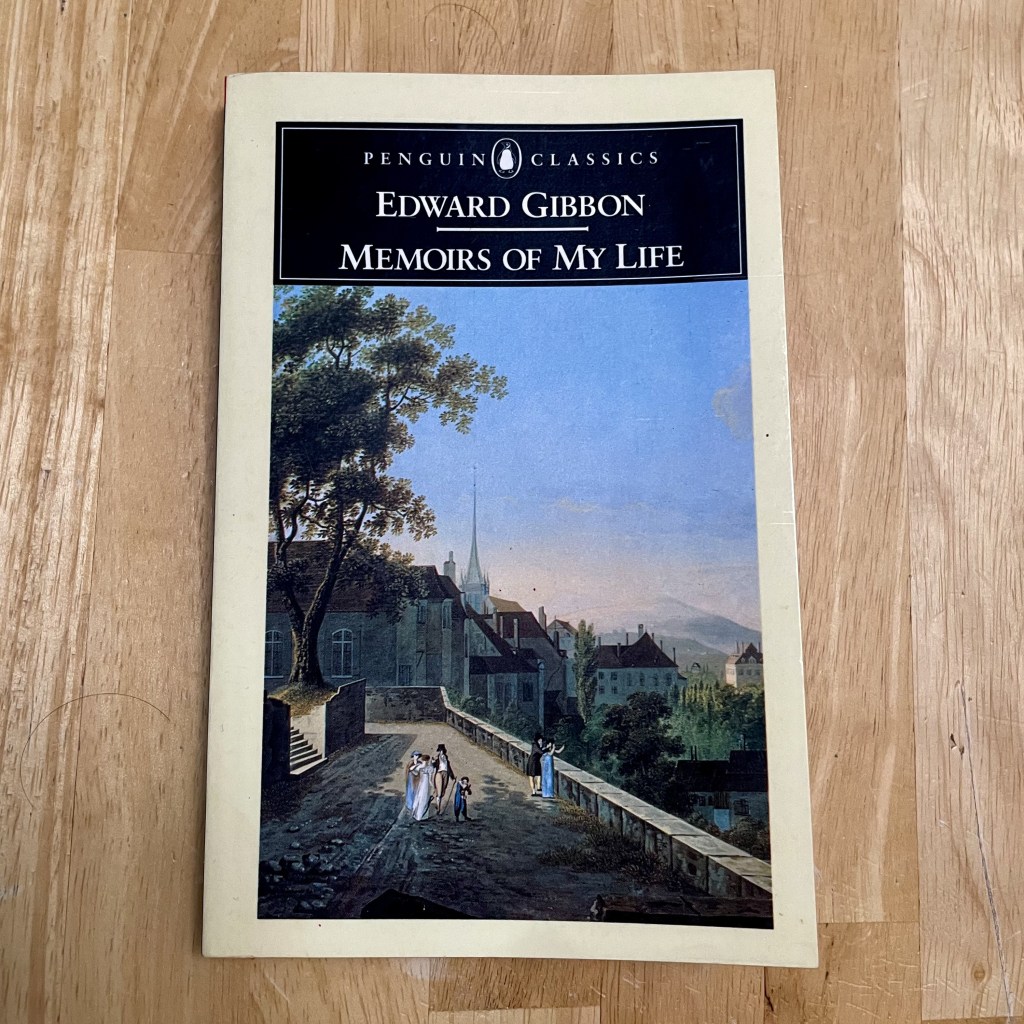
In his posthumous Memoirs from my life (1827), Edward Gibbon writes something quite striking about the modern English university in order to defend his alignment with the érudits. Now, to be an erudite was never something to be achieved at a university or academic discipline, it was something quite different in both style and form. Gibbon was quite crude when he writes:

“The schools of Oxford and Cambridge were founded in a dark age of false and barbarous science; and they are still tainted with the vice of their origin. Their primitive discipline was adapted to the education of priests and monks; and the government still remains in the hand of the clergy, an order of men whose manners are remote from the present world, and whose eyes are dazzled by the light of philosophy. The legal incorporation of these societies by the charters of popes and kings had given them a monopoly of public instruction; and the spirit of monopolists is narrow, lazy and oppressive. Their work is more costly and less productive than that of independent artists; and their new improvements so eagerly grasped by the competition of freedom are admitted with slow and sullen reluctance in those proud corporations, above the fear of a rival and below the confession of an error” [1]. 

It is worth noting that Gibbon’s defense of erudition – the same erudition that will make him undertake the genetic project of The Decline and Fall of the Roman Empire – is at least indirectly opposed to the reorganization of the university as infused by the ecclesiastical culture of priests and canon lawyers, which dominated the institution through the dogmas and platitudes legitimized by the currency of stable philosophical categories or doctrines. The university was always already an institution designed by the moral outsourcing of the intramural clerical rivalry among different levels of the administration and academic chairs. In a way, the future administrative clerk will be an impoverished version of the clerical denomination (homo homini clericus now realized through leading ‘cultural benchmarks’).

It is only at this point that Gibbon’s skeptical and ironic stance against “philosophes” – the secularized figure of the ecclesiastical priest – becomes quite clear, since the rational philosopher occupies the role of the judge in the internal institutional validity, conceptual arraignment, and liturgical enactment of the self-sufficient subject of knowledge. Gibbon reacted against this specific “Enlightenment” that harbored a universitas drenched in the undercurrents of barbarism against the ‘freedom to understand’. Or more precisely: freedom to land the sublime height of personal style. 

Under the sign of erudition, Gibbon understood tradition as a stylistic transmission that did not differ much from Hölderlin’s archeological suggestion in regards to antiquity; mainly, that formation only takes place when “we give ourselves our own direction determined by impure directions”; only this way truth-seeking can commence without prejudice and obscurantism [2]. In this light, the object of happiness must abandon the hubris of priestly academic knowledge in order to pursue the “love of study, a passion which derives fresh vigor from enjoyment, supplying research each day, each hour, with a perpetual source of independent and rational pleasure” [3]. It almost goes without saying that the fact that the contemporary university must justify every project, initiative, and prospect on behalf of current soteriological needs and values speaks to its organized alliance with barbarism against any possible form of personal erudition. But erudition, as something bestowed upon ourselves, will always persuade and humble men against the unreserved rhetorical force of the present.

Notes 

1. Edward Gibbon. Memoirs of my life (Penguin Books, 1990), 77.

2. Friedrich Hölderlin. “The standpoint from which we should consider Antiquity”, in Essays and Letters (Penguin Books, 2009),  442.

3. Edward Gibbon. Memoirs of my life (Penguin Books, 1990), 98.

Lezama Lima and the Etruscan way. by Gerardo Muñoz

Towards the end of his life, poet José Lezama Lima will mysteriously begin to sign the letters to his friends and family as “the Trocadero Etruscan”, a “member of the Etruscan religiosity”, and even the “man who lives in the Etruscan village” [1]. Why call himself an “Etruscan” in this particular moment of his life, and what could it possibly mean? The question about the meaning of the Etruscan authorial mask has been so thoroughly ignored by the literary critics that commentators at their best have noted that “being Etruscan” merely stands for his “cosmopolitanism” and “well-learned Europeanism”. Of course, this explains little to nothing. A sophisticated poet such as Lezama Lima, who ruminate over every single word he would write, could not have ignored that the Etruscans, unlike the civilized Romans and the Latin authorities, was a remnant to the very civilizational enterprise; a prehistoric people poor in written culture, achieved expressivity by the whole outlook of their form of life. And as in the case of Hölderlin’s adoption of different nom de plume (Scardanelli, Killalusimeno, Scaliger Rosa, etc), Lezama’s becoming Etruscan points to something so fundamental that if underscored we would fail to grasp the endgame of his vital poetic experience. The transfiguration of the name does not merely stand as a metaphor; rather it points to a distant figure that will finally dissolve him so that his immortal voice could continue to live on.

Indeed, the self-identification as an Etruscan for Lezama became a subterfuge to flee a political reality – his political reality, entirely structured by the revolutionary gigantic productivism and subjectivism – through a poetic refraction that would free an ethos from the overpowering of alienated autonomous space of the linguistic reproduction of social life. If at first glance it seems like a paradox that Lezama will adopt the Etruscan figure for his antisocial ethos – a civilization lacking written records or high literary achievements, a religious community known for its necropolis – this strangeness will ultimately prove that behind the Etruscan name there was no poetic exclusivity of the poet’s genius, but rather, as he claims in “A partir de la poesía”, the possibility for a divinization of reality to retreat from the historical epoch. In fact, Etruscan culture for Lezama was not a mere archeological ornament, but one of the “imaginary eras” of the West; that is, a stage of condensed and unnumbered imaginative possibilities resistant to griping subsumption and totalization of values. The Etruscan was the mythic remnant through the pantheistic divinization between language and the world. As Lezama writes glossing, in passing, Vico:

“Vico cree que las palabras sagradas, las sacerdotales, eran las que se transmitían entre los etruscos. Pero para nosotros el pueblo etrusco era esencialmente teocrático. Fue el más evidente caso de un pueblo surge en el misterio de las primeras inauguraciones del dios, el monarca, el sacerdote, y el pueblo unidos en forma indiferenciada … .les prestaba a cada una de sus experiencias o de sus gestos, la participación en un mundo sagrado. […] Pues en aquel pueblo, el nombre y la reminiscencia, animista de cada palabra, cobran un relieve de un solo perfil” [2]. 

The divinization of the Etruscans stubbornly insisted on the wonder of things. The human participation in divinity is no longer about founding a new theocracy or a “theocratic politics” in the hands of a ‘mystic accountant’ that would finally put the nation back in track (into the res publica), as Lezama would solicit out of desperation in the 1950s diaries [3]. On the contrary, for Etruscan people the fundamental tonality was the divine music of experience. Of course, we know that D.H. Lawrence captured this when claiming in his Etruscan Places (1932) that “the Etruscans are not a theory or a thesis. If they are anything, they are an experience. An experience that is always spoilt” [4]. And this experience (like every true experience) needs to be necessarily spoiled, which ultimately means that it cannot be mimetically rendered, arbitrarily modified, or subsumed into the order of idealization. But all of this is merely redundant, since the Etruscan inscription is what accounts for the limit to civilization, becoming the impossibility of the destruction of myth in the arrival of modern aesthetic autonomy. Thus, for Lezama the Etruscan way had something of a persistent cure against the ongoing civilizational disenchantment, even if it does not cease to appear in the modern attitude. In fact, Lezama writes that: “Rimbaud is the best reader of the Etruscan liver” (“hígrado etrusco”) to describe the dislocated position of the poet in the modern world of technology [5]. In the Etruscan cosmology, the liver was a symbolon of the vision of the cosmos registering the divisions of the spheres in the sky through the divine naming of the gods; it is the figure by which the poet guards the desecularizing remnant of the prehistoric inception of myth [6]. But this does not mean that Lezama will look at himself in the mirror of Rimbaud’s symbolist alchemy.

Rimbaud as an Etruscan is the poet who descends into hell because his lyricism can bear the pain in the disruption of language after the archaic peitho. Does the possibility mean a travel back in historical time? Not the least, as Lezama knew how to let go of storytelling and historical necessity. This is why Etruscans stand for an image or a sort of handwoven picture (the hand will make a comeback, as we will see) to gain vision. And this is one case on point: the Etruscan stands paradigmatically to the “sufficient enchantment” (“la cantidad hechizada”) , which discloses a higher knowledge of the soul (psychê) in the taking place of poetic errancy: “Sabemos que muchas veces el alma, al escaparse de su morada, tripulaba un caballo inquieto, afanoso de penetrar en las regiones solares” [7]. To wrestle against the historical reduction of autonomy of the modern age means to find this enchanted sufficiency necessarily for myth remnant to elevate itself against the aesthetic mediation that, in the words of Gianni Carchia, had become a consoling surrogate of the emptied historical time [8]. An entirely other conception of freedom is firmly implicated the Etruscan way: the gathering of the enchanted poetic dwelling to dissolve a reality that had become too thick in the business of brute force purporting to call ‘what’s out there’. The Etruscan reintroduces a divine nominalism of pure exteriority.

However, the Etruscan way does not commute with things of the world; rather, his soul unbinds the empirical limit of death to overcome death, and learn to live as if it were already dead. The trespassing of death through the poetic enchantment – which Lezama will also call an ‘potens etrusca’, or the Etruscan potentiality- will multiply the invisible possibilities against the rhetorical closure of reality legitimation. By accepting the thick of the dead as an illuminated presence, the Etruscans draw out the most important consequence: learning to live among the dead as the ultimate form of a dignified life. This is why D.H. Lawrence reminds us that the underworld of the Etruscans – their refusal of reality, the embrace of their dead, the augurium – was after all “a gay place…For the life on earth was so good, the life below could but be a continuation of it. This profound belief in life, acceptance of life, seems characteristic of the Etruscans. It is still vivid in the painted tombs. They are by no means downtrodden menials, let later Romans say what they will” [9].

If civilization is a construction that takes place at the crust of the Earth as some have claimed; the way of the Etruscan is a downward declination away from the architectural reduction of world sensing [10]. For Lezama the Etruscan dreams of a civilization submerged in the depths that only an acoustic totality that bear witness to its sensorial gradation: “Esas civilizaciones errantes por debajo del mar, sumergidas por el manteo de las arenas o por las extensivas exigencias…reaparecen, a veces, en los sueños de los campesinos” [11]. Hence, the fundamental dignity of poetry resides in the mythical homecoming that guards the possibility for what remains inexistent: “this is why the poet lives in the Etruscan world of the birth of fire” [12]. And although the Etruscan stands as one of the worlds in possession of an imaginary epoch (the other two for Lezama being the Catholic world and the feudal feudal Carolingian Empire), it is only in the Etruscan where the resurrection had taken the transubstantiation in the name itself; even if the price was its own liquidation as a historical people that refused to be incorporated into the doxa of postmythical order [13].  

The fiery force of the mythic peitho outlives and predates the political epoch of the nomos of fixation organized as “One People, One State, One Language” [14]. As Lezama explains in “La dignidad de la poesía”: “…el odio en la polis contra el daimon socrático, hizo que la nueva doxa no logra sustituir a cabalidad el período mítico….Si por lo mitos, los dioses se irritable con la felicidad de los de los mortales, pero al menos, se interesaban por sus destinos; en la nueva doxa, la poesis se extinguía – el daimon individual reemplazando al destino individual liberado de la polis” [15]. The primacy of myth as orientation to happiness should make clear that for Lezama the poetics of naming follows the overflow of its permanent modalization [16]. The Etruscan way marks the path for the irrevocable retreat from the space of the polis where civilization will be erected on the grounds of deliating ethos and daimon, polis and poesis, and ultimately life and death as a rubric of a new science of separation. The fact that the civilization of social reproduction has been erected on the basis of the destruction of the chthonic underworld speaks to the systematic erasure from the dead as a vital extension of life [17]. The poetic natality of the Etruscans will only be cultivated, as Aby Warburg suggests, from the assumption of deep superstition in the face of the placement of political autonomy, which allows for the persistence of the image as inseparable from the needs and uses of the living [18]. And only persistence could prepare the final triumph over death.

19
[19]

Towards the later phase of his work, the poet seems to never want to abandon the Etruscan inframundo. Lezama returns to the Etruscan scene towards the end and unfinished novel, Oppiano Licario (1977), in which the central character Fronesis describes at length the mutation of reality following the footsteps at a distance of Ynaca Licario slowly merging into the Tarquinia necropolis painted wall, which is accompanied by a visual reproduction of the Etruscan tomb:

“El sacerdote, en el lateral izquierdo, hace gestos de ensalmo en torno a una espiga de triga. Un pájaro que se acerca queda detenido sin poder posarse en el ámbito hechizado de la hoja. En el lateral derecho, el sacerdote repite idéntico rito, pero ahora de la raíz colorida hace saltar la liebre que cavaba en las profundidades. El aire cubría como unas redes de secreta protección en torno de la mutabilidad de las hojas y de la inmovil jactancia de los troncos. Una indetenible pero resguardada evaporación alcanza aquella llanura con los muertos …La conversación subterránea era el símbolo del vencimiento de la muerte. [20]

The ongoing conversation (the shared word koina ta philōn) in a mysterious divine language had triumphed over death because it had overcome death and the sight of death. It is no longer the transposition of a historical sublime that must protect experience from the fixity of the human corpse, since the soul can escape the limit of form. In passing through and embracing death, the Etruscan validated their passions for mirrors and the palm, which according to Lezama is the true keep of the appearance of the uttermost revealing of the face in its own irreducible ethos. The possibility (potens etrusca) of defeating death while in life finds in the Etruscan appearance Lezama’s most intimate poetic arcana: the persistence of the anima renounces symbolic legibility as too innocuous and ornamental; where the flags of victories now resembled an accumulation of well settled defeats nurtured in the name of the muteness over “life”.

The Etruscan distance mysterium validated myth as the affirmation of the cosmos as based on the potentiality of contemplative imagination [21]. Lezama will call this distance the “eros de la lejanía” (Eros of distance) in the experience of the inframundo that will break through by affirming the possibilities of divine naming as a correlative causation in the world [22]. As Lezama tells his sister in a letter from 1966, he had already assumed to have crossed the bridge between the dead and the living: “Para mi ya ha sucedido todo lo que podía tocarme….Pues creo ya haber alcanzado en mi vida esa unidad entre los vivientes y los que esperan la voz de la resurrección que es la supresa contemplación” [23]. Or yet again: “El que está muerto en la muerte, vive, pero el que está muerto en la vida, es la única forma para mi conocida de la vida en su turbión, en su escala musical, en su fuego cortado” [24]. To scale up life to the higher music is the final trope of happiness as already dead. The Etruscan dirita vía of descension – “a weight going down” of stepping into the Earth, as Ruskin would have it – achieves the arrest of the divine contact between the voice and the dead [25]. It is for us to raise this mirror before our impoverished and fictive unswerving reality.

.

.  

Notes 

1. José Lezama Lima. Cartas a Eloísa y otra correspondencia (1939-1976) (Verbum, 1998), 230.

2.  José Lezama Lima. “A partir de la poesía”, in Obras Completas, Tomo II (Aguilar, 1977), 831.

3.  José Lezama Lima. Diario (Verbum, 2014), 87.

4. D. H. Lawrence. Etruscan Places (The Viking Press, 1957),  90.

5. José Lezama Lima. “La pintura y la poesía en Cuba”, in Obras Completas, Tomo II (Aguilar, 1977), 968 

6. Gustav Herbig. “Etruscan Religion”, in Encyclopedia of Religion and Ethics, Volume V (Dravidians-Fichte, 1912), 533.

7. José Lezama Lima. “Introducción a los vasos órficos”, Obras Completas, Tomo II (Aguilar, 1977), 861. 

8. Gianni Carchia. Orfismo e tragedia (Quodlibet, 2019), 81.

9. D.H. Lawrence. Etruscan Places (The Viking Press, 1957), 31.

10. Amadeo Bordiga. “Specie umana e crosta terrestre”, in Drammi gialli e sinistre della moderna decadenza sociale (Iskra, 1978). 

11. José Lezama Lima. “Estatuas y sueños”, in Obras Completas, Tomo II (Aguilar, 1977), 449.

12.  José Lezama Lima. “La dignidad de la poesía”, in Obras Completas, Tomo II (Aguilar, 1977), 774. 

13. Ibid., 776.

14. Erich Unger. Die staatslose Bildung eines jüdischen Volkes (Verlag David, 1922).

15.  José Lezama Lima. “La dignidad de la poesía”, in Obras Completas, Tomo II (Aguilar, 1977), 777.

16. Monica Ferrando. “Presentazione”, in Hermann Usener, Triade: saggio di numerologia mitologica (Guida Editori, 1993).

1176.  Giorgio Agamben. “Gaia e Ctonia”, Quodlibet, 2020 https://www.quodlibet.it/giorgio-agamben-gaia-e-ctonia 

18. Aby Warburg. The Renewal of Pagan Antiquity (Getty, 1999), 189.

19. Image included in Chapter VII of Oppiano Licario (Cátedra, 1989), 375. 

20. José Lezama Lima. Oppiano Licario (Cátadra, 1989), 374.

21. Aby Warburg’s treatment of the symbolic mediation between myth and distance appears at the center of his essay on Pueblo Indians. See, Aby Warburg, El ritual de la serpiente (Sexto Piso, 2022), 66.  And also, Franz Boll, Vita Contemplativa (Heidelberg, 1920), who connects contemplari to the augur’s spatiality of the templum.

22. José Lezama Lima. Cartas a Eloísa y otra correspondencia (1939-1976) (Verbum, 1998), 411.

23. Ibid., 109.

24. Ibid., 266. 

25. John Ruskin. The Letters of John Ruskin (George Allen, 1909), 133.

Hölderlin’s song. Provisional annotations. by Gerardo Muñoz

There is a moment in Hölderlin’s late hymn “Friedensfeier” (1801) where communication is strictly defined as becoming a song. The verses in question are about midway into the poem, and we read read the following: 

“Viel hat von Morgen an, 

Seit ein Gespräch wir sind und hören voneinander, 

Erfahren der Mensch; bald sind wir aber Gesang.”

“Mucho ha, desde la mañana, 

desde que diálogo somos y oímos unos de otros, 

aprendido el ser humano; pronto empero seremos canto”.

This is the Spanish rendition by the Venezuelan poet and translator Verónica Jaffé [1]. These lines stand for Hölderlin’s unique effort during the years 1800-1804 to substantially qualify what he had confessed to his mother as his true task: to live a serene or quiet life. I think this Spanish translation is much closer to the original German. Jaffé hangs on the present perfect with conviction: “Mucho ha…”, as if knowledge remained at a distance in the metric while becoming a temporal duration, a form of experience. This is the poetic “strict mediacy” for Hölderlin that can only be cultivated [2]. And it is only through the duration of experience that one will become a song (“seremos canto”). We are not yet there, hence the apostrophe. In the late period, duration meant dealing directly with Pindar. Thus, the song is something other than language – even if announced through language. But it is a paratactic dispersion that seeks to free the pure voice. In one of the “Pindar fragments”, this is what Hölderlin claims: “then only the difference between species makes a division in nature, so that everything is therefore more song and pure voice than accent of need or on the other hand language”. [3]

I am caught up in the moment of “division in nature”. The subtraction from representational language allows for the true appearance of a more originary separation, where the song can finally emerge in its proper attunement with the world. The becoming song is another form of separation, which institutes the passage from the Empedocles (tragic sacrifice) to the Pindaric relation to the divine. This is the “highest” poetic challenge for Hölderlin – an impossible task after the fleeing of the gods. It is definitely maddening. Nevertheless, the song remains. It puts us in nearness in a postmythical world without recoiling back to the image of the tragic. Indeed, as Hölderlin says in passing in “The Ground of Empedocles”, his time already “did not demand a song” [4]. The passion for natural unity was an Olympic illusion whose retribution could only become romantic debris as the exclusive possession of the dichter. On the contrary, the clearing for the song has emancipated itself from the exclusivity of the modern autonomy of dichtung as mimetically separated from the experience of life. This is what the song wants to pursue before the closure of a significant (and signifying) world. Fundamentally, this means a subtraction from the continuum of language, and thus a form of prophecy as elaborated by Gianni Carchia in a difficult passage from “Dialettica dell’immagine”: 

“Where music and prophecy, in the inexhaustibility of their tension – an endless effort to overcome the Babel dissipation of language by freeing the residual state of the unexpressed – testify to a disposition to meet precisely in what passes, in pure transience, the need for salvation and the idea of fulfillment, beauty as a totalitarian and exclusive appearance is, on the other hand, nothing but the product of an arrest in the dynamics of the spirit which withdraws from the horror of worldly laceration to seek refuge on the scene circular and static of the eternal”. [5]

If the song addresses the prophetic it is because language has fallen to the fictitious needs that arrest the experience of the human being into the exclusivity of rhetorical force and poetic genius. Is not the song a refusal of both? A refusal now aimed at the “highest” task – that is, the serene life? Against the exclusivity of appearance that Carchia points to, what appears discloses a different sense of law. A few verses in the same poem, in fact, we are confronted with the “law of destiny”: when there is serenity (or peace) there are also words. And a few lines after: “the law of love” is equilibrium from “here” to the “sky”. What appears there is the landscape that comes through in a pictorial depiction: “[Sein bild….Und der Himmel word wie eines Mahlers Haus Wenn seine Gemälde sind aufgestellt] / “[su cuadro e imagen….y el cielo se vuelve como de un pintor una casa cuando sus cuadros de exponen]”.

Does not this also speak to the insufficiency of language, which justifies the step into a folded painting? There is a painting and a vanishing image, but also the painter marveled at gleaming finished masterpieces. Is painting the original placeholder for the song as originary attunement of life? Perhaps. But in its enactment it also means that the song is impossible to disclose except through pictorial invocation. It is a painting of a life in the world, and nothing less. The transfiguration of the law places men no longer into undisputed submission, whether in its positive or natural determinations, but rather of a “strict mediacy” that is ethical in nature. A third way of the law that does not renounce the problem of separation.

Monica Ferrando has insisted upon the enormous importance of this conception: the fact that Pindar’s nomoi, in fact, relates to the nomos mousikos, which is fundamentally dependent on gathering substance of the song [6]. The strict mediacy finds itself between the mortal and the immortal. It is definitely not a “return to the state of nature”, and I do not see how it could be reduced to “genius”, except as an ethics whereby appearing is no longer at the service of objectivity [7]. Adorno was of course right: it is a ruthless effort to deal with disentanglement of nature – and the nature of reason – but only insofar as it is a return to the song. Or, at least, to have a path toward the song: a lyricism of the indestructible against the closure of a finite time dispensed and enclosed.

.

.

Notes

1.  Friedrich Hölderlin. “Fiesta de Paz”, in Cantos hespéricos (La Laguna de Campona, 2016), Traducción y Versiones Libres de Veronica Jaffé, 93. I thank Philippe Theophanidis the exchange initial exchanges on these verses.

2. Friedrich Hölderlin. “Pindar fragments”, in Essays and Letters (Penguin Classics, 2009), 566. Kindle Version. 

3.Ibid., 565.

4. Friedrich Hölderlin. “The Ground of the Empedocles”, in Essays and Letters (Penguin Classics, 2009), 465. Kindle Version. 

5. Gianni Carchia. “Dialettica dell’immagine: note sull’estetica biblica e cristiana”, in Legittimazione dell’arte (Guida Editori, 1982), 21.

6. Lucia Dell’Aia. “Il Regno d’Arcadia: intervista a Monica Ferrando”, in Il mito dell’Arcadia (Ledizioni, 2023), 121. 

7. T.W. Adorno. “Parataxis: On Hölderlin’s Late Poetry”, in Notes to Literature (Columbia University Press, 1992), 148-149.

Hölderlin on the serene life. by Gerardo Muñoz


In a letter from the beginning of 1799 addressed to his mother, Hölderlin makes a sort of confession that fully illuminates (in a multum in parvo fashion) what he understood as a quiet or serene life. Or at least, it allows to grasp how he comes to envision it and towards what end. At first sight, what is striking is its bare literalness, too strange for a poet, and too mundane if it were not for its intrinsic lyricism. It is a lyricism that comes forth effortlessly, which speaks to the quality of its furtive testimony. Literalness is also described in its engagement with the world – and, more fundamentally, the sufficient condition for sense to emerge. This is the fragment in question (from Helena Cortés’ translation of the correspondence):

“No quise rechazar de plano para tener por si acaso una vía de escape, y sobre todo puesto que se ofrece a buscarme una plaza que consiste en acompañar a la universidad a un jovencito. Conocer más mundo (conocer el pueblo alemán le es tan necesario, especialmente a todo el que quiera convertirse en un escritor alemán, como conocer el suelo al jardinero) es al fin y al cabo la única compensación que me puede ofrecer una situación tan fatigosa, y lo alejado del lugar, que de todos modos muy lejos no puede estar de alguna universidad, me parece más ventajoso que perjudicial durante un par de años en los que aun no puedo contar con gozar de una vida tranquila entre los míos”. [1]. 

There is little doubt that the world disclosed here is well within the bourgeois interiority: there is economic calculation and anticipation. At this time Hölderlin was being offered the position of a preceptor to a university student. But there is hardly only this. There is also the affirmation of fleeing from what this world has to offer – and this means quite a lot in the early quarters of the Enlightenment. Una vía de escape – for Hölderlin the way out is not merely from economic hardship, but also the possibility to retain a certain knowledge that he dares to qualify as “of the world”: “to know the world, which is the only compensation to a fatigued situation and the remoteness of place”. Loss of fixity to place demands access to the world.

This is not your expected aesthetic education of man. The subject of the Enlightenment – its commitment to historical abstraction and the possession of aesthetic form as mediation to totality – prevails at the epistemic register at the cost of rescinding the dislocation from nature. By contrast, the knowledge implicated in knowing thy world should be like that of the soil with the gardener (pay attention to how Hölderlin inverts subject and thing: it is the ground that becomes accustomed to the gardener, and not the other way around). But at the threshold of the eighteenth century, Hölderlin’s “vía de escape” was also compensatory to the fatigue of a nascent epoch of the subject. The compensation did not entail an excess of knowledge; it was rather knowledge a way to disengage with the presupositions grounding the historical epoch.

This seems to me the operation at work in Hölderlin’s epistolary confession. Carchia was right in positing Hölderlin’s poetological aspiration of spirit and nature was entirely pre-Olympian, which requires subtracting himself from the modern parody of cultic romanticism [2]. A way out appears in cleared space when serene life is finally realized between friends; that is, among those that I make as friends (“los míos”). Poetry and making are here at their closest proximity cutting through the thicket of experience. This is what it means to know thy world. At the center of Hölderlin’s ethics there is a sense of distance – the waiting for a serene life in which language will finally gather itself unto presence. Ultimately, this is the plain literalness that the 1799 letter offers us.

.

.

Notes

1. Friedrich Hölderlin. Correspondencia completa, traducción de Helena Cortés y Arturo Leyte (Libros Hiperión, 1990), 467.

2. Gianni Carchia. “Introduzione” to Walter Otto’s Il poeta e gli antichi dèi (Guida Editori, 1991), 8.

El bien común según Hölderlin. por Gerardo Muñoz

En una carta tardía de 1837 dirigida a su amigo Karl Künzel, Friedrich Hölderlin ofrece una pequeña definición del “bien común” que merece ser atendida por la sencilla razón que el poeta se desmarca de la gramática de la secularización de la modernidad (en este caso específico, vinculado al roblema de la separación entre moral y derecho) desde la cual se dirime el fondo último de lo que entendemos por libertad. Dice lo siguiente el fragmento de la carta a Funzel:

Cuando las personas se preguntan en qué consiste el bien, la respuesta es que deben rendir su honor a la virtud y practicar en la vida aquello a lo que se comprometen. La vida no es como la virtud, porque la virtud concierne a las personas y la vida está más alejada de ellas. El bien también está constituido en general por la interioridad de las personas. Al amable caballero se recomienda. Buonarotti.” [1]. 

La condensación del fragmento nos exige que separemos distintos elementos para alcanzar la mayor claridad posible. En primer lugar, Hölderlin pregunta por el bien y alude a la vida, lo cual sería consistente con cierta concepción aristotélica de la virtud y la prudencia de la persona, aunque rápidamente contradice esta predicación (en otra instancia hemos comentado la operación de la legitimidad del predicado), puesto que “la vida no es como la virtud”. No existe tal cosa como vida virtuosa porque no la virtud no coincide con las obras del actuar. Pero en un segundo paso contemplamos algo más contundente en el movimiento de Hölderlin: a primera vista uno pensaría que el bien se fundamenta en una impersonalidad substantiva (o incluso, en su acepción moderna, en una tipología de bienes) tal y como lo define el derecho natural en su ideal moral, aunque no es este el caso.

Hölderlin no parece transitar por este terreno ya que la virtud está alejada o separada de la vida, y el bien esta constituido por la ‘interioridad de la persona’. Hölderlin no dice el bien es la persona, o la persona porta el bien, sino que alude una dimensión que se separa con respecto a la vida. De esta manera, Hölderlin esquiva fundamentar el bien en una antropología humana, al mismo tiempo que se aleja de una separación trascendental del principio teológico-político; a saber, que el mundo es “bueno” (o tiene la posibilidad), y los hombres son malos, tal y como Carl Schmitt fijaba las condiciones de la teología cristiana en el temprano “La visibilidad de la Iglesia” (1917).

¿Dónde se encuentra, entonces, el “bien común” según Hölderlin? Pues, podríamos decir que en divergencia de la vida y sus formas, en el sentido de que la “vida” no es ni la oposición al mundo ni tampoco en la adecuación contenida en la persona. En este sentido la “vida más alejada” es homologable al enigmático verso del cual fuera su último poema “La visión”: “Cuando a lo lejos va la vida habitante de los hombres…” [2]. El bien común, por lo tanto, es el abismo entre la vida y sus medios cuya expresividad más pura es la palabra o la poesía, aunque no como unidad de la representación, sino como modos posibles e irreductibles. El bien común, entonces, es lo que siempre resta a la vida de toda comunidad, y lo que persevera en las formas de ser de cada cosa. Ni la política ni la moral puede legislar el abismo en el que acontece una forma. Esta separación de toda ‘obra de la comunidad’ se hace explícita en la pregunta de su ensayo sobre la obra de teatro de Schmid: “Los discursos, cuanto más extravagantes tengan que ser en lo común o en lo no común, ¿no tienen también que interrumpirse con tanto mayor rapidez o fuerza?” [3].

El bien común de la vida, carente de una mediación estricta con la naturaleza, lleva al colapso todo intento de actualizar la libertad como síntesis entre derecho y razón. Esto quiere decir que a la pregunta del joven Hölderlin ¿Dónde puedo encontrar una comunidad?”, el último testimonio en torno al “bien común” respondería: no hay síntesis mediante la comunión, solo abismo como “suprema antiforma o poesía de la naturaleza”. Lo que tiene lugar es la abdicación de cada vida en lo común. Pero esta abdicación es la única posibilidad de retener la disyunción ética entre el “bien” del alma y el común que “evidencia un cuerpo viviente” [4].

.

.

Notas 

1. Friedrich Hölderlin. Correspondencia completa (Hiperión, 1990), 581. 

2. Friedrich Hölderlin. “La visión”, en Poemas de la locura (Hiperión, 1998), 139.

3. Friedrich Hölderlin. “Sobre la pieza de Siegfried Schmid La Heroína“, en Ensayos (Hiperión, 1976), 119.

4. Friedrich Hölderlin. “La satisfacción”, en Poemas de la locura (Hiperión, 1998), 139.

Glosses on Federico Della Sala on tragedy, comedy, and revolution. by Gerardo Muñoz

These are further notes on the mini-series of interventions within the framework of the course that I am teaching at 17 instituto on contemporary Italian political thought. In this third installment we engaged with Francesco Guercio and Federico Della Sala around the notions of comedy and tragedy in Italian theory, and the development of political reflection in Italy from the sixties onwards. Della Sala facilitated an excellent paper entitled “Tragedy and Comedy in Italian Theory: Notes on the intersection between literature and politics” (for the moment unpublished), which was extremely suggestive, elegant, and comprehensive in terms of its critical take on the horizon of Italian theory. These notes are by no means representative of the richness of Della’s text: rather, it just wants to highlight a few checkpoints to further the discussion of the seminar. Francesco Guercio participated in the conversation as a commentator who provided important insights on several of the essay’s critical movements.

1. In his paper, Della Sala offers one of the strongest critiques of Italian theory that I have read in recent times (perhaps the strongest), and it does so by engaging its own premises on alterity and historical restitution, which he defines as working within the paradigm of political modernity. As it emerges in the projects of Massimo Cacciari, Roberto Esposito, Antonio Negri, but also in the commentaries of the so-called Italian difference paradigm by academics such as Dario Gentili, the common terrain is to sustain a paradigm of alternative modernization rooted in difference and conflict. In a way – and I understand I risk of simplifying Della Sala’s layered argument a bit – Italian theory amounts to offering a paradigm that remains within the metaphysics of power and governmental optimization, even when it speaks the language of contingency, errancy, or the outside. Here Della Sala’s critique of Italian theory differs quite substantially from the normativist accounts raised against Italian theory, such as that of P. P. Portinaro, whose discomfort is really against political excess and its allegedly revolutionary principles. For Della Sala, on the contrary, Italian theory is a betrayal of thinking the transformative politics at the threshold of the ruins of modern principles of authority and legitimacy. Indeed, Massimo Caccari’s return to renaissance humanism in his Mente Inquieta: saggio sull’Umanesimo (2019), or Esposito’s Pensiero istituente (2021) that ends up defending human rights and anthropology of rights, ironically self-serve Portinaro’s critique of the “radical excess” as if inadvertently admitting the irreversibility of political modernity. Of course, this doesn’t get out anywhere. In fact, it is regressive, instead of moving thinking forward.

2. Della Sala credits Italian theory – specially from the 1960s onwards, perhaps from the work of Mario Tronti and autonomia more generally – with bringing the question of politics to the center debate, showing the limitations of political economy in Marxist thought and the insufficiency of the negative. But, at the same time, it has done so by remaining within a paradigm of crisis in which the ideal of struggle defines the meditation between politics and life. And this can only exacerbate the administration of a catastrophic of politics. It is through the “krisis” of negative thought (Cacciari, Vattimo, and Esposito) that something like a literature of Italian theory becomes tragic, amounting to a sort of reverse nihilism. Della Sala does not it claim it explicitly – and I wonder if he would agree with my own personal translation – but this tragicity results to a compensatory wager to the sacrificial horizon of the philosophy of history opened by Hegelian dialectics or the imperial romanitas conception of politics. So the sense of the tragic in modernity can live comfortably within the paradigm of the sacrifice of modernity, and it does not get us very far.

3. As Francesco Guercio also suggested it, the abyssal ground of modernity becomes tragic when it places life in the site of death, which entails that existence can only be understood as something to be administered and protected. It goes without saying that this is the overall project of positive biopolitics and immunity in the horizon of democratic legitimacy, whose final utopia, according to Della Sala, is to live at least one day like a King. This rings true given the operative function of King and “archē” (principle) that are needed to legislate the creation between politics and life, history and the anthropological sense of reality. Under this paradigm there is no space – or it is always parasitic, always subjected to the enmity of the species– to the question of existence, which becomes a generic aggregate of civil community. But can one subtract oneself from the seduction of a demonic politics and its negative relation to the tragic politics in the face of nihilism? The strong thesis in Dalla Sala’s paper is that Italian theory has not been successful to the task and that we must begin from scratch putting aside, once and for all, the mythical paradigm of crisis.

4. It is here where comedy enters. And it enters obliquely, although in resonance with Giorgio Agamben’s most recent argument in his book on Hölderlin, where the comic is understood as a retreat from the conversion of the tragic into the sacrificial suture of modernity. And for Della Sala, but also for Agamben, comedy has little done with the anthropology of laughter or the psychic drive of the Freudian slip. Rather comedy becomes the possibility of imagining a life that refuses the promise of living like a future king. On the contrary, the motto of the comic can be the early Hispanic (it was mentioned by Francesco Guercio in the conversation) “vivir desviviéndose” of the pícaro existence that allows for the mystery of life without political subsumption. Della Sala concludes his paper with a provocative assertion: “after all there has never existed nor will exist a tragic or unhappy revolution”. But would a “happy life” be consternated about revolution, or should it forfeit revolution to the trash bin of the modern political concepts? Isn’t comedy the abdication of revolution, either as the return to the same (think of Saint-Just naturalism) or the overcoming of the temporal order of the day after tomorrow? Perhaps comedy as the texture of life is a thorough abandonment not only of the tragic, but also of the efficacy of revolution as a residual messianism. And it is against the closure of revolution (because revolution depends on a principle of authority the exact moment that it triumphs) where the ongoing stasiological present should be thought.

Clandestine life in the open. by Gerardo Muñoz

In the very last article that Maurice Blanchot wrote for the collective publication Comité in the wake of May 68, he draws a scenario that is still very much with us in the present. The “realism” is almost outstanding when Blanchot writes the following: “…from now on I will hold onto an exigency: to become fully conscious that we at the end of history, so that most of our inherited notions, beginning with the from the revolutionary tradition, must be reexamined and, as such, refuted. Let us put everything into question, including your own certainties and verbal hopes. The revolution is behind us: it is already an object of consumption, and occasionally, of enjoyment.” [1]. There was no question that the crisis of the very foundation of modern political thought has collapsed, including, as it couldn’t be otherwise, the generative principle of revolution. Blanchot did not even attempt to convince himself that the revolution could be brought back in an astronomical sense to revitalize a naturalism previous to Rousseau’s social contract.

So, for Blanchot the revolution was over, and yet, whatever it was that followed had no name. What was left, then? In order to avoid paralysis, Blanchot toyed during those months at the Comité (September-December 1968) with two possible maneuvers. The first position resided in what he called the “movement of possible speech” in order to establish an ardent and rigorous relation between the sequence of the French May and the Czech May, Soviet domination and Gaullian State. Blanchot called for (in the spirit of Bataille) a “transgressive speech”: “the impetus of outrageous, ways speaking beyond, spilling over, and thus threatening everything that contains and has limits” [2]. But we know that transgression is still within the logistics of the administration of order and temporal containment of the regulated exception. This was, in fact, the very rupture of the revolutionary break that was in crisis.

But Blanchot was up to something along with his friend Dionys Mascolo in thinking through language and communication as a path towards the outside. Hence the second option, which is really a third option (after the sleepwalking of ideological revolutionary ‘racketing’ of voluntarism); mainly, what he calls, although does not get to tease it out, the “clandestine resistance in the open”. Blanchot only tells us what he is thinking about through a recent example: some members of the Czech resistance when law was suspended had to confront the raw enemy military power, but they also experienced a freedom “through words and through writing than ever before”, tells us Blanchot. But this still does not explain much, given that if there is a naked military power threatening us, how could something like a clandestine form of life take place in the open? And at what risk?

I think one way to read this incorrectly or insufficiently would be to think of Blanchot’s suggestions as a sort of martyrdom or self-immolation. But it is no less true that Blanchot wanted to avoid a sort of Batallian “inner experience” or monastic xeniteia. Thus, he “refused” the fiction of self-clandestine life as sponsored by the Situationists; while, at the same time, also rejecting subjective revolutionary militancy. A third way emerges: the clandestine life into presence by way of friendship. A new “estilo de vida”, which I think could be read in the way that cryptojews and averroists lived in early Modern Spain: “a modo de sociedades secretas o semi-clandestinas, deben haber concebido la filosofía como un estilo de vida para sus iniciados…” [3]. Unlike the bogus image of the secret society as an alienated community of knuckleheads, I think what emerges in the clandestine open region is a form of shared friendship that does not retreat from the world, but rather that is capable of living in it. This was most definitely the transformative practice that during these years, Dionys Mascolo, dared to call the communism of thought that for him belonged to Hölderlin rather than to Marx. If open conspiracy is an act of the sharing and participating in language without meaning or command dependence, then this is already a poetic practice. After all, for Hölderlin the poets reveal an originary loss from nature. It is no surprise that Hölderlin favors a world opening even after the destruction of the leader-figure of the poet (Empedocles).

So, there is only clandestine life in the open when the sharing of language among friends take place (an event). This use of language is always harboring on the threshold of the last word to come. In short, the clandestine form of life has nothing oblique with respect to the world – it is not necessarily the space of an infinite night of contemplation, and it is also indifferent about fugitivity – it demands a return to appearance by way of experience. This might explain what Gilles Deleuze tells Dionys Mascolo at the end of their correspondence about friendship and thought: “it is a question of what we call and experience as philosophy” [4]. This form of experiential thought against the dissatisfaction of political domestication points a way out. For Blanchot this was a “fragmentary, lengthy, and instantaneous” path; a conspiratio unlocked by philia.

.

.

Notes

1. Maurice Blanchot. “On the Movement”, in Political Writings 1953-1993 (Fordham University Press, 2010), 106.

2. Maurice Blanchot. “Clandestine resistance in the open”, in Political Writings 1953-1993 (Fordham University Press, 2010), 106.

3. Francisco Márquez Villanueva. “El caso del averroísmo popular español”, in Cinco Siglos de La Celestina: aportaciones interpretativas (1997), 121-134.

4. Gilles Deleuze. “Correspondence with Dionys Mascolo”, in Two Regimes of Madness (Semiotexte, 2007), 332-338.

The politics of schism: theses on Dionys Mascolo’s La révolution par l’amitié (2022). by Gerardo Muñoz

1. Remembrance without restitution. The publication of Dionys Mascolo’s essays in La révolution par l’amitié (La fabrique, 2022) opens a path to a singular thinking that refused to conform to a master thinking, and even less what has come to us as political theory, or radical critique. Theory and critique have shown their resilient adaptiveness to university discourse. Thinking, on the contrary, moves annexes a relation with the missing word. This caesura negates the closure of both politics and community, it shows its insufficiency. In a letter to Maurice Blanchot regarding his ceased friend Robert Antelme, Mascolo comes to terms with this specific question: the remembrance of what loss in the actual word is – the voice of his friend Robert Antelme – what cannot be posited as a restitution of representation, but rather as effective effort to transcend mutism and silence that would have sunk writing into a pathos not short of a “miserabilist” stance [1]. The exigency of language is absolute. In an analogous way, we can say that the writing in La revolution par l’amité (La fabrique, 2022) is not a matter of restituting the history of Marxism, the intellectual debates of French theory, or even the burial site of a thinker that rejected repeatedly the metaphysical function of the public intellectual (a sort of captain at the steering wheel of public opinion, a cybernetician); but rather the remembrance that thinking is the irreductible site of common to the species. Remembrance has no “archive” and it does not produce anything; on the contrary, it invites a path to thinking in order to bring the absolutism of reality to an end.

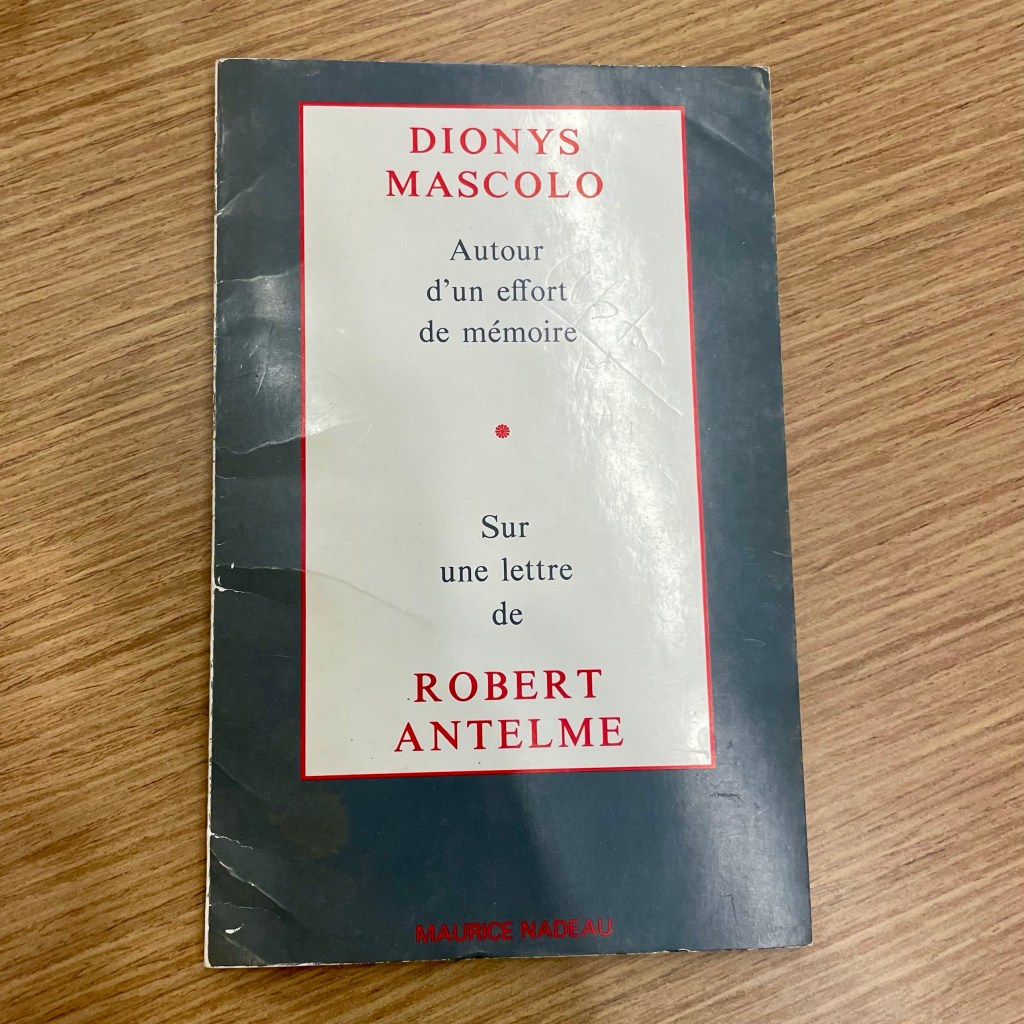
2. The irreducibility of the species. For Mascolo – as for Nicola Chiaromonte – the stimmung of the modern age is not a lack of faith, but a bad faith subscribed by the subject of knowledge, a guardian of the nexus of legitimacy. In his practice of writing, Mascolo explored something like a countermovement to the rationality of the intellectual posture, in which communication ceases to be a common means in order to become a production of ends and instrumentality. Hence, what Mascolo called the “part irreductible” – and its “doubt in any system of organized ideas in sight” – is the only intuition of the unity of the species in communication. And if the intellectual is an organic unity of hegemony that replaces the function of the priest in the Church bureaucracy and its paideia (recall Antonio Gramsci’s “organic intellectual”), for Mascolo irreducibility in the sharing of thought in communication is “not political” as he states in Autour d’un effort de mémoire – Sur une lettre de Robert Antelme (1987). This step back from the production of modern politics thoroughly imagines another figure of communism. It is at this point where the whole Cold War polemics between humanism and anti-humanism is destituted internally: the species finds a way out of political domestication.

3. Communism of thought. We can understand why for Mascolo “the word communism really belongs more to Hölderlin than to Marx, as it designates all the possibilities of thought; that which escapes in thinking, and only that can constitute its work (oeuvre)” [2]. In other words, communism for Mascolo is not a matter of doctrine or an Idea, nor about philosophy of history and its inversion; it is not about a political subject or a unity of organization of political force; communism is a use of thought in language in proximity with what escapes in every communication. The inoperative communism, hence, is only possible in friendship, as a continuous experimentation of taste that cannot coincide with a community form. As Mascolo writes in his essay on Antelme: “We did not live in community. This is a deceptive word…we existed in a sentiment of mutual gift of freedom” (53). Any reinvention of a politics to come after the collapse of authority must commence with this rejection of a compensatory communitarian closure. Today only a conspiratio between friends can animate a new field of intensification for renewal.

4. Refusal and friendship. Even in his earliest stages of writing such as “Refus incoditionnel” (1959), the condition for friendship for Mascolo is to refuse the current state of things; to retreat from the demand of reality in order to survive in the imagination of the shared word. In this sense, the thematic of friendship does not make subjects of duty towards a social bond, but rather a secret in the word designated by separation. Friendship floats high above symbolic representation, as it moves to an inclination that is singulare tantum. If modern politics thought itself as a repression and administration of the hostis; for Mascolo the practice of friendship is the sacred space that is never inherited, but, precisely the dwelling of those who “seek” after in the wake of the homelessness of man and nature. This is analogous to Hölderlin’s allowance of thought which moves in passion while accounting for the abyss of our relationship with the world (aorgic) of originary detachment.

5. Revolution as style. In a brief text on the Cuban revolution of 1959, originally written for the collective exhibition Salón de Mayo in Havana, Mascolo says a new revolution in the island could potentially offer a the opportunity of a new style [3]. Of course, as soon as Fidel Castro supported the Soviet invasion of Czechoslovakia in 1968, it was clear that such promised crumbled, and that the Revolution will fall well within the paradigm of the metaphysics of historical project and the subject (“a new man”). But what is style? Once again, this speaks directly to Mascolo’s passion for the irreductible outside of the subject, and for this reason never alienated from the schism of the species. The notion of style relates fundamentally to our exposition to the outside, to the event of expropriation, which defines our fidelity to the invariant dimension of our character. A new style, therefore, is not something to be produced, an effect of the subject, but rather the unit of an ethical practice in our encounter with the outside. If the apparatus of the revolution was instituted as a the production of a civilization; the fidelity to a style names the modes of life that cannot be oriented towards a specific work. A new aberrant freedom emerges.

6. Saint-Just’s ethos. Mascolo never ceased to reflect on the ethical determination of politics, against politics, and for a transfigurative notion of a politics for the here and now. And he dwelled on this problem in his writings on the ethical figure of Saint-Just during the French Revolution (“Saint Just” and “Si la lecture de Saint-Just est possible”). Unlike the monumental historiographies – both left and right, revolutionary and conservative, historicist or revisionist – that situated the revolutionary under the sign of Terror and Revolution, of will power and the emergency of Jacobinism; for Mascolo Saint-Just stands a figure that keeps an important secret. And this is it: “the inhumanity of Saint Just is that unlike many men, he does not possess many lives but only one” (130). This is a concrete definition of a ethos that is irreducible to the “monstrous arts of government” in an epoch where the political had become the secularization of fate. In the same way that Hölderlin turned his gaze towards the impossible and concealed distance of the moderns in relation to truth of the Greeks, for Mascolo’s Saint-Just the legitimacy of the modern universalization (in the State, the Subject, the Social) does not have the last word. The ethos of life keeps the remembrance of an abyss of the monstrosity of historical universality and the social equality.

7. Borrowed existence. Dionys Mascolo lived at the dusk of the modern arch of the revolution, whether understood as eschatology or a conservation of the natural order of the species, as Saint-Just proposed against the Rousseaunian social contract and the Hobbesian mechanical Leviathan in exchange for authority. We have already crossed this threshold, and we are in the desert of the political, retreating on its shadow fallen into administration of fictive hegemonies. Hence, the question of an ethos of existence becomes even more pressing from Mascolo’s thematic of friendship in order to refuse what he calls in “Sur ma propre bêtise et celle de quelues autres”, a “borrowed existence in a comedy that feels as if we are being watch by God alone” (219). Indeed, as some have diagnosed with precision, the religion of our time is absolute immanence, the full disposition of the tooling of our means [4]. A cybernetic dreamworld, whose pathetic figure is the “influencer” (a few strata beneath the luminosity of the intellectual). This can only fix us into the stupidity of intelligence of the species: specialized intelligence, in other words, prisoners in the sea of nihilism. The intelligence of the species, on the contrary, is the cunning (methis) of the fox: a way out in spite of the swelling tides. But against the nihilism of a borrowed life of immanence (beatitude of the impersonal, and iconicity of things), Mascolo’s thought insists stubbornly in friendship as the initiation in an uncharted path to reenter the world once again.

.

.

Notes 

1. Dionys Mascolo. Autour d’un effort de mémoire: Sur une lettre de Robert Antelme (Maurice Nadeau, 1987). 

2. Ibid., 50.

3. Dionys Mascolo. “Cuba premier territoire libre du socialisme”, in A la recherche d’un communisme de pensée (fourbis, 1993).

4. Lundi Matin. “Éléments de descivilisation. Partie 4”, Lundi Matin, 2019: https://lundi.am/Elements-de-decivilisation-Partie-4

Fijándose de un salto: notas sobre La muerte de Empédocles, de Hölderlin. por Gerardo Muñoz

¿Cómo entender la elaboración trágica del drama de Empedocles de Hölderlin? Se trata de otro intento de abordar la relación disyuntiva entre la sensibilidad moderna y la génesis griega tras la fuga de los dioses. En un importante ensayo sobre La muerte de Empedocles, Max Kommerell se refiere a esta tragedia como la construcción de un “género en desocultamiento” [1]. Ahora bien, lo que se deja ver no es un rasgo elemental ni el error trágico del personaje, sino algo más originario; algo que Kommerell designa bajo un concepto de intimidad, que en su retirada “mora con el otro” desde su singularidad irreductible. Este movimiento, como lo es también el del propio Empedocles, viejo poeta-filósofo-profeta del mundo, se asume como recapitulación, y por lo tanto solo ejercicio en el umbral de la vida. Para Hölderlin, por lo tanto, estaríamos ante la “restitución” de lo infinito en lo finito de la vida, una sutura en declinación desde la cual podemos contemplar, a todas luces, la catástrofe del momento desde la cual emerge el mito de la autoafirmación del hombre. Este es el primer momento de “separación” de la physis, entre lo orgánico y lo aórgico, que tan solo puede ser la formación de lo que ya ha “acontecido”. Empedocles encuentra la inestabilidad del hombre en la génesis de la separación de la presencia.

De manera que no hay posible edificación de mito (típicamente prometeico), como el esbozado por Goethe y luego tomado por la figura del artista de Nietzsche, puesto que Hölderlin lleva al creador ‘súperhombre’ a la ruina. Y más aun: la ruina de este poeta profeta también supone la desintegración del pueblo como unidad orgánica ante un mundo que ahora pasa a ser abismal. En palabras de Kommerell: “abierto a una religiosidad amorfa de una época abierta después de su colapso [2]. Es por esta razón que no hay en Empedocles una figura carismática interesada en abrir la energía para una época entre una comunidad existencial. Como vemos entre los personajes del drama, Empedocles solo se autoreconoce en la amistad bajo el claro de los dioses fugados que alguna vez habían depositado en él la irradiación de una trascendencia ilimitada.  

A diferencia de lo que se ha notado de La muerte de Empedocles como la afirmación de lo trágico bajo la figura sacrificial de poeta genial (hiperbólica de toda una época romántica subjetivista según nos dice Carl Schmitt en una entrada de Glossarium); la fuerza infinita del personaje desplaza y pone en suspenso el personalismo del poeta y el mando por liderar el encuadre objetivo del mundo. Pero esto solo puede hacerse – o así lo hace Hölderlin – a partir de un concepto de religiosidad interior como sustrato de proximidad que pone en crisis lo subjetivo y lo objetivo. Y para esta frontera común-en-separación no hay administración ni guías posibles. Por eso se cerraba el eón de los profetas en comunidad. Aquí Hölderlin se adelantaba a las críticas illichianas a la figura del sacerdocio como figura de la representación eclesiástica de las almas. La crítica al sacerdote en La muerte de Empedocles es explicita: “Fuera! No puedo ver ante mi al hombre que ejerce lo sagrado como industria. Su rostro es falso y frio y muerto, como lo son sus dioses…Concededme la gracia de recorrer tranquilo el sendero por donde ando, el sagrado sendero callado de la muerte” [3].

Kommerell sugiere que más que una factura del mitologema, estaríamos asistiendo a nuevo tipo de religión o de religiosidad transfigurada que se vincula de manera directa a la intimidad, que resuena con la phygen neoplatónica. La verdad oscura o enigmática de Empedocles es la reserva de una proximidad infranqueable – pero también inmedible, en su cesura constitutiva – entre la organización humana de lo sagrado y el tiempo destituido tras la consumación de los dioses entre los seres vivos. El gesto de Hölderlin, sin embargo, a diferencia de la impronta cristológica, capaz de deificar una comunidad a partir del principio de gracia y del pecado, se ve justificada bajo el trabajo infinito de la reconciliación entre lo orgánico y lo inorgánico. Esta franja es lo que pudiéramos llamar una zona invisible, en la que la recapitulación orienta un destino singular e irrepetible. En última instancia, este es el único fundamento de Empedocles. La teología transfigurada de Hölderlin evita el paso de la catástrofe de la separación sin abastecerla con un principio del medio, extratemporal para la comunidad en espera.

En otras palabras, Hölderlin quiere morar entre el derrocamiento del basileus y el advenimiento de la isonomia como administración de las cosas (polis). De ahí que, en la segunda escena, Empedocles refiera al fin de la época de los reyes, de los archêin: “Avergonzaos de desear aun un rey; sois demasiado mayores; en tiempos de vuestros padres, las cosas habrían sido diferentes. Nos os ayudara, sin nos ayudáis vosotros mismos” (91). Podríamos leerlo en paralelo con el Hölderlin histórico: ni reyes, pero tampoco con los poetas. En Hölderlin esta apertura no signa un momento “constituyente” o instancia que prepararía la realización del ideal estatal de la historia hegeliana, tal y como en su momento pensó Dilthey [4]. La puesta en escena, al contrario, intenta afirmar la destitución misma de la unidad facilitada por la efectividad de las mediaciones en conflicto (poeta-palabra, rey-pueblo, sujeto-objetividad).

En “Fundamento para el Empedocles”, leemos: “en donde lo orgánico que se ha hecho aórgico parece encontrarse de nuevo a sí mismo y retomar a sí mismo, en cuanto que se atiene a la individualidad de lo aórgico, y el objeto, lo aórgico, parece encontrarse a si mismo, en cuanto que, en el mismo momento en que adopta individualidad, encuentra también a la vez lo orgánico en el más alto extremo de lo aórgico, de modo que en este momento, en este nacimiento de la más alta hostilidad, parece ser efectivamente real de la más alta reconciliación.” [5]. La descomposición objeto-sujeto queda sublimada a las condiciones de un nuevo expresionismo, puesto que en el “día de la separación, nuestro espíritu es profeta, y dicen verdad los que no van a volver” (97). Solo el espíritu de la intimidad puede tomar el lugar del profeta en toda su expresión. Es así como se instituye un destino singular que se resiste a las transferencias secundarias (el pueblo amado).

Pero, ¿por qué aparece eso que Giorigo Colli llamó el triunfo de la expresión en Empedocles? El mismo Hölderlin encara esta pregunta en un momento decisivo de “Fundamento para el Empedocles”: “Pero ¿en qué puede consistir esta expresión?, ¿qué cosa es aquella expresión que, en una relación de esta índole, satisface a aquella parte que al principio era la incrédula?, y en esta expresión estriba todo, pues, si lo únicamente tiene que perecer, es porque apareció de modo demasiado visible y sensible, y sólo es capaz de esto por cuanto se expresa en algún punto y caso muy determinado” (115). La expresión en Empedocles constituye el momento del nacimiento de los sentidos, por los cuales accedemos no solo al mundo, sino a los propios colores y al claro de la existencia [6]. Ahora la visión no es metáfora suplementaria del logos, sino una tecnología en la que podemos navegar lo visible así como el pasaje indeterminado del mundo de las formas. La tarea del poeta-creador como Empedocles no reside en la factura de la palabra profética que ha sido llevada a su recapitulación (su cumplimiento), sino hacia lo más inacabable de los sentidos vitales: el amor y la repugnancia. Es esto lo que nos recuerda Hölderlin. Y son el amor y la repugnancia porque es desde estos dos grados de afectación que se pueden manejar las variaciones de la fuerza tras la retirada de la unidad y el fin de las revelaciones.

Se trata de dar un salto y efectuar un movimiento. En el inciso sobre Empedocles en su La naturaleza ama esconderse, Colli se detiene en este salto tal y como aparece en el fragmento 110 del filósofo presocrático: “en efecto si de un salto fijándote en tu densa interioridad inspirado contemplarás los principios con puro anhelo”. Este fragmento capta, nos advierte Colli, el íntimo sobresalto que intensamente separa y forma. Una interioridad que es exploración de una potencia, pero solo en la medida en que permite la percepción de toda la irreductibilidad de los mundos [7]. Esta fijación en el salto es apertura al acontecimiento coreográfico de un ser-fuera-de-si desde la cual la realidad no llega a petrificarse, porque permanece bajo el dominio de una potencia intransferible, una expresión sin objeto y sin dios. 

.

.

Notas 

1. Max Kommerell. “Hölderlin’s Empedocles Poems”, en Philosophers and Their Poets (SUNY Press, 2019), ed. C. Bambach & T. George, 239-261.

2. Ibíd., 257. 

3. Friedrich Hölderlin. La muerte de Empedocles (Acantilado, 2001), 36.

4. Wilhelm Dilthey. “Friedrich Hölderlin (1910)”, en Poetry and Experience (Princeton U Press, 1985), 350-368.

5. Friedrich Hölderlin. “Fundamento para el Empedocles”, en Ensayos (Editorial Ayuso, 1976), ed. F. Martinez Marzoa, 133.

6. James I. Porter. The Origins of Aesthetic Thought in Ancient Greece (Cambridge University Press, 2010), 154-155.

7. Giorgio Colli. La naturaleza ama esconderse (Ediciones Siruela, 2008), 191-215.