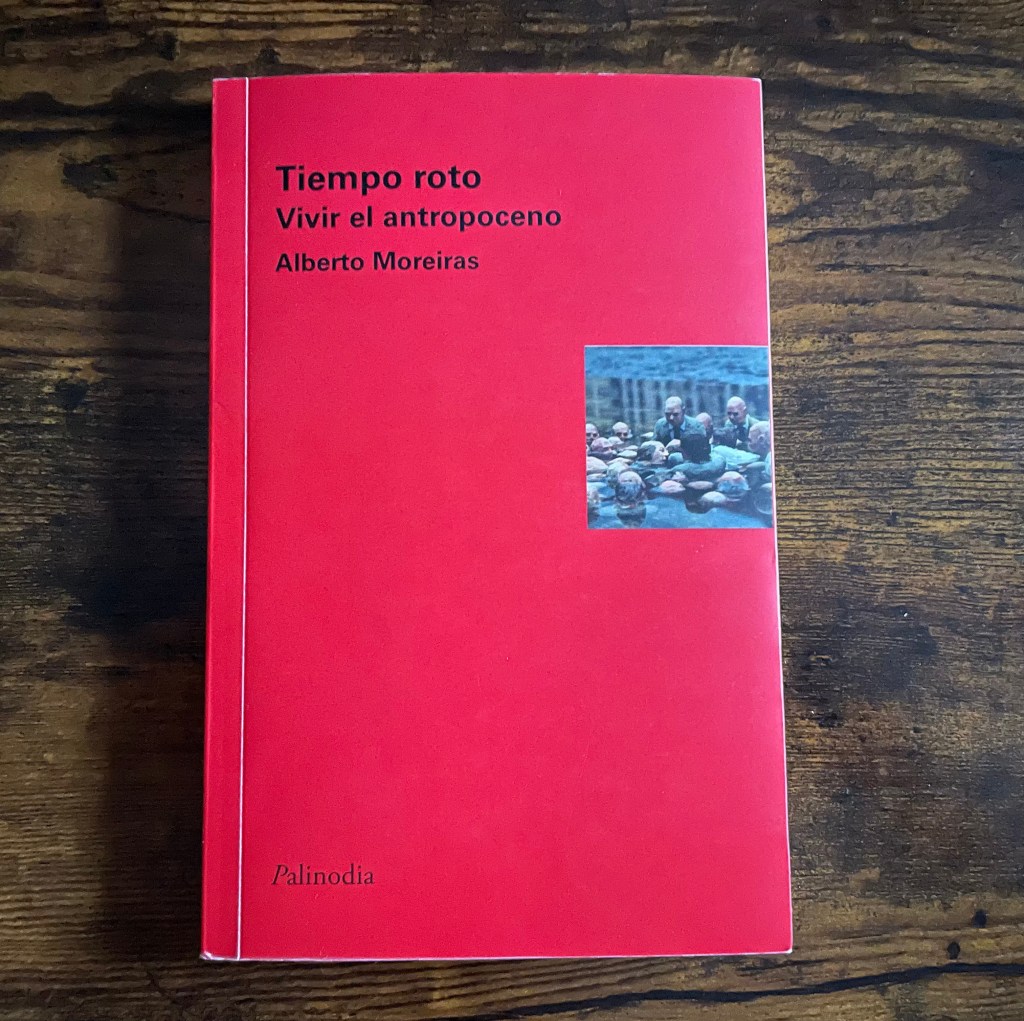
The task of the other beginning. On Alberto Moreiras’ Tiempo roto: vivir el antropoceno (2024). by Gerardo Muñoz

The sudden and uninvited intrusion of Gaia in our world is something rather strange, and yet consistent with the closure of the metaphysical tradition. The call of the outside takes place at the threshold of our reflexive capacities, habits, and mental propositions in our relation with the world, which demands everything to be thought from scratch. The historical imbalance in groundlessness now requires a new task for thinking – the imperative that runs through Alberto Moreiras’ most recent book Tiempo roto: vivir el antropoceno (Palinodia, 2024). The theoretical constellation deployed over the course of a decade now comes to the forefront with extreme urgency – I am referring to marranismo, posthegemony, aprincipial anarchy, and of course, infrapolitics. Tiempo roto (2024) is not a systematic culmination of Moreiras’ philosophical (or antiphilosophical) project of thought, but it is definitely a mature elaboration insofar as the field of problematization enters a hitherto unexplored thematics of late heideggerianism. All things considered, the emerge of the anthropocene as an explicit planetary endgame and the new beginning necessarily move pass the conditions of both political and scientific praxis, which today can only effectively adequate itself into positionality (the so-called Gestell) and objectivity of a world that slowly seems coming to its end. 

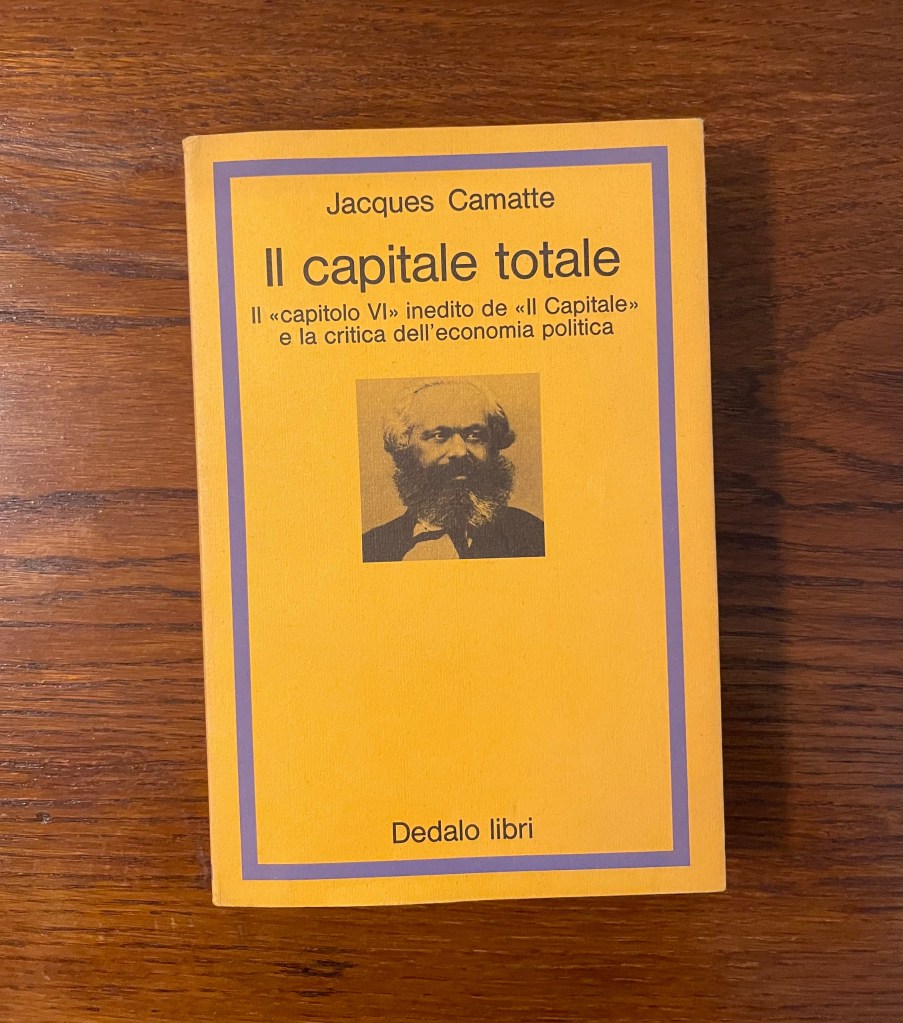
It might be worth remembering that the notion of “other beginning” (“otro comienzo”) in the wake of civilizational decline was already proposed in the book Sosiego siniestro (2020), but it was far from being thoroughly explained [1]. Following Heidegger’s philosophical scene, representational thought in the tradition of adequatio of the Thomist gnoseology coincides with technological administration of every living entity (Moreiras 14). But Heidegger’s suggestion in the Parmenides that calculative representation fails as grasping the essence of the polis might also have its own limitations, insofar Gaia appeals to an excess beyond or below the politics. As Jacques Camatte also understood it, the civilizational invariant of revolutionary breakthrough departing from the historical subject of the working class can seldomly do the work except as an article of faith in the myth of the autonomy of the proletariat within real subsumption. This means that we are in the terrain of infrapolitics or the chora, which point to ontic regions of thought towards a new beginning at the end of principial metaphysics. But the other beginning can only emerge within conditions of transforming existence against the closure of political technicity. 

I do not desire to reconstruct here all the refined analytical movements that lay out the transformation of existence in Tiempo roto (2025), but there is a maxim from Pindar’s Third Pythian Ode that stands out as an emblem for the appropriation of the non-humanity of the world. Moreiras cites Pindar’s “me, phila psycha, bion athanato speude, tan d’emprakton, antlie makanan”, which can roughly be translated as “do not seek, dear soul, immortal life, but do try to carry out the fullest the use of the possible” (Moreiras 61). Moreiras correctly notes that the ultimate difficulty lies in the “emprakton makanan”, or the use of the possible, which metaphysical Humanism and effective general equivalent can only exacerbate towards the planetary production and extractive valorization. The corruption of the use of the possible is the realization of hybris, and in this sense all representational humanism is always already a form of self-deification and induced hallucination, even when it tries to claim to engage in the opposite in relation to nature (Moreiras 65). Moreiras suggests that the pindaric maxim discloses a second relation of the “use of possibles” that does constitute a lacuna  in the metaphysical tradition, and that is understanding a praxis tied to sophrosyne or phronesis that abides to the prudent inclination of the non-human (“es una actividad sometida a la vergüenza de lo in-humano”) (Moreiras 65). Giorgio Agamben’s defense an ontology of possibility against the hegemony of metaphysical realization and representation also comes to mind, although Moreiras might not feel at ease at explicitly calling for a positive ontology nourished in the waters of a transfigured metaphysics of the tradition of scholastic Averroism [2]. Although both Moreiras and Agamben come at their closest proximity in terms of the notion of the chora – and more directly the space of the chora against the primacy of the polis – which serves the ontic condition for the non-spatial surfacing of the abode or region that is necessarily infrapolitical, because it’s never determined by distributionist political isonomia or meson (Moreiras 73). 

There are important nuances here to say the least: whereas for Agamben the notion of chora appeals to the gods of place (theos aisthetos), and thus a dejointed form of divinization decoupled from the legitimacy of every politico-theological archein; for Moreiras, the chora is a praxis of thought towards desecularization that lacks theology, and thus capable of exceeding the onto-theological reduction (Moreiras 74). But Moreiras says about the tendency towards nihilism of “possibility” in the historical dispensation of positionality (Gestell) could also be said about ‘de-secularization’, as the ultimate consequence of the decay of political legitimation in Ernst Bockenforde’s famous formulation. This might not be the space nor the moment to reach a verdict between Moreiras and Agamben’s position regarding the very complicated problem of the Platonic site of the sensible, since what is presented to the reader as a ‘phenomenology of excess’ or the inapparent (something merely alluded in the Zahringer seminar), might be the condition of an atopic mediation that prepares – or that has always prepared since the times of Orphic myths – the tonality of a coming philosophy under the sign of transformative thought (Moreiras 110) [3]. 

The dispensation of the Gestell open up and also step back (a folded movement that does not have a declension into a synthesis) into the genesis of the beginning (Moreiras 115). And the anthropocentric epochal dispensation, says Moreiras, is no longer the site of the polis, but “the planet as a the historical site of humanity, although we are still unaware of it (“aunque sigamos desconociéndolo”) (Moreiras 116). This uncanny phenomenology of the primary, traversed by the discharge of the entstehung, is the infrapolitical site par excellence, because it is in the atopic region where destiny is both affirmed and displaced. This is why, as Moreiras recalls Heidegger saying, the dialogue with Parmenides never exhausts itself, and yet it prepares a destiny (Moreiras 134). I take this to mean that there is an experience of the transfiguration of language for the emergence of an “ethics” (ethos), but this might be beyond Moreiras preliminary conditions for an existential breakthrough; that is, something possible further along the path.

Tiempo roto (2024) closes with a couple of undeveloped pages that take Massimo Cacciari’s old essay “Confrontation with Heidegger” (1977), in which the Italian philosopher makes a plea for a direct confrontation with Heidegger and Nietzsche’s teachings on nihilism and the closure of metaphysics if there would still be any hope for the composition of the working class during the stage of anthropomorphized dimension of capital defined by Jacques Camatte also during those years. But much has changed since the hot Italian summer of 1977 and the formulaic conjunction of  “left Heideggerianism” might not do the work anymore, as if the totality of materialist political economy could be amended by a radicalization of the historical question and the ontological difference. Political economy plus metaphysical critique is still relying on a conception of the political as a technique, which today has transformed into what some have called the “new regime of ecological accumulation” as mere stabilization of green ecological spheres of life [4]. 

But there is  a second register to Cacciari’s programmatic thesis that remains open. And these might be Moreiras’ most important words in the concluding part of the book: “Espero haber mostrado que Hiedegger señala la posibilidad de dejar atrás la explotación y el consumo en la era del Antropoceno a través de una comprensión alotrópica de nuestra relación con el mundo. Por lo tanto, vivir en el Antropoceno debe basarse en el abandono o desplazamiento de la metafísica como modo dominante de aprehensión del mundo en la actualidad” (Moreiras 151-152). Marx’s materialist dialectic through the critique of political economy – even as a destitution of political economy through its own vectorization – might be insufficient to face the unprogrammed presence posed by planetary anthropocene. 

Perhaps we can still repeat Dionys Mascolo’s words that the coming communism will owe more to Hölderlin than than Marx, not because of an idealist dispute over concepts, but rather because of what Cacciari called in his essay, also citing the German poet, the historical “affinity of conditions” [5]. And in the age of the Anthropocene and positionality, those conditions are kept in the pattern of economic decline or stagnation in which the law of rate of profit encounters its own limit, folded unto the ongoing destruction of the life forms in the world. The allotropic praxis endorsed by Moreiras finds traction in Hölderlin’s poetic dwelling in language at the heart of decline so that something other might emerge within and beyond life, from Gaia to Ctonia. This is the most difficult task to depart from, but it is also the path that saves from the current inhabitable passage of the Earth. 

Notes 

1. Alberto Moreiras, Sosiego siniestro (Guillermo Escolar, 2020), 24.

2. Giorgio Agamben. L’irrealizzabile: Per una politica dell’ontologia (Einaudi, 2022), 112-146. Kindle Edition.

3. For more on orphism and the limits of the site of the Greek polis, see Gianni Carchia’s Orfismo e tragedia (Quodlibet, 2019), epilogue by Julien Coupat. 

4. Gerardo Muñoz & Zeit der Ökologie. “On the New Regime of Accumulation”, Endnotes 2024: https://endnotes.org.uk/posts/on-the-new-ecological-regime-of-accumulation 

5. Massimo Cacciari. “Confronto con Heidegger”, in Pensiero negativo e razionalizzazione (Marsilio, 1977).

Nuclear deterrence and Christian silence. by Gerardo Muñoz

Almost at the end of the Cold War, arguably the most important natural law jurist of the West, John Finnis, published a very acrimonious and provocative essay in dialogue with the Christian theological morality and dogmatic tradition entitled “Nuclear Deterrence and the End of Christendom” (1988). In many respects, this essay speaks volumes to our present, but it also solicits new questions around limits that have been severely traspassed in the current atomic age headed towards extinction. It is worth noting that from the outset, Finnis reminds us how a fellow Catholic liberal theologian, Jacques Maritain in a lecture of 1955, claimed with surprising conviction that “America is today the area in the world in which…the notion of Christian-inspired civilization is more part of the national heritage than any other spot-on earth. If there is any hope for the sprouting of a new Christendom in the modern world, it is in America…” [1]. If this sounds completely analogous to the current program of “national conservatism” that today animates American political elites, defined by the ruthless attempt at the convergence of instrumental Christian vocation and political imperium, it is because these prophetic words have been thoroughly realized. 

Finnis does not hesitate to put his thumb on the theological monstrosity maintained by Maritain at mid century – although he does not say it explicitly, it is a concrete restitution of imperial Eusebianism decades before denounced by Erik Peterson in his famous essay on political monotheism – that by accepting nuclear deterrence as a form of uncontested ‘minor evil’ in face of the Soviet menace Christians were endorsing heretic positions at odds with the teachings of the Second Vatican Council. As Finnis argues, the logical structure itself of nuclear deterrence, precisely due to its affirmative promise to exclude “target populations”, fails to differentiate between combatants and non-combatants in an endgame that promises the potential massacre of innocent human beings [2]. This means, first and foremost, that nuclear deterrence (as well as its new preventive forms that have become normalized among global hegemonic powers) terrorize human communities as a direct public act of forthcoming devastation [3]. 

Even though Finnis does not stop to reflect about the notion of “public act”, it is very clear that this action, insofar as it is a linguistic act, aims at the effective cancellation of the possibilities of language and communication. Nuclear deterrence and proliferation are instruments that speak publicly, and that by doing so, it contributes to the atrophy of human language. As a rebuttal to Maritain’s celebratory artificial gnosis, Finnis sees in the language of nuclear deterrence coincides with the language of ‘utopia’ as a new absolutization of morality. This means that Maritain’s philosophical error – which Finnis calls the “theologian’s position”, since it also implicates an official sector of the Church – is to abandon practical reason of allocated goods (including human life) in the name of a comprehensive aim of building a civilizational “Christendom” coupled in a national community [3]. But whoever fully identifies the spiritual-providential realm with the political-legislative order is already at the mercy of an utopian project embedded in the sacrificial structure promoted by nuclear deterrence.

Towards the end of his essay, Finnis laments (implicitly repeating Karl Barth’s well-known 1930s essay but in an opposite direction) that the relationship between Church and State from the point of view of the atomic age and nuclear deterrence has now been completely altered. From now on, the atomic age demands a Christian vocation based on conscience. Specifically, Finnis calls for a position of refusal and minoritarian observance against the general options of radical evil: “The choice to reverence human life by refusing to participate in public choices to destroy it, is thus a choice is material of the Kingdom and has real and truly lasting effects…even when worldly wisdoms understand it only as a choice of greater evil’ [4]. And citing Cardinal Ratzinger, Finnis endorses the position of Christians as “belonging to a minority” finding courage in nonconformity within the normative order of social space [5]. The Finnis-Ratzinger’s position was still oriented by a Catholic commitment to dogmatics and public reason and virtue, which depends on the luminosity of the subject of religion. 

But the objection of conscience is a subjective reduction of modern secularization. In this sense, it might be pertinent to compare Finnis’ position to Ivan Illich’s own stance in the wake of nuclear testing in Germany in the 1980s, which he witnessed in “horrified silence…in order to make the horror visible” [6]. For Illich, who had come to see the triumph of civilizational mysterium iniquitatis in the institutional deformity of the conspiratio of the human species towards controlled subjectivity (conjutario) amounting to “intolerable realities”. The language of Christian prophecy is not the same as the language of silence, because only in the second we can become witnesses through the voice of pain and experience, because pain can uplift a contact with the world without redemption. As Illich made clear in his text “The Eloquence of Silence”, it is through the condition of silence that the word can become flesh and prepare a new life. It is very telling that in a later footnote to the essay in the 2011 edition, Finnis appears doubtful about the religious ground stating that: “Over twenty years later, the unsatisfactory state of Catholic teaching on the matter remains just as it was in 1988” [7]. What changed? At the end of the eighteenth century Novalis had noted that for any orientation of public reason in the West to materialize there needs to be a substrate of the divine mystery, but this is precisely the substrate that desecularization has effectively untied and obliterated from the public. A public where general annihilation percolates without restraints.

Notes 

1. John Finnis. “Nuclear Deterrence and the End of Christendom” (1988), in Religion and Public Reasons, Collected Essays: Volume V (Oxford University Press, 2011), 

2. Ibid., 280. 

3. Ibid., 286-287.

4. Ibid., 288.

5. Ibid., 289.

6. David Cayley. Ivan Illich: An Intellectual Journal (The Penn State University Press, 2021), 80. 

7. John Finnis. “Nuclear Deterrence and the End of Christendom” (1988), 290. 

Prados Such’s Dormido en la yerba (1953). by Gerardo Muñoz

Emilio Prados Such’s postwar book Dormido en la yerba (1953), long out of print since its publication, is the most clear and straightforward literary document of a poetic voice that stands as one of the foremost attempts at thinking the nexus of existence to the divine in the tradition of the twilight of the gods. Dormido en la yerba (1953), albeit its direct Lucretian overtone, does not enact a metaphoric appeal of a return to the physis of nature; rather for Prados, to dwell, imagine, and inhabit language is only possible in coexistence with the caducity of the natural world including life itself. In the poem that names the book, “Dormido en la yerba”, Prados writes that “La vida se te va / y tu te duermes sobre la hierba”, at first sight claim on appearance that seems to endorse the tempus fugit motif of the Spanish Renaissance verse. However, the temporal course in the poem is immediately redirected to a mysterious proximity that befalls existence in nature’s shadows, plunging the voice into the depth of the abyss that colors the caducity in a place. At this point, we note that Prado’s poetics is traversed by a mystical register that transfigures the temporal continuum with that of making of space that is eternal because it has neither end nor beginning. 

It is in this sense that Emilio Prados’ theological drift in his poetry is neither about making transcendence palpable through the animation of the world; nor does it imply the absolute immanence of the divine presence towards a new reenchantment of the world. The status of the liberated theos in Prados, like in the mythic understanding of the platonic “gods of place” (theos aisthetos), is an event that can only take place once existence is attuned to the minuscule surrounding of the world. This means that there is never a “God” as a matter of a divine economy that orients a moral predicament; rather, as Maria Zambrano argued in an essay on his work, Prados’ instantiation with the divine is always expressed in the most diminutive melody of the common things as they are. A way of multum in parvo such as the “diminuta yerba”. Hence, God is not the agent of creation of individuation, rather God is an “idea” that expresses in each thing that we are affected to, such as every blade of grass, the spacing of the clouds, the invisible direction of the wind, a human face.

The event of the divine, thus, is not a matter of mental or international faculty between objectivity and consciousness, existence and the natural world; the irruption of the divine names the genesis of appearance and disappearance. And this means that the divine (Dios) is ultimately an affection of the soul, that animation that provides birth and death as relations that move world. It is for this very reason that Zambrano could claim that the opaque sun irradiating Prado’s work is disclosed by the “dios que está naciendo”, or the god that is birthing [1]. Of course, the birth of God is far from being a transcendental revelation that weaves the history of salvation; in the manner of Meister Eckhart we can say that the god is nothing else but the affection that makes his birth take place in the soul like a harvest; that is, leafy, bright, and green [2]. God is the possibility of sensation in the world that is ineffable because it is always on the path of natality. For Prados, the eternal dimension of the birth of gods is only temporary because it presupposes spacing; it presupposes being thrown somewhere, like in the lucretian trope of lying happily above the grass. Above the grass and infinitely outside the world, dwelling and world are irreductible whenever they come into its uttermost nearness. To dwell – which is the central meaning of laying on the grass – on the crust of the Earth is to liberate God, and the liberation of God is what allows us entry into the world. 

As Prados wrote in a remarkable letter to his friend Zambrano in March of 1960: “Un cielo sin reposo” que es Dios: Dios no quiso morada y nosotros, como tú dices: edifica que te edifica… Y Dios, sin reposo. No buscamos reposo para Dios y nunca lo tendremos… En la guerra, me acuerdo, unos campesinos prendieron fuego a una iglesita en lo alto de un monte. Cuando bajaban, lo hacían como iluminados y decían: “¡Hemos libertado a Dios!” ¿No es hermoso eso?” [3]. To liberate God from dogmatic commands is also the liberation of world as detachment. There is dwelling for us, but never for the unresting divine presence of god. 

Notes 

1. Maria Zambrano. “Emilio Prados”, Cuadernos Americanos, Vol. 126, 1963, 165. 

2. Meister Eckhart. “Sermon 2”, in Selected Writings (Penguin Books, 1994), 116.

3. “Un cielo sin reposo. Emilio Prados y María Zambrano: correspondencia” (1998), El Colegio de Mexico: https://muse.jhu.edu/pub/320/oa_edited_volume/chapter/2584791 

Dialogue with Jacques Camatte (1935-2025)

The passing of Jacques Camatte (1935-2025) a week ago from the writing of this text recalls a life that ostentatiously lingered in thought, and a thought that was entirely enmeshed and intertwined in the irreducibility of life. For some of us that had the good fortune to interact – however briefly and momentary, although every contact is always destinial and inescapable – Camatte transpired generosity and authenticity, and his voice evoked an almost Adanic happiness that has become rare among human beings. A common friend these days has recalled that somewhere in Camatte’s writing there is an endorsement of a capacious phrase from Chernyshevsky that could very well serve to remember his enduring ethical pursuit: ‘we have finally understood that the Earth is a place of life rather than judgement’. The opening the Earth as a dwelling place for life forms means that it is insufficient to conceive of domination as an organization of modes of production, since capital is first and foremost a spatial-temporal arrangement towards the future of the human species, and thus of a certain conquest of the world sensuous life. 

This was the outstanding triumph of real sumption: the modulated and ongoing alienation of the human community (Gemeinwesen) into a community of capital that has arrested time of life to the point of adjusting it to homogenized agony of historical time. Against the dynamic of revolution and counter-revolution that theologically exported the polarity of the eschaton and the ho katechon, already in the inception of 1970s Invariance Camatte called for an exteriority of any philosophy of history in order to rework of “a new relationship between human beings and nature”, and “breaking the lock that inhabits the creation of a new form of life”. The two citations in dialogue with each other come from “Against domestication” (1973) and the introduction to Urtext: frammento del testo originario di Critica dell’economia politica” (the 1977 Italian edition curated by Gianni Carchia), although these are variations from the depth of the emergence of the invariance of truth as a vantage point of the world. At the center is a form of life that renews the world that transitions beyond all forms of metaphysical logistics of appropriation, mere standing reserve, and the general arrangement for the mobilization of production. Any point of departure against domestication measures itself against the totality of this fluctuating dominion.

As it has been said of other great thinkers, Camatte’s ultimate passion was rooted in thinking one idea to the end and not of endorsing a system of concepts. For him it was the schism, that is, how to undo the historical process of domestication of a fictive community against the absorption of the increasing autonomization of fictive capital. The schism against the capitalist general equivalent also demands advancing a secondary schism against all humanism and its originary separation from nature. In schism, there is something of Gaunilo of Marmoutiers’ “thought of the word alone” that is receptive to the movement of the soul tries to account for the perceived voice. This precisely what Camatte carried as the lesson from Bordiga’s idiosyncratic original communist program: a movement against the historical benchmark of the development and political economy of growth, which will entail the exhaustion of the revolutionary horizon driven by an ideological political technification that tends to deepen the power towards the positionality of epochal nihilism expressed in the revitalization of strife and the ‘errancy of humanity’ (contrary to Martin Heidegger’s notion of errancy as a play between unconcealment and truth, for Camatte errancy is another name for the civilizational narrative that exemplifies the withering of the  human community into organized and protracted social reproduction and historical abstraction). Hence, as for Bordiga, Camatte conceived the ontology of communism as a world view (not as a political program oriented by concrete historical subject or distributive economic reproduction; not a soteriological dogma nor a transhistorical material idea); that is, broadly speaking, thinking the relationship between the human beings and the earth. A question more pressing than ever given the current planetary conflagration, which exposes the civilizational course that has lead to an inhospitable world where the survival of the human being has become the byproduct of an effective hostis of the community of capital integrated to the global surplus value accumulation.

In Camatte’s unrealized thought – but perhaps all forms of thinking are so – the bordigist gesture persists in locating the schism at the threshold of the force of real subsumption of the anthropomorphization of capital, where the notion of revolution itself is transfigured since, unlike Delacroix’s paradigmatic romantic painting, ‘liberty’ no longer guides the spirit of the “living”. Its redeeming voice also carries downwards unto the depth of the souls of the dead. Amadeo Bordiga himself in “Dialogato coi morti “(1956) writes that “The Revolution…it is always, in the course of an immense historical arc that will close as it opened and where it promised, where it has an appointment with many of the living, but certainly with the unborn, as with the dead: they knew that it never fails, never deceives”. True life can also take place with the nearness of that which seems remote (as Gustav Landauer once claimed: “For me, the dead also live”).

If both the collapse of the future and the increasing adaptation of social life has entered a gnostic dialectic of endless self-legitimation, it is paramount to capture not just the insurrectionary, but the resurrection flight in Camatte’s gesture that opens possibilities lodged in the dead as an emblem for the return to the world “full of joy and exuberant life”, as he wrote in an apostrophe in “Scatologie et résurrection” (1975): “I will draw from mother earth the vital and infinite power and I will resurface full of wisdom, joy and an exuberant life which will allow me to reach this human community…I will have left your world and been resurrected!” Does holding on to the unity of the Gemeinwesen require a theological undercurrent? Is not the passion for schism, and by the same token the stazion, the energy within the very dispensation withheld between mystery and revelation that has prompted the congenital forms of formal mediations and institutions for the political community? These are the questions that we are exposed to in the enduring task if we are to take seriously a continuous ‘dialogue with Camatte’, which carries the voices of the dead. Ultimately, any authentic conversation that dwells in thought does not have to invent anything new; we are depositories of an endless communication that is handed over, interrupted, and transmitted to anyone willing to hear and capable of being traversed by the shared word. 

In his last year of thinking, Camatte insisted on the notion of “inversion” in the wake of the civilizational phase of extinction, which would require deposing all forms of hostilities and bringing to an end the partisan positions invested in orienting technology and morality (nature) in their seditious defense of the real dominium over the passing of the world. For the current depressing (and depressed) times, writes Camattes in “Instauration du risque d’extinction” (2020), what could very well be a prelude to a return to the repressed allowing a return to the past to initiate an inversion that would allow liquidation of lall exhibition abandoning enmity. This is why, as he told me in an exchange that we undertook five years ago, “inversion cannot be a strategy, as it is totally outside of politics, which is the dynamic of organizing people, of controlling them”. A breakthrough, then, only as a mystical downwards leap into the past? Absolutely – but only insofar as the mystic is the ethical witness to his own openness to the word, and whose exodus from the social machination prepares a return to the world beyond the flattening and dominant language molded by rhetorical dishonesty or passive narcissism of the subjectivity.

This is why according to Carlo Michelstaedter to have courage in the world means to decide between two irreducible figures: the dishonest trickster, or the mystic in the desert. There are no third terms in between. And whereas the dishonest subject knows how to play the hand to his best outcome in each given moment; the mystic knows that his decisive moment is always commencing because the genesis of the human species has yet to take place. This beginning is always at the brink of an untimely auratic experience. And aura names the incommensurable distance from the rational containment of the world — unlike Teilhard de Chardin’s internal introspection in the noosphere that will bring the fullfilment of a spiritualized humanity upon Earth (realized in part by the unification of the sciences by cybernetics); in other words, an exodus from the temporal nominalism that inhabits another life attuned to its genesis: “devenu-devenant ce monde et sur cette vie autre au moment où s’effectue sa création”, he writes in “La séparation nécessaire et l’immense refus” (1979).

The visitation of Jacques Camatte in the world bears witness to that invisible freedom of the human species ready to jump and traverse the catastrophic trumpeting into the living and the dead, making possible the refractions of thinking as original texture of existence. From now on, the exodus from the immanence of this world will embrace a disempowered but perpetual dialogue with Camatte’s demure schism of the living. Indeed, we are always on the path to an earthly beginning. 

Justification and the demonic State. by Gerardo Muñoz

In the broadest sense of the term, questions about the law are predominantly about its justifications, and more specifically about where to locate the act of justifying. That one of the most important elaborations of exclusive positive authority was dependent on a theory of justification to transfer norms of authority (a theory labeled the “normal justification theory”) goes to show that the traditional opposition between positive law as pertaining to the sphere of rights and guarantees and natural law to that of justification comes short in the understanding of the internal development of judicial reasoning in the second half of the twentieth century that unsurprisingly coincides with the crisis of the secular liberal state [1]. The reliance on a “justification theory” will imply not only a new conception of legitimation, but also the outsourcing of the self-referential determination of “Nature” through which Roman Law constructed its principle of the rule of law and the validity of adjudication. As we know, Roman Law did not speak of “justification” but rather of necessity emanating from Nature, which could not oblige to performance or act through by what by nature is impossible or wrong [Ius plurimis modis dicitur: uno modo, cum id quod semper aequum et bonum est ius dicitur, ut est lus naturale]. The natural source of law, as famously defined by Ulpian in the Digest, is in this way permanently tilting between the good and the equitable (ius est ars boni et aequi). This is a matter of first principles of the law (ius), which did not solicit “argumentation” or second order reasoning to uphold its internal legal validity. 

The passage from natural necessity in the “hands of the priest”, in Ulpian’s conception, to the modern autonomy of justification takes place when principles are no longer the exclusive framework parameters for operative claims, but the very activity that defines the elasticity of an actual norm and its argumentation within a concrete positive order. This is one way in which one should define the specificity of the American practical legal order (not just its legal philosophies, which tends to run counter to this, cloaked under the vestigates of positivism vis-à-vis the letter and spirit of the Constitution) through juridical administration, whose structural polarity of command and justification defines the administrative process. Early in the twentieth century, Guglielmo Ferrero noted that one of defining characteristics of the American political model rested on a magistrate judicial power that fundamentally differed from European Common Law or positivist tradition in its practice [2]. Contrasting the independence of a limited bureaucracy to the predominance of an all encompassing “juridical administration”, Ferrero noted (although lacking the legal vocabulary to articulate it positively) that the administrative nexus will infinitely expand over social practical reasoning due to the unrestricted force of justification. And the need for justification is what outsources the ancient principles of natural law (ius) to the executive authority that renders operative every sphere of social action and interaction even if they are not explicitly declared prima facie by those principles. The efficacy of justification is the linguistic deployment – a rhetorical craft through rational argumentation – that will generate specific verisimilitude to the otherwise arbitrary and uncontested enactment of its principles. Justification could be said to appear as the work of language that provides internal cohesion of an array of coordinated conditions for secondary social actions. 

Since the inception of modern secularization, the nature of justification is the realization of the works without end, which inverts the notion of “justification” in the theological sphere that we owe to Paul. For the Apostle the idea of justification or dikaiōsis implies the making of righteousness through the soteriological narrative of Christianity that subsumes humanity’s fall (sin) for a redeeming liquidation of law. This means that man’s just act in faith generates “justification” (dikaiōsis) of life for all people (Roman 5:18). And as we read from Galatians 2:6: “Know that a person is not justified by the works of the law, but by faith in Jesus Christ. So we, too, have put our faith in Christ Jesus that we may be justified by faith”. The force of justification (dikaiōsis) trumps the production of the works of law that divides human beings in the immanence of this world between the saved and the condemned, the free and the imprisoned, the friend and the enemy. Whereas justification in the theological sense can only imply the ‘end of law’ for righteousness (Roman 10:4), in its late secularized rendition it implies exactly its distorted mirror image: to justify is transformed into the binding force over the void of authority that renders effective the hollow machinery of its own self-validation. 

It is telling that in an essay that was first published in German in 1938 under the title “Justification and Justice” (“Rechtfertigung Und Recht”), the German theologian Karl Barth takes note on the transformation of the State becoming “demonic” not due to its utter demise, but as a profanation of the theological justification of “unwarrantable assumption of autonomy as by the loss of its legitimate, relative independence, as by a renunciation of its true substance, dignity, function, and purpose…a renunciation which out in Caesar worship, the myth of the state and the like” [3]. The emergence of the “demonic nature” of the State was internal of its own making , since it conflated faith and people at the same level of social immanence, while preparing the actual realization of an authoritarian world without escape. Following Heinrich Schlier’s work on the figure of the State in the New Testament, Barth will suggest that this political totalization secularized the limit posited by the suum cuique of justification into an instrument of endless domination that characterized the emerging political reality. In fact, in his essay “The State according to the New Testament”, Schlier will define the phase of the demonic State as one colored by the inception of the sphragis, that is, “the sign of the state party as it were the secularized seal of baptism which levels all differences between men and only distinguishes between friend and energies of the ruling system. Those who refuse the new metaphysical slave are deprived of their economic foundations. Even economic life is directed by the spirit of the beast” [4]. 

Only in such context does the true light of the force of justification comes in full display: the sphragis can only labour to justify the vicarious social existence of the mystery of iniquity infinitely redressing itself as legal argumentation and juridical principles, administrative determinations and executive commands. And Schlier could not let the question pass: “What will Christians do in this situation? They will no longer want to have any part in this caricare of a state, they will “go out…they will simply be outlawed and persecuted” [5]. More than ever today, we are in desperate need of elaborating the elementary aspects of a political theory of demonology that defines a certain point where there is no turning back. To outlive persecution and tear the bond of justification shatters the civilizational course that has sublimated the end of time as an instrument of daemonic absorption into endless legal statues.

Notes 

1. Joseph Raz defines “normal justification thesis” of legal authority in this way: “I shall call it the normal justification thesis. It claims that the normal and primary way to establish that a person should be acknowledged to have authority over another person involves showing that the alleged subject is likely better to comply with reasons which apply to him (other than the alleged authoritative directives) if he accepts the directives of the alleged authority as authoritatively binding and tries to follow them, rather than by trying to follow the reasons which apply to him directly”, in “Authority and Justification”, Authority (NYU Press, 1990), 129.

2. Guglielmo Ferrero. “American characteristics” (1910), The Atlantic. 226. 

3. Karl Barth. Community, State, and Church (Peter Smith, 1968), 118.

4. Heinrich Schlier. “The State  according to the New Testament”, in The relevance of the New Testament (Herder and Herder, 1968), 236.

5. Ibid., 237.

The instrument stripped bare. On Adan Kovacsics’ Guerra y lenguaje (2025). by Gerardo Muñoz

Endless war and infinite strife is always preceded by the erosion and the putrid decomposition of language. Such is the thesis of Adan Kovacsics’ idiosyncratic and historically situated Guerra y lenguaje (Acantilado, 2025), which sets a specific date for the moment of such linguistic rot into consciousness in European modernity: Hugo von Hofmannsthal’s “Lord Chandos Letter” of 1902 in which civilizational decline signaled the total detachment of expression, making language flourish in the form of opinions resembling rotten mushrooms. For Hofmannsthal this event was neither accidental nor a temporary malady, but a tonality of existence that soon enough broadened like a “spreading rust” (Kovacsics 11). Just a few years later in his posthumous Persuasion and Rhetoric, Michelstaedter will describe this rusting of language as the triumph of “darkening ornaments” (kallopismata orphnes) of the epoch, liberating the destiny of language as a mere transactional exchange between “technical terms” mastered by everyone regardless of their idioms (it surprises the reader that the thinker of Gorizia is absent from Kovacsics’ Austro-Hungarian constellation on the crisis of language). 

The decline of an empire shimmering with languages and dialects across its territory began to suffer the malady of miscommunication that resulted in making language uninhabitable, throbbing in its empty chatter. Thus, the attempt to initiate an exodus from language began to appear everywhere according to Kovacsics: Fritz Mauthner drafts an encyclopedic treatise on the venereal misapprehension of language, Gustav Landauver battles in the trenches of linguistic scepticism and the mystical tradition in the name of revolution, while others like Hugo Ball attempts to flee from language altogether through the liberation of sounds and words, from the Dada avant-garde to his later Byzantine Christian asceticism. For his part, Karl Kraus in The last days of Mankind prefers to expose the surface of language as it becomes a regime regulated by opinion for bureaucratic administration over facts of reality. The nihilism that colors politics at the turn of the century is accompanied by the instrumentalization of language as the primordial technical apparatus that allows the flows of information through the acceleration of the autonomization of the linguistic mediation; as consequence, language began to arouse constant disbelief and doubt over the very essence of the sayable (Kovacsics 31). This throws light on contemporary debates about “misinformation” that, precisely because they are caught up on the epistemological determination proper to the linguistic crisis, it comes short to putting into perspective the range and depth of language over the problem of appearance now deprived of the expressive mediation between the speaking animal and phenomena, reducing experience to rhetorical commonalities or inter-social allocation of commands. 

Kovacsics’s Guerra y Lenguaje (2025) brings to bear – without totally exhausting the crushing weight of its archive and set of problems for thought – the immense significance of the first decade of the twentieth century at outset of the waning of the Austrian-Hungarian Empire, which has always been understood historically as the condition for the last configuration of European nationalism and its war-economies, but rarely in light of its functionalization of language. If read against the backdrop of Simone Weil’s “Are we heading for the proletarian revolution?” (1933) intervention about the “functional” dimension of the state form in the first decades of the twentieth century, Kovacsic’s essay ultimately helps us to define the concrete nature of functionality as the index of mobilization of ‘worlding’ through the commanding force of language. To deliver this point home, Kovacsics tells how language itself severed enunciation from action:

“La transformación que se produjo y que la ha alejado, como si un tablón se hubiese desprendido del muelle y se hubiera adentrado en el mar, no se debe a que otras gentes se impusieron en su día en Grecia, sino a un cambio radical en el uso concreto de la palabra. Es en la Gran Guerra cuando esa corriente inicial de la utilización del lenguaje como herramienta se consolida de manera definitiva. Es entonces cuando la palabra pasa a ser plenamente funcional y su papel se reduce a aportar argumentos para la acción o incluso a “parirla” mediante el tópico. Hemos visto hasta qué punto el silencio de Karl Kraus al comienzo de la contienda se debía a la percepción de este vínculo entre palabra y acción, al que no quería ni podía sumarse de ningún modo” (Kovacsics 76-77). 

Language does not disappear as much as it transforms itself into two vectors of social enforcement towards communication: functionality and rhetorical enthymemes. In this way, language is able to colonize reality and stabilize for the concrete order, or what Walter Benjamin called during those years the “bourgeois conception of language” hindering on causality and objectivity accelerating the collapse of its vocation to naming the exteriority of the world (Kovacsics 81). The totalization of this new rhetorical social structure becomes the main stage for the production of justification and competing regimes of fiction. But this implies no general theory or systematization of a linguistic science, but rather how language coincides with life in the form of an ethics. This is at the heart of the different attempts to retract language in the eclipse of empire and the new interstate fragmentation – which also entails grammatical and functional unifigies of national language – as a problem that concerns the limits of ethics. Ethics here cannot coincide with the general condition of ‘knowability’ that makes morality possible; rather, the problem of ethics can only reveal in turn the senseless of wanting to go beyond the facts of the world and allows us to dwell in one without completion.  The withdrawal from the language of propaganda and objectivity demanded an ethics of the sayable beyond the commodification and intentionality of words promoted by “war” and “ware” (commodity) that the West had continued to endure; a total communication of ends that decades later evolved into cybernetics as the warping of world into informational encoded relation.

Kovacsics reminds us that there is a story here of extreme violence and creative destruction, only comparable to nuclear fusion and the flaying of a human being, only that this time, unlike the myth of Marsyas, without ever reaching transcendence of redemption through the proximity of language to myth (Kovacsics 129). Underneath there is the body of language, stripped of its capacity for truth and reduced to functions of survival and needs oriented towards the homogeneity of the future. Towards the end of Guerra y lenguaje (2025), and glossing Hobbes’ notion of political authority that legitimated the modern interstate system to neutralize truth contents and the stasis over words, one cannot help but think that the date 1902 as a. arcana was an effective culmination rather than genesis of the modern, which means that the foul scent of the twentieth century was destined for decomposition since it had already stripped bared one of the most beautiful lacunae of the human species: being in language and the event of appearance became integrated into the worldly utopia of the machine.

As captured in Marcel Duchamp’s “The Bride Stripped Bare”, the obsolescence of language over time evolved into a candid instrument of social functions of proportional exchange, coordinated fortuitous relations, and increasing moral indictment that purported parodies of contested realities. Thus, the sickness is always unto language – a basic assumption that reveals the need for infrapolitical analysis before there is any political practice and categorial reinvention. The overexposure of language as an avatar of metaphoric communication for ends and needs of humankind brought itself bare and all encompassing in its appropriative force, but only at the expense of darkening and losing the world forever. 

Osculum pacis. by Gerardo Muñoz

It has taken Pope Francis’s public letter addressed to the Bishops of the United States to put in perspective how late American imperial politics in matters of immigration and probably other spheres of social life is not only at odds with the Christian vocation, but even waging war against the very dogma of Christian revelation. The reminder does not come completely out of context, since as we know, the marching band of intellectuals that for a long time have defended a “Christian postliberal” transformation – some of which not long ago offered theological justifications for the Church as the universal ark for migrants – given the current hegemonic configuration find themselves as mere scribes of whatever is enacted by unilateral executive command. The impossibility of enacting a transitional political theology evidences the emptying of politics into a technical mobilization of apocalyptical overtones, as clearly defended by Peter Thiel. The attempts to pilotage a planetary gnosis to his own image in the last stage of imperial stagnation, definitely supports Francis’ assertion politics today is built “on the basis of force, and not on the truth about equal dignity….begins badly and will end badly”.  But in a way, this “end” has already taken place through the revocation of the ethical tenor of the Christian mystery. 

It comes to no surprise, then, that if the erosion of an ethics is at stake, that Pope Francis would allude to the parable of the Good Samaritan and fraternity, something that he has explored previously in the encyclical “Fratelli Tutti” [1]. It is also important to note that Francis is not opposing the Good Samaritan to the ordo amoris; rather the operation is more subtle: for any community to be organized around ordo amoris, there needs to be a space for the infinite discovery that the Good Samaritan parable solicits of every Christian’s responsability. According to Francis: “The true ordo amoris that must be promoted is that which we discover by meditating constantly on the parable of the “Good Samaritan” (cf. Lk10:25-37), that is, by meditating on the love that builds a fraternity open to all, without exception”. In other words, and implicitly taking distance from the Calvinist dependency on community of salvation, the Pontifex is disclosing the memory of an ethical vocation that cannot end in social norms or national unity without exteriority. The communitarian ordo at times could also amount to oppressive familiarity, as it appears in Corrado Alvaro’s Revolt in Aspromonte: “Village life seemed to him a strange invention, a protective agreement between people who were afraid”. Thus, what the Samaritan teaches human beings is that there are no ethical standards for which we can respond, since every encounter opens up a ‘decision of existence’ before an absolute other beyond the sacramental duty of “I ought”. 

Who is this “other human being” that now becomes your brother? As we know, in Ivan Illich’s late work the ethical inflection of the Good Samaritan illuminates the true character of our poetic relationality and creative act: “You can recognize the other man who is out of bounds….and create the supreme form of relatedness which his not given by creation but created by you. Any attempt to explain this “ought” as corresponding to a norm takes away the mysterious greatness from this act” [2]. Indeed, Illich goes further in telling us that the suppression of the ethical decision of encountering the Samaritan can only leave us with a “liberal fantasy…where bombing our neighbor for his own good” [3]. Just like today the moral justifications of “ordo amoris” or the administrative allocation of a substantive “common good” can produce justifications for mass deportation of immigrants and dividing the social space between citizens and noncitizens (removing the foundation of ius soli) can become the strange patent of a monstrous theological manipulation. 

The ethical mystery exemplified by the parable of the Good Samaritan introduced into history a new conception of “brotherhood” that was not conditioned by national, political, or family affiliations, but by a common vocation expressed upon acting through mercy and charity. Belonging to the “human fraternity” allows me to decide who is my brother through the osculum pacis – a conspiratorial mouth-to-mouth kiss that creates proportionality and peace through the encounter that yields mutual creation. Before the Samaritan we give everything without waiting for anything in return, as required by any true ethical disposition. As the scholar of Ancient Christianity, Christine Mohrman once noted, the osculum pacis was a universal relationship of the human species through their voices coming together to assert external political peace as well as interior health of the soul [4]. If the predatory programs of mass deportations and intensification of hostilities between nations have come to forefront in our days, this is due to the fact that the overall end is not to piecemeal ordo amoris coordinated by state social policies, but rather a permanent assault against the association of the free souls constitutive of the osculum pacis. 

In light of the theological drama of Christianity, nationalism can only be taken as a symptom of brute force and inequity (radical evil). As Erik Peterson reminded in his essay “Das Problem des Nationalismus im alten Christentum” (1951), the cult and strife between nations and imagined communities, at least for the Chirstian vocation, do not have any traction, since the warring angels of nationalities have been overcome by the event of resurrection [4]. The ‘strange career’ of American political Catholicism is precisely that through a technocratic administration of social pain and spectacular delirium, it can only offer an noncorporeal ideal of ordo amoris “in the service of a single nation which seeks to establish its supremacy, by identify its own interest with that of humankind”, as Peterson observed  in the wake of European nationalism, but that it applies today to the letter with little variations [6].

In vain should we attempt to pin down the osculum pacis as professionalization of care or the hospitalization of pain that have become practices of a “corrupted core of a very clear and powerful ideal of democracy”. In the disjointed time that characterizes the end of political theology and its warring nomoi, the osculum pacis will be not be found in those that attempt to conjure a “Christian civilization”, but only in those that dwell in the state of adelphos, faithful to the scandal of peace and the endless conspiracy of speech. 

Notes 

1. Pope Francis. “Encyclical Letter Fratelli Tutti (On Fraternity and Social Friendship), 2020: “By his actions, the Good Samaritan showed that “the existence of each and every individual is deeply tied to that of others: life is not simply time that passes; life is a time for interactions”: https://www.vatican.va/content/francesco/en/encyclicals/documents/papa-francesco_20201003_enciclica-fratelli-tutti.html 

2. Ivan Illich. The Rivers North of the Future (Anansi, 2005), 207. 

3. Ibid., 208.

4. Christine Mohrmann. “Quelques traits caractéristiques du latin des chrétiens”, in Études sur le latin des chrétien (Edizione Di Storia E Letteratura, 1961) , 29-30.

5. Erik Peterson. “Das Problem des Nationalismus im alten Christentum”, Theologische Zeitschrift, 7, 1951, 81-91.

6. Erik Peterson. “Die Frage nach dem Menschen”, in Offenbarung des Johannes und Politisch-theologische Texte (Echter Verlag, 2004), 250.

Americanism and whaling. by Gerardo Muñoz

“What is the genealogical figure that best recalls this form of enmity in late American imperialism? The pirate.” This was written by Rodrigo Karmy, who sets up the ground for a timely inquiry. In fact, it is necessary to understand the accelerated processes that are currently underway as a civilizational choreography that only now finds an intense vortex of legibility. In what sense, then, can we speak of an order of pirates that have taken hostage the fleet of imperial politics and the empire of politics? At this point I would like to recall a brilliant and forgotten book by Charles Olson titled Call Me Ishmael (1947), which offers a perceptive interpretation of the essence and orientation of Americanism as an unbounded planetary civilization. Unlike many others interpretations – Max Weber on Calvinism and communitarian deification; Marxists on the Fordist mode of production and passive revolution; and even those that recast the economy of the spectacle and the psyche of mass culture – for Olson, who takes a necessary stepback, the civilization deployed by Americanism is essentially a production regime that first rose from the extraction of whale oil in the 19th century [1]. And as some economic historians have reminded us, before the first oil wells were found in Pennsylvania in the mid-nineteenth century, oil was embedded in the species of the sea, that is, in the fishing and cutting up of the mythic sea creature [2]. 

The veiled settlement of expansionism to which Daniel Immerwahr has drawn attention recently can only be understood if we start from the premise that the arcana imperii of Americanism is a maritime enterprise that takes the world itself hostage. This means that unlike the English trading companies of early liberal capitalist modernity, Americanism is no longer concerned with the neutralisation of a common space for the exchange of goods and values, but rather with something more terribly vast: the domination and total extraction of the sea and its species. Whoever rules the seas rules the earth; in other words, whoever is able to guide the threshold of the earth has been able to do so because he has already crossed every possible limit in the land surveying (agrimensura meant precisely the measurement of the land) art of territorial appropriation and separation.

The civilizational differential of such achievement should now be evident: this production regime does not have a territory or a specific mode of production as its objective, and this is precisely Olson’s thesis, but its sole purpose is to release an effective domination of the world. And only the world can be its most coveted object. Hence, it is worth remembering, that for Herman Melville – as he puts in the mouths of some of his characters – the enterprise of Americanism embodies in the secularized time of modernity something truly monstrous: nothing less than the consummation of the presence of evil; that is, the mystery of inequity (mysterium iniquitatis) in suspense and processed through the wager of the strongest whaler. How is humanity introduced and lodged in the courtyard of the mystery of inequity? Well, not only by fishing for each other, but by calling into question the very existence of the world. The religious imagination surrounding the fisherman as a prophetic symbol of salvation of the human species, as illustrated in a well-known plate from Herrad of Landsberg’s Hortus Deliciarum (1167), reappears in Americanism as an unbearable parody of all living things on earth. As one of the characters in the late novel Pierre (1852) says: “I hate this world.” And one could say that the inner belief in hatred is the fundamental stimmung of Americanism.

Thus, it is no longer just that we are hostages on the San Dominick, thrown into the groundless instance of the decision; it is something more sinister, lethal, and inconspicuous. The whaler is ultimately not the politician, he is the common man, a hollow-crowned qualunque, whose fate is shipwreck and whose tongue is commanding force. In the existential struggle between Ahab and the whale the only destiny is to caress the sea floor, as Olson says, will amount to something “all scattered in the bottom of the sea”. The post-mythic historicity of the flood reaches its definitive realization in Americanism as the genesis of a devastated world without an ark – propagated by the extinction of all species and all worlds and all presences, putting an end to the soft and untimely music of redemption.

A redemption that, not by chance, Melville only managed to find in the possible restitution of the original garden in the lands and landscape of Palestine: “Looks pearly as the blossoming / And youth and nature fond accord / wins Eden back…”, we read from the verses of Clarel (1876) [3]. Being able to preserve this acoustic garden besieged by the metaphysical force of the whalers may be the only ark left for us to land somewhere on Earth. 

Notes

1. Charles Olson. Call me Ishmael (Grove Press, Inc, 1947), 18-19.

2. David Moment. “The Business of Whaling in America in the 1850s”, The Business History Review, 1957, 281.

3. Herman Melville. Clarel: A Poem and Pilgrimage in the Holy Land (1991), 87.

Vladimir Lossky’s third way. by Gerardo Muñoz

In his war diary Seven days on the roads of France June 1940 (2012), which recounts his itinerant vicissitudes in occupied France, the Russian theologian Vladimir Lossky makes an explicit case for the emergence of a third way beyond conservation and destruction, and its modern ideological avatars that led astray into the modern catastrophe; that is, the social revolution and conservative reaction cloaked under “traditionalism”. As it has been recently glossed, Lossky was not the only person from the East to be preoccupied with putting a halt to the eternal dialectical movement of destruction and conservation only fueling historical abstraction. Indeed, immediately in wake of the Russian Revolution, the poet Alexander Blok, in an epistolary exchange with Vladimir Mayakovsky, and anticipating the bewildering enthusiasm of the revolutionary energy, also demanded an effective exit from servitude so that “a third thing appears, equally dissimilar to construction and destruction” [1]. It matters little whether Lossky knew about Blok’s “third figure”, although it is at the same time impossible not to have it in mind when reading his own annotation in the June 16th entry of his diary, which does seem to offer a answer to Blok’s proposal:

“Nonetheless, revolutionaries are always in the wrong since, in their juvenile fervour for everything new, in their hopes for a better and a way of life built on justice they always base themselves on theories that are abstract and artificial, making a clean sweep of living tradition, which is after all, founded on the experience of centuries. Conservatives are always wrong, too…for in their desire to preservice ancient institutions that have withstood the test of time, they destroy the necessity of renewal and man’s yearning for a better way of life. Is there, then, a third way? Another destiny for society than of always being subject to the threat of revolutions which destroy life, or reactionary attitudes which mummify it? Or is this the inevitable fate of all terrestrial cities, the nature of their existence? In fact, only in the Church can we find both a Tradition that knows no revolution and at the same time, the impetus towards a new life that has no end. Which is why she is in possession of those infinite resources upon which may draw all who are called to govern the perishable cities of this world” [2]. 

It is no surprise that for both Blok and Lossky, the fundamental tension in the amphibology between conservation and rupture rests on the problem of “tradition”; given that, as Blok had also eloquently written in his letter to his fellow poet: “a breach with traditions is a tradition”. This is something that an artist like Kazimir Malevich understood well in his programmatic text about museums in the wake of the revolution (“On the Museum”, 1919): the turn into ashes of all the works of art altered their aura, but it left in place the topological frame and it still produced an image; in order words, the destructive artworks still demanded a museological space for storage, thus enacting new principles of the triumphant revolution. Understood in this sense, tradition is merely the retroactive accumulation of practices by the archē that orients its development retroactively from the point of view of the present with provisions towards the administration of the future. But, how did Lossky understand by the notion of “Tradition”? Rereading the fragment of his war diary entry, it would seem that this notion merely rests on the dogmatic transformations within the Church, and in this sense, a conceptual elucidation similar to the doctrinal exegesis not very different from John Henry Newman’s An essay on the development of Christian doctrine (1845). However, in his important essay “Tradition and Traditions”, Lossky attempts at defining the site and tension of the tradition, which he notes that in the language of theology it has been a term left vague and repeatedly undefined [3]. Lossky writes with sharp precision: “Tradition sometimes receives that of a teaching kept secret, not divulged, lest the mystery be profaned by the uninitiate” [4]. Thus, Tradition is the positive and textual scripture that registers the Word, but it is not exhausted in the positive scriptural authority. 

At the heart of Lossky’s argumentation about the theological meaning of Tradition, is the fact that it exceeds both textual sources and narrative mastery and transmission. In fact, the theology garment of Tradition belongs to the mystery of revelation shared in conspiracy, rumors or whispers [5]. And although, in his essay Lossky reaffirms himself that Tradition is the invisible intertwined with the Church – what keeps the “critical spirit of the institution” for the incorporation of new dogmatic definitions – it is nonetheless important to note that for the theologian, Tradition as “opposed to the reality of the word, it would be necessary to say that Tradition is Silence” [6]. In this sense, Tradition is that which is created and transmitted but that no one has the right nor the authority to speak through its incommunicable name. Is Tradition transmitted at all? If it is not through the written word, how can there be any continuity? This is the ultimate lacuna of the theological underpinning of Tradition for Lossky: Tradition can only be properly understood as the crafting of a “unique mode of receiving truth”; in order words, it names the contact between revelation and the witness who receives its ‘fullness of knowledge’, which far from mastering the totality, it points to “the external limit…the narrow door which leads to the knowledge of Truth” [7]. As Monica Ferrando has recently glossed from Plato’s philosophical corpus, any robust conception of Tradition should be understood as that which maintains an absolute inseparability between wonder and salvation, as well as bridging invention and received grace (charîs) [8]. One step at a time, we invent traditions whenever we are thinking through the abyss that separates our language from the inheritance bestowed upon us. Tradition moves in every ethical position of thought overcoming the pseudo-authorization of alienated and metaphorical knowledge of the past.

But if  the Church is no longer the institutional site for the keeping of the impossibility of the transmission and renewal of Tradition and revealed Truth – subsumed to the mysterium iniquitatis that works against the possibility of the rendition of the eternal life of a permanent vita nova  – it entails that one can still hold on to Lossky’s assertion that the task is to be attentive to the ossified expressions and reified appearances of Truth against the “living Spirit of Truth”. Hence, to insist on the restitution of the Church in our current predicament, would place us on the side of instrumentalized and subject-oriented salvation that turns away from the active kingdom that is the only passage from the world of the living to that of the dead. The traditionalists or integralists are incompetent representatives of the Tradition in this sense: as Von Balthasar once argued, they lack the humor and contact with the invisible to apprehend the mystery that arrives without solicitation, as pure depotentialization [9]. In a godless world of the secularized gnosis of political force – that is, after the fleeing of the gods – perhaps theology could only be understood as the path of Tradition of uncountable wonders and the event of speech that produces an unworldly sensation within this world. Tradition brings the world beyond its shape and legibility. In this sense, we are always participants of Truth that the world cannot retain, and thus keepers of an enduring secret that will ineluctably outlive us. 

Notes 

1. Philippe Theophanidis. “Alexander Blok: ‘A breach with traditions is a tradition'”, October 13, 2024: https://aphelis.net/breach-with-traditions-alexander-blok/ 

2. Vladimir Lossky. Seven days on the roads of France June 1940 (St. Vladimir’s Seminary Press, 2012), 54.

3. Vladimir Lossky. “Tradition and Traditions”, in In the image and likeness of God (St. Vladimir’s Seminary Press, 1974), 141.

4. Ibid., 144-145.

5. Ibid., 146.

6. Ibid., 150.

7. Ibid., 162. 

8. Monica Ferrando. “La libera grazie della tradizione”, in Un anno con Platone (Neri Pozza, 2024), 424.

9. Hans Urs Von Balthasar. The Office of Peter And the Structure of the Church (Ignatius Press, 2013), 403.

Commentary on Monica Ferrando & Michele Dantini’s dialogue on painting and theology. by Gerardo Muñoz

The fourth issue of the journal De Pictura (Quodlibet, 2024) has just been published, and among a dozen of illuminating articles there is a very substantive and rich conversation between Monica Ferrando and the art historian Michele Dantini on theology and painting that solicits required attention, and that I can only emphatically recommend. As the very title suggests, the conversation is about the unity (and posterior historical divorce?) between painting and theology in the Western tradition, but it is also about another problem that never goes out of fashion, if ever rarely attended by a handful of scholars: mainly,  the light of the genesis of modernity vis-à-vis the aesthetic mediation with Antiquity. (Is it fair to say that this is an undeveloped path in post-Nietzschean thought? For now this is a broad question that we can only bracket, and it is needless to say that Ferrando’s own work already amounts to an indispensable barrister to take up this very concern). Be it as it may, there are two problems that I want to flag from this conversation — these are idiosyncratic concerns, as perhaps all attempts to condense a vast area of study obviously are. 

First, there is an important moment in the exchange where the problem of “perfection” is discussed as a watershed schism between the politics of representation in the wake of post-Renaissance development of painting. A notion of “perfection” that derived from the theological sphere was unequivocally different from technical mastery; it was understood as a problem of distance and proximity of pathos inherited from the great tradition of Antiquity and its canons of beauty and virtue. How else to read Poussin’s one of a kind theory of the modes of the Ancient in his famous letter to Chantelou? Of course there is also Hölderlin’s gaze towards the Greeks and Pindaric poetry decades later in the dawn of the nineteenth century only to succumb into madness. The theology grounding distance is the condition of possibility of ‘aura’, but also what Ferrando, at the highest point in the conversation, superbly defines as: “…pura della differenze temendo di riconoscere e irriducibili” (137). The liquidation of perfection into mastery of the “work of art” (and perhaps work should be overly stressed, which is linked to all the metaphysical dispensations over creation) implied that “distance” would become standardized, homogeneous, autonomous to regulated form, and finally absorbed unto the objecthood of creator and spectator in the coupling the force of secularization. Whether it is the vicarious image of the Hollywood spectacle, or the factorization of the socialized art object in the Russian avant-garde, the movement towards absorption is one-directional and open to the validity of an external justification of truth. 

What I find interesting is that the emphasis on perfection allows us to say that painting clearly put into view the history of an error about representation and its negation. As it has been noted, in the outset of Protestantism – for instance in Noa Turell’s excellent Living Pictures: Jan van Eyck and Painting’s First Century (2020) – there took place a new struggle over representation of perfection oriented towards “bringing painting into life”. The Northern superiority hinges upon the effectual perfection of a new legibility of the world that suspends the distance between thought, hand and the idea of pictorial praxis. The valorization of justified truth in perfection is paid by the occlusion of the truth of unintentional appearance. And the consequences are catastrophic: Ferrando at one point claims that the painting is about retaining the invisible; an argument that she has also displayed in relation to Poussin’s landscapes in her L’oro e le ombre (2015). In other words, the development of the dialectical autonomization of the very unit of pictorial space is integrated only be rationalized as an obstacle to be wrestled with and eventually overcome (an endpoint being Jackson Pollock’s outpouring of the line into a vanishing mist over white space). Prometheus unbound. Indeed, über die linie.  The “farewell to modern painting” (so elegantly trumpeted by T.J.Clark at the turn of this century) remains right on track with the only caveat that it did not began in the “age of the machines”, but at the outset of the secularization polemic over the impasse of the responses to the crisis of transcendence and the eclipse of myth.

Now, the second point can be stated briefly: the extension of autonomization implied turning away from what the tradition has offered; especially a tradition that is “pre-historical”, according to Ferrando, since painting is previous to historical consciousness and not the other way around (painting is always without a grounding principle). In the words of Stevens, this tradition can be understood as the “love ascending the humane” that attests to the authenticity of what appears-there in the disclosure of the world. A definition of painting emerges here, although not pursued in the dialogue between Ferrando and Dantini. However, for Dantini this means that the whole history of art / pictorial representation needs to be rethought and reorganized and possibly returned to its proper theological sphere. Of course, it will depend on how we understand the vertical axis of theology converging with the horizontal axis of appearance.

A counterexample here comes to mind, a sort of historical false exit: the Baroque, as a post-Renaissance paradigm of response to the crisis of the erotic and pagan image of the Renaissance paid the price of its exuberance, elliptical contortion, expenditure, and ornamentation through a reified and excessive field of self-ordered theatricality. As shown by the exemplary study of the Jesuit discipline in light of the modern state, La política del cielo: clericalismo jesuita y estado moderno (1999) by Antonio Rivera, the ascesis of the counterreformation Company required the split between director and practitioner that already presupposed the modern autonomization of spheres of signification. The baroque supra-theology (imago naturans notwithstanding) was also a reified theology whose anxiety about annihilation and total absorption of the community of the faithful would further drain the invisible outlook of the theos. Or to use the image favored by Carlo Michelstaedter: “the lamp burns out by the insufficiency of oil, but it drowns by having too much oil”. It is no coincidence, then, that the polarity of absorption and theatrically, used to understand the revolution of French modern painting, can only bring to life anything and everything under the sun of pictorial representation except its own sense of distance between appearance and what always remains unfathomable in the world.