We are all mystics. by Gerardo Muñoz

It is too often that we hear a common critique raised against the theoretical skepticism of the primacy of politics in the form of an alleged prefigured “mysticism”, as if the destructive operation against sufficient political reason would entail an ineffable silence. It is a striking claim because there is some truth to it. But we must also question its assumption: can the proponents of political primacy ascertain a ground that can escape the mystical position that it seeks to avoid? The task of intellectual history is infinite and rewarding, but that does not mean this enterprise can positively mobilize a breakthrough within the epochal collapse of modern politics. If this is true, then it would follow that everyone is, more or less, a defaced mystic, insofar mysticism is the condition that runs against the limits of language and the current of the negative. In the same way an American judge famously said that ‘we are all [legal] originalists now’, one could very well say that ‘we are all mystics now’. It all depends where we put the emphasis and the tone. 

If we are to reject the totality of political administration and intraworldly legitimacy, this does not necessarily mean that we can immediately sketch what a coming politics would look like. According to Karl Barth in his Ethics, the position of mysticism always denotes a weak “us” that emerges from disobedience with respect to the world; concretely, against the system of planning and delegated orders (schools and the police). So mysticism is an archirealist position because it traverses the world, but only to depose the transcendental closure of its authority. In this way, the skepticism against the mystical position, perhaps unconsciously, is also an indirect skepticism against anti-social stance that is deficient from the vantage point of advantageous political realism. But the insistence of political realism is only anti-mystical on the surface, because it depends on an article of faith on the social reproduction and the overall general political economy between subjects and objects, value and the administration of life. 

The mystic cannot be confused with a guru, a magnetic theologian, nor a priest in robes. On the contrary, the mystic is a sibling to the pícaro, a figure of the Spanish Golden Age, that made his life unarrating the social protocols of the emergent social space, revealing and subverting the “autoridades postizas” (fictional authorities) of his epoch, according to the beautiful formulation of Santa Teresa de Ávila. Whoever has read any of the Spanish picarescas will immediately recall that the pícaro does not endorse static or monastic life of interiority, he upholds a temporality of life that coincides with the events of a world that becomes unfixed and betrayed. And the pícaro lives and outlives himself in this gestaltic confrontation. This vital mysticism in how he uses the world is more practical than any political justification for consensual common action.

It is worth noting that Carlo Michelstaedter in a gloss on courage and the persuaded life, divided the world – and his world was that of the Austro-Hungarian interregnum, a transitional epoch of decline filled with specters and monstrosities, very much like ours – between mystics and the dishonest or tricksters, but only the first could be named “heroes” because only them knew the secret of their unique persuasion unto death, renouncing to petty morality, self-interest, and social orders [1]. The mystic inhabits not just the silence that arrests the truth for which he cannot speak; more fundamentally, he also exerts, in every act, the task of freedom as embedded in thought and contemplation of the soul, that according to Michelsteadter is a personal struggle that bends to the real gnosis, “because to know oneself is ultimately to know the universe and to name it…only there is life” [2].

Notes 

1. Carlo Michelstaedter. La melodía del joven divino (Sexto Piso, 2009), 43. 

2. Ibid., 53.

Prados Such’s Dormido en la yerba (1953). by Gerardo Muñoz

Emilio Prados Such’s postwar book Dormido en la yerba (1953), long out of print since its publication, is the most clear and straightforward literary document of a poetic voice that stands as one of the foremost attempts at thinking the nexus of existence to the divine in the tradition of the twilight of the gods. Dormido en la yerba (1953), albeit its direct Lucretian overtone, does not enact a metaphoric appeal of a return to the physis of nature; rather for Prados, to dwell, imagine, and inhabit language is only possible in coexistence with the caducity of the natural world including life itself. In the poem that names the book, “Dormido en la yerba”, Prados writes that “La vida se te va / y tu te duermes sobre la hierba”, at first sight claim on appearance that seems to endorse the tempus fugit motif of the Spanish Renaissance verse. However, the temporal course in the poem is immediately redirected to a mysterious proximity that befalls existence in nature’s shadows, plunging the voice into the depth of the abyss that colors the caducity in a place. At this point, we note that Prado’s poetics is traversed by a mystical register that transfigures the temporal continuum with that of making of space that is eternal because it has neither end nor beginning. 

It is in this sense that Emilio Prados’ theological drift in his poetry is neither about making transcendence palpable through the animation of the world; nor does it imply the absolute immanence of the divine presence towards a new reenchantment of the world. The status of the liberated theos in Prados, like in the mythic understanding of the platonic “gods of place” (theos aisthetos), is an event that can only take place once existence is attuned to the minuscule surrounding of the world. This means that there is never a “God” as a matter of a divine economy that orients a moral predicament; rather, as Maria Zambrano argued in an essay on his work, Prados’ instantiation with the divine is always expressed in the most diminutive melody of the common things as they are. A way of multum in parvo such as the “diminuta yerba”. Hence, God is not the agent of creation of individuation, rather God is an “idea” that expresses in each thing that we are affected to, such as every blade of grass, the spacing of the clouds, the invisible direction of the wind, a human face.

The event of the divine, thus, is not a matter of mental or international faculty between objectivity and consciousness, existence and the natural world; the irruption of the divine names the genesis of appearance and disappearance. And this means that the divine (Dios) is ultimately an affection of the soul, that animation that provides birth and death as relations that move world. It is for this very reason that Zambrano could claim that the opaque sun irradiating Prado’s work is disclosed by the “dios que está naciendo”, or the god that is birthing [1]. Of course, the birth of God is far from being a transcendental revelation that weaves the history of salvation; in the manner of Meister Eckhart we can say that the god is nothing else but the affection that makes his birth take place in the soul like a harvest; that is, leafy, bright, and green [2]. God is the possibility of sensation in the world that is ineffable because it is always on the path of natality. For Prados, the eternal dimension of the birth of gods is only temporary because it presupposes spacing; it presupposes being thrown somewhere, like in the lucretian trope of lying happily above the grass. Above the grass and infinitely outside the world, dwelling and world are irreductible whenever they come into its uttermost nearness. To dwell – which is the central meaning of laying on the grass – on the crust of the Earth is to liberate God, and the liberation of God is what allows us entry into the world. 

As Prados wrote in a remarkable letter to his friend Zambrano in March of 1960: “Un cielo sin reposo” que es Dios: Dios no quiso morada y nosotros, como tú dices: edifica que te edifica… Y Dios, sin reposo. No buscamos reposo para Dios y nunca lo tendremos… En la guerra, me acuerdo, unos campesinos prendieron fuego a una iglesita en lo alto de un monte. Cuando bajaban, lo hacían como iluminados y decían: “¡Hemos libertado a Dios!” ¿No es hermoso eso?” [3]. To liberate God from dogmatic commands is also the liberation of world as detachment. There is dwelling for us, but never for the unresting divine presence of god. 

Notes 

1. Maria Zambrano. “Emilio Prados”, Cuadernos Americanos, Vol. 126, 1963, 165. 

2. Meister Eckhart. “Sermon 2”, in Selected Writings (Penguin Books, 1994), 116.

3. “Un cielo sin reposo. Emilio Prados y María Zambrano: correspondencia” (1998), El Colegio de Mexico: https://muse.jhu.edu/pub/320/oa_edited_volume/chapter/2584791 

The necessity of Penia. by Gerardo Muñoz

It is well known that Aristophanes’ late comic work on wealth, Plutus (388), provides us with what is perhaps the most dramatic and conceptual elaboration of the mythic personification of poverty (Penia) of late antiquity. What is remarkable is that in her self-presentation to the character Chremylus, Penia draws on a political parallelism that colors the ongoing crisis of governance of the ancient polis. If the Greek comedy is dependent on the function of the pólos (which is the vortex of movement that makes possible grasping the specificity of the being that is said), always prior to the arrangement of the polis, then it would follow that Aristophanes’ commentary on the centrality of Penia is neither mockery nor irony within the structure of the play, but rather an element fundamental to the historical presentation of the consciousness of historical public life. The emergence of Penia in Plutus is recorded in the lines 550-554 (a paraphrase might be adequate here): “Thrasybulus and Dionysius are one and the same according to you. No, my life is not like that and will never be. The beggar, whom you have depicted to us, never possesses anything. The poor man lives threfitly and attentively to his work; he has not got too much, but does not lack what he really needs” [1]. Poverty is an intimate relationship with needs; perhaps an unsaid relation, but one that must be accounted for nonetheless.

At her entrance into the play, we are told that Penia’s complexion is both mad (makaron) and tragic (tragōdikon); she could very well be an Erinyes companion from the underworld of the dead. Penia as a mythic figure is a fullfilled form of life. More importantly, what is crucial in the Plutus is that Penia defines herself in sharp contrast to the life of beggars or ptochos. This means that while the penetes is tied to a constitutive need as condition for a form of life; the ptochoi is a being that merely lives in a state of survival, and endures his absence of proper needs. Because Penia is contrasted to the destitute life embodied by ptochos, she can state in one moment primacy over wealth: “all your blessing….you have all that you need in abundance, thanks to me” [2]. Hence, as it has been noted, the irrevocable presence of Penia in the polis is the condition of possibility for Ploutus, god of wealth and abundance, shown in ancient representations as holding the flourishing cornucopia from the fertile harvest season. 

What is important to note is that the close and fluid relationship between Ploutus and Penia; that is, between abundance and need, far from being opposition is relational and nourished by its pólos. In this way, the being of need, the penetes, is only able to flourish if he is capable of attaining a free relation with its desire of its vital making, and not from an external power that can determine the functions directed to abstract modeling of population survival. If Aristophanes’ Penia is defined against the ptochos is not because there is a difference of degrees in terms of dispossession, negative or quantitative, but rather it is because it is a disjointed relationship between poverty as a transfigured life, and a life that become destitute because it has ceased to be attentive to its own needs. In the incommensurable ground of the polis, it could be said that the ptochoi were unformed lives that merely persisted in time on the margin of the system of relation of the human community, and for this reason they dwelled in a permanent state of apolis, since their only viable horizon was the result of economic abstraction for secondary needs. In other words, the beggars of the apolis are ultimately effects of economic forces that they do not control, precisely because they no longer have any existential relation with the realm of necessity, that is, with poverty as understood under the shadow of Penia. 

In this sense, the condition of beggar is an ultimate economic subjection that is already beyond the sufficient limitation of needs, and thus it has lost all contact with the world. It is has become deprived of the world without being truly dead. Here, one should not forget that as Plato registers the genetic relationship between Penia and Eros in an important moment of The Symposium: “Eros is the son of Poros and Penia, and partakes of the nature of both parents, the fertile vigor of the one, the wastrel neediness of the other. As he is a mean between mortal and immortal” [3]. But the erotic soul in the last resort is nothing but the desire for immortality; and, as a daimon, it mediates between passions and the beautiful, between the divine and the mortal, between need and wealth towards the depth of a harmous life [4]. As Sandrine Coin-Longeray has shown in her exemplary study, Penia (πενία) exceeds the effective qualification of the “good life” based on labour; rather it is a route of life that outlives itself in the erotic transfiguration of world towards the preservation of irreducible homeostasis of common life [5]. 

This is why Plato’s conception of the ‘happy city’ or the kallipolis was imagined as a deposition of the process of abstraction between “rich” and “poor” that ultimately has come to regulate the modern organization of social rationality proper to accumulation, production, and distribution to supply to rhe demand of ever expanding secondary needs in the general field of consumption. As Plato writes in Book III of The Laws in a section precisely dedicated to showing how to bring civil war to an end: “Because of all this, they were not intolerably poor, not driven by poverty to quarrel with each other; but presumably they did not grow rich either, in view of the prevailing lack of gold and silver. Now the community in which neither wealth nor poverty exists will generally produce the finest characters, because tendencies to violence and crime, and feelings of jealousy and envy, simply do not arise” [6]. The civilizational path undertaken by West since the rise of institutionalized isonomy could not be but exactly the opposite of the platonic deposition of the autonomy of alienated classes. Today it is all too apparent that every sphere of social reproduction stimulates a ferocious race to the bottom between a kleptocracy and a vast administered population of ptochoi that, precisely because they have no relation to Penia, is left pursuing compensatory reactions within the social mechanism of organized begging that they are forced to endure. Under the oblique light of Penia, it becomes clear that both redistributionist policies through state institutions, as well as the autonomous market initiatives of financial models tend to be two sides of the same defense of abstract abundance on the back of the human community of penetes

The negative subsumption of material needs, and thus of poverty into quantifiable assets that characterize abundance and growth at a civilizational scale – with the collaboration of all modern political ideologies without exception always oriented towards production – has contributed to thwart the path of Penia that is necessary to live freely between passions and needs. This is why in his 1945 lecture “Die Armut” (“Poverty”), Martin Heidegger, departing from a well-known intuition from Hölderlin, claimed that ‘being-poor’ does not mean the absence of some property or substance, but a relation to needs; because only in poverty do we preserve a free relation unto what we need (not-wedigkeit) as necessary. And only this can be taken as the true and ultimate wealth: ‘we have become poor in order to be rich’, means that only through the preserving necessity of Penia will there be a liberating dislocation for human life beyond the indigence of mere exchange and the endless struggle over material goods and the private property. As the world becomes a more vast wasteland of beggars and disposable bodies at the service of technology, Heidegger, in Eckhartian tenor, was not wrong to claim that poverty and Penia will ultimately be the ethical destiny of the people of the West only if they become attune to the divine overtone of poverty as their destiny. Thus, the only possible abundance in a declining world can be realized through the enduring necessity and disquiet return of the essence of poverty – to come near the nothing, because there we find the dearth of the earth. Indeed, as Penia says in Plutus before leaving the stage: “One day you will speedily send for me back” [7]. 

Notes 

1. Aristophanes. Plutus (Loeb 1946), 550-555, 421. 

2. Ibid., 501-511, 409.

3. Plato. The Symposium (Penguin Books, 1987), 203b, 82. 

4. F. M. Cornford. “The Doctrine of Eros in Plato’s Symposium” (1937), in The Unwritten Philosophy and Other Essays (Cambridge University Press, 1950), 74. 

5. Sandrine Coin-Longeray. Poésie de la richesse et de la pauvreté: Étude du vocabulaire de la richesse et de la pauvreté dans la poésie grecque antique, d’Homère à Aristophane: ἄφενος, ὄλβος, πλοῦτος, πενία, πτωχός (Publications de l’Université de Saint-Etienne, 2014), 153-56.

6. Plato. The Laws (Penguin Books, 1975), 122. 

7. Aristophanes. Plutus (Loeb 1946), 630, 421.

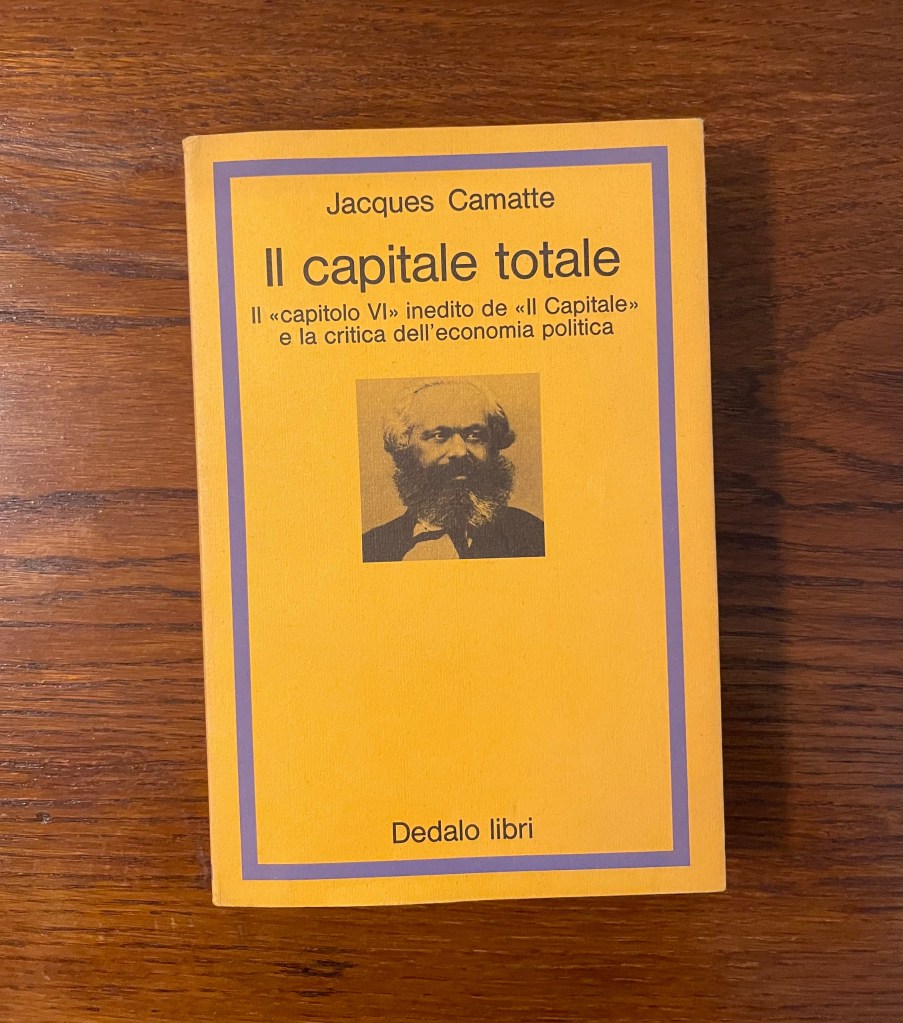
Dialogue with Jacques Camatte (1935-2025)

The passing of Jacques Camatte (1935-2025) a week ago from the writing of this text recalls a life that ostentatiously lingered in thought, and a thought that was entirely enmeshed and intertwined in the irreducibility of life. For some of us that had the good fortune to interact – however briefly and momentary, although every contact is always destinial and inescapable – Camatte transpired generosity and authenticity, and his voice evoked an almost Adanic happiness that has become rare among human beings. A common friend these days has recalled that somewhere in Camatte’s writing there is an endorsement of a capacious phrase from Chernyshevsky that could very well serve to remember his enduring ethical pursuit: ‘we have finally understood that the Earth is a place of life rather than judgement’. The opening the Earth as a dwelling place for life forms means that it is insufficient to conceive of domination as an organization of modes of production, since capital is first and foremost a spatial-temporal arrangement towards the future of the human species, and thus of a certain conquest of the world sensuous life. 

This was the outstanding triumph of real sumption: the modulated and ongoing alienation of the human community (Gemeinwesen) into a community of capital that has arrested time of life to the point of adjusting it to homogenized agony of historical time. Against the dynamic of revolution and counter-revolution that theologically exported the polarity of the eschaton and the ho katechon, already in the inception of 1970s Invariance Camatte called for an exteriority of any philosophy of history in order to rework of “a new relationship between human beings and nature”, and “breaking the lock that inhabits the creation of a new form of life”. The two citations in dialogue with each other come from “Against domestication” (1973) and the introduction to Urtext: frammento del testo originario di Critica dell’economia politica” (the 1977 Italian edition curated by Gianni Carchia), although these are variations from the depth of the emergence of the invariance of truth as a vantage point of the world. At the center is a form of life that renews the world that transitions beyond all forms of metaphysical logistics of appropriation, mere standing reserve, and the general arrangement for the mobilization of production. Any point of departure against domestication measures itself against the totality of this fluctuating dominion.

As it has been said of other great thinkers, Camatte’s ultimate passion was rooted in thinking one idea to the end and not of endorsing a system of concepts. For him it was the schism, that is, how to undo the historical process of domestication of a fictive community against the absorption of the increasing autonomization of fictive capital. The schism against the capitalist general equivalent also demands advancing a secondary schism against all humanism and its originary separation from nature. In schism, there is something of Gaunilo of Marmoutiers’ “thought of the word alone” that is receptive to the movement of the soul tries to account for the perceived voice. This precisely what Camatte carried as the lesson from Bordiga’s idiosyncratic original communist program: a movement against the historical benchmark of the development and political economy of growth, which will entail the exhaustion of the revolutionary horizon driven by an ideological political technification that tends to deepen the power towards the positionality of epochal nihilism expressed in the revitalization of strife and the ‘errancy of humanity’ (contrary to Martin Heidegger’s notion of errancy as a play between unconcealment and truth, for Camatte errancy is another name for the civilizational narrative that exemplifies the withering of the  human community into organized and protracted social reproduction and historical abstraction). Hence, as for Bordiga, Camatte conceived the ontology of communism as a world view (not as a political program oriented by concrete historical subject or distributive economic reproduction; not a soteriological dogma nor a transhistorical material idea); that is, broadly speaking, thinking the relationship between the human beings and the earth. A question more pressing than ever given the current planetary conflagration, which exposes the civilizational course that has lead to an inhospitable world where the survival of the human being has become the byproduct of an effective hostis of the community of capital integrated to the global surplus value accumulation.

In Camatte’s unrealized thought – but perhaps all forms of thinking are so – the bordigist gesture persists in locating the schism at the threshold of the force of real subsumption of the anthropomorphization of capital, where the notion of revolution itself is transfigured since, unlike Delacroix’s paradigmatic romantic painting, ‘liberty’ no longer guides the spirit of the “living”. Its redeeming voice also carries downwards unto the depth of the souls of the dead. Amadeo Bordiga himself in “Dialogato coi morti “(1956) writes that “The Revolution…it is always, in the course of an immense historical arc that will close as it opened and where it promised, where it has an appointment with many of the living, but certainly with the unborn, as with the dead: they knew that it never fails, never deceives”. True life can also take place with the nearness of that which seems remote (as Gustav Landauer once claimed: “For me, the dead also live”).

If both the collapse of the future and the increasing adaptation of social life has entered a gnostic dialectic of endless self-legitimation, it is paramount to capture not just the insurrectionary, but the resurrection flight in Camatte’s gesture that opens possibilities lodged in the dead as an emblem for the return to the world “full of joy and exuberant life”, as he wrote in an apostrophe in “Scatologie et résurrection” (1975): “I will draw from mother earth the vital and infinite power and I will resurface full of wisdom, joy and an exuberant life which will allow me to reach this human community…I will have left your world and been resurrected!” Does holding on to the unity of the Gemeinwesen require a theological undercurrent? Is not the passion for schism, and by the same token the stazion, the energy within the very dispensation withheld between mystery and revelation that has prompted the congenital forms of formal mediations and institutions for the political community? These are the questions that we are exposed to in the enduring task if we are to take seriously a continuous ‘dialogue with Camatte’, which carries the voices of the dead. Ultimately, any authentic conversation that dwells in thought does not have to invent anything new; we are depositories of an endless communication that is handed over, interrupted, and transmitted to anyone willing to hear and capable of being traversed by the shared word. 

In his last year of thinking, Camatte insisted on the notion of “inversion” in the wake of the civilizational phase of extinction, which would require deposing all forms of hostilities and bringing to an end the partisan positions invested in orienting technology and morality (nature) in their seditious defense of the real dominium over the passing of the world. For the current depressing (and depressed) times, writes Camattes in “Instauration du risque d’extinction” (2020), what could very well be a prelude to a return to the repressed allowing a return to the past to initiate an inversion that would allow liquidation of lall exhibition abandoning enmity. This is why, as he told me in an exchange that we undertook five years ago, “inversion cannot be a strategy, as it is totally outside of politics, which is the dynamic of organizing people, of controlling them”. A breakthrough, then, only as a mystical downwards leap into the past? Absolutely – but only insofar as the mystic is the ethical witness to his own openness to the word, and whose exodus from the social machination prepares a return to the world beyond the flattening and dominant language molded by rhetorical dishonesty or passive narcissism of the subjectivity.

This is why according to Carlo Michelstaedter to have courage in the world means to decide between two irreducible figures: the dishonest trickster, or the mystic in the desert. There are no third terms in between. And whereas the dishonest subject knows how to play the hand to his best outcome in each given moment; the mystic knows that his decisive moment is always commencing because the genesis of the human species has yet to take place. This beginning is always at the brink of an untimely auratic experience. And aura names the incommensurable distance from the rational containment of the world — unlike Teilhard de Chardin’s internal introspection in the noosphere that will bring the fullfilment of a spiritualized humanity upon Earth (realized in part by the unification of the sciences by cybernetics); in other words, an exodus from the temporal nominalism that inhabits another life attuned to its genesis: “devenu-devenant ce monde et sur cette vie autre au moment où s’effectue sa création”, he writes in “La séparation nécessaire et l’immense refus” (1979).

The visitation of Jacques Camatte in the world bears witness to that invisible freedom of the human species ready to jump and traverse the catastrophic trumpeting into the living and the dead, making possible the refractions of thinking as original texture of existence. From now on, the exodus from the immanence of this world will embrace a disempowered but perpetual dialogue with Camatte’s demure schism of the living. Indeed, we are always on the path to an earthly beginning. 

The world has been posthegemonic. by Gerardo Muñoz

In a recent text published at Verso Blog, entitled “The Coming Post-Hegemonic World”, Michael Hardt and Sandro Mezzadra make a case for a “turn to a post-hegemonic model” that will challenge the consensus of global in the coming era. In many ways, this era is already here with its diverse and multifaceted (in terms of intensities, forces, and leverages) of protracted and bizarre nationalisms, which as Jamie Merchant has teased out brilliantly, amount to desperate attempts to offer a belated response to the decline of growth as one more stage for containing rampant processes of accumulation via state capacities. For Hardt & Mezzadra, this “posthegemonic world to come” is characterized by a global spatial reconfiguration of capital – accommodating the logistics of regional spaces of influences and exchange across the planet – and on the other, an increasingly “domestic sphere of authoritarian rule” promoted by new accelerated initiatives at generating social homogeneity in the wake of rushing fragmentation hand in hand with a war regime that has utterly scrapped ideals about “strategic autonomy” in order to trumpet an arm race (nuclear weapons included), as it is currently unfolding in Europe. 

One can claim that this posthegemonic world is one that firmly assumes the consequences of two interdependent vectors that imploded within the project of political modernity: the end of  economic growth (thus validating the law of the fall of profit outlined in Capital V.III), and the liquidation of the principle of legitimacy that for two centuries accommodated the legislative sources of the state authority in democratic constituent power. For Hardt & Mezzadra posthegemony means global fragmentation, authoritarianism, and spatial remaking; however, one should also say that it means, the opening towards stagnation, the collapse of political unity of the state, and most recently the total discredit of the foolish leftist hypothesis that promoted a “rainbow social equivalent coalitions” to push for compensatory, and in every instance insufficient and moribound, populist resurgences elevated through the combustion of ethereal but effective rhetoric (in fact, my argument in a new short book, La fisura posthegemónica, is that the push for political hegemony of the last decades only cosigned forms of consensual totalization at the expense of the production of subalternization and social death).  

Even taken as a descriptive and normative condition of the current state of Western politics, the posthegemonic situation lays bare the reciprocal impasse of the claim of its opposition: in other words, one should also put to rest social mobilization that characterized the politics of High Modernity, since ultimately movements (and total mobilization as an apparatus of social energy transfer) presupposes that “every social structure, that it can receive what form required the needs of the political adventure…total mobilization signifies nothing other that the effort to reduce the social substance to a kind of plastic”, as Gérard Granel once defined it. Hence when Hardt & Mezzadra claim that the “effective rebellion must be rooted in social movements envisioning a life beyond the rule of capital”, they are inadvertently refusing to come to terms with the factical posthegemonic reality that they are describing, which is no longer driven by expansive economic growth, but rather by stagnation, and inoperativity at planetary scale that is maintained through the a global veneer of production into regimes of competitive accumulation (of territory, contractual debt, fiscal regulation, executive taxation or tariffs, and increasing arbitrary monetary regulations in the global system) for marginal profitability, as Paul Mattick argues in his recent The Return of Inflation (2023). 

This means that there is no outlook towards ‘social mobilization’ that does not serve the subjective productivity of real subsumption, since its ultimate goal is to anaxate social energy into the force of (un)productive labor. This form of dilatant mobilization can only serve the master of illusionary hegemony, and thus promote functional and unwarranted servitude everywhere. Indeed, only a reprobate can be immune to the moralist or the realist conditions of hegemony. If push comes to shove, the posthegemonic factical world of stagnation and political fragmentation already here proves that the ongoing irruption of non-movements are irreducible to the modern movement’s energy; and that life never fully coincides with political claim to rule and legitimacy, even less so in the becoming-world of Production. 

Ultimately, this posthegemonic fissure outlives the crumbling hegemonic world of principial High Modernism and no ‘international movement’ can piece it back together again. We are all posthegemonic now, but only if one takes up this predicament seriously and candidly.

Unelevated politics. by Gerardo Muñoz

In a fragment from 1919 entitled “World and Time”, written around the time of the elaboration of the essay on the question of violence, Walter Benjamin offers his most succinct definition of politics: “My definition of politics: the fulfillment of unelevated [ungesteigerten] humanness” [1]. The ontological reduction is compact, and the three terms in it are carefully chosen: fulfillment, unelevation, and humanness, which indicates a ‘preparation for a profane politics’ at the threshold of secularization and its negation in a new “spiritual ornamentation”, as he would claim in the notes of “Capitalism and Religion”. The stress on the refusal of “elevation” (gesteigerten), however, does bring to bear that Benjamin’s refusal of a political ontology constrained in subjective and objective representation, which is why in the same fragment he connects the abutting of politics to a “living-corporality” [Leiblichkeit] of the human species. To retract from the cycle of civilizational violence, politics had to be reformed from the groundlessness of the energy of the living.

Hence, for Benjamin there is a metapolitical condition or archipolitics that plays out in refusing “elevated humanity”, which for him was at the source of the romantic response to the impasse of the critical enlightenment, placing the subject of knowledge and its self-reflective faculty at the center of the developing self-rationalization of the spiritual transcendence of the world in this new critical religion: “…the ideal of humanity by rising up to…that very law which, joined to earlier laws, assures an approximation to the eternal ideal of humanity” [2]. Hence, neither trascendental representation nor spiritualized immanence of order could, but unelevation of the “human possibilities” (Menschhaftigkeit). But such possibilities could only be disclosed beyond the pretensions of spiritual elevations of a unified consciousness, as Erich Unger had proposed in his Politics and Metaphysics (1921) around the same time to enact a “politics of exodus” for a common psychosocial regeneration. 

Benjamin’s proximity and distance from Unger’s position could perhaps inform why instead of writing a promised book that was going to be entitled True Politics (Die Wahre Politik) – allegedly containing two chapters “The destitution of power” and “Teleology without ultimate goal” – evolved into the landmark essay “Towards the critique of violence”, in which the frame of domination and the ontology of politics was recasted as a mediation about the folding of secularized annihilating violence, substance intrinsic to the philosophy of history and indestructible life of the soul (“annihilating only in a relative sense…never absolute with regard to the soul of the living”) [3]. Thus, one could say that accounting for the groundwork of “politics” meant accepting the constitutive verticality cosigned to modern philosophy of history, and its bipolar schematism between moral principles and sacrificial production. If Peter Fenves’ assumption is correct, Benjamin was not only inscribing a distance from Unger, but, more importantly, from Kant’s Toward Eternal Peace who defined his “true politics” as dependent on moral determination: “The true politics can therefore not take a step without having already paid homage to morality, and although politics by itself is a difficult art, its union with morality is no art all, for as soon as the two struggle against each other, morality into two cuts the knot that politics cannot dissolve – The right of human beings must be held sacred [heilig], however great a sacrifice this may yet the dominant power” [4].

The Kantian liquidation of politics to morality is hyperbolic to the modern epoch and its crisis – the crisis and enmity against the concept of the political, Carl Schmitt would claim in Political Theology (1922) – rendering modern politics and legitimacy hollow; something that Benjamin had understood well he saw to retract from the question of “politics” to that of a critico-metaphysical exploration waged on morality “as nothing other than the refraction of action in knowability, something from the region of knowledge…Morality is not ethos” [5]. Elevation could only have meant the production of a subject of knowledge and the specific (technical) arrangement of knowledges for subjection. On the contrary, the ethos was the necessary condition no longer for any “coming politics”, but rather for the disclosure of “the coming world” [die kommende Welt] itself. This means that working through the redemption of the world solicits a reversal from morality to ethics only to later transform the conditions of politics.

Let us return to the definition of politics as “unelevated [ungesteigerten] humanness”. What defines “unelevation”? From the ethical point of view it conjoins with the notion of “inclination” [Neigung] that Benjamin favors because of its unconditional valance that disarms the cycle of violence of the human community and its willful hostilities. The inclination rejects the paradigm of force because it an erotic mediation, that is, an affection of donation and love beyond exchange [6]. But inclination is only possible through language, as Benjamin had expressed in his “concept of politics” in a letter to Martin Buber from 1916: “I understand the concept of politics in its broadest sense…in this sense, therefore, language is only one means of more or less suggestively laying the groundwork for the motives that determine the person’s actions in his heart of hearts. Only the intensive aiming of words into the core of intrinsic silence is truly effective action” [7].  

Thus, the suspended elevation of the subject and higher order meant that its persuasive purity allows the inception of the “divine” as a «teleology without a goal» validated by the suspension of judgement of appearance. The intensification of the unelevation opens life to an ethical demand of a “living corporality” that roams the world’s crust beyond depredation where the force of autonomy of social practices does not risks the world of life forms and the soul. Indeed, at this point Benjamin does join Unger’s cardinal thesis: “Overcoming capitalism through wandering”. Or as he wrote even earlier about Hölderlin’s poetics: “[In the world of Hölderlin], the living are always stretching of space, the plane spread out within which destiny extends itself…it already comprehends the fulfillment of destiny” [8]. A politics oriented pending dowards to “unelevation”, inhabits the ground level of co-existence and cultivation dismissing the ontological derivatives or principles (archein) of ‘politics’ in order to conquer every possible destiny in the lawless fulfillment of the world.

Notes 

1. Walter Benjamin. “World and Time”, in Walter Benjamin: Toward the Critique of Violence: A Critical Edition (Stanford University Press, 2021), 74. 

2. Walter Benjamin. “The Concept of Criticism in German Romanticism”, in  Selected Writings, Volume 1, 1913-1926 (Harvard University Press, 1996), 138. 

3. Walter Benjamin. “Toward the Critique of Violence”, in Walter Benjamin: Toward the Critique of Violence: A Critical Edition (Stanford University Press, 2021), 58. 

4. Peter Fenves. “Introduction”, in Walter Benjamin: Toward the Critique of Violence: A Critical Edition (Stanford University Press, 2021), 18-19. 

5. Walter Benjamin. “Ethics, Applied to History”, in Walter Benjamin: Toward the Critique of Violence: A Critical Edition (Stanford University Press, 2021), 74. 

6. Walter Benjamin. “On Kantian Ethics”, in Walter Benjamin: Toward the Critique of Violence: A Critical Edition (Stanford University Press, 2021), 71. 

7. Walter Benjamin. “Letter to Martin Buber” (1916), in The Correspondence of Walter Benjamin (University of Chicago Press, 1994),  79-80.

8. Walter Benjamin. “Two Poems by Fredrich Hölderlin”, in Selected Writings, Volume 1, 1913-1926 (Harvard University Press, 1996), 26. 

The instrument stripped bare. On Adan Kovacsics’ Guerra y lenguaje (2025). by Gerardo Muñoz

Endless war and infinite strife is always preceded by the erosion and the putrid decomposition of language. Such is the thesis of Adan Kovacsics’ idiosyncratic and historically situated Guerra y lenguaje (Acantilado, 2025), which sets a specific date for the moment of such linguistic rot into consciousness in European modernity: Hugo von Hofmannsthal’s “Lord Chandos Letter” of 1902 in which civilizational decline signaled the total detachment of expression, making language flourish in the form of opinions resembling rotten mushrooms. For Hofmannsthal this event was neither accidental nor a temporary malady, but a tonality of existence that soon enough broadened like a “spreading rust” (Kovacsics 11). Just a few years later in his posthumous Persuasion and Rhetoric, Michelstaedter will describe this rusting of language as the triumph of “darkening ornaments” (kallopismata orphnes) of the epoch, liberating the destiny of language as a mere transactional exchange between “technical terms” mastered by everyone regardless of their idioms (it surprises the reader that the thinker of Gorizia is absent from Kovacsics’ Austro-Hungarian constellation on the crisis of language). 

The decline of an empire shimmering with languages and dialects across its territory began to suffer the malady of miscommunication that resulted in making language uninhabitable, throbbing in its empty chatter. Thus, the attempt to initiate an exodus from language began to appear everywhere according to Kovacsics: Fritz Mauthner drafts an encyclopedic treatise on the venereal misapprehension of language, Gustav Landauver battles in the trenches of linguistic scepticism and the mystical tradition in the name of revolution, while others like Hugo Ball attempts to flee from language altogether through the liberation of sounds and words, from the Dada avant-garde to his later Byzantine Christian asceticism. For his part, Karl Kraus in The last days of Mankind prefers to expose the surface of language as it becomes a regime regulated by opinion for bureaucratic administration over facts of reality. The nihilism that colors politics at the turn of the century is accompanied by the instrumentalization of language as the primordial technical apparatus that allows the flows of information through the acceleration of the autonomization of the linguistic mediation; as consequence, language began to arouse constant disbelief and doubt over the very essence of the sayable (Kovacsics 31). This throws light on contemporary debates about “misinformation” that, precisely because they are caught up on the epistemological determination proper to the linguistic crisis, it comes short to putting into perspective the range and depth of language over the problem of appearance now deprived of the expressive mediation between the speaking animal and phenomena, reducing experience to rhetorical commonalities or inter-social allocation of commands. 

Kovacsics’s Guerra y Lenguaje (2025) brings to bear – without totally exhausting the crushing weight of its archive and set of problems for thought – the immense significance of the first decade of the twentieth century at outset of the waning of the Austrian-Hungarian Empire, which has always been understood historically as the condition for the last configuration of European nationalism and its war-economies, but rarely in light of its functionalization of language. If read against the backdrop of Simone Weil’s “Are we heading for the proletarian revolution?” (1933) intervention about the “functional” dimension of the state form in the first decades of the twentieth century, Kovacsic’s essay ultimately helps us to define the concrete nature of functionality as the index of mobilization of ‘worlding’ through the commanding force of language. To deliver this point home, Kovacsics tells how language itself severed enunciation from action:

“La transformación que se produjo y que la ha alejado, como si un tablón se hubiese desprendido del muelle y se hubiera adentrado en el mar, no se debe a que otras gentes se impusieron en su día en Grecia, sino a un cambio radical en el uso concreto de la palabra. Es en la Gran Guerra cuando esa corriente inicial de la utilización del lenguaje como herramienta se consolida de manera definitiva. Es entonces cuando la palabra pasa a ser plenamente funcional y su papel se reduce a aportar argumentos para la acción o incluso a “parirla” mediante el tópico. Hemos visto hasta qué punto el silencio de Karl Kraus al comienzo de la contienda se debía a la percepción de este vínculo entre palabra y acción, al que no quería ni podía sumarse de ningún modo” (Kovacsics 76-77). 

Language does not disappear as much as it transforms itself into two vectors of social enforcement towards communication: functionality and rhetorical enthymemes. In this way, language is able to colonize reality and stabilize for the concrete order, or what Walter Benjamin called during those years the “bourgeois conception of language” hindering on causality and objectivity accelerating the collapse of its vocation to naming the exteriority of the world (Kovacsics 81). The totalization of this new rhetorical social structure becomes the main stage for the production of justification and competing regimes of fiction. But this implies no general theory or systematization of a linguistic science, but rather how language coincides with life in the form of an ethics. This is at the heart of the different attempts to retract language in the eclipse of empire and the new interstate fragmentation – which also entails grammatical and functional unifigies of national language – as a problem that concerns the limits of ethics. Ethics here cannot coincide with the general condition of ‘knowability’ that makes morality possible; rather, the problem of ethics can only reveal in turn the senseless of wanting to go beyond the facts of the world and allows us to dwell in one without completion.  The withdrawal from the language of propaganda and objectivity demanded an ethics of the sayable beyond the commodification and intentionality of words promoted by “war” and “ware” (commodity) that the West had continued to endure; a total communication of ends that decades later evolved into cybernetics as the warping of world into informational encoded relation.

Kovacsics reminds us that there is a story here of extreme violence and creative destruction, only comparable to nuclear fusion and the flaying of a human being, only that this time, unlike the myth of Marsyas, without ever reaching transcendence of redemption through the proximity of language to myth (Kovacsics 129). Underneath there is the body of language, stripped of its capacity for truth and reduced to functions of survival and needs oriented towards the homogeneity of the future. Towards the end of Guerra y lenguaje (2025), and glossing Hobbes’ notion of political authority that legitimated the modern interstate system to neutralize truth contents and the stasis over words, one cannot help but think that the date 1902 as a. arcana was an effective culmination rather than genesis of the modern, which means that the foul scent of the twentieth century was destined for decomposition since it had already stripped bared one of the most beautiful lacunae of the human species: being in language and the event of appearance became integrated into the worldly utopia of the machine.

As captured in Marcel Duchamp’s “The Bride Stripped Bare”, the obsolescence of language over time evolved into a candid instrument of social functions of proportional exchange, coordinated fortuitous relations, and increasing moral indictment that purported parodies of contested realities. Thus, the sickness is always unto language – a basic assumption that reveals the need for infrapolitical analysis before there is any political practice and categorial reinvention. The overexposure of language as an avatar of metaphoric communication for ends and needs of humankind brought itself bare and all encompassing in its appropriative force, but only at the expense of darkening and losing the world forever. 

Kallopismata orphnes: the eclipse of language. by Gerardo Muñoz

In his most decisive confrontation with the scientific method and the legitimacy of science through objective knowledge, Carlo Michelstaedter introduces a rather loosely expression from Plato’s Gorgias to lever his position against the sufficiency of the scientific experiment: the “kallopismata” (καλλωπίσματα), which can be rendered as “embellishments” or “ornaments” that is constituted in figures such as matter, law, the final cause, or ruling principles (archein) that align the conditions for calculative and sufficient reasoning [1]. For Michelstaedter, the world of objectivation and scientific neutrality proceeds through figures of rhetorical ornamentation, kallopismata, which allows conquering the future; that is, what remains completely foreign and inaccessible to the domain of calculative reason waged upon a series of expressed goods. 

It could be said that kallopismata is the artifice that allows the absorption of those goods to the historicity of civilization as they undergo their own ‘corruptio optimi pessima’ a process of functional realization of their entelechy: the desert becomes a cloister, the banquet an academic, the artist’s studio a school of beaux artists…imitative technique assumes the name of art; any virtuosity assumes the name of virtue [2]. In a language similar to that of Heidegger’s, Michelstaedter speaks of the constitution of an “exceptional machine”, which positions the organization of the world through rhetorical deployment (and it was not by coincide that Heidegger referred to Aristotle’s Rhetoric as “the first systematic hermeneutic of everydayness with one another”), and hence the fundamental metalinguistics of any social economy. The exceptional machination not only deploys generic meaning from the irreducibility of things, but also organizes the mediations between the subjective plane and the objective reality. In this way, the rise of the hegemony of science in the hands of the ‘pioneers of civilization’ and a “community of the wicked”, as Michelstaedter calls the endeavor of modern scientists, can violate nature offering security and comfort to the totality of mankind. This will explain their civilizational endurance and the recursive positionality for historical self-amendment and renewed adaptation.

How can this community of the wicked achieve absolute consent and domination through their practice? The domination over nature is not exclusively an anthropological process extended outwardly; it posits a nexus between interiority and exteriority where the question of language itself is entirely redefined. This is why the most stealth invention of the practice of scientists for Michelstaedter is to “infiltrate life with certain words….on which meaning unknowingly prop themselves for their daily needs, without acknowledging them they pass them on as they were received” [3]. The ultimate experiment of the techno-scientific understanding of the world amounts to the elaboration of cybernetics (a term that Michelstaedter never uses but that obviously colors the effect of his general scheme of civilizational nihilism); that is, the unification between the phenomena of the world and the human’s sayable language. To this end, Michelstadter will emphasize this proximity: “Technical terms give men a certain uniformity of language. In  vain do the proponents of internally created international languages dream. The international language will be language of technical terms; of kallopismata orphnes, ‘ornaments of the darkness’ [4]. Whereas darkness denotes the harboring of language and its limit – and one can recall Fridugisus’ De nihilo et tenebris – its slow decay in darkness, kallopismata orphnes, outlives itself by the artificial luminosity that tears all mediation from the sensible world, now realized as fully alien to the appearance of truth and the truth of appearance. As Giorgio Agamben has noted, in what could be read as an esoteric gloss on the triumph of the kallopismata orphnes in our times, the technical question in the scientific paradigm is not merely a problem of the modes of techniques and instrumentalization, but more concretely a process that brings to an end the use of language as a sensible experience with the world [5]. And insofar as “sense” is only an idea of the sayable, it might as well be senselessness has been fully integrated into the infinite production of “informational differences” (“data run”), a final hypertrophied form of an unworldly logoi

It would not have passed Michelstaedter that the context in which the degraded notion of kallopismata (embellishment, ornament, decoration as adjectives do the work, but one should also register the kallos, a central tonality in Plato’s musical thought) happens in a rebuttal of Callicles to Socrates’ critique of force and personal interest as requirement for a conception of Justice. In 492c of the Gorgias Callicles will reply to Scorates stating the following: “No, in good truth, Socrates—which you claim to be seeking—the fact is this: luxury and licentiousness and liberty, if they have the support of force, are virtue and happiness, and the rest of these embellishments (kallōpismata)—the unnatural covenants of mankind—are all mere stuff and nonsense” [6]. In other words, for Callicles anything that does not have the force of principle or justification has already fallen to the level of “stuff” and “nonsense”, even though that nonsense is itself the use of language in its contact with the “thereness” of appearances. It is no coincidence that in his lecture of ethics, Wittgestein will press upon the nonsensical expressions of language in order to elude the escaping and impossible essence of language every time that it seeks to move beyond the world” [7]. In other words, if Callicles is the hyperbolic figure of the rhetorician-scientist, what is at stake in the inception of kallōpismata as veil of language is nothing else than the effective liquidation of its ethical dimension, which in turn transforms the use of language into a mere coding instrument at the altar of philopsychia, or, in the words of Callicles, of empty “unnatural covenants” (para physin synthēmata), depleting language to exclusive semantic and and metaphoric correspondence [8]. In other words, the ascendancy of the nonlanguage of the kallopismata will now entail abandoning the imperative mode in which language and life can enter a secret relation as defined by its use [9]. 

Can one even speak of human life after the ascension of the kallopismata orphnes as the civilizational matrix of the world? A life without the use of language, under the veil of kallōpismata, represents an unprecedented milestone and perhaps something beyond the rhetorical enthymemes. Perhaps one could elucidate this point in this way: according to Hans Blumenberg, the most important rhetorical form ever invented was that of the prayer because through its practice one is ultimately trying to persuade a God. In contrast, in the complete darkness prefigured by kallōpismata orphnes that dwells in a civilization eclipse – the rise and fall of modern secularization and political idolatry – the gods can no longer be posited as exteriority towards the taming of the gnosis for the anthropological need of self-affirmation [10]. Because the process of fictitious anthropomorphism has reached its own limit to the point of becoming itself an “exceptional machine” (macchina eccezionale), the mystery of the senselessness of language has lost the world not necessarily by becoming mute and silent, but by enslaving itself to the endless chatter and infinite consensus by the moral equilibrium of the social age that for Michelstaedter ultimately meant “the machinery of dispersing interests, where the paths of existence are no longer clearly traced, but become confused and disappear; hence it is up to every existence to create the luminous path among the universal chaos; as if were, an art of practical life” [11].  It is that existential path granted by the nonsense of language (soul to soul) that grants beauty in the event of appearance, that cuts through and overcomes the civilizational allure of linguistic kallopismasta whose radiant heliotropism can only result in the most spectacular of blindness. 

Notes

1. Carlo Michelstaedter. Persuasion and Rhetoric (Yale University Press, 2004), 98.

2. Ibid., 96.

3. Ibid., 98.

4. Ibid., 98.

5. Giorgio Agamben writes in “Sul dicibile e l’idea”, Che cos’è la filosofia? (Quodlibet, 2016): “Technics is not an “application of science”: it is the fundamental production of a science that no longer wants to save appearances, but obstinately tends to replace its hypothesis with reality, to “realize” them. The transformation of the experiments – which now takes place through machines there so complex that they do have anything to do with real conditions, but purport to force them – eloquently shows that the translation between languages is no longer at stake. As science that renounces saving appearances can only aim at their destruction; a philosophy that no longer calls itself into question through ideas, in language, loses its necessary connection with the sensible world”, 115. The attempt to escape appearance and experience to turn the world into a mimetic illusion administered by the aesthetic dominance of the pseudos was also elaborated by Gianni Carchia in his analysis of Plato’s aesthetics in L’estetica antica (Editori Laterza, 1999), 89-100.

6. Plato. Gorgias (Loeb, 1967), 413.

7. Ludwig Wittgstein. Lecture on Ethics (Wiley & Sons, 2014), 50-51.

8. Carlo Michelstaedter. Persuasion and Rhetoric (Yale University Press, 2004), 97.

9. Carlo Michelstaedter “Appendici I: Modi Della Significazione Sufficiente”, in La persuasione e la rettorica (Adelphi Edizioni, 1995), 142.

10. Hans Blumenberg. “Una aproximación antropológica a la actualidad de la retórica”, in La realida en que vivimos (Ediciones Paidós, 1999), 133. Philippe Theophanidis recently suggested in a discussion that we should read kallopismata orphnes in mind with the formulation  “God help me”—because I haven’t the courage to help myself” that Michelstaedter introduces in the chapter “Rhetoric”, 69. “Notes on The Constitution of Rhetoric”, unpublished, February 2025.

11. Carlo Michelstaedter. Epistolario (Adelphi Edizioni, 1983), 159.

Americanism and whaling. by Gerardo Muñoz

“What is the genealogical figure that best recalls this form of enmity in late American imperialism? The pirate.” This was written by Rodrigo Karmy, who sets up the ground for a timely inquiry. In fact, it is necessary to understand the accelerated processes that are currently underway as a civilizational choreography that only now finds an intense vortex of legibility. In what sense, then, can we speak of an order of pirates that have taken hostage the fleet of imperial politics and the empire of politics? At this point I would like to recall a brilliant and forgotten book by Charles Olson titled Call Me Ishmael (1947), which offers a perceptive interpretation of the essence and orientation of Americanism as an unbounded planetary civilization. Unlike many others interpretations – Max Weber on Calvinism and communitarian deification; Marxists on the Fordist mode of production and passive revolution; and even those that recast the economy of the spectacle and the psyche of mass culture – for Olson, who takes a necessary stepback, the civilization deployed by Americanism is essentially a production regime that first rose from the extraction of whale oil in the 19th century [1]. And as some economic historians have reminded us, before the first oil wells were found in Pennsylvania in the mid-nineteenth century, oil was embedded in the species of the sea, that is, in the fishing and cutting up of the mythic sea creature [2]. 

The veiled settlement of expansionism to which Daniel Immerwahr has drawn attention recently can only be understood if we start from the premise that the arcana imperii of Americanism is a maritime enterprise that takes the world itself hostage. This means that unlike the English trading companies of early liberal capitalist modernity, Americanism is no longer concerned with the neutralisation of a common space for the exchange of goods and values, but rather with something more terribly vast: the domination and total extraction of the sea and its species. Whoever rules the seas rules the earth; in other words, whoever is able to guide the threshold of the earth has been able to do so because he has already crossed every possible limit in the land surveying (agrimensura meant precisely the measurement of the land) art of territorial appropriation and separation.

The civilizational differential of such achievement should now be evident: this production regime does not have a territory or a specific mode of production as its objective, and this is precisely Olson’s thesis, but its sole purpose is to release an effective domination of the world. And only the world can be its most coveted object. Hence, it is worth remembering, that for Herman Melville – as he puts in the mouths of some of his characters – the enterprise of Americanism embodies in the secularized time of modernity something truly monstrous: nothing less than the consummation of the presence of evil; that is, the mystery of inequity (mysterium iniquitatis) in suspense and processed through the wager of the strongest whaler. How is humanity introduced and lodged in the courtyard of the mystery of inequity? Well, not only by fishing for each other, but by calling into question the very existence of the world. The religious imagination surrounding the fisherman as a prophetic symbol of salvation of the human species, as illustrated in a well-known plate from Herrad of Landsberg’s Hortus Deliciarum (1167), reappears in Americanism as an unbearable parody of all living things on earth. As one of the characters in the late novel Pierre (1852) says: “I hate this world.” And one could say that the inner belief in hatred is the fundamental stimmung of Americanism.

Thus, it is no longer just that we are hostages on the San Dominick, thrown into the groundless instance of the decision; it is something more sinister, lethal, and inconspicuous. The whaler is ultimately not the politician, he is the common man, a hollow-crowned qualunque, whose fate is shipwreck and whose tongue is commanding force. In the existential struggle between Ahab and the whale the only destiny is to caress the sea floor, as Olson says, will amount to something “all scattered in the bottom of the sea”. The post-mythic historicity of the flood reaches its definitive realization in Americanism as the genesis of a devastated world without an ark – propagated by the extinction of all species and all worlds and all presences, putting an end to the soft and untimely music of redemption.

A redemption that, not by chance, Melville only managed to find in the possible restitution of the original garden in the lands and landscape of Palestine: “Looks pearly as the blossoming / And youth and nature fond accord / wins Eden back…”, we read from the verses of Clarel (1876) [3]. Being able to preserve this acoustic garden besieged by the metaphysical force of the whalers may be the only ark left for us to land somewhere on Earth. 

Notes

1. Charles Olson. Call me Ishmael (Grove Press, Inc, 1947), 18-19.

2. David Moment. “The Business of Whaling in America in the 1850s”, The Business History Review, 1957, 281.

3. Herman Melville. Clarel: A Poem and Pilgrimage in the Holy Land (1991), 87.

The bruised souls. by Gerardo Muñoz

Whenever a professional politician today evokes the ‘soul’ one must be immediately suspicious, as it tends to be an automatic lullaby for “national unity” or a dormant metaphor in a flowing stream of empty chatter. What could the soul mean to anyone – say, those millions that have now for the second time voted fairly and squarely Donald J. Trump to the Executive branch of the national government – only capable of giving attention to a series of onomatopoeic pop-words that are now ingrained in the linguistic acoustics of the American lexicon (“Bitcoin”, “Tiktok”, “Woke”, “Prime”, and the list could go on). The ongoing catastrophe is first and foremost within the texture of language, which is ultimately why it is also an ethical decomposition in which all other spheres of practical action (first and foremost, politics) amount to business as usual with its corresponding rhetorical bravura.

Suggesting continuity might perhaps be an understatement: it is now a business that does not need any sumptuous or veiled mediation; refracted upon its own absorption of its hyperproduction of fiction, the defeat of the communitarian salvation of Calvinism can only be expressed as a self-serving an ongoing destruction and self-annihilation. True, it could be claimed that ‘Americanism’  has always been this; the only difference is that today, already well into the century, it moves in a vector that directly rejects the world while making a full fledged program of its own making. Only a Society that has become fully moribund can celebrate its own death and decomposition; while the emancipated and well scripted villains of the act now have no shame but to reveal how the ultimate object of their conspiracy was the obliteration of the Earth.

“It is the time of the assassins”, TJ Clark writes echoing Henry Miller’s unjustly forgotten book on Rimbaud and the legitimation of the social bond, in which the homo homini lupi discloses itself from any all possible contact in the metropolis solely dependent on ad hoc hyperproduction of justifications required to fully commit to the illusion of legitimate action. Only that now the time of the assassins is perhaps an uncanny dark night of those without souls, as in the deranged characters of a McCarthy’ novel: they are willing to kill and be killed; they are beyond any contact with language, and “what do you say to a man that by his own admission has no soul? I’ve thought about it a great deal” [1]. And indeed, there is nothing to say and nothing to face: in the soulless dark night there are only hunters and those that are hunted; there is integration or pulverization; there is killing and there is humiliation before an ever increasing legal nexus coordinating the acquiescence of force. But perhaps this is the real arcana of the American soul that is only shimmering through in all of its glory.

Someone like D.H. Lawreence definitely thought so when writing about the novels of Finimore Cooper: “[The white american] lives by death, by killing the wild things of the air and earth…All the other stuff, the love, the democracy, the flooring into lust is a sort of by-play. The essential American soul is hard, isolate, stoic, and a killer. It has never yet melted” [2]. But in our days it has begun to melt, to fragment, and decompose in a heavy storm of pain and despair. And it continues to stand in the long winter of American civilization (the castle of Frozen is the allegory of the epoch) that now finds itself at the epochal threshold of the end of growth, only left with rampant nationalist impulses of self-affirmation that can only deepen the nihilist tonality of anguish and self-destruction, and the emergence of the bizarre as Jamie Merchant notes in his recent Endgame (2024). 

In his Reflections on America (1958), Jacques Maritain maintained that the spiritual patrimony of Americanism is that of being “bruised souls”, a community that came into being by double exclusion (hunted by their religion and rejected within a national polity), which in turn allowed to be compassionate to human suffering, and thus the hidden meaning of the wound was to be seeing in the “role played by immigration and poverty suffered in the Old World” [3]. Hence, for Maritain the condition for the healing soul of America resides in its opening to ongoing suffering of migrants, the dispossessed, and those in exodus from the psychic pressure of a social metabolism gone sour in every subject of civilizational decay as Erich Unger had proposed in his Politics and Metaphysics (1921).

 It comes to no one’s surprise, thus, that the decomposition of the American soul departs from the overt opposition to migration, as a figure of the grazing over the Earth, that must be vanquished and condemned by a planetary gnosticism undergoing in front our eyes. The Chrisitian modern state enters in this way into a concrete and visible process of artificial desecularization showing that “the Christian relation to the State…is in mad hostility to all of them, having in the end, to the destruction of them all. […]. And it is, simply, suicide. Suicide individual and en masse” [4].

The stakes are extremely clear: it is for the bruised and the brute (some have called it the barbarians, proprietors of strange tongues, keepers of the clandestine lacunae of language) to retreat from the fictive proliferation of appearances, the artificialization of reason that can promise success as the ultimate pinnacle of self-destruction. Inclined beneath the shadow of archaic Penia, the bruised and incurable souls might not find redemption in the American wasteland, but they will land somewhere between language and world. Not a program but a moving conviction.

Notes 

1. Cormac McCarthy. No Country For Old Man (Vintage, 2005), 8.

2. D.H.Lawrence. “Fenimore Cooper’s Leatherstocking Novels”, in Studies in Classic American Literature (Thomas Seltzer, 1923), 92. 

3. Jacques Maritain. Reflections on America (Scribners, 1958), 84-85. 

4. D.H. Lawrence. Apocalypse (Penguin Books, 1995), 148.