In a fragment from 1919 entitled “World and Time”, written around the time of the elaboration of the essay on the question of violence, Walter Benjamin offers his most succinct definition of politics: “My definition of politics: the fulfillment of unelevated [ungesteigerten] humanness” [1]. The ontological reduction is compact, and the three terms in it are carefully chosen: fulfillment, unelevation, and humanness, which indicates a ‘preparation for a profane politics’ at the threshold of secularization and its negation in a new “spiritual ornamentation”, as he would claim in the notes of “Capitalism and Religion”. The stress on the refusal of “elevation” (gesteigerten), however, does bring to bear that Benjamin’s refusal of a political ontology constrained in subjective and objective representation, which is why in the same fragment he connects the abutting of politics to a “living-corporality” [Leiblichkeit] of the human species. To retract from the cycle of civilizational violence, politics had to be reformed from the groundlessness of the energy of the living.
Hence, for Benjamin there is a metapolitical condition or archipolitics that plays out in refusing “elevated humanity”, which for him was at the source of the romantic response to the impasse of the critical enlightenment, placing the subject of knowledge and its self-reflective faculty at the center of the developing self-rationalization of the spiritual transcendence of the world in this new critical religion: “…the ideal of humanity by rising up to…that very law which, joined to earlier laws, assures an approximation to the eternal ideal of humanity” [2]. Hence, neither trascendental representation nor spiritualized immanence of order could, but unelevation of the “human possibilities” (Menschhaftigkeit). But such possibilities could only be disclosed beyond the pretensions of spiritual elevations of a unified consciousness, as Erich Unger had proposed in his Politics and Metaphysics (1921) around the same time to enact a “politics of exodus” for a common psychosocial regeneration.
Benjamin’s proximity and distance from Unger’s position could perhaps inform why instead of writing a promised book that was going to be entitled True Politics (Die Wahre Politik) – allegedly containing two chapters “The destitution of power” and “Teleology without ultimate goal” – evolved into the landmark essay “Towards the critique of violence”, in which the frame of domination and the ontology of politics was recasted as a mediation about the folding of secularized annihilating violence, substance intrinsic to the philosophy of history and indestructible life of the soul (“annihilating only in a relative sense…never absolute with regard to the soul of the living”) [3]. Thus, one could say that accounting for the groundwork of “politics” meant accepting the constitutive verticality cosigned to modern philosophy of history, and its bipolar schematism between moral principles and sacrificial production. If Peter Fenves’ assumption is correct, Benjamin was not only inscribing a distance from Unger, but, more importantly, from Kant’s Toward Eternal Peace who defined his “true politics” as dependent on moral determination: “The true politics can therefore not take a step without having already paid homage to morality, and although politics by itself is a difficult art, its union with morality is no art all, for as soon as the two struggle against each other, morality into two cuts the knot that politics cannot dissolve – The right of human beings must be held sacred [heilig], however great a sacrifice this may yet the dominant power” [4].
The Kantian liquidation of politics to morality is hyperbolic to the modern epoch and its crisis – the crisis and enmity against the concept of the political, Carl Schmitt would claim in Political Theology (1922) – rendering modern politics and legitimacy hollow; something that Benjamin had understood well he saw to retract from the question of “politics” to that of a critico-metaphysical exploration waged on morality “as nothing other than the refraction of action in knowability, something from the region of knowledge…Morality is not ethos” [5]. Elevation could only have meant the production of a subject of knowledge and the specific (technical) arrangement of knowledges for subjection. On the contrary, the ethos was the necessary condition no longer for any “coming politics”, but rather for the disclosure of “the coming world” [die kommende Welt] itself. This means that working through the redemption of the world solicits a reversal from morality to ethics only to later transform the conditions of politics.
Let us return to the definition of politics as “unelevated [ungesteigerten] humanness”. What defines “unelevation”? From the ethical point of view it conjoins with the notion of “inclination” [Neigung] that Benjamin favors because of its unconditional valance that disarms the cycle of violence of the human community and its willful hostilities. The inclination rejects the paradigm of force because it an erotic mediation, that is, an affection of donation and love beyond exchange [6]. But inclination is only possible through language, as Benjamin had expressed in his “concept of politics” in a letter to Martin Buber from 1916: “I understand the concept of politics in its broadest sense…in this sense, therefore, language is only one means of more or less suggestively laying the groundwork for the motives that determine the person’s actions in his heart of hearts. Only the intensive aiming of words into the core of intrinsic silence is truly effective action” [7].
Thus, the suspended elevation of the subject and higher order meant that its persuasive purity allows the inception of the “divine” as a «teleology without a goal» validated by the suspension of judgement of appearance. The intensification of the unelevation opens life to an ethical demand of a “living corporality” that roams the world’s crust beyond depredation where the force of autonomy of social practices does not risks the world of life forms and the soul. Indeed, at this point Benjamin does join Unger’s cardinal thesis: “Overcoming capitalism through wandering”. Or as he wrote even earlier about Hölderlin’s poetics: “[In the world of Hölderlin], the living are always stretching of space, the plane spread out within which destiny extends itself…it already comprehends the fulfillment of destiny” [8]. A politics oriented pending dowards to “unelevation”, inhabits the ground level of co-existence and cultivation dismissing the ontological derivatives or principles (archein) of ‘politics’ in order to conquer every possible destiny in the lawless fulfillment of the world.
.
.
Notes
1. Walter Benjamin. “World and Time”, in Walter Benjamin: Toward the Critique of Violence: A Critical Edition (Stanford University Press, 2021), 74.
2. Walter Benjamin. “The Concept of Criticism in German Romanticism”, in Selected Writings, Volume 1, 1913-1926 (Harvard University Press, 1996), 138.
3. Walter Benjamin. “Toward the Critique of Violence”, in Walter Benjamin: Toward the Critique of Violence: A Critical Edition (Stanford University Press, 2021), 58.
4. Peter Fenves. “Introduction”, in Walter Benjamin: Toward the Critique of Violence: A Critical Edition (Stanford University Press, 2021), 18-19.
5. Walter Benjamin. “Ethics, Applied to History”, in Walter Benjamin: Toward the Critique of Violence: A Critical Edition (Stanford University Press, 2021), 74.
6. Walter Benjamin. “On Kantian Ethics”, in Walter Benjamin: Toward the Critique of Violence: A Critical Edition (Stanford University Press, 2021), 71.
7. Walter Benjamin. “Letter to Martin Buber” (1916), in The Correspondence of Walter Benjamin (University of Chicago Press, 1994), 79-80.
8. Walter Benjamin. “Two Poems by Fredrich Hölderlin”, in Selected Writings, Volume 1, 1913-1926 (Harvard University Press, 1996), 26.
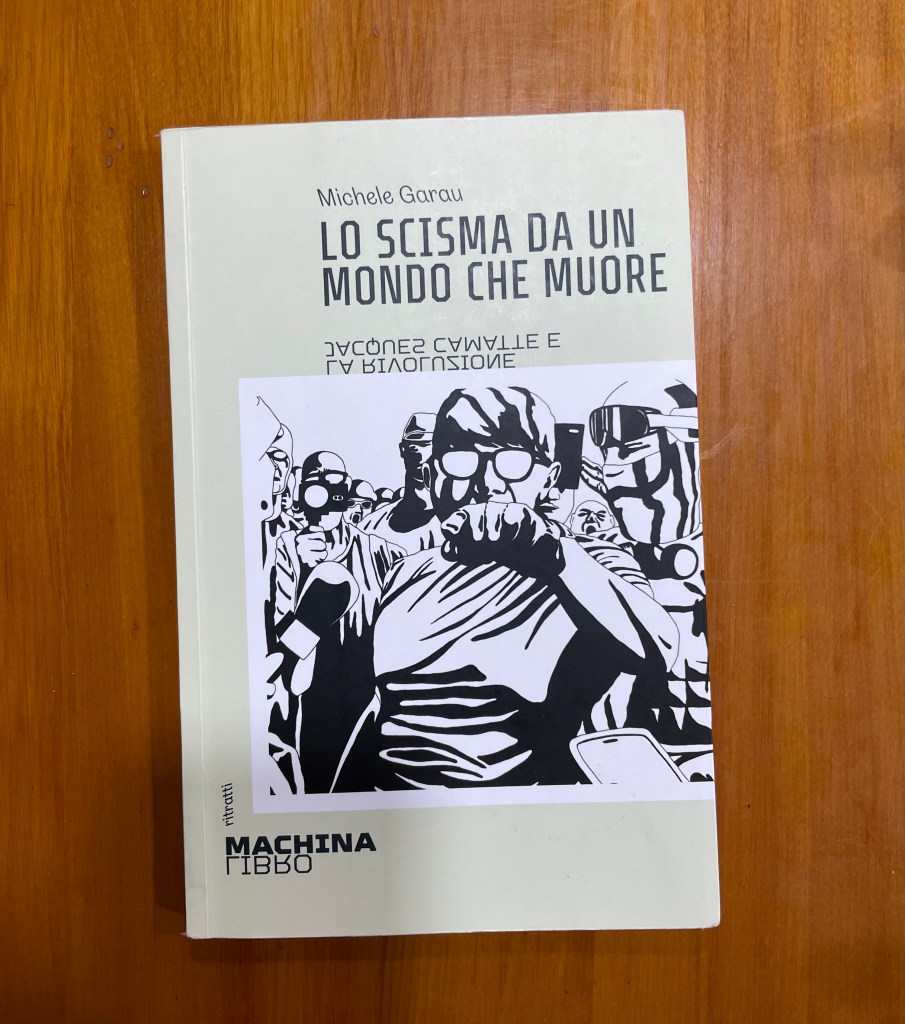
We must welcome that Michele Garau has written the first monograph on Jacques Camatte’s thought in any language, although the book, Lo scisma da un mondo che muore: Jacques Camatte e la rivoluzione (DeriveApprodi, 2024) it is also more ambitious than a mere philological reconstruction of the thinker of Invariance. Of course, not that there is anything particularly wrong with philological or archival work; rather, it is also that Lo scisma da un mondo che muore (2024) tries to think with Camatte (and also beyond some of his potential impasses) the historical bifurcation of a watershed moment in the history of humankind through the realization of the “capitalist revolution” as an autonomous colonization of every form of exteriority (Garau 7). If Camatte’s work has been only selectively considered in our ongoing discussions – while completely ignored at large by the so-called contemporary theory, which I guess it is an uplifting symptom – is precisely because he poses a challenge for a possible breakthrough in times of stagnation, while firmly announcing a much needed farewell to the modern revolution. But who would want to jump on that wagon when precisely voluntarism, prosthetic revolutionary cosmetic, and fictive communitarianism are all necessary platitudes to hold on to the illusion of ground right above the abyss? It is a rhetorical question, of course, but also one that Camatte move passed it in the in the decades of sixties and seventies observant to the material transformation of the working class, and the overall lesson of Amadeo Bordiga’s communism of the human species, which has also been rendered opaque and fossil-like by the victorious force of cultural hegemony and the whole grammatical structure of Gramsci’s thought in postwar political thought (and some will say well into our very present in the most recent cycle of failed left-populism). We said ‘farewell’ and this act, for Camatte after Bordiga’s teaching, means that the revolution has already taken place and must be perceived in the perspective of the crisis of negativity and the inception of the real absorption of capitalist development (Garau 14).
Hence, new challenges lay ahead, which implies the abandonment of the historical and temporal productivity of revolutionary time – and Garau does an excellent mapping of bourgeois revolutionary thinking from Abbe Sieyès to Saint Just to later formulations of the Leninist paradigm of the dictatorship of the proletariat – which in the grand scene of modernity oriented the economy between form and function, but also between thought and action. If the epoch is said to be ‘anarchic’ is mainly because all these mediations and exclusive autonomous spheres have collapsed unto each other, and to favor one over the other is to work within the fiction of ideological reproduction at best. After Bordiga – Garau claims glossing Camatte, although there are nuances that I cannot consider in the space of this short commentary – the temporalization of the ius revolutionis can only bear in mind the crisis of presence (De Martino) as a suspension of exteriority that liberates right unto real subsumption. This means, following the recently polished phrase of Bordiga from his article “Tempo di abiuratori di scismi” (1965), that all revolutions are born and deployed as the affirmation of the schism. “Schism” or “scisma” — and one is reminded or taken back to a theological terrain, and not just as mitigated by the old ecclesiastical memories of the “Great Schism”, but because “schism” is also the “stazion” that fractures the visible-invisible legacy of form of the Church’s Trinitarian doctrine, and which is still the esoteric boiling point of the myth of political theology. This is a detour around Garau-Camatte-Bordiga’s intuition, since none of this is explicitly thematized in the book, nor should it be. It suffices that it opens to this question, given that Camatte’s own grammar of exhaustion – “extinction”, “inversion”, “autopoiesis”, “critique of organization”, “wandering” (erranza) – distill the echoes of an apocalyptic movement proper to the modern anthropological crisis, to put in terms of Ernesto de Martino.
Be as it may, the longue durée of civilizational development of Western revolutions (Edward Gibbon would claim at least since the reconstitution of the Christian Empire) there has been a process of adequation to invariant processes of capitalist accumulation that its substrate (whether permanent, uneven, natural law justified) becomes isomorphic to the structural needs of capitalist autonomization. In a cogent reading of Sieyes with Saint-Just in the framework of the French Revolution, Garau demonstrates how the genesis of modern politics and its categorial scaffolding (localization, constituent power, social unity, subject of rights, and representation) presuppose a thoroughly new vision to make the human community a clean slate for surface legibility (Garau 42). If the civil concept of the ancient polis was measurement and exchange; the crafting of high-modern state politics that took off in the eighteenth century was much thicker and spatially robust dynamics so that the ‘laws of commerce’ and population disciplining could come to fruition with its necessary infrastructural support. The schism was always a perturbation of the “sphere of politics” (and also of politics as a translucent sphere that can be observed, stabilized, and managed), and thus a great scandal.
Hence, the critique of political economy in the history of marxism was never able to untangle this mutual correspondence. For Garau at this point one can locate the difference between Camatte’s thought and Italian operaismo; given that Italian workerism at mid-century was never able to overcome the dialectic between the valence of value form and the theory of the production of capital. Whereas for Mario Tronti the struggle was still to be inscribed in to confrontation between the proletariat qua labor power; for Camatte the “invarianza” is not an permanent stage within the history of class struggle or Marxism, but of the human community and its resistance against the real subsumption of the material community (Garau 48). Decoupling the history of the working class as constitutive of productionism from the human community, allows Camatte, in the wake of Bordiga’s communism, to register the subsumption of capital as it collapses into dialectical negativity. Hence, communism is neither produced nor organized as operaismo always thought (Garau 26-27). And citing a passage from “Against domestication”, Garau argues that for Camatte the history of the proletariat struggle after 1945 is only the struggle to maintain the myth of the proletariat as the subject of a historical breakthrough (Garau 73). This is a staggering affirmation, and one that most definitely produces a theoretical schism. But the schism is also against the fictionalization of a subject of history, which has also been integrated into the emptying of social reality as we have come to know it in the final triumph of the fictive unto itself (Garau 93).
There is the triumph of the fictive and expansive force of capital despotism, and then there is the struggle for the originary community (Gemeinwesen), which as Gianni Carchia argued in his “Glosa sull’umanismo” (1977) was still enmeshed in the contradiction between humanism and anti-humanism obstructing the vascular movement of non-identical fragments imploding the social. Is this getting at an impasse of Camatte’s own effort of thought to find an exit route? As an intelligent book, Lo scisma da un mondo che muore (2024), refuses to give an essay in the last three pages of the essay, although this difficulty is an object of attention. For instance, Garau writes in one of the clearest elaborations to tackle the problem directly: “La comunità deve allora essere riscoperta in una memoria della specie che finisce per radicarsi, questo è il rischio, esclusivamente in un bagaglio biologico. Nell’esaurimento delle strutture sociali preesistenti, dei linguaggi e degli schemi culturali, delle intelaiature rappresentative e cognitive, nella colonizzazione delle capacità psichiche, affettive, simboliche, è davvero possibile individuare un resto intoccabile dall’antropomorfosi del capitale che non debba essere, invece, creato dal nulla? C’è una «parte irriducibile», come scriveva Bataille, rispetto alle unità di misura del dispotismo economico? Non è semplice rispondere” (Garau 124).
In light of this rumination, Garau also attends to the cycle of contemporary revolts, which might stand as an instance of linguistic and existential struggle against domestication and the crisis of presence (Cesarano), and that might be capable of “absorbing the sky of politics into the most simple and elements components” (Garau 124-125). This is a great image, and one that has pictorial density and durability for thought even if it lacks specific elaboration. To absorb the open sky is to confront the exteriority of the world only as transfigured and brought back as a gathering of experience. The great German critic Kurt Badt comes to mind when writing about Constable: “the sky’s the organ of sentiment”. The embarrassing loss of the world today is fundamentally the destruction of the right attunement to our relation to the opening registered by what gleams above our heads. And perhaps this is a way to measure the capacity for non-movements rather than thinking that movements can disclose the sky. To this end, what could it mean to absorb the sky of politics – which is also a way to refuse the politics of sky, that is, the total planetary grand designs of geopolitical Tianxia? The irreductible may not be reduced to a substance, nor an ontological science nor a vitalist return to an originary community (if only mediated by the restriction of the archaic myth); but precisely that positionality of contact between what is exterior to life itself. To dislodge thought from all political plotting of objectivation and its plastic ligament of social adaptation. A life beyond itself that endures, and perhaps will outlive this dying world.
In an early review of Elio Vittorini’s Uomini e no (1945), Renato Poggioli noted that one of the important merits of the novel was that in spite of the authort’s political commitment, the narrative was “neither partisan nor ideological. I dare to say it is not political; the author even apologizes for this at the end of the volume” [1]. Poggioli, of course, is referring to Vittorini’s Postscript where he states, favoring a thin notion of the autonomy of art, that the end of art is to “seek in art the trace progress of humanity is altogether different from fighting for it upon the political and social terrain” [2]. This is enough evidence to bring to bear Vittorini’s humanist project grounded in a faith in the “progress of the human species” that he wrestled with throughout his life, and that he never really abandoned according to Franco Fortini [3]. Of course, Vittorini’s ‘progressivism’ is not bounded to ironclad guidelines of political economy and the science of a materialist history, rather his position is the attempt to flee from it, to undertake a different path in which humanity and inhumanity could enter into an improper and inconspicuous relationship towards presence.
Here we can part ways with Poggioli’s suggestion that Uomini e no (1945) is not “sufficiently political” because the characters do not dare to make political slogans or identify themselves with a concrete political party line (the Communist Party that Vittorini himself identified with in spite of having written a non-political novel) during the underground resistance during the years of fascist domination in Milan during the interwar years. If Uomini e no (1945) drifts aways from engaging in a formal political identification to mobilize the narrative persuasion it is because for Vittorini there is an original struggle for “life” that necessarily precedes subjection and political action: it is the struggle of human species to confront the difficulty of its own inhuman threshold, which becomes necessary to account for in any materialist conception. The whole tension of the novel hinges on the unnerving formal composition of the narrative with the asphyxiating dread and angst of the character that embodies the existential the practice of an incarnated struggle beyond survival.
However, what is beyond survival? What comes after the desert of a world that soon enough – in the words of Theodor Adorno at the height of the mid century – will turn human life into “mere functions within a monstrous social machine in which “life does not longer lives”…in which what grows is the scope of socialization and its functions. What I want to say is that liberty has become a mere pretext to enhance the ways of domination” [4]. If politics is the religion of modernity (political theology suturing the void with authority), the accumulation of liberty can only be understood as the moment of expansion and reproduction of effective domination. In a way, the metropolitan scenario in Uomini e no (1945) foreshadows the evolving historical epoch of this ‘monstrous socialization’ as a civil war or stasis, in which the mere survival of political struggle is proportional to the dispensation of death of humanity as the last dialectical movement of humanity against itself; that is, towards the concrete extinction of the human. For Vittorini the swerving black sun of fascism and political militancy (in its idealized version invested in the paradigm of sacrificial structure of history) can only amount to the realization of epochal nihilism and the fertilization of the expansive desert in the novel at the expense of sacrificing the erotic mediation with the world, which entails the liquidation of the sensibility external to human: “Love, in those deserts, is at its most squalid; it is not that life is absent from but the life it has is not alive. You are thirsty and have a chance to drink; there is water. You are hungry, you have a chance to eat; there’s bread. There is a spring and alms around, just the one you are looking for. But it is only a mirage, it is not the thing itself” [5]. The fundamental question posed by Vittorini is never truly resolved by Uomini e no (1945): crossing the desert to achieve something like an erotic distance with the thing itself as ultimately the confirmation of one’s irreductible destiny. No doubt, there are moments where this emerges in strange ways, at the limit of narration and as a linguistic declaration. This is scripted through the exchange with the old lady Selva on happiness: “We work in order that men be happy. Isn’t that what we are working for?…Men need to be happy. Would there be any point to our clandestine newspapers? To our conspiracies?” [6].
Is happiness a subterfuge to return to the world, or is happiness, authentic non-compensatory happiness, the stimmung of life as it retreats from the delegated representations of civil society? The suspended dialectical closure at the level of form in Uomini e no (1945) provides a preliminary resolution to the question of happiness amidst wreckage; a collapse that speaks to Vittorini’s impossibility to bring into synthesis political action and existential authenticity. The narrative texture of Uomini e no (1945) is a preparatory exploration – showing the false exists in the meantime – towards the possible liberation of man’s passions, even against the premises of a reconciled ‘Humanity’ capable of leaving behind the antinomies of humanism and antihumanism at the service of the ‘communist way’. And we know that for Vittorini the commitment to ‘Communism’ was inscribed not in the idea or the organizational tactics but in the notion of the “way” (una via), capable of opening possibilities to counter the coercive efficacy of the administrative social apparatuses that turn historical progress into a totalizing desert [7]. How to do so – is there any legible index to the “via comunista”? As a novel Uomini e no is preparatory towards this retreat from the confusion of the inhumanity of the human on the one hand, and the total humanization of the world to deface the possibility of happiness and experience with the world itself.
In this sense, Fortini is right in describing the lyricism of the novel as attuned to a funeral oration or song (“canto funebre”), which is also a prolonged farewell to the ideals of Vittorini himself as a moral humanist; that is, as someone committed to the ideals and abstraction of redemptive self-sacrificial christology and the self-serving autonomous action of the pardon as man’s last hope to absorb the inhuman kernel into the vita nova of a redeemed universal Humanity. And in fact, these are two “endings”’ of Uomini e no (1945): the self-immolation and sacrifice of the protagonist N2 waiting to confront the Nazi official Cane Nero, and the final sequence of the worker that refuses to murder a German soldier because he looked “sad” even when standing on occupied soil, even when he occupies the role of the protectorate of the nomos of the earth [8]. These are the novel two preparatory distinct actions in the dense fog of the interregnum: the Christological path of sacrifice of N2 – the sacrifice to end all sacrifices, which according to René Girard’s defines the advent of the Christian sacrificial practice- seeks a last action of resistance holding on to “humanity’s internal weakness”, which carries the elevation of secularized mythic discharge of subjective martyrdom [9]. On the other, the milanese worker offers redemption as a form of secret forgiveness (without a justification and without a why) to the occupier, and in this way integrate the inhuman into the human species as the solution to the repeated rumination over the movement of struggle and resistance: “Why, without being in any way forced to do so, had they entered this duel to the death, and why did they continue to wage it?” [10].
In his early reading of Uomini e no (1945) Franco Fortini offered a thesis that I am tempted to call the domestication of the wolf argument; an inversion of Hobbesian anthropology and the Christian felix culpa in which struggle’s optimism will ultimately transfigure the internal wolf unto the human’s heart [11]. But we know that the homo homini lupi depends on a thick notion of anthropology, of the human’s unfathomable deficiency in relation to ‘object reality’ so that any domestication of the wolf within humanity is also an anthropological quest; perhaps the last “route” of negating humanism through substantive acts (sacrificial sacrifice and forgiveness) in the attempt to reconcile the wolf with man. But this is the very enterprise of civilizational techniques of adaptation proper to the tooling of political anthropology – that is, the domestication of the savage wolf entails its conversion to the passive dog. Could there be a way out to the final verdict of dialectical form beyond struggle, and the reconciliation of humanity with its negation? Perhaps this is only registered as the unthought in Vittorini’s Uomini e no (1945); an experience that prepares a return to the world through the conatus essendi, or the preservation of each thing’s being as their are. This is registered in only instances of the novel in the backdrop of a landscape; indeed, outside the subject of self-reflection, and beyond the premises of radical evil proper to moral platitudes. And the moment reads like this in chapter CXXX: “The long dusty road, the drowsiness, the hay, the stitches where the cicadas were: everything that was, and that, along with everyone who is lost, still wants to be. And the sky filled with kites? The sky that was filled with kites” [12]. The perseverance of the conatus essendi puts to rest what the delegated forms that politics and morality have to offer as temporal substitutes for dragging the historical promise of humanism within epochal nihilism.
In this suspended imagery of an arid landscape, Vittorini descends to the preservation of things as they open to their manifestation of another sense of freedom – no longer tied to the paradigm of historical liberation nor to the assumption of synthetic anthropological determinations to sooth pain – comes upwards, always silently, through the order of description outside the human. And is not in this description what Gianni Carchia would call “the non-human…a gesture of farewell to the idealist movement; a farewell to the exaltation of the human up to the highpoint of its explosion. The refusal to substitute the dead god for a human that in the depredatory scope of totality crosses every limit, every transcendence, and infinity” [13]? This transposition of this proximity with this “other-than-humanity” ( what Humanity can no longer hold on to) is the secret to Vittorini’s infrapolitical impasse in Uomini e no (1945) that holds the key to his insistence on a notion of “freedom” against the subject incapable of overcoming itself in the face of the abstraction (morality) or ideological reassurance (militancy) [14]. One could assume that the worker’s last line in Uomini e no (1945) – which also coincides with Vittorini’s mimetic repetition in his “Postscript” – in the form of a promise (‘I’ll learn better’) registers the final attempt to grasp what remains on the exterior fog of humanity: a notion of freedom that, in seeking ‘a way out’, insists in the possibilities of establishing contact with the world. Thus, the program of historical liberation can only be achieved against historical and civilizational fixation; traversing the polarity of humanity and inhumanity, and thus deposing the sublimated sentiment of pain that social domination can administer as an unending process of degenerated and moribound humanity as mere continuation of the fictive life.
.
.
Notes
1. Renato Poggioli. “Review of Uomini e no by Elio Vittorini”, Books Abroad, Vol.20, N.4, 1946, 393.
2. Elio Vittorini. Men and not men (The Malboro Press, 1985), 199.
4. Theodor Adorno & Max Horkheimer. “El mundo administrado o la crisis del individuo”, Pensamiento al margen: revista digital de ideas políticas, N.19, 2023, 200.
5. Elio Vittorini. Men and not men (The Malboro Press, 1985), 34.
6. Ibid., 13.
7. Elio Vittorini. “El comunismo como vía”, in Diario en público (Gadir Editorial, 2008), 279.
8. Elio Vittorini. Men and not men (The Malboro Press, 1985), 50.
9. René Girard. Sacrifice (Michigan State University Press, 2011), 65.
10. Ibid., 196.
11. Franco Fortini. “Che cosa può l’uomo: Uomini e no” (1945), in Saggi italiani (1987), 253.
12. Elio Vittorini. Men and not men (The Malboro Press, 1985),190.
Philippe Theophanidis has recently brought to my attention an emphatic statement in Dionys Mascolo’s Lettre polonaise sur la misère intellectuelle en France (1957): “La politique est notre passion. Nous en parlons, ne faisons que cela, et tout l’ennui du monde est dans ces dialogues-disputes, dans cette démarche perpétuellement contentieuse qui donne envie de s’occuper de n’importe quoi d’autre, de plaisanter, de se taire, de s’en aller” [1]. These are intense words not entirely divorced from a deep sense of desperation entangled with a commitment to realism – minimally understood as bringing into thought how things looked at the time. In a recent collaborative introduction to the writing scene of this group (preliminary work towards an upcoming seminar) – which included Mascolo, but also Duras, Vittorini, Blanchot, and other continental friends – we took into consideration how the heterogeneous and internal tensions were brought into bear in the effort to connect the creative act to the existential texture of communication and concrete world events [2].
Mascolo’s statement must be read as historically marked and situated, as who today could claim that “politics”, however broadly or loosely understood, is the exclusive “object” of our passion? Mascolo seems to have been aware of the subordination of passion into politics, leading to dialogues and disputes where nothing could facilitate the clearing of a way out. When politics becomes the final object of one’s passion it could only mean that the reign of chatter has liquidated our experience with the world. And it is at this point where the ‘missing word’ that attunes the search for one’s passion can regress as nihilism; that is, as mere force to steer rhetorical valence and representational exchange within the expansive intramural rules of civil society. Restricting one’s passion to the determination of politics merely inverts the order of modern legitimacy (i.e. the repression of passions by the interests), compressing both terms as a higher principle of politics.
If at the outset of modernity contractualism suppressed the passions in exchange for sovereign security from the fear of violent death; in the attempt to elevate the passion to the grammatical height of politics, what is rendered obsolete is precisely the possibility of securing an existential site of freedom outside and beyond politics, that is, in the the nonplace of the passion itself. Of course, one could also read Mascolo’s apothegm in light of his revolutionary politics, in which the name of “politics” solicited the revolutionary emancipation of the civilizational alienation of the human species towards a transformative sequence beyond the scarcity of needs. But the problem of the category of revolution is that it remains tied to the very development of the legitimacy of the political and its erosion (for Edward Gibbon in Decline and Fall of the Roman Empire the configuration of the state is the crowning revolutionary event against disorderly barbarism), which the members of the Saint-Benoît Group were first hand witnesses in the postwar epoch.
I think this speaks to my suggestion that the assertion ‘politics is our passion’ was historically embedded; a sort of last breath of trying to hold onto the utopia that will soon crumble in every active paradigm of planetary order (postcolonial, Soviet state planning, European communism and social democracy). But at least – and this is what remains of interest, as I see it – the Rue Saint-Benoît friends had the courage to confront it in order to enact a farewell to the very assumption of ‘revolution’, which already in 1968 was clearly moot. In the words of Maurice Blanchot after the events of 1968: “…but from now on I will hold onto an exigency: to become fully conscious, and always anew, that we are at the end of history, so that most of our inherited notions, beginning with the one from the revolutionary tradition, must be revised and, as such, refuted. […]. Let us put everything into question, including our own certainties and verbal hopes. The revolution is behind us: it is already an object of consumption and, occasionally, of enjoyment. But what is before us, and it is terrible, does not have a name” [3]. Thus, to conflate “politics” as the passion could no longer offer solid ground in the intra-epochal interregnum of suspended historical time. Just a few years later, Duras will claim that politics had little to offer, since there is an “absolute equivalence between all political programs, and only right ideology seems to be able to do politics as such. We no longer believe in politics…there is only a burrow of hope. We must submit ourselves to the hard evidence of its total degradation” [4]. To dwell in a delimited burrow means a return to the rooting of place and new geographies beyond the temporal axis.
One can read both Duras and Blanchot’s elucidations of the collapse of modern politics and its negation (the ius revolutionis) as a corrective posture to move past Mascolo’s hope to make the unfathomable texture of one’s passion coincide with the object of a political project, even if understood as an archipolitics. But it is precisely in the abyss opened by a terrible and nameless epoch that a new light is casted on the free-standing and ungraspable nature of the passion; the irreducible law that establishes a contact between the ethical life and the world beyond objectivation as both excess and deficit of the tribulations of political order. Perhaps a modification to Mascolo’s thesis is now necessary: passion is what escapes every possible fall into the objective world, and for this very reason it is a ‘refusal’ of what the compensatory bond of politics can offer under the sermo humilis of stagnant artificial utopias. There is no political passion just like there is no political friend, since both friendship and one’s passion remains always objectless, only mediated by the overcoming of the preconditions of fear and of delegated life. In Manuale di sopravvivenza (1974), Giorgio Cesarano will claim that passion was the name of the coming historical program of a sensible presence resisting the “annihilating force of social objectivation” of the world [5]. And the Italian poet will define the passion as the sacred taking possession of the return to appearance. A transformation of politics could only emerge after one’s passion could finally prevail experientially against the terrible and nameless (and unnamed) world organized towards planned obsolescence and generalized humiliation. And it goes without saying that we are still very much our predicament. The caesura between passion and politics has now become spectacularly absolute and irreversible.
.
.
Notes
1. Dionys Mascolo. Lettre polonaise sur la misère intellectuelle en France (Éditions de minuit, 1957).
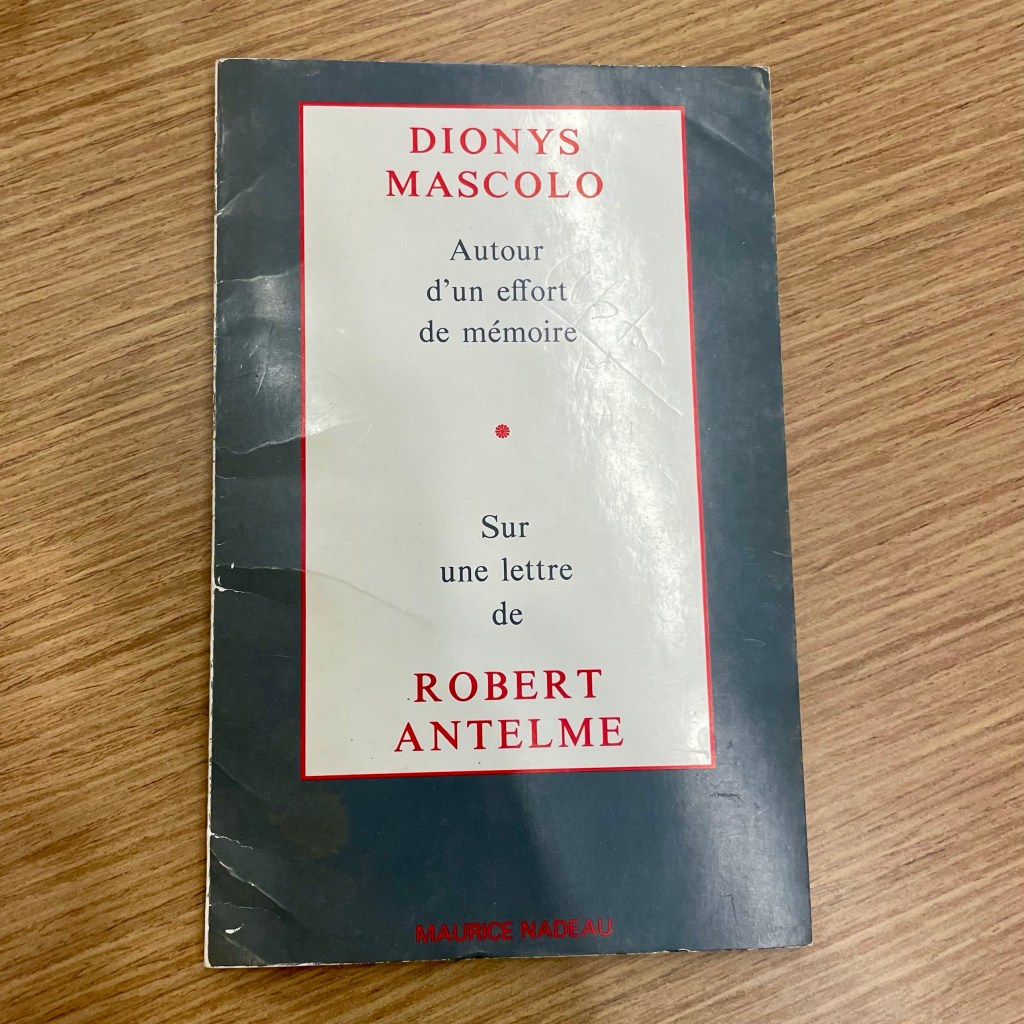
Rereading Dionys Mascolo’s Autour d’un effort de mémoire: sur une lettre de Robert Antelme (1987) in preparation for an upcoming course with Philippe Theophanidis, one gets the sense of beginning backwards or at the very end, since this late essay is a recapitulation of what the Rue Saint-Benoît Group embodied and stood for. And it is so obvious that for Mascolo what is at stake in Antelme’s letter is not a particular practice of confession (and the coupling of secrecy and extraction), but rather an integral register of an experience that belongs to “friendship in thought without reserve” [1]. And that it would not have been possible without friends, as simple as that. Of course, the condition of possibility of this shared thought in friendship has less to do with general principles, norms, or creative acts, and more with what Mascolo does not hesitate to qualify as “a sensibility that was common to us”.
What is this sensibility, and is it possible to describe it? This is a question that I do not think that is attempted to be resolved in Mascolo’s commentary nor in Antelme’s letter so consumed by its internal lacunae and effacement (I am definitely not capable of saying a word about it at the moment, and this might be one of the questions in the ongoing dialogue in the seminar). Mascolo does offer a little more when he states that this sensibility, however broad and partial, was always elevated against all totalitarianisms that were hegemonizing the political positions of the epoch. Obviously, it names the political totalitarianism (Fascist and state planned communism alike), but also the “the soul of the project” (‘est l’âme du projet et sa forme aboutie’) that must retract from it [2]. The last pages of Mascolo’s reflection is a shallow-deep, an insinuation, into the possibility of saying something in relation to this difficult proximity.
Hence, against total subsumption of life into political planning (whether on the right or left, whether ecclesiastical or in the name of the secularized forms of militant communist parties), Mascolo’s insistence on the ‘soul of the project’ is sustained by the “missing word” give that dispenses human necessities as infinite. He writes: “Et par mille et mille détours, il me (nous) fallait toujours en revenir au même point : Je suis ce qui me manque est la sentence que je porte (nous portons) inscrite à l’intérieur du front. La moindre des choses alors est de proposer que, sauf mensonge, elle vaut pour tout homme”. [3]. But what could it mean that “what I am” is always constituted by the missing word? It is definitely not a substantive attribute to a person (and thus what I can acquire), but a word that in its ideal absence and lack of epistemological validity stands as a form of seeking (zēteîn) that Nicoletta Di Vita has recently linked to the form of the ancient hymn [4]. The missing word is the passive and pure voice that calls out the rhetorical fiction of political totalitarianism. In other words, the missing word does not enact a present state of things, articulating the denomination in language with distinct objects of the world; it only has transformative weight when revealing what remains under the capes of morality.
This is why the experience of the camp constitutes a central threshold: on the one hand, it is an extreme and sharpened image of social alienation between classes; and, on the other, it is the experience that by depriving the human of its humanity it brings to an effective end the polarity between rich and poor that structured the economy of salvation and damnation of Western civilization. This is what Antelme describes in his essay “Poor Man – Proletarian – Deportee”, which according to Mascolo brings the rich to a psychotic night of desperation towards destruction and death of the specie. Hölderlin’s definition that “we have become poor in order to become rich” as a clement predicament in the face of the modern is here-forth suspended in the spiritual crisis generated by the social engineering whose most extreme case is the model of the camp.
And yet the missing word remains irreducible even after the corrupted stage of innocence and the impossibility of redemption. Mascolo, reader of Nietzsche, does not believe in the theos. This is why for him the missing word, far from being an apostrophe that offers consolation in the wake of the catastrophe, it remains concretely attached to the experience of the friend that no longer finds solace in abstract peace, but in the profound musicality of what remains inconsolable: “cette heureuse absence de paix qui est sa musique profonde, et que donne en partage l’être aimé, l’inconsolable qui console” [5]. This transfigured word – the unending capacity for hymn in the human, its nomoi mousikos – is both an excess to memory and appearance, and perhaps, more importantly, an excess to the experience of living and the dead. And is not this “seeking” passage of the missing word what the Rue Saint-Benoît Group was obsessively after?
__
Notes
1. Dionys Mascolo. Autour d’un effort de mémoire: sur une lettre de Robert Antelme (Maurice Nadeau, 1987), 82.
2. Ibid., 83.
3. Dionys Mascolo. Autour d’un effort…,82.
4. Nicoletta Di Vita, Il nome e la voce. Per una filosofia dell’inno (Neri Pozza, 2022), 27.
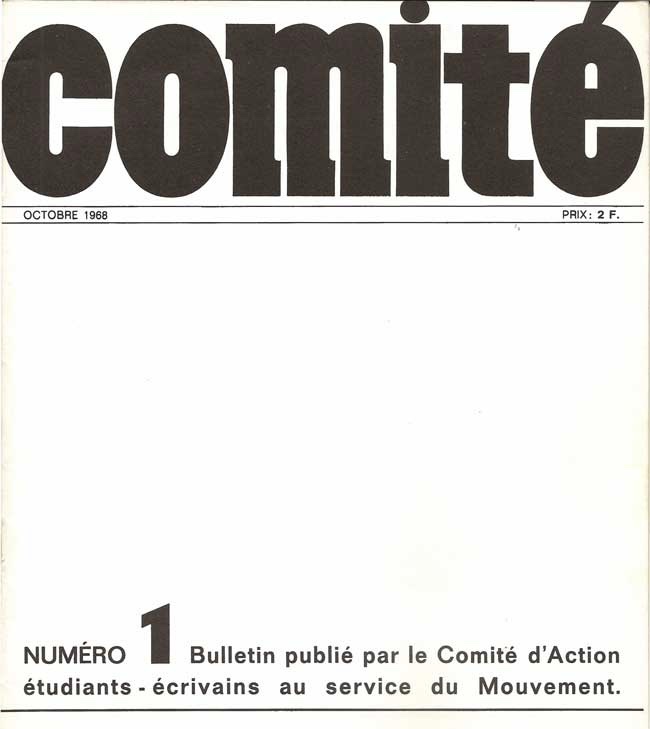
In the very last article that Maurice Blanchot wrote for the collective publication Comité in the wake of May 68, he draws a scenario that is still very much with us in the present. The “realism” is almost outstanding when Blanchot writes the following: “…from now on I will hold onto an exigency: to become fully conscious that we at the end of history, so that most of our inherited notions, beginning with the from the revolutionary tradition, must be reexamined and, as such, refuted. Let us put everything into question, including your own certainties and verbal hopes. The revolution is behind us: it is already an object of consumption, and occasionally, of enjoyment.” [1]. There was no question that the crisis of the very foundation of modern political thought has collapsed, including, as it couldn’t be otherwise, the generative principle of revolution. Blanchot did not even attempt to convince himself that the revolution could be brought back in an astronomical sense to revitalize a naturalism previous to Rousseau’s social contract.
So, for Blanchot the revolution was over, and yet, whatever it was that followed had no name. What was left, then? In order to avoid paralysis, Blanchot toyed during those months at the Comité (September-December 1968) with two possible maneuvers. The first position resided in what he called the “movement of possible speech” in order to establish an ardent and rigorous relation between the sequence of the French May and the Czech May, Soviet domination and Gaullian State. Blanchot called for (in the spirit of Bataille) a “transgressive speech”: “the impetus of outrageous, ways speaking beyond, spilling over, and thus threatening everything that contains and has limits” [2]. But we know that transgression is still within the logistics of the administration of order and temporal containment of the regulated exception. This was, in fact, the very rupture of the revolutionary break that was in crisis.
But Blanchot was up to something along with his friend Dionys Mascolo in thinking through language and communication as a path towards the outside. Hence the second option, which is really a third option (after the sleepwalking of ideological revolutionary ‘racketing’ of voluntarism); mainly, what he calls, although does not get to tease it out, the “clandestine resistance in the open”. Blanchot only tells us what he is thinking about through a recent example: some members of the Czech resistance when law was suspended had to confront the raw enemy military power, but they also experienced a freedom “through words and through writing than ever before”, tells us Blanchot. But this still does not explain much, given that if there is a naked military power threatening us, how could something like a clandestine form of life take place in the open? And at what risk?
I think one way to read this incorrectly or insufficiently would be to think of Blanchot’s suggestions as a sort of martyrdom or self-immolation. But it is no less true that Blanchot wanted to avoid a sort of Batallian “inner experience” or monastic xeniteia. Thus, he “refused” the fiction of self-clandestine life as sponsored by the Situationists; while, at the same time, also rejecting subjective revolutionary militancy. A third way emerges: the clandestine life into presence by way of friendship. A new “estilo de vida”, which I think could be read in the way that cryptojews and averroists lived in early Modern Spain: “a modo de sociedades secretas o semi-clandestinas, deben haber concebido la filosofía como un estilo de vida para sus iniciados…” [3]. Unlike the bogus image of the secret society as an alienated community of knuckleheads, I think what emerges in the clandestine open region is a form of shared friendship that does not retreat from the world, but rather that is capable of living in it. This was most definitely the transformative practice that during these years, Dionys Mascolo, dared to call the communism of thought that for him belonged to Hölderlin rather than to Marx. If open conspiracy is an act of the sharing and participating in language without meaning or command dependence, then this is already a poetic practice. After all, for Hölderlin the poets reveal an originary loss from nature. It is no surprise that Hölderlin favors a world opening even after the destruction of the leader-figure of the poet (Empedocles).
So, there is only clandestine life in the open when the sharing of language among friends take place (an event). This use of language is always harboring on the threshold of the last word to come. In short, the clandestine form of life has nothing oblique with respect to the world – it is not necessarily the space of an infinite night of contemplation, and it is also indifferent about fugitivity – it demands a return to appearance by way of experience. This might explain what Gilles Deleuze tells Dionys Mascolo at the end of their correspondence about friendship and thought: “it is a question of what we call and experience as philosophy” [4]. This form of experiential thought against the dissatisfaction of political domestication points a way out. For Blanchot this was a “fragmentary, lengthy, and instantaneous” path; a conspiratio unlocked by philia.
.
.
Notes
1. Maurice Blanchot. “On the Movement”, in Political Writings 1953-1993 (Fordham University Press, 2010), 106.
2. Maurice Blanchot. “Clandestine resistance in the open”, in Political Writings 1953-1993 (Fordham University Press, 2010), 106.
3. Francisco Márquez Villanueva. “El caso del averroísmo popular español”, in Cinco Siglos de La Celestina: aportaciones interpretativas (1997), 121-134.
4. Gilles Deleuze. “Correspondence with Dionys Mascolo”, in Two Regimes of Madness (Semiotexte, 2007), 332-338.
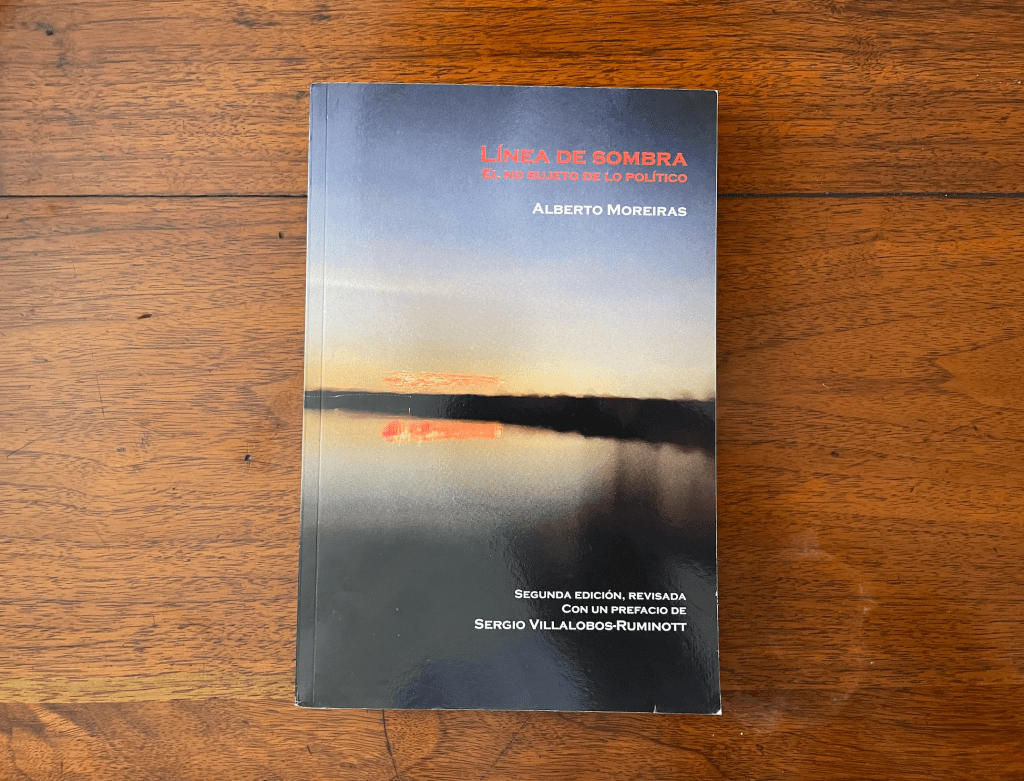
The core of my present intervention was prompted by a joke recently told by a friend. This friend said: “Alberto Moreiras is Spain’s most important Italian philosopher”. I felt I had to respond to it, in my own sort of way, such as this brief intervention. I will offer at least three hypotheses as why that was said. First, what is obvious: Moreiras’ analytical reflection is irreducible to the dominant Spanish philosophical or cultural reflection, however we take that to be (taking in consideration that Moreiras’ work is hardly defined solely by the Spanish archive or historical tradition). Second, that Moreiras’ reflection is somewhat close to the Italian philosophical tradition, particularly in the wake of the contemporary turn of “Italian Difference”. Thirdly, that Moreiras’ own singular thought shares a vinculum with the Italian philosophical culture as “thinking on life”, as perhaps best defined by Roberto Esposito in his Living Thought (2011). There is probably no way to find out the original “intention” of said friend in terms of the Italian signatura of Moreiras’ work, and it is not my desire defend any of three hypotheses. Rather, in what follows what I want to develop is a preliminary exploration of the way in which Línea de sombra: el no-sujeto de lo político (2006) could be very well read a horizon of thought that retreats from community vis-à-vis the non-subject that transfigures the “democratic kernel of domination” (Moreiras 94).
In this analytical development I want to ‘actualize’ Línea de sombra’s potential not very rehearsing the arguments against the so called decolonial option, the metaphysical concepts of Empire and multitude, or the critique of the humanism of the politics of the subject, all of them contested in the book. It is not that I think that those discussions are closed, but rather that I want to suggest that a different politics of thought that radicalizes and abandons those very notions – nomos, legacy, and subject – through the practice of infrapolitical reflection. Hence, I will take up two instances of this nomic sites of contemporary reflections in the so called school of “Italian Difference”; mainly, Remo Bodei’s “Italian” entry in the Dictionary of untranslatables (Princeton U Press, 2014), and Roberto Esposito’s articulation of “Italian philosophy” in his Living Thought: the origins and actuality of Italian Philosophy(Stanford U Press, 2011). I would like to anticipate a critique that could perhaps note that I am putting off Italian thought, or even antagonistically clashing two schools of thought. I am not interested in establishing what could well said to be a legislative clash between theories. I am also aware that Italian Difference is a topological heterogeneity that organizes variations of common themes among thinkers, but that it is not reducible to what singular thinkers generate in their own effective elaborations. In this way, you could say that what I am interested here is in the way in which a certain nomic grounding under the name of ‘Italian Thought’ has been articulated, grounded, and posited as a tradition between conservation and rupture. In the remaining of this intervention, I would like to offer some preliminary speculative ideas about the way in which infrapolitical reflection decisively emerging from Línea de sombra divergences from the general horizon of radical democratic politics advanced by Italian theory.
For reasons that are not just chronological, I think Remo Bodei’s entry in the Dictionary of the untranslatables is preparatory for Esposito’s own take on the territorial and exterritorial force of “Italian Philosophy” in his 2005 book. Indeed, Esposito records in a footnote Bodei’s entry, as well as other recent contribution to the topic such as Borradori’s Recording Metaphysics: New Italian Philosophy (Northwestern, 1988), Virno & Hardt’s Radical Thought in Italy: A Potential Politics (Minnesota, 1996), and Chieza’s The Italian Difference Between Nihilism and Biopolitics (2009). An important predecessor reflecting on Italian philosophical culture – ignored by both Esposito and Bodei – is Mario Perniola’s early “Difference of the Italian Philosophical Culture” (1984), which already establishes the conditions for thinking this nomic specificity beyond the encompassing paradigm of the nation-state, and against the grain of the organization based Italian identity of the Risorgimento. For Perniola, “this is now over, and that natilistic ways, based on a comparison and vindication of identities have completely exhausted their historical function” (Perniola 105). The exhaustion of a national philosophical script is what reversely makes the case for Italian thought to be a thinking measured by civic activism, which entails that the conditions for transmission and interruption of tradition is essentially through a distance between history and language (Perniola 108-09).
sIn a profound way, Italian philosophy is what speaks without historicizing itself, or what speak the non-historiciable to put in Vico’s terms in the New Science. This amounts to an interruption of any philosophy of history, since it discloses a region of what cannot be rendered a science of history. Italian philosophic reflection opens up to the collapse of narration not as consequence of State persecution or constitutive violence, but as a function of a politics incapable of coinciding with the Italian nation-state (as we know this is the symptom of Gramsci’s formulation of the subaltern, and the North-South relations the Prison Notebooks). Perniola’s early essay is an important salient informant of Bodei’s entry, since what arouses the second’s reflection is precisely the drift towards a civil philosophy, or what is the same, a philosophy based on a civic vocation. Thus, writes Bodei:
“From a broad historical perspective and taking into account the limits imposed by its irreducible complexity the Italian language has been character by a constant and predominant civil vocation. By civil I mean a philosophy that is not immediately tied to the sphere of the state, nor to that region of interiority. In fact, ever since its humanist and Renaissance origins, its privileged interlocutors have not been specialist, clerics or students, attending university, but a wider public, a civil society one has sought to orient, to influence, to mold” (Bodei 516).
Italian language, which for Perloina was constitutive of Italian thought, here takes a civic function that exceeds the proper limits of the philosophical act. This is why Bodei’s most important symptomatic definition is Machiavelli’s ‘verità efffecttuale della cosa’, which is guided by desire at the intersection between tradition and innovation, revolution and rupture. For Bodei’s Italian vernacular language necessarily breaks away from the very containment of the philosophical nomos, spilling over an excess that is anti-philosophical or ultra-philosophical. By proxy of Leopardi’s writings, Bodei argues against the ‘German poem of reason’, defending a poetical space of thought that knows (according to Leopardi) “the true and concrete…the theory of man, of governments, and so on, that they Germans have made none”. The point being is not just that Italian philosophers are ultra or non-philosophical, but that an antiphilosophy of praxis, of what citizens already do. The difference, according to Bodei vis-à-vis Croce, only rests upon critico-practical reflection as the central determination of thinking in Italian (523).
As it is for Esposito – but we can say also for Agamben in the last volume of the Homo sacer series, L’uso dei corpi (Neri Pozza, 2014) – philosophy is a praxis that provide immanent validation for Aristotle’s treatment of dunamys and energeia, as well as his general typology of causation. What is at stake here is nothing less than the actualization of the question of technology (technê), which Bodei reads in Galileo’s as a contestation to the systematization of maquination (Gestell). The scientific thought of Bruno or Galileo bring to halt the machination that Heidegger understood as the end and realization of epochality through gigantism, by positing the artificiality of the apparatus (of the ‘thing’) as an extension of nature, and not as its mere opposition (Bodei 527). Although he does not explicitly thematizes it on its proper terms, one could very easily read in this argumentation the polarity that structures Italian non-philosophy: the question of civic vocation (klesīs) and the question of nihilism (the co-belonging between technique and philosophy of history).
What is rather puzzling about Bodei’s argumentation is that at no point does he account for a genealogy of what I would call the non-philosophy of life, or even the life of non-philosophy as the excess of the philosophical life in the Italian republics. In other words, Bodei leaves out the sophist, and it is the figure of the sophist what ultimately lead a positive civic contemplative life outside the constrains of philosophical schools, such as stoicism (Bonazzi & Bènatouïl 2006). Instead, what he does offer and reconstructs is the paradigm of an Italian philosophical tradition that still structures itself between tradition and interruption, thought and action, immanence and life. This is the conflictivity or differend – we could also call its krisis, which Cacciari’s studied in relation to the labor of the negative in his important book Krisis: Saggio sulla crisi del pensiero negative (1976)– that in Bodei remains unresolved at the political register, still organized around the concept of the “civil”.
Roberto Esposito’s Pensiero vivente (Giulio, 2010) shares many of the basic premises advanced by Bodie, but there is little doubt that it is the most sophisticated and sustained reflection on thinking the nature and the political consequences of “Italian Difference” in the wake of nihilism and biopolitics after Michel Foucault’s critique of governmentality. Although unlike Bodei, Esposito pushes the political consequences to its limits on the relation between philosophy and history. According to Esposito, it is on this threshold that a region beyond the impasse of the philosophical and political categories of Western modernity, would allow an actuality of thought with transformative capacities and innovative energy (Esposito 21). Departing from Deleuze & Guattari’s anarchic definition of philosophy as de-territorializing, Esposito affirms not an ultra-philosophy or a non-philosophy, but the development of an uneven grammar that is universal due to its very singularity, that is, it could travel unbounded throughout Europe with arguments, formulations, and images that everyone could make their own and share (20).
Esposito outlines three different paradigms of Italian difference: a political one that solicits conflict in every instance; a radical historicity of the non-historical; and one of life, which is to be understood as both the worldliness of the modern subject and the deconstructive gesture of the dual theological machine folded on the person. I want to limit myself to elaborate on the first and third declinations (political conflict and life). Esposito also thinks against the German or English traditions understood as State traditions – the traditions of Locke, Hegel, or Fichte – which he sees as constituting the state knowledge of the political (Esposito 21). Esposito views them as philosophies of history, whose nexus to the political is one of consensus and not of disagreement or antagonism. Instead, “Italian philosophy has shown a critical and sometimes antagonistic potential not commonly found in other contexts. Sometimes, in special situations, and under certain conditions – in the case of a drastic transition between epochs like the one we have been experiencing for some hears now – what appears to be, an is, in effect, a lack or an antimony can transform itself into advance compared to more stable, well-established situations” (21).
This ‘antagonistic potential’ defiantly avoids the nihilism of acting according to the presenting of principles of the normative order. However, so it seems to argue Esposito, the antagonistic politics feeds off crisis, is born out of transitional or inter-epocal subsumption. The question is similar to the one that one could formulate against the hegemonic principle overriding the populistic logic, which Moreiras frames it in this way in Línea de sombra: “if hegemony is the democratic horizon of domination [because it is not consensual], the search for a politics of the closure of sovereignty begs the question about the end of subalternity in a radically democratic horizon” (Moreiras 94). But the truth of democratic politics is only possible against the condition of hegemonic attainment. Esposito writes this much: “…[against] the Hegelian identification between politics and state, the world of life is cut through by pervasive struggle, in a fight to idea for hegemony: whether like it or no, we are always forced to take a position in favor of one part against the other” (Esposito 25).
I would not go as far as to say this exhaust the horizon of Esposito’s political thought, from the intricacies of the impolitical to his most recent turn to the impersonal. However, this does mark a fissure from the possible of generating a radical theory of de-theologizing the political, an operation of thought not alien to the infrapolitical horizon (132). Essentially, the problem here is not about the theory of hegemony, or the continuation of hegemonic principle of Roman politics, as what continues to divide and administer life through domination. More so, I would argue, give that we are seeing here a second order of interior domination that posits the life of infrapolitics at the expense of the political and the community (munus). This means, that if one takes seriously the articulation of infrapolitics as the possibility of action outside the subject, that it is not enough to think the politics of Italian difference as a pre-statist that is always already the promise of a democratic or post-democratic infrapower as governed by a counter-hegemony of decision (Moreiras 224). Secondly, this leads to the question of contingency that underlines the very co-belonging between history and philosophy of the Italian Difference. Stefano Franchi is right in noting that the “sporgenza” or protrusions are processes that punctuate the body and archive of Italian thought. Protrusions are also what allow for the development of epochs, constituting the excess and contingent foundation of the historical unfolding as such. Of course, the pressing question is: “and how do we know if ‘Il Pensiero vivente’ as such – not the book Esposito wrote, but though he advocates in its last sentence as a breach capable of renewing contemporary philosophy as a whole – is capable to uncover those events in unprecedented ways?” (Franchi 31). And what is more: how does one establishes a co-substantial difference from an epochal presence of living thought to Esposito’s own thought (impersonal / third person)?
My purpose here is not to resolve this aporia in Esposito’s characterization of Italian Difference, because to cross its nihilism. Infrapolitics has something to say here in regards to location. In the chapter on infrapolitics in Linea de sombra, Alberto argues: “The difference between an imperfect experience and one reducible to an aporia is also the difference between understanding the aporetic as the end of thinking, and that of understanding as a reflexive opening that is the beginning of an infrapolitical practice in the same location where the suppression against the aporia reinforces the exorbitant violence of the imperial biopolitical hegemony” (Moreiras 235). But infrapolitical dwells necessarily in a non-space or alocation, since is very excess is the falsification of life; that is, what is no longer structured around an enemy for political antagonism. Italian Difference necessitates a non-supplementary exodus that is infrapolitical life, what escapes biopolitical life of the community.
Here one must ask, what is the relation between alocationality and democracy? Is there a democracy of the impersonal or the unequal? This is a difficult question to ask at this moment, but it is pertinent if the question about civic duty (Bodei) or immanentization of social strife is constitutive Italian thought. Following the political historian of Ancient Greece, Christian Meier, Agamben concludes his recent Stasis (2015) by suggesting that the politization brought by the isonomic foundation carries the latent possibility of social strife or stasis, which is the obfuscation of the ontology of war (politics) within the polis. This runs counter to Arendt, who in On Revolution attributed non-rule to the principle of isonomy as antecedent to democracy as majority rule (Arendt 30). It also seems insufficient to end at Esposito’s determination of the community based on the logistics of binding-debt (munus), intensified today by the total unification of existence and world, in what Moreiras has called the principle of equivalence (Moreiras 2016). Is infrapolitics then, always, a shadow of civil war? If the non-subject cannot constitute isonomic citizenship; infrapolitics disjoints the mediation between the political and the differential absorption of differences. In other words, posthegemonic democracy prepares a different institutionalization for political relation that no longer covers the empty space of the One at the heart of the civil.
* A version of this text was written on the occasion of a roundtable on Alberto Moreiras’ book Línea de sombra: el no-sujeto de lo político (2006, 2021), which Sergio Villalobos-Ruminott and I organized for the ACLA 2016 at Harvard University. I am actualizing it here with minor changes in light of the first discussion on “Italian theory” in the framework of the Foro Euroamericano, at 17/instituto, which I am co-organizing along with José Luis Villacañas, Benjamin Mayer Foulkes, and José Miguel Burgos-Mazas. The first session is mow available here: https://www.youtube.com/watch?v=0BjW4euQduE
Bibliography
Alberto Moreiras. Línea de sombra: el no-sujeto de lo político (Palinodia, 2006).
Giorgio Agamben. Stasis: civil war as a political paradigm (Stanford University Press, 2015).
Hannah Arendt. On Revolution (Penguin Books, 1986).
Mario Perniola. “The difference of Italian philosophical culture”. Graduate Faculty Philosophy Journal, Vol. 10, N.1, Spring 1984.
Mauro Bonazzi & Thomas Benatouïl. Theoria, Praxis and the Contemplative Life after Plato and Aristotle (Brill, 2012).
Reiner Schürmann. Broken Hegemonies (Indiana University Press, 2003).
Remo Bodei. “Italian”. Dictionary of untranslatables (Princeton University Press, 2014), 515-527
Roberto Esposito. Living thought: the origins and actuality of Italian Philosophy (Stanford University Press, 2012).
Stefano Franchi. “Living thought and living things: on Roberto Esposito’s Il pensiero vivente“. Res Publica: Revista de filosofia politica, 29 (2013), 19-33.
Si hasta ahora la escritura de Diego Valeriano nos ha entregado un mosaico de los modos en que la energía vital atraviesa las vidas runflas en la periferia urbana, la novedad a la que invita en La no sufras (Milena Caserola, 2021) radica en el retrato invisible de una vida ejemplar. ¿Por qué invisible? Pues, sencillamente porque esta vida ejemplar carece de la lógica de los nombres clasificados y clasificables; habita por fuera del mundo de las profesiones y de la división del trabajo; y se autodefine mediante el brillo singular en retirada del tono apocalíptico de la época. Los ingredientes del retrato de la vida ejemplar nos sitúan ante los gestos y la voz, la amistad y la errancia, el movimiento y la atención, la escucha y el segundeo. La no sufras es una vida ejemplar en virtud de ser la vida de un cualsea cuya exigencia solo responde a encontrar la música de cómo se viene a ser lo que uno es. Valeriano elige una transfiguración teológica para tematizar el éxodo con respecto al sufrimiento a pesar de todo, porque solo en ese despeje puede sobrevenir una vida feliz. Como lo aclara muy temprano en el libro: “No Sufras no es el Pare de Sufrir de los pastores de la Iglesia Universal, es bien otra cosa, aunque podríamos haber sido sus más fieles seguidores y ella nuestro Edir Macedo. No Sufras suena a consigna de vida, pero no lo es. Tampoco consejo en el momento justo o palabra de aliento, aunque a veces sí. A veces trompada al mentón, a veces abrazo”. La No Sufras es absolutamente todo menos lo que ordena un mundo, pues es lo que consigue desbordar la situación de sus medios.
Pero la vida ejemplar no es una Idea entregada a las pedagogías de la mimesis, sino que es lo irreductible de una forma de vida en relación con las cosas que los encuentros han facilitado para una textura de experiencia. Y cuando generamos una experiencia abrimos un fragmento en el mundo, pues lo hemos madrugado. De ahí que la vida ejemplar se encamina en lo que Valeriano denomina lo “genuino”, que no es más que el proceso inmanente de la verdad ante un mundo caído en la “mala fe” que organiza la tensión entre valores para el actuar. La religión de nuestro tiempo no radica en el hecho de que nadie crea en un dios, sino en que todos los hombres asuman la creencia absoluta de que mediante el valor finalmente pueden ser “algo” o “alguien”. La vida ejemplar se retira del valor, quiere morar en el valor negativo, en una nueva zona que es previa a las infraestructuras de la subsistencia. Por eso la vida ejemplar, al estilo de No Sufras, gana terreno en su inmersión en la entropía experiencial: “Genuina es cierta alegría de descubrir una cosa. No cartela lo que busca, ni bandera, ni posteo, ni chamuyo. Desobedece toda regla, pero sin transgresión, solo como un juego. No acepta el lugar asignado, ninguno.” Lo genuino de una vida ejemplar es textura de existencia, que renuncia de la propia ficción en la que el objeto del deseo ha quedado designado como único destino. La vida ejemplar continuamente rechaza una vida delegada en la que somos meramente figurantes y actores de grandes guiones compuestos durante nuestras vigilias. En este sentido la vida ejemplar es música: experimentación tonal sobre una partitura asimétrica cuyas formas se autodefinen con el afuera.
Si la No Sufras es una vida ejemplar es porque irradia felicidad en los modos en que define sus encuentros. Y esto hace que su estar en el mundo sea inclasificable. Ninguna locación agota sus medios, como ninguna identidad puede colmar sus pasiones. La No Sufra vive atópicamente, lo cual quiere decir que vive contra los modos en que la metrópoli organiza los modos de desear, consumir, sentir, y juntarse entre los vivos. El “permanente movimiento” de la No Sufras es la intuición originaria de que solo hay vida estando afuera; o mejor, en el tránsito de la interioridad a la exterioridad. Ese movimiento perpetuo en la fase alta de la civilización metropolitana aparece como una tercera figura del movimiento contra el dispositivo de la unificación de vida y la política: mientras que el movimiento político busca subjetivar y unificar las existencias para evitar “desviaciones”; el movimiento de la técnica de la metrópoli busca suturar la vida en la superficie que nos asigna un lugar, una función, y un proceso de extracción en los flujos de la infraestructura.
Caminar, andar, deambular, o perderse son modos errantes que “invitan a una deserción” del aparato de la reproducción social. Esta dimensión cinética de la vida es una forma de aprendizaje infinito, en la medida en que no hay lógica de la experiencia que pueda extraer una lección de las cosas que vemos en el encuentro con las cosas en nuestro camino. En realidad, ser un itinerante o errante al interior del desierto no significa perderse de casa para no volver, sino mantener el extravío en la que podamos habitar sin perder de vista la condición exílica del ser (Rafanell i Orra). Y la vida ejemplar no es la que se autodefine por las acciones, las substancias, o las inscripciones en una historia narrada y fechada, sino la que mantiene abierta la posibilidad de “vivir varias vidas, multiplicar lo que siente, seguir vagando…andar todos los días y conseguir esas cosas que son indispensables”. A la vida ejemplar no le falta nada, porque ella es el resto o desprendimiento mismo de la Historia. Como en el conocido fragmento de Parménides que exigía atravesar todas las cosas para poder alcanzar una vida verdadera; la ejemplaridad consiste en ser infinitamente transformado por las cosas concreta que nos determinan finitamente. Y esto es lo que Valeriano nos dice en La no sufras: “una especie de existencia nueva”, capaz de liberar “otras formas de contar el mundo, tan mezquinas, humanistas, docentes, burocráticas, militantes”.
Hemos dejado atrás la época de las ilusiones cuando abandonamos la crítica (¡critica pero obedece!) y comenzamos a asumir la valentía de existir en el camino. Afirmamos la existencia cuando damos un paso al lado de la mala sustancialidad propia de la alineación antropológica dominante. La valentía se registra en dos niveles: asumir que atravesamos en el desierto; despertarnos al hecho de que hay amigos en el transcurso. Esto exige una mirada bizca ante la realidad, pero es solo de esta manera que podemos disolverla (una diagonal ética, “el segundeo” se intersecta con la diagonal de la soledad). Valeriano insiste en el registro teológico transfigurado: “un devenir combatiente como ejercicio espiritual concreto”. Esto es también secretamente una profanación del ejercicio de la militancia (heredada de la ascesis del jesuitismo), ya siempre arraigada en la subjetivación en nombre del Rey, de la Idea, del Atributo, o de la Causa. La vida ejemplar es una ascesis de la existencia que suspende las mediaciones compensatorias de la comunidad y de la politicidad como referentes centrales de la vida. La vida ejemplar, en pocas palabras, es vida infrapolítica porque se separa de la subsunción de lo político.
Así, nos ponemos en movimiento para combatir el aburrimiento que irradia la nueva eficacia de los dispositivos del poder contemporáneo que asociamos con la fase topológica de la metrópoli. Ese aburrimiento no es otra cosa que la eficacia de una geometría sobre la realidad: limitar la potencia cinética de la vida con el afuera; controlar el contacto con la exterioridad a partir de una optimización del riesgo, y subjetivar un terror interno al sujeto para legitimar la necesidad de una gobernabilidad. De ahí que el combate epocal ya no sea entre ideologías ni entre herramientas políticas ni conceptos de la herencia revolucionaria; el nuevo combate ahora aparece como la dispersión de las texturas de la vida ante el tono apocalíptico del mundo en el que la historia decide la caducidad de nuestro encuentro con las cosas. La No Sufras mira de costado y sigue a toda velocidad en su bicicleta. Solo podemos definir una nueva cultura de la violencia sensible cuando medimos nuestros movimientos contra la extática de la metrópoli. Así, hablar del entorno no es asumir la vida como reducción biológica; es una forma de vida en la manera en que habita en el mundo.
Valeriano no instala en su escena al concepto, sino al cuerpo; tampoco se interesa por la literatura, sino por la escritura como proceso incesante de desficcionalización y destrucción de metáforas, un artilugio propio de la alegoría metropolitana (“todos aquí tenemos una vida”). Ya no se trata de “contar quien es el Yo”; en realidad lo importante es cómoes que aparezco en el mundo. Y es desde ahí puedo definir mi proceso de verdad: “El final del Yo será la génesis de la presencia”, afirmaba hace décadas Giorgio Cesarano. Y esto significa que la disolución de la ficción del sujeto nos expone al acontecimiento que reorganiza los modos de nuestra singularidad. Ahí es que podemos hablar de un proceso de verdad, como fuerza que atraviesa en La No Sufras por fuera de la mimesis y de sus excepciones al régimen de legibilidad. Pero ¿qué supone un procedimiento de verdad? Obviamente ya nada tiene que ver con un orden objetivo ni constatable con los residuos de la historia; la verdad es la manera en que aparecemos en el mundo suspendiendo el principio legislativo del juicio. En este sentido, “aparecer” es una revelación asintótica con lo que encontramos. Y esto termina por dibujar la ritmicidad impropia de la existencia. Si la obra de arte se define como una verdad develada; la ética del segundo es la desobra la obra de la vida: “Vida sin forma, sin ganas de tener forma, sin ganas de tener razón…vida errante, imprescindible, gede a su manera, es inatrapable”. La vida en desobra nos prepara para habitar en un mundo por fuera de la idealia y de la prisión del concepto, para transitar por la vocación musical que enmudece al ruido del mundo. Escribe Valeriano: “El lenguaje, lejos de servirle para nombrar las cosas de este mundo, la empuja a construir uno nuevo”.
Acaso ese mundo es el mundo inenarrable de la amistad, que es forma clandestina, espacio sonoro de pormenores insensatos, aunque ineludibles. La no sufras es fundamentalmente el intento imposible, quizás el gesto, de un trazo de la voz sobre el mundo contra las pulsiones de una ficcionalización del yo (Yagüe). La voz de la No Sufra, recorre sus gestos: cuando se lleva un cigarrillo a la boca, en sus silencios, cuando fija la mirada sus amigos que constantemente se desvanecen. Pero la voz es también el modo en que la lengua irrumpe en el mundo, escapando del orden discurso y de los mandatos que hoy se multiplican como última dispensación del psiquismo del poder. La voz es el vehículo para encontrar la proximidad inconmensurable entre los cuerpos de una comunidad de amigos cuya única invariante es el proceso de armar un carácter desde la intuición y la descreación del mundo al que hemos sido arrojados. De ahí la exigencia ética de la ejemplaridad de la No Sufras: asumir esta tarea requiere del ritmo de una deserción de todo aquello que, en perpendicular, nos sitúa sobre la ficción de lo meramente intercambiable. La amistad nos garantiza una derealiazación aquí y ahora: “los amigos y amigas son aquellos con quienes reunimos los ánimos necesarios para huir de nuestro tiempo”.
Esa “pura deserción que recorre el inframundo plagado de planes” al que alude Valeriano al final de La no sufras es también una huida para volver a aparecer: una vida de constates reinvenciones, gradaciones, y sombras; una vida que ha disuelto los polos de la comedia y de la tragedia de nuestra herencia mitológica; una vida en escape del dominio de la hegemonía y de las alianzas políticas. Cuando aparecemos la marca de la finitud ya deja de ser una trampa de la negatividad para convertirse en una región inapropiable que nos abre los caminos entreverados de la felicidad contra el malestar de la domesticación civilizatoria. Cuidar esta zona de lo invisible es ya el movimiento imperceptible de que estamos viviendo a contracorriente de un mundo que jamás es conclusión.
El pensamiento del exsacerdote y arqueólogo de los sedimentos teológicos de Occidente hubiera permanecido inconcluso si no fuese gracias a su amigo e interlocutor David Cayley, quien hizo posible The Rivers North of the future: the testament of Ivan Illich (2005) póstumamente. Si bien desde comienzos de los sesenta Illich —luego de la experiencia catastrófica de generar una ius reformandi dentro del paradigma misionero en Washington Heights y Puerto Rico— había avanzado en una serie de críticas a los dispositivos de la vida contemporánea, no fue hasta el final de su vida cuando tuvo la valentía de esbozar lo que él mismo llamó su testimonio sobre el destino de Occidente. Este testimonio buscaba el desaprendizaje de las raíces proféticas cristianas para “dar comienzo a una teología de nuevo tipo”.
Como en múltiples ocasiones Illich no se cansó de repetir, la signatura de su pensamiento (la “idea única” a la que es fiel todo pensador, según Cayley) residía en la comprensión de la caída de la Modernidad hacia la corruptio optimi quae est pessima (“la corrupción de lo mejor es lo peor”). La peor de las corrupciones había tenido lugar con el advenimiento de la profecía universal cristiana, cuya economía de la salvación terminó administrando los hábitos y los modos sensibles de la vida de los hombres. La idea de “reino” como espacio de apertura a la “sorpresa”, ahora pasaba a estar en manos de la institucionalización de la Iglesia; de la misma manera que la conspiratio convertía el pecado en administración de la comunidad de los vivos en un tiempo sin redención. Así, las páginas de la Historia vencían el misterio de las relaciones entre hombres que ya no podían elegir sus maneras libres de inclinación y afección.
En un trabajo, complementario a su última conversación, Ivan Illich: An Intellectual Journey (Penn State University Press, 2021), David Cayley da forma a una especie de testimonio que recorre las estelas del pensamiento de su viejo amigo. Como sabemos, escribir sobre la clandestinidad de la amistad es siempre una misión imposible. Por esa razón el libro evita la biografía convencional del “sujeto que supone saber”, optando por la indeterminación entre vida y pensamiento, constelando fragmentos que siguen generando la “extrañeza” ante el pensamiento vivo de un testigo de su época. Por esta razón, la escritura de Cayley es también un ejercicio autográfico sobre la potencia de un pensamiento cuya vitalidad, ante y contra la muerte, se coloca en el umbral del testimonio. Todo esto implica, como ha señalado Giorgio Agamben recientemente, generar una verdad en el mundo que solo puede comunicar lo que es absolutamente incomunicable.[1] El libro de Cayley erra en esta dirección, sin abonar modelos o ideas aplicables para un mundo caído al mysterium iniquitatis. El misterio del mal desborda la tarea de las instituciones que alguna vez dotaron a los hombres de las certezas del mundo de la vida y de sus técnicas de sobrevivencia. El testimonio da cuenta de la humillación del hombre ante este declive antropológico que hoy multiplica las compensaciones. Y, sin embargo, no es menos cierto que los hombres en la medida en que “hablan”, no pueden dejar de ser testigos de una verdad, como un vagabundo en la noche que tropieza con ella.
En uno de los momentos más hermosos del libro —hermosos en la medida en que la belleza es también la complicidad secreta de toda amistad— Illich le confiere el secreto abierto de su pensamiento a Cayley de esta manera: “Yo dejo en tus manos lo que yo quiero hacer con mis intenciones… decirte esto en gratitud y fidelidad detrás de este candelabro que está prendido mientras te hablo de mi testamento verdadero que no es reducible a una traición, sino que ha sido elegido en mi propia vida”.[2] Como en pocos otros momentos de la conversación Illich-Cayley, encontramos aquí una instancia del brillo de la proximidad entre el carácter singular y el desasosiego histórico de Occidente. Desde luego, podemos pensar en la etapa paratáctica de Hölderlin, en la que el poeta alemán pudo dar testimonio destruyendo la gramática del poema y la razón, para así dejar ver el abismo entre el mundo moderno de las maquinaciones y la pulsión aórgica de la vieja Grecia. Tras la luz de la vela, Illich abría una instancia que, más allá de la profecía, pudiera orientar otro camino: por eso la figura del amigo ya no era un profeta, sino simplemente como una existencia que, mediante la experiencia, recordaba que las “percepciones vitales ahora eran ajenas a todos en el mundo”.[3] De ahí que Illich diga que “solo una vez que borramos la predictibilidad del rostro del otro podemos ralamente ser sorprendido por él”.
¿Puede el pensamiento de Illich preparar una ius reformandi política o una revolución institucional en un mundo atravesado íntegramente por el mysterium iniquitatis? Ahora hemos llegado a este punto. Cuando le he preguntado esto a Cayley como antesala a nuestra conversación, me ha contestado con una respuesta que pone el acento en la vacilación: “Axiomáticamente nunca es tarde, pero esto no quiere decir que no sea, en verdad, ya muy tarde”.[4] No caben dudas de que Illich es un pensador que toma distancia de la política, y que es ajeno a sustancializar un principio de comunidad redentora. No debemos olvidar que el común para Illich es el silencio irreductible del ejercicio de dar un testimonio. De ahí que su testamento —el de una vida ex ecclesiam, ex universitatis, y ex mundi— solo puede hacerse desde la práctica de amistad y como reparación para las condiciones de una “práctica de amor”. Este amor ya no es una inscripción universal dispensada por la profecía, sino que afirma la celebración ante las cosas que encontramos. En este punto es que es insuficiente pensar teológicamente a Ivan Illich como un pensador mesiánico ante el agotamiento de la comunidad de salvación cristiana y sus instancias de deificación. El testimonio del último Illich registra, sin programa ni determinación teórica alguna, que el reino es la separación de nuestros modos (el espacio invisible de lo vernáculo) del régimen de la escasez. La amistad libera el espacio invisible que le devuelve la subsistencia al existente.
Y hacerse cargo de la subsistencia supone, en última instancia, la afirmación del carácter ante la muerte por encima de los controles de optimización (risk management) de la Vida entendida como abstracción o como guerra contra la muerte singular.[5] Todo esto resuena en el presente pandémico en el que la nueva oikonomia del “polo médico” busca incidir, una y otra vez, sobre la vida haciendo de los seres vivos una mera reserva para la administración del “delivery of death” y de las estadísticas del “death toll”. Si en nuestro presente estamos atravesados por la pérdida absoluta de “la hora de tu propia muerte”, como me ha recordado Alberto Moreiras, entonces lo fundamental es retraerse de una “Vida” para comenzar a vivir verdaderamente.
El vórtice del pensamiento de Illich recae sobre la tarea más difícil de la existencia que, en el afuera de la vida, orienta a todo destino. Buscar una tonalidad con la verdad supone retraerse de la mala fe de los valores del dominio cibernético. Fue así como Illich abrazó la amistad y la compasión al interior de un mundo roto. Por eso, en un ensayo tardío podía decir que “la amistad, la philia, era la verdadera constancia de su enseñanza… y que para la amistad no hay un nombre, puesto que varía en cada respiro”.[6] El retiro a la amistad devenía una teología transfigurada, la única ancilla amicitiae del pensamiento y el único testamento de una experiencia en un mundo en tinieblas. Y es la proximidad del testimonio aquello que atraviesa un mundo incapaz de transmitir la música de las cosas tras el fin del eón de los profetas.
.
* La presentación de Ivan Illich: An Intellectual Journey (Penn State University, 2021) de David Cayley tendrá lugar el viernes 16 de abril junto al autor, en el marco de “Conversaciones a la intemperie” organizada por 17, Instituto de Estudios Críticos.Para asistir al encuentro, abierto al público, es necesario el registro en: https://17edu.org/conversaciones-a-la-intemperie-ivan-illich-an-intellectual-journey-de-david-cayley/
Bibiliografía
[1] Giorgio Agamben, “Testimonianza e verità”, en Quando la casa brucia. Giometti & Antonello, Macerata, 2020, pp. 53-88.
[2] David Cayley. Ivan Illich: An Intellectual Journey.Penn State University Press, Pensilvania, 2021, p. 9.
[3] Ivan Illich. “The Loss of World and Flesh”, Barbara Duden y Muska Nagel (trads.), Freitag, 51, Bremen, diciembre, 2002.
[4] Correspondencia personal con David Cayley, abril de 2021.
[5] Gerardo Muñoz, “Teologías post-coronavirus”, José Luis Villacañas (ed.), Pandemia. Ideas en la encrucijada. Biblioteca Nueva, Madrid, 2021, pp. 254-265.
[6] Ivan Illich. “The cultivation of conspiracy”, Lectura en Villa Ichon, Bremen Archive. Bremen, Alemania, marzo, 1998.
A la altura de los 150 años de la Comuna de París se impone la necesidad de un balance. ¿Puede todavía la irrupción de la comuna decir algo a un presente marcado por la movilización de demandas y por la proyección de futuros previsibles? El balance de la Comuna presupone una serie de despejes para mostrar la intempestividad de su fibra. En primer lugar, entonces, podemos decir que en realidad nunca existió ninguna “Comuna” monumental e instituida en el devenir de la historia (precedente desordenado de la revolución, por ejemplo). Al contrario, la comuna pone en la superficie la “existencia del inexistente” [1]. En otras palabras: la comuna no fue un proceso histórico ni una instancia de sujeción política, sino un proceso de disyunción entre existencia y acontecimiento. La existencia es la multiplicidad que evita la concreción del sujeto; el acontecimiento, por su parte, la dislocación contra el cierre de la forma.
Por eso es por lo que jamás existió una “Comuna” tal y como quieren hacernos creer los historiadores monumentales, puesto que la comunización es necesariamente un proceso de afectación entre lo que somos y los encuentros que nos transforman en la manera en que moramos en un lugar. No se equivoca un autor anónimo al decir que la comuna, bajo el pensamiento práctico de Blanqui, constituyó la impronta de la amistad por fuera de los fueros de la organización, del Partido, de la planificación, o de la “unidad”. Todavía aquel esquematismo seductor resuena entre nosotros. De ahí que en la inscripción de los acontecimientos queden en dos subrogados: el partido de la Unidad y el partido de una amistad que sabe que lo que ha acontecido no es una “sucesión de hechos, fechas, ni un armario de ropa vieja; es el reservorio de las fuerzas de los gestos: la proliferación de posibilidades de existencia” [2]
Todavía guarda enigma aquel apotegma de José Martí, un testigo de su época: “No debe decirse la Comuna”. Lo indecible en cada comuna se retrae de la idealia de la cual extraemos lecciones para ratificar traducciones espacio-temporales. A través de esta traducción hacemos de la tierra un territorio. Otra vez: no podemos decir Comuna porque ésta es la manera en que se disuelve la comunidad para llevar a cabo algo así como “una práctica de comunización, es decir, el misterio de nuestras transfiguraciones. Y estas no tienen límites. Pero experimentar un mundo es siempre una prueba que requiere nuevas determinaciones” [3]. Desde luego, las determinaciones de cada intensificación se inscriben en las condiciones no-objetivas que atacan el ordo de la realidad. Le podemos llamar comunización a la manera en que un encuentro genera un montaje entre los materiales que disponemos y la novedad irreversible que nos ha transformado para siempre. Aquello que ha cambiado no es una fase o secuencia histórica, sino las condiciones para otros posibles modos de vida. En la contaminación y filiación cortamos sobre unificación del mundo.
El inexistente, lo no-objetivo, y lo indecible: el proceso de comunización insiste en la división invisible de cada vida en virtud de la conquista de su destino [4]. Entendida así, es probable que la comuna ya no sea un concepto político, sino una figura para dar cuenta de una transformación de la vida una vez que ésta se ha expuesto al evento. Y, como sabemos, el evento es el enemigo del imperio. Más allá de la historia y del mesianismo, la medida de lo propio en la comunización abandona la caída de la infelicidad para vivir en lo infinito fuera de la vida.
..
Notas
1. Alain Badiou. “The Paris Commune: A political declaration on politics”, en Polemics (Verso, 2006).
2. Quelques agents du Parti imaginaire. “À un ami”, en Auguste Blanqui: Maintenant, il faut des armes (La Fabrique, 2006).
3. Una conversación mía con el pensador Josep Rafanell i Orra, de próxima aparición en la revista Disenso, mayo de 2021.
Esta nota es preparatoria para la conversación que tendrá lugar el próximo miércoles 3/17 en la revista Le Grand Continent, junto a Carlos Illades y Clara Ramas San Miguel.