Casa Bayona’s pensive slave. by Gerardo Muñoz

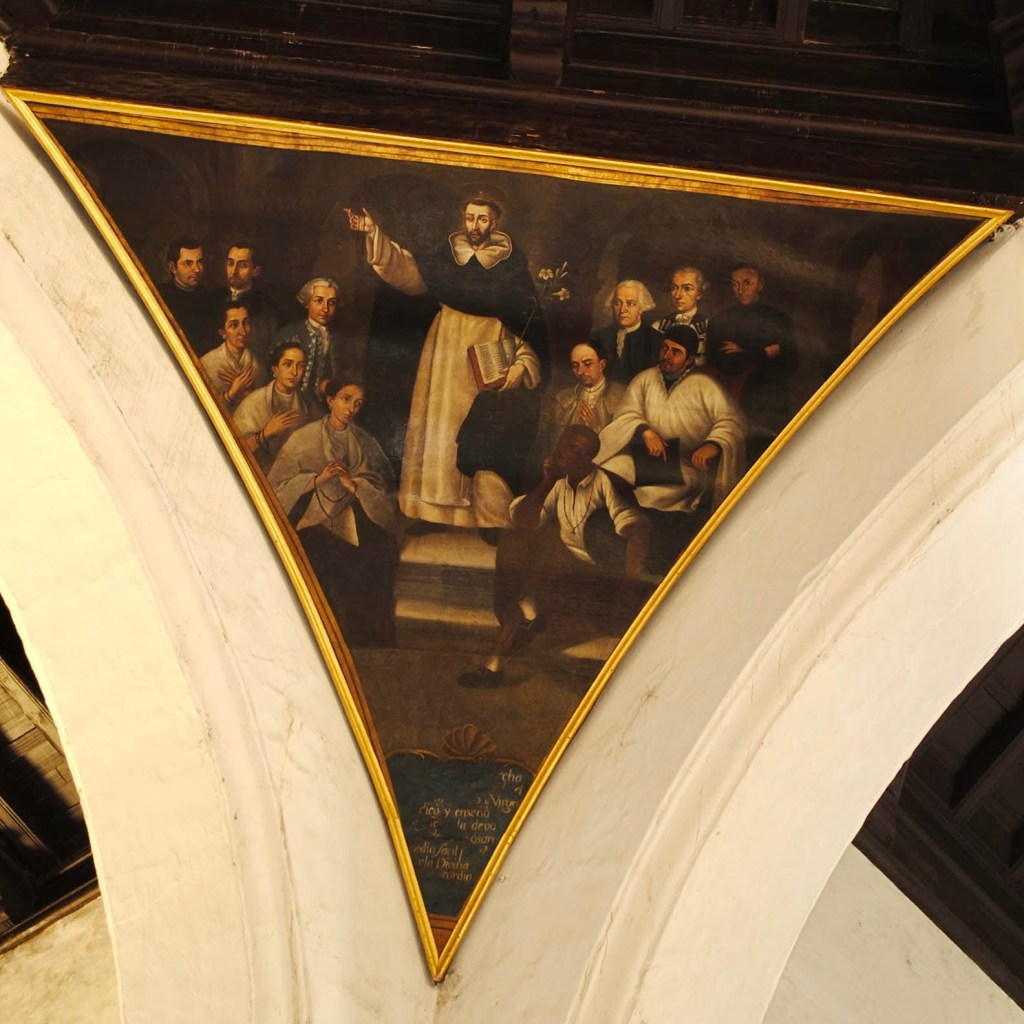
In the Church Santa María del Rosario of Havana there is a pendentive cycle completed in the 1770s painted by the baroque artist José Nicolás de Escalera – whom according to Guy Pérez Cisneros, was truly the first professional Cuban painter of the tradition – that includes a black slave in a pensive pose seating on a lower step, just below a Dominican priest who figures prominently in the middle of the picture holding a Bible and raising his right arm forward [1]. It has been noted that the figure of the black slave is also the first portrait of a slave in the New World, and its meaning has been highly disputed. The enigmatic slave or liberto portrait shows the man in a thinking pose, with a folded long white shirt, and what seems to be a wooden rosary hanging in plain sight. It is hard to make the details of his facial expressions, but it is obvious that his gaze is neither upwards nor directed at the viewer, but rather suspended, as if were, in a moment of attention and rest (and also listening?). The context here is fundamental, since Santa María del Rosario Church was commissioned by the Count of Bayona, a wealthy member of the sacarocracia (sugar plantation owner) after a previous church was burned to the ground by a slave revolt that took place in 1727 in an act of complete defiance to Christian indoctrination. 

The event that only has come down to us in just a handful of mentions and erasures of the colonial archive is featured prominently, as we know, in Manuel Moreno Fraginals’ El Ingenio when the historian documents the spiritual schism of the eighteenth century colonial plantations of the island. According to Fraginals’ historical account, the slave insurrection in the plantation took place in the wake of a theatrical enactment proposed by the Count of Casa Bayona in an act of repentance and humility aiming to mimic a well known moment of the Christian story: one day the Count washed the feet of twelve slaves, and when he finished he made them sat with him for dinner. Later that afternoon the slaves revolted and burnt down the whole sugar mill, including the chapel, to the ground. The episode ended with a plantation mayoral officer hunting down the runaway slaves, who was ordered to place the heads of the dead slaves high in spikes for the Count and everyone to see them [2]. It is an early staging of visibility and bodily dominion that the modern epoch will take to its final conclusion. 

The portrayal of human suffering was a symptom of the impossible hegemony of christianization of body and soul that the missionary Nicolás Duque de Estrada decades later will try to deploy in his pedagogical treatise Explicación de la doctirna cristiana acomoada a la capacidad de los negros bozales (1823), which argued that obedience of slaves could be achieved by implating “guilt” and work ethic in the affective interiority, in the forum internum of their souls. But even Estrada was of the fact that after sixteen hour workdays the Christian ascesis was imperceptible and little more than convoluted chatter to the ears of the slave. It is almost as if the slave, separated from the politico-theological inscription of salvation, was already outside the subjective domination of productive bondage and political freedom.

When Escalera was commissioned to do the cycle of frescos at Santa María del Rosario he was asked to combine a twofold narrative: the history of Christian salvation and the story of the Casa Bayona. At the center of the altar piece is the world as a common house or oikos, that carries history and its bodily sovereignty forward. One possible reading of the pensive slave shown in Santa María del Rosario’s pendentive is to assume that this figure is completely outside the eschatological vision embodying a sense of freedom that only painting could have documented in its unique and mute language. This raises the question about the relation between painting and freedom in which the figural emerges unmistakably fixed beyond historical narration. Although writing about Cézanne’s late work, Kurt Badt once suggested that there is no such a thing as the representation of freedom, but rather “painting generates a concept of freedom as two-faced: negatively, it is liberation from isolation and resistance, positively to the serious gentleness of freedom….expression in freedom to the scene from nature, which declares the world to be existing together, a mutual self-supporting and carrying of things” [3]. The pensive slave portrayed in the pendentive does not embody freedom understood as the spiritual accumulation of rights and duties known to the order of historical transformation; rather is an absolute pictorial appearance of freedom because it embodies, in its non-separation of life and thought, a static moment of a being that contemplates the liberty of his potency.

What is striking about the collective portrait where Escalera inserted the former slave is what we can call, following Bernard Berenson, a dimension of the ineloquent that appears just as “mute, with no urgent communication to make, and no thought of rousing us with look and gesture. If they express anything it is the character, essence rather than momentary feeling or purpose. They manifest potentiality rather than activity. It is enough that they exist in themselves” [4]. In the pensive gesture of his pose, the slave is the untouched existence and the revolt that rips the escathological narrative that ordains the interiors of Santa María del Rosario. Malraux once noted that the age of the divine disdained the realistic portrait of an ordinary person, because he was too distant and mundane from the stone conclave of the gaze of the gods. The slave’s inexpressive ‘naturalness’ refrains from partaking into a mood compensated by the semantic compulsion of the colonial painter, because his naturalness discloses the indestructible soul that has transfigured the realm of the divine. 

The unfathomable mystery of the pensive slave or liberto is the obscure and yet luminous portrait of a life in thought that is, at the same time, the thought of a life that is forever inexpressive, and as such the highest state of imperturbable freedom in the aftermath of worldly destruction. The ‘gentleness of freedom’ that Badt locates at the heart of painting is the imperative of the stream that carries, and yet restrains, thought and appearance into the figure of life. The freedom that anchors painting – because such freedom is never realized in painting except as vulgarity – becomes a tacit secret for which ultimately there is no image.  

Notes 

1.Guy Pérez Cisneros. Características de la evolución de la pintura en Cuba (Ministerio de Educación, 1959).

2. Manuel Moreno Fraginals. El Ingenio (Crítica, 2001), 99.

3. Kurt Badt. The Art of Cézanne (Faber & Faber, 1965), 314.

4. Bernard Berenson. Piero Della Francesca: The Ineloquent in Art (Chapman & Hall 1954), 7.

Seeleenlärm or soul noise. by Gerardo Muñoz

In a letter written in 1969 to her friend Mary McCarthy, Hannah Arendt provides a striking description of the solitary condition of thought in language: “The silent dialogue of thought goes on between me and myself, but not between two selves. In thought, you are self-less – without age, without psychological attributes, not all as you say “really are” [1]. Thinking, she goes on to claim, puts into crisis all identity and nonsense, so that the inward searching can fold “outwardly” into the world. Arendt immediately notes that the passage from interiority to the outwardness does not express a fixed purpose; it is rather a motion through which “words become part of the world”. Thought can be said to express the coming into relation between language and world.

Further exploring the depth of the language that characterizes the “inner life” of thought, the philosopher immediately emphasizes its acoustic or tonal qualities, that is, “an inevitable noise of our apparatus, which Broch called Seeleenlärm, soul-noise. It is what makes us tick”. To be in thought, or in a way to thinking, means allowing the soul noise to buzz from beneath the skin. The Seeleenlärm does not coincide with language as concept or signification; it is rather the tear that allows for the emergence of language as imagination and thinking. 

This operation is nothing more than the relation of language to its own impossibility or muteness in the region of the Seeleenlärm, and what artificial models of language cannot replicate. And although Arendt compares the soul noise to other functional organs of biological existence, it is only obvious that the harmony of the soul lacks a physical compartment, and can only be expressed in the possibilities that language bestows to thinking. The notion of Seeleenlärm, if we are to call it that, appears not in philosophical context, but in a literary one; that is, in Hermann Broch’s “Zerline’s Tale”, in which the soul voice is understood as the lacuna of sensation, having nothing special in terms of intellectual faculty or knowledge collectiom, it is the sensation that fill people’s empty and boring lives” [2]. Seeleenlärm determines thought, but it is not thinking as such; it is more like the suspension of temporalization and judgement in every living being. This is why it is not even coterminous with the passions, let alone love. Perhaps the Seeleenlärm can be said to occupy a third component (tertium comparationis) through which the human being structures the mystery of his spirit [3]. Is this third component that dissolves the self for the place for ethics? In Broch’s modernist aspirations, attuning to the noise of the soul meant the aesthetic reduction of a symbol to mediate “understanding from one person to another”.

But it should be obvious that the  transition of Seeleenlärm to metaphoric understanding flattens the void into a conglomerate of selves that come into being by setting aside thought through the communication or artistic repression. In the reverse, one could imagine then that there is only thought when the suspension of any conglomerate or community ceases to communicate by resting on proximity to the hole of the soul voice in expression. The communication between souls – beyond the transport of the symbol, beyond separation ordered by discourse – can only be understood as the incommensurable in language. This is the instance where thinking takes flight because the invisible seeleenlärm transpires from its depths. 

Notes 

1. Hannah Arendt. Between Friends The Correspondence of Hannah Arendt and Mary McCarthy (Harcourt, 1995), 242-243.

2. Hermann Broch. “Zerline’s Tale”, in Selected Short Writings (Bloomsbury, 2006), 103.

3. Hermann Broch. “Some comments on the philosophy and technique of translating”, in Geist and Zeitgeist: The Spirit in an Unspiritual Age (Counterpoint, 2002), 122.

Pindar’s Fragment 180. by Gerardo Muñoz

Understanding what the ancient Greeks thought of sayability in language is no easy task, but in Pindar’s Fragment 180 we can confirm that the use of language must come to terms with the internal lacuna of silence. Pindar says as a way of recommendation: “Do not break out useless speech in front of everybody; there are times when the path of silence is most trustworthy, but lofty discourse holds the sting of domination” [1]. Although this fragment has been read as a form of “prudential speech”, it might be more interesting to read it as a form of the inception of the sublime in language, which Longinus, although not referring directly to the same fragment, inscribed it under the idea of being ‘tongueless’ or aglossīa, which like Ajax’s silence says significantly more in its restrain than from saying something directly. Language becomes useless – that is, it ceases to have any use with itself – if it becomes a tactic to diminish any given rhetorical order. It is no surprise that in our time the predominant use of language takes the form of a transaction through technical terms that has no use of its own. 

It has been shown that Pindar’s conception of language was not about representation, but rather about the voice or kompos that takes place whenever there is vibration or harmony in the collision or contact between two objects [2]. Of course, the truly originary collision in language is between the voice and the idea, where the cradle of language opens to its own poetic and ethical possibilities. Hence, if there is restraint and silence as constituent of language, it is because there is a rhythmic movement that accommodates without the intromission of an external force. Here, it is the well known definition of poetic creation that Pindar lays out in “Olympian 6”: “Upon my tongue I have the sensation of a clear-sounding whetstone, which I welcome as it comes over me with lovely streams of breath” [3]. What carries those streams of sounds?

The poet is not an independent creator with higher access to language; the poetic instance is only accessible to those who, in contact with inspiration, can sharpen their tongues to the use of one’s language. We are in language when we find ourselves in the direction of a “path of words” [4]. Thus, the contact of language is not with objects or entelechies of the visible world, it is first and foremost with the receiving movement of the voice as a “lovely streams of breath”. In this way, Pindar’s plea for silence is not to be understood as an active negation of “saying”, but of an internal lapse or suspension of language that allows the emergence of the truth of the voice. The absence of kompos turns language into an instrument that can only prepare and foment conflict and domination, seeking to overcome something that is ultimately captive of the common ground of an uninspired language. And this means that language without inspiration is not only a voice that has run astray from its rhythm, it is also a language that will only find war in its path. 

Notes 

1. Píndaro. “Fragmento 180”, in Obra completa (Cátedra, 2023), 410. 

2. Helga Kriegler. Untersuchungen zu den optischen und akustischen Daten der bacchylideischen Dichtung (Verlag Notring, 1969), 90.

3. Píndaro. “Olympian 6”, in Obra completa (Cátedra, 2023), 90. 

4. Píndaro. “Olympian 1”, in Obra completa (Cátedra, 2023), 90. 

Notes on Tetsuro Watsuji’s Climate (1935). by Gerardo Muñoz

A good place to start on Tetsuro Watsuji’s Climate (1935) is by considering how the very notion of the Japanese fudo as it appears defined in the first pages of the text, as a “structural element of human existence”. Augustin Berque has proposed a slightly different translation: the “structural moment” that speaks semantically to the prefix *-med, that also recalls mediality, metaxy, and also the French ‘milieu’. In any case, “fudo” discloses an expressive instance of existence, but it is not overtly determined cultural or historical teleologies; rather fudo like Heidegger’s fourfold (das Geviert), brings into gathering wind and earth in which existence can only appear to exist in between as exteriority. Watsuji writes: “The structure of “ex-sistence” is, thus, something rather than to exist in the reality of the cold; it is rather to exist within other persons. To designate this reality we prefer the technical relation of intentional reality, used by phenomenologists, the Japanese expression term aidagara (interpersonal)” (†27). 

Unless we know the language, we can only take Watsuji at his word when it comes to the Japanese, but all things considered it is at least obvious to say that fudo is not strictly a descriptive objective reality, but a relation of Being. Watsuji calls it a few pages later a “movement of negativity”: “…this is a ‘movement of negativity’. This is how the spatial-temporal structure of human existence comes to being like that of the climate and that of historicity” (33). The notion of existential transcendence that Watsuji wants to hold on to dwells between reality and existence, generating kimochi, or tonality / stimmung (38). The first question here is what to make of Watsuji’s typology of regional climate setting if these are not to be taken geographically or culturally as expressing locational structures for specific kimochi

There are three types of climate regions for Watsuji: monsoon, desert, and meadow. One could imagine that these three ideal types as environmental arrangements in the disclosure of kimochi. Each region has its surroundings. For instance, the monsoon is defined by its humidity (47). For Watsuji each of the climatic regions will fundamentally generate different forms of social organization, and it is from this perspective that he interprets the civilizational rise of the West beginning in Ancient Greece. The emergence of the polis is understood as a direct relation with harvesting and later to a social bond determined by production and struggle (war). In the most clear elaboration of his interpretation of the polis, Watsuji writes:  “With a slave system as through-point as this, the small number of people who comprised the polis were freed from the labours of the herdsman-farmer. […]. With the building of the polis one may begin to use the word ‘Greece’. If this be correct, Greece began with the conversion of the farmer-herdsman gained freedom from the restraints of nature” (82, 113). This restraint of nature is not just productive in the practical sense (attachment to agricultural life), but it is also of the order of the sensible: this is why Watsuji claims that the Greek classical culture possessed a commitment to a visuality of clearing that is ingrained in their architecture and temples in the open (115). And being in the cleared visual spaces demands the question of technique: “The life of the polis has at its center the artificial-technique in order to dominate the Mediterranean. The emergence of this form of life was the powerful instance that determined the destiny of the “West” (116). In this line, modern science is nothing but a consequential reduction of technique for the Greeks (117). 

There is definitely some ambiguity here, since later on and following Komei, Watsuji claims that the emergence of machines in the West was only possible as a retreat from cold weather in the North, and thus a product of interiority (130). Could this mean that the all-clearing established in classical Greece – with its vantage point and all too visible sculptures without oblique point of view – contributed to the later historical production of reserved interiority? Watsuji seems to contrast the clearing in classical Greece with the opaque and gloomy clime of the Germanic lands. In fact, Watsuji says later that only in the shrouds of Germany could pure music be created, where light is not so keenly embodied (141, 111). Returning to the question of existential tonality, or the kimochi, I wonder if Watsuji’s subtle yet recurrent positioning of Western destiny has to do with an originary ethical deficit that is maintained from the depths of fudo as within and outside the clearing of nature. There might be a clue about this in “America’s National Character” (1943): “The true hidden reserves are in ethical strength and not in the power of quantity” [‡]. Is living proportionally in the fudo the ability to master this ethical orientation?  

Session 2 (continued) 

Having laid out his climate interpretation of the West, I think it is fairly easy to grasp the orientation in Watsuji’s monsoon specificity as a sharp contrast to the condition of its “structural moments”. In particular, the political contrast is implicitly established – and I say implicit because Watsuji never confronts it as the guiding principle of differentiation, although it bends that way. It caught my attention that, following the scholar Kateke Fumio, Watsuji will note at the outset that Chinese (Asian) subjectivity refuses any positing of the legitimacy of the state, and especially the fiscal state (we know from Schumpeter that the modern European state is the fiscal state), and they can only flee from such submission, although they are submissive in other ways, to force (shoguns, for instance) (157). The monsoon structure, hence, has primacy over the political sphere projecting a sort of permanent stagnation for historical development. The notion of akirame or “no bearing, nothing we can do”, a sense of overwhelming resignation, becomes the social tonality of the monsoon surrounding, which ultimately (Watsuji does not say it like this, but perhaps we can push the text in this direct) entails enduring stagnation. This perhaps highlights, quite convincingly,  of a certain caducity in Watsuji’s monsoon type in our present epoch.

In the order of the political register, one could read Watsuji’s emphasis on the Japanese home in this direction; that is, the monsoon resignation leads to permanent homecoming. The monsoon region is the region where the oikos triumphed over the polis (180-181). If in the Greek world, legibility and the transparency of the grasping logos made the domestic space an exception to the social life, for Watsuji the Japanese dwelling space is not just a space of familiar gathering, it is also a cosmology and an ecology: “The Japanese consciousness took shape in the totality of the home” (184). (As a side note, I cannot but read this in light of Xi Jinping’s notion of the ‘ecological civilization’ as the master key for the planetary relevance of the CCP). Elevated to the rank of cosmology, the monsoon retreat into the home, does not become an all too easy path towards natural domestication?

In the Japanese home there is no separation – there are no locks and keys – says Watsuji, which introduces as a paradigm for a different form of sociality that differs from Western individuality around appropriation, assignation, and separability (201). This is true to some extent if we think about a spatial figure of Western civilization and enclosure, such as the castle. This is fundamentally different from the tokonama. For Watsuji, the structural moments of ambiance and surrounding generates specific mentis types, and thus concrete organizations of said space. I derive from Watsuji’s second part of the book that Western civilization revolved around the movement of total legibility and clearing (Greeks) that unfolded to separation and thus control over nature, resulting in a machine utopia as Adolf Caspary rightly called it. What about the monsoon specificity? There is retreat and resignation over the surrounding, which allows another mediation or in-betweenness with the natural world and exteriority, although this will entail stagnation in world historical terms. 

The contrast between the West and China was already well established during the Enlightenment in the writings of Montesquieu, Voltaire, and other luminaires according to Federico Chabod. In fact, Chabod claims that the civilizational divide between the West and China is crucial to understanding both [‡ ‡ ‡ ]. Asking why an ancient civilization like the Chinese had made such little progress in two centuries (XVII-XVIII), Montesquieu for instance claims that an explanation is to be found in the sacred respect of this civilizational mentis for the transmission of its tradition. It is easily inferred from Watsuji that the monsoon ambient allows for a civilization of “Wisdom” in the deep sense that it “thanks” all the elements of the tradition that it receives. This is also a form of “resignation” proper to mezuru, a form of wonder and surprise that adds nothing new. When Kojeve referred to the end of history in the form of American animality and Japanese snobbism, I think he was crediting this inner Wisdom in the wake of stagnation and released resignation. Of course, we also wonder what Watsuji will say about the “ecological civilization” driven by China’s modernizing planetary project that, if we are to believe Adam Tooze, possesses the master key for world transformation in the notion of “development”. If true, this can only entail the triumph of Western machination through the labor of its others.

Notes 

† All pages are referring to the Spanish edition, Tetsuro Watsuji, Antropología del paisaje: climas, culturas, y religiones (Ediciones Sígueme, 2016). All English translations rendered are mine. 

‡ Tetsuro Watsuji. “America’s National Character”, Philosophy East & West, Vol.71, 2021, 1026: https://muse.jhu.edu/pub/5/article/819276/pdf 

‡ ‡ ‡ . Federico Chabod. Historia de la idea de Europa (Editorial Norte y Sur, 1967), 135-136.

*These notes are meant to accompany a summer group discussion on Watsuji’s thought, August 2025.

The necessity of Penia. by Gerardo Muñoz

It is well known that Aristophanes’ late comic work on wealth, Plutus (388), provides us with what is perhaps the most dramatic and conceptual elaboration of the mythic personification of poverty (Penia) of late antiquity. What is remarkable is that in her self-presentation to the character Chremylus, Penia draws on a political parallelism that colors the ongoing crisis of governance of the ancient polis. If the Greek comedy is dependent on the function of the pólos (which is the vortex of movement that makes possible grasping the specificity of the being that is said), always prior to the arrangement of the polis, then it would follow that Aristophanes’ commentary on the centrality of Penia is neither mockery nor irony within the structure of the play, but rather an element fundamental to the historical presentation of the consciousness of historical public life. The emergence of Penia in Plutus is recorded in the lines 550-554 (a paraphrase might be adequate here): “Thrasybulus and Dionysius are one and the same according to you. No, my life is not like that and will never be. The beggar, whom you have depicted to us, never possesses anything. The poor man lives threfitly and attentively to his work; he has not got too much, but does not lack what he really needs” [1]. Poverty is an intimate relationship with needs; perhaps an unsaid relation, but one that must be accounted for nonetheless.

At her entrance into the play, we are told that Penia’s complexion is both mad (makaron) and tragic (tragōdikon); she could very well be an Erinyes companion from the underworld of the dead. Penia as a mythic figure is a fullfilled form of life. More importantly, what is crucial in the Plutus is that Penia defines herself in sharp contrast to the life of beggars or ptochos. This means that while the penetes is tied to a constitutive need as condition for a form of life; the ptochoi is a being that merely lives in a state of survival, and endures his absence of proper needs. Because Penia is contrasted to the destitute life embodied by ptochos, she can state in one moment primacy over wealth: “all your blessing….you have all that you need in abundance, thanks to me” [2]. Hence, as it has been noted, the irrevocable presence of Penia in the polis is the condition of possibility for Ploutus, god of wealth and abundance, shown in ancient representations as holding the flourishing cornucopia from the fertile harvest season. 

What is important to note is that the close and fluid relationship between Ploutus and Penia; that is, between abundance and need, far from being opposition is relational and nourished by its pólos. In this way, the being of need, the penetes, is only able to flourish if he is capable of attaining a free relation with its desire of its vital making, and not from an external power that can determine the functions directed to abstract modeling of population survival. If Aristophanes’ Penia is defined against the ptochos is not because there is a difference of degrees in terms of dispossession, negative or quantitative, but rather it is because it is a disjointed relationship between poverty as a transfigured life, and a life that become destitute because it has ceased to be attentive to its own needs. In the incommensurable ground of the polis, it could be said that the ptochoi were unformed lives that merely persisted in time on the margin of the system of relation of the human community, and for this reason they dwelled in a permanent state of apolis, since their only viable horizon was the result of economic abstraction for secondary needs. In other words, the beggars of the apolis are ultimately effects of economic forces that they do not control, precisely because they no longer have any existential relation with the realm of necessity, that is, with poverty as understood under the shadow of Penia. 

In this sense, the condition of beggar is an ultimate economic subjection that is already beyond the sufficient limitation of needs, and thus it has lost all contact with the world. It is has become deprived of the world without being truly dead. Here, one should not forget that as Plato registers the genetic relationship between Penia and Eros in an important moment of The Symposium: “Eros is the son of Poros and Penia, and partakes of the nature of both parents, the fertile vigor of the one, the wastrel neediness of the other. As he is a mean between mortal and immortal” [3]. But the erotic soul in the last resort is nothing but the desire for immortality; and, as a daimon, it mediates between passions and the beautiful, between the divine and the mortal, between need and wealth towards the depth of a harmous life [4]. As Sandrine Coin-Longeray has shown in her exemplary study, Penia (πενία) exceeds the effective qualification of the “good life” based on labour; rather it is a route of life that outlives itself in the erotic transfiguration of world towards the preservation of irreducible homeostasis of common life [5]. 

This is why Plato’s conception of the ‘happy city’ or the kallipolis was imagined as a deposition of the process of abstraction between “rich” and “poor” that ultimately has come to regulate the modern organization of social rationality proper to accumulation, production, and distribution to supply to rhe demand of ever expanding secondary needs in the general field of consumption. As Plato writes in Book III of The Laws in a section precisely dedicated to showing how to bring civil war to an end: “Because of all this, they were not intolerably poor, not driven by poverty to quarrel with each other; but presumably they did not grow rich either, in view of the prevailing lack of gold and silver. Now the community in which neither wealth nor poverty exists will generally produce the finest characters, because tendencies to violence and crime, and feelings of jealousy and envy, simply do not arise” [6]. The civilizational path undertaken by West since the rise of institutionalized isonomy could not be but exactly the opposite of the platonic deposition of the autonomy of alienated classes. Today it is all too apparent that every sphere of social reproduction stimulates a ferocious race to the bottom between a kleptocracy and a vast administered population of ptochoi that, precisely because they have no relation to Penia, is left pursuing compensatory reactions within the social mechanism of organized begging that they are forced to endure. Under the oblique light of Penia, it becomes clear that both redistributionist policies through state institutions, as well as the autonomous market initiatives of financial models tend to be two sides of the same defense of abstract abundance on the back of the human community of penetes

The negative subsumption of material needs, and thus of poverty into quantifiable assets that characterize abundance and growth at a civilizational scale – with the collaboration of all modern political ideologies without exception always oriented towards production – has contributed to thwart the path of Penia that is necessary to live freely between passions and needs. This is why in his 1945 lecture “Die Armut” (“Poverty”), Martin Heidegger, departing from a well-known intuition from Hölderlin, claimed that ‘being-poor’ does not mean the absence of some property or substance, but a relation to needs; because only in poverty do we preserve a free relation unto what we need (not-wedigkeit) as necessary. And only this can be taken as the true and ultimate wealth: ‘we have become poor in order to be rich’, means that only through the preserving necessity of Penia will there be a liberating dislocation for human life beyond the indigence of mere exchange and the endless struggle over material goods and the private property. As the world becomes a more vast wasteland of beggars and disposable bodies at the service of technology, Heidegger, in Eckhartian tenor, was not wrong to claim that poverty and Penia will ultimately be the ethical destiny of the people of the West only if they become attune to the divine overtone of poverty as their destiny. Thus, the only possible abundance in a declining world can be realized through the enduring necessity and disquiet return of the essence of poverty – to come near the nothing, because there we find the dearth of the earth. Indeed, as Penia says in Plutus before leaving the stage: “One day you will speedily send for me back” [7]. 

Notes 

1. Aristophanes. Plutus (Loeb 1946), 550-555, 421. 

2. Ibid., 501-511, 409.

3. Plato. The Symposium (Penguin Books, 1987), 203b, 82. 

4. F. M. Cornford. “The Doctrine of Eros in Plato’s Symposium” (1937), in The Unwritten Philosophy and Other Essays (Cambridge University Press, 1950), 74. 

5. Sandrine Coin-Longeray. Poésie de la richesse et de la pauvreté: Étude du vocabulaire de la richesse et de la pauvreté dans la poésie grecque antique, d’Homère à Aristophane: ἄφενος, ὄλβος, πλοῦτος, πενία, πτωχός (Publications de l’Université de Saint-Etienne, 2014), 153-56.

6. Plato. The Laws (Penguin Books, 1975), 122. 

7. Aristophanes. Plutus (Loeb 1946), 630, 421.

Dialogue with Jacques Camatte (1935-2025)

The passing of Jacques Camatte (1935-2025) a week ago from the writing of this text recalls a life that ostentatiously lingered in thought, and a thought that was entirely enmeshed and intertwined in the irreducibility of life. For some of us that had the good fortune to interact – however briefly and momentary, although every contact is always destinial and inescapable – Camatte transpired generosity and authenticity, and his voice evoked an almost Adanic happiness that has become rare among human beings. A common friend these days has recalled that somewhere in Camatte’s writing there is an endorsement of a capacious phrase from Chernyshevsky that could very well serve to remember his enduring ethical pursuit: ‘we have finally understood that the Earth is a place of life rather than judgement’. The opening the Earth as a dwelling place for life forms means that it is insufficient to conceive of domination as an organization of modes of production, since capital is first and foremost a spatial-temporal arrangement towards the future of the human species, and thus of a certain conquest of the world sensuous life. 

This was the outstanding triumph of real sumption: the modulated and ongoing alienation of the human community (Gemeinwesen) into a community of capital that has arrested time of life to the point of adjusting it to homogenized agony of historical time. Against the dynamic of revolution and counter-revolution that theologically exported the polarity of the eschaton and the ho katechon, already in the inception of 1970s Invariance Camatte called for an exteriority of any philosophy of history in order to rework of “a new relationship between human beings and nature”, and “breaking the lock that inhabits the creation of a new form of life”. The two citations in dialogue with each other come from “Against domestication” (1973) and the introduction to Urtext: frammento del testo originario di Critica dell’economia politica” (the 1977 Italian edition curated by Gianni Carchia), although these are variations from the depth of the emergence of the invariance of truth as a vantage point of the world. At the center is a form of life that renews the world that transitions beyond all forms of metaphysical logistics of appropriation, mere standing reserve, and the general arrangement for the mobilization of production. Any point of departure against domestication measures itself against the totality of this fluctuating dominion.

As it has been said of other great thinkers, Camatte’s ultimate passion was rooted in thinking one idea to the end and not of endorsing a system of concepts. For him it was the schism, that is, how to undo the historical process of domestication of a fictive community against the absorption of the increasing autonomization of fictive capital. The schism against the capitalist general equivalent also demands advancing a secondary schism against all humanism and its originary separation from nature. In schism, there is something of Gaunilo of Marmoutiers’ “thought of the word alone” that is receptive to the movement of the soul tries to account for the perceived voice. This precisely what Camatte carried as the lesson from Bordiga’s idiosyncratic original communist program: a movement against the historical benchmark of the development and political economy of growth, which will entail the exhaustion of the revolutionary horizon driven by an ideological political technification that tends to deepen the power towards the positionality of epochal nihilism expressed in the revitalization of strife and the ‘errancy of humanity’ (contrary to Martin Heidegger’s notion of errancy as a play between unconcealment and truth, for Camatte errancy is another name for the civilizational narrative that exemplifies the withering of the  human community into organized and protracted social reproduction and historical abstraction). Hence, as for Bordiga, Camatte conceived the ontology of communism as a world view (not as a political program oriented by concrete historical subject or distributive economic reproduction; not a soteriological dogma nor a transhistorical material idea); that is, broadly speaking, thinking the relationship between the human beings and the earth. A question more pressing than ever given the current planetary conflagration, which exposes the civilizational course that has lead to an inhospitable world where the survival of the human being has become the byproduct of an effective hostis of the community of capital integrated to the global surplus value accumulation.

In Camatte’s unrealized thought – but perhaps all forms of thinking are so – the bordigist gesture persists in locating the schism at the threshold of the force of real subsumption of the anthropomorphization of capital, where the notion of revolution itself is transfigured since, unlike Delacroix’s paradigmatic romantic painting, ‘liberty’ no longer guides the spirit of the “living”. Its redeeming voice also carries downwards unto the depth of the souls of the dead. Amadeo Bordiga himself in “Dialogato coi morti “(1956) writes that “The Revolution…it is always, in the course of an immense historical arc that will close as it opened and where it promised, where it has an appointment with many of the living, but certainly with the unborn, as with the dead: they knew that it never fails, never deceives”. True life can also take place with the nearness of that which seems remote (as Gustav Landauer once claimed: “For me, the dead also live”).

If both the collapse of the future and the increasing adaptation of social life has entered a gnostic dialectic of endless self-legitimation, it is paramount to capture not just the insurrectionary, but the resurrection flight in Camatte’s gesture that opens possibilities lodged in the dead as an emblem for the return to the world “full of joy and exuberant life”, as he wrote in an apostrophe in “Scatologie et résurrection” (1975): “I will draw from mother earth the vital and infinite power and I will resurface full of wisdom, joy and an exuberant life which will allow me to reach this human community…I will have left your world and been resurrected!” Does holding on to the unity of the Gemeinwesen require a theological undercurrent? Is not the passion for schism, and by the same token the stazion, the energy within the very dispensation withheld between mystery and revelation that has prompted the congenital forms of formal mediations and institutions for the political community? These are the questions that we are exposed to in the enduring task if we are to take seriously a continuous ‘dialogue with Camatte’, which carries the voices of the dead. Ultimately, any authentic conversation that dwells in thought does not have to invent anything new; we are depositories of an endless communication that is handed over, interrupted, and transmitted to anyone willing to hear and capable of being traversed by the shared word. 

In his last year of thinking, Camatte insisted on the notion of “inversion” in the wake of the civilizational phase of extinction, which would require deposing all forms of hostilities and bringing to an end the partisan positions invested in orienting technology and morality (nature) in their seditious defense of the real dominium over the passing of the world. For the current depressing (and depressed) times, writes Camattes in “Instauration du risque d’extinction” (2020), what could very well be a prelude to a return to the repressed allowing a return to the past to initiate an inversion that would allow liquidation of lall exhibition abandoning enmity. This is why, as he told me in an exchange that we undertook five years ago, “inversion cannot be a strategy, as it is totally outside of politics, which is the dynamic of organizing people, of controlling them”. A breakthrough, then, only as a mystical downwards leap into the past? Absolutely – but only insofar as the mystic is the ethical witness to his own openness to the word, and whose exodus from the social machination prepares a return to the world beyond the flattening and dominant language molded by rhetorical dishonesty or passive narcissism of the subjectivity.

This is why according to Carlo Michelstaedter to have courage in the world means to decide between two irreducible figures: the dishonest trickster, or the mystic in the desert. There are no third terms in between. And whereas the dishonest subject knows how to play the hand to his best outcome in each given moment; the mystic knows that his decisive moment is always commencing because the genesis of the human species has yet to take place. This beginning is always at the brink of an untimely auratic experience. And aura names the incommensurable distance from the rational containment of the world — unlike Teilhard de Chardin’s internal introspection in the noosphere that will bring the fullfilment of a spiritualized humanity upon Earth (realized in part by the unification of the sciences by cybernetics); in other words, an exodus from the temporal nominalism that inhabits another life attuned to its genesis: “devenu-devenant ce monde et sur cette vie autre au moment où s’effectue sa création”, he writes in “La séparation nécessaire et l’immense refus” (1979).

The visitation of Jacques Camatte in the world bears witness to that invisible freedom of the human species ready to jump and traverse the catastrophic trumpeting into the living and the dead, making possible the refractions of thinking as original texture of existence. From now on, the exodus from the immanence of this world will embrace a disempowered but perpetual dialogue with Camatte’s demure schism of the living. Indeed, we are always on the path to an earthly beginning. 

Decline and renaissancing. by Gerardo Muñoz

There is something to be said about the facticity of epochal decline, and the reiterated attempts to call for its overcoming. But both decline and renewal are so interconnected in the Western dispensation of community and institutional organization that any attempt to surpass only deepens and pushes onwards the pendular movement between rise and fall towards generic equilibrium and social stabilization. Oswald Spengler understood well that decline situates civilization at the center of Western internal historical development just as birth presupposes death; thus, civilization is merely the coagulation of vital energies to overcome the emergence of decline. The genesis of civilization into final decline should at least elicit a question to break this ongoing circularity: what does it mean to hold to decline without converting its minimal energy into the orientation of a new horizontal epoch? The end of growth (economic stagnation) realized in real subsumption and the autonomization of value also allows us to formulate the question in the following terms: what does it mean to seize the fall of the rate of profit affirming demobilization and the inoperative nature of life beyond its conversion into the movement of energetic production that characterized the epoch of production through the historical figure of the worker? 

Ultimately, this is a question about how to represent (or how to avoid representation) an ethical orientation of life. At the turn of the twentieth century, it was noted that the ethical bourgeois form of life was conditioned by the sense of “community upon all men” around utility of life’s functions subsumed by work, and work as the sole purpose and meaning of life. The definite character of modern social life can be said to compensate for decline for giving up the incommensurability of life forms; that is, what Lukács also called the temporality of the “genius, in the sense that [the genius] can never be measured against anything, whether interior or exterior” [1]. Confronting this very question at the threshold of the crisis of the transmission of forms in Antiquity, Bernard Berenson in The Arch of Constantine: the Decline of Form (1954) offers a distinct position: the moment for seizing decline should be a deliberate prospect of gazing backwards; a facilis descensus that will disclose something entirely different deprived of the race towards “newness” promised by temporal futurity and its social spheres rhetorically organized. In a remarkable moment of his book, Berenson writes that: “Except in unique moments like the fifth century in Hellas or some three thousand years earlier in Egypt and Sumeria, conscious, deliberate, purposeful art is constantly looking backwards – renaissancing – if I may be allowed this uncouth but necessary verb-striving to recapture some phase of its choice in the art of the past, or at least to model itself or draw inspiration from it” [2].

In other words, there is only “renaissancingif one is able to traverse the decline of the past in the fullest sense of its inheritance of its formal stratification. The perpetual infantilism of the modern ethical outlook is that it tries to claim its definite character in irreversibility in order to exit the downwards path of decline through abundance and vulgarity (and we know from Ruskin that vulgarity is one of the forms that death takes unto the living).

For Berenson there seems to be authentic renaissancing at the level of life forms – of that incommensurable generality of human concrete and practical creation – by holding on to epochal decline, and not through state cultural policies that have sedimented the disappearance of forms of art legitimized by a “critic that will discover a deep meaning, a strange beauty, a revelaning newness in what you have done” [3]. The vicious modern liquidation of the free interplaying creation of forms of life and their external model of appearances is paid with the ascension of the rhetorical utility that will alleviate, at least momentarily, the sentiment of the decline proper to the transmission of dissolution. Whatever redemption creation can offer in the muddled waters of decline, the modern autonomy of reified forms, pushing upwards towards “newness”, will separate the sensorial transformation of life to the homogenous representation of communitarian representative order that puts an end to mood and solitude.

What Berenson calls “renaissancing” of factical experience nourishes the unrealized instances of the tradition not towards the breakthrough of a historical epoch (something like a virtuous mythic age of “Renaissance”) that can be posited by way of general background principles nor through the enforcement of a common social morality; rather the incorporated memory of the past is transformed to its very end because in its liquidation “true life” beyond measure reemerges. Berenson will state quite enigmatically that “style cannot be manufactured by taking thought” independently [4]. This is what Hölderlin had in mind when in a moment of “The Fatherland in Decline” from his theory of the tragic and its passage of dissolution: “The new life, which was to dissolve and did in fact dissolve, is not actually the ideally old, the dissolution of which was necessary, exhibiting its peculiar character between being and nonbeing…thus dissolution, as necessary, when seen from the point of view of ideal remembrance” [5]. It is this remembrance of dissolution that reveals decline as a felicitous fall without judgment that brings the appearance of life outside the irreversibility of the modern historical progress that has accumulated the oblivion of possible worlds.

This is why Hölderlin will also claim in his “The Perspective from which we look at Antiquity” (1799) that the ‘general decline of all peoples’ is due to the inheritance of forms of “an almost boundless prior world, which we internalize either through learning or experience and exerts pressure on us” [6]. To take up decline in a serious way means that we proceed from the formlessness of life, and not from the mimetic drive that expresses, in the name of ‘originality and autonomy’, the civilizational alienation towards the most distant (Antiquity) and the most near (ethos). We can then say that in decline the most distant and the irreducible becoming allows the ascension of ethical life. In this way, we can authoritatively say that there is only hope and redemption in decline because new life flourishes in a time of prudens futuri temporis exitum (“Prudently the god covers the outcome of the future in dark night”) that will transcend itself by becoming into what ceases and ultimately is.

Notes 

1. Georg Lukács. “The Bourgeois Way of Life and Art for Art’s Sake”, in Soul and Form (Columbia University Press, 2010), 76. 

2. Bernard Berenson. The Arch of Constantine: the Decline of Form (1954), 36.

3. Ibid., 64.

4. Ibid., 22.

5. Friedrich Hölderlin. “The Fatherland in Decline”, in The Death of Empedocles (Suny Press, 2008), 154.

6. Friedrich Hölderlin. “The Perspective from which We Have to Look at Antiquity”, in Essays and Letters on Theory (Suny Press, 1988), 39-40.

Unelevated politics. by Gerardo Muñoz

In a fragment from 1919 entitled “World and Time”, written around the time of the elaboration of the essay on the question of violence, Walter Benjamin offers his most succinct definition of politics: “My definition of politics: the fulfillment of unelevated [ungesteigerten] humanness” [1]. The ontological reduction is compact, and the three terms in it are carefully chosen: fulfillment, unelevation, and humanness, which indicates a ‘preparation for a profane politics’ at the threshold of secularization and its negation in a new “spiritual ornamentation”, as he would claim in the notes of “Capitalism and Religion”. The stress on the refusal of “elevation” (gesteigerten), however, does bring to bear that Benjamin’s refusal of a political ontology constrained in subjective and objective representation, which is why in the same fragment he connects the abutting of politics to a “living-corporality” [Leiblichkeit] of the human species. To retract from the cycle of civilizational violence, politics had to be reformed from the groundlessness of the energy of the living.

Hence, for Benjamin there is a metapolitical condition or archipolitics that plays out in refusing “elevated humanity”, which for him was at the source of the romantic response to the impasse of the critical enlightenment, placing the subject of knowledge and its self-reflective faculty at the center of the developing self-rationalization of the spiritual transcendence of the world in this new critical religion: “…the ideal of humanity by rising up to…that very law which, joined to earlier laws, assures an approximation to the eternal ideal of humanity” [2]. Hence, neither trascendental representation nor spiritualized immanence of order could, but unelevation of the “human possibilities” (Menschhaftigkeit). But such possibilities could only be disclosed beyond the pretensions of spiritual elevations of a unified consciousness, as Erich Unger had proposed in his Politics and Metaphysics (1921) around the same time to enact a “politics of exodus” for a common psychosocial regeneration. 

Benjamin’s proximity and distance from Unger’s position could perhaps inform why instead of writing a promised book that was going to be entitled True Politics (Die Wahre Politik) – allegedly containing two chapters “The destitution of power” and “Teleology without ultimate goal” – evolved into the landmark essay “Towards the critique of violence”, in which the frame of domination and the ontology of politics was recasted as a mediation about the folding of secularized annihilating violence, substance intrinsic to the philosophy of history and indestructible life of the soul (“annihilating only in a relative sense…never absolute with regard to the soul of the living”) [3]. Thus, one could say that accounting for the groundwork of “politics” meant accepting the constitutive verticality cosigned to modern philosophy of history, and its bipolar schematism between moral principles and sacrificial production. If Peter Fenves’ assumption is correct, Benjamin was not only inscribing a distance from Unger, but, more importantly, from Kant’s Toward Eternal Peace who defined his “true politics” as dependent on moral determination: “The true politics can therefore not take a step without having already paid homage to morality, and although politics by itself is a difficult art, its union with morality is no art all, for as soon as the two struggle against each other, morality into two cuts the knot that politics cannot dissolve – The right of human beings must be held sacred [heilig], however great a sacrifice this may yet the dominant power” [4].

The Kantian liquidation of politics to morality is hyperbolic to the modern epoch and its crisis – the crisis and enmity against the concept of the political, Carl Schmitt would claim in Political Theology (1922) – rendering modern politics and legitimacy hollow; something that Benjamin had understood well he saw to retract from the question of “politics” to that of a critico-metaphysical exploration waged on morality “as nothing other than the refraction of action in knowability, something from the region of knowledge…Morality is not ethos” [5]. Elevation could only have meant the production of a subject of knowledge and the specific (technical) arrangement of knowledges for subjection. On the contrary, the ethos was the necessary condition no longer for any “coming politics”, but rather for the disclosure of “the coming world” [die kommende Welt] itself. This means that working through the redemption of the world solicits a reversal from morality to ethics only to later transform the conditions of politics.

Let us return to the definition of politics as “unelevated [ungesteigerten] humanness”. What defines “unelevation”? From the ethical point of view it conjoins with the notion of “inclination” [Neigung] that Benjamin favors because of its unconditional valance that disarms the cycle of violence of the human community and its willful hostilities. The inclination rejects the paradigm of force because it an erotic mediation, that is, an affection of donation and love beyond exchange [6]. But inclination is only possible through language, as Benjamin had expressed in his “concept of politics” in a letter to Martin Buber from 1916: “I understand the concept of politics in its broadest sense…in this sense, therefore, language is only one means of more or less suggestively laying the groundwork for the motives that determine the person’s actions in his heart of hearts. Only the intensive aiming of words into the core of intrinsic silence is truly effective action” [7].  

Thus, the suspended elevation of the subject and higher order meant that its persuasive purity allows the inception of the “divine” as a «teleology without a goal» validated by the suspension of judgement of appearance. The intensification of the unelevation opens life to an ethical demand of a “living corporality” that roams the world’s crust beyond depredation where the force of autonomy of social practices does not risks the world of life forms and the soul. Indeed, at this point Benjamin does join Unger’s cardinal thesis: “Overcoming capitalism through wandering”. Or as he wrote even earlier about Hölderlin’s poetics: “[In the world of Hölderlin], the living are always stretching of space, the plane spread out within which destiny extends itself…it already comprehends the fulfillment of destiny” [8]. A politics oriented pending dowards to “unelevation”, inhabits the ground level of co-existence and cultivation dismissing the ontological derivatives or principles (archein) of ‘politics’ in order to conquer every possible destiny in the lawless fulfillment of the world.

Notes 

1. Walter Benjamin. “World and Time”, in Walter Benjamin: Toward the Critique of Violence: A Critical Edition (Stanford University Press, 2021), 74. 

2. Walter Benjamin. “The Concept of Criticism in German Romanticism”, in  Selected Writings, Volume 1, 1913-1926 (Harvard University Press, 1996), 138. 

3. Walter Benjamin. “Toward the Critique of Violence”, in Walter Benjamin: Toward the Critique of Violence: A Critical Edition (Stanford University Press, 2021), 58. 

4. Peter Fenves. “Introduction”, in Walter Benjamin: Toward the Critique of Violence: A Critical Edition (Stanford University Press, 2021), 18-19. 

5. Walter Benjamin. “Ethics, Applied to History”, in Walter Benjamin: Toward the Critique of Violence: A Critical Edition (Stanford University Press, 2021), 74. 

6. Walter Benjamin. “On Kantian Ethics”, in Walter Benjamin: Toward the Critique of Violence: A Critical Edition (Stanford University Press, 2021), 71. 

7. Walter Benjamin. “Letter to Martin Buber” (1916), in The Correspondence of Walter Benjamin (University of Chicago Press, 1994),  79-80.

8. Walter Benjamin. “Two Poems by Fredrich Hölderlin”, in Selected Writings, Volume 1, 1913-1926 (Harvard University Press, 1996), 26. 

The instrument stripped bare. On Adan Kovacsics’ Guerra y lenguaje (2025). by Gerardo Muñoz

Endless war and infinite strife is always preceded by the erosion and the putrid decomposition of language. Such is the thesis of Adan Kovacsics’ idiosyncratic and historically situated Guerra y lenguaje (Acantilado, 2025), which sets a specific date for the moment of such linguistic rot into consciousness in European modernity: Hugo von Hofmannsthal’s “Lord Chandos Letter” of 1902 in which civilizational decline signaled the total detachment of expression, making language flourish in the form of opinions resembling rotten mushrooms. For Hofmannsthal this event was neither accidental nor a temporary malady, but a tonality of existence that soon enough broadened like a “spreading rust” (Kovacsics 11). Just a few years later in his posthumous Persuasion and Rhetoric, Michelstaedter will describe this rusting of language as the triumph of “darkening ornaments” (kallopismata orphnes) of the epoch, liberating the destiny of language as a mere transactional exchange between “technical terms” mastered by everyone regardless of their idioms (it surprises the reader that the thinker of Gorizia is absent from Kovacsics’ Austro-Hungarian constellation on the crisis of language). 

The decline of an empire shimmering with languages and dialects across its territory began to suffer the malady of miscommunication that resulted in making language uninhabitable, throbbing in its empty chatter. Thus, the attempt to initiate an exodus from language began to appear everywhere according to Kovacsics: Fritz Mauthner drafts an encyclopedic treatise on the venereal misapprehension of language, Gustav Landauver battles in the trenches of linguistic scepticism and the mystical tradition in the name of revolution, while others like Hugo Ball attempts to flee from language altogether through the liberation of sounds and words, from the Dada avant-garde to his later Byzantine Christian asceticism. For his part, Karl Kraus in The last days of Mankind prefers to expose the surface of language as it becomes a regime regulated by opinion for bureaucratic administration over facts of reality. The nihilism that colors politics at the turn of the century is accompanied by the instrumentalization of language as the primordial technical apparatus that allows the flows of information through the acceleration of the autonomization of the linguistic mediation; as consequence, language began to arouse constant disbelief and doubt over the very essence of the sayable (Kovacsics 31). This throws light on contemporary debates about “misinformation” that, precisely because they are caught up on the epistemological determination proper to the linguistic crisis, it comes short to putting into perspective the range and depth of language over the problem of appearance now deprived of the expressive mediation between the speaking animal and phenomena, reducing experience to rhetorical commonalities or inter-social allocation of commands. 

Kovacsics’s Guerra y Lenguaje (2025) brings to bear – without totally exhausting the crushing weight of its archive and set of problems for thought – the immense significance of the first decade of the twentieth century at outset of the waning of the Austrian-Hungarian Empire, which has always been understood historically as the condition for the last configuration of European nationalism and its war-economies, but rarely in light of its functionalization of language. If read against the backdrop of Simone Weil’s “Are we heading for the proletarian revolution?” (1933) intervention about the “functional” dimension of the state form in the first decades of the twentieth century, Kovacsic’s essay ultimately helps us to define the concrete nature of functionality as the index of mobilization of ‘worlding’ through the commanding force of language. To deliver this point home, Kovacsics tells how language itself severed enunciation from action:

“La transformación que se produjo y que la ha alejado, como si un tablón se hubiese desprendido del muelle y se hubiera adentrado en el mar, no se debe a que otras gentes se impusieron en su día en Grecia, sino a un cambio radical en el uso concreto de la palabra. Es en la Gran Guerra cuando esa corriente inicial de la utilización del lenguaje como herramienta se consolida de manera definitiva. Es entonces cuando la palabra pasa a ser plenamente funcional y su papel se reduce a aportar argumentos para la acción o incluso a “parirla” mediante el tópico. Hemos visto hasta qué punto el silencio de Karl Kraus al comienzo de la contienda se debía a la percepción de este vínculo entre palabra y acción, al que no quería ni podía sumarse de ningún modo” (Kovacsics 76-77). 

Language does not disappear as much as it transforms itself into two vectors of social enforcement towards communication: functionality and rhetorical enthymemes. In this way, language is able to colonize reality and stabilize for the concrete order, or what Walter Benjamin called during those years the “bourgeois conception of language” hindering on causality and objectivity accelerating the collapse of its vocation to naming the exteriority of the world (Kovacsics 81). The totalization of this new rhetorical social structure becomes the main stage for the production of justification and competing regimes of fiction. But this implies no general theory or systematization of a linguistic science, but rather how language coincides with life in the form of an ethics. This is at the heart of the different attempts to retract language in the eclipse of empire and the new interstate fragmentation – which also entails grammatical and functional unifigies of national language – as a problem that concerns the limits of ethics. Ethics here cannot coincide with the general condition of ‘knowability’ that makes morality possible; rather, the problem of ethics can only reveal in turn the senseless of wanting to go beyond the facts of the world and allows us to dwell in one without completion.  The withdrawal from the language of propaganda and objectivity demanded an ethics of the sayable beyond the commodification and intentionality of words promoted by “war” and “ware” (commodity) that the West had continued to endure; a total communication of ends that decades later evolved into cybernetics as the warping of world into informational encoded relation.

Kovacsics reminds us that there is a story here of extreme violence and creative destruction, only comparable to nuclear fusion and the flaying of a human being, only that this time, unlike the myth of Marsyas, without ever reaching transcendence of redemption through the proximity of language to myth (Kovacsics 129). Underneath there is the body of language, stripped of its capacity for truth and reduced to functions of survival and needs oriented towards the homogeneity of the future. Towards the end of Guerra y lenguaje (2025), and glossing Hobbes’ notion of political authority that legitimated the modern interstate system to neutralize truth contents and the stasis over words, one cannot help but think that the date 1902 as a. arcana was an effective culmination rather than genesis of the modern, which means that the foul scent of the twentieth century was destined for decomposition since it had already stripped bared one of the most beautiful lacunae of the human species: being in language and the event of appearance became integrated into the worldly utopia of the machine.

As captured in Marcel Duchamp’s “The Bride Stripped Bare”, the obsolescence of language over time evolved into a candid instrument of social functions of proportional exchange, coordinated fortuitous relations, and increasing moral indictment that purported parodies of contested realities. Thus, the sickness is always unto language – a basic assumption that reveals the need for infrapolitical analysis before there is any political practice and categorial reinvention. The overexposure of language as an avatar of metaphoric communication for ends and needs of humankind brought itself bare and all encompassing in its appropriative force, but only at the expense of darkening and losing the world forever. 

Osculum pacis. by Gerardo Muñoz

It has taken Pope Francis’s public letter addressed to the Bishops of the United States to put in perspective how late American imperial politics in matters of immigration and probably other spheres of social life is not only at odds with the Christian vocation, but even waging war against the very dogma of Christian revelation. The reminder does not come completely out of context, since as we know, the marching band of intellectuals that for a long time have defended a “Christian postliberal” transformation – some of which not long ago offered theological justifications for the Church as the universal ark for migrants – given the current hegemonic configuration find themselves as mere scribes of whatever is enacted by unilateral executive command. The impossibility of enacting a transitional political theology evidences the emptying of politics into a technical mobilization of apocalyptical overtones, as clearly defended by Peter Thiel. The attempts to pilotage a planetary gnosis to his own image in the last stage of imperial stagnation, definitely supports Francis’ assertion politics today is built “on the basis of force, and not on the truth about equal dignity….begins badly and will end badly”.  But in a way, this “end” has already taken place through the revocation of the ethical tenor of the Christian mystery. 

It comes to no surprise, then, that if the erosion of an ethics is at stake, that Pope Francis would allude to the parable of the Good Samaritan and fraternity, something that he has explored previously in the encyclical “Fratelli Tutti” [1]. It is also important to note that Francis is not opposing the Good Samaritan to the ordo amoris; rather the operation is more subtle: for any community to be organized around ordo amoris, there needs to be a space for the infinite discovery that the Good Samaritan parable solicits of every Christian’s responsability. According to Francis: “The true ordo amoris that must be promoted is that which we discover by meditating constantly on the parable of the “Good Samaritan” (cf. Lk10:25-37), that is, by meditating on the love that builds a fraternity open to all, without exception”. In other words, and implicitly taking distance from the Calvinist dependency on community of salvation, the Pontifex is disclosing the memory of an ethical vocation that cannot end in social norms or national unity without exteriority. The communitarian ordo at times could also amount to oppressive familiarity, as it appears in Corrado Alvaro’s Revolt in Aspromonte: “Village life seemed to him a strange invention, a protective agreement between people who were afraid”. Thus, what the Samaritan teaches human beings is that there are no ethical standards for which we can respond, since every encounter opens up a ‘decision of existence’ before an absolute other beyond the sacramental duty of “I ought”. 

Who is this “other human being” that now becomes your brother? As we know, in Ivan Illich’s late work the ethical inflection of the Good Samaritan illuminates the true character of our poetic relationality and creative act: “You can recognize the other man who is out of bounds….and create the supreme form of relatedness which his not given by creation but created by you. Any attempt to explain this “ought” as corresponding to a norm takes away the mysterious greatness from this act” [2]. Indeed, Illich goes further in telling us that the suppression of the ethical decision of encountering the Samaritan can only leave us with a “liberal fantasy…where bombing our neighbor for his own good” [3]. Just like today the moral justifications of “ordo amoris” or the administrative allocation of a substantive “common good” can produce justifications for mass deportation of immigrants and dividing the social space between citizens and noncitizens (removing the foundation of ius soli) can become the strange patent of a monstrous theological manipulation. 

The ethical mystery exemplified by the parable of the Good Samaritan introduced into history a new conception of “brotherhood” that was not conditioned by national, political, or family affiliations, but by a common vocation expressed upon acting through mercy and charity. Belonging to the “human fraternity” allows me to decide who is my brother through the osculum pacis – a conspiratorial mouth-to-mouth kiss that creates proportionality and peace through the encounter that yields mutual creation. Before the Samaritan we give everything without waiting for anything in return, as required by any true ethical disposition. As the scholar of Ancient Christianity, Christine Mohrman once noted, the osculum pacis was a universal relationship of the human species through their voices coming together to assert external political peace as well as interior health of the soul [4]. If the predatory programs of mass deportations and intensification of hostilities between nations have come to forefront in our days, this is due to the fact that the overall end is not to piecemeal ordo amoris coordinated by state social policies, but rather a permanent assault against the association of the free souls constitutive of the osculum pacis. 

In light of the theological drama of Christianity, nationalism can only be taken as a symptom of brute force and inequity (radical evil). As Erik Peterson reminded in his essay “Das Problem des Nationalismus im alten Christentum” (1951), the cult and strife between nations and imagined communities, at least for the Chirstian vocation, do not have any traction, since the warring angels of nationalities have been overcome by the event of resurrection [4]. The ‘strange career’ of American political Catholicism is precisely that through a technocratic administration of social pain and spectacular delirium, it can only offer an noncorporeal ideal of ordo amoris “in the service of a single nation which seeks to establish its supremacy, by identify its own interest with that of humankind”, as Peterson observed  in the wake of European nationalism, but that it applies today to the letter with little variations [6].

In vain should we attempt to pin down the osculum pacis as professionalization of care or the hospitalization of pain that have become practices of a “corrupted core of a very clear and powerful ideal of democracy”. In the disjointed time that characterizes the end of political theology and its warring nomoi, the osculum pacis will be not be found in those that attempt to conjure a “Christian civilization”, but only in those that dwell in the state of adelphos, faithful to the scandal of peace and the endless conspiracy of speech. 

Notes 

1. Pope Francis. “Encyclical Letter Fratelli Tutti (On Fraternity and Social Friendship), 2020: “By his actions, the Good Samaritan showed that “the existence of each and every individual is deeply tied to that of others: life is not simply time that passes; life is a time for interactions”: https://www.vatican.va/content/francesco/en/encyclicals/documents/papa-francesco_20201003_enciclica-fratelli-tutti.html 

2. Ivan Illich. The Rivers North of the Future (Anansi, 2005), 207. 

3. Ibid., 208.

4. Christine Mohrmann. “Quelques traits caractéristiques du latin des chrétiens”, in Études sur le latin des chrétien (Edizione Di Storia E Letteratura, 1961) , 29-30.

5. Erik Peterson. “Das Problem des Nationalismus im alten Christentum”, Theologische Zeitschrift, 7, 1951, 81-91.

6. Erik Peterson. “Die Frage nach dem Menschen”, in Offenbarung des Johannes und Politisch-theologische Texte (Echter Verlag, 2004), 250.