Lo que sigue a continuación es una síntesis escrita de mi réplica en la presentación de La fisura posthegemónica (Doblea Editores, 2025), en la que intervinieron Mauricio Amar, Ángel Octavio Álvarez, Miguel Ángel Hermosilla, y Lieta Vivaldi el 3 de octubre en Ñuñoa, Santiago de Chile. Esos comentarios aparecerán en el próximo número de la revista Escrituras Americanas.
Agradezco enormemente las intervenciones de mis amigos Ángel, Miguel Ángel, Lieta, Mauricio, porque en última instancia un libro no es nada sin la posibilidad de ser encarado y llevado fuera de sus límites. Mauricio Amar preguntaba por la apuesta general del libro, y quizás pueda decir algo sobre esto. Este libro se inspira en lo que me gustaría llamar la escritura del adiós o del farewell. Siempre me ha llamado la atención que, al comienzo de este siglo, dos pensadores que admiro profundamente escribieron por separado dos libros de farewell: me refiero a Farewell to an Idea (Yale U Press, 1999) de T.J. Clark, y The Exhaustion of Difference (Duke U Press, 2000) de Alberto Moreiras. Respectivamente, adiós al modernismo pictórico, y a la suma metareflexiva sobre América Latina. Al menos para mi La fisura es una forma de decirle adiós a cierta reflexión política contemporánea. Y decir adiós supone atravesar el problema; por eso mismo, el hilo del libro es un problema de hegemonía que ha dominado el horizonte reflexivo y práctico del pensamiento teórico.
Ya aludimos al colapso de las formas de mediación, y se nos suele olvidar que forma es política, y la política es sólo posible mediante una forma. Si queremos pensar contra la dominación, a espaldas del vector retórico de la hegemonía, debemos tomar muy en serio cómo la forma hoy solo cumple la tarea de la dominación sobre la existencia y la palabra. La insistencia compulsiva que las formas ofrecen desembocan en su cierre letal (en la jerga de Alex Karp) sobre cada uno de nosotros. Ángel Octavio veía que el problema se nos presentaba como salida a otra parte. ¿Pero, qué salida?
Toda salida remite a una trascendencia menor: podemos salir al cielo como interioridad espiritualizada; o bien, podemos salir a un espacio demónico nocturno, un hacer noche, como versa el título del nuevo libro de Constanza Michelson. No deja de ser un síntoma de época que algunos hoy insistan en el vector de la espiritualización como vuelta a la tierra, aunque ésta sea el desierto en free fall que produce el declive (stagnation). El último Tronti, con el que tuve la suerte de intercambiar, lo recogía: el único combate hoy pasa por la interioridad (xeniteia). Pero el problema aquí es que el mundo no coincide con la Tierra. Y lo que interesa, entonces, ese justamente esa no-coincidencia, esa fisura, con respecto al mundo del viviente que hoy aparece como búsqueda de región. Y la región está en su acontecer fuera del mundo más que en el fuero interno.
O podríamos decir que está en la apertura del paisaje. No hay salida a un lugar sometido a la viabilidad ecológica. O no puede terminar ahí. Al final de cuentas, como vio un pensador en su momento, la revolución industrial fue la segunda revolución, puesto que la primera había sido la relativa a la agricultura entendida como asentamiento en el terreno. En apertura entronizamos con el cielo; o, en la bellísima definición de Kurt Badt comentando la obra pictórica de Constable: “el cielo es el órgano de los sentimientos”. El cielo aquí no es el espejo mítico que habilita la autoafirmación que conduce al humanismo catastrófico; más bien, es el punto de fuga que no se dirime en las particiones del suelo. Es curioso que la dominación en curso ya está operando como el diseño geoespacial del cielo. Esto es lo que comparte la figura del palantir de la Inteligencia, así como la Tianxia, doctrina “Todo bajo el Cielo” del emergente imperio chino. En apertura mantenemos las intermediaciones entre cielo y suelo en el fin de nuestro tiempo.
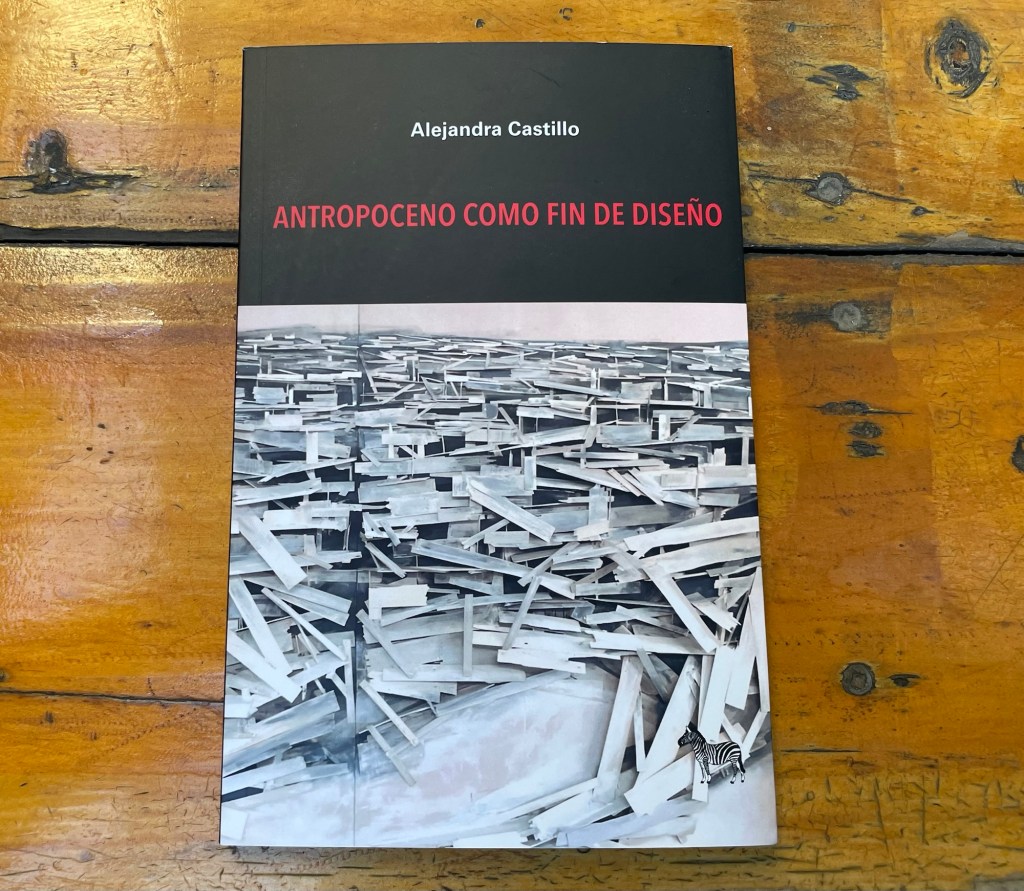
Only in rare occasions the operation of thinking finds angular or lateral points of escape. This is the gesture that characterizes Alejandra Castillo’s theoretical writing, and is particularly bright in her most recent book Antropoceno como fin de diseño (La Cebra, 2025). The zigzagging entry is an intuition that is also a guiding thread: the force of real subsumption of capitalist domination depends on the operation of design. Of course, in design one hears not only blueprint and form, but also designation, and thus the specular regime of visibility, orderability, quantification. It is the world of physiocratic forestry. In fact, Castillo’s succinct definition of the metapolitical condition of design is offered to the reader at the entrance: “Design is the figure that thinks always in advance (por adelantado) (Castillo 12). Design calculates and locates. It is through the operation of design that legibility becomes adequated to political representation so that the state can manage and attenuate the deployment of its forms and the circulations of relations of totality (Castillo 13). The design is what is common to the worker, the engineer, and the lawyer. This is why design for Castillo design is an efficacious nexus that connects the separation of objectivity and the life worlds. Understood in this sense, “design” is analogous to the enframing of the world that intensifies in the age of technology and rhetoric. But in the watershed of the end of modernity, the hegemony of design collapses, while it becomes a temporal “self-design” submerged in all spheres of expressive enactments.
The end of the second vector of the zigzag outlined in the essay is found precisely at this conjuncture: the anthropocene brings the humanist projections and design to a final wreckage. This is means that capitalist form is not formless because it has managed to subsume the time of life as exception to labour; time is a wreckage because design no longer coincides with the world of forms, as it has temporalized experience into total transparency without reminder. For Castillo this means that in the anthropocene there is no longer “struggle for visibility”, as everything has been rendered exposed and hollow; de-substantialized in the very fabric of subjectivity (in the early millennium some called this new hyperbolic figure the Bloom). Implicitly in Castillo’s writing is the assumption that the mediation between politics and design has been severed, and the new securitarian imperium can only immunize itself against the very site that in modern times granted its legitimacy (civil society, constituent power) (Castillo 37).
The end of design means the absolutization of design, a new carceral imperative for adaptation that makes any claim to subjectivity an endorsement of the prison of the ego. To live in a post-designed unworldly condition means not only to come face to face with the homogenous space of cultural exchange into image; it is also a new imperative that requires that “you must submit, without knowing to what; subject to what is the case anyway, and which, as a reflex to its power and commonsense, everyone believes anyway” [1]. The end of design paves the way for new plastic forms of domination towards an integral planetary unity.
Bordiga claimed throughout his work that the democratic design was perhaps the best fittingsystem for the versatility of capitalist accumulation and relentless expansion. This is why in all the political cases that Castillo introduces in a text in a manner of a shadow play do not pretend to offer a new theory of ideology, but rather show how democratic design is a one-piece suit that fits all without any needs for “ideal types” to fix normativity and institutional arrangements. Indeed, there is no longer anything like an “extreme political right” – and this is just a tweak from Castillo’s vocabulary, who does insist on the term throughout the essay – but rightward figures of the political that desperately cling to any form to distract from the abyss of social legitimation. Ultimately, the ruling over this void will be – in many ways already is – the continuation of war in the social fabric; and stasis will require new stealth development of technologies of containment that Palantir’s Alex Karp has called the new “lethal form”. This means that democratic design is not only expressively a system of sentencing to death; it is in virtue of the exchange of social forms, an inverted negation of human finitude. The point of despair would incite some to look again in the cabinet of forms; a knee-jerk reaction to the irruption of the Anthropocene against the total sum of possible designs.
Of course, this is also what Alejandra Castillo’s Antropoceno como fin de diseño (2025) avoids at all costs. Towards the last pages of the book, Castillo calls for a transformative turn that departs from the body; a corporeal insurrection that, in refusing the rectilinear and heteronormative political corpus of the modern epoch (no coincidence that Hobbes was both the founder of the autonomy of civil as well as of the physics of the body of matter in space), is capable of responding to the call of the anthropocene in all of its profuse conflictivity. Castillo proposes the necessity to gravitate towards a “maximum distance” against the general design of orderability of public domination (Castillo 77). But this can only be understood as an incommensurable distance that dissolves the ontotheological separation of subject and object of the state of confinement.
The political constitution of a corpus appears as the promise of an exit from the temporalization of the post-auratic literalism that, according to Michel Fried, dominated the structure of the object-oriented work of art, as compensatory to the corrosion of political forms and presentist autonomy [2]. Castillo does not seek to revive a last gasp of auratic objectification, which amounts to the sleepwalking condition of the image world of mere survival. In soliciting a maximum distance to what is closest (in fact, a body), Castillo invites us, as both promise and commitment, to think at the end of nondependency – not the “independence” that carries the traces of the fictitious individuality- from the crutches of design to finally conquer another liberty beyond terror and prevention; a life imbricated in the nonbeing of place (ecology) with others.
.
.
Notes
1. Thedor W. Adorno. “The Cultural Industry: A Resumé”, in Without Model (Seagull Books, 2023), 58.
2. Michael Fried. “Art and Objecthood”, in Art and Objecthood: Essays and Reviews (University of Chicago Press, 1998), 172.
The common Spanish verb “desvivirse” resists obvious translations. Could one translate “desvivirse” as “unliving”, “constructing by destroying”, or “fulfilled life”? It seems that none of them capture the full meaning of an expression that is anchored in practical use. It is important to note that when the term emerged in the intellectual discourse of Spanish twentieth century, its depth was intimately connected to its meaning (life, living, vocation) that it immediately took the life of a concept for cultural milieu and national character. In his lecture “Ideas para una filosofía de la historia de España”, Manuel García Morente suggested that “vivir desviviendose” was the singular form of life of Hispanic being that attained eternity while on the terrestrial world:
“Porque lo típico del hombre hispánico es, por decirlo así, su modo singular de vivir, que consiste en “vivir no viviendo”, o, dicho de otro modo, en “vivir desviviéndose”, en vivir la vida como si no fuera vida temporal, sino eternidad. El hombre hispánico no considera la vida eterna. O la salvación del alma como el remate, término y fin de la vida terrestre, sino como remate, término y fin de cada uno de los instantes y de los actos de la vida terrestre. La salvación eterna no es para él solamente un objeto de contemplación; ni tampoco solamente una norma de conducta, sino que es, ante todo y sobre todo, lo que da sentido y finalidad concreta a cada uno de los actos en que se descompone la vida terrestre” [1]”.
For García Morente, the specific meaning of “desvivirse” entails a tension between interiority and exteriority; and, by extension, between life and death, and in fact of death in life that leads to resurrection and a new life. He writes: “La vida del alma hispánica es un constante morir y resucitar para volver a morir; hasta que la última resurrección” [2]. “Desvivirse”, quite literally, happens at the level of the soul when life continuous through finitude and concrete death. This is why the notion of “desvivirse” has a clear theological underpenning that one can pair with the divine apocatastasis in intramundane life. “Desvivirse” is never about personal salvation and the economy of election, which is why Americo Castro would emphasize that this vocation does not align well with modern individualism, because the “vivir desvivido” experiences its own ruin like a joyous and exuberant Saturnalia” [3].
As in the indication by García Morente, for Castro “desvivirse” entails something like an external perspective in which life can ultimately only take place from its transcendence with a relation to what’s outside ofitself. This outside is neither determined by politics nor rhetoric [4]. To live “desviviéndose” entails an intensity that persists not just as an interior affirmation of self-preservation, but as an erotic relation with what is most desired and venerated (many Spanish thesaurus of the nineteenth century would define desvivirse as “to love or desire with eagerness”, “amar con ansia”). If extracted from the cultural and identitarian historical context, “desvivirse” appeals to the object of passion that overflows the senses of human life.
This overflow is embedded in the word itself. The great Spanish scholar of Benedictine monasticism, García Colombás, in his book El monje y el Misterio Pascual (1984), made a simple, and yet remarkable lexicographical observation about the word “desvivirse”. Colombás noted that while in most of monastic literature the prefix “-des” donates privation and deficiency, the function of this prefix in “desvivirse” suffered a complete inversion, since now it entails to love intensively and thoroughly, as in “se desvive por complacer a todo el mundo” [5]. As a theologian, it should not have passed Colombás that the term in question is a triad of three linguistic units: -des/vivir/-se. This means that it is not just that the prefix exerts the meaning of privation of “life”, but also makes room for the reflexive “se”. It is curious that in in Spanish grammar “vivirse” is often used in relation to location (i.e. “el va a vivirse al campo”), and never as a conventional reflexive action (i.e. “él quiere vivirse solo”, “el se vive solo” = this would be incorrect). Taking this cue, one could perhaps say that the inversion so keenly perceived by Colombás acts upon the living so that they can repeatedly making space for the unfolding of life, rendering possible the soul’s crossing the inside and outside in every form of life.
.
.
Notes
1. Manuel García Morente. “Ideas para una filosofía de la historia de España”, in Idea de la Hispanidad (Espasa-Calpe, 1947), 215.
2. Ibid., 216.
3. Américo Castro. España en su Historia: Cristianos, Moros, y Judíos (Editorial Losada, 1948), 45.
4. Ibid., 279.
5. García M. Colombás. El monje y el Misterio Pascual (Ediciones Monte Casino, 1984), 132.
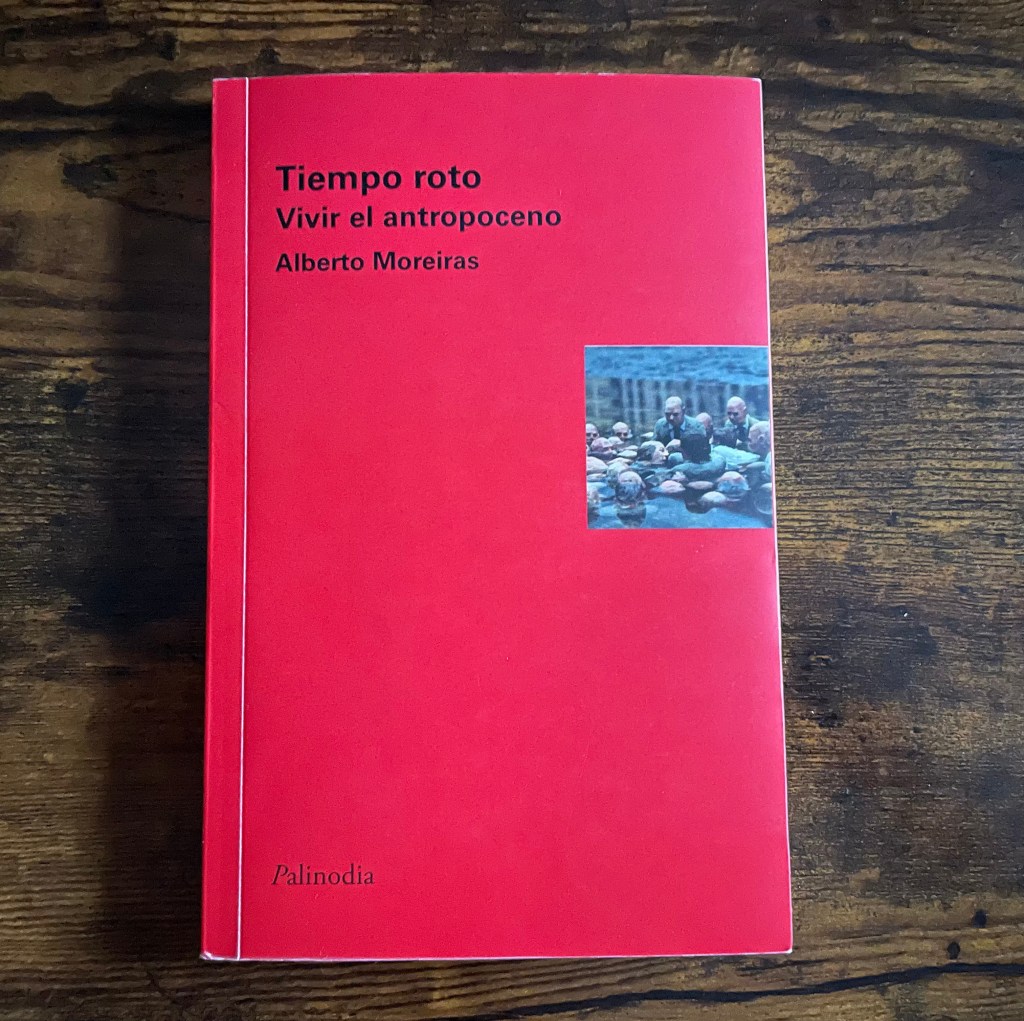
The sudden and uninvited intrusion of Gaia in our world is something rather strange, and yet consistent with the closure of the metaphysical tradition. The call of the outside takes place at the threshold of our reflexive capacities, habits, and mental propositions in our relation with the world, which demands everything to be thought from scratch. The historical imbalance in groundlessness now requires a new task for thinking – the imperative that runs through Alberto Moreiras’ most recent book Tiempo roto: vivir el antropoceno (Palinodia, 2024). The theoretical constellation deployed over the course of a decade now comes to the forefront with extreme urgency – I am referring to marranismo, posthegemony, aprincipial anarchy, and of course, infrapolitics. Tiempo roto (2024) is not a systematic culmination of Moreiras’ philosophical (or antiphilosophical) project of thought, but it is definitely a mature elaboration insofar as the field of problematization enters a hitherto unexplored thematics of late heideggerianism. All things considered, the emerge of the anthropocene as an explicit planetary endgame and the new beginning necessarily move pass the conditions of both political and scientific praxis, which today can only effectively adequate itself into positionality (the so-called Gestell) and objectivity of a world that slowly seems coming to its end.
It might be worth remembering that the notion of “other beginning” (“otro comienzo”) in the wake of civilizational decline was already proposed in the book Sosiego siniestro (2020), but it was far from being thoroughly explained [1]. Following Heidegger’s philosophical scene, representational thought in the tradition of adequatio of the Thomist gnoseology coincides with technological administration of every living entity (Moreiras 14). But Heidegger’s suggestion in the Parmenides that calculative representation fails as grasping the essence of the polis might also have its own limitations, insofar Gaia appeals to an excess beyond or below the politics. As Jacques Camatte also understood it, the civilizational invariant of revolutionary breakthrough departing from the historical subject of the working class can seldomly do the work except as an article of faith in the myth of the autonomy of the proletariat within real subsumption. This means that we are in the terrain of infrapolitics or the chora, which point to ontic regions of thought towards a new beginning at the end of principial metaphysics. But the other beginning can only emerge within conditions of transforming existence against the closure of political technicity.
I do not desire to reconstruct here all the refined analytical movements that lay out the transformation of existence in Tiempo roto (2025), but there is a maxim from Pindar’s Third Pythian Ode that stands out as an emblem for the appropriation of the non-humanity of the world. Moreiras cites Pindar’s “me, phila psycha, bion athanato speude, tan d’emprakton, antlie makanan”, which can roughly be translated as “do not seek, dear soul, immortal life, but do try to carry out the fullest the use of the possible” (Moreiras 61). Moreiras correctly notes that the ultimate difficulty lies in the “emprakton makanan”, or the use of the possible, which metaphysical Humanism and effective general equivalent can only exacerbate towards the planetary production and extractive valorization. The corruption of the use of the possible is the realization of hybris, and in this sense all representational humanism is always already a form of self-deification and induced hallucination, even when it tries to claim to engage in the opposite in relation to nature (Moreiras 65). Moreiras suggests that the pindaric maxim discloses a second relation of the “use of possibles” that does constitute a lacuna in the metaphysical tradition, and that is understanding a praxis tied to sophrosyne or phronesis that abides to the prudent inclination of the non-human (“es una actividad sometida a la vergüenza de lo in-humano”) (Moreiras 65). Giorgio Agamben’s defense an ontology of possibility against the hegemony of metaphysical realization and representation also comes to mind, although Moreiras might not feel at ease at explicitly calling for a positive ontology nourished in the waters of a transfigured metaphysics of the tradition of scholastic Averroism [2]. Although both Moreiras and Agamben come at their closest proximity in terms of the notion of the chora – and more directly the space of the chora against the primacy of the polis – which serves the ontic condition for the non-spatial surfacing of the abode or region that is necessarily infrapolitical, because it’s never determined by distributionist political isonomia or meson (Moreiras 73).
There are important nuances here to say the least: whereas for Agamben the notion of chora appeals to the gods of place (theos aisthetos), and thus a dejointed form of divinization decoupled from the legitimacy of every politico-theological archein; for Moreiras, the chora is a praxis of thought towards desecularization that lacks theology, and thus capable of exceeding the onto-theological reduction (Moreiras 74). But Moreiras says about the tendency towards nihilism of “possibility” in the historical dispensation of positionality (Gestell) could also be said about ‘de-secularization’, as the ultimate consequence of the decay of political legitimation in Ernst Bockenforde’s famous formulation. This might not be the space nor the moment to reach a verdict between Moreiras and Agamben’s position regarding the very complicated problem of the Platonic site of the sensible, since what is presented to the reader as a ‘phenomenology of excess’ or the inapparent (something merely alluded in the Zahringer seminar), might be the condition of an atopic mediation that prepares – or that has always prepared since the times of Orphic myths – the tonality of a coming philosophy under the sign of transformative thought (Moreiras 110) [3].
The dispensation of the Gestell open up and also step back (a folded movement that does not have a declension into a synthesis) into the genesis of the beginning (Moreiras 115). And the anthropocentric epochal dispensation, says Moreiras, is no longer the site of the polis, but “the planet as a the historical site of humanity, although we are still unaware of it (“aunque sigamos desconociéndolo”) (Moreiras 116). This uncanny phenomenology of the primary, traversed by the discharge of the entstehung, is the infrapolitical site par excellence, because it is in the atopic region where destiny is both affirmed and displaced. This is why, as Moreiras recalls Heidegger saying, the dialogue with Parmenides never exhausts itself, and yet it prepares a destiny (Moreiras 134). I take this to mean that there is an experience of the transfiguration of language for the emergence of an “ethics” (ethos), but this might be beyond Moreiras preliminary conditions for an existential breakthrough; that is, something possible further along the path.
Tiempo roto (2024) closes with a couple of undeveloped pages that take Massimo Cacciari’s old essay “Confrontation with Heidegger” (1977), in which the Italian philosopher makes a plea for a direct confrontation with Heidegger and Nietzsche’s teachings on nihilism and the closure of metaphysics if there would still be any hope for the composition of the working class during the stage of anthropomorphized dimension of capital defined by Jacques Camatte also during those years. But much has changed since the hot Italian summer of 1977 and the formulaic conjunction of “left Heideggerianism” might not do the work anymore, as if the totality of materialist political economy could be amended by a radicalization of the historical question and the ontological difference. Political economy plus metaphysical critique is still relying on a conception of the political as a technique, which today has transformed into what some have called the “new regime of ecological accumulation” as mere stabilization of green ecological spheres of life [4].
But there is a second register to Cacciari’s programmatic thesis that remains open. And these might be Moreiras’ most important words in the concluding part of the book: “Espero haber mostrado que Hiedegger señala la posibilidad de dejar atrás la explotación y el consumo en la era del Antropoceno a través de una comprensión alotrópica de nuestra relación con el mundo. Por lo tanto, vivir en el Antropoceno debe basarse en el abandono o desplazamiento de la metafísica como modo dominante de aprehensión del mundo en la actualidad” (Moreiras 151-152). Marx’s materialist dialectic through the critique of political economy – even as a destitution of political economy through its own vectorization – might be insufficient to face the unprogrammed presence posed by planetary anthropocene.
Perhaps we can still repeat Dionys Mascolo’s words that the coming communism will owe more to Hölderlin than than Marx, not because of an idealist dispute over concepts, but rather because of what Cacciari called in his essay, also citing the German poet, the historical “affinity of conditions” [5]. And in the age of the Anthropocene and positionality, those conditions are kept in the pattern of economic decline or stagnation in which the law of rate of profit encounters its own limit, folded unto the ongoing destruction of the life forms in the world. The allotropic praxis endorsed by Moreiras finds traction in Hölderlin’s poetic dwelling in language at the heart of decline so that something other might emerge within and beyond life, from Gaia to Ctonia. This is the most difficult task to depart from, but it is also the path that saves from the current inhabitable passage of the Earth.
.
.
Notes
1. Alberto Moreiras, Sosiego siniestro (Guillermo Escolar, 2020), 24.
2. Giorgio Agamben. L’irrealizzabile: Per una politica dell’ontologia (Einaudi, 2022), 112-146. Kindle Edition.
3. For more on orphism and the limits of the site of the Greek polis, see Gianni Carchia’s Orfismo e tragedia (Quodlibet, 2019), epilogue by Julien Coupat.
In a fragment from 1919 entitled “World and Time”, written around the time of the elaboration of the essay on the question of violence, Walter Benjamin offers his most succinct definition of politics: “My definition of politics: the fulfillment of unelevated [ungesteigerten] humanness” [1]. The ontological reduction is compact, and the three terms in it are carefully chosen: fulfillment, unelevation, and humanness, which indicates a ‘preparation for a profane politics’ at the threshold of secularization and its negation in a new “spiritual ornamentation”, as he would claim in the notes of “Capitalism and Religion”. The stress on the refusal of “elevation” (gesteigerten), however, does bring to bear that Benjamin’s refusal of a political ontology constrained in subjective and objective representation, which is why in the same fragment he connects the abutting of politics to a “living-corporality” [Leiblichkeit] of the human species. To retract from the cycle of civilizational violence, politics had to be reformed from the groundlessness of the energy of the living.
Hence, for Benjamin there is a metapolitical condition or archipolitics that plays out in refusing “elevated humanity”, which for him was at the source of the romantic response to the impasse of the critical enlightenment, placing the subject of knowledge and its self-reflective faculty at the center of the developing self-rationalization of the spiritual transcendence of the world in this new critical religion: “…the ideal of humanity by rising up to…that very law which, joined to earlier laws, assures an approximation to the eternal ideal of humanity” [2]. Hence, neither trascendental representation nor spiritualized immanence of order could, but unelevation of the “human possibilities” (Menschhaftigkeit). But such possibilities could only be disclosed beyond the pretensions of spiritual elevations of a unified consciousness, as Erich Unger had proposed in his Politics and Metaphysics (1921) around the same time to enact a “politics of exodus” for a common psychosocial regeneration.
Benjamin’s proximity and distance from Unger’s position could perhaps inform why instead of writing a promised book that was going to be entitled True Politics (Die Wahre Politik) – allegedly containing two chapters “The destitution of power” and “Teleology without ultimate goal” – evolved into the landmark essay “Towards the critique of violence”, in which the frame of domination and the ontology of politics was recasted as a mediation about the folding of secularized annihilating violence, substance intrinsic to the philosophy of history and indestructible life of the soul (“annihilating only in a relative sense…never absolute with regard to the soul of the living”) [3]. Thus, one could say that accounting for the groundwork of “politics” meant accepting the constitutive verticality cosigned to modern philosophy of history, and its bipolar schematism between moral principles and sacrificial production. If Peter Fenves’ assumption is correct, Benjamin was not only inscribing a distance from Unger, but, more importantly, from Kant’s Toward Eternal Peace who defined his “true politics” as dependent on moral determination: “The true politics can therefore not take a step without having already paid homage to morality, and although politics by itself is a difficult art, its union with morality is no art all, for as soon as the two struggle against each other, morality into two cuts the knot that politics cannot dissolve – The right of human beings must be held sacred [heilig], however great a sacrifice this may yet the dominant power” [4].
The Kantian liquidation of politics to morality is hyperbolic to the modern epoch and its crisis – the crisis and enmity against the concept of the political, Carl Schmitt would claim in Political Theology (1922) – rendering modern politics and legitimacy hollow; something that Benjamin had understood well he saw to retract from the question of “politics” to that of a critico-metaphysical exploration waged on morality “as nothing other than the refraction of action in knowability, something from the region of knowledge…Morality is not ethos” [5]. Elevation could only have meant the production of a subject of knowledge and the specific (technical) arrangement of knowledges for subjection. On the contrary, the ethos was the necessary condition no longer for any “coming politics”, but rather for the disclosure of “the coming world” [die kommende Welt] itself. This means that working through the redemption of the world solicits a reversal from morality to ethics only to later transform the conditions of politics.
Let us return to the definition of politics as “unelevated [ungesteigerten] humanness”. What defines “unelevation”? From the ethical point of view it conjoins with the notion of “inclination” [Neigung] that Benjamin favors because of its unconditional valance that disarms the cycle of violence of the human community and its willful hostilities. The inclination rejects the paradigm of force because it an erotic mediation, that is, an affection of donation and love beyond exchange [6]. But inclination is only possible through language, as Benjamin had expressed in his “concept of politics” in a letter to Martin Buber from 1916: “I understand the concept of politics in its broadest sense…in this sense, therefore, language is only one means of more or less suggestively laying the groundwork for the motives that determine the person’s actions in his heart of hearts. Only the intensive aiming of words into the core of intrinsic silence is truly effective action” [7].
Thus, the suspended elevation of the subject and higher order meant that its persuasive purity allows the inception of the “divine” as a «teleology without a goal» validated by the suspension of judgement of appearance. The intensification of the unelevation opens life to an ethical demand of a “living corporality” that roams the world’s crust beyond depredation where the force of autonomy of social practices does not risks the world of life forms and the soul. Indeed, at this point Benjamin does join Unger’s cardinal thesis: “Overcoming capitalism through wandering”. Or as he wrote even earlier about Hölderlin’s poetics: “[In the world of Hölderlin], the living are always stretching of space, the plane spread out within which destiny extends itself…it already comprehends the fulfillment of destiny” [8]. A politics oriented pending dowards to “unelevation”, inhabits the ground level of co-existence and cultivation dismissing the ontological derivatives or principles (archein) of ‘politics’ in order to conquer every possible destiny in the lawless fulfillment of the world.
.
.
Notes
1. Walter Benjamin. “World and Time”, in Walter Benjamin: Toward the Critique of Violence: A Critical Edition (Stanford University Press, 2021), 74.
2. Walter Benjamin. “The Concept of Criticism in German Romanticism”, in Selected Writings, Volume 1, 1913-1926 (Harvard University Press, 1996), 138.
3. Walter Benjamin. “Toward the Critique of Violence”, in Walter Benjamin: Toward the Critique of Violence: A Critical Edition (Stanford University Press, 2021), 58.
4. Peter Fenves. “Introduction”, in Walter Benjamin: Toward the Critique of Violence: A Critical Edition (Stanford University Press, 2021), 18-19.
5. Walter Benjamin. “Ethics, Applied to History”, in Walter Benjamin: Toward the Critique of Violence: A Critical Edition (Stanford University Press, 2021), 74.
6. Walter Benjamin. “On Kantian Ethics”, in Walter Benjamin: Toward the Critique of Violence: A Critical Edition (Stanford University Press, 2021), 71.
7. Walter Benjamin. “Letter to Martin Buber” (1916), in The Correspondence of Walter Benjamin (University of Chicago Press, 1994), 79-80.
8. Walter Benjamin. “Two Poems by Fredrich Hölderlin”, in Selected Writings, Volume 1, 1913-1926 (Harvard University Press, 1996), 26.
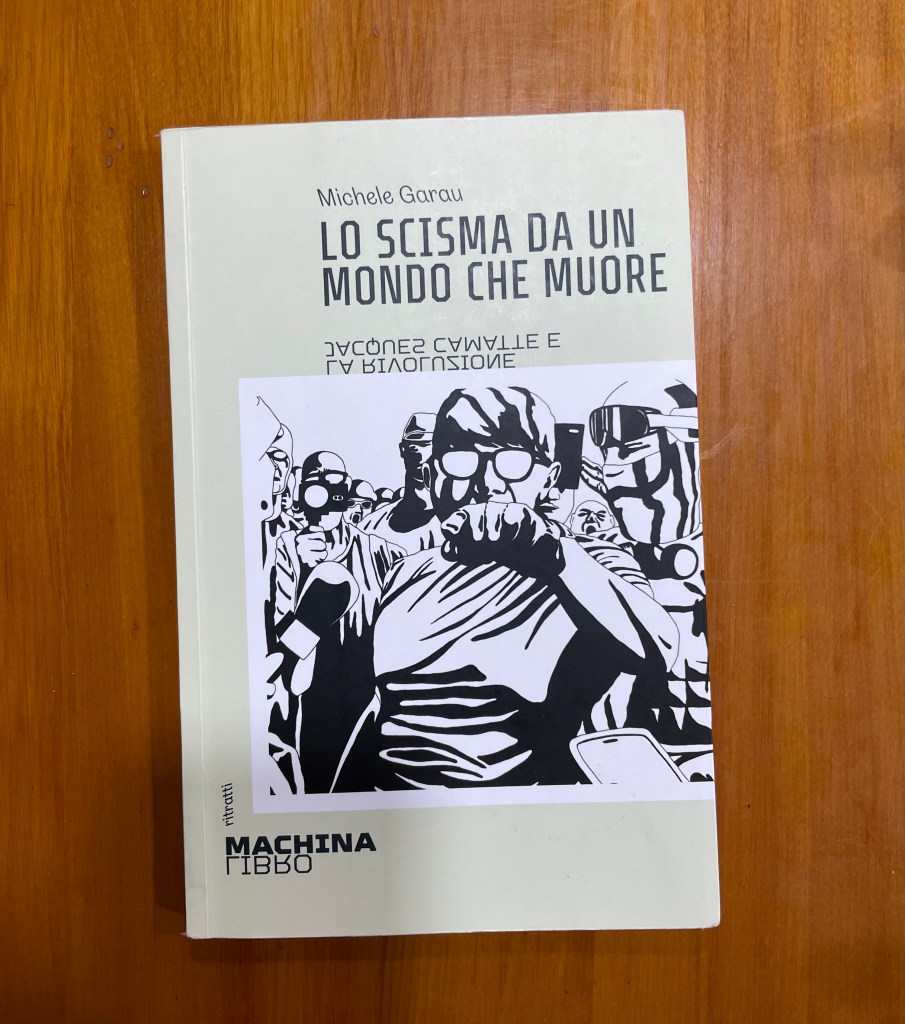
We must welcome that Michele Garau has written the first monograph on Jacques Camatte’s thought in any language, although the book, Lo scisma da un mondo che muore: Jacques Camatte e la rivoluzione (DeriveApprodi, 2024) it is also more ambitious than a mere philological reconstruction of the thinker of Invariance. Of course, not that there is anything particularly wrong with philological or archival work; rather, it is also that Lo scisma da un mondo che muore (2024) tries to think with Camatte (and also beyond some of his potential impasses) the historical bifurcation of a watershed moment in the history of humankind through the realization of the “capitalist revolution” as an autonomous colonization of every form of exteriority (Garau 7). If Camatte’s work has been only selectively considered in our ongoing discussions – while completely ignored at large by the so-called contemporary theory, which I guess it is an uplifting symptom – is precisely because he poses a challenge for a possible breakthrough in times of stagnation, while firmly announcing a much needed farewell to the modern revolution. But who would want to jump on that wagon when precisely voluntarism, prosthetic revolutionary cosmetic, and fictive communitarianism are all necessary platitudes to hold on to the illusion of ground right above the abyss? It is a rhetorical question, of course, but also one that Camatte move passed it in the in the decades of sixties and seventies observant to the material transformation of the working class, and the overall lesson of Amadeo Bordiga’s communism of the human species, which has also been rendered opaque and fossil-like by the victorious force of cultural hegemony and the whole grammatical structure of Gramsci’s thought in postwar political thought (and some will say well into our very present in the most recent cycle of failed left-populism). We said ‘farewell’ and this act, for Camatte after Bordiga’s teaching, means that the revolution has already taken place and must be perceived in the perspective of the crisis of negativity and the inception of the real absorption of capitalist development (Garau 14).
Hence, new challenges lay ahead, which implies the abandonment of the historical and temporal productivity of revolutionary time – and Garau does an excellent mapping of bourgeois revolutionary thinking from Abbe Sieyès to Saint Just to later formulations of the Leninist paradigm of the dictatorship of the proletariat – which in the grand scene of modernity oriented the economy between form and function, but also between thought and action. If the epoch is said to be ‘anarchic’ is mainly because all these mediations and exclusive autonomous spheres have collapsed unto each other, and to favor one over the other is to work within the fiction of ideological reproduction at best. After Bordiga – Garau claims glossing Camatte, although there are nuances that I cannot consider in the space of this short commentary – the temporalization of the ius revolutionis can only bear in mind the crisis of presence (De Martino) as a suspension of exteriority that liberates right unto real subsumption. This means, following the recently polished phrase of Bordiga from his article “Tempo di abiuratori di scismi” (1965), that all revolutions are born and deployed as the affirmation of the schism. “Schism” or “scisma” — and one is reminded or taken back to a theological terrain, and not just as mitigated by the old ecclesiastical memories of the “Great Schism”, but because “schism” is also the “stazion” that fractures the visible-invisible legacy of form of the Church’s Trinitarian doctrine, and which is still the esoteric boiling point of the myth of political theology. This is a detour around Garau-Camatte-Bordiga’s intuition, since none of this is explicitly thematized in the book, nor should it be. It suffices that it opens to this question, given that Camatte’s own grammar of exhaustion – “extinction”, “inversion”, “autopoiesis”, “critique of organization”, “wandering” (erranza) – distill the echoes of an apocalyptic movement proper to the modern anthropological crisis, to put in terms of Ernesto de Martino.
Be as it may, the longue durée of civilizational development of Western revolutions (Edward Gibbon would claim at least since the reconstitution of the Christian Empire) there has been a process of adequation to invariant processes of capitalist accumulation that its substrate (whether permanent, uneven, natural law justified) becomes isomorphic to the structural needs of capitalist autonomization. In a cogent reading of Sieyes with Saint-Just in the framework of the French Revolution, Garau demonstrates how the genesis of modern politics and its categorial scaffolding (localization, constituent power, social unity, subject of rights, and representation) presuppose a thoroughly new vision to make the human community a clean slate for surface legibility (Garau 42). If the civil concept of the ancient polis was measurement and exchange; the crafting of high-modern state politics that took off in the eighteenth century was much thicker and spatially robust dynamics so that the ‘laws of commerce’ and population disciplining could come to fruition with its necessary infrastructural support. The schism was always a perturbation of the “sphere of politics” (and also of politics as a translucent sphere that can be observed, stabilized, and managed), and thus a great scandal.
Hence, the critique of political economy in the history of marxism was never able to untangle this mutual correspondence. For Garau at this point one can locate the difference between Camatte’s thought and Italian operaismo; given that Italian workerism at mid-century was never able to overcome the dialectic between the valence of value form and the theory of the production of capital. Whereas for Mario Tronti the struggle was still to be inscribed in to confrontation between the proletariat qua labor power; for Camatte the “invarianza” is not an permanent stage within the history of class struggle or Marxism, but of the human community and its resistance against the real subsumption of the material community (Garau 48). Decoupling the history of the working class as constitutive of productionism from the human community, allows Camatte, in the wake of Bordiga’s communism, to register the subsumption of capital as it collapses into dialectical negativity. Hence, communism is neither produced nor organized as operaismo always thought (Garau 26-27). And citing a passage from “Against domestication”, Garau argues that for Camatte the history of the proletariat struggle after 1945 is only the struggle to maintain the myth of the proletariat as the subject of a historical breakthrough (Garau 73). This is a staggering affirmation, and one that most definitely produces a theoretical schism. But the schism is also against the fictionalization of a subject of history, which has also been integrated into the emptying of social reality as we have come to know it in the final triumph of the fictive unto itself (Garau 93).
There is the triumph of the fictive and expansive force of capital despotism, and then there is the struggle for the originary community (Gemeinwesen), which as Gianni Carchia argued in his “Glosa sull’umanismo” (1977) was still enmeshed in the contradiction between humanism and anti-humanism obstructing the vascular movement of non-identical fragments imploding the social. Is this getting at an impasse of Camatte’s own effort of thought to find an exit route? As an intelligent book, Lo scisma da un mondo che muore (2024), refuses to give an essay in the last three pages of the essay, although this difficulty is an object of attention. For instance, Garau writes in one of the clearest elaborations to tackle the problem directly: “La comunità deve allora essere riscoperta in una memoria della specie che finisce per radicarsi, questo è il rischio, esclusivamente in un bagaglio biologico. Nell’esaurimento delle strutture sociali preesistenti, dei linguaggi e degli schemi culturali, delle intelaiature rappresentative e cognitive, nella colonizzazione delle capacità psichiche, affettive, simboliche, è davvero possibile individuare un resto intoccabile dall’antropomorfosi del capitale che non debba essere, invece, creato dal nulla? C’è una «parte irriducibile», come scriveva Bataille, rispetto alle unità di misura del dispotismo economico? Non è semplice rispondere” (Garau 124).
In light of this rumination, Garau also attends to the cycle of contemporary revolts, which might stand as an instance of linguistic and existential struggle against domestication and the crisis of presence (Cesarano), and that might be capable of “absorbing the sky of politics into the most simple and elements components” (Garau 124-125). This is a great image, and one that has pictorial density and durability for thought even if it lacks specific elaboration. To absorb the open sky is to confront the exteriority of the world only as transfigured and brought back as a gathering of experience. The great German critic Kurt Badt comes to mind when writing about Constable: “the sky’s the organ of sentiment”. The embarrassing loss of the world today is fundamentally the destruction of the right attunement to our relation to the opening registered by what gleams above our heads. And perhaps this is a way to measure the capacity for non-movements rather than thinking that movements can disclose the sky. To this end, what could it mean to absorb the sky of politics – which is also a way to refuse the politics of sky, that is, the total planetary grand designs of geopolitical Tianxia? The irreductible may not be reduced to a substance, nor an ontological science nor a vitalist return to an originary community (if only mediated by the restriction of the archaic myth); but precisely that positionality of contact between what is exterior to life itself. To dislodge thought from all political plotting of objectivation and its plastic ligament of social adaptation. A life beyond itself that endures, and perhaps will outlive this dying world.
In an early review of Elio Vittorini’s Uomini e no (1945), Renato Poggioli noted that one of the important merits of the novel was that in spite of the authort’s political commitment, the narrative was “neither partisan nor ideological. I dare to say it is not political; the author even apologizes for this at the end of the volume” [1]. Poggioli, of course, is referring to Vittorini’s Postscript where he states, favoring a thin notion of the autonomy of art, that the end of art is to “seek in art the trace progress of humanity is altogether different from fighting for it upon the political and social terrain” [2]. This is enough evidence to bring to bear Vittorini’s humanist project grounded in a faith in the “progress of the human species” that he wrestled with throughout his life, and that he never really abandoned according to Franco Fortini [3]. Of course, Vittorini’s ‘progressivism’ is not bounded to ironclad guidelines of political economy and the science of a materialist history, rather his position is the attempt to flee from it, to undertake a different path in which humanity and inhumanity could enter into an improper and inconspicuous relationship towards presence.
Here we can part ways with Poggioli’s suggestion that Uomini e no (1945) is not “sufficiently political” because the characters do not dare to make political slogans or identify themselves with a concrete political party line (the Communist Party that Vittorini himself identified with in spite of having written a non-political novel) during the underground resistance during the years of fascist domination in Milan during the interwar years. If Uomini e no (1945) drifts aways from engaging in a formal political identification to mobilize the narrative persuasion it is because for Vittorini there is an original struggle for “life” that necessarily precedes subjection and political action: it is the struggle of human species to confront the difficulty of its own inhuman threshold, which becomes necessary to account for in any materialist conception. The whole tension of the novel hinges on the unnerving formal composition of the narrative with the asphyxiating dread and angst of the character that embodies the existential the practice of an incarnated struggle beyond survival.
However, what is beyond survival? What comes after the desert of a world that soon enough – in the words of Theodor Adorno at the height of the mid century – will turn human life into “mere functions within a monstrous social machine in which “life does not longer lives”…in which what grows is the scope of socialization and its functions. What I want to say is that liberty has become a mere pretext to enhance the ways of domination” [4]. If politics is the religion of modernity (political theology suturing the void with authority), the accumulation of liberty can only be understood as the moment of expansion and reproduction of effective domination. In a way, the metropolitan scenario in Uomini e no (1945) foreshadows the evolving historical epoch of this ‘monstrous socialization’ as a civil war or stasis, in which the mere survival of political struggle is proportional to the dispensation of death of humanity as the last dialectical movement of humanity against itself; that is, towards the concrete extinction of the human. For Vittorini the swerving black sun of fascism and political militancy (in its idealized version invested in the paradigm of sacrificial structure of history) can only amount to the realization of epochal nihilism and the fertilization of the expansive desert in the novel at the expense of sacrificing the erotic mediation with the world, which entails the liquidation of the sensibility external to human: “Love, in those deserts, is at its most squalid; it is not that life is absent from but the life it has is not alive. You are thirsty and have a chance to drink; there is water. You are hungry, you have a chance to eat; there’s bread. There is a spring and alms around, just the one you are looking for. But it is only a mirage, it is not the thing itself” [5]. The fundamental question posed by Vittorini is never truly resolved by Uomini e no (1945): crossing the desert to achieve something like an erotic distance with the thing itself as ultimately the confirmation of one’s irreductible destiny. No doubt, there are moments where this emerges in strange ways, at the limit of narration and as a linguistic declaration. This is scripted through the exchange with the old lady Selva on happiness: “We work in order that men be happy. Isn’t that what we are working for?…Men need to be happy. Would there be any point to our clandestine newspapers? To our conspiracies?” [6].
Is happiness a subterfuge to return to the world, or is happiness, authentic non-compensatory happiness, the stimmung of life as it retreats from the delegated representations of civil society? The suspended dialectical closure at the level of form in Uomini e no (1945) provides a preliminary resolution to the question of happiness amidst wreckage; a collapse that speaks to Vittorini’s impossibility to bring into synthesis political action and existential authenticity. The narrative texture of Uomini e no (1945) is a preparatory exploration – showing the false exists in the meantime – towards the possible liberation of man’s passions, even against the premises of a reconciled ‘Humanity’ capable of leaving behind the antinomies of humanism and antihumanism at the service of the ‘communist way’. And we know that for Vittorini the commitment to ‘Communism’ was inscribed not in the idea or the organizational tactics but in the notion of the “way” (una via), capable of opening possibilities to counter the coercive efficacy of the administrative social apparatuses that turn historical progress into a totalizing desert [7]. How to do so – is there any legible index to the “via comunista”? As a novel Uomini e no is preparatory towards this retreat from the confusion of the inhumanity of the human on the one hand, and the total humanization of the world to deface the possibility of happiness and experience with the world itself.
In this sense, Fortini is right in describing the lyricism of the novel as attuned to a funeral oration or song (“canto funebre”), which is also a prolonged farewell to the ideals of Vittorini himself as a moral humanist; that is, as someone committed to the ideals and abstraction of redemptive self-sacrificial christology and the self-serving autonomous action of the pardon as man’s last hope to absorb the inhuman kernel into the vita nova of a redeemed universal Humanity. And in fact, these are two “endings”’ of Uomini e no (1945): the self-immolation and sacrifice of the protagonist N2 waiting to confront the Nazi official Cane Nero, and the final sequence of the worker that refuses to murder a German soldier because he looked “sad” even when standing on occupied soil, even when he occupies the role of the protectorate of the nomos of the earth [8]. These are the novel two preparatory distinct actions in the dense fog of the interregnum: the Christological path of sacrifice of N2 – the sacrifice to end all sacrifices, which according to René Girard’s defines the advent of the Christian sacrificial practice- seeks a last action of resistance holding on to “humanity’s internal weakness”, which carries the elevation of secularized mythic discharge of subjective martyrdom [9]. On the other, the milanese worker offers redemption as a form of secret forgiveness (without a justification and without a why) to the occupier, and in this way integrate the inhuman into the human species as the solution to the repeated rumination over the movement of struggle and resistance: “Why, without being in any way forced to do so, had they entered this duel to the death, and why did they continue to wage it?” [10].
In his early reading of Uomini e no (1945) Franco Fortini offered a thesis that I am tempted to call the domestication of the wolf argument; an inversion of Hobbesian anthropology and the Christian felix culpa in which struggle’s optimism will ultimately transfigure the internal wolf unto the human’s heart [11]. But we know that the homo homini lupi depends on a thick notion of anthropology, of the human’s unfathomable deficiency in relation to ‘object reality’ so that any domestication of the wolf within humanity is also an anthropological quest; perhaps the last “route” of negating humanism through substantive acts (sacrificial sacrifice and forgiveness) in the attempt to reconcile the wolf with man. But this is the very enterprise of civilizational techniques of adaptation proper to the tooling of political anthropology – that is, the domestication of the savage wolf entails its conversion to the passive dog. Could there be a way out to the final verdict of dialectical form beyond struggle, and the reconciliation of humanity with its negation? Perhaps this is only registered as the unthought in Vittorini’s Uomini e no (1945); an experience that prepares a return to the world through the conatus essendi, or the preservation of each thing’s being as their are. This is registered in only instances of the novel in the backdrop of a landscape; indeed, outside the subject of self-reflection, and beyond the premises of radical evil proper to moral platitudes. And the moment reads like this in chapter CXXX: “The long dusty road, the drowsiness, the hay, the stitches where the cicadas were: everything that was, and that, along with everyone who is lost, still wants to be. And the sky filled with kites? The sky that was filled with kites” [12]. The perseverance of the conatus essendi puts to rest what the delegated forms that politics and morality have to offer as temporal substitutes for dragging the historical promise of humanism within epochal nihilism.
In this suspended imagery of an arid landscape, Vittorini descends to the preservation of things as they open to their manifestation of another sense of freedom – no longer tied to the paradigm of historical liberation nor to the assumption of synthetic anthropological determinations to sooth pain – comes upwards, always silently, through the order of description outside the human. And is not in this description what Gianni Carchia would call “the non-human…a gesture of farewell to the idealist movement; a farewell to the exaltation of the human up to the highpoint of its explosion. The refusal to substitute the dead god for a human that in the depredatory scope of totality crosses every limit, every transcendence, and infinity” [13]? This transposition of this proximity with this “other-than-humanity” ( what Humanity can no longer hold on to) is the secret to Vittorini’s infrapolitical impasse in Uomini e no (1945) that holds the key to his insistence on a notion of “freedom” against the subject incapable of overcoming itself in the face of the abstraction (morality) or ideological reassurance (militancy) [14]. One could assume that the worker’s last line in Uomini e no (1945) – which also coincides with Vittorini’s mimetic repetition in his “Postscript” – in the form of a promise (‘I’ll learn better’) registers the final attempt to grasp what remains on the exterior fog of humanity: a notion of freedom that, in seeking ‘a way out’, insists in the possibilities of establishing contact with the world. Thus, the program of historical liberation can only be achieved against historical and civilizational fixation; traversing the polarity of humanity and inhumanity, and thus deposing the sublimated sentiment of pain that social domination can administer as an unending process of degenerated and moribound humanity as mere continuation of the fictive life.
.
.
Notes
1. Renato Poggioli. “Review of Uomini e no by Elio Vittorini”, Books Abroad, Vol.20, N.4, 1946, 393.
2. Elio Vittorini. Men and not men (The Malboro Press, 1985), 199.
4. Theodor Adorno & Max Horkheimer. “El mundo administrado o la crisis del individuo”, Pensamiento al margen: revista digital de ideas políticas, N.19, 2023, 200.
5. Elio Vittorini. Men and not men (The Malboro Press, 1985), 34.
6. Ibid., 13.
7. Elio Vittorini. “El comunismo como vía”, in Diario en público (Gadir Editorial, 2008), 279.
8. Elio Vittorini. Men and not men (The Malboro Press, 1985), 50.
9. René Girard. Sacrifice (Michigan State University Press, 2011), 65.
10. Ibid., 196.
11. Franco Fortini. “Che cosa può l’uomo: Uomini e no” (1945), in Saggi italiani (1987), 253.
12. Elio Vittorini. Men and not men (The Malboro Press, 1985),190.
Philippe Theophanidis has recently brought to my attention an emphatic statement in Dionys Mascolo’s Lettre polonaise sur la misère intellectuelle en France (1957): “La politique est notre passion. Nous en parlons, ne faisons que cela, et tout l’ennui du monde est dans ces dialogues-disputes, dans cette démarche perpétuellement contentieuse qui donne envie de s’occuper de n’importe quoi d’autre, de plaisanter, de se taire, de s’en aller” [1]. These are intense words not entirely divorced from a deep sense of desperation entangled with a commitment to realism – minimally understood as bringing into thought how things looked at the time. In a recent collaborative introduction to the writing scene of this group (preliminary work towards an upcoming seminar) – which included Mascolo, but also Duras, Vittorini, Blanchot, and other continental friends – we took into consideration how the heterogeneous and internal tensions were brought into bear in the effort to connect the creative act to the existential texture of communication and concrete world events [2].
Mascolo’s statement must be read as historically marked and situated, as who today could claim that “politics”, however broadly or loosely understood, is the exclusive “object” of our passion? Mascolo seems to have been aware of the subordination of passion into politics, leading to dialogues and disputes where nothing could facilitate the clearing of a way out. When politics becomes the final object of one’s passion it could only mean that the reign of chatter has liquidated our experience with the world. And it is at this point where the ‘missing word’ that attunes the search for one’s passion can regress as nihilism; that is, as mere force to steer rhetorical valence and representational exchange within the expansive intramural rules of civil society. Restricting one’s passion to the determination of politics merely inverts the order of modern legitimacy (i.e. the repression of passions by the interests), compressing both terms as a higher principle of politics.
If at the outset of modernity contractualism suppressed the passions in exchange for sovereign security from the fear of violent death; in the attempt to elevate the passion to the grammatical height of politics, what is rendered obsolete is precisely the possibility of securing an existential site of freedom outside and beyond politics, that is, in the the nonplace of the passion itself. Of course, one could also read Mascolo’s apothegm in light of his revolutionary politics, in which the name of “politics” solicited the revolutionary emancipation of the civilizational alienation of the human species towards a transformative sequence beyond the scarcity of needs. But the problem of the category of revolution is that it remains tied to the very development of the legitimacy of the political and its erosion (for Edward Gibbon in Decline and Fall of the Roman Empire the configuration of the state is the crowning revolutionary event against disorderly barbarism), which the members of the Saint-Benoît Group were first hand witnesses in the postwar epoch.
I think this speaks to my suggestion that the assertion ‘politics is our passion’ was historically embedded; a sort of last breath of trying to hold onto the utopia that will soon crumble in every active paradigm of planetary order (postcolonial, Soviet state planning, European communism and social democracy). But at least – and this is what remains of interest, as I see it – the Rue Saint-Benoît friends had the courage to confront it in order to enact a farewell to the very assumption of ‘revolution’, which already in 1968 was clearly moot. In the words of Maurice Blanchot after the events of 1968: “…but from now on I will hold onto an exigency: to become fully conscious, and always anew, that we are at the end of history, so that most of our inherited notions, beginning with the one from the revolutionary tradition, must be revised and, as such, refuted. […]. Let us put everything into question, including our own certainties and verbal hopes. The revolution is behind us: it is already an object of consumption and, occasionally, of enjoyment. But what is before us, and it is terrible, does not have a name” [3]. Thus, to conflate “politics” as the passion could no longer offer solid ground in the intra-epochal interregnum of suspended historical time. Just a few years later, Duras will claim that politics had little to offer, since there is an “absolute equivalence between all political programs, and only right ideology seems to be able to do politics as such. We no longer believe in politics…there is only a burrow of hope. We must submit ourselves to the hard evidence of its total degradation” [4]. To dwell in a delimited burrow means a return to the rooting of place and new geographies beyond the temporal axis.
One can read both Duras and Blanchot’s elucidations of the collapse of modern politics and its negation (the ius revolutionis) as a corrective posture to move past Mascolo’s hope to make the unfathomable texture of one’s passion coincide with the object of a political project, even if understood as an archipolitics. But it is precisely in the abyss opened by a terrible and nameless epoch that a new light is casted on the free-standing and ungraspable nature of the passion; the irreducible law that establishes a contact between the ethical life and the world beyond objectivation as both excess and deficit of the tribulations of political order. Perhaps a modification to Mascolo’s thesis is now necessary: passion is what escapes every possible fall into the objective world, and for this very reason it is a ‘refusal’ of what the compensatory bond of politics can offer under the sermo humilis of stagnant artificial utopias. There is no political passion just like there is no political friend, since both friendship and one’s passion remains always objectless, only mediated by the overcoming of the preconditions of fear and of delegated life. In Manuale di sopravvivenza (1974), Giorgio Cesarano will claim that passion was the name of the coming historical program of a sensible presence resisting the “annihilating force of social objectivation” of the world [5]. And the Italian poet will define the passion as the sacred taking possession of the return to appearance. A transformation of politics could only emerge after one’s passion could finally prevail experientially against the terrible and nameless (and unnamed) world organized towards planned obsolescence and generalized humiliation. And it goes without saying that we are still very much our predicament. The caesura between passion and politics has now become spectacularly absolute and irreversible.
.
.
Notes
1. Dionys Mascolo. Lettre polonaise sur la misère intellectuelle en France (Éditions de minuit, 1957).
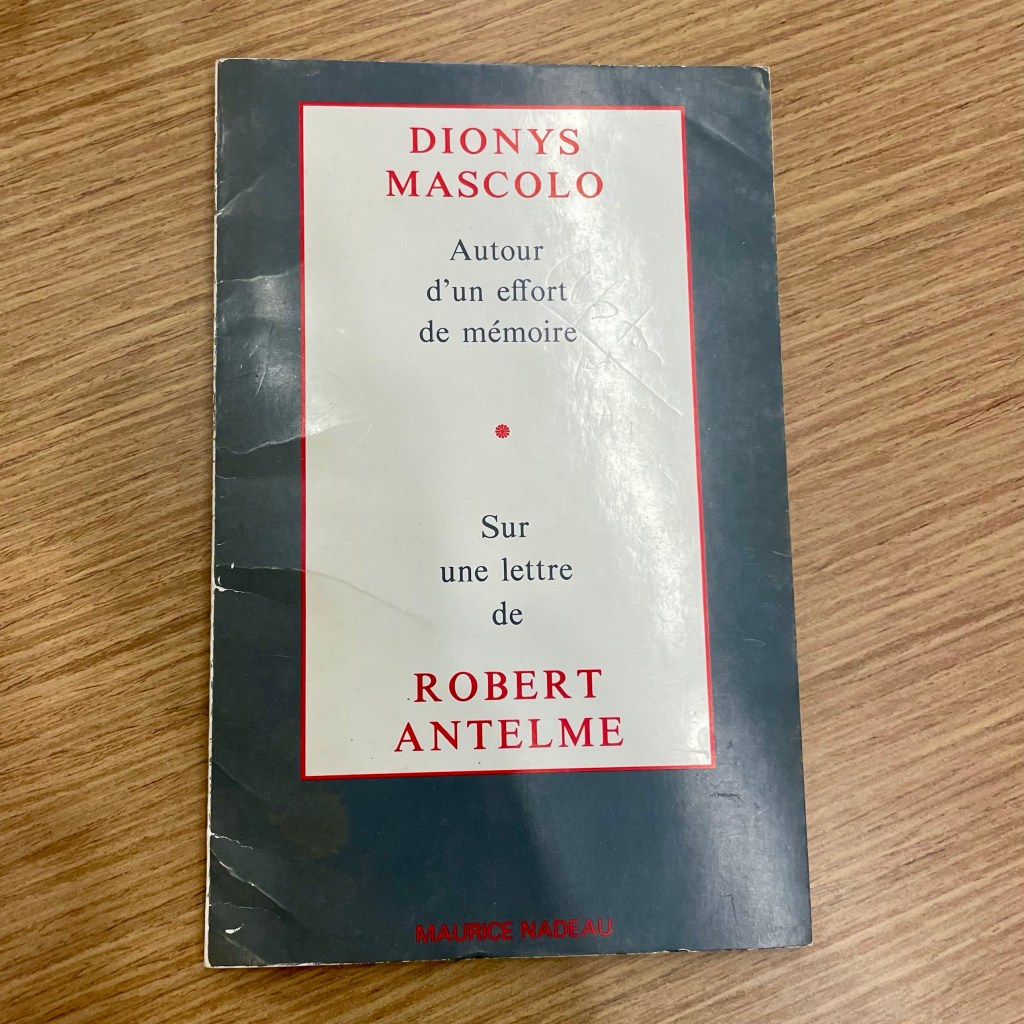
Rereading Dionys Mascolo’s Autour d’un effort de mémoire: sur une lettre de Robert Antelme (1987) in preparation for an upcoming course with Philippe Theophanidis, one gets the sense of beginning backwards or at the very end, since this late essay is a recapitulation of what the Rue Saint-Benoît Group embodied and stood for. And it is so obvious that for Mascolo what is at stake in Antelme’s letter is not a particular practice of confession (and the coupling of secrecy and extraction), but rather an integral register of an experience that belongs to “friendship in thought without reserve” [1]. And that it would not have been possible without friends, as simple as that. Of course, the condition of possibility of this shared thought in friendship has less to do with general principles, norms, or creative acts, and more with what Mascolo does not hesitate to qualify as “a sensibility that was common to us”.
What is this sensibility, and is it possible to describe it? This is a question that I do not think that is attempted to be resolved in Mascolo’s commentary nor in Antelme’s letter so consumed by its internal lacunae and effacement (I am definitely not capable of saying a word about it at the moment, and this might be one of the questions in the ongoing dialogue in the seminar). Mascolo does offer a little more when he states that this sensibility, however broad and partial, was always elevated against all totalitarianisms that were hegemonizing the political positions of the epoch. Obviously, it names the political totalitarianism (Fascist and state planned communism alike), but also the “the soul of the project” (‘est l’âme du projet et sa forme aboutie’) that must retract from it [2]. The last pages of Mascolo’s reflection is a shallow-deep, an insinuation, into the possibility of saying something in relation to this difficult proximity.
Hence, against total subsumption of life into political planning (whether on the right or left, whether ecclesiastical or in the name of the secularized forms of militant communist parties), Mascolo’s insistence on the ‘soul of the project’ is sustained by the “missing word” give that dispenses human necessities as infinite. He writes: “Et par mille et mille détours, il me (nous) fallait toujours en revenir au même point : Je suis ce qui me manque est la sentence que je porte (nous portons) inscrite à l’intérieur du front. La moindre des choses alors est de proposer que, sauf mensonge, elle vaut pour tout homme”. [3]. But what could it mean that “what I am” is always constituted by the missing word? It is definitely not a substantive attribute to a person (and thus what I can acquire), but a word that in its ideal absence and lack of epistemological validity stands as a form of seeking (zēteîn) that Nicoletta Di Vita has recently linked to the form of the ancient hymn [4]. The missing word is the passive and pure voice that calls out the rhetorical fiction of political totalitarianism. In other words, the missing word does not enact a present state of things, articulating the denomination in language with distinct objects of the world; it only has transformative weight when revealing what remains under the capes of morality.
This is why the experience of the camp constitutes a central threshold: on the one hand, it is an extreme and sharpened image of social alienation between classes; and, on the other, it is the experience that by depriving the human of its humanity it brings to an effective end the polarity between rich and poor that structured the economy of salvation and damnation of Western civilization. This is what Antelme describes in his essay “Poor Man – Proletarian – Deportee”, which according to Mascolo brings the rich to a psychotic night of desperation towards destruction and death of the specie. Hölderlin’s definition that “we have become poor in order to become rich” as a clement predicament in the face of the modern is here-forth suspended in the spiritual crisis generated by the social engineering whose most extreme case is the model of the camp.
And yet the missing word remains irreducible even after the corrupted stage of innocence and the impossibility of redemption. Mascolo, reader of Nietzsche, does not believe in the theos. This is why for him the missing word, far from being an apostrophe that offers consolation in the wake of the catastrophe, it remains concretely attached to the experience of the friend that no longer finds solace in abstract peace, but in the profound musicality of what remains inconsolable: “cette heureuse absence de paix qui est sa musique profonde, et que donne en partage l’être aimé, l’inconsolable qui console” [5]. This transfigured word – the unending capacity for hymn in the human, its nomoi mousikos – is both an excess to memory and appearance, and perhaps, more importantly, an excess to the experience of living and the dead. And is not this “seeking” passage of the missing word what the Rue Saint-Benoît Group was obsessively after?
__
Notes
1. Dionys Mascolo. Autour d’un effort de mémoire: sur une lettre de Robert Antelme (Maurice Nadeau, 1987), 82.
2. Ibid., 83.
3. Dionys Mascolo. Autour d’un effort…,82.
4. Nicoletta Di Vita, Il nome e la voce. Per una filosofia dell’inno (Neri Pozza, 2022), 27.
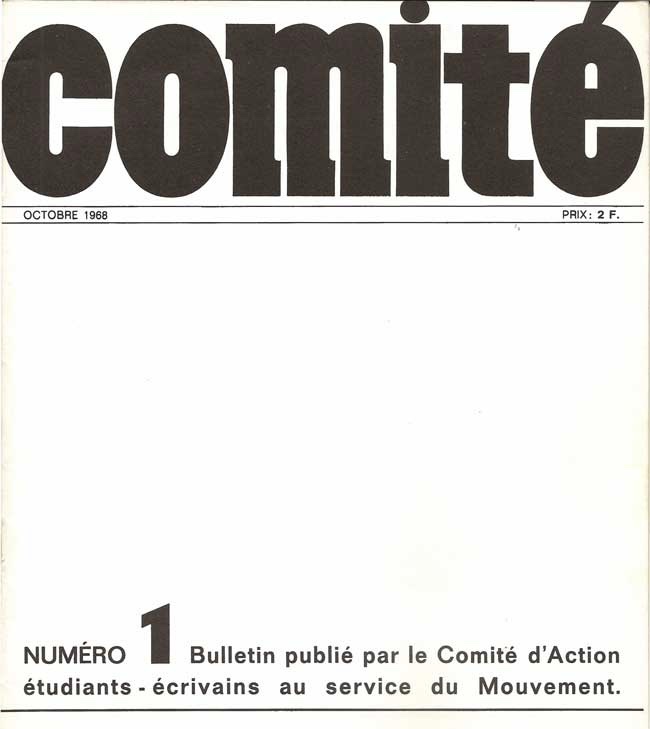
In the very last article that Maurice Blanchot wrote for the collective publication Comité in the wake of May 68, he draws a scenario that is still very much with us in the present. The “realism” is almost outstanding when Blanchot writes the following: “…from now on I will hold onto an exigency: to become fully conscious that we at the end of history, so that most of our inherited notions, beginning with the from the revolutionary tradition, must be reexamined and, as such, refuted. Let us put everything into question, including your own certainties and verbal hopes. The revolution is behind us: it is already an object of consumption, and occasionally, of enjoyment.” [1]. There was no question that the crisis of the very foundation of modern political thought has collapsed, including, as it couldn’t be otherwise, the generative principle of revolution. Blanchot did not even attempt to convince himself that the revolution could be brought back in an astronomical sense to revitalize a naturalism previous to Rousseau’s social contract.
So, for Blanchot the revolution was over, and yet, whatever it was that followed had no name. What was left, then? In order to avoid paralysis, Blanchot toyed during those months at the Comité (September-December 1968) with two possible maneuvers. The first position resided in what he called the “movement of possible speech” in order to establish an ardent and rigorous relation between the sequence of the French May and the Czech May, Soviet domination and Gaullian State. Blanchot called for (in the spirit of Bataille) a “transgressive speech”: “the impetus of outrageous, ways speaking beyond, spilling over, and thus threatening everything that contains and has limits” [2]. But we know that transgression is still within the logistics of the administration of order and temporal containment of the regulated exception. This was, in fact, the very rupture of the revolutionary break that was in crisis.
But Blanchot was up to something along with his friend Dionys Mascolo in thinking through language and communication as a path towards the outside. Hence the second option, which is really a third option (after the sleepwalking of ideological revolutionary ‘racketing’ of voluntarism); mainly, what he calls, although does not get to tease it out, the “clandestine resistance in the open”. Blanchot only tells us what he is thinking about through a recent example: some members of the Czech resistance when law was suspended had to confront the raw enemy military power, but they also experienced a freedom “through words and through writing than ever before”, tells us Blanchot. But this still does not explain much, given that if there is a naked military power threatening us, how could something like a clandestine form of life take place in the open? And at what risk?
I think one way to read this incorrectly or insufficiently would be to think of Blanchot’s suggestions as a sort of martyrdom or self-immolation. But it is no less true that Blanchot wanted to avoid a sort of Batallian “inner experience” or monastic xeniteia. Thus, he “refused” the fiction of self-clandestine life as sponsored by the Situationists; while, at the same time, also rejecting subjective revolutionary militancy. A third way emerges: the clandestine life into presence by way of friendship. A new “estilo de vida”, which I think could be read in the way that cryptojews and averroists lived in early Modern Spain: “a modo de sociedades secretas o semi-clandestinas, deben haber concebido la filosofía como un estilo de vida para sus iniciados…” [3]. Unlike the bogus image of the secret society as an alienated community of knuckleheads, I think what emerges in the clandestine open region is a form of shared friendship that does not retreat from the world, but rather that is capable of living in it. This was most definitely the transformative practice that during these years, Dionys Mascolo, dared to call the communism of thought that for him belonged to Hölderlin rather than to Marx. If open conspiracy is an act of the sharing and participating in language without meaning or command dependence, then this is already a poetic practice. After all, for Hölderlin the poets reveal an originary loss from nature. It is no surprise that Hölderlin favors a world opening even after the destruction of the leader-figure of the poet (Empedocles).
So, there is only clandestine life in the open when the sharing of language among friends take place (an event). This use of language is always harboring on the threshold of the last word to come. In short, the clandestine form of life has nothing oblique with respect to the world – it is not necessarily the space of an infinite night of contemplation, and it is also indifferent about fugitivity – it demands a return to appearance by way of experience. This might explain what Gilles Deleuze tells Dionys Mascolo at the end of their correspondence about friendship and thought: “it is a question of what we call and experience as philosophy” [4]. This form of experiential thought against the dissatisfaction of political domestication points a way out. For Blanchot this was a “fragmentary, lengthy, and instantaneous” path; a conspiratio unlocked by philia.
.
.
Notes
1. Maurice Blanchot. “On the Movement”, in Political Writings 1953-1993 (Fordham University Press, 2010), 106.
2. Maurice Blanchot. “Clandestine resistance in the open”, in Political Writings 1953-1993 (Fordham University Press, 2010), 106.
3. Francisco Márquez Villanueva. “El caso del averroísmo popular español”, in Cinco Siglos de La Celestina: aportaciones interpretativas (1997), 121-134.
4. Gilles Deleuze. “Correspondence with Dionys Mascolo”, in Two Regimes of Madness (Semiotexte, 2007), 332-338.


 Infrapolitical Reflections