One of the merits of Sandor Agócs’ The troubled origins of the Italian Catholic Labor Movement (1988) is located on the question of Thomism during the rise of a national industrialization and the new centrality of the worker. This is a question that informs the very genesis of modern political thought, so I want to zoom in to the specifics: in Agócs’ narrative, the reinvention of Thomism goes hand in hand with the ‘social question’; that is, not just as the substrate for state legitimacy, but also as a supplement in the very mediation between the state and social incorporation. After reading Agócs a question lingers: what to make of the success story of social Thomism in the long history of modernity, that includes episodes from the both the left and the right; from the Italian Catholic Social Movement to Corporate Francoism, from the Pinochet Constitution drafted by Jaime Guzman to the most recent articulations of an interpretative common good in the contemporary American postliberal constitutional and interpretative balancing? One easy way out of the explanation is to delegate the answer to the historical uses (and misuses, depending who is defending what) of Aquinas’ thought, but that hardly answers the question. A while ago, John Finnis made a claim that could point to an important destination:
“This grand metaphysical overview of reality, and of our knowledge (‘theoretical’ in the first two kinds of order, ‘practical’ in the second two) of it, has been as fundamental to the new classical natural law theory from its beginnings as it was to Aquinas. It enables us to identify as illegitimately reductionist almost all the streams of social-theoretical thought, including political and legal, that have emerged since early modernity. It helps in identifying the errors of those would-be followers of Aquinas who reject the new-classical natural law theory on the ground that it neglects or subordinates nature and metaphysics; the misunderstanding of Aquinas, and of the relation between practical and theoretical thought” [1].
For Finnis, although writing for legal theorists, Aquinas’ thought properly understood possesses a ‘metaphysical view of reality’, a sort of plasticity interlocking practical reason for action and morality that serves socio-theoretical ends. In other words, the thomistic plasticity for social legitimation can be connected to what Martin Heidegger held as ‘adequatio’ as a fixed point in the problem of Medieval representation of beings. And this means that thomism is always already a theory of legitimate ground for governing that reality. As Finnis suggests in different moments of his work, the lesson of Thomism is construed in its emphasis on the rule of law as the source for justice and fairness, and in this sense it was never alien to modern social contract. Karl Barth’s rhetorical question -“Why did Hegel not become for the Protestant world something similar to what Thomas Aquinas was for Roman Catholicism? – can now be understood in its most consequential light.
Now it makes sense that Agócs refers to early twentieth century Italian Catholic Neo-Thomism as a “counterrevolution”, although he does not denote that this would be a second instance of counterrevolution with social prospects that the post-French Revolution figures (De Maistre, Bonald, and Donoso) could not meet in their antimodern stance. And here the divide is sharpened: whereas the counterrevolution post-1789 had very limited and unstable sources in social facts, Neo-Thomism offered a theory of law that was consistent with modern class dynamics supported towards social cohesion and stabilization proper to the ideal of the community centered in urban centers. If one defining feature of political modernity is reversibility, it would then make sense that thomistic natural law could rise to the demands of any given historical time to offer a nexus informed by the onto-theological structure of adequatio and analogia entis, whose proper end is the stabilization of social pressure. The second order ideological uses of Thomism (left, right, revolutionary, moral conservative, traditionalist, pre-post Vatican councils) are contingent to its malleable adequation generated by its own claim to natural morality. Heidegger once pointed in this direction when he claimed that Aquinas’ philosophical horizon was fundamentally the inception of metaphysics over theology as faith (that is actio and efficiency unto subjection) [2]. If modernity is the realization of onto-theology, then it can only make sense that Thomism takes as many garments as necessary to prevent gazing towards the abyss, becoming a manifold phosphorescent theory of social morality.
.
.
Notes
1. John Finnis. “Aquinas and Natural Law Jurisprudence”, in Duke & George, Natural Law and Jurisprudence (Cambridge University Press, 2017), 32.
2. Jean Beaufret. Dialogue with Heidegger (Indiana University Press, 2006), 106.
In one of the glosses in Marginalia on theology, Erik Peterson provides a remarkable pictorial image of thought of death and resurrection through the activity of washing a bowl. Peterson writes: “When washing a dirty dish, our thoughts may turn to the dead, to the dead as a genus, as an inferior genus that perhaps unconsciously influences our actions, as angels and demons do in another way. This probably happens because the dead have something in common with dirty, unclean dishes. Imagine this cleanliness however you like: perhaps we can say that death as such is an act of purification. To think of death in this way, endowed among things – like a bowl – gleam just like the voice of god in the bush” [1]. It is a fragment where Peterson comes closest to the specific nature of painting: what is painting if not the transference of muteness to the gleaming of the visible that opens before our very eyes? And like the divine voice in the bush in Exodus, what does it take to grasp and see the divine between or behind a dirty bowl as it lays on our hands? If washing a dirty dish entails receiving the dead in our thought, the passive act of painting seems always to lay a claim about the mystery of presence outside language.
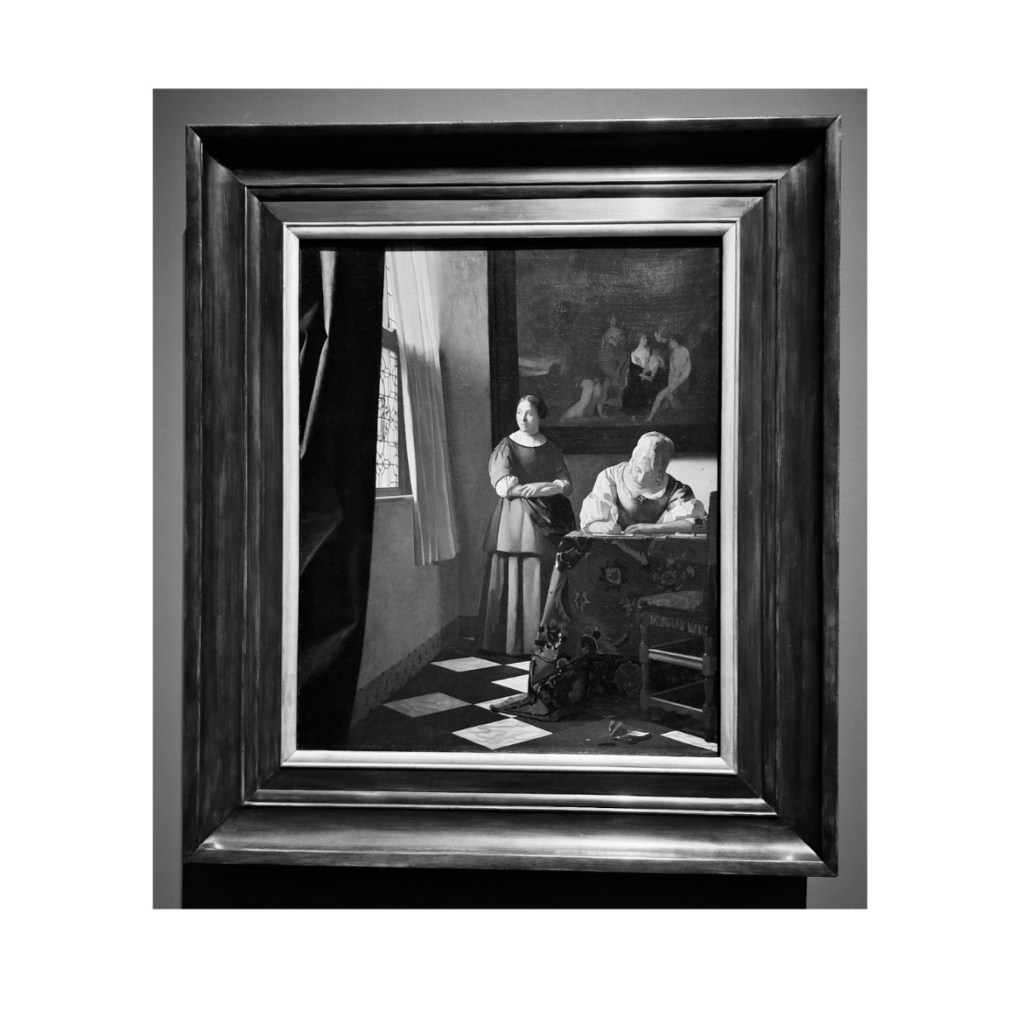
If I elevate Peterson’s remarks to a terrain that the one that he intended, is connected to two Vermeer’s pictures exhibited these days at the Frick Collection gathered around the theme of “letter writing”. In both pictures there is a lady seating at a table drafting a letter – one of them has already concluded it fully attentive to the visitor on her right side; the other a maid gazes at an open window – but what is always unnerving in Vermeer’s work is the sense of the ineffable and impenetrable in the disclosure of the picture (an exposure that that is usually aided by a side curtain that welcomes us in). What is this impenetrable divinity that lurks in Vermeer picture in pure presence? Although we do not have a name for it, it is like the god that dwells in the dirty bowls or in the nocturnal bushes of Peterson’s gloss.
The painting does not speak in revealing, it only bear witness of the absolute fall of language as it becomes imperturbable in the picture. Contesting the vulgar interpretations on Vermeer’s Catholic conversion in Delft, Daniel Arasse notes that the vortex of his pictorial theology is bounded to the threshold in which images become alive (in the tradition of au vif) outside itself: “Vermeer’s painting are constructed such a way as tho render this life equally present inaccessible, near and impenetrable. What is seen is not a crete of nature observed, but a mystery within the painting itself” [2]. In Vermeer’s pictures, presence and the invisible collapse not through the inception of a metaphor of nature, but rather through the painting’s light when it casts a shadow beyond any instance of closure.
This is why in Vermeer’s paintings surfaces mandate an order of theatrical presence, while simultaneously making room for a perturbance that is forever barred from the conceptual. Unlike Giorgione’s “Three Philosophers”, Vermeer’s pictures are not endowed by the mysterious force of an alienated nature that man can measure and master; rather, the mystery resides in the whispering of the invisible that cosigns the amoris causa of the appearance of painting. If for Peterson what gleams in the dirty bowl is the cleansing of resurrection; what befalls Vermeer’s pictures can only be understood as the faith in the painterly emergence of appearance dependent on the path opened by its light.
The question of god as appearance is always posited as a challenge to the meaning of reality as totality no longer as what emerges in the open, but as what which retracts lagging behind. And we know that only appearance is seductive enough to stand for faith well beyond the fact of being visible [3]. Hence, a way to supreme subtlety of painting (picturae summa subtilitas): no longer a matter of perspective and contour, but of the mysterious indiscernibility that mounts depth between vision and the divinity of presence.
.
.
Notes
1. Erik Peterson. “Fragmentos”, in Tratados Teológicos (Ediciones Cristiandad, 1966), 251-252.
2. Daniel Arasse. Vermeer: Faith in Painting (Princeton University Press, 1994), 75.
3. Consider Heidegger’s response to a question in the Zurich Seminar, 1951: “If I were yet to write a theology then the word ‘being’ would not be allowed to occur in it. Faith has no need of the thinking of being. If faith has recourse to it, it is already not faith. I believe that being can never be thought as the ground of God”. Séminare de Zurich (Paris, 1980), 60-61.
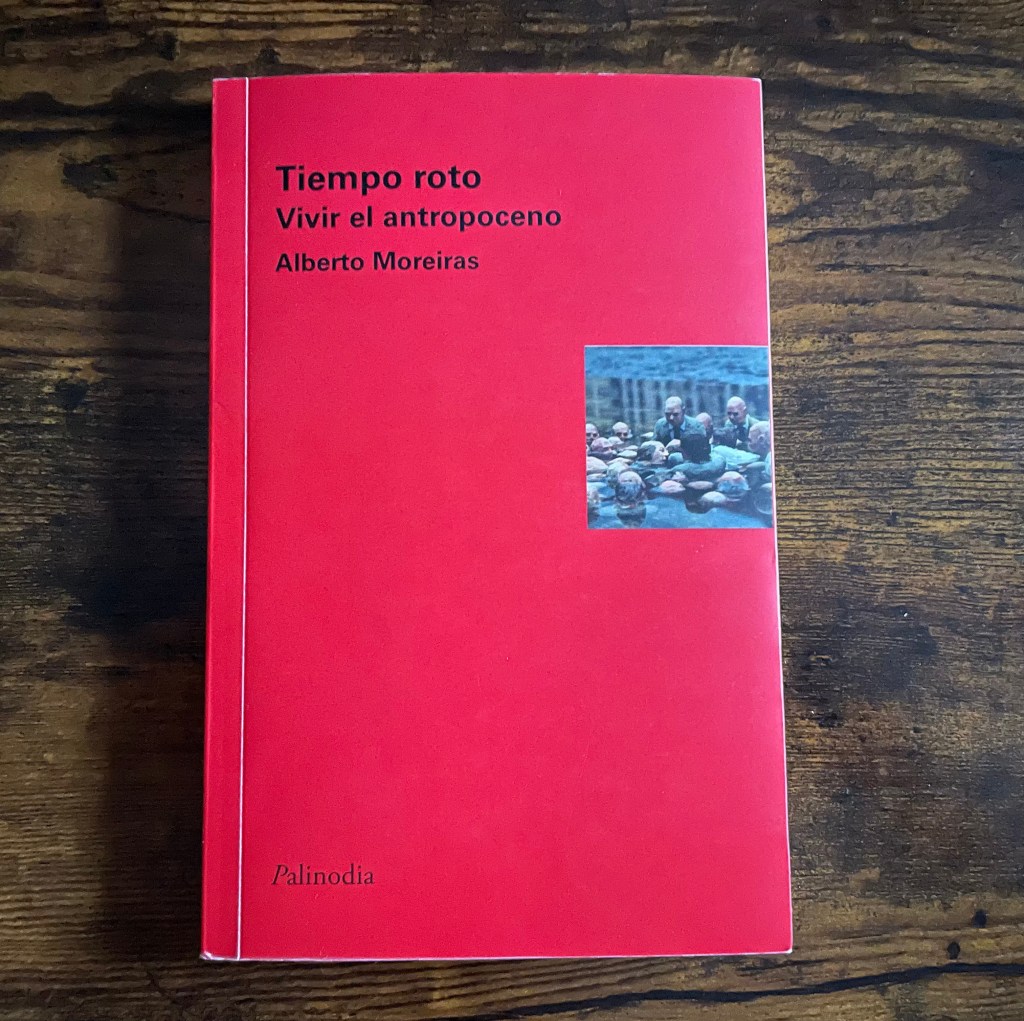
The sudden and uninvited intrusion of Gaia in our world is something rather strange, and yet consistent with the closure of the metaphysical tradition. The call of the outside takes place at the threshold of our reflexive capacities, habits, and mental propositions in our relation with the world, which demands everything to be thought from scratch. The historical imbalance in groundlessness now requires a new task for thinking – the imperative that runs through Alberto Moreiras’ most recent book Tiempo roto: vivir el antropoceno (Palinodia, 2024). The theoretical constellation deployed over the course of a decade now comes to the forefront with extreme urgency – I am referring to marranismo, posthegemony, aprincipial anarchy, and of course, infrapolitics. Tiempo roto (2024) is not a systematic culmination of Moreiras’ philosophical (or antiphilosophical) project of thought, but it is definitely a mature elaboration insofar as the field of problematization enters a hitherto unexplored thematics of late heideggerianism. All things considered, the emerge of the anthropocene as an explicit planetary endgame and the new beginning necessarily move pass the conditions of both political and scientific praxis, which today can only effectively adequate itself into positionality (the so-called Gestell) and objectivity of a world that slowly seems coming to its end.
It might be worth remembering that the notion of “other beginning” (“otro comienzo”) in the wake of civilizational decline was already proposed in the book Sosiego siniestro (2020), but it was far from being thoroughly explained [1]. Following Heidegger’s philosophical scene, representational thought in the tradition of adequatio of the Thomist gnoseology coincides with technological administration of every living entity (Moreiras 14). But Heidegger’s suggestion in the Parmenides that calculative representation fails as grasping the essence of the polis might also have its own limitations, insofar Gaia appeals to an excess beyond or below the politics. As Jacques Camatte also understood it, the civilizational invariant of revolutionary breakthrough departing from the historical subject of the working class can seldomly do the work except as an article of faith in the myth of the autonomy of the proletariat within real subsumption. This means that we are in the terrain of infrapolitics or the chora, which point to ontic regions of thought towards a new beginning at the end of principial metaphysics. But the other beginning can only emerge within conditions of transforming existence against the closure of political technicity.
I do not desire to reconstruct here all the refined analytical movements that lay out the transformation of existence in Tiempo roto (2025), but there is a maxim from Pindar’s Third Pythian Ode that stands out as an emblem for the appropriation of the non-humanity of the world. Moreiras cites Pindar’s “me, phila psycha, bion athanato speude, tan d’emprakton, antlie makanan”, which can roughly be translated as “do not seek, dear soul, immortal life, but do try to carry out the fullest the use of the possible” (Moreiras 61). Moreiras correctly notes that the ultimate difficulty lies in the “emprakton makanan”, or the use of the possible, which metaphysical Humanism and effective general equivalent can only exacerbate towards the planetary production and extractive valorization. The corruption of the use of the possible is the realization of hybris, and in this sense all representational humanism is always already a form of self-deification and induced hallucination, even when it tries to claim to engage in the opposite in relation to nature (Moreiras 65). Moreiras suggests that the pindaric maxim discloses a second relation of the “use of possibles” that does constitute a lacuna in the metaphysical tradition, and that is understanding a praxis tied to sophrosyne or phronesis that abides to the prudent inclination of the non-human (“es una actividad sometida a la vergüenza de lo in-humano”) (Moreiras 65). Giorgio Agamben’s defense an ontology of possibility against the hegemony of metaphysical realization and representation also comes to mind, although Moreiras might not feel at ease at explicitly calling for a positive ontology nourished in the waters of a transfigured metaphysics of the tradition of scholastic Averroism [2]. Although both Moreiras and Agamben come at their closest proximity in terms of the notion of the chora – and more directly the space of the chora against the primacy of the polis – which serves the ontic condition for the non-spatial surfacing of the abode or region that is necessarily infrapolitical, because it’s never determined by distributionist political isonomia or meson (Moreiras 73).
There are important nuances here to say the least: whereas for Agamben the notion of chora appeals to the gods of place (theos aisthetos), and thus a dejointed form of divinization decoupled from the legitimacy of every politico-theological archein; for Moreiras, the chora is a praxis of thought towards desecularization that lacks theology, and thus capable of exceeding the onto-theological reduction (Moreiras 74). But Moreiras says about the tendency towards nihilism of “possibility” in the historical dispensation of positionality (Gestell) could also be said about ‘de-secularization’, as the ultimate consequence of the decay of political legitimation in Ernst Bockenforde’s famous formulation. This might not be the space nor the moment to reach a verdict between Moreiras and Agamben’s position regarding the very complicated problem of the Platonic site of the sensible, since what is presented to the reader as a ‘phenomenology of excess’ or the inapparent (something merely alluded in the Zahringer seminar), might be the condition of an atopic mediation that prepares – or that has always prepared since the times of Orphic myths – the tonality of a coming philosophy under the sign of transformative thought (Moreiras 110) [3].
The dispensation of the Gestell open up and also step back (a folded movement that does not have a declension into a synthesis) into the genesis of the beginning (Moreiras 115). And the anthropocentric epochal dispensation, says Moreiras, is no longer the site of the polis, but “the planet as a the historical site of humanity, although we are still unaware of it (“aunque sigamos desconociéndolo”) (Moreiras 116). This uncanny phenomenology of the primary, traversed by the discharge of the entstehung, is the infrapolitical site par excellence, because it is in the atopic region where destiny is both affirmed and displaced. This is why, as Moreiras recalls Heidegger saying, the dialogue with Parmenides never exhausts itself, and yet it prepares a destiny (Moreiras 134). I take this to mean that there is an experience of the transfiguration of language for the emergence of an “ethics” (ethos), but this might be beyond Moreiras preliminary conditions for an existential breakthrough; that is, something possible further along the path.
Tiempo roto (2024) closes with a couple of undeveloped pages that take Massimo Cacciari’s old essay “Confrontation with Heidegger” (1977), in which the Italian philosopher makes a plea for a direct confrontation with Heidegger and Nietzsche’s teachings on nihilism and the closure of metaphysics if there would still be any hope for the composition of the working class during the stage of anthropomorphized dimension of capital defined by Jacques Camatte also during those years. But much has changed since the hot Italian summer of 1977 and the formulaic conjunction of “left Heideggerianism” might not do the work anymore, as if the totality of materialist political economy could be amended by a radicalization of the historical question and the ontological difference. Political economy plus metaphysical critique is still relying on a conception of the political as a technique, which today has transformed into what some have called the “new regime of ecological accumulation” as mere stabilization of green ecological spheres of life [4].
But there is a second register to Cacciari’s programmatic thesis that remains open. And these might be Moreiras’ most important words in the concluding part of the book: “Espero haber mostrado que Hiedegger señala la posibilidad de dejar atrás la explotación y el consumo en la era del Antropoceno a través de una comprensión alotrópica de nuestra relación con el mundo. Por lo tanto, vivir en el Antropoceno debe basarse en el abandono o desplazamiento de la metafísica como modo dominante de aprehensión del mundo en la actualidad” (Moreiras 151-152). Marx’s materialist dialectic through the critique of political economy – even as a destitution of political economy through its own vectorization – might be insufficient to face the unprogrammed presence posed by planetary anthropocene.
Perhaps we can still repeat Dionys Mascolo’s words that the coming communism will owe more to Hölderlin than than Marx, not because of an idealist dispute over concepts, but rather because of what Cacciari called in his essay, also citing the German poet, the historical “affinity of conditions” [5]. And in the age of the Anthropocene and positionality, those conditions are kept in the pattern of economic decline or stagnation in which the law of rate of profit encounters its own limit, folded unto the ongoing destruction of the life forms in the world. The allotropic praxis endorsed by Moreiras finds traction in Hölderlin’s poetic dwelling in language at the heart of decline so that something other might emerge within and beyond life, from Gaia to Ctonia. This is the most difficult task to depart from, but it is also the path that saves from the current inhabitable passage of the Earth.
.
.
Notes
1. Alberto Moreiras, Sosiego siniestro (Guillermo Escolar, 2020), 24.
2. Giorgio Agamben. L’irrealizzabile: Per una politica dell’ontologia (Einaudi, 2022), 112-146. Kindle Edition.
3. For more on orphism and the limits of the site of the Greek polis, see Gianni Carchia’s Orfismo e tragedia (Quodlibet, 2019), epilogue by Julien Coupat.
A few years ago, in a book I edited on the thought of Giorgio Agamben, I tried to suggest that his work was both an archeology of politics in the wake of the closure of metaphysics and a reopening of the problem of existence. Now it seems to me that this formulation did not go deep enough, insofar as I remained silent aboutabout existence was inscribed into a problematic field of reflection. Agamben has continued writing many other books in recent years, and in reading them I have come to think that the question of existence is intimately tied to the problem of “ethics”, which continues to be underdeveloped in his philosophical writings, but then again probably all ethics is always underwritten, oblique, and fundamentally lacking an essence. As Agamben states in La comunità che viene (1990): “….the point of departure of any discourse on ethics is that there is no essence, no historical or spiritual vocation, no biopolitical destiny…This is the only reason why something like an ethics can exist, because it is clear that if humans were or had to be this or that substance…no ethical experience would be possible – there would be only tasks to be done” [1].
It is obvious that ethics is unequal to morality, and here Agamben implicitly (later it will become also explicit in his opuscule L’avventura) is taking a distance from the Goethean conflation of ethos into a substrate of nature in the Aristotelian tradition [2]. But in the 1990 essay, Agamben is still considering and grappling with “ethics” from a vantage point that I would call a high-level of generality that can only connect to the conceptual exploration of potentiality and potentiality with an unequal valence, still searching for its ground as it were. In more recent books, it has become evident that Agamben’s thinking on ethics achieves a new precision. It does not mean that it modifies or alters his conviction of the untamable and unprogrammatic potentiality of ethics against morality and nihilism, but it does put it in the specific light the terrain of language. I am thinking of this moment in Filosofia prima Filosofia ultima (2023), where he writes the following:
“What corresponds to is not a limit dimension of signification [“that which is said”], not even in the mystical form of a negation or a dark night, but an experience absolutely heterogeneous to that: not a logic but an ethics; not a logos but an ethics or a form of life. In other words, ethics is first and foremost the experience that reveals itself when we dwell in a fully nonintentional language. Far from being mute and ineffable, it is the speech we wrong when language frees itself from its suppositional pretension and address itself not as an object of a metalanguage but as the rhythm and scansion of a doing, a poesis” [3]
In no other book has a view on ethics come forth with the same force and eloquence. Although, clearly, the passage is drenched in negative conditions («not mystical, not a logic, not a logos»), the thinker also advances towards a par construens orientation that allows him to push for a different route from the relationship of ethics and language arrested in two important paradigms of Western thought: that of the mystical ineffable experience, and that of Wittgestein’s suggestion in his 1929 lecture that the ethical question runs into the “boundaries of language” in its attempt to go beyond the world [4].
The mystical experience of the “dark night” – and which Agamben seems to be recapitulating here after early essay on this very question in an edition of San Juan De la Cruz’s poetry translated in Italian – is also, in the words of Gustav Landauer’s Skepsis und Mystik (1903), the immaterial symbol of what cannot be discussed any further [5]. And in the early essay on De la Cruz’s mystic poetry, Agamben positioned himself against the elevation of dichtung as an autonomous sphere of the language’s modern wreckage into discourse and rhetoric. In both conceptions, Agamben seems to suggest, the negative lack in language seems to hold back the event of language that is nothing more than the “sayable”. And this sayable is the non-articulated, and thus in suspended judgement before the world (although not beyond it) in the opening of the voice securing its own appearance without remainder or negative threshold of substantial lack.
There is something to be said about this ex-position in Agamben’s types of the ethical life in recent books; mainly, Pulcinella, Pinocchio, Hölderlin, and the formless peasantry of the Rabelaisian world. Is not common to all them, precisely, an experience of the taking place of language that, far from being divorced from the world, is able to makes its own chorā within the world? As we read in Il corpo della lingua 2024): “… is because there is no world, but always and constantly leaping worlds within worlds that sink into each other in a star-crossed blazon, which is the same sensitivity of God as a living and thinking being” [6].
The refinement around the question of ethics also illuminates the moment in L’uso dei corpi (2014) where Agamben, following French linguist Michel Bréal, attempts to secure the modal status of the “ethos” as a creative non-relation (and non-naturalist) of being, which is not only a matter of “suspension of a work of end”, but more positively, a dwelling in non-intententional use of language [7]. And is not this, precisely, the language of Persuasion (Peitho) in which the human touches the divine, an eternal life of speech that relates, in an angular manner, to Karl Barth’s suum cuique’ solace between life and death, happiness and pain? It is an open and intriguing question. The pure taking place of every thing – as God is, in fact, in all things – is the positive ethics of the chorā in which nothing is presupposed, and yet its ek-tasis never perturbes what, in fact, takes place in language.
.
.
Notes
1. Giorgio Agamben. La comunità che viene (Einaudi, 1990).
2. Giorgio Agamben. L’avventura (nottetempo, 2015), 11-12.
3. Giorgio Agamben. Filosofia prima filosofia ultima (Einaudi, 2023), 74.
4. Ludwig Wittgestein. Lecture on Ethics (Wiley Blackwell, 2014), 119.
5. Giorgio Agamben. “La ‘notte oscura’ di San Juan de la Cruz”, in Poesie (Einaudi, 1974), v-xiii.
6. Giorgio Agamben. Il corpo della lingua (Einaudi, 2024), 59.
7. Giorgio Agamben. L’uso dei corpi (Neri Pozza, 2014), 314.
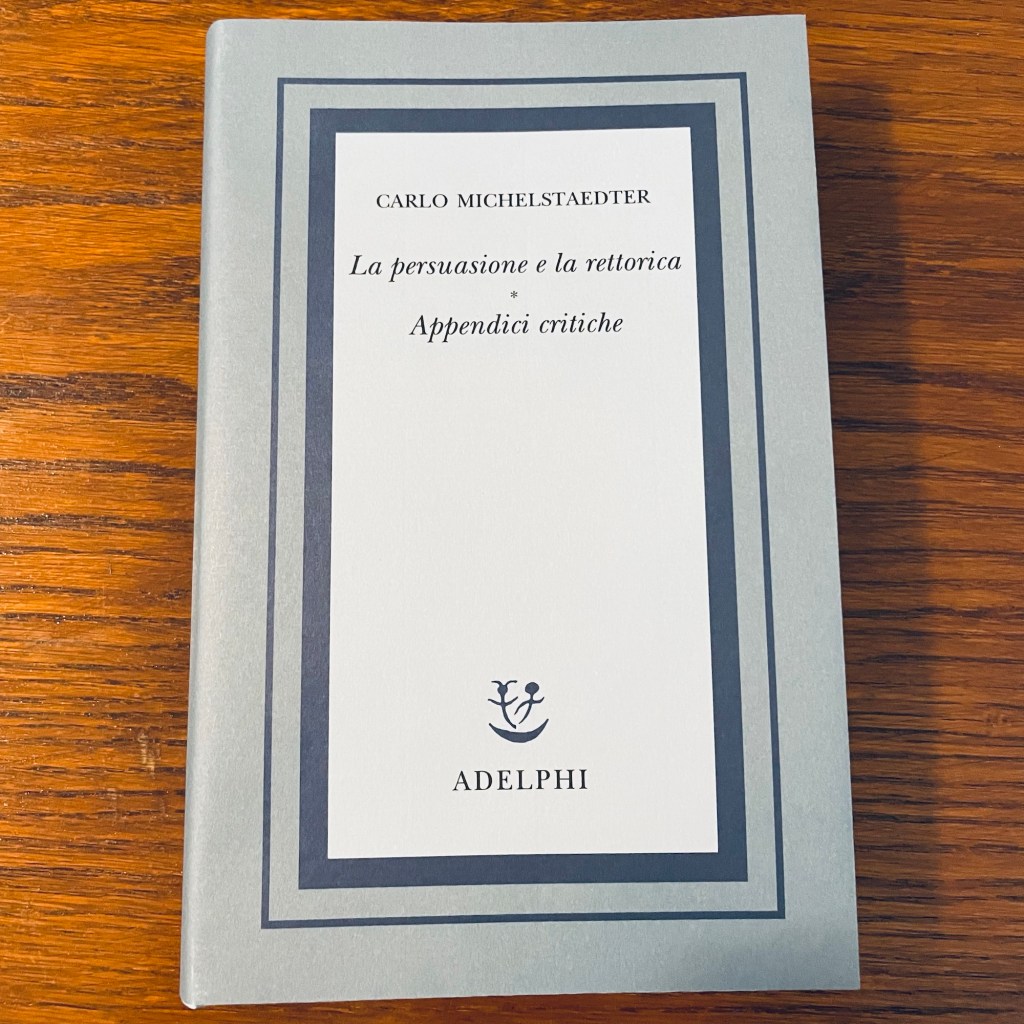
In the following months some of us will offer an eight week seminar exclusively dedicated to a close and analytical reading of the enigmatic work La persuasione e la rettorica (1910) by Italian thinker Carlo Michelsteadter (1887-1910). Ever since his death – as can be easily gasped by Giovanni Papini’s obituary in 1917 – there has been an aura of mystery around the infamous philosophical suicide of Michelsteadter that only parallels that of Socrates’ hemlock or Otto Weiniger’s self-inflected gunshot. Of course, we will be less interested in the biographical motives, and if push comes to shove attention to this detail will be elaborated in light of the nexus of his thought to the event of his death.
La persuasione e la rettorica (1910) offers a unique theoretical elaboration about the civilizational decline of the “living” into the rhetorical deferment of life as realized in the organization of social alienation. And for Michaelsteadter there is no other purpose of rhetorical form than the absolute submission to the general abstraction that defaces the event of pain. It is no accident that he was also interested in the thematics of health and ancient techniques of pain-relief (the techné alupias, for instance), even if underdeveloped in his thinking given his sudden premature death. So, it is for us, his posthumous readers, to take these sets of issues and move them forward in our present any way we can. This is part of the task that motivates putting together this seminar after a series of conversations with friends and interlocutors.
La persuasione e la rettorica (1910) deploys the classical metaphysical tradition through the ancient poles of “rhetoric” and “persuasion”, where the second (the ancient Peithò) seeks to return the voice and expression to the problem of pain as an ineffable type of speech (Logos) that refuses the elevation of force that harbors the circulation of violence and the administration of social death. The ancient notion of the Peithò withdraws echoes of the mythical inception and the sacred, as also reminded by Aristophanes: “Persuasion’s only shrine is eloquent speech (Logos)…And I Persuasion (Peitho), the most lovely word” (The Frogs, 1391-1395). Where and how do we attune ourselves to the peitho today – the imperative of the eros of the word in the wake of the regime of social production of pain?
In the aftermath of the collapse of the cycle of civilizational secularization, it is only obvious that all these questions stratified in the tradition once again become attractive and pertinent. In this light, we think that Michelstaedter’s thought still offers us a series of significant hypotheses to think through the crisis of social man and the domination of the civil that colors our current predicament, where the question of “pain” is still an understudied problem. Throughout this course we will address notions such as rhetoric and persuasion, life and communication, nihilism and values, the logic of capital and the social bond, or the notion of world and pain. Our aspiration when approaching Carlo Michelsteadter’s work is to develop reflective conditions to address the thorny issue of an ethics of pain that so thickly enmeshed in our historical moment.
.
.
‡: Information about the registration to the seminar will be made available at Revista Disenso in upcoming days. The seminar will run every other week for a period of eight sessions (roughly from the beginning of September to early December, 2024).
I am sure that others will draw their point of inflection, but for me the stakes of a recent Berlin meeting (already commented here) was laid out during the very first session when one of the “non-participants” – let’s call it like this to embrace the spirit of the meeting – spoke audaciously about the current predicament: there has been a thorough loss, nothing but defeat that is both irreversible and consummated at the level of subjectivity. Some of us remembered that T.J. Clark more than a decade ago in the pages of New Left Reviewtook a similar position and was grilled for it. This tends to happen to any gesture that dares to push thought forward. In any case, the non-participant went further and called for a “new beginning”, a start from scratch, alluding to the underrated Revolution and counterrevolutionary in Germany (1851) by F. Engels, in which in fact this language is very much present. Engels wrote in the first article (the book is a collection of pieces published anonymously in the wake of the 1848 revolutions): “If, then, we have been beaten, we have nothing else to do but to begin again from the beginning. And, fortunately, the probably very short interval of rest which is allowed us between the close of the first and the beginning of the second act of the movement, gives us time for a very necessary piece of work: the study of the causes that necessitated both the late outbreak and its defeat; causes that are not to be sought for in the accidental efforts, talents, faults, errors, or treacheries of some of the leaders, but in the general social state and conditions of existence of each of the convulsed nations” [1].
Of course, “social or national conditions” are not “trapped in amber”, and I think that today one cannot take the national, local, or even regional contexts as sufficient to explain failure. The failure is civilizational, and raising the question of the “beginning” (or new beginnings) has a heideggerian overtone that is not facetious, but it is consistent with any exploration in the quadrant of critical-metaphysical commitments for thought (infrapolitical reflection has thematized it) [2]. This elaboration could be very well idiosyncratic, but I think it provides “grip” to the problem by not making concessions to well known junior partners of abstract politicization and ideological backlogging that like the Tortoise in the parable still fantasize with a breakthrough via yet another “textualist interpretation”; one more sophisticated mapping of political ecology or a collective hegemonic political theory department; or even a policy redistribution of a new Green Deal towards a new accumulation regime [3]. Perhaps they themselves do not believe any of the lies – for my part I think that they do not – and they endorse it for the sake of “bad faith”. But just in case, I think that raising the threshold at the highest point (ontotheology, civilization, the constitution of the polis) is a litmus test of separation against the new secular priests. These negative conditions already open a door to go through.
But there are also positive conditions for this “new beginning”: reopening the ethical intensity in retreat of political subjection; rejection of public chatter and freeing fugitive marranos; elaborating strong descriptions of the metamorphoses of domination; and avoiding the “revolt” as a compensatory category for of ius revolutionis in the epoch of real subsumption [4]. At the end of the day, it should not be forgotten that an-archy also means the turbulence of phenomena, in which every fragment moves in the direction of experience poking through the objectification of the world. This is “inapparent”, but it is for this very reason what is fundamental and invariant.
The ‘new beginning’ in the wake of collapse can only conquer life to traverse the hunger of meaning that propels the fictional machine of ongoing nihilism, as Giorgio Cesarano warned. There is no historical or moral beginning; there is only the beginning in which existence is able to expand the originary accumulation of a sensible ethos. And it is at the very end, or almost at the end of everything, that true beginning commences. Whoever does not start from the beginning is either understudying the epoch, or mastering the evermore painful social roles. It is only in the direction towards beginning that can avoid the crushing weight of the post-neolithic condition (Métraux) that calls for a divestment of what reality can contrive for us.
.
.
Notes
1. Fredrich Engels. Revolution and counter-revolution in Germany (FLP, 1977), 3.
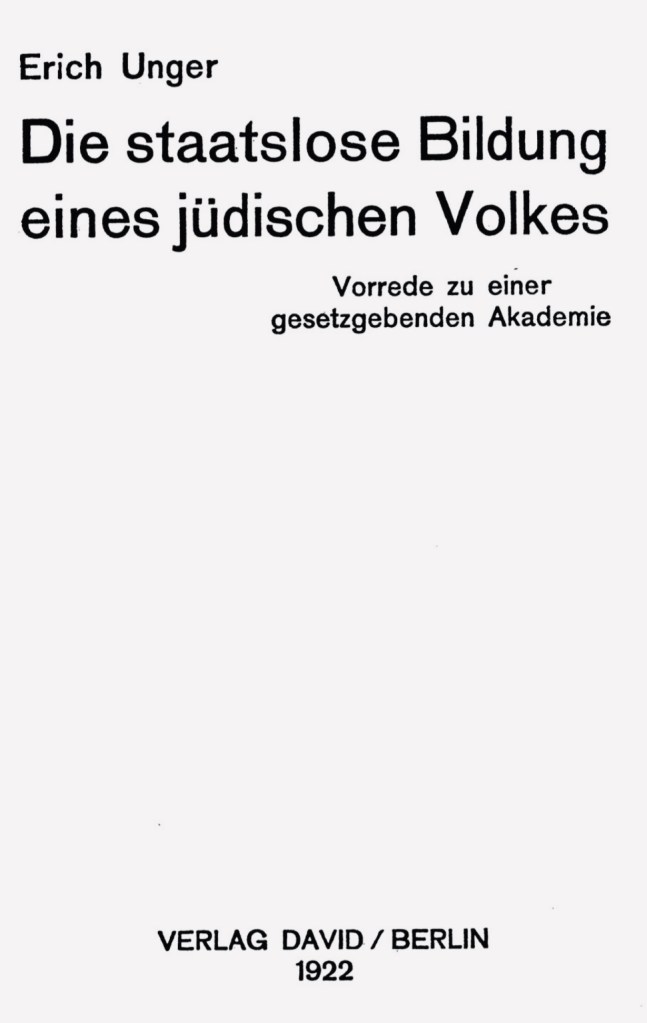
The same year that Carl Schmitt’s Political Theology (1922) appeared in the intellectual scene of the Weimar Republic defending the exceptional of the decision against immanentism, a short opuscule entitled Die staatenlose Bildung eines jüdischen Volkes (The stateless formation of the Jewish People, 1922) written by Jewish philosopher Erich Unger was published as an untimely response to the question of “Jewish identity” (Judentum) and its fate in the wake of civilizational collapse. The fact that this essay – as well as his 1921 book Politics and Metaphysics, which Walter Benjamin described as the most important political reflection of his time – has remained on the fringe of intellectual history, political theory, and the history of thought is something that anyone must seriously reflect upon. It should not come to a surprise that this text comes back today to attentive readers evidences how every creation, event of speech, or written word does not reside in the preventive invention of a specific audience; but, on the contrary, in the way that its words, images, and thought will generate the evanescence community of extemporal readers. The century that separates us in time from Unger’s essay bears witness to its ultimately proximity and prophetic calling.
In 1922, for Unger, very much like for us today, thinking about politics meant finding a way out of a catastrophic politics [1]. If Politics and Metaphysics had suggested the necessity of an existential and energetic exodus for breakthrough against civilizational sedentary absorption and domestication, in The stateless formation of the Jewish People (1922) Unger argues critically against a state Zionist project that artificially, and through the anti-universalism paradigm of force (just as Weil would argue during her war writings about politics in the West) will attempt to “absolute Judaism, and all the manifestation of judaism that remain outside, hostile to the state trend” [2]. For Unger, Zionism as a political ideology and state program fails to come to terms with the concrete “outside the world historical power” that characterizes the universalism of the Hebrews as a theology marked by dispersal in the West; that is, outside the philosophy of history of sacrifice and soteriological incarnation of the Christian eon [3]. Hence, Zionism’s political form of the Jewish people was epochally insufficient – too empirical and thus trapped into the modern logic of racial and biological survival – to express the true conditions to enact as the “a priori” for the question of Judaism as a grounded redemptive universality. And insofar as Zionism presupposes something “outside of itself” (corporeal and spiritual Judaism), for Unger “the demand for an imperial state…must modify its demand, since it should express its underlying basis of the demand differently” [4]. The Hebrew ‘universality’ was metaphysical as much as “concrete”, based on modal ritual and myth, and for this reason at a distance from the discharge of formal logical statements [5].
What did the apriorist consideration of Judaism mean for Unger? The hypothesis in The stateless formation of the Jewish People (1922) was far from bring esoteric: Judaism is a exclusively a spiritual, immutable soul matter that hoevers the surface of the corporeal; and, more importantly, “it governs itself independently through the insubstantial for of a concrete existence” [6]. In other words, for Unger before the unity of the “People”, the articulation of the “movement”, and the erection of a positivist constitution based on Zionist nationalist principles, one should consider the sensible fabric of a people – a dispersed, multiple, and metapolitical communities that have endured outside the geopolitical and sacrificial structuration of Christian history – that each and every time have insisted on the separation from the subsumption into a sphere of power and domination, into an ethnic-community validated by recognition and its claims to “consciousness” at the most empirical and material level. But this would amount to an effective liquidation – a surrogate for the acceleration of the dominant religion of historicity – of Judaism into yet another planetary religion, and an expression of power that integrates itself into the struggle for the nomoi of a contained and policed world. For Unger, “empirical Zionism” becomes the attempt to reduce Judaism to a “real self-executiving power” that will diminish the “supreme expression of existence” of Judaic spiritualism as “an inner experience that it is not historically given but that must precede it in order to make Judaism an endless and inevitable precondition of a truly world historical project” [7]. In this mold, Judaism will be dispensed into the theaters of the constitutive war of historical progress.
As such, Judaism as theologically transcendent is not to be conflated into the corset of a political fictive ethnicity, but rather as an autonomous transmission that allows the communication from soul to soul that descends all the way from its metaphysical beginning. And at this beginning that has exerted itself against the whirlwind of historical fixation (the very structure of civilization after Cain according to his mentor, the Jewish theologian Oskar Goldberg) were metaphysical and errant fragments of encounters and communication, of psychological energy and dispersal of shared spiritual goals. If this is lacking, then no political form [for Judaism] will arise, but only a foolish copy of the already-existing, because the spirit cannot be skipped and left out without the rising danger” [8]. It is telling that for Unger this rising danger can emerge not only from indirect powers that exert pressure against the unity of authority – as Schmitt would have in his framework of his theory of sovereignty in Political Theology (1922) – but also, and more dramatically, from the suppression and alienation of the spiritual interiority by which a “people” never coinciding with itself can arrive at the “crystallization point” (sic) outside of the individual [9].
Circling back to the problem of “catastrophic politics” – that Schmitt wants to “contain” through decisionism, and that Unger wants to overbecome through an exodus from political thresholds – at the crux of Unger’s indictment of the arcana of Western politics is the “it has set everything in such a way so that the metaphysical or religious area, the internal direction, stands as a mere private thing”, sidestepping the fact that even reality and the constitution of the principle of reality depends on interiority for the possibility of an outside. And it is this outside what allows the a priori historicity that Oskar Goldberg had defended in his book The Reality of the Hebrews (1925). As the late Bruce Rosenstock lucidly argued, for Goldberg (who stands as the unnamed reference in Unger’s position about an experiential Judaism), the “a priori” takes place in an ur-time in which the physical world was closely connected to the transcendental presence of the gods, in which the people cease to be a cultural, ethnic, or identitarian unit in order to become a humanity capable of “overcoming the catastrophic history of wars sparked by competition over scarce resources” [10]. In endorsing the instrumentalized politico-theological reduction of state Zionism, Unger sees the abdication of the “Jews as the people who have driven the spirit the furthest…to cultivate the spirit deeper, more skillful, more subtle, to be the most deeply suitable through this tension” [11]. A true and vital reality was in the conspiracy between souls, wherever and whenever these meet as the ultimate manifestation of the fidelity to the unspeakable mediation between the true life and the divine.
At the height of 1922, Unger did not suspend from a certain self-afflecting optimism, and towards the end of The stateless formation of the Jewish People (1922) he writes: “The Jews should not overlook their uniquely favorable situation; mainly, they have been materially unhistorical for two thousand years, and the only one that have not been beaten into a reality and into the shackles of the past or the empirical state that others have had to suffer” [12]. In Unger’s reading, Judaism and its errant communities (the ‘wandering Jew’ that Joseph Roth will narrate in these years, but that one must trace to the mythic texture from expulsion of Cain to the marrano) have shown the density to gather through spirit a resistance to the paradigm of force and the technicians in charge of dominating over materialism. As Unger states unequivocally: “the one who technically masters matter is ultimately defeated” [13].
This was Unger’s anti-promethean wager in 1922 skeptical of all political horizons oriented towards foreseeable catastrophes blinded to the underlying cyclical polarity of barbarism and civilization in the West. The wayward asymptote of a non-catastrophic politics was not to be found in the abstraction of the political concept or the mechanical construction of a state form through assimilation and usurpation, but in what Unger termed, in the most intense poetic moment of his essay, the Hebrew “ increasing decipherability of its own origin”. And unlike Enlightenment historians such as Edward Gibbon who saw the state as the irreversible revolution in world history that brought the age of the nomads to an end; for Unger the twentieth century meant the fixation of the state degenerating in the worst of barbarisms. It was the existence of the unit that must generate the internal limit to the political, and not the political as the external threshold to what is inherited in the world. And yet, insofar the events of thought, language, and imagination take place, the origin (urgeschichte) will always escape what has been sedimented by rubble and wars that fuel planetary destruction and collapse.
.
.
Notes
1. Erich Unger. Die staatenlose Bildung eines jüdischen Volkes (Verlag David, 1922).
2. Ibid., 6.
3. Ibid., 10.
4. Ibid., 15.
5. Erich Unger. “Universalism in Hebreism”, trans. Esther J. Ehrman, The Journal of Jewish Thought and Philosophy, Vol.4, 1995, 307.
6. Erich Unger. Die staatenlose Bildung eines jüdischen Volkes (Verlag David, 1922), 8.
7. Ibid., 19.
8. Ibid., 25.
9. Ibid., 24.
10. Ibid., 29.
11. Bruce Rosenstock. Transfinite Life: Oskar Goldberg and the Vitalist Imagination (Indiana University Press, 2017), 172.
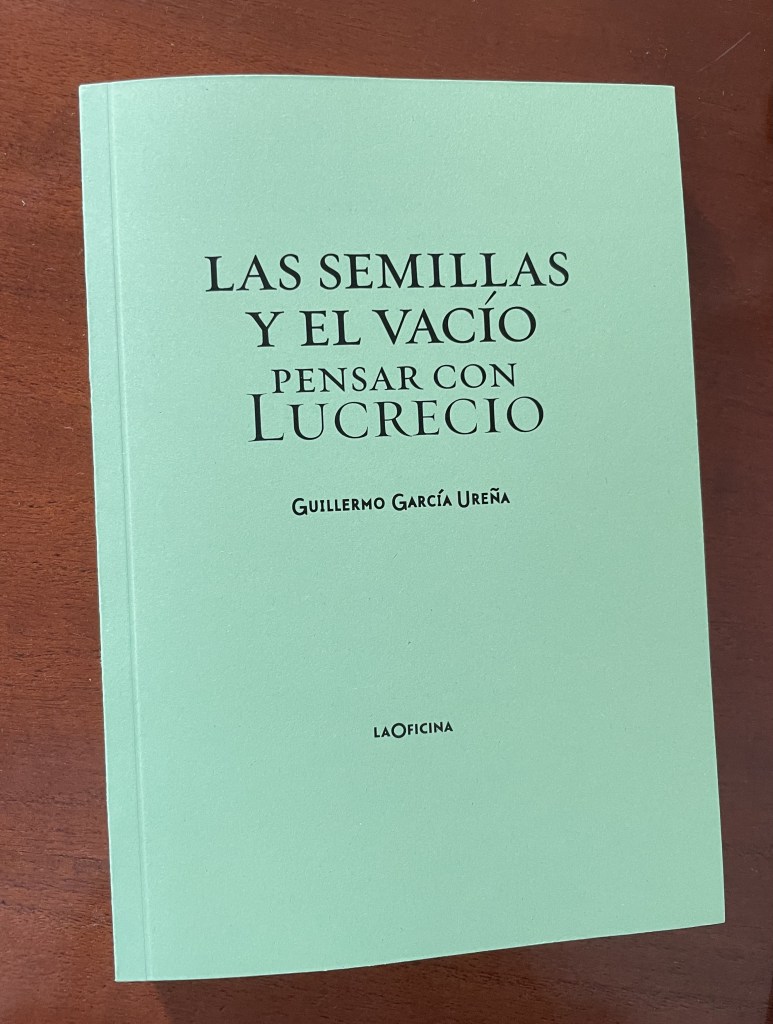
Lucretius’ poem De rerum natura is one of the most used and abused texts of the tradition, and like all classics it has had the most diverse receptions imaginable: the poem of modern science, a baroque expression of creationism for the English metaphysical poets, the precursor of historical materialism and atheism, and a tract of scientific positivism that laid the foundation for the regulation of nineteenth century social order. Once a text becomes an emblem, it usually means that it has lost its prehistoric imprint and place in the tradition. Against this backdrop, Guillermo García Ureña’s just published Las semillas y el vacío: pensar con Lucrecio (La Oficina, 2023) has the prudential gesture of disclosing the great Roman poem to its fundamental structure; attentively listening to its original complex articulation difficult to grasp with the categories of modern philosophical thought. In this sense, Ureña’s purpose is not to deploy another “philosophical account” of De rerum natura – endorsing and subscribing the influence of Epicurus and its later resonances in modern theories of physicalism and materialism of the continental schools – but rather to engage in its own ground exerting an original philological exploration of the text that opens up an array of different problems for thought. Whoever is looking for a “theory” of Lucretius will find none in this brilliant and well articulated essay. But the reader will find, nonetheless, a comprehensive hermeneutics of a text that stands as a threshold between the closure of Greek classical antiquity and the Roman reintegration of the tradition. Now, for Ureña De rerum natura proem discloses the originary understand of the epic, or épos, through which the stability of the things as they appear takes place; whether it is the Muses, the gods, being and language, the simulacra or the soul, the physical declination of creation (the atomic clinamen) and the final document of language invigorated in the corpus of the poem itself. De rerum natura is both a cosmology and a poetics with the ambition of elucidating the most obscure things of this world: Lucretius’ text defies a fixed representation through a choreography (a term that it is not used by Ureña, it must be said) that discloses the possibilities of worlds; the combination of worlds only to posit the question of how to live within them, which is another way of saying how to account for a form of life.
One of Ureña’s commitments is to hold on to Lucretius’ aesthetic and philosophical autonomy. This implies treating the influence of Epicureanism with great care; engaging with Epicurus insofar as the aesthetic autonomy and its loci of poetization reject the classical structure of the epic hero incarnated by the soteriological impulse of the great poet-philosopher (we know that this is the same problem that centuries later Hölderlin will identify through the tragic drama of Empedocles). Lucretius is writing after the twilight of the classical Greek genres. Furthermore, there is no community under an organized program of leadership and telos; on the contrary, there is only an existence that “one day will want to desert all of us” (41). True, the Epicurean notion of serenity (ataraxía) is retained and treasured; but only as the aspiration of every living being who seeks to transfigure the shadows of superstitiousness and fear that govern over the perceptive mediating forces in the world. In this sense, to dwell in the world does not consist in the limitless relationship with the simulacra; it is rather, the self-transformative exercise of freeing possibilities within the void in which forms of life can emerge. As Ureña reminds, the rainfall of the atom is as fast as that of thought itself. It is already an image of thought, as well as the figure of imagination. And the image of thought validates the history of cosmos as a patchwork of accumulations and deflections, creations and destructions, repetitions and disintegrations in a swerve of forms that infinitely recline on its ethical possibilities (139). It is altogether interesting that Ureña reminds us that, in fact, De rerum natura is not interested in staging the things in Nature; on the contrary, at the center there is the question of the ‘nature of things’ in the luminous expression of their irreducibility. This is what modern onto-theological closure brings to a process of domestication, whether through the composition of the civil structure (limitless exchange according to philosopher Felipe Martínez Marzoa, who figures prominently in Ureña’s book) or through the progressive historical structure commanded by the essence of technology that blurs the relations between forms and techniques.
If De rerum natura abandons universal history and historical narration, it is because its structure is profoundly kenotic: it can only be assigned as contingent historical transmission of the most immediate and sensorial (not necessarily “true” in the metaphysical sense) that allows the convergence of the history of forms of life and natural history (140). The operation of subtraction implies the transfiguration of freedom through the becoming of forms – their interests, constructions, and pacts (foedera naturae) as guarantee for a plastic relationship between things in a world that is always already a fragment in the void. The highly attractive Lucretian notion of foedera or “pact” (that expresses separation in coming together: a com-pact that de-compacts) is almost the inversion of the modern principle of irreversibility, if one were to take Hans Blumenberg’s legitimation hypothesis at face value. And this is so because a foedus or pact is insufficiently strong to resist the impact of the clinamen, but indispensable for the emergence of a body that materializes its own fate towards dissolution.
The lack of unity of being allows for the existence of simulacra as that which does not have sufficient matter to compose itself as foedera; and so, it is a material semblance as an image without figure that makes it an ephemeral entelechy. In this choreography between the downwards of atoms and ephemeral intermittence of events the taking place of the world emerges a topoi of a combination of rhythms that intertwine the weight of bodies and the animation of souls. The possible combination and stylization of multiplicities in separation is the way in which a form of life emerges as the desertion from superstition and fear that hinges upon the irreversible stabilization of a principle of reality. Ureña does not go this far into the wager of Lucretius’s text – and he does not have to in his close reading of the text – but it is precisely this thick dimension of the ethical primacy that makes Lucretius’ dislocated comprehension of materiality a vibrant tune against the weight of alienation that we are still struggling to abandon.
The struggle against the alienated life – the alienation from the world, and the external manipulation of the simulacra that has become a gnostic planetary form of “TV Democracy’ (Schmitt) of the “society of the spectacle” (Debord), which implies the usurpation of our imaginal and erotic relationship with the world – well understood, does not mean to relocate the confrontation at the level of political order; it rather, rests on what we have understood by order and disorder for the reconstitution of a happy or contemplative life (naturae species ratioque). This serene life declines the offer to negotiate at the arena of sacrifice and legitimate domination, favoring the event of friendship. At this point Lucretius comes closest to Epicurus’s society of friends – studied by Carlo Diano in an important 1966 conference in relation to the organization of the passions and the transmission of love – that can guarantee a content life in the presence of “other joyous gazes” (glossing Diano’s terms) away from the persistence of war and the compensatory administration of pain. This is the ultimate treat of De rerum natura: the exemplary dimension of the serene life takes shape through the community of friends, the civilizational invariant of the human experience (prehistoric times, the classical epoch, and in our times) that abandons the paradigm of perpetual war that obfuscates omnia cordi.
It is not too ambitious to claim that only at this point we finally grasp the full extent of the Lucretian épos: not just an ephemeral and contingent declension of the primacy of atoms in the void; but, more importantly, it can disclose the irreducibility of an experience with friends. Ureña wisely closest his book with an image of the “buena vida en compañía” (the good life in companion) that insists that serenity is only possible (or desirable) in the open landscape, a nowhere-land of an eternal foedera (or a sinousia, as it appears in Plato’s Symposium) that even if temporarily too short-lived or inconsequential it paints an earthly paradise just above the grass: “poder tendernos unos juntos a otros en el césped suave, cabe un arroyuelo, a la sombra de un árbol copudo, y regalar el cuerpo sin grandes dispendios; sobre todo si el cielo sonríe y la estación del año esparce de flores el verdor de la hierba (II, 29-33)” (203). It is this inconspicuous and mute experience that strangely holds on to the passing of the world.
These are just a few notes on Rodrigo Karmy’s excellent presentation today on Averroes and averroism in Italy in the framework of a two-month course that I am teaching at 17 instituto on contemporary Italian political thought. And this series is a way to supplement and contribute to an ongoing discussion. So, these notes have no pretensions of being exhaustive, but rather to leave in writing some instances that could foster the discussion further in the subsequent interventions with Philippe Theophanidis, Francesco Guercio and Idris Robinson. There are two subtexts to this presentation: Rodrigo Karmy’s essay on Averroes and medieval theology of the person published in the new collection Averroes intempestivo(Doblea editores, 2022), and his preface to my own Tras la política on Italian thinkers forthcoming at some point this year (this text is unpublished at the moment).
1. Rodrigo Karmy is interested in advancing an averroist genealogy of Italian theory, and not just a matter of historical influence or history of ideas. The genealogical central unity for Karmy is the “commentary”, which I guess one could relate to the gloss, but also to philology (in the broad sense), and to the concrete practice of translation and incorporation of a way of thinking about life and the life of thought. Averroes is the signatura of a strong reading of Aristotle (the strongest argues Karmy against Renan). However, there is no academic ideal here, but rather a force of thought.
2. This force of thinking for Karmy is to be found in Averroes’ unique contribute on the Aristotelean text: the common intellect is substance. This will have important and decisive consequences for anthropology and the anthropological determination in Medieval philosophy (the absolutization of the person in Thomism, for instance). So, for Karmy it is no coincidence that Italian theory is heavily invested in the “common intellect”: from Mario Tronti’s elaboration on the autonomy of the worker to Antonio Negri’s general intellect when conflating Marx and Spinoza, but also in Esposito’s thought on the impolitical up to Giorgio Agamben’s self-serving averroism and its relation to experience of language and poetry as a form of life. The common intellect in Averroes allows, then, the separation of the the nominal subject from the genus of Man or Human. For Karmy this signals a fracture of the theological-political paradigm.
3. Why does Averroes emerge in Italian theory, and not, say, in French philosophy or German hermeneutics? Karmy relates this to the Italian tradition as a laboratory of translation, sedimentation, and the commentary. To which I responded that this is consistent with Bodei’s emphasis on fragmentation of the Italian tradition, Esposito’s idea of contamination of Italian living thought, and even Agmben’s most recent emphasis of diglossia and bilingualism in the Italian language from Dante onwards (in fact, Agamben is the editor of the Ardilut series on Italian poetry at Quodlibet). I tried to add to Karmy’s thesis the following: the notion of the “commentary” is far from being just a standard glossing over the corpus of an author, it could be very well taken as a sort of problem of language – a poetics, not a politics – which expresses a dynamic of the living that is prior to grammaticalization and political separation of power, for instance. This is the event of a language as such (una voce). It occurs to me that Karmy’s notion of the commentary could be analogous to the vocative in poetry (formidable present in Andrea Zanzotto’s poetics, for instance).
4. Finally, Karmy insisted that Averroes is, indeed, a sort of step back from the modern foundation of politics and the res publica. I suggested that this must entail a decisive step back from Machiavellian politics, or the ‘Machiavellian moment’ (JGA Pocock), insofar as Machiavelli inaugurates the sequence of technical nihilism from the force the political to the force of the worker (ways of arranging the administration of power). This is very neatly stated in Martin Heidegger’s seminar on Jünger’s The Worker. So, Averroes insofar as it gestures to a step back is something other than political republicanism, and this forces us to rethink the genealogy of politics. That seems a heavy but important task at the core of contemporary Italian theory.
¿Qué puede la parodia hoy en un tiempo sin epokhe? O tal vez deberíamos alterar levemente la pregunta: ¿cómo puede la parodia desde la lluvia de la imagen? Primero, la parodia ya no está contenida paragonalmente en un concepto, sino como forma de vida. La parodia ya no tiene fuerza para parodiar una “cabeza” o un “centro” una vez que aceptamos la hipótesis cibernética, pues ahora se trata de la organización del poder a partir de la administración de los flujos. Y segundo, tampoco la parodia es violencia que destituye la sobrecarga de la data lingüística como ‘objetualidad’ de la lengua. En realidad, este fue el problema de Hölderlin en la aurora de la modernidad: ¿cómo volver a deponer la lengua del sujeto hacia lo informe de la poesía? Empédocles como experimento en esa dirección. ¿Empédocles como nuevo Cristo arcaico? ¿Qué funda un sacrificio que tan solo quiere entrar en relación con lo aorgánico, y que en modo absoluto quiere formar cuerpo místico? Dejamos la cuestión en suspenso para otro momento, aunque habría que suponer que el gesto ateológico de Hölderlin es una transfiguración que no coincide con una inversión cristológica, sino que la ex-carna. Y en esa ex-carnación hay un paso atrás con respecto al momento moderno de la auto-afirmación política (y de toda política revolucionaria post-1789).
Por eso no hay articulación posible entre poesía y política. Esa relación abismal es la que hay que superar dejando a un lado la subjetividad de la filosofia de la historia y sus ‘coeficientes políticos’, como les llamó Simón Villalobos. El poema hace otra cosa con la política; otra cosa que escapa a la ‘contra-hegemonía’ que abastece en su negatividad. Al final, este es también el problema de la categoría de la multitud como zona de multiplicidad (‘subjetividad aglutinante’, como se ha dicho en ocasiones), pues una cosa es la infinitización de las posibilidades del singular, y otra muy distinta es la multiplicación de la subjetividad como fuerza de una orientación interna a la conducción de la historia. Si algo nos ex-pone el poema en su potencia de voz es la caída misma de lo múltiple hacia sus encuentro. Una multitud o una plebe, ya no como sombra del pueblo del Uno, figura en los modos en que el singular experimenta sus posibilidad en el encuentro. Pero esto ya no es necesariamente político, ni prepara ninguna fase hacia un poder “constituyente”. Por ahí solo repetimos el viejo paradigma del liberalismo, ahora desde conceptos subsidiarios como ‘hegemonía’ o multitud o subjetividad o esfera pública. Ser testigo del desfundamento de lo político supone abandonar la gramática de la subjetividad; pensar en el otro del sujeto moderno. Al final en eso consiste la tarea de la destrucción tras el fin de la legitimidad.
En realidad, proclamar el fin de la legitimidad supone afirmar que la ‘representación’ ya no da más en política, y por lo tanto en ninguna de las prácticas de la vida humana. La situación es de parábasis: el teatro se suspende y la persona ahora deviene un cualsea. Ya de nada vale entrar en una nueva economía del saber de la ironía; por el contrario, la interrupción de la representación del teatro nos abre a la experiencia aquí y ahora en un proceso de des-realización. Y en la des-realización tomamos partido por las imágenes que constituyen nuestros hábitos y ritmos. Asegurarse que eso permanezca en el tiempo pudiera servir como condicion para una institución de lo impropio. Esto ya nada tiene que ver con el “común” apropiativo y produccionista del comunitarismo contemporáneo. El fin de la representación teatral nos devuelve a todos un carácter (ethos) sin destino (fines). Al final, lo que está en juego en la apertura de la parábasis que destruye la forma paródica es esto: mi forma de vida que ya no aspira a ser un cualidad que participa de una eidos superior, sino los modos de lo que ya puedo ser. Ajens recoge una mínima definición de Werner Hamacher ligada a la filología: “la filología es la parodia del lenguaje, porque muestra pero no significa”. La forma de vida es aquello que muestra los gestos de cada forma de vida.
En su compleja intervención Andrés Ajens recuerda de la importancia de vigilar sobre las cesuras que organizan el topoi de la parodia: comedia contra tragedia, serio contra cómico, pero también uno pudiera decir guerra contra juego, persuasión contra retórica, o carácter contra acción. Por eso es importante preguntarnos cómo pensar una vida paródica y no su uso instrumental, lo cual se mantendría completamente ajeno a la interrupción de la economía entre pensar y acción de la representación. Si el poder hoy es paródico (y produce efectos irónicos) es porque en la volatilidad de la carcajada busca la provocación. Y en la provocación se “exige” que el singular se revista de sujeto que “debe actuar”. A partir de la provocación se fomenta la movilización. En este sentido, lo que emerge tras el fin de un principio común de contrato social es un deber compensatorio. Es lo que se ha llamado culpa. Por eso es que la parábasis pudiera tener consecuencias desicivas para lo que entendemos por una forma de vida que ya no puede definirse (trágicamente) mediante sus acciones. Esto lo ha visto bien Giorgio Agamben en Pulcinella ovvero divertimento per li regazzi (2015):
“La commedia antica ha conservato il suo nucleo originario nella parabasi. Il termine – che significa letteralmente latto di camminar di lato, deviare, trasgredire – denotava il momento in cui, dopo che l’azione si era interrotta e gli attori erano usciti di scena, il coro si toglieva la maschera e, rivolgendosi direttamente agli spettatori, ridiventava quel che era in origine: komos, un allegro, tumultuoso, insolente corteggio dionisiaco. La parabasi non era, in questo senso, soltanto un’interruzione o una deviazione: era un’interrzuione in cui di colpo appariva l’origine – o, se si vuole, un’origine che si manifestava infrangendo e scompaginando lo svolgimento scontato dell’azione. […] Nella vita dellig uomini – questo e il suo insegnamento – la sola cosa importante e trovare una via d’uscita. Verso dove? Verso l’origine. Perche l’origine sta empre nel mezzo, si da solo como interruzione. E l’interruzione e una via d’uscita. Ubi fraccasorium, ibi fuggitorium – dove c’e una castrofe, la c’e una via di fuga”. (45).
Pulcinella es la figura o el mito que aparece una vez que los principios políticos ya no pueden organizarse desde la legitimidad, la distribución de poderes en el mundo entre gobernados y gobernantes. Esa es la des-articulación que la demanda busca suturar. Por eso es que hablamos de un momento experiencial o de una anarquía de los fenómenos. La parábasis, en resumidas cuentas, no es un movimiento retórico en el plano del discurso y de la justificaciones, sino la transfiguración del sujeto una vez que es dispensado de la dimensión paragonal de la representación. Pulcinella es el resto que vive lo invivido sin culpa y sin pena; tal vez ajeno a la pulsión de muerte. Aquí se juega otro sentido de la errancia que excede a la densidad conceptual de lo que los modernos y los antiguos entendieran por “libertad”, ese oscuro supuesto encarnado en toda actio.
Dos últimos apuntes: en la medida en que la parábasis destruye la parodia, toda parodia del poder termina siendo una mera inversión del poder que nutre el rendimiento de la máquina (algo así como el anti-trumpismo que termina contribuyendo a una parodia incluso más efectiva que la del propio el trumpismo). Y segundo: en el caso chileno, se debiera recordar que la escritura de una constitución tiene algo de ejercicio paródico en la medida en que suprime la parábasis desde la disponibilidad de l dispositivo del poder constituyente. Como saben muy bien los historiadores del constitucionalismo anglosajón, nada es más misterioso que el origen de una written constitution. Y no por el hecho de haber sido escrita, sino porque sabemos que la historia efectiva y material del constitucionalismo en realidad se termina decantando por una serie de normas, precedentes, configuraciones institucionales, desiciones delegadas, y modos de excepción que permanecen unwritten en la carta magna. La constitución taponea el vacío que la constituye en su dinamismo eterno. Emprender un camino hacia de salida, en cambio, ya no constituirá destino, sino que expone carácter. Es lo hace el propio Pulcinella desde su voz y entonación.



 Infrapolitical Reflections