We owe an untimely intuition about the enduring seduction of patriotism and nationalism to Leo Tolstoy’ essay “Patriotism and Government” (1900), in which he captured a paradoxical phenomenon: mainly, that at the same time that the integration of humanity and its historical consciousness reached its civilizational peak, patriotism instead of disappearing became increasingly more destructive and fierce. Looking at the outset of the First World War in Europe and its nascent total mobilization of industries, the Russian novelist claimed that, from that moment, government organization will depend on patriotism as a source to conduct total war within the human species. But what surprised Tolstoy – which has clear contemporary overtones in the impolitical movements that dominate Western societies – was the degree that this lethal patriotism infiltrated the very worldview and orientation of the Christian vocation. Tolstoy writes in the most most potent passage of the essay:
“All the peoples of the so-called Christian world have been reduced by patriotism to such a state of brutality, that not only those who are obliged to kill or be killed desire slaughter and rejoice in murder, but all the people of Europe and America, living peaceably in their homes exposed to no danger, are, at each war – thanks to easy means of communication and to the press – in the position of the spectators in a Roman circus, and, like them, delight in the slaughter, and raise the bloodthirsty cry, ‘Pollice verso.’ [1].
This should suffice to note that for Tolstoy patriotism is neither a political ideology nor a formal principle of community; patriotism is rather a social liturgy born of the absolute sacrazalization of human life and whose hyperbolic figure will be that of the war-slave trained to endure “the act” (especially the slave that participates in the carnage through his words and attention). And just like in a theater play or in the Catholic liturgy where there are “acts” (and the service can only subsist through its enactment), the unleashed force of patriotism becomes a form of destruction as the essence of government organization.
This is why for Tolstoy the inception of total war recalibrates the grotesque spectacle through the “hypnotism of patriotism”, positing a fictional belonging of salvation – that is nontheological because it is unredeemable – through the destruction of another community of the human species. True, the end of politics always results in war; although Tolstoy introduces a nuance to this axiom: war is able to subsist thanks to the self-affirmation of patriotism as the triumph of a wordless inhumanity.
It is no coincidence that Tolstoy observed the rise of patriotic strife in tandem with modern science as conquest over Nature and the reality of human experience [2]. Thus, government patriotism and instrumental sciences are two interconnected regimes of the organization inhumanity that speak the rhetoric of growth and prosperity as stagnation deepens. In our days, this social cohesion, as Tolstoy warned with precision more than a century ago, has entered a new phase of domination that some called a “lethal form” integrating technology and war without any reminder [3].
.
.
Notes
1. Leo Tolstoy. “Patriotism and Government” (1900), in Last Steps: The Late Writings (Penguin Books, 2009), 318.
2. Leo Tolstoy. “Modern Science” (1898), Last Steps: The Late Writings (Penguin Books, 2009), 252.
3. Alexander Karp. The Technological Republic (Crown Currency, 2025), 154.
In the Spanish language there is a wonderful idiom that has gone out of fashion in our times to express a sudden silence: “ha pasado un ángel”, or an angel passed by. The phrase is commonly used whenever a sudden silence imposes itself in the middle of a conversation, which leads to obvious discomfort and embarrassment among those engaged. It is almost as if the invisible angel reminds human beings that conversation rests as much in words as in silence; and that the shadow of silence sooner or later interrupts any communicative practice. According to historians and lexicographers, the inception of this idiom into Spanish remains a curious enigma, since although used in early modernity it does not have a Latinized version, and its origins can only be traced to classical Greek antiquity. In fact, Plutarch notes in his De garrulitate that whenever silence is introduced in a meeting it is said that Hermes has joined the company [1]. The angel thus stands for the nonpresence of language in language, just like an icon is the sublimation of presence in pictorial representation.
We know that in Antiquity the angel as a minor divinity (angeloi) was a mediator between heaven and earth, only that in that moment that an ‘angel passed by’, it is not all clear on which side is there heaven and where earth [2]. In his beautiful book Angels & Saints (2020), Eliot Weinberger reminds us that for Saint Augustine the angels were first and foremost original gardeners of Paradise – given that they are free from felix culpa and sin – and that they are messengers between the living and the divine, as documented in the beggar Lazarous carried by angels to the bosom of Abraham [3]. Here it seems that the invisible inception of the angel relates fundamentally to the dead and conclusion, which also carries its aspiration in the lacunae of a conversation that reaches an impasse, and that for a moment effectively dies.
The angel that accompanies the dead and the poor – and thus our structural poverty in language, being in the language that always lacks a grasping signifier – is also confirmed by lexicographer Alberto Buitrago, who in his entry on the idiom writes that the expression has its origins in the fact that in antiquity whenever a dead person was mentioned or brought up in conversation there was a silence held, because it was thought that his “spirit” (his angel) had become present in its nonpresence of language [4]. Although Buitrago does not provide any documentation for his assertion, it does bring to bear that whenever we are in communication, whether we like it or not, we are in the communion of angels that are expressing the soul of the dead through the litany of their names.
This is why Antelme could suggest the similar enigmatic notion that being powerless and in poverty means to ‘have to forever be’ in a silence adjourned so that language can continue speaking. This is why perhaps the irruption of authentic silence has the effect of a certain petrification of the human expression, as masterfully captured in Velázquez’s Apollo in the Forge of Vulcan (1630). It is through silence that we encounter the divinity that for a moment places itself outside of language in order to contemplate it, letting the angel make his entrance. The language of computational machines is not only a language that has renounced its poetic and ethical instance; it is also a form of gated communication that has expelled itself from the angelic visitation of its own contemplation.
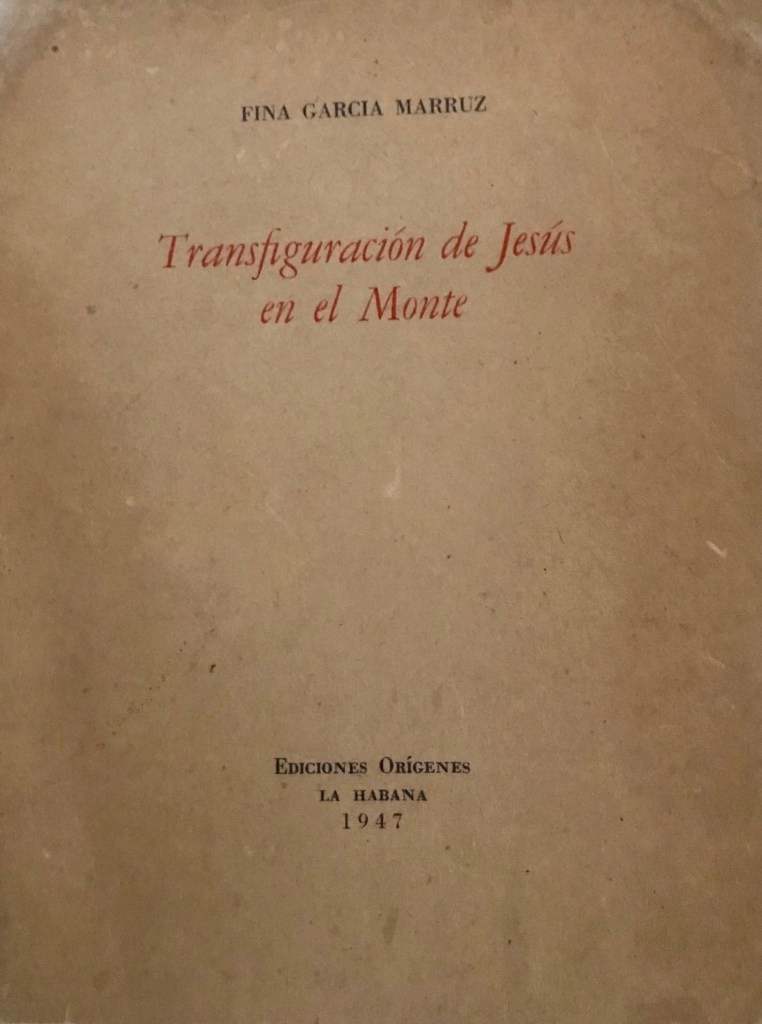
In 1947, the very young Cuban poet Fina García Marruz published the liturgical poem Transfiguración de Jesús en el Monte (Ediciones Orígenes, 1947), which stands in the modernist tradition series of attempts to probe the divine nature of language after the flight of gods and the triumph of the new secular jargons. If earlier in the century a well known Italian philosopher will predict that the international language of the future will be that of technical terms; the English Catholic poet David Jones, will reaffirm that we are “living in a world where the symbolic life (the life of the true cultures, of institutional religion and of all artists) is progressive eliminated – the technician is master. In a manner of speaking the priest and the artists are already in the catacombs, but separate catacombs – for the technician divides to rule” [1]. And if “liturgy” originally meant “public service” and the sphere of gestures, as suggested by Lubienska de Lenval, then Transfiguración has to be read, even into our days, as an attempt for language to measure to the transfiguration of revelation, in which the poem is a sacramental form that retracts language to possibilities of retaining communication.
In fact, Transfiguración de Jesús en el Monte, reinforcing the liturgical repetitions of an hymn and a sacred chant, enacts a flowing rhythm (“en tanto que”) that assesses the limits of the ineffable; a pure exteriority that is the negative or wound of language without ever being able to transcend it. In this sense, Marruz’s poem is only the poetic anabasis to the impossibility of a guided sacrament to organize interiority and visibility. Only the mystical can mediate between exteriority and the crisis of appearance. In an almost programmatic fashion, we read in the second part of the poem: “oh, difícilmente podríamos comprenderlo / Él se ha vuelto totalmente exterior como la luz; / Él ha rehusado la intimidad y se ha echado totalmente fuera de sí mismo” [2]. Transfiguration is the event that exiles oneself from the self (phygé), and in which language can generate contact with something other than its own conventions. This is why they [the witnesses and the martyrs] cannot provide an account about the transfigured revelation – just like anyone cannot truly provide a narrative, except by betraying the experience – except by their hearts as if being mysteriously called by a singular name (“ellos sienten que dentro de su corazón alguien / los ha llamado misteriosamente por su nombre”).
How can language disclose a sense of exteriority that is capable of moving past the autonomy of signification and self-referentiality of language? Can language befall into exteriority? Marruz provides an answer to this question, which can be taken as her contribution to the aporias of modern poetics: poetry can only attune to transfiguration as a cohabitual of a communicating being. In the year that the poem was published, Marruz also wrote in the winter issue of 1947 Orígenes a dense essay titled “Lo Exterior en la Poesía” (“The exterior in poetry) where she claims that “the heart of poem is always outside of it – it should not be that the poet can offer infinite variations of a secret self-possessed knowledge, but rather to rediscover the liturgy of the real; the extreme degree of visibility, which is also its great escape” [3]. What could the “liturgia de lo real” have meant for Marruz in 1947? Marruz does provide a clearcut theological definition of the exteriority as the “angelic”, which does corroborate the hymnological dimension of language, a transcendence between beings of the invisible. The liturgy of the real that defines the exteriority of the poetics of life does not entail a Romantic elevation by the Poet, but the effort to animate reality beyond an alienated monologue. This is why Marruz writes that “only a dialogue can realize an impossible communication, mystical, whenever it does take place in all of its purity” [4].
In 1947 Marruz went a step further than her fellow poets Gaztelu & Lezama Lima, who had defined transfiguration as a learning exercise of the potentia dei of the divine (“a todo transfigurarse sigue una suspension y el ejercicio del Monte era solo un aprendizaje”) [5]. Read side by side with Antelme’s Angel of Reims, one could very well say that for Marruz there is an event of transfiguration whenever transcendence delivers communication between beings, soul to soul; a relation that can one truly speak of the ungrounded and commencement. The liturgy clamored in language is not the memory of an original Adam severed from Nature, but the transfiguration of a linguistic relationship with the world. This might be the secret to Marruz last two verses: “como la infancia que acuña nuestro Rostro allí / donde no puede ser despertado”. If transfiguration also entails recapitulation, this means that this is not a process of forward becoming, but of retaining the atemporal detention that, like that of childhood, traces our silhouette as both figural and pure presence in the bushes of language.
.
.
Notes
1. David Jones. “Religion and the Muses” (1941), in Epoch and Artist (Faber&Faber, 1959), 134.
2. Fina García Marruz. Transfiguración de Jesús en el Monte (Orígenes, 1947), 6.
3. Fina García Marruz. “Lo Exterior en la Poesía”, 19.
3. Fina García Marruz. “Lo Exterior en la Poesía”, 22
4. Ángel Gaztelu & José Lezama Lima. Editorial: “Éxtasis de la Sustancia Destruida”, Nadie Parecía, Número IX, Nov, 1943, 1.
The common Spanish verb “desvivirse” resists obvious translations. Could one translate “desvivirse” as “unliving”, “constructing by destroying”, or “fulfilled life”? It seems that none of them capture the full meaning of an expression that is anchored in practical use. It is important to note that when the term emerged in the intellectual discourse of Spanish twentieth century, its depth was intimately connected to its meaning (life, living, vocation) that it immediately took the life of a concept for cultural milieu and national character. In his lecture “Ideas para una filosofía de la historia de España”, Manuel García Morente suggested that “vivir desviviendose” was the singular form of life of Hispanic being that attained eternity while on the terrestrial world:
“Porque lo típico del hombre hispánico es, por decirlo así, su modo singular de vivir, que consiste en “vivir no viviendo”, o, dicho de otro modo, en “vivir desviviéndose”, en vivir la vida como si no fuera vida temporal, sino eternidad. El hombre hispánico no considera la vida eterna. O la salvación del alma como el remate, término y fin de la vida terrestre, sino como remate, término y fin de cada uno de los instantes y de los actos de la vida terrestre. La salvación eterna no es para él solamente un objeto de contemplación; ni tampoco solamente una norma de conducta, sino que es, ante todo y sobre todo, lo que da sentido y finalidad concreta a cada uno de los actos en que se descompone la vida terrestre” [1]”.
For García Morente, the specific meaning of “desvivirse” entails a tension between interiority and exteriority; and, by extension, between life and death, and in fact of death in life that leads to resurrection and a new life. He writes: “La vida del alma hispánica es un constante morir y resucitar para volver a morir; hasta que la última resurrección” [2]. “Desvivirse”, quite literally, happens at the level of the soul when life continuous through finitude and concrete death. This is why the notion of “desvivirse” has a clear theological underpenning that one can pair with the divine apocatastasis in intramundane life. “Desvivirse” is never about personal salvation and the economy of election, which is why Americo Castro would emphasize that this vocation does not align well with modern individualism, because the “vivir desvivido” experiences its own ruin like a joyous and exuberant Saturnalia” [3].
As in the indication by García Morente, for Castro “desvivirse” entails something like an external perspective in which life can ultimately only take place from its transcendence with a relation to what’s outside ofitself. This outside is neither determined by politics nor rhetoric [4]. To live “desviviéndose” entails an intensity that persists not just as an interior affirmation of self-preservation, but as an erotic relation with what is most desired and venerated (many Spanish thesaurus of the nineteenth century would define desvivirse as “to love or desire with eagerness”, “amar con ansia”). If extracted from the cultural and identitarian historical context, “desvivirse” appeals to the object of passion that overflows the senses of human life.
This overflow is embedded in the word itself. The great Spanish scholar of Benedictine monasticism, García Colombás, in his book El monje y el Misterio Pascual (1984), made a simple, and yet remarkable lexicographical observation about the word “desvivirse”. Colombás noted that while in most of monastic literature the prefix “-des” donates privation and deficiency, the function of this prefix in “desvivirse” suffered a complete inversion, since now it entails to love intensively and thoroughly, as in “se desvive por complacer a todo el mundo” [5]. As a theologian, it should not have passed Colombás that the term in question is a triad of three linguistic units: -des/vivir/-se. This means that it is not just that the prefix exerts the meaning of privation of “life”, but also makes room for the reflexive “se”. It is curious that in in Spanish grammar “vivirse” is often used in relation to location (i.e. “el va a vivirse al campo”), and never as a conventional reflexive action (i.e. “él quiere vivirse solo”, “el se vive solo” = this would be incorrect). Taking this cue, one could perhaps say that the inversion so keenly perceived by Colombás acts upon the living so that they can repeatedly making space for the unfolding of life, rendering possible the soul’s crossing the inside and outside in every form of life.
.
.
Notes
1. Manuel García Morente. “Ideas para una filosofía de la historia de España”, in Idea de la Hispanidad (Espasa-Calpe, 1947), 215.
2. Ibid., 216.
3. Américo Castro. España en su Historia: Cristianos, Moros, y Judíos (Editorial Losada, 1948), 45.
4. Ibid., 279.
5. García M. Colombás. El monje y el Misterio Pascual (Ediciones Monte Casino, 1984), 132.
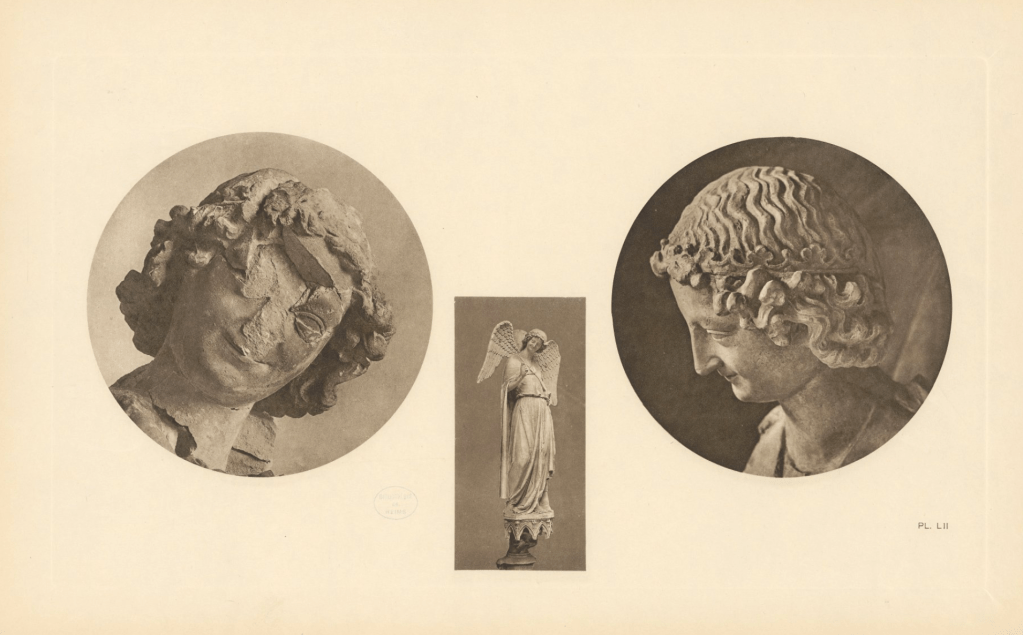
Among Robert Antelme’s posthumous writings the short text “L’ange au sourire” has a decisive place if we are to explain the transfigured theological experience of the French writer. To anyone familiar with French architecture history the title should sound familiar, since the ‘l’ange au sourire’ was already a common expression used by French scholars of architecture during the interwar years. Charles Sarazin, arguably the most important scholar of the architecture of Reims, penned a separata titled “Le Sourire de Reims” (1929), in which he celebrated the mysterious smile of the angel Gabriel that was severely damaged due to shell fire of the Cathedral during the fall of 1914 [1]. But a decade prior to the destruction, art historian Arthur Gardner, in a detailed essay on the sculptures of the facade of the Rheims Cathedral, also took note of this angel’s gaze writing that: “…the angel Gabriel of the Annunciation in which the French smile has almost become a grin, the beginning of the contorted expressions frequently found over the border in Germany.” [2]. The particular aspect of this unique angel’s face that Antelme undresses from the cloak of authority is also wonderfully documented in the photographic book by Pierre Antony-Thouret, who also showed pictorial interest in the way that angel Gabriel was chipped in a large area of the right frontal relief (image 1) [3].
Image 1. Reims au lendemain de la guerre (1928), plate 52.
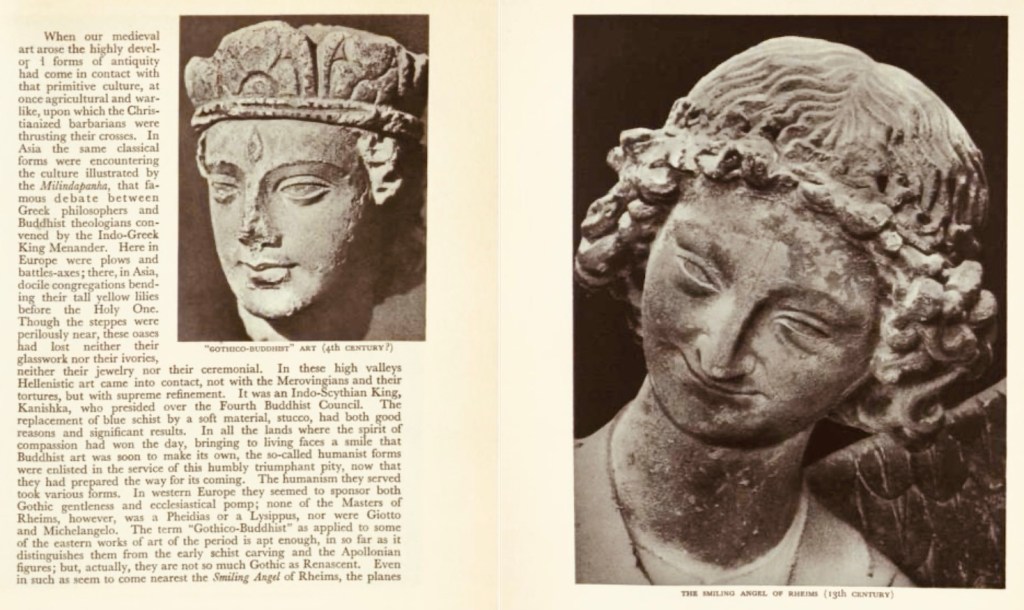
This curatorial context informs the historical background of Antelme’s reference to destruction and what he references as the crushed: “But not crushed by this building, or by that event, or by some power. It has always been crushed, crushed forever” [4]. For Antelme the tenuous, almost imperceptible, smile of the Angel of Rheims is what outlives absolute destruction because to be destroyed cannot be executed absolutely. It is the soul of existence that, because of its exteriority to history, is powerless “to have forever to be”. Even if this being has become petrified and immobile from its original plastic appearance auf vif of sacred art. This is what Malraux captured in his brief mention of the “L’ange au sourire” in The Voices of Silence (1951), where he also compares it to the Buddhist faces of Oriental sacred art (image 2): “The Smiling Angel of Rheims is a statue whose “stiffness” increased with every century; but at its birth it was a similar incarnate, a face that had suddenly come alive – like all faces sponsoring a discovery in the field of the lifelike” [5]. In order words, to see in the muteness of the face the nothingness that allows expressive relations to emerge in the open. This holds for Antelme’s description as well: “Radiant or hidden, inevitably it is there. Word, image, music: everything expresses it, and nothing. It lies at the heart of that realm where all relations are born. Forever starting anew. Possessing nothing, capable of nothing, it must be there, forever”.
Image 2. Angel of Rheims in The Voices of Silence (1964).
But what Antelme was able to capture through the smiling angel of the Rheims Cathedral was not a problem of iconology of art forms, but rather the very essence of the theological problem of angels as it relates to the poetics of life itself. The angel is not a promythical figure scaled to a specific historical moment, but an instantiation of the divine appeals to the withdrawal the possibilities and modes of the human being. This is why Antelme can state that “the only transcendence is the relation between beings”. Even in its muteness, the theologica depth of the angel is the poetic speech of divinity through a surge in language that has no end, but only celebration or hymnology.
This is why Erik Peterson writes towards the end of “The Book of Angels” about the intimate relation of angels in human existence: “A human being can draw near to the angels because the angel too – as its name already indicates – can draw near to humanity. […] The angels are more than poetic ornamentation left from the storehouse of popular fables, they belong to us. For us, they stand for a possibility of our being, a heightening and intensifying of our being – but for the possibility of a new faith…as a passion for mental clarity and an authentic existence” [6]. It is fair to say that, although the figure of the angel does not show again in Antelme’s work, all of his vision and witness accounts in the face of political horror must be placed in the endless vigil of a nocturnal life that is shared with the ethos of angels (utirur vigilis, angelorum vitam procul dubio meditatur).
.
.
Notes
1. Charles Sarazin. “Le Sourire de Reims” (s.l.n.d, 1929).
2. Arthur Gardner. “The sculptures of Rheims Cathedral”, The Burlington Magazine for Connoisseurs, V.26, 1914, 64.
3. Pierre Antony-Thouret. Reims au lendemain de la guerre: la cathédrale mutilée, la ville dévastée (Jean Budry, 1928).
4. Robert Antelme. Textes inédits sur l’Espèce humaine (Gallimard, 1996), 14.
5. Andre Malraux. The Voices of Silence (Secker & Warburg, 1964), 317.
6. Erik Peterson. “The Book of Angels”, in Theological Tractates (Stanford University Press, 2011), 139.
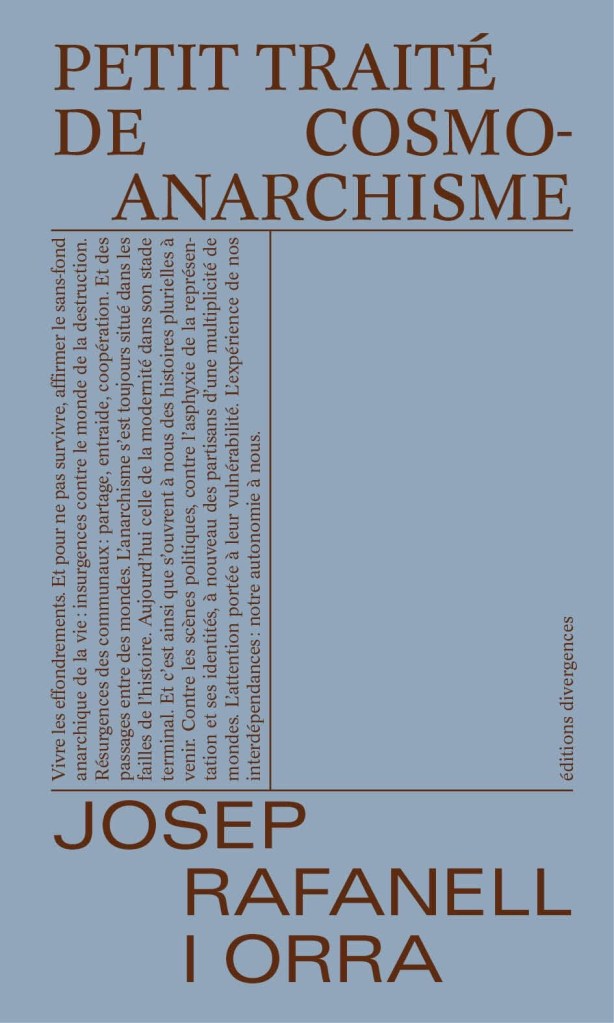
Anyone somewhat familiar with the writing of Josep Rafanell i Orra knows that we are in the company of a wanderer and itinerant in an infinite pursuit of what the experiences of worlds might offer [1]. A mad endeavor for a groundless epoch oriented towards planetary reduction and confinement, so obsessed with infrastructure and security, most recently through the reiteration of the politico-theological program of national sovereignty, one more desperate reaction to unrestrained planetary decline. We can say with Hölderlin that we are vagabonds in a destitute time, a poet who figures prominently at the entrance of Josep’s Traité. In our posthistorical epoch we are confronted with the thicket over the dominion of life, which means that the question of exteriority becomes pressing as existence enacts a path beyond the endless rubble of representation bestowed upon the human species in every point of the globe.
The book that the Spanish reader now holds in his hands thanks to Luciole Ediciones will immediately let in a dimming light of a singular style or maniera that dislocates the modernist assumptions of political thought into what one could what I am willing to name an analytics of sensible hybridizations between languages and thought. This analytic of the sensible refuses immediately Social normativity as well as the melancholic hangovers of the modern revolutionary tradition (always caught up between constituent and constituted power, representation and humanism, growth and production). This is why Josep will redefine communism as the nonprogramatic event that irrupts through hybridization of surrounds and regions capable of overcoming the ontotheological adequation of subject and object that has led an entire civilization astray (33). The project of the critique of metaphysics finds in Josep’s Traité a powerful schematic cartography that raises questions precisely in those spaces where the rationality of the science of political economy has never dared to enter.
If the critical projects of High Modernity were fundamentally temporal (including that of Messianism and its overemphasized trance towards absolute immanentization), Josep’s writing also has the virtue of displacing the focus to the spatial formation and the thinking of the creation of spaces understood as dwelling, once populated by the gods of the events and which modern ontotheology obliterated through integrated objectivation and technological positionality. We know that the greatest nearness of the last god eventuates only when the event is elevated into refusal, especially when it manages to become too near [2]. As a shorthand, this drift towards objectification in the liquidation of modern politics is domination of the Social totality; ultimately, it is through the plasticity of the social bond that the reproduction of biopolitical life is temporalized, legally ordered, and rhetorically subsumused into an apparatus of predatory accumulation. It is the Social (not the State, or this or that concept of the modern grammar of political thought, or even fascism) that we must refuse. The collapse of the modern secular state and its moral guarantees, is the beginning of an autonomized social bond that now coincides with the total administration of world forms. The hegemony of the Social reduction is what allows Josep to claim that the opposition is no longer between Society and the State; but rather between community as a process and praxis against the static formation of the Social. Thinking today drifts from social domination to communities of encounters, heteronomic relations, communication, and interdependence in a web that characterizes the exotic movement of the imaginative possibilities of exteriority for manifold worlds.
The notion of community in Josep’s thinking is neither about ecstatic groups or “little platoons” of identitarian belonging (as once famously defined by Edmund Burke); nor referring to filiation and propriety reductions that can subsist quite nicely under the heatwaves of the ongoing conflagrations of Empire. For Josep communities insofar as they are exposed to their excess (ubermass) are processes of external contact between souls as rites of passages. The community is formless, and in this sense it ceases to be a problem of Chistological stereology in order to become one in the order of ethics and language (50). In this sense, very much like the late Mario Tronti looking at the collapse of the modern revolutionary experiment; for Josep the ruinous fragmentation of the worlds has a silver lining: that all human, and non-human, souls are dwelling on the outside world calling for worldiness, and thus potentially sharing a sense of intimacy that re-enchants the appearance and knowability of the world through the invisible attunement to the outside (un nuovo modo di essere fuori e contro) [3].
Beyond the subject and the narcissism of the Ego, the light of a “spark of the soul”, in the words of Meister Eckhart’s memorable sermon, a new animism returns not because there is a transcendental revelation to be asserted, but because the encounter between souls brings forth the concatenation of worlds that are entangled with other worlds (68). If Jünger described the epoch of planetary machination as “soul murder” (seleenmord) it was because there was no longer any contact with the unfathomable opacity between the soul and any possible worlds [4]. Josep with an elegant mannerist style enhances this intuition: “We are no longer exiles on Earth, as the romantic moment freighted by the loss of world. We ended up forcing the Earth into exile after so many deadly abstractions (108). The modern age has not ceased accumulating abstractions against the human species until becoming a whirlwind of soul murdering that has extended into the current ecocide of the worlds.
It does not come as a surprise that throughout Petit traité de cosmoanarchisme (2023) Josep appears more than skeptical about political critique (and to say skeptical might be an understanding). There is a clear imperative that is mobilized in the book and that it should not be taken for granted: political critique should evolve into the negation and abandonment of politics, which also includes the always anachronistic anarchist politics. We know that ever since the Greek polis the autonomy of politics partition and distribution was waged against the incommensurable topos of the chora, the ungovernable and infrapolitical hinterland of the new substantive community of rights and obligations posited by the logistics of representation [5]. As we know, this is what forced Heraclitus to resolutely remain playing knucklebones in the temple of Artemis: “What are you gaping at, you scoundrels? Or is it not better to do this than to work with you on behalf of the polis?” [6]. The knucklebones of the ancient anecdote of the presocratic philosopher is symbolic to what Josep demands of existence: the liberation of environments and surrounds for multiplicities of experiences. The experience of gaming always starts in the middle, expressing the ineffable ethics of how I become what I am already on my way of becoming (142). The maximization of politics into the very thicket of life (this is biopolitical administration) have increasingly defaced the experiential practice of existence that now extends over the course of the historical dispensation of civilization. This is the vortex of the struggle against the realist validations in the interregnum.
Against and beyond the force of abstraction and the prison of individuality, Josep situates the stakes: “It is there, where the fierce struggle we can lead today: to find the intimacy of our soul in the welcome of other souls to hear their silences and their voices. To participate in the animation of the world is to perceive the outside. And gently find the inside of the outside” (145). And between the process of the community and the soul there is no longer struggle or enmity, but only solvent philia; the influx of creation that, insofar was enmeshed in solitude, allows pain to speak in the time of transition, in the skirmishes between worlds. Ultimately, the experience of the itinerant is not that of learning to live in places; rather, it is the one that intensively yearns the presence of encounters. This remains the only ethopoetic imperative [7]. As Carlo Diano observed in an erudite study on the notion of the chora, the attunement of the soul with the world is not a conceptual entelechy; it runs materially through the sensorium of this body as it traverses the world towards its renewal [8]. To grasp this chiasmic region that dispenses the harmony of the soul as it flees the prison gates of an objective world, is the enduring letter and spirit that Petit traité grants to the ongoing task of thought.
.
.
Notes
1. Gerardo Muñoz. “Escuchar las llamadas del mundo: diálogo con Josep Rafanell i Orra”, Disenso: Revista de Pensamiento Político, N.3, July 2020, 134-158.
2. Martin Heidegger. Contributions to Philosophy (Indiana University Press, 2012), 329.
3. Mario Tronti writes in “Disperate speranze” (2019): “È necessario trovare un nuovo modo di essere fuori e contro. Io posso farlo nel solo modo in cui so farlo: tirando l’arco al punto che permette di cogliere il bersaglio più raggiungibile. Realistica visione.”. CRS, October 2019: https://centroriformastato.it/disperate-speranze/
4. Ernst Jünger. The Forest Passage (Telos Press, 2003), 93.
5. Julien Coupat. “Dialogo con i morti”, in Gianni Carchia’s Orfismo e tragedia (Quodlibet, 2019).
6. Martin Heidegger. Heraclitus: The Inception of Occidental Thinking and Logic (Bloomsbury, 2018).
7. Josep Rafanell i Orra. Fragmenter le monde (Divergences, 2020), 70.
8. Carlo Diano. “Il problema della materia in Platone: la chora del Timeo”, Giornale Critico della Filosofia Italiana, V.1, 1970, 335.
The essay “Por nada del mundo. Anarquismo y Catolicismo”, by Spanish poet and essayist José Bergamín, should be read as a wartime reflection on the historical impasse of the Spanish Civil War. First published in Emmanuel Mounier’s Catholic journal Esprit in the 1937 April issue, the essay in its final version featured in Bergamín’s Mexican exile collection Detrás de la cruz: terrorismo y persecusión religiosa en España (Lucero, 1941). While on the surface Bergamín is responding to the struggle between secular political anarchism and traditionalist Spanish Catholicism intertwined at the heart of the civil war, the essay is also highly idiosyncratic in laying out the poet’s theological vision that permeates his entire body of work, and which can already be found, in nuce, in the fragments and aphorisms of his first book El cohete y la estrella (Índice, 1923). “Reality is the spirit, imagination, and thought…there is religiosity when it claims space positively”, he would write in the first pages of that book.
The 1937 essay, along with his defense of illiteracy in “Decadadencia del analfabetismo” (1933), Bergamín argues for a living theology of the Spanish people (pueblo) that is neither imperial nor clerical, but rather always an excess to the imperial political theology that dominated the long historical narrative of Spanish modernity since the Reconquista. It was thanks to Bergamín’s genius that Catholicism appears connected to a habitual form of life of everyday people, their shared language, symbols, and experiences; and, ultimately the common imagination that grants them access to the world through the mystery of living and dying. In fact, as in “Decadencia” (1933), it is important to highlight the centrality of the term “pueblo”, which although translated as “people”, it coincides neither with the “People” of the unity of civil society nor the common historical identity of the Nation. For Bergamín, these determinations, in fact, were corrupted notions of pueblo. The pueblo is always the event that remains from the abstraction of political theology, and always pueblo minoría, a ‘minor people’ that dwells in the house of God within and beyond the mundane. This is why Bergamín would claim in the text that the pueblo is always ancilla mundi. In this light, Bergamín thought that political anarchism incapable of a revelation to the divine, and an imperial Church in charge of the administration of the “nothingness”, were two poles of the same vectorial force of modern nihilism. That was the color of his corruptio optimi pessima with clear echoes of Fridugisus’ De nihilo et tenebris.
In “Por nada del mundo. Anarquismo y Catolicismo”, Bergamín’s theological position emerges as a third way to exit this historical poverty of relating to the theos. As Giorgio Agamben observes in a 1973 entry of Quaderni (Quodlibet, I, 2024, 46-47), for Bergamín the divine entails a corporeal cohabitation of a demon and an angel that expresses appearance of life, and thus the sensible and poetic mediation with the world of forms. In this sense, Bergamín’s theology differs fundamentally from the rational and canonical traditions, fostering the sensorial path of dramatic and divine beauty. This goes to the kernel of the 1937 essay: the rise of the Totalizing State (historical Fascism), was a corrupting form of theos insofar as it aimed at regulating the “nothingness” against the possibility of appearance and truth. But the word of God and the angelic hymns linger in the time of wreckage and devastation in its impatient drift towards anger in the world, which is still very much our own. Ultimately, Bergamín was convinced that the pueblo’s mute voice, resurfacing from the depths of pain, could dodge the abysmal fall into the tribulations of radical evil always too congenial with the survival of ‘this world’.
.
.
* This gloss was written to accompany the English translation of Bergamín’s “Por nada del mundo” forthcoming at New Personalism, summer 2025.
Emilio Prados Such’s postwar book Dormido en la yerba (1953), long out of print since its publication, is the most clear and straightforward literary document of a poetic voice that stands as one of the foremost attempts at thinking the nexus of existence to the divine in the tradition of the twilight of the gods. Dormido en la yerba (1953), albeit its direct Lucretian overtone, does not enact a metaphoric appeal of a return to the physis of nature; rather for Prados, to dwell, imagine, and inhabit language is only possible in coexistence with the caducity of the natural world including life itself. In the poem that names the book, “Dormido en la yerba”, Prados writes that “La vida se te va / y tu te duermes sobre la hierba”, at first sight claim on appearance that seems to endorse the tempus fugit motif of the Spanish Renaissance verse. However, the temporal course in the poem is immediately redirected to a mysterious proximity that befalls existence in nature’s shadows, plunging the voice into the depth of the abyss that colors the caducity in a place. At this point, we note that Prado’s poetics is traversed by a mystical register that transfigures the temporal continuum with that of making of space that is eternal because it has neither end nor beginning.
It is in this sense that Emilio Prados’ theological drift in his poetry is neither about making transcendence palpable through the animation of the world; nor does it imply the absolute immanence of the divine presence towards a new reenchantment of the world. The status of the liberated theos in Prados, like in the mythic understanding of the platonic “gods of place” (theos aisthetos), is an event that can only take place once existence is attuned to the minuscule surrounding of the world. This means that there is never a “God” as a matter of a divine economy that orients a moral predicament; rather, as Maria Zambrano argued in an essay on his work, Prados’ instantiation with the divine is always expressed in the most diminutive melody of the common things as they are. A way of multum in parvo such as the “diminuta yerba”. Hence, God is not the agent of creation of individuation, rather God is an “idea” that expresses in each thing that we are affected to, such as every blade of grass, the spacing of the clouds, the invisible direction of the wind, a human face.
The event of the divine, thus, is not a matter of mental or international faculty between objectivity and consciousness, existence and the natural world; the irruption of the divine names the genesis of appearance and disappearance. And this means that the divine (Dios) is ultimately an affection of the soul, that animation that provides birth and death as relations that move world. It is for this very reason that Zambrano could claim that the opaque sun irradiating Prado’s work is disclosed by the “dios que está naciendo”, or the god that is birthing [1]. Of course, the birth of God is far from being a transcendental revelation that weaves the history of salvation; in the manner of Meister Eckhart we can say that the god is nothing else but the affection that makes his birth take place in the soul like a harvest; that is, leafy, bright, and green [2]. God is the possibility of sensation in the world that is ineffable because it is always on the path of natality. For Prados, the eternal dimension of the birth of gods is only temporary because it presupposes spacing; it presupposes being thrown somewhere, like in the lucretian trope of lying happily above the grass. Above the grass and infinitely outside the world, dwelling and world are irreductible whenever they come into its uttermost nearness. To dwell – which is the central meaning of laying on the grass – on the crust of the Earth is to liberate God, and the liberation of God is what allows us entry into the world.
As Prados wrote in a remarkable letter to his friend Zambrano in March of 1960: “Un cielo sin reposo” que es Dios: Dios no quiso morada y nosotros, como tú dices: edifica que te edifica… Y Dios, sin reposo. No buscamos reposo para Dios y nunca lo tendremos… En la guerra, me acuerdo, unos campesinos prendieron fuego a una iglesita en lo alto de un monte. Cuando bajaban, lo hacían como iluminados y decían: “¡Hemos libertado a Dios!” ¿No es hermoso eso?” [3]. To liberate God from dogmatic commands is also the liberation of world as detachment. There is dwelling for us, but never for the unresting divine presence of god.
It is well known that Aristophanes’ late comic work on wealth, Plutus (388), provides us with what is perhaps the most dramatic and conceptual elaboration of the mythic personification of poverty (Penia) of late antiquity. What is remarkable is that in her self-presentation to the character Chremylus, Penia draws on a political parallelism that colors the ongoing crisis of governance of the ancient polis. If the Greek comedy is dependent on the function of the pólos (which is the vortex of movement that makes possible grasping the specificity of the being that is said), always prior to the arrangement of the polis, then it would follow that Aristophanes’ commentary on the centrality of Penia is neither mockery nor irony within the structure of the play, but rather an element fundamental to the historical presentation of the consciousness of historical public life. The emergence of Penia in Plutus is recorded in the lines 550-554 (a paraphrase might be adequate here): “Thrasybulus and Dionysius are one and the same according to you. No, my life is not like that and will never be. The beggar, whom you have depicted to us, never possesses anything. The poor man lives threfitly and attentively to his work; he has not got too much, but does not lack what he really needs” [1]. Poverty is an intimate relationship with needs; perhaps an unsaid relation, but one that must be accounted for nonetheless.
At her entrance into the play, we are told that Penia’s complexion is both mad (makaron) and tragic (tragōdikon); she could very well be an Erinyes companion from the underworld of the dead. Penia as a mythic figure is a fullfilled form of life. More importantly, what is crucial in the Plutus is that Penia defines herself in sharp contrast to the life of beggars or ptochos. This means that while the penetes is tied to a constitutive need as condition for a form of life; the ptochoi is a being that merely lives in a state of survival, and endures his absence of proper needs. Because Penia is contrasted to the destitute life embodied by ptochos, she can state in one moment primacy over wealth: “all your blessing….you have all that you need in abundance, thanks to me” [2]. Hence, as it has been noted, the irrevocable presence of Penia in the polis is the condition of possibility for Ploutus, god of wealth and abundance, shown in ancient representations as holding the flourishing cornucopia from the fertile harvest season.
What is important to note is that the close and fluid relationship between Ploutus and Penia; that is, between abundance and need, far from being opposition is relational and nourished by its pólos. In this way, the being of need, the penetes, is only able to flourish if he is capable of attaining a free relation with its desire of its vital making, and not from an external power that can determine the functions directed to abstract modeling of population survival. If Aristophanes’ Penia is defined against the ptochos is not because there is a difference of degrees in terms of dispossession, negative or quantitative, but rather it is because it is a disjointed relationship between poverty as a transfigured life, and a life that become destitute because it has ceased to be attentive to its own needs. In the incommensurable ground of the polis, it could be said that the ptochoi were unformed lives that merely persisted in time on the margin of the system of relation of the human community, and for this reason they dwelled in a permanent state of apolis, since their only viable horizon was the result of economic abstraction for secondary needs. In other words, the beggars of the apolis are ultimately effects of economic forces that they do not control, precisely because they no longer have any existential relation with the realm of necessity, that is, with poverty as understood under the shadow of Penia.
In this sense, the condition of beggar is an ultimate economic subjection that is already beyond the sufficient limitation of needs, and thus it has lost all contact with the world. It is has become deprived of the world without being truly dead. Here, one should not forget that as Plato registers the genetic relationship between Penia and Eros in an important moment of The Symposium: “Eros is the son of Poros and Penia, and partakes of the nature of both parents, the fertile vigor of the one, the wastrel neediness of the other. As he is a mean between mortal and immortal” [3]. But the erotic soul in the last resort is nothing but the desire for immortality; and, as a daimon, it mediates between passions and the beautiful, between the divine and the mortal, between need and wealth towards the depth of a harmous life [4]. As Sandrine Coin-Longeray has shown in her exemplary study, Penia (πενία) exceeds the effective qualification of the “good life” based on labour; rather it is a route of life that outlives itself in the erotic transfiguration of world towards the preservation of irreducible homeostasis of common life [5].
This is why Plato’s conception of the ‘happy city’ or the kallipolis was imagined as a deposition of the process of abstraction between “rich” and “poor” that ultimately has come to regulate the modern organization of social rationality proper to accumulation, production, and distribution to supply to rhe demand of ever expanding secondary needs in the general field of consumption. As Plato writes in Book III of The Laws in a section precisely dedicated to showing how to bring civil war to an end: “Because of all this, they were not intolerably poor, not driven by poverty to quarrel with each other; but presumably they did not grow rich either, in view of the prevailing lack of gold and silver. Now the community in which neither wealth nor poverty exists will generally produce the finest characters, because tendencies to violence and crime, and feelings of jealousy and envy, simply do not arise” [6]. The civilizational path undertaken by West since the rise of institutionalized isonomy could not be but exactly the opposite of the platonic deposition of the autonomy of alienated classes. Today it is all too apparent that every sphere of social reproduction stimulates a ferocious race to the bottom between a kleptocracy and a vast administered population of ptochoi that, precisely because they have no relation to Penia, is left pursuing compensatory reactions within the social mechanism of organized begging that they are forced to endure. Under the oblique light of Penia, it becomes clear that both redistributionist policies through state institutions, as well as the autonomous market initiatives of financial models tend to be two sides of the same defense of abstract abundance on the back of the human community of penetes.
The negative subsumption of material needs, and thus of poverty into quantifiable assets that characterize abundance and growth at a civilizational scale – with the collaboration of all modern political ideologies without exception always oriented towards production – has contributed to thwart the path of Penia that is necessary to live freely between passions and needs. This is why in his 1945 lecture “Die Armut” (“Poverty”), Martin Heidegger, departing from a well-known intuition from Hölderlin, claimed that ‘being-poor’ does not mean the absence of some property or substance, but a relation to needs; because only in poverty do we preserve a free relation unto what we need (not-wedigkeit) as necessary. And only this can be taken as the true and ultimate wealth: ‘we have become poor in order to be rich’, means that only through the preserving necessity of Penia will there be a liberating dislocation for human life beyond the indigence of mere exchange and the endless struggle over material goods and the private property. As the world becomes a more vast wasteland of beggars and disposable bodies at the service of technology, Heidegger, in Eckhartian tenor, was not wrong to claim that poverty and Penia will ultimately be the ethical destiny of the people of the West only if they become attune to the divine overtone of poverty as their destiny. Thus, the only possible abundance in a declining world can be realized through the enduring necessity and disquiet return of the essence of poverty – to come near the nothing, because there we find the dearth of the earth. Indeed, as Penia says in Plutus before leaving the stage: “One day you will speedily send for me back” [7].
3. Plato. The Symposium (Penguin Books, 1987), 203b, 82.
4. F. M. Cornford. “The Doctrine of Eros in Plato’s Symposium” (1937), in The Unwritten Philosophy and Other Essays (Cambridge University Press, 1950), 74.
5. Sandrine Coin-Longeray. Poésie de la richesse et de la pauvreté: Étude du vocabulaire de la richesse et de la pauvreté dans la poésie grecque antique, d’Homère à Aristophane: ἄφενος, ὄλβος, πλοῦτος, πενία, πτωχός (Publications de l’Université de Saint-Etienne, 2014), 153-56.
There is something to be said about the facticity of epochal decline, and the reiterated attempts to call for its overcoming. But both decline and renewal are so interconnected in the Western dispensation of community and institutional organization that any attempt to surpass only deepens and pushes onwards the pendular movement between rise and fall towards generic equilibrium and social stabilization. Oswald Spengler understood well that decline situates civilization at the center of Western internal historical development just as birth presupposes death; thus, civilization is merely the coagulation of vital energies to overcome the emergence of decline. The genesis of civilization into final decline should at least elicit a question to break this ongoing circularity: what does it mean to hold to decline without converting its minimal energy into the orientation of a new horizontal epoch? The end of growth (economic stagnation) realized in real subsumption and the autonomization of value also allows us to formulate the question in the following terms: what does it mean to seize the fall of the rate of profit affirming demobilization and the inoperative nature of life beyond its conversion into the movement of energetic production that characterized the epoch of production through the historical figure of the worker?
Ultimately, this is a question about how to represent (or how to avoid representation) an ethical orientation of life. At the turn of the twentieth century, it was noted that the ethical bourgeois form of life was conditioned by the sense of “community upon all men” around utility of life’s functions subsumed by work, and work as the sole purpose and meaning of life. The definite character of modern social life can be said to compensate for decline for giving up the incommensurability of life forms; that is, what Lukács also called the temporality of the “genius, in the sense that [the genius] can never be measured against anything, whether interior or exterior” [1]. Confronting this very question at the threshold of the crisis of the transmission of forms in Antiquity, Bernard Berenson in The Arch of Constantine: the Decline of Form (1954) offers a distinct position: the moment for seizing decline should be a deliberate prospect of gazing backwards; a facilis descensus that will disclose something entirely different deprived of the race towards “newness” promised by temporal futurity and its social spheres rhetorically organized. In a remarkable moment of his book, Berenson writes that: “Except in unique moments like the fifth century in Hellas or some three thousand years earlier in Egypt and Sumeria, conscious, deliberate, purposeful art is constantly looking backwards – renaissancing – if I may be allowed this uncouth but necessary verb-striving to recapture some phase of its choice in the art of the past, or at least to model itself or draw inspiration from it” [2].
In other words, there is only “renaissancing” if one is able to traverse the decline of the past in the fullest sense of its inheritance of its formal stratification. The perpetual infantilism of the modern ethical outlook is that it tries to claim its definite character in irreversibility in order to exit the downwards path of decline through abundance and vulgarity (and we know from Ruskin that vulgarity is one of the forms that death takes unto the living).
For Berenson there seems to be authentic renaissancing at the level of life forms – of that incommensurable generality of human concrete and practical creation – by holding on to epochal decline, and not through state cultural policies that have sedimented the disappearance of forms of art legitimized by a “critic that will discover a deep meaning, a strange beauty, a revelaning newness in what you have done” [3]. The vicious modern liquidation of the free interplaying creation of forms of life and their external model of appearances is paid with the ascension of the rhetorical utility that will alleviate, at least momentarily, the sentiment of the decline proper to the transmission of dissolution. Whatever redemption creation can offer in the muddled waters of decline, the modern autonomy of reified forms, pushing upwards towards “newness”, will separate the sensorial transformation of life to the homogenous representation of communitarian representative order that puts an end to mood and solitude.
What Berenson calls “renaissancing” of factical experience nourishes the unrealized instances of the tradition not towards the breakthrough of a historical epoch (something like a virtuous mythic age of “Renaissance”) that can be posited by way of general background principles nor through the enforcement of a common social morality; rather the incorporated memory of the past is transformed to its very end because in its liquidation “true life” beyond measure reemerges. Berenson will state quite enigmatically that “style cannot be manufactured by taking thought” independently [4]. This is what Hölderlin had in mind when in a moment of “The Fatherland in Decline” from his theory of the tragic and its passage of dissolution: “The new life, which was to dissolve and did in fact dissolve, is not actually the ideally old, the dissolution of which was necessary, exhibiting its peculiar character between being and nonbeing…thus dissolution, as necessary, when seen from the point of view of ideal remembrance” [5]. It is this remembrance of dissolution that reveals decline as a felicitous fall without judgment that brings the appearance of life outside the irreversibility of the modern historical progress that has accumulated the oblivion of possible worlds.
This is why Hölderlin will also claim in his “The Perspective from which we look at Antiquity” (1799) that the ‘general decline of all peoples’ is due to the inheritance of forms of “an almost boundless prior world, which we internalize either through learning or experience and exerts pressure on us” [6]. To take up decline in a serious way means that we proceed from the formlessness of life, and not from the mimetic drive that expresses, in the name of ‘originality and autonomy’, the civilizational alienation towards the most distant (Antiquity) and the most near (ethos). We can then say that in decline the most distant and the irreducible becoming allows the ascension of ethical life. In this way, we can authoritatively say that there is only hope and redemption in decline because new life flourishes in a time of prudens futuri temporis exitum (“Prudently the god covers the outcome of the future in dark night”) that will transcend itself by becoming into what ceases and ultimately is.
.
.
Notes
1. Georg Lukács. “The Bourgeois Way of Life and Art for Art’s Sake”, in Soul and Form (Columbia University Press, 2010), 76.
2. Bernard Berenson. The Arch of Constantine: the Decline of Form (1954), 36.
3. Ibid., 64.
4. Ibid., 22.
5. Friedrich Hölderlin. “The Fatherland in Decline”, in The Death of Empedocles (Suny Press, 2008), 154.
6. Friedrich Hölderlin. “The Perspective from which We Have to Look at Antiquity”, in Essays and Letters on Theory (Suny Press, 1988), 39-40.