In his 1982 novel Aladdin’s Problem (1982), Ernst Jünger defined planetary domination through the actualization of the trope of Aladdin’s lamp. Whenever a symbol of this sort is used, we know that it always carries weight of ambivalence more than that of synthesis. The mythic lamp is a trope for magic and enduring power; of countering visibility and invisibility, but it is also made from a material that has been extracted from the Earth. In other words, raw materials are manipulated as a reservoir of energy that dispense the world of forms. In the most succinct moment of the novel, Jünger writes: “Aladdin’s lamp was made of pewter or copper, perhaps merely clay. The lamp guaranteed domination as far as the frontiers of the traveled world – from China to Mauritania. Aladdin preferred the life of a minor despot. Our lamp is made of uranium. It establishes the same problem: power streaming towards us titanically” [1]. Aladdin’s lamp is no longer a tool deployed by governments and armies, it is rather the autonomous commanding force that opens to human domination and technological catastrophe that generates calculable objectivity in the world.
In his conversations with Julien Hervier, Jünger stated that the “problem of Aladdin” is not a political problem, but rather one that involves the administration of energy and intelligence that is already beyond our hands, because it has been set loose by ongoing compulsion necessary to meet the indexes of production and transference of technology [2]. Of course, energy defined the broad design of modernity as the necessary condition to amplify historical forms and mediations (and deform, since it was always dialectic) of worldly events and relations. One should only be reminded that in the beginning of the 1920s three major texts by European thinkers – I am thinking of Pavel Florensky, Carl Schmitt, and Aby Warburg – saw the necessity to allude to the settled hegemony of electricity as the defining feature of the dominion of the world.
As Warburg understood it prophetically in his lecture on the serpent ritual of the Hopi Indians: “But myths and symbols, in attempting to establish spiritual bonds between man and the outside world, create space of devotion and scope for reason which are destroyed by the instantaneous electrical contact – unless a disciplined humanity reintroduce the impediment of conscience” [3]. And it goes without saying that this “instantaneous electrical contact” has become so thoroughly engrained in human existence, that it is now clear that life on Earth, as advanced by the latest phase of Artificial Intelligence (AI), is no longer point to the destruction of space but of the total disruption of electricity and energy that exceeds any sensible contact. Electricity as the paradigm of artificial mediation can only liberate the spiritualization of ongoing decline.
It is no historical accident that empires and nations have always been driven by the accumulation of energy, although at its historical exhaustion, there is no longer a veneer of development and production between energy and empire, but only a unified empire of energy in a lamp that quenches and overruns itself towards extinction. This means that what defines the darkness of our times is neither disorientation nor political violence (although there is much of that too), but the blinding darkness of a translucent expropriation of the world of the living and the dead. It is through this assumption that Jünger makes the last business of the epoch of Aladdin – extractive energy as domination of objects and objecthood between worlds – as a large necropolis called Terrestra, financed by a banker named Jersson, where there is no longer any need for the liturgy or cults proper to myths, but naked exchange between gold and the material corpse that suppresses, via technological titanism, any possible relations to the irreducible. It remains to be thought whether the moment when the lamp goes off in the drained excess of its energy will also lead to the end of this world.
.
.
Notes
1. Ernst Jünger. Aladdin’s Problem (Marsilio Publishers, 1992), 118.
2. Julien Hervier. Conversaciones con Ernst Jünger (Fondo de Cultura Económica, 1990), 100.
3. Aby Warburg. “A Lecture on Serpent Ritual”, Journal of Warburg Institute, V.2, April 1939, 292.
Lo que sigue a continuación es una síntesis escrita de mi réplica en la presentación de La fisura posthegemónica (Doblea Editores, 2025), en la que intervinieron Mauricio Amar, Ángel Octavio Álvarez, Miguel Ángel Hermosilla, y Lieta Vivaldi el 3 de octubre en Ñuñoa, Santiago de Chile. Esos comentarios aparecerán en el próximo número de la revista Escrituras Americanas.
Agradezco enormemente las intervenciones de mis amigos Ángel, Miguel Ángel, Lieta, Mauricio, porque en última instancia un libro no es nada sin la posibilidad de ser encarado y llevado fuera de sus límites. Mauricio Amar preguntaba por la apuesta general del libro, y quizás pueda decir algo sobre esto. Este libro se inspira en lo que me gustaría llamar la escritura del adiós o del farewell. Siempre me ha llamado la atención que, al comienzo de este siglo, dos pensadores que admiro profundamente escribieron por separado dos libros de farewell: me refiero a Farewell to an Idea (Yale U Press, 1999) de T.J. Clark, y The Exhaustion of Difference (Duke U Press, 2000) de Alberto Moreiras. Respectivamente, adiós al modernismo pictórico, y a la suma metareflexiva sobre América Latina. Al menos para mi La fisura es una forma de decirle adiós a cierta reflexión política contemporánea. Y decir adiós supone atravesar el problema; por eso mismo, el hilo del libro es un problema de hegemonía que ha dominado el horizonte reflexivo y práctico del pensamiento teórico.
Ya aludimos al colapso de las formas de mediación, y se nos suele olvidar que forma es política, y la política es sólo posible mediante una forma. Si queremos pensar contra la dominación, a espaldas del vector retórico de la hegemonía, debemos tomar muy en serio cómo la forma hoy solo cumple la tarea de la dominación sobre la existencia y la palabra. La insistencia compulsiva que las formas ofrecen desembocan en su cierre letal (en la jerga de Alex Karp) sobre cada uno de nosotros. Ángel Octavio veía que el problema se nos presentaba como salida a otra parte. ¿Pero, qué salida?
Toda salida remite a una trascendencia menor: podemos salir al cielo como interioridad espiritualizada; o bien, podemos salir a un espacio demónico nocturno, un hacer noche, como versa el título del nuevo libro de Constanza Michelson. No deja de ser un síntoma de época que algunos hoy insistan en el vector de la espiritualización como vuelta a la tierra, aunque ésta sea el desierto en free fall que produce el declive (stagnation). El último Tronti, con el que tuve la suerte de intercambiar, lo recogía: el único combate hoy pasa por la interioridad (xeniteia). Pero el problema aquí es que el mundo no coincide con la Tierra. Y lo que interesa, entonces, ese justamente esa no-coincidencia, esa fisura, con respecto al mundo del viviente que hoy aparece como búsqueda de región. Y la región está en su acontecer fuera del mundo más que en el fuero interno.
O podríamos decir que está en la apertura del paisaje. No hay salida a un lugar sometido a la viabilidad ecológica. O no puede terminar ahí. Al final de cuentas, como vio un pensador en su momento, la revolución industrial fue la segunda revolución, puesto que la primera había sido la relativa a la agricultura entendida como asentamiento en el terreno. En apertura entronizamos con el cielo; o, en la bellísima definición de Kurt Badt comentando la obra pictórica de Constable: “el cielo es el órgano de los sentimientos”. El cielo aquí no es el espejo mítico que habilita la autoafirmación que conduce al humanismo catastrófico; más bien, es el punto de fuga que no se dirime en las particiones del suelo. Es curioso que la dominación en curso ya está operando como el diseño geoespacial del cielo. Esto es lo que comparte la figura del palantir de la Inteligencia, así como la Tianxia, doctrina “Todo bajo el Cielo” del emergente imperio chino. En apertura mantenemos las intermediaciones entre cielo y suelo en el fin de nuestro tiempo.
The highest poetic moment in Michel De Certeau’s La culture au pluriel (1974) appears in the concluding pages where the historian resorts to a hunting image: “Culture is an untold night in which the revolutions of earlier times are dormant, invisible, folded into practices – but fireflies, and sometimes great nocturnal birds, cutting through it – as thrusts and creations that trace the promise of another day to come” [1]. This is De Certeau’s trope that stands for culture as opening of possibilities, the shoreline where administrators and technicians (his own terms) do not dare to cross and will probably never adventure. This is the site (the night, la noche oscura, which has a ringtone of the mystical tradition that the author knew perfectly well) where De Certeau wants to posit the possibilities of new struggles of cultural alterities [2]. A book in 1974 means many things, but for De Certeau it is an incursion into the collapse of his historical present, already showing full fledged signs of the crisis of legitimation, erosion of institutional trust, and the decomposition of social forms across Western symbolic realities. It is the nascent confirmation of the ascent of real subsumption, a term that does not appear in De Certeau’s book, although it informs it, even if negatively (the Italian Fiat wildstrikes makes a surprising cameo in the last paragraphs). Where to look, then?
De Certeau’s answer read today does bring much naivete: cultural alterity. But this notion, which is reworked and contested in concrete fields of human activities (the university and schools, the new technological society and communication, social practices intertwined in popular and elite culture, power relations and post-statist configurations) do not appeal to the identitarian cosmopolitan horizon prima facie anchored in the diversity administration of a well integrated, albeit exploited planetary humanity. One senses that for De Certeau the nineteenth century “Social Question” has become the “cultural question” as the unit of the national sovereign state wanes and reacts. With the crisis of legitimation as backdrop, De Certeau sees the rise of a new subjectivity that he calls the new “militants without a cause”, a battalion of “exiles” that will only tacitly accept credible cultural imprints [3]. He wants to work with “culture” because at bottom De Certeau is both a historian and a realist. This new erosion of civil society-State relations entails a “new exile is in the works” [4]. And for De Certeau the exile, since biblical times, is seeking a new Earth where to “land”.
In 1974, De Certeau’s invitation was to create the conditions for pluralist cultural landings that will foster, in the night of waiting, a new politics. But, could the same be said today even assuming concrete situations and the infuriating image of migration as a token for the workings of hegemonic politics? Does Gaia not alert us that we must “land” somewhere else on Earth? The anger and dissatisfaction that De Certeau cautiously predicated head on is already here in the form of what some of us have theorized as ongoing social stasis that is integrated in every social mediation. In the global metastasis of the 1970s De Certeau could claim that “behind anger there is the desire to create a polis and a politics; there is a desire to organize the conditions of life….” [5].
We are far removed from this desire, and even the most prominent cycle of revolts of the decade have refused in the solicitation of a new politics or a political horizon; and, even if, almost like weeds in cracks of piled urban ruins, we see again and again the last residues of the desire for hegemonic representation of the totality (the People, the Movement, the Class). In this light – now it is our own epoche – culture can only be compensatory, and still very much a symptom of the closure of exteriority. “Where there is no longer an imaginable outside we lose the possibility of an inside”, Moreiras wrote at the turn of the century against every form of culturalism [6]. Of course, De Certeau was well aware of it, which is why his proposal to cultural alterity retains zones of hermeneutical ambiguity many decades later [7]. For instance, he writes when commenting on neo-nationalist regional movements (Quebec, Catalonia, Occitania) that “cultural claims appear to be a reminder and a compensation” [8].
And recent events have proven De Certeau correct: what is Catalan nationalism – whether left or right, although ideological division is not a substantive difference – if not a compensatory rhetorical ruse to mobilize regional political elites to feed off the stagnant resources of a waning state form? The rhetoric of “political foundation” in the Catalan case created an “cultural alterity” that depended on the high illusion of hegemonic politics; a politics solely based on the “bad faith” of escalating and superposing values (“Spanish” v. “Catalan”) as the combustion of a fractured political social contract that ultimately deepens its fragmentation. De Certeau noted – cited with the long Augustunian tradition of political liberalism – that politics cannot bring happiness, but only create its conditions. However, today even this liberal ideal fails to account for its true source: our metapolitical collapse at the twilight of secularization means that the revival of the “social bond” is not to be found in the demand of new political principles, however narrowly or broadly defined. De Certeau in 1974 aspired at giving politics one more chance pulling it to the facticial heterogeneity of culture: “a politics that discovers in the diversity of the sky a generical….linked to the ambition of beginning over again, that is, of living” [9].
And indeed, we must begin all over again, but is really the only possibility? I believe that there are symptoms elsewhere in La culture au pluriel, and these concern language. In the second chapter, referring to the crisis of speech, De Certeau refers to the “denaturing act” of speech, as communication enters the regimen of commercial language and new computational masteries (what Jaime Semprún called neo-language) [10]. The crisis of language in the ascent of a new expressivity renders communication obsolete and obtuse; parasitic, or mushroom-like, as Hugo Von Hofmenthal had already noted in his Letter to Lord Chandos. Speech becomes a new form of blasphemy, something confirmed in recent years in the United States, which takes itself also as the homeland of “Free Speech” is increasingly under heavy surveillance by constitutionalism of codified parameters of “time, place, and manner”.
De Certeau shows himself highly consternated about blasphemous language, which is also conspiratorial language; the language that dwells on the reverse of social normativity and legal codification. But this perhaps the only language today can properly speak of pain without recurring to the transactions of violence; especially of the numbing violence of a neo-language that can communicate “everything” insofar as it ceases to communicate to no one. Could the “untold night”, that is also the night of the “unthought”, be the site of the preservation of another use of language, of nurturing language, descending into the hymnic sources of the sayable – thus, inverting the denaturing of historical severability – a language embedded in silence, in the protofigure of the mystic, assuming “the immediacy of nature and experience, to contact of things, one by one, in their primal disorder”? [11]. Ultimately, whatever the night will tell will only be possible through and in language.
.
.
Notes
1. Michel De Certeau. Culture in the Plural (University of Minnesota Press, 1997), 138.
2. Ibid., 11.
3. Ibid., 7.
4. Ibid., 8.
5. Ibid., 11.
6. Alberto Moreiras. The Exhaustion of Difference: The Politics of Latin American Cultural Studies (Duke U Press, 2001), 21.
7. Michel De Certeau. Culture in the Plural (University of Minnesota Press, 1997), 78.
8. Ibid., 70.
9. Michel De Certeau. Culture in the Plural (University of Minnesota Press, 1997), 100.
10. Jaime Semprún. Defensa e ilustración de la neolengua (Ediciones El Salmón, 2018).
11. Nicola Chiaromonte. “An Age of Bad Faith”, in The Paradox of History (University of Pennsylvania Press, 1985), 148. On the hymnic dimension of human speech, see the study undertaken by Nicoletta Di Vita, Il nome e la voce. Per una filosofia dell’inno (Neri Pozza, 2022).
One of the merits of Sandor Agócs’ The troubled origins of the Italian Catholic Labor Movement (1988) is located on the question of Thomism during the rise of a national industrialization and the new centrality of the worker. This is a question that informs the very genesis of modern political thought, so I want to zoom in to the specifics: in Agócs’ narrative, the reinvention of Thomism goes hand in hand with the ‘social question’; that is, not just as the substrate for state legitimacy, but also as a supplement in the very mediation between the state and social incorporation. After reading Agócs a question lingers: what to make of the success story of social Thomism in the long history of modernity, that includes episodes from the both the left and the right; from the Italian Catholic Social Movement to Corporate Francoism, from the Pinochet Constitution drafted by Jaime Guzman to the most recent articulations of an interpretative common good in the contemporary American postliberal constitutional and interpretative balancing? One easy way out of the explanation is to delegate the answer to the historical uses (and misuses, depending who is defending what) of Aquinas’ thought, but that hardly answers the question. A while ago, John Finnis made a claim that could point to an important destination:
“This grand metaphysical overview of reality, and of our knowledge (‘theoretical’ in the first two kinds of order, ‘practical’ in the second two) of it, has been as fundamental to the new classical natural law theory from its beginnings as it was to Aquinas. It enables us to identify as illegitimately reductionist almost all the streams of social-theoretical thought, including political and legal, that have emerged since early modernity. It helps in identifying the errors of those would-be followers of Aquinas who reject the new-classical natural law theory on the ground that it neglects or subordinates nature and metaphysics; the misunderstanding of Aquinas, and of the relation between practical and theoretical thought” [1].
For Finnis, although writing for legal theorists, Aquinas’ thought properly understood possesses a ‘metaphysical view of reality’, a sort of plasticity interlocking practical reason for action and morality that serves socio-theoretical ends. In other words, the thomistic plasticity for social legitimation can be connected to what Martin Heidegger held as ‘adequatio’ as a fixed point in the problem of Medieval representation of beings. And this means that thomism is always already a theory of legitimate ground for governing that reality. As Finnis suggests in different moments of his work, the lesson of Thomism is construed in its emphasis on the rule of law as the source for justice and fairness, and in this sense it was never alien to modern social contract. Karl Barth’s rhetorical question -“Why did Hegel not become for the Protestant world something similar to what Thomas Aquinas was for Roman Catholicism? – can now be understood in its most consequential light.
Now it makes sense that Agócs refers to early twentieth century Italian Catholic Neo-Thomism as a “counterrevolution”, although he does not denote that this would be a second instance of counterrevolution with social prospects that the post-French Revolution figures (De Maistre, Bonald, and Donoso) could not meet in their antimodern stance. And here the divide is sharpened: whereas the counterrevolution post-1789 had very limited and unstable sources in social facts, Neo-Thomism offered a theory of law that was consistent with modern class dynamics supported towards social cohesion and stabilization proper to the ideal of the community centered in urban centers. If one defining feature of political modernity is reversibility, it would then make sense that thomistic natural law could rise to the demands of any given historical time to offer a nexus informed by the onto-theological structure of adequatio and analogia entis, whose proper end is the stabilization of social pressure. The second order ideological uses of Thomism (left, right, revolutionary, moral conservative, traditionalist, pre-post Vatican councils) are contingent to its malleable adequation generated by its own claim to natural morality. Heidegger once pointed in this direction when he claimed that Aquinas’ philosophical horizon was fundamentally the inception of metaphysics over theology as faith (that is actio and efficiency unto subjection) [2]. If modernity is the realization of onto-theology, then it can only make sense that Thomism takes as many garments as necessary to prevent gazing towards the abyss, becoming a manifold phosphorescent theory of social morality.
.
.
Notes
1. John Finnis. “Aquinas and Natural Law Jurisprudence”, in Duke & George, Natural Law and Jurisprudence (Cambridge University Press, 2017), 32.
2. Jean Beaufret. Dialogue with Heidegger (Indiana University Press, 2006), 106.
In a recent text published at Verso Blog, entitled “The Coming Post-Hegemonic World”, Michael Hardt and Sandro Mezzadra make a case for a “turn to a post-hegemonic model” that will challenge the consensus of global in the coming era. In many ways, this era is already here with its diverse and multifaceted (in terms of intensities, forces, and leverages) of protracted and bizarre nationalisms, which as Jamie Merchant has teased out brilliantly, amount to desperate attempts to offer a belated response to the decline of growth as one more stage for containing rampant processes of accumulation via state capacities. For Hardt & Mezzadra, this “posthegemonic world to come” is characterized by a global spatial reconfiguration of capital – accommodating the logistics of regional spaces of influences and exchange across the planet – and on the other, an increasingly “domestic sphere of authoritarian rule” promoted by new accelerated initiatives at generating social homogeneity in the wake of rushing fragmentation hand in hand with a war regime that has utterly scrapped ideals about “strategic autonomy” in order to trumpet an arm race (nuclear weapons included), as it is currently unfolding in Europe.
One can claim that this posthegemonic world is one that firmly assumes the consequences of two interdependent vectors that imploded within the project of political modernity: the end of economic growth (thus validating the law of the fall of profit outlined in Capital V.III), and the liquidation of the principle of legitimacy that for two centuries accommodated the legislative sources of the state authority in democratic constituent power. For Hardt & Mezzadra posthegemony means global fragmentation, authoritarianism, and spatial remaking; however, one should also say that it means,the opening towards stagnation, the collapse of political unity of the state, and most recently the total discredit of the foolish leftist hypothesis that promoted a “rainbow social equivalent coalitions” to push for compensatory, and in every instance insufficient and moribound, populist resurgences elevated through the combustion of ethereal but effective rhetoric (in fact, my argument in a new short book, La fisura posthegemónica, is that the push for political hegemony of the last decades only cosigned forms of consensual totalization at the expense of the production of subalternization and social death).
Even taken as a descriptive and normative condition of the current state of Western politics, the posthegemonic situation lays bare the reciprocal impasse of the claim of its opposition: in other words, one should also put to rest social mobilization that characterized the politics of High Modernity, since ultimately movements (and total mobilization as an apparatus of social energy transfer) presupposes that “every social structure, that it can receive what form required the needs of the political adventure…total mobilization signifies nothing other that the effort to reduce the social substance to a kind of plastic”, as Gérard Granel once defined it. Hence when Hardt & Mezzadra claim that the “effective rebellion must be rooted in social movements envisioning a life beyond the rule of capital”, they are inadvertently refusing to come to terms with the factical posthegemonic reality that they are describing, which is no longer driven by expansive economic growth, but rather by stagnation, and inoperativity at planetary scale that is maintained through the a global veneer of production into regimes of competitive accumulation (of territory, contractual debt, fiscal regulation, executive taxation or tariffs, and increasing arbitrary monetary regulations in the global system) for marginal profitability, as Paul Mattick argues in his recent The Return of Inflation (2023).
This means that there is no outlook towards ‘social mobilization’ that does not serve the subjective productivity of real subsumption, since its ultimate goal is to anaxate social energy into the force of (un)productive labor. This form of dilatant mobilization can only serve the master of illusionary hegemony, and thus promote functional and unwarranted servitude everywhere. Indeed, only a reprobate can be immune to the moralist or the realist conditions of hegemony. If push comes to shove, the posthegemonic factical world of stagnation and political fragmentation already here proves that the ongoing irruption of non-movements are irreducible to the modern movement’s energy; and that life never fully coincides with political claim to rule and legitimacy, even less so in the becoming-world of Production.
Ultimately, this posthegemonic fissure outlives the crumbling hegemonic world of principial High Modernism and no ‘international movement’ can piece it back together again. We are all posthegemonic now, but only if one takes up this predicament seriously and candidly.
It has taken Pope Francis’s public letter addressed to the Bishops of the United States to put in perspective how late American imperial politics in matters of immigration and probably other spheres of social life is not only at odds with the Christian vocation, but even waging war against the very dogma of Christian revelation. The reminder does not come completely out of context, since as we know, the marching band of intellectuals that for a long time have defended a “Christian postliberal” transformation – some of which not long ago offered theological justifications for the Church as the universal ark for migrants – given the current hegemonic configuration find themselves as mere scribes of whatever is enacted by unilateral executive command. The impossibility of enacting a transitional political theology evidences the emptying of politics into a technical mobilization of apocalyptical overtones, as clearly defended by Peter Thiel. The attempts to pilotage a planetary gnosis to his own image in the last stage of imperial stagnation, definitely supports Francis’ assertion politics today is built “on the basis of force, and not on the truth about equal dignity….begins badly and will end badly”. But in a way, this “end” has already taken place through the revocation of the ethicaltenor of the Christian mystery.
It comes to no surprise, then, that if the erosion of an ethics is at stake, that Pope Francis would allude to the parable of the Good Samaritan and fraternity, something that he has explored previously in the encyclical “Fratelli Tutti” [1]. It is also important to note that Francis is not opposing the Good Samaritan to the ordo amoris; rather the operation is more subtle: for any community to be organized around ordo amoris, there needs to be a space for the infinite discovery that the Good Samaritan parable solicits of every Christian’s responsability. According to Francis: “The true ordo amoris that must be promoted is that which we discover by meditating constantly on the parable of the “Good Samaritan” (cf. Lk10:25-37), that is, by meditating on the love that builds a fraternity open to all, without exception”. In other words, and implicitly taking distance from the Calvinist dependency on community of salvation, the Pontifex is disclosing the memory of an ethical vocation that cannot end in social norms or national unity without exteriority. The communitarian ordo at times could also amount to oppressive familiarity, as it appears in Corrado Alvaro’s Revolt in Aspromonte: “Village life seemed to him a strange invention, a protective agreement between people who were afraid”. Thus, what the Samaritan teaches human beings is that there are no ethical standards for which we can respond, since every encounter opens up a ‘decision of existence’ before an absolute other beyond the sacramental duty of “I ought”.
Who is this “other human being” that now becomes your brother? As we know, in Ivan Illich’s late work the ethical inflection of the Good Samaritan illuminates the true character of our poetic relationality and creative act: “You can recognize the other man who is out of bounds….and create the supreme form of relatedness which his not given by creation but created by you. Any attempt to explain this “ought” as corresponding to a norm takes away the mysterious greatness from this act” [2]. Indeed, Illich goes further in telling us that the suppression of the ethical decision of encountering the Samaritan can only leave us with a “liberal fantasy…where bombing our neighbor for his own good” [3]. Just like today the moral justifications of “ordo amoris” or the administrative allocation of a substantive “common good” can produce justifications for mass deportation of immigrants and dividing the social space between citizens and noncitizens (removing the foundation of ius soli) can become the strange patent of a monstrous theological manipulation.
The ethical mystery exemplified by the parable of the Good Samaritan introduced into history a new conception of “brotherhood” that was not conditioned by national, political, or family affiliations, but by a common vocation expressed upon acting through mercy and charity. Belonging to the “human fraternity” allows me to decide who is my brother through the osculum pacis – a conspiratorial mouth-to-mouth kiss that creates proportionality and peace through the encounter that yields mutual creation. Before the Samaritan we give everything without waiting for anything in return, as required by any true ethical disposition. As the scholar of Ancient Christianity, Christine Mohrman once noted, the osculum pacis was a universal relationship of the human species through their voices coming together to assert external political peace as well as interior health of the soul [4]. If the predatory programs of mass deportations and intensification of hostilities between nations have come to forefront in our days, this is due to the fact that the overall end is not to piecemeal ordo amoris coordinated by state social policies, but rather a permanent assault against the association of the free souls constitutive of the osculum pacis.
In light of the theological drama of Christianity, nationalism can only be taken as a symptom of brute force and inequity (radical evil). As Erik Peterson reminded in his essay “Das Problem des Nationalismus im alten Christentum” (1951), the cult and strife between nations and imagined communities, at least for the Chirstian vocation, do not have any traction, since the warring angels of nationalities have been overcome by the event of resurrection [4]. The ‘strange career’ of American political Catholicism is precisely that through a technocratic administration of social pain and spectacular delirium, it can only offer an noncorporeal ideal of ordo amoris “in the service of a single nation which seeks to establish its supremacy, by identify its own interest with that of humankind”, as Peterson observed in the wake of European nationalism, but that it applies today to the letter with little variations [6].
In vain should we attempt to pin down the osculum pacis as professionalization of care or the hospitalization of pain that have become practices of a “corrupted core of a very clear and powerful ideal of democracy”. In the disjointed time that characterizes the end of political theology and its warring nomoi, the osculum pacis will be not be found in those that attempt to conjure a “Christian civilization”, but only in those that dwell in the state of adelphos, faithful to the scandal of peace and the endless conspiracy of speech.
2. Ivan Illich. The Rivers North of the Future (Anansi, 2005), 207.
3. Ibid., 208.
4. Christine Mohrmann. “Quelques traits caractéristiques du latin des chrétiens”, in Études sur le latin des chrétien (Edizione Di Storia E Letteratura, 1961) , 29-30.
5. Erik Peterson. “Das Problem des Nationalismus im alten Christentum”, Theologische Zeitschrift, 7, 1951, 81-91.
6. Erik Peterson. “Die Frage nach dem Menschen”, in Offenbarung des Johannes und Politisch-theologische Texte (Echter Verlag, 2004), 250.
The global stock market crash this past Monday over fear of a forthcoming US recession has rendered materially visible the long economic stagnation across the large market economies. Those that feel content with the “not yet” moment of a strong AI financial bubble see it as an interphase of ongoing transformations on the domain of artificial intelligence. The interphase hypothesis, however, prefers to ignore that the expansion of AI will only plunge even deeper the condition of stagnation and the end of human labor.
In this scenario, it has been interesting to see one segment of the stock market that has stood the test of the global crash; mainly, the defense giant Lockheed Martin, whose stocks S&P stood firmly at 55% and its profit has seen about 21% growth compared to a year ago and expecting revenues as high as 71 billions at the closing of this year. In fact, according to Frank St John, chief operating officer at Lookhead Martin, “the company will not slow its production rate. St John said it would “probably take three or four quarters to work our way through the backlog of jets that need to be delivered”. The active war zones in Eastern Europe have only intensified the production growth of the military economy.
From a historical perspective there is nothing new here, and it is “business as usual”. In fact, the great German war economic theorist of the Weimar Republic, Adolf Caspary, who also authored the book Wirtschaftsstrategie Und Kriegsführung (1932), entitled as piece in the Esquire, March of 1944, entitled “War is a Business, as Usual”, where he claimed that historically “though the expenditure of war have become larger, the risk is smaller, for manpower, industrial resources and wealth decide the war – if they are mobilized”. Of course, Caspary’s historical conditions were one of ‘total mobilization’, as famously theorized by Jünger; whereas ours is one of demobilization, stagnation, and polycrises. The partial mobilization of military industries is, at best, a symptom of the epochal demobilization and paralysis.
There is also something like an inversion of the causal relationship between wealth and hostilities: if for Caspary in the 1930s it was the effective management of wealth what could lead a nation to win a war, in our times it is the production of multiple wars and catastrophes what need to be organized in order to maintain the still too illusory, and thus compensatory, state of productive economic growth. This is also why military giants like Lockheed Martin or RTX Corporation are federal state sponsored conglomerates that nourish the otherwise decomposition of modern state form. What is unusual in the “business as usual” of war management and the economy in our days is that neither wars are won, nor is a stable productive economy ever achieved.
“Symbolism and immortality”, was the title of a talk that a very young Boris Pasternak gave in 1913 to a group of students, although the paper was finalized around 1917. It has been known that the integral version was destroyed or misplaced, and only a synthesis was preserved in the author’s papers, which provides access to the thicket of the argument, which concerned ultimately the immortality of artistic creation and the transhistorical participation of the human species in the enduring process. Pasternak himself inscribes this lecture at the heights of his ars poetica: “My main purpose was to put forward the proposal that perhaps this maximally subjective and universally human corner or lot of the soul was art’s immemorial area of activity and its chief content. And, further, that although the artist is of course mortal like everybody else, the happiness of existence which he has felt is immortal and can be felt through his works by others centuries after him” [1]. Unlike the contentious positions about the creative genius and the orientation of the poet (dichter als Führer) that soon enough will inform the thick aura of European modernism in the age of dissonance, for Pasternak in the 1910s (the same decade as the early Lukacs and the youthful Michelstaedter), creation concerned a gathering of experience outside subjectivity; it was fundamentally the experience of the outside beyond the subject, which could only be cultivated by the poetic sensibility’s relation to that outside. It is not clear where there was a figural specificity to the notion of “poet” that Pasternak advances; but, what is essential, is that the poetic task was only possible through a spiritual formation and deployment of symbolization, that is, of the transfigurative use of language.
Pasternak does not distinguish between vulgar and crafted poetic language; rather he uses the term symbolism to account for the sensible immortal reservoir that is transmitted in the stratification of the genesis of the human race. It is not of minor importance that Pasternak is writing in the dawn of a concrete materialist revolution, in which possession is only registered, counted, and even “destroyed” as mere “stuff”, thus incapable of solving the crisis of the transmission of tradition and blind to the problem of sense. Indeed, perhaps the revolution can only deepen the epochal crisis of symbolization. Pastnark will write affirmatively: “Immortality takes possession of the contents of the soul…in pure form this is what symbolism teaches” [2]. In a conception that is strikingly similar to Warburg & Saxl’s conception of the symbol (and history now designed as a study of the coagulation of symbologies) as a surplus discharged of energy as the reservoir of human sensation and formulas of imagination (the pathos formulae); the attunement towards symbolization never amounts to an accumulation of meaning and narration, but rather it is what preserves the earliest and purest stages of human expression, as argued by Saxl [3].
This is why there is no immortality except in the beginning: the real process of the anthrogenesis is only accessible in those moments of passion and experience while “being observant and drawing from nature”, Pasternak will claim in his talk. The immortality to be retained, it seems now clear, is not that of a future and postponed soteriological communal “life”; it is rather a life that clings to the ordinary and intuitive symbolism that resists the monstrous numbing of fictitious life commanded by the blackmail of the reality principle required by orderability. In this light, perhaps Alfred Metraux is right in that going beyond the neolithic age marked a catastrophic wandering for human beings. (And is not the poetic instantiation a painful reminder of this?)
The stratification of symbolism was of a higher reality; a playful dance between the figure and the non-figural, between the visible and the invisible, between the countable and the non-countable. Pasternak situates this tendency under the sign of “theos“, a religious character in which the texture of the soul is able to find some breathing space as condition of possibility for the opening of symbolism. Modernity is many things at once, but for Pasternak what was being “withered away” at the altar of morality and politics, Church and State (his terms verbatim) was precisely the historical draught of the symbolic man: “The communion of mortals is immortal and that life is symbolic, because it is full of meaning” [4]. This means that there is no community of salvation that serves as the general economy transport between the two kingdoms; if there is a Kingdom it is only of the symbolization of the irreducibility of souls, that can only enjoy immortality in the renunciation of what the materialist and survivalist life is capable of offering in detriment of the experiential possibilities of creation and language when grasping the sense of deathlessness.
In the life of civil society you will live organized only unto death, without any experience of immortal death of any other, given that death has become mere transaction, a burdensome logistical ritual, a common spectacle. And this is why Pasternak, unlike the Cold War pawn that sometimes he was forced to embody, gradually became convinced that poetic existence could only take place outside the Social with no role or mission to subscribe to: “Do not reserve a poet’s position: it is a dangerous, if not empty” [5]. What was at stake was not a “new life” but a second birth (title of his own poetry collection, Vtoroe Roshdenie from 1934) to plunge into the depth of symbolization. The task is not to invent anything “new” (that modern fetishism), but to regain the life of the soul where the origin commences: “…and here art stops, And earth and fate breath in your face” [6]. It is a mysterious and impossible portrait of a face that reckons with the passing of the symbol and its absolute mystery. The very texture of expressivity that, against all odds, lingers on.
.
.
Notes
1. Boris Pasternak. An essay in Autobiography (Collins and Harvill Press, 1919), 69.
2. Boris Pasternak. “Symbolism and immortality”, in The Marsh of Gold: Pasternak’s Writing on Inspiration and Creation (2008), 40-41.
3. Fritz Saxl. “The expressive gestures of Fine Arts”, in Lectures V1-V2 (Warburg Institute, 1957).
4. Boris Pasternak. “Foreword”, in Selected Poems (Penguin Books, 1983), 14.
5. Boris Pasternak. “To a Friend”, in Selected Poems (Penguin Books, 1983), 100.
6. Boris Pasternak. “Second Birth”, in Selected Poems (Penguin Books, 1983), 109.
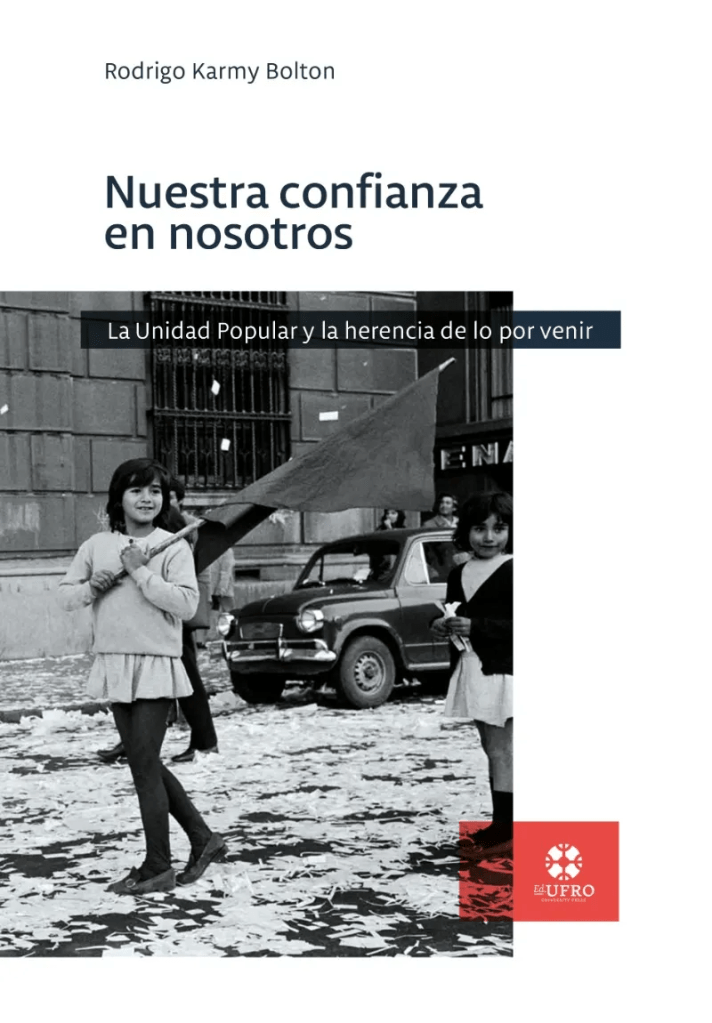
Transfiguration. Towards the end of Nuestra confianza en nosotros: la Unidad Popular y la herencia del por venir (Ufro, 2023), Rodrigo Karmy suggests that the experiential texture of Salvador Allende’s political years amounted to a sort of corporeal transfiguration of historical time, but also of the political subject within modern architectonics of the inter-state sovereign system. The death-martyrdom brought a new world into order, radically transforming the sense of historical assumptions and its immanent refutations and accelerations. For those of all that know Karmy’s philosophical investigations working through this intuition, it is impossible not to see that ‘transfiguration’ does not entail ‘sacrifice’, but rather it implies the figure of the martyr [1]. And we also know from Erik Peterson that martyrs are absolute witness to truth of an irrevocable event; in other words, those that transcend the core materiality of the mere opinions and matter-of-factness as to remain faithful to the unfathomable to a world brought to abrupt change (and at times, this means also despair). Karmy writes:
“Se produce así una transfiguración radical de Allende que trastoca enteramente el juego de la teología política, tal como ha sido planteada bajo los avatares del fantasma portaliano: si en esta última, el cuerpo físico termina desmaterializado en un cuerpo institucional, tal como ocurrió con el devenir del general Pinochet, en Allende termina desmaterializado en una potencia por venir (no en cuerpo institucional), aquello que Walter Benjamin llamaba lo «nunca sido»: «Siempre estaré junto a ustedes», dice el presidente usurpado por el golpismo esa triste mañana de septiembre” [2].
The truth of transfiguration – and in a sense every event of truth is always carried by the energy what is transfigured – marks the incommensurable distance between the eternal persistence of the word and the historical movement guided by the precepts of civilization. Whereas the political grammar organizes itself through an indiscriminate institutional corpus and a set of moral binding obligations upon its citizens; the truth of transfiguration is the keeper of the night of the soul that, like the myth of Er, signals the passage between the world of the living and the kingdom of the dead. When transfigured, the dead can become even more lively than those allegedly “alive”; where those alive become embodied and rigid statues or mummies. As such, the energy of transfiguration remains outside the cloisters of history and its memory sites, since its realization takes place whenever there is a drift outside and beyond the suturing of the world as mere stated and enclosed fact.
Voice. The “we” (Nosotros) in Karmy’s thesis does not signal the constituent political unity of the People nor a partisan form that can exert force towards the inversion of the sedimented historical order. In his archeological endeavor, the ‘nosotros’ indexes a non-numerical instance through the vocative raises its own question to the past. This does not imply that there is a “collective voice” that must enact its point of annunciation through representation and mediated forms; the voice emerges as an exception to the grammaticalization of the constitutional order and its statuary production as expression of legislative will. The voice is the exteriority to every scheme of reproduction. But, what is a “voice”? Following Emilio Recabarren, Karmy connects the voice to the very act of creation: in other words, a voice to the truth implies the vocative of what has truly never been there before. Like the chorā, the voice is both at the reemergence of its origin and medium rather than substance; and this is why the voice, unlike the written language, cannot be subsumed to the reification of mimesis and generative substance [3]. The voice is what every time remains irreducible to the order of discourse difference, historiographical narrativity, and the original letter and spirit of the law. And even in traditions without “Constitutions”, law cannot escape its written and grammatical framework; this is why in Common Law, the Constitutional authority is supplanted by the historical absorption of habits, manners, and tradition into the force of legal codes and binding statutes. It is a high merit of Karmy’s Nuestra confianza (2023) to reminds us that the happiest moments (and perhaps the only moment worth saving, that infinitely returns against the grain of historical progress) of the revolutionary experiences of the twentieth century are to be found in the evocation of the voice and its popular music (something that can also be said of the Cuban Revolution, for instance). This esoteric orphic thread evidences the disjointed relation between the polis and the mythic transfiguration when facilitated by the prophetic overtones of the musical nomos in the genesis of the West [4]. Hence, whenever there is a voice, the suture of politics to the theology cannot amount to the continuous transaction upon the survival and agony of the living.
Freedom from revolution. Unlike the reverential or formalist accounts written for the fiftieth anniversary of the Chilean Unidad Popular, Karmy’s essay invites us to dwell about a political experience after its epochal exhaustion: the collapse of the horizon of the philosophy of history implies the internal implosion of the modern revolution’s infrastructure (constituent power, moral justice, militant subjectivity, sacrificial energy). For Karmy to arrive at a certain nearness to the well lighted tradition of the UP is to abandon once and for all the civilizational eon of sedentary political hegemony (“a revolution in world history” bringing about the age of the nomads to an end, claimed historian Edward Gibbon) that has now paved the way for the unlimited forms of planetary government exerted through the rationality of the management of population and the distribution of the economy [5].
The farewell to the revolution and its reverse – it is well known that De Maistre claimed in the wake of the French Revolution that the opposite of the revolution is not a counter-revolution, but what is all together contrarian to it – means to put a halt to the paradigm of force (positive and immanent hostility) that has oriented actions, expectations, passions, and even dreams taxed at the fictive illusions of an abstract Humanity devoid of any possibility of happiness in the world. It is only after we can leave behind the revolutionary metaphysical mimesis that a new sense of freedom could emerge away from the dominion of the land-surveyors of the Earth. Abandoning any clamors oriented towards the future, it is now for us to attune to the everlasting traditions that are unrelinquished to the endless rubble of time.
.
.
Notes
1. Rodrigo Karmy. “The Absolute Gift: Martyrdom as Destituent Power”, SAQ, 122, 2023, 157-170.
2. Rodrigo Karmy. Nuestra confianza en nosotros (Ufro, 2023), 183.
3. Ibid., 102.
4. Gianni Carchia. Orfismo e tragedia: Il mito trasfigurato (Quodlibet, 2019).
The neutralization of an intense political movement tends to defy both institutional and implicit norms of the rule of law. The fact that former President Donald J. Trump has been charged with four different legal indictments – the hush money New York state case, the Mar-a-Lago Classified Documents case, the January 6th insurrection case, and the Giorgia election meddling case – have only boosted his cultish popularity among his followers who are now pushing for a second presidential term. On top of this, it is also important to note that none of the indictments truly bar Trump from reaching the executive office and engaging in a self-pardon. However, we have seen the emergence of a fifth possible venue to indict Trump elaborated in an important lengthy law review article co-written by jurists William Baude & Michael Stokes Paulsen that reclaims the sweeping and effective force of section three of the Fourteenth Amendment of the United States Constitution [1]. The letter of section 3 is straightforward, and it states that anyone that has previously taken an oath to defend the United States Constitution, and engages “in insurrection and rebellion” disqualifies him from future appointments in any public office, although Congress could remove said disability with a sufficient majority [2].
There are two central qualifying conditions in the section: having taken a prior oath to the Constitution, and engaging or avoiding insurrection and rebellion against the unity of the state, which assumes that the current political situation is one of either the threat of secession or civil war (this was Lincoln’s standard). The fact that this has been proposed by one of the foremost exponents of constitutional originalism should already indicate the juridical pressure that American lawyers are facing at the moment [3]. If there is room for disagreement about the “objectivity of the context”, the fact that the applicability of section 3, Am.14. presupposes the state of a full-fledged civil war that confirms the unprecedented controversy about the political context – regardless if considered an open civil war or an institutional political crisis – in which the enforcement of the constitutional provision will be executed[4].
The precondition for the effectivity of the sanction, however, hangs on something that has been taken for granted by most commentators: that is, the fact that the public official has taken an oath, becoming what Baude & Paulsen denominate an ‘oath-taking category of person’, which implies that the self-defense and the continuity of the constitution relies on the structure and form of the oath. Of course, we know from the great legal historian Paolo Prodi that one of the fundamental categories of political authority of the state was the absorption of the religious vow and the sacrament into the oath expressing the collective will and intra-institutional regulation of a normative system of the rule of law [5]. The oath achieves the unity of institutional authority, but this is only possible if there is a common collective faith in the constituted community of the oath-taking practice.
Under this consideration, it is almost redundant to note that the object of this collective and consensual faith (fides) is the oath as the nexus of public trust between the word and the instituted reasons for action. Oath and faith – and its immanent dialectic, since it also implies the faith in the oath – just like the polarity of religion and the rule of law, can only be sustained on stable conditions of a robust secularized equilibrium now broken. In fact, this is what paves the way for the indirect powers of civil war. This implies that the dependency on the oath is invalid without fides; and, mutatis mutandis, it is only once that fides is separated from the oath that its self-executing force becomes possible in the field of factional forces.
This is something that is definitely not a new problem, since one can read in “Federalist 18” how the implementation of oath during the Greek polis did not lessen the exacerbation of the fragmentation between the rise of different factions [6]. In the same vein, Carl Schmitt reminded how Hindenburg during the Weimar Republic felt comfortable taking an oath prima facie, only to find himself later hostage to the absolutization of internal political hostilities [7]. Given that the oath is predicated on the faith of a “promise of future behavior” (Baude & Paulsen dixit), an oathdischarged from the presupposition of a faith in the concrete institutional order, tends to reproduce an adverse relation between perjurers, legal sanction, and pardons. In this circularity any political system will no longer depend on the internal categories of legitimate rule and social representation, but rather on the parallel tripartite structure of oath-taking, compelled oath, and acceleration of instrumental exchange of burdens, misdemeanors or infractions.
This tripartite structure – oath, perjury, politization – orients the force of fides after the collapse of modern secularization and the rise of legal constitutionalism [8]. Indeed, the energy of desecularization can only be expressed with the efficacy of moral principles dependent on a political will that fluctuates on the coagulation of legislative majorities that will see their “truths”, “public reasons”, and “social sensibilities” as permanent marching orders (let us not lose sight that the Congress can override the force of proscription). This does not mean that there is no such thing as having taken on “oath to the Constitution”, which is at the center of the American political system. Nor can one ignore the fact that section 3 enacts a clear threshold against public office holding if engaged in the context of insurrection or rebellion. Furthermore, one should not confuse the expediency of the unit of the political with the external question pertaining to social facts or public opinion [9]. Rather the point is much simpler and stark: if a constitution is a normative system of rules and principles, its free-standing application can not respond on the basis of having faith in the future promise compelled by the force of the oath. This can only deepen the conditions for civil war that neo-constitutionalism facilitates through its flexible and discretionary principles (the primacy of ius over lex). In the shadow of the oath, the archaic jingle of the sacramental enunciation is heard one more time [10].
The oath should not be reduced to a candid constitutional interpretation or federal jurisdiction: it is eminently a political question about the form, scope, and urgency of the guardian of the constitution and its nocturnal council. It is perhaps pertinent to conclude by recalling Plutarch’s old maxim: “Children are to be deceived with toys, men with oath”, which today could very well apply to generic constitutionalism and political militants alike, two fierce contenders in shaping and distributing the the energies of the legal stasis [11]. And if wrongs committed are no longer done to the gods as in Tacitus’s sacramental maxim ( deorum iniurias dis curae), but first and foremost against the authority of a concrete order; this means that political differentiation emerges against the quiet harbinger of the sacralization of politics – an anodyne time in which men with oaths, quite often, also behave and act like children with toys.
2. US Constitution, Article XIV, sec.3: “No person shall be a Senator or Representative in Congress, or elector of President and Vice President, or hold any office, civil or military, under the United States, or under any State, who, having previously taken an oath, as a member of Congress, or as an officer of the United States, or as a member of any State legislature, or as an executive or judicial officer of any State, to support the Constitution of the United States, shall have engaged in insurrection or rebellion against the same, or given aid or comfort to the enemies thereof. But Congress may by a vote of two-thirds of each House, remove such disability”.
9. Martin Loughlin. Against Constitutionalism (Harvard University Press, 2022).
10. Émile Benveniste. “Ius and the Oath in Rome”, in Dictionary of Indo-European Concepts and Society (Hau Books, 2016), 401.11. Plutarch. Lives. Agesilaus and Pompey. Pelopidas and Marcellus. Volume V (Loeb, 1917), 12.



 Infrapolitical Reflections