El libro Uncanny Rest: For Antiphilosophy (2022), versión aumentada de Sosiego siniestro (2020), es el libro cuaderno de Alberto Moreiras que despliega una peculiar escena de escritura de los primeros meses del confinamiento en pandemia. Como todo libro verdadero (o escritura que entiende la verdad como una inexorable develación), las entradas del cuaderno se van haciendo al ritmo de su propia búsqueda. Tal cual como quería Miles Davis: “I’ll play it first and tell you what it is later”. Uncanny Rest tiene mucho de esto, y para quienes acompañamos de forma directa aquella constelación de apuntes, glosas, interrogaciones y susurros, no podemos dejar de leer todo tipo de partituras esotéricas. Se trata de un libro prolífico en registros e insinuaciones. En cualquier caso, Uncanny Rest (2022) es el libro más aventurero y dialogante de Alberto Moreiras, aunque esto tiene poco que ver con una capacidad afectiva para generar “consuelo” al interior de aquel tiempo enrarecido.
Cuando digo diálogo pienso concretamente en la palabra compartida, en la brecha entre palabra y pensamiento que para Alberto Moreiras – y ahora compruebo para mi sorpresa que ya en la primera entrada del libro versa sobre esto – es la “sola vía abierta”. ¿Tendremos el coraje necesario para emprender camino en ella? En efecto, nada le es ajeno a la escritura de Alberto para despejar ese encargo: un paseo con Teresa, un recuerdo juvenil que regresa en una fotografía; una conversación imposible o una pintura de Andrew Wyeth; la rememoración del mito de Tobías o el trazo de la figura sublime del piel roja acéfalo sobre el anómico desierto. Rastros de experiencia. Uncanny Rest es también el libro más feliz de Alberto Moreiras porque es el más especular; una tela donde comienzan a aparecer todo tipo de cosas – vivas y muertas, lejanas y próximas, posibles, existentes, e inaparentes – que actúan como un espejo de paciencia en el que escritura y pensamiento, allende de las inclinaciones personales, esbozan la búsqueda clemente en un tiempo espectral.
La ‘sola vía abierta’ – a la que podemos ingresar desde la inaprensible soledad del pensamiento entre amigos – no se reduce al acontecimiento de los meses de la pandemia. De ahí que, a diferencia de tantos ensayos escritos durante aquel momento, no sería justo catalogar Uncanny Rest (2021) en el anaquel del global writing of COVID-19. Al contrario, Alberto aprovecha el tiempo de sosiego de la pandemia para tirar las tabas en el tablero de la época: lo central de nuestra vida es afirmar una vía de salida de la barbarie biopolítica y administrativa sobre la que Occidente pareciera haber colapsado irremediablemente.
Y si por todos lados – incluyendo desde la clase periodística a la “progresía filosófica” a los programas IA de Eric Schmidt o los nudges de Cass Sunstein – el ‘imperativo adaptativo’ no ha dejado de efectuarse como la nueva plasticidad regulativa de lo Social; la valentía de Uncanny Rest reside en haber percibido desde el ground zero las falsas salidas y los rat-holes que impiden ver lo esencial, lo duradero, o lo más alto que Alberto vincula al imperativo pindárico γένοι᾽ οἷος ἐσσὶ μαθών; esto es, ‘habiendo aprendido quién eres, debes convertirte en ese ser’. Creo que aún no hemos sabido cómo extraer todas las consecuencias de esa forma de vida que tiene algo de eternidad transfigurada, ciertamente de vida fuera de la vida contra toda vida delegada [2].
Los excelentes comentarios de Maddalena Cerrato, Mårten Björk, y Andrés Gordillo, más que reseñas protocolares y subsidiarias del libro, son ejercicios de escritura que facturan sobre la invitación a cabalgar sobre la única vía que resta: el pensamiento. Finalmente, el último texto en el carné es la versión escrita de la réplica que Alberto Moreiras ofreció a los participantes durante la presentación del libro durante la primavera de este año [3].
.
Notas
* Esta introducción es parte del dossier que preparé sobre Uncanny Rest (2022) de Alberto Moreiras de próxima aparición en la revista chilena Escrituras americanas, primavera de 2024.
1. Barbara Stiegler. Adapt! On a New Political Imperative (2022).
2. Mårten Björk. The Politics of Immortality in Rosenzweig, Barth, and Goldberg Theology and Resistance Between 1914-1945 (2021).
3. Conversaciones a la intemperie: Uncanny Rest (2022), de Alberto Moreiras, junto a Maddalena Cerrato, Andrés Gordillo, Mårten Björk, Gerardo Muñoz, y el autor, mayo de 2023: https://www.youtube.com/watch?v=I9Zs-FvdANE
Giorgio Agamben’s most recent La voce umana (Quodlibet, 2023) sets the scene with an elemental question: what is to call on something, and what is it to be called upon? The exploration around the notion of the voice (a sort of chorâ that falls between the different antinomies of human language, as we will soon learn) is far from new in Agamben’s work, who from the the early period of Il linguaggio e la morte (1982) directly confronted the negative foundation of phonê in relation to the closure of metaphysics. In a certain way, the perimeter of La voce umana (2023) is now deliberately limited to how the ‘mystery of the language’ is to be found in the unending event of the voice as the arcanum of anthropogenesis itself. At this stage of his investigations, the problem of the voice for Agamben designates a double movement of inflection and recapitulation: the voice proves the internal division of political life in the West; at the same time, it is also the most intense experience that a form of life can bestow the disclosure of the world. The attentive reader might recall the last pages of L’aperto: l’uomo e l’animale (2002) where the impasse of the anthropological machine was assigned by caesuras between human and animal, the semiotic and the semantic, the word and the name, redemption and the end of time, writing (gramma) and sound. But it is now with the voice that a clear way out becomes apparent. In the analytics of the voice klesis no longe stands as a political-theological category of the West; but, on the contrary, a call of language unto itself, the vocative that resists linguistic denomination and the free-standing outside the case and even language itself (“fuori lingua”) as suggested by Gustave Guillaume.
The vocative dimension of language is shown as pure means of the human experience: the apostrophe that calls something – as in Moby Dick’s majestic beginning “Call me Ishmael” – is already the call through the act of naming, and naming falling into the voice becomes the originary place of language in the denomination of speech (21). Irreductible to the antinomy of langue and parole, the semantic and the semiotic, the vocative texture of the voice emerges as the third figure that neither linguistics, philosophy of language, phonology, analytical linguistics, and biological cybernetics are capable of truly grasping. And this is so – Agamben does not says it in this brutish way – because there cannot be any theory of the voice and the vocative denomination; there can only be a poetics of the voice in which the transformative and self-generative experience with reality is staged: “Ma è possibile pensare il linguaggio prescindendo dal suo rifermenta lla realtà? La voce – il vocabolo – non designa soltanto un significant, chiama piuttosto un ente reale…non si limite a elencare segni in un lessico, ma annuncai ed encunia realtà” (36).
In my respects – and this is not the place to bring into focus Emile Benveniste’s last seminar on language and writing – Agamben’s treatment of the voice is nourished by pushing beyond the limits of the great twentieth century linguist who, for the most part, remained silent on the place of the voice. Not that there is a need for another substantive treatment of the vocative; in fact, one of the great achievements of La voce umana (2023) is precisely the archeological reconstruction of the Aristotelean “what is in the voice” (ta en té phonē) formula in which the classical metaphysical inception of language comes closest to the voice only to render it “articulate” and thus subordinated to the legibility of gramma or the written sign (42-44). And whatever one thinks of what constitutes the “primacy” of metaphysics in West (phone or gramma), what is important is the fact that domestication of language has been auxiliary by the “fundamental discipline of the West” (grammar) that sets off the immediate point of dialectical force between speech and the alphabetical inscription in the voice (45-46). Civilization is nothing more than the historical process of taming one’s voice.
At this point, it becomes clear that Agamben remains faithful to his old friend, the Spanish poet José Bergamín, whose bewildering essay from 1933 “La decadencia del analfabetismo” (“The decline of illiteracy”), argued precisely that the upwards movement of civilization of grammar and writing undermined the living voice and imagination of concrete and localized people (“pueblos minorías”) livelihood [1]. Indeed, it does not take much to see how the grammaticalization of human experience was a fundamental infrastructure for the consolidation of civil society grounded in the articulation of internal recognition of rules, normative directives, and binding statutory enforcement. The triumph of the order of grammar will only intensify the movement towards the total integration of every form of life into the fictive rhetorical space on behalf of what has already been stated without having to persuade, to put in Carlo Michaelstaedter’s terms that I do not think contradict the terms that Agamben extracts from his exegesis of the voice.
The political problems emerging from the confrontation with the voice are multiple. One can recall how in modernity, when “words have been liberated from their sacred denomination” (something pondered by Joseph De Maistre in his The Generative Principle of Political Constitutions as political revolution sets through universal recognition), the closure of the rhetoric embedded in “social life” captures the event of the voice into a stable communicative dimension of language (“suoni della lengua”), which for Agamben resembles the etymology of the word phònos: murder, that is, the self-conscious assassination of the voice at the altar of free-floating rhetoric and the order of discourse (50-51). By the same token, in our epoch every living being has the malleable equalizer and “amplifier” (a word used, indeed, by the Supreme Court of the United States when deciding the case that granted equity between finance campaign and ‘public use of language’) of words, but it is only rare to see anyone truly possessing a voice. If every entity in the world has been previously assigned and grammatically ordered, what is absent is precisely the chōra as the “invisible and formeless place” (‘invisibile e senza forma”) in which the intelligible pure state of the language in the voice. In this strict sense, whoever possesses a voice is one who dissolves the axiomatic arrangement of discourse only to transform the world as inhabited. This is why the voice remains not a threshold to semantic register or the written technology, but rather an unknown song (“canto ignoto”), as it was called by Benedictine monk Guido d’Arezzo. And this song, the voice, can be followed and deciphered but never truly mastered as absolute transparent knowledge (45).
And if music is an index of prophecy, as Gianni Carchia once suggested, then this means that the voice, like the mythic harmony of the spheres, is what exceeds the proper human as indivisible and non-exchangeable realized only here and now. The political consequences are immense, Agamben is right. This means that we need to restate the medial and geographical distances of the chorā over the orderly cultural exchange of the polis. As it has been noted, the rise of the city state is waged against the orphic poetic myth; in the same way that the Roman imperium was possible by the erasure of the Etruscan musical underworld. Agamben reminds us that the birth of biopolitics coincides with the historical invention of the science of language leading to the impoverishment of the intangible and expressive communication between souls. This is Agamben’s rendition that the task of philosophy – not historical benchmarks or epistemological categorizations – resides in the attunement to the highest hymn of expressive form as it has been studied by Nicoletta De Vita’s erudite monograph Il nome e la voce (2022). There is no philosophical or theological closure as long as the song remains.
We can say that wherever there is a chorā of the voice something like this minor transcendence of the original human being that retracts from the soteriological false exits that have devastated the anthropogenic event. And it occurs to me that we could thematize three areas of what this closure means for us today: first, the technification of politics in epoch has been reduced, precisely, to a discursive theory of articulation (of social demands) to craft the fictive totalization of hegemony; second, the collapse of the political representation within contemporary democracies has turned into the optimal organization of containing willful self-expression in light of the contingency of values of the dominant aesthetic regime; and finally, the very understanding of legal culture and constitutionalism in the West has shuffled different modalities of the written authorial intention to generate the internal rules of institutional and statutory norms only to expand police powers and codification of conducts. At the expense of the unknown song, all sorts of prosthetic contraptions have been erected to douse the prehistoric voice that nevertheless keeps overflowing and reemerging like the unnerving cracking squick of Kafka’s Josephine. It is this watershed mystery of the anthropogenesis with its philo-poetological density that calls on humanity by the highest superlative imaginable: its voice.
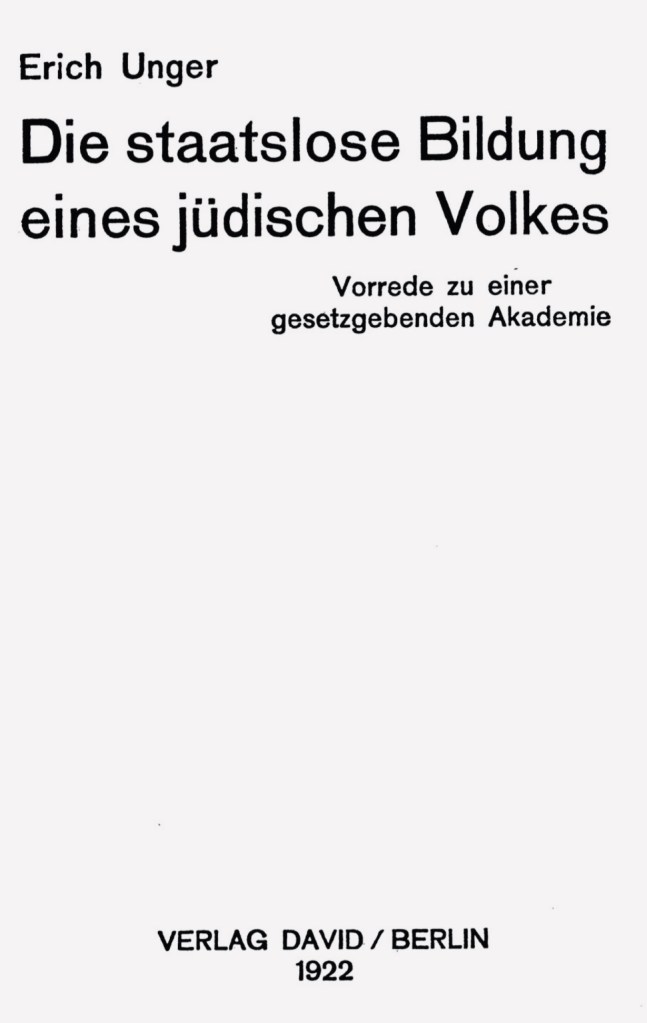
The same year that Carl Schmitt’s Political Theology (1922) appeared in the intellectual scene of the Weimar Republic defending the exceptional of the decision against immanentism, a short opuscule entitled Die staatenlose Bildung eines jüdischen Volkes (The stateless formation of the Jewish People, 1922) written by Jewish philosopher Erich Unger was published as an untimely response to the question of “Jewish identity” (Judentum) and its fate in the wake of civilizational collapse. The fact that this essay – as well as his 1921 book Politics and Metaphysics, which Walter Benjamin described as the most important political reflection of his time – has remained on the fringe of intellectual history, political theory, and the history of thought is something that anyone must seriously reflect upon. It should not come to a surprise that this text comes back today to attentive readers evidences how every creation, event of speech, or written word does not reside in the preventive invention of a specific audience; but, on the contrary, in the way that its words, images, and thought will generate the evanescence community of extemporal readers. The century that separates us in time from Unger’s essay bears witness to its ultimately proximity and prophetic calling.
In 1922, for Unger, very much like for us today, thinking about politics meant finding a way out of a catastrophic politics [1]. If Politics and Metaphysics had suggested the necessity of an existential and energetic exodus for breakthrough against civilizational sedentary absorption and domestication, in The stateless formation of the Jewish People (1922) Unger argues critically against a state Zionist project that artificially, and through the anti-universalism paradigm of force (just as Weil would argue during her war writings about politics in the West) will attempt to “absolute Judaism, and all the manifestation of judaism that remain outside, hostile to the state trend” [2]. For Unger, Zionism as a political ideology and state program fails to come to terms with the concrete “outside the world historical power” that characterizes the universalism of the Hebrews as a theology marked by dispersal in the West; that is, outside the philosophy of history of sacrifice and soteriological incarnation of the Christian eon [3]. Hence, Zionism’s political form of the Jewish people was epochally insufficient – too empirical and thus trapped into the modern logic of racial and biological survival – to express the true conditions to enact as the “a priori” for the question of Judaism as a grounded redemptive universality. And insofar as Zionism presupposes something “outside of itself” (corporeal and spiritual Judaism), for Unger “the demand for an imperial state…must modify its demand, since it should express its underlying basis of the demand differently” [4]. The Hebrew ‘universality’ was metaphysical as much as “concrete”, based on modal ritual and myth, and for this reason at a distance from the discharge of formal logical statements [5].
What did the apriorist consideration of Judaism mean for Unger? The hypothesis in The stateless formation of the Jewish People (1922) was far from bring esoteric: Judaism is a exclusively a spiritual, immutable soul matter that hoevers the surface of the corporeal; and, more importantly, “it governs itself independently through the insubstantial for of a concrete existence” [6]. In other words, for Unger before the unity of the “People”, the articulation of the “movement”, and the erection of a positivist constitution based on Zionist nationalist principles, one should consider the sensible fabric of a people – a dispersed, multiple, and metapolitical communities that have endured outside the geopolitical and sacrificial structuration of Christian history – that each and every time have insisted on the separation from the subsumption into a sphere of power and domination, into an ethnic-community validated by recognition and its claims to “consciousness” at the most empirical and material level. But this would amount to an effective liquidation – a surrogate for the acceleration of the dominant religion of historicity – of Judaism into yet another planetary religion, and an expression of power that integrates itself into the struggle for the nomoi of a contained and policed world. For Unger, “empirical Zionism” becomes the attempt to reduce Judaism to a “real self-executiving power” that will diminish the “supreme expression of existence” of Judaic spiritualism as “an inner experience that it is not historically given but that must precede it in order to make Judaism an endless and inevitable precondition of a truly world historical project” [7]. In this mold, Judaism will be dispensed into the theaters of the constitutive war of historical progress.
As such, Judaism as theologically transcendent is not to be conflated into the corset of a political fictive ethnicity, but rather as an autonomous transmission that allows the communication from soul to soul that descends all the way from its metaphysical beginning. And at this beginning that has exerted itself against the whirlwind of historical fixation (the very structure of civilization after Cain according to his mentor, the Jewish theologian Oskar Goldberg) were metaphysical and errant fragments of encounters and communication, of psychological energy and dispersal of shared spiritual goals. If this is lacking, then no political form [for Judaism] will arise, but only a foolish copy of the already-existing, because the spirit cannot be skipped and left out without the rising danger” [8]. It is telling that for Unger this rising danger can emerge not only from indirect powers that exert pressure against the unity of authority – as Schmitt would have in his framework of his theory of sovereignty in Political Theology (1922) – but also, and more dramatically, from the suppression and alienation of the spiritual interiority by which a “people” never coinciding with itself can arrive at the “crystallization point” (sic) outside of the individual [9].
Circling back to the problem of “catastrophic politics” – that Schmitt wants to “contain” through decisionism, and that Unger wants to overbecome through an exodus from political thresholds – at the crux of Unger’s indictment of the arcana of Western politics is the “it has set everything in such a way so that the metaphysical or religious area, the internal direction, stands as a mere private thing”, sidestepping the fact that even reality and the constitution of the principle of reality depends on interiority for the possibility of an outside. And it is this outside what allows the a priori historicity that Oskar Goldberg had defended in his book The Reality of the Hebrews (1925). As the late Bruce Rosenstock lucidly argued, for Goldberg (who stands as the unnamed reference in Unger’s position about an experiential Judaism), the “a priori” takes place in an ur-time in which the physical world was closely connected to the transcendental presence of the gods, in which the people cease to be a cultural, ethnic, or identitarian unit in order to become a humanity capable of “overcoming the catastrophic history of wars sparked by competition over scarce resources” [10]. In endorsing the instrumentalized politico-theological reduction of state Zionism, Unger sees the abdication of the “Jews as the people who have driven the spirit the furthest…to cultivate the spirit deeper, more skillful, more subtle, to be the most deeply suitable through this tension” [11]. A true and vital reality was in the conspiracy between souls, wherever and whenever these meet as the ultimate manifestation of the fidelity to the unspeakable mediation between the true life and the divine.
At the height of 1922, Unger did not suspend from a certain self-afflecting optimism, and towards the end of The stateless formation of the Jewish People (1922) he writes: “The Jews should not overlook their uniquely favorable situation; mainly, they have been materially unhistorical for two thousand years, and the only one that have not been beaten into a reality and into the shackles of the past or the empirical state that others have had to suffer” [12]. In Unger’s reading, Judaism and its errant communities (the ‘wandering Jew’ that Joseph Roth will narrate in these years, but that one must trace to the mythic texture from expulsion of Cain to the marrano) have shown the density to gather through spirit a resistance to the paradigm of force and the technicians in charge of dominating over materialism. As Unger states unequivocally: “the one who technically masters matter is ultimately defeated” [13].
This was Unger’s anti-promethean wager in 1922 skeptical of all political horizons oriented towards foreseeable catastrophes blinded to the underlying cyclical polarity of barbarism and civilization in the West. The wayward asymptote of a non-catastrophic politics was not to be found in the abstraction of the political concept or the mechanical construction of a state form through assimilation and usurpation, but in what Unger termed, in the most intense poetic moment of his essay, the Hebrew “ increasing decipherability of its own origin”. And unlike Enlightenment historians such as Edward Gibbon who saw the state as the irreversible revolution in world history that brought the age of the nomads to an end; for Unger the twentieth century meant the fixation of the state degenerating in the worst of barbarisms. It was the existence of the unit that must generate the internal limit to the political, and not the political as the external threshold to what is inherited in the world. And yet, insofar the events of thought, language, and imagination take place, the origin (urgeschichte) will always escape what has been sedimented by rubble and wars that fuel planetary destruction and collapse.
.
.
Notes
1. Erich Unger. Die staatenlose Bildung eines jüdischen Volkes (Verlag David, 1922).
2. Ibid., 6.
3. Ibid., 10.
4. Ibid., 15.
5. Erich Unger. “Universalism in Hebreism”, trans. Esther J. Ehrman, The Journal of Jewish Thought and Philosophy, Vol.4, 1995, 307.
6. Erich Unger. Die staatenlose Bildung eines jüdischen Volkes (Verlag David, 1922), 8.
7. Ibid., 19.
8. Ibid., 25.
9. Ibid., 24.
10. Ibid., 29.
11. Bruce Rosenstock. Transfinite Life: Oskar Goldberg and the Vitalist Imagination (Indiana University Press, 2017), 172.
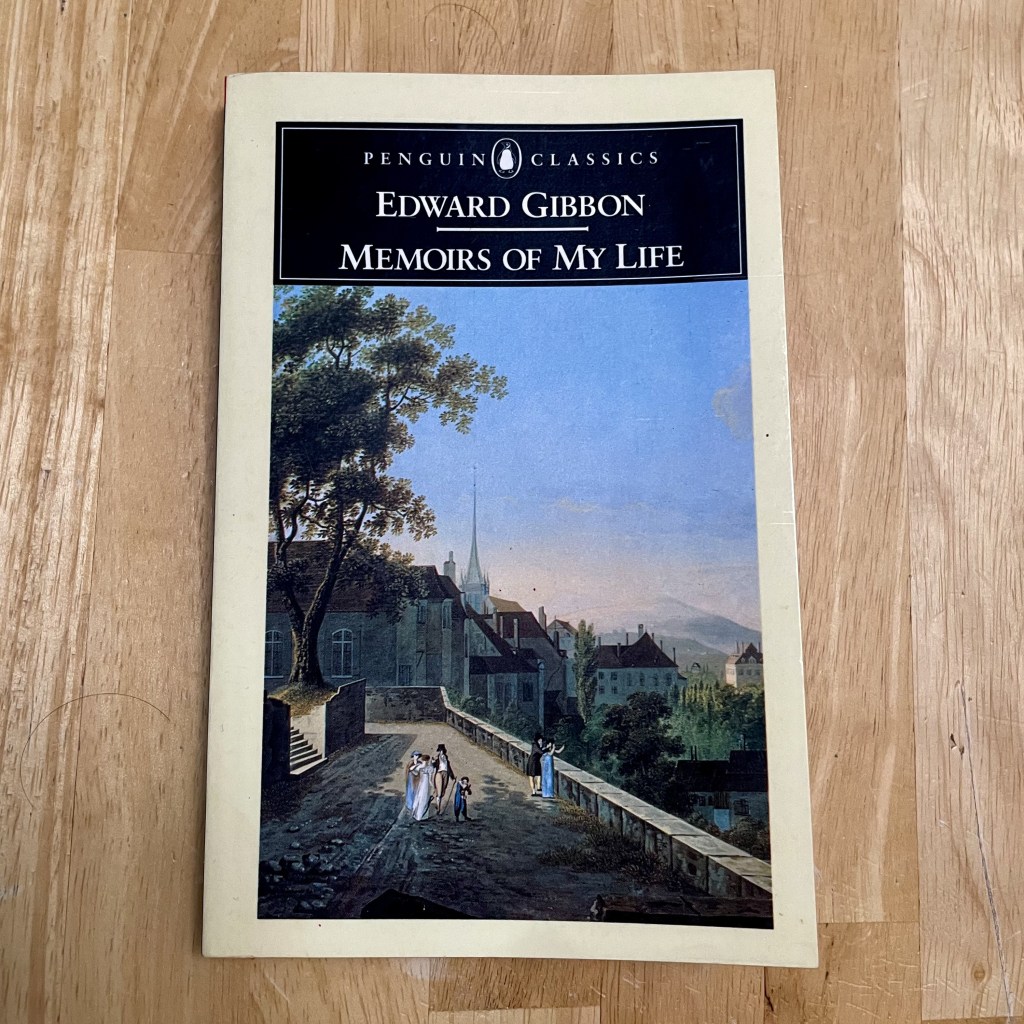
In his posthumous Memoirs from my life (1827), Edward Gibbon writes something quite striking about the modern English university in order to defend his alignment with the érudits. Now, to be an erudite was never something to be achieved at a university or academic discipline, it was something quite different in both style and form. Gibbon was quite crude when he writes:
“The schools of Oxford and Cambridge were founded in a dark age of false and barbarous science; and they are still tainted with the vice of their origin. Their primitive discipline was adapted to the education of priests and monks; and the government still remains in the hand of the clergy, an order of men whose manners are remote from the present world, and whose eyes are dazzled by the light of philosophy. The legal incorporation of these societies by the charters of popes and kings had given them a monopoly of public instruction; and the spirit of monopolists is narrow, lazy and oppressive. Their work is more costly and less productive than that of independent artists; and their new improvements so eagerly grasped by the competition of freedom are admitted with slow and sullen reluctance in those proud corporations, above the fear of a rival and below the confession of an error” [1].
It is worth noting that Gibbon’s defense of erudition – the same erudition that will make him undertake the genetic project of The Decline and Fall of the Roman Empire – is at least indirectly opposed to the reorganization of the university as infused by the ecclesiastical culture of priests and canon lawyers, which dominated the institution through the dogmas and platitudes legitimized by the currency of stable philosophical categories or doctrines. The university was always already an institution designed by the moral outsourcing of the intramural clerical rivalry among different levels of the administration and academic chairs. In a way, the future administrativeclerk will be an impoverished version of the clerical denomination (homo homini clericus now realized through leading ‘cultural benchmarks’).
It is only at this point that Gibbon’s skeptical and ironic stance against “philosophes” – the secularized figure of the ecclesiastical priest – becomes quite clear, since the rational philosopher occupies the role of the judge in the internal institutional validity, conceptual arraignment, and liturgical enactment of the self-sufficient subject of knowledge. Gibbon reacted against this specific “Enlightenment” that harbored a universitas drenched in the undercurrents of barbarism against the ‘freedom to understand’. Or more precisely: freedom to land the sublime height of personal style.
Under the sign of erudition, Gibbon understood tradition as a stylistic transmission that did not differ much from Hölderlin’s archeological suggestion in regards to antiquity; mainly, that formation only takes place when “we give ourselves our own direction determined by impure directions”; only this way truth-seeking can commence without prejudice and obscurantism [2]. In this light, the object of happiness must abandon the hubris of priestly academic knowledge in order to pursue the “love of study, a passion which derives fresh vigor from enjoyment, supplying research each day, each hour, with a perpetual source of independent and rational pleasure” [3]. It almost goes without saying that the fact that the contemporary university must justify every project, initiative, and prospect on behalf of current soteriological needs and values speaks to its organized alliance with barbarism against any possible form of personal erudition. But erudition, as something bestowed upon ourselves, will always persuade and humble men against the unreserved rhetorical force of the present.
.
.
Notes
1. Edward Gibbon. Memoirs of my life (Penguin Books, 1990), 77.
2. Friedrich Hölderlin. “The standpoint from which we should consider Antiquity”, in Essays and Letters (Penguin Books, 2009), 442.
3. Edward Gibbon. Memoirs of my life (Penguin Books, 1990), 98.
What comes after state form? The grounds for a self-evolving civil war at the heart of the social is what opens up in the wake of the collapse of the categories and grammar of modern politics. Stasiology becomes the fundamental unit to grasp the decoupling of the liberal state from its fixed guarantees and duties. Already during the crisis of legitimation of the seventies, we were told that the modern secular liberal state can no longer guarantee the conditions that made it possible, in the famous hypothesis developed by Böckenförde. The stasiological paradigm thoroughly governs the once implied mediations, social forms, and positive juridical norms of state-society internal mechanics without reminders and procedures. This is why all calls for political realism today are futile and insufficient; the only real existing realism is the one that must be confronted with increasing categorial inversions that ultimately channel the passage from a sufficiently ordered polity (the equilibrium of commerce and virtues) to the conflagration of the civil war as the production of social fabric.
All of this is implicit and glossed in Rodrigo Karmy’s excellent essay Stasiología: guerra civil, formas de vida, capitalismo (Voces Opuestas, 2023) in which the empty performance in the stage of fictitious contemporary sovereignty exchanged for the effective precautionary inversions that have become operative at a planetary scale: republicanism has given in to empire; the horizon of “liberty” nows entails dispossession and domination; authoritative and legitimate rule now means interpretative and exceptional discretionary execution; and, civil society (the modern civilizational unity for social cohesion) has become an axiomatic nexus to manage the tractions and turbulence of total economy (equivalence). The current state of things could not be more grim – and everything that passes through the sign of “order” (orderability, ordinary, ordo) elevates in the name of an self-sufficient abstraction that government paranoia to guide every deviation. The Leviathan stage has zoomed in into the pastoral exercise of uncontested dominion. Those that have claimed that the polis – precisely, as the sphere of social exchange and masquerade, in other words, of practical nihilism – is defunct are perhaps right in stating that its autonomy was destined to become the sheltered territory for pirates, delinquents, and the mafia. What is civil society today if not the confluence or the commuting space of the concert of all existing indirect powers?
For Karmy, abstraction and inversal do not mean just arbitrariness and formlessness lacking description. There is some rationality to what is arbitrary and anarchic in how the public powers are conjoined, distributed, and organized under several logistical units of optimal endurance: a) an axiomatic method that is immanent, flexible, and technologically sophisticated in its aversion to civil war; b) there is a process of exposition and vigilance that, conflating oikos and polis, makes hostis and inimicus indistinguishable, and by extension, coextensive to a global police (just as predicted by Carl Schmitt in the prologue to the Italian edition of The Concept of the political) that can manage and intervene in world-events as without residue. Expressively, Karmy reminds us, the police apparatus becomes the composition of cybernetic deployment based on the capillary consortium of information, reproduction, and differentiations. c) And finally, there is a nomic coupling between politics and geopolitics as the univocal destiny of a planetary humanity as a nihilistic mastery over nature, passions, and geographical localities. But if a century ago Benjamin suggested in One-Way Street (1928) that the power of the proletariat amounted to the measure of its convalescence, it seems that this is a materialist ideal that also has sunk deep into the anomia of the seas. Neither a “collective and sensible” proletariat nor a mobilized pacifist can enact the much expected epochal katechon; the immanent subject of Empire is already invested in the paradigm of force and counter-force, reinforcing what Karmy sees as the global practical and rhetorical geopolitics as an ongoing polemos: “Toda guerra es, ante todo, una guerra contra el pensamiento, Por eso abunda el análisis geopolítico” (Karmy 79). The manifest destiny of geopolitical grounding (knowledge, measurement, exposition) can only admit voluntary servitude towards the conflagration and the distributions of dominance and “influence” that has only intensified from the Iraq invasion of the early millennium to the Covid-19 pandemic techno-administrative measures.
But geopolitical dominance can no longer be said to integrate – there are too many cracks and holes in what it is still called, by inertia (Karmy calls it the ‘Newtonian hypothesis’) , the autonomy of the social. Similarly, its universality is a fallen one; but not because it has accepted the Augustuinian saeculum against the Pelagian heresy, but rather because its unitary mold consists in an internal stasis fractured within: a schism of every community from itself, a separation between things and forms in the originary sense of the Greek polis. Could another nomoi be recovered here? This is the last question posed by Karmy’s Stasiología (2023) through the poetic scene of Guadalupe Santa Cruz, whose turn to the garden is an involuntary act that gathers whatever is left of an ethical life from the ongoing devastation enacted by the barbarism of civilization. The garden is the threshold to a world according to Karmy reading Santa Cruz: “…al borde del mundo, el jardín es la figura que remite al cultivo de estilo, cuidado de la potencia de la imaginación, en último término, lo que designa un gesto” (Karmy 102-103). It is no coincidence that gesture and gestar is a polysemic term that allows to comprehend the figural and self-evolving of a transformation of life; “freedom” is not to deploy internal force towards the appropriation of advantageous outcomes and interest, but of the possibility of delineating the appearance of “a life” holding the unmeasurable world in proximity [1]. It is at this point where forms color how we become who we are.
What must be saved is not “life itself”, but rather the theōs between world and existence that opens “new possibilities” that is anti-scientific precisely because it is not incorporated by the pressure of objective absorption. The theōs is the invisible deviation from the worldly necessity of how things should be and what our lives should aspire to become; and only in this sense we are all martyrs as witnesses to this nearness. Extracting a further consequence from Karmy’s Stasiología (2023) one could claim that every desertion from geopolitical destiny – its unspeakable misery, its blatant bad faith, its farcical prepotence that forces a parodic eschatology – presupposes a return to a new life, which has always began at the surface of our face, as if anticipating reality prophetically: “Only a genuine revolution succeeds in changing the way people look, their facial expressions, the light in their eyes, the charm of their smiles. Christianity appeared with new faces, or taught a new way of looking at them. It is something that anticipates reality, as if prophetically, the universal change that for almost two centuries now has been shaping new faces throughout the whole world.” [2]. If the acclamations for a “New Man” concerned the humanist aspiration of the productive modernity; the vita nova concerns, first and foremost, the conservation of the partition of the soul, the only true entity of alienability where life conquers death. The practice of stasilogy sets out an exercise of this elegant depiction: allowing invisibility to prefigure and breach a new life from the trenches of a never ending struggle.
.
Notes
1. Monica Ferrando. “Gestare la figura. Note sulla pittura e il suo gesto”, Giardino di studi filosofici, Quodlibet, 2018.
2. Carlo Levi. The Two-Fold night: A narrative of travel in Germany (Cresset Press, 1962), 109.
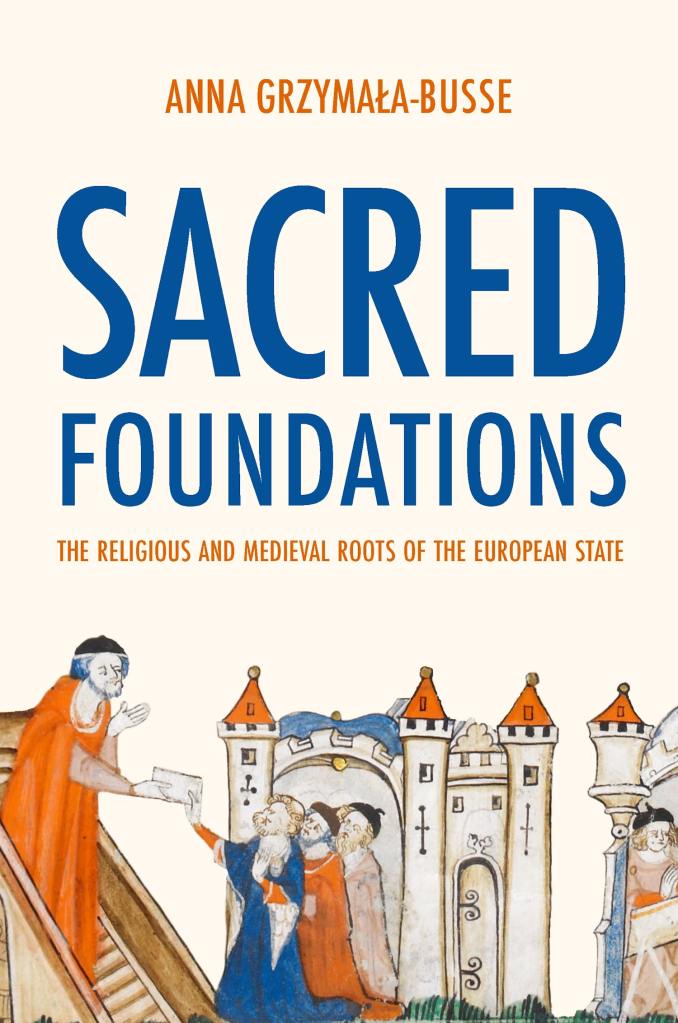
Anna Grzymala-Busse’s recent study Sacred Foundations: The Religious and Medieval Roots of the Modern State (Princeton U Press, 2023) makes a compelling historical and data analysis grounded case for the emergence of the modern state through the process of the Church’s autonomization in its ongoing disputes with the European monarchs across the centuries. This process of the secularization of ecclesiastical forms (conciliarism, legal administration, the uniformity of procedures, rules for governing institutions, the emergence of educational training and mechanisms for political representation and fiscal control, etc), however, is silent about two defining features of the modern secular state. And I do not think it is an exaggeration to say that these two elements bring forth the way in which political authority was established after the victory of modern European Enlightenment. Busse’s book, if anything, has the felicity of putting in perspective, even if only in negative, the two pieces of the puzzle: a) coercion as guarantee by a legal process (not just the monopoly of force); b) and the inter-institutional coordination that we tend to associate with a ‘principle of an internal rule of recognition’ between different spheres of bureaucratic rationality. Busse admits for (a) that “….the authority of the people over the whole Church was not statelike. It depends on moral authority and influence, not on coercive control. Both kings and popes cajoled, convinced, and threatened rather than demanded or extracted force” (Busse, 78). But ruling on morality and influence are two weak presuppositions to guarantee systemic, homogeneous and uniform process required by institutional authority.
In other words, the Church was able to construct forms of civil mediations, although it lacked the power of efficacy; that is, a coherent set of reasons for action that would define a strong concept of sovereign authority as service (to put it in Raz’s well-known formulation). The classical apothegm by which ‘kings rule rule but do not govern’ (Rex regnat sed non gubernat) now is protracted by the exercise of an efficacious rule, which means laying out a combination of forms and a well-ordered power over coercive forms. In fact, this is one feature that will define the legitimacy of the Enlightenment according to historian Franco Venturi; the discovery of punishment understood within the scheme of a trade off between the “necessity of the right to punish when man was not able to re-establish communism” [1]. Hence, the genesis of modern legitimation is not exclusively “a given” vis-a-vis the structure of separation of powers and the ultimate source of the plenitudo potestatis; rather, it requires a second-step rule, as it were, to convalidate the specificity of institutional authority with ample concrete efficacy of police powers in charge of compliance and punishment. The reach and exercise of public police powers and the systematic ordering of penal codes through a criminal procedure and its guarantees (reasonable doubt, fair trial and due process, no crime published without a previous enacted law, nullum crimen sine lege) is what renders effective and “energic” the principle of authority.
Now, broadly speaking, when it comes to (b) Busse admits that (and this is in spite of its institutional schemes) laying down justice “…the church relied on secular enforcement, for example when it came to religious orthodoxy. […] The carrying out of sentences against heretics and apostates lay in secular hands – those found guilty were handed over the temporal authorities so as to not sully the clergy. Legal coevolution and influence, the struggles between popes and monarchs, and the diffusion of both canon law and personnel into the juridical systems were critical to the rise of constitutionalism and the rule of law in Europe” (Busse, 132-133). This asymmetry between two systems of legal jurisdiction confirm the inexistence of a strong internal rule of recognition that for H.L.A. Hart defines any robust modern legal system of public law. The internal rule of recognition, one must remember, is not a set of principles or norms for social action, but rather the internal mediation between a legislative authority and its internal obedience within a concrete application thereof. The internal rule of recognition binds a central authority with its specific formal enforcement in institutional union of primary rules and secondary rules to avoid the pathology of uncertainty. This is thoroughly absent from the free-floating institutional forms of the medieval church whose principal construction of primary rules was divorced from the objective and rational procedures of its internal coherence (the rule of recognition) that would ground, in time and place, the otherwise abstract primary norm and the pressure of contested social conflict.
But going straight to the crux of the matter, it follows that medieval templates as superbly redrawn in Busse’s studies lack the two fundamental determinations that ground the modern concept of law: law as the necessarily monopoly over coercion (the Austin thesis), and the concept of law as the construction of an internal rule of recognition to unite primary and secondary rules (the Hart thesis). But insofar as all major modern political concepts and mediations are secularized forms of religious and medieval forms – something we can say that Busse’s scholarship also confirms – we can then say that modern legitimacy will consist in the congruence of these two determinations to organize the mediations between civil society and state. Already in his early The value of the state and the significance of the individual (1914), Carl Schmitt will note of this formal transplant: “…the Catholic doctrine of the Pope as the infallible interpreter of the natural moral law and of the content of revelation, who receives the competence to declare state statutes that stand in contradiction with the moral law or ius divino-naturale to be non-obligatory in conscience. The exercise of his potestas indirecta which is regarded as an act of jurisdiction, and which is held, by many canonists, to be determinative of a statute’s validity in state law – contains real vis coactiva, even where the expression potestas directiva is employed in place of potestas indirecta (Suárez, de fide cath, 3.22.1)” [2].
For Schmitt, then, the process of rationalization between ecclesiastical form and the modern legal norms of the state is very much straightforward. This is what constitutes the very texture of secular modernity. But as we know, for Schmitt the secularization of forms was not enough – it must be said that he himself did not negate in his theory of adjudication of his constitutional thought – which is why the construction parameters of his ‘political theology’ proposes supplemental safeguards to isolate law and power, extending the power of secularization into the decision of the potentia dei asoluta (at times this was contained in the theological figure of the Katechon) [3]. But as Carlo Galli has noted, Schmitt’s political theology is far from a “political christology” or a substantive theological politics grounded in natural law; rather it is a resolute affirmation to defend any concrete order from the potential fallouts of the secularized cornerstones of rational neutralization (potentia directiva and potestas coactivva) of state authority [4]. Neither mechanic state forms nor a higher source of morality (natural law) would define the modern law; rather the autonomy of the political in the existential situation could provide the sufficient energy to avoid the self-defeating circularity of ius revolutionis (this is what most of the times is obliterated from the so called question of “decisionism”)[5]. If Busse is correct in making the case that all modern institutions have sacred medieval foundations; Schmitt’s concurrence in the wake of modern secularization will be to define the energy of the political as the defining element that must stand as the threshold of formal transplantations to have a chance within nihilism and against nihilism. It is both things. In other words, formlessness is the constitutive dimension of political forms; an element that defines, in my view at least, the strongest practical element of what it is to inherit a Christian political foundation. The process of secularization is thus infinite and groundless, ultimately without a moral foundation and universal design. Among its many achievements, a book like Sacred Foundations: The Religious and Medieval Roots of the Modern State (Princeton U Press, 2023) has the ability to refine what political theology is, what it meant, and what to make of its endurance and possible iterations in our present.
.
.
Notas
1. Franco Venturi. Utopia and Reform in the Enlightenment (Cambridge University Press, 1971), 116.
2. Carl Schmitt. The value of the state and the significance of the individual, in Carl Schmitt’s Early Legal-Theoretical Writings (Cambridge University Press, 2022), eds. Zeitlin & Vinx, 215.
Pasolini never ceased reflecting upon the painterly nature of the image outside of both literalness and abstraction. In Pasolini we are accustomed to be exposed to a set of antinomies: image and depiction, tradition and the primordial, figuration and the tactile, the world and its fragments. The publication of his miscellaneous writings on painting (and painters of the Italy of the 1950s-1960s) Heretical Aesthetics: Pasolini on painting (Verso, 2023), edited by Ara Merjian and Alessandro Giammei, provides depth and substance to document Pasolini’s insistence to the pictorial activity as an index of unmediated expressivity against the domestication of the accelerated capitalist form that soon enough will generate devastating consequences for idiomaticity and the pregramatical expression of a living culture. It is not too far-fetched to claim that painting remained for him a necessary condition of the cinematic; a specific craft that fundamentally rejected the impulse to naturalness and its mimetic performance. Pasolini remains attached to painting as a form of embodiment, a corporeal resource, and an energetic surface of positioning of light.
After all, as the editors of the book remind us at the outset, Pasolini was after the “plasticity of the image” (37). And plasticity pushes the dexterity of human creativity, but it is something else as well: it is a line of expansion into the prehistoric when it comes to the frontier of appearance. And perhaps Pasolini would have agreed with Gianni Carchia’s indictment in Il mito in pittura (1987) that the attempt of realizing appearance – even at the cost of failing at it – is the fundamental metaphysical node in which the entire history of Western painting stands. A good painting elevates itself to supreme theology, as Luca Giordano said of Velázquez. The problem of appearance in Pasolini’s scene of writing on painting is registered through partial indications: the tone of detailism, the violent and free moving impressionism, the struggle for stylistic contamination, or in the “fragmentary chromatic and interrupted aesthetic” (114). Pasolini’s eye is always accessible to the transient and expressive in a picture.
But the Italian filmmaker struggles with description of paintings, as if possessed by a permanent impatience that harbors his recurrent shortcomings. And he was not unaware: “I am not fluent in the terminology of painting, so forgive me if I sound less specific” (134). It is a declaration that does not only appear once in this collection. One could speculate that this dilemma is resolved by Pasolini in three ways: first, he can choose the painters from a personal criteria that would justify his awareness of painting as a prehistoric cultural activity. Secondly, Pasolini repeatedly alludes to the teaching of the great Italian art historian Roberto Longhi – who was responsible for the first formal analysis of Piero de la Francesca’s pictorial oeuvre – as companion and a maestro that during the Fascist interwar period gifted his students (and Pasolini among them) a different reality through commentaries on the seminal works of Italian Renaissance painting (155). Longhi’s anti-iconographical approach to the pictorial tradition allowed Pasolini a sense touch – not less real than the physical hand that caresses another body or hard surface – and the inexorable mystery-like quality of plasticity. Thirdly, Pasolini avoids coming near a possible ontological description of what, in fact, painting as such stands for him. Does it have an autonomous specificity, or an internal grammar, or perhaps an intricate dependence on other artistic activities (poetry, cinema, social criticism, politics)? Pasolini wanted to understand painting as a force of absorption even if ultimately blinding to the spectator. Nonetheless, Pasolini’s commentaries is rigid at the abyss between what painting is (or should be) and the painters or pictures that he explores in these pages.
This abyssal between word and depiction vouches for Pasolini’s unresolved tension with the nature of painting; a picture is always already dependent or attached to a peripheral phenomena that moves beyond the modern vista’s fulfillment towards totality. In fact, there are a few moments where painting is qualified, as in the text on Carlo Levi: “We are in the presence of something mysterious, ineffable. To speak about that something I can only fumble in the dark, since O a, without a proper terminology…but this ‘something’ is a mystery to me” (176). Or, when in the fragment “Dialectal painting” he suggests that “ [the dialectal tone] is not for the objective content of its figure sand landscapes, but also for the tone he uses to represent it (a tonalism drawn, we could say, from a crepuscular post-impressionism)” (81). Both fragments – so distant from each other in time; one from the fifties and the one on Levi from the seventies – provide an approximate orientation of Pasoloni’s fixation of painting in its specific muteness. This is not because it lacks language, but rather because it only speaks in its own dialect. A painted picture is always about resolving a situated uncanny appearance.
And for Pasolini only the partial profile of a picture – its superficial depth and strength of figuration, but also its lack of sentimentality and abandonment of lyricism that he would come to associate with the bourgeoisie worldview – was capable of dialectical valance, thus upending its misstep into the vulgarity of the “equality predestined and predetermined…the representation of such a world excludes the very possibility of dialectics” (186). This was his indictment of Warhol’s homogenous silkscreen prints and the general phenomenon of Pop Art and the neovvanguardias as coordinated efforts to surpass all that was past and present collapsing into “the voice of the homo technologicus…replacing history with a surreptitious and sacral prediction of history” (147). Bernard Berenson would have agreed to this: the inception of ‘knowing’ over seeing will only secure further mimetic and mystified (through mechanized and applied models in advance) points of departure for a subject of consciousness directed towards history. This is why for Pasolini the avant-garde can only “make the definition of that moment zero [of absolute beginning] profoundly insincere” (149). Painting and tradition walk along the abyss of nihilism. Only negatively can we say that for Pasolini painting is, then, an earthly activity; it is about being in the world in spite of the state of the world; attached to seeing even if the blurred limits perturb the open horizon.
The allure of a lagging postmodern and mechanized painting – but isn’t’ the eclipse of painting for the epoch as such? – for Pasolini exchanges, rather too quickly, lyricism (dependent on the romantic subject that attains it) for nuanced poetic sayability. After all, one of the most straightforward assumptions entertained by Pasolini is that “a painter is a poet who is never forced by circumstances to write in prose…” (106). A remark that comes very close to Poussin’s assertion that painting is an endeavor about the mute nature of things. The muteness of painting has granted artists the possibility to evoke the picture from poetry, as if word and image by entering into proximity can finally participate, side by side, into the mystery of appearance withdrawing from the “adumbrations of our present image-world”, as T.J. Clark recognizes it. There is something to be said in this respect about Pasolini’s long poem “Picasso” (1953) where the medium of poetry touches Picasso’s canvas only to flee from its empty abstraction, disclosing the cunning negation of the world. Or to use a trope common to Clark’s art criticism: Picasso’s fall of Icarus lacks any possible awakening in the present.
Pasolini’s last verse of the poem expresses what for him painting should avoid: “Sunday air…and his error is here [Picasso’s], in this absence. / The exit to / eternity lines not in this desired and premature love. Salvation is to be sought by staying in hell, with a marmoreal will to understand it. A society fated to lose its way is always bound to lose it: a person, never” (75-76). For him painting and Paradise are not meant to cohabitation – which bears witness to Pasolini’s long lasting commitment to the fallen modern world ascertained by the promethean durable struggle. Painting is poetically affirmed by retaining to what does not come to pass: the convulsions of this world. But a question remains: should not the distance implicated in seeing be sufficient in a fading world? Traversing this distance is the inherent divine task of painting; or, as Pasolini simply called it: “exquisite, mysterious – a new religion of things”.
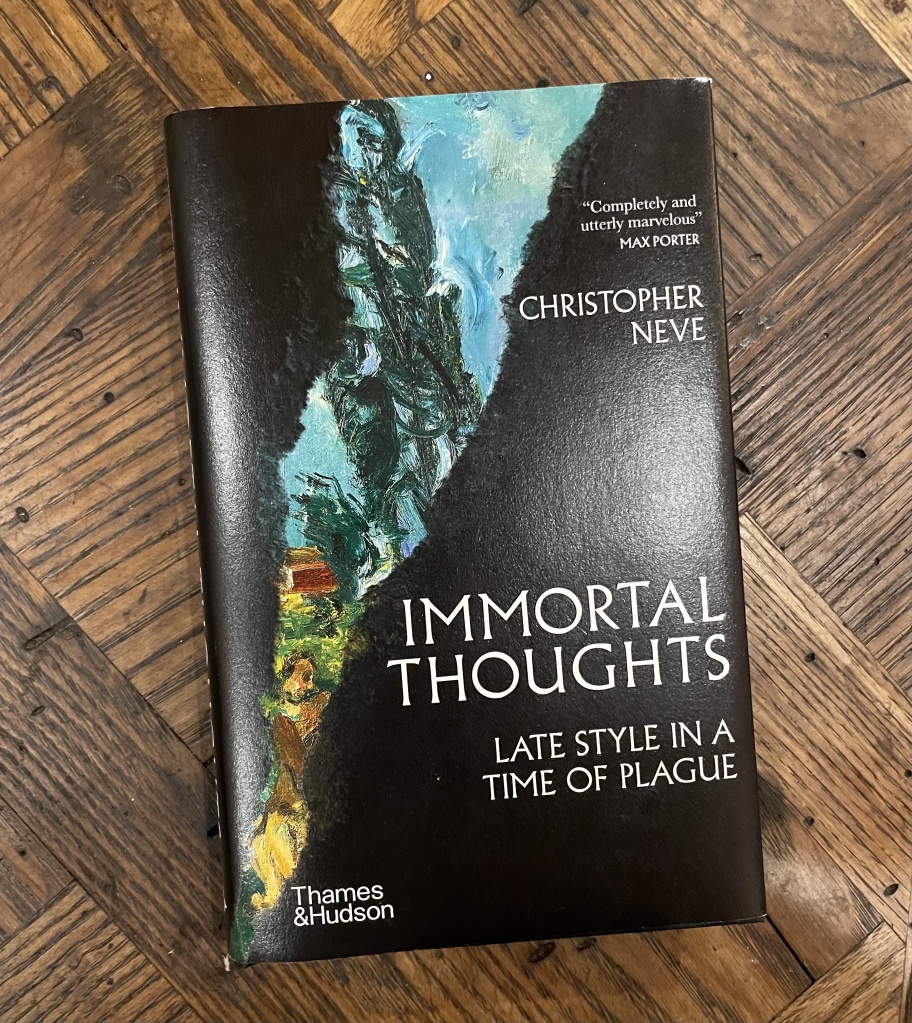
In his Immortal Thoughts: Late Style in a Time of Plague (Thames & Hudson, 2023), Christopher Neve ponders whether there is something like an “experience” of late style in painting. He immediately sets up himself to the task in the last works of great modern masters, from Cézanne to Soutine. The notion of “late style” can only be raised at the definitive end of the artist’s path. The old age style is an aspotilla no longer dependent on approval and excellence; it favors inner capacity and dexterity of seeing. This is why late style is, probably, always self-transformative: it poses the notion of work under erasure as it comes near the zenith of retraction. For Adorno late style registers the failure of synthesis as well as the force of dissociation in the permanence of the catastrophic. Neve will perhaps agree this much: painting is not about fixing temporality (the density of the history, the vulgarity of the contemporary, the monumentality of the past); rather what remains is the fugitive scene of depiction. If the question of “late style” is immensely difficult to raise, that is because it resists conceptualization: it merely seeks to denote achievement and the ruinous; appearance and retreat; unlearning schematics and producing “from life” itself, to put it with Poussin’s pictorial vocabulary. Late style is not about the moment of judgement and recapitulation – it is what depiction can achieve in the twilight of creative powers. As Goethe once defined old age: “Old age is gradual retreat from appearance”. But this retreat animates the space that had remained secluded in the order of temporal abstraction.
There is no theory (and there will never be) of late style of pictorial representation. It is a question that merits the weight of description – which Neve combines, quite successfully, with that of emblematic instances of the artists’ form of life. In other words, late style does not require conceptual renditions; it demands the elaboration of strong descriptions that can grasp the resonance of a fundamental ethos. Neve glosses Delacroix’s ethical imperative: ‘only in old age does a painter finally know what sort of artist he should have been all along’. In late style there is coming to conclusion because there is a path for homecoming. This ethical dimension of the artist is neither regulated by form nor by epistemological conditions. Late style implies a stripping away of things; it bares a specific nudity: it can reveal interiority (the invariant) without argumentative absorption. If anything else, it is the non-knowledge of the gesturing hand. Neve points calls this “statement” when offering a treatment of Rembrandt’s old age: “…technique and the process of getting older, and that this was somehow done all in one, summed up and expressed undeniable and in confidence of one blow and as a single statement. And I wished that all painting could be like this” (46). We suppose Neve’s desire as hyperbolic, since painting under a single statement also implies the moment when the picture approaches the abyss between the hand and the order of reality.
Painting gravitates towards a single statement when it surpasses life by taking death seriously. There is much truth in reminding that the work of art aspires to its bare lyrical moment of decline and unworking of itself – this was also Cézanne’s moment of “not being able to realize!”- in order to flee from the objective fixation of the “thisness of nature”. Painting assembles a transfigurative force against the temporal succession of the pro-duction of a specific work on a surface. As expressed by the old Pisarro from the window of his studio quoted by Neve: “A little more work before dying” (54). True, nothing else but painting mattered to Pisarro, as Neve reminds us. Now, does this mean that he is holding on to the unchanged and muted essence of things as a “metaphysical solace” in the face of the whirling of a world in chaos? Perhaps there is something to this suspicion that must be reckoned with – painting comes close to theological presuppositions insofar as creation unsettles a disenchanted world and its fictitious mimesis. Alas, this is a question not fully posed by Neve, but it is also one of the ways in which his book could travel without much effort. The question of immortality of a picture has a point of departure here. But is immortality conceivable as a form of solace and fallen piety? One should refuse to ask this question in the form of generality. The works Titian, Goya, Cézanne, the dreary and posthumous glory of Velázquez or the suffering Soutine during the Nazi occupation are all efforts to pose the problem of late style painting as the ethical attunement of each artist.
In the most elevated and charged moment of Neve’s efforts to grapple with the notion of style he recurs to Soutine (and it requires us to turn to the picture “Children playing at Champigny” from 1942): “What you are seeing, when Soutine paints the Auxerre trees, is what I think happens in the work of most of the artists I haven written about here. This storm of temperament is true painting, an inexplicable combination of seeing, feeling, memory, response, imagination, and profound oddness. And so he turns away in exhaustion” (122). Late style registers the collapse of a possible fulfillment with the world by indexing a detour to the point where realization seeks to “return to simplicity and order”. Truth indicates the literal thereness on the surface devoid of illusions. So, solace does not have the last word; this is not how a painting subsists under a single statement. And that accounts for the ultimate risk: the ethical presupposition of painting exposes the artist to the “terrible freedom” as the distance between the passions (temperament) and the gesture within profound disorder and arbitrariness of nature.
Someone like Carlo Levi will find himself at home: true freedom cannot begin by the suppression of the passions in the name of interests; rather, the burden of freedom is the caesura of passions that displaces the otherwise inexorable fear of civilizational progress. Painting as the event of truth dethrones fear as the primary attunement in reality. Through our emperament one finds the exit from alienation, gathering the moment of depiction into order. There is a gentleness of freedom in the mutual self-supporting carrying of things, as Kurt Badt saw in Cézanne’s old style. And this might be the tragic element of painting and its fundamental antinomy.
For Neve this means nothing shorter than “the world reduced to a series of prodigious impulses, the revelation of the inner intact, the change taken to see the universe in a new light at the risk of failing utterly” (130). Late style is what reveals inner intact to the fruition of exteriority – this is the compass of visibility. A failed world followed by decline – two terms where mythic transfiguration moves painting to the eccentric luminosity of altering the jarring relation with the world. Old style enacts a catastrophe that refuses the insolvency of pulsation that binds character to the harmony of form. One might add that it could very well be that painting is, as revealed in the abyssal caesura of a late style, a stated mystery: a passionate life that profoundly perturbs the world, a transcendence that falls into an irrevocable eternity.
There is a moment in Hölderlin’s late hymn “Friedensfeier” (1801) where communication is strictly defined as becoming a song. The verses in question are about midway into the poem, and we read read the following:
“Viel hat von Morgen an,
Seit ein Gespräch wir sind und hören voneinander,
Erfahren der Mensch; bald sind wir aber Gesang.”
“Mucho ha, desde la mañana,
desde que diálogo somos y oímos unos de otros,
aprendido el ser humano; pronto empero seremos canto”.
This is the Spanish rendition by the Venezuelan poet and translator Verónica Jaffé [1]. These lines stand for Hölderlin’s unique effort during the years 1800-1804 to substantially qualify what he had confessed to his mother as his true task: to live a serene or quiet life. I think this Spanish translation is much closer to the original German. Jaffé hangs on the present perfect with conviction: “Mucho ha…”, as if knowledge remained at a distance in the metric while becoming a temporal duration, a form of experience. This is the poetic “strict mediacy” for Hölderlin that can only be cultivated [2]. And it is only through the duration of experience that one will become a song (“seremos canto”). We are not yet there, hence the apostrophe. In the late period, duration meant dealing directly with Pindar. Thus, the song is something other than language – even if announced through language. But it is a paratactic dispersion that seeks to free the pure voice. In one of the “Pindar fragments”, this is what Hölderlin claims: “then only the difference between species makes a division in nature, so that everything is therefore more song and pure voice than accent of need or on the other hand language”. [3]
I am caught up in the moment of “division in nature”. The subtraction from representational language allows for the true appearance of a more originary separation, where the song can finally emerge in its proper attunement with the world. The becoming song is another form of separation, which institutes the passage from the Empedocles (tragic sacrifice) to the Pindaric relation to the divine. This is the “highest” poetic challenge for Hölderlin – an impossible task after the fleeing of the gods. It is definitely maddening. Nevertheless, the song remains. It puts us in nearness in a postmythical world without recoiling back to the image of the tragic. Indeed, as Hölderlin says in passing in “The Ground of Empedocles”, his time already “did not demand a song” [4]. The passion for natural unity was an Olympic illusion whose retribution could only become romantic debris as the exclusive possession of the dichter. On the contrary, the clearing for the song has emancipated itself from the exclusivity of the modern autonomy of dichtung as mimetically separated from the experience of life. This is what the song wants to pursue before the closure of a significant (and signifying) world. Fundamentally, this means a subtraction from the continuum of language, and thus a form of prophecy as elaborated by Gianni Carchia in a difficult passage from “Dialettica dell’immagine”:
“Where music and prophecy, in the inexhaustibility of their tension – an endless effort to overcome the Babel dissipation of language by freeing the residual state of the unexpressed – testify to a disposition to meet precisely in what passes, in pure transience, the need for salvation and the idea of fulfillment, beauty as a totalitarian and exclusive appearance is, on the other hand, nothing but the product of an arrest in the dynamics of the spirit which withdraws from the horror of worldly laceration to seek refuge on the scene circular and static of the eternal”. [5]
If the song addresses the prophetic it is because language has fallen to the fictitious needs that arrest the experience of the human being into the exclusivity of rhetorical force and poetic genius. Is not the song a refusal of both? A refusal now aimed at the “highest” task – that is, the serene life? Against the exclusivity of appearance that Carchia points to, what appears discloses a different sense of law. A few verses in the same poem, in fact, we are confronted with the “law of destiny”: when there is serenity (or peace) there are also words. And a few lines after: “the law of love” is equilibrium from “here” to the “sky”. What appears there is the landscape that comes through in a pictorial depiction: “[Sein bild….Und der Himmel word wie eines Mahlers Haus Wenn seine Gemälde sind aufgestellt] / “[su cuadro e imagen….y el cielo se vuelve como de un pintor una casa cuando sus cuadros de exponen]”.
Does not this also speak to the insufficiency of language, which justifies the step into a folded painting? There is a painting and a vanishing image, but also the painter marveled at gleaming finished masterpieces. Is painting the original placeholder for the song as originary attunement of life? Perhaps. But in its enactment it also means that the song is impossible to disclose except through pictorial invocation. It is a painting of a life in the world, and nothing less. The transfiguration of the law places men no longer into undisputed submission, whether in its positive or natural determinations, but rather of a “strict mediacy” that is ethical in nature. A third way of the law that does not renounce the problem of separation.
Monica Ferrando has insisted upon the enormous importance of this conception: the fact that Pindar’s nomoi, in fact, relates to the nomos mousikos, which is fundamentally dependent on gathering substance of the song [6]. The strict mediacy finds itself between the mortal and the immortal. It is definitely not a “return to the state of nature”, and I do not see how it could be reduced to “genius”, except as an ethics whereby appearing is no longer at the service of objectivity [7]. Adorno was of course right: it is a ruthless effort to deal with disentanglement of nature – and the nature of reason – but only insofar as it is a return to the song. Or, at least, to have a path toward the song: a lyricism of the indestructible against the closure of a finite time dispensed and enclosed.
.
.
Notes
1. Friedrich Hölderlin. “Fiesta de Paz”, in Cantos hespéricos (La Laguna de Campona, 2016), Traducción y Versiones Libres de Veronica Jaffé, 93. I thank Philippe Theophanidis the exchange initial exchanges on these verses.
2. Friedrich Hölderlin. “Pindar fragments”, in Essays and Letters (Penguin Classics, 2009), 566. Kindle Version.
3.Ibid., 565.
4. Friedrich Hölderlin. “The Ground of the Empedocles”, in Essays and Letters (Penguin Classics, 2009), 465. Kindle Version.
5. Gianni Carchia. “Dialettica dell’immagine: note sull’estetica biblica e cristiana”, in Legittimazione dell’arte (Guida Editori, 1982), 21.
6. Lucia Dell’Aia. “Il Regno d’Arcadia: intervista a Monica Ferrando”, in Il mito dell’Arcadia (Ledizioni, 2023), 121.
7. T.W. Adorno. “Parataxis: On Hölderlin’s Late Poetry”, in Notes to Literature (Columbia University Press, 1992), 148-149.
The origin of Eliseo Diego’s mythical poetic collection En la Calzada de Jesús del Monte (1949) is so well known and recorded that it has been completely forgotten even by its most copious commentators. In his short memoralist essay “Un día ceremonial”, written decades after the publication of the poem, José Lezama Lima wrote the following: “En uno de sus ceremoniales litúrgicos, en un día de nuestro santo, nos reunimos en la iglesia de Bauta. En esa ocasión Eliseo Diego leyó su “Primer discurso” de En la Calzada de Jesús del Monte. Era un precioso y sorprendente regalo, suficientemente para llenar la tarde con aquella palabra que nace para uno de los más opulentamente sobrios destinos poéticos que hemos tenido…Cuando se publicó En la calzada de Jesús del Monte, el júbilo que me produjo fue esencialmente poético. En unos versos de circunstancia amistosa he intentado decir la alegría que me produce ese libro que traía esclarecimientos para nuestro paisaje y su acercamiento” [1]. At the center in this confession is not only the centrality of a poetic liturgical practice that vested the friendship of the origenistas poets, but more fundamentally the efficacy of the poetic word that Lezama describes as a “júbilo poético” or poetic happiness. It is a strange remark (like almost everything written by Lezama), since En la calzada de Jesús del Monte has been largely read as the litany of a domestic space (a “gran casa de todos”) consumed by dread experienced at the turn of the mid-century failed and stagnated republic.
The intuition raised by Lezama, although not elaborated, still haunts us: in what sense is En la calzada de Jesus del Monte about poetic happiness and what could stand for? We can go astray if we claim that happiness is a particular substantive and representational content of the poetic word. Indeed, there is really no event of happiness in En la calzada de Jesus del Monte except for the taking place of the poetic word fully estranged and foreign from its own place of annunciation. This seems to confirm Diego’s poetic vortex who writes in the dedicación of the book: “A poem is nothing more than a few words told one afternoon to a group of friends” [2]. However, this only deepens the mystery, since whoever tries to find concrete friends in En la calzada de Jesús del Monte (1949) will find none. Solitude abounds and expands throughout spaces. Lezama attempted to elevate the secret of friendship from thought to the liturgical enactment in search for transcendent meaning. Indeed, the emphasis on the mystery of liturgy is emphatic and compressed in Lezama’s programmatic memory about the almost ecclesiastical origins of the poem. I would like to suggest another path for the mysterious and inapparent force of the poem, which is no longer situated at the liturgical aesthetic experience, but rather in the mystery of a felicitous life at the threshold of history. If anything is disclosed throughout the pages of En la calzada de Jesús del Monte this is, precisely, that things appear to dwell in their place, even if no one is around and no community could stand for its reverence. Indeed, the poetic event dwells in an existential solitude before a changing world now fallen into pure disenchantment.
The happiness that falls from the poem, then, is not merely about the execution of the word or the unity of form, but it consists of something previous, altogether different: a mysterious shadow of the enchanted myth. In En la calzada de Jesús del Monte (1949) we are exposed to a poetic language that gathers in a desecularized dimension that suspends what Gianni Carchia identified as the postmythical form of mystery that seems to anticipate the semblance of historical order [3]. But Diego’s En la calzada de Jesús del Monte transfigures mystery to the point of disclosing the limit where life and redemption from the material world take place; namely, in the Sunday of life. But, unlike for Carchia, this poetic transfiguration takes place within the grammar of Christian theology and not the Greek classical past. Here Diego’s poetic mysterium differs fundamentally from the liturgical mystery, which presupposes a “fundamental sacrifice” that allows the temporal sequence of the end of time as the motor for universal religious redemption [4]. By contrast, Diego’s idea of a poetic mystery (which is also the mystery of the poem, which he never ceased to reflect upon through his life) is spatially dispersed, redeeming eternal life from the visibility of worldly phenomena. As Diego writes in an essay defining his conception of the theological mystery: “Primero les haré una confesión…no veo por la sala ningún hábito de Santo Domingo. Uno no debe jugar con los Misterios Mayores, y ninguno es mayor que el Misterio de los Tres que son Uno. Pero, ¿acaso no hizo Él a las ballenas y a los colibríes? ¿Acaso él no sonríe con la infinitud de sus peces y sus insectos? No creo que me tome a mal esta broma que hago como un niño pequeño que pretende jugar con su padre” [5].
By separating the “mayor mystery” of the Trinity from the minor mysteries of imaginative creations of the world (fables, poetry, child’s play), Diego was able to displace the grandiose stage of the liturgical mystery emphasizing the role that humor plays in the affective realization of the kingdom. In other words, it is most definitely the case that the mystery and the poetic musicality compose the parabolic nature of a transfigured kingdom that accompanies the inner existence of each and every human being [6]. Furthermore, this is why the Calzada is a defined in “Primer Discurso” as a pantheistic kingdom: “mi reino, en esta isla pequeña rodeada de Dios por todas partes / en ti ciego mis descanso” [7]. The happiness of the poetic effect in En la calzada de Jesús del Monte is the consummation of an eternal life that, by withdrawing itself from the representation of historical time, can outlive both dread and death. However, in its call for “eternity”, it is language itself that becomes a mode within a series of uncountable events: “sigo pensando, aquí, mi amigo, sucediéndome. / Luego de la primera muerte, señores, las imágenes … .Porque soy reciente, de ayer mismo” [8]. The “sigo sucediéndome”, a modal attempt at transforming life through event diffuses life and death like “Abel y Cain reunidos en Adán, como la muerte” [9]. The transfiguration of liturgical mystery does not evoke a christological arcana, but the overcoming of the civilizational myth of fratricide only to find “unity” in the eternal paradise evoked through Adam. As Diego will also write in an essay about the work of British novelist Jean Rhys: “…el sentido de orar para convertirse en símbolo del misterio de vivir: nuestro jardín era grande y hermoso como aquel jardín de la Biblia – el árbol de la vida crecía allí, nos dice, en medio del terror de una violencia que no entiende” [10]. The reemergence of the myth of an enchanted Edenic garden through the poem?
The fact that Diego chose to write En la calzada de Jesús del Monte as a series of poems and not a novel speaks to his resistance to metaphorize the Garden of Eden outside of the world, overly compensated through a figural postmythical semblance that could have only been taken as a form of parody. On the contrary, En la calzada de Jesús del Monte evokes the original paradise as a recurring and parabolic Sunday of life. A life of nothingness: “si la nada / es también el dormir, pesadamente / la caída sin voz entre la sombra… el Paraíso / realizado en la tierra, como un nombre!” [11]. What cuts through between the forms of the world is the poetic parabola that put us in nearness to the limit of the mystery and the unspeakable. This is what poet Fina García Marruz beautifully captured in one of the most outstanding essays on En la calzada de Jesus del Monte where the weight of the question is meshed with the eros of the poem’s parabola: “Todo arte es, o debería ser, arte de amor, qué es arte de re respeto, la estrategia de una amorosa retirada. Donde el yo se manifiesta en exceso, invade los otros límites, incendia el mundo, pero el verdadero sol del centro, como en Heráclito, no rebasa sus medidas” [12].
García Marruz will even allude to a “magical distance” to elucidate Diego’s poetic measureless opening to proximity: “para el dulce tamaño de la vida que miden estas distancias” [13]. The distances modulate situated existence against the reduction of ordered historical time: “El sitio donde gustamos las costumbres / aquí no pasa nada, no es más que la vida” [14]. As an authentic habitante Diego’s parabola solves the problem of the eclipse of historical time (the ruins of the first morning of historical development) through a descension to spatial detachment where the rest of Sunday is achieved amidst the dust of the world (“como el polvo del mundo”). And from the vantage point of every concrete experience and every limit, life emerges from the dead before a ruinous world marked by the failed Republic. This was a Republic that could not be named (“Yo no sé decirlo: la República”) in a paradoxical display of expository nominalism. As Diego writes in “El sitio en el que tan bien se está”: “en la penumbra como deshabitado sueño” [15]. At the height of 1949, En la calzada de Jesús del Monte was the most rigorous attempt to retreat from this penumbra of historical political life and its daydreaming.
This is the open secret of the actual city street, La Calzada de Jesús del Monte (Havana), during the first decades of the twentieth century, which according to historian Emilio Roig de Lauschering was the only route of communication between the hinterland and the new urban community: “La Calzada de Jesús del Monte que después se llamó después Calzada de Jesús del Monte por haber construido una ermita en la pequeña eminencia donde se encuentra la iglesia parroquial de Jesús del Monte…[…] Pero la Calzada de Jesús del Monte fue desde remotos tiempos hasta no hace mucho la vía principal de entrada y salida entre la población y el campo” [16]. In the late 1940s, la Calzada de Jesús del Monte was already a ‘deshabitado sueño’ as symbolized by dust, debris, oblivion, and death announced by the abstract time of modernization. En la calzada de Jesús del Monte, however, does not cross the path nor seeks a communication between the limits, but rather it opts to dwells on it.
This might be, indeed, Diego’s most important and subtle difference with Lezama’s defense of a liturgical surplus (even ex ecclesia cult of friendship, Freundschaftsdichtung, as a surrogate for national salvation) as if he had found a refuge in the mysterious parish of the Calzada Jesus del Monte or Bauta [17]. Diego’s transfiguration of history placed him at Sabbath in possession of “poderosas versiones de su vida” (“strong modes of his own life”) [18]. But the Sabbath is not a mere memory of a defeated religious community, but as Hermann Cohen argued, a spatial and institutional habit of a people coinciding with the cycles of a bright moonlight [19]. This is why imagination in En la calzada de Jesus del Monte is not enough, and the poet laments: “de tanto imaginarla mi corazón iba callando”. The eternal life of Sundays finds a retreat in the sabbatical experience against the historical time of normality and its revolutionary cycles that demystifies the thingly destruction in which civilization had declined at the end of times. Diego’s La Calzada de Jesús del Monte enshrined the only access to the transfiguration of the mystery: a sabbatical rest disambiguated from the monotone idleness posed by postmythical romanticism [20]. It was in the threshold of parabolic dwelling where En la Calzada de Jesús del Monte remained faithful neither to religious idolatry nor to a free-standing mysterium, but only to the feast of a sabbatical life “como un asno, en perpetuo domingo” (like a donkey, in a perpetual sunday) [21]. The donkey is the transfiguration that must carry this weight. And withdrawing from Juan Vives’ known fable about the peasant who sacrificed a donkey when realizing that he was drinking the moon reflected on a bucket of water, En la calzada de Jesus del Monte stubbornly trumpets not the entry to a “poetic enlightenment”, but the dwelling into the eternal Sunday where poetry is not a resource of radiant sacrifice of beauty, but the prophecy for both silence and sound [22].
.
.
Notes
1. José Lezama Lima. “Un día ceremonial”, in Imagen y Posibilidad (Editorial Letras Cubanas, 1992), 48-50.
2. Eliseo Diego. En la Calzada de Jesús del Monte (Editorial Pre-Textos, 2020), 103.
3. Gianni Carchia. Dall’Apparenza al Mistero, in Immagine e verità: Studi sulla tradizione classica, Edizioni di Storia e Letteratura, Roma, 2003.
4. Odo Casel. Misterio del culto en el cristianismo (Cuadernos Phase, 2006), 82.
5. Eliseo Diego. “Viaje al centro de la tierra”, in Flechas en vuelo: ensayos selectos (Editorial Verbum, 2014), 162.
6. Giorgio Agamben. “Parabola e Regno”, in Il fuoco e il racconto (nottetempo, 2014), 25-37.
7. Eliseo Diego, En la Calzada de Jesús del Monte (Editorial Pre-Textos, 2020).
8. Ibid., 115.
9. Ibid., 117.
10. Eliseo Diego. “Una Iglesia no muy británica: Jean Rhys y su ancho mar”, in Flechas en vuelo: ensayos selectos (Editorial Verbum, 2014), 124.
11. E. Diego, 119.
12. Fina García Marruz. “Ese breve domingo de la forma”, in Hablar de la poesía (Editorial Letras Cubanas, 1986), 398.
13. E. Diego, 131.
14. Ibid., 177.
15. Ibid., 184.
16. Emilio Roig de Leuchsenring. La Habana: Apuntes Históricos (Editora del Consejo Nacional de Cultura, 1963), 111.
17. Wolfdietrich Rasch. Freundschaftskult und Freundschaftsdichtung im Deutschen Schrifttum des 18. Jahrhunderts (Halle-Saale, 1936).
18. Ibid., 157.
19. Hermann Cohen. “The Sabbath in its Cultural-Historical Significance”, The Reform Advocate, February 10, 1917, 5-6.
20. José Lezama Lima claims in “Pascal y la poesía”: “En la tradición de Pitágoras, que creía que sólo el símbolo daba el signo y que la escritura, tesis incomprehensible para el contemporáneo romanticismo antisignario, nace de un misterio, no de la horticultura de la pereza”, in Algunos tratados en La Habana (Anagrama, 1971), 166.
21. E. Diego, 147.
22. The fable is told by Hans Blumenberg: “The Spanish humanist Juan Luis Vives recorded the fable of a peasant who killed a donkey because it swallowed the moon while drinking from a bucket, and because the world could sooner do without a donkey than without heaven’s lamp”, in “Glosses on Three Fables” (1984), History, Metaphors, Fables: A Hans Blumenberg Reader (Cornell University Press, 2020), 604.