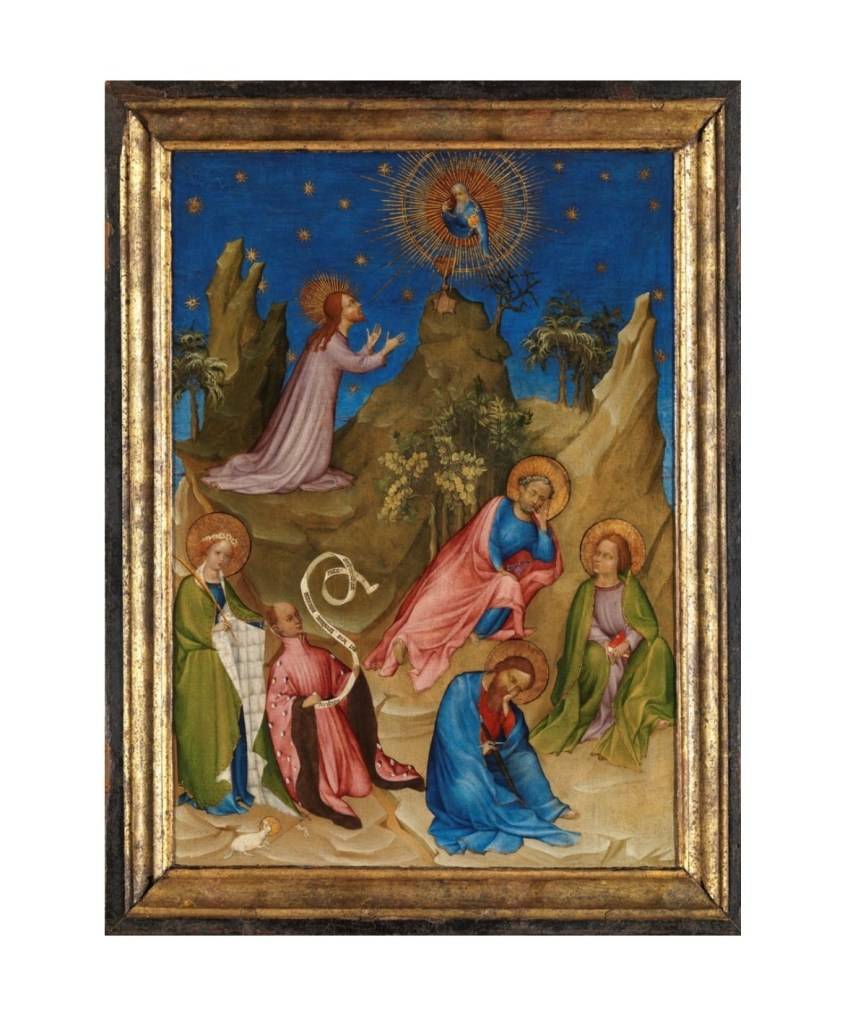
There is a panel in the Museo del Prado titled “Agony in the Garden”, attributed to the French painter Colart de Laon (1377) whose religious work barely survives (this panel is, in fact, one piece from an original triptych). The scene portrays the well known stay of Jesus in the Garden of Gethsamane on the Mount of Olives, where solitude and abandonment prepares the interval for the moment of transfiguration. If anything, Gethsamane is an experience of inwardness outside itself, which the painter has marvelously captured in the figure of Jesus raising his hands in supplication to the starry skies and god. Or so we think. The crisp blue tone of the sky immediately reminds the view of the vault of the Villa Farnesina that Fritz Saxl has interpreted as the transmission of a previous pagan astrological faith in the pictorial composition. The intense blue tone coupled with the emphatic stars arrest our imagination, but also that of the humane and worldly Christ.
What kind of experience is to look up into the firmament from man’s place on Earth and the cosmos? And what are we to make of the inability of the civilized human being to look into the blue depth not as a mirror of Nature, but of the non-totalizable and irreducible experience of solitude? It must be said that in a post-mythical world, the increasing loss of the opening of the sky goes hand in hand with the boundless loss of the Earth. And this is why we are tempted to read Colart de Laon’s picture as a gesture that renders legible the passage of the same movement: the Jesus that raises his hands outwards to the sky; and, simultaneously, the dozing Jesus that inhabits the contemplative state at the center bottom of the picture. To live in the world is defined neither by the experience of the time of arrival of the sky nor by the inward experience of the soul, but by the ability of transiting from one state to the other. And only there the worldly divine can be disclosed beyond the sclerosis of form.
This might also explain why Søren Kierkegaard following the German hymnist Gerhard Tersteegen could write in a gloss of his diaries that Jesus arises from the love feat into the path of Gethsemane: “It is always this way: Gethsemane lies closest to the highest bliss” [1]. The highest place is not the moment of absolute transcendence through faith; it is the secret that for Tersteegen expresses a kenotic hymn that empties life in the direction of poverty and death. In other words, the “highest bliss” is the experience of expropriation of every life; making life and death become indistinguishable in the vacillating night. A night beyond time and without god.
Perhaps not just the “religious experience”, but allexperience has as its central paradigm, the highest bliss in the face of death in which language can only account for it in its muteness and reverence. This is not an experience of vital teleology of humanity, but of a furtive relation. “Hacía sobre ella la experiencia”, as a Chilean writer once put it in the imperfect tense. But this can only mean to do an experience on the dissolution of oneself.
.
Notes
1. Søren Kierkegaard. Journals and Notebooks V.7 (Princeton University Press, 2014), 368.
A good place to start on Tetsuro Watsuji’s Climate (1935) is by considering how the very notion of the Japanese fudo as it appears defined in the first pages of the text, as a “structural element of human existence”. Augustin Berque has proposed a slightly different translation: the “structural moment” that speaks semantically to the prefix *-med, that also recalls mediality, metaxy, and also the French ‘milieu’. In any case, “fudo” discloses an expressive instance of existence, but it is not overtly determined cultural or historical teleologies; rather fudo like Heidegger’s fourfold (das Geviert), brings into gathering wind and earth in which existence can only appear to exist in between as exteriority. Watsuji writes: “The structure of “ex-sistence” is, thus, something rather than to exist in the reality of the cold; it is rather to exist within other persons. To designate this reality we prefer the technical relation of intentional reality, used by phenomenologists, the Japanese expression term aidagara (interpersonal)” (†27).
Unless we know the language, we can only take Watsuji at his word when it comes to the Japanese, but all things considered it is at least obvious to say that fudo is not strictly a descriptive objective reality, but a relation of Being. Watsuji calls it a few pages later a “movement of negativity”: “…this is a ‘movement of negativity’. This is how the spatial-temporal structure of human existence comes to being like that of the climate and that of historicity” (33). The notion of existential transcendence that Watsuji wants to hold on to dwells between reality and existence, generating kimochi, or tonality / stimmung (38). The first question here is what to make of Watsuji’s typology of regional climate setting if these are not to be taken geographically or culturally as expressing locational structures for specific kimochi?
There are three types of climate regions for Watsuji: monsoon, desert, and meadow. One could imagine that these three ideal types as environmental arrangements in the disclosure of kimochi. Each region has its surroundings. For instance, the monsoon is defined by its humidity (47). For Watsuji each of the climatic regions will fundamentally generate different forms of social organization, and it is from this perspective that he interprets the civilizational rise of the West beginning in Ancient Greece. The emergence of the polis is understood as a direct relation with harvesting and later to a social bond determined by production and struggle (war). In the most clear elaboration of his interpretation of the polis, Watsuji writes: “With a slave system as through-point as this, the small number of people who comprised the polis were freed from the labours of the herdsman-farmer. […]. With the building of the polis one may begin to use the word ‘Greece’. If this be correct, Greece began with the conversion of the farmer-herdsman gained freedom from the restraints of nature” (82, 113). This restraint of nature is not just productive in the practical sense (attachment to agricultural life), but it is also of the order of the sensible: this is why Watsuji claims that the Greek classical culture possessed a commitment to a visuality of clearing that is ingrained in their architecture and temples in the open (115). And being in the cleared visual spaces demands the question of technique: “The life of the polis has at its center the artificial-technique in order to dominate the Mediterranean. The emergence of this form of life was the powerful instance that determined the destiny of the “West” (116). In this line, modern science is nothing but a consequential reduction of technique for the Greeks (117).
There is definitely some ambiguity here, since later on and following Komei, Watsuji claims that the emergence of machines in the West was only possible as a retreat from cold weather in the North, and thus a product of interiority (130). Could this mean that the all-clearing established in classical Greece – with its vantage point and all too visible sculptures without oblique point of view – contributed to the later historical production of reserved interiority? Watsuji seems to contrast the clearing in classical Greece with the opaque and gloomy clime of the Germanic lands. In fact, Watsuji says later that only in the shrouds of Germany could pure music be created, where light is not so keenly embodied (141, 111). Returning to the question of existential tonality, or the kimochi, I wonder if Watsuji’s subtle yet recurrent positioning of Western destiny has to do with an originary ethical deficit that is maintained from the depths of fudo as within and outside the clearing of nature. There might be a clue about this in “America’s National Character” (1943): “The true hidden reserves are in ethical strength and not in the power of quantity” [‡]. Is living proportionally in the fudo the ability to master this ethical orientation?
Session 2 (continued)
Having laid out his climate interpretation of the West, I think it is fairly easy to grasp the orientation in Watsuji’s monsoon specificity as a sharp contrast to the condition of its “structural moments”. In particular, the political contrast is implicitly established – and I say implicit because Watsuji never confronts it as the guiding principle of differentiation, although it bends that way. It caught my attention that, following the scholar Kateke Fumio, Watsuji will note at the outset that Chinese (Asian) subjectivity refuses any positing of the legitimacy of the state, and especially the fiscal state (we know from Schumpeter that the modern European state is the fiscal state), and they can only flee from such submission, although they are submissive in other ways, to force (shoguns, for instance) (157). The monsoon structure, hence, has primacy over the political sphere projecting a sort of permanent stagnation for historical development. The notion of akirame or “no bearing, nothing we can do”, a sense of overwhelming resignation, becomes the social tonality of the monsoon surrounding, which ultimately (Watsuji does not say it like this, but perhaps we can push the text in this direct) entails enduring stagnation. This perhaps highlights, quite convincingly, of a certain caducity in Watsuji’s monsoon type in our present epoch.
In the order of the political register, one could read Watsuji’s emphasis on the Japanese home in this direction; that is, the monsoon resignation leads to permanent homecoming. The monsoon region is the region where the oikos triumphed over the polis (180-181). If in the Greek world, legibility and the transparency of the grasping logos made the domestic space an exception to the social life, for Watsuji the Japanese dwelling space is not just a space of familiar gathering, it is also a cosmology and an ecology: “The Japanese consciousness took shape in the totality of the home” (184). (As a side note, I cannot but read this in light of Xi Jinping’s notion of the ‘ecological civilization’ as the master key for the planetary relevance of the CCP). Elevated to the rank of cosmology, the monsoon retreat into the home, does not become an all too easy path towards natural domestication?
In the Japanese home there is no separation – there are no locks and keys – says Watsuji, which introduces as a paradigm for a different form of sociality that differs from Western individuality around appropriation, assignation, and separability (201). This is true to some extent if we think about a spatial figure of Western civilization and enclosure, such as the castle. This is fundamentally different from the tokonama. For Watsuji, the structural moments of ambiance and surrounding generates specific mentis types, and thus concrete organizations of said space. I derive from Watsuji’s second part of the book that Western civilization revolved around the movement of total legibility and clearing (Greeks) that unfolded to separation and thus control over nature, resulting in a machine utopia as Adolf Caspary rightly called it. What about the monsoon specificity? There is retreat and resignation over the surrounding, which allows another mediation or in-betweenness with the natural world and exteriority, although this will entail stagnation in world historical terms.
The contrast between the West and China was already well established during the Enlightenment in the writings of Montesquieu, Voltaire, and other luminaires according to Federico Chabod. In fact, Chabod claims that the civilizational divide between the West and China is crucial to understanding both [‡ ‡ ‡ ]. Asking why an ancient civilization like the Chinese had made such little progress in two centuries (XVII-XVIII), Montesquieu for instance claims that an explanation is to be found in the sacred respect of this civilizational mentis for the transmission of its tradition. It is easily inferred from Watsuji that the monsoon ambient allows for a civilization of “Wisdom” in the deep sense that it “thanks” all the elements of the tradition that it receives. This is also a form of “resignation” proper to mezuru, a form of wonder and surprise that adds nothing new. When Kojeve referred to the end of history in the form of American animality and Japanese snobbism, I think he was crediting this inner Wisdom in the wake of stagnation and released resignation. Of course, we also wonder what Watsuji will say about the “ecological civilization” driven by China’s modernizing planetary project that, if we are to believe Adam Tooze, possesses the master key for world transformation in the notion of “development”. If true, this can only entail the triumph of Western machination through the labor of its others.
.
.
Notes
† All pages are referring to the Spanish edition, Tetsuro Watsuji, Antropología del paisaje: climas, culturas, y religiones (Ediciones Sígueme, 2016). All English translations rendered are mine.
The common Spanish verb “desvivirse” resists obvious translations. Could one translate “desvivirse” as “unliving”, “constructing by destroying”, or “fulfilled life”? It seems that none of them capture the full meaning of an expression that is anchored in practical use. It is important to note that when the term emerged in the intellectual discourse of Spanish twentieth century, its depth was intimately connected to its meaning (life, living, vocation) that it immediately took the life of a concept for cultural milieu and national character. In his lecture “Ideas para una filosofía de la historia de España”, Manuel García Morente suggested that “vivir desviviendose” was the singular form of life of Hispanic being that attained eternity while on the terrestrial world:
“Porque lo típico del hombre hispánico es, por decirlo así, su modo singular de vivir, que consiste en “vivir no viviendo”, o, dicho de otro modo, en “vivir desviviéndose”, en vivir la vida como si no fuera vida temporal, sino eternidad. El hombre hispánico no considera la vida eterna. O la salvación del alma como el remate, término y fin de la vida terrestre, sino como remate, término y fin de cada uno de los instantes y de los actos de la vida terrestre. La salvación eterna no es para él solamente un objeto de contemplación; ni tampoco solamente una norma de conducta, sino que es, ante todo y sobre todo, lo que da sentido y finalidad concreta a cada uno de los actos en que se descompone la vida terrestre” [1]”.
For García Morente, the specific meaning of “desvivirse” entails a tension between interiority and exteriority; and, by extension, between life and death, and in fact of death in life that leads to resurrection and a new life. He writes: “La vida del alma hispánica es un constante morir y resucitar para volver a morir; hasta que la última resurrección” [2]. “Desvivirse”, quite literally, happens at the level of the soul when life continuous through finitude and concrete death. This is why the notion of “desvivirse” has a clear theological underpenning that one can pair with the divine apocatastasis in intramundane life. “Desvivirse” is never about personal salvation and the economy of election, which is why Americo Castro would emphasize that this vocation does not align well with modern individualism, because the “vivir desvivido” experiences its own ruin like a joyous and exuberant Saturnalia” [3].
As in the indication by García Morente, for Castro “desvivirse” entails something like an external perspective in which life can ultimately only take place from its transcendence with a relation to what’s outside ofitself. This outside is neither determined by politics nor rhetoric [4]. To live “desviviéndose” entails an intensity that persists not just as an interior affirmation of self-preservation, but as an erotic relation with what is most desired and venerated (many Spanish thesaurus of the nineteenth century would define desvivirse as “to love or desire with eagerness”, “amar con ansia”). If extracted from the cultural and identitarian historical context, “desvivirse” appeals to the object of passion that overflows the senses of human life.
This overflow is embedded in the word itself. The great Spanish scholar of Benedictine monasticism, García Colombás, in his book El monje y el Misterio Pascual (1984), made a simple, and yet remarkable lexicographical observation about the word “desvivirse”. Colombás noted that while in most of monastic literature the prefix “-des” donates privation and deficiency, the function of this prefix in “desvivirse” suffered a complete inversion, since now it entails to love intensively and thoroughly, as in “se desvive por complacer a todo el mundo” [5]. As a theologian, it should not have passed Colombás that the term in question is a triad of three linguistic units: -des/vivir/-se. This means that it is not just that the prefix exerts the meaning of privation of “life”, but also makes room for the reflexive “se”. It is curious that in in Spanish grammar “vivirse” is often used in relation to location (i.e. “el va a vivirse al campo”), and never as a conventional reflexive action (i.e. “él quiere vivirse solo”, “el se vive solo” = this would be incorrect). Taking this cue, one could perhaps say that the inversion so keenly perceived by Colombás acts upon the living so that they can repeatedly making space for the unfolding of life, rendering possible the soul’s crossing the inside and outside in every form of life.
.
.
Notes
1. Manuel García Morente. “Ideas para una filosofía de la historia de España”, in Idea de la Hispanidad (Espasa-Calpe, 1947), 215.
2. Ibid., 216.
3. Américo Castro. España en su Historia: Cristianos, Moros, y Judíos (Editorial Losada, 1948), 45.
4. Ibid., 279.
5. García M. Colombás. El monje y el Misterio Pascual (Ediciones Monte Casino, 1984), 132.
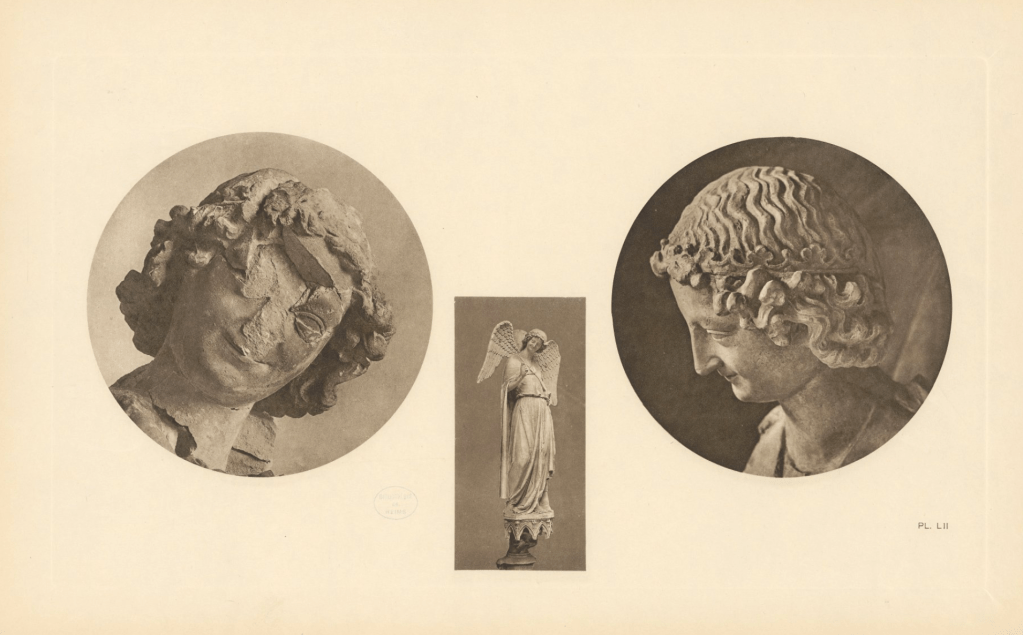
Among Robert Antelme’s posthumous writings the short text “L’ange au sourire” has a decisive place if we are to explain the transfigured theological experience of the French writer. To anyone familiar with French architecture history the title should sound familiar, since the ‘l’ange au sourire’ was already a common expression used by French scholars of architecture during the interwar years. Charles Sarazin, arguably the most important scholar of the architecture of Reims, penned a separata titled “Le Sourire de Reims” (1929), in which he celebrated the mysterious smile of the angel Gabriel that was severely damaged due to shell fire of the Cathedral during the fall of 1914 [1]. But a decade prior to the destruction, art historian Arthur Gardner, in a detailed essay on the sculptures of the facade of the Rheims Cathedral, also took note of this angel’s gaze writing that: “…the angel Gabriel of the Annunciation in which the French smile has almost become a grin, the beginning of the contorted expressions frequently found over the border in Germany.” [2]. The particular aspect of this unique angel’s face that Antelme undresses from the cloak of authority is also wonderfully documented in the photographic book by Pierre Antony-Thouret, who also showed pictorial interest in the way that angel Gabriel was chipped in a large area of the right frontal relief (image 1) [3].
Image 1. Reims au lendemain de la guerre (1928), plate 52.
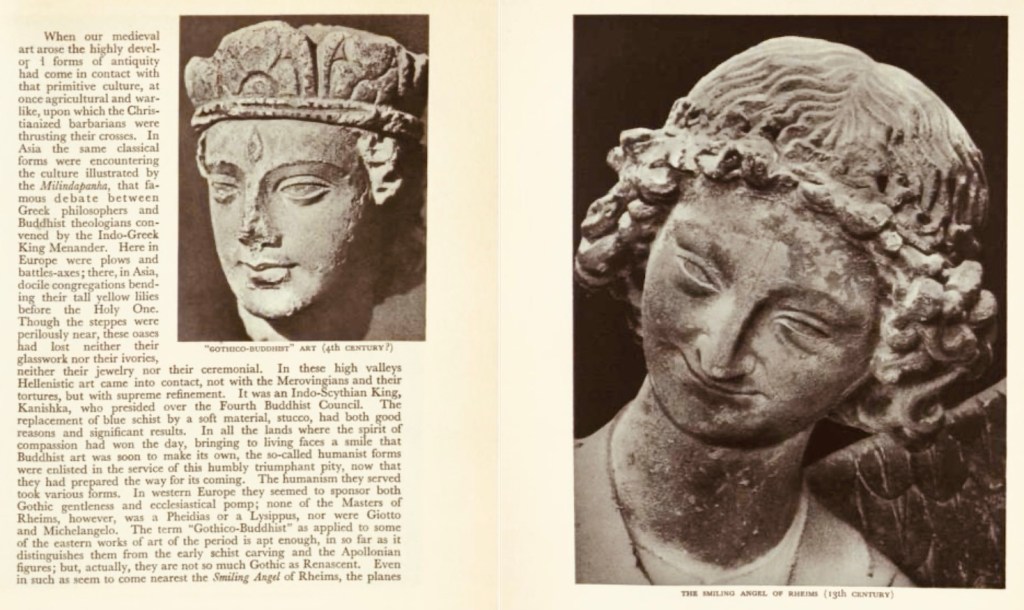
This curatorial context informs the historical background of Antelme’s reference to destruction and what he references as the crushed: “But not crushed by this building, or by that event, or by some power. It has always been crushed, crushed forever” [4]. For Antelme the tenuous, almost imperceptible, smile of the Angel of Rheims is what outlives absolute destruction because to be destroyed cannot be executed absolutely. It is the soul of existence that, because of its exteriority to history, is powerless “to have forever to be”. Even if this being has become petrified and immobile from its original plastic appearance auf vif of sacred art. This is what Malraux captured in his brief mention of the “L’ange au sourire” in The Voices of Silence (1951), where he also compares it to the Buddhist faces of Oriental sacred art (image 2): “The Smiling Angel of Rheims is a statue whose “stiffness” increased with every century; but at its birth it was a similar incarnate, a face that had suddenly come alive – like all faces sponsoring a discovery in the field of the lifelike” [5]. In order words, to see in the muteness of the face the nothingness that allows expressive relations to emerge in the open. This holds for Antelme’s description as well: “Radiant or hidden, inevitably it is there. Word, image, music: everything expresses it, and nothing. It lies at the heart of that realm where all relations are born. Forever starting anew. Possessing nothing, capable of nothing, it must be there, forever”.
Image 2. Angel of Rheims in The Voices of Silence (1964).
But what Antelme was able to capture through the smiling angel of the Rheims Cathedral was not a problem of iconology of art forms, but rather the very essence of the theological problem of angels as it relates to the poetics of life itself. The angel is not a promythical figure scaled to a specific historical moment, but an instantiation of the divine appeals to the withdrawal the possibilities and modes of the human being. This is why Antelme can state that “the only transcendence is the relation between beings”. Even in its muteness, the theologica depth of the angel is the poetic speech of divinity through a surge in language that has no end, but only celebration or hymnology.
This is why Erik Peterson writes towards the end of “The Book of Angels” about the intimate relation of angels in human existence: “A human being can draw near to the angels because the angel too – as its name already indicates – can draw near to humanity. […] The angels are more than poetic ornamentation left from the storehouse of popular fables, they belong to us. For us, they stand for a possibility of our being, a heightening and intensifying of our being – but for the possibility of a new faith…as a passion for mental clarity and an authentic existence” [6]. It is fair to say that, although the figure of the angel does not show again in Antelme’s work, all of his vision and witness accounts in the face of political horror must be placed in the endless vigil of a nocturnal life that is shared with the ethos of angels (utirur vigilis, angelorum vitam procul dubio meditatur).
.
.
Notes
1. Charles Sarazin. “Le Sourire de Reims” (s.l.n.d, 1929).
2. Arthur Gardner. “The sculptures of Rheims Cathedral”, The Burlington Magazine for Connoisseurs, V.26, 1914, 64.
3. Pierre Antony-Thouret. Reims au lendemain de la guerre: la cathédrale mutilée, la ville dévastée (Jean Budry, 1928).
4. Robert Antelme. Textes inédits sur l’Espèce humaine (Gallimard, 1996), 14.
5. Andre Malraux. The Voices of Silence (Secker & Warburg, 1964), 317.
6. Erik Peterson. “The Book of Angels”, in Theological Tractates (Stanford University Press, 2011), 139.
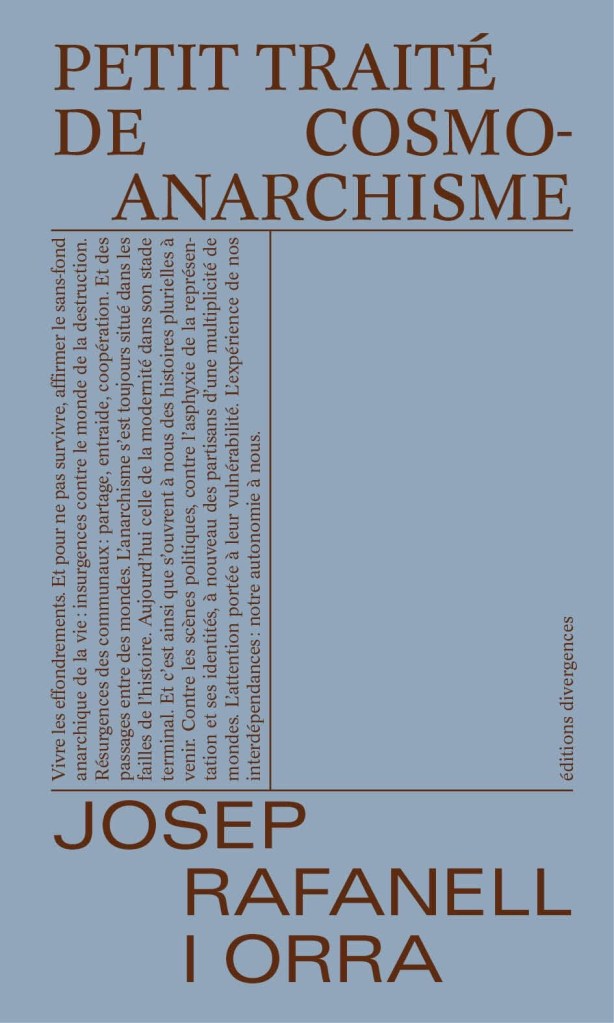
Anyone somewhat familiar with the writing of Josep Rafanell i Orra knows that we are in the company of a wanderer and itinerant in an infinite pursuit of what the experiences of worlds might offer [1]. A mad endeavor for a groundless epoch oriented towards planetary reduction and confinement, so obsessed with infrastructure and security, most recently through the reiteration of the politico-theological program of national sovereignty, one more desperate reaction to unrestrained planetary decline. We can say with Hölderlin that we are vagabonds in a destitute time, a poet who figures prominently at the entrance of Josep’s Traité. In our posthistorical epoch we are confronted with the thicket over the dominion of life, which means that the question of exteriority becomes pressing as existence enacts a path beyond the endless rubble of representation bestowed upon the human species in every point of the globe.
The book that the Spanish reader now holds in his hands thanks to Luciole Ediciones will immediately let in a dimming light of a singular style or maniera that dislocates the modernist assumptions of political thought into what one could what I am willing to name an analytics of sensible hybridizations between languages and thought. This analytic of the sensible refuses immediately Social normativity as well as the melancholic hangovers of the modern revolutionary tradition (always caught up between constituent and constituted power, representation and humanism, growth and production). This is why Josep will redefine communism as the nonprogramatic event that irrupts through hybridization of surrounds and regions capable of overcoming the ontotheological adequation of subject and object that has led an entire civilization astray (33). The project of the critique of metaphysics finds in Josep’s Traité a powerful schematic cartography that raises questions precisely in those spaces where the rationality of the science of political economy has never dared to enter.
If the critical projects of High Modernity were fundamentally temporal (including that of Messianism and its overemphasized trance towards absolute immanentization), Josep’s writing also has the virtue of displacing the focus to the spatial formation and the thinking of the creation of spaces understood as dwelling, once populated by the gods of the events and which modern ontotheology obliterated through integrated objectivation and technological positionality. We know that the greatest nearness of the last god eventuates only when the event is elevated into refusal, especially when it manages to become too near [2]. As a shorthand, this drift towards objectification in the liquidation of modern politics is domination of the Social totality; ultimately, it is through the plasticity of the social bond that the reproduction of biopolitical life is temporalized, legally ordered, and rhetorically subsumused into an apparatus of predatory accumulation. It is the Social (not the State, or this or that concept of the modern grammar of political thought, or even fascism) that we must refuse. The collapse of the modern secular state and its moral guarantees, is the beginning of an autonomized social bond that now coincides with the total administration of world forms. The hegemony of the Social reduction is what allows Josep to claim that the opposition is no longer between Society and the State; but rather between community as a process and praxis against the static formation of the Social. Thinking today drifts from social domination to communities of encounters, heteronomic relations, communication, and interdependence in a web that characterizes the exotic movement of the imaginative possibilities of exteriority for manifold worlds.
The notion of community in Josep’s thinking is neither about ecstatic groups or “little platoons” of identitarian belonging (as once famously defined by Edmund Burke); nor referring to filiation and propriety reductions that can subsist quite nicely under the heatwaves of the ongoing conflagrations of Empire. For Josep communities insofar as they are exposed to their excess (ubermass) are processes of external contact between souls as rites of passages. The community is formless, and in this sense it ceases to be a problem of Chistological stereology in order to become one in the order of ethics and language (50). In this sense, very much like the late Mario Tronti looking at the collapse of the modern revolutionary experiment; for Josep the ruinous fragmentation of the worlds has a silver lining: that all human, and non-human, souls are dwelling on the outside world calling for worldiness, and thus potentially sharing a sense of intimacy that re-enchants the appearance and knowability of the world through the invisible attunement to the outside (un nuovo modo di essere fuori e contro) [3].
Beyond the subject and the narcissism of the Ego, the light of a “spark of the soul”, in the words of Meister Eckhart’s memorable sermon, a new animism returns not because there is a transcendental revelation to be asserted, but because the encounter between souls brings forth the concatenation of worlds that are entangled with other worlds (68). If Jünger described the epoch of planetary machination as “soul murder” (seleenmord) it was because there was no longer any contact with the unfathomable opacity between the soul and any possible worlds [4]. Josep with an elegant mannerist style enhances this intuition: “We are no longer exiles on Earth, as the romantic moment freighted by the loss of world. We ended up forcing the Earth into exile after so many deadly abstractions (108). The modern age has not ceased accumulating abstractions against the human species until becoming a whirlwind of soul murdering that has extended into the current ecocide of the worlds.
It does not come as a surprise that throughout Petit traité de cosmoanarchisme (2023) Josep appears more than skeptical about political critique (and to say skeptical might be an understanding). There is a clear imperative that is mobilized in the book and that it should not be taken for granted: political critique should evolve into the negation and abandonment of politics, which also includes the always anachronistic anarchist politics. We know that ever since the Greek polis the autonomy of politics partition and distribution was waged against the incommensurable topos of the chora, the ungovernable and infrapolitical hinterland of the new substantive community of rights and obligations posited by the logistics of representation [5]. As we know, this is what forced Heraclitus to resolutely remain playing knucklebones in the temple of Artemis: “What are you gaping at, you scoundrels? Or is it not better to do this than to work with you on behalf of the polis?” [6]. The knucklebones of the ancient anecdote of the presocratic philosopher is symbolic to what Josep demands of existence: the liberation of environments and surrounds for multiplicities of experiences. The experience of gaming always starts in the middle, expressing the ineffable ethics of how I become what I am already on my way of becoming (142). The maximization of politics into the very thicket of life (this is biopolitical administration) have increasingly defaced the experiential practice of existence that now extends over the course of the historical dispensation of civilization. This is the vortex of the struggle against the realist validations in the interregnum.
Against and beyond the force of abstraction and the prison of individuality, Josep situates the stakes: “It is there, where the fierce struggle we can lead today: to find the intimacy of our soul in the welcome of other souls to hear their silences and their voices. To participate in the animation of the world is to perceive the outside. And gently find the inside of the outside” (145). And between the process of the community and the soul there is no longer struggle or enmity, but only solvent philia; the influx of creation that, insofar was enmeshed in solitude, allows pain to speak in the time of transition, in the skirmishes between worlds. Ultimately, the experience of the itinerant is not that of learning to live in places; rather, it is the one that intensively yearns the presence of encounters. This remains the only ethopoetic imperative [7]. As Carlo Diano observed in an erudite study on the notion of the chora, the attunement of the soul with the world is not a conceptual entelechy; it runs materially through the sensorium of this body as it traverses the world towards its renewal [8]. To grasp this chiasmic region that dispenses the harmony of the soul as it flees the prison gates of an objective world, is the enduring letter and spirit that Petit traité grants to the ongoing task of thought.
.
.
Notes
1. Gerardo Muñoz. “Escuchar las llamadas del mundo: diálogo con Josep Rafanell i Orra”, Disenso: Revista de Pensamiento Político, N.3, July 2020, 134-158.
2. Martin Heidegger. Contributions to Philosophy (Indiana University Press, 2012), 329.
3. Mario Tronti writes in “Disperate speranze” (2019): “È necessario trovare un nuovo modo di essere fuori e contro. Io posso farlo nel solo modo in cui so farlo: tirando l’arco al punto che permette di cogliere il bersaglio più raggiungibile. Realistica visione.”. CRS, October 2019: https://centroriformastato.it/disperate-speranze/
4. Ernst Jünger. The Forest Passage (Telos Press, 2003), 93.
5. Julien Coupat. “Dialogo con i morti”, in Gianni Carchia’s Orfismo e tragedia (Quodlibet, 2019).
6. Martin Heidegger. Heraclitus: The Inception of Occidental Thinking and Logic (Bloomsbury, 2018).
7. Josep Rafanell i Orra. Fragmenter le monde (Divergences, 2020), 70.
8. Carlo Diano. “Il problema della materia in Platone: la chora del Timeo”, Giornale Critico della Filosofia Italiana, V.1, 1970, 335.
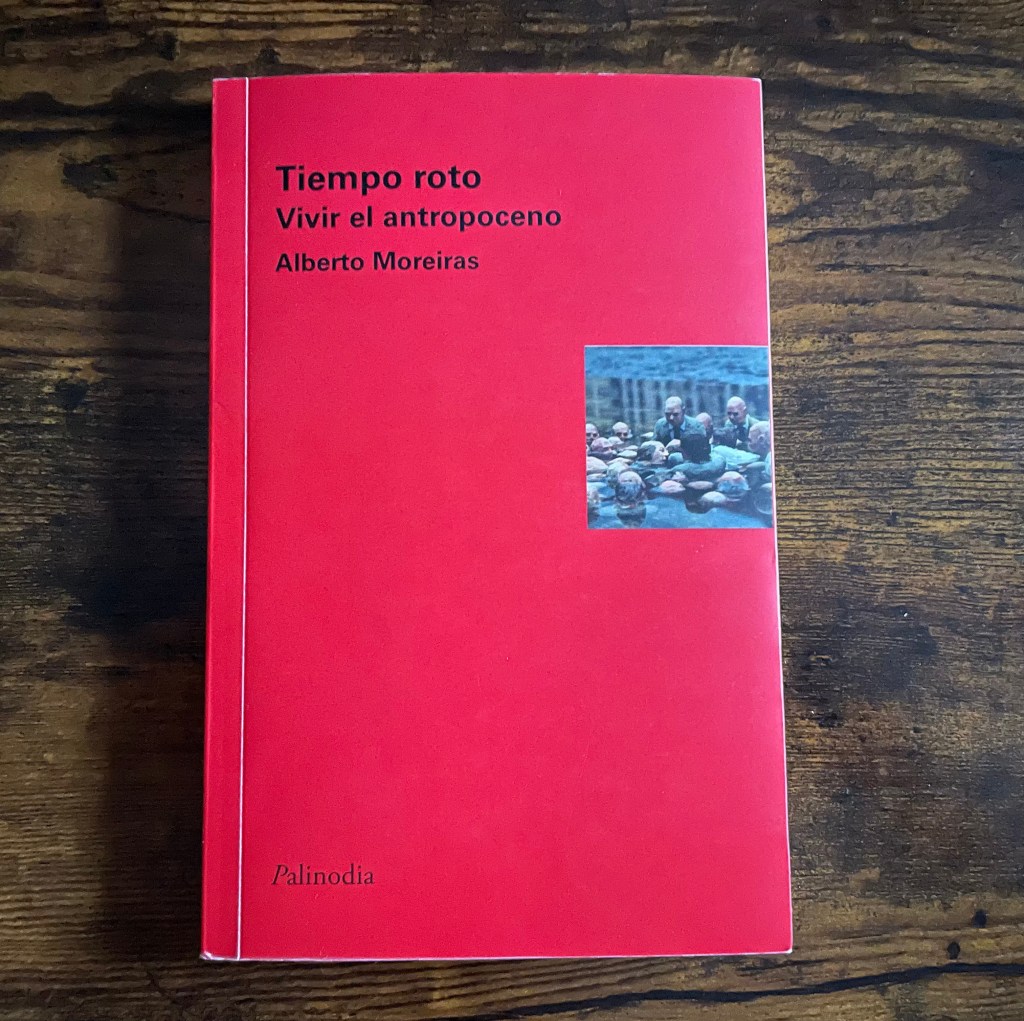
The sudden and uninvited intrusion of Gaia in our world is something rather strange, and yet consistent with the closure of the metaphysical tradition. The call of the outside takes place at the threshold of our reflexive capacities, habits, and mental propositions in our relation with the world, which demands everything to be thought from scratch. The historical imbalance in groundlessness now requires a new task for thinking – the imperative that runs through Alberto Moreiras’ most recent book Tiempo roto: vivir el antropoceno (Palinodia, 2024). The theoretical constellation deployed over the course of a decade now comes to the forefront with extreme urgency – I am referring to marranismo, posthegemony, aprincipial anarchy, and of course, infrapolitics. Tiempo roto (2024) is not a systematic culmination of Moreiras’ philosophical (or antiphilosophical) project of thought, but it is definitely a mature elaboration insofar as the field of problematization enters a hitherto unexplored thematics of late heideggerianism. All things considered, the emerge of the anthropocene as an explicit planetary endgame and the new beginning necessarily move pass the conditions of both political and scientific praxis, which today can only effectively adequate itself into positionality (the so-called Gestell) and objectivity of a world that slowly seems coming to its end.
It might be worth remembering that the notion of “other beginning” (“otro comienzo”) in the wake of civilizational decline was already proposed in the book Sosiego siniestro (2020), but it was far from being thoroughly explained [1]. Following Heidegger’s philosophical scene, representational thought in the tradition of adequatio of the Thomist gnoseology coincides with technological administration of every living entity (Moreiras 14). But Heidegger’s suggestion in the Parmenides that calculative representation fails as grasping the essence of the polis might also have its own limitations, insofar Gaia appeals to an excess beyond or below the politics. As Jacques Camatte also understood it, the civilizational invariant of revolutionary breakthrough departing from the historical subject of the working class can seldomly do the work except as an article of faith in the myth of the autonomy of the proletariat within real subsumption. This means that we are in the terrain of infrapolitics or the chora, which point to ontic regions of thought towards a new beginning at the end of principial metaphysics. But the other beginning can only emerge within conditions of transforming existence against the closure of political technicity.
I do not desire to reconstruct here all the refined analytical movements that lay out the transformation of existence in Tiempo roto (2025), but there is a maxim from Pindar’s Third Pythian Ode that stands out as an emblem for the appropriation of the non-humanity of the world. Moreiras cites Pindar’s “me, phila psycha, bion athanato speude, tan d’emprakton, antlie makanan”, which can roughly be translated as “do not seek, dear soul, immortal life, but do try to carry out the fullest the use of the possible” (Moreiras 61). Moreiras correctly notes that the ultimate difficulty lies in the “emprakton makanan”, or the use of the possible, which metaphysical Humanism and effective general equivalent can only exacerbate towards the planetary production and extractive valorization. The corruption of the use of the possible is the realization of hybris, and in this sense all representational humanism is always already a form of self-deification and induced hallucination, even when it tries to claim to engage in the opposite in relation to nature (Moreiras 65). Moreiras suggests that the pindaric maxim discloses a second relation of the “use of possibles” that does constitute a lacuna in the metaphysical tradition, and that is understanding a praxis tied to sophrosyne or phronesis that abides to the prudent inclination of the non-human (“es una actividad sometida a la vergüenza de lo in-humano”) (Moreiras 65). Giorgio Agamben’s defense an ontology of possibility against the hegemony of metaphysical realization and representation also comes to mind, although Moreiras might not feel at ease at explicitly calling for a positive ontology nourished in the waters of a transfigured metaphysics of the tradition of scholastic Averroism [2]. Although both Moreiras and Agamben come at their closest proximity in terms of the notion of the chora – and more directly the space of the chora against the primacy of the polis – which serves the ontic condition for the non-spatial surfacing of the abode or region that is necessarily infrapolitical, because it’s never determined by distributionist political isonomia or meson (Moreiras 73).
There are important nuances here to say the least: whereas for Agamben the notion of chora appeals to the gods of place (theos aisthetos), and thus a dejointed form of divinization decoupled from the legitimacy of every politico-theological archein; for Moreiras, the chora is a praxis of thought towards desecularization that lacks theology, and thus capable of exceeding the onto-theological reduction (Moreiras 74). But Moreiras says about the tendency towards nihilism of “possibility” in the historical dispensation of positionality (Gestell) could also be said about ‘de-secularization’, as the ultimate consequence of the decay of political legitimation in Ernst Bockenforde’s famous formulation. This might not be the space nor the moment to reach a verdict between Moreiras and Agamben’s position regarding the very complicated problem of the Platonic site of the sensible, since what is presented to the reader as a ‘phenomenology of excess’ or the inapparent (something merely alluded in the Zahringer seminar), might be the condition of an atopic mediation that prepares – or that has always prepared since the times of Orphic myths – the tonality of a coming philosophy under the sign of transformative thought (Moreiras 110) [3].
The dispensation of the Gestell open up and also step back (a folded movement that does not have a declension into a synthesis) into the genesis of the beginning (Moreiras 115). And the anthropocentric epochal dispensation, says Moreiras, is no longer the site of the polis, but “the planet as a the historical site of humanity, although we are still unaware of it (“aunque sigamos desconociéndolo”) (Moreiras 116). This uncanny phenomenology of the primary, traversed by the discharge of the entstehung, is the infrapolitical site par excellence, because it is in the atopic region where destiny is both affirmed and displaced. This is why, as Moreiras recalls Heidegger saying, the dialogue with Parmenides never exhausts itself, and yet it prepares a destiny (Moreiras 134). I take this to mean that there is an experience of the transfiguration of language for the emergence of an “ethics” (ethos), but this might be beyond Moreiras preliminary conditions for an existential breakthrough; that is, something possible further along the path.
Tiempo roto (2024) closes with a couple of undeveloped pages that take Massimo Cacciari’s old essay “Confrontation with Heidegger” (1977), in which the Italian philosopher makes a plea for a direct confrontation with Heidegger and Nietzsche’s teachings on nihilism and the closure of metaphysics if there would still be any hope for the composition of the working class during the stage of anthropomorphized dimension of capital defined by Jacques Camatte also during those years. But much has changed since the hot Italian summer of 1977 and the formulaic conjunction of “left Heideggerianism” might not do the work anymore, as if the totality of materialist political economy could be amended by a radicalization of the historical question and the ontological difference. Political economy plus metaphysical critique is still relying on a conception of the political as a technique, which today has transformed into what some have called the “new regime of ecological accumulation” as mere stabilization of green ecological spheres of life [4].
But there is a second register to Cacciari’s programmatic thesis that remains open. And these might be Moreiras’ most important words in the concluding part of the book: “Espero haber mostrado que Hiedegger señala la posibilidad de dejar atrás la explotación y el consumo en la era del Antropoceno a través de una comprensión alotrópica de nuestra relación con el mundo. Por lo tanto, vivir en el Antropoceno debe basarse en el abandono o desplazamiento de la metafísica como modo dominante de aprehensión del mundo en la actualidad” (Moreiras 151-152). Marx’s materialist dialectic through the critique of political economy – even as a destitution of political economy through its own vectorization – might be insufficient to face the unprogrammed presence posed by planetary anthropocene.
Perhaps we can still repeat Dionys Mascolo’s words that the coming communism will owe more to Hölderlin than than Marx, not because of an idealist dispute over concepts, but rather because of what Cacciari called in his essay, also citing the German poet, the historical “affinity of conditions” [5]. And in the age of the Anthropocene and positionality, those conditions are kept in the pattern of economic decline or stagnation in which the law of rate of profit encounters its own limit, folded unto the ongoing destruction of the life forms in the world. The allotropic praxis endorsed by Moreiras finds traction in Hölderlin’s poetic dwelling in language at the heart of decline so that something other might emerge within and beyond life, from Gaia to Ctonia. This is the most difficult task to depart from, but it is also the path that saves from the current inhabitable passage of the Earth.
.
.
Notes
1. Alberto Moreiras, Sosiego siniestro (Guillermo Escolar, 2020), 24.
2. Giorgio Agamben. L’irrealizzabile: Per una politica dell’ontologia (Einaudi, 2022), 112-146. Kindle Edition.
3. For more on orphism and the limits of the site of the Greek polis, see Gianni Carchia’s Orfismo e tragedia (Quodlibet, 2019), epilogue by Julien Coupat.
Emilio Prados Such’s postwar book Dormido en la yerba (1953), long out of print since its publication, is the most clear and straightforward literary document of a poetic voice that stands as one of the foremost attempts at thinking the nexus of existence to the divine in the tradition of the twilight of the gods. Dormido en la yerba (1953), albeit its direct Lucretian overtone, does not enact a metaphoric appeal of a return to the physis of nature; rather for Prados, to dwell, imagine, and inhabit language is only possible in coexistence with the caducity of the natural world including life itself. In the poem that names the book, “Dormido en la yerba”, Prados writes that “La vida se te va / y tu te duermes sobre la hierba”, at first sight claim on appearance that seems to endorse the tempus fugit motif of the Spanish Renaissance verse. However, the temporal course in the poem is immediately redirected to a mysterious proximity that befalls existence in nature’s shadows, plunging the voice into the depth of the abyss that colors the caducity in a place. At this point, we note that Prado’s poetics is traversed by a mystical register that transfigures the temporal continuum with that of making of space that is eternal because it has neither end nor beginning.
It is in this sense that Emilio Prados’ theological drift in his poetry is neither about making transcendence palpable through the animation of the world; nor does it imply the absolute immanence of the divine presence towards a new reenchantment of the world. The status of the liberated theos in Prados, like in the mythic understanding of the platonic “gods of place” (theos aisthetos), is an event that can only take place once existence is attuned to the minuscule surrounding of the world. This means that there is never a “God” as a matter of a divine economy that orients a moral predicament; rather, as Maria Zambrano argued in an essay on his work, Prados’ instantiation with the divine is always expressed in the most diminutive melody of the common things as they are. A way of multum in parvo such as the “diminuta yerba”. Hence, God is not the agent of creation of individuation, rather God is an “idea” that expresses in each thing that we are affected to, such as every blade of grass, the spacing of the clouds, the invisible direction of the wind, a human face.
The event of the divine, thus, is not a matter of mental or international faculty between objectivity and consciousness, existence and the natural world; the irruption of the divine names the genesis of appearance and disappearance. And this means that the divine (Dios) is ultimately an affection of the soul, that animation that provides birth and death as relations that move world. It is for this very reason that Zambrano could claim that the opaque sun irradiating Prado’s work is disclosed by the “dios que está naciendo”, or the god that is birthing [1]. Of course, the birth of God is far from being a transcendental revelation that weaves the history of salvation; in the manner of Meister Eckhart we can say that the god is nothing else but the affection that makes his birth take place in the soul like a harvest; that is, leafy, bright, and green [2]. God is the possibility of sensation in the world that is ineffable because it is always on the path of natality. For Prados, the eternal dimension of the birth of gods is only temporary because it presupposes spacing; it presupposes being thrown somewhere, like in the lucretian trope of lying happily above the grass. Above the grass and infinitely outside the world, dwelling and world are irreductible whenever they come into its uttermost nearness. To dwell – which is the central meaning of laying on the grass – on the crust of the Earth is to liberate God, and the liberation of God is what allows us entry into the world.
As Prados wrote in a remarkable letter to his friend Zambrano in March of 1960: “Un cielo sin reposo” que es Dios: Dios no quiso morada y nosotros, como tú dices: edifica que te edifica… Y Dios, sin reposo. No buscamos reposo para Dios y nunca lo tendremos… En la guerra, me acuerdo, unos campesinos prendieron fuego a una iglesita en lo alto de un monte. Cuando bajaban, lo hacían como iluminados y decían: “¡Hemos libertado a Dios!” ¿No es hermoso eso?” [3]. To liberate God from dogmatic commands is also the liberation of world as detachment. There is dwelling for us, but never for the unresting divine presence of god.
The passing of Jacques Camatte (1935-2025) a week ago from the writing of this text recalls a life that ostentatiously lingered in thought, and a thought that was entirely enmeshed and intertwined in the irreducibility of life. For some of us that had the good fortune to interact – however briefly and momentary, although every contact is always destinial and inescapable – Camatte transpired generosity and authenticity, and his voice evoked an almost Adanic happiness that has become rare among human beings. A common friend these days has recalled that somewhere in Camatte’s writing there is an endorsement of a capacious phrase from Chernyshevsky that could very well serve to remember his enduring ethical pursuit: ‘we have finally understood that the Earth is a place of life rather than judgement’. The opening the Earth as a dwelling place for life forms means that it is insufficient to conceive of domination as an organization of modes of production, since capital is first and foremost a spatial-temporal arrangement towards the future of the human species, and thus of a certain conquest of the world sensuous life.
This was the outstanding triumph of real sumption: the modulated and ongoing alienation of the human community (Gemeinwesen) into a community of capital that has arrested time of life to the point of adjusting it to homogenized agony of historical time. Against the dynamic of revolution and counter-revolution that theologically exported the polarity of the eschaton and the ho katechon, already in the inception of 1970s Invariance Camatte called for an exteriority of any philosophy of history in order to rework of “a new relationship between human beings and nature”, and “breaking the lock that inhabits the creation of a new form of life”. The two citations in dialogue with each other come from “Against domestication” (1973) and the introduction to Urtext: frammento del testo originario di Critica dell’economia politica” (the 1977 Italian edition curated by Gianni Carchia), although these are variations from the depth of the emergence of the invariance of truth as a vantage point of the world. At the center is a form of life that renews the world that transitions beyond all forms of metaphysical logistics of appropriation, mere standing reserve, and the general arrangement for the mobilization of production. Any point of departure against domestication measures itself against the totality of this fluctuating dominion.
As it has been said of other great thinkers, Camatte’s ultimate passion was rooted in thinking one idea to the end and not of endorsing a system of concepts. For him it was the schism, that is, how to undo the historical process of domestication of a fictive community against the absorption of the increasing autonomization of fictive capital. The schism against the capitalist general equivalent also demands advancing a secondary schism against all humanism and its originary separation from nature. In schism, there is something of Gaunilo of Marmoutiers’ “thought of the word alone” that is receptive to the movement of the soul tries to account for the perceived voice. This precisely what Camatte carried as the lesson from Bordiga’s idiosyncratic original communist program: a movement against the historical benchmark of the development and political economy of growth, which will entail the exhaustion of the revolutionary horizon driven by an ideological political technification that tends to deepen the power towards the positionality of epochal nihilism expressed in the revitalization of strife and the ‘errancy of humanity’ (contrary to Martin Heidegger’s notion of errancy as a play between unconcealment and truth, for Camatte errancy is another name for the civilizational narrative that exemplifies the withering of the human community into organized and protracted social reproduction and historical abstraction). Hence, as for Bordiga, Camatte conceived the ontology of communism as a world view (not as a political program oriented by concrete historical subject or distributive economic reproduction; not a soteriological dogma nor a transhistorical material idea); that is, broadly speaking, thinking the relationship between the human beings and the earth. A question more pressing than ever given the current planetary conflagration, which exposes the civilizational course that has lead to an inhospitable world where the survival of the human being has become the byproduct of an effective hostis of the community of capital integrated to the global surplus value accumulation.
In Camatte’s unrealized thought – but perhaps all forms of thinking are so – the bordigist gesture persists in locating the schism at the threshold of the force of real subsumption of the anthropomorphization of capital, where the notion of revolution itself is transfigured since, unlike Delacroix’s paradigmatic romantic painting, ‘liberty’ no longer guides the spirit of the “living”. Its redeeming voice also carries downwards unto the depth of the souls of the dead. Amadeo Bordiga himself in “Dialogato coi morti “(1956) writes that “The Revolution…it is always, in the course of an immense historical arc that will close as it opened and where it promised, where it has an appointment with many of the living, but certainly with the unborn, as with the dead: they knew that it never fails, never deceives”. True life can also take place with the nearness of that which seems remote (as Gustav Landauer once claimed: “For me, the dead also live”).
If both the collapse of the future and the increasing adaptation of social life has entered a gnostic dialectic of endless self-legitimation, it is paramount to capture not just the insurrectionary, but the resurrection flight in Camatte’s gesture that opens possibilities lodged in the dead as an emblem for the return to the world “full of joy and exuberant life”, as he wrote in an apostrophe in “Scatologie et résurrection” (1975): “I will draw from mother earth the vital and infinite power and I will resurface full of wisdom, joy and an exuberant life which will allow me to reach this human community…I will have left your world and been resurrected!” Does holding on to the unity of the Gemeinwesen require a theological undercurrent? Is not the passion for schism, and by the same token the stazion, the energy within the very dispensation withheld between mystery and revelation that has prompted the congenital forms of formal mediations and institutions for the political community? These are the questions that we are exposed to in the enduring task if we are to take seriously a continuous ‘dialogue with Camatte’, which carries the voices of the dead. Ultimately, any authentic conversation that dwells in thought does not have to invent anything new; we are depositories of an endless communication that is handed over, interrupted, and transmitted to anyone willing to hear and capable of being traversed by the shared word.
In his last year of thinking, Camatte insisted on the notion of “inversion” in the wake of the civilizational phase of extinction, which would require deposing all forms of hostilities and bringing to an end the partisan positions invested in orienting technology and morality (nature) in their seditious defense of the real dominium over the passing of the world. For the current depressing (and depressed) times, writes Camattes in “Instauration du risque d’extinction” (2020), what could very well be a prelude to a return to the repressed allowing a return to the past to initiate an inversion that would allow liquidation of lall exhibition abandoning enmity. This is why, as he told me in an exchange that we undertook five years ago, “inversion cannot be a strategy, as it is totally outside of politics, which is the dynamic of organizing people, of controlling them”. A breakthrough, then, only as a mystical downwards leap into the past? Absolutely – but only insofar as the mystic is the ethical witness to his own openness to the word, and whose exodus from the social machination prepares a return to the world beyond the flattening and dominant language molded by rhetorical dishonesty or passive narcissism of the subjectivity.
This is why according to Carlo Michelstaedter to have courage in the world means to decide between two irreducible figures: the dishonest trickster, or the mystic in the desert. There are no third terms in between. And whereas the dishonest subject knows how to play the hand to his best outcome in each given moment; the mystic knows that his decisive moment is always commencing because the genesis of the human species has yet to take place. This beginning is always at the brink of an untimely auratic experience. And aura names the incommensurable distance from the rational containment of the world — unlike Teilhard de Chardin’s internal introspection in the noosphere that will bring the fullfilment of a spiritualized humanity upon Earth (realized in part by the unification of the sciences by cybernetics); in other words, an exodus from the temporal nominalism that inhabits another life attuned to its genesis: “devenu-devenant ce monde et sur cette vie autre au moment où s’effectue sa création”, he writes in “La séparation nécessaire et l’immense refus” (1979).
The visitation of Jacques Camatte in the world bears witness to that invisible freedom of the human species ready to jump and traverse the catastrophic trumpeting into the living and the dead, making possible the refractions of thinking as original texture of existence. From now on, the exodus from the immanence of this world will embrace a disempowered but perpetual dialogue with Camatte’s demure schism of the living. Indeed, we are always on the path to an earthly beginning.
There is an untimely moment in Saint Teresa de Jesús’ Oraciones where she speaks metaphorically about her soul as a form of a flourishing garden. It is a description that also advises of a potential risk of the devastation of the garden; as if more than a locus amoenus, what is at stake is a sort of ethical activity that must be retained and nourished in prolonged periods of unexpected danger. We read in the Oraciones: “Y considerar el ser mi alma un huerto, y al Señor que se paseaba en él. Suplicábale aumentase el olor de las florecitas de virtudes, que comenzaban, á lo que parecía, á querer salir, y que fuese para su gloria, y las sustentase, pues yo no quería nada para mí, y cortase las que quisiese, que ya sabía habían de salir mejores. Digo cortar, porque vienen tiempos en el alma que no hay memoria de este huerto; todo parece está seco, y que no ha de haber agua para sustentar, ni parece hubo jamás en el alma cosa de virtud” [1]. The topic of the garden and gardening, as we know, was central to the culture of medieval monasteries, as anyone knows who has seen these places all over the Mediterranean world, and that today many of them have been turned into high-end hotels for global tourism.
The monastic garden was both a site but also a nonsite, a sort of chorā that, as the Saint Pacomio (286-346) would write, it was the place where one could be closest to God, and where existence could experiment its true grace and happiness [2]. And what are the company of the gods of place if not the very nameless fleeting instance of our free relation with the world? This is the index of the ethical nourishment that has been entirely lost.
There is little doubt that Teresa was also conscious of the theology of gardening that her predecessors wrote, such as Walafrido Strabo’s Hortulus (840), which was undoubtedly the most important treatise on horticulture of the monastic tradition during the middle ages laying down the principles for a flourishing seasonal harvest. Like the abbess Hildegard von Bingen centuries before her, for Teresa a comprehensive understanding of “sickness” was not just a question of biological maladies of life, but more fundamentally an existential problem that must be cultivated like a gardener keeps a parcel of land flourishing like a transfigured memory of Arcadia. A space of shade and a surrounding for breathing.
Santa Teresa extends the metaphor when she tells us that there are dark times where the garden is drying up; and, in fact, the soul itself could entirely forget that there was a garden. It is all too simple to say that this dried soulless wasteland is a mirror image of our epoch, where it becomes obvious that in the name of “ecological” administered apocalyptic time, we are entirely uprooted from any possibility of nourishing our garden. In fact, what just a few years ago seemed like exceptional and arbitrary measures of confinement, social distancing and artificialization of the human community, it is now clear that it amounts to not just the absorption of the world as such (this was already the project of formal capital), but rather the destruction of the ethical dimension of the non-world that binds us, at a distance with what remains outside of it.
Even Carmille Pisarro’s “Two Young Peasant Women” (1891), at the shadow of nascent industrialization, now seems to us as dumbstruck by a deep sense of acedia (disconnected and mute) foreshadowing the forthcoming vanishing of their life-world. After all, the aim of the machinist is to make the world soulless, said Landauer in Skepsis und mystik (1903). We have lost all space but we must conquer the chorā, which allows us to cultivate, once again, the soul against all expectancy of programmed obsolescence. Teresa’s huerto del alma persuades us in the stray direction that some, in reality, have never left.
.
.
Notes
1. Santa Teresa de Jesús. Obras de Santa Teresa de Jesús, Tomo I (Libreria Religiosa, 1887), 12.
2. Peter Seewald & Regula Freuler. Los jardines de los monjes (Editorial Elba, 2019), 99.
Pointing to a methodological clarification, Pierpaolo Ascari’s Fine di mondo: dentro al rifugio antiatomico da giardino (DeriveApprodi, 2024) opens with an untimely advice: the threat of atomic extermination of human life can only be told and appealed through the irony deployed in all areas of consumerist culture. Undoubtedly, this fits pretty well to the case on point, since American modernization is both the hotbed of Hollywood and the atomic bomb, two poles of the regime of a vicarious life consisted with Henry Adams’ well-known assertion that, in spite of everything, America civilizational passion has always been generalized optimism. And it is not surprising that Stanley Kubrick, when asked about the thesis of Dr. Strangelove (1964), also claimed that the only possible form to tell a story about the bomb of total extermination was through a black comedy (Ascari 11). This self-serving optimism is tested in Ascari’s Fine di mondo (2024) by looking at the construction of an apocalyptic underworld fantasy; that is, in the garden of anti-atomic sheltering that reveals the true arcana of modern Americanism as a subterfuge – but also a civil current in plain sight – parallel to the rise of mechanized labor under the conditions of the triumphant Fordism. Of course, now that our farewell to Fordism has been longed trumpeted, it does not take much to see that what remains is the infrastructure of schizophrenia and general terror in the social fabric that colors the specific tune of American apocalypticism. Ascari’s book is a superb elaboration of this tonality as historically rooted and articulated, but also open to its (pseudo)theological mutations undergoing in our present.
On the surface, Ascari’s Fine di mondo (2024) is a short compendium of the civil responses and techniques towards atomic destruction and survival; but, more deeply, is also a history of Americanism as a historical project committed to a long process of civil domestication, enclosure, and endurance of survival. Of course, the nuances here are important to grasp the subtle hypothesis of Ascari’s working scene, since we also know that modernity at large (considering both its contingency and contradiction as features of its emergence) was also a process of an optimized gnosis through alienation and the enclosure of private property towards commerce stabilization and productive growth (the nomos). But for Ascari the specificity of the American nomoi through the lenses of atomic sheltering and refuge implies a microphysis; that is, a “way of life” validated through theological premises tailored in the organization of subjective deificatio (Ascari 23). This means that the apocalyptic apparatus driving American philosophy of history is not just one of realization towards the absolute objectivation of the world – even if such endeavor is necessary and preparatory – but rather that the sheltering and self-imposed domestication of human existence has become naturalized as a threshold of the conditions of finite human life. The paradigm of sheltering as the unit of survival is a form of self-regulation of grace that is consistent with the evangelical dispensationalism and technical election analyzed in Monica Ferrando’s recent important book.
The concrete examples abound in Ascari’s short but densely illustrated book: from the Civil Protection comic to the details of the emergence of “do it yourself” assemble manuals (discussed in the correspondence between Adorno and Sohn-Rethel); from the Hulk to Godzilla in a post-atomic bombed world; form the resilient speeches on atomic menace by JFK to a 1950s study conducted at Princeton University that reassured that “fathers” will get to know their children better in conditions of total sheltering even if it results in an “ethics of the jungle” (Ascari 34). Following Guy Oakes’ groundbreaking The Imaginary War: Civil Defense and American Cold War Culture (1994), what is distilled in Ascari’s pop culture puzzle is the panorama of the “Cold War” not as a war that did not take place between two imperial powers; but rather a total war that took place beneath the crust of the earth (and this is why the topoi of the refugee becomes so telling) and at the thicket of human existence waged as psychic management of the civil sphere. In fact, the “imaginary war” is nothing else than the stazion once social life that has yet to cease to exist in our days (Ascari 48-49).
For Ascari this implied an interiorization of the ‘sublime’ in the reification of the social fabric, which cannot be divorced from the lobotomized subjectivity of the crisis of “social man” that Gianni Carchia identified as the steering project of post-enlightenment Romantic negativity. In the turbid vaults of the self-made man we encounter the liquidation of everything that is living and the projection of fictitious death that clings into “salvation” in spite of absolute destruction; because, after all, those that survive total destruction are only there to confirm the soteriological greatness of the American destiny (Ascari 78-79). The thorough “Ubu” dimension of American psychic political power definitely speaks to this well sedimented conviction of sacrificial subjectivity. Who does not remember the glorious chants for resilience and isolation of the American political elites during the peak of the COVID19 crisis management? If it came to no one’s surprise that a large majority of Americans accepted the pandemic arbitrary rules (monetized whenever needed, it goes without saying), it was because the American subjectivity has been adapted for quite too long to the ongoing separation of refugee and domestication. After reading Ascari, in fact, we think whether the emergency policies were not just another episode in the history of American sheltering now extended at a planetary scale.
There is another idiosyncrasy to American apocalypticism that must be accounted for. And this is introduced towards the end of Fine di mondo (2024), when Ascari quotes Ernesto De Martino about nuclear war; mainly, that when it comes to atomic annihilation there is no longer the symbolic mythic-ritualistic process of reintegration, but rather the mere technification of the hand that gathers scientific knowledge in convergence with the death drive” (Ascari 81). In other words, this technico-apocalypticism brings to absolute unity the originary response of the human species (the movement of the hand) with the organization of scientific rationality that, like Günther Anders saw, brings no re-symbolization of the principle of reality, but rather it can only reaffirm the layering of the principle of reality to govern over it (Ascari 85). In a way, if it as if the essence of American apocalypticism is instituted as if beyond time, since the endurance of a “time of the end” means that the triumphant death (and the dead fueling the demagoguery of its process) foreclosing the symbolization without an exit. Indeed, an apocalypse without redeeming kingdom. For Ascari the only anticipation – primordial mechanism of anthropological capacity – is that of “money”, and hence the dominance of the principle of general equivalence entails gaining the temporal illusion of some distance from the ongoing production of death. But it is evident to anyone today, as it was said not long ago, that the true dead are those petit bourgeoisie living in the American suburbs. And they keep coming as the embers of domestic happiness try to ferociously shut down the latency of a piercing pain.
Yes, the nature of permanent apocalypticism confirms that the true and final object of techno-capitalist force has always been the possibility of multiple life worlds. And its erosion implies the endless possibility of ordering the life of the city, as Elon Musk just a couple of weeks ago told the former president of the Republican Party: “Hiroshima and Nagasaki were bombed and now they are full cities again. Yeah, it is not as scary as people think”. If the enterprise of civilization has largely been understood as springing from the crust of the earth upwards, one of the important lessons of Ascari’s Fine di mondo is that it trains us to look downwards and inwards as the cruxes of America’s persistent government over the garden of our souls.