In his Lives of Ten Orators, Plutarch dedicates an entry to the sophist and rhetorician Antiphon who, among other things, allegedly possessed a technique to deal with distress of the human soul (techne alupias) [1]. We know from historical sources that anxiety was already a common psychotic malady in the life of the polis, and it is most probable that Antiphon’s discourse treatment was reacting to this general phenomenon of his time. In the testimonia of Suda and Lucian there is agreement that Antiphon was a sort of language magician, a “speech-cook” (sic), who derived his powers from the interpretation of dreams, and in the words of the second, could unlock “the office of Sleep” [2]. Although his so-called pain-removing lectures have been lost, there is enough evidence that suggests that these rested on the archaic notion of “persuasion” (Peitho), whose main object was neither human psychology nor bodily somatic terrain, but rather psyche or the soul in the state of being. It is an art that has been lost – if something like “techne alupias” can be counted as a technique is plausible, given its irreducibility. In other words, what survives is only a lacuna of a philosophical ascesis that we should locate no so much as a conceptual problem, but as an ethical one. This is a task that today seems more needed than ever if we can agree that the fundamental tonality of social existence today is, precisely, the reproduction and endurance of pain, or what has been called the self-inflicted deaths of despair.
Much of the reflective work in this direction has been lacking, however in 1958 there was a publication entitled La curación por la palabra en la antigüedad clásica by the Spanish physician and historian Pedro Lain Entralgo, which dedicated a whole section to Antiphon’s “techne alupias” as a fundamental strategy to treat an existential affliction. Recasting the opposition between nomos and physis as a general structure of Antiphon’s teaching, Entralgo seems to advance the hypothesis that the technique to alleviate affliction seeks to revoke the primacy of the normative conventions of the nomos towards the natural consension and causation of physis. In the most elaborate moment of his reconstruction of Antiphone’s techne alupias, Entralgo seems to project unto the opposition of nomos-physis, the rationalization of the sensible and the sensation of the corporeal through language: “Antifonte cree que para tal fin hay una «técnica» (tékhne alypías); más aún, práctica esa tékhné, informándose acerca de las causas de la aflicción y hablando al paciente en consecuencia. Actuando según las causas, la persuasión verbal logra eliminar la pena del alma: el pensamiento y la palabra del retórico sanador —su lógos— ordenan y racionalizan la vida anímica y corporal del afligido” [3].
But Entralgo stops short of elucidating what the language of persuasion entails in this specific elaboration. Is it just a form of compensatory mediation between nomos and physics, between soul and body dualism? The German classical philologist Julius Stenzel in an article dedicated to Antiphon in the 1920s had taken the contrary view; mainly, that the sophist’s treatment of pain does not aim at naturalizing the logos, nor at rationalizing nature (physis) for the event of affliction; it was rather an opening through language creating a new reality principle beyond all opposition, an undercurrent in which the taking place of language could only serve as the anemic nutrient [4]. Taking into account Stenzel’s intuition it becomes evident why Entralgo, as he concludes his gloss on Antiphon, seems to be skeptical of an existential techne alupias fully deprived of normative content, that is, situated outside the nomos that founded the polis so lavishly celebrated by Pindar.
This was totally unconvincing to him, since it would seem to shake a bit the foundation of Western political civilization that needs to maintain the hylomorphism between soul and body, nomos and physis, happiness and deficiency towards a well balanced organic life. The prefix –*lup that derives from –luk should be understood as a lightening of human appearance converted into something ominous that must be contained and differentiated into a political program [5]. In this way, and if “techne alupias” is to be understood as the event of language, it is also the eruption of the involuntary form of language that “can prevent the autonomization of ethical action: pain is the “grace” that is communicated by acting. And it is, at the same time, the muteness that permits the realization of authentic communication: not that of abstract or arbitrary signs, but between souls. The obstinate, irreducible enigmaticity of pain is precisely what prevents Persuasion from falling back on the Christian morality of “sacrifice”, or of acting towards the direction of an end” [6].
This picture drawn by Gianni Carchia should reveal itself as fully contemporaneous, since today the two poles being offered (replicating the nomos and physis duality in updated versions) are on the one hand the moralization of a neo-Christian acceptance towards salvation; and, on the other, the secularized version of salvation in the form of the highly sophisticated techno-medical field. If both positions have as their central aim an offer to end pain, it is also true that they both renounce the ethical dimension of the sayable in language, which renders impossible a techne alupias to come to terms with our current abysmal sentiment. This means that no amount of prescribed pain-killers and medicalized strategies can come to terms with the soul’s angst. By choosing to erase pain from life of the soul, religious-medical integration univocally accepts the triumph of a living death.
.
.
Notes
1. Plutarch. “Lives of the Ten Orators”, in Plutarch’s Morals, V.5 (Little Brown and Company, 1874), 18-21.
2. Antiphon the Sophist. The Fragments (Cambridge University Press, 2002), ed. Gerard J. Pendrick, 96-97.
3. Pedro Lain Entralgo. La curación por la palabra en la antigüedad clásica (Revista de Occidente, 1958), 149.
4. Julius Stenzel. “Antiphon”(1924), in Paulys Realencyclopädie der classischen, Stuttgart, 33-43.
5. Hermann Usener. Götternamen (F. Cohen, 1896), 198-199.
6. Gianni Carchia. “Tragedia y persuasión: nota sobre Carlo Michelstaedter”, in Retórica de lo sublime (Técnos, 1990), 38.
It could easily be argued that one of the central immaterial characters of Robert Antelme’s L’espèce humaine (1947)is the constant state of hunger. It is the more telling that Antelme – and it is also surprising that most of his relevant critics have been unattentive to this problem – does not reflect explicitly about the nature of hunger in his account, as if already hunger as “facticity” of the destruction of human experience in the camp was enough to show how the crisis of effective symbolization with the world means, ultimately, the struggle for the maintenance of the nutritional condition for survival [1]. It is a particular state of nutritional privation that colors not just every community or social relation in L’espèce humaine, but also every thought, passive meandering, and even moral clarity of the deportee life in the camp. The pathetic struggles over pieces of bread or scoops of putrid soup while deposing the human race from the world brings them back, at the level of consciousness, to the raw origins of its anthropological self-affirmation. And this means that every bite of food and every bit of protein digested by the human being is only the antecedent of the future need to meet the elemental nutritional gain for survival. The ‘consciousness towards hunger’ colored in the camp becomes the mirror image of the incessant eating disorder of hypermodern social adaptation as two forms of predatory struggle over the exchange goods of the world.
Excessive eating and nutritional deficiency are, in this sense, two pothistorical temporal circuit of human beings as a species of hunger and gluttony. About a decade ago a book entitled Hunger: the oldest problem (2014), written by Martín Caparrós, stood out as a proof of a materialist conception at a planetary scale, which for the novelist could easily be solved by drafting the legibility of material inequality and charting the regional disproportionate asymmetries between the “good eaters” (and good feeders), and those in permanent hunger, malnutrition, localized famine, and potential starvation. For Caparros, given the height of our “civilizational progress”, hunger revealed the “original plague of humanity….which now can be solved through a political decision” [2]. The substance of the “political decision” for hunger of the human race was as empty as the very nauseating fatigue of real starvation, although as a rhetorical ploy it does contribute, even against its own presuppositions, to the civilizational paradigm that structures the poles of gluttony and hunger that sustains the domestication of the human species in conformity – under the terror imposed by the glacial tonality of nihilism – with a ‘good enough life’, as an American cultural scholar univocally upheld it [3]. A deconstructed Michelin rated restaurant is as much of the ‘good enough life’ as the oversized pots of soup delivered by World Central Kitchen in any of the ongoing war zones.
A ‘good enough life’, always marching towards the absolute postponement of an absolute hunger in any part of the planet, whose most recent avatar (not the final by any means) is the well wrapped brown bag of “food app delivery” that is silently placed in front of your house door. The food delivery package, very much like the breadcrumbs of the concentration camp described in L’espèce humaine, enter full circle even if the arrangement of symbolic reality says otherwise. It does not matter that there are human hand struggles for dregs in the camp while in civil society there is a seemingly untouched brown bag; what makes them equivalent is how the autonomization of hunger and gluttony have been deprived of everything except its own functionalization. In other words, the absolutization of gluttony and hunger as abstract nexus of social reproduction entails the complete devastation of commensality, and all features of experiential sharing that in the ancient tradition is gathered in the banquet or in wine festivities [4].
This absolute autonomization turns its back to the world, which has now been transformed as a mere reserve and container. This is why the analogies with the wild cornucopia of the elastic worlds of Gargantua or Pantagruel, or even the mythical land of Cockaigne fall short, and can only contribute to fetichize the problem of the “true hunger” of the human species beyond nutritional and biological arrangement. The dialectical movement at work in the alleged returned to the primal anthropological condition comes at a price: the sensible and meaningful relation, which is no longer to be invented but rather to be renounced in the elaborate thickening of a social space organized through depredation and adaptation. In his Manuale di sopravvivenza, Giorigo Cesarano noted that the problem of hunger exceeded the political and biological determinations, since hunger was first and foremost the problem of the completion of nihilism – the only hunger was that of the wandering of the human species reveals the hunger of meaning as a the true double negation:
“At the end of prehistoric times, the most ancient problem signals the return of the negative instinct: hunger. But this time is about the hunger of meaning that exceeds, while bringing it to synthesis, the anxiety of survival as merely an animal and its false resolution as a life that transcendentals the idealist forms of the human “ideal”. …both the negative instinct and the rational separation, having conquered some coherence in its praxis, from a possible totality seeks to insert being in a real university in order to be known truly as such” [5].
In this dense moment of his book, Cesarano seems to be arriving at an important inflection point: that is, the primal instinct of hunger, precisely as fealt and maximized in the new existential poverty of the human experience, is already compensatory to the concrete realization of an absolute hunger of meaning that emerges in both the privative stage of hunger, and in the consummation of any imaginable and desirable meal. Hence, the return to the facticity of the prehistoric stage of instinct negativity is ultimately the final exclusive dish: the nothingness of nihilism to retain the illusion of, in the words of Antelme’s poem “The soup”, going to far (or as far as it needs to be that the “world doesn’t end” [6]. The anthropophagic energies are the last tools of self-burial of the bicameral man in the wake of intramundane extinction [7].
But the dialectical vengeance in the epoch of real subsumption is hereby expressed in its uttermost kernel: the material world can only take the image of a predatory park of hunters and preys, of eating and being eaten. In the privation of death, the fictitious life of being is already a form of expropriating death as ongoing struggle for survival and self-conquest of life’s own organic illness, as it appears in Anatole France’s fragment: “No, I would rather think that organic life is an illness peculiar to our unlovely planet. It would be intolerable to believe that throughout the infinite universe there was nothing but eating and being eaten” [8]. The poverty of a restricted vitalist self-reflection can only described the organization of the world as a civilization that resembles a Pac-Man maze of the circulation of the equivalent. It is not difficult agree with Adorno that this is a perfect image of the integral society without any residue – as it continues to be in any point of the planet – is the last possible well administered utopia.
.
.
Notes
1. See the essays in the volume On Robert Antelme’s The Human Race: Essays and Commentaries (The Malboro Press, 2003), 55-203.
2. Martín Caparrós. Hunger: The Oldest Problem (Melville House, 2020).
3. Avram Alpert. The Good-Enough Life (Princeton University Press, 2022).
4. Albert Hirschman. “Melding the public and private spheres: taking commensality seriously”, in Crossing Boundaries: Selected Essays (Zone Books, 1998), 11-28.
5. Giorgio Cesarano. Manuale di sopravvivenza (Bollati Boringhieri, 2000), 70.
6. Robert Antelme. “The Soup”, in On Robert Antelme’s The Human Race: Essays and Commentaries (The Malboro Press, 2003), 36.
7. Julian Jayne. The Origin of Consciousness in the Breakdown of the Bicameral Mind (Msriner Book, 2000).
8. Theodor Adorno. Minima Moralia: Reflections from Damaged Life (Verso, 2020), 83-84.
Let us imagine a person that in a short period of time finds himself haunted by successive deaths, abandonments, missed encounters, displacements, and lost possibilities – the list could go on. All of this amounts to a loss of world. This is obviously the narration of anyone’s life, and every moment of it would seem to imply an internal necessity of its unfolding as felt in the weight of its coming together in remembrance. Obviously factical life will continue on – and it always goes on – but the ultimate question will reside in the relationship between existence and the narrative order of that past. All of Duras’ narrative world is almost entirely a direct wrestling with the possibility of going against this specific weight of narrativization, because to narrate means to forget oneself from the experience of being in the world here and now. The demand of recollection imposes rhetorical limitations to the unfathomable present. Remembrance is the courtyard of historical and religious necessity where self-transformation takes a secondary role in a massive and alienated narrative of causes and reasons.
Duras’ first novel La vie tranquille (1944) reacts strongly against the burden of memory in the name of forgetting: “Once you lose the ability to forget you are deprived for a certain life” [1]. But what could a “certain life” amount to? Obviously, this forgetting here does not mean a neutralization of conflict in life (as in the status of a civil war in a political community); rather, it entails a sort of rebirth, in which the density of life refuses the crushing force of fictitious acceptance dispensed by the order of the past. That loosely defined “certain life” does not qualify nor situates “life” to the survival of “this life”; on the contrary, it seeks to open life to its open and self-evolving possibilities. In other words, there is “only one life” because there are only irruptions of the tragic possibilities that will always elicit a vita nova. The “certain life” that is always lacking allows the infinite possibilities of rebirth in the face of the eruption of the tragedy. And tragedy requires affirmation and exposition to the world in a strong sense. This could very well be the ultimate tone and color of the adventure for Duras.
Dionys Mascolo once wrote that Marguerite Duras’ literary and cinematic work is a transfigurative elaboration of the the tragic, and for this very reason the active undoing of the civilizational narrative at least since the humans of the neolithic that had resulted in the production of justifications and reasons to live “our life” [2]. And in a way the irruption of the tragic is the confirmation that civilization does not have the last word of absolute moral order. But life – and this is the “mystery” coloring a good part of Duras’ imagination – is always about keep afloat the possibility of the certain life without the threats of self-absorption and destruction in the wake of nihilism and abstract political equality between beings in the world. A “certain life” (our certain life without qualifications other than being attuned to the object of our passions) is always elsewhere, and for this very same reason as a transfigured revelation outside of what appears as the enclosed necessities of ‘this life’. “A certain life” is a higher indented form of the theos unto life, whose transcendence is not regulated by an article of faith or the anthropological deficiency of sin (this is at bottom the difference between Christ and Saint Paul). In other words, the tranquil life that many readers have generally understood as wilful irony wrapping Duras’ narrative bears the truth to that life – the only one worth affirming as destiny – must always be outside itself. As the character of La vie tranquille (1944) confesses in one of the peak moments of the monologue in the second part of the novel:
“I’ve existed for twenty-five years. I was very little, then I grew and reached my size, the size I am now and that I’ll be forever. I could have died in one of the thousand ways people die, and yet I managed to cover twenty-five years of life, I am still alive, not yet dead. I breathe. From my nostrils emanates real breath, wet and warm. Without trying, I managed to die of nothing. It advances stubbornly, what seems halted, in this moment: my life. …My life: a fruit I must have eaten without tasting it, without realizing it, distractedly. I am not responsible for this age or for this image…” [3].
The bite into the fruit in this monologue differs from the metaphoric self-confession that ascertains the theological irreversibility of original sin and felix culpa; it signals the passage of the narrative of life into denarrativization. Here a “certain life” might open against the fluvial current of the order of necessity that will make the subject into a bundle of legible and memorable infortunios. The passage to the tranquil or serene life, however, is not just grounded in the description of a trembling account of onself. In Duras, it has a proper name: thought. In fact, as we will find in the last part of the novel: “You must advance with the last of your powers;…with the power of thought” [4]. And following Mascolo to the letter, one could say that this ‘power’ is misplaced – it is not a power of the subject to force a will to do or act – it is rather a passion of thought (“la passion de la pensée”) that elevates itself against necessity and actualization through a “refusal” of any given historical order.
This is to say, the breakthrough to the ‘certain life’ or the ‘serene life does not presuppose a counterpolitical strategy, as much as the movement of thought enacted in refusal as condition for any democratic requirement that no one can ultimately possess, as Duras a decade later will go on to write in the third issue of Le 14 Juillet [5]. The serene life is only possible as an infinite movement of denarrativization. The inhabitation of the world in La vie tranquille (1944) was already preparatory for the gesture of ‘refusal’ where a certain life follows a retreat from the hypsipolis apolis (superpolitical apolitical) into the existential xenikos of a contemplative life that is irreducible to both the principles of humanity and the normative regulations of social interaction. The serene life is only achieved when the separation of thought and life enters into the incommunicable sense of persuasion (the ancient peitho) capable of decompressing the vector of force that has only produced a generic humanity of political depredation, acceptance, and excruciating tonality of boredom. Duras’ writing – at its best moments – is an intense search of this kind; a search does not end in neither politics nor literature, but on what remains outside of them.
.
.
Notes
1. Marguerite Duras. The Easy Life (Bloomsbury Publishing, 2022), 90.
2. Dionys Mascolo. “Naissance de la tragédie”, in A la recherche d’un communisme de pensée (fourbis, 1993), 397.
3. Marguerite Duras. The Easy Life (Bloomsbury Publishing, 2022), 96-97.
4. Ibid., 114.
5. Marguerite Duras. “Responses à l’enquête auprès d’intelectuels français”, Le 14 Juillet, N.3., 1959, 5-6.
Few characters are more memorable in the first book of Plato’s The Republic than the sophist Thrasymachus, whose shadow is still very much looming around us given that it is obvious that today everything in our contemporary world is optimized through force. Thrasymachus’s strict identification of reserve power (potentia) with justice (ius) is in many respects prophetic, since it already subordinates the ideal of justice with practical reason and effective norms, a crowning achievement of modern political power. This is why Leo Strauss could claim in The City and Man that Thrasymachus’ position is ultimately a defense of the thesis of “legal positivism” that brings to fruition the legitimate order and the police powers of the city. In other words, Thrasymachus discovered that the requirements for the permanence of an active social order of a police entails the mediation of the two dimensions of legal authority: obedience and the internal recognition of a secondary rule that liquidates the possibility of raising the question of what is “just” (now internal to the organization of internal powers). If the aim of “justice” becomes the optimal application of effective rules and norms that provide the services of the city, then political rule becomes an infallible and uncontested logic. Politics is ultimately force, and force is the energy organized by politics in the city.
As Strauss writes: “Thrasymachus acts like the city, he resembles the city, and this means according to a way reasonably acceptable to both…Thrasymachus is the city. It is because he is the city that he maintains the thesis of the city regarding justice and that he is angry at Socrates for his antagonism to the thesis of the city. Thrasymachus’ rhetoric was especially concerned with both arousing and appeasing the angry passions of the multitude, with both attacking a man’s character and counteracting such attacks, as well as with play-acting as an ingredient of oratory” [1]. Well before the general equivalent of contractual commercial relations, Thrasymachus’ rhetorical deployment functioned as a techne alupias against the unwarranted passions of human beings. And, contrary to the common opinion that separates the craft of sophistry from the unity of rational discourse (logos), Thrasymachus’ defense of force presupposes the autonomy of language in the rhetorical construction (very much like modern poetry centuries later) to serve as the hospice of rational pondering in the polis. To make language the exclusive battle ground: even in antiquity it was said of Thrasymachus, “you are just like your name, bold in battle”. And Plato wanted to hold on to this picture. This ultimately means – and it is still at the center of our contemporary predicament – that the coming of the “Social man” in the city is only possible on the condition of a primary transformation of the event of language and the speaking being. This is why if Thrasymachus was the “pioneer of rhetoric and elocution”, as it has been claimed, it is only because his appeal to the pragmatics of political power was mediated by the invention of the ‘mystery of the prose style’; that is, of reducing the non-grammatical mediation to the orderability of a prose adjusted as an instrument to the world [2]. The enslavement of the passions is the commencement of the social prose in which we are forced to act in our alienated roles.
Only when language becomes rhetorical communication it is possible to grasp the world as a case of an entity of legibility and knowability, where reasons (inclusive and exclusive, that is, as what can be delegated for my own interests) and political rule converge without residue. What will become obvious through the cybernetic dominion over “information”, it was first elaborated as the pressure of rhetoric where the logical force of predication took its force to disclaim myth as the unappropriated experience of worldly phenomena. The art of rhetoric does not render “truth” obsolete; it rather incorporates theoretical and systemic deductions – a flattening of logos without myth -, so that the event of truth can no longer stand as the unsurveyed horizon of the intelligibility [3]. The consolidation of force means this much: that Thrasymachus’ prose of the world is not just an exclusive political program of the “fictitious”, as much as a program for the total attainability of the world; a world that by becoming fully accessible and objective, it pays the high price of eclipsing the presence of things, and the event of truth and naming in language. A world without kallipolis that will only distribute and perpetuate ad infinitum injustice as the corollary for the triumph of immanence of force.
.
.
Notes
1. Leo Strauss. The City and Man (University of Chicago Press, 1964), 78.
2. Bromley Smith. “Thrasymachus: a pioneer rhetorician”, Quarterly Journal of Speech, 1927.
3. Gianni Carchia. “La persuasión y la retórica de los sofistas”, in Retórica de lo sublime (Tecnos, 1994), 60.
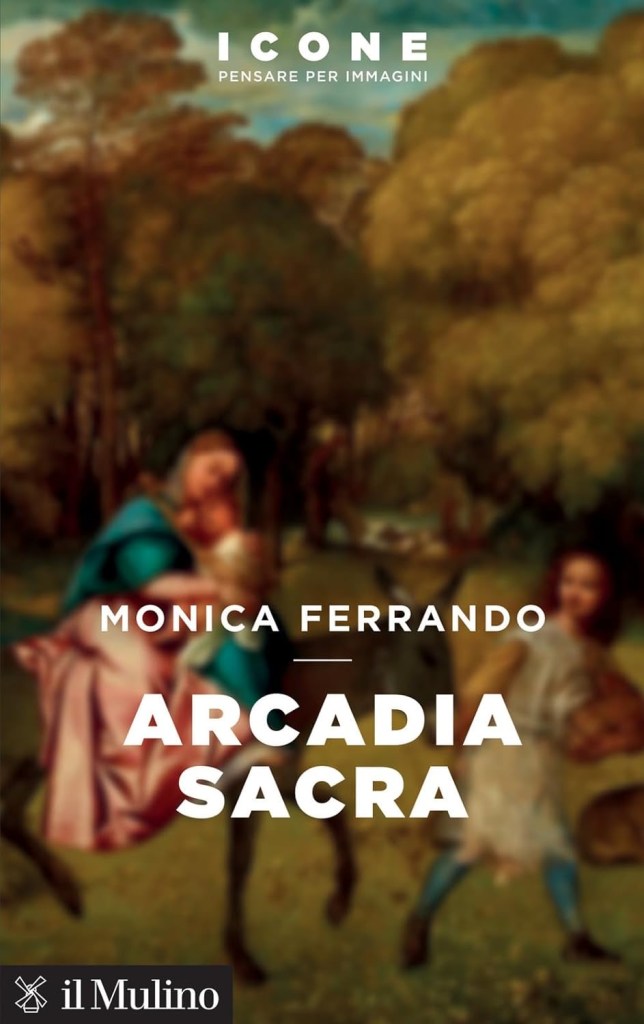
For anyone familiar with the delicate thought of Monica Ferrando, the short book just published, Arcadia Sacra (Il Molino, 2024), makes it impossible not to read it in light of her the two previous works, the ambitious Il regno errante (Neri Pozza, 2018) that reconstructs the political paradigm of the nomos of Arcadia, and L’elezione e la sua ombra: Il cantico tradito (2022), which brought to light the corrupted meaning of a theopoetic understanding of “election” and its appropriation by an effective economic theology apparatus that governs over the destiny of the modern edifice. Arcadia Sacra continues Ferrando’s highly original reconstruction of the unforgettable myth of Arcadia within the obscure setting of secular modernization in which painting itself has come into crisis to the point of utter obsolescence. We might be the first epoch in the history of humanity (or even prehistoric, since painting goes back to the non-original origin of the caves, as Ferrando has argued) in which painting itself is lacking and almost non-existent [1]. And although Ferrando does not allude to the present directly, it goes without saying that by choosing as her focal point Titian’s early picture “The Flight into Egypt” (1508), the vision deployed in the essay can only speak to us as urgently, where the thematics confronted by the Renaissance of Venetian painting returns to our present in a fractured flash: imperial conflagration, unlimited deployment of force, usurpation of territory and multiplication of legal checkpoints, and the accelerated disconnection between architecture and nature, color the ongoing devastation of the vantage point of the landscape now eclipsed by the radiant artificial confinements of the contemporary metropolitan designs.
Already during his postwar years in the United States, Theodor Adorno observed how the unbounded sadness of the American landscape has nothing to do with an inhuman romantic sublime; it was rather that the landscape feels as if it bears no traces of the human hand [2]. If Americanism configures the long lasting night of planetary nihilism; this is so, not only due to capitalist subsumption and production of human life, but fundamentally because of the inherent obliviousness of the landscape that forecloses dwelling in the world. But the myth of Arcadia, as Ferrando will insists, is no utopia nor crafted rhetoric (the bucolic genre as an aesthetic compensation to the normative grid of the social bond); it is also the question about the earthly ground of existence, and the necessary attunement with the things that have been domesticated into order of the metaphysics of idolatry and objectivity (Ferrando 28). In this sense, Arcadia does not name another world to come; it is a world that has been registered many times, reappearing whenever the hand reaches out in proximity as if caressing the landscape’s skin.
The mytho-poetical deployment of Arcadia returns amidst a world in conflagration, and for Ferrando this has fundamental political implications insofar as it shows a way out from the grammar at the service of force and political dominion of commanders and soldiers – which is always already exercised as legitimate to coerce and to become a tool for the regulation of abstract mediations – into the voice of poets, painters, and shepherds (Ferrando 51). Arcadia reveals that the human species is a ductile animal that can sense by the ability to touch and use. This is why Arcadia stands as a third space outside the political dichotomy of empire and republicanism, between the struggle of usurpation and conquest, and the techno-political administration of common goods of social distribution and institutional delegation. The abstract humanism of the Renaissance, as Heidegger once claimed alluding to Machiavelli’s political thought, is also the commencement of a specific political technology rooted in certainty and justification that can only conceive representation as the ground for the production of an “effective truth” [3]. The virtuous homini militari of the Italian city states anticipate the neutralization of force as legitimate rule that will prepare the stage of modern political realism based on fear and normative rule of law. The final efficacy of force is to transform the sense of the world into a mere object, as Weil clearly understood it in her essay on Homer’s Iliad. One of the key insights of Ferrando’s Arcadia Sacra (2024) is that it shows that, parallel to the revolution in political technologies taking place in Renaissance Humanism, the image of Arcadia was being rediscovered in treatises and paintings in order to remain faithful to a different attunement of the nomoi, in which the philosophy of history of sacrifice, endless civil wars, and destruction of the Earth do not constitute true destiny (Ferrando 14). In an exoteric way – and it is so, because the craft of the painter is, precisely, depiction and figuration of the nakedness of what appears before our vision- painters like Titian, Veronese, and Bellini, became witnesses to the acquiescence of the nomos mousikos, which far from soliciting the conceptual density of a theory of Justice; it registered the preeminent condition of poetizing nature of living in the vanishing world. Indeed, it was in the musical nomos where the soul could establish the communication between exteriority and interiority within the gleaming order of things.
If Heidegger in The Origin of the Work of Art suggests that the erection of work occupies the open space of this clearing; Ferrando will thematize how Boccaccio’s understanding of the Earth as radiantly divine was drawing upon the tradition of Arcadia will emerge as the pictorial space of the artists to disclose the vibrant sense of a necessary freedom (Ferrando 43). This means that living among the gods is not reducible to panentheism, if understood as oppositional to monotheism; rather, it was the opening to the event that gathered forms of life, creations, affections, and territories. In other words, there will always be gods whenever the world is not enclosed into the homogenous surface of a unified planetarity. And is not painting the quasi-originary activity of human anthropogenesis (the event of being in the world as such) the sensible evidence that negates any conceptual and political translation directed towards action and justification? After all, painting is, among other things, the business of depicting mute things, as Nicolas Poussin famously claimed.
But muteness must be qualified and expanded, since Arcadia is no asylum or final refuge of man. Titian’s “The Flight into Egypt” depicts a rite of passage, but also opens to a set of rhythmic connected activities that lead to the landscape. Thus, as Monica Ferrando reminds us, building from her previous Il regno errante, Arcadia is also the material experimentation of acoustic energy; music, or the the nomos mousikos, no longer guided by the command of political service, directed by attunement of the lyre and the syrinx, will speak the unwritten language of the human soul. Painting and music convergence at the nonsite of permanent formlessness. And it is rhythmic music allowing improvisation and experimentation that reimagines a different conception of the polis; a transfiguration of political life, in which the principle of civility in all of its complexity (citizenship, objective transference and negation, civilizational fortitude) will no longer articulate the principal axis of the human commonwealth. Neither a source of higher natural law nor a mere expansion of positive norms, the nomos of Arcadia for Ferrando entails: “inalterabile a unire intimamente musica e legge, entrambe ágrapha, non scritte, se non nel cuore. L’interdipendenza tra modi della musica e nomoi della città, che sarebbe vano interpretare secondo un rapporto causale, trova nella stessa parola nomos un compendio inesauribile, ribadito nella Politeia: «Non si introducono mai cambiamenti nei modi della musica senza che se ne introducano nei più importanti nomoi della polis” (Ferrando 54). The separation of law from music – as Ferrando will say for poetry and philosophy in later pages – will ultimately lead to the moral struggle towards the rise of the fictitious (and whoever can impose it through their effective hegemony) against the emergence of the “love of thought” (l’amore del pensiero) (Ferrando 57). In this sense, the moralization of justice and its conversion into a specific historical grammar (lex scripta in the juridical apparatus) will ground the order of the polis in which the human will be absolutely sacred so that the sacred nearness between existence and the world – the atopia where the promise of happiness can take place – will vanish forever. As Carlo Levi saw clearly during the postwar years, the rise of the political administration of fear will coincide with the decline of painting as the source of being in liberty within the senses [4]. And, in our days, the historical termination of secularization can only be felt like an unending glacial interregnum (it is no surprise that Disney’s epochal blockbuster is precisely a defense of alienation of a cold being in a Frozen castle) in which the prehistoric reminiscence of the garden can only appear as an afterthought or mere representation, always out of reach, and viciously grazed by wild beasts before our own eyes.
But seeing is already an exercise in prefiguration of a world that returns where painting stands as the medium for a mediation between the formlessness and the soul. This is why, above all, pictorial space is a privileged surface from which to flee our condition of unworldly inmates of our times. In a certain way, painting does not just bring to bear truth against the regime of calamitous fictions; it is also bears witness, as Ferrando states towards a high moment of Arcadia Sacra (2024), to the rediscovery of a new mental space that revives the attunement to a state of the world no longer reduced to the depredatory practices of civilizational extraction and consented servitude (Ferrando 77). The tradition of painting is not just a collection of forms and artistic conventions, but the ongoing concert that facilitates our movement (and being moved) towards happiness.
This is the promise of the itinerant Mary’s passive and inclined face in Titian’s early masterpiece. It does not come to surprise that for Ferrando, the mother dwells among the gods of peace, in contrast to the figures of the commander or the inquisitorial or priestly judge that monitor an endless narrative of intra-species civil war (Ferrando 63). It should not go without saying that at the same time that some contemporary scholars in the face of a historical crisis of legitimation attempt to revive the aura of the homini militari, the precepts of the ragion di stato and the technical virtues of the charismatic Prince; it has been the work of Monica Ferrando, in fully in display in Arcadia Sacra (2024), that invites us to turn to the counters of eros of painting that, almost stubbornly, transmit to us the infinite possibilities of life among the green blades of grass in Pan’s spiritual land (Ferrando 82) [5]. The sacredness of Arcadia resides in this unbounded exteriority that thanks to the mystery of the mother, is always commencing; and, having achieved happiness, it wants to know nothing about bring the world to conclusion. Beneath the arcana imperii (Rome) and the bylaws of the polis (Athens), the landscape of Arcadia remains a harmonious passage of our cohabitation.
5. I am thinking here of the works of several American historians of political thought and legal scholars in recent years that have mobilized efforts to restore a “neoclassical”, Renaissance centered political tradition, as a response to the crisis of modern liberalism. The most prominent list includes, although it is not limited to James Hankins’ Virtue Politics: Soulcraft and Statecraft in Renaissance Italy (Harvard U Press, 2020), Harvey Mansfield’s Machiavelli’s Effectual Truth (Cambridge U Press, 2023), and Adrian Vermuele’s endorsement of Renaissance imperial categories such as Ragion di stato, Lex Regia and the tradition of the Mirror of Princes, see his “Sacramental Liberalism and Region di Stato” (2019) and “The Many and the Few: On the American Lex Regia” (2023). The pastiche of this neoclassical investment made possible by rhetorical and hermeneutical deployments of instrumentalized myth, it is something that I have taken note of in “¿Revival de la tradición legal clásica?” (2022). Drawing a parallel to this classical absorption in American political thought, one could say that this is a reiteration of what Monica Ferrando herself has analyzed in her chapter on German Romantic Neoclassicism and the Winckelmann aesthetic project in her L’elezione e la sua ombra. Il cantico tradito (Neri Pozza, 2022), except now that it lacks aesthetic meditations (there is no Dichter als Führer), thus culminating in the direct exercise of applied executive force.
Giorgio Agamben’s most recent La voce umana (Quodlibet, 2023) sets the scene with an elemental question: what is to call on something, and what is it to be called upon? The exploration around the notion of the voice (a sort of chorâ that falls between the different antinomies of human language, as we will soon learn) is far from new in Agamben’s work, who from the the early period of Il linguaggio e la morte (1982) directly confronted the negative foundation of phonê in relation to the closure of metaphysics. In a certain way, the perimeter of La voce umana (2023) is now deliberately limited to how the ‘mystery of the language’ is to be found in the unending event of the voice as the arcanum of anthropogenesis itself. At this stage of his investigations, the problem of the voice for Agamben designates a double movement of inflection and recapitulation: the voice proves the internal division of political life in the West; at the same time, it is also the most intense experience that a form of life can bestow the disclosure of the world. The attentive reader might recall the last pages of L’aperto: l’uomo e l’animale (2002) where the impasse of the anthropological machine was assigned by caesuras between human and animal, the semiotic and the semantic, the word and the name, redemption and the end of time, writing (gramma) and sound. But it is now with the voice that a clear way out becomes apparent. In the analytics of the voice klesis no longe stands as a political-theological category of the West; but, on the contrary, a call of language unto itself, the vocative that resists linguistic denomination and the free-standing outside the case and even language itself (“fuori lingua”) as suggested by Gustave Guillaume.
The vocative dimension of language is shown as pure means of the human experience: the apostrophe that calls something – as in Moby Dick’s majestic beginning “Call me Ishmael” – is already the call through the act of naming, and naming falling into the voice becomes the originary place of language in the denomination of speech (21). Irreductible to the antinomy of langue and parole, the semantic and the semiotic, the vocative texture of the voice emerges as the third figure that neither linguistics, philosophy of language, phonology, analytical linguistics, and biological cybernetics are capable of truly grasping. And this is so – Agamben does not says it in this brutish way – because there cannot be any theory of the voice and the vocative denomination; there can only be a poetics of the voice in which the transformative and self-generative experience with reality is staged: “Ma è possibile pensare il linguaggio prescindendo dal suo rifermenta lla realtà? La voce – il vocabolo – non designa soltanto un significant, chiama piuttosto un ente reale…non si limite a elencare segni in un lessico, ma annuncai ed encunia realtà” (36).
In my respects – and this is not the place to bring into focus Emile Benveniste’s last seminar on language and writing – Agamben’s treatment of the voice is nourished by pushing beyond the limits of the great twentieth century linguist who, for the most part, remained silent on the place of the voice. Not that there is a need for another substantive treatment of the vocative; in fact, one of the great achievements of La voce umana (2023) is precisely the archeological reconstruction of the Aristotelean “what is in the voice” (ta en té phonē) formula in which the classical metaphysical inception of language comes closest to the voice only to render it “articulate” and thus subordinated to the legibility of gramma or the written sign (42-44). And whatever one thinks of what constitutes the “primacy” of metaphysics in West (phone or gramma), what is important is the fact that domestication of language has been auxiliary by the “fundamental discipline of the West” (grammar) that sets off the immediate point of dialectical force between speech and the alphabetical inscription in the voice (45-46). Civilization is nothing more than the historical process of taming one’s voice.
At this point, it becomes clear that Agamben remains faithful to his old friend, the Spanish poet José Bergamín, whose bewildering essay from 1933 “La decadencia del analfabetismo” (“The decline of illiteracy”), argued precisely that the upwards movement of civilization of grammar and writing undermined the living voice and imagination of concrete and localized people (“pueblos minorías”) livelihood [1]. Indeed, it does not take much to see how the grammaticalization of human experience was a fundamental infrastructure for the consolidation of civil society grounded in the articulation of internal recognition of rules, normative directives, and binding statutory enforcement. The triumph of the order of grammar will only intensify the movement towards the total integration of every form of life into the fictive rhetorical space on behalf of what has already been stated without having to persuade, to put in Carlo Michaelstaedter’s terms that I do not think contradict the terms that Agamben extracts from his exegesis of the voice.
The political problems emerging from the confrontation with the voice are multiple. One can recall how in modernity, when “words have been liberated from their sacred denomination” (something pondered by Joseph De Maistre in his The Generative Principle of Political Constitutions as political revolution sets through universal recognition), the closure of the rhetoric embedded in “social life” captures the event of the voice into a stable communicative dimension of language (“suoni della lengua”), which for Agamben resembles the etymology of the word phònos: murder, that is, the self-conscious assassination of the voice at the altar of free-floating rhetoric and the order of discourse (50-51). By the same token, in our epoch every living being has the malleable equalizer and “amplifier” (a word used, indeed, by the Supreme Court of the United States when deciding the case that granted equity between finance campaign and ‘public use of language’) of words, but it is only rare to see anyone truly possessing a voice. If every entity in the world has been previously assigned and grammatically ordered, what is absent is precisely the chōra as the “invisible and formeless place” (‘invisibile e senza forma”) in which the intelligible pure state of the language in the voice. In this strict sense, whoever possesses a voice is one who dissolves the axiomatic arrangement of discourse only to transform the world as inhabited. This is why the voice remains not a threshold to semantic register or the written technology, but rather an unknown song (“canto ignoto”), as it was called by Benedictine monk Guido d’Arezzo. And this song, the voice, can be followed and deciphered but never truly mastered as absolute transparent knowledge (45).
And if music is an index of prophecy, as Gianni Carchia once suggested, then this means that the voice, like the mythic harmony of the spheres, is what exceeds the proper human as indivisible and non-exchangeable realized only here and now. The political consequences are immense, Agamben is right. This means that we need to restate the medial and geographical distances of the chorā over the orderly cultural exchange of the polis. As it has been noted, the rise of the city state is waged against the orphic poetic myth; in the same way that the Roman imperium was possible by the erasure of the Etruscan musical underworld. Agamben reminds us that the birth of biopolitics coincides with the historical invention of the science of language leading to the impoverishment of the intangible and expressive communication between souls. This is Agamben’s rendition that the task of philosophy – not historical benchmarks or epistemological categorizations – resides in the attunement to the highest hymn of expressive form as it has been studied by Nicoletta De Vita’s erudite monograph Il nome e la voce (2022). There is no philosophical or theological closure as long as the song remains.
We can say that wherever there is a chorā of the voice something like this minor transcendence of the original human being that retracts from the soteriological false exits that have devastated the anthropogenic event. And it occurs to me that we could thematize three areas of what this closure means for us today: first, the technification of politics in epoch has been reduced, precisely, to a discursive theory of articulation (of social demands) to craft the fictive totalization of hegemony; second, the collapse of the political representation within contemporary democracies has turned into the optimal organization of containing willful self-expression in light of the contingency of values of the dominant aesthetic regime; and finally, the very understanding of legal culture and constitutionalism in the West has shuffled different modalities of the written authorial intention to generate the internal rules of institutional and statutory norms only to expand police powers and codification of conducts. At the expense of the unknown song, all sorts of prosthetic contraptions have been erected to douse the prehistoric voice that nevertheless keeps overflowing and reemerging like the unnerving cracking squick of Kafka’s Josephine. It is this watershed mystery of the anthropogenesis with its philo-poetological density that calls on humanity by the highest superlative imaginable: its voice.
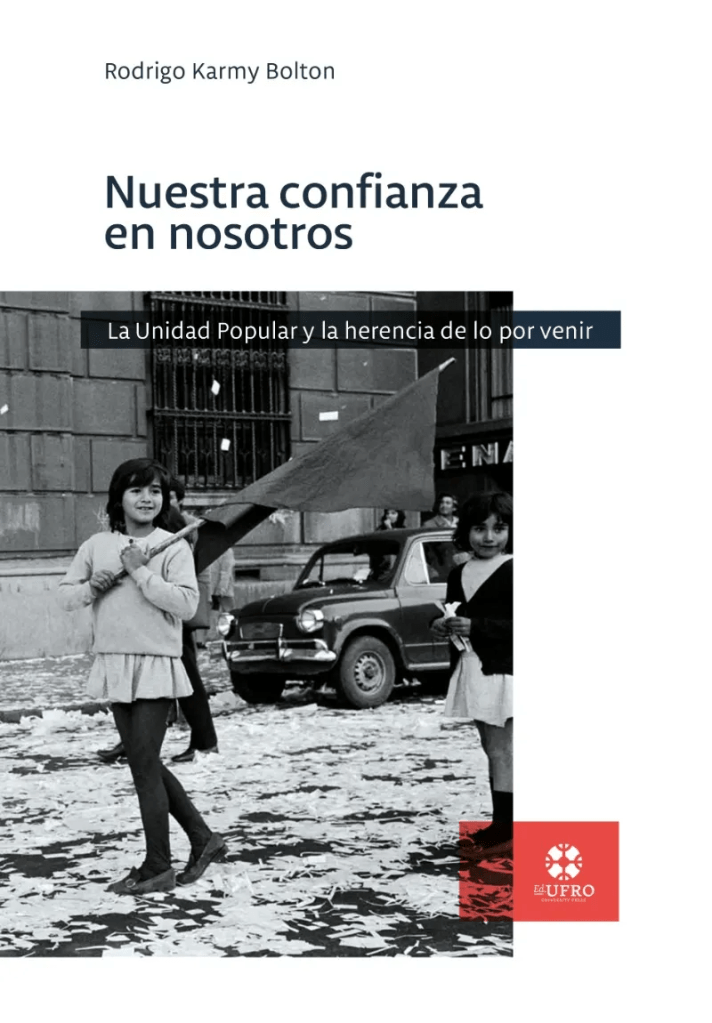
Transfiguration. Towards the end of Nuestra confianza en nosotros: la Unidad Popular y la herencia del por venir (Ufro, 2023), Rodrigo Karmy suggests that the experiential texture of Salvador Allende’s political years amounted to a sort of corporeal transfiguration of historical time, but also of the political subject within modern architectonics of the inter-state sovereign system. The death-martyrdom brought a new world into order, radically transforming the sense of historical assumptions and its immanent refutations and accelerations. For those of all that know Karmy’s philosophical investigations working through this intuition, it is impossible not to see that ‘transfiguration’ does not entail ‘sacrifice’, but rather it implies the figure of the martyr [1]. And we also know from Erik Peterson that martyrs are absolute witness to truth of an irrevocable event; in other words, those that transcend the core materiality of the mere opinions and matter-of-factness as to remain faithful to the unfathomable to a world brought to abrupt change (and at times, this means also despair). Karmy writes:
“Se produce así una transfiguración radical de Allende que trastoca enteramente el juego de la teología política, tal como ha sido planteada bajo los avatares del fantasma portaliano: si en esta última, el cuerpo físico termina desmaterializado en un cuerpo institucional, tal como ocurrió con el devenir del general Pinochet, en Allende termina desmaterializado en una potencia por venir (no en cuerpo institucional), aquello que Walter Benjamin llamaba lo «nunca sido»: «Siempre estaré junto a ustedes», dice el presidente usurpado por el golpismo esa triste mañana de septiembre” [2].
The truth of transfiguration – and in a sense every event of truth is always carried by the energy what is transfigured – marks the incommensurable distance between the eternal persistence of the word and the historical movement guided by the precepts of civilization. Whereas the political grammar organizes itself through an indiscriminate institutional corpus and a set of moral binding obligations upon its citizens; the truth of transfiguration is the keeper of the night of the soul that, like the myth of Er, signals the passage between the world of the living and the kingdom of the dead. When transfigured, the dead can become even more lively than those allegedly “alive”; where those alive become embodied and rigid statues or mummies. As such, the energy of transfiguration remains outside the cloisters of history and its memory sites, since its realization takes place whenever there is a drift outside and beyond the suturing of the world as mere stated and enclosed fact.
Voice. The “we” (Nosotros) in Karmy’s thesis does not signal the constituent political unity of the People nor a partisan form that can exert force towards the inversion of the sedimented historical order. In his archeological endeavor, the ‘nosotros’ indexes a non-numerical instance through the vocative raises its own question to the past. This does not imply that there is a “collective voice” that must enact its point of annunciation through representation and mediated forms; the voice emerges as an exception to the grammaticalization of the constitutional order and its statuary production as expression of legislative will. The voice is the exteriority to every scheme of reproduction. But, what is a “voice”? Following Emilio Recabarren, Karmy connects the voice to the very act of creation: in other words, a voice to the truth implies the vocative of what has truly never been there before. Like the chorā, the voice is both at the reemergence of its origin and medium rather than substance; and this is why the voice, unlike the written language, cannot be subsumed to the reification of mimesis and generative substance [3]. The voice is what every time remains irreducible to the order of discourse difference, historiographical narrativity, and the original letter and spirit of the law. And even in traditions without “Constitutions”, law cannot escape its written and grammatical framework; this is why in Common Law, the Constitutional authority is supplanted by the historical absorption of habits, manners, and tradition into the force of legal codes and binding statutes. It is a high merit of Karmy’s Nuestra confianza (2023) to reminds us that the happiest moments (and perhaps the only moment worth saving, that infinitely returns against the grain of historical progress) of the revolutionary experiences of the twentieth century are to be found in the evocation of the voice and its popular music (something that can also be said of the Cuban Revolution, for instance). This esoteric orphic thread evidences the disjointed relation between the polis and the mythic transfiguration when facilitated by the prophetic overtones of the musical nomos in the genesis of the West [4]. Hence, whenever there is a voice, the suture of politics to the theology cannot amount to the continuous transaction upon the survival and agony of the living.
Freedom from revolution. Unlike the reverential or formalist accounts written for the fiftieth anniversary of the Chilean Unidad Popular, Karmy’s essay invites us to dwell about a political experience after its epochal exhaustion: the collapse of the horizon of the philosophy of history implies the internal implosion of the modern revolution’s infrastructure (constituent power, moral justice, militant subjectivity, sacrificial energy). For Karmy to arrive at a certain nearness to the well lighted tradition of the UP is to abandon once and for all the civilizational eon of sedentary political hegemony (“a revolution in world history” bringing about the age of the nomads to an end, claimed historian Edward Gibbon) that has now paved the way for the unlimited forms of planetary government exerted through the rationality of the management of population and the distribution of the economy [5].
The farewell to the revolution and its reverse – it is well known that De Maistre claimed in the wake of the French Revolution that the opposite of the revolution is not a counter-revolution, but what is all together contrarian to it – means to put a halt to the paradigm of force (positive and immanent hostility) that has oriented actions, expectations, passions, and even dreams taxed at the fictive illusions of an abstract Humanity devoid of any possibility of happiness in the world. It is only after we can leave behind the revolutionary metaphysical mimesis that a new sense of freedom could emerge away from the dominion of the land-surveyors of the Earth. Abandoning any clamors oriented towards the future, it is now for us to attune to the everlasting traditions that are unrelinquished to the endless rubble of time.
.
.
Notes
1. Rodrigo Karmy. “The Absolute Gift: Martyrdom as Destituent Power”, SAQ, 122, 2023, 157-170.
2. Rodrigo Karmy. Nuestra confianza en nosotros (Ufro, 2023), 183.
3. Ibid., 102.
4. Gianni Carchia. Orfismo e tragedia: Il mito trasfigurato (Quodlibet, 2019).
En el viejo artículo “Praise of Law: the origins of legal philosophy and the Greeks” (1947), originalmente escrito en ocasión de honor a la obra del jurista norteamericano Roscoe Pound, Werner Jaeger desarrolla la sorprendente tesis que la génesis del derecho se encontra en la Grecia antigua antes que en el imperium romano, y llega a decir que el pensamiento filosófico griego nunca dejó de reflexionar sobre la constitución de una legalidad. Ya en en los poemas homéricos, recuerda Jaeger, encontramos una tematización no tanto del nomos como de la themistes, un conjunto de ordinanzas orientadas a un principio de autoridad mundana aunque proyectada en forma de mito a los dioses. La themis separaba el mundo de la civilización ante el mundo barbaro sin ley (que era el mundo del Cíclope en la Odisea). Ya en Homero y Solón, la distinción entre drecho y justicio se complemetarian para explicar una relación con la naturaleza que cosmológicamente implicaba orden y armonía. La dike en Anixamandro, por ejemplo, se etendía como el orden eterno que componen todas las leyes del mundo. De manera que antes que la concepción de la división del poder de una garantía “positiva” del derecho tal y como lo entendieron los modernos, ya la armonía que a la que aspiraba la diké como balance (isomoiria) de los humores.
Esto implicaba una relación con la salud, pues la “buena salud” capaz de garantizar un principio de igualdad (ison) era solo posible mediante un ordenamiento que limitara “la tendencia hacia el exceso”, como nos recuerda Jaeger (358). De manera que el ideal de la salud para los antiguos no se hallaba en una administración de un cuerpo “enfermo” y al que hay que curar como luego lo asumirá la biopolítica, sino como armonía entre la irreductibilidad de almas. La polis tenia que orientarse hacia la Justicia, ya no como abstracción de un gobierno (como lo entiende el tomismo y el derecho natural), sino diferenciación absoluta entre derecho y Justicia en el ordenamiento del mundo. Lo justo era un medio de la salud, y estar saludable solo podía ser una realización de la j instancia de la justicia.
La consitutcion de la polis como entidad política demótica de alguna manera marca una transformación inédita del principio armónico hacia una concepción de igualdad de representación mediante la comunidad social. La isonomia consolida la máxima pindárica del nomos basilus (el nomos es rey) que para Jaeger es el logro más alto de la civilización griega. La polis “enseña y educa al hombre”, llegaría a decir Simonides quien instala una paideia de la virtud cívica entre iguales. Esto es, la isonomia necesita no solo de una recodificación representativa en la polis, sino que tambien requiere de una paideia como “educación en el espirtu de las leyes” (361). Como demuestra Jaeger, esta concepción civil del derecho hace que la ley se entienda como una “mera funcion del poder” (364). Y así lo entendieron los sofisitas que, como recordamos con Trisimaco en La República de Platón, llega a definir la Justicia (el concepto pivote que busca indagar Socrates) como cualquier cosa que sea definida por quien tenga el poder en un momento dado.
En efecto, no estamos muy lejos aquí del concepto hobbesiano de potestas soberana, donde la armonía queda relegada por una comprensión legal fundada “desde la seguridad y el crédito en la producción de la naturaleza de la realidad” (365-366). Ahora la textura de la polis depende de una ingeniería hidráulica de la legalidad cuya finalidas es el manteninimietno del orden de lo civil. En efecto, la circularidad entre orden y civilidad emerge como un proyecto de “creciente subjetivismo” (growling subjetivism, Jaeger dixit), a tal punto que en Platón el estado se entiende como una gigantesca abstracción pedagógica (366). De alguna manera la paideia del estado orientado hacia lo Justo requiere de un dispositivo educativo hegemónico que termina reemplazando la centralidad del derecho, o al menos volviéndolo secundario.
Pero Jaeger insiste que la palabra final de Platón sobre el derecho no se encuentra en el organización pedagógica de La República, y que al final de su obra el filósofo regresa a la cudestion de las leyes. En Las leyes enfrecerá una noción de derecho positivo mediante un protector guardían del derecho que legisla a partir de un principio de racionalidad del derecho (una integridad interna, tal y como luego lo entendería Lon Fuller en The Morality of Law). Pero será en el diálogo Minos, cuya autoría de Platón es cuestionada, en donde se define el ejercicio del derecho como “technē”. Según Jaeger la technē habilita el descubrimiento de una cosa real contra el dogma poleos de la decisión del estado (370). En otras palabras, es mediante la techné que el derecho se orienta hacia el ser verdadero de las cosas a pesar de la positivización de las leyes de una comunidad política. Esa verdad no es reconocida en la legitimidad de un “pueblo” sino en el logos del guardián.
En este punto reaparece aquí la diferenciación entre derecho y Justicia o “verdad”, que en Platón se tematiza como la diferencia absoluta entre filosofia y derecho en el momento de la consolidación administrative, aunque el estado es el portador de la Ley como medio para la verdad de las cosas. Este es el resto cosmológico en el pensamiento platónico para una época en su momento ya dominada por la visión sofística de la validación del derecho como paradigma subjetivo en la construcción de la realidad; un sentido de realidad que luego la jurisprudencia romana perfeccionará bajo la rubrica de la “-res” [2]. El artificio consistirá, por un lado, en la construcción de un sentido ordenado de la realidad; y, por otro, de una estratificación de valores asumido por la producción de una normatividad. La mirada de Jaeger en la génesis griega constituye, de esta manera, algo así como una urgeschichte de la consolidación del ius romana y del desarrollo clásico del imperium del derecho.
.
.
Notas
1. Werner Jaeger. “Praise of Law: the origins of legal philosophy and the Greeks” (1947), en Interpretations of Modern Legal Philosophies (New York, 1947).
2. Yan Thomas. L’istituzione della natura (Quodlibet, 2020).
En lo que sigue quiero organizar algunos apuntes de lectura sobre la noción griega de nomos mousikos, y para hacerlo quiero glosar algunos movimientos del último capítulo de The Birth of the Nomos (2019) del estudioso Thanos Zartaloudis, quien ha elaborado la contribución filológica y conceptual más importante del concepto hasta el momento. La noción de nomos mousikos pudiera orientar de manera decisiva la prehistoria de una institucionalidad no necesariamente jurídica, previa a la captura del derecho, y en tanto tal capaz de iluminar la relación entre derecho y forma de vida (ethos). En efecto, Thanos Zartaloudis comienza por recordarnos que en el Fedro Sócrates refería a la filosofía como la “más alta mousikē”, y que, en este sentido, la mousikē era una forma de vida, un ethos cuya exploración experiencial se daba mediante la mousikē [1]. Pero la mousikē tiene una prehistoria o una protohistoria antes del momento platónico, que en realidad es su último momento.
En sus inicios la mousikē constaba de una dimensión experiencial mayor que la technē, pues prepara las condiciones para la realización más educada del carácter (ethos) (341). Y, por lo tanto, se entendía que antes que la polis estaba mousikē, y que no habría vida en la polis sin la necesaria condición de la mousikē. Zartaloudis no llega a relacionar la mousikē con el ideal de la ciudad bella (kalapolis), pero sí nos dice que esa “experiencia” de la mousikē garantizaba un orden; una noción de orden acústico, más ligada a la voz y a la memoria que a una sustancia medible de la vida en la polis.
La mousikē, por lo tanto, apelaba directamente a las Musas, y, por extensión, a una función de la transmisión social de la memoria. Según Zartaloudis se trataba de: “una iniciación con la divinidad, que era saber común, y también poder de la música para instituir un saber común o una comunidad mediante la mimesis” (348). La mousikē constituía una forma institucional mínima, invisible, que tampoco era reducible a la especificidad de la música, sino a la asociación con las Musas. Y con las Musas se hacía posible guardar el silencio de la palabra, que entonces se entendía como un ejercicio fundamental de la paideia del ethos.
Aquí la mousikē asume su condición protofilosófica y especulativa más importante: la mousikē es el nombre que se le da al evento originario de la experiencia lingüística de lo no-lingüístico. Zartaloudis nos dice que la memoria que transfiere la mousikē es siempre de antemano trágica; y es trágica porque en ella se registra, o se intenta registrar, la pérdida de la voz como apertura del logos en la phonē. De manera que la “Musa es, el nombre de un acontecimiento que intenta ser recordado como advenimiento de la palabra, como cosmopoesis musical” (355). La Musa es, entonces, no solo ritimicidad de la mousikē, sino la memoria de la pérdida de toda divinidad que, en última instancia, dispensa la inmortalidad mediante el recogimiento de lo mortal, como sugiere Zartaloudis glosando a Jean-Pierre Vernant.
Las Musas ejemplifican una relación entre la voz y el orden social mediante la dimensión del ritual que Zartaloudis refiere de manera directa al problema de la armonía. Y es mediante este problema que la mousikē se convierte en un tema abiertamente político, o de interés político puesto que: “Armonía no era una cuestión de darle forma al caos, en el sentido de lo medible y lo cuantificable, sino de escuchar el chaosmos y ser capaz de anunciarlo” (362). Por eso ahora se puede entender porqué mousikē eventualmente pasó a ser una forma educativa política del ethos, así como un episteme técnico de las matemáticas y de la filosofía. De manera que mousikē era la forma mediante la cual se podía activar una regeneración del kosmos desde la experiencia de la phonē en el decir. La organización de la mousikē para los griegos poseía un poder cosmopoetico. Y Zartaloudis indica que el fenómeno del kosmos no era otro que el de aletheia en la canción. Se trataría, entonces, de un ritual de la mimesis del orden de lo melódico.
Es probable entonces que el nomos mousikos haya sido el sobrevenido técnico de transponer este problema de la voz como acontecimiento a formas genéricas de la melodía y de la tonalidad (382). Y posteriormente en Platón la mousikē obtiene un carácter jurídico y social, por el cual el acontecimiento queda plasmado en el orden de la legislación estatuaria. O sea, nos encontramos ante una forma temprana de la invención del “costum” como norma escrita. He aquí uno de los misterios que Zartaloudis registra, pero que tampoco logra desentrañar del todo de manera explicita: ¿cómo entender el tránsito del orden musical previo a su dimensión estamental del derecho, y luego su confección en la sutura del nomos mousikos? Zartaloudis cita al estudioso Mittica quien argumenta que dicha transformación es de orden de la analogía, y necesariamente de un desarrollo temporal, cuya ambigüedad permaneció por mucho tiempo en la antigua Grecia.
Pero será en Las Leyes de Platón donde la analogía encuentre su mayor grado de sofisticación y perfección, puesto que las reglas mousike serán transpuestas al ordenamiento (taxin) de la polis. Y ahora el poeta aparece ‘ordenado’ para la finalidad de un ‘bien común’ de la polis, ya que el poeta compondrá en la medida en que parmanezca dentro de la ley (nomina), apele a lo bello (kala), y contribuya al bien (agatha) de la ciudad. La dimensión del kosmos-mousikos, nos dice Zartaloudis, ahora aparecía albergarse en el artificio de la palabra. Y solo de lejos era posible escuchar “el pensamiento acústico” de Heráclito. Pero entre sonoridad (nómos) y ley (nomós) algo irremediablemente se perdía: el ritmo incongruente a la forma – el orden melódico, ahora devenía un molde para el orden social. Así se edificaba el nomos mousikos como actividad cívica. Y era el filósofo quien portaría la divisa de la “más alta mousike”, cuyo mysterium era residual a la apariencia de la idea. Por lo tanto, la mousikē era una instancia profética de toda filosofía, como en su momento pensó Gianni Carchia.
.
Notas
1. Thanos Zartaloudis. The Birth of the Nomos (Edinburgh University Press, 2019).
¿Cómo entender la elaboración trágica del drama de Empedocles de Hölderlin? Se trata de otro intento de abordar la relación disyuntiva entre la sensibilidad moderna y la génesis griega tras la fuga de los dioses. En un importante ensayo sobre La muerte de Empedocles, Max Kommerell se refiere a esta tragedia como la construcción de un “género en desocultamiento” [1]. Ahora bien, lo que se deja ver no es un rasgo elemental ni el error trágico del personaje, sino algo más originario; algo que Kommerell designa bajo un concepto de intimidad, que en su retirada “mora con el otro” desde su singularidad irreductible. Este movimiento, como lo es también el del propio Empedocles, viejo poeta-filósofo-profeta del mundo, se asume como recapitulación, y por lo tanto solo ejercicio en el umbral de la vida. Para Hölderlin, por lo tanto, estaríamos ante la “restitución” de lo infinito en lo finito de la vida, una sutura en declinación desde la cual podemos contemplar, a todas luces, la catástrofe del momento desde la cual emerge el mito de la autoafirmación del hombre. Este es el primer momento de “separación” de la physis, entre lo orgánico y lo aórgico, que tan solo puede ser la formación de lo que ya ha “acontecido”. Empedocles encuentra la inestabilidad del hombre en la génesis de la separación de la presencia.
De manera que no hay posible edificación de mito (típicamente prometeico), como el esbozado por Goethe y luego tomado por la figura del artista de Nietzsche, puesto que Hölderlin lleva al creador ‘súperhombre’ a la ruina. Y más aun: la ruina de este poeta profeta también supone la desintegración del pueblo como unidad orgánica ante un mundo que ahora pasa a ser abismal. En palabras de Kommerell: “abierto a una religiosidad amorfa de una época abierta después de su colapso [2]. Es por esta razón que no hay en Empedocles una figura carismática interesada en abrir la energía para una época entre una comunidad existencial. Como vemos entre los personajes del drama, Empedocles solo se autoreconoce en la amistad bajo el claro de los dioses fugados que alguna vez habían depositado en él la irradiación de una trascendencia ilimitada.
A diferencia de lo que se ha notado de La muerte de Empedocles como la afirmación de lo trágico bajo la figura sacrificial de poeta genial (hiperbólica de toda una época romántica subjetivista según nos dice Carl Schmitt en una entrada de Glossarium); la fuerza infinita del personaje desplaza y pone en suspenso el personalismo del poeta y el mando por liderar el encuadre objetivo del mundo. Pero esto solo puede hacerse – o así lo hace Hölderlin – a partir de un concepto de religiosidad interior como sustrato de proximidad que pone en crisis lo subjetivo y lo objetivo. Y para esta frontera común-en-separación no hay administración ni guías posibles. Por eso se cerraba el eón de los profetas en comunidad. Aquí Hölderlin se adelantaba a las críticas illichianas a la figura del sacerdocio como figura de la representación eclesiástica de las almas. La crítica al sacerdote en La muerte de Empedocles es explicita: “Fuera! No puedo ver ante mi al hombre que ejerce lo sagrado como industria. Su rostro es falso y frio y muerto, como lo son sus dioses…Concededme la gracia de recorrer tranquilo el sendero por donde ando, el sagrado sendero callado de la muerte” [3].
Kommerell sugiere que más que una factura del mitologema, estaríamos asistiendo a nuevo tipo de religión o de religiosidad transfigurada que se vincula de manera directa a la intimidad, que resuena con la phygen neoplatónica. La verdad oscura o enigmática de Empedocles es la reserva de una proximidad infranqueable – pero también inmedible, en su cesura constitutiva – entre la organización humana de lo sagrado y el tiempo destituido tras la consumación de los dioses entre los seres vivos. El gesto de Hölderlin, sin embargo, a diferencia de la impronta cristológica, capaz de deificar una comunidad a partir del principio de gracia y del pecado, se ve justificada bajo el trabajo infinito de la reconciliación entre lo orgánico y lo inorgánico. Esta franja es lo que pudiéramos llamar una zona invisible, en la que la recapitulación orienta un destino singular e irrepetible. En última instancia, este es el único fundamento de Empedocles. La teología transfigurada de Hölderlin evita el paso de la catástrofe de la separación sin abastecerla con un principio del medio, extratemporal para la comunidad en espera.
En otras palabras, Hölderlin quiere morar entre el derrocamiento del basileus y el advenimiento de la isonomia como administración de las cosas (polis). De ahí que, en la segunda escena, Empedocles refiera al fin de la época de los reyes, de los archêin: “Avergonzaos de desear aun un rey; sois demasiado mayores; en tiempos de vuestros padres, las cosas habrían sido diferentes. Nos os ayudara, sin nos ayudáis vosotros mismos” (91). Podríamos leerlo en paralelo con el Hölderlin histórico: ni reyes, pero tampoco con los poetas. En Hölderlin esta apertura no signa un momento “constituyente” o instancia que prepararía la realización del ideal estatal de la historia hegeliana, tal y como en su momento pensó Dilthey [4]. La puesta en escena, al contrario, intenta afirmar la destitución misma de la unidad facilitada por la efectividad de las mediaciones en conflicto (poeta-palabra, rey-pueblo, sujeto-objetividad).
En “Fundamento para el Empedocles”, leemos: “en donde lo orgánico que se ha hecho aórgico parece encontrarse de nuevo a sí mismo y retomar a sí mismo, en cuanto que se atiene a la individualidad de lo aórgico, y el objeto, lo aórgico, parece encontrarse a si mismo, en cuanto que, en el mismo momento en que adopta individualidad, encuentra también a la vez lo orgánico en el más alto extremo de lo aórgico, de modo que en este momento, en este nacimiento de la más alta hostilidad, parece ser efectivamente real de la más alta reconciliación.” [5]. La descomposición objeto-sujeto queda sublimada a las condiciones de un nuevo expresionismo, puesto que en el “día de la separación, nuestro espíritu es profeta, y dicen verdad los que no van a volver” (97). Solo el espíritu de la intimidad puede tomar el lugar del profeta en toda su expresión. Es así como se instituye un destino singular que se resiste a las transferencias secundarias (el pueblo amado).
Pero, ¿por qué aparece eso que Giorigo Colli llamó el triunfo de la expresión en Empedocles? El mismo Hölderlin encara esta pregunta en un momento decisivo de “Fundamento para el Empedocles”: “Pero ¿en qué puede consistir esta expresión?, ¿qué cosa es aquella expresión que, en una relación de esta índole, satisface a aquella parte que al principio era la incrédula?, y en esta expresión estriba todo, pues, si lo únicamente tiene que perecer, es porque apareció de modo demasiado visible y sensible, y sólo es capaz de esto por cuanto se expresa en algún punto y caso muy determinado” (115). La expresión en Empedocles constituye el momento del nacimiento de los sentidos, por los cuales accedemos no solo al mundo, sino a los propios colores y al claro de la existencia [6]. Ahora la visión no es metáfora suplementaria del logos, sino una tecnología en la que podemos navegar lo visible así como el pasaje indeterminado del mundo de las formas. La tarea del poeta-creador como Empedocles no reside en la factura de la palabra profética que ha sido llevada a su recapitulación (su cumplimiento), sino hacia lo más inacabable de los sentidos vitales: el amor y la repugnancia. Es esto lo que nos recuerda Hölderlin. Y son el amor y la repugnancia porque es desde estos dos grados de afectación que se pueden manejar las variaciones de la fuerza tras la retirada de la unidad y el fin de las revelaciones.
Se trata de dar un salto y efectuar un movimiento. En el inciso sobre Empedocles en su La naturaleza ama esconderse, Colli se detiene en este salto tal y como aparece en el fragmento 110 del filósofo presocrático: “en efecto si de un salto fijándote en tu densa interioridad inspirado contemplarás los principios con puro anhelo”. Este fragmento capta, nos advierte Colli, el íntimo sobresalto que intensamente separa y forma. Una interioridad que es exploración de una potencia, pero solo en la medida en que permite la percepción de toda la irreductibilidad de los mundos [7]. Esta fijación en el salto es apertura al acontecimiento coreográfico de un ser-fuera-de-si desde la cual la realidad no llega a petrificarse, porque permanece bajo el dominio de una potencia intransferible, una expresión sin objeto y sin dios.
.
.
Notas
1. Max Kommerell. “Hölderlin’s Empedocles Poems”, en Philosophers and Their Poets (SUNY Press, 2019), ed. C. Bambach & T. George, 239-261.
2. Ibíd., 257.
3. Friedrich Hölderlin. La muerte de Empedocles (Acantilado, 2001), 36.
4. Wilhelm Dilthey. “Friedrich Hölderlin (1910)”, en Poetry and Experience (Princeton U Press, 1985), 350-368.
5. Friedrich Hölderlin. “Fundamento para el Empedocles”, en Ensayos (Editorial Ayuso, 1976), ed. F. Martinez Marzoa, 133.
6. James I. Porter. The Origins of Aesthetic Thought in Ancient Greece (Cambridge University Press, 2010), 154-155.
7. Giorgio Colli. La naturaleza ama esconderse (Ediciones Siruela, 2008), 191-215.