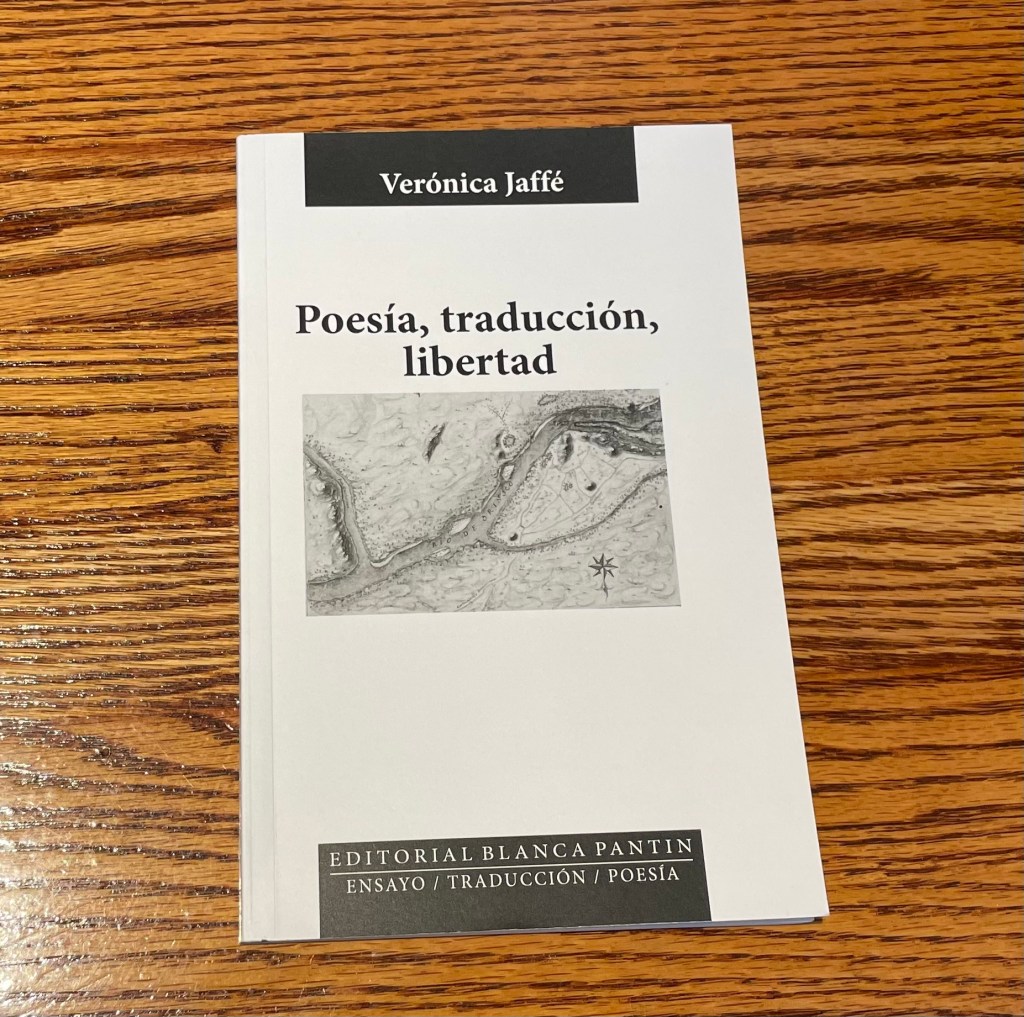
Verónica Jaffé’s most recent Poesía, traduccion, libertad (2024), which gathers some of the translations already contained in Fredrich Hölderlin: Cantos Hespéricos (La Laguna de Campona, 2016), features an introductory essay where she reflects on translating Hölderlin’s poetry from the German into her own creative visual renderings of Spanish. Reflecting on the difficult task, if not utterly impossible, of translating “Andenken” (in Spanish she opts for “Recuerdo” and not “Memoria”), Jaffé departs from an important observation that we must take into account here: the fact that this late hymn has been catalogued as a proemial composition. What does it mean that “Andenken” is to be read as a proem? As we know from the Ancient sources, the proem is an oratory prelude to the topic deployed in a text; in other words, it is the persuasive caesura of language before any argumentative exposition. Hence, the composition of the proem is something like the pure mirroring of language. This could explain why Hölderlin’s “Andenken” while prima facie about memory and thinking does not have a guiding thread to restrain it; it unfolds the enactment of its own recollection through the sayable.
If “Andenken” is a long proem – the space where the poem and proem absolutely coincide – then this means any translation must keep the poetic possibilities of oration in preamble, in path of preparation. Jaffé offers two distinct trans-creations of the famous poem’s last lines. The first reads thus: “Un mar que guarda los recuerdos / que da amores, que los toma / para que solo queden después / como tesoros / en quienes recuerden y en quienes escriban” [1]. In the second version, even more elaborate and idiosyncratic, Jaffé writes: “de pensar con todos / mis amores, es decir / pensar fijando / papel y lápiz / sobre tela / en memoria de todos mis muertos” [2]. It is noteworthy that the famous literal last lines of the “Andenken”, suspended in an enjambment, appeals to a canvas that is splattered with the memory of the dead. It seems of all the dead of the human race. What does it mean that the act of remembrance is the recollection of all the dead? Poetic imagination, if a testamentary document, appeals to the archaic where the living and the dead inhabit the world through image [3]. For Jaffé – but this also an intuition that Hölderlin shared in his pindaric translations – the beginning is not a previous stage, but in media res of the event of language.
The recollection of language within proem attests to the exilic dimension of language; the site where no one truly ever belongs to: “…la lengua en mi país que no me pertenece”, writes Jaffé [4]. This means that the authentic remembrance of language is not a national language, but always ex patria lingua, or a language outside the telluric fabric of the national community. Because we are always walking strangers in our own language, the contact with the dead repeatedly reemerges in the memorial grain of the voice.
As C.M. Bowra has noted, Pindar’s allusion to Memory takes place in the context of the Muses: “[the poet] invokes Memory because she embodies the accumulated wisdom of the past, and the Muses because they pass on this wisdom to him. What he asks from them is the ability to deal properly with what they give….men are blind if they do not pursue wisdom with the help of the Muses” [5]. If the “Andenken” should be read as a proem, this is because recollection is always fixed in the irreducible experience of our voice that recalls language from its beyond.
In one of the glosses in Marginalia on theology, Erik Peterson provides a remarkable pictorial image of thought of death and resurrection through the activity of washing a bowl. Peterson writes: “When washing a dirty dish, our thoughts may turn to the dead, to the dead as a genus, as an inferior genus that perhaps unconsciously influences our actions, as angels and demons do in another way. This probably happens because the dead have something in common with dirty, unclean dishes. Imagine this cleanliness however you like: perhaps we can say that death as such is an act of purification. To think of death in this way, endowed among things – like a bowl – gleam just like the voice of god in the bush” [1]. It is a fragment where Peterson comes closest to the specific nature of painting: what is painting if not the transference of muteness to the gleaming of the visible that opens before our very eyes? And like the divine voice in the bush in Exodus, what does it take to grasp and see the divine between or behind a dirty bowl as it lays on our hands? If washing a dirty dish entails receiving the dead in our thought, the passive act of painting seems always to lay a claim about the mystery of presence outside language.
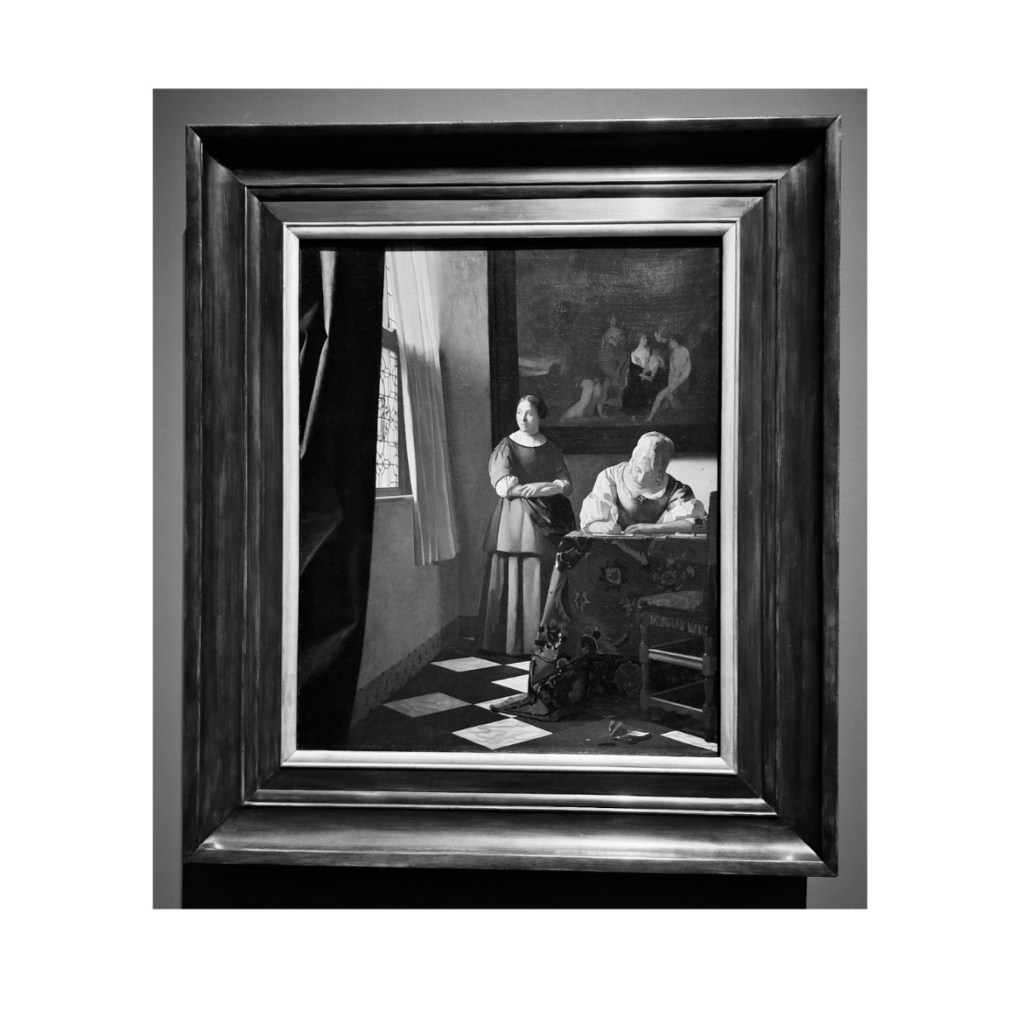
If I elevate Peterson’s remarks to a terrain that the one that he intended, is connected to two Vermeer’s pictures exhibited these days at the Frick Collection gathered around the theme of “letter writing”. In both pictures there is a lady seating at a table drafting a letter – one of them has already concluded it fully attentive to the visitor on her right side; the other a maid gazes at an open window – but what is always unnerving in Vermeer’s work is the sense of the ineffable and impenetrable in the disclosure of the picture (an exposure that that is usually aided by a side curtain that welcomes us in). What is this impenetrable divinity that lurks in Vermeer picture in pure presence? Although we do not have a name for it, it is like the god that dwells in the dirty bowls or in the nocturnal bushes of Peterson’s gloss.
The painting does not speak in revealing, it only bear witness of the absolute fall of language as it becomes imperturbable in the picture. Contesting the vulgar interpretations on Vermeer’s Catholic conversion in Delft, Daniel Arasse notes that the vortex of his pictorial theology is bounded to the threshold in which images become alive (in the tradition of au vif) outside itself: “Vermeer’s painting are constructed such a way as tho render this life equally present inaccessible, near and impenetrable. What is seen is not a crete of nature observed, but a mystery within the painting itself” [2]. In Vermeer’s pictures, presence and the invisible collapse not through the inception of a metaphor of nature, but rather through the painting’s light when it casts a shadow beyond any instance of closure.
This is why in Vermeer’s paintings surfaces mandate an order of theatrical presence, while simultaneously making room for a perturbance that is forever barred from the conceptual. Unlike Giorgione’s “Three Philosophers”, Vermeer’s pictures are not endowed by the mysterious force of an alienated nature that man can measure and master; rather, the mystery resides in the whispering of the invisible that cosigns the amoris causa of the appearance of painting. If for Peterson what gleams in the dirty bowl is the cleansing of resurrection; what befalls Vermeer’s pictures can only be understood as the faith in the painterly emergence of appearance dependent on the path opened by its light.
The question of god as appearance is always posited as a challenge to the meaning of reality as totality no longer as what emerges in the open, but as what which retracts lagging behind. And we know that only appearance is seductive enough to stand for faith well beyond the fact of being visible [3]. Hence, a way to supreme subtlety of painting (picturae summa subtilitas): no longer a matter of perspective and contour, but of the mysterious indiscernibility that mounts depth between vision and the divinity of presence.
.
.
Notes
1. Erik Peterson. “Fragmentos”, in Tratados Teológicos (Ediciones Cristiandad, 1966), 251-252.
2. Daniel Arasse. Vermeer: Faith in Painting (Princeton University Press, 1994), 75.
3. Consider Heidegger’s response to a question in the Zurich Seminar, 1951: “If I were yet to write a theology then the word ‘being’ would not be allowed to occur in it. Faith has no need of the thinking of being. If faith has recourse to it, it is already not faith. I believe that being can never be thought as the ground of God”. Séminare de Zurich (Paris, 1980), 60-61.
It is well known that Aristophanes’ late comic work on wealth, Plutus (388), provides us with what is perhaps the most dramatic and conceptual elaboration of the mythic personification of poverty (Penia) of late antiquity. What is remarkable is that in her self-presentation to the character Chremylus, Penia draws on a political parallelism that colors the ongoing crisis of governance of the ancient polis. If the Greek comedy is dependent on the function of the pólos (which is the vortex of movement that makes possible grasping the specificity of the being that is said), always prior to the arrangement of the polis, then it would follow that Aristophanes’ commentary on the centrality of Penia is neither mockery nor irony within the structure of the play, but rather an element fundamental to the historical presentation of the consciousness of historical public life. The emergence of Penia in Plutus is recorded in the lines 550-554 (a paraphrase might be adequate here): “Thrasybulus and Dionysius are one and the same according to you. No, my life is not like that and will never be. The beggar, whom you have depicted to us, never possesses anything. The poor man lives threfitly and attentively to his work; he has not got too much, but does not lack what he really needs” [1]. Poverty is an intimate relationship with needs; perhaps an unsaid relation, but one that must be accounted for nonetheless.
At her entrance into the play, we are told that Penia’s complexion is both mad (makaron) and tragic (tragōdikon); she could very well be an Erinyes companion from the underworld of the dead. Penia as a mythic figure is a fullfilled form of life. More importantly, what is crucial in the Plutus is that Penia defines herself in sharp contrast to the life of beggars or ptochos. This means that while the penetes is tied to a constitutive need as condition for a form of life; the ptochoi is a being that merely lives in a state of survival, and endures his absence of proper needs. Because Penia is contrasted to the destitute life embodied by ptochos, she can state in one moment primacy over wealth: “all your blessing….you have all that you need in abundance, thanks to me” [2]. Hence, as it has been noted, the irrevocable presence of Penia in the polis is the condition of possibility for Ploutus, god of wealth and abundance, shown in ancient representations as holding the flourishing cornucopia from the fertile harvest season.
What is important to note is that the close and fluid relationship between Ploutus and Penia; that is, between abundance and need, far from being opposition is relational and nourished by its pólos. In this way, the being of need, the penetes, is only able to flourish if he is capable of attaining a free relation with its desire of its vital making, and not from an external power that can determine the functions directed to abstract modeling of population survival. If Aristophanes’ Penia is defined against the ptochos is not because there is a difference of degrees in terms of dispossession, negative or quantitative, but rather it is because it is a disjointed relationship between poverty as a transfigured life, and a life that become destitute because it has ceased to be attentive to its own needs. In the incommensurable ground of the polis, it could be said that the ptochoi were unformed lives that merely persisted in time on the margin of the system of relation of the human community, and for this reason they dwelled in a permanent state of apolis, since their only viable horizon was the result of economic abstraction for secondary needs. In other words, the beggars of the apolis are ultimately effects of economic forces that they do not control, precisely because they no longer have any existential relation with the realm of necessity, that is, with poverty as understood under the shadow of Penia.
In this sense, the condition of beggar is an ultimate economic subjection that is already beyond the sufficient limitation of needs, and thus it has lost all contact with the world. It is has become deprived of the world without being truly dead. Here, one should not forget that as Plato registers the genetic relationship between Penia and Eros in an important moment of The Symposium: “Eros is the son of Poros and Penia, and partakes of the nature of both parents, the fertile vigor of the one, the wastrel neediness of the other. As he is a mean between mortal and immortal” [3]. But the erotic soul in the last resort is nothing but the desire for immortality; and, as a daimon, it mediates between passions and the beautiful, between the divine and the mortal, between need and wealth towards the depth of a harmous life [4]. As Sandrine Coin-Longeray has shown in her exemplary study, Penia (πενία) exceeds the effective qualification of the “good life” based on labour; rather it is a route of life that outlives itself in the erotic transfiguration of world towards the preservation of irreducible homeostasis of common life [5].
This is why Plato’s conception of the ‘happy city’ or the kallipolis was imagined as a deposition of the process of abstraction between “rich” and “poor” that ultimately has come to regulate the modern organization of social rationality proper to accumulation, production, and distribution to supply to rhe demand of ever expanding secondary needs in the general field of consumption. As Plato writes in Book III of The Laws in a section precisely dedicated to showing how to bring civil war to an end: “Because of all this, they were not intolerably poor, not driven by poverty to quarrel with each other; but presumably they did not grow rich either, in view of the prevailing lack of gold and silver. Now the community in which neither wealth nor poverty exists will generally produce the finest characters, because tendencies to violence and crime, and feelings of jealousy and envy, simply do not arise” [6]. The civilizational path undertaken by West since the rise of institutionalized isonomy could not be but exactly the opposite of the platonic deposition of the autonomy of alienated classes. Today it is all too apparent that every sphere of social reproduction stimulates a ferocious race to the bottom between a kleptocracy and a vast administered population of ptochoi that, precisely because they have no relation to Penia, is left pursuing compensatory reactions within the social mechanism of organized begging that they are forced to endure. Under the oblique light of Penia, it becomes clear that both redistributionist policies through state institutions, as well as the autonomous market initiatives of financial models tend to be two sides of the same defense of abstract abundance on the back of the human community of penetes.
The negative subsumption of material needs, and thus of poverty into quantifiable assets that characterize abundance and growth at a civilizational scale – with the collaboration of all modern political ideologies without exception always oriented towards production – has contributed to thwart the path of Penia that is necessary to live freely between passions and needs. This is why in his 1945 lecture “Die Armut” (“Poverty”), Martin Heidegger, departing from a well-known intuition from Hölderlin, claimed that ‘being-poor’ does not mean the absence of some property or substance, but a relation to needs; because only in poverty do we preserve a free relation unto what we need (not-wedigkeit) as necessary. And only this can be taken as the true and ultimate wealth: ‘we have become poor in order to be rich’, means that only through the preserving necessity of Penia will there be a liberating dislocation for human life beyond the indigence of mere exchange and the endless struggle over material goods and the private property. As the world becomes a more vast wasteland of beggars and disposable bodies at the service of technology, Heidegger, in Eckhartian tenor, was not wrong to claim that poverty and Penia will ultimately be the ethical destiny of the people of the West only if they become attune to the divine overtone of poverty as their destiny. Thus, the only possible abundance in a declining world can be realized through the enduring necessity and disquiet return of the essence of poverty – to come near the nothing, because there we find the dearth of the earth. Indeed, as Penia says in Plutus before leaving the stage: “One day you will speedily send for me back” [7].
3. Plato. The Symposium (Penguin Books, 1987), 203b, 82.
4. F. M. Cornford. “The Doctrine of Eros in Plato’s Symposium” (1937), in The Unwritten Philosophy and Other Essays (Cambridge University Press, 1950), 74.
5. Sandrine Coin-Longeray. Poésie de la richesse et de la pauvreté: Étude du vocabulaire de la richesse et de la pauvreté dans la poésie grecque antique, d’Homère à Aristophane: ἄφενος, ὄλβος, πλοῦτος, πενία, πτωχός (Publications de l’Université de Saint-Etienne, 2014), 153-56.
In a recent text published at Verso Blog, entitled “The Coming Post-Hegemonic World”, Michael Hardt and Sandro Mezzadra make a case for a “turn to a post-hegemonic model” that will challenge the consensus of global in the coming era. In many ways, this era is already here with its diverse and multifaceted (in terms of intensities, forces, and leverages) of protracted and bizarre nationalisms, which as Jamie Merchant has teased out brilliantly, amount to desperate attempts to offer a belated response to the decline of growth as one more stage for containing rampant processes of accumulation via state capacities. For Hardt & Mezzadra, this “posthegemonic world to come” is characterized by a global spatial reconfiguration of capital – accommodating the logistics of regional spaces of influences and exchange across the planet – and on the other, an increasingly “domestic sphere of authoritarian rule” promoted by new accelerated initiatives at generating social homogeneity in the wake of rushing fragmentation hand in hand with a war regime that has utterly scrapped ideals about “strategic autonomy” in order to trumpet an arm race (nuclear weapons included), as it is currently unfolding in Europe.
One can claim that this posthegemonic world is one that firmly assumes the consequences of two interdependent vectors that imploded within the project of political modernity: the end of economic growth (thus validating the law of the fall of profit outlined in Capital V.III), and the liquidation of the principle of legitimacy that for two centuries accommodated the legislative sources of the state authority in democratic constituent power. For Hardt & Mezzadra posthegemony means global fragmentation, authoritarianism, and spatial remaking; however, one should also say that it means,the opening towards stagnation, the collapse of political unity of the state, and most recently the total discredit of the foolish leftist hypothesis that promoted a “rainbow social equivalent coalitions” to push for compensatory, and in every instance insufficient and moribound, populist resurgences elevated through the combustion of ethereal but effective rhetoric (in fact, my argument in a new short book, La fisura posthegemónica, is that the push for political hegemony of the last decades only cosigned forms of consensual totalization at the expense of the production of subalternization and social death).
Even taken as a descriptive and normative condition of the current state of Western politics, the posthegemonic situation lays bare the reciprocal impasse of the claim of its opposition: in other words, one should also put to rest social mobilization that characterized the politics of High Modernity, since ultimately movements (and total mobilization as an apparatus of social energy transfer) presupposes that “every social structure, that it can receive what form required the needs of the political adventure…total mobilization signifies nothing other that the effort to reduce the social substance to a kind of plastic”, as Gérard Granel once defined it. Hence when Hardt & Mezzadra claim that the “effective rebellion must be rooted in social movements envisioning a life beyond the rule of capital”, they are inadvertently refusing to come to terms with the factical posthegemonic reality that they are describing, which is no longer driven by expansive economic growth, but rather by stagnation, and inoperativity at planetary scale that is maintained through the a global veneer of production into regimes of competitive accumulation (of territory, contractual debt, fiscal regulation, executive taxation or tariffs, and increasing arbitrary monetary regulations in the global system) for marginal profitability, as Paul Mattick argues in his recent The Return of Inflation (2023).
This means that there is no outlook towards ‘social mobilization’ that does not serve the subjective productivity of real subsumption, since its ultimate goal is to anaxate social energy into the force of (un)productive labor. This form of dilatant mobilization can only serve the master of illusionary hegemony, and thus promote functional and unwarranted servitude everywhere. Indeed, only a reprobate can be immune to the moralist or the realist conditions of hegemony. If push comes to shove, the posthegemonic factical world of stagnation and political fragmentation already here proves that the ongoing irruption of non-movements are irreducible to the modern movement’s energy; and that life never fully coincides with political claim to rule and legitimacy, even less so in the becoming-world of Production.
Ultimately, this posthegemonic fissure outlives the crumbling hegemonic world of principial High Modernism and no ‘international movement’ can piece it back together again. We are all posthegemonic now, but only if one takes up this predicament seriously and candidly.
The fourth issue of the journal De Pictura (Quodlibet, 2024) has just been published, and among a dozen of illuminating articles there is a very substantive and rich conversation between Monica Ferrando and the art historian Michele Dantini on theology and painting that solicits required attention, and that I can only emphatically recommend. As the very title suggests, the conversation is about the unity (and posterior historical divorce?) between painting and theology in the Western tradition, but it is also about another problem that never goes out of fashion, if ever rarely attended by a handful of scholars: mainly, the light of the genesis of modernity vis-à-vis the aesthetic mediation with Antiquity. (Is it fair to say that this is an undeveloped path in post-Nietzschean thought? For now this is a broad question that we can only bracket, and it is needless to say that Ferrando’s own work already amounts to an indispensable barrister to take up this very concern). Be it as it may, there are two problems that I want to flag from this conversation — these are idiosyncratic concerns, as perhaps all attempts to condense a vast area of study obviously are.
First, there is an important moment in the exchange where the problem of “perfection” is discussed as a watershed schism between the politics of representation in the wake of post-Renaissance development of painting. A notion of “perfection” that derived from the theological sphere was unequivocally different from technical mastery; it was understood as a problem of distance and proximity of pathos inherited from the great tradition of Antiquity and its canons of beauty and virtue. How else to read Poussin’s one of a kind theory of the modes of the Ancient in his famous letter to Chantelou? Of course there is also Hölderlin’s gaze towards the Greeks and Pindaric poetry decades later in the dawn of the nineteenth century only to succumb into madness. The theology grounding distance is the condition of possibility of ‘aura’, but also what Ferrando, at the highest point in the conversation, superbly defines as: “…pura della differenze temendo di riconoscere e irriducibili” (137). The liquidation of perfection into mastery of the “work of art” (and perhaps work should be overly stressed, which is linked to all the metaphysical dispensations over creation) implied that “distance” would become standardized, homogeneous, autonomous to regulated form, and finally absorbed unto the objecthood of creator and spectator in the coupling the force of secularization. Whether it is the vicarious image of the Hollywood spectacle, or the factorization of the socialized art object in the Russian avant-garde, the movement towards absorption is one-directional and open to the validity of an external justification of truth.
What I find interesting is that the emphasis on perfection allows us to say that painting clearly put into view the history of an error about representation and its negation. As it has been noted, in the outset of Protestantism – for instance in Noa Turell’s excellent Living Pictures: Jan van Eyck and Painting’s First Century (2020) – there took place a new struggle over representation of perfection oriented towards “bringing painting into life”. The Northern superiority hinges upon the effectual perfection of a new legibility of the world that suspends the distance between thought, hand and the idea of pictorial praxis. The valorization of justified truth in perfection is paid by the occlusion of the truth of unintentional appearance. And the consequences are catastrophic: Ferrando at one point claims that the painting is about retaining the invisible; an argument that she has also displayed in relation to Poussin’s landscapes in her L’oro e le ombre (2015). In other words, the development of the dialectical autonomization of the very unit of pictorial space is integrated only be rationalized as an obstacle to be wrestled with and eventually overcome (an endpoint being Jackson Pollock’s outpouring of the line into a vanishing mist over white space). Prometheus unbound. Indeed, über die linie. The “farewell to modern painting” (so elegantly trumpeted by T.J.Clark at the turn of this century) remains right on track with the only caveat that it did not began in the “age of the machines”, but at the outset of the secularization polemic over the impasse of the responses to the crisis of transcendence and the eclipse of myth.
Now, the second point can be stated briefly: the extension of autonomization implied turning away from what the tradition has offered; especially a tradition that is “pre-historical”, according to Ferrando, since painting is previous to historical consciousness and not the other way around (painting is always without a grounding principle). In the words of Stevens, this tradition can be understood as the “love ascending the humane” that attests to the authenticity of what appears-there in the disclosure of the world. A definition of painting emerges here, although not pursued in the dialogue between Ferrando and Dantini. However, for Dantini this means that the whole history of art / pictorial representation needs to be rethought and reorganized and possibly returned to its proper theological sphere. Of course, it will depend on how we understand the vertical axis of theology converging with the horizontal axis of appearance.
A counterexample here comes to mind, a sort of historical false exit: the Baroque, as a post-Renaissance paradigm of response to the crisis of the erotic and pagan image of the Renaissance paid the price of its exuberance, elliptical contortion, expenditure, and ornamentation through a reified and excessive field of self-ordered theatricality. As shown by the exemplary study of the Jesuit discipline in light of the modern state, La política del cielo: clericalismo jesuita y estado moderno (1999) by Antonio Rivera, the ascesis of the counterreformation Company required the split between director and practitioner that already presupposed the modern autonomization of spheres of signification. The baroque supra-theology (imago naturans notwithstanding) was also a reified theology whose anxiety about annihilation and total absorption of the community of the faithful would further drain the invisible outlook of the theos. Or to use the image favored by Carlo Michelstaedter: “the lamp burns out by the insufficiency of oil, but it drowns by having too much oil”. It is no coincidence, then, that the polarity of absorption and theatrically, used to understand the revolution of French modern painting, can only bring to life anything and everything under the sun of pictorial representation except its own sense of distance between appearance and what always remains unfathomable in the world.
In his Lives of Ten Orators, Plutarch dedicates an entry to the sophist and rhetorician Antiphon who, among other things, allegedly possessed a technique to deal with distress of the human soul (techne alupias) [1]. We know from historical sources that anxiety was already a common psychotic malady in the life of the polis, and it is most probable that Antiphon’s discourse treatment was reacting to this general phenomenon of his time. In the testimonia of Suda and Lucian there is agreement that Antiphon was a sort of language magician, a “speech-cook” (sic), who derived his powers from the interpretation of dreams, and in the words of the second, could unlock “the office of Sleep” [2]. Although his so-called pain-removing lectures have been lost, there is enough evidence that suggests that these rested on the archaic notion of “persuasion” (Peitho), whose main object was neither human psychology nor bodily somatic terrain, but rather psyche or the soul in the state of being. It is an art that has been lost – if something like “techne alupias” can be counted as a technique is plausible, given its irreducibility. In other words, what survives is only a lacuna of a philosophical ascesis that we should locate no so much as a conceptual problem, but as an ethical one. This is a task that today seems more needed than ever if we can agree that the fundamental tonality of social existence today is, precisely, the reproduction and endurance of pain, or what has been called the self-inflicted deaths of despair.
Much of the reflective work in this direction has been lacking, however in 1958 there was a publication entitled La curación por la palabra en la antigüedad clásica by the Spanish physician and historian Pedro Lain Entralgo, which dedicated a whole section to Antiphon’s “techne alupias” as a fundamental strategy to treat an existential affliction. Recasting the opposition between nomos and physis as a general structure of Antiphon’s teaching, Entralgo seems to advance the hypothesis that the technique to alleviate affliction seeks to revoke the primacy of the normative conventions of the nomos towards the natural consension and causation of physis. In the most elaborate moment of his reconstruction of Antiphone’s techne alupias, Entralgo seems to project unto the opposition of nomos-physis, the rationalization of the sensible and the sensation of the corporeal through language: “Antifonte cree que para tal fin hay una «técnica» (tékhne alypías); más aún, práctica esa tékhné, informándose acerca de las causas de la aflicción y hablando al paciente en consecuencia. Actuando según las causas, la persuasión verbal logra eliminar la pena del alma: el pensamiento y la palabra del retórico sanador —su lógos— ordenan y racionalizan la vida anímica y corporal del afligido” [3].
But Entralgo stops short of elucidating what the language of persuasion entails in this specific elaboration. Is it just a form of compensatory mediation between nomos and physics, between soul and body dualism? The German classical philologist Julius Stenzel in an article dedicated to Antiphon in the 1920s had taken the contrary view; mainly, that the sophist’s treatment of pain does not aim at naturalizing the logos, nor at rationalizing nature (physis) for the event of affliction; it was rather an opening through language creating a new reality principle beyond all opposition, an undercurrent in which the taking place of language could only serve as the anemic nutrient [4]. Taking into account Stenzel’s intuition it becomes evident why Entralgo, as he concludes his gloss on Antiphon, seems to be skeptical of an existential techne alupias fully deprived of normative content, that is, situated outside the nomos that founded the polis so lavishly celebrated by Pindar.
This was totally unconvincing to him, since it would seem to shake a bit the foundation of Western political civilization that needs to maintain the hylomorphism between soul and body, nomos and physis, happiness and deficiency towards a well balanced organic life. The prefix –*lup that derives from –luk should be understood as a lightening of human appearance converted into something ominous that must be contained and differentiated into a political program [5]. In this way, and if “techne alupias” is to be understood as the event of language, it is also the eruption of the involuntary form of language that “can prevent the autonomization of ethical action: pain is the “grace” that is communicated by acting. And it is, at the same time, the muteness that permits the realization of authentic communication: not that of abstract or arbitrary signs, but between souls. The obstinate, irreducible enigmaticity of pain is precisely what prevents Persuasion from falling back on the Christian morality of “sacrifice”, or of acting towards the direction of an end” [6].
This picture drawn by Gianni Carchia should reveal itself as fully contemporaneous, since today the two poles being offered (replicating the nomos and physis duality in updated versions) are on the one hand the moralization of a neo-Christian acceptance towards salvation; and, on the other, the secularized version of salvation in the form of the highly sophisticated techno-medical field. If both positions have as their central aim an offer to end pain, it is also true that they both renounce the ethical dimension of the sayable in language, which renders impossible a techne alupias to come to terms with our current abysmal sentiment. This means that no amount of prescribed pain-killers and medicalized strategies can come to terms with the soul’s angst. By choosing to erase pain from life of the soul, religious-medical integration univocally accepts the triumph of a living death.
.
.
Notes
1. Plutarch. “Lives of the Ten Orators”, in Plutarch’s Morals, V.5 (Little Brown and Company, 1874), 18-21.
2. Antiphon the Sophist. The Fragments (Cambridge University Press, 2002), ed. Gerard J. Pendrick, 96-97.
3. Pedro Lain Entralgo. La curación por la palabra en la antigüedad clásica (Revista de Occidente, 1958), 149.
4. Julius Stenzel. “Antiphon”(1924), in Paulys Realencyclopädie der classischen, Stuttgart, 33-43.
5. Hermann Usener. Götternamen (F. Cohen, 1896), 198-199.
6. Gianni Carchia. “Tragedia y persuasión: nota sobre Carlo Michelstaedter”, in Retórica de lo sublime (Técnos, 1990), 38.
In an early review of Elio Vittorini’s Uomini e no (1945), Renato Poggioli noted that one of the important merits of the novel was that in spite of the authort’s political commitment, the narrative was “neither partisan nor ideological. I dare to say it is not political; the author even apologizes for this at the end of the volume” [1]. Poggioli, of course, is referring to Vittorini’s Postscript where he states, favoring a thin notion of the autonomy of art, that the end of art is to “seek in art the trace progress of humanity is altogether different from fighting for it upon the political and social terrain” [2]. This is enough evidence to bring to bear Vittorini’s humanist project grounded in a faith in the “progress of the human species” that he wrestled with throughout his life, and that he never really abandoned according to Franco Fortini [3]. Of course, Vittorini’s ‘progressivism’ is not bounded to ironclad guidelines of political economy and the science of a materialist history, rather his position is the attempt to flee from it, to undertake a different path in which humanity and inhumanity could enter into an improper and inconspicuous relationship towards presence.
Here we can part ways with Poggioli’s suggestion that Uomini e no (1945) is not “sufficiently political” because the characters do not dare to make political slogans or identify themselves with a concrete political party line (the Communist Party that Vittorini himself identified with in spite of having written a non-political novel) during the underground resistance during the years of fascist domination in Milan during the interwar years. If Uomini e no (1945) drifts aways from engaging in a formal political identification to mobilize the narrative persuasion it is because for Vittorini there is an original struggle for “life” that necessarily precedes subjection and political action: it is the struggle of human species to confront the difficulty of its own inhuman threshold, which becomes necessary to account for in any materialist conception. The whole tension of the novel hinges on the unnerving formal composition of the narrative with the asphyxiating dread and angst of the character that embodies the existential the practice of an incarnated struggle beyond survival.
However, what is beyond survival? What comes after the desert of a world that soon enough – in the words of Theodor Adorno at the height of the mid century – will turn human life into “mere functions within a monstrous social machine in which “life does not longer lives”…in which what grows is the scope of socialization and its functions. What I want to say is that liberty has become a mere pretext to enhance the ways of domination” [4]. If politics is the religion of modernity (political theology suturing the void with authority), the accumulation of liberty can only be understood as the moment of expansion and reproduction of effective domination. In a way, the metropolitan scenario in Uomini e no (1945) foreshadows the evolving historical epoch of this ‘monstrous socialization’ as a civil war or stasis, in which the mere survival of political struggle is proportional to the dispensation of death of humanity as the last dialectical movement of humanity against itself; that is, towards the concrete extinction of the human. For Vittorini the swerving black sun of fascism and political militancy (in its idealized version invested in the paradigm of sacrificial structure of history) can only amount to the realization of epochal nihilism and the fertilization of the expansive desert in the novel at the expense of sacrificing the erotic mediation with the world, which entails the liquidation of the sensibility external to human: “Love, in those deserts, is at its most squalid; it is not that life is absent from but the life it has is not alive. You are thirsty and have a chance to drink; there is water. You are hungry, you have a chance to eat; there’s bread. There is a spring and alms around, just the one you are looking for. But it is only a mirage, it is not the thing itself” [5]. The fundamental question posed by Vittorini is never truly resolved by Uomini e no (1945): crossing the desert to achieve something like an erotic distance with the thing itself as ultimately the confirmation of one’s irreductible destiny. No doubt, there are moments where this emerges in strange ways, at the limit of narration and as a linguistic declaration. This is scripted through the exchange with the old lady Selva on happiness: “We work in order that men be happy. Isn’t that what we are working for?…Men need to be happy. Would there be any point to our clandestine newspapers? To our conspiracies?” [6].
Is happiness a subterfuge to return to the world, or is happiness, authentic non-compensatory happiness, the stimmung of life as it retreats from the delegated representations of civil society? The suspended dialectical closure at the level of form in Uomini e no (1945) provides a preliminary resolution to the question of happiness amidst wreckage; a collapse that speaks to Vittorini’s impossibility to bring into synthesis political action and existential authenticity. The narrative texture of Uomini e no (1945) is a preparatory exploration – showing the false exists in the meantime – towards the possible liberation of man’s passions, even against the premises of a reconciled ‘Humanity’ capable of leaving behind the antinomies of humanism and antihumanism at the service of the ‘communist way’. And we know that for Vittorini the commitment to ‘Communism’ was inscribed not in the idea or the organizational tactics but in the notion of the “way” (una via), capable of opening possibilities to counter the coercive efficacy of the administrative social apparatuses that turn historical progress into a totalizing desert [7]. How to do so – is there any legible index to the “via comunista”? As a novel Uomini e no is preparatory towards this retreat from the confusion of the inhumanity of the human on the one hand, and the total humanization of the world to deface the possibility of happiness and experience with the world itself.
In this sense, Fortini is right in describing the lyricism of the novel as attuned to a funeral oration or song (“canto funebre”), which is also a prolonged farewell to the ideals of Vittorini himself as a moral humanist; that is, as someone committed to the ideals and abstraction of redemptive self-sacrificial christology and the self-serving autonomous action of the pardon as man’s last hope to absorb the inhuman kernel into the vita nova of a redeemed universal Humanity. And in fact, these are two “endings”’ of Uomini e no (1945): the self-immolation and sacrifice of the protagonist N2 waiting to confront the Nazi official Cane Nero, and the final sequence of the worker that refuses to murder a German soldier because he looked “sad” even when standing on occupied soil, even when he occupies the role of the protectorate of the nomos of the earth [8]. These are the novel two preparatory distinct actions in the dense fog of the interregnum: the Christological path of sacrifice of N2 – the sacrifice to end all sacrifices, which according to René Girard’s defines the advent of the Christian sacrificial practice- seeks a last action of resistance holding on to “humanity’s internal weakness”, which carries the elevation of secularized mythic discharge of subjective martyrdom [9]. On the other, the milanese worker offers redemption as a form of secret forgiveness (without a justification and without a why) to the occupier, and in this way integrate the inhuman into the human species as the solution to the repeated rumination over the movement of struggle and resistance: “Why, without being in any way forced to do so, had they entered this duel to the death, and why did they continue to wage it?” [10].
In his early reading of Uomini e no (1945) Franco Fortini offered a thesis that I am tempted to call the domestication of the wolf argument; an inversion of Hobbesian anthropology and the Christian felix culpa in which struggle’s optimism will ultimately transfigure the internal wolf unto the human’s heart [11]. But we know that the homo homini lupi depends on a thick notion of anthropology, of the human’s unfathomable deficiency in relation to ‘object reality’ so that any domestication of the wolf within humanity is also an anthropological quest; perhaps the last “route” of negating humanism through substantive acts (sacrificial sacrifice and forgiveness) in the attempt to reconcile the wolf with man. But this is the very enterprise of civilizational techniques of adaptation proper to the tooling of political anthropology – that is, the domestication of the savage wolf entails its conversion to the passive dog. Could there be a way out to the final verdict of dialectical form beyond struggle, and the reconciliation of humanity with its negation? Perhaps this is only registered as the unthought in Vittorini’s Uomini e no (1945); an experience that prepares a return to the world through the conatus essendi, or the preservation of each thing’s being as their are. This is registered in only instances of the novel in the backdrop of a landscape; indeed, outside the subject of self-reflection, and beyond the premises of radical evil proper to moral platitudes. And the moment reads like this in chapter CXXX: “The long dusty road, the drowsiness, the hay, the stitches where the cicadas were: everything that was, and that, along with everyone who is lost, still wants to be. And the sky filled with kites? The sky that was filled with kites” [12]. The perseverance of the conatus essendi puts to rest what the delegated forms that politics and morality have to offer as temporal substitutes for dragging the historical promise of humanism within epochal nihilism.
In this suspended imagery of an arid landscape, Vittorini descends to the preservation of things as they open to their manifestation of another sense of freedom – no longer tied to the paradigm of historical liberation nor to the assumption of synthetic anthropological determinations to sooth pain – comes upwards, always silently, through the order of description outside the human. And is not in this description what Gianni Carchia would call “the non-human…a gesture of farewell to the idealist movement; a farewell to the exaltation of the human up to the highpoint of its explosion. The refusal to substitute the dead god for a human that in the depredatory scope of totality crosses every limit, every transcendence, and infinity” [13]? This transposition of this proximity with this “other-than-humanity” ( what Humanity can no longer hold on to) is the secret to Vittorini’s infrapolitical impasse in Uomini e no (1945) that holds the key to his insistence on a notion of “freedom” against the subject incapable of overcoming itself in the face of the abstraction (morality) or ideological reassurance (militancy) [14]. One could assume that the worker’s last line in Uomini e no (1945) – which also coincides with Vittorini’s mimetic repetition in his “Postscript” – in the form of a promise (‘I’ll learn better’) registers the final attempt to grasp what remains on the exterior fog of humanity: a notion of freedom that, in seeking ‘a way out’, insists in the possibilities of establishing contact with the world. Thus, the program of historical liberation can only be achieved against historical and civilizational fixation; traversing the polarity of humanity and inhumanity, and thus deposing the sublimated sentiment of pain that social domination can administer as an unending process of degenerated and moribound humanity as mere continuation of the fictive life.
.
.
Notes
1. Renato Poggioli. “Review of Uomini e no by Elio Vittorini”, Books Abroad, Vol.20, N.4, 1946, 393.
2. Elio Vittorini. Men and not men (The Malboro Press, 1985), 199.
4. Theodor Adorno & Max Horkheimer. “El mundo administrado o la crisis del individuo”, Pensamiento al margen: revista digital de ideas políticas, N.19, 2023, 200.
5. Elio Vittorini. Men and not men (The Malboro Press, 1985), 34.
6. Ibid., 13.
7. Elio Vittorini. “El comunismo como vía”, in Diario en público (Gadir Editorial, 2008), 279.
8. Elio Vittorini. Men and not men (The Malboro Press, 1985), 50.
9. René Girard. Sacrifice (Michigan State University Press, 2011), 65.
10. Ibid., 196.
11. Franco Fortini. “Che cosa può l’uomo: Uomini e no” (1945), in Saggi italiani (1987), 253.
12. Elio Vittorini. Men and not men (The Malboro Press, 1985),190.
Let us imagine a person that in a short period of time finds himself haunted by successive deaths, abandonments, missed encounters, displacements, and lost possibilities – the list could go on. All of this amounts to a loss of world. This is obviously the narration of anyone’s life, and every moment of it would seem to imply an internal necessity of its unfolding as felt in the weight of its coming together in remembrance. Obviously factical life will continue on – and it always goes on – but the ultimate question will reside in the relationship between existence and the narrative order of that past. All of Duras’ narrative world is almost entirely a direct wrestling with the possibility of going against this specific weight of narrativization, because to narrate means to forget oneself from the experience of being in the world here and now. The demand of recollection imposes rhetorical limitations to the unfathomable present. Remembrance is the courtyard of historical and religious necessity where self-transformation takes a secondary role in a massive and alienated narrative of causes and reasons.
Duras’ first novel La vie tranquille (1944) reacts strongly against the burden of memory in the name of forgetting: “Once you lose the ability to forget you are deprived for a certain life” [1]. But what could a “certain life” amount to? Obviously, this forgetting here does not mean a neutralization of conflict in life (as in the status of a civil war in a political community); rather, it entails a sort of rebirth, in which the density of life refuses the crushing force of fictitious acceptance dispensed by the order of the past. That loosely defined “certain life” does not qualify nor situates “life” to the survival of “this life”; on the contrary, it seeks to open life to its open and self-evolving possibilities. In other words, there is “only one life” because there are only irruptions of the tragic possibilities that will always elicit a vita nova. The “certain life” that is always lacking allows the infinite possibilities of rebirth in the face of the eruption of the tragedy. And tragedy requires affirmation and exposition to the world in a strong sense. This could very well be the ultimate tone and color of the adventure for Duras.
Dionys Mascolo once wrote that Marguerite Duras’ literary and cinematic work is a transfigurative elaboration of the the tragic, and for this very reason the active undoing of the civilizational narrative at least since the humans of the neolithic that had resulted in the production of justifications and reasons to live “our life” [2]. And in a way the irruption of the tragic is the confirmation that civilization does not have the last word of absolute moral order. But life – and this is the “mystery” coloring a good part of Duras’ imagination – is always about keep afloat the possibility of the certain life without the threats of self-absorption and destruction in the wake of nihilism and abstract political equality between beings in the world. A “certain life” (our certain life without qualifications other than being attuned to the object of our passions) is always elsewhere, and for this very same reason as a transfigured revelation outside of what appears as the enclosed necessities of ‘this life’. “A certain life” is a higher indented form of the theos unto life, whose transcendence is not regulated by an article of faith or the anthropological deficiency of sin (this is at bottom the difference between Christ and Saint Paul). In other words, the tranquil life that many readers have generally understood as wilful irony wrapping Duras’ narrative bears the truth to that life – the only one worth affirming as destiny – must always be outside itself. As the character of La vie tranquille (1944) confesses in one of the peak moments of the monologue in the second part of the novel:
“I’ve existed for twenty-five years. I was very little, then I grew and reached my size, the size I am now and that I’ll be forever. I could have died in one of the thousand ways people die, and yet I managed to cover twenty-five years of life, I am still alive, not yet dead. I breathe. From my nostrils emanates real breath, wet and warm. Without trying, I managed to die of nothing. It advances stubbornly, what seems halted, in this moment: my life. …My life: a fruit I must have eaten without tasting it, without realizing it, distractedly. I am not responsible for this age or for this image…” [3].
The bite into the fruit in this monologue differs from the metaphoric self-confession that ascertains the theological irreversibility of original sin and felix culpa; it signals the passage of the narrative of life into denarrativization. Here a “certain life” might open against the fluvial current of the order of necessity that will make the subject into a bundle of legible and memorable infortunios. The passage to the tranquil or serene life, however, is not just grounded in the description of a trembling account of onself. In Duras, it has a proper name: thought. In fact, as we will find in the last part of the novel: “You must advance with the last of your powers;…with the power of thought” [4]. And following Mascolo to the letter, one could say that this ‘power’ is misplaced – it is not a power of the subject to force a will to do or act – it is rather a passion of thought (“la passion de la pensée”) that elevates itself against necessity and actualization through a “refusal” of any given historical order.
This is to say, the breakthrough to the ‘certain life’ or the ‘serene life does not presuppose a counterpolitical strategy, as much as the movement of thought enacted in refusal as condition for any democratic requirement that no one can ultimately possess, as Duras a decade later will go on to write in the third issue of Le 14 Juillet [5]. The serene life is only possible as an infinite movement of denarrativization. The inhabitation of the world in La vie tranquille (1944) was already preparatory for the gesture of ‘refusal’ where a certain life follows a retreat from the hypsipolis apolis (superpolitical apolitical) into the existential xenikos of a contemplative life that is irreducible to both the principles of humanity and the normative regulations of social interaction. The serene life is only achieved when the separation of thought and life enters into the incommunicable sense of persuasion (the ancient peitho) capable of decompressing the vector of force that has only produced a generic humanity of political depredation, acceptance, and excruciating tonality of boredom. Duras’ writing – at its best moments – is an intense search of this kind; a search does not end in neither politics nor literature, but on what remains outside of them.
.
.
Notes
1. Marguerite Duras. The Easy Life (Bloomsbury Publishing, 2022), 90.
2. Dionys Mascolo. “Naissance de la tragédie”, in A la recherche d’un communisme de pensée (fourbis, 1993), 397.
3. Marguerite Duras. The Easy Life (Bloomsbury Publishing, 2022), 96-97.
4. Ibid., 114.
5. Marguerite Duras. “Responses à l’enquête auprès d’intelectuels français”, Le 14 Juillet, N.3., 1959, 5-6.
Towards the end of his life, poet José Lezama Lima will mysteriously begin to sign the letters to his friends and family as “the Trocadero Etruscan”, a “member of the Etruscan religiosity”, and even the “man who lives in the Etruscan village” [1]. Why call himself an “Etruscan” in this particular moment of his life, and what could it possibly mean? The question about the meaning of the Etruscan authorial mask has been so thoroughly ignored by the literary critics that commentators at their best have noted that “being Etruscan” merely stands for his “cosmopolitanism” and “well-learned Europeanism”. Of course, this explains little to nothing. A sophisticated poet such as Lezama Lima, who ruminate over every single word he would write, could not have ignored that the Etruscans, unlike the civilized Romans and the Latin authorities, was a remnant to the very civilizational enterprise; a prehistoric people poor in written culture, achieved expressivity by the whole outlook of their form of life. And as in the case of Hölderlin’s adoption of different nom de plume (Scardanelli, Killalusimeno, Scaliger Rosa, etc), Lezama’s becoming Etruscan points to something so fundamental that if underscored we would fail to grasp the endgame of his vital poetic experience. The transfiguration of the name does not merely stand as a metaphor; rather it points to a distant figure that will finally dissolve him so that his immortal voice could continue to live on.
Indeed, the self-identification as an Etruscan for Lezama became a subterfuge to flee a political reality – his political reality, entirely structured by the revolutionary gigantic productivism and subjectivism – through a poetic refraction that would free an ethos from the overpowering of alienated autonomous space of the linguistic reproduction of social life. If at first glance it seems like a paradox that Lezama will adopt the Etruscan figure for his antisocial ethos – a civilization lacking written records or high literary achievements, a religious community known for its necropolis – this strangeness will ultimately prove that behind the Etruscan name there was no poetic exclusivity of the poet’s genius, but rather, as he claims in “A partir de la poesía”, the possibility for a divinization of reality to retreat from the historical epoch. In fact, Etruscan culture for Lezama was not a mere archeological ornament, but one of the “imaginary eras” of the West; that is, a stage of condensed and unnumbered imaginative possibilities resistant to griping subsumption and totalization of values. The Etruscan was the mythic remnant through the pantheistic divinization between language and the world. As Lezama writes glossing, in passing, Vico:
“Vico cree que las palabras sagradas, las sacerdotales, eran las que se transmitían entre los etruscos. Pero para nosotros el pueblo etrusco era esencialmente teocrático. Fue el más evidente caso de un pueblo surge en el misterio de las primeras inauguraciones del dios, el monarca, el sacerdote, y el pueblo unidos en forma indiferenciada … .les prestaba a cada una de sus experiencias o de sus gestos, la participación en un mundo sagrado. […] Pues en aquel pueblo, el nombre y la reminiscencia, animista de cada palabra, cobran un relieve de un solo perfil” [2].
The divinization of the Etruscans stubbornly insisted on the wonder of things. The human participation in divinity is no longer about founding a new theocracy or a “theocratic politics” in the hands of a ‘mystic accountant’ that would finally put the nation back in track (into the res publica), as Lezama would solicit out of desperation in the 1950s diaries [3]. On the contrary, for Etruscan people the fundamental tonality was the divine music of experience. Of course, we know that D.H. Lawrence captured this when claiming in his Etruscan Places (1932) that “the Etruscans are not a theory or a thesis. If they are anything, they are an experience. An experience that is always spoilt” [4]. And this experience (like every true experience) needs to be necessarily spoiled, which ultimately means that it cannot be mimetically rendered, arbitrarily modified, or subsumed into the order of idealization. But all of this is merely redundant, since the Etruscan inscription is what accounts for the limit to civilization, becoming the impossibility of the destruction of myth in the arrival of modern aesthetic autonomy. Thus, for Lezama the Etruscan way had something of a persistent cure against the ongoing civilizational disenchantment, even if it does not cease to appear in the modern attitude. In fact, Lezama writes that: “Rimbaud is the best reader of the Etruscan liver” (“hígrado etrusco”) to describe the dislocated position of the poet in the modern world of technology [5]. In the Etruscan cosmology, the liver was a symbolon of the vision of the cosmos registering the divisions of the spheres in the sky through the divine naming of the gods; it is the figure by which the poet guards the desecularizing remnant of the prehistoric inception of myth [6]. But this does not mean that Lezama will look at himself in the mirror of Rimbaud’s symbolist alchemy.
Rimbaud as an Etruscan is the poet who descends into hell because his lyricism can bear the pain in the disruption of language after the archaic peitho. Does the possibility mean a travel back in historical time? Not the least, as Lezama knew how to let go of storytelling and historical necessity. This is why Etruscans stand for an image or a sort of handwoven picture (the hand will make a comeback, as we will see) to gain vision. And this is one case on point: the Etruscan stands paradigmatically to the “sufficient enchantment” (“la cantidad hechizada”) , which discloses a higher knowledge of the soul (psychê) in the taking place of poetic errancy: “Sabemos que muchas veces el alma, al escaparse de su morada, tripulaba un caballo inquieto, afanoso de penetrar en las regiones solares” [7]. To wrestle against the historical reduction of autonomy of the modern age means to find this enchanted sufficiency necessarily for myth remnant to elevate itself against the aesthetic mediation that, in the words of Gianni Carchia, had become a consoling surrogate of the emptied historical time [8]. An entirely other conception of freedom is firmly implicated the Etruscan way: the gathering of the enchanted poetic dwelling to dissolve a reality that had become too thick in the business of brute force purporting to call ‘what’s out there’. The Etruscan reintroduces a divine nominalism of pure exteriority.
However, the Etruscan way does not commute with things of the world; rather, his soul unbinds the empirical limit of death to overcome death, and learn to live as if it were already dead. The trespassing of death through the poetic enchantment – which Lezama will also call an ‘potens etrusca’, or the Etruscan potentiality- will multiply the invisible possibilities against the rhetorical closure of reality legitimation. By accepting the thick of the dead as an illuminated presence, the Etruscans draw out the most important consequence: learning to live among the dead as the ultimate form of a dignified life. This is why D.H. Lawrence reminds us that the underworld of the Etruscans – their refusal of reality, the embrace of their dead, the augurium – was after all “a gay place…For the life on earth was so good, the life below could but be a continuation of it. This profound belief in life, acceptance of life, seems characteristic of the Etruscans. It is still vivid in the painted tombs. They are by no means downtrodden menials, let later Romans say what they will” [9].
If civilization is a construction that takes place at the crust of the Earth as some have claimed; the way of the Etruscan is a downward declination away from the architectural reduction of world sensing [10]. For Lezama the Etruscan dreams of a civilization submerged in the depths that only an acoustic totality that bear witness to its sensorial gradation: “Esas civilizaciones errantes por debajo del mar, sumergidas por el manteo de las arenas o por las extensivas exigencias…reaparecen, a veces, en los sueños de los campesinos” [11]. Hence, the fundamental dignity of poetry resides in the mythical homecoming that guards the possibility for what remains inexistent: “this is why the poet lives in the Etruscan world of the birth of fire” [12]. And although the Etruscan stands as one of the worlds in possession of an imaginary epoch (the other two for Lezama being the Catholic world and the feudal feudal Carolingian Empire), it is only in the Etruscan where the resurrection had taken the transubstantiation in the name itself; even if the price was its own liquidation as a historical people that refused to be incorporated into the doxa of postmythical order [13].
The fiery force of the mythic peitho outlives and predates the political epoch of the nomos of fixation organized as “One People, One State, One Language” [14]. As Lezama explains in “La dignidad de la poesía”: “…el odio en la polis contra el daimon socrático, hizo que la nueva doxa no logra sustituir a cabalidad el período mítico….Si por lo mitos, los dioses se irritable con la felicidad de los de los mortales, pero al menos, se interesaban por sus destinos; en la nueva doxa, la poesis se extinguía – el daimon individual reemplazando al destino individual liberado de la polis” [15]. The primacy of myth as orientation to happiness should make clear that for Lezama the poetics of naming follows the overflow of its permanent modalization [16]. The Etruscan way marks the path for the irrevocable retreat from the space of the polis where civilization will be erected on the grounds of deliating ethos and daimon, polis and poesis, and ultimately life and death as a rubric of a new science of separation. The fact that the civilization of social reproduction has been erected on the basis of the destruction of the chthonic underworld speaks to the systematic erasure from the dead as a vital extension of life [17]. The poetic natality of the Etruscans will only be cultivated, as Aby Warburg suggests, from the assumption of deep superstition in the face of the placement of political autonomy, which allows for the persistence of the image as inseparable from the needs and uses of the living [18]. And only persistence could prepare the final triumph over death.
[19]
Towards the later phase of his work, the poet seems to never want to abandon the Etruscan inframundo. Lezama returns to the Etruscan scene towards the end and unfinished novel, Oppiano Licario (1977), in which the central character Fronesis describes at length the mutation of reality following the footsteps at a distance of Ynaca Licario slowly merging into the Tarquinia necropolis painted wall, which is accompanied by a visual reproduction of the Etruscan tomb:
“El sacerdote, en el lateral izquierdo, hace gestos de ensalmo en torno a una espiga de triga. Un pájaro que se acerca queda detenido sin poder posarse en el ámbito hechizado de la hoja. En el lateral derecho, el sacerdote repite idéntico rito, pero ahora de la raíz colorida hace saltar la liebre que cavaba en las profundidades. El aire cubría como unas redes de secreta protección en torno de la mutabilidad de las hojas y de la inmovil jactancia de los troncos. Una indetenible pero resguardada evaporación alcanza aquella llanura con los muertos …La conversación subterránea era el símbolo del vencimiento de la muerte. [20]
The ongoing conversation (the shared word koina ta philōn) in a mysterious divine language had triumphed over death because it had overcome death and the sight of death. It is no longer the transposition of a historical sublime that must protect experience from the fixity of the human corpse, since the soul can escape the limit of form. In passing through and embracing death, the Etruscan validated their passions for mirrors and the palm, which according to Lezama is the true keep of the appearance of the uttermost revealing of the face in its own irreducible ethos. The possibility (potens etrusca) of defeating death while in life finds in the Etruscan appearance Lezama’s most intimate poetic arcana: the persistence of the anima renounces symbolic legibility as too innocuous and ornamental; where the flags of victories now resembled an accumulation of well settled defeats nurtured in the name of the muteness over “life”.
The Etruscan distance mysterium validated myth as the affirmation of the cosmos as based on the potentiality of contemplative imagination [21]. Lezama will call this distance the “eros de la lejanía” (Eros of distance) in the experience of the inframundo that will break through by affirming the possibilities of divine naming as a correlative causation in the world [22]. As Lezama tells his sister in a letter from 1966, he had already assumed to have crossed the bridge between the dead and the living: “Para mi ya ha sucedido todo lo que podía tocarme….Pues creo ya haber alcanzado en mi vida esa unidad entre los vivientes y los que esperan la voz de la resurrección que es la supresa contemplación” [23]. Or yet again: “El que está muerto en la muerte, vive, pero el que está muerto en la vida, es la única forma para mi conocida de la vida en su turbión, en su escala musical, en su fuego cortado” [24]. To scale up life to the higher music is the final trope of happiness as already dead. The Etruscan dirita vía of descension – “a weight going down” of stepping into the Earth, as Ruskin would have it – achieves the arrest of the divine contact between the voice and the dead [25]. It is for us to raise this mirror before our impoverished and fictive unswerving reality.
.
.
Notes
1. José Lezama Lima. Cartas a Eloísa y otra correspondencia (1939-1976) (Verbum, 1998), 230.
2. José Lezama Lima. “A partir de la poesía”, in Obras Completas, Tomo II (Aguilar, 1977), 831.
3. José Lezama Lima. Diario (Verbum, 2014), 87.
4. D. H. Lawrence. Etruscan Places (The Viking Press, 1957), 90.
5. José Lezama Lima. “La pintura y la poesía en Cuba”, in Obras Completas, Tomo II (Aguilar, 1977), 968
6. Gustav Herbig. “Etruscan Religion”, in Encyclopedia of Religion and Ethics, Volume V (Dravidians-Fichte, 1912), 533.
7. José Lezama Lima. “Introducción a los vasos órficos”, Obras Completas, Tomo II (Aguilar, 1977), 861.
8. Gianni Carchia. Orfismo e tragedia (Quodlibet, 2019), 81.
9. D.H. Lawrence. Etruscan Places (The Viking Press, 1957), 31.
10. Amadeo Bordiga. “Specie umana e crosta terrestre”, in Drammi gialli e sinistre della moderna decadenza sociale (Iskra, 1978).
11. José Lezama Lima. “Estatuas y sueños”, in Obras Completas, Tomo II (Aguilar, 1977), 449.
12. José Lezama Lima. “La dignidad de la poesía”, in Obras Completas, Tomo II (Aguilar, 1977), 774.
13. Ibid., 776.
14. Erich Unger. Die staatslose Bildung eines jüdischen Volkes (Verlag David, 1922).
15. José Lezama Lima. “La dignidad de la poesía”, in Obras Completas, Tomo II (Aguilar, 1977), 777.
18. Aby Warburg. The Renewal of Pagan Antiquity (Getty, 1999), 189.
19. Image included in Chapter VII of Oppiano Licario (Cátedra, 1989), 375.
20. José Lezama Lima. Oppiano Licario (Cátadra, 1989), 374.
21. Aby Warburg’s treatment of the symbolic mediation between myth and distance appears at the center of his essay on Pueblo Indians. See, Aby Warburg, El ritual de la serpiente (Sexto Piso, 2022), 66. And also, Franz Boll, Vita Contemplativa (Heidelberg, 1920), who connects contemplari to the augur’s spatiality of the templum.
22. José Lezama Lima. Cartas a Eloísa y otra correspondencia (1939-1976) (Verbum, 1998), 411.
23. Ibid., 109.
24. Ibid., 266.
25. John Ruskin. The Letters of John Ruskin (George Allen, 1909), 133.
Erich Unger’s Politics and Metaphysics (1921), published just a year before Political Theology (1922), fully captures the spirit of the epoch: it is the moment when politics becomes catastrophic; a vehicle for war conflagration, an instrument for the acceleration of technology, and the spatial fragmentation of civil society and state. The overcoming of man through technology meant a new ‘reality principle’ in which the species were forced to adapt to an abstract process of catastrophic metabolic regulation. Unger’s essay, thoroughly ignored at the time of its publication, was a product of what in Political Theology (1922) was labeled as the force of indirect immanent powers. And from his side, Walter Benjamin, in his preparatory notes for his essay on violence, made the obscure remark that Unger’s Politics and Metaphysics (1921) ultimately favored the ‘overcoming of capitalism’ through errancy (at times translated as “migration”, which has been recently corrected by Fenves & Ng’s critical edition of the “Critique of Violence”) [1]. Indeed, in his short tract, Unger called for a “non-catastrophic politics”, which he understood as coming to terms with the problem of metaphysical structuration and positionality, and for politics to have a chance a principle of exodus was needed. This goes to show why Schmitt reacted against this spirit of the epoch, going as far as to say that his “concept of the political ” was the unified response to a sentiment of a whole generation, as well as the detector of enemies of the political demarcation [2]. In contrast, for Unger modern political autonomy had collapsed, and catastrophe now expressed itself as a civilizational problem of living forms, and so it demanded a confrontation with the problem of unity and separation of politics and metaphysics.
Politics is not metaphysics, but it had to be confronted with it if a non-catastrophic politics is to be imagined. This meant a new conception of the problem of “life”, which in Unger’s speculative philosophy received its historicity from immanence through the temporality of the tragic. The psychic separation between metaphysics and politics (a politics of the subject and subjection) meant fundamentally a catastrophic politics, which Unger read against the backdrop of the Oskar Goldberg’s Hebrew speculative reversal as a new re-constitution of the people (Volk) outside the fixation of the state. All of this is connected to his previous work on the stateless dimension of the Hebrew people in a short tract entitled Die staatslose Bildung eines jüdischen Volkes (1922). For Unger, the Hebrew prophetic rulers were not just a form of government, but rather also of healers, practitioners of a “techné alupias” of psychic intensification in the business of instituting an autoregulation between the metaphysical and the political.
The contrast with Carl Schmitt’s position is, once again, illuminating to say the least: whereas the figure central to Schmitt’s juridical thinking is that of the Pauline Katechon, the restrainer against the apocalyptic catastrophe; for Unger, no stranger to theological myth, appealed to a Parakletos of a universal People (Volk), coming to one as a single consciousness against unreality. The theological drama that informed the positions of both Schmitt and Unger, recasted the problem of separation the central concern of a particular thinking in a time of constituent power (and its infrastructure in the principle of civil society). But whereas Schmitt’s Katechon depends on an institutional mediation conditioned by revelation and authority; Unger’s non-catastrophic politics evokes a ‘people’ emptied of patrimony as reservoir of new energies for the unification of reality against psychic imbalance. Against the “relentless forms of domination”, Unger did not appeal to institutional mediation of the moderns, but instead to the interiority of the species that, in turn, required a “political principle of exodus”:
“The principle of the exodus can end the civil war and represent the presupposition for the emergence of real political units, thus putting an end to those centrifugal tendencies which are lethal for any real synthesis. This principle of separation of communities operates an external delimitation of the Material to give rise to a possible real unity. It now considers establishing the basic regulatory principles of its internal structure.” [3]
The principle of exodus of politics meant, all things considered, the opening the metaphysical order of the possible against what was understood as domination of the species within the paradigm of civil war. It is telling that for Unger, like for Carl Schmitt, the true force to be confronted is that of the stasiological force, or nihilism, as the condition for the catastrophic politics in the perpetuity of separation during time of finality (Endgultigkeit) in historical transformation. For Unger this was no easy task, nor fully passive and open to gnostic reversal. On the contrary, it is connected to “a kind of intellectual orientation required of anything who might wish to understand this reflection” [4]. This is ultimately tied to Unger’s most enduring idea in Politics and Metaphysics (1922) – at least for some of us that look with suspicion anything that the contemporary has to offer today, or that has ever offered – which is the metapolitical universities, not mere supplementary communities against the politics of catastrophe, but rather practical forms of encounter, languages, and exercises in thought that return the dignity to the shipwrecked fragments in the field of immanence.
Unger knew very well that there was no absolute “exteriority”, and so the defense of a metapolitical university was offered not as a “new political unit” of intellectuals leading the masses, but something quite different: the encounter of a finality that is not knowledge but “the effective treatment of the concrete” elevating itself from mundane understanding of social knowledge [5]. This is no collective practice either, since the discriminatory point assumes the internal perspective of the instance of “intensification” [6]. And intensification is not executed from the coordinates immanence of the social but rather as a ‘possibility of an elevation (Steigerbarkeit) capable of returning to reality against a non-catastrophic politics. For Unger the notion of elevation – necessarily to destroy the compulsory mimesis and automatic recursiveness of subjection – is predicated as a path of innerness, “that is, in the inclusion of originally alien psychical factors within a single consciousness” [7]. The metapolitical universities were, hypothetically, hubs for the concrete practice of elevation vacant of any universal pretensions of unreality. Here Unger, like Schmitt, does not propose an exodus from politics, but rather an elevation to a coming politics whose mediation is neither annihilation nor exchange, but rather the imagination and concrete practice of organization. The question, of course, is whether the politics of exodus today has not also collapsed to the catastrophic (no longer an exception to it but immanent to the logic of equivalence), which means implies a relocation: the practice of the metapolitical university, mutatis mutandi, now presupposes an exodus from politics.
.
.
Notes
1. Peter Fenves & Julia Ng (eds.). Walter Benjamin: Toward The Critique of Violence: A Critical Edition (Stanford University Press, 2022), 92.
2. Carl Schmitt. Glossarium: Anotaciones desde 1947 hasta 1958 (El Paseo, 2019), 240.
3. Erich Unger. Politica e metafisica (Edizioni Cronopio, 2009), 87.



 Infrapolitical Reflections