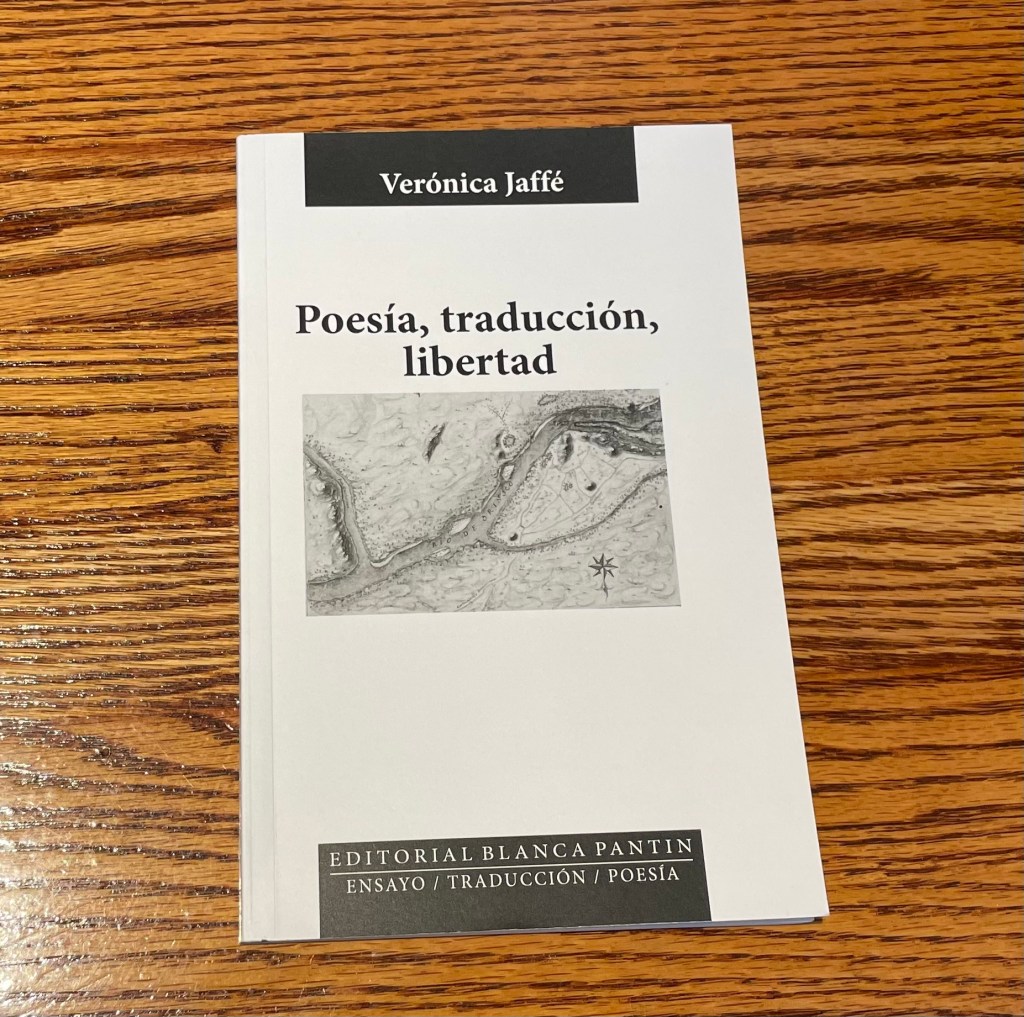
Verónica Jaffé’s most recent Poesía, traduccion, libertad (2024), which gathers some of the translations already contained in Fredrich Hölderlin: Cantos Hespéricos (La Laguna de Campona, 2016), features an introductory essay where she reflects on translating Hölderlin’s poetry from the German into her own creative visual renderings of Spanish. Reflecting on the difficult task, if not utterly impossible, of translating “Andenken” (in Spanish she opts for “Recuerdo” and not “Memoria”), Jaffé departs from an important observation that we must take into account here: the fact that this late hymn has been catalogued as a proemial composition. What does it mean that “Andenken” is to be read as a proem? As we know from the Ancient sources, the proem is an oratory prelude to the topic deployed in a text; in other words, it is the persuasive caesura of language before any argumentative exposition. Hence, the composition of the proem is something like the pure mirroring of language. This could explain why Hölderlin’s “Andenken” while prima facie about memory and thinking does not have a guiding thread to restrain it; it unfolds the enactment of its own recollection through the sayable.
If “Andenken” is a long proem – the space where the poem and proem absolutely coincide – then this means any translation must keep the poetic possibilities of oration in preamble, in path of preparation. Jaffé offers two distinct trans-creations of the famous poem’s last lines. The first reads thus: “Un mar que guarda los recuerdos / que da amores, que los toma / para que solo queden después / como tesoros / en quienes recuerden y en quienes escriban” [1]. In the second version, even more elaborate and idiosyncratic, Jaffé writes: “de pensar con todos / mis amores, es decir / pensar fijando / papel y lápiz / sobre tela / en memoria de todos mis muertos” [2]. It is noteworthy that the famous literal last lines of the “Andenken”, suspended in an enjambment, appeals to a canvas that is splattered with the memory of the dead. It seems of all the dead of the human race. What does it mean that the act of remembrance is the recollection of all the dead? Poetic imagination, if a testamentary document, appeals to the archaic where the living and the dead inhabit the world through image [3]. For Jaffé – but this also an intuition that Hölderlin shared in his pindaric translations – the beginning is not a previous stage, but in media res of the event of language.
The recollection of language within proem attests to the exilic dimension of language; the site where no one truly ever belongs to: “…la lengua en mi país que no me pertenece”, writes Jaffé [4]. This means that the authentic remembrance of language is not a national language, but always ex patria lingua, or a language outside the telluric fabric of the national community. Because we are always walking strangers in our own language, the contact with the dead repeatedly reemerges in the memorial grain of the voice.
As C.M. Bowra has noted, Pindar’s allusion to Memory takes place in the context of the Muses: “[the poet] invokes Memory because she embodies the accumulated wisdom of the past, and the Muses because they pass on this wisdom to him. What he asks from them is the ability to deal properly with what they give….men are blind if they do not pursue wisdom with the help of the Muses” [5]. If the “Andenken” should be read as a proem, this is because recollection is always fixed in the irreducible experience of our voice that recalls language from its beyond.
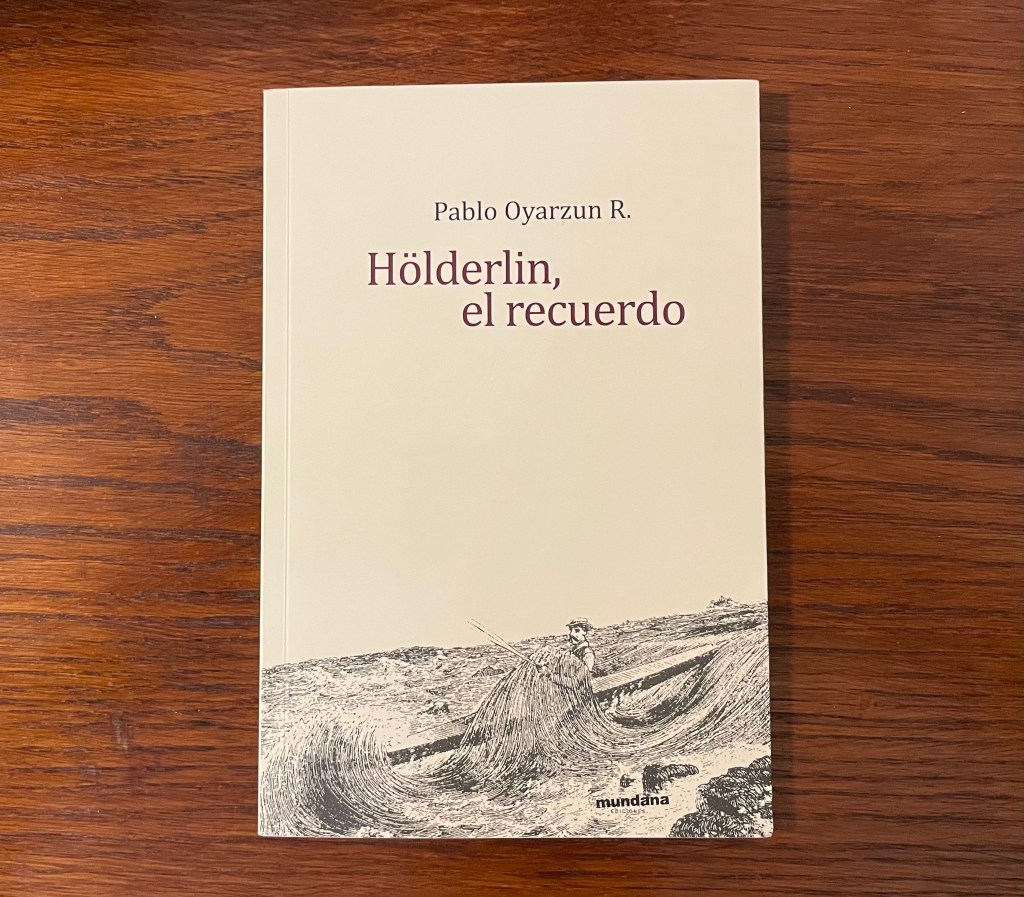
The concluding verses of Hölderlin’s “Andenken” (“Rembrance” or “Memoria”), “Yet what remains, the poets found” stands as one of the preeminent testaments of modern poetry, and in Heidegger’s famous characterization, as a declaration of the task of the poet. At least since the time of Stefan George and Max Kommerell, the figure of poet or Dichter, a hyperbolic figure of illumination and guidance caught in the net of poetry and philosophy, was already dependent on Hölderlin’s mysterious words. What remains in what the poet remembers and clears for foundation? What is the relationship between remembrance and what is ‘found’ or ‘established’? “Andenken / Remembrance” is a hymn from the late period, which means that it must be read in consistency with Höderlin’s poetological framework as it reaches its maximum degree of intensity in its declaration and deliverance. Pablo Oyarzun’s most recent Hölderlin, el recuerdo (Mudana ediciones, 2025) is a powerful and subtle contribution to the understanding of this poem that measures up to the task in its attention to lexicon and structure, metaphysical condensation, and the vortex of ‘memory’ that discloses the poem. One of the merits of Oyarzun’s philosophical hermeneutics, if we can call it that, resides in its refusal to incorporate philosophical doctrines to inform the major questions of the hymn; rather, he favors the very unfolding of the poem ramping its internal structure for possibilities (Oyarzun 18-19). Rereading “Remembrance” opens a path between philosophy and poetry in the dawn of the realization of metaphysics, whose price was paid by crushing the possible and the voice of the poem.
For Oyarzun the poet’s remembrance is that of appropriation of what is proper, and thus inappropriable, and to which the hymn can only ‘thank’ in the way of thinking as figure in the face of the unfathomable. Following Heidegger’s reading to a point, to give thanks is also to welcome and greet that lets humans and things be in their truth; since greeting always assumes otherness as foreign into presence (Oyarzun 29-30). And in presence life acquires texture, depth, singularization, but also conversation; a reminder that will control the rhythm of Hölderlin’s hymn. What is brought to presence, then, is neither a possession nor a legible inheritance, but the non-synthetizable modulation of what is proper in virtue of being absolutely alien (Oyarzun 34). What is recalled in this poem that remembers and thinks the unthinkable? Is it just a stage for Hölderlin to poetically transfigure his well known travels in Bordeaux? Oyarzun tells us that even if that is to be taken into account, the foreigner path is only essential as a way of homecoming, making the site (and song) into the hymn (Oyarzun 42). There is relation to the absolute other, but only as transitory to becoming and divine destiny in the world: “…el espíritu ama, porque precisamente así, ensa autoalienación puede transitar a lo otro que lo otro, es decir, apropiarse de lo propio […] el pensamiento del Ereignis está condicionado estructuralmente poesía ex-propiación, por ese retraimiento, distracción o retiro (Entzug), solo puede el cual se da lo propio (Oyarzun 54-55). Höderlin’s poem sings from the lacuna of its own expropriation of the abode. And that abode is ultimately the unworking of remembrance and memory that is defaced in being absolutely intimate and irreducible.
In order to elucidate the contours of this memory and its oblivion, Oyarzun follows Dieter Heinrich observation that: “este movimiento [of remembrance as transcendence] conocedor de su propio curso y a la vez desviado del mismo, aspirando a un conocimiento en que algo perdurable (lasting), con gratitud, reine aún en la superación – esto es remembranza” (Oyarzun 61). What is remembrance if not what unweaves time? It is not an actual faculty of human psychology, nor a spectral incorporation of a missing object; rather, it is the non-syntheizable partition between language and the wound of existence; a separation that is only redeemed in the way of remembrance that deposes an ideal recollection of missing facts in preparation for recomposition. Oyarzun’s reading will depend on clearing the notion of severability as a condition for remembering and forgetting as it makes an entry into the poem’s final verse about the “fixating eyes of love” (den Blick heften). Helena Cortés Gabaudán translates it as “y el amor también fija aplicadamente los ojos” [1]. “Y también”, “but also”, a conjunction of persistence that Oyarzun reads as an inexorable attachment to memory and separation, and the memory of separation (Oyarzun 68). Because there is no sliding towards remembrance without departure, coming into the presence welcomes the memory that, in that very moment, has transformed our souls.
Ultimately, for Oyarzun the vortex of Hölderlin’s “Andenken” is love understood as the supreme citation that enacts the place of both thanking and remembering: “Amar es recordar, frecuentar con el recuerdo (el pensamiento), lo amado, incluso allí donde lo amado está presente, porque así lo resguarda de la mera posesión y agradece su presencia. Amar es pensar-en, un modo, tal vez el más entrañable, de Andenken, amor” (Oyarzun 73-74). And this means that what remains and endures, as Adorno observed in his well known essay on parataxis in Hölderlin’s late poetry, is neither of the logical nor of the temporal indexes, but the event of language as originary creation and donation without contestation (Oyarzun 77). This is the instance where Hölderlin’s strange case of the divinization of the word – and this is the particularity of the hymn form, an element that is never teased out by Oyarzun – becomes absolute and intransigent. It is Höderlin’s absolute proximity with the classical world, but also its radical separation in the post-mythical world of dissenchantment. It can be said that that what endures ‘thanks’ the love of remembrance in its persistence of the word that does not allow history and the crisis of tradition: “en nombre de la cosa que queda, en la fragilidad de su tiempo, que es ese mismo quedar” (Oyarzun 79).
The poem becomes the verbal and sayable site where the poetizing resides, as well as the greeting and farewell of departure, just like the spectral sailors of the poem. What endures intimately can be called love as a form of the immemorial (Oyarzun 80). And that is because in inscribing, or holding on to the irreducible origin, poetics becomes the supreme form of love – the love in separation – of an expropriated language that welcomes us home in conversation with friends. This attests to the spirit of Hölderlin’s well known letter to his friend Böhlendorff in 1802: “A los artistas les hace falta la psyche entre amigos, el nacimiento del pensamiento en la conversación y la carta. De lo contrario, no gozamos de nada de esto para nosotros mismos” [2]. And this intoxicated love in language that departs from separation situates Hölderlin as radically different from the Chirstian agape and its bond of perfect unity for securing salvation (Colossians 3:14). A salvation that Hölderlin overcame in the drama of Empedocles, enacting the impossible incorporation of the aorgic physis through the writing of the tragic myth.
Now we are also able to understand why Hölderlin transited to the hymn as the supreme form of the poem; not because because it is the origin or its last stage, but a suspension of language retrieved is gathered in the two moments of salutation and farewell, celebration and lamentation [3]. The hymnal dimension of the poem becomes language as such, which Oyarzun calls the immemorial without ever alluding to the notion of hymn. Indeed, the love of remembrance only becomes possible as a disjointed factum of experience anchored in its abyssal noncorrespondence (Oyarzun 84). Thus, to remember is to love the caducity of life – “este ya no es la signatura indeleble del amor”, as beautifully expressed by Oyarzun – in a world in which the testament of language awaits no resurrection.
.
.
.
Notes
1. Friedrich Hölderlin. Poesía esencial (La Oficina, 2017), Trad. Helena Cortés, 129.
2. Friedrich Hölderlin. Correspondencia completa (Ediciones Hiperión, 1990), trads. Helena Cortés & Arturo Leyte, 554.
3. Nicoletta Di Vita, Il nome e la voce: Per una filosofia dell’inno (Neri Pozza, 2022), 246-247.
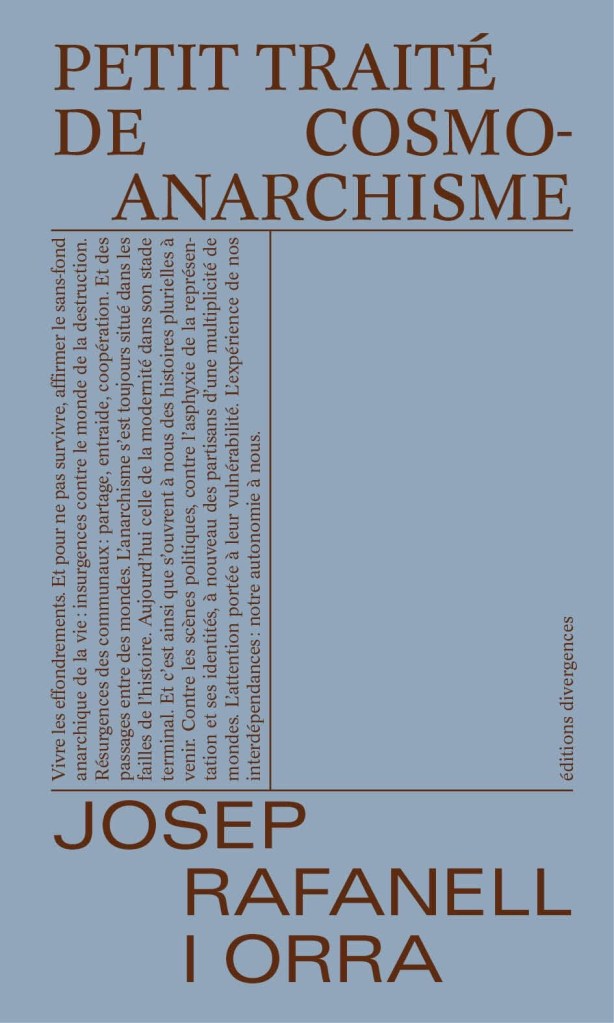
Anyone somewhat familiar with the writing of Josep Rafanell i Orra knows that we are in the company of a wanderer and itinerant in an infinite pursuit of what the experiences of worlds might offer [1]. A mad endeavor for a groundless epoch oriented towards planetary reduction and confinement, so obsessed with infrastructure and security, most recently through the reiteration of the politico-theological program of national sovereignty, one more desperate reaction to unrestrained planetary decline. We can say with Hölderlin that we are vagabonds in a destitute time, a poet who figures prominently at the entrance of Josep’s Traité. In our posthistorical epoch we are confronted with the thicket over the dominion of life, which means that the question of exteriority becomes pressing as existence enacts a path beyond the endless rubble of representation bestowed upon the human species in every point of the globe.
The book that the Spanish reader now holds in his hands thanks to Luciole Ediciones will immediately let in a dimming light of a singular style or maniera that dislocates the modernist assumptions of political thought into what one could what I am willing to name an analytics of sensible hybridizations between languages and thought. This analytic of the sensible refuses immediately Social normativity as well as the melancholic hangovers of the modern revolutionary tradition (always caught up between constituent and constituted power, representation and humanism, growth and production). This is why Josep will redefine communism as the nonprogramatic event that irrupts through hybridization of surrounds and regions capable of overcoming the ontotheological adequation of subject and object that has led an entire civilization astray (33). The project of the critique of metaphysics finds in Josep’s Traité a powerful schematic cartography that raises questions precisely in those spaces where the rationality of the science of political economy has never dared to enter.
If the critical projects of High Modernity were fundamentally temporal (including that of Messianism and its overemphasized trance towards absolute immanentization), Josep’s writing also has the virtue of displacing the focus to the spatial formation and the thinking of the creation of spaces understood as dwelling, once populated by the gods of the events and which modern ontotheology obliterated through integrated objectivation and technological positionality. We know that the greatest nearness of the last god eventuates only when the event is elevated into refusal, especially when it manages to become too near [2]. As a shorthand, this drift towards objectification in the liquidation of modern politics is domination of the Social totality; ultimately, it is through the plasticity of the social bond that the reproduction of biopolitical life is temporalized, legally ordered, and rhetorically subsumused into an apparatus of predatory accumulation. It is the Social (not the State, or this or that concept of the modern grammar of political thought, or even fascism) that we must refuse. The collapse of the modern secular state and its moral guarantees, is the beginning of an autonomized social bond that now coincides with the total administration of world forms. The hegemony of the Social reduction is what allows Josep to claim that the opposition is no longer between Society and the State; but rather between community as a process and praxis against the static formation of the Social. Thinking today drifts from social domination to communities of encounters, heteronomic relations, communication, and interdependence in a web that characterizes the exotic movement of the imaginative possibilities of exteriority for manifold worlds.
The notion of community in Josep’s thinking is neither about ecstatic groups or “little platoons” of identitarian belonging (as once famously defined by Edmund Burke); nor referring to filiation and propriety reductions that can subsist quite nicely under the heatwaves of the ongoing conflagrations of Empire. For Josep communities insofar as they are exposed to their excess (ubermass) are processes of external contact between souls as rites of passages. The community is formless, and in this sense it ceases to be a problem of Chistological stereology in order to become one in the order of ethics and language (50). In this sense, very much like the late Mario Tronti looking at the collapse of the modern revolutionary experiment; for Josep the ruinous fragmentation of the worlds has a silver lining: that all human, and non-human, souls are dwelling on the outside world calling for worldiness, and thus potentially sharing a sense of intimacy that re-enchants the appearance and knowability of the world through the invisible attunement to the outside (un nuovo modo di essere fuori e contro) [3].
Beyond the subject and the narcissism of the Ego, the light of a “spark of the soul”, in the words of Meister Eckhart’s memorable sermon, a new animism returns not because there is a transcendental revelation to be asserted, but because the encounter between souls brings forth the concatenation of worlds that are entangled with other worlds (68). If Jünger described the epoch of planetary machination as “soul murder” (seleenmord) it was because there was no longer any contact with the unfathomable opacity between the soul and any possible worlds [4]. Josep with an elegant mannerist style enhances this intuition: “We are no longer exiles on Earth, as the romantic moment freighted by the loss of world. We ended up forcing the Earth into exile after so many deadly abstractions (108). The modern age has not ceased accumulating abstractions against the human species until becoming a whirlwind of soul murdering that has extended into the current ecocide of the worlds.
It does not come as a surprise that throughout Petit traité de cosmoanarchisme (2023) Josep appears more than skeptical about political critique (and to say skeptical might be an understanding). There is a clear imperative that is mobilized in the book and that it should not be taken for granted: political critique should evolve into the negation and abandonment of politics, which also includes the always anachronistic anarchist politics. We know that ever since the Greek polis the autonomy of politics partition and distribution was waged against the incommensurable topos of the chora, the ungovernable and infrapolitical hinterland of the new substantive community of rights and obligations posited by the logistics of representation [5]. As we know, this is what forced Heraclitus to resolutely remain playing knucklebones in the temple of Artemis: “What are you gaping at, you scoundrels? Or is it not better to do this than to work with you on behalf of the polis?” [6]. The knucklebones of the ancient anecdote of the presocratic philosopher is symbolic to what Josep demands of existence: the liberation of environments and surrounds for multiplicities of experiences. The experience of gaming always starts in the middle, expressing the ineffable ethics of how I become what I am already on my way of becoming (142). The maximization of politics into the very thicket of life (this is biopolitical administration) have increasingly defaced the experiential practice of existence that now extends over the course of the historical dispensation of civilization. This is the vortex of the struggle against the realist validations in the interregnum.
Against and beyond the force of abstraction and the prison of individuality, Josep situates the stakes: “It is there, where the fierce struggle we can lead today: to find the intimacy of our soul in the welcome of other souls to hear their silences and their voices. To participate in the animation of the world is to perceive the outside. And gently find the inside of the outside” (145). And between the process of the community and the soul there is no longer struggle or enmity, but only solvent philia; the influx of creation that, insofar was enmeshed in solitude, allows pain to speak in the time of transition, in the skirmishes between worlds. Ultimately, the experience of the itinerant is not that of learning to live in places; rather, it is the one that intensively yearns the presence of encounters. This remains the only ethopoetic imperative [7]. As Carlo Diano observed in an erudite study on the notion of the chora, the attunement of the soul with the world is not a conceptual entelechy; it runs materially through the sensorium of this body as it traverses the world towards its renewal [8]. To grasp this chiasmic region that dispenses the harmony of the soul as it flees the prison gates of an objective world, is the enduring letter and spirit that Petit traité grants to the ongoing task of thought.
.
.
Notes
1. Gerardo Muñoz. “Escuchar las llamadas del mundo: diálogo con Josep Rafanell i Orra”, Disenso: Revista de Pensamiento Político, N.3, July 2020, 134-158.
2. Martin Heidegger. Contributions to Philosophy (Indiana University Press, 2012), 329.
3. Mario Tronti writes in “Disperate speranze” (2019): “È necessario trovare un nuovo modo di essere fuori e contro. Io posso farlo nel solo modo in cui so farlo: tirando l’arco al punto che permette di cogliere il bersaglio più raggiungibile. Realistica visione.”. CRS, October 2019: https://centroriformastato.it/disperate-speranze/
4. Ernst Jünger. The Forest Passage (Telos Press, 2003), 93.
5. Julien Coupat. “Dialogo con i morti”, in Gianni Carchia’s Orfismo e tragedia (Quodlibet, 2019).
6. Martin Heidegger. Heraclitus: The Inception of Occidental Thinking and Logic (Bloomsbury, 2018).
7. Josep Rafanell i Orra. Fragmenter le monde (Divergences, 2020), 70.
8. Carlo Diano. “Il problema della materia in Platone: la chora del Timeo”, Giornale Critico della Filosofia Italiana, V.1, 1970, 335.
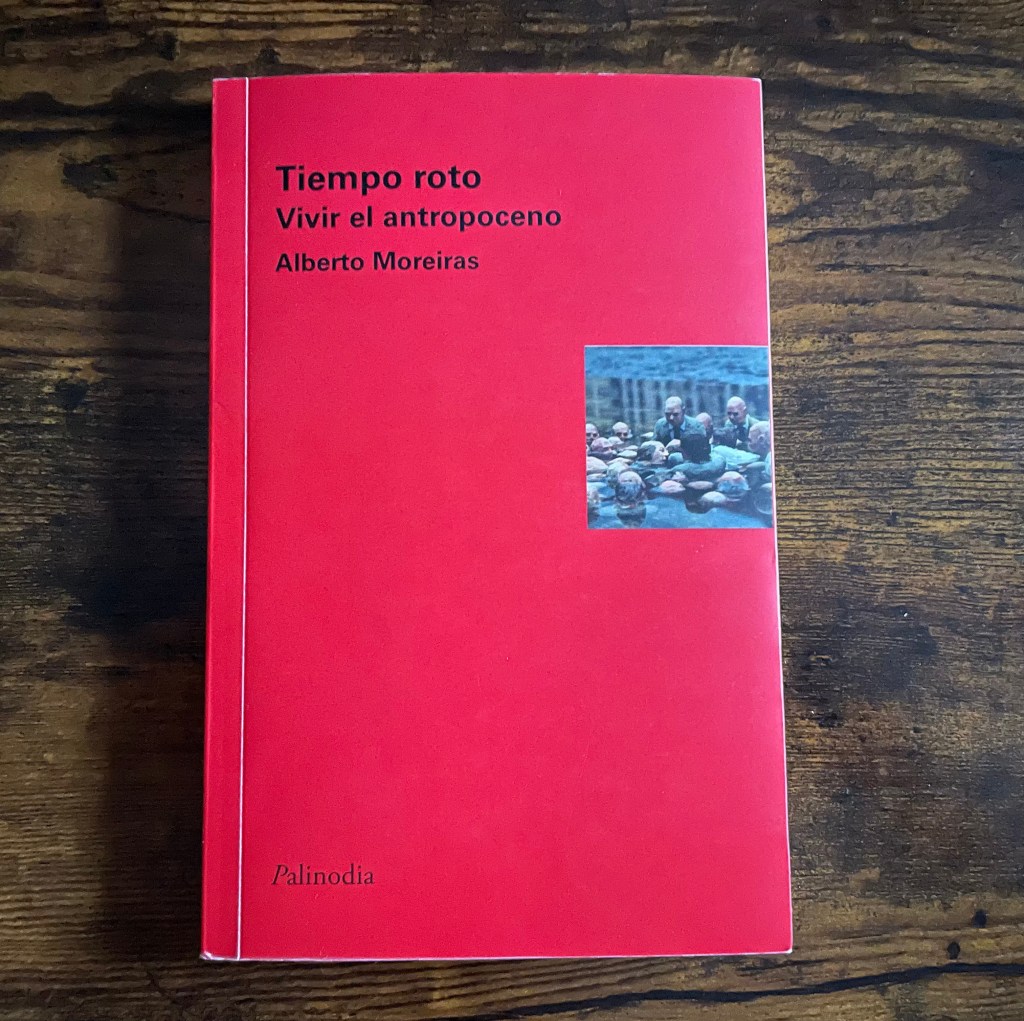
The sudden and uninvited intrusion of Gaia in our world is something rather strange, and yet consistent with the closure of the metaphysical tradition. The call of the outside takes place at the threshold of our reflexive capacities, habits, and mental propositions in our relation with the world, which demands everything to be thought from scratch. The historical imbalance in groundlessness now requires a new task for thinking – the imperative that runs through Alberto Moreiras’ most recent book Tiempo roto: vivir el antropoceno (Palinodia, 2024). The theoretical constellation deployed over the course of a decade now comes to the forefront with extreme urgency – I am referring to marranismo, posthegemony, aprincipial anarchy, and of course, infrapolitics. Tiempo roto (2024) is not a systematic culmination of Moreiras’ philosophical (or antiphilosophical) project of thought, but it is definitely a mature elaboration insofar as the field of problematization enters a hitherto unexplored thematics of late heideggerianism. All things considered, the emerge of the anthropocene as an explicit planetary endgame and the new beginning necessarily move pass the conditions of both political and scientific praxis, which today can only effectively adequate itself into positionality (the so-called Gestell) and objectivity of a world that slowly seems coming to its end.
It might be worth remembering that the notion of “other beginning” (“otro comienzo”) in the wake of civilizational decline was already proposed in the book Sosiego siniestro (2020), but it was far from being thoroughly explained [1]. Following Heidegger’s philosophical scene, representational thought in the tradition of adequatio of the Thomist gnoseology coincides with technological administration of every living entity (Moreiras 14). But Heidegger’s suggestion in the Parmenides that calculative representation fails as grasping the essence of the polis might also have its own limitations, insofar Gaia appeals to an excess beyond or below the politics. As Jacques Camatte also understood it, the civilizational invariant of revolutionary breakthrough departing from the historical subject of the working class can seldomly do the work except as an article of faith in the myth of the autonomy of the proletariat within real subsumption. This means that we are in the terrain of infrapolitics or the chora, which point to ontic regions of thought towards a new beginning at the end of principial metaphysics. But the other beginning can only emerge within conditions of transforming existence against the closure of political technicity.
I do not desire to reconstruct here all the refined analytical movements that lay out the transformation of existence in Tiempo roto (2025), but there is a maxim from Pindar’s Third Pythian Ode that stands out as an emblem for the appropriation of the non-humanity of the world. Moreiras cites Pindar’s “me, phila psycha, bion athanato speude, tan d’emprakton, antlie makanan”, which can roughly be translated as “do not seek, dear soul, immortal life, but do try to carry out the fullest the use of the possible” (Moreiras 61). Moreiras correctly notes that the ultimate difficulty lies in the “emprakton makanan”, or the use of the possible, which metaphysical Humanism and effective general equivalent can only exacerbate towards the planetary production and extractive valorization. The corruption of the use of the possible is the realization of hybris, and in this sense all representational humanism is always already a form of self-deification and induced hallucination, even when it tries to claim to engage in the opposite in relation to nature (Moreiras 65). Moreiras suggests that the pindaric maxim discloses a second relation of the “use of possibles” that does constitute a lacuna in the metaphysical tradition, and that is understanding a praxis tied to sophrosyne or phronesis that abides to the prudent inclination of the non-human (“es una actividad sometida a la vergüenza de lo in-humano”) (Moreiras 65). Giorgio Agamben’s defense an ontology of possibility against the hegemony of metaphysical realization and representation also comes to mind, although Moreiras might not feel at ease at explicitly calling for a positive ontology nourished in the waters of a transfigured metaphysics of the tradition of scholastic Averroism [2]. Although both Moreiras and Agamben come at their closest proximity in terms of the notion of the chora – and more directly the space of the chora against the primacy of the polis – which serves the ontic condition for the non-spatial surfacing of the abode or region that is necessarily infrapolitical, because it’s never determined by distributionist political isonomia or meson (Moreiras 73).
There are important nuances here to say the least: whereas for Agamben the notion of chora appeals to the gods of place (theos aisthetos), and thus a dejointed form of divinization decoupled from the legitimacy of every politico-theological archein; for Moreiras, the chora is a praxis of thought towards desecularization that lacks theology, and thus capable of exceeding the onto-theological reduction (Moreiras 74). But Moreiras says about the tendency towards nihilism of “possibility” in the historical dispensation of positionality (Gestell) could also be said about ‘de-secularization’, as the ultimate consequence of the decay of political legitimation in Ernst Bockenforde’s famous formulation. This might not be the space nor the moment to reach a verdict between Moreiras and Agamben’s position regarding the very complicated problem of the Platonic site of the sensible, since what is presented to the reader as a ‘phenomenology of excess’ or the inapparent (something merely alluded in the Zahringer seminar), might be the condition of an atopic mediation that prepares – or that has always prepared since the times of Orphic myths – the tonality of a coming philosophy under the sign of transformative thought (Moreiras 110) [3].
The dispensation of the Gestell open up and also step back (a folded movement that does not have a declension into a synthesis) into the genesis of the beginning (Moreiras 115). And the anthropocentric epochal dispensation, says Moreiras, is no longer the site of the polis, but “the planet as a the historical site of humanity, although we are still unaware of it (“aunque sigamos desconociéndolo”) (Moreiras 116). This uncanny phenomenology of the primary, traversed by the discharge of the entstehung, is the infrapolitical site par excellence, because it is in the atopic region where destiny is both affirmed and displaced. This is why, as Moreiras recalls Heidegger saying, the dialogue with Parmenides never exhausts itself, and yet it prepares a destiny (Moreiras 134). I take this to mean that there is an experience of the transfiguration of language for the emergence of an “ethics” (ethos), but this might be beyond Moreiras preliminary conditions for an existential breakthrough; that is, something possible further along the path.
Tiempo roto (2024) closes with a couple of undeveloped pages that take Massimo Cacciari’s old essay “Confrontation with Heidegger” (1977), in which the Italian philosopher makes a plea for a direct confrontation with Heidegger and Nietzsche’s teachings on nihilism and the closure of metaphysics if there would still be any hope for the composition of the working class during the stage of anthropomorphized dimension of capital defined by Jacques Camatte also during those years. But much has changed since the hot Italian summer of 1977 and the formulaic conjunction of “left Heideggerianism” might not do the work anymore, as if the totality of materialist political economy could be amended by a radicalization of the historical question and the ontological difference. Political economy plus metaphysical critique is still relying on a conception of the political as a technique, which today has transformed into what some have called the “new regime of ecological accumulation” as mere stabilization of green ecological spheres of life [4].
But there is a second register to Cacciari’s programmatic thesis that remains open. And these might be Moreiras’ most important words in the concluding part of the book: “Espero haber mostrado que Hiedegger señala la posibilidad de dejar atrás la explotación y el consumo en la era del Antropoceno a través de una comprensión alotrópica de nuestra relación con el mundo. Por lo tanto, vivir en el Antropoceno debe basarse en el abandono o desplazamiento de la metafísica como modo dominante de aprehensión del mundo en la actualidad” (Moreiras 151-152). Marx’s materialist dialectic through the critique of political economy – even as a destitution of political economy through its own vectorization – might be insufficient to face the unprogrammed presence posed by planetary anthropocene.
Perhaps we can still repeat Dionys Mascolo’s words that the coming communism will owe more to Hölderlin than than Marx, not because of an idealist dispute over concepts, but rather because of what Cacciari called in his essay, also citing the German poet, the historical “affinity of conditions” [5]. And in the age of the Anthropocene and positionality, those conditions are kept in the pattern of economic decline or stagnation in which the law of rate of profit encounters its own limit, folded unto the ongoing destruction of the life forms in the world. The allotropic praxis endorsed by Moreiras finds traction in Hölderlin’s poetic dwelling in language at the heart of decline so that something other might emerge within and beyond life, from Gaia to Ctonia. This is the most difficult task to depart from, but it is also the path that saves from the current inhabitable passage of the Earth.
.
.
Notes
1. Alberto Moreiras, Sosiego siniestro (Guillermo Escolar, 2020), 24.
2. Giorgio Agamben. L’irrealizzabile: Per una politica dell’ontologia (Einaudi, 2022), 112-146. Kindle Edition.
3. For more on orphism and the limits of the site of the Greek polis, see Gianni Carchia’s Orfismo e tragedia (Quodlibet, 2019), epilogue by Julien Coupat.
It is well known that Aristophanes’ late comic work on wealth, Plutus (388), provides us with what is perhaps the most dramatic and conceptual elaboration of the mythic personification of poverty (Penia) of late antiquity. What is remarkable is that in her self-presentation to the character Chremylus, Penia draws on a political parallelism that colors the ongoing crisis of governance of the ancient polis. If the Greek comedy is dependent on the function of the pólos (which is the vortex of movement that makes possible grasping the specificity of the being that is said), always prior to the arrangement of the polis, then it would follow that Aristophanes’ commentary on the centrality of Penia is neither mockery nor irony within the structure of the play, but rather an element fundamental to the historical presentation of the consciousness of historical public life. The emergence of Penia in Plutus is recorded in the lines 550-554 (a paraphrase might be adequate here): “Thrasybulus and Dionysius are one and the same according to you. No, my life is not like that and will never be. The beggar, whom you have depicted to us, never possesses anything. The poor man lives threfitly and attentively to his work; he has not got too much, but does not lack what he really needs” [1]. Poverty is an intimate relationship with needs; perhaps an unsaid relation, but one that must be accounted for nonetheless.
At her entrance into the play, we are told that Penia’s complexion is both mad (makaron) and tragic (tragōdikon); she could very well be an Erinyes companion from the underworld of the dead. Penia as a mythic figure is a fullfilled form of life. More importantly, what is crucial in the Plutus is that Penia defines herself in sharp contrast to the life of beggars or ptochos. This means that while the penetes is tied to a constitutive need as condition for a form of life; the ptochoi is a being that merely lives in a state of survival, and endures his absence of proper needs. Because Penia is contrasted to the destitute life embodied by ptochos, she can state in one moment primacy over wealth: “all your blessing….you have all that you need in abundance, thanks to me” [2]. Hence, as it has been noted, the irrevocable presence of Penia in the polis is the condition of possibility for Ploutus, god of wealth and abundance, shown in ancient representations as holding the flourishing cornucopia from the fertile harvest season.
What is important to note is that the close and fluid relationship between Ploutus and Penia; that is, between abundance and need, far from being opposition is relational and nourished by its pólos. In this way, the being of need, the penetes, is only able to flourish if he is capable of attaining a free relation with its desire of its vital making, and not from an external power that can determine the functions directed to abstract modeling of population survival. If Aristophanes’ Penia is defined against the ptochos is not because there is a difference of degrees in terms of dispossession, negative or quantitative, but rather it is because it is a disjointed relationship between poverty as a transfigured life, and a life that become destitute because it has ceased to be attentive to its own needs. In the incommensurable ground of the polis, it could be said that the ptochoi were unformed lives that merely persisted in time on the margin of the system of relation of the human community, and for this reason they dwelled in a permanent state of apolis, since their only viable horizon was the result of economic abstraction for secondary needs. In other words, the beggars of the apolis are ultimately effects of economic forces that they do not control, precisely because they no longer have any existential relation with the realm of necessity, that is, with poverty as understood under the shadow of Penia.
In this sense, the condition of beggar is an ultimate economic subjection that is already beyond the sufficient limitation of needs, and thus it has lost all contact with the world. It is has become deprived of the world without being truly dead. Here, one should not forget that as Plato registers the genetic relationship between Penia and Eros in an important moment of The Symposium: “Eros is the son of Poros and Penia, and partakes of the nature of both parents, the fertile vigor of the one, the wastrel neediness of the other. As he is a mean between mortal and immortal” [3]. But the erotic soul in the last resort is nothing but the desire for immortality; and, as a daimon, it mediates between passions and the beautiful, between the divine and the mortal, between need and wealth towards the depth of a harmous life [4]. As Sandrine Coin-Longeray has shown in her exemplary study, Penia (πενία) exceeds the effective qualification of the “good life” based on labour; rather it is a route of life that outlives itself in the erotic transfiguration of world towards the preservation of irreducible homeostasis of common life [5].
This is why Plato’s conception of the ‘happy city’ or the kallipolis was imagined as a deposition of the process of abstraction between “rich” and “poor” that ultimately has come to regulate the modern organization of social rationality proper to accumulation, production, and distribution to supply to rhe demand of ever expanding secondary needs in the general field of consumption. As Plato writes in Book III of The Laws in a section precisely dedicated to showing how to bring civil war to an end: “Because of all this, they were not intolerably poor, not driven by poverty to quarrel with each other; but presumably they did not grow rich either, in view of the prevailing lack of gold and silver. Now the community in which neither wealth nor poverty exists will generally produce the finest characters, because tendencies to violence and crime, and feelings of jealousy and envy, simply do not arise” [6]. The civilizational path undertaken by West since the rise of institutionalized isonomy could not be but exactly the opposite of the platonic deposition of the autonomy of alienated classes. Today it is all too apparent that every sphere of social reproduction stimulates a ferocious race to the bottom between a kleptocracy and a vast administered population of ptochoi that, precisely because they have no relation to Penia, is left pursuing compensatory reactions within the social mechanism of organized begging that they are forced to endure. Under the oblique light of Penia, it becomes clear that both redistributionist policies through state institutions, as well as the autonomous market initiatives of financial models tend to be two sides of the same defense of abstract abundance on the back of the human community of penetes.
The negative subsumption of material needs, and thus of poverty into quantifiable assets that characterize abundance and growth at a civilizational scale – with the collaboration of all modern political ideologies without exception always oriented towards production – has contributed to thwart the path of Penia that is necessary to live freely between passions and needs. This is why in his 1945 lecture “Die Armut” (“Poverty”), Martin Heidegger, departing from a well-known intuition from Hölderlin, claimed that ‘being-poor’ does not mean the absence of some property or substance, but a relation to needs; because only in poverty do we preserve a free relation unto what we need (not-wedigkeit) as necessary. And only this can be taken as the true and ultimate wealth: ‘we have become poor in order to be rich’, means that only through the preserving necessity of Penia will there be a liberating dislocation for human life beyond the indigence of mere exchange and the endless struggle over material goods and the private property. As the world becomes a more vast wasteland of beggars and disposable bodies at the service of technology, Heidegger, in Eckhartian tenor, was not wrong to claim that poverty and Penia will ultimately be the ethical destiny of the people of the West only if they become attune to the divine overtone of poverty as their destiny. Thus, the only possible abundance in a declining world can be realized through the enduring necessity and disquiet return of the essence of poverty – to come near the nothing, because there we find the dearth of the earth. Indeed, as Penia says in Plutus before leaving the stage: “One day you will speedily send for me back” [7].
3. Plato. The Symposium (Penguin Books, 1987), 203b, 82.
4. F. M. Cornford. “The Doctrine of Eros in Plato’s Symposium” (1937), in The Unwritten Philosophy and Other Essays (Cambridge University Press, 1950), 74.
5. Sandrine Coin-Longeray. Poésie de la richesse et de la pauvreté: Étude du vocabulaire de la richesse et de la pauvreté dans la poésie grecque antique, d’Homère à Aristophane: ἄφενος, ὄλβος, πλοῦτος, πενία, πτωχός (Publications de l’Université de Saint-Etienne, 2014), 153-56.
There is something to be said about the facticity of epochal decline, and the reiterated attempts to call for its overcoming. But both decline and renewal are so interconnected in the Western dispensation of community and institutional organization that any attempt to surpass only deepens and pushes onwards the pendular movement between rise and fall towards generic equilibrium and social stabilization. Oswald Spengler understood well that decline situates civilization at the center of Western internal historical development just as birth presupposes death; thus, civilization is merely the coagulation of vital energies to overcome the emergence of decline. The genesis of civilization into final decline should at least elicit a question to break this ongoing circularity: what does it mean to hold to decline without converting its minimal energy into the orientation of a new horizontal epoch? The end of growth (economic stagnation) realized in real subsumption and the autonomization of value also allows us to formulate the question in the following terms: what does it mean to seize the fall of the rate of profit affirming demobilization and the inoperative nature of life beyond its conversion into the movement of energetic production that characterized the epoch of production through the historical figure of the worker?
Ultimately, this is a question about how to represent (or how to avoid representation) an ethical orientation of life. At the turn of the twentieth century, it was noted that the ethical bourgeois form of life was conditioned by the sense of “community upon all men” around utility of life’s functions subsumed by work, and work as the sole purpose and meaning of life. The definite character of modern social life can be said to compensate for decline for giving up the incommensurability of life forms; that is, what Lukács also called the temporality of the “genius, in the sense that [the genius] can never be measured against anything, whether interior or exterior” [1]. Confronting this very question at the threshold of the crisis of the transmission of forms in Antiquity, Bernard Berenson in The Arch of Constantine: the Decline of Form (1954) offers a distinct position: the moment for seizing decline should be a deliberate prospect of gazing backwards; a facilis descensus that will disclose something entirely different deprived of the race towards “newness” promised by temporal futurity and its social spheres rhetorically organized. In a remarkable moment of his book, Berenson writes that: “Except in unique moments like the fifth century in Hellas or some three thousand years earlier in Egypt and Sumeria, conscious, deliberate, purposeful art is constantly looking backwards – renaissancing – if I may be allowed this uncouth but necessary verb-striving to recapture some phase of its choice in the art of the past, or at least to model itself or draw inspiration from it” [2].
In other words, there is only “renaissancing” if one is able to traverse the decline of the past in the fullest sense of its inheritance of its formal stratification. The perpetual infantilism of the modern ethical outlook is that it tries to claim its definite character in irreversibility in order to exit the downwards path of decline through abundance and vulgarity (and we know from Ruskin that vulgarity is one of the forms that death takes unto the living).
For Berenson there seems to be authentic renaissancing at the level of life forms – of that incommensurable generality of human concrete and practical creation – by holding on to epochal decline, and not through state cultural policies that have sedimented the disappearance of forms of art legitimized by a “critic that will discover a deep meaning, a strange beauty, a revelaning newness in what you have done” [3]. The vicious modern liquidation of the free interplaying creation of forms of life and their external model of appearances is paid with the ascension of the rhetorical utility that will alleviate, at least momentarily, the sentiment of the decline proper to the transmission of dissolution. Whatever redemption creation can offer in the muddled waters of decline, the modern autonomy of reified forms, pushing upwards towards “newness”, will separate the sensorial transformation of life to the homogenous representation of communitarian representative order that puts an end to mood and solitude.
What Berenson calls “renaissancing” of factical experience nourishes the unrealized instances of the tradition not towards the breakthrough of a historical epoch (something like a virtuous mythic age of “Renaissance”) that can be posited by way of general background principles nor through the enforcement of a common social morality; rather the incorporated memory of the past is transformed to its very end because in its liquidation “true life” beyond measure reemerges. Berenson will state quite enigmatically that “style cannot be manufactured by taking thought” independently [4]. This is what Hölderlin had in mind when in a moment of “The Fatherland in Decline” from his theory of the tragic and its passage of dissolution: “The new life, which was to dissolve and did in fact dissolve, is not actually the ideally old, the dissolution of which was necessary, exhibiting its peculiar character between being and nonbeing…thus dissolution, as necessary, when seen from the point of view of ideal remembrance” [5]. It is this remembrance of dissolution that reveals decline as a felicitous fall without judgment that brings the appearance of life outside the irreversibility of the modern historical progress that has accumulated the oblivion of possible worlds.
This is why Hölderlin will also claim in his “The Perspective from which we look at Antiquity” (1799) that the ‘general decline of all peoples’ is due to the inheritance of forms of “an almost boundless prior world, which we internalize either through learning or experience and exerts pressure on us” [6]. To take up decline in a serious way means that we proceed from the formlessness of life, and not from the mimetic drive that expresses, in the name of ‘originality and autonomy’, the civilizational alienation towards the most distant (Antiquity) and the most near (ethos). We can then say that in decline the most distant and the irreducible becoming allows the ascension of ethical life. In this way, we can authoritatively say that there is only hope and redemption in decline because new life flourishes in a time of prudens futuri temporis exitum (“Prudently the god covers the outcome of the future in dark night”) that will transcend itself by becoming into what ceases and ultimately is.
.
.
Notes
1. Georg Lukács. “The Bourgeois Way of Life and Art for Art’s Sake”, in Soul and Form (Columbia University Press, 2010), 76.
2. Bernard Berenson. The Arch of Constantine: the Decline of Form (1954), 36.
3. Ibid., 64.
4. Ibid., 22.
5. Friedrich Hölderlin. “The Fatherland in Decline”, in The Death of Empedocles (Suny Press, 2008), 154.
6. Friedrich Hölderlin. “The Perspective from which We Have to Look at Antiquity”, in Essays and Letters on Theory (Suny Press, 1988), 39-40.
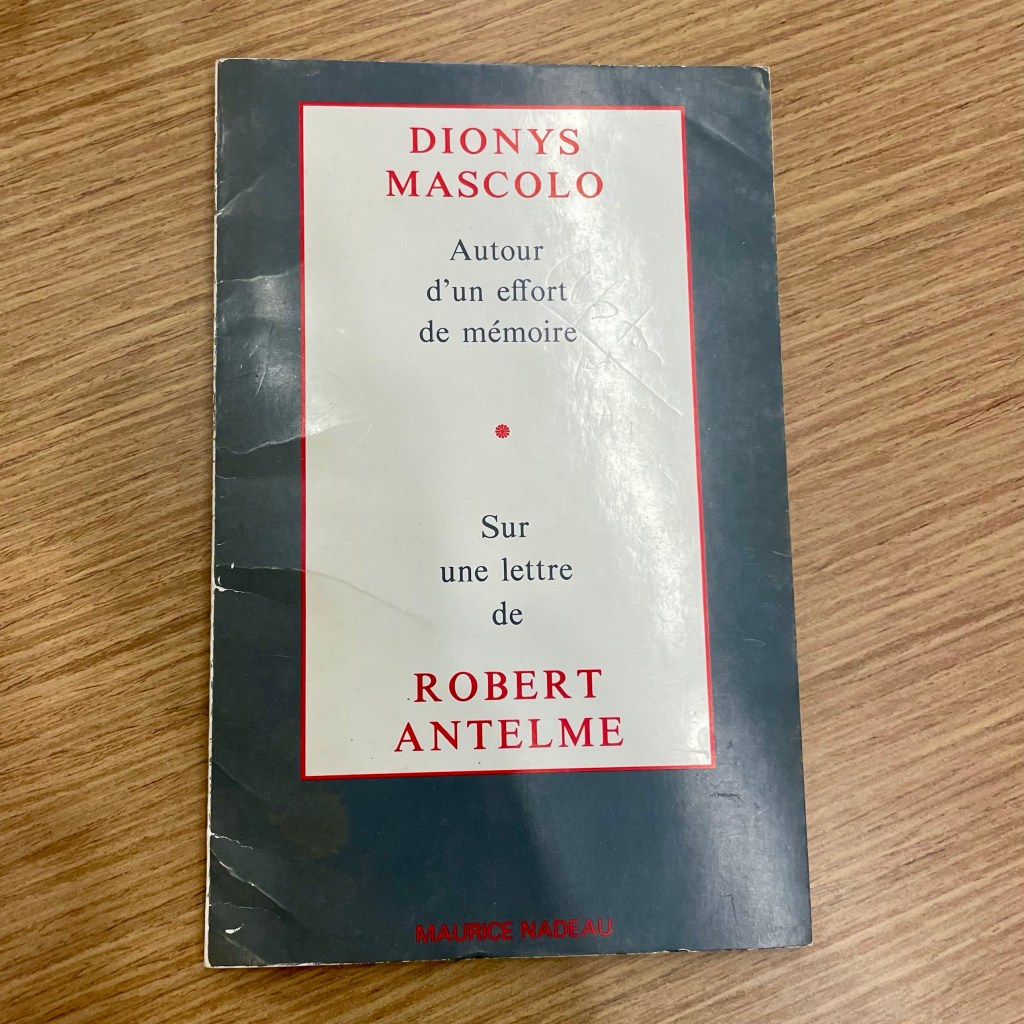
Rereading Dionys Mascolo’s Autour d’un effort de mémoire: sur une lettre de Robert Antelme (1987) in preparation for an upcoming course with Philippe Theophanidis, one gets the sense of beginning backwards or at the very end, since this late essay is a recapitulation of what the Rue Saint-Benoît Group embodied and stood for. And it is so obvious that for Mascolo what is at stake in Antelme’s letter is not a particular practice of confession (and the coupling of secrecy and extraction), but rather an integral register of an experience that belongs to “friendship in thought without reserve” [1]. And that it would not have been possible without friends, as simple as that. Of course, the condition of possibility of this shared thought in friendship has less to do with general principles, norms, or creative acts, and more with what Mascolo does not hesitate to qualify as “a sensibility that was common to us”.
What is this sensibility, and is it possible to describe it? This is a question that I do not think that is attempted to be resolved in Mascolo’s commentary nor in Antelme’s letter so consumed by its internal lacunae and effacement (I am definitely not capable of saying a word about it at the moment, and this might be one of the questions in the ongoing dialogue in the seminar). Mascolo does offer a little more when he states that this sensibility, however broad and partial, was always elevated against all totalitarianisms that were hegemonizing the political positions of the epoch. Obviously, it names the political totalitarianism (Fascist and state planned communism alike), but also the “the soul of the project” (‘est l’âme du projet et sa forme aboutie’) that must retract from it [2]. The last pages of Mascolo’s reflection is a shallow-deep, an insinuation, into the possibility of saying something in relation to this difficult proximity.
Hence, against total subsumption of life into political planning (whether on the right or left, whether ecclesiastical or in the name of the secularized forms of militant communist parties), Mascolo’s insistence on the ‘soul of the project’ is sustained by the “missing word” give that dispenses human necessities as infinite. He writes: “Et par mille et mille détours, il me (nous) fallait toujours en revenir au même point : Je suis ce qui me manque est la sentence que je porte (nous portons) inscrite à l’intérieur du front. La moindre des choses alors est de proposer que, sauf mensonge, elle vaut pour tout homme”. [3]. But what could it mean that “what I am” is always constituted by the missing word? It is definitely not a substantive attribute to a person (and thus what I can acquire), but a word that in its ideal absence and lack of epistemological validity stands as a form of seeking (zēteîn) that Nicoletta Di Vita has recently linked to the form of the ancient hymn [4]. The missing word is the passive and pure voice that calls out the rhetorical fiction of political totalitarianism. In other words, the missing word does not enact a present state of things, articulating the denomination in language with distinct objects of the world; it only has transformative weight when revealing what remains under the capes of morality.
This is why the experience of the camp constitutes a central threshold: on the one hand, it is an extreme and sharpened image of social alienation between classes; and, on the other, it is the experience that by depriving the human of its humanity it brings to an effective end the polarity between rich and poor that structured the economy of salvation and damnation of Western civilization. This is what Antelme describes in his essay “Poor Man – Proletarian – Deportee”, which according to Mascolo brings the rich to a psychotic night of desperation towards destruction and death of the specie. Hölderlin’s definition that “we have become poor in order to become rich” as a clement predicament in the face of the modern is here-forth suspended in the spiritual crisis generated by the social engineering whose most extreme case is the model of the camp.
And yet the missing word remains irreducible even after the corrupted stage of innocence and the impossibility of redemption. Mascolo, reader of Nietzsche, does not believe in the theos. This is why for him the missing word, far from being an apostrophe that offers consolation in the wake of the catastrophe, it remains concretely attached to the experience of the friend that no longer finds solace in abstract peace, but in the profound musicality of what remains inconsolable: “cette heureuse absence de paix qui est sa musique profonde, et que donne en partage l’être aimé, l’inconsolable qui console” [5]. This transfigured word – the unending capacity for hymn in the human, its nomoi mousikos – is both an excess to memory and appearance, and perhaps, more importantly, an excess to the experience of living and the dead. And is not this “seeking” passage of the missing word what the Rue Saint-Benoît Group was obsessively after?
__
Notes
1. Dionys Mascolo. Autour d’un effort de mémoire: sur une lettre de Robert Antelme (Maurice Nadeau, 1987), 82.
2. Ibid., 83.
3. Dionys Mascolo. Autour d’un effort…,82.
4. Nicoletta Di Vita, Il nome e la voce. Per una filosofia dell’inno (Neri Pozza, 2022), 27.
The Rue Saint-Benoît Group, organized by Marguerite Duras, Robert Antelme, and Dionys Mascolo and other fellow-travelers of the interwar years can hardly be defined as a political movement, a literary school, nor an intellectual community with a direct orientation or aesthetic program. In fact, the Saint-Benoît Group (transnational in its composition) understood itself as a shared experience of thought that gravitated under the words of the German poet Friedrich Hölderlin: “The life of the mind among friends, thought is formed in the exchange of the written word and for those who seek”. It is also known that Hölderlin was the quintessential poet dwelling in the fracture between tradition and modernity, the flight of the gods and the eclipse of the poetic in the wake of a consummated technological Prometheism. To affirm Hölderlin’s words entails to confront the difficult questions of language and the voice as conditions for thought. How can we think of an intellectual experience in which friendship becomes inseparable from thought; and, at the same time, when thought becomes a condition for the endurance of friendship? And to what extent could this double register allow for a reinvention of the autonomy of politics in the wake of the crisis of Humanism?
These are the enduring questions that the experiential setting of the Saint-Benoît Group bequeaths to us today. If the Saint-Benoît experience has remained opaque and invisible even within monumental historiographic narratives of twentieth-century ideas, it is because only seldom have these problems been rightly posed. Under the sign of a “friendship of thought” – a transfigurative plane that immediately resonates with the immaterial common intellect, the Heideggerian incursion on the task of thinking, and the revival of a sensible Platonism – the members of the Saint-Benoît Group witnessed the catastrophe of modern politics in real time; such as, although not limited to, the concentration camp, the postcolonial wars of liberation, communist totalitarianism, and the exhaustion of the fundamental categories of political Liberalism. Taking distance from the elaboration of a normative political theory, the Saint-Benoît Group favored the heterogeneity of stylistic endeavors and expressive acts in order to grapple with the crisis of experience. And it is to their specific scenes of writing that we must attend to in a systematic and careful way.
In this eight-week course we will explore the diversity of the writings of the group, including figures such as Dionys Mascolo, Robert Antelme, Marguerite Duras, Maurice Blanchot, Elio Vittorini and other fellow-travelers to explore questions concerning the nexus between experience and creation (both of us have worked on some of these writers intermittently in the past couple of years). To the extent that we still live among the ruins of the legitimacy of modern politics, the contestatory style of Saint-Benoît Group still raises the question about the human species within our civilizational collapse.
What type of authority emerges from their writings, communication, and imagination of a fractured humanity? And how could the concept of ‘revolution’ be transformed from its moral and technical elaborations that hegemonized the twentieth century? We are aware that the Saint-Benoît Group has no “lesson” to be extracted and made “actual”; rather, we are interested in what we would call a “gesture of thinking” that prepares the condition for a life in freedom within and beyond the contours of the polis.
*For those interested in registering for the eight week seminar beginning in February 2024, please consider signing up at 17/instituto de estudios críticos: https://17instituto.org, or by writing to extension@17edu.org.
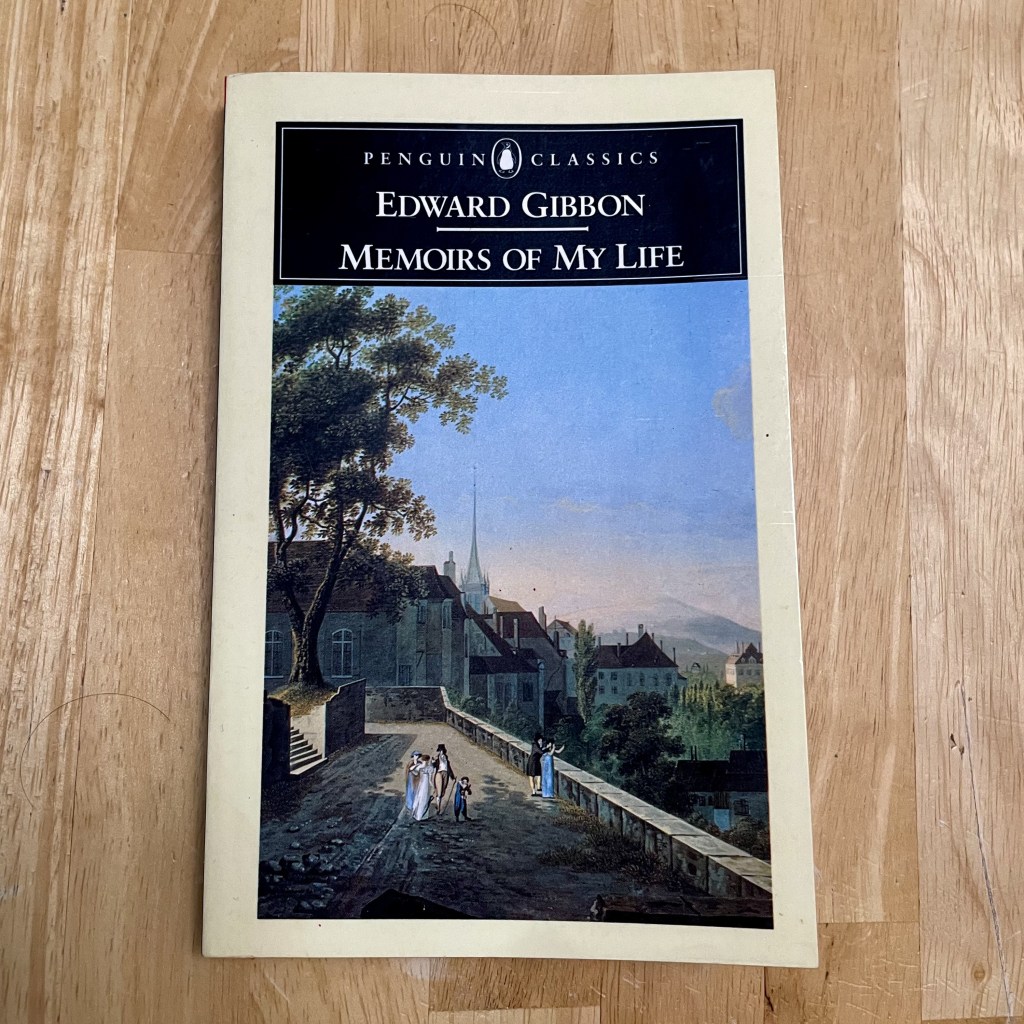
In his posthumous Memoirs from my life (1827), Edward Gibbon writes something quite striking about the modern English university in order to defend his alignment with the érudits. Now, to be an erudite was never something to be achieved at a university or academic discipline, it was something quite different in both style and form. Gibbon was quite crude when he writes:
“The schools of Oxford and Cambridge were founded in a dark age of false and barbarous science; and they are still tainted with the vice of their origin. Their primitive discipline was adapted to the education of priests and monks; and the government still remains in the hand of the clergy, an order of men whose manners are remote from the present world, and whose eyes are dazzled by the light of philosophy. The legal incorporation of these societies by the charters of popes and kings had given them a monopoly of public instruction; and the spirit of monopolists is narrow, lazy and oppressive. Their work is more costly and less productive than that of independent artists; and their new improvements so eagerly grasped by the competition of freedom are admitted with slow and sullen reluctance in those proud corporations, above the fear of a rival and below the confession of an error” [1].
It is worth noting that Gibbon’s defense of erudition – the same erudition that will make him undertake the genetic project of The Decline and Fall of the Roman Empire – is at least indirectly opposed to the reorganization of the university as infused by the ecclesiastical culture of priests and canon lawyers, which dominated the institution through the dogmas and platitudes legitimized by the currency of stable philosophical categories or doctrines. The university was always already an institution designed by the moral outsourcing of the intramural clerical rivalry among different levels of the administration and academic chairs. In a way, the future administrativeclerk will be an impoverished version of the clerical denomination (homo homini clericus now realized through leading ‘cultural benchmarks’).
It is only at this point that Gibbon’s skeptical and ironic stance against “philosophes” – the secularized figure of the ecclesiastical priest – becomes quite clear, since the rational philosopher occupies the role of the judge in the internal institutional validity, conceptual arraignment, and liturgical enactment of the self-sufficient subject of knowledge. Gibbon reacted against this specific “Enlightenment” that harbored a universitas drenched in the undercurrents of barbarism against the ‘freedom to understand’. Or more precisely: freedom to land the sublime height of personal style.
Under the sign of erudition, Gibbon understood tradition as a stylistic transmission that did not differ much from Hölderlin’s archeological suggestion in regards to antiquity; mainly, that formation only takes place when “we give ourselves our own direction determined by impure directions”; only this way truth-seeking can commence without prejudice and obscurantism [2]. In this light, the object of happiness must abandon the hubris of priestly academic knowledge in order to pursue the “love of study, a passion which derives fresh vigor from enjoyment, supplying research each day, each hour, with a perpetual source of independent and rational pleasure” [3]. It almost goes without saying that the fact that the contemporary university must justify every project, initiative, and prospect on behalf of current soteriological needs and values speaks to its organized alliance with barbarism against any possible form of personal erudition. But erudition, as something bestowed upon ourselves, will always persuade and humble men against the unreserved rhetorical force of the present.
.
.
Notes
1. Edward Gibbon. Memoirs of my life (Penguin Books, 1990), 77.
2. Friedrich Hölderlin. “The standpoint from which we should consider Antiquity”, in Essays and Letters (Penguin Books, 2009), 442.
3. Edward Gibbon. Memoirs of my life (Penguin Books, 1990), 98.
Towards the end of his life, poet José Lezama Lima will mysteriously begin to sign the letters to his friends and family as “the Trocadero Etruscan”, a “member of the Etruscan religiosity”, and even the “man who lives in the Etruscan village” [1]. Why call himself an “Etruscan” in this particular moment of his life, and what could it possibly mean? The question about the meaning of the Etruscan authorial mask has been so thoroughly ignored by the literary critics that commentators at their best have noted that “being Etruscan” merely stands for his “cosmopolitanism” and “well-learned Europeanism”. Of course, this explains little to nothing. A sophisticated poet such as Lezama Lima, who ruminate over every single word he would write, could not have ignored that the Etruscans, unlike the civilized Romans and the Latin authorities, was a remnant to the very civilizational enterprise; a prehistoric people poor in written culture, achieved expressivity by the whole outlook of their form of life. And as in the case of Hölderlin’s adoption of different nom de plume (Scardanelli, Killalusimeno, Scaliger Rosa, etc), Lezama’s becoming Etruscan points to something so fundamental that if underscored we would fail to grasp the endgame of his vital poetic experience. The transfiguration of the name does not merely stand as a metaphor; rather it points to a distant figure that will finally dissolve him so that his immortal voice could continue to live on.
Indeed, the self-identification as an Etruscan for Lezama became a subterfuge to flee a political reality – his political reality, entirely structured by the revolutionary gigantic productivism and subjectivism – through a poetic refraction that would free an ethos from the overpowering of alienated autonomous space of the linguistic reproduction of social life. If at first glance it seems like a paradox that Lezama will adopt the Etruscan figure for his antisocial ethos – a civilization lacking written records or high literary achievements, a religious community known for its necropolis – this strangeness will ultimately prove that behind the Etruscan name there was no poetic exclusivity of the poet’s genius, but rather, as he claims in “A partir de la poesía”, the possibility for a divinization of reality to retreat from the historical epoch. In fact, Etruscan culture for Lezama was not a mere archeological ornament, but one of the “imaginary eras” of the West; that is, a stage of condensed and unnumbered imaginative possibilities resistant to griping subsumption and totalization of values. The Etruscan was the mythic remnant through the pantheistic divinization between language and the world. As Lezama writes glossing, in passing, Vico:
“Vico cree que las palabras sagradas, las sacerdotales, eran las que se transmitían entre los etruscos. Pero para nosotros el pueblo etrusco era esencialmente teocrático. Fue el más evidente caso de un pueblo surge en el misterio de las primeras inauguraciones del dios, el monarca, el sacerdote, y el pueblo unidos en forma indiferenciada … .les prestaba a cada una de sus experiencias o de sus gestos, la participación en un mundo sagrado. […] Pues en aquel pueblo, el nombre y la reminiscencia, animista de cada palabra, cobran un relieve de un solo perfil” [2].
The divinization of the Etruscans stubbornly insisted on the wonder of things. The human participation in divinity is no longer about founding a new theocracy or a “theocratic politics” in the hands of a ‘mystic accountant’ that would finally put the nation back in track (into the res publica), as Lezama would solicit out of desperation in the 1950s diaries [3]. On the contrary, for Etruscan people the fundamental tonality was the divine music of experience. Of course, we know that D.H. Lawrence captured this when claiming in his Etruscan Places (1932) that “the Etruscans are not a theory or a thesis. If they are anything, they are an experience. An experience that is always spoilt” [4]. And this experience (like every true experience) needs to be necessarily spoiled, which ultimately means that it cannot be mimetically rendered, arbitrarily modified, or subsumed into the order of idealization. But all of this is merely redundant, since the Etruscan inscription is what accounts for the limit to civilization, becoming the impossibility of the destruction of myth in the arrival of modern aesthetic autonomy. Thus, for Lezama the Etruscan way had something of a persistent cure against the ongoing civilizational disenchantment, even if it does not cease to appear in the modern attitude. In fact, Lezama writes that: “Rimbaud is the best reader of the Etruscan liver” (“hígrado etrusco”) to describe the dislocated position of the poet in the modern world of technology [5]. In the Etruscan cosmology, the liver was a symbolon of the vision of the cosmos registering the divisions of the spheres in the sky through the divine naming of the gods; it is the figure by which the poet guards the desecularizing remnant of the prehistoric inception of myth [6]. But this does not mean that Lezama will look at himself in the mirror of Rimbaud’s symbolist alchemy.
Rimbaud as an Etruscan is the poet who descends into hell because his lyricism can bear the pain in the disruption of language after the archaic peitho. Does the possibility mean a travel back in historical time? Not the least, as Lezama knew how to let go of storytelling and historical necessity. This is why Etruscans stand for an image or a sort of handwoven picture (the hand will make a comeback, as we will see) to gain vision. And this is one case on point: the Etruscan stands paradigmatically to the “sufficient enchantment” (“la cantidad hechizada”) , which discloses a higher knowledge of the soul (psychê) in the taking place of poetic errancy: “Sabemos que muchas veces el alma, al escaparse de su morada, tripulaba un caballo inquieto, afanoso de penetrar en las regiones solares” [7]. To wrestle against the historical reduction of autonomy of the modern age means to find this enchanted sufficiency necessarily for myth remnant to elevate itself against the aesthetic mediation that, in the words of Gianni Carchia, had become a consoling surrogate of the emptied historical time [8]. An entirely other conception of freedom is firmly implicated the Etruscan way: the gathering of the enchanted poetic dwelling to dissolve a reality that had become too thick in the business of brute force purporting to call ‘what’s out there’. The Etruscan reintroduces a divine nominalism of pure exteriority.
However, the Etruscan way does not commute with things of the world; rather, his soul unbinds the empirical limit of death to overcome death, and learn to live as if it were already dead. The trespassing of death through the poetic enchantment – which Lezama will also call an ‘potens etrusca’, or the Etruscan potentiality- will multiply the invisible possibilities against the rhetorical closure of reality legitimation. By accepting the thick of the dead as an illuminated presence, the Etruscans draw out the most important consequence: learning to live among the dead as the ultimate form of a dignified life. This is why D.H. Lawrence reminds us that the underworld of the Etruscans – their refusal of reality, the embrace of their dead, the augurium – was after all “a gay place…For the life on earth was so good, the life below could but be a continuation of it. This profound belief in life, acceptance of life, seems characteristic of the Etruscans. It is still vivid in the painted tombs. They are by no means downtrodden menials, let later Romans say what they will” [9].
If civilization is a construction that takes place at the crust of the Earth as some have claimed; the way of the Etruscan is a downward declination away from the architectural reduction of world sensing [10]. For Lezama the Etruscan dreams of a civilization submerged in the depths that only an acoustic totality that bear witness to its sensorial gradation: “Esas civilizaciones errantes por debajo del mar, sumergidas por el manteo de las arenas o por las extensivas exigencias…reaparecen, a veces, en los sueños de los campesinos” [11]. Hence, the fundamental dignity of poetry resides in the mythical homecoming that guards the possibility for what remains inexistent: “this is why the poet lives in the Etruscan world of the birth of fire” [12]. And although the Etruscan stands as one of the worlds in possession of an imaginary epoch (the other two for Lezama being the Catholic world and the feudal feudal Carolingian Empire), it is only in the Etruscan where the resurrection had taken the transubstantiation in the name itself; even if the price was its own liquidation as a historical people that refused to be incorporated into the doxa of postmythical order [13].
The fiery force of the mythic peitho outlives and predates the political epoch of the nomos of fixation organized as “One People, One State, One Language” [14]. As Lezama explains in “La dignidad de la poesía”: “…el odio en la polis contra el daimon socrático, hizo que la nueva doxa no logra sustituir a cabalidad el período mítico….Si por lo mitos, los dioses se irritable con la felicidad de los de los mortales, pero al menos, se interesaban por sus destinos; en la nueva doxa, la poesis se extinguía – el daimon individual reemplazando al destino individual liberado de la polis” [15]. The primacy of myth as orientation to happiness should make clear that for Lezama the poetics of naming follows the overflow of its permanent modalization [16]. The Etruscan way marks the path for the irrevocable retreat from the space of the polis where civilization will be erected on the grounds of deliating ethos and daimon, polis and poesis, and ultimately life and death as a rubric of a new science of separation. The fact that the civilization of social reproduction has been erected on the basis of the destruction of the chthonic underworld speaks to the systematic erasure from the dead as a vital extension of life [17]. The poetic natality of the Etruscans will only be cultivated, as Aby Warburg suggests, from the assumption of deep superstition in the face of the placement of political autonomy, which allows for the persistence of the image as inseparable from the needs and uses of the living [18]. And only persistence could prepare the final triumph over death.
[19]
Towards the later phase of his work, the poet seems to never want to abandon the Etruscan inframundo. Lezama returns to the Etruscan scene towards the end and unfinished novel, Oppiano Licario (1977), in which the central character Fronesis describes at length the mutation of reality following the footsteps at a distance of Ynaca Licario slowly merging into the Tarquinia necropolis painted wall, which is accompanied by a visual reproduction of the Etruscan tomb:
“El sacerdote, en el lateral izquierdo, hace gestos de ensalmo en torno a una espiga de triga. Un pájaro que se acerca queda detenido sin poder posarse en el ámbito hechizado de la hoja. En el lateral derecho, el sacerdote repite idéntico rito, pero ahora de la raíz colorida hace saltar la liebre que cavaba en las profundidades. El aire cubría como unas redes de secreta protección en torno de la mutabilidad de las hojas y de la inmovil jactancia de los troncos. Una indetenible pero resguardada evaporación alcanza aquella llanura con los muertos …La conversación subterránea era el símbolo del vencimiento de la muerte. [20]
The ongoing conversation (the shared word koina ta philōn) in a mysterious divine language had triumphed over death because it had overcome death and the sight of death. It is no longer the transposition of a historical sublime that must protect experience from the fixity of the human corpse, since the soul can escape the limit of form. In passing through and embracing death, the Etruscan validated their passions for mirrors and the palm, which according to Lezama is the true keep of the appearance of the uttermost revealing of the face in its own irreducible ethos. The possibility (potens etrusca) of defeating death while in life finds in the Etruscan appearance Lezama’s most intimate poetic arcana: the persistence of the anima renounces symbolic legibility as too innocuous and ornamental; where the flags of victories now resembled an accumulation of well settled defeats nurtured in the name of the muteness over “life”.
The Etruscan distance mysterium validated myth as the affirmation of the cosmos as based on the potentiality of contemplative imagination [21]. Lezama will call this distance the “eros de la lejanía” (Eros of distance) in the experience of the inframundo that will break through by affirming the possibilities of divine naming as a correlative causation in the world [22]. As Lezama tells his sister in a letter from 1966, he had already assumed to have crossed the bridge between the dead and the living: “Para mi ya ha sucedido todo lo que podía tocarme….Pues creo ya haber alcanzado en mi vida esa unidad entre los vivientes y los que esperan la voz de la resurrección que es la supresa contemplación” [23]. Or yet again: “El que está muerto en la muerte, vive, pero el que está muerto en la vida, es la única forma para mi conocida de la vida en su turbión, en su escala musical, en su fuego cortado” [24]. To scale up life to the higher music is the final trope of happiness as already dead. The Etruscan dirita vía of descension – “a weight going down” of stepping into the Earth, as Ruskin would have it – achieves the arrest of the divine contact between the voice and the dead [25]. It is for us to raise this mirror before our impoverished and fictive unswerving reality.
.
.
Notes
1. José Lezama Lima. Cartas a Eloísa y otra correspondencia (1939-1976) (Verbum, 1998), 230.
2. José Lezama Lima. “A partir de la poesía”, in Obras Completas, Tomo II (Aguilar, 1977), 831.
3. José Lezama Lima. Diario (Verbum, 2014), 87.
4. D. H. Lawrence. Etruscan Places (The Viking Press, 1957), 90.
5. José Lezama Lima. “La pintura y la poesía en Cuba”, in Obras Completas, Tomo II (Aguilar, 1977), 968
6. Gustav Herbig. “Etruscan Religion”, in Encyclopedia of Religion and Ethics, Volume V (Dravidians-Fichte, 1912), 533.
7. José Lezama Lima. “Introducción a los vasos órficos”, Obras Completas, Tomo II (Aguilar, 1977), 861.
8. Gianni Carchia. Orfismo e tragedia (Quodlibet, 2019), 81.
9. D.H. Lawrence. Etruscan Places (The Viking Press, 1957), 31.
10. Amadeo Bordiga. “Specie umana e crosta terrestre”, in Drammi gialli e sinistre della moderna decadenza sociale (Iskra, 1978).
11. José Lezama Lima. “Estatuas y sueños”, in Obras Completas, Tomo II (Aguilar, 1977), 449.
12. José Lezama Lima. “La dignidad de la poesía”, in Obras Completas, Tomo II (Aguilar, 1977), 774.
13. Ibid., 776.
14. Erich Unger. Die staatslose Bildung eines jüdischen Volkes (Verlag David, 1922).
15. José Lezama Lima. “La dignidad de la poesía”, in Obras Completas, Tomo II (Aguilar, 1977), 777.
18. Aby Warburg. The Renewal of Pagan Antiquity (Getty, 1999), 189.
19. Image included in Chapter VII of Oppiano Licario (Cátedra, 1989), 375.
20. José Lezama Lima. Oppiano Licario (Cátadra, 1989), 374.
21. Aby Warburg’s treatment of the symbolic mediation between myth and distance appears at the center of his essay on Pueblo Indians. See, Aby Warburg, El ritual de la serpiente (Sexto Piso, 2022), 66. And also, Franz Boll, Vita Contemplativa (Heidelberg, 1920), who connects contemplari to the augur’s spatiality of the templum.
22. José Lezama Lima. Cartas a Eloísa y otra correspondencia (1939-1976) (Verbum, 1998), 411.
23. Ibid., 109.
24. Ibid., 266.
25. John Ruskin. The Letters of John Ruskin (George Allen, 1909), 133.


 Infrapolitical Reflections